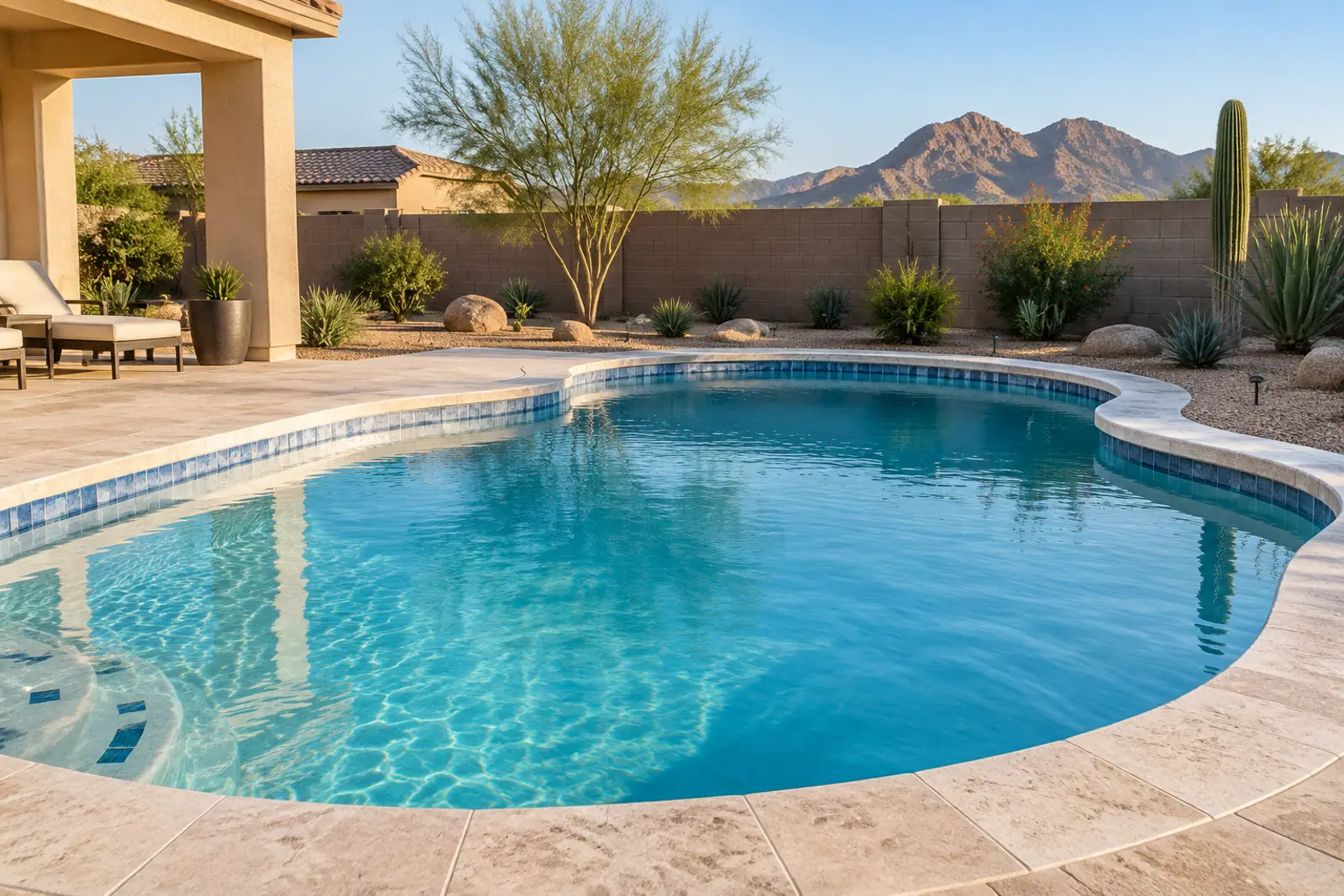
Calcium Hardness Pool Levels: How to Raise It and How to Lower It
Calcium hardness pool targets depend on the surface: 200 to 400 ppm for plaster and 80 to 200 ppm for vinyl or fiberglass (2024 MAHC Annex). Raise it with calcium chloride; lower it only with softer water.
- ✓200 to 400 ppm for plasterThe 2024 MAHC Annex, Florida DOH and the National Plasterers Council agree on this band.
- ✓1.2 lb per 10 ppm77% calcium chloride per 10,000 gallons (Knorr Systems); 0.98 lb of 94% by the chemistry.
- ✓Your tap water is the floorLas Vegas water runs 291 ppm, so dilution there cannot get a pool below it.
Key takeaways
- The 2024 Model Aquatic Health Code Annex sets calcium hardness at 200 to 400 ppm for plaster and other masonry pools and 80 to 200 ppm for vinyl or fiberglass (MAHC Annex 5.7.4.6).
- Fiberglass makers disagree: River Pools asks for less than 120 ppm, while Latham’s 2022 warranty lists 250 to 350 ppm (River Pools care guide; Latham warranty).
- Raising calcium hardness 10 ppm in 10,000 gallons takes about 1.2 lb of 77% calcium chloride or 0.9 lb of 100% (Knorr Systems), which matches the chemistry within 0.03 lb.
- Lowering it means replacing water, and the fill water sets the floor: Las Vegas tap water runs 291 ppm hardness (LVVWD), so dilution there cannot reach 250 ppm.
- Topping off evaporation can add up to 385 ppm of hardness a year to a 16,830 gallon Las Vegas pool, by PC&S arithmetic from our pool evaporation research.
What does calcium hardness do in a pool?
Calcium hardness is the dissolved calcium in the water, reported as ppm of calcium carbonate. It decides whether water deposits calcium or takes it from surfaces. The 2024 MAHC Annex says too much calcium causes cloudiness and scale, and too little, especially with low pH or alkalinity, makes aggressive water that dissolves plaster, grout and metal parts.
Calcium hardness is one of five inputs to the Langelier Saturation Index (LSI), the scale the 2024 MAHC Annex uses to judge whether water will scale or corrode. The Annex states plainly that improperly balanced water is not in itself a public health threat; water balance protects equipment and surfaces. That is why calcium deviations, even up to 300,000 ppm, do not close a public pool, while they still damage the shell.
| Number | What it means | Source |
|---|---|---|
| 200 to 400 ppm | Calcium hardness for plaster, concrete and other masonry pools | 2024 MAHC Annex 5.7.4.6; NPC; Florida DOH |
| 80 to 200 ppm | Calcium hardness for vinyl or fiberglass pools | 2024 MAHC Annex 5.7.4.6 |
| 100 to 200 ppm | Calcium hardness when water runs above 90 F | 2024 MAHC Annex 5.7.4.4.3 |
| 2,500 ppm | Public pool maximum | 2024 MAHC code 5.7.4.4.3 |
| minus 0.3 to plus 0.3 | Balanced Langelier Saturation Index | 2024 MAHC Annex 5.7.4.6 |
| 1.2 lb | 77% calcium chloride per 10 ppm in 10,000 gal | Knorr Systems chart |
| 0.71 ppm | Calcium hardness added per 1 ppm chlorine from cal hypo | PC&S arithmetic, PubChem weights |
| Monthly | How often public pools test calcium hardness | 2024 MAHC code 5.7.5.6 |
Sources: CDC, 2024 MAHC Annex; 2024 MAHC code; NPC; Florida DOH; Knorr Systems; PC&S arithmetic from PubChem. Accessed October 26, 2026. Download CSV
| Condition | LSI signal (MAHC band) | What you see | Can it be undone? | Source |
|---|---|---|---|---|
| Calcium too high (scaling) | Above plus 0.3 | Cloudy water; white or gray rough scale at the tile line, in pipes, filter and heater; shorter filter runs | Often: lower pH and alkalinity, brush or acid-wash scale; heater scale raises heating cost | 2024 MAHC Annex 5.7.4.6; Taylor (2025) |
| Calcium too low (etching) | Below minus 0.3 | Etched or pitted plaster, dissolved grout, rough surfaces, metal staining or colored water | No: Taylor says corrosion damage is repaired only by resurfacing and replacing piping | 2024 MAHC Annex 5.7.4.6; Taylor (2025) |
| Balanced | minus 0.3 to plus 0.3 | No new scale, no new etching | n/a | 2024 MAHC Annex 5.7.4.6 |
Sources: CDC, 2024 MAHC Annex 5.7.4.6; Taylor Technologies, February 27, 2025. Accessed October 26, 2026. Download CSV
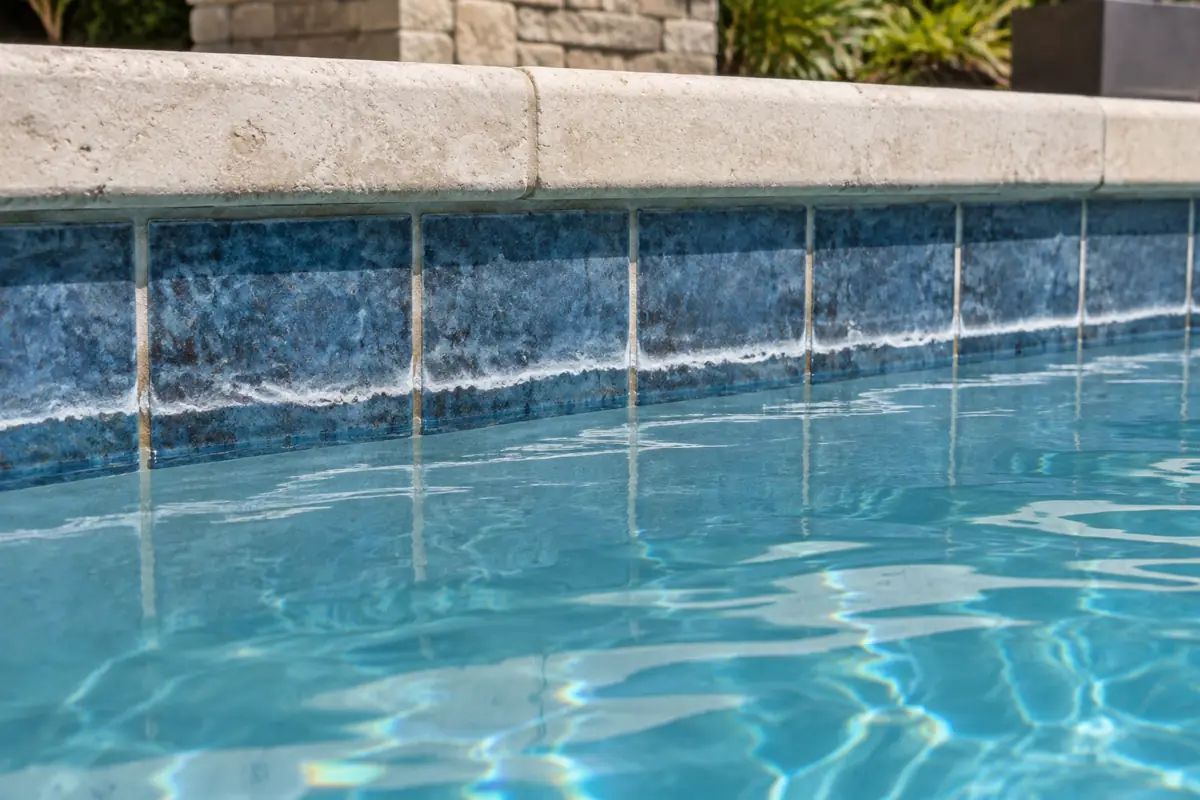
The two failures are not equal. Taylor Technologies, the test kit maker, notes that scale can sometimes be reversed by running the index near minus 1.0 for a short time, at the cost of some plaster, while etching can only be repaired by resurfacing. The MAHC Annex reaches the same conclusion and prefers a small positive LSI, because slight scale is less harmful than corrosion. If etching has already roughened the finish, our pool resurfacing cost guide shows what a new surface costs. Hot tubs add a third effect: five of nine spa makers’ manuals list low calcium as a cause of hot tub foam. When that slight scale lands on the waterline, our how to clean pool tile guide matches the removal method to the scale type and the tile.
What calcium hardness level does your pool surface need?
Plaster and other masonry finishes need 200 to 400 ppm in the 2024 MAHC Annex, the Florida DOH manual and the National Plasterers Council card. Vinyl and fiberglass get 80 to 200 ppm in the MAHC Annex, but makers publish numbers from under 120 ppm to 350 ppm. Water above 90 F, as in spas, gets 100 to 200 ppm because warm water holds less calcium.
| Surface | Calcium hardness (ppm) | Source | Source type and date |
|---|---|---|---|
| Plaster, concrete, masonry | 200 to 400 | 2024 MAHC Annex 5.7.4.6 | CDC model code annex, 2024 |
| Plaster (start-up and after) | 200 to 400 (minimum 200 by day 4) | National Plasterers Council card | Trade association, rev. 03-2021 |
| All pools (public) | 200 to 400 normal | Florida DOH operators manual | State health dept, 2016 |
| All pools (public) | 200 to 300 ideal; 150 to 400 acceptable | Virginia DOH guide | State health dept, 2018 |
| Plaster and concrete | 250 to 350 best | HTH Calcium Up label page | Chemical maker, current |
| Vinyl or fiberglass | 80 to 200 | 2024 MAHC Annex 5.7.4.6 | CDC model code annex, 2024 |
| Vinyl liner | 150 to 250 | Latham vinyl guidance | Liner and pool maker, current |
| Vinyl liner | 200 to 300 | CFFA vinyl liner care sheet | Vinyl trade association, undated |
| Fiberglass (River Pools) | Less than 120 | River Pools care guide | Fiberglass maker, 02.2025 |
| Fiberglass (Leisure Pools) | 80 to 120 | Leisure Pools handbook | Fiberglass maker, 2020 |
| Fiberglass (Latham) | 250 to 350 | Latham fiberglass warranty | Fiberglass maker, 2022 (Canada) |
| Water above 90 F (spas) | 100 to 200 | 2024 MAHC Annex 5.7.4.4.3 | CDC model code annex, 2024 |
| Spas | 150 to 250 | Taylor Technologies | Test kit maker, 2025 |
Sources: 2024 MAHC Annex; National Plasterers Council; Florida DOH; Virginia DOH; HTH; Latham vinyl; CFFA; River Pools; Leisure Pools; Latham fiberglass warranty; Taylor Technologies. Accessed October 26, 2026. Download CSV
Fiberglass shows the widest split, and the warranty is what counts. River Pools’ February 2025 guide warns that high pH plus high calcium damages a fiberglass surface and asks for less than 120 ppm, with a chelating scale product above that line. Latham’s 2022 fiberglass warranty lists 250 to 350 ppm and an LSI of minus 0.3 to plus 0.3. Read the manual for your shell before you add any calcium chloride.
How do you test calcium hardness? Use a drop-count titration kit. Taylor says titration resolves calcium hardness in 10 ppm steps, while test strips read total hardness with color blocks at 0, 100, 250, 500 and 1,000 ppm, too coarse to dose from. Public pools test calcium hardness monthly under 2024 MAHC section 5.7.5.6, a sensible rhythm for a home pool too. Our guide on how to test pool water compares the color steps and price per test of seven kits and strips.
How does calcium hardness fit the Langelier Saturation Index?
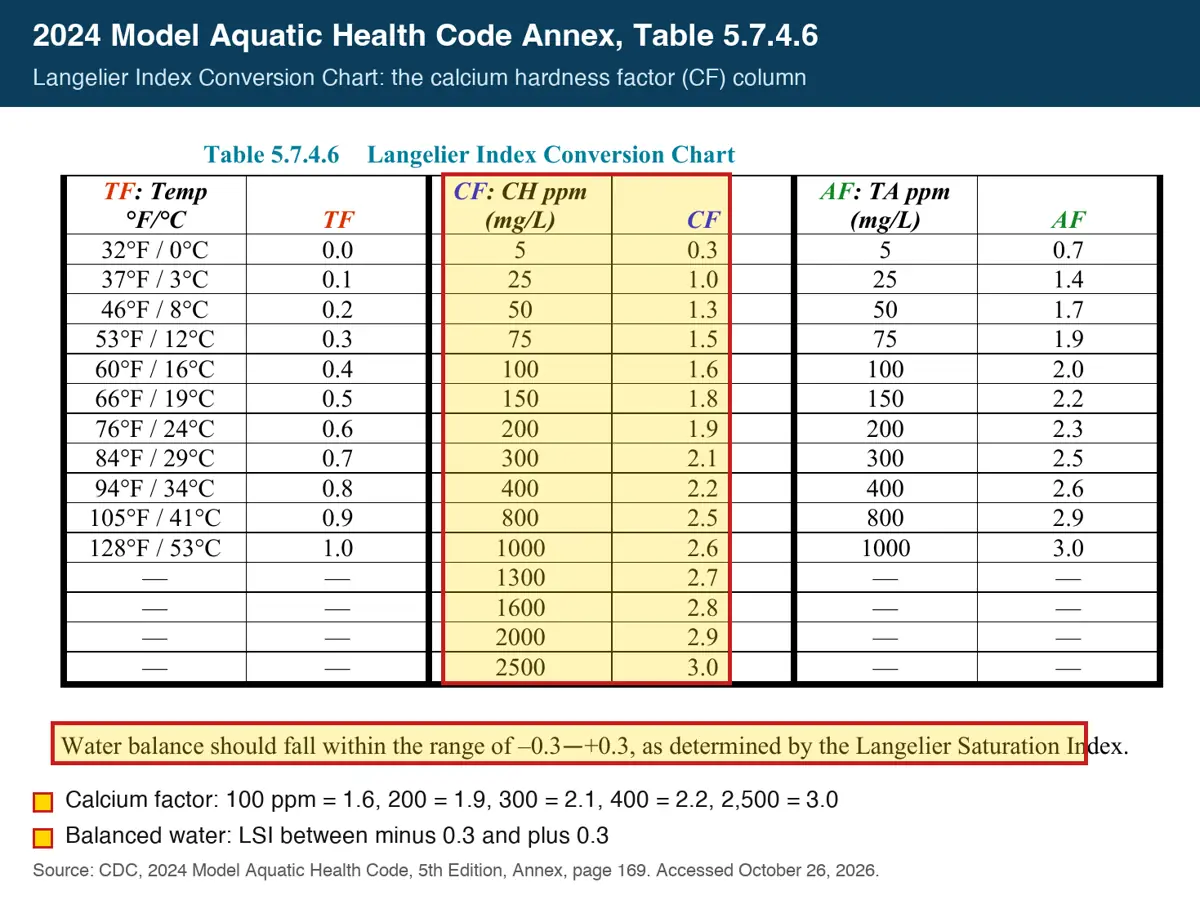
The LSI adds pH and three looked-up factors for temperature, calcium hardness and alkalinity, then subtracts a dissolved solids factor of 12.1 or 12.2. The 2024 MAHC Annex calls minus 0.3 to plus 0.3 balanced. Calcium hardness moves the index slowly: going from 150 to 300 ppm adds only 0.3, the same as raising pH from 7.4 to 7.7.
The formula in the MAHC Annex, section 5.7.4.6 is LSI = pH + TF + CF + AF minus TDSF. Look up each factor in Annex Table 5.7.4.6 using the reading closest to yours. In stabilized outdoor pools, deduct 30% of the cyanuric acid reading from total alkalinity first; the National Plasterers Council and Taylor deduct one third instead, so 100 ppm alkalinity with 60 ppm CYA becomes 82 or 80 ppm.
| Case | pH | Temperature (factor) | Calcium hardness (factor) | Alkalinity (factor) | TDS (factor) | LSI | Reading |
|---|---|---|---|---|---|---|---|
| A: hard fill water, summer | 7.6 | 94 F (0.8) | 400 ppm (2.2) | 100 ppm (2.0) | 1,200 ppm (12.2) | plus 0.4 | Scaling side |
| A fixed: lower pH only | 7.4 | 94 F (0.8) | 400 ppm (2.2) | 100 ppm (2.0) | 1,200 ppm (12.2) | plus 0.2 | Balanced |
| B: soft fill water, spring | 7.4 | 76 F (0.6) | 150 ppm (1.8) | 75 ppm (1.9) | 500 ppm (12.1) | minus 0.4 | Corrosive side |
| B fixed: raise calcium to 300 | 7.4 | 76 F (0.6) | 300 ppm (2.1) | 75 ppm (1.9) | 500 ppm (12.1) | minus 0.1 | Balanced (MAHC) |
| B fixed for plaster: calcium 300, pH 7.6 | 7.6 | 76 F (0.6) | 300 ppm (2.1) | 75 ppm (1.9) | 500 ppm (12.1) | plus 0.1 | Balanced (MAHC and NPC) |
| NPC card example (cross-check) | 7.8 | 90 F (0.8) | 300 ppm (2.1) | 125 ppm (2.1) | 950 ppm (12.1) | plus 0.7 | Scaling side |
PC&S arithmetic with factors from CDC, 2024 MAHC Annex Table 5.7.4.6; NPC example from the NPC start-up card. Download CSV
Case A is a hard-water pool in summer: at 400 ppm calcium and 94 F the index reaches plus 0.4, and dropping pH from 7.6 to 7.4 brings it to plus 0.2 without touching calcium. Case B is a soft-water pool in spring at minus 0.4; raising calcium to 300 ppm gets it to minus 0.1, and pH 7.6 lifts it to plus 0.1, inside the NPC’s 0.0 to plus 0.3 plaster band.
| Source | Balanced band | Scaling side | Corrosive side |
|---|---|---|---|
| 2024 MAHC Annex 5.7.4.6 | minus 0.3 to plus 0.3 | Above plus 0.3 | Below minus 0.3 |
| National Plasterers Council (2021) | 0.0 to plus 0.3 | Positive LSI scales | Negative LSI leaches and etches |
| Florida DOH manual (2016) | minus 0.5 to plus 0.5 | Above plus 0.5 | Below minus 0.5 |
| Taylor Technologies (2025) | 0 is balanced | Plus 0.5 or more | Minus 0.3 or less |
| Latham fiberglass warranty (2022) | minus 0.3 to plus 0.3 | n/a | n/a |
Sources: 2024 MAHC Annex; NPC card; Florida DOH manual; Taylor Technologies; Latham warranty. Download CSV
For the pH and alkalinity side of the index, our guides on how to lower pH in a pool and how to lower alkalinity in a pool give the acid doses by gallons.
How hard is the tap water you fill your pool with?
Fill water sets the starting point and the floor for calcium hardness. In utility reports and FAQs read in October 2026, average hardness ran from 129 ppm in Orlando to 291 ppm in Las Vegas, and Phoenix’s 2025 report ranged 172 to 302 ppm. Utilities report total hardness, calcium plus magnesium, so the calcium a pool kit reads from the same water is lower.
| City | Utility | Total hardness (ppm as CaCO3) | Data period | Source |
|---|---|---|---|---|
| Las Vegas, NV | Las Vegas Valley Water District | 291 (17 grains per gallon) | Current FAQ page | LVVWD water quality FAQ |
| Phoenix, AZ | City of Phoenix Water Services | 172 to 302 (10 to 17.6 grains per gallon) | Calendar 2025 | Phoenix 2025 Water Quality Report |
| Los Angeles, CA | LADWP | 103 to 236 (averages by supply); 78 to 280 range | Calendar 2025 | LADWP Drinking Water Quality Report 2025, Table III |
| Tampa, FL | City of Tampa Water Department | 211 average (12.3 grains per gallon) | Calendar 2025 | Tampa 2025 Water Quality Report |
| Houston, TX | Houston Public Works, Main System | 135.5 average; 43.5 to 229 range | Sampled 2025 | Houston Water Quality Report 2025 |
| Orlando, FL | Orlando Utilities Commission | 129 average (7 grains per gallon) | Current FAQ page | OUC Water Services FAQ |
Sources: LVVWD; City of Phoenix 2025 Water Quality Report; LADWP 2025 report; City of Tampa 2025 report; Houston Public Works 2025 report; OUC. Accessed October 26, 2026. Download CSV
Utilities report total hardness (calcium plus magnesium). Pool kits read calcium only, so the pool-test number for the same water is lower.
Source: Sources: City of Phoenix 2025 report; LVVWD FAQ; LADWP 2025 report Table III (averages by supply); City of Tampa 2025 report; Houston 2025 report (Main System); OUC FAQ. Accessed October 26, 2026.. Download chart data (CSV)
The gap between total and calcium hardness is measurable. LADWP reports both: water from MWD’s Weymouth plant averaged 234 mg/L total hardness in 2025 but 56 mg/L calcium, which is 140 ppm as calcium carbonate (56 x 2.497). That is why the National Plasterers Council has you test the fill water’s calcium hardness with the pool kit before start-up, rather than trusting the utility figure.
Soft-water regions face the opposite problem. The Florida DOH manual says Collier County public water usually lacks enough calcium for pool balance, so operators there add calcium chloride after filling, and Orlando’s 129 ppm average sits below the 200 ppm plaster minimum.
Why does pool water get harder every season?
Evaporation removes water but leaves calcium behind, and every top-off brings in more. Topping off a 16,830 gallon pool can add up to 385 ppm a year in Las Vegas and 340 ppm in Phoenix, against 7 ppm in rainy Houston, by PC&S arithmetic. Calcium hypochlorite adds about 0.71 ppm of calcium hardness for each 1 ppm of chlorine.
| City | Net evaporation after rain (gal/yr, 15 x 30 ft pool) | Fill water hardness (ppm) | Hardness added per year, 16,830 gal pool (ppm, upper bound) |
|---|---|---|---|
| Las Vegas, NV | 22,272 | 291 | 385 |
| Phoenix, AZ | 18,963 | 172 to 302 | 194 to 340 |
| Los Angeles, CA | 9,567 | 103 to 236 | 59 to 134 |
| Tampa, FL | 3,161 | 211 | 40 |
| Orlando, FL | 2,567 | 129 | 20 |
| Houston, TX | 916 | 135.5 | 7 |
PC&S arithmetic: net evaporation after rain from PC&S research: Pool Evaporation Rate by City (NOAA data) x utility hardness / 16,830 gallons (15 x 30 ft, 5 ft average depth, 7.48 gal per cu ft from USGS). Download CSV
Upper bound: counts total hardness, ignores splash-out, backwash and rain overflow, and assumes no scale drops out.
Source: PC&S arithmetic: net evaporation from PC&S research (NOAA pan data and 1991 to 2020 normals) x 2025 utility hardness / 16,830 gallons.. Download chart data (CSV)
Treat the table as a ceiling, not a forecast. It counts total hardness rather than calcium, and it ignores water that leaves by splash-out, backwash or rain overflow, each of which removes calcium along with water. It still shows why desert pools drift upward every season while Gulf Coast pools barely move.
Does shocking a pool raise calcium hardness? Only calcium hypochlorite shock does. By PubChem molecular weights it adds about 0.71 ppm of calcium hardness per 1 ppm of chlorine, so a 10 ppm shock adds about 7.1 ppm. Liquid chlorine and dichlor add none, which is why our guide on how to shock a pool weighs calcium against cyanuric acid when choosing a shock.
Will baking soda increase calcium hardness in the pool? No. Baking soda is sodium bicarbonate, NaHCO3 in PubChem, and it contains no calcium; it raises total alkalinity. It does push the LSI up through the alkalinity factor, and Taylor warns that adding it within hours of calcium chloride clouds the water, so space the two additions.
How to raise calcium hardness in pool water
Add calcium chloride: about 1.2 lb of the 77% product or 0.98 lb of 94% per 10 ppm in 10,000 gallons. Broadcast it with the pump running, add no more than 10 lb per 10,000 gallons at a time, split rises above 50 ppm into thirds 4 to 6 hours apart, and retest after 48 hours (HTH label).
| Step | Value | Basis |
|---|---|---|
| Water in 10,000 gallons | 83,400 lb | 8.34 lb per gallon (USGS 62.366 lb per cu ft / 7.48 gal) |
| 10 ppm as calcium carbonate | 0.834 lb | 83,400 x 10 / 1,000,000 |
| Convert to calcium chloride | x 1.109 | 110.98 / 100.09 (PubChem molecular weights) |
| 100% calcium chloride | 0.925 lb (14.8 oz) | 0.834 x 1.109 |
| 94% calcium chloride | 0.984 lb (15.7 oz) | 0.925 / 0.94 |
| 77% calcium chloride | 1.20 lb (19.2 oz) | 0.925 / 0.77 |
PC&S arithmetic from PubChem molecular weights and USGS water density. Download CSV
| Source | Product strength | Pounds per 10 ppm in 10,000 gal | Note |
|---|---|---|---|
| Knorr Systems chart | 77% | 1.2 | Matches the 1.20 lb chemistry figure |
| Knorr Systems chart | 100% | 0.9 | Chemistry figure 0.925 |
| HTH Calcium Up label | Not stated | 1.0 | 2 lb per 20 ppm; label caps 10 lb per 10,000 gal at once |
| Virginia DOH chart (2018) | Not stated | 1.0 | 10 lb per 100 ppm |
| Florida DOH manual (2016) | Not stated | 1.25 | 10 lb raises 80 ppm |
| PC&S arithmetic | 94% | 0.98 | From PubChem weights and USGS water weight |
Sources: Knorr Systems; HTH Calcium Up label; Virginia DOH; Florida DOH. Accessed October 26, 2026. Download CSV
Check the strength on the bag first. Taylor describes hydrated calcium chloride at 77% and anhydrous at 100%, and OxyChem, a calcium chloride maker, sells anhydrous pellets at 94 to 97% and flakes at 83 to 87%. A product without a printed strength, like the HTH label, should be dosed from its own chart: 2 lb per 20 ppm in 10,000 gallons.
| Pool gallons | 77%: +50 ppm (lb) | 77%: +100 ppm (lb) | 77%: +150 ppm (lb) | 94%: +50 ppm (lb) | 94%: +100 ppm (lb) | 94%: +150 ppm (lb) |
|---|---|---|---|---|---|---|
| 10,000 | 6.0 | 12.0 | 18.0 | 4.9 | 9.8 | 14.8 |
| 15,000 | 9.0 | 18.0 | 27.0 | 7.4 | 14.8 | 22.1 |
| 20,000 | 12.0 | 24.0 | 36.0 | 9.8 | 19.7 | 29.5 |
| 25,000 | 15.0 | 30.0 | 45.0 | 12.3 | 24.6 | 36.9 |
| 30,000 | 18.0 | 36.0 | 54.0 | 14.8 | 29.5 | 44.3 |
PC&S arithmetic: 1.20 lb (77%) or 0.984 lb (94%) per 10 ppm in 10,000 gallons, scaled by gallons and ppm. Round down and retest before the last third. Download CSV
- Test calcium, pH and alkalinityUse a titration kit. Fix alkalinity and pH first; Virginia DOH adjusts calcium last of the three.
- Work out gallons and the doseGallons from the pool volume calculator; pounds from the table above for your product strength.
- Split big jobsNo more than 10 lb per 10,000 gallons at once; above 50 ppm, add one third per round, 4 to 6 hours apart (HTH label).
- Broadcast with the pump runningSpread it over the deep end and brush; Taylor says not to pre-dissolve because it heats on contact with water.
- Keep it away from baking sodaNever add calcium chloride and sodium bicarbonate at the same time (NPC); separate them by several hours.
- Retest after 48 hoursHTH allows 48 hours of circulation, then recalculate the LSI.
Taylor and the National Plasterers Council differ on one point: Taylor says broadcast calcium chloride dry, while the NPC start-up card says dissolve it and add 10 lb at a time. The heat is the reason for caution either way; OxyChem reports that mixing a 30% solution raises its temperature almost 84 F. If you pre-dissolve, add the product slowly to a large bucket of cool pool water, never water onto the product. Size the pool first with our pool volume calculator.
How to lower calcium hardness in pool water
Replace part of the water with softer water. Because tap water carries its own hardness, the share to drain is (current minus target) divided by (current minus fill). Going from 800 to 400 ppm in 20,000 gallons takes 59.6% with Orlando water but 78.6% with Las Vegas water. When the fill is harder than the target, lower pH and alkalinity instead.
| Calcium hardness now to target (ppm) | Fill water Orlando OUC, 129 ppm | Fill water Tampa, 211 ppm | Fill water Las Vegas, 291 ppm |
|---|---|---|---|
| 600 to 400 | 42% | 51% | 65% |
| 800 to 400 | 60% | 68% | 79% |
| 1000 to 400 | 69% | 76% | 85% |
| 600 to 300 | 64% | 77% | 97% |
| 800 to 300 | 75% | 85% | 98% |
PC&S arithmetic: share = (current minus target) / (current minus fill). Uses utility total hardness as the fill value; test your hose water with your pool kit and use that number instead. Download CSV
| Step | Orlando (fill 129 ppm) | Las Vegas (fill 291 ppm) |
|---|---|---|
| Pool size and goal | 20,000 gal, 800 to 400 ppm | 20,000 gal, 800 to 400 ppm |
| Share = (800 minus 400) / (800 minus fill) | 59.6% | 78.6% |
| Gallons to replace | 11,923 | 15,717 |
| Water and sewer per 1,000 gal (PC&S research) | $7.19 | $6.25 |
| Water cost | $85.72 | $98.23 |
| Same job if fill water had 0 ppm (share 50%) | 10,000 gal | 10,000 gal |
PC&S arithmetic; water and sewer cost per 1,000 gallons from PC&S research: Cost to Fill a Pool (rates in effect October 2026). Download CSV
Hard fill water also changes the job size. With zero-hardness water the same cut would be a 50% drain; Orlando water stretches it to 59.6% and Las Vegas water to 78.6%, or 15,717 gallons. Large drains carry their own risks to shells and liners, so read our guide on how to drain a pool before you remove more than about a third of the water, and split big jobs into two rounds.
Can you lower calcium hardness without draining? Not in a way a health department documents. Virginia and Florida DOH both call partial draining the only way, and the MAHC Annex says that where calcium cannot come down, operators should lower pH or alkalinity to keep the LSI in range. Taylor gives the same advice for drought areas, and River Pools tells fiberglass owners above 120 ppm to use a chelating scale control product, which holds calcium in solution rather than removing it.
In practice that means running pH at the low end of the Annex’s 7.2 to 7.6 range, about 7.2 to 7.4, and alkalinity toward the low end of 60 to 180 ppm in the MAHC Annex, then recalculating the LSI each month. For Case A above, pH 7.4 alone took the index from plus 0.4 to plus 0.2 at 400 ppm calcium.
What should you do at your reading?
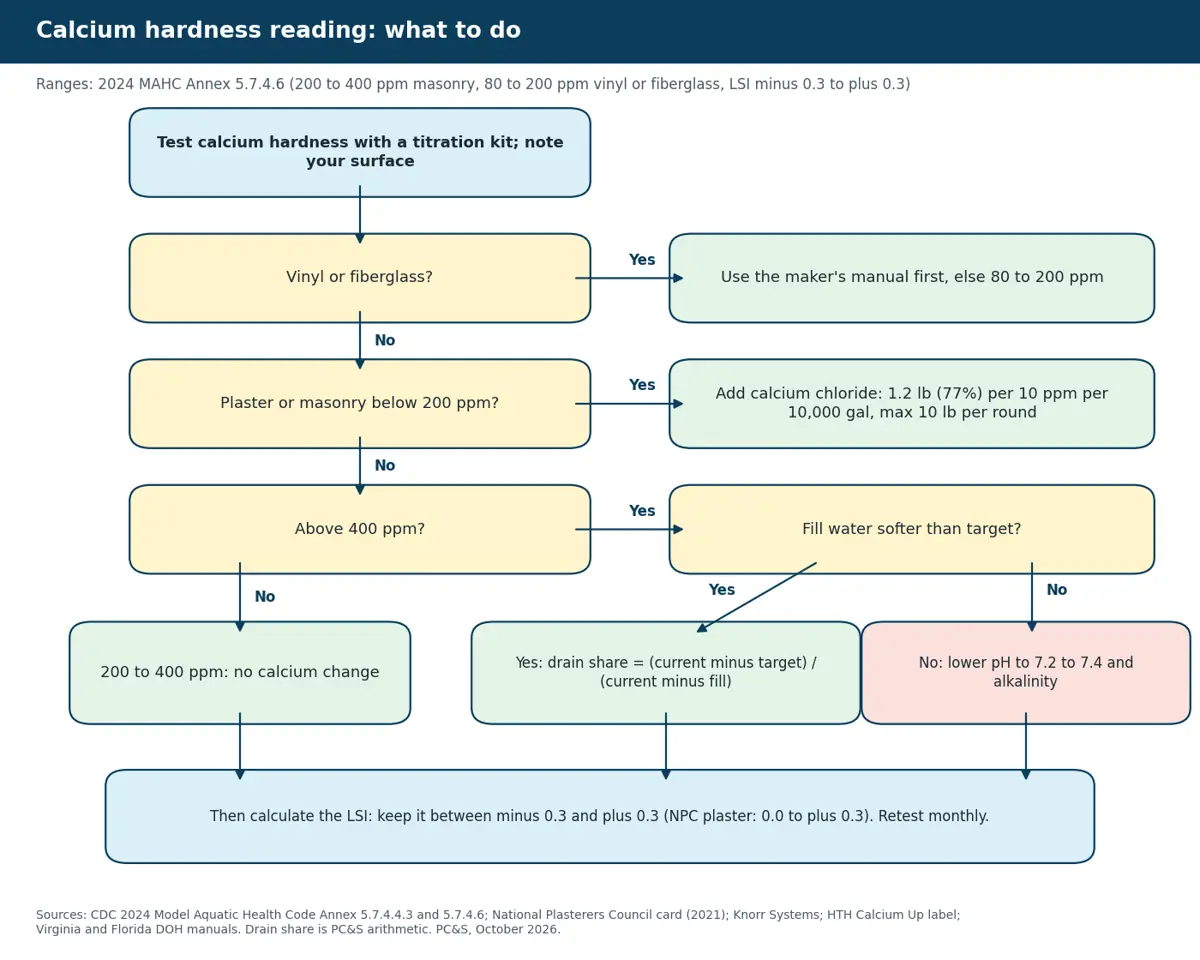
Match your surface and reading to a row. Plaster under 200 ppm needs calcium chloride, and anything over 400 ppm needs dilution only if the fill water is softer than the target. Vinyl and fiberglass follow the maker’s manual first, then the MAHC’s 80 to 200 ppm. Every decision ends with an LSI check between minus 0.3 and plus 0.3.
| If your situation is | Do this | Rule behind it |
|---|---|---|
| Plaster or masonry pool below 200 ppm | Raise with calcium chloride toward 200 to 400 ppm; no more than 10 lb per 10,000 gal per addition | 2024 MAHC Annex 5.7.4.6; HTH label |
| Freshly plastered pool | Day 2: 100 to 150 ppm; day 4: at least 200 ppm; 10 lb increments hours apart; keep LSI 0.0 to plus 0.3 | National Plasterers Council card |
| Vinyl or fiberglass pool | Hold 80 to 200 ppm unless the maker's manual or warranty says otherwise (River Pools under 120; Latham fiberglass 250 to 350) | 2024 MAHC Annex; maker manuals |
| 200 to 400 ppm and LSI minus 0.3 to plus 0.3 | No calcium change; retest monthly | 2024 MAHC 5.7.5.6 and Annex 5.7.4.6 |
| Above 400 ppm and fill water is softer than your target | Replace water: share = (current minus target) / (current minus fill) | Virginia DOH; Florida DOH; PC&S arithmetic |
| Above 400 ppm and fill water is at or above your target | Dilution cannot reach the target; hold pH 7.2 to 7.4 and alkalinity at the low end so the LSI stays at or under plus 0.3 | 2024 MAHC Annex 5.7.4.6; Taylor |
| White scale at the tile line, heater or salt cell | Calculate the LSI; lower pH first if it is above plus 0.3 | 2024 MAHC Annex 5.7.4.6 |
| Rough or etched plaster | Calculate the LSI; raise calcium, pH or alkalinity if it is below minus 0.3 | 2024 MAHC Annex; Taylor |
| Spa or water above 90 F | Target 100 to 200 ppm | 2024 MAHC Annex 5.7.4.4.3 |
Sources: 2024 MAHC Annex; 2024 MAHC code; NPC card; HTH label; Virginia DOH; Florida DOH; Taylor; River Pools; Latham; PC&S arithmetic. Download CSV
Hazy water with a high LSI is a calcium problem only after chlorine and filtration check out; our cloudy pool water guide runs that diagnosis in order.
How we compiled this
We compiled this page in October 2026 from 25 documents: the 2024 MAHC code and Annex, the Florida and Virginia health department manuals, the National Plasterers Council card, six water utility reports or FAQ pages, maker manuals and labels from River Pools, Latham, Leisure Pools, HTH and OxyChem, the CFFA liner sheet, the Knorr chart, two Taylor Technologies pages, NPIC, PubChem and USGS. Evaporation and water cost figures come from two of our own research reports built from NOAA data and utility rate cards. Doses, drain shares and LSI cases are our arithmetic and labeled as such; we did not test water or products, and forum threads were used for question wording only.
Frequently Asked Questions
How do you fix calcium hardness in a pool?
Raise it with calcium chloride, about 1.2 lb of the 77% product per 10 ppm in 10,000 gallons (Knorr Systems), added in rounds of no more than 10 lb per 10,000 gallons. Lower it by replacing water: share = (current minus target) / (current minus fill). Then check that the LSI sits between minus 0.3 and plus 0.3.
What is a good calcium hardness level in a pool?
For plaster and other masonry finishes, 200 to 400 ppm, per the 2024 MAHC Annex, the Florida DOH manual and the National Plasterers Council. For vinyl or fiberglass, the MAHC Annex lists 80 to 200 ppm, though makers range from under 120 ppm (River Pools) to 250 to 350 ppm (Latham’s 2022 warranty).
Does shocking a pool raise calcium hardness?
Calcium hypochlorite shock does: about 0.71 ppm of calcium hardness for each 1 ppm of chlorine, so a 10 ppm shock adds about 7.1 ppm, by PubChem molecular weights. Liquid chlorine (sodium hypochlorite) and dichlor add no calcium. River Pools tells fiberglass owners to avoid calcium hypochlorite for that reason.
Will baking soda increase calcium hardness in the pool?
No. Baking soda is sodium bicarbonate (NaHCO3), which contains no calcium; Florida DOH uses it to raise total alkalinity. It does raise the saturation index through the alkalinity factor, and Taylor Technologies warns that adding it within hours of calcium chloride makes the water cloudy, so separate the two.
What happens if calcium hardness is low in a pool?
Low calcium, especially with low pH or alkalinity, makes aggressive water that dissolves plaster, grout and metal (2024 MAHC Annex). Below an LSI of minus 0.3 the Annex links it to etching, pitting and staining. Taylor Technologies says that damage cannot be reversed, only repaired by resurfacing. Metal stains from aggressive water are different, and our pool stains guide shows how a vitamin C test separates them from etching.
What causes calcium hardness to rise in a pool?
Mostly evaporation and top-off water. Evaporation leaves calcium behind, and each refill adds the tap water’s hardness: up to about 385 ppm a year for a 16,830 gallon Las Vegas pool, by PC&S arithmetic. Calcium hypochlorite adds about 0.71 ppm per 1 ppm of chlorine as well.
How do you lower calcium hardness in a pool without draining?
You cannot remove it without water replacement by any method a health department documents; Virginia and Florida DOH call partial draining the only way. Where draining is not possible, the 2024 MAHC Annex says to lower pH or total alkalinity so the LSI stays at or below plus 0.3.
Sources
- Centers for Disease Control and Prevention (CDC). 2024 Model Aquatic Health Code, 5th Edition, Annex (sections 5.7.4.4.3 and 5.7.4.6). Accessed 2026-10-26.
- CDC. 2024 Model Aquatic Health Code, 5th Edition, Code Language. Accessed 2026-10-26.
- National Plasterers Council. NPC Pool Start-Up Procedures card (rev. 03-2021). Accessed 2026-10-26.
- Florida Department of Health in Collier County. Swimming Pool Operators' Manual, 2016 Version. Accessed 2026-10-26.
- Virginia Department of Health. Pool Operation and Maintenance Guide (Portsmouth Health Department, 2018). Accessed 2026-10-26.
- Taylor Technologies. Understanding and Managing Calcium Hardness in Pool & Spa Water (February 27, 2025). Accessed 2026-10-26.
- Taylor Technologies. Taylor Water Testing Technical FAQs. Accessed 2026-10-26.
- Knorr Systems (supplier chart). Chemical Dosing Charts. Accessed 2026-10-26.
- HTH (manufacturer). HTH Pool Care Calcium Up (label directions and dose chart). Accessed 2026-10-26.
- OxyChem (manufacturer). Pool and Spa Maintenance: calcium chloride products. Accessed 2026-10-26.
- River Pools. Fiberglass Pool Care Guide (RP 02.2025). Accessed 2026-10-26.
- Latham Pool Products. Latham Fiberglass Pools Limited Lifetime Warranty (2022, Canada English). Accessed 2026-10-26.
- Leisure Pools. Swimming Pool Handbook 2020. Accessed 2026-10-26.
- Latham Pool Products. How to Balance the Water Chemistry in your Vinyl Liner Pool. Accessed 2026-10-26.
- Chemical Fabrics and Film Association. Proper Care of Your Vinyl Pool Liner. Accessed 2026-10-26.
- City of Phoenix Water Services. 2025 Water Quality Report. Accessed 2026-10-26.
- Las Vegas Valley Water District. Water quality FAQs (hard water). Accessed 2026-10-26.
- Los Angeles Department of Water and Power. Drinking Water Quality Report 2025 (calendar year 2025 results). Accessed 2026-10-26.
- Houston Public Works. Houston Water Quality Report 2025. Accessed 2026-10-26.
- City of Tampa Water Department. 2025 Water Quality Report. Accessed 2026-10-26.
- Orlando Utilities Commission. Water Services FAQ. Accessed 2026-10-26.
- NIH National Library of Medicine. PubChem compound records: calcium chloride, calcium carbonate, calcium, sodium bicarbonate, calcium hypochlorite, chlorine. Accessed 2026-10-26.
- U.S. Geological Survey. Water Density. Accessed 2026-10-26.
- U.S. Geological Survey. Water Science Glossary. Accessed 2026-10-26.
- National Pesticide Information Center (Oregon State University). Pool and Spa Chemicals Fact Sheet. Accessed 2026-10-26.
- Pool Construction & Service. Pool Evaporation Rate by City (PC&S research). Accessed 2026-10-26.
- Pool Construction & Service. Cost to Fill a Pool (PC&S research, rates in effect October 2026). Accessed 2026-10-26.
Related pages
Get Quotes From Licensed Local Pool Pros
Tell us what you need and your ZIP code. We match you with pool companies that cover your area.