Pool Volume Calculator: How Many Gallons Is Your Pool?
This pool volume calculator multiplies surface area by average depth and by 7.48 gallons per cubic foot (USGS). A 16 x 32 ft pool running from 3.5 ft to 6 ft deep holds about 18,191 gallons.
- ✓Pool volume calculator for 4 shapesRectangle, round, oval and kidney, in gallons, liters and cubic feet.
- ✓Every factor sourced7.48 from USGS, shape factors from a county health department operator guide, liters from NIST.
- ✓Standard sizes includedPublished gallon tables for 11 in-ground and 12 above-ground pool sizes.
Pool volume calculator: pick a shape, enter feet, get gallons
Enter the length, width and the depth at both ends. For a round pool the width box becomes the diameter; for a kidney pool add the width of the second lobe.
Formula source: USGS Water Science Glossary (7.48 gallons per cubic foot); County of San Diego Department of Environmental Health, Swimming Pool Operator's Guide, Appendix K (round, oval and kidney area formulas). Estimates only.
The calculator averages your shallow and deep readings, multiplies the surface area by that average depth and converts cubic feet to US gallons at 7.48 gallons per cubic foot, the figure the U.S. Geological Survey uses. Liters come from the NIST factor of 3.785412 liters per gallon. Round and oval areas use 0.785 (3.14 divided by 4) and kidney areas use 0.45 x (A + B) x length, the formulas in the San Diego County pool operator guide published by its Department of Environmental Health.
Treat the answer as a close estimate. Steps, benches, sun shelves and a sloped transition between the ends all change the true figure, and a water meter reading taken while the pool fills gives a measured figure instead of an estimate. Pool operator guides, including San Diego County’s, work from the same formula-based estimate.
Pool volume formulas by shape, and where each factor comes from
| Shape | Measure | Surface area | Gallons | Source of the factor |
|---|---|---|---|---|
| Rectangle or square | Length, width, shallow and deep depth | Length x width | Area x average depth x 7.48 | USGS (7.48 gallons per cubic foot) |
| Round | Diameter, water depth | 0.785 x diameter x diameter (3.14 x radius x radius) | Area x average depth x 7.48 | San Diego County DEH circle formula; Akron uses diameter x diameter x depth x 5.9 |
| Oval | Length, width, depth | 0.785 x length x width (a x b x 3.14 with half-axes) | Area x average depth x 7.48 | San Diego County DEH oval formula; Akron uses 5.9 |
| Kidney | Length, width across each lobe (A and B), depth | 0.45 x (A + B) x length | Area x average depth x 7.48 | San Diego County DEH; same 0.45 factor in Leslie's guide |
| Free-form or L-shape | Split into rectangles and circles | Sum of the parts | Area x average depth x 7.48 | San Diego County DEH (combination shapes) |
Sources: USGS; County of San Diego DEH operator guide, Appendix K; City of Akron; Leslie’s. Download CSV
Every formula has the same two steps: work out the surface area, then multiply by average depth and by 7.48. The shape only changes the area step. A circle covers 3.14 x radius x radius, which is the same as 0.785 x diameter x diameter. An oval covers 3.14 x half the length x half the width, which is 0.785 x length x width. A kidney pool covers about 0.45 x (A + B) x length, where A and B are the widths across the two lobes.
You will see two shortcut numbers on other pool size calculator pages. Many use 7.5 in place of 7.48, including the San Diego County guide and the City of Akron sheet; the difference is 0.27%. Akron also uses 5.9 for round and oval pools, which is the 0.785 area factor already multiplied by a rounded gallons figure (0.785 x 7.48 is about 5.87).
How to measure your pool for a pool size calculator
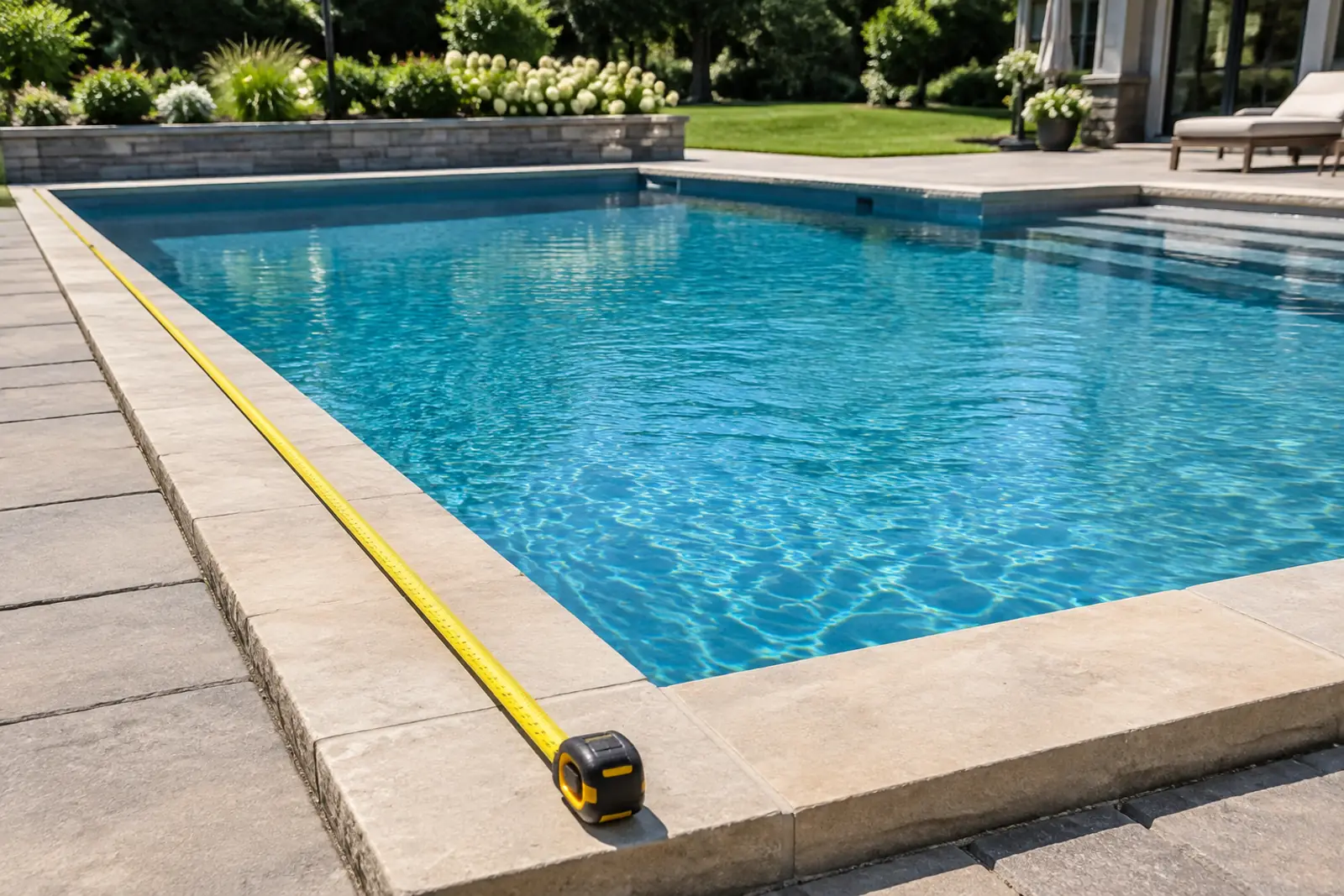
- Measure the water surface, not the deckRun a tape along the inside edge of the coping for length and width. Coping and deck width do not hold water.
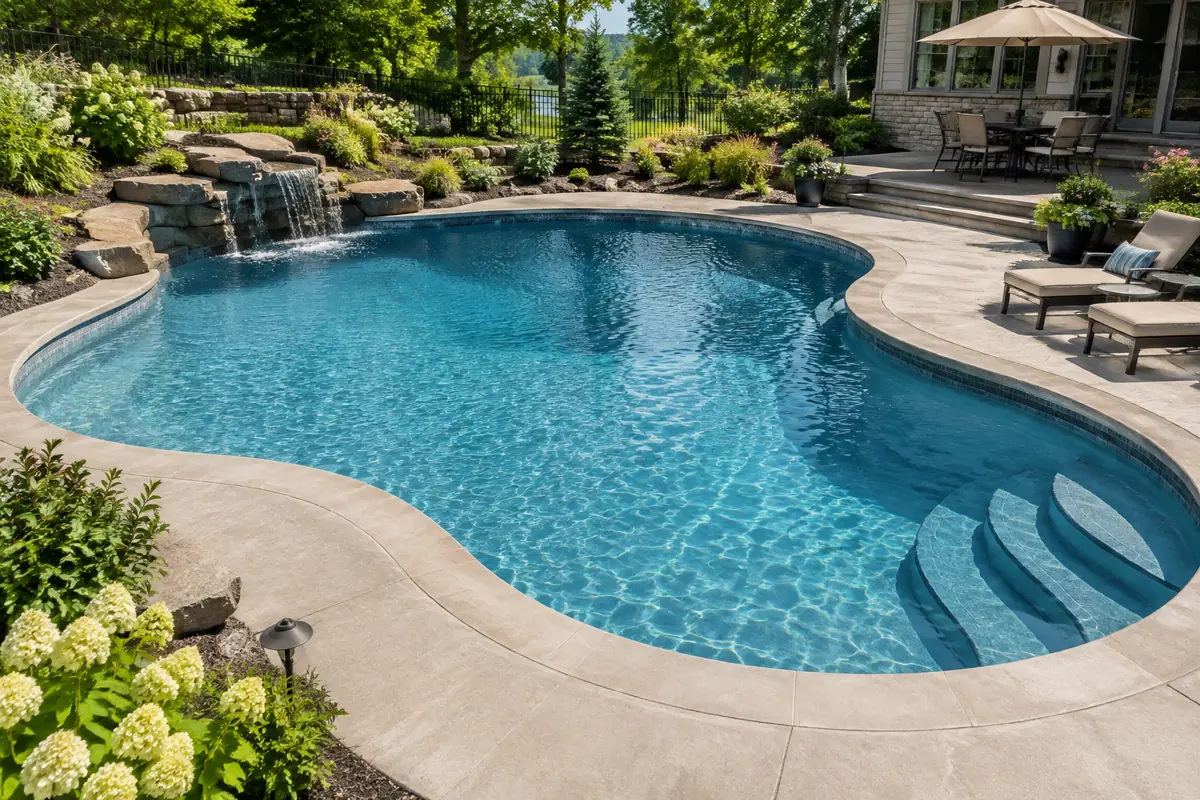
- Find the widest points on curved poolsFor a round pool, measure straight across through the center for the diameter. For a kidney, measure the full length plus the width across each lobe (A and B).
- Read the depth at both endsPush a pole to the floor at the shallow end and at the deepest point and mark the water line. Many pools also have depth markers on the tile.
- Convert inches to feetDivide inches by 12. A 54-inch water depth in an above-ground pool is 4.5 ft.
- Split odd shapesMeasure an L-shape as two rectangles, and a pool with a round spa as a rectangle plus a circle, then add the volumes.
- Check against a known numberIf your builder’s plans, the original permit or a fill-day water meter reading lists gallons, compare it with the calculator and use the documented figure.
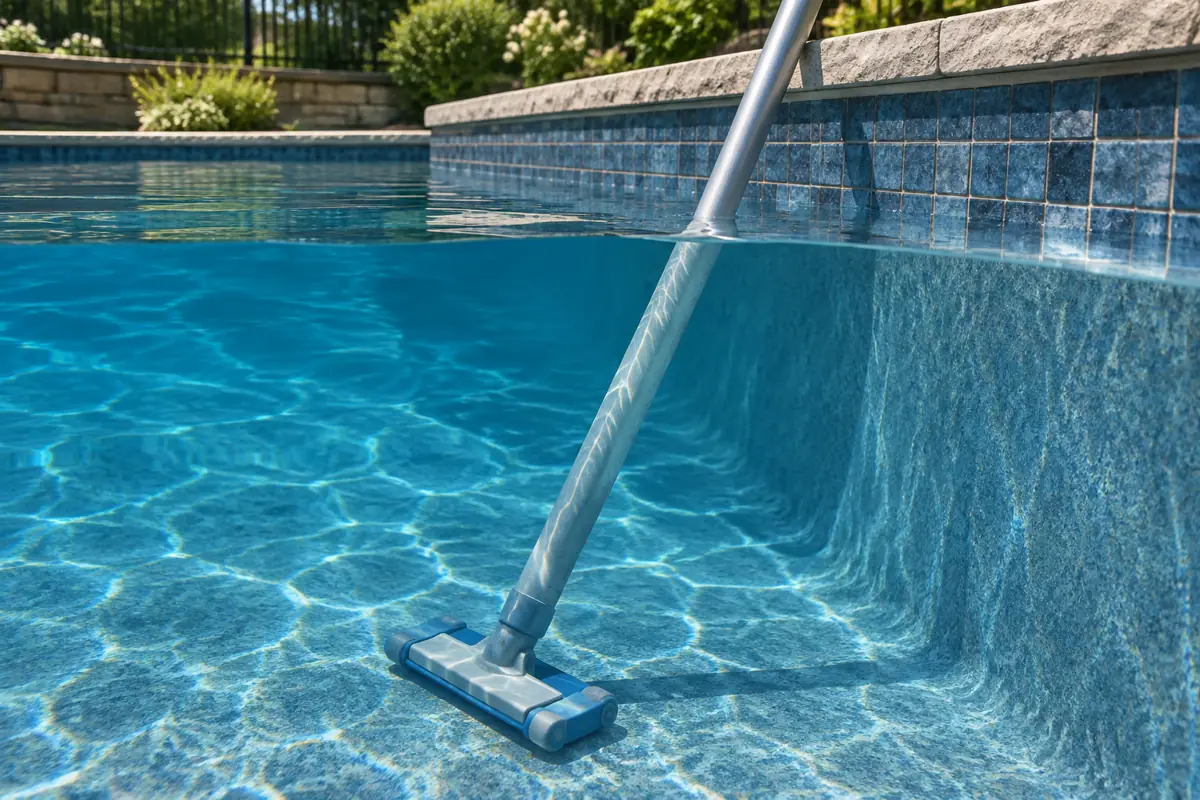
Water level matters as much as the shell. A pool filled to the middle of the skimmer opening holds less than its nominal size suggests, and an above-ground pool with a 52-inch wall rarely holds 52 inches of water. The City of Akron table, for example, lists 2,975 gallons for a 12 ft round pool with a 48-inch wall, which matches the formula at about 3.5 ft of water (12 x 12 x 3.5 x 5.9 is 2,974).
Worked examples: how many gallons in a pool of each shape
| Shape | Measurements | Surface area (sq ft) | Average depth (ft) | Cubic feet | US gallons | Liters |
|---|---|---|---|---|---|---|
| Rectangle | 16 x 32 ft, 3.5 to 6 ft deep | 512 | 4.75 | 2,432 | 18,191 | 68,862 |
| Round (above-ground) | 24 ft diameter, 4 ft of water | 452.16 | 4 | 1,808.64 | 13,529 | 51,211 |
| Oval | 15 x 30 ft, 4 ft of water | 353.25 | 4 | 1,413 | 10,569 | 40,009 |
| Kidney | 30 ft long, lobes 10 ft and 14 ft wide, 3.5 to 6 ft deep | 324 | 4.75 | 1,539 | 11,512 | 43,577 |
Source: PC&S calculations using the San Diego County DEH area formulas, 7.48 gallons per cubic foot (USGS) and 3.785412 liters per gallon (NIST). Download CSV
Rectangle. A 16 x 32 ft pool that runs from 3.5 ft to 6 ft deep has a 4.75 ft average depth. 512 sq ft x 4.75 ft is 2,432 cubic feet, and 2,432 x 7.48 is about 18,191 gallons, or 68,862 liters. Akron’s table puts the same footprint at 17,300 gallons at 4.5 ft and 19,200 at 5 ft, so the answer sits where it should.
Round. A 24 ft round above-ground pool holding 4 ft of water covers 452.16 sq ft (0.785 x 24 x 24). That is 1,808.64 cubic feet, or about 13,529 gallons. Akron lists 13,594 gallons for the same pool with a 52-inch wall, the small gap coming from its 5.9 shortcut.
Oval. A 15 x 30 ft oval with 4 ft of water covers 353.25 sq ft and holds about 10,569 gallons. Akron’s 52-inch wall table lists 10,620 gallons for a 15 x 30 oval.
Kidney. A kidney pool 30 ft long with lobes 10 ft and 14 ft wide, 3.5 ft to 6 ft deep, covers 324 sq ft (0.45 x 24 x 30) and holds about 11,512 gallons. Measured as a plain 30 x 14 ft rectangle, the same pool would come out at 14,923 gallons, 30% too high, which is why the shape setting matters. Leslie’s free-form shortcut gives 11,770 gallons, 2% above the kidney formula.
For a bigger check, the San Diego County guide works a 30 x 50 ft pool that runs from 3 ft to 6 ft: 1,500 sq ft x 4.5 ft x 7.5 is 50,625 gallons. With 7.48 the same pool comes to 50,490 gallons.
How many gallons in a pool: standard sizes at a glance
If your pool matches a stock size, these published tables give the answer without a tape measure.
Source: City of Akron, Ohio, How to calculate the gallons in a swimming pool. Download chart data (CSV)
| Pool size (ft) | 3.5 ft average depth (gallons) | 4 ft average depth (gallons) | 4.5 ft average depth (gallons) | 5 ft average depth (gallons) | 5.5 ft average depth (gallons) |
|---|---|---|---|---|---|
| 12 x 24 | 7,600 | 8,600 | 9,700 | 10,800 | 11,900 |
| 14 x 28 | 10,300 | 11,800 | 13,200 | 14,700 | 16,200 |
| 15 x 30 | 11,800 | 13,500 | 15,200 | 16,900 | 18,600 |
| 16 x 32 | 13,400 | 15,400 | 17,300 | 19,200 | 21,100 |
| 18 x 36 | 17,000 | 19,400 | 21,900 | 24,300 | 26,700 |
| 19 x 38 | 19,000 | 21,700 | 24,400 | 27,100 | 29,800 |
| 20 x 40 | 21,000 | 24,000 | 27,000 | 30,000 | 33,000 |
| 22 x 44 | 25,400 | 29,000 | 32,700 | 36,300 | 39,900 |
| 25 x 45 | 29,531 | 33,750 | 37,968 | 42,187 | 46,406 |
| 25 x 50 | 32,800 | 37,500 | 42,200 | 46,900 | 51,600 |
| 30 x 50 | 39,375 | 45,000 | 50,525 | 56,250 | 61,875 |
Source: City of Akron, Ohio, How to calculate the gallons in a swimming pool (multiplier 7.5). Download CSV
Read across to your average depth. A 16 x 32 ft pool holds 13,400 gallons at a 3.5 ft average and 21,100 gallons at 5.5 ft. A 20 x 40 ft pool holds 24,000 gallons at a 4 ft average and 30,000 at 5 ft. For the footprints these sizes come in, see our guide to standard pool sizes and the shapes in pool shapes.
| Above-ground pool | 48-inch wall (gallons) | 52-inch wall (gallons) |
|---|---|---|
| 12 ft round | 2,975 | 3,398 |
| 15 ft round | 4,646 | 5,310 |
| 18 ft round | 7,646 | 8,602 |
| 21 ft round | 9,106 | 10,408 |
| 24 ft round | 11,895 | 13,594 |
| 27 ft round | 15,054 | 17,205 |
| 30 ft round | 18,585 | 21,240 |
| 33 ft round | 22,488 | 25,700 |
| 12 x 24 ft oval | 5,948 | 6,797 |
| 15 x 30 ft oval | 9,293 | 10,620 |
| 16 x 32 ft oval | 10,573 | 12,084 |
| 18 x 33 ft oval | 12,267 | 14,019 |
Source: City of Akron, Ohio. Download CSV
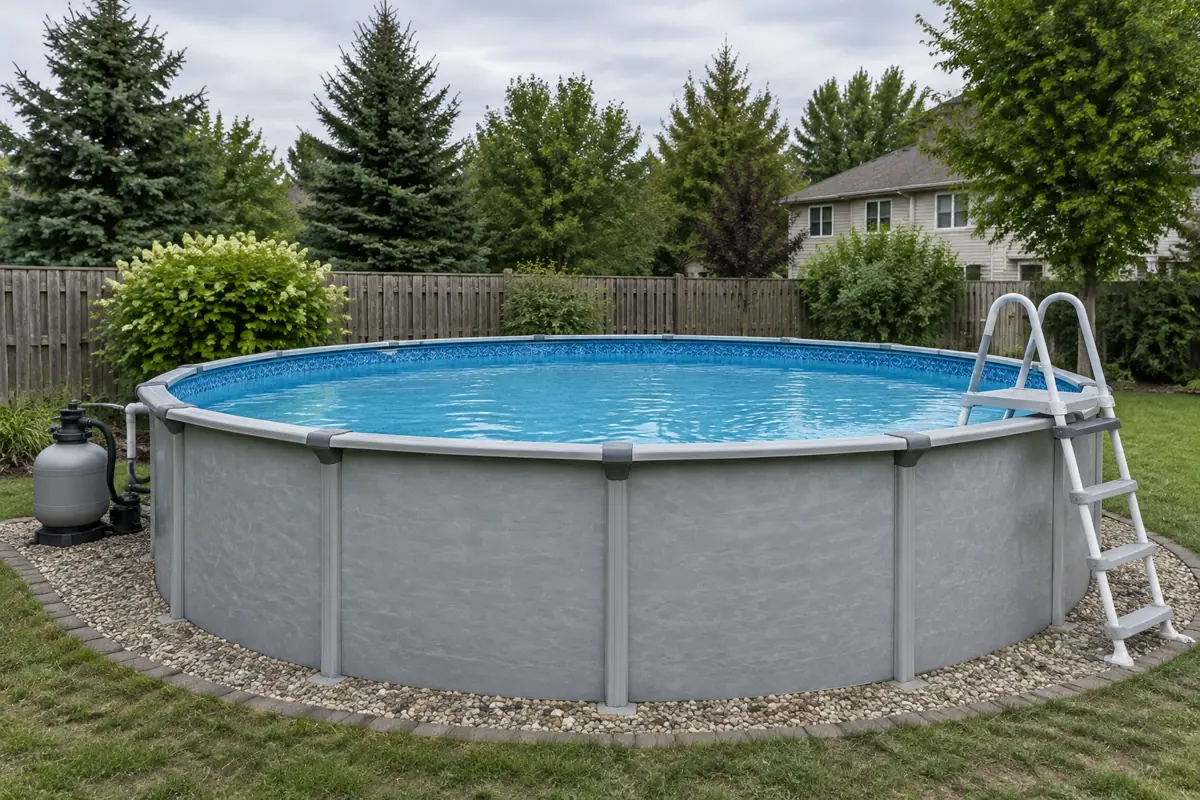
Above-ground pools are sold by diameter and wall height, so the table lists both. An 18 ft round pool holds 7,646 gallons with a 48-inch wall and 8,602 gallons with a 52-inch wall, and a 24 ft round holds 11,895 and 13,594. Akron’s 48-inch figures for most sizes imply water about 3.5 ft deep, so measure your own water level if you dose by these numbers. For prices by size, see above ground pool cost.
Why your pool's volume matters: chemicals, pump, heat and water bills
Chemical dosing. Chemical doses are worked out from the volume of water: the San Diego County guide gives its volume formulas to help with “determining amount of chemicals to add to adjust pool water chemistry”. A dose based on a volume that is 30% too high puts in about 30% too much product. Before adjusting balance, read our guides on how to raise pH in a pool, how to lower pH and cloudy pool water.
Pump run time. Turnover is the time it takes the full volume to pass through the filter: volume divided by flow rate divided by 60 (San Diego County DEH). ENERGY STAR’s pool pump fact sheet calibrates the lowest pump speed to a 12-hour turnover. For the 18,191-gallon example that works out to about 25.3 gallons per minute.
Heating. One Btu warms one pound of water by 1 F (EIA), and a cubic foot of water weighs 62.3 lb at 70 F (USGS). The 16 x 32 ft example holds about 151,514 lb of water, so a 10 F rise needs about 1.52 MMBtu before any heat escapes. At 2025 US average delivered-heat prices of $18.06 per MMBtu for gas and $10.14 for a heat pump, that is about $27.36 and $15.36. Real seasons cost far more because evaporation, the largest source of pool energy loss according to DOE, keeps pulling heat out; see what it costs to heat a pool and the solar pool heater guide.
Filling and refilling. Water and sewer charges turn gallons into dollars. At October 2026 rates, filling 20,000 gallons costs $649.98 in Houston, where sewer is billed on the fill, and $180.61 in Phoenix, based on our study of the cost to fill a pool in 25 cities.
Source: City water utility rate schedules effective as of October 2026; PC&S research, cost to fill a pool. Download chart data (CSV)
| City | 10,000 gallons ($) | 20,000 gallons ($) | 30,000 gallons ($) |
|---|---|---|---|
| Houston, TX | 300.36 | 649.98 | 1003.98 |
| Atlanta, GA | 292.11 | 584.22 | 876.34 |
| Miami-Dade County (Miami), FL | 225.63 | 481.90 | 738.16 |
| Los Angeles, CA | 193.44 | 394.30 | 595.15 |
| Tampa, FL | 91.23 | 215.09 | 349.26 |
| Dallas, TX | 76.63 | 187.21 | 317.41 |
| Phoenix, AZ | 90.31 | 180.61 | 270.92 |
| Orlando, FL | 58.85 | 143.85 | 298.60 |
| Las Vegas, NV | 48.00 | 124.94 | 284.94 |
| Sacramento, CA | 19.50 | 39.00 | 58.50 |
Source: city water utility rate schedules; PC&S research, cost to fill a pool. Download CSV
Evaporation and top-offs. Evaporation depends on surface area, not depth. Every inch lost from a 16 x 32 ft pool is about 319 gallons, and from a 15 x 30 ft pool about 280.5 gallons. NOAA pan data put a 15 x 30 ft pool in Las Vegas at about 23,444 gallons a year, more than the 18,191 gallons in the 16 x 32 ft example (pool evaporation rate).
| City | Pool evaporation (inches per year) | Gallons per year, 15 x 30 ft pool | Peak month | Peak-month gallons per day |
|---|---|---|---|---|
| Las Vegas, NV | 83.6 | 23,444 | Jul | 110 |
| Phoenix, AZ | 74.8 | 20,988 | Jun | 97 |
| Dallas, TX | 53.7 | 15,074 | Jul | 72 |
| Miami-Dade County (Miami), FL | 52.5 | 14,716 | Jul | 51 |
| Orlando, FL | 51.2 | 14,363 | May | 54 |
| Tampa, FL | 50.8 | 14,253 | May | 56 |
| Houston, TX | 47.4 | 13,297 | Jul | 55 |
| Los Angeles, CA | 45.5 | 12,765 | Jul | 50 |
| Atlanta, GA | 40.1 | 11,255 | Jun | 46 |
| Nashville, TN | 37.4 | 10,485 | Jul | 48 |
Source: NOAA Technical Report NWS 34 pan evaporation x 0.7; PC&S research, pool evaporation rate. Download CSV
Surface area: the other pool size number heaters, covers and solar use
Gallons drive chemicals and fill cost, but several kinds of equipment are sized on surface area, which the calculator’s first step already gives you. Three examples from federal guidance:
- Solar pool heaters: collector area of 50% to 100% of the pool’s surface area, according to the archived U.S. Department of Energy Energy Saver guide. Our solar pool heater guide turns that into panel counts.
- Heat pump heaters: DOE’s sizing rule is Btu per hour = pool area x temperature rise x 12 (DOE Energy Saver, archived).
- Covers: safety covers are ordered by the pool’s shape, length and width; see the pool safety cover guide for mesh, solid and automatic options.
If you are still choosing a size, volume also feeds the build budget: bigger shells mean more excavation, finish area and water. Our inground pool cost guide breaks down price by size, and local water costs differ widely; our city pages for Phoenix and Houston cover local rules and costs.
Frequently Asked Questions
What is the volume of a 16×32 pool?
It depends on depth. The City of Akron table lists 13,400 gallons at a 3.5 ft average depth, 17,300 gallons at 4.5 ft and 21,100 gallons at 5.5 ft. A 16 x 32 ft pool running from 3.5 ft to 6 ft (4.75 ft average) holds about 18,191 gallons at 7.48 gallons per cubic foot.
How many gallons is a 20×40 pool with a deep end?
A 20 x 40 ft pool holds 24,000 gallons at a 4 ft average depth, 30,000 at 5 ft and 33,000 at 5.5 ft (City of Akron). Add the shallow and deep readings, divide by 2, and read across to that average.
How big of a pool is 10,000 gallons?
Several sizes land near 10,000 gallons: a 14 x 28 ft pool at a 3.5 ft average depth holds 10,300 gallons, a 12 x 24 ft pool at 5 ft holds 10,800, and a 21 ft round above-ground pool with a 52-inch wall holds 10,408 (City of Akron).
How many gallons of water does an 18 ft round pool hold?
The City of Akron lists 7,646 gallons for an 18 ft round pool with a 48-inch wall and 8,602 gallons with a 52-inch wall. Your figure depends on how high you keep the water.
How many gallons is a standard pool?
There is no single standard. The common 16 x 32 ft rectangle holds 13,400 to 21,100 gallons across average depths of 3.5 ft to 5.5 ft, and a 20 x 40 ft pool holds 21,000 to 33,000 (City of Akron). See standard pool size for typical footprints.
How big is a 20,000 gallon pool?
An 18 x 36 ft pool at a 4 ft average depth holds 19,400 gallons, a 16 x 32 ft pool at 5.5 ft holds 21,100, and a 20 x 40 ft pool at 3.5 ft holds 21,000 (City of Akron). Filling 20,000 gallons costs $39.00 to $649.98 across 25 cities at 2026 rates (PC&S research).
Is a 12×24 pool considered small?
It is the smallest in-ground size in the City of Akron table, holding 7,600 to 11,900 gallons across 3.5 ft to 5.5 ft average depths, against 39,375 to 61,875 gallons for the largest, 30 x 50 ft.
What is the formula for calculating pool volume?
Surface area x average depth x 7.48 gives US gallons (USGS: 7.48 gallons per cubic foot). Rectangle area is length x width, round is 0.785 x diameter x diameter, oval 0.785 x length x width, kidney 0.45 x (A + B) x length (San Diego County DEH). Many guides round 7.48 to 7.5, a 0.27% difference.
How do I calculate my pool size?
Pool size usually means surface area in square feet: length x width for a rectangle, 0.785 x diameter x diameter for a round pool. Multiply that area by average depth for cubic feet, and by 7.48 for gallons. Heater and solar sizing use the area; chemicals and fill cost use the gallons.
How many sq ft is a 15×30 pool?
A 15 x 30 ft rectangle covers 450 sq ft, the example size the U.S. Department of Energy uses for solar collector sizing. Each inch of water over that area is about 280.5 gallons.
How can I find out how many gallons my pool is?
Measure length, width and depth at both ends and use the calculator above; convert inches to feet first (54 inches is 4.5 ft). For liters, multiply gallons by 3.785412 (NIST), so the 18,191-gallon example holds about 68,862 liters. Builder plans or a water meter reading on fill day give a documented figure.
What size is a 15,000 gallon pool?
In the City of Akron table, a 15 x 30 ft pool at a 4.5 ft average depth holds 15,200 gallons, a 16 x 32 ft pool at 3.5 ft holds 13,400 and at 4 ft holds 15,400, and a 14 x 28 ft pool at 5 ft holds 14,700.
How do you calculate the volume of an irregular shaped pool?
Split the outline into rectangles and circles, find each area and add them, then multiply by average depth and 7.48; this is the combination method in the San Diego County guide. Leslie’s offers a shortcut of longest length x widest width x average depth x 5.9.
Sources
- U.S. Geological Survey. Water Science Glossary. Accessed 2026-10-08.
- County of San Diego Department of Environmental Health (PDF hosted by the Connecticut State Department of Education). Swimming Pool Operator's Guide, 1st Edition (Appendix K: Formulas, Conversions and Calculations). Accessed 2026-10-08.
- City of Akron, Ohio. How to calculate the gallons in a swimming pool. Accessed 2026-10-08.
- National Institute of Standards and Technology. NIST Guide to the SI, Appendix B.8: Factors for Units Listed Alphabetically. Accessed 2026-10-08.
- Leslie's. How To Calculate Pool Volume (Wayback capture 2026-07-18). Accessed 2026-10-08.
- U.S. Energy Information Administration. British thermal units (Btu). Accessed 2026-10-08.
- U.S. Geological Survey. Water Density. Accessed 2026-10-08.
- U.S. EPA ENERGY STAR. ENERGY STAR Pool Pumps Fact Sheet 2022. Accessed 2026-10-08.
- U.S. Department of Energy, Energy Saver. Solar Swimming Pool Heaters (archived 2026-01-01). Accessed 2026-10-08.
- U.S. Department of Energy, Energy Saver. Heat Pump Swimming Pool Heaters (archived 2026-01-01). Accessed 2026-10-08.
- NOAA National Weather Service. Technical Report NWS 34: Mean Monthly, Seasonal, and Annual Pan Evaporation for the United States. Accessed 2026-10-08.
- PC&S Research. Cost to fill a pool (city water and sewer rates, 2026). Accessed 2026-10-08.
- PC&S Research. Pool evaporation rate by city. Accessed 2026-10-08.
- PC&S Research. Cost to heat a pool. Accessed 2026-10-08.
Related pages
Get Quotes From Licensed Local Pool Pros
Tell us what you need and your ZIP code. We match you with pool companies that cover your area.