Pool Operator Certification Requirements by State: 2026 Matrix of Operator, Lifeguard and Inspection Rules
Pool operator certification requirements are set state by state. As of October 7, 2026, 21 of 51 US jurisdictions (50 states plus DC) require a certified or trained operator for public pools and 9 more require one for some pools. Those 21 hold only 33.5% of US residents: California, Pennsylvania and Illinois require no state credential.
The rules at a glance
- 21 of 51 US jurisdictions require a certified or trained operator for public pools statewide as of October 7, 2026, and 9 more require one only for some pools or after violations (PC&S review of 51 state pool rules).
- The 21 jurisdictions with a full requirement hold 33.5% of US residents; adding the 9 partial rules brings coverage to 55.5% (U.S. Census Bureau Vintage 2025).
- 16 states set no operator credential in state rules, including California, Pennsylvania and Illinois; 5 more leave pool rules to local government.
- PHTA Certified Pool & Spa Operator (CPO) and NRPA Aquatic Facility Operator (AFO) certificates are both valid for 5 years (PHTA, NRPA); only 6 jurisdictions issue their own operator card, license or exam.
- 28 jurisdictions require lifeguards at some public pools, but hotel and motel pools need none under 26 state rules, where a warning sign suffices or no rule applies (PC&S review of 51 state pool rules).
- Only 2 jurisdictions, New Mexico and Oregon, adopted the CDC Model Aquatic Health Code in full, and neither uses the 2024 (5th) edition released in December 2024 (Safe States Alliance).
- The PC&S Public Pool Oversight Score averages 2.07 of 5 across 51 jurisdictions in October 2026; District of Columbia and Montana score highest at 4.5.
- PC&S logged 36 dated pool rule changes from 2024 to 2026 in 26 jurisdictions, including a new Maryland pool chapter effective September 14, 2026 (Maryland Register 53:18).
Pool operator certification requirements by state: the 51-jurisdiction matrix
21 jurisdictions require a certified or trained operator for public pools, 9 require one for some pools, 16 set no operator credential and 5 leave pool rules to local government, as of October 7, 2026. Four of the five most populous states (California, Florida, New York, Pennsylvania) have no full statewide mandate.
| State | Abbr | Operator certification required | Accepted credentials | State-issued license or exam | Renewal or validity | Hotels and motels | Apartments and condos | HOA and community pools | Rule | Rule URL |
|---|---|---|---|---|---|---|---|---|---|---|
| Alabama | AL | Local | No statewide list. Example county rule (Shelby): NSPF (now PHTA) pool/spa operator course, Aquatic Training Institute Certified Pool and Spa Technician, or a state or local course approved by the health department | No | Not stated in state rule; set by county rules and course providers | Local | Local | Local | No general statewide public pool code. Ala. Admin. Code ch. 420-3-11 (Hotels), r. 420-3-11-.16(5) sets minimal pool standards for hotel pools only; county boards of health adopt their own pool rules (e.g. Shelby County Rules Governing Public Swimming Pools and Spas, 2019; Baldwin County ch. 499-05-01, 2007) | https://admincode.legislature.state.al.us/administrative-code/420-3-11 |
| Alaska | AK | Yes | NSPF (now PHTA) Certified Pool/Spa Operator, or an equivalent certification program as determined by the department | No | Not stated in rule; DEC checks that operator training certification is available onsite; term set by course provider | Yes | Not verified | Not verified | 18 AAC 30, Article 5, Public Swimming Pools and Spas (18 AAC 30.500 to 30.590), Alaska Department of Environmental Conservation | https://dec.alaska.gov/media/5824/18-aac-30.pdf |
| Arizona | AZ | No | None required by state rule | No | Not applicable; no state operator certification requirement | No | No | No | Ariz. Admin. Code R9-8-801 to R9-8-813 (ADHS, Public and Semipublic Swimming Pools and Bathing Places, operation) and R18-5-201 to R18-5-240 (ADEQ, Public and Semipublic Swimming Pools and Spas, design and construction) | https://www.law.cornell.edu/regulations/arizona/title-9/chapter-8/article-8 |
| Arkansas | AR | Partial | Recommended (not mandatory): NSPF (now PHTA) CPO, APSP pool certification courses, NRPA pool certification courses, or other courses evaluated case by case | No | Not stated in rule; certification itself is only recommended ('current certification recognized by the Department' is recommended) | Partial | Partial | Partial | Arkansas State Board of Health Rules and Regulations Pertaining to Swimming Pools and Other Related Facilities (effective August 1, 2012), codified as 20 CAR ch. 136 (Code of Arkansas Rules); Ark. Code Ann. 20-30-103 et seq. | https://codeofarrules.arkansas.gov/Rules/Rule?levelType=section&titleID=20&chapterID=32&subChapterID=125&partID=455&subPartID=6958§ionID=45194 |
| California | CA | No | None required by state law or Title 22 | No | Not applicable; no state operator certification requirement | No | No | No | Cal. Health and Safety Code 116025 to 116068 (Swimming Pool Sanitation); Cal. Code Regs. tit. 22, div. 4, ch. 20 (Public Pools, 22 CCR 65501 to 65551), operative January 1, 2015 | https://www.law.cornell.edu/regulations/california/22-CCR-65521 |
| Colorado | CO | Yes | NSPF (now PHTA) Certified Pool Operator (CPO), NRPA Aquatic Facility Operator (AFO), NSPI Tech I, or other approved certification program | No | Current certificate required; term set by course provider | Yes | No | No | 5 CCR 1003-5, Swimming Pools and Mineral Baths (Colorado Department of Public Health and Environment), effective December 15, 2020 | https://www.law.cornell.edu/regulations/colorado/5-CCR-1003-5-4.9 |
| Connecticut | CT | No | None specified in state rule (knowledgeable person on duty) | No | Not stated in rule (no certificate required); supervisory personnel names reported to the local health department annually | No | No | No | Regs. Conn. State Agencies sec. 19-13-B33b (Public Health Code, Public pools); Connecticut Public Swimming Pool Design Guide (2021) | https://eregulations.ct.gov/eRegsPortal/Browse/getDocument?guid=%7B010900D5-7C86-4615-9D0B-0D80093874C1%7D |
| Delaware | DE | Yes | Division recognized operator training course (at least 8 hours with an exam, approved by the Division of Public Health); the Division's criteria page names the NSPF-CPO course and YMCA-POOL course as examples of approved courses. The Division issues the qualified operator certificate. | Yes | 5 years (State of Delaware Qualified Pool Operator certificate); rule requires a current certificate | Yes | Partial | Partial | 16 Del. Admin. Code 4464 (Public Swimming Pools); 16 Del.C. sec. 122(3)(d) | https://regulations.delaware.gov/AdminCode/title16/Department%20of%20Health%20and%20Social%20Services/Division%20of%20Public%20Health/Health%20Systems%20Protection%20(HSP)/4464.shtml |
| District of Columbia | DC | Yes | Training course approved by DC Health (approved provider list includes the National Swimming Pool Foundation, Association of Pool & Spa Professionals, NRPA, American Lifeguard Association, Starfish Aquatics Institute and regional providers), registered with a DC Pool and Spa Operator Registration Card | Yes | 3 years (DC Pool and Spa Operator Registration Card) | Yes | Yes | Yes | 25-C DCMR, Aquatic Facilities Regulations: Swimming Pools, Spa Pools, and Saunas (final rulemaking, 64 DCR, June 9, 2017) | https://dchealth.dc.gov/sites/default/files/dc/sites/doh/publication/attachments/2017-%2025C%20DCMR-DC%20Swimming%20Pool,%20Spa%20and%20Saunas_0.pdf |
| Florida | FL | Partial | Department-approved course of national recognition (at least 16 hours plus a test acceptable to the department). The Florida DOH approved list names PHTA CPO, NRPA AFO, Florida Swimming Pool Association Public Pool Specialist, ASPSA, ATI and others. Pool contractors licensed under s. 489.105(3)(j), (k) or (l) F.S. are deemed certified. | No | Not stated in rule; certification is conferred by an approved course of national recognition | Yes | Partial | Partial | Fla. Admin. Code ch. 64E-9 (Public Swimming Pools and Bathing Places); Fla. Stat. ch. 514 | https://www.flrules.org/gateway/ChapterHome.asp?Chapter=64E-9 |
| Georgia | GA | Yes | Department approved courses: PHTA Certified Pool Operator (CPO), NRPA Aquatic Facility Operator (AFO), ASPSA Licensed Aquatic Facility Technician (LAFT), Aquatic Training Institute Certified Pool Technician (CPT) (DPH list revised May 2025) | No | Current certificate required; term set by course provider | Yes | Partial | Partial | Ga. Comp. R. & Regs. ch. 511-3-5 (Public Swimming Pools, Spas, and Recreational Water Parks) | https://rules.sos.ga.gov/gac/511-3-5 |
| Hawaii | HI | No | None specified in state rule | No | Not stated in rule (no operator certificate); the facility permit to operate is valid five years | No | No | No | Haw. Admin. Rules ch. 11-10 (Public Swimming Pools), Department of Health | https://health.hawaii.gov/opppd/files/2015/06/11-10.pdf |
| Idaho | ID | No | None required by the state since July 1, 2025 | No | Not applicable; no statewide rule since July 1, 2025 | No | No | No | None in force. IDAPA 16.02.14 (Rules Governing Construction and Operation of Public Swimming Pools in Idaho) lost its enforcement authority when 2025 House Bill 202 (Session Law ch. 47) struck public swimming pool enforcement from Idaho Code 56-1003, effective July 1, 2025 | https://legislature.idaho.gov/wp-content/uploads/sessioninfo/2025/legislation/H0202.pdf |
| Illinois | IL | No | None required; optional IDPH Certified Swimming Pool Operator certificate (self-study course plus exam, 75% pass score) | Yes | Not stated in rule (no operator certificate required) | No | No | No | 77 Ill. Adm. Code 820 (Illinois Swimming Facility Code); Swimming Facility Act, 210 ILCS 125 | https://www.ilga.gov/agencies/JCAR/EntirePart?titlepart=07700820 |
| Indiana | IN | No | None required by the state rule; county ordinances (e.g. Floyd County) may require a CPO | No | Not stated in rule (no operator certificate required) | No | No | No | 410 IAC 6-2.1 (Public and Semi-Public Pools), Indiana Department of Health | https://www.in.gov/health/eph/files/410_iac_6_2_1.pdf |
| Iowa | IA | Yes | PHTA Certified Pool/Spa Operator (CPO), PHTA Professional Pool & Spa Operator (PPSO), NRPA Aquatic Facility Operator (AFO), ASPSA Licensed Aquatic Facility Technician (LAFT); training courses are reviewed and approved by the department | No | Current, valid certificate required and recertification as required by the sanctioning organization, plus at least 2 hours of continuing education per year | Yes | Partial | Partial | Iowa Admin. Code 641 ch. 15 (Swimming Pools, Spas, and Spray Pads); Iowa Code ch. 135I | https://www.legis.iowa.gov/docs/iac/chapter/01-07-2026.641.15.pdf |
| Kansas | KS | Local | None required by the state; set by local ordinance where one exists | No | Not applicable; no state operator requirement | Local | Local | Local | No general statewide public pool code (KDHE guidance only). K.A.R. 4-27-16 (Kansas Department of Agriculture, lodging establishments) regulates pools, recreational water facilities and hot tubs at licensed lodging establishments only | https://www.kdhe.ks.gov/DocumentCenter/View/14669/Recreational-Water-Guidelines-PDF |
| Kentucky | KY | No | None required by state rule | No | Not stated in rule (no operator certificate required) | No | No | No | 902 KAR 10:120 (Kentucky public swimming and bathing facilities operations); 902 KAR 10:125 (safety requirements, lifeguards); 902 KAR 10:123 (construction); KRS 211.203 (lifeguards, 2024 Ky. Acts ch. 116) | https://apps.legislature.ky.gov/law/kar/titles/902/010/120/ |
| Louisiana | LA | No | None required by state rule | No | Not stated in rule (no operator credential required) | No | No | No | La. Admin. Code tit. 51, Part XXIV (Sanitary Code: Swimming Pools and Natural or Semi-Artificial Swimming or Bathing Places) | https://www.law.cornell.edu/regulations/louisiana/La-Admin-Code-tit-51-SS-XXIV-731 |
| Maine | ME | Yes | NSPF (now PHTA) Certified Pool-Spa Operator (CPO); Pool & Hot Tub Council of Canada Professional Pool and Spa Operator (PPSO); or equivalent training acceptable to the Department | No | Valid certified pool operator certificate required with license application; term set by course provider | Yes | No | No | 10-144 CMR Ch. 202 (Rules Relating to Public Pools and Spas); 10-144 CMR Ch. 201 (Health Inspection Program Administration Rule); 22 MRS ch. 562 | https://www.maine.gov/dhhs/mecdc/sites/maine.gov.dhhs.mecdc/files/144c202_SwimmingPoolSpaRules-2010.pdf |
| Maryland | MD | Yes | State pool and spa operator certification card issued by the Secretary after a 14-hour approved operator course (or a course offered by the Secretary) with at least 70 percent on an approved written exam; renewal via approved 4-hour refresher course or state challenge exam. Separate 3-year limited public-use pool operator card (4-hour course). | Yes | 3 years (state certification card); renew with proof of prior certification plus a 4-hour refresher course or the Secretary's challenge exam | Yes | Yes | Yes | COMAR 10.17.01 (Public Swimming Pools and Spas), new Regulations .01-.47 effective September 14, 2026; construction under COMAR 09.12.56 (Maryland Swimming Pool and Spa Standards) | https://regs.maryland.gov/us/md/exec/comar/10.17/index.full.html |
| Massachusetts | MA | Yes | Pool Operator certification from the YMCA or the National Swimming Pool Foundation (now PHTA CPO), or DPH-approved equivalent 16-hour courses: ASPSA LAFT, PHTA online Pool Operator Primer plus two-day live online class, ASRG Practical Pool Management Plus, NRPA AFO (plus recertification-only options: ASRG 8-hour PPM, ATI online CPT) | No | Not stated in rule; DPH equivalency list accepts some shorter online courses 'for recertification only' | Yes | Yes | Yes | 105 CMR 435.00 (State Sanitary Code Chapter V: Minimum Standards for Swimming Pools); M.G.L. c. 111, s. 127A | https://www.mass.gov/doc/105-cmr-435-state-sanitary-code-chapter-v-sanitary-standards-for-swimming-pools/download |
| Michigan | MI | Partial | 'Certified pool operator' or an equivalent certification as determined by the department (only for pools with in-water food/beverage service); otherwise no credential named | No | Not stated in rule | Partial | Partial | Partial | Michigan Public Health Code, MCL 333.12521 to 333.12534 (1978 PA 368, Part 125); Mich. Admin. Code R 325.2111 et seq. (Public Swimming Pools) | https://www.michigan.gov/egle/-/media/Project/Websites/egle/Documents/Programs/DWEHD/Public-Swimming-Pool/Public-Swimming-Pool-Public-Act-and-Rules.pdf |
| Minnesota | MN | Yes | PHTA Certified Pool Operator; PHTA CST plus CMS (CHTT for spas); NRPA Aquatic Facility Operator; Aquatic Training Institute Certified Pool Technician; Starfish Aquatics Institute AquaTech | No | Training course must be completed again at least once every five years | Yes | Yes | Yes | Minn. Rules ch. 4717, parts 4717.0150 to 4717.3975 (Public Pools); Minn. Stat. 144.1222 and 157.20 | https://www.revisor.mn.gov/rules/4717/full |
| Mississippi | MS | No | None required by the state | No | Not applicable (no state certification requirement) | No | No | No | No state pool rule. MSDH Swimming Pool and Spa Sanitation Guidelines (July 2014) are recommendations only | https://msdh.ms.gov/page/resources/144.pdf |
| Missouri | MO | Local | None required by the state lodging rule; local ordinances may require them | No | Not stated in rule | No | Local | Local | 19 CSR 20-3.050 (Sanitation and Safety Standards for Lodging Establishments), section (3)(F) Swimming Pools/Spas; RSMo 315.005 to 315.065. Applies only to pools at licensed lodging establishments; other public pools are left to local health departments. | https://www.law.cornell.edu/regulations/missouri/19-CSR-20-3-050 |
| Montana | MT | Yes | PHTA (NSPF) CPO, NRPA AFO, or equivalent course approved by the department | No | Current certification required; term set by course provider | Yes | Partial | Not verified | Mont. Code Ann. Title 50, ch. 53 (Public Swimming Pools and Swimming Areas); ARM 37.115 adopting Circular FCS 3-2022, Montana Standards for Public Swimming Pools (effective Feb. 25, 2023) | https://www.dphhs.mt.gov/assets/publichealth/FCS/PublicSwimmingPools/CircularFCS_3_2022.pdf |
| Nebraska | NE | Yes | Certificate of competency from a pool course listed by DWEE: Lincoln-Lancaster County Health Department class, PHTA CPO, NRPA AFO, AquaTech Certified Pool and Aquatic Facility Operator; former state certificates valid until expiry | No | Current certificate required; former DWEE/DHHS state certificate valid 2 years from issuance (no longer issued after July 18, 2026); other courses set their own terms | Yes | Yes | Yes | Neb. Rev. Stat. 81-15,264 to 81-15,270 (Environmental Safety Act, as amended by LB 759, 2026); 196 NAC Title 196, Nebraska Public Swimming Pool Standards (effective 09-23-2026), replacing 178 NAC 2 (effective 07/27/2020) | https://dwee.nebraska.gov/surface-water/water-quality-permitting/swimming-pool-program |
| Nevada | NV | Partial | None named in state rule; operator must demonstrate competence to the health authority | No | Not stated in rule (no certificate required by state rule) | Yes | Yes | Yes | Nev. Admin. Code 444.010 to 444.546 (Public Bathing Places); NRS 444.070 to 444.080 | https://www.law.cornell.edu/regulations/nevada/NAC-444-262 |
| New Hampshire | NH | Yes | PHTA (formerly NSPF / APSP) Certified Pool and Spa Operator, or other training program approved by NHDES as meeting MAHC (2018) section 6.1 | No | Not stated in rule; annual self-certification must list each CPO's certificate number and expiration date; term set by course provider | Yes | Yes | Yes | N.H. Code Admin. R. Env-Wq 1100 (Public Bathing Places), Part Env-Wq 1106 (Certified Pool Operator Training Requirement); RSA 485-A:26 and 485-A:27-a | https://gc.nh.gov/rules/state_agencies/env-wq1100.html |
| New Jersey | NJ | Yes | N.J.A.C. 8:26 Appendix A TPO list: ASPSA, Aquatics Training Institute (ATI), APSP, AquaSafe Pool Management, NSPI, NRPA, NSPF (now PHTA CPO) | No | Not stated in rule; TPO must have completed a course and 'have certification' from an Appendix A organization (term set by course provider) | Yes | Yes | Yes | N.J.A.C. 8:26 (State Sanitary Code Chapter IX, Public Recreational Bathing), New Jersey Department of Health | https://www.nj.gov/health/ceohs/documents/phss/recbathing.pdf |
| New Mexico | NM | Yes | NMED-approved course list: PHTA Certified Pool Operator, NRPA Aquatic Facility Operator (AFO), Aquatic Training Institute Certified Pool Technician, American Swimming Pool and Spa Association National Licensed Aquatic Facility Technician, APSP course | No | Not stated in the opened NM rule text (term set by MAHC 1st Edition and course provider; MAHC 1st Edition text not opened) | Yes | Yes | Yes | 7.18.1 NMAC (Public Aquatic Venues, adopting the CDC Model Aquatic Health Code 1st Edition) and 7.18.2 NMAC (Fees), New Mexico Environment Department | https://www.srca.nm.gov/parts/title07/07.018.0001.html |
| New York | NY | Partial | NYSDOH Water Treatment Plant Operator Certification Course Type A or B, or an 'adequate course of instruction' on pool treatment equipment operation and maintenance (no named list in rule) | No | Not stated in rule; evidence of successful course completion only | Partial | Partial | Partial | 10 NYCRR Subpart 6-1 (State Sanitary Code, Swimming Pools), New York State Department of Health | https://regs.health.ny.gov/content/section-6-121-operator-and-operating-records |
| North Carolina | NC | Yes | NSF/PHTA (National Swimming Pool Foundation) pool and spa operator certificate, or a certificate from another organization that trains on those subjects | No | Not stated in rule; owner must keep documentation of the operator's training | Yes | Yes | Yes | 15A NCAC 18A .2500 (Rules Governing Public Swimming Pools); N.C. Gen. Stat. 130A-280 to 130A-282 | https://ehs.dph.ncdhhs.gov/docs/rules/15A-NCAC-18A-2500-11-1-24.pdf |
| North Dakota | ND | Local | No state-accepted list. Local example: First District Health Unit (Minot area) requires NSPF Certified Pool/Spa Operator or a comparable certification approved by that health unit. | No | Not stated in state rule (state rule has no operator section) | Local | Local | Local | N.D. Admin. Code ch. 33-29-01 (Pool Facilities in North Dakota); N.D.C.C. ch. 23-09 (lodging establishments) | https://ndlegis.gov/information/acdata/pdf/33-29-01.pdf |
| Ohio | OH | No | None specified for operators (general staff training only) | No | Not stated in rule (no operator credential required) | No | No | No | Ohio Admin. Code ch. 3701-31 (Public Swimming Pools or Spas); Ohio Rev. Code ch. 3749 | https://codes.ohio.gov/ohio-administrative-code/rule-3701-31-04 |
| Oklahoma | OK | Partial | Rule: short courses for pool operators by state, county and municipal health departments, state colleges and universities, YMCA, YWCA, Red Cross. OSDH and county health departments run 4-hour pool operator classes. No national credential (CPO/AFO) is named in the rule. | Yes | Not stated in rule; OSDH says its pool operator class certificates are good for 3 years | Yes | Yes | Partial | Okla. Admin. Code 310:320 (Public Bathing Place Operations) and 310:315 (Public Bathing Place Facility Standards); 63 O.S. 1-1013 et seq. | https://www.law.cornell.edu/regulations/oklahoma/OAC-310-320-3-2 |
| Oregon | OR | Partial | Operator training course recognized by the Authority: PHTA Certified Pool Operator, NRPA Aquatic Facility Operator, or equivalent as determined by the Authority | No | Current certificate required; term set by course provider | No | No | No | OAR 333-062-1000 (Aquatic Facilities, Operations and Policies) and OAR 333-060-1000 (Design Standards and Construction); ORS 448.005 to 448.100 | https://www.oregon.gov/oha/PH/HEALTHYENVIRONMENTS/RECREATION/POOLSLODGING/Documents/OAR%20333-062-1000.pdf |
| Pennsylvania | PA | No | None required by rule. DOH recommendation: NRPA Aquatic Facility Operator (AFO), PHTA Certified Pool Operator (CPO), or another approved program. Separately, the DOH application packet says facilities with pools or hot tubs must have a Category 24 certified pesticide applicator on staff (7 Pa. Code ch. 128, Department of Agriculture). | No | Not stated in rule (no operator certification required) | No | No | No | 28 Pa. Code ch. 18 (Public Swimming and Bathing Places); Public Bathing Law, 35 P.S. 672-680d | https://www.pacodeandbulletin.gov/Display/pacode?file=/secure/pacode/data/028/chapter18/chap18toc.html&d=reduce |
| Rhode Island | RI | Partial | When required: Certified Pool Operator credentialed by the National Swimming Pool Foundation (now PHTA) or a similarly trained operator credentialed by an entity the Licensing Agency deems equivalent. Corrective Action Plans must be signed by a certified pool care professional (NSPF, APSP or equivalent). | No | Not stated in rule | Partial | Partial | Partial | 216-RICR-50-05-4 (Licensing Aquatic Venues); R.I. Gen. Laws ch. 23-22 (Licensing of Swimming Pools) | https://rules.sos.ri.gov/Regulations/part/216-50-05-4 |
| South Carolina | SC | Yes | Valid South Carolina Pool Operator certification from a Department-approved provider. SCDES lists PHTA, the American Pool and Spa Association, Starfish Aquatics Institute, the State of South Carolina Swimming Pool/Spa Operator Training Program (Pope and Company) and Pool Guy Trainers; courses give both a national exam and a SC pool operators exam. | Yes | Valid (current) SC Pool Operator certificate required; term not stated in rule | Yes | Yes | Yes | S.C. Code Regs. R.61-51 (Public Swimming Pools); State Recreational Waters Act, S.C. Code 44-55-2310 et seq. | https://des.sc.gov/sites/des/files/Library/Regulations/R.61-51.pdf |
| South Dakota | SD | No | None required | No | Not stated in rule (no operator certification required) | No | No | No | ARSD 44:02:02:22 (Hotels), 44:02:05:15 (Specialty resorts), 44:02:06:15 (Bed and breakfast), 44:02:08:13 (Vacation homes), 44:02:14:11 (Campgrounds), each adopting the 1996 'Recommended Standards for Swimming Pool Design and Operation' (GLUMRB); SDCL 34-18 | https://sdlegislature.gov/api/Rules/44:02 |
| Tennessee | TN | No | None required by state rule | No | Not applicable (no operator credential in rule); pool permits renew annually | No | No | No | Tenn. Comp. R. & Regs. ch. 1200-23-05 (Public Swimming Pools); T.C.A. 68-14-301 et seq. | https://publications.tnsosfiles.com/rules/1200/1200-23/1200-23-05.20240922.pdf |
| Texas | TX | Yes | NRPA Aquatic Facility Operator, PHTA Certified Pool Operator, ASPSA Licensed Aquatic Facility Technician, or an equivalent tested course approved by the local regulatory authority | No | Not stated in rule; term set by course provider | Yes | Yes | Yes | 25 Tex. Admin. Code ch. 265, Subchapter L (Public Swimming Pools and Spas, 265.181 to 265.199); Tex. Health & Safety Code 341.064 and 341.0645 | https://www.dshs.texas.gov/sites/default/files/poolspa/pdf/25%20TAC-P1-CH%20265-SubCh%20L%20-%20050324.pdf |
| Utah | UT | Yes | Programs accepted by Utah DHHS, per agency list: Aqua Cert Academy, Starfish AquaTech, NRPA Aquatic Facility Operator, Aquatic Training Institute, ASPSA, Certified Watershape Operator, PHTA, Salt Lake Community College | No | Operator must be certified or recertified by an accepted program and the certificate posted; term set by course provider | Yes | Yes | Yes | Utah Admin. Code R392-302 (Public Pool Design, Construction, and Operation); Utah Code 26B-7-402 et al. | https://adminrules.utah.gov/public/rule/R392-302/Current%20Rules |
| Vermont | VT | No | None required; Health Department suggests considering Certified Pool Operator training | No | Not applicable (no operator credential in rule); lodging license expires annually | No | No | No | Vermont Department of Health, Licensed Lodging Establishment Rule (Code Vt. R. 13-140-023), section 18.0 Swimming Pools, RWFs and Hot Tubs; applies only to pools at licensed lodging establishments | https://www.healthvermont.gov/sites/default/files/document/reg-lodging-establishment.pdf |
| Virginia | VA | Local | None required by state rule; set by local ordinance where one exists | No | Not applicable at state level (no operator credential in rule) | Local | Local | Local | 12VAC5-460 (Regulations Governing Tourist Establishment Swimming Pools and Other Public Pools); 12VAC5-462 (Swimming Pool Regulations Governing the Posting of Water Quality Test Results); Va. Code 32.1-248.1 and Title 35.1 | https://law.lis.virginia.gov/admincodefull/title12/agency5/chapter460/ |
| Washington | WA | No | None required for the water treatment operator; Table 131.1 covers safety personnel only (lifeguards: ARC, YMCA, Lifesaving Society, E&A, ALTI, Starguard) | No | Not applicable; no operator certificate required. Lifeguard and other safety-personnel certifications must be kept currently valid. | No | No | No | WAC ch. 246-260 (Water Recreation Facilities); RCW ch. 70.90 | https://app.leg.wa.gov/wac/default.aspx?cite=246-260&full=true |
| West Virginia | WV | Yes | PHTA Certified Pool Operator (classroom or hybrid), NRPA Aquatic Facility Operator, Aquatic Training Institute Commercial Pool Technician (with WV addendum and exam), ASPSA Licensed Aquatic Facility Technician, Aquatic Safety Research Group Practical Pool Management Plus, ATCS Professional Swimming Pool Operator; other courses approved by the Commissioner | No | Current certificate required (agency); validity set by course: NRPA AFO 3 years, PHTA CPO 5 years, others 3 or 5 years per the state-approved list. Rule text itself states no period. | Yes | Yes | Yes | W. Va. Code St. R. 64CSR16 (Recreational Water Facilities), authority W. Va. Code 16-1-4, 16-1-6, 16-1-17 | https://apps.sos.wv.gov/adlaw/csr/readfile.aspx?DocId=8316&Format=WORD&KeyWord= |
| Wisconsin | WI | Partial | PHTA Certified Pool Operator, NRPA Aquatic Facility Operator, or an equivalent course approved by DATCP (agency list adds Watershape University Certified Watershape Operator) | No | Current certificate required (copy kept at the pool); term set by course provider | Partial | Partial | Partial | Wis. Admin. Code ch. ATCP 76 (Safety, Maintenance, and Operation of Public Pools and Water Attractions); Wis. Stat. ch. 97 (97.67, 97.615) | https://docs.legis.wisconsin.gov/code/admin_code/atcp/055/76.pdf |
| Wyoming | WY | Yes | Certified Pool Operator (CPO, NSPF/PHTA), NRPA Aquatic Facility Operator (AFO), NSPI Tech I, or other equivalent certification approved by the regulatory authority | No | Current certificate required; operator must be re-certified or earn CEUs as required by the sanctioning organization (term set by course provider) | Yes | Yes | Yes | Wyoming Dept. of Agriculture Rules, Public Swimming Pools, Spas and Similar Installations, Chapters 1-7; Wyoming Swimming Pool and Spa Health and Safety Act, W.S. 35-28-101 through 35-28-110 | https://agriculture.wy.gov/corecode/uploads/document6/uploaded_pdfs/corecode/All%20Chapters%201-7%20Rules%20for%20Public%20Swimming%20Pools,%20Spas,%20&%20Aquatic%20Facilities%20_1758.pdf |
Source: PC&S review of state administrative codes and statutes (rule URL in each row); evidence quotes in the downloadable files. Download CSV
Source: Source: PC&S review of state pool rules, October 7, 2026. Download chart data (CSV)
The 21 Yes jurisdictions are Alaska, Colorado, District of Columbia, Delaware, Georgia, Iowa, Massachusetts, Maryland, Maine, Minnesota, Montana, North Carolina, Nebraska, New Hampshire, New Jersey, New Mexico, South Carolina, Texas, Utah, West Virginia and Wyoming. The 9 Partial jurisdictions are Arkansas, Florida, Michigan, Nevada, New York, Oklahoma, Oregon, Rhode Island and Wisconsin.
The 16 No states are Arizona, California, Connecticut, Hawaii, Idaho, Illinois, Indiana, Kentucky, Louisiana, Mississippi, Ohio, Pennsylvania, South Dakota, Tennessee, Vermont and Washington. Most of their rules name an operator, manager or ‘knowledgeable’ person without requiring a course. Kentucky, for example, requires a facility operator who is available whenever the pool is open but sets no certification (902 KAR 10:120). The 5 Local jurisdictions are Alabama, Kansas, Missouri, North Dakota and Virginia.
Which pools the operator rules reach: hotels, apartments and HOA pools
A statewide Yes does not reach every pool. The operator rule covers hotel pools in 24 jurisdictions, apartment and condo pools in 16 and HOA pools in 15, because several codes exempt small resident-only pools.
- Iowa exempts condominium associations, apartments, cooperatives and HOAs with 25 or fewer living units from its certified operator rule (Iowa Admin. Code 641 ch. 15).
- Florida exempts condo, cooperative and HOA pools with 32 or fewer units from state supervision except water quality (Florida rule).
- Georgia’s chapter excludes apartment complex, country club and resident-only subdivision pools (Ga. Comp. R. 511-3-5).
- South Carolina applies its operator certificate rule to all public pool types, naming hotel, apartment, condo and subdivision pools (S.C. Code Regs. 61-51).
- New Hampshire requires a CPO at every public bathing facility since January 1, 2022, exempting pools that serve 3 or fewer living units (N.H. Code Admin. R. Env-Wq 1100).
- Oregon requires a Certified Pool Operator on staff only at government pools of 2,000 sq ft or more; other pools designate an onsite responsible supervisor (OAR 333-062).
Private single-family pools are outside every rule in this matrix. Residential barrier rules are covered separately in pool fence laws by state.
Accepted credentials and how long a CPO certification lasts
Most state rules accept the PHTA CPO and the NRPA AFO, often alongside other approved courses, and leave the term to the course provider. Both national certificates last 5 years. 6 jurisdictions issue their own card, license or exam, and 16 put a renewal term or a current-certificate rule in the text.
| Credential or model rule | Item | Value | Publisher | URL |
|---|---|---|---|---|
| PHTA Certified Pool & Spa Operator (CPO) | Certificate validity | 5 years from the end of the month of issuance | Pool & Hot Tub Alliance | https://www.phta.org/main-navigation-tree/education-certification/certification/recertify/ |
| PHTA Certified Pool & Spa Operator (CPO) | Course length | 16 hours (two-day classroom or blended) | Pool & Hot Tub Alliance | https://www.phta.org/education-certification/certification/phta-certified-pool-service-professional-pathway/certified-pool-spa-operator-cpo/ |
| NRPA Aquatic Facility Operator (AFO) | Certificate validity | 5 years | National Recreation and Park Association | https://www.nrpa.org/certification/AFO/become-an-afo/ |
| NRPA Aquatic Facility Operator (AFO) | Exam | 50 questions, open book; candidates at least 18 | National Recreation and Park Association | https://www.nrpa.org/certification/AFO/become-an-afo/ |
| NRPA Aquatic Facility Operator (AFO) | Renewal | 2.0 CEUs or re-examination route | National Recreation and Park Association | https://www.nrpa.org/certification/AFO/afo-renewal/ |
| Maryland state operator card | Validity | 3 years; 14-hour approved course; renewal by 4-hour refresher or challenge exam | Maryland Department of Health (COMAR 10.17.01) | https://regs.maryland.gov/us/md/exec/comar/10.17/index.full.html |
| District of Columbia registration card | Validity | 3 years | DC Health (25-C DCMR) | https://dchealth.dc.gov/sites/default/files/dc/sites/doh/publication/attachments/2017-%2025C%20DCMR-DC%20Swimming%20Pool,%20Spa%20and%20Saunas_0.pdf |
| Delaware qualified pool operator certificate | Validity | 5 years; course of at least 8 hours with exam | Delaware Division of Public Health | https://regulations.delaware.gov/AdminCode/title16/Department%20of%20Health%20and%20Social%20Services/Division%20of%20Public%20Health/Health%20Systems%20Protection%20(HSP)/4464.shtml |
| Minnesota trained operator | Retraining | Course completed again at least once every five years | Minnesota Department of Health (Minn. R. ch. 4717) | https://www.revisor.mn.gov/rules/4717/full |
| 2024 MAHC qualified operator (6.1) | Certificate term | Not fixed; course providers must publish renewal criteria (re-exam or refresher with exam) | CDC | https://www.cdc.gov/model-aquatic-health-code/media/pdfs/2024/11/5th-Ed-MAHC-Code-508.pdf |
| 2024 MAHC qualified operator (6.3.1) | Availability | On site or within 2 hours at larger or higher-risk facilities; otherwise a contracted operator with at least weekly visits | CDC | https://www.cdc.gov/model-aquatic-health-code/media/pdfs/2024/11/5th-Ed-MAHC-Code-508.pdf |
| 2024 MAHC lifeguard (6.2.1.3.5) | Certificate validity | Maximum 2 years for lifeguarding and first aid; maximum 1 year for CPR/AED | CDC | https://www.cdc.gov/model-aquatic-health-code/media/pdfs/2024/11/5th-Ed-MAHC-Code-508.pdf |
Sources: PHTA, NRPA, CDC 2024 MAHC, state rules linked in each row. Download CSV
PHTA says CPO certifications are valid for five years from the end of the month of issuance (PHTA). The CPO classroom course is a 16-hour, two-day program (PHTA). NRPA says AFO certification is valid for five years and renews with 2.0 continuing education units (NRPA).
Shorter state terms exist. Maryland’s state card and the District of Columbia’s registration card each run 3 years (COMAR 10.17.01, 25-C DCMR). Minnesota requires the operator course to be completed again at least once every five years (Minn. R. 4717). Iowa adds at least 2 hours of continuing education per year (Iowa rule).

Lifeguard rules and hotel pools
28 jurisdictions require lifeguards at a defined set of public pools, usually pools open to the general public, charging fees, or with diving boards, slides or deep water. Hotel pools are the main exemption: 26 state rules require no lifeguard there and 21 require one only under conditions.
| State | Abbr | Lifeguard rule | When lifeguards are required | Lifeguard certifications named | Hotel pool lifeguards | Routine inspection mandate | Inspection frequency | MAHC adoption | MAHC detail | Rule URL |
|---|---|---|---|---|---|---|---|---|---|---|
| Alabama | AL | Local | No statewide lifeguard rule; the hotel rule only requires lifesaving equipment (shepherd's crook and life buoy). Lifeguard rules, if any, are in county pool rules. | Not stated | Local | Partial | Hotels (whose rule includes hotel pools) must be inspected at least once a year (every 90 days if score below 85) under 420-3-11-.19. Other public pools depend on county rules (Shelby: opening inspection before permit, then as often as necessary). | No | The ADPH environmental rules page lists only hotel and camp chapters plus CDC disinfection guidelines; the hotel rule was last amended effective January 24, 2007, before the first MAHC (2014), and contains no MAHC adoption. | https://admincode.legislature.state.al.us/administrative-code/420-3-11 |
| Alaska | AK | No | No lifeguard requirement in 18 AAC 30.500 to 30.590; the rule requires lifesaving equipment (ring buoy, life pole) and states lifeguard chairs are not required. DEC's inspection checklist asks for lifeguard training certification onsite where lifeguards are used. | Not stated | No | Partial | Pre-occupancy inspection required before a pool may operate (18 AAC 30.545(a), 30.950); inspections of existing facilities are at the department's discretion; no set frequency stated. | No | DEC presents the MAHC only as best-practice guidance ('Federal guidance on best practices for aquatic facilities'); 18 AAC 30 (as amended through November 7, 2017; pool sections last amended 12/23/93) contains no MAHC adoption. | https://dec.alaska.gov/media/5824/18-aac-30.pdf |
| Arizona | AZ | No | No state rule requires lifeguards on duty. ADEQ design rules require elevated lifeguard chairs at public (general-public) pools, one per 3,000 sq ft, and lifesaving equipment (ring buoy, shepherd crook) at public and semipublic pools. | Not stated | No | Partial | The regulatory authority (ADHS or a county under delegation) shall inspect every bathing place; public (general-public) swimming pools must be inspected at least once each month they are open. No set frequency for semipublic pools (hotels, apartments, HOAs). | No | The current ADEQ definitions rule R18-5-201 is shown as adopted effective February 19, 1998 with no later amendment, and the ADHS article contains no MAHC reference. A 2015 ADEQ proposal to reference the 2016 MAHC appears in search results but the document returned HTTP 403 and could not be opened; the current text shows it was not adopted. | https://www.law.cornell.edu/regulations/arizona/title-9/chapter-8/article-8 |
| Arkansas | AR | Yes | Lifeguards must be present at all Class A pools and any pool open to the general public; at least one lifeguard per 2,000 sq ft of water surface. Other pools post 'Warning - No Lifeguard on Duty'. | Not stated; the rule says the pool owner shall determine competency | No | Yes | Annual operating permit (expires December 31); the Department shall inspect the facility before approving each permit application, existing or new, plus access for inspections at all reasonable times. | No | The rule (effective August 1, 2012) does not adopt the MAHC. ADH's 2026 non-binding Guidelines for operators say the manual was compiled using the 2012 rules and the MAHC 5th Edition, but that is guidance, not rule adoption. | https://codeofarrules.arkansas.gov/Rules/Rule?levelType=section&titleID=20&chapterID=32&subChapterID=125&partID=455&subPartID=6958§ionID=45194 |
| California | CA | Yes | Lifeguard service is required at any wholly artificial public swimming pool that charges a direct fee (a separately stated fee for pool use). All other public pools must either provide lifeguards or post signs that lifeguard service is not provided. Persons giving aquatic instruction must hold lifeguard certificates unless certified lifeguards or instructors are in attendance. | American Red Cross or YMCA of the USA lifeguard training program, or equivalent qualifications as determined by the department, plus first aid and CPR | No | Local | State law and Title 22 set no inspection frequency; enforcement is by the 'enforcing agent' (local health officer, director of environmental health or their staff, or a CDPH inspector). Frequency is set locally. | Partial | Not adopted. CDPH's Final Statement of Reasons for the 2014 Title 22 rewrite says the MAHC 'is one resource the Department used in promulgating these regulations, not every one of the model code's provisions fits the needs of California', and cites MAHC values for specific water quality limits. Treat as MAHC-informed, not adoption. | https://www.law.cornell.edu/regulations/california/22-CCR-65521 |
| Colorado | CO | No | The regulation contains no lifeguard staffing requirement; 'lifeguard station' appears only as a definition. Local jurisdictions that adopt the MAHC may impose their own rules. | Not stated | No | No | Not stated as a schedule; swimming areas must be open to inspection and water sampling by Department of Health agents at any time they are in use and at other reasonable times (5 CCR 1003-5-4.13). | Partial | 5 CCR 1003-5-1.3 incorporates the MAHC 3rd Edition (2018) by reference so that cities, counties and local boards of health may voluntarily adopt the MAHC in whole or in part; CDPHE itself is not authorized to enforce the MAHC and enforces the state regulation where no local program exists. | https://www.law.cornell.edu/regulations/colorado/5-CCR-1003-5-4.9 |
| Connecticut | CT | No | State code never requires lifeguards; when no lifeguard service is in effect a 'Warning - No Lifeguard on Duty' sign must be posted. | Not stated | No | Partial | Code says inspections shall be conducted by the local director of health but sets no frequency; DPH Circular Letter 2005-5 recommends at least annual inspection. | No | Opened regulation (effective 1984), 2021 Public Swimming Pool Manual and DPH program page contain no MAHC adoption or reference. | https://eregulations.ct.gov/eRegsPortal/Browse/getDocument?guid=%7B010900D5-7C86-4615-9D0B-0D80093874C1%7D |
| Delaware | DE | Yes | Each pool with any portion deeper than 4 feet must have a lifeguard on duty when open, unless exempted by statute (hotel, motel, private campground pools, and since 2024 pools serving residential communities such as apartments, townhomes and single family communities that are not open to the general public). Pools not needing a lifeguard must have an attendant on duty and a 'WARNING NO LIFEGUARD ON DUTY' sign where no lifeguard or attendant is present. | National YMCA Lifeguarding, American Red Cross Basic Lifeguarding, Ellis and Associates International Lifeguard Training Program, Aquatic Resource Service Associates Aquatic Rescue Training, or approved equivalent; plus current CPR and first aid | No | Yes | At least once per year at every active pool, plus pre-operational inspection before an operating permit | No | Opened regulation 4464 (2015) and its final order (19 DE Reg. 309) contain no statement adopting or referencing the MAHC, although some definitions use similar wording. | https://regulations.delaware.gov/AdminCode/title16/Department%20of%20Health%20and%20Social%20Services/Division%20of%20Public%20Health/Health%20Systems%20Protection%20(HSP)/4464.shtml |
| District of Columbia | DC | Yes | Lifeguards (at least 1 per 50 bathers permitted in the water) are required except at restricted use pools (members only, residents and their guests, lodging guests, spas and saunas). The exemption is lost if the pool has a diving board, is at least 5 feet deep (non-municipal), expects 50 percent or more bathers under 15, or is new construction deeper than 5 feet. | American Red Cross, YMCA or other equivalent nationally recognized aquatic training organization, or others recognized by DC Health; plus current first aid and CPR/AED | Partial | Yes | Indoor pools: two unannounced routine inspections (per license period); seasonal outdoor pools: mandatory preopening inspection plus one unannounced routine inspection; plus follow-up and complaint inspections | Partial | The 2017 final rulemaking states it incorporates industry standards included in the second edition of the CDC Model Aquatic Health Code, as well as other standards (e.g. 2012 ISPSC bather load table). | https://dchealth.dc.gov/sites/default/files/dc/sites/doh/publication/attachments/2017-%2025C%20DCMR-DC%20Swimming%20Pool,%20Spa%20and%20Saunas_0.pdf |
| Florida | FL | Partial | No general lifeguard mandate in ch. 64E-9; lifeguards are regulated 'if provided'. A lifeguard and/or safety plan must be submitted for water slide plunge pools and water activity pools with climbable structures. Anyone working as a lifeguard must hold a current lifeguard, first aid and CPR certification. | American Red Cross, YMCA, or other nationally recognized aquatic training programs judged equivalent by the department (DOH list includes Ellis and Associates, StarGuard Elite and others) | No | Yes | County health departments are responsible for routine inspections of all public pools (s. 514.025 F.S.); annual operating permits expire June 30. Frequency is not stated in the opened text except that exempt condo/co-op pools over 32 units are inspected annually. | No | Opened rule ch. 64E-9 and DOH program page contain no MAHC adoption; construction standards come from the Florida Building Code section 454.1, and the rule incorporates the CDC fecal incident response recommendations only. | https://www.flrules.org/gateway/ChapterHome.asp?Chapter=64E-9 |
| Georgia | GA | No | No lifeguard mandate; lifeguards 'if provided' must hold current nationally recognized lifeguard, CPR and first aid certifications. Where no lifeguard is on duty a 'WARNING - NO LIFE GUARD ON DUTY and RISK OF DROWNING - SUPERVISE CHILDREN CLOSELY' sign is required. | Current nationally recognized lifeguarding certification (no bodies named) | No | Yes | Seasonal pools (open April 1 to October 31) at least once during the operating period; all other pools at least twice each year; frequency may be changed by the health authority based on injury, illness or inspection history | No | Opened rule chapter 511-3-5 and DPH pools page contain no MAHC adoption or reference. | https://rules.sos.ga.gov/gac/511-3-5 |
| Hawaii | HI | No | Chapter 11-10 contains no lifeguard provision; its operation and maintenance subchapter covers water quality, cleaning, bathhouses, toilets and showers, records and posted pool rules only. | Not stated | No | Partial | After a permit is issued the director has right of entry, but subsequent inspections are at the director's discretion; no set frequency. Permit renewal every five years includes review of operation, maintenance and emergency response records. | No | Opened rule (adopted 2002) contains no MAHC adoption or reference. | https://health.hawaii.gov/opppd/files/2015/06/11-10.pdf |
| Idaho | ID | No | No statewide lifeguard rule since the Idaho Swimming Pool Rules were discontinued on July 1, 2025 | Not stated | No | No | Health districts stopped regulatory pool inspections on July 1, 2025; Central District Health now offers only optional non-regulatory inspections for a fee | No | No state pool rule is in force, so there is nothing that adopts the MAHC; the opened bill and health district pages do not mention the MAHC | https://legislature.idaho.gov/wp-content/uploads/sessioninfo/2025/legislation/H0202.pdf |
| Illinois | IL | Yes | Required at all wave pools and water slides, and at any pool where persons under 16 are allowed in the pool enclosure without supervision by a parent, guardian or responsible person at least 16; otherwise a 'not protected by lifeguards' sign must be posted. Minimum 1 lifeguard per 100 bathers or 2,000 sq ft of water surface. | American Red Cross, National Pool and Water Park Lifeguard Training Program, YMCA, or an equivalent program as determined by the Department | Partial | Partial | Facilities need an annual state (or ordinance health department) license; the Act and rule define subsequent inspections as including inspections for annual renewals, and ordinance health departments 'annually license and inspect', but no fixed inspection frequency for every pool is stated in the opened text | No | The rule's incorporated and referenced materials list (Section 820.20) and the full Part text contain no reference to the Model Aquatic Health Code | https://www.ilga.gov/agencies/JCAR/EntirePart?titlepart=07700820 |
| Indiana | IN | Yes | A qualified lifeguard is required at all public pools and at semi-public pools with 2,000 sq ft or more of surface area, on duty at poolside whenever open; 1 lifeguard per 75 bathers. Pools without lifeguard service must post 'Warning-No Lifeguard on Duty' signs. | Current nationally recognized certification in lifeguard training, adult/infant/child CPR and first aid (no named bodies) | Partial | No | Rule gives the department or local health officer a right of entry to inspect but sets no inspection schedule | No | The opened rule text and IDOH program pages contain no reference to the Model Aquatic Health Code | https://www.in.gov/health/eph/files/410_iac_6_2_1.pdf |
| Iowa | IA | Yes | Required at municipal and school pools of any size and at other pools of 1,500 sq ft or more of water surface (not wading pools or spray pads); apartment, condominium, country club, neighborhood, manufactured home community and mobile home park pools are exempt. Minimum 1 lifeguard up to 30 swimmers, 2 up to 125, plus 1 per additional 125. Pools without lifeguards post a 'No Lifeguard' sign. | American Red Cross, YMCA, Boy Scouts of America, Ellis & Associates, Starfish Aquatics Institute (list continues in rule), plus first aid and CPR | Partial | Partial | Statute: the department may inspect at the time of installation and periodically thereafter; no fixed frequency stated. Registration must be renewed annually. Local boards of health inspect under 28E agreements (57 agreements as of 2025). | No | The current chapter 15 text and the 2025 rulemaking notice (ARC 9048C) contain no reference to the Model Aquatic Health Code | https://www.legis.iowa.gov/docs/iac/chapter/01-07-2026.641.15.pdf |
| Kansas | KS | Local | No statewide lifeguard requirement; lodging-establishment pools without a lifeguard must post 'Warning - No Lifeguard On Duty'. Other pools depend on local ordinances. | Not stated | No | Local | No state inspection schedule found for pools; lodging licensees must keep records of inspections by a local regulatory agency for one year; KDHE supplies a sample inspection checklist for local programs | No | KDHE guidance (revised 2008) and K.A.R. 4-27-16 contain no adoption of the Model Aquatic Health Code | https://www.kdhe.ks.gov/DocumentCenter/View/14669/Recreational-Water-Guidelines-PDF |
| Kentucky | KY | Yes | KRS 211.203: lifeguards at all Class A (general public) and Class B (limited groups such as clubs and residential communities) pools that admit persons 17 or younger without a responsible adult 18 or older, or have waves, slides, or diving boards/platforms in use (1 per 100 bathers); also at Class A pools of 2,000 sq ft or more or with 100 or more bathers. Pools not required to have lifeguards post 'No Lifeguard on Duty' and 'A person shall not enter the facility area alone or swim alone'. Alternative third-party-certified staffing plans allowed. | Current lifesaving certificate; American Red Cross or equivalent training with an in-water component | Partial | Yes | Seasonal facilities: at least two full facility inspections per operating season; continuous indoor facilities: full inspection at least once each six months; all facilities: monitoring inspection at least once each 30 days; annual inspection fee | No | The opened 902 KAR 10:120 and 10:125 texts contain no reference to the Model Aquatic Health Code | https://apps.legislature.ky.gov/law/kar/titles/902/010/120/ |
| Louisiana | LA | No | No rule requires lifeguards. Where lifeguards are used they must be identifiable and hold a Red Cross certificate or equivalent; elevated lifeguard chairs are only 'recommended' for Class B and C pools over 1,800 sq ft. | American Red Cross certificate or equivalent (for lifeguards who are employed) | No | Not verified | Not stated in Part XXIV sections opened; the state health officer approves plans and sets operating conditions in the letter of approval. | No | Part XXIV was promulgated in June 2002 (amended 2012), before the first MAHC edition; no MAHC adoption appears in the rule. LDH Engineering Services only lists the MAHC as an external resource link. | https://www.law.cornell.edu/regulations/louisiana/La-Admin-Code-tit-51-SS-XXIV-731 |
| Maine | ME | No | No lifeguard mandate; every public pool and spa without a lifeguard must post a 'no lifeguard on duty' sign stating children must be supervised. | Not stated | No | Yes | Health Inspection Program routine inspections at a baseline of every two years, increased to quarterly or monthly after failed inspections (Ch. 201, Section 6(B)); pre-operation inspection required for new pools. | No | Ch. 202 is effective September 1, 2010, before the first MAHC edition (2014); neither Ch. 202 nor Ch. 201 (2024) mentions the MAHC. | https://www.maine.gov/dhhs/mecdc/sites/maine.gov.dhhs.mecdc/files/144c202_SwimmingPoolSpaRules-2010.pdf |
| Maryland | MD | Yes | Recreational pools (swim clubs, fee or general-admission pools, pools with slides/diving, municipal, school, apartment/subdivision pools with more than ten units, etc.): at least one lifeguard on deck whenever anyone is in the pool, 1 per 50 swimmers. Semipublic pools over 2,500 sq ft water surface (or multi-pool enclosures over 2,500 sq ft combined): 1 lifeguard per 50 bathers Memorial Day to Labor Day and year round for indoor heated pools. Other semipublic pools without a lifeguard post a 'NO LIFEGUARD ON DUTY' warning sign. Stricter local codes apply. | American Red Cross; Boy Scouts of America (not the merit badge); YMCA; Ellis and Associates National Pool and Waterpark Lifeguard Training; or an equivalent program | Partial | Yes | Full compliance inspection at least once every 12 months, plus an inspection at least every 90 business days (every 30 business days if a critical violation exists; only the annual full inspection if no critical violations on the three previous consecutive inspections). Annual operating permit requires a full compliance inspection within the prior 12 months. | No | The new 2026 chapter does not mention the MAHC; it references COMAR 09.12.56 (Maryland Swimming Pool and Spa Standards), ISPSC pool classes and the American National Standards for public pools and spas. | https://regs.maryland.gov/us/md/exec/comar/10.17/index.full.html |
| Massachusetts | MA | Local | The local board of health decides whether lifeguards are needed and how many (guideline 1 per 25 bathers), considering size, shape and capacity; the number is written on the annual permit. If none are required, a 'WARNING-NO LIFEGUARD ON DUTY' sign is posted. | Red Cross Lifeguard Training, Royal Bronze Medallion, Boy Scouts of America Lifeguard, National YMCA Lifeguard, or an equivalent containing all minimum requirements; plus professional rescuer CPR and first aid certificates | Local | No | Rule requires an annual operating permit from the local board of health (expires no more than 12 months after issue) and a final inspection before a new or remodeled pool opens, but sets no routine inspection schedule. | No | 105 CMR 435.00 is dated 07/09/2004 on mass.gov, predating the MAHC; no MAHC adoption in the rule. | https://www.mass.gov/doc/105-cmr-435-state-sanitary-code-chapter-v-sanitary-standards-for-swimming-pools/download |
| Michigan | MI | Yes | Required (1 per 75 people in the pool) at pools other than wading/spa pools that are owned or operated by a government, public corporation or school, have more than 2,400 sq ft total water surface in the enclosure, or have a diving board; also required at pools with in-water food/beverage service. Department may waive with an approved contingency plan. Other pools post a 'no lifeguard on duty' sign. | American Red Cross lifeguarding, YMCA lifeguard course, National Pool and Waterpark lifeguard course, or equivalent approved by the department; plus CPR (Red Cross, AHA or National Safety Council type) | Partial | Yes | Statute requires 'periodic inspections' by EGLE or the designated local health department (no frequency stated); EGLE releases a pool license only after receiving a current approved or conditional local health department inspection report; inspection required before reopening after a permit expires. | No | Rules R 325.2111 et seq. were last amended effective February 6, 2001 and contain no MAHC adoption; EGLE pool program page does not mention the MAHC. | https://www.michigan.gov/egle/-/media/Project/Websites/egle/Documents/Programs/DWEHD/Public-Swimming-Pool/Public-Swimming-Pool-Public-Act-and-Rules.pdf |
| Minnesota | MN | Partial | A lifeguard (Red Cross certified or equivalent, with first aid and CPR) must be on duty whenever the pool is open unless a 'Warning - No lifeguard on duty' sign is posted. Lifeguards are mandatory only at wave pools (1 per 2,000 sq ft over 2 ft deep) and at the zero-depth area of zero-depth pools (adult-only exception by statute). | Red Cross lifeguard certification or equivalent | Partial | Yes | Commissioner must inspect every public pool; public pools are high-risk establishments to be inspected at least once every 12 months (Minn. Stat. 157.20). | No | Chapter 4717 (adopted 1995, 19 SR 1419) and its incorporation-by-reference list contain no MAHC adoption. | https://www.revisor.mn.gov/rules/4717/full |
| Mississippi | MS | No | No state lifeguard requirement; MSDH guidelines are recommendations only and list only safety equipment (shepherd's hook, ring buoy) | Not stated | No | No | MSDH does not regulate pools and issues no permits, so no state inspection mandate | No | MSDH links to the CDC MAHC only as a model that 'can be used to create or improve pool codes'; no adoption (page last reviewed Aug 13, 2025) | https://msdh.ms.gov/page/resources/144.pdf |
| Missouri | MO | Partial | Lodging establishment pools of 2,000 sq ft water surface area or more must have a certified lifeguard present at all times the pool is available for use, plus one more per additional 2,000 sq ft. Smaller lodging pools may open without lifeguards if 'WARNING-NO LIFEGUARD ON DUTY' signs are posted. Non-lodging pools are left to local rules. | Not stated (rule says 'certified lifeguard') | Partial | Partial | Lodging establishments (including their pools) are inspected before the annual state lodging license, via DHSS contracts with local health departments. Other pools depend on local programs. | No | Lodging rule requires new pool designs to comply with 'a national swimming pool code'; no MAHC adoption in the opened rule or DHSS pages | https://www.law.cornell.edu/regulations/missouri/19-CSR-20-3-050 |
| Montana | MT | Yes | Required at any municipally owned or operated public pool (except splash decks) and at all wave and vortex pools; may be required at water slides 11 ft or higher. Other public pools may operate with a 'NO LIFEGUARD ON DUTY' sign plus an attendant on the premises. Apartment complex pools need neither lifeguard nor attendant. | American Red Cross, YMCA, Boy Scouts of America, Ellis & Associates ILTP, StarGuard, Lifeguard-Pro, National Pool and Waterpark (licensed lifeguard), or department-approved equivalent; plus current CPR and first aid | Partial | Yes | Annually: at least one full facility inspection and one critical point inspection of each year-round pool, and at least one full facility inspection of each seasonal pool (MCA 50-53-209); pre-licensing inspection by local board sanitarian | Partial | Circular FCS 3-2022 requires Legionella contamination response to follow the 2018 MAHC section 6.5.3.6; construction is based on the ISPSC (2018/2021), not the MAHC | https://www.dphhs.mt.gov/assets/publichealth/FCS/PublicSwimmingPools/CircularFCS_3_2022.pdf |
| Nebraska | NE | Yes | Under 178 NAC 2-008.04 every Class A (municipal or other government) pool must have lifeguards on duty whenever open (1 per 100 bathers or 2,000 sq ft, whichever is lesser), with an exemption during supervised classes and meets. Class B, C, D, E and F pools without continuous lifeguard service must post 'WARNING - NO LIFEGUARD ON DUTY' and an adult supervision sign. Title 196 Chapter 2 text was not opened. | American Red Cross, National Pool and Water Park Lifeguard Training Program, YMCA, Boy Scouts of America, or equivalent determined by the department; plus CPR from AHA, NSC, ARC or other national organization (renewed annually) | No | Local | Since July 18, 2026 DWEE no longer performs operational inspections; statute authorizes local public health departments and local governments to inspect and charge fees. DWEE still performs engineering (construction) inspections. Before LB 759 the state issued annual operating permits (expiring March 31). | No | Neither 178 NAC 2, Title 196 Chapter 1, nor the DWEE program page mentions the MAHC; standards are Nebraska-specific | https://dwee.nebraska.gov/surface-water/water-quality-permitting/swimming-pool-program |
| Nevada | NV | Yes | Any public swimming facility must have a lifeguard on duty when open, unless it is a lodging, trailer park, apartment, condominium or multi-dwelling pool under 2,000 sq ft with no fee and use limited to guests, tenants or residents. HOA or jointly owned resident pools not open to the public may use health-authority-approved written supervision procedures instead, but need a lifeguard when occupancy exceeds 80 percent of maximum. Where no lifeguard is provided a 'Warning - No Lifeguard on Duty' sign is required. | Red Cross Advanced Lifesaving Course or the equivalent | Partial | Not verified | Annual operating permit required (expires January 1); a routine inspection frequency was not found in the opened sections | No | State NAC 444 public bathing place rules are not MAHC based; Southern Nevada Health District replaced NAC 444 locally with its own MAHC-based Aquatic Facility Regulations (effective July 1, 2019) | https://www.law.cornell.edu/regulations/nevada/NAC-444-262 |
| New Hampshire | NH | No | No state lifeguard requirement found; if a lifeguard or other individual to enforce safety standards will not be present, the owner must post signs at all access points noting the absence of a lifeguard | Not stated (rule defines a lifeguard as an individual trained and certified in water rescue and lifesaving) | No | Partial | Department pre-operational inspection required for new PBFs and PBFs closed 12 months or longer; NHDES states it regularly inspects venues but no fixed frequency is set in the rule; owners file an annual fee-based compliance self-certification. Bedford, Manchester, Merrimack and Nashua run their own inspection programs. | Partial | Env-Wq 1106.04 approves CPO training programs that meet Section 6.1 of the MAHC, 3rd edition, 2018 (PHTA/NSPF/APSP deemed to meet it); the rest of the code is New Hampshire specific | https://gc.nh.gov/rules/state_agencies/env-wq1100.html |
| New Jersey | NJ | Yes | At all times a pool is in use: at least 1 lifeguard for pools under 2,000 sq ft with 60 or fewer bathers, at least 2 for pools over 2,000 sq ft, more by bather load. Specially exempt facilities (hotels, motels, campgrounds, mobile home parks, retirement communities, owner-only common interest communities, qualifying health clubs) are exempt but must tell the local health authority whether they will comply. | Appendix A (pools and lakes): American Red Cross, Boy Scouts of America, International Lifeguard Training Program, International Life Saving Federation, North Shore Lifesaving Association, Lifeguard-Pro, Starfish Aquatics Institute, National Aquatics Safety Company (NASCO), YMCA | No | Yes | Health authority must inspect year-round facilities at least twice a year and seasonal facilities at least once per season; new facilities before first opening; written approval to operate renewed each year. | No | Opened N.J.A.C. 8:26 text and 2023 readoption notice contain no reference to the Model Aquatic Health Code. | https://www.nj.gov/health/ceohs/documents/phss/recbathing.pdf |
| New Mexico | NM | Yes | MAHC 6.3.2 (adopted) lists aquatic venues requiring qualified lifeguards, e.g. any new pool deeper than 5 feet; NM omitted MAHC 6.3.2.1(4). Swim coach with first aid/CPR may substitute when swim teams or exercise classes are the only users. | Not stated in NM rule text (MAHC 6.2 lifeguard training course content applies); swim coach substitute must hold American Red Cross or equivalent first aid and CPR | Partial | Yes | NMED shall inspect each public aquatic venue at least annually; operating permits run 12 months and need a successful department inspection. | Full | 7.18.1.9 NMAC: MAHC 1st Edition is incorporated by reference, with state modifications, additions and omissions in 7.18.1.11 NMAC. | https://www.srca.nm.gov/parts/title07/07.018.0001.html |
| New York | NY | Yes | Supervision Level IIa or IIb (pool lifeguard) required for white water slides, wave pools, aquatic amusements and any pool with water 5 ft or deeper, diving boards, non-USCG flotation devices, pool deck slides, or surface area over 2,000 sq ft; one per 3,400 sq ft. Smaller shallow pools use Level IV (no lifeguard; adult rules). Condo, co-op and property association 'homeowner' pools are exempt from the staffing subdivision. | Current certificate from a recognized certifying agency acceptable to the State Health Commissioner (NYSDOH reviews courses), plus current A.R.C. Basic Life Support for the Professional Rescuer CPR or equivalent | No | No | Rule gives the permit-issuing official a right of entrance and inspection and requires an operating permit, but sets no inspection frequency. | No | Subpart 6-1 does not adopt the MAHC. A NYSDOH regulatory agenda (2020 cycle) lists a planned amendment to update Subpart 6-1 'using the Centers for Disease Control and Prevention's Model Aquatic Health Code as a guide'; no adoption found. | https://regs.health.ny.gov/content/section-6-121-operator-and-operating-records |
| North Carolina | NC | Partial | No general lifeguard requirement: pools without a lifeguard must post 'WARNING-NO LIFEGUARD ON DUTY' and adult-supervision signs. A lifeguard is required only in narrow cases, e.g. pools with in-pool exercise equipment left in the water must be adults-only or have a lifeguard on duty when children are allowed. | Not stated | No | Yes | Each public pool inspected by the Department (local environmental health specialists): seasonal pools (open on or after April 1 and closed by October 31) at least once during operation, all other pools at least twice a year; annual operation permit. | No | The rule compilation amended effective November 1, 2024 contains no reference to the Model Aquatic Health Code (it incorporates ANSI/PHTA/ICC-7 2020 for suction entrapment). | https://ehs.dph.ncdhhs.gov/docs/rules/15A-NCAC-18A-2500-11-1-24.pdf |
| North Dakota | ND | Local | No lifeguard provision in the state rule. Local example: First District Health Unit requires lifeguards at public pools and at semi-public pools of 2,000 sq ft or more. | Not stated in state rule. Local example (FDHU): Red Cross, YMCA or equivalent agency approved by the health unit. | Local | Local | State pool rule's 'Right of onsite inspection' section was repealed in 1993; HHS says pools are licensed by the local public health licensing agency. (N.D.C.C. 23-09-11 requires lodging establishments to be inspected at least once every two years, but that covers the lodging license, not a pool-specific mandate.) | No | NDAC 33-29-01 (effective 1985, amended 1993) contains no reference to the Model Aquatic Health Code. | https://ndlegis.gov/information/acdata/pdf/33-29-01.pdf |
| Ohio | OH | Yes | Per the table in 3701-31-04(E)(4): pools 2,000 to 5,999 sq ft need at least 1 lifeguard (2 or 3 at higher bather counts); pools under 2,000 sq ft need none for 1 to 50 bathers and 1 for 51 to 150; pools 6,000 sq ft or larger need a written lifeguard coverage plan. Lifeguards also required at diving boards in use, zero-depth areas and slides over 10 ft. Pools not required to have a lifeguard post 'Warning, No Lifeguard.' | Director's list: American Red Cross, YMCA, Boy Scouts of America, Ellis and Associates, Starfish Aquatics, NASCO, Lifeguard-Pro.org, American Aquatics and Safety Training, World Academy of Safety & Health; plus current CPR and first aid from listed entities | Partial | Yes | Licensor (local health district) must inspect every public swimming pool annually; license renewed every April. | No | OAC 3701-31 contains no MAHC adoption. The ODH program page only links CDC 'Mini Model Aquatic Health Codes' resources on pool chemical safety. | https://codes.ohio.gov/ohio-administrative-code/rule-3701-31-04 |
| Oklahoma | OK | Yes | One or more lifeguards on duty at all bathing places open to the general public and at all pools with diving boards or platforms higher than 1 meter. Pools limited to tenants or guests may instead post 'NO LIFEGUARD OR ATTENDANT ON DUTY'. | Advanced lifesaving course equivalent to American Red Cross or YMCA; current CPR and first aid for at least one guard; ARC Basic Water Safety or equivalent allowed for general-public pools 4 feet deep or less | Partial | Partial | Annual license required by statute; pre-licensure inspection required by OSDH; otherwise the Department 'may' inspect at any reasonable time. No fixed routine inspection frequency stated. | No | Current chapters 315/320 contain no MAHC adoption. The 2024 proposed replacement chapter 310:321 says its standards are based on the 2024 International Swimming Pool and Spa Code (ISPSC), not the MAHC. | https://www.law.cornell.edu/regulations/oklahoma/OAC-310-320-3-2 |
| Oregon | OR | Yes | All general-use aquatic venues, plus any venue used by youth groups or for competitive swimming or sports, venues with a point more than 30 ft from the deck, wave pools and lazy rivers, slide landing pools, venues with diving boards or elevated entry, and facilities serving alcohol in the enclosure while alcohol is served. One lifeguard per 40 patrons or an approved lifeguard safety plan. | Council for the Model Aquatic Health Code-certified lifeguard training program or equivalent approved by the Authority; current certificate required | Partial | Partial | ORS 448.051 says the Authority 'shall inspect all public swimming pools'; annual license required (ORS 448.035). No inspection frequency is stated in the statute or rule text opened. Counties may be delegated licensing and inspection (ORS 448.100). | Full | OAR 333-062-1000 adopts and incorporates by reference the 2023 MAHC 4th Edition Chapters 2, 5 and 6 (OAR 333-060-1000 does the same for design chapters), with Oregon amendments and deletions. Effective April 1, 2025. | https://www.oregon.gov/oha/PH/HEALTHYENVIRONMENTS/RECREATION/POOLSLODGING/Documents/OAR%20333-062-1000.pdf |
| Pennsylvania | PA | Yes | Recreational swimming establishments (facilities that charge a fee for admission, open to the general public): at least 1 certified lifeguard per 4,000 sq ft of water surface (plus 1 for a fraction of 1,000 sq ft or more), never fewer than 2 when open to the general public; extra guards for diving boards, slides and wading pools; at least 1 during swim meets, lessons and special events. | Lifeguard certifying authorities recognized by the Department of Health in a list published yearly in the Pennsylvania Bulletin; course certificate must expire in no longer than 3 years | No | Partial | Operational inspection required before a permit to operate is issued (18.16 and DOH application instructions). No routine inspection frequency stated in Chapter 18. Electrical inspections by an independent agency before opening and every 3 years. | No | Chapter 18 contains no MAHC adoption. DOH says pool construction now follows the Uniform Construction Code, which adopts the 2018 International Swimming Pool and Spa Code. | https://www.pacodeandbulletin.gov/Display/pacode?file=/secure/pacode/data/028/chapter18/chap18toc.html&d=reduce |
| Rhode Island | RI | Partial | Statute: no lifeguard required for any licensed pool, except a lifeguard must be on duty if the pool is used by a swim club or a group of unsupervised children. Pools without a lifeguard need an attendant or mechanical access control, a first-aid-trained person nearby, required signs (NO LIFEGUARD ON DUTY) and fencing for outdoor pools. | Not stated | Partial | Partial | Statute: on receipt of an application for a license the director shall cause the pool to be inspected; licenses are seasonal (June 1 to Sept 30) or year-round (expire Dec 31) and may be renewed year to year. Rule allows self-assessment inspection checklists on request. No separate fixed inspection frequency stated. | Partial | 216-RICR-50-05-4 incorporates by reference the 2018 MAHC section 4.0 (Facility Design and Construction Standards) and cross-referenced sections, to the extent not inconsistent with the Regulations. Operations chapters 5 and 6 are not adopted. | https://rules.sos.ri.gov/Regulations/part/216-50-05-4 |
| South Carolina | SC | Yes | Type A pools (open to the general public, not membership, residential or lodging pools) and Type E pools (water parks, and subdivision pools with a slide in use) must have lifeguards on duty during operating hours; statute and rule set minimum numbers by pool size and patron count (e.g. 1 lifeguard for 1 to 25 patrons in pools of 3,000 sq ft or less). Type B, C, D, F and G pools without lifeguards must post 'NO LIFEGUARD ON DUTY - SWIM AT YOUR OWN RISK'. | Current American Red Cross, YMCA, or equivalent Lifeguard Certificate, plus current First Aid and CPR (adult, child, infant) | No | Partial | Statute and rule require a final inspection before a new pool opens and annual operating permits; they set no routine inspection frequency. SCDES states it inspects recreational waters at least twice during May to August and once a quarter September to April. | No | R.61-51 and the SCDES program page contain no MAHC adoption. | https://des.sc.gov/sites/des/files/Library/Regulations/R.61-51.pdf |
| South Dakota | SD | Partial | Adopted 1996 GLUMRB standards: every pool must be under a responsible supervisor or lifeguard; lifeguard numbers set with the regulatory agency; pools without lifeguard service post 'WARNING - NO LIFEGUARD ON DUTY'. Continuous lifeguard service is required only where a zero-depth pool is provided; flume slides need attendants. | Valid and current lifesaving or lifeguarding certificate from the American National Red Cross, National YMCA, or equivalent as determined by the regulatory agency | Partial | Partial | Only pools at licensed lodging, campground and similar establishments are covered. SD Department of Health says lodging and campground establishments are inspected annually; the statute or rule text setting that frequency was not opened. | No | Rules adopt the 1996 Great Lakes-Upper Mississippi River Board 'Recommended Standards for Swimming Pool Design and Operation', not the MAHC. | https://sdlegislature.gov/api/Rules/44:02 |
| Tennessee | TN | Yes | Certified lifeguards required at Type A pools (general public, schools, camps, country clubs) by surface-area schedule starting at 1,800 sq ft, at any pool with a diving board or tower 1 meter or higher, and 2 at wave pools; Type B pools used by the general public follow Type A lifeguard rules. Other pools post 'WARNING NO LIFEGUARD'. | American Red Cross Lifeguard Training (or Red Cross equivalent), YMCA Senior Life Saving, or Boy Scouts of America equivalent | Partial | Yes | Commissioner inspects public swimming pools at least once every month while in operation | No | The rule dates from the original 2000 filing, references N.S.P.I. standards and contains no reference to the Model Aquatic Health Code. | https://publications.tnsosfiles.com/rules/1200/1200-23/1200-23-05.20240922.pdf |
| Texas | TX | Yes | Minimum of two lifeguards at Class B (general public) pools whenever open, Class A pools during competitive events, any pool with an open diving board, platform, drop slide, waterslide, starting platform, zip line or climbing wall, any wave or surf pool, and any pool used by youth groups. Not required at spas. | Current ARC, YMCA, or equivalent lifeguard certificate from an aquatic safety organization, plus current first aid and CPR/AED certificates | Partial | No | Rule gives DSHS or the local regulatory authority the right to enter and inspect at reasonable times; no inspection frequency is set in the rule | No | Texas adopts by reference the 2021 International Swimming Pool and Spa Code (ISPSC) plus ANSI/APSP-16 and ANSI/PHTA/ICC-7; the rule text contains no MAHC adoption. | https://www.dshs.texas.gov/sites/default/files/poolspa/pdf/25%20TAC-P1-CH%20265-SubCh%20L%20-%20050324.pdf |
| Utah | UT | Yes | Pools charging a direct fee or supported by public funds. For pools with plans approved on or after January 1, 2026, also pools with induced current or wave action, line-of-sight obstructions (tunnels, grottos), movable floating structures, group events (competitions, lessons) or pumped slides. Otherwise a sign stating no lifeguard service. | American Red Cross or an equivalent program accepted by the department (agency list includes American Lifeguard and Safety Training, Ellis and Associates, Lifeguard-Pro, NASCO, StarGuard Elite, WASH), plus CPR/AED and first aid | Partial | No | R392-302 sets no inspection frequency; R380-40-8 requires each local health department to maintain a public pool program with an inventory of regulated entities or complaints | Partial | R392-302 incorporates by reference Table 4.8.2.2 and Figures 4.8.2.2.1 and 4.8.2.2.2 of the 2018 MAHC as one option for diving-area design; the rule is otherwise a state code, not MAHC adoption. | https://adminrules.utah.gov/public/rule/R392-302/Current%20Rules |
| Vermont | VT | No | No lifeguard requirement in the lodging rule; each lodging pool or RWF without a lifeguard must post 'Warning - No Lifeguard On Duty' | Not stated | No | No | Lodging rule sets no pool inspection frequency; lodging license applicants must pass an opening inspection and daily pool logs must be kept one year and shown to the inspector on request | No | The Health Department encourages pool managers to follow the CDC MAHC as guidance and states Vermont has no statewide pool maintenance and testing regulations outside licensed lodging; no adoption. | https://www.healthvermont.gov/sites/default/files/document/reg-lodging-establishment.pdf |
| Virginia | VA | Partial | State rule applies only to transient lodging pools: management must designate and have on duty a 'reliable and competent person as a lifeguard' (no certification stated). Other public pools have no state lifeguard rule; left to local ordinances. | Not stated (rule says 'reliable and competent person') | Yes | No | Rules give the Commissioner right of entry to inspect; VDH states current regulations do not specify an inspection frequency, and many non-tourist pools are inspected only on complaint or as local health departments decide | No | No MAHC adoption in 12VAC5-460 or 462. VDH's 2023 agency review says it intends to use the CDC MAHC and other national standards as a starting point for revising the tourist pool regulation. | https://law.lis.virginia.gov/admincodefull/title12/agency5/chapter460/ |
| Washington | WA | Yes | General use pools must have lifeguards present at all times pools are in use (coach or SCUBA instructor substitutes allowed). Private clubs need lifeguards when users are 16 and under (attendants or shallow water lifeguards allowed for shallow pools). Limited use pools (apartments, condos, HOAs, hotels, motels) need no lifeguard; signs and adult-accompaniment rules apply instead. | American Red Cross, YMCA, Lifesaving Society, Ellis & Associates, ALTI, Starguard; department determines equivalents | No | Partial | Annual operating permit required; rule lets department or local health officer perform inspections 'considered necessary'; no inspection frequency stated. Statute exempts apartment, condo and homeowner pools under 15 units from routine inspection. | No | Current rule (2004 base) does not adopt MAHC. RCW 70.90.120(2) (2017) directs the board to review and consider the latest MAHC; DOH and the board are in rulemaking and 'considering amending these rules to adopt' MAHC standards (not yet adopted as of October 2026). | https://app.leg.wa.gov/wac/default.aspx?cite=246-260&full=true |
| West Virginia | WV | Yes | Except spas and hot tubs, facilities that charge an admission fee (gate receipt, annual pass or membership dues) or are used by an organized camp or child care center must have certified lifeguards on duty at all times open; number set by Table 64-16 B (surface area and bather count). Otherwise a 'No lifeguard on duty' sign is required. | Rule: American Red Cross, Ellis and Associates, YMCA, or equivalent approved by the Commissioner, plus current CPR and first aid. Agency list also approves BSA, ILTP, American Aquatics and Safety Training, Lifeguard-Pro, NASCO, StarGuard. | No | Yes | Commissioner inspects each recreational water facility not less than two times per year; permits and inspections handled by the local health department in the county. | No | 64CSR16 (2007) incorporates ANSI/NSPI-1 2003, ANSI/NSPI-2 1999, ANSI/APSP-7 2006 and ANSI/IAF-9 2005 design standards; no MAHC adoption. The agency page only links to the MAHC as a resource. | https://apps.sos.wv.gov/adlaw/csr/readfile.aspx?DocId=8316&Format=WORD&KeyWord= |
| Wisconsin | WI | Yes | Each pool with a surface area of 2,000 sq ft or more must be staffed with lifeguards per Table A (by area and patron load) when in use or open to the public; Table B also requires at least one lifeguard for activity pools, leisure rivers, vortex, current, wave and vanishing-edge pools, diving boards and climbing walls regardless of size. Pools not requiring a lifeguard must post 'Warning: No Lifeguard on Duty.' | Current certificate from a course meeting the lifeguarding, first aid, CPR and AED criteria of the 2018 MAHC or approved by the department (approved list from DATCP); not named in the rule | Partial | Partial | Preinspection required before a license is issued; department or agent may inspect at any reasonable time and reinspect after violations; no routine inspection frequency stated in the opened rule text. | Partial | ATCP 76.03(44) defines a lifeguard by reference to the training and certification criteria of the 2018 Model Aquatic Health Code; the rest of ATCP 76 is a state code, not an MAHC adoption. | https://docs.legis.wisconsin.gov/code/admin_code/atcp/055/76.pdf |
| Wyoming | WY | Yes | General-use public pools must have one lifeguard per 40 bathers or fraction thereof on deck during operating hours; limited-use pools (housing with 4+ units, travelers' accommodations, clubs limited to members, etc.) post a 'No Lifeguard on Duty' sign instead. | Not named; current nationally recognized certification in lifeguarding, adult/child/infant CPR and first aid, with certificates approved by the regulatory authority | No | Yes | Risk-based; no facility may receive less than 1 inspection per year (rule also allows the authority to lengthen the interval beyond once a year under listed conditions); pre-opening inspection before licensing; annual license renewal. | No | Rules effective 10/09/2003 contain no MAHC reference; the agency pool page and rules list no MAHC adoption. | https://agriculture.wy.gov/corecode/uploads/document6/uploaded_pdfs/corecode/All%20Chapters%201-7%20Rules%20for%20Public%20Swimming%20Pools,%20Spas,%20&%20Aquatic%20Facilities%20_1758.pdf |
Source: PC&S review of state administrative codes and statutes (rule URL in each row). Download CSV
The 2024 MAHC lists 9 conditions that require qualified lifeguards, including new venues deeper than 5 feet and any venue that allows unsupervised children under 14 (CDC 2024 MAHC 6.3.2.1). The MAHC caps lifeguard and first aid certificates at 2 years and CPR/AED at 1 year (CDC 2024 MAHC 6.2.1.3.5).
New Jersey treats hotels, motels, campgrounds and owner-only common interest communities as specially exempt facilities with no lifeguard requirement (N.J.A.C. 8:26). California requires lifeguard service at public pools that charge a direct fee, while other pools may post a sign (California Title 22). Virginia’s hotel pool rule asks for ‘a reliable and competent person as a lifeguard’ without naming a certification (12VAC5-460).
Routine inspection mandates for public pools
18 jurisdictions write an inspection schedule into rule or statute, 17 inspect only before permitting or ‘as necessary’, and 10 set no schedule at all. Frequencies range from monthly to once before a permit.
- Tennessee: at least once a month while operating (Tenn. Comp. R. & Regs. 1200-23-05).
- Maryland: a full inspection every 12 months plus inspections every 90 business days (COMAR 10.17.01).
- Georgia: twice a year, seasonal pools once (Ga. Comp. R. 511-3-5).
- West Virginia: at least 2 inspections per year (W. Va. Code St. R. 64CSR16).
- Texas: right of entry at reasonable times, with no frequency in the rule (25 TAC ch. 265).
Violation rates found by local inspectors are analysed in public pool inspection violations, and outbreak data in swimming pool illness outbreaks.
Model Aquatic Health Code adoption and the 2024 edition
The MAHC is CDC guidance that becomes law only when a jurisdiction adopts it. More than a decade after the first edition, 2 jurisdictions adopted it in full and 8 use parts of it. Neither full adopter uses the 2024 (5th) edition.
CDC states that the MAHC is not a federal law and that jurisdictions can adopt all of it or parts of it (CDC). The first edition was released in 2014 (CDC), and CDC released the 2024 edition on December 19, 2024 (Safe States Alliance).
New Mexico adopted the MAHC 1st Edition with New Mexico changes (7.18.1 NMAC); Oregon adopted the 2023 MAHC by reference with Oregon amendments effective April 1, 2025 (OAR 333-062-1000). Partial users are California, Colorado, District of Columbia, Montana, New Hampshire, Rhode Island, Utah and Wisconsin; Utah, for example, incorporates the 2018 MAHC diving tables (Utah Admin. Code R392-302).
A CDC study in PLOS Water found that, at the time of its 2019 tracking, CDC counted 5 majority and 7 partial MAHC adoptions by states, and 22 states or counties were considering adoption (Vander Kelen et al., PLOS Water). Comparing five state codes with the MAHC, the authors found agreement from 14% (Arizona) to 86% (New Mexico) and called self-reported adoption labels unreliable (PLOS Water).
Public Pool Oversight Score: which states write the most oversight into their pool rules
The PC&S score adds five rule elements for a range of 0 to 5. The mean is 2.07 and the population-weighted mean is 1.92, because large states such as California, New York, Illinois and Pennsylvania score 1.5. No jurisdiction scores 5.
Source: Source: PC&S review of state pool rules, October 7, 2026; PC&S score formula. Download chart data (CSV)
| State | Abbr | Operator certification (Yes 1, Partial 0.5) | Renewal or current-certificate rule (1) | Lifeguard rule (Yes 1, Partial 0.5) | Routine inspection mandate (Yes 1, Partial 0.5) | MAHC adoption (Full 1, Partial 0.5) | Public Pool Oversight Score (0 to 5) | Population July 1, 2025 (Census Vintage 2025) |
|---|---|---|---|---|---|---|---|---|
| District of Columbia | DC | 1 | 1 | 1 | 1 | 0.5 | 4.5 | 693645 |
| Montana | MT | 1 | 1 | 1 | 1 | 0.5 | 4.5 | 1144694 |
| Delaware | DE | 1 | 1 | 1 | 1 | 0 | 4 | 1059952 |
| Maryland | MD | 1 | 1 | 1 | 1 | 0 | 4 | 6265347 |
| New Mexico | NM | 1 | 0 | 1 | 1 | 1 | 4 | 2125498 |
| Oregon | OR | 0.5 | 1 | 1 | 0.5 | 1 | 4 | 4273586 |
| West Virginia | WV | 1 | 1 | 1 | 1 | 0 | 4 | 1766147 |
| Wyoming | WY | 1 | 1 | 1 | 1 | 0 | 4 | 588753 |
| Iowa | IA | 1 | 1 | 1 | 0.5 | 0 | 3.5 | 3238387 |
| Minnesota | MN | 1 | 1 | 0.5 | 1 | 0 | 3.5 | 5830405 |
| South Carolina | SC | 1 | 1 | 1 | 0.5 | 0 | 3.5 | 5570274 |
| Utah | UT | 1 | 1 | 1 | 0 | 0.5 | 3.5 | 3538904 |
| Wisconsin | WI | 0.5 | 1 | 1 | 0.5 | 0.5 | 3.5 | 5972787 |
| Georgia | GA | 1 | 1 | 0 | 1 | 0 | 3 | 11302748 |
| Maine | ME | 1 | 1 | 0 | 1 | 0 | 3 | 1414874 |
| Nebraska | NE | 1 | 1 | 1 | 0 | 0 | 3 | 2018006 |
| New Jersey | NJ | 1 | 0 | 1 | 1 | 0 | 3 | 9548215 |
| Arkansas | AR | 0.5 | 0 | 1 | 1 | 0 | 2.5 | 3114791 |
| Colorado | CO | 1 | 1 | 0 | 0 | 0.5 | 2.5 | 6012561 |
| Michigan | MI | 0.5 | 0 | 1 | 1 | 0 | 2.5 | 10127884 |
| North Carolina | NC | 1 | 0 | 0.5 | 1 | 0 | 2.5 | 11197968 |
| Florida | FL | 0.5 | 0 | 0.5 | 1 | 0 | 2 | 23462518 |
| Kentucky | KY | 0 | 0 | 1 | 1 | 0 | 2 | 4606864 |
| New Hampshire | NH | 1 | 0 | 0 | 0.5 | 0.5 | 2 | 1415342 |
| Ohio | OH | 0 | 0 | 1 | 1 | 0 | 2 | 11900510 |
| Oklahoma | OK | 0.5 | 0 | 1 | 0.5 | 0 | 2 | 4123288 |
| Rhode Island | RI | 0.5 | 0 | 0.5 | 0.5 | 0.5 | 2 | 1114521 |
| Tennessee | TN | 0 | 0 | 1 | 1 | 0 | 2 | 7315076 |
| Texas | TX | 1 | 0 | 1 | 0 | 0 | 2 | 31709821 |
| Alaska | AK | 1 | 0 | 0 | 0.5 | 0 | 1.5 | 737270 |
| California | CA | 0 | 0 | 1 | 0 | 0.5 | 1.5 | 39355309 |
| Illinois | IL | 0 | 0 | 1 | 0.5 | 0 | 1.5 | 12719141 |
| Nevada | NV | 0.5 | 0 | 1 | 0 | 0 | 1.5 | 3282188 |
| New York | NY | 0.5 | 0 | 1 | 0 | 0 | 1.5 | 20002427 |
| Pennsylvania | PA | 0 | 0 | 1 | 0.5 | 0 | 1.5 | 13059432 |
| Washington | WA | 0 | 0 | 1 | 0.5 | 0 | 1.5 | 8001020 |
| Indiana | IN | 0 | 0 | 1 | 0 | 0 | 1 | 6973333 |
| Massachusetts | MA | 1 | 0 | 0 | 0 | 0 | 1 | 7154084 |
| Missouri | MO | 0 | 0 | 0.5 | 0.5 | 0 | 1 | 6270541 |
| South Dakota | SD | 0 | 0 | 0.5 | 0.5 | 0 | 1 | 935094 |
| Alabama | AL | 0 | 0 | 0 | 0.5 | 0 | 0.5 | 5193088 |
| Arizona | AZ | 0 | 0 | 0 | 0.5 | 0 | 0.5 | 7623818 |
| Connecticut | CT | 0 | 0 | 0 | 0.5 | 0 | 0.5 | 3688496 |
| Hawaii | HI | 0 | 0 | 0 | 0.5 | 0 | 0.5 | 1432820 |
| Virginia | VA | 0 | 0 | 0.5 | 0 | 0 | 0.5 | 8880107 |
| Idaho | ID | 0 | 0 | 0 | 0 | 0 | 0 | 2029733 |
| Kansas | KS | 0 | 0 | 0 | 0 | 0 | 0 | 2977220 |
| Louisiana | LA | 0 | 0 | 0 | 0 | 0 | 0 | 4618189 |
| Mississippi | MS | 0 | 0 | 0 | 0 | 0 | 0 | 2954160 |
| North Dakota | ND | 0 | 0 | 0 | 0 | 0 | 0 | 799358 |
| Vermont | VT | 0 | 0 | 0 | 0 | 0 | 0 | 644663 |
Source: PC&S calculation from the matrix; population from U.S. Census Bureau Vintage 2025. Download CSV
Source: Source: PC&S review of state pool rules, October 7, 2026. Download chart data (CSV)
Source: Source: PC&S review of state pool rules, October 7, 2026. Download chart data (CSV)
The 6 jurisdictions scoring 0 are Idaho, Kansas, Louisiana, Mississippi, North Dakota and Vermont. Their state rules set none of the five elements in the opened text: Idaho withdrew state enforcement, Mississippi does not regulate pools, Kansas, North Dakota and Vermont regulate only lodging pools or water quality, and Louisiana’s inspection cell is Not verified.
How many Americans live under each pool operator rule
Weighting by population changes the picture. 33.5% of US residents live where the state requires an operator credential and 37.4% live in No states, where state rules require none.
Source: Source: PC&S review of state pool rules, October 7, 2026; U.S. Census Bureau Vintage 2025. Download chart data (CSV)
| Rule | Cell | Jurisdictions | Members | Population July 1, 2025 | Share of US population (%) |
|---|---|---|---|---|---|
| Operator certification | Yes | 21 | AK CO DC DE GA IA MA MD ME MN MT NC NE NH NJ NM SC TX UT WV WY | 114332895 | 33.5 |
| Operator certification | Partial | 9 | AR FL MI NV NY OK OR RI WI | 75473990 | 22.1 |
| Operator certification | Local | 5 | AL KS MO ND VA | 24120314 | 7.1 |
| Operator certification | No | 16 | AZ CA CT HI ID IL IN KY LA MS OH PA SD TN VT WA | 127857658 | 37.4 |
| Lifeguard rule | Yes | 28 | AR CA DC DE IA IL IN KY MD MI MT NE NJ NM NV NY OH OK OR PA SC TN TX UT WA WI WV WY | 224095279 | 65.6 |
| Lifeguard rule | Partial | 7 | FL MN MO NC RI SD VA | 57691154 | 16.9 |
| Lifeguard rule | Local | 4 | AL KS MA ND | 16123750 | 4.7 |
| Lifeguard rule | No | 12 | AK AZ CO CT GA HI ID LA ME MS NH VT | 43874674 | 12.8 |
| Hotel pool lifeguards | Yes | 1 | VA | 8880107 | 2.6 |
| Hotel pool lifeguards | Partial | 21 | DC IA IL IN KY MD MI MN MO MT NM NV OH OK OR RI SD TN TX UT WI | 134161514 | 39.3 |
| Hotel pool lifeguards | Local | 3 | AL MA ND | 13146530 | 3.8 |
| Hotel pool lifeguards | No | 26 | AK AR AZ CA CO CT DE FL GA HI ID KS LA ME MS NC NE NH NJ NY PA SC VT WA WV WY | 185596706 | 54.3 |
| Routine inspection mandate | Yes | 18 | AR DC DE FL GA KY MD ME MI MN MT NC NJ NM OH TN WV WY | 113465889 | 33.2 |
| Routine inspection mandate | Partial | 17 | AK AL AZ CT HI IA IL MO NH OK OR PA RI SC SD WA WI | 85368905 | 25.0 |
| Routine inspection mandate | Local | 4 | CA KS ND NE | 45149893 | 13.2 |
| Routine inspection mandate | No | 10 | CO ID IN MA MS NY TX UT VA VT | 89899793 | 26.3 |
| Routine inspection mandate | Not verified | 2 | LA NV | 7900377 | 2.3 |
| MAHC adoption | Full | 2 | NM OR | 6399084 | 1.9 |
| MAHC adoption | Partial | 8 | CA CO DC MT NH RI UT WI | 59247763 | 17.3 |
| MAHC adoption | No | 41 | AK AL AR AZ CT DE FL GA HI IA ID IL IN KS KY LA MA MD ME MI MN MO MS NC ND NE NJ NV NY OH OK PA SC SD TN TX VA VT WA WV WY | 276138010 | 80.8 |
Source: PC&S calculation; U.S. Census Bureau Vintage 2025. Download CSV
California alone holds 39,355,309 residents (U.S. Census Bureau Vintage 2025) and requires no state operator credential. Texas (31,709,821) requires one; Florida (23,462,518) and New York (20,002,427) have partial rules.
For the number of public pools behind these rules, see number of swimming pools in the US and public pools by city.
Pool operator and lifeguard rule changes, 2024 to 2026
PC&S logged 36 dated changes in 26 jurisdictions from 2024 to 2026. The largest were Maryland’s new pool chapter, Nebraska’s move to local permitting, Idaho’s withdrawal of state pool rules, Oregon’s MAHC adoption and Kentucky’s new lifeguard statute.
- NENebraskaTitle 196, Nebraska Public Swimming Pool Standards (Chapter 1 design and construction; Chapter 2 minimum sanitary and safety requirements for local adoption) took effect.
- MDMarylandCOMAR 10.17.01 Regulations .01-.55 repealed and new Regulations .01-.47 adopted (53:18 Md. R. 878). New chapter covers operation and maintenance of all public pools and spas, with construction of pools approved after December 31, 2023 governed by COMAR 09.12.56.
- WAWashingtonDOH and State Board of Health rule revision of chapters 246-260 and 246-262 WAC to reflect MAHC continues; TAC met through July 2025 and a facility cost survey ran through September 30, 2026. No revised rule adopted yet.
- SCSouth CarolinaSCDES published a Notice of Drafting to amend R.61-51 (comment period Aug 28 to Sept 28, 2026), citing 2026 Act No. 146, effective May 15, 2026. Content of the proposed changes not verified.
- NENebraskaLB 759 amended the Environmental Safety Act and moved pool operating permits and operational inspections from DWEE to local governments; DWEE stopped issuing pool operator certificates (existing certificates valid to expiry).
- OROregonTemporary rule (effective June 22 to December 18, 2026) amending OAR 333-062-1000 to let operators of lifeguarded pools allow children under 14 to swim without direct adult supervision.
- UTUtahRule R392-302 amended (date of last change May 26, 2026). Current text adds lifeguard triggers for pools with plans approved on or after January 1, 2026 (wave/current, obstructed sight lines, floating structures, group events, pumped slides).
- VAVirginiaVDH's NOIRA 'Amend Regulations as a Result of Periodic Review' for 12VAC5-460 (the tourist pool rule rewrite) was withdrawn on April 13, 2026 before the Governor's office completed its review, so the 1962/2019 rule text remains in force.
- COColoradoCDPHE Interpretive Memo 26-01 (Private Aquatic Venues): pools, spas and hydrotherapy pools in private, commercial or non-residential settings that are not open to the general public are treated as exempt from 5 CCR 1003-5, aligned with the 2024 MAHC definition of aquatic venue.
- ARArkansasADH published an updated (2026) edition of its non-binding Guidelines for Arkansas Pools, Spas, and Other Aquatic Facility Operators, still citing the 2012 rules.
- MNMinnesotaLaws 2026, ch. 127, art. 1 adds Minn. Stat. 144.1222 subd. 2e allowing a private residential pool to be used for one-on-one certified swimming classes by a certified instructor homeowner (max four people in the pool), and adds definitions of certified swimming class and certified swimming instructor to subd. 4.
- WAWashingtonWAC 246-260-9901 fees amended by WSR 25-22-068 (filed 10/31/25, effective 12/1/25); operating permits now $1,509 (under 6 months) or $2,504 (6 to 12 months) for a single pool.
- IAIowaChapter 15 repromulgated under Executive Order 10 (Notice ARC 9048C, IAB 4/2/25; adopted ARC 9498C, IAB 8/20/25, effective 9/24/25). Chapter renamed Swimming Pools, Spas, and Spray Pads; certified operator rule now in 15.4(6)a and 15.11 with 2 hours of annual continuing education.
- WIWisconsinPhase-in from the 2023 rule: cyanuric acid-containing disinfectant may not be used at indoor pools, therapy pools or whirlpools beginning September 24, 2025.
- IDIdahoHouse Bill 202 (2025, Session Law ch. 47) amended Idaho Code 56-1003 to remove the Director's duty to enforce minimum health, safety and sanitation standards for public swimming pools; health districts report the Idaho Swimming Pool Rules discontinued and pool inspections ended on July 1, 2025.
- GAGeorgiaDPH approved operator training course list revised (PHTA CPO, NRPA AFO, ASPSA LAFT, ATI CPT).
- OROregonNew OAR 333-060-1000 and 333-062-1000 effective; old Division 60 rules repealed; 2023 MAHC adopted by reference with Oregon amendments.
- WIWisconsinNew license, preinspection and reinspection fee schedule (ATCP 76.06 Table C, SFY 2025) applies to licenses issued on or after April 1, 2025 (scheduled in the 2023 rule).
- KYKentucky902 KAR 10:120 amended (51 Ky.R. 385, 1151, 1457) and new 902 KAR 10:125 (51 Ky.R. 448, 1170, 1474) took effect, moving lifeguard and safety equipment rules into 10:125 to implement KRS 211.203.
- ARArkansasRules codified into the official Code of Arkansas Rules (20 CAR ch. 136); codification only, no substantive change identified in the operator or lifeguard text.
- MNMinnesotaMinn. Stat. 144.1222 subd. 1a (plan review fees) and subd. 2d (spa pools on stand-alone rental property and rented houseboats exempt from public pool rules with posted notice) amended by Laws 2025, 1st Spec. Sess. ch. 3, art. 1, ss. 44-45.
- MTMontanaMCA 50-53-102 (definitions, including public swimming pool and its exclusions) amended by Sec. 6, Ch. 737, L. 2025. Content of the change not separately verified.
- NCNorth Carolina15A NCAC 18A .2518 (Circulation System) readopted effective November 1, 2024.
- NCNorth Carolina15A NCAC 18A .2539 (Suction Hazard Reduction) amended effective November 1, 2024; incorporates ANSI/PHTA/ICC-7 2020 suction entrapment standard.
- TNTennesseeRule 1200-23-05-.06 repealed (repeal filed June 24, 2024; effective September 22, 2024). The repealed section's content is not shown in the current compilation.
- OHOhioOAC 3701-31-04 (Responsibilities of the licensee) and 3701-31-03 (licensor duties, including annual compliance inspections) re-issued effective July 25, 2024 after five-year review (next review 7/15/2029); current text uses 'will' in place of 'shall'.
- MEMaineHealth Inspection Program Administration Rule (10-144 CMR Ch. 201) amended (filing 2024-267): renamed, definitions added (including public pool), higher fees for delegated municipalities and higher administrative fines; it also requires public pool/spa license applicants to include a valid certified pool operator certificate.
- DEDelaware84 Del. Laws c. 262 (HB 348) amended 16 Del.C. sec. 122(3)(d) so no regulation may require a lifeguard at pools serving residential communities (apartment, townhome, single family communities) that are not accessible to the general public, in addition to the existing hotel, motel and private campground exemption.
- TXTexasAmended and renumbered Chapter 265 Subchapter L took effect (operator requirement now at 265.194; lifeguard rules at 265.191). DSHS lists no draft or proposed pool rules as of the fetch.
- KYKentuckyHB 109 (2024 Ky. Acts ch. 116) created KRS 211.203 defining Class A and Class B pools and setting statewide lifeguard triggers (unaccompanied minors 17 or under, waves/slides, diving features, Class A pools of 2,000 sq ft or 100+ bathers), alternative staffing plans and emergency shut-off switches; became law without the Governor's signature April 9, 2024.
- GAGeorgiaIzzy's Law (signed 2023): from April 1, 2024 all private swim instructors must have an aquatic safety plan before giving swim lessons (DPH Model Aquatic Safety Plan). Does not change pool operator or lifeguard rules.
- AZArizonaR9-8-801 (Definitions) amended by final expedited rulemaking at 30 A.A.R. 237, effective 1/10/2024; no operator, lifeguard or MAHC provisions were found in the amended article.
- WIWisconsinDATCP guidance (not a rule amendment): Red Cross lifeguard courses taken on or after January 1, 2024 must be paired with annual recertification in an approved CPR course.
- DCDistrict of ColumbiaDC Health updated its list of approved swimming pool operator course providers (January 5, 2024). No 2024 to 2026 amendment of 25-C DCMR was found in opened sources.
- FLFloridas. 514.073 F.S. Swimming Lesson Voucher Program created (ch. 2024-89, Laws of Fla.) and amended in 2026 (ch. 2026-38). Does not change operator or lifeguard rules.
- OKOklahomaOSDH Flight 1 2024 proposed rules would revoke Chapter 320 (Public Bathing Place Operations) and add Chapter 310:321 (Public Bathing Place Facility Standards and Operations) based on the 2024 ISPSC; the proposed 321 text excludes apartment complex pools, country club pools and resident-only HOA pools and contains no operator or lifeguard section. Adoption not verified: Cornell LII and the OSDH program page still show Chapters 315 and 320.
How the states compare
Operator certification count
How many states require a certified pool operator?
count of 51 jurisdictions by operator_cert cell (Yes, Partial, No, Local)Inputs: fact rows for each state's operator certification cell; derived D1 to D4
Limitations: Yes can still exempt small resident-only pools; Partial bundles several kinds of limits; local rules were not catalogued.
Population coverage
What share of US residents live where the state requires a certified pool operator?
sum of July 1, 2025 population in each category / 341,784,857 x 100Inputs: operator cells; Census Vintage 2025 state rows; derived D5 to D9 and D25
Limitations: Residents are a proxy; pool counts and pool users by state are not measured here.
MAHC adoption count
How many states have adopted the CDC Model Aquatic Health Code?
count of mahc cells Full and PartialInputs: MAHC cells; derived D10 to D12
Limitations: Partial ranges from one borrowed section to a rule built on an edition; a CDC study found self-reported adoption labels unreliable.
Public Pool Oversight Score
Which states write the most oversight into their public pool rules?
score = operator certification (Yes 1, Partial 0.5) + renewal or current-certificate rule (Yes 1) + lifeguard rule (Yes 1, Partial 0.5) + routine inspection mandate (Yes 1, Partial 0.5) + MAHC adoption (Full 1, Partial 0.5); range 0 to 5Inputs: five cells per jurisdiction; derived D19 to D23
Limitations: Equal weights are a PC&S choice; the score reads written rules only, not enforcement, staffing or outcomes. Not verified cells score 0.
Hotel lifeguard gap
Do hotel pools need lifeguards under state rules?
count of hotel_lifeguard cellsInputs: hotel lifeguard cells; derived D14 and D15
Limitations: Partial conditions differ by state; local codes may require more.
What the statutes show
- Statewide operator certification: 21 of 51 US jurisdictions require a certified or trained operator for public pools in general, as of October 7, 2026 (PC&S review of 51 state pool rules).
- Partial rules: 9 jurisdictions limit the requirement, for example New York to pools over 3,000 sq ft or using gas chlorine (10 NYCRR Subpart 6-1) and Rhode Island to pools with 3 water-quality violations in 12 months (216-RICR-50-05-4).
- Population: 33.5% of the 341,784,857 US residents counted on July 1, 2025 live where the state requires an operator credential for public pools, and 44.5% live where the state rule requires none (U.S. Census Bureau Vintage 2025).
- Largest states: Texas requires a certified operator for Class A, B and C pools, including hotels, apartments and condos, with no on-site requirement (25 TAC ch. 265 Subchapter L); California defines the pool operator as the owner or a delegate with no training rule (22 CCR 65521).
- Florida: only third-party pool service technicians must be certified, through a department-approved course of at least 16 hours; owners and their direct employees are exempt (Fla. Admin. Code ch. 64E-9).
- State-issued credentials: 6 jurisdictions issue their own operator card, license or exam (DC, Delaware, Illinois, Maryland, Oklahoma, South Carolina); Maryland’s card lasts 3 years and requires a 14-hour course (COMAR 10.17.01).
- Renewal: 16 jurisdictions set a renewal term or require a current certificate in the rule text; the rest stay silent and leave the term to the course provider (PC&S review of 51 state pool rules).
- Facility coverage: the operator rule covers hotel pools in 24 jurisdictions and HOA pools in 15, because many rules exempt small resident-only pools, such as Iowa’s exemption for associations with 25 or fewer units (Iowa Admin. Code 641 ch. 15).
- Lifeguards: 28 jurisdictions require lifeguards at a defined set of public pools, and 12 have no lifeguard mandate in the state rule, as of October 2026 (PC&S review of 51 state pool rules).
- Hotel pools: 26 state rules require no lifeguard at hotel or motel pools and 21 require one only under conditions such as size, depth, diving boards or general public access (PC&S review of 51 state pool rules).
- Inspections: 18 jurisdictions set a routine inspection schedule in rule or statute, for example twice a year in Georgia and New Jersey for year-round pools (Ga. Comp. R. 511-3-5, N.J.A.C. 8:26).
- MAHC: 2 jurisdictions adopted the Model Aquatic Health Code in full and 8 use MAHC elements, while 41 show no adoption in the opened rule text (PC&S review of 51 state pool rules).
- Model code: the 2024 MAHC requires a qualified operator on site or within 2 hours at facilities with more than 200 bathers daily or a venue over 50,000 gallons (CDC 2024 MAHC 6.3.1.1).
- Idaho: since July 1, 2025, House Bill 202 removed state enforcement of public pool rules, and health districts describe the Idaho pool rules as discontinued (Idaho Legislature).
State-specific questions
Do you need a license to operate a pool?
For a public or commercial pool, it depends on the state. As of October 2026, 21 of 51 jurisdictions require a certified or trained operator and 9 require one for some pools; only 6 (DC, Delaware, Illinois, Maryland, Oklahoma, South Carolina) issue their own card, license or exam (PC&S review of 51 state pool rules). Private home pools are outside these rules.
What is a CPO certification?
CPO stands for Certified Pool & Spa Operator, a credential issued by the Pool & Hot Tub Alliance after a 16-hour course and exam (PHTA). It is the credential named most often in state pool rules, usually alongside the NRPA AFO.
Do hotel pools need a lifeguard?
Usually not. As of October 2026, 26 of 51 state rules require no lifeguard at hotel or motel pools and 21 require one only under conditions such as size, depth, diving boards or general public access (PC&S review of 51 state pool rules). Local codes can be stricter.
How long is a CPO certification good for?
Five years from the end of the month of issuance, according to PHTA (PHTA). Maryland’s and DC’s state cards run 3 years (COMAR 10.17.01, 25-C DCMR).
Do HOA pools need a certified operator?
In 15 of 51 jurisdictions the state operator rule covers HOA pools, as of October 2026. Others exempt resident-only pools, such as Iowa for associations of 25 or fewer units (Iowa rule) or Georgia for resident-only subdivision pools (Georgia rule).
Questions and answers
How many states require a certified pool operator?
21 of 51 US jurisdictions (50 states plus DC) require a certified or trained operator for public pools as of October 7, 2026, and 9 more require one only for some pools (PC&S review of 51 state pool rules).
Which large states do not require pool operator certification?
California, Pennsylvania, Illinois and Ohio have statewide pool rules that set no operator credential, as of October 2026 (California, Pennsylvania, Illinois, Ohio). Local health departments may still require one.
Does Texas require a certified pool operator?
Yes. Texas requires a properly trained and certified operator for Class A, B and C pools, including hotel, apartment and condo pools, and accepts the NRPA AFO, PHTA CPO, ASPSA LAFT or an approved equivalent (25 TAC ch. 265 Subchapter L).
Does Florida require a certified pool operator?
Partly. Florida requires certification for anyone who services a public pool as a third party, through a course of at least 16 hours, but owners and their direct employees are exempt (Fla. Admin. Code ch. 64E-9).
Is the NRPA AFO accepted instead of the CPO?
In most states that name credentials, yes. Texas, Georgia, Minnesota, Montana, Iowa and Wyoming list the AFO beside the CPO in their rules or approved lists (October 2026). NRPA says the AFO is valid for five years (NRPA).
Does the CDC Model Aquatic Health Code require a certified operator?
The 2024 MAHC requires a qualified operator who has completed a course recognized by the authority, on site or within 2 hours at larger facilities and under a weekly-visit contract elsewhere (CDC 2024 MAHC). It binds only where adopted; 2 jurisdictions adopted it in full.
Which states adopted the Model Aquatic Health Code?
New Mexico (1st edition with changes) and Oregon (2023 edition with amendments, effective April 1, 2025) adopted it in full; 8 more use MAHC elements: California, Colorado, District of Columbia, Montana, New Hampshire, Rhode Island, Utah and Wisconsin (PC&S review of 51 state pool rules).
How often are public pools inspected?
18 of 51 jurisdictions set an inspection schedule in rule or statute as of October 2026, from monthly in Tennessee to once a year in several states (Tennessee rule); 10 set no schedule.
Do apartment pools need a lifeguard?
Rarely under state rules. Most rules treat apartment pools like hotel pools and allow a warning sign; New York exempts condo, co-op and property association pools from its staffing rules (10 NYCRR 6-1.23). Texas requires lifeguards at apartment and hotel (Class C) pools only for elevated entries, youth groups or general public use (25 TAC 265.191).
What changed in pool operator rules in 2026?
Maryland replaced its pool chapter effective September 14, 2026 and requires a state operator card; Nebraska moved permits and inspections to local governments on July 18, 2026; Utah added lifeguard triggers on May 26, 2026 (Maryland, Nebraska DWEE, Utah).
Recent law changes
- Maryland repealed and replaced COMAR 10.17.01 effective September 14, 2026; no one may act as a public pool operator without a state certification card (Maryland Division of State Documents).
- Nebraska’s Title 196 pool standards took effect September 23, 2026, after LB 759 moved operating permits and inspections to local governments on July 18, 2026 (Nebraska DWEE).
- South Carolina published a Notice of Drafting to amend pool regulation R.61-51 on August 28, 2026; the content of the changes was not verified (SCDES).
- Utah amended R392-302 on May 26, 2026, adding lifeguard triggers for pools with plans approved on or after January 1, 2026 (Utah Office of Administrative Rules).
- Iowa re-promulgated its pool chapter effective September 24, 2025, keeping the certified operator rule and adding 2 hours of annual continuing education (Iowa Administrative Bulletin).
- Idaho stopped enforcing state public pool rules on July 1, 2025 under House Bill 202 (Idaho Legislature).
- Oregon adopted the 2023 MAHC by reference with Oregon amendments, effective April 1, 2025 (Oregon Health Authority rule text).
- CDC released the 2024 Model Aquatic Health Code (5th edition) on December 19, 2024 (Safe States Alliance).
How we read the statutes
- Listed 51 jurisdictions (50 states plus DC) and located each state’s public swimming pool rule, statute and health agency program page.
- Opened and saved the rule text (raw/states/), using the official host where reachable, the Wayback Machine copy of the official URL where blocked, and Cornell LII as an unofficial copy of official text (tier 2) where neither worked.
- Coded 11 cells per jurisdiction from verbatim quotes, using fixed cell words (Yes, Partial, No, Local, Full, Not verified); 961 quotes were checked automatically against the saved files (scripts/check_evidence.py).
- Opened the CDC 2024 Model Aquatic Health Code, PHTA and NRPA credential pages and a CDC study of MAHC adoption to set benchmarks.
- Matched each jurisdiction to its July 1, 2025 population from Census Vintage 2025 and computed shares and the Public Pool Oversight Score (scripts/build_matrix.py).
- Logged dated rule changes from 2024 to 2026 found in the opened sources.
Included: Statewide rules, statutes and agency program statements that govern public, semi-public and commercial pools (hotels, apartments, condos, HOAs, clubs, municipal pools). Rules in force on October 7, 2026.
Excluded: County and city pool codes (noted only where the state text points to them), private single-family pools, vendor and training-company summaries (used only to find primary sources), and the PHTA lifeguard list (lead only).
Conflicting numbers: Where agency guidance and rule text disagreed, the rule text set the cell and the guidance went into notes (for example Arkansas, where certification is only recommended, and Vermont’s 2026 fact sheet). Where a statute changed after the posted rule, the statute set the cell and the conflict is noted (Delaware HB 348, Nebraska LB 759).
Derived metrics: Counts and population shares are simple tallies of matrix cells joined to Census Vintage 2025 populations. The oversight score adds five components with equal weight. Every derived value is in derived.csv with its formula and input rows and is reproduced by scripts/build_matrix.py.
Caveats
- The matrix reads written statewide rules, not enforcement. Many counties and cities in No and Local states require certified operators or lifeguards.
- Coding Partial involves judgment; the reason for every Partial cell is in the downloadable CSV and the evidence files.
- Several official sites blocked automated access, so some rule text came from Wayback Machine captures or Cornell LII copies.
- Nebraska’s new Title 196 Chapter 2 could not be opened, so its lifeguard cells rest on the rule it replaced.
- Two routine inspection cells (Louisiana, Nevada) and a few facility cells are Not verified.
Method last reviewed October 7, 2026.
For reporters and policy researchers
Quotable comparisons
- As of October 2026, 21 of 51 US jurisdictions require a certified or trained operator for public swimming pools statewide. (PC&S Research Desk)
- Only 33.5% of US residents live in a state whose rule requires an operator credential for public pools (October 2026, Census 2025 population). (U.S. Census Bureau)
- Hotel and motel pools need no lifeguard under 26 of 51 state pool rules as of October 2026. (PC&S Research Desk)
- Only 2 US jurisdictions, New Mexico and Oregon, have adopted the CDC Model Aquatic Health Code in full as of October 2026. (Centers for Disease Control and Prevention)
- PHTA CPO and NRPA AFO pool operator certificates are each valid for 5 years (2026). (Pool & Hot Tub Alliance)
- California, the most populous state, requires no state credential for public pool operators as of October 2026. (PC&S Research Desk)
Statutes to cite
- 2024 Model Aquatic Health Code (5th edition), Centers for Disease Control and Prevention
- Recertify (CPO validity), Pool & Hot Tub Alliance
- Aquatic Facility Operator (AFO), National Recreation and Park Association
- Vintage 2025 state population estimates (NST-EST2025-ALLDATA), U.S. Census Bureau
Summary for editors
Pool operator certification requirements vary widely across the United States, according to a PC&S Research Desk review of public pool rules in all 50 states and DC, current to October 7, 2026. 21 jurisdictions require a certified or trained operator for public pools, 9 require one only for some pools, 16 set no state operator credential and 5 leave the matter to local government. The 21 with a full requirement hold 33.5% of US residents, because California, Pennsylvania, Illinois and Ohio set no state credential. Hotel pools need no lifeguard under 26 state rules. Only New Mexico and Oregon have adopted the CDC Model Aquatic Health Code in full. A PC&S Public Pool Oversight Score averages 2.07 of 5, led by DC and Montana at 4.5. Maryland, Nebraska and Utah changed their pool rules in 2026, and Idaho stopped enforcing state pool rules in July 2025.
Headline options
- Only 21 of 51 US jurisdictions require certified operators at public pools
- Two in three Americans (66.5%) live where the state sets no full pool operator mandate
- Hotel pools need no lifeguard under 26 state pool rules
- More than a decade on, 2 states have adopted CDC's pool safety code in full
- Maryland and Nebraska rewrote their pool rules in 2026; Idaho dropped state oversight in 2025
Suggested citation
Pool Construction & Service. "Pool Operator Certification Requirements by State: 2026 Matrix of Operator, Lifeguard and Inspection Rules." PC&S Research Desk, October 7, 2026. https://poolconstructionandservice.com/research/pool-operator-certification-requirements/
License
The data tables and charts in this report are licensed under CC BY 4.0. Reuse them with this attribution: “Source: Pool Construction & Service (poolconstructionandservice.com), Pool Operator Certification Requirements by State: 2026 Matrix of Operator, Lifeguard and Inspection Rules.” Figures from third-party sources remain subject to their publishers’ terms.
Matrix data
- Pool operator certification requirements by state, October 2026 (51 rows) CSV
- Lifeguard, inspection and MAHC rules by state, October 2026 CSV
- Public Pool Oversight Score by state, October 2026 CSV
- Rule coverage and population share, October 2026 CSV
- Credential terms and model code benchmarks, 2026 CSV
- Pool rule changes, 2024 to 2026 CSV
- Full fact sheet with sources and limitations CSV
Source hierarchy
Tier 1: primary and government sources (49)
- PC&S Research Desk: Pool operator certification requirements by state (matrix and evidence files)
- Centers for Disease Control and Prevention: 2024 Model Aquatic Health Code (5th edition)
- Centers for Disease Control and Prevention: About The Model Aquatic Health Code
- PLOS Water (CDC authors), via PubMed Central: Assessing state partner use of the Model Aquatic Health Code (MAHC)
- U.S. Census Bureau: Vintage 2025 state population estimates (NST-EST2025-ALLDATA)
- Alabama Department of Public Health: Alabama: No general statewide public pool code. Ala. Admin. Code ch. 420-3-11 (Hotels), r. 420-3-11-.16(5) sets minimal pool standards for hotel pools only; county board
- Alaska Department of Environmental Conservation: Alaska: 18 AAC 30, Article 5, Public Swimming Pools and Spas (18 AAC 30.500 to 30.590), Alaska Department of Environmental Conservation
- Arkansas Secretary of State, Code of Arkansas Rules: Arkansas: Arkansas State Board of Health Rules and Regulations Pertaining to Swimming Pools and Other Related Facilities (effective August 1, 2012), codified as 20 CAR ch
- Connecticut Secretary of the State (eRegulations): Connecticut: Regs. Conn. State Agencies sec. 19-13-B33b (Public Health Code, Public pools); Connecticut Public Swimming Pool Design Guide (2021)
- Delaware Division of Public Health (Delaware Administrative Code): Delaware: 16 Del. Admin. Code 4464 (Public Swimming Pools); 16 Del.C. sec. 122(3)(d)
- DC Department of Health (D.C. Register): District of Columbia: 25-C DCMR, Aquatic Facilities Regulations: Swimming Pools, Spa Pools, and Saunas (final rulemaking, 64 DCR, June 9, 2017)
- Florida Department of State (Florida Administrative Code): Florida: Fla. Admin. Code ch. 64E-9 (Public Swimming Pools and Bathing Places); Fla. Stat. ch. 514
- Georgia Secretary of State (Rules and Regulations of the State of Georgia): Georgia: Ga. Comp. R. & Regs. ch. 511-3-5 (Public Swimming Pools, Spas, and Recreational Water Parks)
- Hawaii Department of Health: Hawaii: Haw. Admin. Rules ch. 11-10 (Public Swimming Pools), Department of Health
- Idaho Legislature (via Wayback Machine): Idaho: None in force. IDAPA 16.02.14 (Rules Governing Construction and Operation of Public Swimming Pools in Idaho) lost its enforcement authority when 2025 House Bill
- Illinois General Assembly, JCAR (via Wayback Machine capture of 2026-05-11): Illinois: 77 Ill. Adm. Code 820 (Illinois Swimming Facility Code); Swimming Facility Act, 210 ILCS 125
- Indiana Department of Health: Indiana: 410 IAC 6-2.1 (Public and Semi-Public Pools), Indiana Department of Health
- Iowa Legislature (Iowa Administrative Code): Iowa: Iowa Admin. Code 641 ch. 15 (Swimming Pools, Spas, and Spray Pads); Iowa Code ch. 135I
- Kansas Department of Health and Environment (via Wayback Machine): Kansas: No general statewide public pool code (KDHE guidance only). K.A.R. 4-27-16 (Kansas Department of Agriculture, lodging establishments) regulates pools, recreatio
- Kentucky Legislative Research Commission: Kentucky: 902 KAR 10:120 (Kentucky public swimming and bathing facilities operations); 902 KAR 10:125 (safety requirements, lifeguards); 902 KAR 10:123 (construction); KR
- Maine DHHS, Maine CDC Health Inspection Program: Maine: 10-144 CMR Ch. 202 (Rules Relating to Public Pools and Spas); 10-144 CMR Ch. 201 (Health Inspection Program Administration Rule); 22 MRS ch. 562
- Maryland Division of State Documents (COMAR Online): Maryland: COMAR 10.17.01 (Public Swimming Pools and Spas), new Regulations .01-.47 effective September 14, 2026; construction under COMAR 09.12.56 (Maryland Swimming Pool
- Massachusetts Department of Public Health: Massachusetts: 105 CMR 435.00 (State Sanitary Code Chapter V: Minimum Standards for Swimming Pools); M.G.L. c. 111, s. 127A
- Michigan Department of Environment, Great Lakes, and Energy (EGLE): Michigan: Michigan Public Health Code, MCL 333.12521 to 333.12534 (1978 PA 368, Part 125); Mich. Admin. Code R 325.2111 et seq. (Public Swimming Pools)
- Minnesota Office of the Revisor of Statutes (Minn. Rules ch. 4717): Minnesota: Minn. Rules ch. 4717, parts 4717.0150 to 4717.3975 (Public Pools); Minn. Stat. 144.1222 and 157.20
- Mississippi State Department of Health: Mississippi: No state pool rule. MSDH Swimming Pool and Spa Sanitation Guidelines (July 2014) are recommendations only
- Montana DPHHS: Montana: Mont. Code Ann. Title 50, ch. 53 (Public Swimming Pools and Swimming Areas); ARM 37.115 adopting Circular FCS 3-2022, Montana Standards for Public Swimming Pool
- Nebraska Department of Water, Energy, and Environment: Nebraska: Neb. Rev. Stat. 81-15,264 to 81-15,270 (Environmental Safety Act, as amended by LB 759, 2026); 196 NAC Title 196, Nebraska Public Swimming Pool Standards (effec
- NH Office of Legislative Services, Administrative Rules (Wayback copy): New Hampshire: N.H. Code Admin. R. Env-Wq 1100 (Public Bathing Places), Part Env-Wq 1106 (Certified Pool Operator Training Requirement); RSA 485-A:26 and 485-A:27-a
- New Jersey Department of Health: New Jersey: N.J.A.C. 8:26 (State Sanitary Code Chapter IX, Public Recreational Bathing), New Jersey Department of Health
- New Mexico State Records Center and Archives (NMAC): New Mexico: 7.18.1 NMAC (Public Aquatic Venues, adopting the CDC Model Aquatic Health Code 1st Edition) and 7.18.2 NMAC (Fees), New Mexico Environment Department
- New York State Department of Health (NYCRR Title 10): New York: 10 NYCRR Subpart 6-1 (State Sanitary Code, Swimming Pools), New York State Department of Health
- North Carolina DHHS, Environmental Health Section (via Wayback Machine): North Carolina: 15A NCAC 18A .2500 (Rules Governing Public Swimming Pools); N.C. Gen. Stat. 130A-280 to 130A-282
- North Dakota Legislative Council (N.D. Admin. Code): North Dakota: N.D. Admin. Code ch. 33-29-01 (Pool Facilities in North Dakota); N.D.C.C. ch. 23-09 (lodging establishments)
- Ohio Legislative Service Commission (Ohio Admin. Code, via Wayback Machine): Ohio: Ohio Admin. Code ch. 3701-31 (Public Swimming Pools or Spas); Ohio Rev. Code ch. 3749
- Oregon Health Authority: Oregon: OAR 333-062-1000 (Aquatic Facilities, Operations and Policies) and OAR 333-060-1000 (Design Standards and Construction); ORS 448.005 to 448.100
- Pennsylvania Code and Bulletin (Legislative Reference Bureau): Pennsylvania: 28 Pa. Code ch. 18 (Public Swimming and Bathing Places); Public Bathing Law, 35 P.S. 672-680d
- Rhode Island Department of State (RICR): Rhode Island: 216-RICR-50-05-4 (Licensing Aquatic Venues); R.I. Gen. Laws ch. 23-22 (Licensing of Swimming Pools)
- South Carolina Legislature: South Carolina: S.C. Code Regs. R.61-51 (Public Swimming Pools); State Recreational Waters Act, S.C. Code 44-55-2310 et seq.
- South Dakota Legislature (Administrative Rules): South Dakota: ARSD 44:02:02:22 (Hotels), 44:02:05:15 (Specialty resorts), 44:02:06:15 (Bed and breakfast), 44:02:08:13 (Vacation homes), 44:02:14:11 (Campgrounds), each adopt
- Tennessee Secretary of State / Tennessee Department of Health: Tennessee: Tenn. Comp. R. & Regs. ch. 1200-23-05 (Public Swimming Pools); T.C.A. 68-14-301 et seq.
- Texas Department of State Health Services: Texas: 25 Tex. Admin. Code ch. 265, Subchapter L (Public Swimming Pools and Spas, 265.181 to 265.199); Tex. Health & Safety Code 341.064 and 341.0645
- Utah Office of Administrative Rules / Utah DHHS: Utah: Utah Admin. Code R392-302 (Public Pool Design, Construction, and Operation); Utah Code 26B-7-402 et al.
- Vermont Department of Health: Vermont: Vermont Department of Health, Licensed Lodging Establishment Rule (Code Vt. R. 13-140-023), section 18.0 Swimming Pools, RWFs and Hot Tubs; applies only to pool
- Virginia General Assembly (Virginia Administrative Code): Virginia: 12VAC5-460 (Regulations Governing Tourist Establishment Swimming Pools and Other Public Pools); 12VAC5-462 (Swimming Pool Regulations Governing the Posting of W
- Washington State Legislature (WAC): Washington: WAC ch. 246-260 (Water Recreation Facilities); RCW ch. 70.90
- West Virginia Secretary of State (Code of State Rules): West Virginia: W. Va. Code St. R. 64CSR16 (Recreational Water Facilities), authority W. Va. Code 16-1-4, 16-1-6, 16-1-17
- Cornell LII (copy of Wis. Admin. Code): Wisconsin: Wis. Admin. Code ch. ATCP 76 (Safety, Maintenance, and Operation of Public Pools and Water Attractions); Wis. Stat. ch. 97 (97.67, 97.615)
- Wyoming Department of Agriculture: Wyoming: Wyoming Dept. of Agriculture Rules, Public Swimming Pools, Spas and Similar Installations, Chapters 1-7; Wyoming Swimming Pool and Spa Health and Safety Act, W.
Tier 2: trade bodies, public companies, market research (12)
- Pool & Hot Tub Alliance: Recertify (CPO validity)
- Pool & Hot Tub Alliance: Certified Pool & Spa Operator (CPO)
- National Recreation and Park Association: Aquatic Facility Operator (AFO)
- National Recreation and Park Association: Renew Your AFO Certification
- Safe States Alliance: CDC Releases 2024 Model Aquatic Health Code
- Cornell LII (Arizona Administrative Code): Arizona: Ariz. Admin. Code R9-8-801 to R9-8-813 (ADHS, Public and Semipublic Swimming Pools and Bathing Places, operation) and R18-5-201 to R18-5-240 (ADEQ, Public and S
- Cornell LII (California Code of Regulations): California: Cal. Health and Safety Code 116025 to 116068 (Swimming Pool Sanitation); Cal. Code Regs. tit. 22, div. 4, ch. 20 (Public Pools, 22 CCR 65501 to 65551), operativ
- Cornell LII (Code of Colorado Regulations): Colorado: 5 CCR 1003-5, Swimming Pools and Mineral Baths (Colorado Department of Public Health and Environment), effective December 15, 2020
- Cornell LII (copy of Louisiana Administrative Code): Louisiana: La. Admin. Code tit. 51, Part XXIV (Sanitary Code: Swimming Pools and Natural or Semi-Artificial Swimming or Bathing Places)
- Cornell LII (Missouri Code of State Regulations): Missouri: 19 CSR 20-3.050 (Sanitation and Safety Standards for Lodging Establishments), section (3)(F) Swimming Pools/Spas; RSMo 315.005 to 315.065. Applies only to pools
- Cornell LII (Nevada Administrative Code): Nevada: Nev. Admin. Code 444.010 to 444.546 (Public Bathing Places); NRS 444.070 to 444.080
- Cornell LII (Okla. Admin. Code 310:320-3-2): Oklahoma: Okla. Admin. Code 310:320 (Public Bathing Place Operations) and 310:315 (Public Bathing Place Facility Standards); 63 O.S. 1-1013 et seq.
Tier 3: journalism and expert commentary (1)
Statutes and official sources
- PC&S Research Desk. Pool operator certification requirements by state (matrix and evidence files). Accessed 2026-10-07.
- Centers for Disease Control and Prevention. 2024 Model Aquatic Health Code (5th edition). Accessed 2026-10-07.
- Centers for Disease Control and Prevention. About The Model Aquatic Health Code. Accessed 2026-10-07.
- PLOS Water (CDC authors), via PubMed Central. Assessing state partner use of the Model Aquatic Health Code (MAHC). Accessed 2026-10-07.
- Pool & Hot Tub Alliance. Recertify (CPO validity). Accessed 2026-10-07.
- Pool & Hot Tub Alliance. Certified Pool & Spa Operator (CPO). Accessed 2026-10-07.
- National Recreation and Park Association. Aquatic Facility Operator (AFO). Accessed 2026-10-07.
- National Recreation and Park Association. Renew Your AFO Certification. Accessed 2026-10-07.
- Safe States Alliance. CDC Releases 2024 Model Aquatic Health Code. Accessed 2026-10-07.
- Pool & Hot Tub Alliance. Lifeguard Requirements (lead list). Accessed 2026-10-07.
- U.S. Census Bureau. Vintage 2025 state population estimates (NST-EST2025-ALLDATA). Accessed 2026-10-07.
- Alabama Department of Public Health. Alabama: No general statewide public pool code. Ala. Admin. Code ch. 420-3-11 (Hotels), r. 420-3-11-.16(5) sets minimal pool standards for hotel pools only; county board. Accessed 2026-10-07.
- Alaska Department of Environmental Conservation. Alaska: 18 AAC 30, Article 5, Public Swimming Pools and Spas (18 AAC 30.500 to 30.590), Alaska Department of Environmental Conservation. Accessed 2026-10-07.
- Cornell LII (Arizona Administrative Code). Arizona: Ariz. Admin. Code R9-8-801 to R9-8-813 (ADHS, Public and Semipublic Swimming Pools and Bathing Places, operation) and R18-5-201 to R18-5-240 (ADEQ, Public and S. Accessed 2026-10-07.
- Arkansas Secretary of State, Code of Arkansas Rules. Arkansas: Arkansas State Board of Health Rules and Regulations Pertaining to Swimming Pools and Other Related Facilities (effective August 1, 2012), codified as 20 CAR ch. Accessed 2026-10-07.
- Cornell LII (California Code of Regulations). California: Cal. Health and Safety Code 116025 to 116068 (Swimming Pool Sanitation); Cal. Code Regs. tit. 22, div. 4, ch. 20 (Public Pools, 22 CCR 65501 to 65551), operativ. Accessed 2026-10-07.
- Cornell LII (Code of Colorado Regulations). Colorado: 5 CCR 1003-5, Swimming Pools and Mineral Baths (Colorado Department of Public Health and Environment), effective December 15, 2020. Accessed 2026-10-07.
- Connecticut Secretary of the State (eRegulations). Connecticut: Regs. Conn. State Agencies sec. 19-13-B33b (Public Health Code, Public pools); Connecticut Public Swimming Pool Design Guide (2021). Accessed 2026-10-07.
- Delaware Division of Public Health (Delaware Administrative Code). Delaware: 16 Del. Admin. Code 4464 (Public Swimming Pools); 16 Del.C. sec. 122(3)(d). Accessed 2026-10-07.
- DC Department of Health (D.C. Register). District of Columbia: 25-C DCMR, Aquatic Facilities Regulations: Swimming Pools, Spa Pools, and Saunas (final rulemaking, 64 DCR, June 9, 2017). Accessed 2026-10-07.
- Florida Department of State (Florida Administrative Code). Florida: Fla. Admin. Code ch. 64E-9 (Public Swimming Pools and Bathing Places); Fla. Stat. ch. 514. Accessed 2026-10-07.
- Georgia Secretary of State (Rules and Regulations of the State of Georgia). Georgia: Ga. Comp. R. & Regs. ch. 511-3-5 (Public Swimming Pools, Spas, and Recreational Water Parks). Accessed 2026-10-07.
- Hawaii Department of Health. Hawaii: Haw. Admin. Rules ch. 11-10 (Public Swimming Pools), Department of Health. Accessed 2026-10-07.
- Idaho Legislature (via Wayback Machine). Idaho: None in force. IDAPA 16.02.14 (Rules Governing Construction and Operation of Public Swimming Pools in Idaho) lost its enforcement authority when 2025 House Bill. Accessed 2026-10-07.
- Illinois General Assembly, JCAR (via Wayback Machine capture of 2026-05-11). Illinois: 77 Ill. Adm. Code 820 (Illinois Swimming Facility Code); Swimming Facility Act, 210 ILCS 125. Accessed 2026-10-07.
- Indiana Department of Health. Indiana: 410 IAC 6-2.1 (Public and Semi-Public Pools), Indiana Department of Health. Accessed 2026-10-07.
- Iowa Legislature (Iowa Administrative Code). Iowa: Iowa Admin. Code 641 ch. 15 (Swimming Pools, Spas, and Spray Pads); Iowa Code ch. 135I. Accessed 2026-10-07.
- Kansas Department of Health and Environment (via Wayback Machine). Kansas: No general statewide public pool code (KDHE guidance only). K.A.R. 4-27-16 (Kansas Department of Agriculture, lodging establishments) regulates pools, recreatio. Accessed 2026-10-07.
- Kentucky Legislative Research Commission. Kentucky: 902 KAR 10:120 (Kentucky public swimming and bathing facilities operations); 902 KAR 10:125 (safety requirements, lifeguards); 902 KAR 10:123 (construction); KR. Accessed 2026-10-07.
- Cornell LII (copy of Louisiana Administrative Code). Louisiana: La. Admin. Code tit. 51, Part XXIV (Sanitary Code: Swimming Pools and Natural or Semi-Artificial Swimming or Bathing Places). Accessed 2026-10-07.
- Maine DHHS, Maine CDC Health Inspection Program. Maine: 10-144 CMR Ch. 202 (Rules Relating to Public Pools and Spas); 10-144 CMR Ch. 201 (Health Inspection Program Administration Rule); 22 MRS ch. 562. Accessed 2026-10-07.
- Maryland Division of State Documents (COMAR Online). Maryland: COMAR 10.17.01 (Public Swimming Pools and Spas), new Regulations .01-.47 effective September 14, 2026; construction under COMAR 09.12.56 (Maryland Swimming Pool. Accessed 2026-10-07.
- Massachusetts Department of Public Health. Massachusetts: 105 CMR 435.00 (State Sanitary Code Chapter V: Minimum Standards for Swimming Pools); M.G.L. c. 111, s. 127A. Accessed 2026-10-07.
- Michigan Department of Environment, Great Lakes, and Energy (EGLE). Michigan: Michigan Public Health Code, MCL 333.12521 to 333.12534 (1978 PA 368, Part 125); Mich. Admin. Code R 325.2111 et seq. (Public Swimming Pools). Accessed 2026-10-07.
- Minnesota Office of the Revisor of Statutes (Minn. Rules ch. 4717). Minnesota: Minn. Rules ch. 4717, parts 4717.0150 to 4717.3975 (Public Pools); Minn. Stat. 144.1222 and 157.20. Accessed 2026-10-07.
- Mississippi State Department of Health. Mississippi: No state pool rule. MSDH Swimming Pool and Spa Sanitation Guidelines (July 2014) are recommendations only. Accessed 2026-10-07.
- Cornell LII (Missouri Code of State Regulations). Missouri: 19 CSR 20-3.050 (Sanitation and Safety Standards for Lodging Establishments), section (3)(F) Swimming Pools/Spas; RSMo 315.005 to 315.065. Applies only to pools. Accessed 2026-10-07.
- Montana DPHHS. Montana: Mont. Code Ann. Title 50, ch. 53 (Public Swimming Pools and Swimming Areas); ARM 37.115 adopting Circular FCS 3-2022, Montana Standards for Public Swimming Pool. Accessed 2026-10-07.
- Nebraska Department of Water, Energy, and Environment. Nebraska: Neb. Rev. Stat. 81-15,264 to 81-15,270 (Environmental Safety Act, as amended by LB 759, 2026); 196 NAC Title 196, Nebraska Public Swimming Pool Standards (effec. Accessed 2026-10-07.
- Cornell LII (Nevada Administrative Code). Nevada: Nev. Admin. Code 444.010 to 444.546 (Public Bathing Places); NRS 444.070 to 444.080. Accessed 2026-10-07.
- NH Office of Legislative Services, Administrative Rules (Wayback copy). New Hampshire: N.H. Code Admin. R. Env-Wq 1100 (Public Bathing Places), Part Env-Wq 1106 (Certified Pool Operator Training Requirement); RSA 485-A:26 and 485-A:27-a. Accessed 2026-10-07.
- New Jersey Department of Health. New Jersey: N.J.A.C. 8:26 (State Sanitary Code Chapter IX, Public Recreational Bathing), New Jersey Department of Health. Accessed 2026-10-07.
- New Mexico State Records Center and Archives (NMAC). New Mexico: 7.18.1 NMAC (Public Aquatic Venues, adopting the CDC Model Aquatic Health Code 1st Edition) and 7.18.2 NMAC (Fees), New Mexico Environment Department. Accessed 2026-10-07.
- New York State Department of Health (NYCRR Title 10). New York: 10 NYCRR Subpart 6-1 (State Sanitary Code, Swimming Pools), New York State Department of Health. Accessed 2026-10-07.
- North Carolina DHHS, Environmental Health Section (via Wayback Machine). North Carolina: 15A NCAC 18A .2500 (Rules Governing Public Swimming Pools); N.C. Gen. Stat. 130A-280 to 130A-282. Accessed 2026-10-07.
- North Dakota Legislative Council (N.D. Admin. Code). North Dakota: N.D. Admin. Code ch. 33-29-01 (Pool Facilities in North Dakota); N.D.C.C. ch. 23-09 (lodging establishments). Accessed 2026-10-07.
- Ohio Legislative Service Commission (Ohio Admin. Code, via Wayback Machine). Ohio: Ohio Admin. Code ch. 3701-31 (Public Swimming Pools or Spas); Ohio Rev. Code ch. 3749. Accessed 2026-10-07.
- Cornell LII (Okla. Admin. Code 310:320-3-2). Oklahoma: Okla. Admin. Code 310:320 (Public Bathing Place Operations) and 310:315 (Public Bathing Place Facility Standards); 63 O.S. 1-1013 et seq.. Accessed 2026-10-07.
- Oregon Health Authority. Oregon: OAR 333-062-1000 (Aquatic Facilities, Operations and Policies) and OAR 333-060-1000 (Design Standards and Construction); ORS 448.005 to 448.100. Accessed 2026-10-07.
- Pennsylvania Code and Bulletin (Legislative Reference Bureau). Pennsylvania: 28 Pa. Code ch. 18 (Public Swimming and Bathing Places); Public Bathing Law, 35 P.S. 672-680d. Accessed 2026-10-07.
- Rhode Island Department of State (RICR). Rhode Island: 216-RICR-50-05-4 (Licensing Aquatic Venues); R.I. Gen. Laws ch. 23-22 (Licensing of Swimming Pools). Accessed 2026-10-07.
- South Carolina Legislature. South Carolina: S.C. Code Regs. R.61-51 (Public Swimming Pools); State Recreational Waters Act, S.C. Code 44-55-2310 et seq.. Accessed 2026-10-07.
- South Dakota Legislature (Administrative Rules). South Dakota: ARSD 44:02:02:22 (Hotels), 44:02:05:15 (Specialty resorts), 44:02:06:15 (Bed and breakfast), 44:02:08:13 (Vacation homes), 44:02:14:11 (Campgrounds), each adopt. Accessed 2026-10-07.
- Tennessee Secretary of State / Tennessee Department of Health. Tennessee: Tenn. Comp. R. & Regs. ch. 1200-23-05 (Public Swimming Pools); T.C.A. 68-14-301 et seq.. Accessed 2026-10-07.
- Texas Department of State Health Services. Texas: 25 Tex. Admin. Code ch. 265, Subchapter L (Public Swimming Pools and Spas, 265.181 to 265.199); Tex. Health & Safety Code 341.064 and 341.0645. Accessed 2026-10-07.
- Utah Office of Administrative Rules / Utah DHHS. Utah: Utah Admin. Code R392-302 (Public Pool Design, Construction, and Operation); Utah Code 26B-7-402 et al.. Accessed 2026-10-07.
- Vermont Department of Health. Vermont: Vermont Department of Health, Licensed Lodging Establishment Rule (Code Vt. R. 13-140-023), section 18.0 Swimming Pools, RWFs and Hot Tubs; applies only to pool. Accessed 2026-10-07.
- Virginia General Assembly (Virginia Administrative Code). Virginia: 12VAC5-460 (Regulations Governing Tourist Establishment Swimming Pools and Other Public Pools); 12VAC5-462 (Swimming Pool Regulations Governing the Posting of W. Accessed 2026-10-07.
- Washington State Legislature (WAC). Washington: WAC ch. 246-260 (Water Recreation Facilities); RCW ch. 70.90. Accessed 2026-10-07.
- West Virginia Secretary of State (Code of State Rules). West Virginia: W. Va. Code St. R. 64CSR16 (Recreational Water Facilities), authority W. Va. Code 16-1-4, 16-1-6, 16-1-17. Accessed 2026-10-07.
- Cornell LII (copy of Wis. Admin. Code). Wisconsin: Wis. Admin. Code ch. ATCP 76 (Safety, Maintenance, and Operation of Public Pools and Water Attractions); Wis. Stat. ch. 97 (97.67, 97.615). Accessed 2026-10-07.
- Wyoming Department of Agriculture. Wyoming: Wyoming Dept. of Agriculture Rules, Public Swimming Pools, Spas and Similar Installations, Chapters 1-7; Wyoming Swimming Pool and Spa Health and Safety Act, W.. Accessed 2026-10-07.
Related pool research
Public Pools by City: Pools per Resident in 99 Large US Cities, 2026
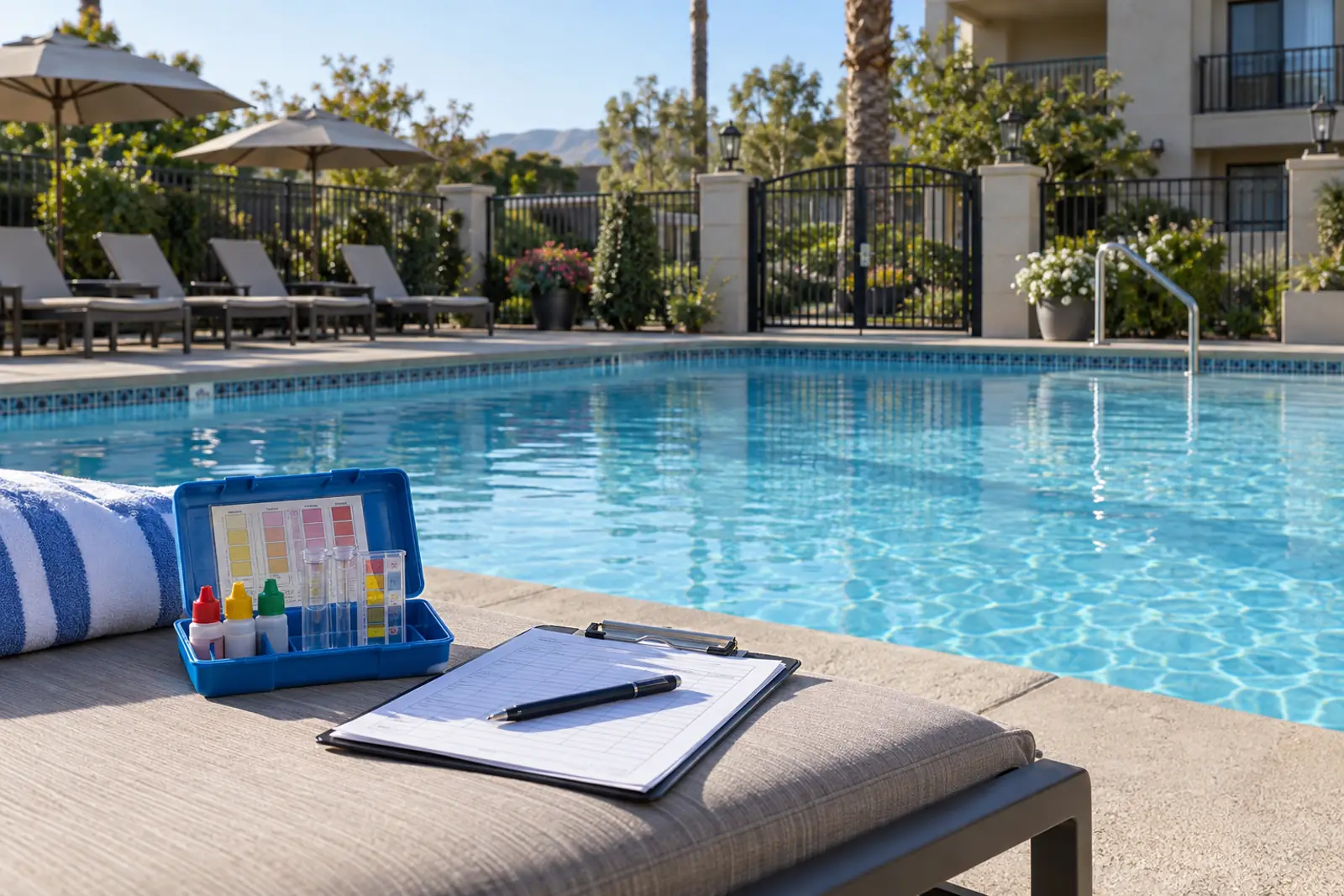
Public Pool Inspection Violations: Closure Rates and Most Common Citations in Six US Jurisdictions, 2019 to 2026
Swimming Participation Statistics: Who Swims in the US, How Often and for How Long, 2003 to 2025
Public Pool Admission Prices in 33 Large US Cities, 2026
Pool Contractors Per Capita: A 2026 Metro Saturation Index
Cities With the Most Pools: A 2022 to 2023 Satellite Census of 25 US Metros
All pool industry research (43 reports)