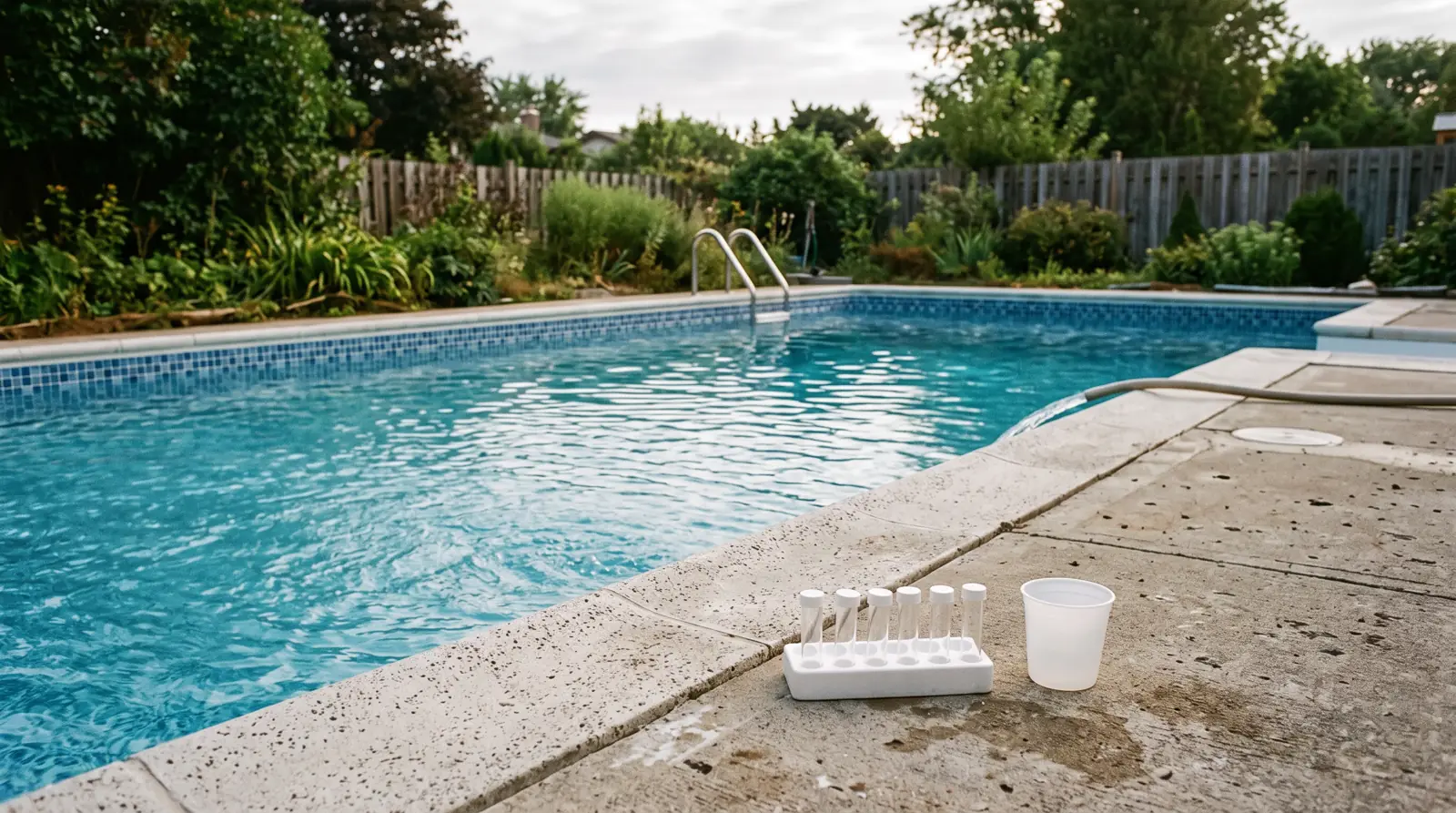
How to Test Pool Water: Sampling, Test Methods and What Your Readings Mean
How to test pool water: fill a clean vial at elbow depth away from return jets, run a DPD or FAS-DPD test for free chlorine and pH, and repeat at least twice a day, as CDC advises.
- ✓Elbow depth, between inletsThe 2024 MAHC samples at least 18 inches down.
- ✓Twice a dayCDC: test chlorine and pH at least twice daily.
- ✓Drops beat stripsCDC rates DPD kits above strips; titration reads to 0.2 ppm.
Key takeaways
- CDC says to test chlorine and pH at least twice a day with a DPD kit and calls test strips less accurate than DPD kits.
- The 2024 Model Aquatic Health Code (MAHC) takes samples at least 18 inches below the surface, between water inlets (section 5.7.4.3.1).
- Color matching is accurate to half the gap between color standards, and drop tests to one drop, per the Taylor Technologies FAQ; a Taylor K-2006 drop is 0.2 or 0.5 ppm.
- Strips cost about $0.30 per test (AquaChek 7-in-1, Sunplay, November 2026) against $1.04 for the Taylor K-2005 and $1.60 for a LaMotte ColorQ photometer.
- 23% of do-it-yourself pool owners in a 2020 Water Quality & Health Council survey tested chlorine and pH once every two weeks or less, against CDC’s advice of twice a day.
What should you test in pool water, and how often?
Test free chlorine and pH most often: CDC says at least twice a day for home pools, and the 2024 MAHC has public pools test them before opening and every 2 to 4 hours. Total alkalinity is weekly, calcium hardness and cyanuric acid monthly, and cyanuric acid weekly when stabilized chlorine is the main sanitizer. Combined chlorine needs the total chlorine test too. Every reading’s target, with the CDC, MAHC, Florida, California and Texas limits side by side, is in our pool chemical levels chart.
| Test | Target | Home pool rhythm | Public pool rule (2024 MAHC) | Source |
|---|---|---|---|---|
| Free chlorine | 1 ppm or more; 2 ppm with stabilizer | At least twice a day | Before opening, then every 2 hours (manual feed) or 4 hours (automated) | CDC home pool page; MAHC 5.7.5.1 to 5.7.5.3 |
| pH | 7.0 to 7.8 | At least twice a day | With every free chlorine test | CDC; MAHC 5.7.5.1 to 5.7.5.3 |
| Combined chlorine (total minus free) | Act above 0.4 ppm | Once or twice a week | Before opening each day | MAHC 5.7.4.4.2 and 5.7.5.1; Taylor (May 15, 2025) |
| Total alkalinity | 60 to 180 ppm | Weekly | Weekly | MAHC 5.7.4.4.1 and 5.7.5.5 |
| Calcium hardness | 2,500 ppm or less | Monthly | Monthly | MAHC 5.7.4.4.3 and 5.7.5.6 |
| Cyanuric acid (stabilizer) | 90 ppm or less | Monthly; weekly on trichlor or dichlor | Monthly; weekly with stabilized chlorine; 24 hours after adding CYA | MAHC 5.7.3.1.3.2 and 5.7.5.7 |
| Salt (salt pools) | Chlorinator maker's range | Weekly | At least weekly or per maker | MAHC 5.7.5.11 |
Sources: CDC home pool page; CDC, 2024 MAHC code; Taylor Technologies. Accessed October 26 and November 1, 2026. Download CSV
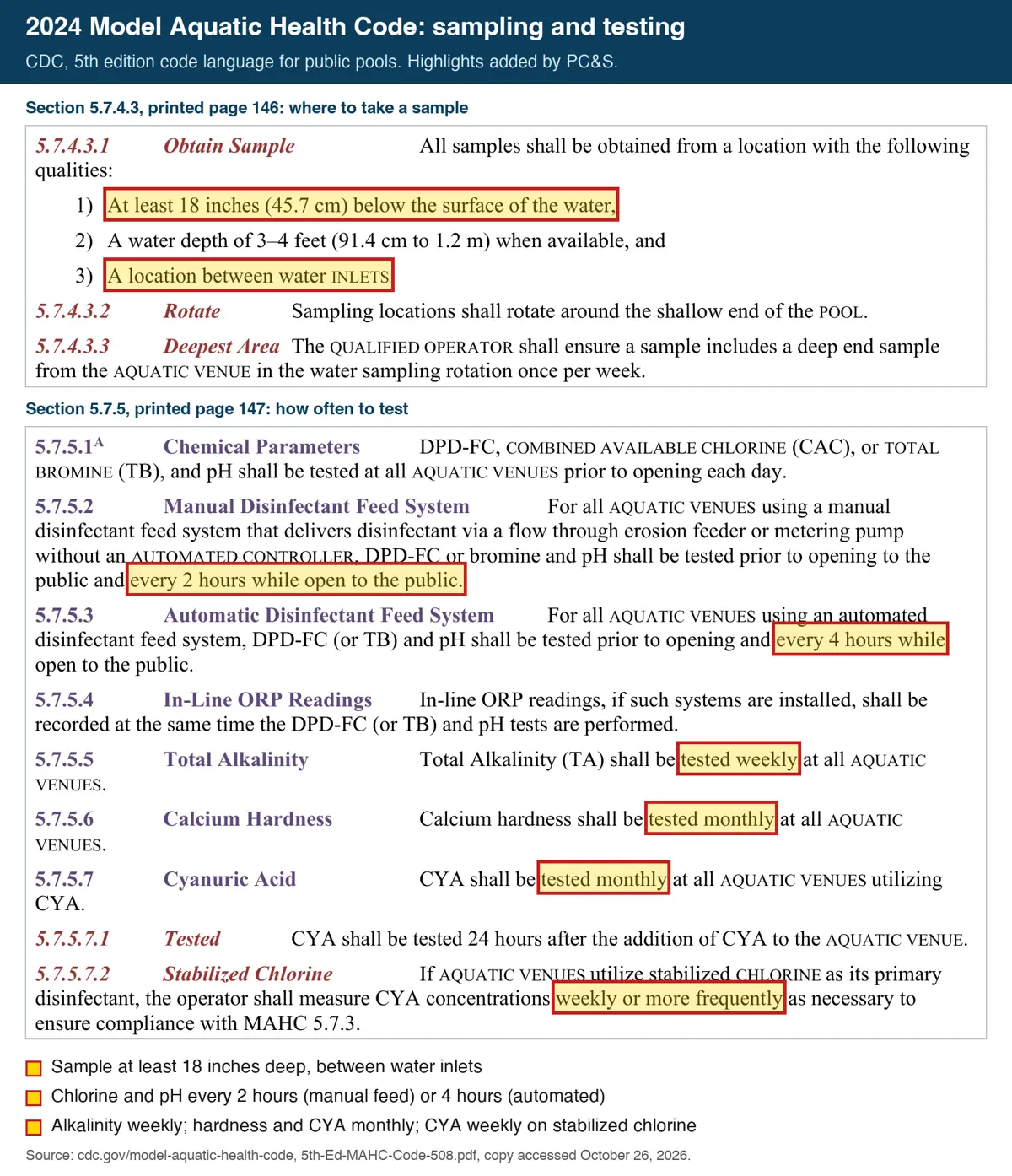
Home pools are not bound by the MAHC, but section 5.7.5 is the only published schedule with section numbers, and our pool maintenance checklist builds the weekly and monthly jobs around it; salt pools add the weekly salt test covered in our salt water pool maintenance guide. Taylor Technologies suggests testing at roughly the same time each day, ideally in the morning before sunlight starts breaking down chlorine, so readings compare day to day.
How do you take a pool water sample?
Push an upturned cup or vial to elbow depth, turn it upright to fill, and test right away. Virginia DOH says sample 12 to 18 inches down and stay away from corners and return lines, where water fresh from the chlorinator reads high. The 2024 MAHC asks for at least 18 inches, a spot between inlets and water 3 to 4 feet deep.
- Pick the spotOpen water between inlets, not a corner, skimmer mouth or return jet (Virginia DOH; MAHC 5.7.4.3.1).
- Rinse the tube in the poolSeveral times, then empty it (Florida DOH Sarasota).
- Go to elbow depthMouth down to 12 to 18 inches (Virginia DOH), at least 18 inches for public pools (MAHC); turn it upright to fill.
- Fill to the line9 mL for chlorine and 44 mL for pH on the Taylor tubes in the Florida DOH guide.
- Check the temperatureWarm a sample below 60 F to at least 60 F before testing (MAHC Annex).
- Cap, never cover with a fingerChemical traces on skin change the result (Virginia DOH).
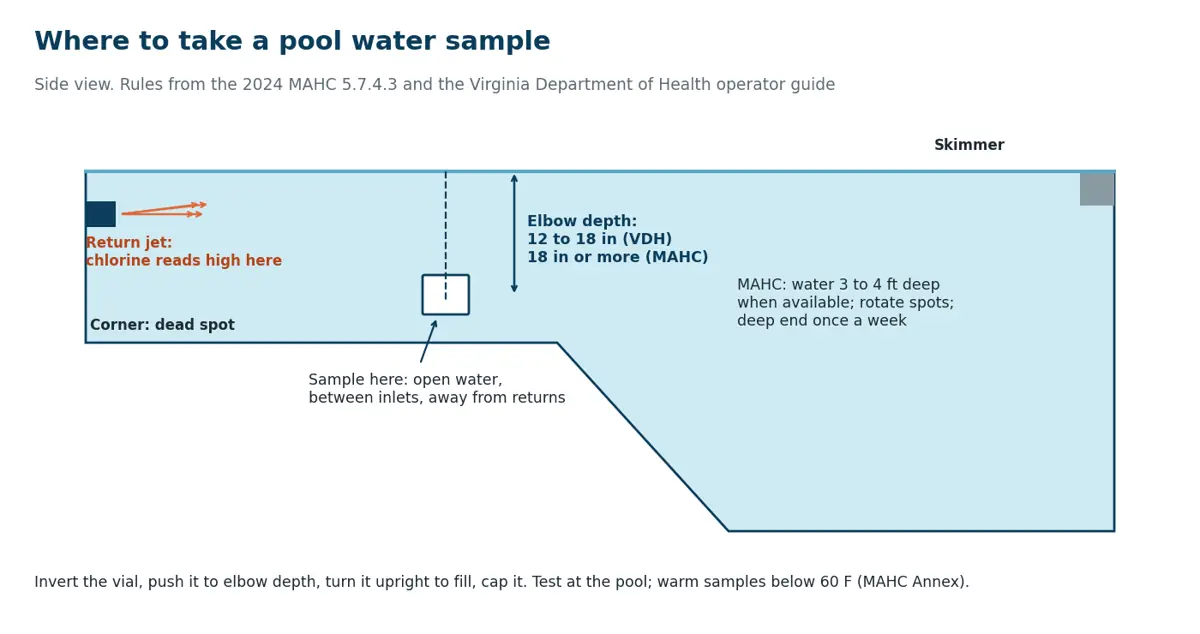
Public pools rotate the spot. The MAHC rotates samples around the shallow end and adds a deep end sample once a week (sections 5.7.4.3.2 and 5.7.4.3.3). If you are taking water to a store, the Virginia DOH operator guide (2018) says to use a clean container, preferably glass, so leftover chemicals do not skew the result.
How to test pool water with a DPD kit, step by step
A DPD kit reads free chlorine, total chlorine and pH from two tubes. Add 5 drops each of DPD #1 and #2 to the 9 mL chlorine sample for free chlorine, 5 drops of DPD #3 for total, and 5 drops of phenol red to the pH tube, then compare colors in daylight, per the Florida DOH Sarasota guide to the Taylor kit.
- Check the reagent datesReplace anything past its best-by date (Taylor FAQ).
- Free chlorine5 drops DPD #1 (R-0001) and 5 drops DPD #2 (R-0002) in the 9 mL tube; cap, invert, read the pink against the chlorine scale.
- Total chlorineAdd 5 drops DPD #3 (R-0003) to the same tube; read again; total minus free is combined chlorine.
- pH5 drops phenol red (R-0004) in the 44 mL tube; read against the pH scale.
- Read in daylightKeep your back to the sun; incandescent or fluorescent light and sunglasses distort the match (Taylor FAQ).
- Log it and rinseWrite down the numbers and time; rinse tubes so DPD #3 does not skew the next free chlorine test (Taylor FAQ).
How do you use a FAS-DPD kit? Add the DPD powder, then count drops of ferrous ammonium sulfate (FAS) titrant until the pink disappears; drops times the factor is free chlorine. On the Taylor K-2006 each drop is 0.2 or 0.5 ppm, depending on sample size. The Taylor FAS-DPD article (May 8, 2025) says the clear endpoint removes color matching and reads up to 20 ppm, so the same kit tests a shock.
How do you use test strips? Dip, remove, read. The AquaChek 7-in-1 directions say to dip the strip and remove it immediately, hold it level for 15 seconds without shaking, then match the pads to the bottle chart. Read the pads at the time the label gives. Our free chlorine vs total chlorine guide explains what the two chlorine numbers mean.
Test strips vs liquid kits vs digital testers: which is most accurate?
Drop titration and photometers read finest. The 2024 MAHC Annex calls titration accurate to 0.2 mg/L and portable colorimeters the most accurate poolside kits where affordable, while color matching is accurate only to half the gap between color blocks. CDC says strips are less accurate than DPD kits. Near 4 ppm, a strip or comparator can be off by 1.0 ppm.
| Method | Example (maker code) | What it measures | Chlorine color steps or resolution | Chlorine range | Reagent life | Price (listing, Nov 1, 2026) | Price per chlorine test | Source |
|---|---|---|---|---|---|---|---|---|
| Test strip | Taylor S-1403 7-Way | Free and total chlorine, pH, alkalinity, hardness, CYA, bromine | Free: 0, 1, 2, 3, 5, 10 ppm; total: 0, 0.5, 1, 2, 5, 10 ppm | 0 to 10 ppm | Best-by date on label; replace each season | $17.42 (Taylor) | Not stated | Taylor S-1403 page; Taylor FAQ |
| Test strip | AquaChek Silver 7-in-1 | Same 7 tests | Blocks not listed | Free 0 to 20 ppm; total 0 to 10 ppm | Check the expiration date (CDC) | $29.95 for 100 strips (Sunplay) | $0.30 | Sunplay listing |
| OTO liquid kit | Taylor K-1000 | Total chlorine, bromine, pH; no free chlorine | 0.5, 1, 2, 3, 5 ppm | 0.5 to 5 ppm | Best-by date; replace each season | $17.21 (Taylor) | Not stated | Taylor K-1000 page |
| DPD color-match kit | Taylor K-1004 | Free and total chlorine, pH, alkalinity, bromine | 0.5, 1, 2, 3, 5 ppm | 0.5 to 5 ppm | Best-by date; replace each season | $36.21 (Taylor) | Not stated | Taylor K-1004 page |
| DPD color-match kit | Taylor K-2005 | Free and total chlorine, pH, alkalinity, hardness, CYA | 1, 2, 3, 5, 7.5, 10 ppm | 1 to 10 ppm | Best-by date; replace each season | $114.47 (Taylor) | $1.04 (110 chlorine tests) | Taylor K-2005 page; Taylor FAQ |
| FAS-DPD drop titration | Taylor K-2006 | Free and combined chlorine, pH, alkalinity, hardness, CYA | 1 drop = 0.2 or 0.5 ppm | Up to 20 ppm | Best-by date; replace each season | $142.71 (Taylor) | Not stated | Taylor K-2006 page; Taylor FAS-DPD article |
| Digital photometer | LaMotte ColorQ 2x PRO 7 (2086) | Free and total chlorine, bromine, pH, alkalinity, hardness, CYA | Digital readout; NSF level L1 or L2 for chlorine | 0 to 10 ppm | NSF shelf life based on 12 months | $229.95 (Sunplay) | $1.60 (144 tests) | LaMotte 2086 page; Sunplay |
| Store test | Leslie's AccuBlue | 10 items incl. free and total chlorine | Photometer; resolution not published | Not published | n/a | Free in store | $0 | Leslie's AccuBlue pages (Wayback copies, 2025) |
Sources: Taylor S-1403; Sunplay AquaChek; Taylor K-1000; Taylor K-1004; Taylor K-2005; Taylor K-2006; Taylor FAQ; LaMotte 2086; Sunplay LaMotte 2086; Leslie AccuBlue (Wayback). Prices accessed November 1, 2026. Price per test = price divided by the chlorine tests the maker states (PC&S arithmetic). Download CSV
At 7.5 ppm the strip range widens to 5.0 to 10.0 ppm; see the table below.
Source: PC&S arithmetic: Taylor FAQ (color match half the gap between standards; drops plus or minus one) and color standards on the Taylor S-1403, K-1004, K-2005 and K-2006 pages, accessed November 1, 2026.. Download chart data (CSV)
| Method | Steps around 4 ppm | Accuracy rule (Taylor) | Range for a 4 ppm reading (ppm) | Range for a 7.5 ppm reading (ppm) |
|---|---|---|---|---|
| Taylor S-1403 strip | 3 and 5 ppm | Half the gap: plus or minus 1.0 ppm | 3.0 to 5.0 | 5.0 to 10.0 (5 and 10 ppm blocks) |
| Taylor K-1004 DPD | 3 and 5 ppm | Half the gap: plus or minus 1.0 ppm | 3.0 to 5.0 | Off scale (top 5 ppm) |
| Taylor K-2005 DPD | 3 and 5 ppm | Half the gap: plus or minus 1.0 ppm | 3.0 to 5.0 | 6.25 to 8.75 (gaps of 2.5 ppm) |
| FAS-DPD, 0.5 ppm per drop | 8 drops | Plus or minus 1 drop: 0.5 ppm | 3.5 to 4.5 | 7.0 to 8.0 |
| FAS-DPD, 0.2 ppm per drop | 20 drops | Plus or minus 1 drop: 0.2 ppm | 3.8 to 4.2 | 7.3 to 7.7 |
PC&S arithmetic from the Taylor FAQ accuracy rule and the color standards on the S-1403, K-1004, K-2005 and K-2006 pages. Accessed November 1, 2026. Download CSV
The gap matters most at shock levels. A Taylor S-1403 strip jumps from 5 to 10 ppm, so a 7.5 ppm pool could read anywhere from 5.0 to 10.0, while a K-1004 comparator tops out at 5 ppm. Public pools have no choice: MAHC 4.7.3.5.1 requires test kits certified to NSF/ANSI 50, which grades accuracy as level 1, 2 or 3, and LaMotte lists its ColorQ liquid combined chlorine test at level 1.
Skip OTO kits for chlorine. The Taylor K-1000 reads total chlorine only, and Virginia DOH bars OTO kits at Portsmouth public pools because orthotolidine is a carcinogen as determined by the FDA and its yellow color cannot separate free from total chlorine. One top-ranking guide (Poolonomics) calls strips the easiest way to get accurate readings; CDC says strips are less accurate than DPD kits.
How do you know your test strips and reagents still work?
Check them against a known sample. CDC’s archived test strip page (last reviewed April 2, 2022) mixed 1 drop of liquid bleach into 6 cups of tap water for a 2 to 3 ppm reading and 2 drops for 4 to 5 ppm. Taylor says to replace reagents and strips each season and store them at 36 to 85 F.
| Container | Tap water | Household liquid chlorine bleach | Free chlorine the strip should read |
|---|---|---|---|
| 1 | At least 1 cup | None | 0 to under 1 ppm |
| 2 | At least 6 cups | 1 drop | 2 to 3 ppm |
| 3 | At least 6 cups | 2 drops | 4 to 5 ppm |
Source: CDC, Pool and Hot Tub Test Strips (page last reviewed April 2, 2022; no longer on cdc.gov; Internet Archive copy of April 12, 2024). Accessed November 1, 2026. Download CSV
Run the tap for about 2 minutes first and use bleach no more than 3 months old, CDC’s page said, because older bleach may be too weak for an accurate check. A strip that reads 0 in container 3 is past its life. The same three containers work for a DPD kit, though the kit itself is the better reference.
| Rule | Number | Source |
|---|---|---|
| Store reagents and strips at a steady temperature | 36 F to 85 F | Taylor FAQ |
| Replace reagents and strips | Each season, and past the best-by date | Taylor FAQ; Virginia DOH |
| Store and use ColorQ reagents for best accuracy | 68 F to 75 F | LaMotte ColorQ 2x user guide |
| NSF shelf-life basis for ColorQ reagents | 12 months | LaMotte 2086 page |
| Check reagent expiration at public pools | Every use; record the date | 2024 MAHC 5.7.3.6.1.1 |
| Warm cold samples before testing | To at least 60 F | 2024 MAHC Annex 4.7.3.5 |
| Use bleach for the CDC strip check that is fresh | 3 months old or less | CDC strip page (archived) |
| Replace Taylor comparator blocks | Every 2 to 3 years | Taylor FAQ |
Sources: Taylor FAQ; Virginia DOH; LaMotte user guide; LaMotte 2086 page; 2024 MAHC; MAHC Annex; CDC strip page (archived). Accessed November 1, 2026. Download CSV
Should you use a pool store water test?
Use it for the slow numbers, not as your chlorine test. Leslie’s AccuBlue runs a free 10-point analysis in about 60 seconds, including alkalinity, hardness, cyanuric acid, salt and metals. Virginia DOH calls store testing a good start for new operators but notes it lets the store sell the fix. Chlorine and pH still need testing at the pool twice a day.
The Leslie AccuBlue page (Internet Archive copy, September 2025) says the unit passes light at different wavelengths through the sample in a test disk, the same photometric idea as a home ColorQ. Bring water from elbow depth in a clean container, and compare the store’s alkalinity and stabilizer with your own monthly test; our cyanuric acid pool guide covers why CYA readings near 100 ppm need a diluted retest.
You can test a public pool too. CDC’s archived strip page told swimmers they can check free chlorine and pH with an over-the-counter strip before getting in, and only 21% of U.S. adults said they had done so in a 2019 Healthy Pools survey, one of the habits our pool hygiene statistics report tracks. A 2010 CDC release found 12.1% of 111,487 routine inspections in 2008 led to immediate closure.
Source: Source: Louisville Metro Public Health and Wellness pool inspection data, tabulated by PC&S research (accessed October 6, 2026).. Download chart data (CSV)
| Measure | Share (%) | Denominator |
|---|---|---|
| Routine inspections with disinfectant level out of range | 21.6 | Routine inspections, Oct 2021 to Apr 2024 |
| Free chlorine readings below 1.0 ppm | 14.5 | 1,748 routine readings at pool venues |
| Routine inspections with an imminent health hazard | 10.8 | Routine inspections, Oct 2021 to Apr 2024 |
| Free chlorine readings of 0 ppm | 8.6 | 1,748 routine readings at pool venues |
| Routine inspections with pH outside 7.2 to 7.8 | 7.4 | Routine inspections, Oct 2021 to Apr 2024 |
Source: Louisville Metro Public Health and Wellness, Pool Inspections, tabulated in PC&S research: Public Pool Inspection Violations. Data accessed October 6, 2026. Download CSV
What do your pool test readings mean?
Fix chlorine and pH first, then balance. Free chlorine under 1 ppm (2 ppm with stabilizer) needs a dose before swimming; over 4 ppm, keep swimmers out. A clear DPD sample after a shock means too much chlorine, not none. Total minus free above 0.4 ppm calls for a breakpoint shock, and pH outside 7.0 to 7.8 comes before any chlorine change.
| If your situation is | Do this | Rule behind it |
|---|---|---|
| Free chlorine below 1 ppm (2 ppm with stabilizer) | Add chlorine and retest before anyone swims | CDC home pool page |
| Free chlorine above 4 ppm | Keep swimmers out and retest; do not add more | Hasachlor label re-entry limit |
| DPD sample stays clear after a shock | Dilute 1:1 with tap water, retest, multiply by 2 | CDC; Taylor FAQ (bleaching above 10 ppm) |
| pH test turns purple | Chlorine is above about 10 ppm; retest pH once chlorine falls | LaMotte user guide; MAHC Annex Table 4.7.3.5 |
| Total minus free chlorine above 0.4 ppm | Shock to about 10 times the gap with unstabilized chlorine | 2024 MAHC 5.7.4.4.2 and glossary |
| pH below 7.0 or above 7.8 | Adjust pH, then retest chlorine | CDC home pool page |
| Total alkalinity outside 60 to 180 ppm | Adjust alkalinity before fine-tuning pH | 2024 MAHC 5.7.4.4.1 |
| Cyanuric acid reads 100 ppm or off the scale | Dilute 1:1, retest, multiply by 2; partial drain above 90 ppm | Taylor; 2024 MAHC 5.7.3.1.3.2 |
| Strip and drop kit disagree | Go with the DPD or FAS-DPD reading; run the CDC bleach check on the strips | CDC (strips less accurate); CDC strip page |
| Draining chlorinated water onto a lawn | Stop chlorine about 10 days ahead; drain once total chlorine reads below 0.01 mg/L and pH is 6.5 to 8.0 | Orange County, Florida BMP sheet |
Sources: CDC; 2024 MAHC; MAHC Annex; Taylor FAQ; LaMotte guide; Hasachlor label; Orange County, Florida; CDC strip page (archived). Accessed November 1, 2026. Download CSV
For the fixes, our guide on how to shock a pool gives label doses, and our calcium hardness guide works through the saturation index. Before a drain, Orange County, Florida asks owners to stop chlorine about 10 days ahead and confirm total chlorine below 0.01 mg/L, far under the 0.5 ppm lowest color block on the Taylor K-1004.
A weekly service visit tests the water on the days a pro is there; our pool cleaning service guide lists what each plan includes.
How we compiled this
We compiled this page in October and November 2026 from 20 primary documents: the 2024 MAHC code and Annex, CDC’s home pool page, an Internet Archive copy of CDC’s retired test strip page, a 2010 CDC release, Florida, Virginia and Orange County health documents, the Hasachlor EPA label, eight Taylor Technologies pages, two LaMotte documents and dated listings from Sunplay and Leslie’s. We did not test any kit; resolution and price per test come from maker figures and our arithmetic. Forum threads were excluded.
Frequently Asked Questions
How do I test my pool water myself?
Fill a rinsed tube at elbow depth away from return jets, add 5 drops each of DPD #1 and #2 for free chlorine, then 5 drops of DPD #3 for total chlorine, and 5 drops of phenol red to the pH tube. Compare colors in daylight. CDC says to do it at least twice a day.
What is the most accurate way to test pool water at home?
A FAS-DPD drop kit or a photometer. The 2024 MAHC Annex calls titration accurate to 0.2 mg/L and recommends it over color matching, and Taylor’s K-2006 counts chlorine at 0.2 or 0.5 ppm per drop. Color blocks are only accurate to half the gap between standards, up to 1.0 ppm near 4 ppm.
How often should you test pool water?
Chlorine and pH at least twice a day, per CDC, and more often when the pool is busy. Public pools under the 2024 MAHC also test alkalinity weekly, calcium hardness and cyanuric acid monthly, cyanuric acid weekly when stabilized chlorine is the main sanitizer, and salt at least weekly in salt pools.
Are pool test strips accurate?
Accurate enough for a quick check, not for dosing. CDC calls strips less accurate than DPD kits, and Taylor rates color matching at half the gap between blocks: on the S-1403 the free chlorine blocks jump from 3 to 5 and 5 to 10 ppm. Check old strips with CDC’s 1 and 2 drop bleach test.
Can I get my pool water tested for free?
Yes. Leslie’s runs a free in-store AccuBlue test that reports 10 items in about 60 seconds, and Virginia DOH notes chemical suppliers usually test at no cost. Bring water from elbow depth in a clean container, ideally glass, and still test chlorine and pH yourself at least twice a day.
What time of day should you test pool water?
Morning, at about the same time each day. Taylor Technologies says morning is ideal because sunlight has not yet begun to break down the chlorine, and same-time readings show trends. CDC’s twice-a-day advice adds a second test later, and more tests when the pool is busy.
Sources
- CDC. 2024 Model Aquatic Health Code, 5th Edition, Code Language. Accessed 2026-10-26.
- CDC. 2024 Model Aquatic Health Code, 5th Edition, Annex. Accessed 2026-10-26.
- CDC. Home Pool and Hot Tub Water Treatment and Testing (May 10, 2024). Accessed 2026-10-26.
- CDC. Pool and Hot Tub Test Strips (last reviewed April 2, 2022; Internet Archive copy of April 12, 2024). Accessed 2026-11-01.
- CDC. Pool Inspection Data Show Need for Improvement (press release, May 20, 2010). Accessed 2026-11-01.
- Virginia Department of Health. Pool Operation and Maintenance Guide (2018). Accessed 2026-10-26.
- Florida Department of Health in Sarasota County. How to Use Your Test Kit. Accessed 2026-10-26.
- Orange County, Florida. How to Test Your Pool Water (BMP sheet). Accessed 2026-11-01.
- U.S. EPA Pesticide Product and Label System. Hasachlor sodium hypochlorite 12.5%, EPA Reg. No. 10897-26 (April 24, 2026). Accessed 2026-10-19.
- Taylor Technologies. Water Testing Technical FAQs. Accessed 2026-11-01.
- Taylor Technologies. Difference Between Free, Combined and Total Chlorine in Pool Water (May 15, 2025). Accessed 2026-11-01.
- Taylor Technologies. How FAS-DPD Tests for Free and Combined Chlorine Values (May 8, 2025). Accessed 2026-10-26.
- Taylor Technologies. 7-Way Test Strips, S-1403. Accessed 2026-11-01.
- Taylor Technologies. 3-Way Test Kit (OTO), K-1000. Accessed 2026-11-01.
- Taylor Technologies. 6-Way Test Kit (DPD), K-1004. Accessed 2026-11-01.
- Taylor Technologies. Complete Test Kit, K-2005. Accessed 2026-11-01.
- Taylor Technologies. Complete Test Kit (FAS-DPD), K-2006. Accessed 2026-11-01.
- LaMotte. ColorQ 2x PRO 7, order code 2086 (NSF table, ranges, test counts). Accessed 2026-11-01.
- LaMotte. ColorQ 2x PRO 7 user guide (2086-UG). Accessed 2026-11-01.
- Sunplay. AquaChek Silver 7-in-1 Test Strips, 100 strips (listing). Accessed 2026-11-01.
- Sunplay. LaMotte ColorQ 2x Pro 7 Test Kit 2086 (listing). Accessed 2026-11-01.
- Leslie's. Leslie's AccuBlue Water Test (Internet Archive copy, December 5, 2025). Accessed 2026-11-01.
- Leslie's. Leslie's AccuBlue Water Test: Fast, Accurate, Complete (Internet Archive copy, September 13, 2025). Accessed 2026-11-01.
- Water Quality & Health Council. 2020 Healthy Pools survey release (reprinted by Swimmer's Daily). Accessed 2026-10-08.
- Sachs Media for the Water Quality & Health Council. Healthy Pools 2019 survey results. Accessed 2026-10-08.
- Louisville Metro Public Health and Wellness. Louisville Metro KY Pool Inspections. Accessed 2026-10-06.
- Poolonomics. Pool Water Testing (claim compared). Accessed 2026-11-01.
Related pages
Get Quotes From Licensed Local Pool Pros
Tell us what you need and your ZIP code. We match you with pool companies that cover your area.