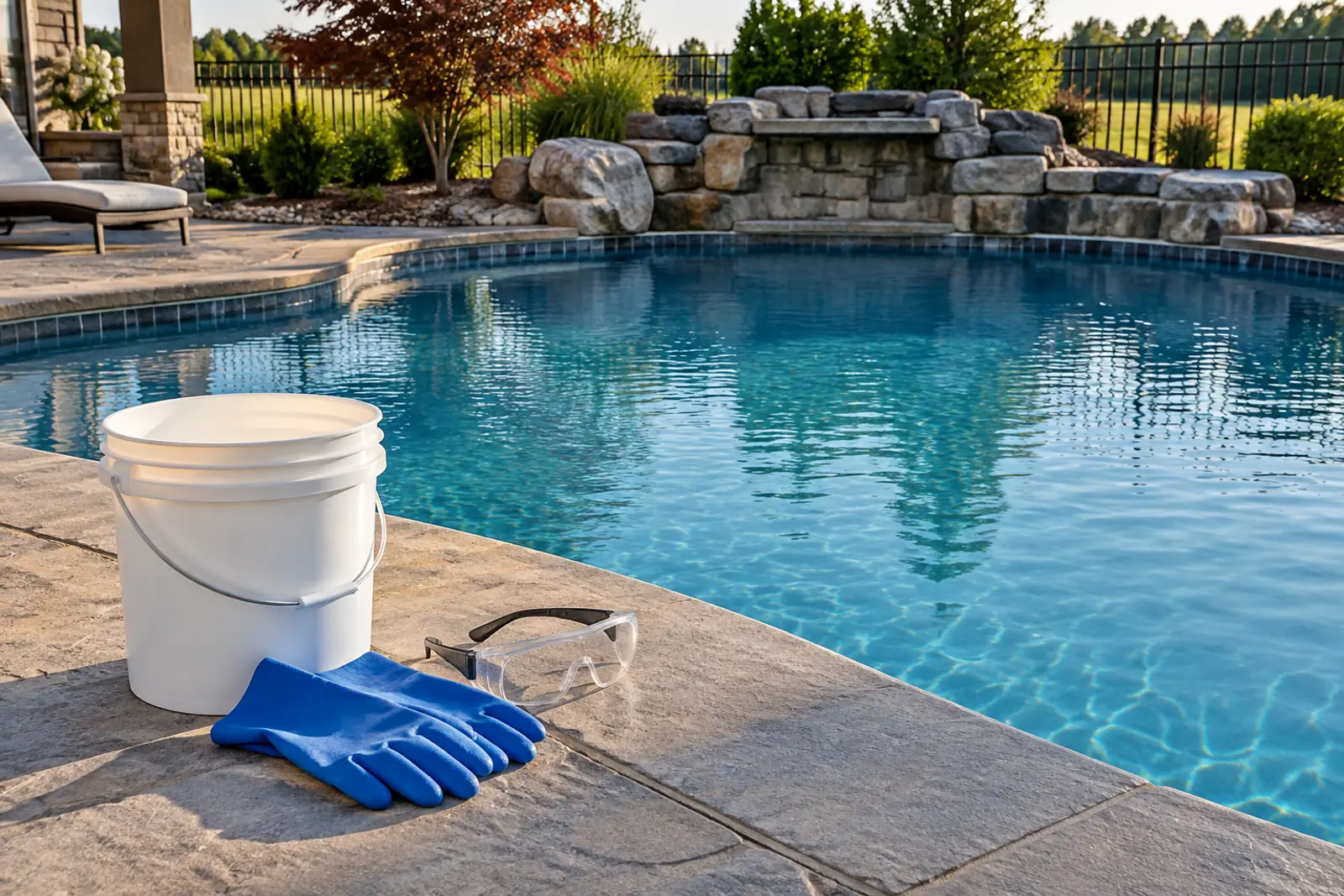
How to Lower pH in Pool Water Without Overshooting
Here is how to lower pH in pool water: add diluted muriatic acid or dry acid in measured steps, about 12 oz of muriatic acid per 10,000 gallons to drop pH 0.2 (Florida DOH), then retest before adding more.
- ✓High pH weakens chlorineAt pH 8.0 only 24% of free chlorine is in its active form, versus 66% at 7.2 (Pennsylvania DOH).
- ✓Acid doses agree, roughlyFlorida DOH, Virginia DOH and FROG all land near 12 oz of muriatic acid per 10,000 gallons for a 0.2 drop.
- ✓Salt pools: skip dry acid in dry climatesHayward and Pentair manuals warn dry acid byproducts can damage salt cells where evaporation is high.
Why high pool pH matters: less of your chlorine does the work
CDC puts the healthy range for home pools at pH 7.0 to 7.8 and says that as pH goes up, chlorine’s ability to kill germs decreases, especially above 8.0 (CDC, 2024). The reason is chemistry you can see in one table. Free chlorine splits between hypochlorous acid (HOCl), the fast germ killer, and hypochlorite, a weak one. Pennsylvania’s health department publishes the split: 66% active at pH 7.2, 50% at 7.5, 24% at 8.0.
Values as published by Pennsylvania DOH. Cyanuric acid (stabilizer) changes the picture further.
Source: Source: Pennsylvania Department of Health, Public Swimming and Bathing Places recommendations, Table 5 (November 2016).. Download chart data (CSV)
High pH has physical costs too. Pennsylvania lists a urine-like odor, increased cloudiness, scale on pipes, pump impellers and heater coils, and calcium-clogged sand filters above pH 7.6, and recommends 7.2 to 7.6 for public pools. The 2024 Model Aquatic Health Code makes pH above 8.0 an imminent health hazard. In Louisville Metro, 52 of 2,057 routine pH readings at public pools from October 2021 to April 2024 were above 8.0, about 2.5%, and Sacramento County cited maximum pH 744 times in three years (PC&S inspection research).
What keeps pushing your pool pH up
Lowering pH works better once you know which of these is driving it.
| What pushes pH up | Why | What to do | Source |
|---|---|---|---|
| Liquid chlorine (sodium hypochlorite) or calcium hypochlorite | Hypochlorites raise pH and alkalinity over time | Expect regular small acid doses; keep alkalinity 80 to 100 ppm | Pennsylvania DOH; Virginia DOH |
| Salt chlorine generator | Electrolysis byproducts have a very high pH | Use muriatic acid; avoid dry acid where evaporation is high | Sensorex; Pentair; Hayward |
| New plaster | Fresh plaster raises pH during cure | Follow the NPC start-up schedule with pre-diluted acid | Virginia DOH; NPC |
| Waterfalls, spillways, jets, splashing | Aeration drives off carbon dioxide | Turn features down while correcting | Orenda; FROG |
| High total alkalinity | pH bounces back above 8.0 after acid | Lower alkalinity with acid in steps, then fix pH | Virginia DOH |
| Algae bloom | Algae raise pH | Treat the algae; see our cloudy water guide | Virginia DOH |
| Too much soda ash or baking soda | Both are bases | Measure doses; retest before adding more | Virginia DOH |
Sources: Pennsylvania DOH; Virginia DOH; National Plasterers Council; Sensorex, Pentair, Hayward, Orenda and FROG (manufacturer guidance). Download CSV
Two of these explain most stubborn cases. The first is high total alkalinity. Virginia’s operator guide describes the pattern: you add acid, pH drops, and a short while later it bounces back above 8.0. That only stops once alkalinity itself comes down, and Virginia suggests holding it at 80 to 100 ppm when your pH tends to rise. The second is aeration. Waterfalls, spillways, deck jets and splashing swimmers drive carbon dioxide out of the water, and pH rises (Orenda and FROG, manufacturer guidance).
Muriatic acid vs dry acid vs carbon dioxide for lowering pH
The 2024 Model Aquatic Health Code lists muriatic (hydrochloric) acid, sodium bisulfate, carbon dioxide and sulfuric acid as approved pH reducers for public pools, certified to NSF/ANSI 50 or 60. Homeowners mostly choose between the first two. Muriatic acid is a liquid, about 30% hydrochloric acid per Florida DOH (the National Plasterers Council specifies 31 to 33%). Dry acid is granular sodium bisulfate. Florida’s manual gives the conversion: one pint of muriatic acid equals 1.25 pounds of dry acid, so a 12 oz muriatic dose is about 0.94 lb of dry acid.
| Option | Form and strength | Equivalent dose | Salt chlorine generator pools | Handling | Source |
|---|---|---|---|---|---|
| Muriatic acid (hydrochloric) | Liquid, about 30% (Florida DOH) or 31 to 33% HCl (NPC) | 12 oz per 10,000 gal for about a 0.2 drop | Recommended by Pentair for lowering pH | Pre-dilute: add acid to a bucket of water; fumes; highly corrosive | Florida DOH; NPC; Pentair; Virginia DOH |
| Dry acid (sodium bisulfate) | Granular | 1.25 lb equals 1 pint of muriatic acid | Discouraged by Hayward and Pentair, especially in arid regions (byproducts can damage the cell) | No pre-dilution needed per FROG; still corrosive; follow label | Florida DOH; Hayward; Pentair; FROG |
| Carbon dioxide (CO2) | Gas through a feeder | Set by feeder | Not addressed in manuals read | Equipment install; suits water that keeps drifting high, as with liquid chlorine | Virginia DOH; MAHC 2024 |
| Sulfuric acid | Liquid | Not published for homeowners | Not addressed | Approved in MAHC 2024 for public pools; commercial use | MAHC 2024 |
Sources: MAHC 2024, 5.7.3.4.2; Florida DOH; Virginia DOH; Hayward, Pentair, FROG manuals and guides (manufacturer guidance). Download CSV
Carbon dioxide is the quiet option for pools that drift high every day. Virginia’s guide notes CO2 forms an acid in water and works best where pH constantly moves up, as with liquid chlorine. It is fed through dedicated equipment, so it is an equipment decision rather than a bucket job.
How much muriatic acid to lower pH: dose per 10,000 gallons
Unlike soda ash, where published doses vary widely, acid charts line up. Florida DOH lists 12 oz of muriatic acid per 10,000 gallons for a 0.2 drop, Virginia DOH lists 12 oz for water at 7.6 to 7.8, FROG Products says 12 to 16 oz for a 0.2 drop, and Knorr Systems lists 1 1/3 cups (about 10.7 fl oz) to bring 7.8 down to 7.6. The Virginia chart scales by pool size and starting pH:
| Starting pH | 5,000 gal (oz) | 10,000 gal (oz) | 15,000 gal (oz) | 20,000 gal (oz) | 25,000 gal (oz) | 30,000 gal (oz) |
|---|---|---|---|---|---|---|
| 7.4 to 7.6 | none | none | none | none | none | none |
| 7.6 to 7.8 | 6 | 12 | 18 | 24 | 32 | 36 |
| 7.8 to 8.0 | 8 | 16 | 24 | 32 | 40 | 48 |
| 8.0 to 8.4 | 12 | 24 | 36 | 48 | 60 | 72 |
| Over 8.4 | 16 | 32 | 48 | 64 | 80 | 96 |
Source: Virginia Department of Health, Portsmouth Health Department guide (2018), Annex 2.6. Values checked against the scanned page. Download CSV
No acid is listed for pH 7.4 to 7.6. Doses assume typical alkalinity; retest after each dose.
Source: Source: Virginia Department of Health, Portsmouth Health Department, Pool Operation and Maintenance Guide (2018), Annex 2.6.. Download chart data (CSV)
| Starting pH (target 7.6) | 10,000 gal as published | 10,000 gal in fl oz | 25,000 gal | 50,000 gal |
|---|---|---|---|---|
| 8.4 | 1/4 gallon | 32 | 3/4 gallon | 1 1/2 gallons |
| 8.2 | 3 1/2 cups | 28 | 1/2 gallon | 1 gallon |
| 8.0 | 2 1/2 cups | 20 | 1 1/2 quarts | 3 quarts |
| 7.8 | 1 1/3 cups | 10.7 | 3 1/4 cups | 1 1/2 quarts |
Source: Knorr Systems, Chemical Dosing Charts (manufacturer guidance), accessed October 8, 2026. Fluid ounces use Knorr’s own conversions (1 cup = 8 oz, 1 gallon = 128 oz). Download CSV
Acid also lowers total alkalinity, which is exactly what you want when alkalinity is the reason pH keeps climbing. Virginia’s guide lists 21 oz of muriatic acid per 10,000 gallons to drop alkalinity 10 ppm. Work out your gallons first with our pool volume calculator; as a worked example from the Virginia chart, a 20,000 gallon pool at pH 8.1 needs 48 oz.
| Lower total alkalinity by (ppm) | 1,000 gal | 5,000 gal | 10,000 gal | 25,000 gal |
|---|---|---|---|---|
| 10 | 2 oz | 10 oz | 21 oz | 3 1/4 pints |
| 20 | 4 oz | 20 oz | 42 oz | 6 1/2 pints |
| 30 | 6 oz | 2 pints | 4 pints | 5 quarts |
| 40 | 8 oz | 2 1/2 pints | 5 pints, 4 oz | 6 quarts, 1 pint |
| 50 | 10 oz | 3 pints, 2 oz | 6 1/2 pints | 2 gallons |
Source: Virginia Department of Health, Portsmouth Health Department guide (2018), page 34. Download CSV
How to lower pH in pool water without overshooting
FROG Products warns that too much acid can drop pH too low and create a new set of problems, so dose in small, measured steps.
- Test pH and total alkalinityUse a DPD kit, which CDC recommends, and note both numbers. High alkalinity changes the plan.
- Turn down aerationSwitch off waterfalls, spillways and bubblers while you correct, so they are not pushing pH back up.
- Measure the low end of the chartFor 10,000 gallons at pH 7.6 to 7.8, that is 12 oz of muriatic acid (Virginia DOH, Florida DOH). Scale with your real gallons.
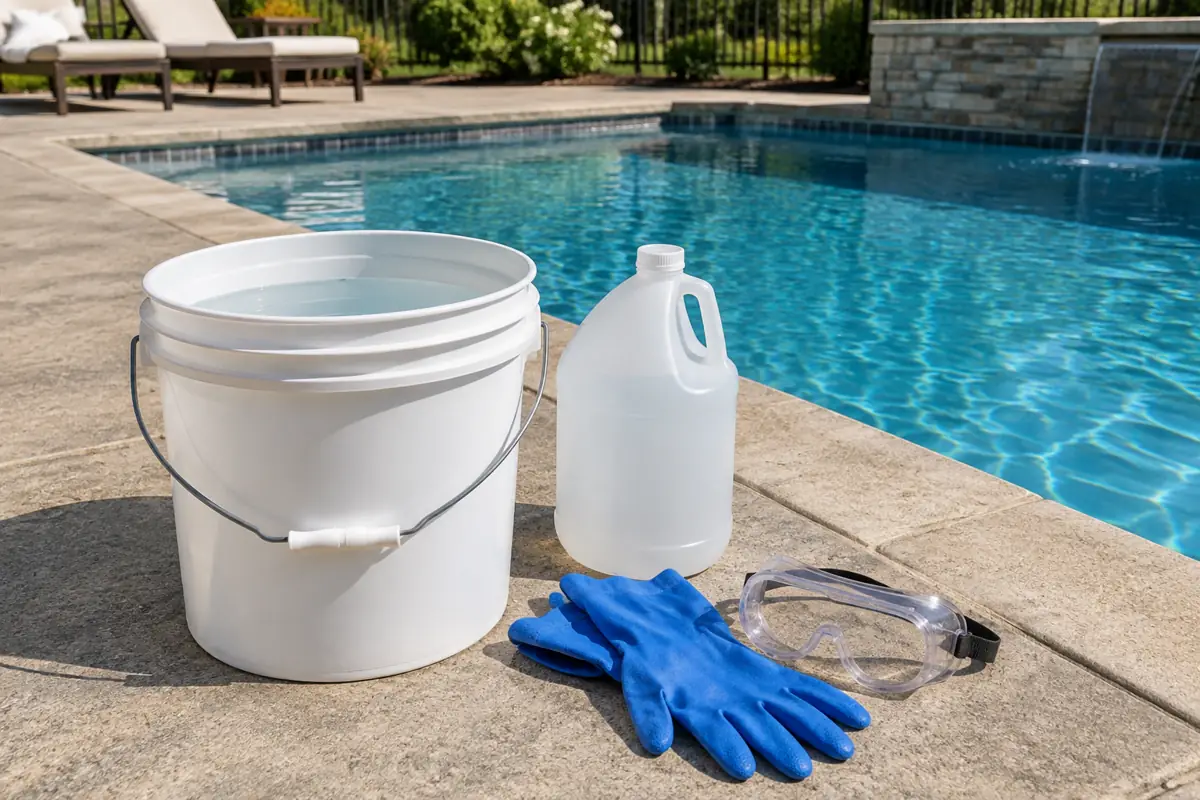
- Gear upChemical-resistant gloves, goggles, long sleeves and closed-toe shoes (NPIC). Knorr Systems adds an acid-resistant apron and breathing protection.
- Add acid to water, never water to acidFill a clean plastic bucket with water first, then pour the acid in slowly, facing away from the fumes. FROG notes dry acid does not need pre-dilution; follow its label.
- Pour with the pump runningFlorida DOH recommends pouring in one spot rather than walking it around the edge; FROG suggests near a return jet and away from the skimmer. Keep swimmers out; Knorr closes pools for at least 30 minutes.
- Circulate, then retestFROG says circulate 4 to 6 hours and retest after 12 hours. Stop when pH reads 7.4 to 7.6; the Virginia chart adds nothing in that band.
- Repeat in small stepsIf pH is still high, repeat a measured dose. If it keeps bouncing back, lower alkalinity first using the table above.
Want someone else to handle the acid?
Saltwater pool pH drift: why it climbs and which acid to use
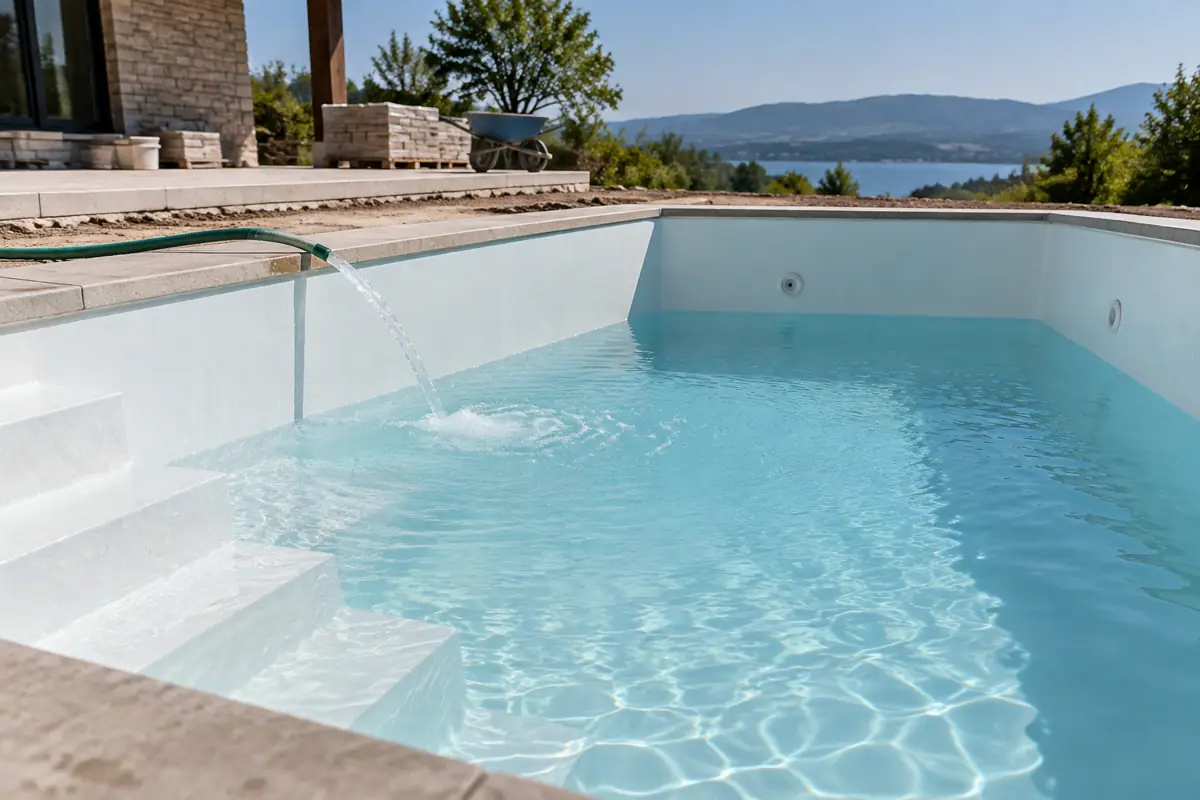
If you own a salt pool, rising pH is expected rather than a sign something is broken. Sensorex, a water sensor maker, explains that the electrolysis inside a salt chlorine generator creates byproducts with a very high pH, so salt pools tend to drift up steadily. Pentair’s IntelliChlor guide gives the fix in one line: use muriatic acid to lower pH and soda ash to raise it, keeping pH at 7.2 to 7.8.
Both salt cell manuals we read warn against dry acid in some climates. Hayward’s Aqua Rite manual and Pentair’s guide say sodium bisulfate is discouraged, especially in arid regions where pool water is subject to excessive evaporation and is not often diluted with fresh water, because its byproducts can build up and damage the cell. If you live in a desert metro such as Phoenix, muriatic acid is the choice the manufacturers point to.
New or resurfaced plaster: lowering pH during start-up
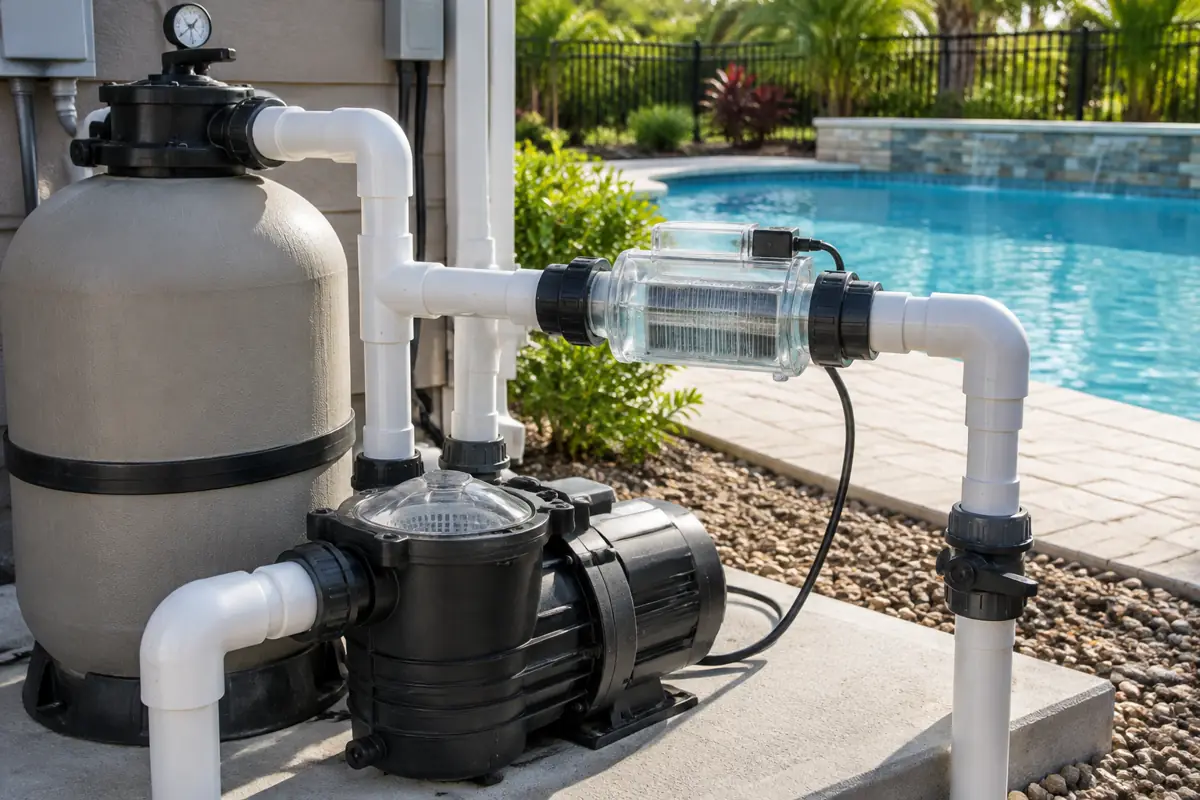
Fresh plaster raises pH (Virginia DOH), so a newly built or resurfaced pool needs acid on a schedule. The National Plasterers Council start-up card calls for pre-diluted muriatic acid (31 to 33% hydrochloric acid, mixed into a five gallon bucket of water) to bring total alkalinity to 80 to 100 ppm, then pH to 7.2 to 7.6, with the filter running continuously for seven days or until the plaster dust is gone, at least 72 hours, and no chlorine for the first 48 hours. NPC also cautions that cyanuric acid at 100 ppm or more may damage the surface permanently.
If you are planning a replaster, ask the contractor who handles start-up chemistry and for how long. Our pool resurfacing cost guide and pool remodeling page cover the job itself.
Muriatic acid safety: the part most how-to guides skip
These rules exist because people get hurt. CDC estimates pool chemicals cause about 4,500 emergency department visits a year, and national injury surveillance data put the 2024 estimate at 4,700 (PC&S pool injury research). CDC’s own maintenance advice includes flushing chlorine feed tubing with water before cleaning it with acid, and storing chemicals dry, separate and below 95 F.
Estimates carry wide confidence intervals; treat year-to-year changes with caution.
Source: Source: U.S. Consumer Product Safety Commission NEISS data, weighted by PC&S; see /research/pool-injury-statistics/.. Download chart data (CSV)
Troubleshooting high pH that will not stay down
| What you see | Likely cause | What to check or do | Source |
|---|---|---|---|
| pH back above 7.8 the day after acid | High total alkalinity, aeration or a salt cell | Test alkalinity; aim for 80 to 100 ppm; turn down water features | Virginia DOH; Orenda; Sensorex |
| pH crashed below 7.2 | Acid dose too large for the alkalinity | Raise with soda ash in small steps; see our raise pH guide | Virginia DOH |
| White crust on tile, rough heater or pump parts | Scale from high pH and calcium | Fix pH; have equipment inspected | Pennsylvania DOH |
| Hazy water with high pH | Calcium carbonate dropping out | Lower pH, run the filter; see our cloudy water guide | Pennsylvania DOH |
| Chlorine reads fine but algae or odor persists | At pH 8.0 only about 24% of free chlorine is active HOCl | Bring pH to 7.2 to 7.6 before adding more chlorine | Pennsylvania DOH |
| Strong fumes when pouring acid | Undiluted or splashed muriatic acid | Pre-dilute outdoors, face away, wear goggles and gloves | NPIC; Knorr Systems |
Sources: Virginia DOH; Pennsylvania DOH; NPIC; Orenda, Sensorex and Knorr Systems (manufacturer guidance). Download CSV
If you overshoot, our guide on how to raise pH in pool water has the soda ash charts, and hazy water after a pH swing is covered in cloudy pool water. Odor is a poor guide on its own: in a 2019 Healthy Pools survey, 23% of U.S. adults wrongly agreed that pool chemicals give off a strong odor when levels are correct (PC&S hygiene research). Test instead.
When a pool service is the better buy
Weekly acid is routine work for a pool cleaning service, which brings its own chemicals, gear and storage. See our pool service cost guide for what weekly plans charge. On the chemical side, producer prices for the inorganic acid series closest to muriatic acid were 8.6% below their 2019 level in August 2026, according to BLS data tracked in our pool chemical price research.
Frequently Asked Questions
How do I lower high pH in my pool quickly?
Add a measured dose of diluted muriatic acid with the pump running: 12 oz per 10,000 gallons drops pH about 0.2 (Florida DOH). Turn off waterfalls and jets while you correct, then retest after the water circulates.
How much muriatic acid to lower pH in a 10,000 gallon pool?
The Virginia DOH chart lists 12 oz at pH 7.6 to 7.8, 16 oz at 7.8 to 8.0, 24 oz at 8.0 to 8.4 and 32 oz above 8.4. Nothing is added at 7.4 to 7.6.
How much muriatic acid to add to a 20,000 gallon pool to lower pH?
Double the 10,000 gallon amounts: the Virginia DOH chart gives 24 oz at 7.6 to 7.8, 32 oz at 7.8 to 8.0, 48 oz at 8.0 to 8.4 and 64 oz above 8.4.
Which is better for lowering pH, muriatic acid or dry acid?
Both work; the difference is form and handling. Muriatic acid is a liquid you pre-dilute, dry acid is granular, and one pint of muriatic acid equals 1.25 lb of dry acid (Florida DOH). Salt pool owners in dry climates should use muriatic acid, per Hayward and Pentair.
Can I add dry acid directly to the pool?
Usually yes, per the label. FROG Products says sodium bisulfate does not need pre-dilution, and Virginia DOH allows acids added directly per label when no one is in the water. Broadcast it with the pump running and keep swimmers out until it dissolves.
What happens if pH is too high in a pool?
Chlorine weakens (24% active at pH 8.0 versus 66% at 7.2), water can cloud, scale forms on pipes and heaters, and swimmers notice odor and irritation (Pennsylvania DOH). Public pools above 8.0 face closure under the 2024 MAHC.
Is 7.8 pH too high for a pool?
It is the upper limit of CDC’s 7.0 to 7.8 range and Florida’s 7.2 to 7.8 rule, so it is allowed but not ideal. Pennsylvania recommends 7.2 to 7.6, and the Virginia chart starts adding acid at 7.6.
Why is my salt water pool pH always high?
Salt chlorine generators make chlorine by electrolysis, and Sensorex explains the byproducts have a very high pH, so pH climbs steadily. Plan on regular small doses of muriatic acid, which Pentair’s manual recommends.
Can baking soda lower pH in a pool?
No. Baking soda (sodium bicarbonate) is a base. Virginia DOH lists it among chemicals that raise pH, and it is used to raise total alkalinity. To lower pH you need an acid.
Can I use vinegar to lower pool pH?
We found no health department or label dose for vinegar. The 2024 Model Aquatic Health Code’s approved list for public pools names muriatic acid, sodium bisulfate, carbon dioxide and sulfuric acid as pH reducers, and vinegar is not on it.
How long after adding muriatic acid can you swim?
Follow the product label. Knorr Systems closes pools for at least 30 minutes after acid, Pennsylvania DOH says acid goes in while the pool is closed, and FROG suggests 4 to 6 hours of circulation before you judge the result.
How do I lower pH in a pool with high alkalinity?
Lower the alkalinity first, or pH will bounce back above 8.0 (Virginia DOH). Virginia lists 21 oz of muriatic acid per 10,000 gallons to drop alkalinity 10 ppm; aim for 80 to 100 ppm if your pH tends to rise.
Sources
- Centers for Disease Control and Prevention (CDC). Home Pool and Hot Tub Water Treatment and Testing (page updated May 10, 2024). Accessed 2026-10-08.
- Centers for Disease Control and Prevention (CDC). 2024 Model Aquatic Health Code, 5th Edition, Code Language (December 2024). Accessed 2026-10-08.
- Pennsylvania Department of Health. Public Swimming and Bathing Places: Operational and Biological Contamination Protocol Recommendations (November 1, 2016). Accessed 2026-10-08.
- Virginia Department of Health (Portsmouth Health Department). Pool Operation and Maintenance Guide (Portsmouth Health Department, compiled 2018). Accessed 2026-10-08.
- Florida Department of Health in Collier County. Swimming Pool Operators' Manual, 2016 Version (Chapter 2, Maintaining Water Chemistry). Accessed 2026-10-08.
- Knorr Systems (commercial pool equipment and chemical supplier; manufacturer guidance). Chemical Dosing Charts. Accessed 2026-10-08.
- FROG Products (manufacturer guidance). How to Lower pH in a Swimming Pool: A Step-by-Step Guide. Accessed 2026-10-08.
- Orenda Technologies (manufacturer guidance). Why does Soda Ash cloud up pool water?. Accessed 2026-10-08.
- Sensorex (sensor manufacturer guidance). How to Maintain pH in Saltwater Swimming Pools. Accessed 2026-10-08.
- Hayward (manufacturer manual). Aqua Rite Electronic Chlorine Generator Manual (092009N RevP). Accessed 2026-10-08.
- Pentair (manufacturer manual). IntelliChlor Salt Chlorine Generator Installation and User's Guide (IC15, IC20, IC40, IC60). Accessed 2026-10-08.
- National Plasterers Council. NPC Pool Start-up Card (National Plasterers Council procedure; copy hosted by Finest Finish Pools). Accessed 2026-10-08.
- National Pesticide Information Center (Oregon State University, cooperative agreement with U.S. EPA). Pool and Spa Chemicals Fact Sheet. Accessed 2026-10-08.
- U.S. Environmental Protection Agency (EPA). Chemical Safety Alert: Safe Storage and Handling of Swimming Pool Chemicals (EPA 550-F-01-003, March 2001). Accessed 2026-10-08.
- Centers for Disease Control and Prevention (CDC). Pool Chemical Safety (page updated June 24, 2025). Accessed 2026-10-08.
- U.S. Bureau of Labor Statistics. PPI series PCU3251803251803: Inorganic acids, excluding nitric, sulfuric and phosphoric. Accessed 2026-10-08.
- Pool Construction & Service. Public Pool Inspection Violations (PC&S research). Accessed 2026-10-08.
- Pool Construction & Service. Pool Injury Statistics (PC&S research). Accessed 2026-10-08.
- Pool Construction & Service. Pool Hygiene Statistics (PC&S research). Accessed 2026-10-08.
- Pool Construction & Service. Pool Chemical Prices (PC&S research). Accessed 2026-10-08.
Related pages
Get Quotes From Licensed Local Pool Pros
Tell us what you need and your ZIP code. We match you with pool companies that cover your area.