How to Shock a Pool: Steps, Doses and When to Swim Again
How to shock a pool: test, then add enough chlorine to reach 5 to 10 ppm (the EPA label range) or 10 times the combined chlorine, whichever is higher, with the pump running. Swim again at 4 ppm or less.
- ✓Shock level: 5 to 10 ppmSeven EPA-registered labels we read set superchlorination at 5 to 10 ppm free chlorine, every 7 days or after heavy use, rain or wind.
- ✓Breakpoint: 10 times combined chlorineThe 2024 Model Aquatic Health Code puts the breakpoint dose at about 10 times the combined chlorine and flags combined chlorine above 0.4 ppm.
- ✓Swim again at 4 ppm or lessMost labels prohibit re-entry above 4 ppm; Scorch and one trichlor label set 3 ppm. Public pools close above 10 ppm.
Key takeaways
- Shock means superchlorination, and seven EPA-registered labels we read set the dose at 5 to 10 ppm free chlorine, for example 9 to 18 oz of 73% calcium hypochlorite per 10,000 gallons (HTH Granular 73, EPA Reg. No. 1258-1239).
- Breakpoint chlorination takes about 10 times the combined chlorine, and the MAHC treats combined chlorine above 0.4 ppm as the level that calls for action (MAHC 5.7.4.4.2).
- Most labels prohibit swimming above 4 ppm free chlorine; the Scorch calcium hypochlorite label says 1.0 to 3.0 ppm.
- A diarrheal accident needs far more: 20 ppm for 12.75 hours with unstabilized chlorine, and 20.7 to 28 hours if the water holds cyanuric acid (MAHC 6.5.3.2).
- Never mix shock with acid or another pool chemical: CDC estimated 13,508 emergency visits for pool chemical injuries in 2015 to 2017, at least 56.3% at a residence (MMWR 2019).
What does shocking a pool actually do?
Shocking a pool raises free chlorine far above the 1 to 4 ppm swim range for a few hours so it can burn off chloramines, sweat, urine and early algae. The 2024 Model Aquatic Health Code calls this superchlorination, and calls the point where chloramines break apart the breakpoint, reached at about 10 times the combined chlorine.
Your test kit reads two chlorine numbers. Free chlorine (FC) is the chlorine still able to disinfect. Total chlorine (TC) adds the chlorine already tied up with ammonia and nitrogen waste. The difference, combined chlorine (CC), is the chloramine load behind the chlorine smell and red eyes. The Florida Department of Health operators manual says swimmers who smell chlorine usually have too little free chlorine, and that chloramines are removed by adding chlorine at 10 times the combined level. Our free chlorine vs total chlorine guide works through four sample readings, from a 0.2 ppm gap that needs nothing to a 1.5 ppm gap that needs a 15 ppm breakpoint shock.
The 2024 Model Aquatic Health Code glossary describes the chemistry: chlorine added to water that holds ammonia first forms monochloramine, then dichloramine, which breaks down to nitrogen gas. The MAHC treats 0.4 ppm combined chlorine as the action level for public pools (section 5.7.4.4.2); the Pennsylvania Department of Health sets 0.2 ppm and superchlorinates public pools weekly.
| Key number | Value | Applies to | Source |
|---|---|---|---|
| Shock (superchlorination) target | 5 to 10 ppm free chlorine | Home pools, by label directions | EPA labels: Hasachlor 10897-26, HTH Granular 73 1258-1239, Scorch 3432-76, Dichlor 98507-2 |
| Breakpoint dose | About 10 x combined chlorine | Any chlorinated pool | MAHC 2024 glossary; Florida DOH; Pennsylvania DOH |
| Combined chlorine action level | Above 0.4 ppm | Public pools (MAHC 5.7.4.4.2) | MAHC 2024 |
| Combined chlorine maximum | 0.2 ppm | Pennsylvania public pools | Pennsylvania DOH 2016 |
| Swim again (label re-entry) | 4 ppm or less (1.0 to 3.0 ppm on Scorch) | Home pools | EPA labels |
| Maximum with swimmers present | 10 ppm | Public pools (MAHC 6.6.3.1) | MAHC 2024 |
| Minimum free chlorine | 1 ppm; 2 ppm with cyanuric acid | Home pools | CDC 2024 |
| Test bleach-out | Above 10 ppm a DPD test can read falsely low or 0 | Any pool | CDC 2024 |
| Diarrheal incident | 20 ppm for 12.75 hours | Public pools without cyanuric acid (MAHC 6.5.3.2) | MAHC 2024 |
Sources: 2024 MAHC; CDC (2024); Pennsylvania DOH (2016); Florida DOH; EPA labels: Hasachlor, HTH Granular 73, Scorch, Dichlor 98507-2. Accessed October 2026. Download CSV
When should you shock a pool?
Shock on a schedule and on demand. The labels we read say every 7 days (7 to 10 days on one dichlor label) and after heavy swimmer loads, rain, wind or hot weather. Test results are sharper triggers: combined chlorine above 0.4 ppm, free chlorine below the CDC minimum, visible algae, cloudy water or a fecal accident.
- Weekly The Hasachlor, HTH Granular 73 and Scorch labels say every 7 days or as necessary; the Dichlor 98507-2 label says every 7 to 10 days during the swimming season.
- After heavy use, storms or heat HTH Granular 73 recommends extra shocks after rain and heavy winds, a high number of swimmers and higher water temperature; the dichlor label adds water that has lost its sparkle.
- Combined chlorine above 0.4 ppm Total chlorine minus free chlorine above 0.4 ppm is the MAHC action level. Pennsylvania DOH acts at 0.2 ppm.
- Free chlorine below the minimum CDC‘s floor is 1 ppm, or 2 ppm when the pool uses cyanuric acid, dichlor or trichlor.
- Pool opening The Hasachlor label calls for 50 to 100 fl oz per 10,000 gallons at spring start-up; the Comal 12.5% label says 52 to 104 oz.
- Algae or cloudy water The Scorch label doses 1 oz per 500 gallons for algae, then scrubbing, vacuuming and filtering. For haze, test before you shock: our cloudy pool water guide.
- Fecal accident Follow the MAHC fecal-incident procedure, which sets its own levels and contact times.
Low chlorine is a routine inspection finding. Sacramento County inspectors issued 1,333 minimum disinfectant residual citations at public pools from April 2023 to March 2026, according to our analysis of county inspection records.
What does the label say about shock dose?
Use the dose printed on your product’s EPA-registered label, scaled to your gallons. For a 5 to 10 ppm shock in 10,000 gallons, the labels we read call for 50 to 100 fl oz of 12.5% liquid chlorine, 9 to 18 oz of 73% calcium hypochlorite, 10 to 20 oz of 65% cal-hypo or 11 to 22 oz of 62% dichlor.
| Product (label, EPA Reg. No.) | Strength | 5,000 gal | 10,000 gal | 15,000 gal | 20,000 gal | 30,000 gal | 50,000 gal |
|---|---|---|---|---|---|---|---|
| Liquid chlorine (Hasachlor, 10897-26) | 12.5% sodium hypochlorite | 25 to 50 fl oz | 50 to 100 fl oz | 75 to 150 fl oz | 100 to 200 fl oz | 150 to 300 fl oz | 250 to 500 fl oz |
| Cal-hypo (HTH Granular 73, 1258-1239) | 73% calcium hypochlorite | 4.6 to 9.1 oz | 9.15 to 18.29 oz | 13.72 to 27.44 oz | 18.3 to 36.6 oz | 27.4 to 54.9 oz | 45.8 to 91.5 oz |
| Cal-hypo (Scorch, 3432-76) | 65% available chlorine | 5 to 10 oz | 10 to 20 oz | 15 to 30 oz | 20 to 40 oz | 30 to 60 oz | 50 to 100 oz |
| Dichlor (Dichlor Chlorinating Granules, 98507-2) | 62% available chlorine | 5.5 to 11 oz | 11 to 22 oz | 16.5 to 33 oz | 22 to 44 oz | 33 to 66 oz | 55 to 110 oz |
| Dichlor dihydrate (Pace, 1258-984) | 56% available chlorine | 6 to 12 oz | 12 to 24 oz | 18 to 36 oz | 24 to 48 oz | 36 to 72 oz | 60 to 120 oz |
Sources: EPA-registered labels Hasachlor 10897-26, HTH Granular 73 1258-1239, Scorch 3432-76, Dichlor 98507-2, Pace 1258-984. Columns other than those printed on each label are scaled by PC&S. Accessed October 2026. Download CSV
The 10,000 gallon column is printed on each label; the other columns scale it in a straight line, the method in the Virginia Department of Health operator guide (label amount x your gallons / label gallons). Printed values agree with that scaling: the HTH Granular 73 chart lists 13.72 to 27.44 oz for 15,000 gallons, and the dichlor chart lists 55 to 110 oz for 50,000 gallons.
At $8.99 for a 1 lb bag of 73% cal-hypo (Leslie’s listing, July 2026), one bag shocks 10,000 gallons to 8.75 ppm, so a 20,000 gallon pool needs two bags per shock. Our pool equipment and chemical price index tracks those listings. For everyday dosing between shocks, use our chlorine dose table by pool size. For bag counts, gallons of liquid and doses by goal and cyanuric acid level, see our table of how much shock to add to a pool.
How do you work out a breakpoint shock dose?
Subtract free chlorine from total chlorine to get combined chlorine, multiply by 10, and take the higher of that number and the 5 ppm label floor. The gap between your free chlorine and that target is the ppm to add. Convert it with the label rate or with lb = ppm x gallons x 8.34 / (1,000,000 x available chlorine).
| Step | Value | Arithmetic | Source |
|---|---|---|---|
| 1. Pool volume | 20,000 gal | 32 ft x 16 ft x 5.2 ft average depth x 7.5 = 19,968 gal, rounded | Label volume formula (HTH Granular 73) |
| 2. Free chlorine (FC) reading | 1.0 ppm | DPD test | CDC |
| 3. Total chlorine (TC) reading | 1.6 ppm | DPD test | CDC |
| 4. Combined chlorine (CC) | 0.6 ppm | 1.6 minus 1.0 | MAHC 2024 glossary |
| 5. Breakpoint target | 6.0 ppm | 10 x 0.6 = 6.0, above the 5 ppm label floor | MAHC 2024; EPA labels |
| 6. Chlorine to add | 5.0 ppm | 6.0 minus 1.0 | PC&S arithmetic |
| 7a. Liquid chlorine 12.5% | 100 fl oz (0.78 gal) | 10 fl oz x (20,000 / 10,000) x 5.0 | Hasachlor label chart (10 fl oz = 1 ppm in 10,000 gal) |
| 7b. Cal-hypo 73% | 1.14 lb (18.3 oz) | 5.0 x 20,000 x 8.34 / (1,000,000 x 0.73) | Formula; strength from HTH Granular 73 label |
| 7c. Dichlor 62% | 22 oz | 2.2 oz x (20,000 / 10,000) x 5.0 | Dichlor 98507-2 label chart (2.2 oz = 1 ppm in 10,000 gal) |
| 8. Side effect check (dichlor) | About 4.6 ppm cyanuric acid added | 5.0 ppm x 0.91 ppm CYA per ppm chlorine | PC&S arithmetic from PubChem molecular weights |
Sources: 2024 MAHC glossary; Hasachlor label; HTH Granular 73 label; Dichlor 98507-2 label; PubChem molecular weights. Arithmetic by PC&S. Download CSV
The Scorch algae figure is PC&S arithmetic: 20 oz of 65% product per 10,000 gallons. Diarrheal targets are public pool code (MAHC); home pools are not bound by it.
Source: EPA-registered labels (Hasachlor 10897-26, HTH Granular 73 1258-1239, Scorch 3432-76, Dichlor 98507-2), accessed October 2026; CDC 2024 Model Aquatic Health Code sections 6.5.3.1 and 6.5.3.2; breakpoint range is PC&S arithmetic (10 x combined chlorine). Download chart data (CSV)
Two cautions. CDC warns that above 10 ppm a DPD test can bleach out and read falsely low or 0, so a freshly shocked pool that reads 0 may be very high, not empty. And when free chlorine is already above the target, more shock does nothing useful; that case is covered in our guide on how to lower chlorine in a pool.
How to shock a pool, step by step
Test, fix pH, confirm gallons, measure the dose, add it at dusk with the pump on, keep the water moving at least 2 hours, and retest before anyone swims. Each step below carries the label or health-code number behind it, so you can check it against the product you bought.
- Test free chlorine, total chlorine and pHUse a DPD test kit, which CDC rates as more accurate than strips. The breakpoint math needs free and total chlorine.
- Bring pH to 7.2 to 7.6 firstThe HTH Granular 73 and Scorch labels set 7.2 to 7.6, and the dichlor label says not to adjust pH and chlorinate at the same time. If pH is high, use our guide on how to lower pH in pool water.
- Confirm your gallonsLabels use length x width x average depth x 7.5 for rectangular pools and diameter x diameter x average depth x 5.9 for round ones. The same math runs in our pool volume calculator.
- Measure the doseUse the dose table or the breakpoint example, and a clean, dry scoop kept for that product only (HTH Granular 73 label).
- Add it at dusk with the pump runningHTH Granular 73 says add it in the evening while the filter pump runs and broadcast it over a wide area of the deep end; the BioGuard 73 label says at night or when the pool is not in use. Florida DOH notes that sunlight breaks down unstabilized chlorine.
- Pour liquid, broadcast granules, pre-dissolve for vinylPour liquid chlorine slowly into the pool water. The Scorch label says vinyl pools get a solution of 1 oz in 2 quarts of water, mixed in a clean pail by adding product to water, never water to product.
- Keep the water movingThe dichlor label says run the filter and pump at least 2 hours after adding chlorine; HTH allows 30 minutes for the product to disperse before testing. Brush algae and vacuum through the filter (Scorch label).
- Retest before swimmingSwim only when free chlorine reads 4 ppm or less (1.0 to 3.0 ppm on Scorch) and pH is back in range. Florida DOH describes a full public-pool superchlorination as an 18 to 24 hour procedure.
Do you pour shock straight in, and should the pump run?
Run the pump every time; whether you pour straight in depends on the product. All 7 labels in the table assume the filter and pump are running. Liquid chlorine and most granular cal-hypo and dichlor go straight into the water; Scorch wants a pre-dissolved solution in vinyl pools, and trichlor tablets never go loose on the floor.
| Product (EPA Reg. No.) | Form | How the label says to add it | Pre-dissolve? | Swim again |
|---|---|---|---|---|
| Hasachlor 12.5% (10897-26) | Liquid sodium hypochlorite | Add manually or by feeder; super-chlorinate with 50 to 100 fl oz per 10,000 gal every 7 days | No | Entry prohibited above 4 ppm |
| Comal Sodium Hypochlorite 12.5% (103607-1) | Liquid sodium hypochlorite | 52 to 104 oz per 10,000 gal every 7 days or as necessary | No | Re-entry prohibited above 4 ppm |
| HTH Granular 73 (1258-1239) | Granular cal-hypo, 73% | Evening, filter pump running; broadcast over a wide area of the deepest part; brush settled granules | No | Re-entry prohibited above 4 ppm |
| BioGuard Calcium Hypochlorite 73 (5185-515) | Granular cal-hypo, 73% | 1 lb per 16,500 gal at night or when the pool is not in use | No (label claim: no need to pre-dissolve) | Re-entry prohibited above 4 ppm |
| Scorch (3432-76) | Granular cal-hypo, 65% available | Concrete pools: scatter over the surface. Vinyl pools: add as a solution, 1 oz in 2 qt of water in a clean pail | Yes, for vinyl pools | Not until 1.0 to 3.0 ppm |
| Dichlor Chlorinating Granules (98507-2) | Granular dichlor, 62% | Broadcast over the surface with filter and pump running; run them at least 2 hours after adding | No | Ready at 1 to 4 ppm; prohibited above 4 ppm |
| HTH Super 3 inch tablets (1258-1338) | Trichlor tablet, 84% available | Feeder, floater or clean skimmer only; 1 tablet per 10,000 gal per week; never thrown into the pool | Not a shock product | Re-entry prohibited above 4 ppm |
Sources: Hasachlor 10897-26; Comal 103607-1; HTH Granular 73 1258-1239; BioGuard 73 5185-515; Scorch 3432-76; Dichlor 98507-2; HTH Super 3 inch tablets 1258-1338. Labels on the EPA Pesticide Product and Label System, accessed October 2026. Download CSV
Rather have a pro handle the chemistry?
How long after shocking a pool can you swim?
Swim when a test says so, not when a clock does. Most EPA-registered labels prohibit re-entry above 4 ppm free chlorine, and Scorch and the Olympic trichlor label set 3 ppm. Guides quote 8 to 24 hours (HTH Pools) or 24 to 48 hours after a heavy granular shock (In The Swim), because dose, sunlight and swimmers change the decay rate.
| Source | Type | Swim again when free chlorine is | Time quoted |
|---|---|---|---|
| Scorch, EPA Reg. No. 3432-76 | EPA-registered label | 1.0 to 3.0 ppm | None; test |
| Olympic 3 inch trichlor, EPA Reg. No. 42177-18 | EPA-registered label | 3 ppm or less | None; test |
| HTH Granular 73, EPA Reg. No. 1258-1239 | EPA-registered label | 4 ppm or less | Allow 30 minutes to disperse, then test |
| Hasachlor, EPA Reg. No. 10897-26 | EPA-registered label | 4 ppm or less | None; test |
| Dichlor Chlorinating Granules, EPA Reg. No. 98507-2 | EPA-registered label | 1 to 4 ppm | Run pump at least 2 hours |
| BioGuard Calcium Hypochlorite 73, EPA Reg. No. 5185-515 | EPA-registered label | 4.0 ppm or less | None; test |
| HTH Pools how-to guide | Manufacturer guide | 1 to 4 ppm | Typically 8 to 24 hours |
| In The Swim shock eGuide | Retailer guide | Below 5 ppm | 12 to 24 hours; 24 to 48 hours after heavy granular shock |
| Pennsylvania DOH (public pools) | State guidance | 2 to 4 ppm during open hours, never above 5 ppm | Superchlorinate during closure |
| 2024 MAHC 6.6.3.1 (public pools) | Model code | Not above 10 ppm with bathers present | None |
| Florida DOH operators' manual (public pools) | State manual | Reopen when free chlorine drops to 10.0 ppm | 18 to 24 hour procedure |
Sources: EPA labels Scorch, Olympic 42177-18, HTH Granular 73, Hasachlor, Dichlor 98507-2, BioGuard 73; HTH Pools guide; In The Swim eGuide; Pennsylvania DOH; 2024 MAHC; Florida DOH. Accessed October 2026. Download CSV
For a home pool, the label on the product you used is the legal limit. Retest before swimming.
Source: EPA-registered labels on the EPA Pesticide Product and Label System; In The Swim shock eGuide; Pennsylvania DOH 2016; Florida DOH Collier County operators' manual 2016; CDC 2024 Model Aquatic Health Code 6.6.3.1. Accessed October 2026. Download chart data (CSV)
For a home pool the label is the binding rule: the Hasachlor label states that using the product inconsistently with its labeling violates federal law. The 10 ppm figures belong to public pool codes, where the MAHC treats free chlorine above 10 ppm with bathers present as an imminent health hazard. The exact re-entry wording on 11 labels, wait estimates by starting dose and hot tub limits are in our guide on how long after shocking a pool you can swim.
How do you shock a pool after poop or diarrhea?
Use the MAHC fecal-incident procedure, written for public pools and the most detailed published method. Formed stool: remove it, then hold at least 2 ppm for 25 minutes. Diarrhea: hold 20 ppm for 12.75 hours with pH 7.5 or lower, water at 77 F or warmer and unstabilized chlorine only. Cyanuric acid stretches those times.
The long hold exists for one parasite. CDC‘s table shows 1 ppm free chlorine kills E. coli O157:H7 in under a minute but needs about 15,300 minutes, or 10.6 days, for Cryptosporidium. The MAHC’s 20 ppm for 12.75 hours delivers the same 15,300 mg min/L dose. Cryptosporidium caused 186 treated recreational water outbreaks and 4,944 cases reported to CDC from 2009 to 2023, according to our pool illness outbreak registry.
| Starting cyanuric acid (ppm) | Share of pool drained and refilled | Hours at 20 ppm | Hours at 30 ppm | Hours at 40 ppm |
|---|---|---|---|---|
| None (MAHC 6.5.3.2) | 0% | 12.75 | not listed | not listed |
| 15 or less | 0% | 28 | 18 | 8.5 |
| 30 | 50% | 25.2 | 16.2 | 7.7 |
| 50 | 70% | 23.2 | 14.9 | 7.0 |
| 70 | 79% | 21.8 | 14.0 | 6.6 |
| 90 | 83% | 20.7 | 13.3 | 6.3 |
Source: CDC 2024 Model Aquatic Health Code, sections 6.5.3.2 and 6.5.3.2.1. Pools with cyanuric acid first drain and refill to 15 ppm or less. Accessed October 2026. Download CSV
The no cyanuric acid bar is 12.75 hours (the bar label rounds it to 12.8). The MAHC is a model code for public pools. At 40 ppm the table lists 8.5 hours for CYA of 15 ppm or less.
Source: CDC 2024 Model Aquatic Health Code, sections 6.5.3.2 and 6.5.3.2.1, Table 6.5.3.2.1. Accessed October 2026. Download chart data (CSV)
Which pool shock should you use?
Pick the shock by what else it leaves behind. Liquid chlorine and calcium hypochlorite add no stabilizer, so they suit repeated shocks and fecal-incident holds. Dichlor adds about 0.9 ppm cyanuric acid for every 1 ppm of chlorine, cal-hypo about 0.7 ppm calcium hardness, and trichlor tablets are for slow daily feeding, not shocking.
| Product type | Available chlorine | pH effect in water | Also adds, per 10 ppm chlorine | Best use | Source |
|---|---|---|---|---|---|
| Liquid chlorine (sodium hypochlorite) | 10 to 12% (Florida DOH); 11.9% on the Comal 12.5% label | Raises | Nothing that builds up | Repeated shocks, fecal incidents, vinyl pools | Florida DOH; Comal label 103607-1 |
| Calcium hypochlorite (cal-hypo) | 65 to 78% (Florida DOH); 65% and 73% labels | Raises | About 7.1 ppm calcium hardness | Weekly shock in plaster pools; pre-dissolve for vinyl (Scorch) | Florida DOH; PubChem; Scorch label |
| Dichlor | 56 to 63% (Florida DOH); 62% on label 98507-2 | Neutral | About 9.1 ppm cyanuric acid | Occasional shock while cyanuric acid is low | Florida DOH; PubChem |
| Trichlor | 90% (Florida DOH); 84% on HTH Super 3 inch tablets | Lowers | About 6.1 ppm cyanuric acid | Slow daily feed in tablets, not shocking | Florida DOH; PubChem; label 1258-1338 |
| Potassium monopersulfate (non-chlorine shock) | None | not listed | No free chlorine; false high combined chlorine on DPD tests | Oxidizing waste between chlorine shocks | MAHC 2024 Annex |
Sources: Florida DOH operators manual (disinfectant chart); Comal 103607-1 label; Scorch label; Dichlor 98507-2 label; label 1258-1338; 2024 MAHC Annex; PubChem. Cyanuric acid and calcium figures are PC&S stoichiometric estimates. Download CSV
Where the per-10-ppm figures come from: one trichlor molecule (232.41 g/mol on PubChem) releases chlorine equal to 3 x 70.90 g of Cl2 and leaves one cyanuric acid molecule (129.07 g/mol), so each 1 ppm of chlorine leaves about 0.61 ppm of cyanuric acid. Dichlor’s ratio is 129.07 / 141.80 = 0.91, and cal-hypo leaves 100.09 / 141.80 = 0.71 ppm of calcium hardness, counted as calcium carbonate. These are PC&S estimates, not label claims. Our calcium hardness pool guide shows what that calcium does to the saturation index and how to dilute it when it climbs past 400 ppm.
That arithmetic is why stabilized shock runs out of road. Ten 10 ppm dichlor shocks add about 91 ppm of cyanuric acid, past the 90 ppm ceiling the MAHC sets for public pools (5.7.3.1.3.2). Our guide to cyanuric acid in pools covers testing and lowering it. That build-up is what pool owners call chlorine lock, and our chlorine lock guide shows how to test for it.
Which shock level does your situation need?
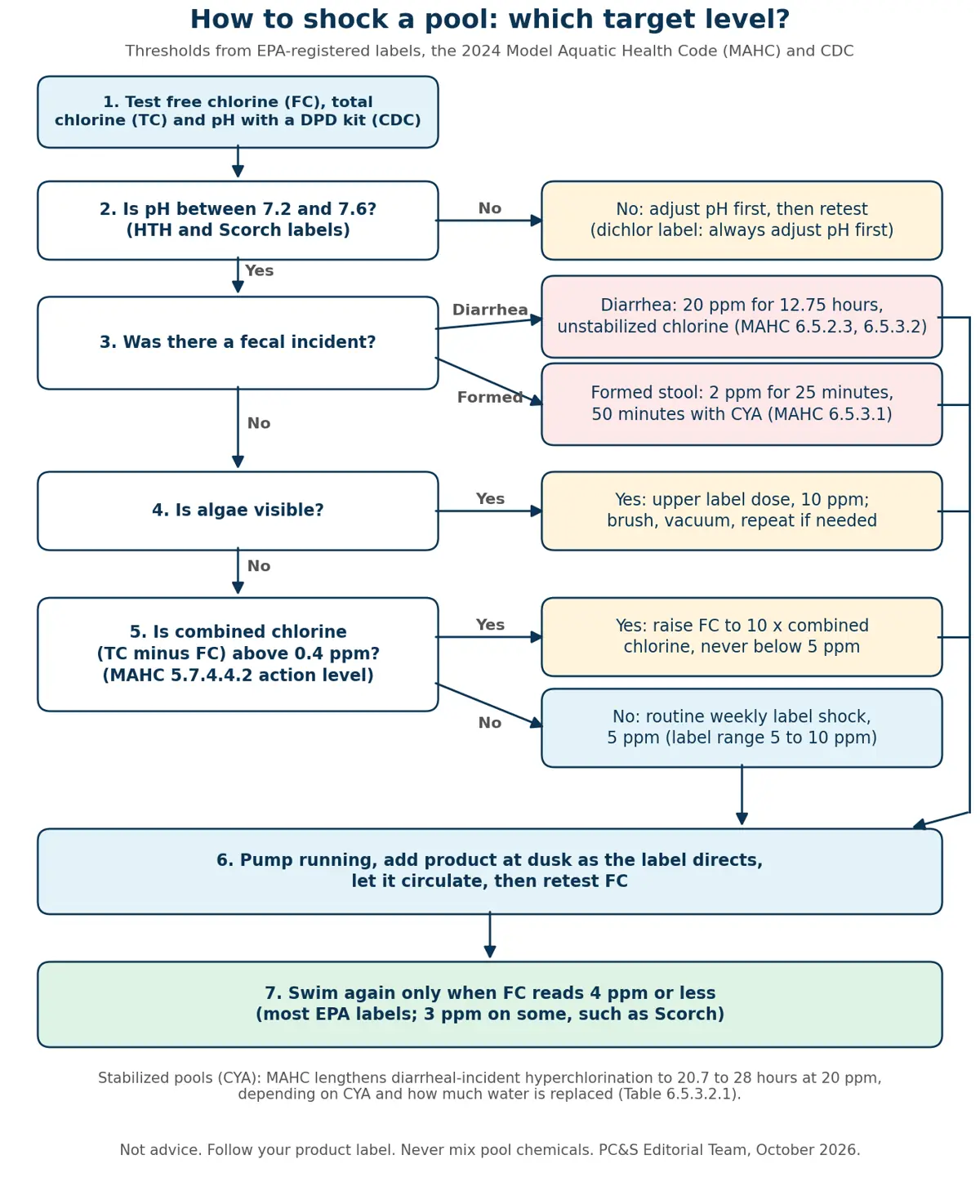
Match your test reading to a rule. The decision table turns the 5 to 10 ppm label range, the 10 times combined chlorine breakpoint rule and the 20 ppm fecal-incident hold into if-then steps, and the flowchart under it holds the same logic in picture form for quick use at the pool.
| If your situation is | Do this | Source |
|---|---|---|
| pH above 7.6 (or below 7.2) | Adjust pH first and retest; do not adjust pH and chlorinate at the same time | HTH Granular 73 and Scorch labels; Dichlor 98507-2 label |
| Diarrheal accident, no cyanuric acid | Close the pool; hold 20 ppm for 12.75 hours with pH 7.5 or lower, water 77 F or warmer, unstabilized chlorine only | MAHC 6.5.2.3 and 6.5.3.2 |
| Diarrheal accident, cyanuric acid present | Drain to 15 ppm CYA or less, then 20 ppm for 20.7 to 28 hours (or 40 ppm for 6.3 to 8.5 hours) per MAHC Table 6.5.3.2.1 | MAHC 6.5.3.2.1 |
| Formed stool | Remove it; hold at least 2 ppm for 25 minutes (50 minutes with cyanuric acid) | MAHC 6.5.3.1 |
| Visible algae | Use the upper label dose (10 ppm; Scorch: 1 oz per 500 gal), brush, vacuum, filter, repeat if needed | Scorch label 3432-76; HTH Granular 73 label |
| Combined chlorine above 0.4 ppm | Raise free chlorine to 10 x combined chlorine, never below 5 ppm | MAHC 5.7.4.4.2 and glossary; EPA labels |
| Combined chlorine 0.4 ppm or less, routine week | Label weekly shock at the low end, 5 ppm | EPA labels (every 7 days or as necessary) |
| Free chlorine reads 0 right after a shock | Add no more: above 10 ppm a DPD test can bleach out and read falsely low or 0. Retest later, following the test kit maker's directions | CDC 2024 |
| Cyanuric acid near 90 ppm | Shock with liquid chlorine or cal-hypo, not dichlor; each 10 ppm from dichlor adds about 9.1 ppm CYA | MAHC 5.7.3.1.3.2; PC&S arithmetic |
| Vinyl liner | Use liquid chlorine, or pre-dissolve cal-hypo (1 oz in 2 qt of water) per the Scorch label | Scorch label 3432-76 |
| Free chlorine above 4 ppm | Keep swimmers out and retest; let sunlight and time bring it down | EPA labels |
Sources: 2024 MAHC; CDC (2024); EPA labels HTH Granular 73, Scorch, Dichlor 98507-2. Accessed October 2026. Download CSV
How do you shock a pool safely?
Treat shock as the strong oxidizer its label says it is. Add product to water, never water to product; never mix shock with acid, tablets or another chemical; keep each product dry, in its own container and below 95 F; and wear goggles and gloves. Most of the pool chemical injuries CDC counted happened at a home.
CDC’s analysis of emergency department data estimated 13,508 visits for pool chemical injuries in 2015 to 2017; 36.4% of patients were under 18, and at least 56.3% of injuries happened at a residence (MMWR, 2019). The newer federal numbers are in our pool injury statistics report.
The EPA chemical safety alert (EPA 550-F-01-003, March 2001) names the two classic accidents: a small amount of water splashed onto dry chlorine, which can trigger heat and toxic gas, and mixing incompatible products, which can start fires or release chlorine gas. The Hasachlor label adds that mixing liquid chlorine with acids, ammonia, detergents or urine releases chlorine gas.
How we compiled this
We read 10 EPA-registered pool chlorine labels from the EPA Pesticide Product and Label System, the 2024 Model Aquatic Health Code and its Annex, CDC’s home pool page and 2019 MMWR injury report, and operator manuals from the Florida, Pennsylvania and Virginia health departments, all accessed in October 2026. Doses for unprinted pool sizes and the cyanuric acid and calcium figures are PC&S arithmetic, shown in the tables. Two consumer guides (HTH Pools, In The Swim) appear only where we compare what guides say with what labels say; forum posts were excluded.
Frequently Asked Questions
What is the proper way to shock a pool?
Test free chlorine, total chlorine and pH, set pH to 7.2 to 7.6, then add enough chlorine to reach 5 to 10 ppm or 10 times the combined chlorine, whichever is higher. Add it at dusk with the pump running, keep the pump on at least 2 hours, and swim only at 4 ppm or less.
Are chlorine and shock the same thing?
Chlorine shock is the same chemical at a higher dose. The HTH Granular 73 label uses one product for daily chlorination (5 to 7 oz per 10,000 gallons in unstabilized pools) and for shock (9 to 18 oz). Non-chlorine shock is different: potassium monopersulfate oxidizes waste but adds no free chlorine. Our comparison of liquid chlorine vs shock sets the cost per ppm, shelf life and storage class of each product side by side.
Do you just pour shock directly into the pool?
Liquid chlorine, yes. Most granular cal-hypo and dichlor labels say to broadcast it over the deep end with the pump running. The Scorch label is the exception for vinyl pools: dissolve 1 oz in 2 quarts of water in a clean pail first, adding product to water, never the reverse.
Should I run a pump when shocking the pool?
Yes. The dichlor 98507-2 label says broadcast while the filter and pump run and keep them running at least 2 hours, and the HTH Granular 73 label says add it in the evening while the filter pump runs. Florida DOH describes public pool superchlorination as an 18 to 24 hour procedure.
Do you put shock and chlorine in a pool at the same time?
Not mixed together. Tablets can stay in their feeder while you shock with liquid or cal-hypo, but the products must never touch: the HTH 3 inch trichlor label warns of fire, explosion and toxic gas on contact with other pool products. Adjust pH at a different time from chlorinating, as the 98507-2 label says.
Will shocking a pool get rid of dirt?
No. Shock oxidizes dissolved waste such as sweat, urine and chloramines and kills algae, but dirt, leaves and dead algae stay until the filter, brush or vacuum removes them. The Scorch label pairs its 1 oz per 500 gallon algae dose with scrubbing, vacuuming and cycling the water through the filter. For water that has already turned green, the severe-bloom dose and how long clearing takes are in our guide on how to clear a green pool. If the water turns hazy afterward, our guide to a cloudy pool after shock shows how long the filter needs.
How often should you shock a pool?
Every 7 days or as needed, per the labels we read (every 7 to 10 days on the 98507-2 dichlor label), plus after storms, heavy use or hot weather. A test is the better trigger: shock when combined chlorine passes 0.4 ppm, the MAHC action level, or free chlorine falls below the CDC minimum of 1 ppm.
How long after shocking a pool can you swim?
When free chlorine tests at 4 ppm or less, the re-entry limit on most EPA labels (1.0 to 3.0 ppm on Scorch). That often takes overnight: HTH Pools quotes 8 to 24 hours, and In The Swim says 24 to 48 hours after a heavy granular shock. Retest rather than counting hours.
Sources
- Centers for Disease Control and Prevention (CDC). Home Pool and Hot Tub Water Treatment and Testing (page dated May 10, 2024). Accessed 2026-10-19.
- Centers for Disease Control and Prevention (CDC). 2024 Model Aquatic Health Code, 5th Edition, Code Language. Accessed 2026-10-19.
- Centers for Disease Control and Prevention (CDC). 2024 Model Aquatic Health Code, 5th Edition, Annex. Accessed 2026-10-19.
- CDC, Morbidity and Mortality Weekly Report. Pool Chemical Injuries in Public and Residential Settings, United States, 2008 to 2017 (MMWR 2019;68(19)). Accessed 2026-10-19.
- Centers for Disease Control and Prevention (CDC). Pool Chemical Safety (page dated June 24, 2025). Accessed 2026-10-19.
- U.S. Environmental Protection Agency (EPA). Chemical Safety Alert: Safe Storage and Handling of Swimming Pool Chemicals (EPA 550-F-01-003). Accessed 2026-10-19.
- National Pesticide Information Center (Oregon State University and U.S. EPA). Pool and Spa Chemicals Fact Sheet. Accessed 2026-10-19.
- Florida Department of Health in Collier County. Swimming Pool Operators' Manual, 2016 Version. Accessed 2026-10-19.
- Pennsylvania Department of Health. Public Swimming and Bathing Places: Operational and Biological Contamination Protocol Recommendations (November 1, 2016). Accessed 2026-10-19.
- Virginia Department of Health (Portsmouth Health Department). Pool Operation and Maintenance Guide (Portsmouth Health Department, June 2018). Accessed 2026-10-19.
- Hasa, Inc. label on file with U.S. EPA (Pesticide Product and Label System). Hasachlor (sodium hypochlorite 12.5%), EPA Reg. No. 10897-26, label notification accepted April 24, 2026. Accessed 2026-10-19.
- Comal Chemical label on file with U.S. EPA (Pesticide Product and Label System). Sodium Hypochlorite 12.5% (Comal Chemical), EPA Reg. No. 103607-1, registration issued September 28, 2025. Accessed 2026-10-19.
- Champak label on file with U.S. EPA (Pesticide Product and Label System). Sodium Hypochlorite Solution 12.5% (Champion Pool Shock Liquid Chlorinator), EPA Reg. No. 55852-3, label dated February 4, 2020. Accessed 2026-10-19.
- Innovative Water Care label on file with U.S. EPA (Pesticide Product and Label System). HTH Granular 73 (calcium hypochlorite 73%), EPA Reg. No. 1258-1239, label file dated February 24, 2025. Accessed 2026-10-19.
- BioLab label on file with U.S. EPA (Pesticide Product and Label System). BioGuard Calcium Hypochlorite 73, EPA Reg. No. 5185-515, label dated May 21, 2024. Accessed 2026-10-19.
- N. Jonas & Co. label on file with U.S. EPA (Pesticide Product and Label System). Scorch (calcium hypochlorite 68%, 65% available chlorine), EPA Reg. No. 3432-76, label notification September 22, 2025. Accessed 2026-10-19.
- Swimables Inc. label on file with U.S. EPA (Pesticide Product and Label System). Dichlor Chlorinating Granules (62% available chlorine), EPA Reg. No. 98507-2, registration issued December 8, 2025. Accessed 2026-10-19.
- Innovative Water Care label on file with U.S. EPA (Pesticide Product and Label System). Pace Concentrated Pool Chlorinating Granules (dichlor dihydrate, 56% available chlorine), EPA Reg. No. 1258-984, label dated June 21, 2018. Accessed 2026-10-19.
- Innovative Water Care label on file with U.S. EPA (Pesticide Product and Label System). AW30 (HTH Super 3 inch chlorinating tablets, trichlor 93.6%, 84% available chlorine), EPA Reg. No. 1258-1338, label dated July 2, 2026. Accessed 2026-10-19.
- Alliance Trading label on file with U.S. EPA (Pesticide Product and Label System). Olympic Chlorinated Tablets 3 inch (trichlor 99%, 90% available chlorine), EPA Reg. No. 42177-18, label dated November 8, 2011. Accessed 2026-10-19.
- U.S. Environmental Protection Agency (EPA). Pesticide Product and Label System record lookups (product status Active for all labels cited). Accessed 2026-10-19.
- National Library of Medicine, PubChem. PubChem compound records: cyanuric acid (CID 7956), trichloroisocyanuric acid (CID 6909), sodium dichloroisocyanurate (CID 517121), calcium hypochlorite (CID 24504), chlorine (CID 24526), calcium carbonate (CID 10112). Accessed 2026-10-19.
- Knorr Systems (commercial pool supplier; manufacturer guidance). Chemical Dosing Charts. Accessed 2026-10-19.
- HTH Pools (manufacturer guide). How to Shock a Pool: Step-by-Step Pool Shock Treatment Guide. Accessed 2026-10-19.
- In The Swim (retailer guide). Swimming Pool Shock eGuide (read via Wayback Machine 2026 capture). Accessed 2026-10-19.
- Leslie's (retail listing) via PC&S research: /research/pool-equipment-prices/. Leslie's 1 lb Power Powder Plus 73% Calcium Hypochlorite Pool Shock, listed price (Wayback capture July 19, 2026). Accessed 2026-10-19.
- Centers for Disease Control and Prevention (CDC) via PC&S research: /research/swimming-pool-illness-outbreaks/. NORS public dataset, treated recreational water outbreaks (PC&S tabulation). Accessed 2026-10-19.
- Sacramento County (Environmental Management Department data) via PC&S research: /research/public-pool-inspection-violations/. Pool Inspections: Facilities and Inspection & Violation History. Accessed 2026-10-19.
Related pages
Get Quotes From Licensed Local Pool Pros
Tell us what you need and your ZIP code. We match you with pool companies that cover your area.