Pool Planning Checklist: 40 Decisions Before You Sign
This pool planning checklist lists 40 decisions to settle before you sign a contract, from setbacks and barrier law to pump type, heating, budget and payment terms.
- ✓Pool planning checklist in 8 groups40 decisions grouped by budget, site, rules, design, season, equipment, safety and contract.
- ✓Built on official checklistsDrawn from city plan-review lists, state contract rules and federal energy and safety data.
- ✓Local rules flaggedBarrier rules: 20 of 51 US jurisdictions mandate one statewide; 15 states leave it to local codes (PC&S review).
How to use this pool planning checklist
Work through the 40 decisions before you ask for bids. Builders price what you specify; anything you leave open, they decide.
The decisions start where a city plan reviewer starts: the site plan. Herriman, Utah’s plan checklist, for example, asks for the pool’s distance to property lines, the barrier and gate swing, the equipment location, every disconnect and every GFCI receptacle before anything is approved (Herriman City). If you settle these first, every bid you collect prices the same project. Then use how to choose a pool builder to compare the bids.
Decisions 1 to 5: goals and total budget
Budget for the whole backyard, not just the pool.
- 1. Who will use the pool, and how Laps, play, entertaining or cooling off set the length, depth and shallow area. Write it down; it is the brief every bidder should price.
- 2. Total project budget Angi’s typical installed range is $44,499 to $87,349 (2026). River Pools, a manufacturer, says electrical, patio, fencing and accessories often add $25,000 to $50,000.
- 3. Yearly running budget Plan $3,000 to $5,000 a year for upkeep, water and electricity (Angi, 2026).
- 4. How you will pay Banks averaged 11.86% on 24-month personal loans in 2026 Q2 (Federal Reserve G.19). Compare options in the inground pool cost guide.
- 5. How long you will stay Seven US studies put the pool premium at a median 5.4% of home value; REALTORS estimated 56% cost recovery on a $90,000 pool in 2023 (PC&S home value review).
| Budget line | Published range | Source |
|---|---|---|
| Pool, installed | $44,499 to $87,349 | Angi (2026) |
| Spa built with the pool (gunite) | $14,512 to $26,927 | California BOE AH 531 (2026) |
| Gas heater, 125,000 Btu per hour | $4,010 average | California BOE AH 531 (2026) |
| Pool fence | $1,500 to $10,000 | Angi (2026) |
| Pool decking | $3,000 to $12,000 | Angi (2026) |
| Automatic safety cover | $8,000 to $20,000 | HomeGuide (2025) |
| Landscaping | $3,000 to $5,000 | HomeGuide (2025) |
| Permits | $450 to $1,800 | Angi (2026) |
| Electrical, patio, fencing and accessories, if quoted separately | $25,000 to $50,000 | River Pools (manufacturer) |
| Yearly running costs | $3,000 to $5,000 | Angi (2026) |
Sources: Angi (2026), California BOE AH 531 (2026), HomeGuide (2025), River Pools Download CSV
Decisions 6 to 10: site, soil and access
The yard decides what is possible and what it costs.
- 6. Setbacks and placement Get your lot survey and ask the city for pool setbacks from property lines, the house and easements. Plan reviewers expect the distances on the site plan (Herriman).
- 7. Buried and overhead utilities Contact 811 a few business days before any digging (811). Ask the builder to plan around marked lines before the design is final.
- 8. Soil and slope Some cities require a soils report from a licensed geotechnical engineer after the dig (Herriman). Ask bidders how they price rock, clay or groundwater.
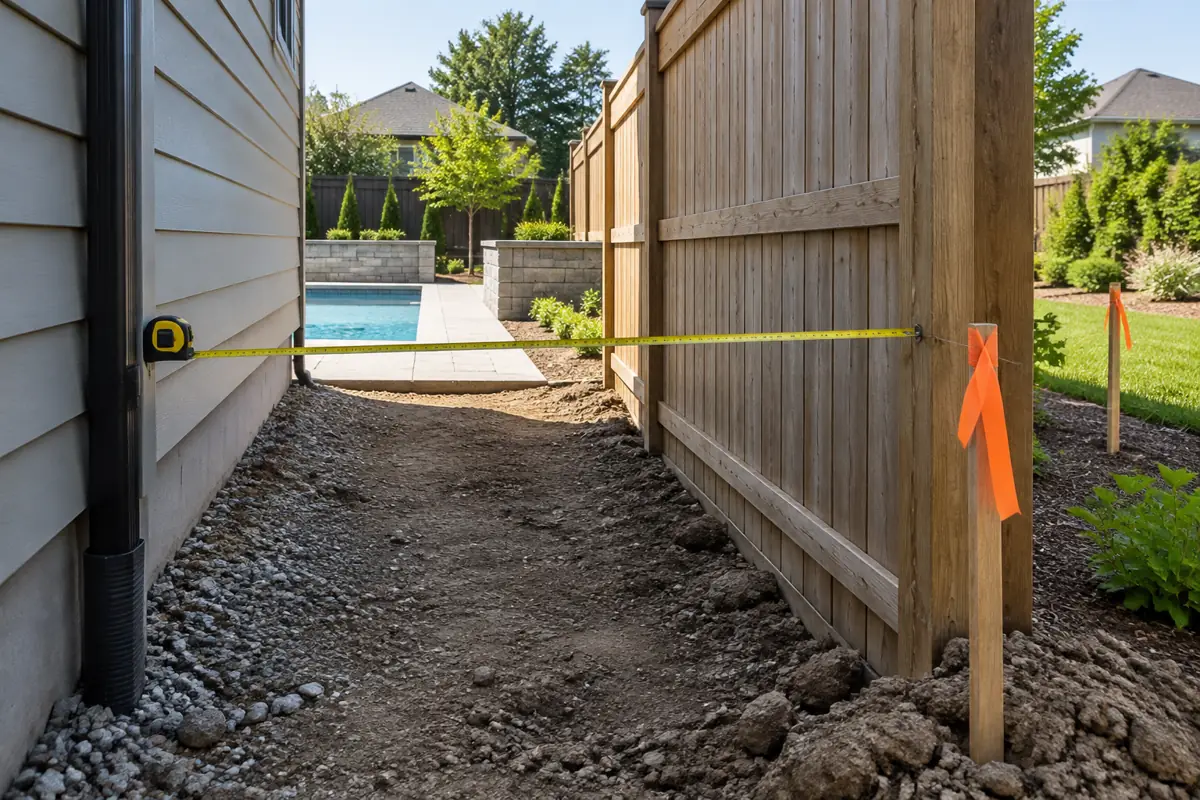
- 9. Access for equipment Excavators and, for fiberglass, a truck and crane must reach the yard. Measure gates and side yards and ask what happens if a fence or wall must come down.
- 10. Equipment pad location Pump, filter and heater need power, gas or space for a heat pump, and a spot away from bedroom windows. Plan reviewers want it on the site plan (Herriman).
Decisions 11 to 15: permits, barrier law, tax and insurance
Rules differ by state and city, so confirm each one locally.
- 11. Permit timing Median waits from application to pool permit issue ran from 1 to 70 days across 12 jurisdictions in 2025 (PC&S permit study). Build that into your start date.
- 12. Barrier rules 20 of 51 US jurisdictions mandate a barrier statewide; 30 of the 32 states with a height rule set 48 inches, and Arizona and California 60 inches (PC&S fence law review).
- 13. HOA approval If you have a homeowners association, get its written approval of design, fence and equipment location before permits.
- 14. Property tax A $40,000 pool adds a median $698.04 a year across 18 large counties; Arizona re-sets taxed value only when construction changes it by 15% of full cash value (PC&S property tax study).
- 15. Insurance The Insurance Information Institute calls a pool an attractive nuisance and suggests liability of at least $300,000 or $500,000, or an umbrella policy. Call your insurer before you sign.
| State | Statewide barrier mandate | Minimum barrier height | Self-closing, self-latching gate | Door or window alarm | Safety cover option |
|---|---|---|---|---|---|
| Arizona | Partial | 60 in | Yes | No | Yes |
| California | Partial | 60 in | Yes | Yes | Yes |
| Connecticut | Yes | 48 in | Yes | Required | Yes |
| Florida | Yes | 48 in | Yes | Yes | Yes |
| New York | Yes | 48 in | Yes | Required | Yes |
| Texas | Partial | 48 in | Yes | Yes | Yes |
Source: PC&S review of state statutes and codes; A.R.S. 36-1681; California Health and Safety Code Download CSV
Source: PC&S review of state statutes and codes; U.S. Census Bureau Vintage 2025. Download chart data (CSV)
Decisions 16 to 20: type, size, depth and features
These five decisions set most of the price.
- 16. Pool type California’s 2026 assessor schedule prices concrete at $94 to $173 per square foot, fiberglass at $70 to $94 and liner pools at $45 to $70 (BOE). Compare them in gunite vs fiberglass vs vinyl pool.
- 17. Size and shape A 12×24 pool ranges from $23,000 to $72,000 in HomeGuide’s table. Simple rectangles and ovals cost least (HomeGuide).
- 18. Depth HomeGuide says the average pool is 6 to 7 feet deep, and a diving board may need a deep end of 9 or more feet. Herriman requires handholds where depth exceeds 42 inches.
- 19. Spa now or never HomeGuide prices an attached spa at $6,000 to $15,000 when built with the pool and $8,000 to $25,000 when added later.
- 20. Features you will really use Lights, waterfalls, slides and benches each add cost and maintenance. Price them as separate line items so you can drop them.
Decisions 21 to 25: season, heating and water
How many months you swim decides whether heating and a cover pay off.
Source: NOAA NCEI U.S. Climate Normals 1991-2020; PC&S Swim Season Index. Download chart data (CSV)
- 21. Your real swim season NOAA normals give Miami 265 days a year with a high of 80F or more, Phoenix 232 and Chicago 81 (PC&S swim season index). The table below lists 14 metros.
- 22. Heat or no heat A typical gas-heated pool costs $582 a season with gas and $327 with a heat pump at 2025 prices; a heat pump delivered heat more cheaply in all 44 jurisdictions with EIA gas data in July 2026 (PC&S heating study).
- 23. Cover DOE says a cover saves 50% to 70% of heating cost, and EPA says it can prevent up to 95% of evaporation, yet only 15% of owners have and regularly use one. Herriman requires a listed vapor-retardant cover on heated pools.
- 24. Water to fill Filling 20,000 gallons costs a median $215.09 across 25 cities, and Charlotte, North Carolina banned residential pool fills under Stage 2 restrictions in 2026 (PC&S fill cost study). Check rules for your fill month.
- 25. Water you will lose An uncovered 15 x 30 ft pool loses a median 13,872 gallons a year to evaporation across 25 cities, and 23,444 in Las Vegas (PC&S evaporation study).
| Metro (main city) | Days with normal high of 80F or more | Season start | Season end |
|---|---|---|---|
| Miami | 265 | Mar 8 | Nov 27 |
| Phoenix | 232 | Mar 22 | Nov 8 |
| Orlando | 227 | Mar 25 | Nov 6 |
| Tampa | 223 | Apr 1 | Nov 9 |
| Houston | 193 | Apr 15 | Oct 24 |
| Las Vegas | 180 | Apr 22 | Oct 18 |
| Dallas | 161 | May 5 | Oct 12 |
| Atlanta | 142 | May 11 | Sep 29 |
| Charlotte | 133 | May 16 | Sep 25 |
| Washington | 112 | May 30 | Sep 18 |
| New York | 88 | Jun 12 | Sep 7 |
| Chicago | 81 | Jun 14 | Sep 2 |
| Boston | 54 | Jun 28 | Aug 20 |
| Buffalo | 29 | Jul 8 | Aug 5 |
Source: PC&S analysis of NOAA NCEI climate normals Download CSV
Decisions 26 to 30: equipment and electrical
Equipment choices made now set the running cost for years.
- 26. Pump New standard-size in-ground pumps made since July 19, 2021 must meet variable-speed-level efficiency; in the median state that means $218 a year against $705 for single-speed operation (PC&S pump study).
- 27. Filtration and turnover Herriman requires the circulation system to turn the pool over at least once every 12 hours. Ask each bidder for the filter type, size and model.
- 28. Electrical service Ask whether your panel can carry the pump, lights and a heat pump, and who pays for any upgrade. Herriman asks for load calculations when the heater is electric.
- 29. Receptacles and switches Herriman requires GFCI protection on 15 to 20 amp receptacles 6 to 20 feet from the water and bars switches within 5 feet of it. Mark them on the plan.
- 30. Gas line A gas heater needs a line sized for every gas appliance on the meter; Herriman asks for a gas diagram with meter size, line size and BTUs.
Decisions 31 to 35: safety layers
Barriers and covers are cheaper to plan than to retrofit.
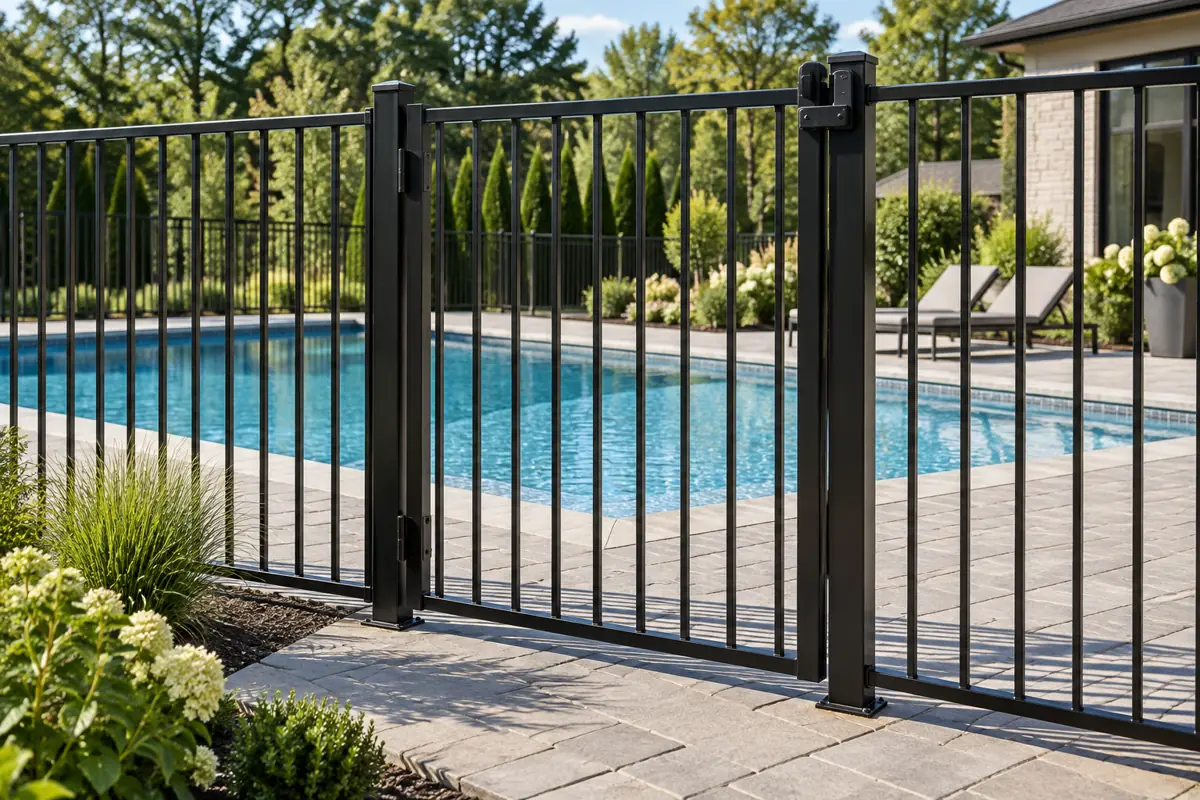
- 31. Barrier type and height Choose a fence that meets your local height rule (48 inches in most states with a rule, 60 inches in Arizona and California) with a self-closing, self-latching gate.
- 32. House doors as part of the barrier If the house wall is part of the barrier, door alarms or other protection may be required; Connecticut and New York require a pool alarm in any case (PC&S fence law review).
- 33. Drain covers and suction Drain covers and suction fittings are the most recalled pool product: 29 of 83 CPSC pool and spa recalls since 2001 (PC&S recall registry). Ask for the model numbers.
- 34. Safety cover An automatic safety cover costs $8,000 to $20,000 installed and a manual cover $1,000 to $3,600 (HomeGuide). In some states a listed safety cover counts toward the barrier rules.
- 35. Supervision plan 59.5% of unintentional drowning deaths of US children ages 1 to 4 in 2018 to 2024 happened in pools (PC&S analysis of CDC WONDER). The Insurance Information Institute recommends several layers of protection.
Decisions 36 to 40: builder, contract and the long term
The contract is where the other 35 decisions become enforceable.
- 36. Licensed bidders only 14 of 51 US jurisdictions issue a dedicated pool contractor license and 16 states leave licensing to cities and counties (PC&S license review). Check each bidder.
- 37. Three comparable bids HomeGuide recommends comparing at least 3 estimates; send each bidder this checklist so they price the same scope.
- 38. Deposit and payment schedule California caps a pool deposit at 10% or $1,000, whichever is less, and requires a plan and scale drawing in pool contracts (CSLB). Tie every payment to a passed inspection.
- 39. Warranty and service Get the structure, surface and equipment warranties in writing, and decide who will service the pool; see the pool service cost guide.
- 40. The exit plan Not every buyer wants a pool: Los Angeles, San Diego and Austin issued 545 pool removal permits in 2025, 27.6 for every 100 new pool permits (PC&S pool removal study). Keep records; a pool adds to your tax basis (IRS Publication 523).
Next, read the pool construction process so you know what happens after you sign, and browse local pages for Phoenix, Tampa, Orlando and Houston.
Frequently Asked Questions
What are the must-haves for a pool in 2026?
A barrier that meets your local rule (48 inches in most states with one, 60 in Arizona and California), compliant drain covers, GFCI protection where your code requires it, and a variable-speed-level pump, which federal standards have required on new standard-size in-ground pumps since July 19, 2021.
What are the key things to consider when building a pool?
Budget (Angi’s 2026 installed range is $44,499 to $87,349), local permit and barrier rules, pool type, your swim season, running costs and the builder’s license. The 40 decisions on this page cover each one.
What questions should I ask before building a pool?
Ask your city about setbacks, permits and barrier rules; ask your insurer about liability; and ask each builder about license, insurance, warranty, exclusions and a payment schedule tied to inspections (CSLB; Insurance Information Institute).
Does a pool raise your homeowners insurance?
Usually it changes your liability needs. The Insurance Information Institute calls a pool an attractive nuisance and suggests liability coverage of at least $300,000 or $500,000, or an umbrella policy. Get a quote before you build.
Can a swimming pool be a tax write-off?
Rarely. IRS Publication 502 counts a home improvement made mainly for medical care only to the extent its cost exceeds the increase in your home’s value. Otherwise a pool adds to your basis (IRS Publication 523). Ask a tax professional.
What is the typical cost of a 12×24 inground pool?
Angi’s 2026 size table says $25,200 and its FAQ says $48,500; HomeGuide gives $23,000 to $72,000 depending on material (2025). Get bids on the same specification.
Do it yourself pool plans?
Permit plans usually need more than a sketch. Herriman, Utah requires structural plans stamped by a licensed engineer and a soils report after the dig, and St. Helena, California requires engineered plans for structurally built pools.
Should I put in an inground pool?
Weigh use against cost. A pool adds a median 5.4% to home value across seven US studies, while REALTORS estimate 56% cost recovery and only 1% recommend adding one before selling (2023). A long swim season, like Miami’s 265 days, makes the math easier.
How hard is it to build an inground pool?
It is a multi-trade project with several inspections: four for a gunite pool in St. Helena, California (pre-gunite, pre-deck, pre-plaster and final). Permit review alone took a median 38.5 days in the middle of eight US cities in 2025.
What to know before buying a pool?
Know your total budget, yearly running cost ($3,000 to $5,000, Angi), local barrier and permit rules, and the builder’s license status. Only 7.2% of US homes had their own pool in 2024 (EIA), so check buyer demand in your area.
Sources
- Herriman City, Utah. Swimming Pool Checklist (plan review). Accessed 2026-10-08.
- Prince William County, Virginia. Residential Pools, Spas, and Hot Tubs Plan Review Checklist. Accessed 2026-10-08.
- City of St. Helena, California. Swimming Pool Requirements. Accessed 2026-10-08.
- Contractors State License Board. Swimming Pool Construction Details to Consider. Accessed 2026-10-08.
- Insurance Information Institute. Pool safety and insurance. Accessed 2026-10-08.
- Common Ground Alliance. 811 Before You Dig. Accessed 2026-10-08.
- Angi. How Much Does an In-Ground Pool Cost? [2026 Data]. Accessed 2026-10-08.
- HomeGuide. How Much Does An Inground Pool Cost?. Accessed 2026-10-08.
- California State Board of Equalization. Assessors' Handbook Section 531 (January 2026). Accessed 2026-10-08.
- NOAA NCEI. U.S. Climate Normals 1991-2020. Accessed 2026-10-08.
- Internal Revenue Service. Publication 502 and Publication 523. Accessed 2026-10-08.
- Federal Reserve Board. Consumer Credit G.19 (September 8, 2026). Accessed 2026-10-08.
Related pages
Get Quotes From Licensed Local Pool Pros
Tell us what you need and your ZIP code. We match you with pool companies that cover your area.