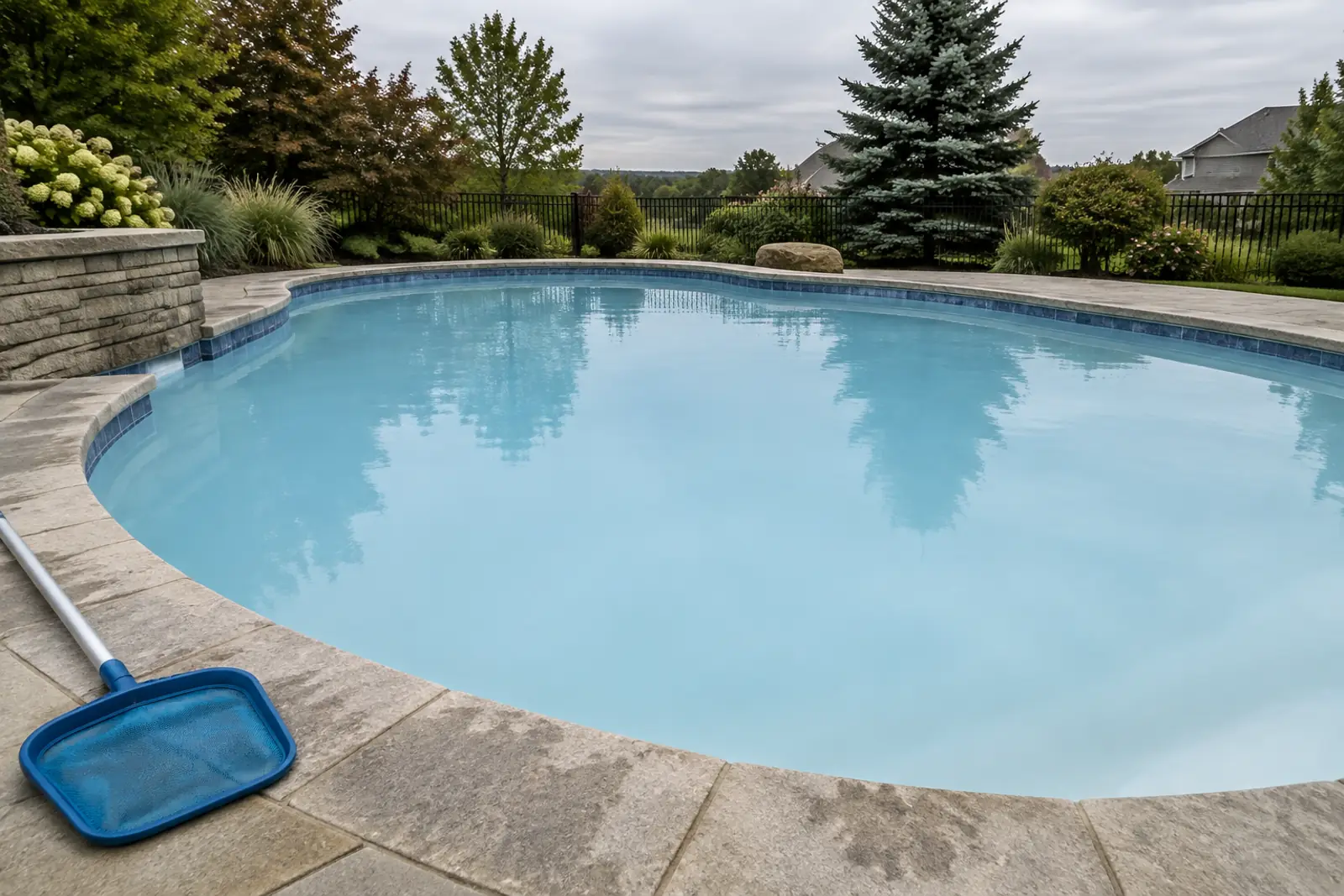
Cloudy Pool Water: Causes and How to Clear It
Cloudy pool water usually means low chlorine, high pH, alkalinity or calcium, or a filter that is not keeping up. Test chlorine and pH first, run the filter continuously, then shock, rebalance or clarify based on the result.
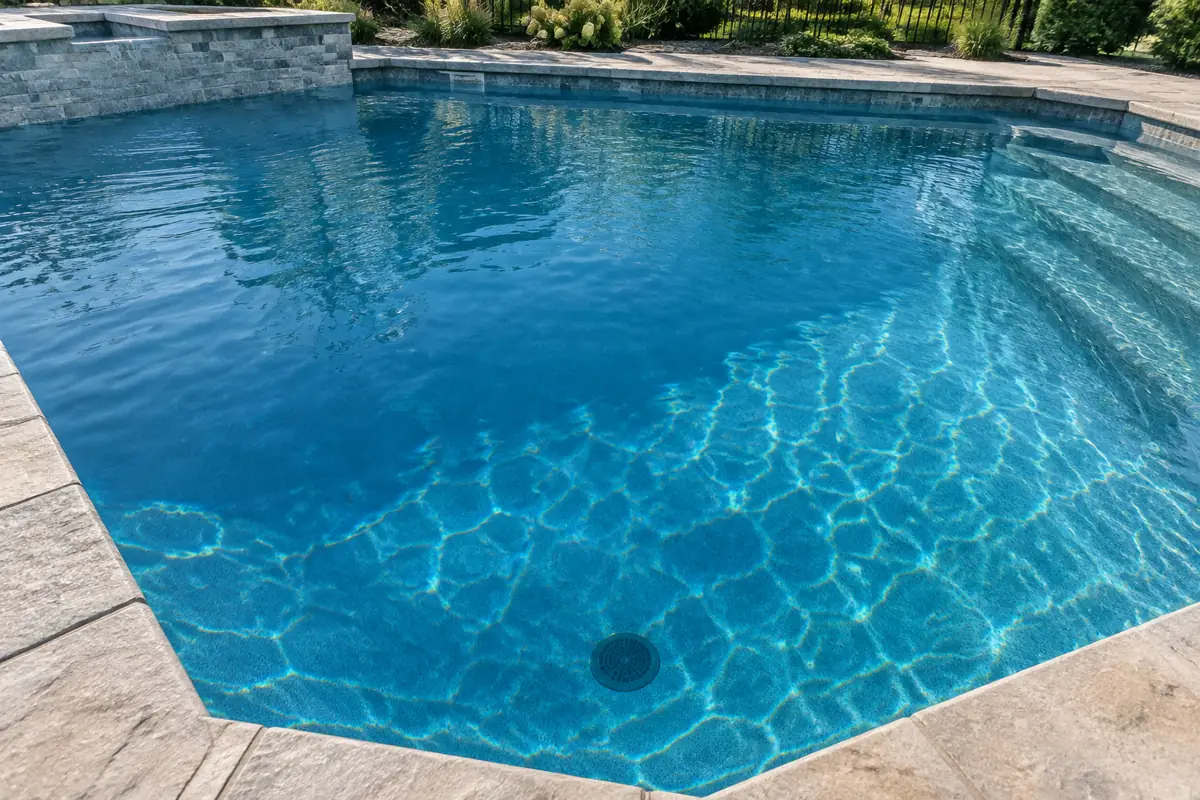
- ✓Can you see the main drain?The 2024 Model Aquatic Health Code closes public pools when the bottom is not visible from the deck up to 30 feet away.
- ✓Test before you treatCDC targets: free chlorine at least 1 ppm (2 ppm with stabilizer) and pH 7.0 to 7.8, tested twice a day.
- ✓Haze has a short list of causesLow chlorine, high pH, alkalinity over 120 ppm, high calcium in warm water, poor filtration or new plaster dust (state health manuals; National Plasterers Council).
Diagnose cloudy pool water before you add anything
Cloudiness is a symptom. A few quick checks narrow down the cause before you spend money on products.
- Look at the drainStand on the deck and look for the main drain. The public pool standard is that the drain or a reference tile is visible from any point on the deck up to 30 feet away (MAHC 2024, 5.7.6). If you cannot see it, keep everyone out.
- Test the waterUse a DPD kit for free and combined chlorine, plus pH, total alkalinity and calcium hardness. CDC recommends testing chlorine and pH at least twice a day.
- Check the equipmentIs the pump running long enough, and is the filter clean? HTH, a pool chemical maker, recommends at least 8 hours of pump time a day.
- Think about the last weekHeavy use, a storm, a soda ash dose, a shock treatment or new plaster each point to a different cause.
| What you see or what happened | Likely cause | Test to confirm | Fix | Source |
|---|---|---|---|---|
| Dull, hazy water; chlorine low or zero | Not enough free chlorine; organic load or early algae | Free and combined chlorine (DPD) | Shock to raise free chlorine; keep at least 1 ppm (2 ppm with stabilizer) | CDC; HTH; Pennsylvania DOH |
| Milky white haze, pH above 7.6 | Calcium carbonate dropping out at high pH | pH, total alkalinity, calcium hardness | Lower pH with measured acid; run filter | Pennsylvania DOH; Virginia DOH |
| Haze and pH that will not hold | Total alkalinity above 120 ppm | Total alkalinity | Lower alkalinity with acid in steps | Virginia DOH; Florida DOH |
| Cloud right after adding soda ash | Too much soda ash at once | pH | Let the filter run; dose at or under 1 lb per 10,000 gal next time | Knorr Systems; Orenda |
| Warm water or spa turning hazy | Calcium less soluble when warm | Calcium hardness, temperature | Keep calcium in range; partial drain if too high | Florida DOH |
| Clear chemistry, still hazy | Filter or circulation not keeping up, or high dissolved solids | Filter pressure, pump hours, TDS | Clean or backwash filter; run longer; check TDS above 2,000 ppm | HTH; Florida DOH |
| New or resurfaced plaster | Plaster dust | None needed | Brush and filter continuously until clear, at least 72 hours | National Plasterers Council |
| Hazy after shocking | Fine particles left after the shock, or a pH rise from hypochlorite shock | pH and free chlorine | Run filter, correct pH, then clarifier if still hazy | HTH; Pennsylvania DOH |
Sources: CDC; Pennsylvania DOH; Virginia DOH; Florida DOH; National Plasterers Council; HTH, Knorr Systems and Orenda (manufacturer guidance). Download CSV
Water test targets that keep a pool clear
| Test | Target | Why it matters for clarity | Source |
|---|---|---|---|
| Free chlorine | At least 1 ppm (2 ppm with cyanuric acid); hot tubs 3 ppm | Low chlorine lets organics and algae cloud water | CDC |
| Combined chlorine | No more than 0.2 ppm | High levels mean chloramines; superchlorinate to 10x | Pennsylvania DOH |
| pH | 7.0 to 7.8 | High pH brings cloudiness and scale | CDC; Pennsylvania DOH |
| Total alkalinity | 80 to 120 ppm | Too high causes cloudy water | Virginia DOH; Florida DOH |
| Calcium hardness | 200 to 400 ppm | Too high, especially in warm water, clouds water | Florida DOH |
| Total dissolved solids | Check if above 2,000 ppm | Check whenever clarity is compromised | Florida DOH |
Sources: CDC; Pennsylvania DOH; Virginia DOH; Florida DOH. Download CSV
Read the numbers together. A pool can show plenty of chlorine and still be hazy because pH or calcium is high, and a pool with perfect balance can be hazy because the filter is clogged. CDC also warns that above 10 ppm a DPD test can bleach out and read falsely low, so a very high shock level can look like no chlorine at all.
Cause 1: low chlorine, organic load or early algae
When free chlorine falls below CDC’s minimum (1 ppm, or 2 ppm in pools using cyanuric acid), organic waste and algae get ahead. HTH notes early algae often shows up as dull or cloudy water before it ever looks green. The fix is to shock the pool: raise free chlorine enough to burn off the load. Pennsylvania DOH’s rule for combined chlorine (chloramines) is to keep it at 0.2 ppm or less and, when it rises, raise free chlorine to 10 times the combined level.
| Product | Available chlorine | Raise free chlorine 1 ppm | Raise free chlorine 10 ppm | Source |
|---|---|---|---|---|
| Liquid chlorine (sodium hypochlorite) | 12% | 10 fl oz (Virginia DOH method: 10.8 oz) | 3.3 quarts | Knorr Systems; Virginia DOH |
| Calcium hypochlorite | 67% | 2 oz | 1.3 lb | Knorr Systems |
| Dichlor (dihydrate) | 56% | 2.3 oz (PC&S calculation) | Not published | USITC via PC&S research; Virginia DOH method |
| Trichlor | 90% | 1.4 oz (PC&S calculation) | Not published | USITC via PC&S research; Virginia DOH method |
| Any product, no label | Use label percentage | 1.3 oz divided by the available chlorine fraction | 10 times the 1 ppm amount | Virginia DOH |
Sources: Knorr Systems dosing chart (manufacturer guidance); Virginia DOH no-label formula; available chlorine for dichlor and trichlor from the U.S. International Trade Commission via PC&S pool chemical research. Download CSV
Virginia’s guide gives a rule that works for any product without a dose label: 1 ppm of chlorine in 10,000 gallons takes about 1.3 oz of 100% available chlorine, so divide 1.3 by the product’s available chlorine fraction. For 12% liquid chlorine that is 10.8 oz per ppm. Use the volume from our pool volume calculator to scale it, and note that calcium hypochlorite and liquid chlorine both nudge pH up over time (Pennsylvania DOH), so retest pH after a big dose.
Cause 2: high pH, alkalinity or calcium (milky, scale-type cloudiness)
If chlorine is fine, look at water balance. Pennsylvania DOH lists increased cloudiness among the results of pH above 7.6, and Virginia’s guide says high total alkalinity can cause cloudy water. Florida DOH adds calcium to the list: calcium is less soluble in warm water, so cloudiness appears at lower calcium levels in warm pools and spas. Florida’s manual puts normal calcium hardness at 200 to 400 ppm and says total dissolved solids should be checked whenever clarity is compromised.
The fix here is chemistry, not more chlorine or clarifier. Bring pH back to range with measured acid (our guide on how to lower pH in pool water has the Virginia DOH acid chart) and lower total alkalinity if it sits above 120 ppm. If calcium or dissolved solids are too high, Florida DOH says partial draining and refilling is the only way to lower them. A cloud that appears minutes after a soda ash dose is the same chemistry in miniature: Knorr Systems warns that more than 1 lb per 10,000 gallons at once can turn the water milky, and our raise pH guide shows safer doses.
Cause 3: the filter is not keeping up
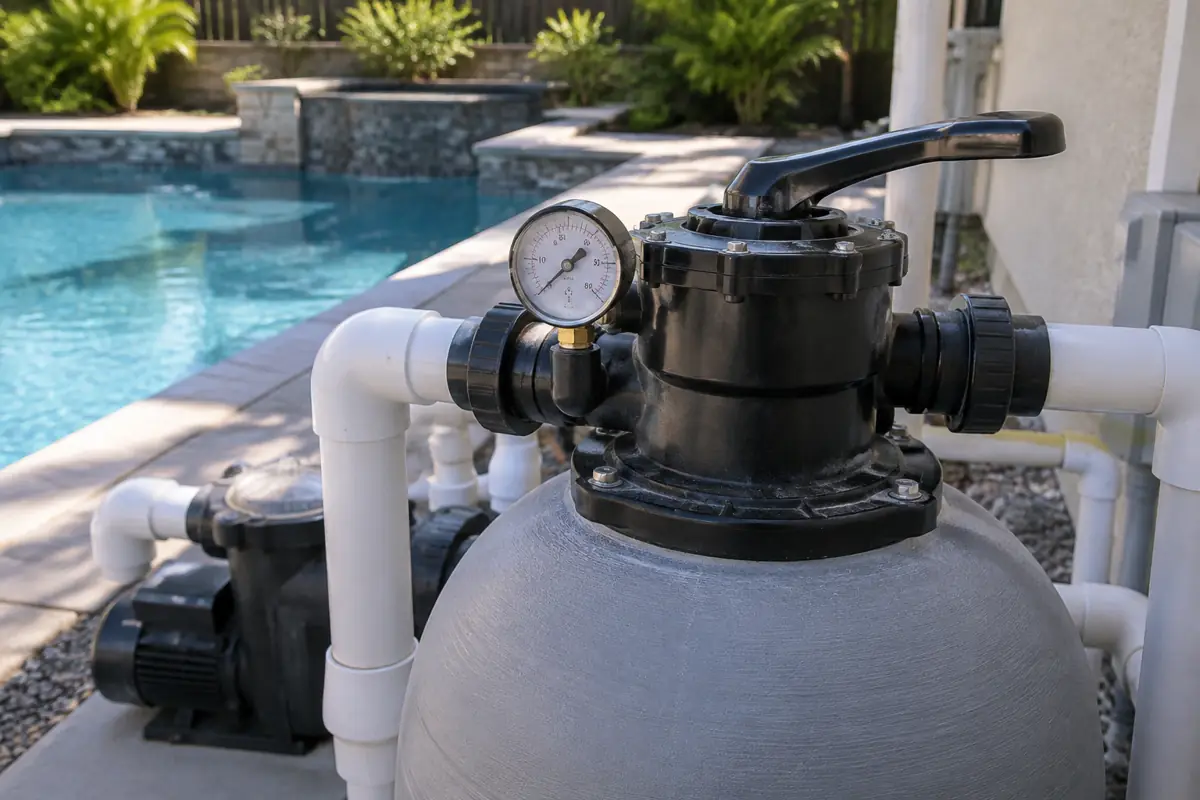
For public pools, failing to run filtration and disinfection continuously is itself an imminent health hazard under the 2024 Model Aquatic Health Code. Home pools have no such rule, but the logic carries over. HTH recommends at least 8 hours of pump time a day and regular filter cleaning. Clarifier only works with a working filter: HTH’s label says not to backwash for at least 24 hours after adding it, and to check the filter if the water is not clear within 48 hours.
New or resurfaced plaster is a special case. The National Plasterers Council start-up card calls for brushing and running the filter continuously for seven days or until the plaster dust is gone and the water is no longer cloudy, at least 72 hours. If a filter, pump or valve is the problem, our pool repair page covers equipment fixes.
Clarifier vs flocculant vs shock: match the fix to the cause
| Treatment | How it works | Label dose per 10,000 gal | Time | Filter step | Best for | Source |
|---|---|---|---|---|---|---|
| Clarifier | Clumps fine particles so the filter catches them | 2 fl oz mild haze; 4 fl oz very cloudy | Clear within 48 hours or check the filter | Run filter continuously; no backwash for 24 hours | Hazy water with balanced chemistry and visible bottom | HTH label |
| Flocculant | Drops particles to the floor as heavy masses | 8 fl oz with pump running | Pump 2 hours, then settle 8 to 12 hours | Vacuum to waste, not through the filter | Severe cloudiness when you can vacuum to waste | HTH label |
| Shock (chlorine) | Raises free chlorine to destroy organics and early algae | See chlorine dose table | Swim when free chlorine is back to 1 to 4 ppm | Run filter | Low chlorine, high combined chlorine, early algae | HTH; Pennsylvania DOH; Knorr Systems |
Sources: HTH product label directions (manufacturer guidance); Pennsylvania DOH; Knorr Systems. Download CSV
Clarifier suits haze where the bottom is still visible and chemistry is balanced. Flocculant is faster for severe cloudiness but needs a vacuum-to-waste setting on your filter valve; HTH says above-ground pools without that option should use clarifier instead. Shock is the fix only when the cause is chlorine demand, so test first. Doses in the table are one manufacturer’s label directions; other brands differ, so follow your product’s label.
How to clear cloudy pool water, step by step
- Keep swimmers outIf you cannot see the main drain, close the pool until you can.
- Clean and run the filterEmpty skimmer and pump baskets, clean or backwash the filter, and run the pump continuously while you work.
- Fix pH and alkalinity firstBring pH to 7.2 to 7.6 and total alkalinity to 80 to 120 ppm. HTH’s flocculant directions ask for pH 7.2 to 7.6 before dosing.
- Shock if chlorine is lowRaise free chlorine using the dose table above. Add the product to the water, never water to the product.
- Clarify or flocculateUse clarifier for haze with a visible bottom (2 to 4 fl oz per 10,000 gallons on HTH’s label) or flocculant for severe cloudiness if you can vacuum to waste (8 fl oz, settle 8 to 12 hours).
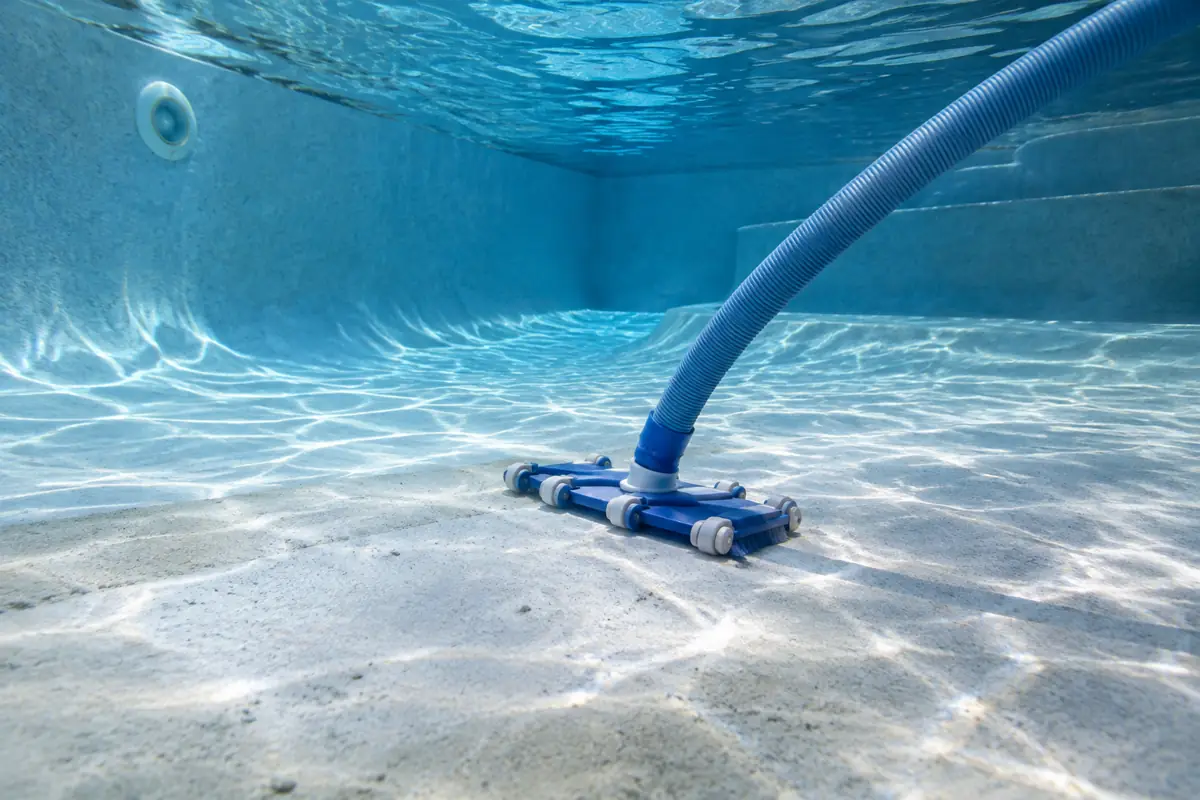
- Vacuum and retestVacuum settled debris to waste, retest chlorine and pH, and wait until free chlorine is back to 1 to 4 ppm before swimming (HTH).
- Find the root causeIf haze returns within days, recheck calcium, dissolved solids and filter condition rather than repeating clarifier.
Cloudy water keeps coming back?
Is it safe to swim in cloudy pool water?
For public pools the answer is written into the code: the 2024 Model Aquatic Health Code lists an aquatic venue bottom that is not visible as an imminent health hazard requiring correction or closure. Treat a home pool the same way. Cloudiness also tends to travel with low chlorine (HTH), and CDC’s disinfection times show why the chlorine level matters even in clear water.
| Germ | Type | Approximate time to kill at 1 ppm free chlorine |
|---|---|---|
| E. coli O157:H7 | Bacterium | Less than 1 minute |
| Hepatitis A | Virus | About 16 minutes |
| Giardia | Parasite | About 45 minutes |
| Cryptosporidium | Parasite | About 15,300 minutes (10.6 days) |
Source: CDC, Home Pool and Hot Tub Water Treatment and Testing. CDC notes times are longer when cyanuric acid is present. Download CSV
Pool-related illness is not hypothetical. CDC outbreak surveillance counts 560 outbreaks tied to treated recreational water such as pools, hot tubs and splash pads with illness onset from 2009 to 2023, with 8,539 cases and 689 hospitalizations (PC&S outbreak research). Pennsylvania DOH also notes that cloudiness reduces the effectiveness of ultraviolet treatment systems. Yet in a 2019 Healthy Pools survey of 3,100 adults, 18% said they would swim in a pool with cloudy water (PC&S hygiene research).
Survey sponsored by an industry-funded council; online sample.
Source: Source: Healthy Pools 2019 survey by Sachs Media for the Water Quality and Health Council, via PC&S research /research/pool-hygiene-statistics/.. Download chart data (CSV)
Safety when shocking and clarifying
CDC estimates pool chemical injuries send about 4,500 people to U.S. emergency departments each year (PC&S pool injury research). Clearing cloudy water often means adding chlorine and acid on the same day, so dose one product, let it circulate, and only then add the next, using separate scoops and buckets for each (EPA).
What inspection data says about cloudy water
Inspection records show that haze bad enough to hide the drain is less common than the chemistry problems that cause it. In Louisville Metro, 21.6% of routine public pool inspections from October 2021 to April 2024 failed for disinfectant level out of range and 7.4% for pH, while 1.2% failed because the main drain was not visible, an 18-fold gap (PC&S inspection research). That is why the fixes on this page start with chemistry.
Public pools only. Chemistry problems that cause haze were cited far more often than haze bad enough to hide the drain.
Source: Source: Louisville Metro Public Health and Wellness inspection data, via PC&S research /research/public-pool-inspection-violations/.. Download chart data (CSV)
At home, testing is the weak point: 23% of do-it-yourself pool owners in a 2020 survey said they test chlorine and pH no more often than once every two weeks. A weekly pool cleaning service tests, cleans the filter and doses on every visit; our pool service cost guide shows typical monthly prices.
Frequently Asked Questions
What is the fastest way to clear a cloudy pool?
Fix chemistry first, then use flocculant if your filter can vacuum to waste: HTH’s label calls for 8 fl oz per 10,000 gallons, 2 hours of pump time, 8 to 12 hours of settling, then vacuuming to waste. Without that option, clarifier plus continuous filtration is the route.
Does shock clear a cloudy pool?
Only when the cause is low chlorine, organic waste or early algae. If chlorine is already in range and pH, alkalinity or calcium is high, shock will not help, and hypochlorite shock can push pH higher (Pennsylvania DOH). Test first.
How long does it take for a cloudy pool to clear up?
It depends on the fix. HTH says clarifier should clear water within 48 hours or the filter needs checking; flocculant settles in 8 to 12 hours; new plaster dust takes at least 72 hours of continuous filtration (National Plasterers Council).
What is the most common cause of cloudy pool water?
We found no national data that ranks causes. Health department manuals point to the same short list: low chlorine, high pH, total alkalinity above 120 ppm, high calcium in warm water and poor filtration. Testing tells you which one is yours.
How do you fix a cloudy pool after shocking?
Run the filter continuously, retest pH (calcium and sodium hypochlorite push it up), and correct with measured acid. If haze remains once chlorine and pH are in range, HTH suggests a clarifier to catch the fine particles left behind.
Should I add more chlorine if the pool is cloudy?
Only if a test shows free chlorine below target: CDC’s minimum is 1 ppm, or 2 ppm with cyanuric acid. More chlorine does nothing for haze caused by high pH, calcium or a dirty filter.
Is it safe to swim in cloudy pool water after shocking?
Wait until free chlorine drops back to 1 to 4 ppm (HTH) and you can see the main drain. Public pools must keep swimmers out above 10 ppm under the 2024 Model Aquatic Health Code.
Is cloudy pool water harmful?
Cloudiness is a warning sign rather than a diagnosis. It often comes with low chlorine, and CDC’s data show some germs survive chlorine for a long time, Cryptosporidium for about 10.6 days at 1 ppm. Public codes close pools whose bottom is not visible.
Is slightly cloudy water safe to swim in?
Use the public pool test: if you can see the main drain or a reference tile from any point on the deck up to 30 feet away (MAHC 2024), clarity passes. If you cannot, stay out and test the water.
Why is my pool cloudy but the chemicals are fine?
Check what most test strips skip: calcium hardness (200 to 400 ppm), total dissolved solids (check above 2,000 ppm) and combined chlorine (0.2 ppm or less). Then check pump hours and filter pressure, or plaster dust if the surface is new.
Will a pool clarifier work if the water is very cloudy?
HTH says clarifier works best while the pool bottom is still visible and lists a higher dose (4 fl oz per 10,000 gallons) for extremely cloudy water. For severe cases it recommends flocculant and vacuuming to waste.
How do I keep pool water from getting cloudy again?
Test chlorine and pH at least twice a day as CDC recommends, keep alkalinity at 80 to 120 ppm and calcium at 200 to 400 ppm, run the pump long enough (HTH says at least 8 hours) and clean the filter regularly.
Sources
- Centers for Disease Control and Prevention (CDC). 2024 Model Aquatic Health Code, 5th Edition, Code Language (December 2024). Accessed 2026-10-08.
- Centers for Disease Control and Prevention (CDC). Home Pool and Hot Tub Water Treatment and Testing (page updated May 10, 2024). Accessed 2026-10-08.
- Pennsylvania Department of Health. Public Swimming and Bathing Places: Operational and Biological Contamination Protocol Recommendations (November 1, 2016). Accessed 2026-10-08.
- Virginia Department of Health (Portsmouth Health Department). Pool Operation and Maintenance Guide (Portsmouth Health Department, compiled 2018). Accessed 2026-10-08.
- Florida Department of Health in Collier County. Swimming Pool Operators' Manual, 2016 Version (Chapter 2, Maintaining Water Chemistry). Accessed 2026-10-08.
- Knorr Systems (commercial pool equipment and chemical supplier; manufacturer guidance). Chemical Dosing Charts. Accessed 2026-10-08.
- HTH Pools (manufacturer guidance and label doses). Why Is My Pool Cloudy? Causes and Fixes. Accessed 2026-10-08.
- National Plasterers Council. NPC Pool Start-up Card (National Plasterers Council procedure; copy hosted by Finest Finish Pools). Accessed 2026-10-08.
- Orenda Technologies (manufacturer guidance). Why does Soda Ash cloud up pool water?. Accessed 2026-10-08.
- National Pesticide Information Center (Oregon State University, cooperative agreement with U.S. EPA). Pool and Spa Chemicals Fact Sheet. Accessed 2026-10-08.
- U.S. Environmental Protection Agency (EPA). Chemical Safety Alert: Safe Storage and Handling of Swimming Pool Chemicals (EPA 550-F-01-003, March 2001). Accessed 2026-10-08.
- Centers for Disease Control and Prevention (CDC). Pool Chemical Safety (page updated June 24, 2025). Accessed 2026-10-08.
- Pool Construction & Service. Public Pool Inspection Violations (PC&S research). Accessed 2026-10-08.
- Pool Construction & Service. Pool Hygiene Statistics (PC&S research). Accessed 2026-10-08.
- Pool Construction & Service. Swimming Pool Illness Outbreaks (PC&S research). Accessed 2026-10-08.
- Pool Construction & Service. Pool Chemical Prices (PC&S research). Accessed 2026-10-08.
- Pool Construction & Service. Pool Injury Statistics (PC&S research). Accessed 2026-10-08.
Related pages
Get Quotes From Licensed Local Pool Pros
Tell us what you need and your ZIP code. We match you with pool companies that cover your area.