How to Lower Alkalinity in Pool Water (and How to Raise It)
How to lower alkalinity in pool water: add diluted muriatic acid, about 25.6 fl oz per 10,000 gallons for each 10 ppm, cut 10 to 20 ppm per dose, then aerate so pH recovers.
- ✓Health department charts run lowVirginia DOH lists 21 oz per 10 ppm in 10,000 gallons, 18% below the 25.6 oz the chemistry gives (Skinner and Hales, 1995).
- ✓Acid first, air secondAcid lowers alkalinity and pH together; aeration then lifts pH without adding alkalinity back (AQUA Magazine, 2016).
- ✓Raising it is baking soda1.4 to 1.5 lb of sodium bicarbonate per 10,000 gallons adds about 10 ppm (Florida DOH, Knorr Systems).
Key takeaways
- Total alkalinity belongs at 80 to 120 ppm in home pools, per the Florida DOH operators manual and the Virginia DOH guide; public pools under the 2024 Model Aquatic Health Code may run 60 to 180 ppm (section 5.7.4.4.1).
- Lowering 10 ppm in 10,000 gallons takes 25.6 fl oz of 31.45% muriatic acid or 2.13 lb of 94.5% dry acid, per the Skinner and Hales dosage study in the Journal of the Swimming Pool and Spa Industry (1995).
- Health department charts list less: Virginia DOH says 21 oz, about 82% of the chemistry figure, so treat chart doses as a safe low start and retest.
- Cut no more than 20 ppm per dose (Orenda); in AQUA Magazine, Robert W. Lowry calculated that a single 120 ppm cut can drop pH to about 6.1.
- Aeration raises pH without raising alkalinity, which is why the method is acid, then air, then retest after at least 4 hours (Blue Tropic label).
- To raise alkalinity, add 1.4 to 1.5 lb of baking soda per 10,000 gallons per 10 ppm (Knorr Systems, Florida DOH).
What alkalinity should a pool have?
The Florida, Virginia and Pennsylvania health department manuals all put total alkalinity at 80 to 120 ppm, measured as calcium carbonate. Virginia DOH narrows that to 80 to 100 ppm for pools whose chlorine keeps pushing pH up and allows up to 150 ppm where pH tends to fall. The 2024 Model Aquatic Health Code sets a wider legal band of 60 to 180 ppm for public pools.
| Source | Applies to | Total alkalinity | Extra rule |
|---|---|---|---|
| 2024 Model Aquatic Health Code, 5.7.4.4.1 (CDC) | Public pools and spas that adopt it | 60 to 180 ppm | Test weekly (5.7.5.5) |
| Florida DOH, Collier County manual (2016) | Florida public pools | 80 to 120 ppm | Adjust alkalinity first, before pH |
| Virginia DOH, Portsmouth guide (2018) | Public and private pools | 80 to 120 ppm | 80 to 100 ppm if pH tends to rise; up to 150 ppm if it tends to fall |
| Pennsylvania DOH (2016) | Aquatic facilities | 80 to 120 ppm | Test and log weekly; above 120 ppm locks pH high |
| Lincoln County, Wisconsin, operator handout | Public pools | 75 to 125 ppm | Ideal 100 ppm |
| FROG Products (manufacturer) | Home pools | 80 to 120 ppm | Aim for the middle of the range |
| Orenda Technologies (manufacturer) | Home and commercial pools | Over 120 ppm is high | Over 150 ppm is very high |
Sources: MAHC 2024, 5.7.4.4.1 and 5.7.5.5; Florida DOH (2016); Virginia DOH (2018); Pennsylvania DOH (2016); Lincoln County, WI; FROG Products; Orenda. Download CSV
Total alkalinity is the water’s buffer. Virginia’s guide explains that at pool pH of 7.2 to 7.8 it is mostly bicarbonate, and that high alkalinity makes pH hard to move, while low alkalinity lets pH swing with small chemical additions. The public pool code asks operators to test it weekly (MAHC 5.7.5.5), a sensible floor for a home pool too. Testing usually uses a titration kit; Virginia DOH warns that cyanuric acid can skew the result.
| Number | Value | Source |
|---|---|---|
| Muriatic acid (31.45%) to lower alkalinity 10 ppm in 10,000 gal | 25.6 fl oz (0.80 qt) | Skinner and Hales 1995; Lowry, AQUA 2016 |
| Same job, Virginia DOH chart | 21 oz | Virginia DOH 2018 |
| Dry acid (94.5% sodium bisulfate), same job | 2.13 lb | Skinner and Hales 1995 |
| Baking soda to raise alkalinity 10 ppm in 10,000 gal | 1.4 to 1.5 lb | Skinner and Hales 1995; Knorr; Florida and Pennsylvania DOH |
| Largest cut per acid dose | 20 ppm (Orenda); 40 ppm keeps pH at 6.5 or higher (Lowry) | Orenda; AQUA 2016 |
| Muriatic to dry acid conversion | 1 pint = 1.25 lb | Florida DOH 2016 |
| Public pool legal range | 60 to 180 ppm | MAHC 2024, 5.7.4.4.1 |
Sources: Skinner and Hales (1995); Lowry, AQUA (2016); Virginia DOH; Florida DOH; Pennsylvania DOH; Knorr Systems; Orenda; MAHC 2024. Download CSV
What happens if your pool alkalinity is too high?
High alkalinity holds pH up and makes it resist acid. Pennsylvania DOH says alkalinity above 120 ppm locks pH above operating standards and weakens the disinfectant, and the water starts to taste salty. Virginia DOH adds cloudy water and a pH that drops after acid, then bounces back above 8.0 within a short while.
- pH bounce: acid lowers pH briefly, then it climbs back above 8.0 until alkalinity itself comes down (Virginia DOH).
- Weaker chlorine: pH stuck high reduces disinfecting power (Pennsylvania DOH); see our guide on how to lower pH in pool water for the chlorine split by pH.
- Scale and haze: Florida DOH says high alkalinity tends to form scale and cloudiness, a cause covered in our cloudy pool water guide.
- A pH ceiling near 8.4: the Lincoln County, Wisconsin handout says high alkalinity will try to hold pH at about 8.4.
Common causes are the fill water and the chlorine you use. Pennsylvania DOH says sodium and calcium hypochlorite tend to raise pH and alkalinity over time, while trichlor, dichlor and bromine lower them. Orenda, a pool chemical maker, reports tap water above 300 ppm in some parts of the country, so test your hose water once if the number keeps creeping up after top offs.
How much muriatic acid lowers alkalinity in a pool?
Use Skinner and Hales’ formula: pool gallons divided by 125,000, times the ppm you want to remove, equals quarts of 31.45% muriatic acid. That is 25.6 fl oz per 10 ppm in 10,000 gallons. For dry acid (94.5% sodium bisulfate) divide gallons by 47,058 and multiply by ppm to get pounds.
| Change (ppm) | 5,000 gal | 10,000 gal | 15,000 gal | 20,000 gal | 25,000 gal | 30,000 gal |
|---|---|---|---|---|---|---|
| Lower by 10 | 12.8 fl oz | 25.6 fl oz | 38.4 fl oz | 51.2 fl oz | 64 fl oz | 76.8 fl oz |
| Lower by 20 | 25.6 fl oz | 51.2 fl oz | 76.8 fl oz | 102.4 fl oz | 128 fl oz | 153.6 fl oz |
| Lower by 30 | 38.4 fl oz | 76.8 fl oz | 115.2 fl oz | 153.6 fl oz | 192 fl oz | 230.4 fl oz |
| Lower by 40 | 51.2 fl oz | 102.4 fl oz | 153.6 fl oz | 204.8 fl oz | 256 fl oz | 307.2 fl oz |
| Lower by 50 | 64 fl oz | 128 fl oz | 192 fl oz | 256 fl oz | 320 fl oz | 384 fl oz |
PC&S calculation from the Skinner and Hales (1995) formula: gallons / 125,000 x ppm = quarts, x 32 = fl oz. Split cuts above 20 ppm into separate doses (Orenda). Download CSV
| Change (ppm) | 5,000 gal | 10,000 gal | 15,000 gal | 20,000 gal | 25,000 gal | 30,000 gal |
|---|---|---|---|---|---|---|
| Lower by 10 | 1.06 lb | 2.13 lb | 3.19 lb | 4.25 lb | 5.31 lb | 6.38 lb |
| Lower by 20 | 2.13 lb | 4.25 lb | 6.38 lb | 8.50 lb | 10.63 lb | 12.75 lb |
| Lower by 30 | 3.19 lb | 6.38 lb | 9.56 lb | 12.75 lb | 15.94 lb | 19.13 lb |
| Lower by 40 | 4.25 lb | 8.50 lb | 12.75 lb | 17.00 lb | 21.25 lb | 25.50 lb |
| Lower by 50 | 5.31 lb | 10.63 lb | 15.94 lb | 21.25 lb | 26.56 lb | 31.88 lb |
PC&S calculation from the Skinner and Hales (1995) formula: gallons / 47,058 x ppm = pounds. Products range from 88% to 95% strength, per the same paper. Download CSV
Check the strength on your acid jug before you pour. The tables assume 31.45% hydrochloric acid, the strength Skinner and Hales used; for any other strength, multiply the dose by 31.45 and divide by the percentage on your label. Work out gallons first with our pool volume calculator, because a 20% error in volume becomes a 20% error in acid.
Why do health department charts list less acid than the chemistry?
Skinner and Hales found in 1995 that most published charts understate muriatic acid for alkalinity by about 20%, likely because a chemist used 37% laboratory acid instead of 31.45% pool acid. The charts we found today still sit low: Virginia DOH lists 21 oz and Lincoln County, Wisconsin 22.4 fl oz, against 25.6 fl oz from the chemistry.
Skinner and Hales (1995) traced the shortfall to charts built on 37% laboratory acid instead of 31.45% pool acid.
Source: Sources: Virginia DOH Portsmouth guide (2018) p. 34; Florida DOH Collier County manual (2016) p. 15, converted at 1 pint = 1.25 lb; Lincoln County, WI operator handout, Table 1; Skinner and Hales, JSPSI vol. 1 no. 1 (1995); Lowry, AQUA Magazine (Sept 6, 2016).. Download chart data (CSV)
| Source | Product | Published figure | Same job: 10 ppm in 10,000 gal | Share of chemistry figure |
|---|---|---|---|---|
| Virginia DOH, Portsmouth guide (2018) | Muriatic acid | 21 oz per 10 ppm, 10,000 gal | 21 fl oz | 82% |
| Florida DOH, Collier County manual (2016) | Dry acid | About 2 lb lowers 24,000 gal by 5 ppm | 1.67 lb dry acid, or 21.3 fl oz muriatic at 1 pint = 1.25 lb | 83% |
| Lincoln County, Wisconsin, operator handout | Muriatic acid | 1.4 pints per 10 ppm, 10,000 gal | 22.4 fl oz | 87% |
| Lincoln County, Wisconsin, operator handout | Sodium bisulfate | 1.6 lb per 10 ppm, 10,000 gal | 1.6 lb | 75% of 2.13 lb |
| Blue Tropic pH Decreaser label | Sodium bisulfate | 2 lb per 10 ppm, 10,000 gal | 2 lb | 94% of 2.13 lb |
| Skinner and Hales, Journal of the Swimming Pool and Spa Industry (1995) | Muriatic acid, 31.45% | 0.80 qt per 10 ppm, 10,000 gal | 25.6 fl oz | 100% (chemistry reference) |
| Skinner and Hales (1995) | Sodium bisulfate, 94.5% | 2.13 lb per 10 ppm, 10,000 gal | 2.13 lb | 100% (chemistry reference) |
| Robert W. Lowry, AQUA Magazine (2016) | Muriatic acid, 31.45% | 25.6 oz per 10 ppm, 10,000 gal | 25.6 fl oz | 100% |
Sources: Virginia DOH (2018), p. 34; Florida DOH (2016), p. 15; Lincoln County, WI, Table 1; Blue Tropic pH Decreaser label; Skinner and Hales (1995); Lowry, AQUA Magazine (2016). Florida conversion uses its own rule, 1 pint of muriatic acid = 1.25 lb of dry acid. Download CSV
You can check the 125,000 divisor yourself. The inputs below are the ones Skinner and Hales took from their safety data sheets: 31.45% hydrochloric acid, specific gravity 1.16, 36.46 g per mole of HCl, and 100.09 g per mole of calcium carbonate, which takes two moles of acid.
| Step | Arithmetic | Result |
|---|---|---|
| 1. Mass of one quart of muriatic acid | 946 mL x 1.16 g/mL (specific gravity) | 1,097.4 g of solution |
| 2. Hydrochloric acid in that quart | 1,097.4 g x 31.45% | 345.1 g HCl |
| 3. Moles of acid | 345.1 g / 36.46 g per mole | 9.466 moles HCl |
| 4. Alkalinity neutralized (as calcium carbonate) | 9.466 / 2 x 100.09 g per mole x 1,000 | 473,711 mg |
| 5. Gallon-ppm per quart (1 ppm in 1 gallon = 3.785 mg) | 473,711 / 3.785 | 125,155 (Skinner and Hales round to 125,000) |
| 6. Acid for 10 ppm in 10,000 gallons | 10,000 x 10 / 125,000 | 0.80 quart = 25.6 fl oz |
| 7. Virginia DOH chart figure for the same job | 21 oz / 25.6 oz | 82% of the chemistry figure |
Inputs from Skinner and Hales (1995); arithmetic by PC&S, October 2026. Download CSV
What this means at the pool: a chart dose is a cautious first step, not a mistake that hurts you. Expect a Virginia or Wisconsin chart amount to move alkalinity roughly 8 to 9 ppm instead of 10, and plan on the retest to tell you the rest.
How to lower alkalinity in pool water without crashing the pH
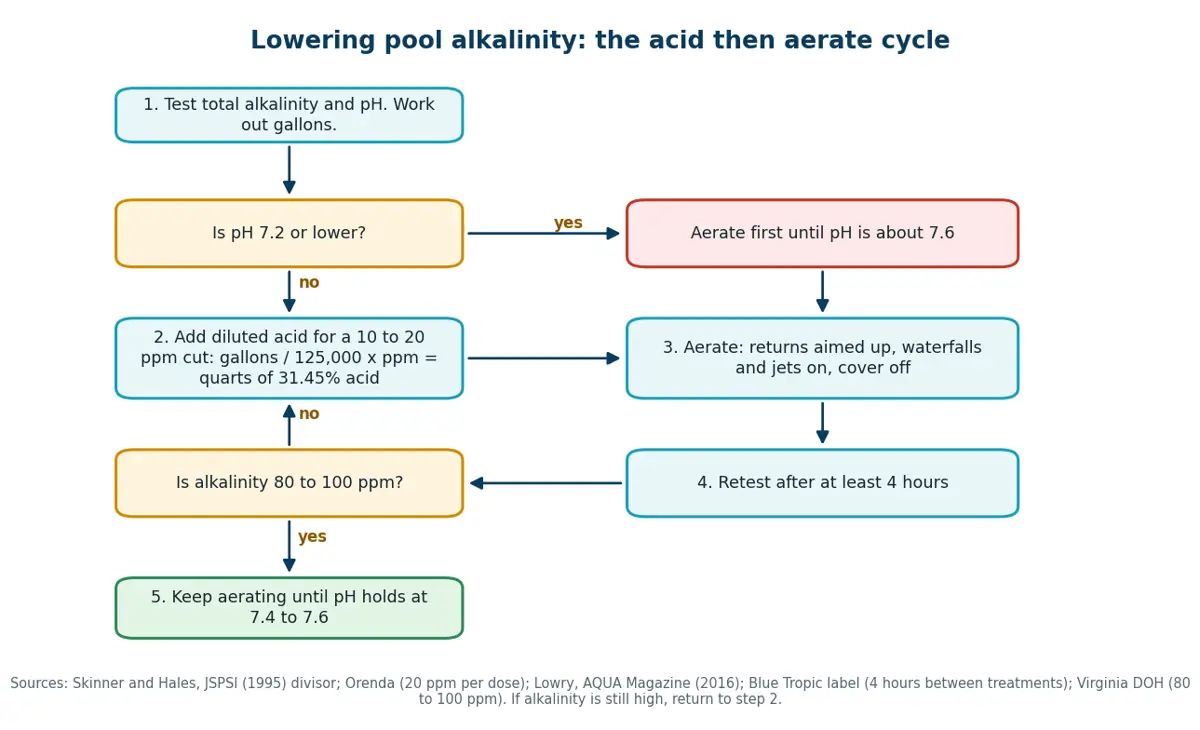
Acid always lowers pH and alkalinity together, so the method is to add acid for a 10 to 20 ppm cut, then aerate. Aeration drives carbon dioxide out of the water, which raises pH without adding alkalinity back. Repeat the cycle until alkalinity reaches 80 to 100 ppm, then let aeration finish pH at 7.4 to 7.6.
- Test alkalinity and pHUse a titration kit for alkalinity. If pH is already 7.2 or lower, aerate first until it reaches about 7.6.
- Size the doseGallons / 125,000 x ppm = quarts of 31.45% acid. Example: 20,000 gallons x 20 ppm / 125,000 = 3.2 quarts (102.4 fl oz).
- Gear up and diluteGloves, goggles, long sleeves and closed toe shoes (NPIC). Orenda recommends diluting at least 10 parts pool water to 1 part acid in a bucket, 50 to 1 if you can. Always add acid to water.
- Pour with the pump runningPour slowly over a return in the deep end, away from the skimmer, lights and ladders, then brush (Lowry; Blue Tropic label). Keep swimmers out (Pennsylvania DOH).
- AerateAim returns up, run waterfalls, spillways and jets, or bubble air from a compressor through the deep end. Take a solid cover off so carbon dioxide can escape (Orenda).
- Retest after at least 4 hoursBlue Tropic’s label says wait at least 4 hours between treatments. Lowry estimates pH climbs from 6.0 to 6.5 in 1 to 2 hours and from 6.5 to 7.0 in 4 to 8 more.
- Repeat until 80 to 100 ppmThen keep aerating. Lowry notes the last step, 7.0 to 7.5, can take more than a day or two, and pH rarely climbs much past 7.5 from aeration alone.
Why not just pour it all in? In AQUA Magazine, Lowry calculated how far pH falls when alkalinity is cut in one dose from a starting pH of 7.8: to about 6.1 for a 200 to 80 ppm cut, 5.8 for 300 to 80 ppm, and no lower than 6.5 for a 40 ppm cut. CDC‘s healthy range starts at pH 7.0, and Lowry warns that vinyl liners are more sensitive to low pH than plaster.
Values are the author's calculated estimates, not field measurements. CDC's recommended floor is pH 7.0.
Source: Source: Robert W. Lowry, Using Air and Acid to Quickly Get Perfect pH/Alkalinity, AQUA Magazine, Sept 6, 2016.. Download chart data (CSV)
Rather have a pro handle the acid?
How do you raise alkalinity in a pool?
Add sodium bicarbonate (baking soda). Florida and Pennsylvania DOH use 1.5 lb per 10,000 gallons for a 10 ppm rise, and Knorr Systems and Skinner and Hales put it at 1.4 lb. Florida’s manual says it raises alkalinity without greatly affecting pH, which is why it is the tool when pH is fine but alkalinity is under 80 ppm. Dose tables to 40,000 gallons, the arithmetic behind the 1.4 lb figure and the pH side effect are in our guide on how to raise alkalinity in pool water.
| Change (ppm) | 5,000 gal | 10,000 gal | 15,000 gal | 20,000 gal | 25,000 gal | 30,000 gal |
|---|---|---|---|---|---|---|
| Raise by 10 | 0.70 lb | 1.40 lb | 2.10 lb | 2.80 lb | 3.50 lb | 4.20 lb |
| Raise by 20 | 1.40 lb | 2.80 lb | 4.20 lb | 5.60 lb | 7.00 lb | 8.40 lb |
| Raise by 30 | 2.10 lb | 4.20 lb | 6.30 lb | 8.40 lb | 10.50 lb | 12.60 lb |
| Raise by 40 | 2.80 lb | 5.60 lb | 8.40 lb | 11.20 lb | 14.00 lb | 16.80 lb |
| Raise by 50 | 3.50 lb | 7.00 lb | 10.50 lb | 14.00 lb | 17.50 lb | 21.00 lb |
PC&S calculation from the Skinner and Hales (1995) formula: gallons / 71,425 x ppm = pounds. The Florida DOH rule of 1.5 lb per 10 ppm per 10,000 gallons runs about 7% higher. Download CSV
Arm & Hammer suggests first-timers add only one half to three fourths of the calculated amount, wait at least six hours with the pump on, then retest within 6 to 24 hours. FROG Products also says wait 6 hours, and says a branded alkalinity increaser should be made from sodium bicarbonate, so check the label. If pH is low as well as alkalinity, raise alkalinity first and retest; soda ash for pH is covered in our guide on how to raise pH in pool water.
What should you do at your alkalinity reading?
Match the reading to a row. The thresholds come from state health department ranges, Orenda’s 20 ppm per dose limit and Lowry’s pH estimates. When pH and alkalinity are both off, Florida and Virginia DOH both say fix alkalinity first, then pH.
| If your situation is | Do this | Why (source) |
|---|---|---|
| Alkalinity 80 to 120 ppm and pH 7.2 to 7.8 | Leave alkalinity alone; retest weekly | Inside the Florida, Virginia and Pennsylvania DOH range; MAHC 5.7.5.5 tests weekly |
| Alkalinity 120 to 150 ppm and pH keeps climbing past 7.8 | Lower alkalinity 10 to 20 ppm per acid dose, then aerate | Virginia DOH: pH bounces back above 8.0 until alkalinity drops; Orenda: max 20 ppm per dose |
| Alkalinity above 150 ppm | Plan several rounds: acid, aerate, retest, repeat; pros may cut up to 40 ppm per round | Orenda calls over 150 ppm very high; Lowry: 40 ppm cuts keep pH at 6.5 or higher |
| Alkalinity high but pH already 7.2 or lower | Aerate first until pH reaches about 7.6, then add acid | Acid lowers pH and alkalinity together (Virginia DOH); aeration raises pH only (Lowry) |
| Vinyl liner pool with alkalinity above 150 ppm | Use 10 to 20 ppm steps, never a single big dose | Lowry: vinyl is more sensitive to low pH than plaster |
| Pool under a solid cover during treatment | Uncover while aerating | Orenda: carbon dioxide cannot escape under a cover, so pH stays low |
| Alkalinity below 80 ppm and pH falling | Add baking soda: 1.4 to 1.5 lb per 10,000 gal per 10 ppm | Florida and Pennsylvania DOH; Skinner and Hales |
| Alkalinity below 80 ppm and pH below 7.2 | Raise alkalinity first, retest, then use soda ash if pH is still low | Florida DOH: adjust alkalinity first |
Sources: Florida DOH; Virginia DOH; Pennsylvania DOH; MAHC 2024; Orenda; Orenda; Lowry, AQUA (2016); Skinner and Hales (1995). Download CSV
What does it cost to fix pool alkalinity?
Chemicals for one correction usually cost tens of dollars, and the dose drives the bill. In September 2026, Leslie’s listed Dry Acid pH Down at $30.99 per 10 lb and Alkalinity Up increaser at $29.99 per 10 lb in our equipment price index, about $3 a pound for either.
| Job | Arithmetic | Amount | Price basis (Leslie's list price, Sept 2026) | Product cost |
|---|---|---|---|---|
| Lower 20,000 gal from 150 to 100 ppm with muriatic acid | 20,000 / 125,000 x 50 = 8 qt | 256 fl oz (2 gal), in 3 to 5 doses | Not in our price index | Not estimated |
| Same job with dry acid | 20,000 / 47,058 x 50 | 21.25 lb | Dry Acid pH Down, 10 lb at $30.99 ($3.10/lb) | $66 |
| Raise 15,000 gal from 60 to 90 ppm with baking soda | 15,000 / 71,425 x 30 | 6.30 lb | Alkalinity Up, 10 lb at $29.99 ($3.00/lb) | $19 |
| Same job, health department rule | 1.5 lb x 1.5 x 3 | 6.75 lb | Alkalinity Up, 10 lb at $29.99 ($3.00/lb) | $20 |
Doses: Skinner and Hales (1995) and Florida DOH. Prices: Leslie’s product pages captured September 16, 2026, in PC&S pool equipment price research. Download CSV
The 2024 public pool code requires a weekly alkalinity test (MAHC 5.7.5.5), the same rhythm as a weekly visit from a pool cleaning service, which brings its own chemicals and test kit; our pool service cost guide shows what weekly plans charge.
Acid safety for big alkalinity corrections
Large alkalinity cuts mean handling more acid than a routine pH fix, so the safety rules matter more. NPIC lists gloves, goggles, long sleeves, pants and closed toe shoes, and the EPA warns that mixing pool chemicals can release highly toxic chlorine gas.
CDC estimates pool chemical injuries send about 4,500 people to U.S. emergency departments each year (PC&S pool injury research). CDC also says store pool chemicals below 95 F, dry and apart from each other. If your plan is to shock as well, our guide on how to shock a pool covers the timing.
How we compiled this
We read 18 primary and manufacturer documents in October 2026: the 2024 Model Aquatic Health Code, CDC guidance, three state and one county health department manual, the 1995 Skinner and Hales dosage study, a 2016 AQUA Magazine article, product labels from HTH, Blue Tropic, Knorr Systems, Arm & Hammer and FROG, Orenda’s help articles, and NPIC and EPA safety sheets. Dose tables are our arithmetic from the published formulas, shown in full above. We did not test products or water, and forum posts were used only to find the questions people ask.
Frequently Asked Questions
What happens if your pool alkalinity is too high?
pH gets stuck high and bounces back after acid. Virginia DOH says pH can return above 8.0 until alkalinity drops, Pennsylvania DOH says alkalinity above 120 ppm weakens the disinfectant and makes the water taste salty, and Florida DOH links it to scale and cloudy water.
How do you bring down alkalinity in a pool?
With acid. Add diluted muriatic acid, 25.6 fl oz per 10 ppm in 10,000 gallons (Skinner and Hales, 1995), or dry acid at 2.13 lb for the same drop. Cut no more than 20 ppm per dose, aerate to lift pH, and retest after at least 4 hours.
Does baking soda lower pool alkalinity?
No. Baking soda (sodium bicarbonate) raises alkalinity: Florida DOH says 1.5 lb per 10,000 gallons adds about 10 ppm without greatly affecting pH. To lower alkalinity you need an acid, such as muriatic acid at 25.6 fl oz per 10 ppm in 10,000 gallons, or sodium bisulfate (dry acid).
Does shocking a pool lower alkalinity?
Not in a useful way. Pennsylvania DOH says calcium and sodium hypochlorite tend to raise pH and alkalinity over time, while trichlor and dichlor lower them. To lower alkalinity after a shock, use acid; HTH’s pH Down label says wait 4 to 6 hours after shocking before adding it.
How much muriatic acid does it take to lower alkalinity by 10 ppm?
About 25.6 fl oz of 31.45% muriatic acid per 10,000 gallons, by the Skinner and Hales formula (gallons / 125,000 x ppm = quarts). Virginia DOH’s chart lists 21 oz, about 82% of that, so a chart dose may move alkalinity only 8 to 9 ppm.
Can you lower alkalinity without lowering pH?
Not with one chemical: acid lowers both. The workaround is acid, then aeration. Lowry (AQUA Magazine, 2016) explains that aerating drives off carbon dioxide, which raises pH with no change in alkalinity, so repeat acid and air until alkalinity reaches 80 to 100 ppm.
How long does it take for acid to lower alkalinity?
Plan on hours, not minutes. Blue Tropic’s label says wait at least 4 hours between treatments, and Lowry estimates pH rises from 6.5 to 7.0 within 4 to 8 hours of aeration but may need a day or two to reach 7.5.
Sources
- Kim Skinner and J. Que Hales (copy hosted by CPO Training). Dosages for Adjusting Alkalinity, Journal of the Swimming Pool and Spa Industry, vol. 1 no. 1, pp. 14 to 20 (1995). Accessed 2026-10-19.
- Robert W. Lowry, AQUA Magazine. Using Air and Acid to Quickly Get Perfect pH/Alkalinity (Sept 6, 2016; read via Wayback capture of Oct 17, 2025). Accessed 2026-10-19.
- Centers for Disease Control and Prevention (CDC). 2024 Model Aquatic Health Code, 5th Edition, Code Language. Accessed 2026-10-19.
- CDC. Home Pool and Hot Tub Water Treatment and Testing (updated May 10, 2024). Accessed 2026-10-19.
- Virginia Department of Health. Pool Operation and Maintenance Guide (Portsmouth Health Department, 2018). Accessed 2026-10-19.
- Florida Department of Health in Collier County. Swimming Pool Operators' Manual, 2016 Version. Accessed 2026-10-19.
- Pennsylvania Department of Health. Public Swimming and Bathing Places: Operational and Biological Contamination Protocol Recommendations (2016). Accessed 2026-10-19.
- Lincoln County, Wisconsin. What Does a Swimming Pool Operator Need to Know? (undated handout). Accessed 2026-10-19.
- Orenda Technologies (manufacturer guidance). How to Lower Alkalinity in a Pool (help article). Accessed 2026-10-19.
- Orenda Technologies (manufacturer guidance). How to lower Total Alkalinity without lowering pH too much. Accessed 2026-10-19.
- Blue Tropic (manufacturer label). pH Decreaser (product label directions). Accessed 2026-10-19.
- HTH (manufacturer label). HTH Pool Care pH Down (product directions). Accessed 2026-10-19.
- Knorr Systems (manufacturer guidance). Chemical Dosing Charts. Accessed 2026-10-19.
- FROG Products (manufacturer guidance). Alkalinity information for balancing your pool. Accessed 2026-10-19.
- Arm & Hammer (manufacturer guidance). How to Use Baking Soda for Pool Maintenance. Accessed 2026-10-19.
- National Pesticide Information Center (Oregon State University and U.S. EPA). Pool and Spa Chemicals Fact Sheet. Accessed 2026-10-19.
- U.S. Environmental Protection Agency. Chemical Safety Alert: Safe Storage and Handling of Swimming Pool Chemicals (EPA 550-F-01-003). Accessed 2026-10-19.
- CDC. Pool Chemical Safety (updated June 24, 2025). Accessed 2026-10-19.
- Pool Construction & Service. Pool Equipment Prices (PC&S research; Leslie's list prices via Wayback captures). Accessed 2026-10-19.
- Pool Construction & Service. Pool Injury Statistics (PC&S research; CDC Pool Chemical Emergencies). Accessed 2026-10-19.
Related pages
Get Quotes From Licensed Local Pool Pros
Tell us what you need and your ZIP code. We match you with pool companies that cover your area.