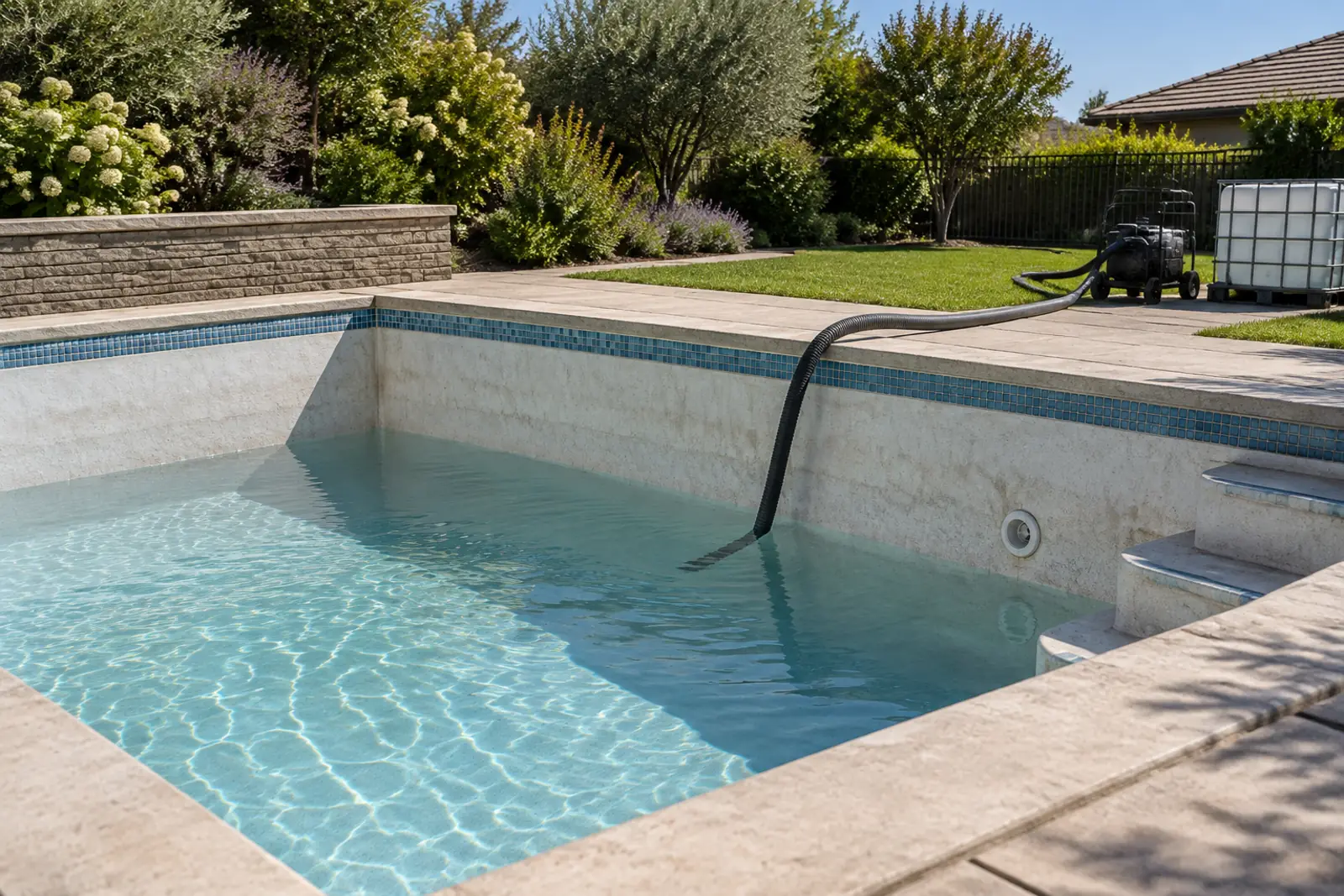
How to Drain a Pool Safely: Drain Times, Discharge Rules and When Not To
How to drain a pool: dechlorinate the water, pump it to your sewer cleanout or lawn at the rate your city allows, and never empty a vinyl or fiberglass pool without the maker's approval.
- ✓Drain-time tableHours for 8,600 to 30,000 gallons at 12 to 50 gpm, with the arithmetic shown.
- ✓Discharge rules from 5 governmentsMansfield TX, Fairfax County VA, Washington DC, Montgomery County MD and Ohio EPA.
- ✓When not to drainLatham's fiberglass warranty terms, vinyl shrink and groundwater pressure.
Key takeaways
- Washington DC requires chlorine under 0.1 mg/L before pool water reaches a storm drain, with fines up to $1,000 for a first offense that double for each repeat.
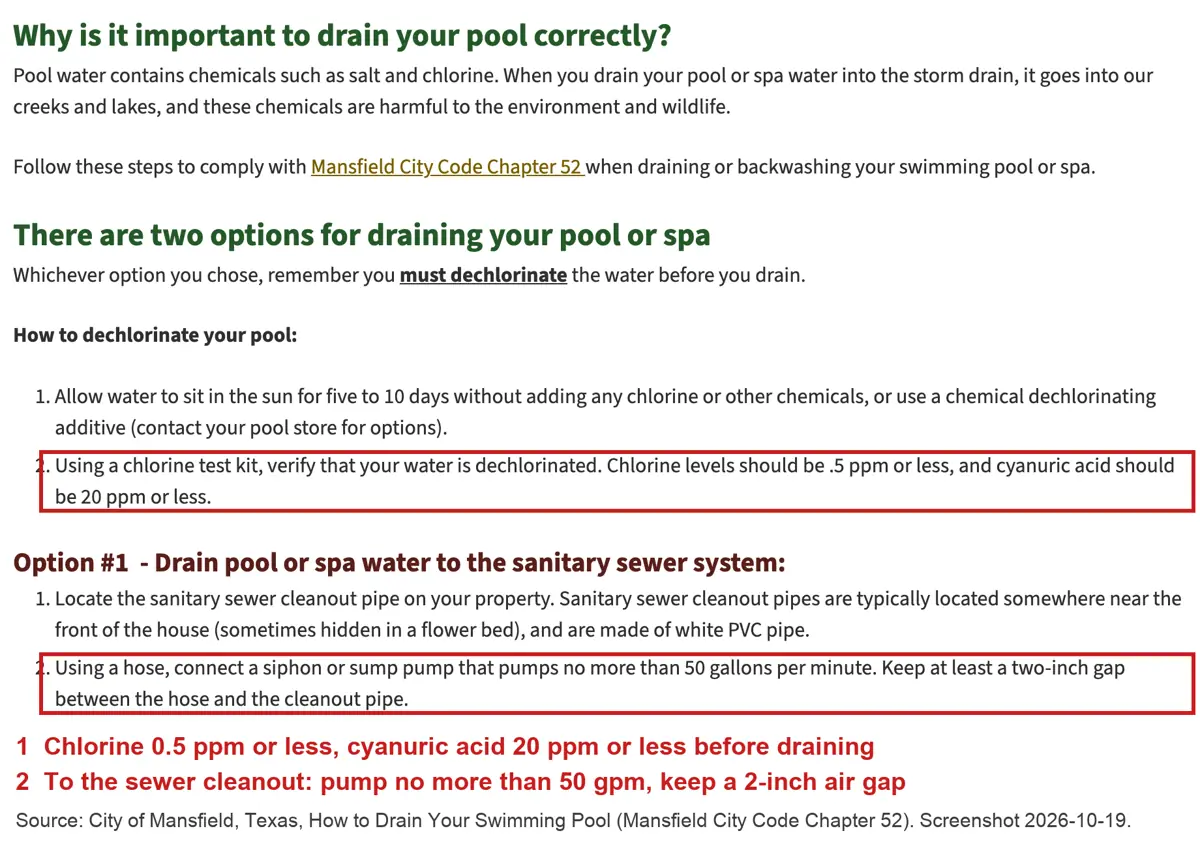
- Mansfield, Texas wants chlorine at 0.5 ppm or less and cyanuric acid at 20 ppm or less, and caps flow into a sewer cleanout at 50 gallons per minute with a 2-inch air gap.
- Fairfax County, Virginia recommends draining at 12 to 15 gpm with a 25 gpm maximum to storm drains or streams, after 7 to 10 days for chlorine to dissipate.
- The 2026 Latham fiberglass warranty is voided if the water drops below the skimmer outlet; the shell is designed to remain full of water at all times.
- Drain time is gallons divided by gpm divided by 60: a 1/4 HP K2 UTA02502K utility pump rated 1,800 gallons per hour (30 gpm) empties a 17,300-gallon pool in about 9.6 hours.
Do you actually need to drain your pool?
Usually not. A full drain is for work that needs a dry shell: resurfacing, replastering, acid washing or a new liner. Chemistry problems such as cyanuric acid above the 90 ppm ceiling in the 2024 Model Aquatic Health Code or calcium hardness near 800 ppm (Leslie’s) are usually fixed with a partial drain and refill, which keeps weight in the shell. If the drain is for a pool acid wash, neutralize the rinse water to your local pH window before it goes to the sewer.
| Reason to drain | Trigger | Full or partial | Source |
|---|---|---|---|
| Resurfacing, replastering, acid wash or shell crack repair | Work needs a dry surface | Full | Leslie's |
| Vinyl liner replacement | Old liner is coming out anyway | Full | Leslie's |
| Cyanuric acid above the code ceiling | Above 90 ppm (2024 MAHC 5.7.3.1.3.2, public pools); In The Swim calls 100 to 150 ppm very high | Partial drain and refill | CDC 2024 Model Aquatic Health Code; In The Swim |
| Very high total dissolved solids | 5,000 to 10,000 ppm | Partial or full | In The Swim |
| Calcium hardness out of control | About 800 ppm or more | Partial or full | Leslie's |
| Water too high after rain | Level above the skimmer opening | Lower a few inches on WASTE | Hayward VariFlo valve manual |
| Hurricane or tropical storm forecast | Storm approaching | Do not drain | Florida Swimming Pool Association; UF/IFAS Extension |
Sources: Leslie’s; In The Swim; Hayward VariFlo valve manual; Florida Swimming Pool Association. Accessed 2026-10-19. Download CSV
Leslie’s gives a rule of thumb of draining every 3 to 5 years, when cyanuric acid, calcium hardness or dissolved solids climb past what chemicals can correct. Treat that as a retailer estimate and let a water test decide. If cyanuric acid is the problem, the benchmark is the 2024 Model Aquatic Health Code, which keeps cyanuric acid at public pools at or below 90 ppm (section 5.7.3.1.3.2); In The Swim’s 100 to 150 ppm “very high” band is a retailer figure. The share to drain is 1 minus target divided by current: going from 120 ppm to 60 ppm means replacing 50% of the water. Our guide to cyanuric acid in a pool works through that drain math. For a cyanuric acid problem, a partial drain is usually enough; the share by reading is in our guide on how to lower cyanuric acid in a pool.
For shell work the drain is part of the job. Our pool resurfacing cost guide prices the finish itself, and pool liner replacement cost covers the vinyl side, where the old liner comes out anyway. The drain fee alone runs $180 to $230 in Angi’s 2026 data. Draining is also the first step of taking a pool out for good, priced line by line in our pool removal cost guide.
When should you not drain a pool?
Do not drain after heavy rain, before a storm, in high heat, or at all if the pool is fiberglass without the maker’s written approval. An empty shell has no water weight holding it down, so groundwater can lift it. Latham voids its fiberglass warranty if water drops below the skimmer outlet, and vinyl shrinks when left dry in the sun.
| Pool type | Risk when emptied | What the maker or source says | Source |
|---|---|---|---|
| Fiberglass (Latham) | Shell can lift or shift if groundwater pushes up | Warranty void if water drops below the skimmer outlet; "designed to remain full of water at all times" | Latham warranty rev. 4/26, section 11a |
| Fiberglass (other makers) | Same | Drain only with written authorization (Tallman); an authorized dealer must drain it or the warranty may be void (River Pools) | Tallman Pools; River Pools |
| Vinyl liner, inground or above-ground | Liner shrinks, wrinkles or will not refit | Do not leave a liner with no water in the sun, as vinyl will shrink | Ocean Blue Water Products liner instructions |
| Concrete (gunite, shotcrete, plaster) | Shell can crack or float on high groundwater | Open the hydrostatic relief valve in the main drain sump as the deep end empties | TMI Aquatics; In The Swim |
| Any pool before a hurricane | Water table rises fast | Do not drain; water weight keeps the pool from popping | Florida Swimming Pool Association; UF/IFAS Extension |
Sources: Latham Fiberglass Pools warranty; Tallman Pools; River Pools; Ocean Blue Water Products; TMI Aquatics; In The Swim; FSPA. Download CSV
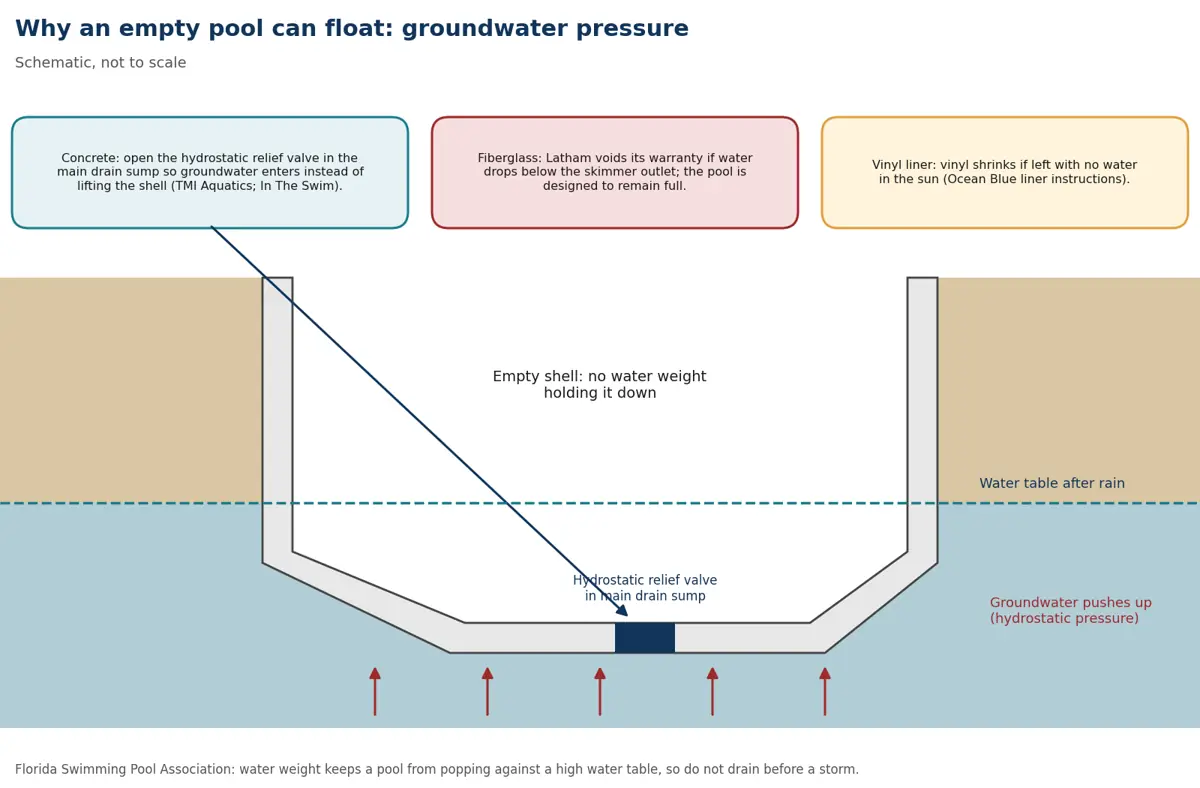
Groundwater is the main risk, and it is local. TMI Aquatics notes that pools in low-lying areas, next to natural bodies of water or on naturally high groundwater see the most pressure, and that relief valves under the main drain cover must be opened or removed when the pool is drained. The Florida Swimming Pool Association and UF/IFAS Extension both tell owners not to drain before a hurricane for the same reason; Broward County allows lowering by no more than 1 to 2 feet, as our pool hurricane rules study records.
Heat matters for the surface. Leslie’s advises draining when the air is below 85F because sun and heat damage exposed plaster, liners and fiberglass, and In The Swim names 55F to 85F as the best range. For fiberglass, Tallman Pools says never drain without written authorization, and River Pools says an authorized dealer must drain it or the warranty may be void. Our fiberglass pool installation guide explains the backfill that makes some shells safer to drain than others.
Where can you drain pool water?
Into the sanitary sewer cleanout or onto your own lawn in most places, and into a storm drain only where the local rule allows it and only once chlorine tests under the limit, often 0.1 mg/L. Mansfield, Texas caps sewer-cleanout flow at 50 gpm; Fairfax County caps storm-drain flow at 25 gpm. Salt pools go to the sanitary sewer.
| Jurisdiction | Chlorine before discharge | Other limits | Flow limit | Allowed routes | Penalty | Source |
|---|---|---|---|---|---|---|
| Mansfield, TX (City Code Ch. 52) | 0.5 ppm or less | Cyanuric acid 20 ppm or less before either route; 5 to 10 days in sun to dechlorinate | No more than 50 gpm to sewer cleanout, 2-inch air gap | Sanitary sewer cleanout; your own lawn or landscaped area | Not stated on page | City of Mansfield |
| Fairfax County, VA | Under 0.1 mg/L total residual chlorine or bromine | pH 6.0 to 8.0; 7 to 10 days to dissipate; salt pools to sanitary sewer only | 12 to 15 gpm recommended, 25 gpm max to storm drains or streams | Lawn first; storm drain as a last resort; no manholes | Civil penalty under county ordinance | Fairfax County Public Works |
| Washington, DC | Under 0.1 mg/L before the storm sewer | Sunlight dissipates chlorine within 10 days | Not stated | Sanitary or combined sewer; storm sewer only once dechlorinated | Up to $1,000 first offense, doubling each time | DC Department of Energy and Environment |
| Montgomery County, MD | Below 0.1 mg/L, or at least 48 hours after adding chlorine | pH 6.5 to 8.5 | Not stated | Sanitary sewer preferred; storm drain needs a state permit for community pools | $500 civil citation (permit violations) | Montgomery County press release |
| Ohio (state rule) | Dechlorinated | Rest water typically 48 hours or more | Not stated | Storm sewer allowed once dechlorinated | Not stated | Ohio EPA |
Sources: City of Mansfield; Fairfax County Public Works; DC DOEE; Montgomery County, MD; Ohio EPA. Accessed 2026-10-19. Download CSV
Chlorine is the reason storm drains are off limits. DC’s Department of Energy and Environment notes that EPA treats chlorine at 1 mg/L or less as highly toxic to aquatic life, and the District sets its own bar at under 0.1 mg/L. The U.S. EPA’s stormwater guidance for municipalities lists draining to the sanitary sewer, or dechlorinating and then discharging or irrigating, as the accepted routes, and cites Virginia Beach as one city with an ordinance on pool discharges.
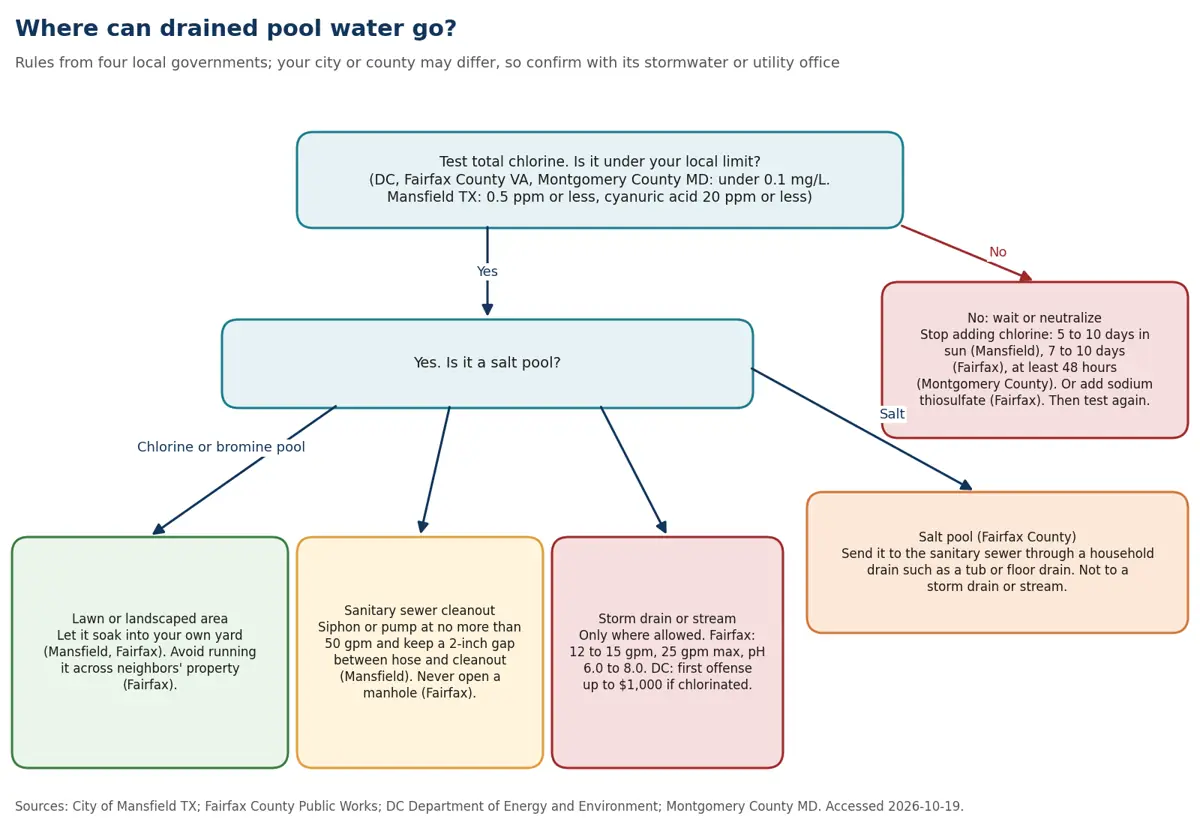
Dechlorinating takes days, not hours. Mansfield says 5 to 10 days in the sun without adding chlorine, Fairfax County says 7 to 10 days, and Montgomery County sets at least 48 hours after the last chlorine dose or a reading below 0.1 mg/L. Fairfax notes that sodium thiosulfate removes chlorine faster. Test with a pool kit before the first gallon leaves the yard.
How long does it take to drain a pool?
Divide the gallons by the pump’s gallons per minute, then by 60. A 16 x 32 ft pool holding 17,300 gallons takes 9.6 hours at 30 gpm, 11.5 hours at Fairfax County’s 25 gpm storm-drain cap and 24 hours at its recommended 12 gpm. Lift costs flow: a 1/4 HP pump rated 1,800 gallons per hour drops to 1,320 when lifting 10 feet.
| Pool (Akron volume table) | Gallons | 12 gpm (Fairfax low rec.) | 22 gpm (1/4 HP pump, 10 ft lift) | 25 gpm (Fairfax storm max) | 30 gpm (1/4 HP pump, 0 ft lift) | 50 gpm (Mansfield sewer cap) |
|---|---|---|---|---|---|---|
| 12 x 24 ft inground, 4 ft avg | 8,600 | 11.9 | 6.5 | 5.7 | 4.8 | 2.9 |
| 24 ft round above-ground, 48 in wall | 11,895 | 16.5 | 9.0 | 7.9 | 6.6 | 4.0 |
| 14 x 28 ft inground, 4.5 ft avg | 13,200 | 18.3 | 10.0 | 8.8 | 7.3 | 4.4 |
| 16 x 32 ft inground, 4.5 ft avg | 17,300 | 24.0 | 13.1 | 11.5 | 9.6 | 5.8 |
| 18 x 36 ft inground, 4.5 ft avg | 21,900 | 30.4 | 16.6 | 14.6 | 12.2 | 7.3 |
| 20 x 40 ft inground, 5 ft avg | 30,000 | 41.7 | 22.7 | 20.0 | 16.7 | 10.0 |
Sources: volumes from the City of Akron gallons table; rates from Fairfax County, K2 UTA02502K spec sheet and City of Mansfield; PC&S arithmetic. Download CSV
Source: PC&S arithmetic; volume from City of Akron; rates from Fairfax County, K2 UTA02502K spec sheet and City of Mansfield TX. Download chart data (CSV)
| Step | Input or result | Arithmetic |
|---|---|---|
| Pool volume | 17,300 gallons | 16 x 32 ft at 4.5 ft average depth (City of Akron table) |
| Pump rating | 1,800 gallons per hour at 0 ft lift | K2 UTA02502K, 1/4 HP (spec sheet) |
| Flow in gpm | 30 gpm | 1,800 / 60 |
| Minutes to empty | 576.7 minutes | 17,300 / 30 |
| Hours to empty | 9.6 hours | 576.7 / 60 |
| Same pump lifting water 10 ft | 22 gpm, 13.1 hours | 1,320 GPH / 60 = 22; 17,300 / 22 / 60 |
| Capped at Fairfax storm-drain maximum | 25 gpm, 11.5 hours | 17,300 / 25 / 60 |
Sources: City of Akron; K2 UTA02502K spec sheet; Fairfax County. Download CSV
How long does it take to drain a 24 foot round pool? About 6.6 hours at 30 gpm and 16.5 hours at 12 gpm, for the 11,895 gallons the City of Akron lists for a 24 ft round pool with a 48-inch wall. With a 52-inch wall Akron lists 13,594 gallons, so add about 14%. Measure your own water depth first with the pool volume calculator.
The filter pump is a second option. Hayward’s VariFlo multiport valve manual (IS0710X62 Rev B) lists the WASTE setting “for vacuuming directly to waste, lowering pool level and/or draining pool,” which sends water out the waste port without passing through the filter. In The Swim says a filter pump can sometimes get nearly all the water out but normally leaves several hundred gallons at least, so most owners finish with a submersible pump.
How to drain a pool, step by step
Check the rules and the weather, stop chlorinating until the water tests under your local limit, cut power to the equipment, set a submersible pump in the deep end, route the hose to an allowed outlet at the allowed flow, open relief valves on concrete pools as the water drops, do the work quickly, and refill the same day the work allows.
- Confirm you are allowed to drainCall your city or county stormwater office for the discharge route and flow limit. For fiberglass, get the maker’s or dealer’s authorization in writing (Tallman; River Pools).
- Pick a dry, mild weekNo heavy rain in the days before, no storm in the forecast (FSPA), and air below 85F (Leslie’s).
- Dechlorinate and testStop adding chlorine 5 to 10 days ahead (Mansfield) or use sodium thiosulfate (Fairfax). Test until chlorine is under 0.1 mg/L, or 0.5 ppm in Mansfield, and pH is 6.0 to 8.0 (Fairfax).
- Turn off the pool equipmentSwitch off the pump, heater and automation at the breaker so nothing runs dry while the level falls.
- Set the pumpLower a submersible utility pump to the deep end. A 1/4 HP K2 UTA02502K moves 1,800 gallons per hour at 0 ft of lift. Or set the multiport valve to WASTE and run the filter pump, which normally leaves several hundred gallons behind (Hayward; In The Swim).
- Route the hose to an allowed outletSewer cleanout at no more than 50 gpm with a 2-inch air gap (Mansfield), or your own lawn without running onto neighbors (Fairfax). Never open a manhole (Fairfax).
- Watch the level and the shellOn concrete pools, open the hydrostatic relief valve in the main drain sump as the deep end empties (TMI Aquatics). Stop if the floor moves or water rises through cracks.
- Do the work fastDo not leave a vinyl liner dry in the sun (Ocean Blue). Partial drains in vinyl pools leave 4 to 6 in of water on the floor (In The Swim).
- Refill and rebalanceRefill as soon as the work allows, check whether your utility has a fill ban, then rebuild chlorine, pH and stabilizer from zero.
If you are lowering the water a few inches for winter rather than emptying the shell, the cover maker’s level is what counts, such as 15 to 18 inches below the top of the pool for a Loop-Loc mesh cover; our guide on how to winterize a pool lists those levels by cover brand.
What does it cost to drain and refill a pool?
Angi lists $180 to $230 for a professional drain and $55 per 5,000 gallons to refill. The water itself is the bigger line in some cities: a 20,000-gallon refill cost $39.00 in Sacramento and $649.98 in Houston at October 2026 rates, with a 25-city median of $215.09, because some utilities bill sewer on every gallon.
| Cost line | Amount | Source |
|---|---|---|
| Professional drain | $180 to $230 | Angi pool repair cost guide, 2026 |
| Professional refill | $55 per 5,000 gallons | Angi pool repair cost guide, 2026 |
| Tap water and sewer for a 20,000-gallon refill | $39.00 (Sacramento) to $649.98 (Houston), median $215.09 | PC&S cost to fill a pool ledger, 25 cities, rates in effect Oct 4, 2026 |
| Submersible utility pump, 1/4 HP | 1,800 gallons per hour at 0 ft lift | K2 UTA02502K spec sheet (performance, not price) |
Sources: Angi pool repair cost guide (2026); PC&S cost to fill a pool ledger from utility rate schedules; K2 spec sheet. Download CSV
Source: PC&S cost to fill a pool ledger, from official utility rate schedules in effect 2026-10-04. Download chart data (CSV)
Check drought rules before the water leaves. Our pool filling restrictions atlas found 15 of 32 utilities and state rules can ban filling pools at some drought stage, and 4 had a ban in force on October 8, 2026, including Charlotte Water and Aurora Water. Draining during a fill ban leaves the shell empty, and exposed to groundwater, until the ban lifts. Refill hours by hose size, meter and water truck are in our guide on how long it takes to fill a pool.
Should you drain, partially drain or leave it full?
Skip the full drain whenever a partial drain or chemistry fixes the problem, and leave the pool full before a storm. Drain fully only for shell work on a concrete pool in dry, mild weather with the relief valve open. Fiberglass needs the maker’s written approval, and vinyl liners stay wet unless the liner is being replaced. The table maps each case.
| If your situation is | Do this | Why (source) |
|---|---|---|
| Chemistry is off (cyanuric acid above 90 ppm, high TDS or calcium) | Partial drain and refill in stages; keep the floor covered; check local cyanuric acid discharge limits first | 2024 MAHC 90 ppm ceiling; In The Swim suggests leaving 4 to 6 in of water in vinyl pools; Mansfield caps discharge at 20 ppm cyanuric acid |
| Resurfacing or replastering a concrete pool | Full drain in dry weather; open the hydrostatic relief valve | TMI Aquatics; In The Swim |
| Fiberglass pool | Do not drain yourself; get the maker or dealer to authorize it in writing | Latham, Tallman and River Pools warranty terms |
| Vinyl liner not being replaced | Partial drain only; never leave the liner dry in sun | Ocean Blue liner instructions; Leslie's |
| Heavy rain in the last few days or high water table | Wait for a dry stretch | Groundwater lifts empty shells (TMI Aquatics) |
| Storm or hurricane forecast | Leave it full; shock it instead | FSPA; UF/IFAS; Lee County Emergency Management |
| Air temperature above 85F | Drain in early morning or wait for a cooler week | Leslie's says below 85F; In The Swim prefers 55F to 85F |
| Utility has a pool-fill ban in force | Do not drain until refilling is allowed | Charlotte Water and Aurora Water bans in force Oct 8, 2026 (PC&S research) |
Sources: In The Swim; TMI Aquatics; Latham; Tallman Pools; River Pools; Ocean Blue; Leslie’s; FSPA; PC&S filling restrictions research. Download CSV
When a repair is the reason, the drain is often part of the contractor’s quote. Our pool repair guide lists what drain-dependent repairs cost and which Florida license covers draining a pool for repair under Fla. Stat. 489.105.
How we compiled this
We read 12 primary documents in October 2026: the 2024 Model Aquatic Health Code, discharge rules from the City of Mansfield, Fairfax County, the DC Department of Energy and Environment, Montgomery County and Ohio EPA, the U.S. EPA stormwater guidance, the Latham fiberglass warranty, the Ocean Blue liner instructions, the Hayward VariFlo valve manual, the K2 utility pump spec sheet and the City of Akron gallons table, plus Angi’s repair cost page for prices. Refill costs, drought bans and hurricane guidance come from three PC&S research reports. Drain times are our arithmetic; we did not drain any pools or test pumps.
Frequently Asked Questions
How do I drain water from my pool?
Dechlorinate first, then pump the water out. Stop adding chlorine 5 to 10 days ahead (Mansfield, TX) until it tests under your local limit, lower a submersible pump into the deep end, and run the hose to your sewer cleanout or lawn at the allowed rate, such as 50 gpm in Mansfield. On concrete pools, open the hydrostatic relief valve as the deep end empties.
How long does it take to drain a 24 foot round pool?
About 6.6 hours with a 30 gpm pump and 16.5 hours at 12 gpm, for the 11,895 gallons the City of Akron lists for a 24 ft round pool with a 48-inch wall. Divide your gallons by the pump’s gallons per minute, then by 60. A 52-inch wall holds 13,594 gallons by Akron’s table.
Does backwash drain the pool?
It lowers it a little. Backwash sends water through the filter in reverse and out the waste line, so the level drops while it runs. To drain on purpose, Hayward’s VariFlo manual uses the WASTE setting, which skips the filter and is meant for lowering pool level or draining. Fairfax County wants backwash water dechlorinated before it reaches a storm drain. Our how to backwash a pool filter guide shows how many gallons each backwash sends out and where it may go.
How do I get water out of my pool without a pump?
Use a garden hose as a siphon. Pinch A Penny’s method: submerge the hose to fill it, cap one end, carry that end downhill below the pool’s water surface to an approved outlet, and uncover it. Flow depends on the height difference, so it is slow for a full drain. Mansfield, Texas allows a siphon into the sewer cleanout with a 2-inch air gap. Siphon times for every above ground pool size, and why a hose that ends at ground level stalls near the floor, are in our guide on how to drain an above ground pool.
How long does it take to drain a 30,000 gallon pool?
About 16.7 hours at 30 gpm and 10 hours at Mansfield’s 50 gpm sewer cap, using hours = gallons / gpm / 60. At Fairfax County’s recommended 12 gpm to a storm drain it takes 41.7 hours. The City of Akron lists 30,000 gallons for a 20 x 40 ft pool at a 5 ft average depth.
Can I drain my pool into my sewer clean out?
In many places, yes, and it is often the preferred route. Mansfield, Texas allows it with a siphon or pump at no more than 50 gpm and a 2-inch gap between hose and cleanout. Washington DC allows the sanitary or combined sewer. Fairfax County bars opening a manhole and asks residents to call its Wastewater Management office before sending backwash to the sanitary sewer. Spa water has its own rules on heat and bromine, set out in our guide on how to drain a hot tub.
What is the easiest way to drain a pool?
A submersible utility pump in the deep end with a hose to an approved outlet. A 1/4 HP K2 UTA02502K moves 1,800 gallons per hour at 0 ft of lift, about 9.6 hours for 17,300 gallons. The filter pump on WASTE works too but usually leaves several hundred gallons behind (In The Swim).
Sources
- City of Mansfield, Texas. How to Drain Your Swimming Pool (Mansfield City Code Chapter 52). Accessed 2026-10-19.
- Fairfax County Public Works and Environmental Services. Proper Discharge of Swimming Pool Water. Accessed 2026-10-19.
- DC Department of Energy and Environment. How to Drain Your Swimming Pool Properly. Accessed 2026-10-19.
- Montgomery County, Maryland. Press release: pool water discharge requirements. Accessed 2026-10-19.
- Ohio EPA. Discharging swimming pool water into storm sewers. Accessed 2026-10-19.
- U.S. Environmental Protection Agency. Educating Residents on Safely Discharging Chemically Treated Water (stormwater BMP). Accessed 2026-10-19.
- Latham Pool Products. Latham Fiberglass Pools Limited Lifetime Warranty (rev. 4/26). Accessed 2026-10-19.
- Tallman Pools. Use and care manual for your fiberglass pool. Accessed 2026-10-19.
- River Pools. How and When to Drain a Fiberglass Pool. Accessed 2026-10-19.
- Ocean Blue Water Products. Liner warranty and installation instructions. Accessed 2026-10-19.
- Hayward. VariFlo Multiport Valve owner's manual (IS0710X62 Rev B). Accessed 2026-10-19.
- K2 Pumps (via Lowe's). UTA02502K Automatic Submersible Utility Pump spec sheet. Accessed 2026-10-19.
- City of Akron, Ohio. How to calculate the gallons in a swimming pool. Accessed 2026-10-04.
- TMI Aquatics. The Importance of Hydrostatic Relief Valves. Accessed 2026-10-19.
- In The Swim. How to Drain a Swimming Pool. Accessed 2026-10-19.
- Leslie's. Pool Draining 101: How to Drain a Pool. Accessed 2026-10-19.
- Pinch A Penny. How to Drain Your Swimming Pool. Accessed 2026-10-19.
- Angi. How Much Do Swimming Pool Repairs Cost? (2026 data). Accessed 2026-10-19.
- Florida Swimming Pool Association. Hurricane Preparedness. Accessed 2026-10-08.
- UF/IFAS Extension Indian River County. Pools and Hurricanes. Accessed 2026-10-08.
- U.S. Centers for Disease Control and Prevention. 2024 Model Aquatic Health Code (5th edition), section 5.7.3.1.3.2. Accessed 2026-10-19.
- Charlotte Water. Drought Resources. Accessed 2026-10-08.
Related pages
Get Quotes From Licensed Local Pool Pros
Tell us what you need and your ZIP code. We match you with pool companies that cover your area.