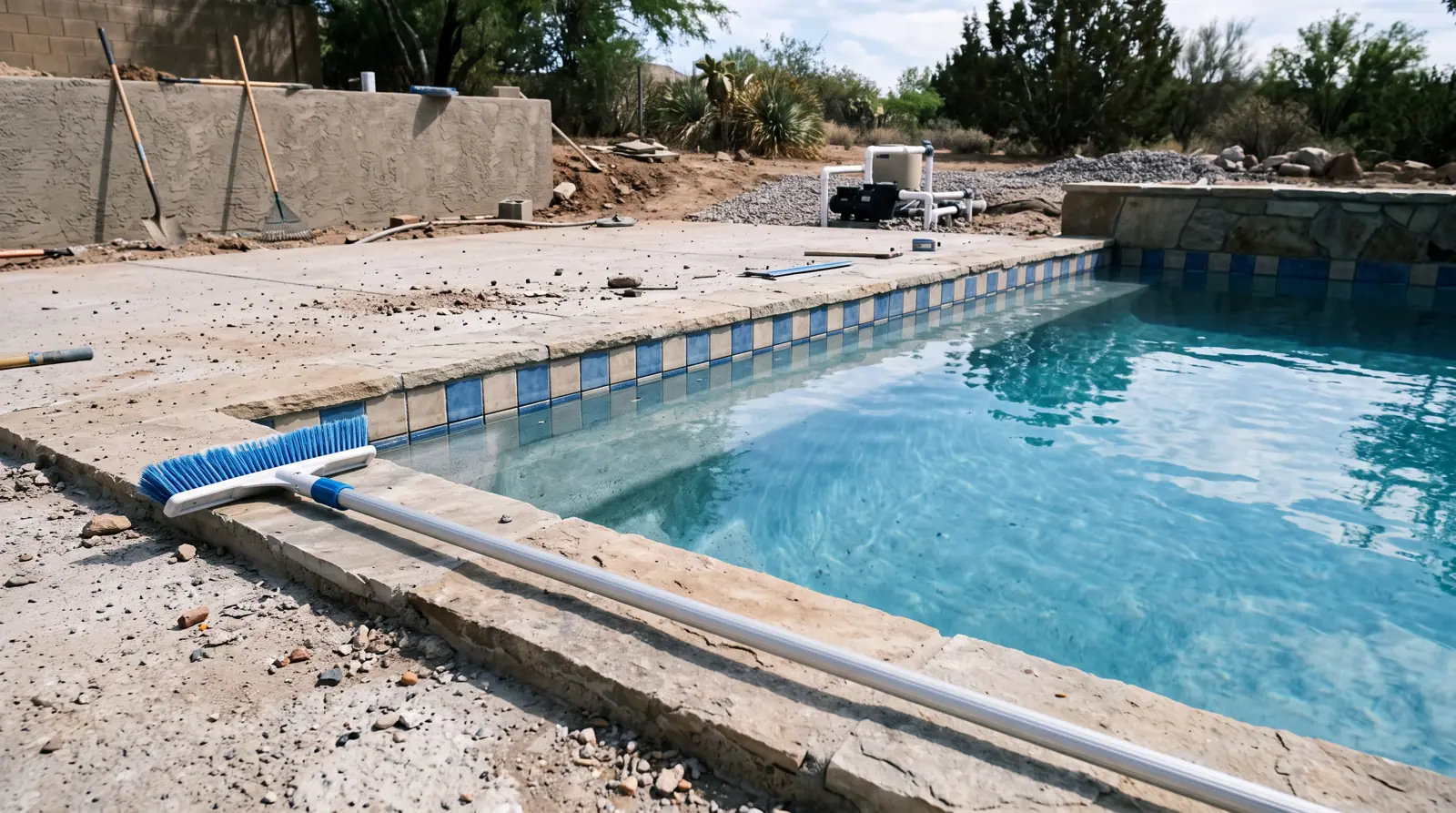
How to Clean Pool Tile and Remove Calcium Without Damaging It
How to clean pool tile: brush weekly with a tile cleaner, test white scale with a drop of muriatic acid, then match the method to the tile, since one glass tile maker bans pumice and acid.
- ✓Foams or not: two different scalesCalcium carbonate foams under a drop of muriatic acid; calcium silicate does not (Latham Pool Products).
- ✓Glass tile needs soft methodsJeffrey Court's 2021 tile guide rules out pumice, wire brushes and acid contact, but allows baking soda or kieserite blasting.
- ✓Cleaning costs about a quarter of retilingA 96 ft waterline: $620 to $635 for glass bead blasting with sealer vs $2,400 to retile at $25 per foot.
Key takeaways
- Calcium carbonate scale foams under a few drops of muriatic acid and calcium silicate does not, which decides the method (Latham Pool Products).
- Jeffrey Court’s pool tile guide says to brush tile weekly and to avoid pumice stones, wire brushes and abrasive or acidic cleaners on its tile (Pool Tile Maintenance Guide, October 2021).
- Baking soda or kieserite blasting media is safe for tile including glass, while glass bead is the aggressive end of the range, per the same guide.
- A Long Beach, California pool service listed glass bead blasting at $5.25 per foot and mineral salt media at $6.25, with a 100 foot minimum (HomeAdvisor listing, May 2025); retiling averages $25 per linear foot (HomeAdvisor).
- Scale forms when the Langelier Saturation Index rises above plus 0.30 (Orenda); the 2024 MAHC Annex sets the balanced band at minus 0.3 to plus 0.3.
What is the white buildup on pool tile?
Usually calcium scale, and there are 2 kinds. Calcium carbonate is white and flaky and comes off fairly easily; calcium silicate is white-grey, harder and slower to form, and pools with it often have scale in the pipes too, according to Latham Pool Products. A grey or brown greasy band is scum and body oil, which a degreaser handles.
| Deposit | Looks like | Muriatic acid drop test | What removes it | Source |
|---|---|---|---|---|
| Calcium carbonate | White and flaky; fairly easy to take off | Foams and fizzes | Brush plus calcium releaser, negative LSI soak, pumice on ceramic, media blasting | Latham; Jeffrey Court; Orenda |
| Calcium silicate | White-grey, harder, slower to form; often also in pipes | No reaction | Pumice on hard surfaces and hard work, or pro media blasting; additives can take months | Latham |
| Waterline scum and oils | Grey or brown film, greasy feel | Not a scale; no test needed | All purpose cleaner and degreaser with a nylon brush or pad | Jeffrey Court |
Sources: Latham Pool Products; Jeffrey Court Pool Tile Maintenance Guide (2021); Orenda scale procedure. Download CSV
Scale is a water chemistry symptom before it is a cleaning job. Florida’s pool operators manual notes that water carrying too much calcium deposits it on the equipment, walls, floor and tile, and Latham adds that evaporating water leaves calcium behind, which is why the waterline scales first. Our calcium hardness guide shows how much hardness a year of top-offs adds, up to 385 ppm in Las Vegas.
| Number | Value | Source |
|---|---|---|
| Acid drop test result | Calcium carbonate foams; calcium silicate does not react | Latham Pool Products blog |
| Brushing interval for pool tile | Weekly | Jeffrey Court Pool Tile Maintenance Guide (Oct 2021) |
| Glass bead blasting, Long Beach CA listing | $5.25 per foot, 100 ft minimum | Pool Tech So Cal on HomeAdvisor (May 2025 capture) |
| Mineral salt media blasting, same listing | $6.25 per foot; sealer $95 to $110 | Pool Tech So Cal on HomeAdvisor (May 2025 capture) |
| Waterline retile, national average | $25 per linear foot | HomeAdvisor (updated Apr 14, 2025) |
| Chemical scale soak target | LSI minus 0.30 to minus 0.01 for 2 to 3 weeks | Orenda scale removal procedure |
| LSI band to prevent scale | Minus 0.3 to plus 0.3 | 2024 MAHC Annex 5.7.4.6 |
| Calcium hardness target | 200 to 400 ppm masonry; 80 to 200 ppm vinyl or fiberglass | 2024 MAHC Annex |
Sources: Latham; Jeffrey Court; Pool Tech So Cal on HomeAdvisor; HomeAdvisor; Orenda; 2024 MAHC Annex. Download CSV
How do you tell calcium carbonate from calcium silicate?
Put a few drops of muriatic acid on the deposit while wearing safety goggles. Calcium carbonate reacts and foams; calcium silicate does not, per Latham Pool Products. On glass or iridescent tile, drop the acid on the crust only and neutralize at once: Jeffrey Court says acid damages tile glaze and gives a fix of 1 lb baking soda to 3 gallons.
- Gear upGoggles and chemical-resistant gloves; NPIC lists both for pool acids. Keep a bucket of baking soda solution ready, 1 lb per 3 gallons of water (Jeffrey Court).
- Pick a thick spotChoose the thickest crust, away from grout lines, so the acid touches scale rather than glaze.
- Apply a few dropsUse pool muriatic acid, which is 31.45% hydrogen chloride, straight from a dropper. Never add water to the acid.
- Watch the dropsFoaming or fizzing means calcium carbonate. No reaction means calcium silicate, or a sealed crust over it.
- Neutralize and rinseSponge on the baking soda solution, then rinse. Test more than one spot, because one waterline can carry both scales.
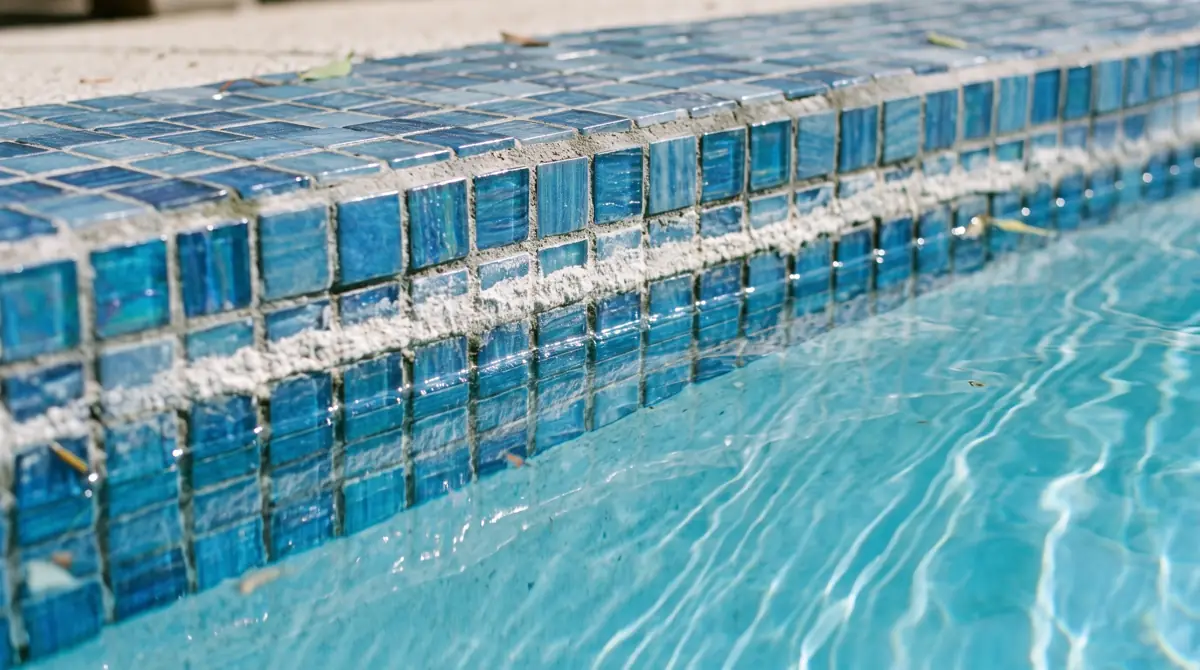
Which cleaning methods can your tile take?
Glazed ceramic tile can take a wet pumice stone; US Pumice lists its Pool Blok for ceramic tile and concrete. Glass tile cannot, at least from one maker: Jeffrey Court’s 2021 guide rules out pumice, wire brushes and acid contact. Vinyl and fiberglass waterlines scratch under pumice, Latham warns. Check your tile maker’s care sheet first.
| Surface | OK per the source | Avoid per the source | Source |
|---|---|---|---|
| Jeffrey Court pool tile, including iridescent glass | Nylon bristle brush; 3M White or Blue nylon pad; calcium releaser; baking soda or kieserite media | Pumice stones, wire brushes, abrasive or acidic cleaners; contact with hydrofluoric, hydrochloric, muriatic or phosphoric acid | Jeffrey Court Pool Tile Maintenance Guide (Oct 2021) |
| Ceramic tile and concrete | US Pumice Pool Blok (PB-80) pumice, used wet | Not listed for other surfaces | US Pumice listing at Ace Hardware (June 2026 capture) |
| Hard surfaces (tile, concrete) | Pumice stone, stone and surface kept wet | Pumice on vinyl liner or fiberglass: it scratches | Latham blog |
| Tile or vinyl liner | Bio-Dex Quick'n Thick Tile and Vinyl Liner Cleaner for light calcium | Not stated | Leslie's listing (Apr 2025 capture) |
| Any tile | Glass bead blasting by a pro, tested first | Glass bead is the aggressive end of blasting media | Jeffrey Court |
Sources: Jeffrey Court (2021); US Pumice listing at Ace Hardware (June 2026); Latham; Leslie’s listing (April 2025). Download CSV
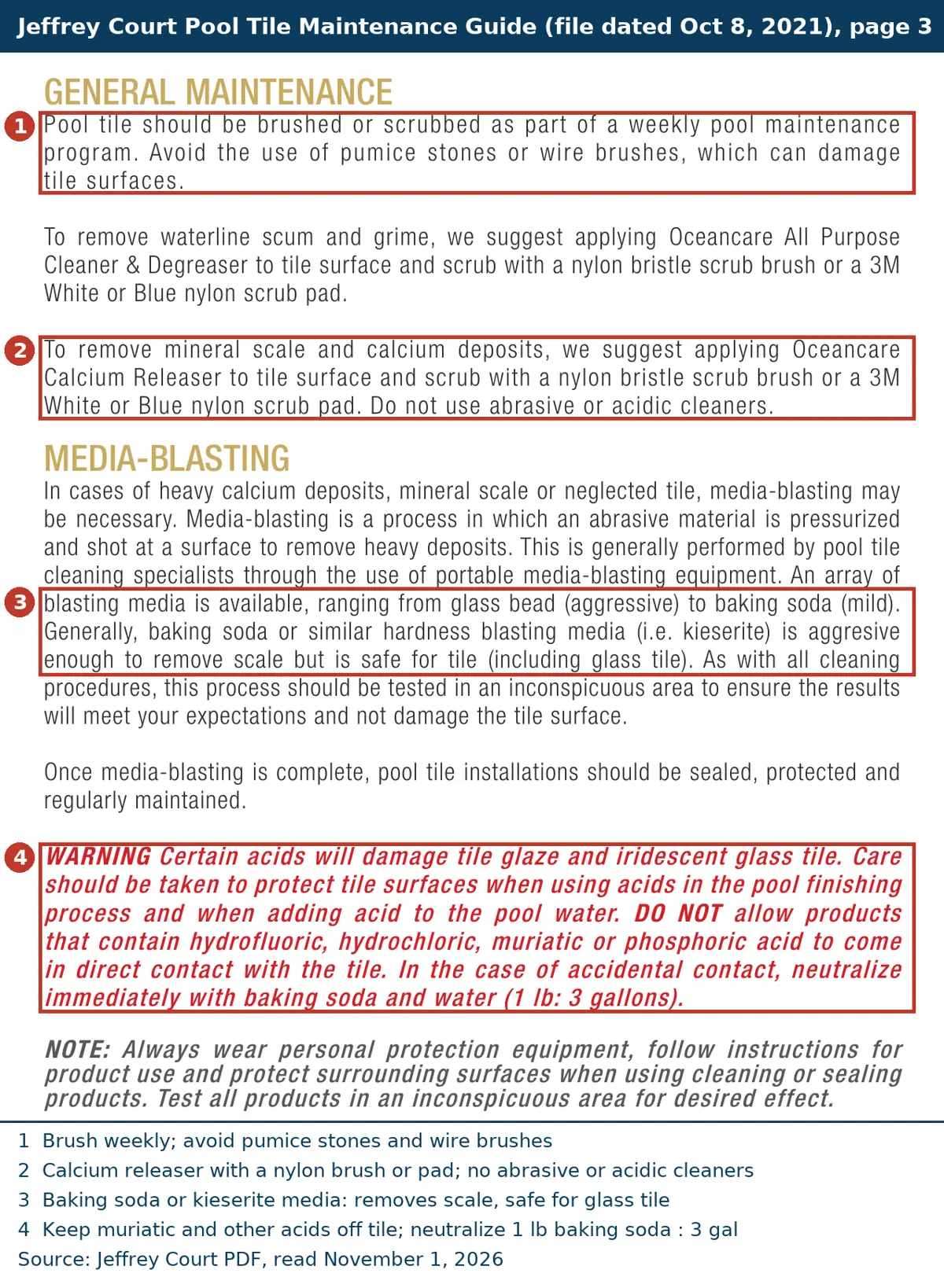
That puts the maker at odds with most how-to guides, which list pumice as a standard step. Latham limits pumice to hard surfaces such as tile and concrete and says to keep both stone and tile wet. PubChem lists kieserite, the soft blasting medium Jeffrey Court names, as a magnesium sulfate hydrate (CID 73357781). If you do not know your tile’s maker, test any abrasive on 1 hidden tile first.
How to clean pool tile, from lowest to highest risk
Start at rank 1 and stop at the first method that works. Brush and degrease, then a calcium releaser, then a chemical soak that pulls carbonate back into the water over 2 to 3 weeks, then wet pumice on ceramic tile only. Media blasting, acid on the tile and retiling are the last 4 ranks, and the last 3 are jobs for a pro.
| Risk rank | Method | Works on | Typical price | Main risk | Source |
|---|---|---|---|---|---|
| 1 (lowest) | Nylon brush and tile cleaner | Scum, oils, fresh light scale | Supplies only | None noted | Jeffrey Court |
| 2 | Calcium releaser or scale cleaner | Calcium carbonate | $22.99 to $41.99 per bottle (Leslie's, 2025) | Follow label on glass tile | Jeffrey Court; Leslie's listings |
| 3 | Negative LSI soak with scale control product | Calcium carbonate, whole waterline | Product plus acid | Chlorine drops at first; 2 to 3 weeks | Orenda procedure |
| 4 | Pumice stone, kept wet | Carbonate and silicate on ceramic tile and concrete | $7.99 per block (Ace, 2026); pro $2 to $4 per ft | Scratches; Jeffrey Court says avoid on its tile | US Pumice; Latham; PoolDial |
| 5 | Soft media blasting (baking soda, kieserite or mineral salt) | Heavy scale, including on glass tile | $6.25 per ft (Pool Tech So Cal, 2025) | Test a hidden area first | Jeffrey Court; HomeAdvisor listing |
| 6 | Glass bead blasting | Heavy scale on durable tile | $5.25 per ft (Pool Tech So Cal); $5 to $8 per ft (PoolDial) | Aggressive media | Jeffrey Court; PoolDial |
| 7 | Acid on the tile (muriatic) | Calcium carbonate only | $3 to $5 per ft pro acid wash (PoolDial) | Damages glaze and iridescent glass | Jeffrey Court; PoolDial |
| 8 (last resort) | Retile the waterline | Etched, cracked or failed tile | $25 per linear ft (HomeAdvisor) | Cost and downtime | HomeAdvisor; Anthony & Sylvan |
Sources: Jeffrey Court; Orenda; Ace Hardware; Leslie’s; PoolDial; Pool Tech So Cal on HomeAdvisor; HomeAdvisor. Download CSV
- Test the water firstRead pH, alkalinity, calcium and temperature and work out the LSI. Above plus 0.30, scale comes straight back (Orenda).
- Brush and degreaseNylon bristle brush or a 3M White or Blue nylon pad with an all purpose tile cleaner (Jeffrey Court). Weekly from here on.
- Apply a calcium releaserFollow the label dwell time; Leslie’s lists Bio-Dex #300 for heavy calcium and Quick’n Thick for light calcium on tile or vinyl.
- Or soak the whole line chemicallyOrenda’s method holds the LSI at minus 0.30 to minus 0.01 with pH 7.2 to 7.4 and 1 quart of SC-1000 per 10,000 gallons, brushing each visit for 2 to 3 weeks.
- Pumice, wet, ceramic onlyKeep the stone and tile wet and test 1 tile (Latham). Not on glass tile from makers who forbid it, and never on vinyl or fiberglass.
- Stop and call a proIf silicate or heavy scale survives, ask for soft media blasting first and a test patch; reseal afterward (Jeffrey Court).
Most of these steps work without draining. US Pumice says its Pool Blok (PB-80) needs no drain, and Orenda’s chemical method raises the water level to soak the scale instead of lowering it. Draining a pool carries its own rules, which our guide on how to drain a pool covers.
How to remove calcium from pool tile
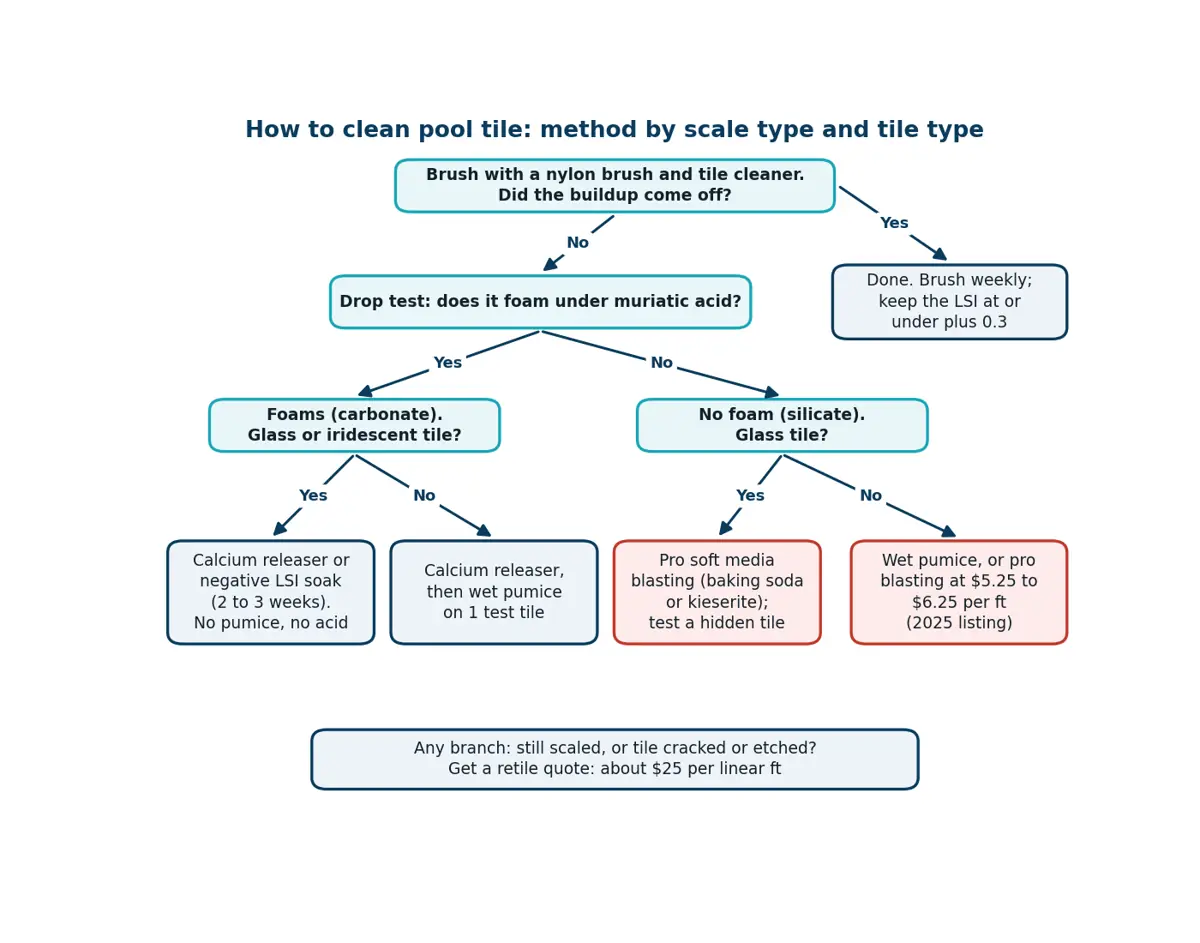
Match the method to the scale. Calcium carbonate dissolves when the water is pushed slightly negative on the LSI, and it scrubs off with a releaser or wet pumice on ceramic tile. Calcium silicate does not dissolve in acid: Latham calls pumice and hard work the only reliable DIY route, and scale additives can take months, against 2 to 3 weeks for carbonate. Glass tile with silicate is a blasting job.
Carbonate. Orenda’s procedure dissolves it in place: hold pH at 7.2 to 7.4, hold the LSI between minus 0.30 and minus 0.01, add 1 quart (32 fl oz) each of its scale and enzyme products per 10,000 gallons and brush every visit. It warns the first dose wipes out chlorine for a day or two and that the process generally takes 2 to 3 weeks. Maintenance doses then drop to 3 fl oz and 5 fl oz.
Silicate. No household acid touches it, which is what the drop test shows, so acid (rank 7) does nothing and additives (ranks 2 and 3) can take months, per Latham. On ceramic tile that leaves wet pumice and patience. On glass tile it leaves soft media blasting, because Jeffrey Court rules out pumice and acid. A pro who quotes glass bead on glass tile should test a hidden tile first, since the same guide calls glass bead the aggressive end of the media range.
Which method fits your scale and your tile? Decision table
Read across 2 facts: what the acid test showed and what the tile is. Carbonate on ceramic is a DIY job. Silicate on ceramic is pumice or a pro. Anything on glass tile means no pumice and no acid, and silicate on glass means soft media blasting. Scale that returns within weeks means fixing the LSI first, and etched tile means a retile quote.
| If your situation is | Do this | Why (source) |
|---|---|---|
| Glazed ceramic tile, deposit foams in the acid test (carbonate) | Nylon brush and calcium releaser; if it stays, pumice kept wet on a test tile, or a negative LSI soak | Carbonate is the easy scale (Latham); US Pumice lists ceramic tile |
| Glazed ceramic tile, no reaction (silicate) | Pumice kept wet, or hire soft media or glass bead blasting | Pumice and hard work is the only reliable DIY route (Latham) |
| Glass or iridescent glass tile, carbonate | Nylon pad and calcium releaser, or a negative LSI soak; no pumice, no acid | Jeffrey Court bans pumice and acid contact on its tile |
| Glass tile, silicate or heavy scale | Pro blasting with baking soda or kieserite media, tested on a hidden tile first | Jeffrey Court: soft media is safe for glass tile; glass bead is aggressive |
| Vinyl liner or fiberglass waterline | No pumice; a liner-safe cleaner or a scale treatment that works over weeks | Pumice scratches vinyl and fiberglass (Latham) |
| Scale returns within weeks of cleaning | Fix water balance first: LSI at or under plus 0.3, calcium in range | Scale forms above plus 0.30 (Orenda); MAHC Annex band minus 0.3 to plus 0.3 |
| Tile is cracked, loose or etched under the scale | Get a retile quote instead of cleaning | About $25 per linear foot (HomeAdvisor, 2025) |
Sources: Latham; Jeffrey Court (2021); US Pumice listing; Orenda; 2024 MAHC Annex; HomeAdvisor. Download CSV
How do you use acid safely around pool tile?
Use it only as a few-drop test unless the tile maker allows more. Pool muriatic acid is 31.45% hydrogen chloride. Pre-dilute by adding acid to water, never water to acid, as the National Plasterers Council card says. Keep 1 lb of baking soda per 3 gallons of water on hand to neutralize spills on tile (Jeffrey Court).
Muriatic acid also changes the water. Any acid that drips into the pool lowers pH and alkalinity, so retest after a tile session and, if alkalinity has dropped, follow our guide on how to raise alkalinity in a pool. Leslie’s listed a 2 x 1 gallon pack at $19.49 in September 2026, about $9.75 a gallon, in our pool equipment price research.
What does pool tile cleaning cost, DIY vs pro bead blasting?
DIY supplies run about $8 to $50: a US Pumice block listed at $7.99 in June 2026 and a quart of Bio-Dex #300 at $41.99 in May 2025. Pros charge $2 to $8 per linear foot by method, per PoolDial’s pricing tool, and one Long Beach listing quoted $5.25 to $6.25 per foot with a 100 foot minimum. Retiling averages $25 per foot.
| Item | Price | Unit | Seller or source | Date |
|---|---|---|---|---|
| US Pumice Pool Blok PB-80 pumice block, 6 oz | $7.99 | each | Ace Hardware (Wayback capture) | June 12, 2026 |
| Bio-Dex #300 Tile Cleaner, 1 qt | $41.99 | bottle | Leslie's (Wayback capture) | May 12, 2025 |
| Bio-Dex Quick'n Thick Tile and Vinyl Liner Cleaner | $22.99 | bottle | Leslie's (Wayback capture) | Apr 23, 2025 |
| Muriatic acid, 2 x 1 gallon | $19.49 | 2-pack ($9.75 a gallon) | Leslie's (Wayback capture) | Sept 16, 2026 |
| Pro pumice tile cleaning | $2 to $4 | per linear ft | PoolDial pricing calculator | Read Nov 1, 2026 |
| Pro acid wash of tile line | $3 to $5 | per linear ft | PoolDial pricing calculator | Read Nov 1, 2026 |
| Pro glass bead blasting | $5 to $8 | per linear ft | PoolDial pricing calculator | Read Nov 1, 2026 |
| Glass bead blasting, Long Beach CA | $5.25 | per ft, 100 ft minimum | Pool Tech So Cal, HomeAdvisor listing | May 19, 2025 |
| Mineral salt media blasting, Long Beach CA | $6.25 | per ft, 100 ft minimum | Pool Tech So Cal, HomeAdvisor listing | May 19, 2025 |
| Tile sealer after blasting | $95 to $110 | per job | Pool Tech So Cal, HomeAdvisor listing | May 19, 2025 |
| Waterline retile, national average | $25 | per linear ft | HomeAdvisor cost guide | Updated Apr 14, 2025 |
| Retile an average pool | $2,500 to $5,000 | per job ($25 to $30 per sq ft) | Anthony & Sylvan Pools | Updated Nov 21, 2025 |
Sources: Ace Hardware; Leslie’s (Bio-Dex #300); Leslie’s (Quick’n Thick); Leslie’s (muriatic acid); PoolDial; Pool Tech So Cal on HomeAdvisor; HomeAdvisor; Anthony & Sylvan. Retailer pages were read through Wayback captures where live pages block scripts. Download CSV
Pool Tech So Cal applies a 100 foot minimum, so short waterlines pay for 100 feet.
Source: PoolDial tile cleaning pricing calculator (read Nov 1, 2026); Pool Tech So Cal HomeAdvisor listing (Wayback, May 19, 2025); HomeAdvisor pool tiling cost guide (updated Apr 14, 2025). Download chart data (CSV)
| Option | Arithmetic | Cost | Source of rate |
|---|---|---|---|
| Waterline length, 16 x 32 ft pool | 2 x (32 + 16) = 96 linear ft | n/a | Perimeter of a rectangle |
| DIY supplies | 1 pumice block $7.99 + 1 qt Bio-Dex #300 $41.99 | $49.98 | Ace; Leslie's |
| Pro pumice (PoolDial range) | 96 x $2 to $4 | $192 to $384 | PoolDial |
| Pro glass bead (PoolDial range) | 96 x $5 to $8 | $480 to $768 | PoolDial |
| Glass bead, Pool Tech So Cal | 100 ft minimum x $5.25 + sealer $95 to $110 | $620 to $635 | HomeAdvisor listing, May 2025 |
| Mineral salt, Pool Tech So Cal | 100 ft minimum x $6.25 + sealer $95 to $110 | $720 to $735 | HomeAdvisor listing, May 2025 |
| Retile the waterline | 96 x $25 | $2,400 | HomeAdvisor average, Apr 2025 |
Source: PC&S arithmetic from the dated rates in the table above. Download CSV
DIY covers one pumice block and one quart of tile cleaner; heavy scale can need more of both.
Source: PC&S arithmetic: Ace Hardware and Leslie's listings (Wayback captures 2025 to 2026), PoolDial, Pool Tech So Cal HomeAdvisor listing (May 2025), HomeAdvisor (Apr 2025). Download chart data (CSV)
The gap is the reason to clean before you retile. Glass bead blasting with sealer at the Long Beach listing comes to $620 to $635 for this pool, about 26% of the $2,400 retile figure. Retiling makes sense when the tile itself is cracked, loose or etched; it is often bundled with a new interior, as our pool resurfacing cost guide shows, and the finish options are compared in our pool finishes guide. Which tile to put back, and what a retile costs per linear foot, is covered in our pool waterline tile guide.
Want a pro to quote the tile line?
PoolDial, a pool service software maker, calls tile cleaning a profitable add-on service, and its pricing tool puts a typical waterline at 60 to 120 feet. Tell us your ZIP code and what the scale looks like and we will connect you with licensed pool service companies; ask each one which blasting media it uses and whether it tests a hidden tile first.
How do you keep calcium off pool tile?
Keep the Langelier Saturation Index at or below plus 0.3 and calcium in range: 200 to 400 ppm for plaster and masonry pools, 80 to 200 ppm for vinyl or fiberglass, per the 2024 MAHC Annex. Brush the tile weekly, cut evaporation with a cover and reseal glass tile every 6 months if its maker sells a protectant.
| Source | Balanced or target band | Scale warning | Source date |
|---|---|---|---|
| 2024 Model Aquatic Health Code Annex 5.7.4.6 | Minus 0.3 to plus 0.3 | Above plus 0.3: scale, cloudy water, heater problems | 2024 |
| National Plasterers Council start-up card | 0.0 to plus 0.3 | Not stated | Rev. 03-2021 |
| Florida DOH operators manual | Minus 0.5 to plus 0.5 | Above plus 0.5 may scale | 2016 |
| Taylor Technologies | 0 is balanced | Plus 0.5 or more: scaling | Feb 27, 2025 |
| Orenda scale procedure | Minus 0.30 to minus 0.01 while removing scale | Scale forms above plus 0.30 | Read Nov 1, 2026 |
| Jeffrey Court tile guide | 0.0 to 0.5 acceptable | Above 0.5: cloudiness, accelerated scaling | Oct 2021 |
Sources: 2024 MAHC Annex; National Plasterers Council card (2021); Florida DOH (2016); Taylor Technologies (2025); Orenda; Jeffrey Court (2021). Download CSV
The sources disagree on where scale starts, from plus 0.3 (MAHC, Orenda) to plus 0.5 (Florida DOH, Taylor, Jeffrey Court). Aim for the tighter MAHC band and the waterline stays cleaner. Latham adds that pH moves scaling more than calcium does, so a pool that drifts above the CDC’s pH 7.8 ceiling for home pools scales first. Evaporation is the other driver: our pool evaporation research shows how many gallons a year each city loses, and an automatic pool cover is the fix Latham names.
A weekly service visit covers the brushing and the testing. PoolDial’s tool expects tile cleaning every 2 to 3 years with good pH control and every year with calcium above 400 ppm and high pH. What weekly service costs is in our pool service cost guide, and borax users should know it can push pH up, as our borax in pool guide explains.
How we compiled this
In November 2026 we read a tile maker’s pool tile maintenance guide, a pool manufacturer’s scaling article, a chemical maker’s scale removal procedure, four retailer listings, one pool service price listing, two cost guides and a pricing calculator, a PubChem record, an NPIC fact sheet, an acid strength paper, and the MAHC, NPC, Florida DOH and Taylor water balance figures already verified for our calcium hardness guide: 18 sources. We did not test any product. Forum posts were used for question wording only.
Frequently Asked Questions
What is the best thing to clean pool tile with?
For routine grime, a nylon bristle brush or a 3M White or Blue nylon pad with a tile cleaner, weekly, per Jeffrey Court’s 2021 guide. For calcium carbonate, a calcium releaser. Pumice works on ceramic tile, but that guide rules it out on its own tile.
How do you remove calcium deposits from pool tile?
Test first. If a drop of muriatic acid makes it foam, it is calcium carbonate: use a releaser, wet pumice on ceramic tile, or Orenda’s soak at an LSI of minus 0.30 to minus 0.01 for 2 to 3 weeks. If it does not foam, it is silicate: pumice or pro blasting.
Can you use a pumice stone on pool tile?
On glazed ceramic tile and concrete, yes, kept wet: US Pumice lists its Pool Blok for ceramic tile and concrete, and Latham limits pumice to hard surfaces. Jeffrey Court’s guide says to avoid pumice on its tile, and Latham says never on vinyl or fiberglass.
Does vinegar remove calcium from pool tile?
No maker guide we read recommends it. Vinegar is an acid, and Jeffrey Court’s 2021 tile guide says not to use acidic cleaners on its tile. For carbonate scale, a calcium releaser or Orenda’s 2 to 3 week soak is the documented route.
Will bead blasting damage pool tile?
It can. Jeffrey Court calls glass bead the aggressive end of blasting media and says baking soda or kieserite media removes scale but is safe for tile, including glass tile. Ask for a test on a hidden tile and a sealer afterward; one listing charged $95 to $110 for sealer.
How much does it cost to have pool tile cleaned?
About $2 to $8 per linear foot by method in PoolDial’s pricing tool. A Long Beach listing quoted $5.25 per foot for glass bead and $6.25 for mineral salt media with a 100 foot minimum, so a 96 foot waterline came to $620 to $735 with sealer in 2025.
How often should pool tile be cleaned?
Brush it weekly (Jeffrey Court). Deep cleaning depends on water balance: PoolDial’s tool expects every 2 to 3 years with good pH control and every year when calcium runs above 400 ppm with high pH. Jeffrey Court adds a calcium releaser every 6 to 12 months.
Can you clean pool tile without draining the pool?
Yes. US Pumice says its Pool Blok needs no drain, and Orenda’s chemical method raises the water level to soak the scale instead of lowering it, so most of the job happens at the normal waterline. Retest pH after any session where acid drips into the water.
Sources
- Latham Pool Products. How to Defeat Calcium Scaling in Your Swimming Pool (published Aug 2017, modified Sept 2026). Accessed 2026-11-01.
- Jeffrey Court. Pool Tile Maintenance Guide (file dated October 8, 2021). Accessed 2026-11-01.
- Orenda Technologies. Scale Removal with LSI balance and SC-1000. Accessed 2026-11-01.
- CDC. Home Pool and Hot Tub Water Treatment and Testing (updated May 2024). Accessed 2026-10-08.
- National Library of Medicine, PubChem. Kieserite, compound record CID 73357781. Accessed 2026-11-01.
- PoolDial. Tile Cleaning Pricing Calculator. Accessed 2026-11-01.
- HomeAdvisor, via Internet Archive. Swimming Pool Clean and Maintain, Long Beach, CA: Pool Tech So Cal listing (Wayback capture May 19, 2025). Accessed 2026-11-01.
- HomeAdvisor, via Internet Archive. How Much Does Installing Pool Tile Cost? (updated April 14, 2025; Wayback capture May 19, 2025). Accessed 2026-11-01.
- Anthony & Sylvan Pools. Pool Remodeling Costs: Complete Guide (updated November 21, 2025). Accessed 2026-10-08.
- Ace Hardware, via Internet Archive. US Pumice Pool Blok PB-80 (Wayback capture June 12, 2026). Accessed 2026-11-01.
- Leslie's, via Internet Archive. Bio-Dex #300 Tile Cleaner, 1 qt (Wayback capture May 12, 2025). Accessed 2026-11-01.
- Leslie's, via Internet Archive. Bio-Dex Quick'n Thick Tile and Vinyl Liner Cleaner (Wayback capture April 23, 2025). Accessed 2026-11-01.
- Leslie's, via Internet Archive. Muriatic Acid 2-Pack of 1 Gallon Bottles (Wayback capture September 16, 2026). Accessed 2026-10-14.
- CDC. 2024 Model Aquatic Health Code, 5th Edition, Annex. Accessed 2026-10-26.
- National Plasterers Council. Pool Start-Up Procedures card (rev. 03-2021). Accessed 2026-10-26.
- Florida Department of Health in Collier County. Swimming Pool Operators' Manual, 2016 Version. Accessed 2026-10-26.
- Taylor Technologies. Understanding and Managing Calcium Hardness in Pool & Spa Water (February 27, 2025). Accessed 2026-10-26.
- National Pesticide Information Center. Pool and Spa Chemicals Fact Sheet. Accessed 2026-10-19.
- Kim Skinner and J. Que Hales. Dosages for Adjusting Alkalinity, JSPSI 1(1) (1995). Accessed 2026-10-19.
Related pages
Get Quotes From Licensed Local Pool Pros
Tell us what you need and your ZIP code. We match you with pool companies that cover your area.