Cyanuric Acid Pool Levels: What to Keep and How to Lower It
Cyanuric acid pool stabilizer shields chlorine from sunlight, but it also slows germ killing: public pools must stay at or below 90 ppm (2024 MAHC), and the proven way to lower it is replacing water.
- ✓90 ppm public pool capThe 2024 Model Aquatic Health Code caps CYA at 90 ppm and closes pools at 300 ppm.
- ✓Drain share = 1 minus target / current90 to 40 ppm means replacing 55.6% of the water, the same math as MAHC Table 6.5.3.2.1.
- ✓Tablets add it every dayTrichlor adds about 0.61 ppm CYA per 1 ppm of chlorine; dichlor about 0.91 ppm.
Key takeaways
- The 2024 Model Aquatic Health Code caps cyanuric acid at public pools at 90 ppm and closes a pool at 300 ppm (MAHC 5.7.3.1.3).
- Cyanuric acid cuts active chlorine sharply: at 2 ppm free chlorine, HOCl falls from 42 ppb at 20 ppm CYA to 8.7 ppb at 90 ppm (MAHC Annex).
- Trichlor adds about 0.61 ppm CYA for every 1 ppm of chlorine it delivers, and dichlor about 0.91 ppm (PC&S arithmetic from PubChem molecular weights).
- The only proven way to lower CYA is replacing water: share to drain = 1 minus target / current, the same math as MAHC Table 6.5.3.2.1.
- Raising CYA takes about 13 oz of stabilizer per 10 ppm per 10,000 gallons (Knorr Systems); test again after 24 hours.
What does cyanuric acid do in a pool?
Cyanuric acid, sold as stabilizer or conditioner, binds part of the free chlorine so sunlight destroys less of it. The cost is slower germ killing: CDC says disinfection takes longer when cyanuric acid is present, so CDC asks for at least 2 ppm free chlorine instead of 1 ppm. CYA is not a disinfectant and is not registered by the EPA (2024 MAHC Annex).
The Florida DOH operators manual describes the trade: cyanuric acid bonds with hypochlorous acid and prevents rapid dissipation from the sun’s UV rays, but when the chlorine is used up the cyanuric acid stays and increases over time. Trichlor tablets and dichlor granules carry it built in; the Montana DPHHS fact sheet puts the cyanuric acid content at 54% of trichlor and 57% of dichlor by weight.
The 2024 MAHC Annex quantifies the cost. Hypochlorous acid (HOCl) is the fast-killing form of chlorine, and at the 2 ppm free chlorine minimum it drops from 42 parts per billion at 20 ppm CYA to 8.7 ppb at 90 ppm. Without CYA, 1 ppm free chlorine gives 490 ppb, so a pool at 90 ppm CYA and 2 ppm free chlorine carries about 1.8% of that active chlorine.
HOCl is the fast-acting form of chlorine. Values assume the MAHC minimum of 2.0 ppm free chlorine for pools using CYA.
Source: Source: CDC, 2024 Model Aquatic Health Code Annex, Table 5.7.3.1.1.2(d). Values converted from ppm to ppb by PC&S.. Download chart data (CSV)
| Cyanuric acid (ppm) | Free chlorine (ppm) | Active chlorine, HOCl (ppm) | HOCl (parts per billion) |
|---|---|---|---|
| 0 | 1.0 | 0.49 | 490 |
| 20 | 2.0 | 0.042 | 42 |
| 30 | 2.0 | 0.027 | 27 |
| 40 | 2.0 | 0.020 | 20 |
| 50 | 2.0 | 0.016 | 16 |
| 60 | 2.0 | 0.013 | 13 |
| 70 | 2.0 | 0.011 | 11 |
| 80 | 2.0 | 0.0098 | 9.8 |
| 90 | 2.0 | 0.0087 | 8.7 |
Source: CDC, 2024 MAHC Annex, Table 5.7.3.1.1.2(d). Accessed October 19, 2026. Download CSV
Kill times show the same effect. In the Annex buffer studies at 0.5 ppm free chlorine, 99.9% of poliovirus 1 died in 0.8 minutes without CYA and in 5.6 minutes with 30 ppm CYA. CDC recommends not using cyanuric acid or stabilized chlorine in hot tubs at all, and the 2024 MAHC bars it from new spas and therapy pools. Hot tub owners on dichlor add about 0.91 ppm of cyanuric acid per 1 ppm of chlorine; our guide to chlorine vs bromine shows how fast that builds up in a 400 gallon tub.
What should cyanuric acid be in a pool?
Most guidance for outdoor home pools clusters at 30 to 50 ppm (National Plasterers Council, Portage County, and chemical suppliers as cited by Montana DPHHS), with 90 ppm as the public pool cap in the 2024 MAHC. Salt pools vary by maker: Hayward’s current AquaRite 900 manual specifies 30 to 50 ppm, down from 60 to 80 ppm in older AquaRite manuals. State health departments set tighter limits, from Montana’s 50 ppm rule to Pennsylvania’s advice not to use CYA at all.
| Source | Applies to | Cyanuric acid guidance | Date |
|---|---|---|---|
| CDC | Home pools and hot tubs | No numeric range; keep free chlorine at least 2 ppm when CYA is used; no CYA in hot tubs | Page updated May 2024 |
| 2024 MAHC 5.7.3.1.3.2 to 5.7.3.1.3.3 | Public pools | At or below 90 ppm; closed at 300 ppm or more | 2024 |
| 2024 MAHC 6.5.3.2.1 | Public pools after a diarrheal incident | 15 ppm or less before hyperchlorination | 2024 |
| Florida DOH operators' manual | Public pools and spas | Maximum 100 ppm in pools, 40 ppm in spas | 2016 |
| Virginia DOH (Portsmouth) guide | Public pools | Effective at 40 to 60 ppm | 2018 |
| Pennsylvania DOH | Public pools | Not recommended; if used, under 15 ppm, added once a season | 2016 |
| Montana DPHHS | Public pools | Rule maximum 50 ppm; ideally under 15 ppm | Undated fact sheet |
| Portage County Health District (Ohio) | Pools | Ideal 30 to 50 ppm; above 70 ppm cuts chlorine effectiveness | Undated fact sheet |
| National Plasterers Council | Plaster pools | 30 to 50 ppm; 100 ppm or more may permanently damage the surface | 2021 |
| Hayward AquaRite 900 manual | Salt chlorine generator pools | 30 to 50 ppm (older AquaRite manuals: 60 to 80 ppm) | Manual rev. D |
| Mahoning County Public Health (Ohio) | Salt pools | Usually 20 to 50 ppm | Undated fact sheet |
Sources: CDC; 2024 MAHC; Florida DOH; Virginia DOH; Pennsylvania DOH; Montana DPHHS; Portage County; National Plasterers Council; Hayward; Mahoning County. Accessed October 19, 2026. Download CSV
The MAHC limit has a practical origin. The Annex says the code first adopted 100 ppm, as the World Health Organization had, then cut it to 90 ppm because 100 ppm is the top of the standard turbidimetric test without diluting the sample. Homeowners are not bound by the MAHC, but staying under 90 ppm keeps the reading on the scale of a home test kit.
Salt pools once sat apart because the cell makes chlorine continuously in sunlight. Older Hayward AquaRite manuals asked for 60 to 80 ppm, but the current AquaRite 900 manual asks for 30 to 50 ppm, and Mahoning County Public Health lists 20 to 50 ppm as usual for salt pools. Our saltwater vs chlorine report compares the two systems’ chemistry and costs. Our salt water pool maintenance guide compares stabilizer targets in 9 chlorinator manuals, from Hayward’s 30 to 50 ppm to Jandy’s 50 to 75 ppm.
How much free chlorine do you need at your CYA level?
Keep free chlorine at least 2 ppm whenever cyanuric acid is present (CDC; 2024 MAHC 5.7.3.1.1.2). The MAHC also treats a CYA to free chlorine ratio above 45:1 as an imminent health hazard, so at 135 ppm CYA even 3 ppm free chlorine sits on the line. The MAHC Annex shows that holding a fixed ratio, such as 20:1, keeps active chlorine steady as CYA climbs.
| Cyanuric acid (ppm) | MAHC minimum free chlorine (ppm) | Free chlorine at the MAHC 45:1 hazard line (ppm) | Free chlorine at a 20:1 ratio, Annex example (ppm) | Free chlorine at a 10:1 ratio, Annex example (ppm) |
|---|---|---|---|---|
| 30 | 2.0 | 0.67 | 1.5 | 3.0 |
| 50 | 2.0 | 1.11 | 2.5 | 5.0 |
| 90 | 2.0 | 2.0 | 4.5 | 9.0 |
| 135 (above the 90 ppm cap) | 2.0 | 3.0 | 6.75 | 13.5 |
Sources: 2024 MAHC 5.7.3.1.1.2 and 6.6.3.1; MAHC Annex, Table 5.7.3.1.1.2(c). Ratio columns are PC&S arithmetic (CYA divided by the ratio). Download CSV
Read the ratio columns as examples, not rules. The Annex table shows HOCl holding near 0.020 ppm at a 20:1 ratio and near 0.043 ppm at 10:1, whatever the CYA level, while a fixed 2 ppm minimum lets HOCl slide as CYA rises. The 45:1 line is the only ratio written into the code, and the Annex recommends running pools at 2 to 4 ppm free chlorine.
For dosing, our guide on how much chlorine to add to a pool converts a target ppm into ounces of each chlorine product.
What does high cyanuric acid do to a pool?
High cyanuric acid slows disinfection, can let chlorine pile up without working, and may damage plaster. The National Plasterers Council warns that 100 ppm or more may cause permanent surface deterioration, and Portage County’s health district says levels above 70 ppm can reduce chlorine’s effectiveness. In public pools it is also a common inspection finding.
- Slower germ killing The MAHC Annex reports 3-log Cryptosporidium kill at 16 ppm CYA but not at 50 or 100 ppm, which is why public pools must drop to 15 ppm before treating a diarrheal incident.
- Trapped chlorine Virginia DOH calls it over-stabilized: chlorine added to superchlorinate can be trapped, levels climb, swimmers get irritated, and plumbing corrodes and surfaces etch.
- Cloudiness and chloramines Montana DPHHS links rising CYA to cloudier water and combined chlorine above limits.
- Plaster damage The National Plasterers Council start-up card says 100 ppm and above may permanently deteriorate the pool surface.
- Hot tub risk Montana DPHHS says moderate CYA can make Pseudomonas kill times up to 100 times longer in a hot tub.
The Sacramento figures come from county inspection records analysed in our public pool inspection violations report. If high CYA has already pitted the finish, our pool resurfacing cost guide shows what replastering runs.
Is it safe to swim in a pool with high cyanuric acid levels? CYA itself is not the hazard the codes target; weak chlorine is. The 2024 MAHC closes public pools at 300 ppm and treats a CYA to free chlorine ratio above 45:1 as an imminent health hazard, so a pool at 120 ppm with only 2 ppm free chlorine (60:1) fails that test. Pool owners often call that state chlorine lock, and our chlorine lock guide shows why adding more chlorine runs into the 4 ppm label swim limit.
Why does cyanuric acid keep rising?
Cyanuric acid rises because stabilized chlorine adds it every day and nothing but water loss takes it out. Trichlor adds about 0.61 ppm CYA for each 1 ppm of chlorine it delivers and dichlor about 0.91 ppm, by PC&S arithmetic from PubChem molecular weights. Evaporation does not help: it removes water but leaves the cyanuric acid behind, and the top-up water restores the volume, not the dilution.
| Chlorine product | Cyanuric acid added per 1 ppm free chlorine | Per 10 ppm free chlorine | Basis |
|---|---|---|---|
| Trichlor tablets | 0.61 ppm | 6.1 ppm | 129.07 / (3 x 70.90), PubChem molecular weights |
| Dichlor granules | 0.91 ppm | 9.1 ppm | 129.07 / (2 x 70.90), PubChem molecular weights |
| Calcium hypochlorite | 0 ppm | 0 ppm | Contains no cyanurate |
| Liquid chlorine (sodium hypochlorite) | 0 ppm | 0 ppm | Contains no cyanurate |
| Salt chlorine generator | 0 ppm | 0 ppm | Makes chlorine from salt |
PC&S arithmetic from PubChem molecular weights (cyanuric acid 129.07, Cl2 70.90), counting available chlorine as Cl2 as the 2024 MAHC defines it. Montana DPHHS lists CYA at 54% of trichlor and 57% of dichlor by weight. Download CSV
The numbers add up fast. Every 100 ppm of chlorine delivered by trichlor leaves about 61 ppm of CYA, so a pool that starts the season at 30 ppm reaches about 91 ppm, above the MAHC cap. Our saltwater vs chlorine research estimates trichlor adds about 102 ppm over a 4-month season and 304 ppm over a year-round season in a 20,000 gallon pool at mid demand, before any dilution.
Water loss is the only exit. The Virginia DOH guide says CYA stays until it is lost through backwashing or other water loss, which includes splash-out and rain overflow. Evaporation is different: the EPA WaterSense pool guide estimates an uncovered 500 sq ft pool loses 12,000 to 31,000 gallons a year to evaporation, and all of the cyanuric acid stays in the pool.
Does pool shock raise cyanuric acid? Only stabilized shock does. Dichlor shock adds about 9.1 ppm CYA for every 10 ppm of chlorine it delivers. Calcium hypochlorite and liquid chlorine add none. The Virginia DOH guide goes further and recommends non-chlorine products for superchlorinating pools that are already stabilized.
What share of the water do you replace to cut CYA?
To lower cyanuric acid, replace part of the pool water. The share to drain is 1 minus target divided by current: 90 ppm to 40 ppm means replacing 55.6% of the water. The 2024 MAHC uses the same arithmetic in Table 6.5.3.2.1, where a 90 ppm pool drains 83% to reach 15 ppm. Montana DPHHS and Portage County name partial draining as the method to use.
| Current CYA (ppm) | Replace to reach 30 ppm | Replace to reach 40 ppm | Replace to reach 50 ppm | Replace to reach 90 ppm (MAHC cap) |
|---|---|---|---|---|
| 60 | 50% | 33% | 17% | none |
| 70 | 57% | 43% | 29% | none |
| 80 | 62% | 50% | 38% | none |
| 90 | 67% | 56% | 44% | none |
| 100 | 70% | 60% | 50% | 10% |
| 120 | 75% | 67% | 58% | 25% |
| 150 | 80% | 73% | 67% | 40% |
| 200 | 85% | 80% | 75% | 55% |
PC&S arithmetic: share = 1 minus target / current, rounded to whole percent. Assumes refill water carries no cyanuric acid and no rain overflow during the job. Download CSV
Two partial drains multiply: two drains of one third each equal one 55.6% drain.
Source: Source: PC&S arithmetic; the formula matches CDC 2024 MAHC Table 6.5.3.2.1 (for example, 30 to 15 ppm = 50%).. Download chart data (CSV)
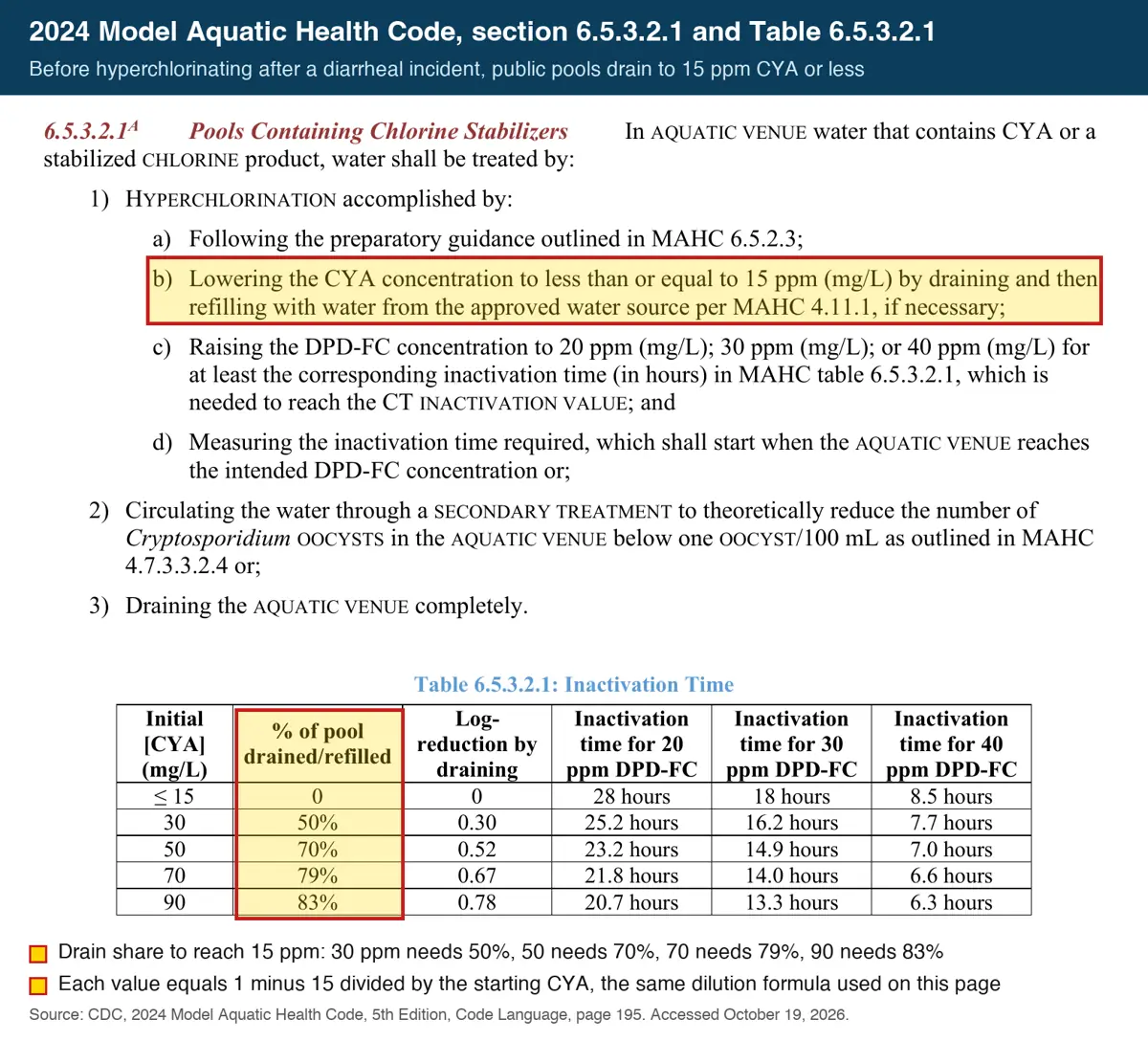
Two caveats change the real result of any drain percentage in the table. Montana DPHHS notes that some cyanuric acid clings to the pool shell, plumbing and filter, so even a full drain leaves a detectable reading. Rain that overflows the pool does extra dilution for free, while evaporation between test and drain does none. Test again after the refill rather than trusting the arithmetic. Drain shares for readings up to 300 ppm, refill costs by city and what reducers and reverse osmosis deliver are in our guide on how to lower cyanuric acid in a pool.
What are the steps for a CYA drain and refill?
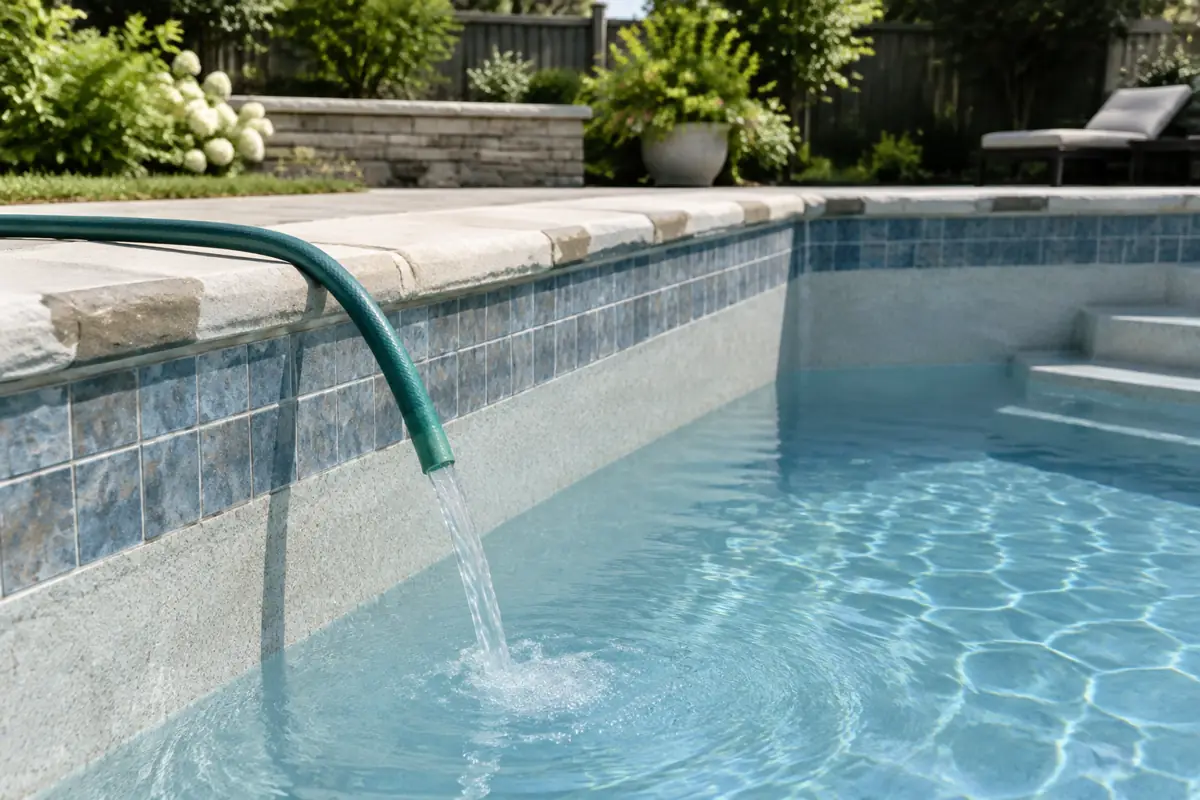
Confirm the reading, work out the gallons, check local drain rules, then drain and refill in one or two rounds. Two partial drains multiply: two drains of one third each equal one 55.6% drain. For a 20,000 gallon pool going from 90 to 40 ppm, the 11,111 gallons of water cost about $119 at the median rate in our 25 city study.
- Confirm the readingIf the black dot never disappears, mix 1 part pool water with 1 part tap water, retest and multiply by 2 (Taylor Technologies).
- Pick a target30 to 50 ppm for most pools, including a Hayward AquaRite 900 salt pool; never above 90 ppm if you follow the MAHC.
- Compute the share and gallonsShare = 1 minus target / current. Multiply by pool gallons from the pool volume calculator.
- Check discharge and refill rulesCall the local sewer or storm drain authority, as pool chemical labels instruct, and check watering restrictions before refilling.
- Drain in one or two roundsTwo drains of one third each equal one 55.6% drain, which keeps the water above the skimmer if your pump needs it.
- Refill and rebalanceFresh water lowers alkalinity and calcium too; test pH and alkalinity after the refill.
- Retest after 24 hoursThe 2024 MAHC tests CYA 24 hours after a change; compare the reading with the table.
- Stop the sourceSwitch from trichlor or dichlor to liquid chlorine or calcium hypochlorite, which add no CYA.
| Item | Value | Basis |
|---|---|---|
| Pool size | 20,000 gal | Example |
| Current to target CYA | 90 to 40 ppm | Example |
| Share of water to replace | 55.6% | 1 minus 40 / 90 |
| Gallons to drain and refill | 11,111 gal | 20,000 x 0.556 |
| Same result in two smaller drains | Two drains of 33.3% | 1 minus (2/3) x (2/3) = 55.6% |
| Water and sewer cost, Sacramento rates | $21.67 | $39.00 per 20,000 gal |
| Water and sewer cost, 25 city median | $119.49 | $215.09 per 20,000 gal |
| Water and sewer cost, Houston rates | $361.10 | $649.98 per 20,000 gal |
PC&S arithmetic. Water and sewer costs scaled from 20,000 gallon fill costs in PC&S research: Cost to Fill a Pool (rates in effect October 4, 2026). Download CSV
Before a deep drain, read our guide on how to drain a pool, which covers pumps, hoses and where the water can go, and our pool filling restrictions research for cities that limit refills. The refill also dilutes chlorine, which is the same math our guide on how to lower chlorine in pool water uses.
Can you lower CYA without draining the pool? Draining is the method health departments name most often, though the City of Longview, Texas environmental health FAQ also accepts a specially designed commercial product used correctly. Montana DPHHS and Portage County both name partial draining as the way to reduce CYA. The MAHC Annex accepts alternative methods for public pools only when test data show 15 ppm or less, and we found no primary source that measures how well products marketed as CYA reducers work.
Does baking soda lower cyanuric acid in pools? No. Baking soda is sodium bicarbonate, which the Florida DOH manual lists for raising total alkalinity: 1.5 lb per 10,000 gallons adds about 10 ppm. CYA does distort the alkalinity reading, though. The National Plasterers Council subtracts one third of the CYA from total alkalinity to get the corrected figure, so see our guide on how to lower alkalinity in a pool before you adjust it.
Doing it yourself costs mainly water, $21.67 to $361.10 for 11,111 gallons (a 20,000 gallon pool going from 90 to 40 ppm), depending on the city. A weekly service that tests CYA on every visit costs more: our pool service cost guide found a $160 monthly median across 71 published company prices in 20 metros in October 2026.
How do you raise cyanuric acid in a pool?
Add stabilizer at about 13 oz per 10 ppm per 10,000 gallons. Three published sources agree within half an ounce: Knorr Systems gives 13 oz, the Leslie’s label 2.5 lb for 30 ppm (13.3 oz per 10 ppm) and Hayward’s chart 6.7 lb from 0 to 80 ppm (13.4 oz). Add it through the skimmer with the pump running and retest 24 hours later.
| Source | Published dose | Cyanuric acid per 10 ppm per 10,000 gal (oz) |
|---|---|---|
| Knorr Systems chart | 13 oz per 10 ppm per 10,000 gal | 13 |
| Leslie's Pool Stabilizer label (100% cyanuric acid) | 2.5 lb per 10,000 gal raises 30 ppm | 13.3 |
| Hayward AquaRite manual | 6.7 lb takes 10,000 gal from 0 to 80 ppm | 13.4 |
Sources: Knorr Systems chart; Leslie’s Pool Stabilizer label (Wayback capture September 16, 2026); Hayward AquaRite manual. Conversions are PC&S arithmetic. Download CSV
As a worked example, a 20,000 gallon pool going from 0 to 30 ppm needs 5 lb at the Leslie’s label rate (2.5 lb x 2). At Leslie’s list price of $54.99 for 8 lb in September 2026, that is about $34.37 of stabilizer. The National Plasterers Council adds stabilizer through the skimmer with the pump running and warns that concentrated CYA can discolor pigmented finishes.
How do you test cyanuric acid accurately?
Home kits measure CYA by turbidity: a reagent clouds the sample in proportion to the CYA, and you pour until a black dot disappears. Taylor Technologies says the scale cannot read above 100 ppm, so dilute 1:1 and multiply by 2, or 1:2 and multiply by 3. The 2024 MAHC has public pools test monthly, weekly when stabilized chlorine is the main sanitizer, and 24 hours after adding CYA.
Taylor Technologies explains why high readings mislead: the comparator scale is logarithmic, so near 100 ppm very little sample makes the dot disappear and readings bunch together. The National Plasterers Council gives the same advice for plaster pools: retest readings near 100 ppm with a 50% dilution, and drain or treat if the diluted result is still near 100 ppm.
Testing frequency follows the chlorine type. Montana DPHHS requires a kit that reads 0 to 100 ppm for any pool using CYA, and Taylor sells turbidimetric CYA tests as part of its kits. A pool on trichlor tablets needs a weekly check because every tablet adds CYA; a pool on liquid chlorine or a salt cell drifts down only as water leaves. The full testing calendar, with the MAHC sections behind each interval, is in our guide on how to test pool water.
What to do at your cyanuric acid reading
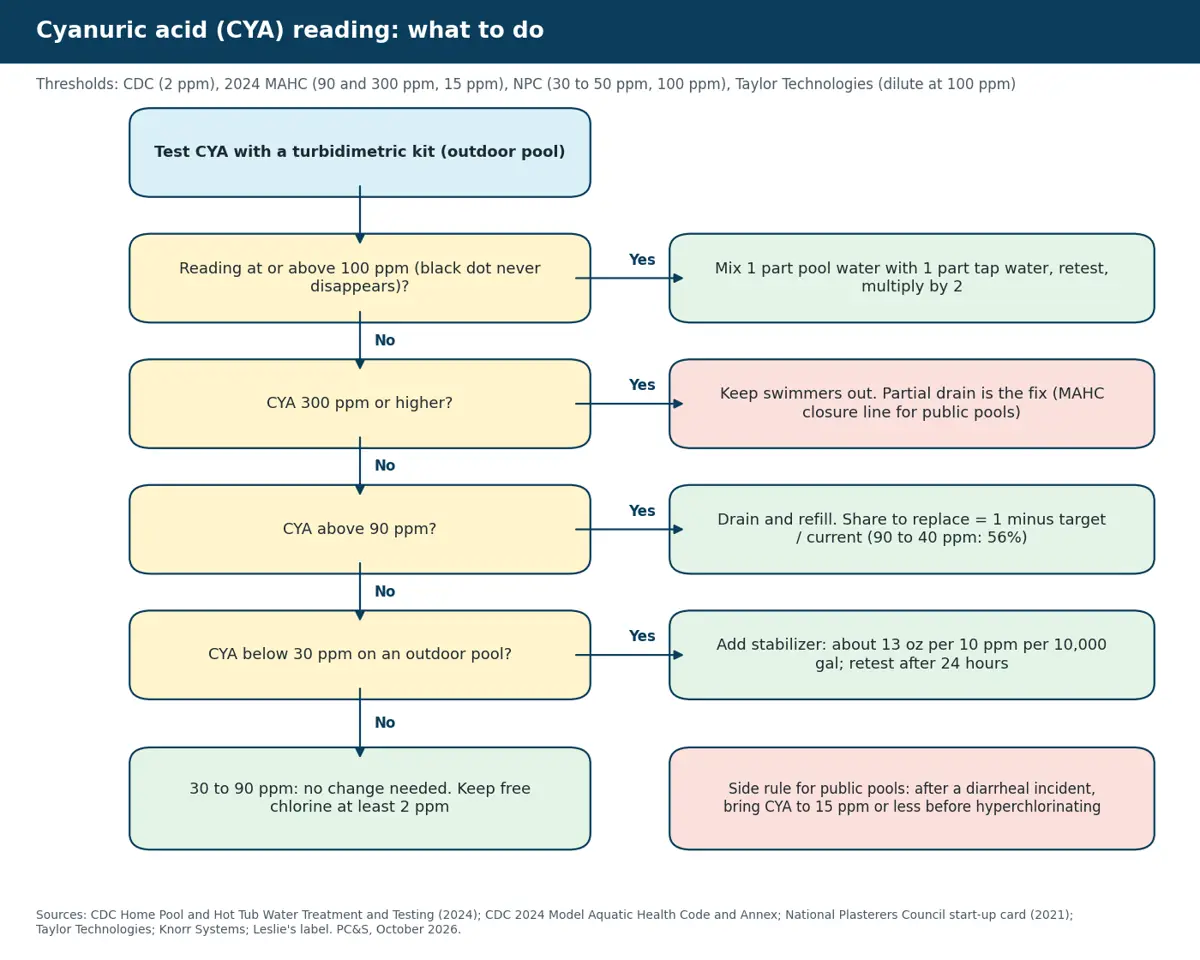
Match the reading to a row. Between 30 and 90 ppm, keep free chlorine at 2 ppm or more and change nothing else. Below 30 ppm on an outdoor pool, add stabilizer. Above 90 ppm, drain and refill using the table, and at 300 ppm keep swimmers out. Readings at the top of the scale need a diluted retest first, because the kit cannot read above 100 ppm.
| If your situation is | Do this | Rule behind it |
|---|---|---|
| Reading at or above 100 ppm, or the black dot never disappears | Mix 1 part pool water with 1 part tap water, retest, multiply by 2 | Taylor Technologies; NPC |
| CYA 300 ppm or more | Keep swimmers out; partial drain | 2024 MAHC closure line for public pools |
| CYA above 90 ppm | Drain and refill; replace 1 minus target / current of the water | 2024 MAHC cap; NPC surface warning at 100 ppm |
| CYA 50 to 90 ppm and you use trichlor or dichlor | Switch to liquid chlorine or calcium hypochlorite until CYA falls | Trichlor adds 0.61 ppm and dichlor 0.91 ppm CYA per ppm chlorine |
| CYA 30 to 90 ppm | No change needed; keep free chlorine at least 2 ppm | CDC; 2024 MAHC 5.7.3.1.1.2 |
| CYA below 30 ppm on an outdoor pool | Add stabilizer at about 13 oz per 10 ppm per 10,000 gal; retest after 24 hours | Knorr Systems; 2024 MAHC 5.7.5.7.1 |
| The drain share is more than one round can remove while the water stays above the skimmer | Split it into two rounds (two thirds left after each third removed) or have a pool service plan the drain | Dilution arithmetic |
| Hot tub or spa | Do not use cyanuric acid or stabilized chlorine | CDC; 2024 MAHC 5.7.3.1.3.1 |
| Public pool after a diarrheal incident | Bring CYA to 15 ppm or less before hyperchlorinating | 2024 MAHC 6.5.3.2.1 |
Sources: CDC; 2024 MAHC; National Plasterers Council; Taylor Technologies; Knorr Systems; PC&S arithmetic. Download CSV
How we compiled this
We compiled this page in October 2026 from 18 primary documents: CDC’s home pool guidance, the 2024 MAHC code and annex, health department documents from Florida, Virginia, Pennsylvania, Montana and two Ohio counties, the National Plasterers Council start-up card, the Hayward AquaRite manual, the Knorr Systems chart, the Leslie’s stabilizer label, two Taylor Technologies pages, EPA WaterSense, NPIC and PubChem. The Sacramento inspection counts, fill costs and the trichlor season estimate come from three of our own research reports built from public records, and the service price from our pool service cost survey. We did not test water or products; drain shares and chlorine-to-CYA figures are our arithmetic and labeled as such, and forum threads were used for question wording only.
Frequently Asked Questions
How do I adjust the cyanuric acid in my pool?
To raise it, add stabilizer at about 13 oz per 10 ppm per 10,000 gallons (Knorr Systems) and retest after 24 hours. To lower it, replace water: the share to drain is 1 minus target divided by current, so 90 to 40 ppm means replacing 55.6%. Health departments mostly name draining; the City of Longview, Texas also accepts a specially designed commercial product used correctly.
Is baking soda the same as cyanuric acid?
No. Baking soda is sodium bicarbonate, which raises total alkalinity, about 10 ppm per 1.5 lb in 10,000 gallons (Florida DOH). Cyanuric acid is a chlorine stabilizer that shields chlorine from sunlight. The two interact only on the test: the National Plasterers Council subtracts one third of the CYA from total alkalinity. For the baking soda dose by pool size, see our guide on how to raise alkalinity in pool water.
What does high cyanuric acid do to a pool?
It slows disinfection and can trap chlorine. At 2 ppm free chlorine, active chlorine falls from 42 ppb at 20 ppm CYA to 8.7 ppb at 90 ppm (MAHC Annex). The National Plasterers Council warns 100 ppm or more may permanently damage plaster, and the 2024 MAHC closes public pools at 300 ppm.
Does pool shock raise cyanuric acid?
Dichlor shock does: about 9.1 ppm of CYA for every 10 ppm of chlorine it adds, by PC&S arithmetic from PubChem molecular weights. Calcium hypochlorite and liquid chlorine add none. Virginia DOH goes further and recommends non-chlorine products for superchlorinating pools that already contain cyanuric acid.
Can you lower CYA without draining the pool?
Mostly no: health departments name draining, though the City of Longview, Texas also accepts a specially designed commercial product used correctly. Montana DPHHS and Portage County both name partial draining as the way to cut CYA, and the 2024 MAHC Annex accepts other methods only when tests prove 15 ppm or less. Rain overflow dilutes too, but evaporation does not, because the CYA stays behind.
Is it safe to swim in a pool with high cyanuric acid levels?
The risk comes from weak chlorine, not CYA itself. The 2024 MAHC treats a CYA to free chlorine ratio above 45:1 as an imminent health hazard and closes public pools at 300 ppm CYA. At 120 ppm CYA you would need more than 2.7 ppm free chlorine to stay under 45:1.
How high is too high for cyanuric acid in a pool?
Above 90 ppm breaks the 2024 MAHC limit for public pools, and 100 ppm is where the National Plasterers Council warns of surface damage and where home test kits stop reading. Several state rules are tighter: Montana caps CYA at 50 ppm, and Florida’s 2016 manual lists 100 ppm for pools and 40 ppm for spas.
Sources
- Centers for Disease Control and Prevention (CDC). Home Pool and Hot Tub Water Treatment and Testing (page updated May 10, 2024). Accessed 2026-10-19.
- CDC. 2024 Model Aquatic Health Code, 5th Edition, Code Language. Accessed 2026-10-19.
- CDC. 2024 Model Aquatic Health Code, 5th Edition, Annex. Accessed 2026-10-19.
- Florida Department of Health in Collier County. Swimming Pool Operators' Manual, 2016 Version. Accessed 2026-10-19.
- Virginia Department of Health. Pool Operation and Maintenance Guide (Portsmouth Health Department, 2018). Accessed 2026-10-19.
- Pennsylvania Department of Health. Public Swimming and Bathing Places: Operational and Biological Contamination Protocol Recommendations (November 1, 2016). Accessed 2026-10-19.
- Montana Department of Public Health and Human Services. Fact Sheet on Cyanuric Acid and Stabilized Chlorine Products. Accessed 2026-10-19.
- Portage County Combined General Health District (Ohio). What happens when Cyanuric Acid in a pool is too high?. Accessed 2026-10-19.
- Mahoning County Public Health (Ohio). Pools Equipped With a Chlorine Generator From Salt. Accessed 2026-10-19.
- National Plasterers Council. NPC Pool Start-Up Procedures card (rev. 03-2021). Accessed 2026-10-19.
- Hayward (manufacturer manual). Aqua Rite Electronic Chlorine Generator manual. Accessed 2026-10-19.
- Knorr Systems (supplier chart). Chemical Dosing Charts. Accessed 2026-10-19.
- Leslie's. Leslie's Pool Stabilizer Water Conditioner, 8 lbs (Wayback capture September 16, 2026). Accessed 2026-10-19.
- Taylor Technologies. How and When to Use Dilutions in Pool and Spa Water Testing. Accessed 2026-10-19.
- Taylor Technologies. Why Monitoring Cyanuric Acid (CYA) in a Pool is Important. Accessed 2026-10-19.
- U.S. Environmental Protection Agency. Jump Into Pool Water Efficiency (WaterSense, 2022). Accessed 2026-10-19.
- NIH National Library of Medicine. PubChem compound properties: cyanuric acid, trichloroisocyanuric acid, chlorine, sodium dichloroisocyanurate. Accessed 2026-10-19.
- National Pesticide Information Center (Oregon State University). Pool and Spa Chemicals Fact Sheet. Accessed 2026-10-19.
- Sacramento County Environmental Management Department. Pool Inspections feature service (inspection and violation history). Accessed 2026-10-19.
- Pool Construction & Service. Saltwater Pool vs Chlorine (PC&S research). Accessed 2026-10-19.
- Pool Construction & Service. Cost to Fill a Pool (PC&S research, rates in effect October 4, 2026). Accessed 2026-10-19.
- Pool Construction & Service. Public Pool Inspection Violations (PC&S research). Accessed 2026-10-19.
- Pool Construction & Service. Pool Service Cost per Month (PC&S survey of 71 company prices in 20 metros, October 2026). Accessed 2026-10-19.
Related pages
Get Quotes From Licensed Local Pool Pros
Tell us what you need and your ZIP code. We match you with pool companies that cover your area.