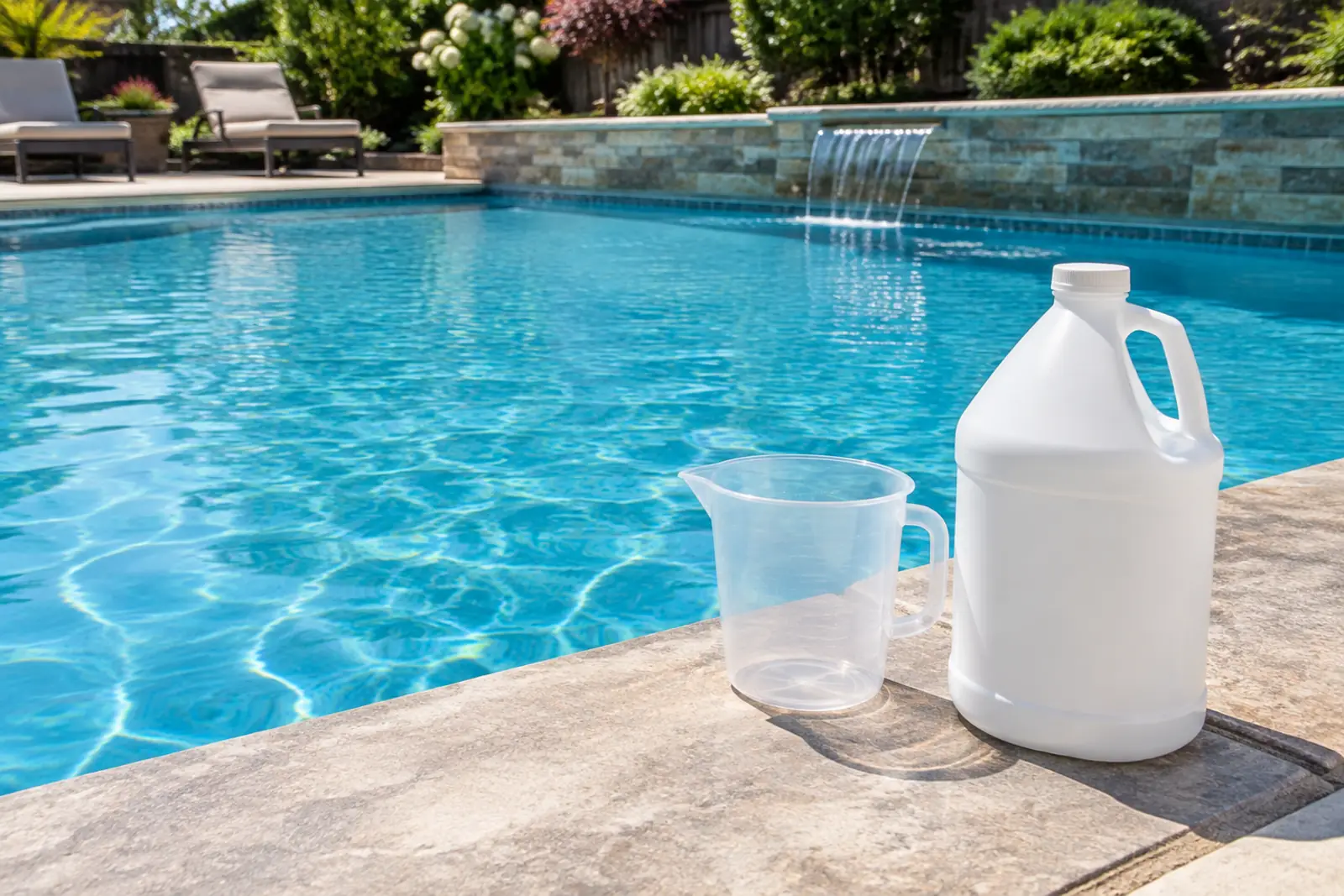
How Much Chlorine to Add to Pool Water, by Product and Pool Size
How much chlorine to add to pool water: about 10 fl oz of 12.5% liquid chlorine or 2 oz of 65% cal-hypo per 10,000 gallons raises free chlorine 1 ppm (EPA labels). Aim for 1 to 4 ppm.
- ✓Target 1 to 4 ppmCDC's floor is 1 ppm, or 2 ppm with cyanuric acid; most EPA labels prohibit swimming above 4 ppm.
- ✓Per 1 ppm in 10,000 gallons10 fl oz of 12.5% liquid, 1.83 oz of 73% cal-hypo, 2 oz of 65% cal-hypo or 2.2 oz of 62% dichlor, from EPA-registered labels.
- ✓The math, shownppm = lb x 1,000,000 / (gallons x 8.34) x available chlorine. One 1 lb bag of 73% cal-hypo gives 8.75 ppm in 10,000 gallons.
Key takeaways
- Keep free chlorine at 1 to 4 ppm: CDC‘s minimum is 1 ppm, or 2 ppm with cyanuric acid, and most EPA-registered labels prohibit swimming above 4 ppm.
- To raise free chlorine 1 ppm in 10,000 gallons, the Hasachlor label (EPA Reg. No. 10897-26) calls for 10 fl oz of 12.5% liquid chlorine; scale that by your gallons and the ppm you need.
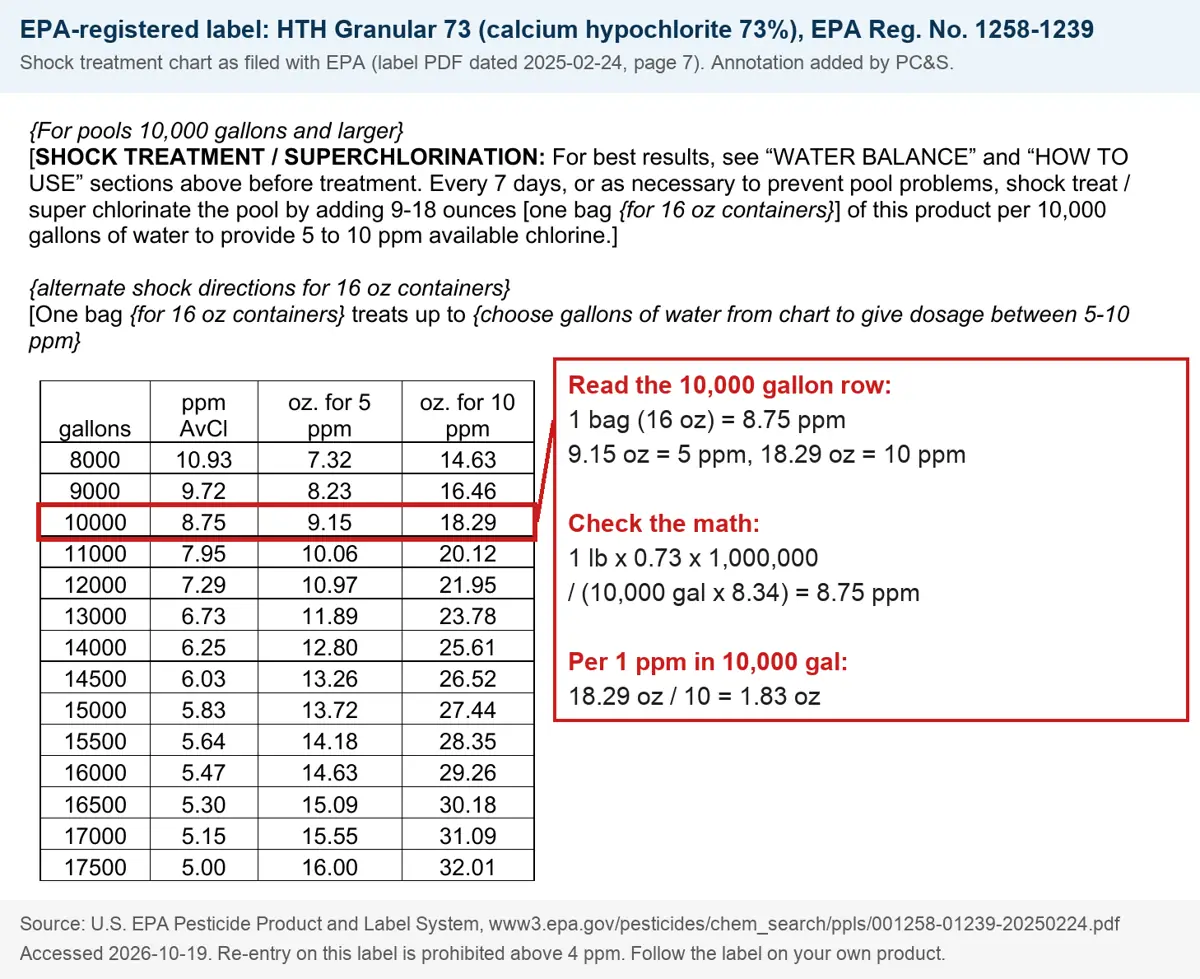
- The HTH Granular 73 label prints the math: 1 lb of 73% calcium hypochlorite in 10,000 gallons gives 8.75 ppm, which is 1 x 0.73 x 1,000,000 / (10,000 x 8.34).
- Liquid chlorine strength is stated three ways, so published liquid doses for 1 ppm in 10,000 gallons run from 10 to 13 fl oz (OxyChem handbook; Florida DOH).
- Stabilized chlorine leaves cyanuric acid behind: about 6.1 ppm per 10 ppm of chlorine from trichlor and 9.1 ppm from dichlor, against a 90 ppm public pool ceiling in the 2024 Model Aquatic Health Code.
What chlorine level should you aim for?
Aim for 1 to 4 ppm free chlorine in a home pool. CDC sets the floor at 1 ppm, or 2 ppm when cyanuric acid, dichlor or trichlor is in the water, and at 3 ppm in hot tubs. Most EPA labels set 4 ppm as the ceiling for swimming; the 2024 MAHC treats more than 10 ppm with bathers present as a hazard at public pools.
| Source | Applies to | Minimum free chlorine | Maximum or target | Notes |
|---|---|---|---|---|
| CDC (page dated May 2024) | Home pools and hot tubs | 1 ppm in pools; 2 ppm with cyanuric acid; 3 ppm in hot tubs | Not set | pH 7.0 to 7.8; no cyanuric acid products in hot tubs |
| EPA-registered labels (Hasachlor, HTH Granular 73, Dichlor 98507-2, HTH Super 3 inch tablets) | Pools treated with that product | 1 ppm | 4 ppm re-entry limit | Scorch label: swim at 1.0 to 3.0 ppm |
| 2024 MAHC 5.7.3.1.1.2 and 6.6.3.1 | Public pools | 1.0 ppm; 2.0 ppm with cyanuric acid; 3.0 ppm in spas | Above 10 ppm with bathers present is an imminent hazard | Cyanuric acid 90 ppm or less; CYA to free chlorine ratio no more than 45 to 1 |
| Pennsylvania DOH (2016) | Public pools | 2 ppm | 2 to 4 ppm ideal; 5 ppm maximum | Combined chlorine 0.2 ppm maximum |
| Virginia DOH, Portsmouth guide (12VAC5-462-290) | Public pools | 1.0 ppm | 3.0 ppm | Spas and hot tubs 1.0 to 5.0 ppm |
Sources: CDC (May 2024); 2024 MAHC; Pennsylvania DOH (2016); Virginia DOH Portsmouth guide (2018); EPA labels Hasachlor, HTH Granular 73, Dichlor 98507-2, HTH Super 3 inch, Scorch. Accessed October 2026. Download CSV
The floor rises with stabilizer because chlorine works more slowly when cyanuric acid is present; CDC notes that disinfection times are longer in that water. The 2024 Model Aquatic Health Code treats a cyanuric acid to free chlorine ratio above 45 to 1 as an imminent health hazard at public pools (section 6.6.3.1), so at its 90 ppm cyanuric acid ceiling, free chlorine has to stay at 2 ppm or more (90 / 45 = 2). Above that ceiling the chlorine needed to hold the ratio climbs fast, to 3.3 ppm at 150 ppm cyanuric acid, which is the situation our chlorine lock guide covers.
Holding the floor is harder than it sounds. In Louisville Metro inspections from October 2021 to April 2024, 14.5% of routine free chlorine readings at public pools were below the MAHC minimum of 1.0 ppm and 8.6% read 0 ppm, according to our analysis of the inspection data.
How much chlorine raises free chlorine 1 ppm?
For 10,000 gallons, EPA-registered labels list 10 fl oz of 12.5% liquid chlorine, 1.83 oz of 73% calcium hypochlorite, 2 oz of 65% cal-hypo, 2.2 oz of 62% dichlor and 2.4 oz of 56% dichlor dihydrate per 1 ppm. Pure available chlorine takes 1.3 oz, so each product’s dose is roughly 1.3 oz divided by its strength.
| Product | EPA Reg. No. | Label date | Strength on label | What the label prints | Per 1 ppm in 10,000 gal |
|---|---|---|---|---|---|
| Hasachlor liquid chlorine | 10897-26 | Apr 2026 | 12.5% sodium hypochlorite | Chart: 10 fl oz gives 1 ppm in 10,000 gal | 10 fl oz |
| Comal Sodium Hypochlorite 12.5% | 103607-1 | Sep 2025 | 12.5% sodium hypochlorite (11.9% available chlorine) | 52 to 104 oz gives 5 to 10 ppm in 10,000 gal | 10.4 oz |
| HTH Granular 73 | 1258-1239 | Feb 2025 | 73% calcium hypochlorite | Chart: 16 oz gives 8.75 ppm; 18.29 oz gives 10 ppm | 1.83 oz |
| Scorch | 3432-76 | Sep 2025 | 65% available chlorine | 10 to 20 oz gives 5 to 10 ppm in 10,000 gal | 2 oz |
| Dichlor Chlorinating Granules | 98507-2 | Dec 2025 | 62% available chlorine | Chart: 2.2 oz gives 1 ppm in 10,000 gal | 2.2 oz |
| Pace (dichlor dihydrate) | 1258-984 | Jun 2018 | 56% available chlorine | 12 to 24 oz gives 5 to 10 ppm in 10,000 gal | 2.4 oz |
| HTH Super 3 inch tablets (trichlor) | 1258-1338 | Jul 2026 | 84% available chlorine | 1 tablet (6 to 8 oz) per 10,000 gal per week | 1.59 oz (PC&S arithmetic) |
| Any product without a dose chart | Virginia DOH method | 2018 | Your label's available chlorine | 1.3 oz of 100% available chlorine per ppm per 10,000 gal | 1.3 oz divided by strength |
Sources: Hasachlor 10897-26; Comal 103607-1; HTH Granular 73 1258-1239; Scorch 3432-76; Dichlor 98507-2; Pace 1258-984; HTH Super 3 inch 1258-1338; Virginia DOH (2018). Labels from the EPA Pesticide Product and Label System; all listed as Active on 2026-10-19. Download CSV
Bar labels round to one decimal: 1.48, 1.59 and 1.83 oz show as 1.5, 1.6 and 1.8. Trichlor rows are PC&S arithmetic; tablets dissolve slowly, so their labels dose by tablets per week.
Source: EPA-registered labels HTH Granular 73 (1258-1239), Scorch (3432-76), Dichlor 98507-2, Pace (1258-984), HTH Super 3 inch (1258-1338), Olympic (42177-18); Virginia DOH Portsmouth guide 2018. Accessed October 2026. Download chart data (CSV)
How much chlorine to add to a pool, by pool size
Multiply the 1 ppm amount for your pool size by the ppm you need to add. The table covers 5,000 to 50,000 gallons for the six products whose labels give a dose or a strength; a 15,000 gallon pool going from 1 to 3 ppm needs 2 x 15 = 30 fl oz of 12.5% liquid chlorine.
| Product, amount per 1 ppm | 5,000 gal | 10,000 gal | 15,000 gal | 20,000 gal | 25,000 gal | 30,000 gal | 50,000 gal | Label |
|---|---|---|---|---|---|---|---|---|
| Liquid chlorine 12.5%, fl oz | 5 | 10 | 15 | 20 | 25 | 30 | 50 | Hasachlor 10897-26 (chart) |
| Cal-hypo 73%, oz | 0.9 | 1.8 | 2.7 | 3.7 | 4.6 | 5.5 | 9.1 | HTH Granular 73, 1258-1239 |
| Cal-hypo 65%, oz | 1.0 | 2.0 | 3.0 | 4.0 | 5.0 | 6.0 | 10.0 | Scorch 3432-76 |
| Dichlor 62%, oz | 1.1 | 2.2 | 3.3 | 4.5 | 5.5 | 6.6 | 11.0 | Dichlor 98507-2 (chart) |
| Dichlor dihydrate 56%, oz | 1.2 | 2.4 | 3.6 | 4.8 | 6.0 | 7.2 | 12.0 | Pace 1258-984 |
| Trichlor 84%, oz (tablets dose by count) | 0.8 | 1.6 | 2.4 | 3.2 | 4.0 | 4.8 | 7.9 | HTH Super 3 inch, 1258-1338; PC&S arithmetic |
Sources: EPA labels Hasachlor (chart prints 5, 10, 20 and 50 fl oz), HTH Granular 73, Scorch, Dichlor 98507-2 (chart prints 1.1, 2.2, 4.5 and 11.0 oz), Pace, HTH Super 3 inch. Other columns scaled by PC&S (label amount x gallons / 10,000), the Virginia DOH method. Download CSV
Your gallon figure drives every number in this table. Labels use length x width x average depth x 7.5 for rectangular pools and diameter x diameter x average depth x 5.9 for round ones; our pool volume calculator runs the same formulas. Then subtract your DPD reading from your target: a pool at 1 ppm aiming for 3 ppm needs 2 times the 1 ppm amount. A pool with a copper ionizer still needs this dose: registered ionizer labels keep 0.5 to 3 ppm free chlorine, as our pool ionizer guide shows. To dose pH, alkalinity, calcium and stabilizer in the same session, in the right order, use our pool chemical calculator.
How do you calculate the chlorine dose yourself?
Use ppm = lb x 1,000,000 / (gallons x 8.34) x available chlorine, or flip it to lb = ppm x gallons x 8.34 / (1,000,000 x available chlorine). Water weighs 8.34 lb per gallon, so 1 ppm in 10,000 gallons is 0.0834 lb, about 1.3 oz, of pure available chlorine; divide by your label’s strength.
- Find your gallonsLength x width x average depth x 7.5 for a rectangle (label formula).
- Find the ppm gapTarget minus your free chlorine reading, for example 3 minus 1 = 2 ppm.
- Read the available chlorine on the labelUse it as a decimal: 0.73 for 73% cal-hypo, 0.62 for 62% dichlor.
- Compute poundsppm gap x gallons x 8.34 / (1,000,000 x strength). For 18,000 gallons, 2 ppm and 73% cal-hypo: 0.41 lb, or 6.6 oz.
- Convert liquids by weightFluid ounces / 128 x 8.34 x specific gravity gives pounds; 12.5% sodium hypochlorite has a specific gravity near 1.20 (OxyChem).
- Add part, then retestLabels say to check available chlorine with a test kit after dosing; the Hasachlor label notes the product degrades with age, so the dose may need to rise.
| Check or job | Inputs | Arithmetic | Result | Label says |
|---|---|---|---|---|
| HTH Granular 73, one 1 lb bag | 1 lb, 73%, 10,000 gal | 1 x 0.73 x 1,000,000 / (10,000 x 8.34) | 8.75 ppm | 8.75 ppm |
| Scorch, top shock dose | 20 oz (1.25 lb), 65%, 10,000 gal | 1.25 x 0.65 x 1,000,000 / 83,400 | 9.7 ppm | 10 ppm |
| Dichlor 98507-2, top shock dose | 22 oz (1.375 lb), 62%, 10,000 gal | 1.375 x 0.62 x 1,000,000 / 83,400 | 10.2 ppm | 10 ppm |
| Comal 12.5% liquid, top shock dose | 104 fl oz = 0.8125 gal x 8.34 x 1.20 = 8.13 lb; 11.9% available | 8.13 x 0.119 x 1,000,000 / 83,400 | 11.6 ppm | 10 ppm (label rounds down; liquid loses strength with age) |
| HTH Super 3 inch tablet | 8 oz (0.5 lb), 84%, 10,000 gal | 0.5 x 0.84 x 1,000,000 / 83,400 | 5.0 ppm per week | 1 tablet per week holds 1 to 4 ppm |
| Job: 15,000 gal, 1 to 3 ppm, 12.5% liquid | 10 fl oz per ppm per 10,000 gal | 10 x (15,000 / 10,000) x 2 | 30 fl oz | Hasachlor chart rate |
| Job: 18,000 gal, 1 to 3 ppm, 73% cal-hypo | Formula | 2 x 18,000 x 8.34 / (1,000,000 x 0.73) | 0.41 lb (6.6 oz) | HTH Granular 73 strength |
| Job: 50,000 gal, 1 to 3 ppm, 12.5% liquid | 10 fl oz per ppm per 10,000 gal | 10 x 5 x 2 | 100 fl oz (0.78 gal) | Hasachlor chart rate |
Sources: HTH Granular 73; Scorch; Dichlor 98507-2; Comal 103607-1; HTH Super 3 inch; Hasachlor; specific gravity from the OxyChem Sodium Hypochlorite Handbook. Arithmetic by PC&S. Download CSV
Liquid chlorine is where guides disagree, because labels state strength three ways. The OxyChem Sodium Hypochlorite Handbook defines weight % sodium hypochlorite, weight % available chlorine and trade %, which is grams of available chlorine per liter divided by 10. On the OxyChem table, a 12.5% sodium hypochlorite solution works out to about 11.9% available chlorine by weight, the figure the Comal label prints, and roughly 14.3 trade %, with a specific gravity near 1.20 (PC&S interpolation).
The Comal figure is its 5 ppm dose divided by 5. Virginia computes 1.3 / 0.12 = 10.8 oz. Florida's table covers 10 to 12% product.
Source: Hasachlor label (EPA Reg. No. 10897-26, 2026); Knorr Systems dosing chart; Comal label (EPA Reg. No. 103607-1, 2025); Virginia DOH Portsmouth guide 2018; Florida DOH Collier County operators' manual 2016. Accessed October 2026. Download chart data (CSV)
So the 10 to 13 fl oz spread in that chart is mostly units, not error. The Virginia DOH method divides 1.3 oz by 0.12 and gets 10.8 oz for 12% product; Florida DOH lists 13 oz for its 10 to 12% range; Knorr Systems lists 10 fl oz for 12%. Use your own label’s chart when it has one, then let the test kit settle the difference.
How much chlorine should you add daily or weekly?
Labels give maintenance doses, but your test sets the real number. HTH Granular 73 lists 5 to 7 oz per 10,000 gallons daily in unstabilized pools and 3 to 5 oz every other day in stabilized ones, and one 3 inch trichlor tablet per 10,000 gallons per week holds 1 to 4 ppm on the HTH tablet label. CDC says test at least twice a day.
| Product (EPA Reg. No.) | Label maintenance dose | How often | Free chlorine it delivers (PC&S arithmetic) | Label target |
|---|---|---|---|---|
| HTH Granular 73 (1258-1239), unstabilized pool | 5 to 7 oz per 10,000 gal | Daily or as often as needed | 2.7 to 3.8 ppm per dose | 1 to 4 ppm |
| HTH Granular 73 (1258-1239), stabilized pool | 3 to 5 oz per 10,000 gal | Every other day | 1.6 to 2.7 ppm per dose | 1 to 4 ppm |
| Pace dichlor 56% (1258-984) | 3 to 5 oz per 10,000 gal | Every other day | 1.3 to 2.1 ppm per dose | 1 to 4 ppm |
| Hasachlor 12.5% liquid (10897-26) | 11 fl oz per 10,000 gal | Frequency set by testing | 0.6 to 1.0 ppm (label figure) | 1 to 4 ppm in stabilized pools |
| HTH Super 3 inch tablets (1258-1338) | 1 tablet (6 to 8 oz) per 10,000 gal; no more than 3 per treatment | Weekly | 3.8 to 5.0 ppm per week (about 0.5 to 0.7 ppm a day) | 1 to 4 ppm |
| Olympic 3 inch trichlor 90% (42177-18) | 1 to 2 oz per 10,000 gal | Daily | 0.7 to 1.3 ppm per day | 1 to 3 ppm |
Sources: HTH Granular 73; Pace 1258-984; Hasachlor; HTH Super 3 inch 1258-1338; Olympic 42177-18. ppm figures are PC&S arithmetic except the Hasachlor label figure. Download CSV
No table can know your chlorine demand. CDC lists pee, poop, sweat, dirt and sunlight among the things that use up chlorine, which is why it recommends testing at least 2 times a day and more often when the pool is busy. If a full day’s dose is gone by morning, the water needs a shock, not a bigger routine dose; our guide on how to shock a pool covers the levels. The shock amounts themselves, from routine 5 ppm to SLAM levels, are tabled by pool size in our guide on how much shock to add to a pool.
What else does each type of chlorine add to the water?
Every chlorine product leaves something behind besides chlorine. Calcium hypochlorite adds about 0.7 ppm calcium hardness per ppm of chlorine, dichlor about 0.9 ppm cyanuric acid and trichlor about 0.6 ppm, while liquid chlorine adds neither. Over a season of 90 ppm of chlorine, that is 55 to 82 ppm of cyanuric acid from stabilized products.
| Product | Also adds per 10 ppm of chlorine | Example season: 90 ppm of chlorine added | pH effect (Florida DOH) | Basis |
|---|---|---|---|---|
| Liquid chlorine (sodium hypochlorite) | No cyanuric acid, no calcium | No cyanuric acid or calcium build-up | Raises | Florida DOH chart |
| Calcium hypochlorite | About 7.1 ppm calcium hardness | About 64 ppm calcium hardness | Raises | PubChem: 100.09 / 141.80 |
| Dichlor | About 9.1 ppm cyanuric acid | About 82 ppm cyanuric acid | Neutral | PubChem: 129.07 / 141.80 |
| Trichlor | About 6.1 ppm cyanuric acid | About 55 ppm cyanuric acid | Lowers | PubChem: 129.07 / 212.70 |
Sources: PubChem molecular weights (stoichiometry by PC&S); pH effects from the Florida DOH operators manual. The 90 ppm season is an illustration, not a measured average. Download CSV
Florida DOH notes that cyanuric acid stays in the water after the chlorine is used up and builds up over time. The MAHC caps it at 90 ppm in public pools (5.7.3.1.3.2), and Florida’s manual lists 100 ppm for pools and 40 ppm for spas. Our guide to cyanuric acid in pools covers testing and lowering it.
pH moves too: Florida DOH’s chart lists a pH of 9 to 14 for a 1% sodium hypochlorite solution and 2.8 to 3.5 for trichlor, so hypochlorites raise pool pH and trichlor lowers it, and the Pennsylvania DOH says the same over time. A pool fed on trichlor tablets tends to need pH raised, and one fed on liquid chlorine tends to need acid; see our guide on how to raise pH in pool water.
Want a pro to handle the chlorine?
What happens if you add too much chlorine?
Too much chlorine is a reason to stay out, not a permanent problem. Most EPA labels prohibit swimming above 4 ppm, CDC warns tests can bleach out above 10 ppm and read falsely low, and the MAHC treats more than 10 ppm with bathers present as a hazard at public pools. Let sunlight and time bring it down, or neutralize it.
| Pool size | Free chlorine added by 2 gal (256 fl oz) of 12.5% liquid | Above the 4 ppm swim limit? |
|---|---|---|
| 10,000 gal | 25.6 ppm | Yes |
| 15,000 gal | 17.1 ppm | Yes |
| 20,000 gal | 12.8 ppm | Yes |
| 30,000 gal | 8.5 ppm | Yes |
| 50,000 gal | 5.1 ppm | Yes |
Source: PC&S arithmetic at the Hasachlor label rate of 10 fl oz per ppm per 10,000 gallons; 4 ppm swim limit from the same label. Download CSV
Two gallons only stays under the 4 ppm limit in about 64,000 gallons or more (256 / 10 x 10,000 / 4), so it is a shock-sized dose for most home pools. To bring a high reading down, the Florida DOH manual lists 10 oz of sodium thiosulfate to neutralize 10 ppm of free chlorine in 10,000 gallons. Our guide on how to lower chlorine in a pool covers the other methods.
How much chlorine does your situation call for?
Match your test reading to a rule. The table turns CDC’s 1 and 2 ppm floors, the 4 ppm label ceiling, the MAHC’s 45 to 1 cyanuric acid ratio and the Virginia DOH no-label formula into if-then steps, so the dose follows from the reading rather than from habit.
| If your situation is | Do this | Source |
|---|---|---|
| Free chlorine below 1 ppm, no cyanuric acid | Dose (3 minus reading) x the 1 ppm amount for your pool size, then retest | CDC 2024; EPA labels |
| Free chlorine below 2 ppm in a pool with cyanuric acid, dichlor or trichlor | Raise to 3 to 4 ppm; CDC's minimum here is 2 ppm | CDC 2024 |
| Free chlorine 1 to 4 ppm (2 to 4 ppm with cyanuric acid) | Add nothing; test again, at least twice a day | CDC 2024; EPA labels |
| Free chlorine above 4 ppm | Add no chlorine, keep swimmers out, retest; neutralize if needed (Florida DOH: 10 oz sodium thiosulfate per 10 ppm in 10,000 gal) | EPA labels; Florida DOH |
| Free chlorine 0 after a hot or busy day, or combined chlorine above 0.4 ppm | Shock to 5 to 10 ppm, or 10 x combined chlorine, instead of a routine dose | EPA labels; MAHC 5.7.4.4.2 |
| Cyanuric acid near 90 ppm | Switch from dichlor or trichlor to liquid chlorine or cal-hypo | MAHC 5.7.3.1.3.2; PC&S arithmetic |
| Free chlorine below cyanuric acid divided by 45 (under 2 ppm at 90 ppm CYA) | Raise free chlorine above that line; public pools must close past a 45 to 1 ratio | MAHC 6.6.3.1 |
| Hot tub | Keep at least 3 ppm; skip cyanuric acid and stabilized chlorine | CDC 2024 |
| Product with no dose chart | Use 1.3 oz divided by the label's available chlorine fraction, per ppm per 10,000 gal | Virginia DOH 2018 |
| pH above 7.8 | Lower pH first; do not adjust pH and chlorinate at the same time | CDC 2024; Dichlor 98507-2 label |
Sources: CDC (2024); 2024 MAHC; Florida DOH; Virginia DOH; EPA labels Hasachlor, Dichlor 98507-2. Accessed October 2026. Download CSV
How do you add chlorine safely?
Add chlorine to the pool water, never water to the chlorine, and never let it meet acid or another product. CDC estimates pool chemical injuries cause about 4,500 emergency department visits a year, at least 56.3% of them at a residence in its 2015 to 2017 analysis. Store each product dry, separate and below 95 F.
The numbers behind that warning: CDC puts pool chemical injuries at about 4,500 emergency department visits a year, and its 2019 MMWR analysis found 36.4% of 2015 to 2017 patients were under 18. The EPA chemical safety alert (March 2001) adds that even a small splash of water on dry chlorine can trigger heat and toxic gas. Newer federal counts are in our pool injury statistics report.
How we compiled this
We read 8 EPA-registered pool chlorine labels from the EPA Pesticide Product and Label System and confirmed each was listed as Active on October 19, 2026, then checked their printed doses against the ppm formula. Targets come from CDC, the 2024 Model Aquatic Health Code and the Pennsylvania, Virginia and Florida health departments; liquid strength conversions come from the OxyChem handbook and molecular weights from PubChem. Doses for unprinted pool sizes, maintenance ppm and side-effect figures are PC&S arithmetic, and forum posts were excluded.
Frequently Asked Questions
How much chlorine should I put in my pool daily?
There is no fixed daily amount; test and dose the gap. As a label guide, HTH Granular 73 lists 5 to 7 oz per 10,000 gallons daily in unstabilized pools, about 2.7 to 3.8 ppm, and 3 to 5 oz every other day in stabilized pools. CDC recommends testing at least twice a day.
Is it bad to add too much chlorine to a pool?
It is a swimming problem, not a permanent one. Most EPA labels prohibit swimming above 4 ppm, and CDC warns tests can bleach out above 10 ppm. Wait, retest, or neutralize: the Florida DOH manual lists 10 oz of sodium thiosulfate per 10 ppm in 10,000 gallons.
Can you swim immediately after adding liquid chlorine?
Only after it has mixed and a test reads 4 ppm or less, the re-entry limit on the Hasachlor and Comal 12.5% labels. A routine 11 fl oz per 10,000 gallon dose (0.6 to 1.0 ppm on the Hasachlor label) usually stays under that; a 50 to 100 fl oz shock dose does not.
How much chlorine to add to a 50,000 gallon pool?
For each 1 ppm: 50 fl oz of 12.5% liquid chlorine (Hasachlor label chart), 9.1 oz of 73% cal-hypo or 11 oz of 62% dichlor (98507-2 label chart). Raising a 50,000 gallon pool from 1 to 3 ppm takes 100 fl oz, about 0.78 gallon, of 12.5% liquid chlorine.
Is 2 gallons of chlorine too much?
For a routine dose, yes, in most home pools. Two gallons (256 fl oz) of 12.5% liquid chlorine adds about 25.6 ppm to 10,000 gallons, 12.8 ppm to 20,000 and 5.1 ppm to 50,000, all above the 4 ppm swim limit. It is a shock-sized dose, not a daily one.
Can I add liquid chlorine directly to a pool?
Yes. Liquid chlorine labels such as Hasachlor say to add it manually or by a feeder device. Pour it slowly into the pool water, never into a bucket or feeder that has held another chemical, and adjust pH at a different time, as the dichlor 98507-2 label advises.
How many gallons of liquid chlorine equals 1 bag of shock?
About 0.68 gallon of 12.5% liquid chlorine. A 1 lb bag of 73% cal-hypo gives 8.75 ppm in 10,000 gallons (HTH Granular 73 label), and the Hasachlor chart needs 10 fl oz per ppm, so 8.75 x 10 = 87.5 fl oz. Weaker 10% liquid needs more. Cost per ppm and how fast each product loses strength are in our guide to liquid chlorine vs shock.
How much liquid chlorine raises 1 ppm?
About 10 fl oz of 12.5% liquid chlorine per 10,000 gallons, per the Hasachlor label chart (5 fl oz for 5,000 gallons, 50 fl oz for 50,000). Published figures run from 10 to 13 fl oz because liquid strength is stated in different units; Florida DOH lists 13 oz for 10 to 12% product.
Sources
- Centers for Disease Control and Prevention (CDC). Home Pool and Hot Tub Water Treatment and Testing (page dated May 10, 2024). Accessed 2026-10-19.
- Centers for Disease Control and Prevention (CDC). 2024 Model Aquatic Health Code, 5th Edition, Code Language. Accessed 2026-10-19.
- CDC, Morbidity and Mortality Weekly Report. Pool Chemical Injuries in Public and Residential Settings, United States, 2008 to 2017 (MMWR 2019;68(19)). Accessed 2026-10-19.
- Centers for Disease Control and Prevention (CDC). Pool Chemical Emergencies (page dated May 28, 2025). Accessed 2026-10-19.
- U.S. Environmental Protection Agency (EPA). Chemical Safety Alert: Safe Storage and Handling of Swimming Pool Chemicals (EPA 550-F-01-003). Accessed 2026-10-19.
- National Pesticide Information Center (Oregon State University and U.S. EPA). Pool and Spa Chemicals Fact Sheet. Accessed 2026-10-19.
- Florida Department of Health in Collier County. Swimming Pool Operators' Manual, 2016 Version. Accessed 2026-10-19.
- Pennsylvania Department of Health. Public Swimming and Bathing Places: Operational and Biological Contamination Protocol Recommendations (November 1, 2016). Accessed 2026-10-19.
- Virginia Department of Health (Portsmouth Health Department). Pool Operation and Maintenance Guide (Portsmouth Health Department, June 2018). Accessed 2026-10-19.
- Hasa, Inc. label on file with U.S. EPA (Pesticide Product and Label System). Hasachlor (sodium hypochlorite 12.5%), EPA Reg. No. 10897-26, label notification accepted April 24, 2026. Accessed 2026-10-19.
- Comal Chemical label on file with U.S. EPA (Pesticide Product and Label System). Sodium Hypochlorite 12.5% (Comal Chemical), EPA Reg. No. 103607-1, registration issued September 28, 2025. Accessed 2026-10-19.
- Innovative Water Care label on file with U.S. EPA (Pesticide Product and Label System). HTH Granular 73 (calcium hypochlorite 73%), EPA Reg. No. 1258-1239, label file dated February 24, 2025. Accessed 2026-10-19.
- N. Jonas & Co. label on file with U.S. EPA (Pesticide Product and Label System). Scorch (calcium hypochlorite 68%, 65% available chlorine), EPA Reg. No. 3432-76, label notification September 22, 2025. Accessed 2026-10-19.
- Swimables Inc. label on file with U.S. EPA (Pesticide Product and Label System). Dichlor Chlorinating Granules (62% available chlorine), EPA Reg. No. 98507-2, registration issued December 8, 2025. Accessed 2026-10-19.
- Innovative Water Care label on file with U.S. EPA (Pesticide Product and Label System). Pace Concentrated Pool Chlorinating Granules (dichlor dihydrate, 56% available chlorine), EPA Reg. No. 1258-984, label dated June 21, 2018. Accessed 2026-10-19.
- Innovative Water Care label on file with U.S. EPA (Pesticide Product and Label System). AW30 (HTH Super 3 inch chlorinating tablets, trichlor 93.6%, 84% available chlorine), EPA Reg. No. 1258-1338, label dated July 2, 2026. Accessed 2026-10-19.
- Alliance Trading label on file with U.S. EPA (Pesticide Product and Label System). Olympic Chlorinated Tablets 3 inch (trichlor 99%, 90% available chlorine), EPA Reg. No. 42177-18, label dated November 8, 2011. Accessed 2026-10-19.
- U.S. Environmental Protection Agency (EPA). Pesticide Product and Label System record lookups (product status Active for all labels cited). Accessed 2026-10-19.
- Occidental Chemical Corporation (manufacturer reference, hosted by Force Flow). OxyChem Sodium Hypochlorite Handbook (strength conversions and specific gravity table). Accessed 2026-10-19.
- National Library of Medicine, PubChem. PubChem compound records: cyanuric acid (CID 7956), trichloroisocyanuric acid (CID 6909), sodium dichloroisocyanurate (CID 517121), calcium hypochlorite (CID 24504), chlorine (CID 24526), calcium carbonate (CID 10112). Accessed 2026-10-19.
- Knorr Systems (commercial pool supplier; manufacturer guidance). Chemical Dosing Charts. Accessed 2026-10-19.
- Louisville Metro Public Health and Wellness via PC&S research: /research/public-pool-inspection-violations/. Louisville Metro KY: Pool Inspections (feature layer). Accessed 2026-10-19.
Related pages
Get Quotes From Licensed Local Pool Pros
Tell us what you need and your ZIP code. We match you with pool companies that cover your area.