How to Lower Cyanuric Acid in Pool Water: Drain Math, Reducers and Reverse Osmosis
How to lower cyanuric acid in pool water: replace part of it. Drain 1 minus target divided by current, so 100 to 50 ppm means 50%. Reverse osmosis and bacterial reducers are the no-drain options.
- ✓Drain share = 1 minus target / current100 to 50 ppm replaces 50%; 150 to 50 replaces 67%.
- ✓Refill: $1.95 to $32.50 per 1,000 galWater and sewer charges across 25 cities at October 2026 rates (PC&S study).
- ✓RO keeps 80 to 85% of the waterMobile trailers priced at $350 to $600 per residential treatment (AMPAC, 2026).
Key takeaways
- Replacing water is the one method with a predictable result: drain 1 minus target / current of the pool, so 100 to 50 ppm means 50%, the same arithmetic as 2024 MAHC Table 6.5.3.2.1.
- Refilling 10,000 gallons cost $19.50 in Sacramento and $324.99 in Houston at October 2026 water and sewer rates, per our 25 city fill cost study.
- The Bio-Active Cyanuric Acid Reducer data sheet targets pools over 100 ppm, needs chlorine at 5 ppm or less and water at 65 F to 105 F, and works for up to 10 days; we found no independent controlled test of it.
- Mobile reverse osmosis keeps about 80 to 85% of the water (Pool and Spa News) and was priced at $350 to $600 per residential treatment by AMPAC in 2026.
- Baking soda and evaporation do nothing to cyanuric acid: the Virginia DOH guide says it leaves only with water loss such as backwashing, and evaporation leaves it behind.
How much water do you drain to lower cyanuric acid?
Drain the share 1 minus target divided by current, then refill. Going from 100 to 50 ppm replaces 50% of the water; 150 to 50 replaces 67%; 300 to 50 replaces 83%. The table covers readings from 60 to 300 ppm and targets from 30 to 80 ppm, so you can read your number without doing the math.
| Current CYA (ppm) | To reach 30 ppm | To reach 40 ppm | To reach 50 ppm | To reach 60 ppm | To reach 70 ppm | To reach 80 ppm |
|---|---|---|---|---|---|---|
| 60 | 50% | 33% | 17% | none | none | none |
| 70 | 57% | 43% | 29% | 14% | none | none |
| 80 | 62% | 50% | 38% | 25% | 12% | none |
| 90 | 67% | 56% | 44% | 33% | 22% | 11% |
| 100 | 70% | 60% | 50% | 40% | 30% | 20% |
| 120 | 75% | 67% | 58% | 50% | 42% | 33% |
| 150 | 80% | 73% | 67% | 60% | 53% | 47% |
| 200 | 85% | 80% | 75% | 70% | 65% | 60% |
| 250 | 88% | 84% | 80% | 76% | 72% | 68% |
| 300 | 90% | 87% | 83% | 80% | 77% | 73% |
Source: dilution arithmetic (share = 1 minus target / current), the method behind 2024 MAHC Table 6.5.3.2.1; PC&S calculation. Download CSV
Source: PC&S arithmetic (dilution); same method as 2024 MAHC Table 6.5.3.2.1. Download chart data (CSV)
Confirm the reading before you drain. Taylor Technologies says the turbidity test cannot read above 100 ppm, so mix 1 part pool water with 1 part tap water, retest and multiply by 2. Then pick a target: Portage County Health District and the National Plasterers Council both name 30 to 50 ppm, and the 2024 MAHC caps public pools at 90 ppm.
Real results land a little above the table. Montana DPHHS notes that some cyanuric acid clings to the shell, plumbing and filter, so retest 24 hours after the refill. The levels themselves, and what high CYA does to chlorine, are covered in our guide to cyanuric acid pool levels.
How much does it cost to drain and refill for high CYA?
The water is the main cost. At October 2026 rates, refilling 20,000 gallons cost $39.00 in Sacramento, $215.09 at the 25-city median and $649.98 in Houston, where sewer is billed on every gallon. A 50% drain of a 20,000 gallon pool therefore costs $19.50 to $324.99 in water and sewer charges.
| Pool size | Share replaced | Gallons | Refill cost, Sacramento rates | Refill cost, 25-city median | Refill cost, Houston rates |
|---|---|---|---|---|---|
| 10,000 gal | 25% | 2,500 | $4.88 | $26.89 | $81.25 |
| 10,000 gal | 50% | 5,000 | $9.75 | $53.77 | $162.50 |
| 10,000 gal | 75% | 7,500 | $14.62 | $80.66 | $243.74 |
| 15,000 gal | 25% | 3,750 | $7.31 | $40.33 | $121.87 |
| 15,000 gal | 50% | 7,500 | $14.62 | $80.66 | $243.74 |
| 15,000 gal | 75% | 11,250 | $21.94 | $120.99 | $365.61 |
| 20,000 gal | 25% | 5,000 | $9.75 | $53.77 | $162.50 |
| 20,000 gal | 50% | 10,000 | $19.50 | $107.55 | $324.99 |
| 20,000 gal | 75% | 15,000 | $29.25 | $161.32 | $487.49 |
| 25,000 gal | 25% | 6,250 | $12.19 | $67.22 | $203.12 |
| 25,000 gal | 50% | 12,500 | $24.38 | $134.43 | $406.24 |
| 25,000 gal | 75% | 18,750 | $36.56 | $201.65 | $609.36 |
| 30,000 gal | 25% | 7,500 | $14.62 | $80.66 | $243.74 |
| 30,000 gal | 50% | 15,000 | $29.25 | $161.32 | $487.49 |
| 30,000 gal | 75% | 22,500 | $43.88 | $241.98 | $731.23 |
Source: our Cost to Fill a Pool study (utility rate cards for 25 cities, October 2026); partial volumes scaled from each city’s 20,000 gallon total. Download CSV
Source: PC&S Cost to Fill a Pool study (utility rate cards, October 2026); 10,000 gal = 20,000 gal total / 2. Download chart data (CSV)
Check refill rules before you pull the plug. Several cities limit pool filling during drought stages, as our pool filling restrictions research lists, and many utilities restrict where drain water may go. Pumps, hoses and discharge rules are in our guide on how to drain a pool.
Can you drain in rounds instead of all at once?
Yes, and rounds multiply. Each round leaves (1 minus the share) of the CYA, so two drains of one third leave 4/9 of it, the same as one 55.6% drain. Going from 120 to 50 ppm takes 3 rounds of one third, 4 rounds of 25% or 2 rounds of 50%. Smaller rounds keep the water above the skimmer.
| Current to target CYA | Total share to replace | Rounds at 25% each | Rounds at 33% each | Rounds at 50% each |
|---|---|---|---|---|
| 90 to 40 ppm | 55.6% | 3 | 2 | 2 |
| 100 to 50 ppm | 50.0% | 3 | 2 | 1 |
| 120 to 50 ppm | 58.3% | 4 | 3 | 2 |
| 150 to 50 ppm | 66.7% | 4 | 3 | 2 |
| 200 to 50 ppm | 75.0% | 5 | 4 | 2 |
| 300 to 50 ppm | 83.3% | 7 | 5 | 3 |
Source: PC&S arithmetic, rounds = ln(target / current) / ln(1 minus share per round), rounded up. Download CSV
Rounds suit pools that should not be emptied far. The Latham fiberglass warranty (2026) bars dropping water below the skimmer outlet without written approval, and vinyl liners can shift or shrink when left dry. Rounds cost more water, because each refill dilutes water that is already cleaner: reaching 50 ppm from 120 in two equal rounds takes 35.5% each, 14,180 gallons in all, against 11,667 gallons for one 58.3% drain of a 20,000 gallon pool.
Do cyanuric acid reducers work?
Unproven. The best-known product, Bio-Active Cyanuric Acid Reducer, is a microbial culture in 95% to 99% dextrose that its maker sells for pools above 100 ppm, with chlorine at 5 ppm or less and water at 65 F to 105 F. Guides report mixed results, and we found no independent controlled test.
| Claim or finding | Source | Type of source | What it means for you |
|---|---|---|---|
| Works in pools with cyanuric acid over 100 ppm; operates for up to 10 days | Bio-Active Cyanuric Acid Reducer technical data sheet | Maker claim | Not sold as a fix for 60 to 100 ppm |
| 0.1% to 1.0% active microbial cultures, 95% to 99% dextrose | Same data sheet | Maker disclosure | A bacterial culture fed on sugar, not a chemical that binds CYA |
| Will not work fully until chlorine is 5 ppm or below; ideal water 65 F to 105 F | Same data sheet | Maker claim | Useless in a cold pool or right after a shock |
| No clarifiers, algaecides or phosphate treatments in the past week; water at least 65 F | Swim University | Consumer guide | Plan a week without other treatments |
| Customers report mixed results; nitrifying bacteria cannot survive in chlorinated water | Orenda | Chemical maker blog | Expect to dechlorinate and wait |
| Reducer products have not proven effective in decades of experience | Pool Shark H2O | Commercial pool software maker | Plan on a drain if the retest does not move |
| Draining or a specially designed commercial product used correctly are the only ways to reduce CYA | City of Longview Environmental Health | Local health department | One health office accepts reducers as a method |
| Alternative CYA methods accepted for public pools only with test data showing 15 ppm or less | 2024 MAHC Annex | Model health code | Measure before and after; trust the test, not the label |
| No independent controlled test of a CYA reducer found | PC&S search, November 2026 | Our finding | Treat results as unproven |
Source: Bio-Active data sheet; Swim University; Orenda; Pool Shark H2O; City of Longview; 2024 MAHC Annex (all opened November 2026). Download CSV
The conditions explain the mixed reports. Orenda notes that nitrifying bacteria cannot survive in chlorinated water, and the data sheet says the product will not reach full effect until chlorine is 5 ppm or below, so a pool fresh from a shock or below 65 F gives it little chance. Aluminum sulfate floc is the other no-drain idea; Pool Shark H2O says it needs pH 5.8 to 8.0 and 70 F water, then sludge vacuumed to waste.
If you try a reducer, measure it. The 2024 MAHC Annex accepts alternative methods at public pools only when tests prove the result, and the data sheet gives up to 10 days of activity. Test CYA with a 1:1 dilution before dosing and again on day 10; if the reading has not moved, the drain table above is the fallback.
Is reverse osmosis worth it for high cyanuric acid?
Where water is expensive or restricted, often yes. A mobile RO trailer filters the pool in place and keeps about 80 to 85% of the water, and AMPAC put the service at $350 to $600 for a residential pool up to 25,000 gallons in 2026. Where refill water is cheap, a partial drain costs less.
| Option, 20,000 gal pool, CYA 120 to 50 ppm | Cost | Water used | Also fixes | Source |
|---|---|---|---|---|
| Drain and refill 58.3% | $22.75 to $379.15 in water and sewer charges | 11,667 gal replaced | Calcium and dissolved solids diluted by the same share | PC&S fill cost study (25 cities, Oct 2026) |
| Mobile reverse osmosis | $350 to $600 (AMPAC, updated Sept 2026); $475 (Pool Services Technologies, 2013) | Keeps about 80 to 85% of the water | Calcium, dissolved solids, phosphates, nitrates | AMPAC; Pool and Spa News 2013 and 2014 |
| Bacterial reducer | Not priced here (no listing we could open) | None drained | Nothing else | Bio-Active data sheet |
Source: AMPAC (updated September 2026); Pool and Spa News, September 2013; Pool and Spa News, March 2014; PC&S fill cost study. Download CSV
The break-even depends on your water bill. At Houston rates, replacing 11,667 gallons costs $379.15, inside the RO price range; at the 25-city median it is $125.47, below it. RO also lowers calcium and dissolved solids, which Pool and Spa News lists alongside cyanuric acid, so a hard-water pool due for a drain anyway gains more from it. Ask the operator for a before and after CYA reading in writing.
How do you lower cyanuric acid without draining?
Mostly by stopping the source and waiting for rain and splash-out, which dilute the same way a drain does. Reverse osmosis and bacterial reducers are the active options. Baking soda does nothing to CYA, and evaporation leaves all of it behind, per Virginia DOH. Oxidation by chlorine is slow, measured in months.
| Method | How much CYA it removes | Cost or time | Evidence | Source |
|---|---|---|---|---|
| Partial drain and refill | Exactly the share replaced: 1 minus target / current | $1.95 to $32.50 per 1,000 gal of refill water (Oct 2026) | Dilution arithmetic; named by health departments | Montana DPHHS; Portage County; PC&S fill cost study |
| Reverse osmosis (mobile trailer) | Removes CYA with calcium and dissolved solids; keeps 80 to 85% of the water | $350 to $600 up to 25,000 gal (AMPAC, 2026); $475 up to 20,000 gal (2013) | Trade press and maker; no published removal rate | AMPAC; Pool and Spa News |
| Bacterial CYA reducer | Maker does not state a ppm figure on its data sheet | Up to 10 days; chlorine 5 ppm or less; 65 F to 105 F | Maker claim; mixed results in guides | Bio-Active data sheet; Orenda; Swim University |
| Aluminum sulfate (alum) floc | Mixed results, no figure published | pH 5.8 to 8.0, water 70 F or warmer, then vacuum sludge to waste | Pro-service anecdote | Pool Shark H2O; Orenda |
| Rain overflow and splash-out | Same dilution math as a drain, for the water that leaves | Free, slow | Virginia DOH: CYA leaves only with water loss | Virginia DOH |
| Evaporation | None: water leaves, CYA stays | Not a method | Virginia DOH; EPA WaterSense | Virginia DOH |
| Chlorine and sunlight over time | Slow oxidation; community estimate 5 to 10 ppm a month | Months | Maker and community statements, no controlled data | Orenda; Trouble Free Pool |
| Baking soda | None: it raises total alkalinity | Not a method | Florida DOH | Florida DOH |
Source: Montana DPHHS; Portage County; Virginia DOH; Florida DOH; AMPAC; Bio-Active; Pool Shark H2O; Orenda; Trouble Free Pool (community estimate); PC&S fill cost study. Download CSV
Stopping the source matters most. By PubChem molar masses, trichlor adds about 0.61 ppm of CYA for every 1 ppm of chlorine and dichlor about 0.91 ppm, so a tablet-fed pool climbs every week. Switch to liquid chlorine or cal-hypo, which add none; the dose per ppm is in our guide on how much chlorine to add to a pool. A pool whose chlorine tests fine but will not stay clean is usually over-stabilized, the state our chlorine lock guide covers.
How to lower cyanuric acid, step by step
Confirm the reading with a diluted test, stop stabilized chlorine, work out the share and gallons from the table, check drain and refill rules, drain in one or more rounds, refill, rebalance and retest after 24 hours. The worked example below takes a 20,000 gallon pool from 120 to 50 ppm for $22.75 to $379.15 in water.
- Confirm the readingAt 100 ppm or above, dilute 1:1 with tap water and multiply by 2 (Taylor Technologies).
- Stop the sourcePull trichlor tablets and dichlor shock; use liquid chlorine or cal-hypo meanwhile, keeping free chlorine at least 2 ppm (CDC).
- Pick the target and share30 to 50 ppm for most pools; share = 1 minus target / current, from the drain table.
- Check the rulesDechlorinate if your city requires it, use the allowed outlet and confirm refills are allowed.
- Drain in rounds if neededKeep water above the skimmer on fiberglass and vinyl; rounds of one third multiply.
- Refill and rebalanceFresh water lowers alkalinity and calcium too; test pH and alkalinity after the refill.
- Retest after 24 hoursThe 2024 MAHC tests CYA 24 hours after a change; compare with the table and repeat if short.
| Step | Value | Arithmetic or basis |
|---|---|---|
| Pool size | 20,000 gal | Example |
| Current CYA (diluted test x 2) | 120 ppm | 60 ppm on a 1:1 dilution x 2 (Taylor Technologies method) |
| Target CYA | 50 ppm | Top of the 30 to 50 ppm range (Portage County; NPC) |
| Share to replace | 58.3% | 1 minus 50 / 120 |
| Gallons to drain and refill | 11,667 gal | 20,000 x 0.583 |
| In rounds of one third | 3 rounds | 120 x (2/3) x (2/3) = 53.3 ppm after 2; a third round reaches 35.6 ppm |
| Refill cost, Sacramento rates | $22.75 | $39.00 per 20,000 gal (PC&S fill cost study) |
| Refill cost, 25-city median | $125.47 | $215.09 per 20,000 gal |
| Refill cost, Houston rates | $379.15 | $649.98 per 20,000 gal |
| Retest | 24 hours after refill | 2024 MAHC tests CYA 24 hours after a change |
Source: Taylor Technologies; Portage County; PC&S fill cost study; 2024 MAHC; PC&S arithmetic. Download CSV
Which method fits your cyanuric acid reading?
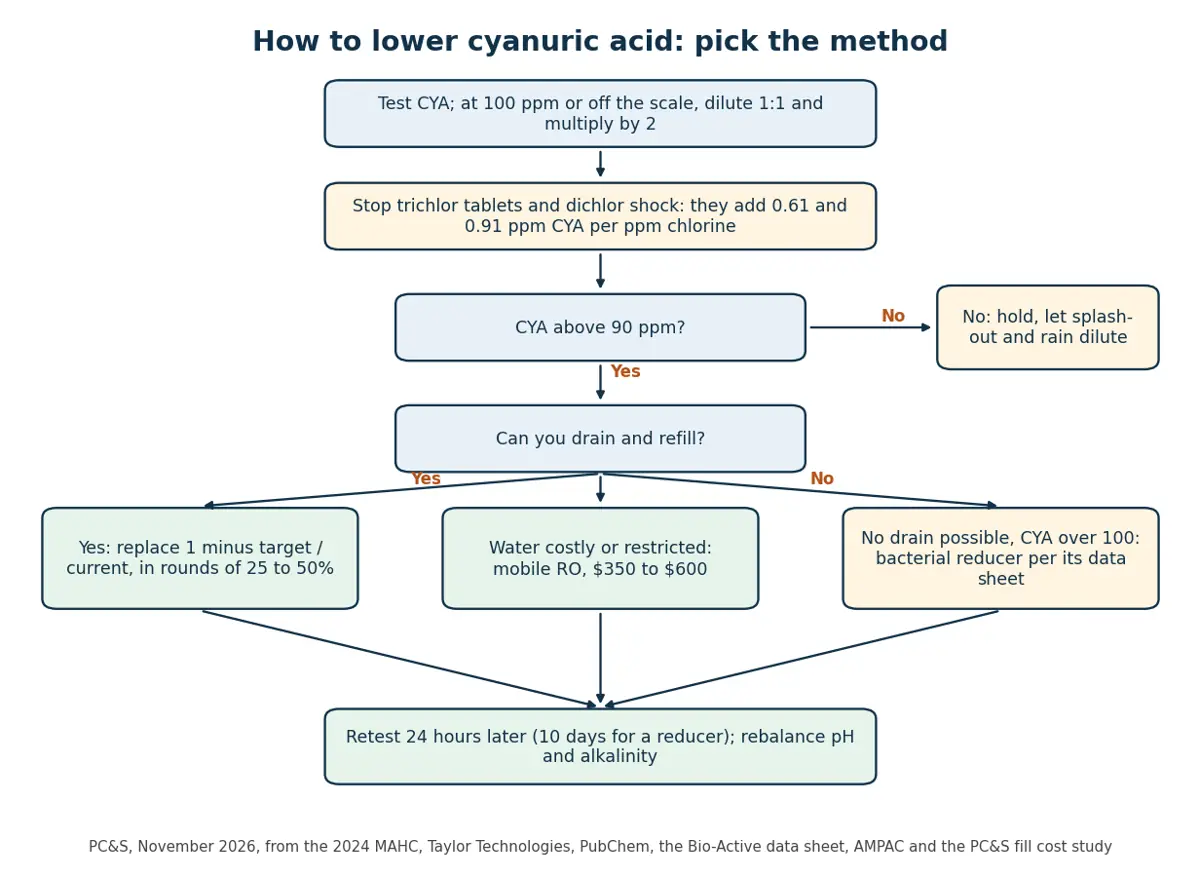
Match your reading and situation to a row. The table turns the 90 ppm MAHC cap, the 300 ppm closure line, the dilution formula, the RO price range and the reducer’s own operating limits into if-then steps; the flowchart and key numbers below hold the same logic for quick use.
| If your situation is | Do this | Source |
|---|---|---|
| Reading at 100 ppm or the dot never disappears | Dilute 1:1 with tap water, retest, multiply by 2 | Taylor Technologies |
| CYA 50 to 90 ppm and you use tablets or dichlor | Stop stabilized chlorine; switch to liquid or cal-hypo; let splash-out and rain dilute | PubChem arithmetic; Virginia DOH |
| CYA above 90 ppm | Drain the share in the table: 1 minus target / current | 2024 MAHC 5.7.3.1.3.2; Montana DPHHS |
| CYA 300 ppm or more | Keep swimmers out; drain in rounds | 2024 MAHC 5.7.3.1.3.3 (public pool closure line) |
| Drain share above what keeps water over the skimmer | Split into rounds of 25 to 50% | Dilution arithmetic |
| Fiberglass pool | Partial drains only, within the maker's warranty limits | Latham fiberglass warranty (2026) |
| Refill water is restricted or very expensive | Price mobile RO: $350 to $600 per treatment up to 25,000 gal | AMPAC; PC&S filling restrictions research |
| You cannot drain at all and CYA is above 100 ppm | A bacterial reducer is the maker's use case; dechlorinate to 5 ppm or less, water 65 F or warmer, retest after 10 days | Bio-Active data sheet |
| Public pool after a diarrheal incident | Bring CYA to 15 ppm or less before hyperchlorinating | 2024 MAHC 6.5.3.2.1 |
Source: 2024 MAHC; Taylor Technologies; Montana DPHHS; Latham; AMPAC; Bio-Active; PC&S filling restrictions research. Download CSV
| Key number | Value | Source |
|---|---|---|
| Share to drain | 1 minus target / current | Dilution arithmetic; 2024 MAHC Table 6.5.3.2.1 |
| Public pool CYA cap | 90 ppm (closed at 300 ppm) | 2024 MAHC 5.7.3.1.3 |
| Usual home target | 30 to 50 ppm | Portage County; National Plasterers Council |
| CYA added by dichlor / trichlor | 0.91 / 0.61 ppm per ppm chlorine | PubChem arithmetic |
| Refill cost per 20,000 gal | $39.00 to $649.98, median $215.09 | PC&S fill cost study, Oct 2026 rates |
| Mobile RO price | $350 to $600 up to 25,000 gal | AMPAC, updated Sept 2026 |
| Water kept by RO | About 80 to 85% | Pool and Spa News, 2013 and 2014 |
| Bacterial reducer conditions | Chlorine 5 ppm or less, 65 F to 105 F, up to 10 days | Bio-Active data sheet |
Source: as listed in each row. Download CSV
How we compiled this
We used the 2024 Model Aquatic Health Code and Annex, health department documents from Montana, Virginia, Florida, Portage County (Ohio) and Longview (Texas), the Bio-Active reducer data sheet, two Pool and Spa News reports and an AMPAC price page, accessed October and November 2026. Refill costs come from our 25 city utility rate study; drain shares, rounds and costs are PC&S arithmetic. We did not test any product; guide and forum claims are labeled, and a retailer listing we could not open was left out.
Frequently Asked Questions
How do you lower cyanuric acid in a pool quickly?
Drain and refill. It is the only method that works the same day: replace 1 minus target / current of the water, so 100 to 50 ppm means 50%. Mobile reverse osmosis takes about 8 to 12 hours for 20,000 to 40,000 gallons (AMPAC). Bacterial reducers need up to 10 days, per their data sheet.
Does baking soda lower cyanuric acid in pools?
No. Baking soda is sodium bicarbonate, which raises total alkalinity, about 10 ppm per 1.5 lb in 10,000 gallons (Florida DOH). It has no effect on cyanuric acid. Virginia DOH says CYA leaves only with water loss such as backwashing, splash-out or draining.
Does sunlight reduce cyanuric acid?
Only slowly and indirectly. Orenda says chlorine oxidizes CYA over months, and the Trouble Free Pool community estimates losses of 5 to 10 ppm a month in summer. Evaporation does not help: water leaves and the CYA stays, per Virginia DOH. Do not count on the sun to fix a reading above 90 ppm.
What happens if cyanuric acid is high in a pool?
Chlorine works slowly. At 2 ppm free chlorine the 2024 MAHC Annex shows active chlorine falling from 42 ppb at 20 ppm CYA to 8.7 ppb at 90 ppm. The MAHC caps public pools at 90 ppm and the National Plasterers Council warns 100 ppm or more may damage plaster.
How much water do I drain to lower cyanuric acid?
The share is 1 minus target divided by current. From 90 to 40 ppm replace 55.6%; from 120 to 50 ppm replace 58.3%, or 11,667 gallons of a 20,000 gallon pool. Retest 24 hours after the refill, because some CYA stays on the shell and filter (Montana DPHHS).
Do cyanuric acid reducers really work?
Evidence is thin. The Bio-Active data sheet sells its microbial reducer for pools above 100 ppm with chlorine at 5 ppm or less and water at 65 F to 105 F. Orenda and Swim University report mixed results, and we found no independent controlled test. Test before and after 10 days.
Sources
- CDC. 2024 Model Aquatic Health Code, 5th Edition, Code Language. Accessed 2026-10-27.
- CDC. 2024 Model Aquatic Health Code, 5th Edition, Annex. Accessed 2026-10-27.
- CDC. Home Pool and Hot Tub Water Treatment and Testing. Accessed 2026-10-27.
- Montana DPHHS. Fact Sheet on Cyanuric Acid and Stabilized Chlorine Products. Accessed 2026-10-27.
- Portage County Health District (Ohio). What happens when Cyanuric Acid in a pool is too high?. Accessed 2026-10-27.
- City of Longview Environmental Health Division (Texas). Frequently Asked Questions about Cyanuric Acid and Stabilized Chlorine Products. Accessed 2026-11-10.
- Virginia Department of Health. Pool Operation and Maintenance Guide (2018). Accessed 2026-10-27.
- Florida Department of Health in Collier County. Swimming Pool Operators' Manual, 2016 Version. Accessed 2026-10-27.
- National Plasterers Council. NPC Pool Start-up Card. Accessed 2026-10-27.
- Taylor Technologies. How and When to Use Dilutions in Pool and Spa Water Testing. Accessed 2026-10-27.
- NIH National Library of Medicine. PubChem compound records (molar masses). Accessed 2026-10-27.
- PC&S research. Cost to Fill a Pool in 25 US Cities (October 2026 rates). Accessed 2026-10-04.
- Bio-Active Products, Inc. (hosted by Doheny's). Bio-Active Cyanuric Acid Reducer Technical Data Sheet. Accessed 2026-11-10.
- Pool and Spa News. Recycled Water on a Roll For Replenishing Pools (September 5, 2013). Accessed 2026-11-10.
- Pool and Spa News. Mobile Filtration Gains Momentum (March 12, 2014). Accessed 2026-11-10.
- AMPAC USA. Pool Reverse Osmosis: Removing Chlorine from Swimming Pools (updated September 29, 2026). Accessed 2026-11-10.
- Latham Pool Products. Latham Fiberglass Pools Limited Lifetime Warranty (rev. 4/26). Accessed 2026-10-27.
- Orenda Technologies. How to Reduce Cyanuric Acid (CYA) in a Swimming Pool. Accessed 2026-11-10.
- Pool Shark H2O. Cyanuric Acid Reducer. Accessed 2026-11-10.
- Swim University. How to Lower Cyanuric Acid in Your Pool (claims compared). Accessed 2026-11-10.
- Trouble Free Pool. The Free Chlorine and Cyanuric Acid Relationship (community estimate). Accessed 2026-11-10.
Related pages
Get Quotes From Licensed Local Pool Pros
Tell us what you need and your ZIP code. We match you with pool companies that cover your area.