Chlorine vs Bromine: Which Hot Tub Sanitizer Fits Your Tub
Chlorine vs bromine in a hot tub: dichlor chlorine costs less per month in our 400 gallon arithmetic but adds stabilizer CDC advises against, while bromine stays 83% active at pH 8.0 versus 23% for chlorine.
- ✓Bromine holds up at high pH83% of bromine is in its active form at pH 8.0, versus 23% for chlorine (2024 MAHC Annex).
- ✓Dichlor adds stabilizer fastEach 1 ppm of chlorine from dichlor leaves about 0.91 ppm of cyanuric acid behind.
- ✓Built from labels and codeRanges and doses come from EPA labels 6836-317 and 5185-441, CDC guidance and the 2024 code.
Key takeaways
- CDC sets hot tub targets of at least 3 ppm free chlorine or 4 to 8 ppm bromine, pH 7.0 to 7.8 and water no hotter than 104 F.
- At pH 8.0, 83% of bromine is active hypobromous acid versus 23% of chlorine as hypochlorous acid, per the 2024 Model Aquatic Health Code Annex.
- Dichlor leaves about 0.91 ppm of cyanuric acid for every 1 ppm of chlorine it adds (PubChem weights), and CDC recommends no cyanuric acid in hot tubs.
- The Dantoin BCDMH-RW label (EPA Reg. No. 6836-317) lists 64.73% available bromine and 28.72% available chlorine, about 57.5% halogen as chlorine, close to dichlor at 55%.
- At Leisure Time Inc and Spa Depot prices on Oct 26, 2026, bromine oxidant cost 1.15 to 1.71 times as much as dichlor per pound.
- Switching sanitizers takes a drain and refill: the MAHC Annex notes bromide turns back into bromine when an oxidizer such as chlorine is added.
Chlorine vs bromine: how do they compare side by side?
Chlorine and bromine both meet CDC hot tub guidance when kept in range, but they behave differently. Dichlor chlorine is about 55% available chlorine, near neutral on pH and adds cyanuric acid. BCDMH bromine tablets carry about 57.5% halogen as chlorine, lower pH, cannot be stabilized and test only as total bromine. The table compares the two using EPA-registered labels.
| Factor | Chlorine (dichlor granules) | Bromine (BCDMH tablets) | Source |
|---|---|---|---|
| Example EPA label | BioGuard Master Dichloro Dihydrate, EPA Reg. No. 5185-441: 99.0% sodium dichloro-s-triazinetrione dihydrate | Dantoin BCDMH-RW Tablets, EPA Reg. No. 6836-317: 97.70% BCDMH | EPA label files (PPLS), 2024 and 2026 |
| Available halogen | 55% available chlorine (RWP Master Dihydrate, EPA Reg. No. 67262-1) | 64.73% available bromine plus 28.72% available chlorine, about 57.5% as chlorine | EPA labels; PC&S arithmetic |
| CDC hot tub target | At least 3 ppm free chlorine | 4 to 8 ppm bromine | CDC hot tub guidance |
| Label range, home spas | 3 to 5 ppm; no entry above 5 ppm | 2 to 4 ppm; after a shock, wait until below 6 ppm | EPA labels 5185-441 and 6836-317 |
| Public spa code | Minimum 3.0 ppm; maximum set by the label | Minimum 4.00 ppm; maximum 8.0 ppm | MAHC 2024 5.7.3.1.1.2.3, 5.7.3.1.2.2, 5.7.3.1.2.3 |
| What the test reads | Free and combined chlorine separately (DPD) | Total bromine only; kits multiply a chlorine value by 2.25 | MAHC 2024 Annex |
| Active share at pH 7.5 / 8.0 | 49% / 23% hypochlorous acid | 94% / 83% hypobromous acid | MAHC 2024 Annex |
| Effect on pH | Near neutral: pH 6.5 to 6.8 in a 1% solution | Lowers pH: pH 4.8 in a 1% solution | Florida DOH operator manual, 2016 |
| Stabilizer | Adds cyanuric acid: about 0.91 ppm per 1 ppm chlorine | Cyanuric acid does not protect bromine | PubChem; MAHC 2024 Annex; Florida DOH |
| Combined form | Chloramines: odor and eye irritation | Bromamines: no irritating odor, but efficacy claims are an over-generalization | Florida DOH; MAHC 2024 Annex |
| How you dose it | 1/2 teaspoon per 100 gallons, repeat every 15 to 20 minutes to 3 to 5 ppm | One floating dispenser per 350 gallons | EPA labels 5185-441 and 6836-317 |
| Start-up step | None | 1/2 oz sodium bromide per 100 gallons (30 ppm bromide) at each fill | Dantobrom S label, EPA Reg. No. 6836-116 |
| Price per lb, Oct 26, 2026 | $9.98 (Spa Depot, 2 lb) to $11.50 (Leisure Time Spa 56, 2 lb) | $11.99 (Spa Depot, 5 lb) to $20.66 (SpaGuard, 1.5 lb) | Retailer listings |
| Supply cost, 400 gal tub | $6.65 to $11.50 a month | $7.62 to $19.71 a month, plus about $3.00 of sodium bromide per refill | PC&S arithmetic |
Sources: EPA label 5185-441; EPA label 67262-1; EPA label 6836-317; EPA label 6836-116; CDC; MAHC 2024; MAHC 2024 Annex; Florida DOH; PubChem; Leisure Time Inc; Spa Depot. Prices accessed Oct 26, 2026. Download CSV
Most hot tub chlorine is dichlor, sodium dichloro-s-triazinetrione, sold as granules; the BioGuard Master Dichloro Dihydrate label lists 99.0% dichlor dihydrate and a spa dose of 1/2 teaspoon per 100 gallons. Most hot tub bromine is BCDMH, 1-bromo-3-chloro-5,5-dimethylhydantoin, the compound the 2024 Model Aquatic Health Code names in 5.7.3.1.2.1.1 alongside DBDMH.
Bromine numbers read higher than chlorine numbers for the same oxidizing power. The MAHC Annex explains that test kits measure a chlorine value and multiply it by 2.25, the ratio of the molecular weights of bromine and chlorine, so 4 ppm bromine on a strip equals about 1.8 ppm as chlorine.
Which sanitizer stays active when hot tub pH drifts?
Bromine does. The 2024 MAHC Annex reports that at pH 7.5, 94% of bromine is active hypobromous acid against 49% of chlorine as hypochlorous acid, and at pH 8.0 the split is 83% to 23%. Hot tub jets push pH up, so a bromine tub loses less sanitizing power between tests. Labels for both products still say to hold pH at 7.2 to 7.6.
Chlorine shares assume no cyanuric acid. CDC still recommends hot tub pH of 7.0 to 7.8.
Source: Source: CDC, 2024 Model Aquatic Health Code Annex, section 5.7.3.1.2.2.. Download chart data (CSV)
The Pennsylvania Department of Health operator recommendations for public pools and spas say bromine is more powerful than chlorine at higher pH levels and temperature ranges and does not form the odors associated with chlorine. The same document puts ideal bromine at 4 to 8 ppm with a 10 ppm maximum, and free chlorine at 2 to 4 ppm with a 5 ppm maximum.
pH drift is the most common fault in hot tub water. Our guide on how to lower pH in a hot tub scales acid doses by tub size, in ounces and teaspoons. BCDMH itself pushes pH down: the Florida Department of Health operator manual lists a pH of 4.8 for a 1% BCDMH solution against 6.5 to 6.8 for dichlor.
What do bromine guides get wrong?
Several top-ranking guides repeat four claims: bromine is gentler on skin, bromamines sanitize as well as free bromine, bromine works across a wider pH range, and its cost evens out. Only the pH claim holds up fully against primary sources. EPA label files, the 2024 MAHC Annex and CDC guidance contradict or qualify the other three, as the table shows.
| What several guides say | Who says it | What the primary source says | Primary source |
|---|---|---|---|
| Bromine is gentler on skin and eyes | Cal Spas, Bullfrog Spas, Hot Tub Things | EPA asked Lonza in 2009 to delete "Less irritating to skin and eyes" from a BCDMH label because the label says the product causes eye and skin damage; the MAHC Annex calls "bromine itch" widely reported | EPA notification review for EPA Reg. No. 6836-317 (Dec 17, 2009); MAHC 2024 Annex |
| Bromamines sanitize as well as free bromine | Cal Spas, Hot Tub Things | The MAHC Annex calls this an over-generalization: bromamine efficacy drops at low ammonia to bromine ratios and dibromamine has an estimated half-life of 10 minutes | MAHC 2024 Annex 5.7.3.1.2 |
| Bromine works across a wider pH range | Halogen Supply, Bullfrog Spas, Cal Spas | Supported: 83% of bromine is active hypobromous acid at pH 8.0 versus 23% for chlorine; the labels still say adjust pH to 7.2 to 7.6 | MAHC 2024 Annex; EPA labels 6836-317 and 5185-441 |
| Dichlor's stabilizer protects chlorine in a hot tub | Cal Spas, Leisure Time Inc | CDC recommends no cyanuric acid or chlorine products with it in hot tubs, because it slows disinfection; the 2024 code bars it for new spas | CDC home water page; CDC Legionella toolkit; MAHC 2024 5.7.3.1.3.1 |
| Bromine lasts longer, so the cost evens out | Halogen Supply, Cal Spas | Per pound, BCDMH carries about 57.5% halogen as chlorine and dichlor 55%, so the shelf price decides it: oxidant costs 1.15 to 1.71 times more as bromine in our listings | EPA labels 6836-317 and 67262-1; retailer listings, Oct 26, 2026 |
| ANSI recommends 2.0 ppm bromine for spas | FROG | CDC sets 4 to 8 ppm for hot tubs and the 2024 code sets a 4.00 ppm minimum for public spas | CDC hot tub guidance; MAHC 2024 5.7.3.1.2.2 |
Primary sources: EPA notification review, EPA Reg. No. 6836-317 (Dec 17, 2009); MAHC 2024 Annex; CDC home water page; CDC Legionella toolkit; MAHC 2024. Guides read Oct 26, 2026: Cal Spas, Bullfrog Spas, Halogen Supply, FROG, Hot Tub Things. Download CSV
The skin claim is the clearest gap. In its December 17, 2009 review of a Lonza label change, EPA told the maker to delete “Less irritating to skin and eyes” because the precautionary statements say the tablets cause eye and skin damage. The current May 22, 2026 label still carries that warning.
The MAHC Annex also reports more skin-infection outbreaks in brominated water than chlorinated water since the mid-1980s, and says it is not known whether that reflects true incidence or reporting bias. In one Alberta review of semi-public spas, brominated spas failed bacterial tests more often than chlorinated ones.
Why does dichlor build up stabilizer in a hot tub?
Every dose of dichlor releases cyanuric acid along with chlorine, and cyanuric acid does not evaporate or get used up. By PubChem molecular weights, each 1 ppm of chlorine from dichlor leaves about 0.91 ppm of cyanuric acid. At the usage one retailer gives for a 400 gallon tub, that passes Florida’s 40 ppm spa limit in 8 to 12 days.
Assumes the tub uses one 2 lb container in 2 to 3 months and no water is drained or splashed out. CDC recommends no cyanuric acid in hot tubs.
Source: Source: PC&S arithmetic from PubChem molecular weights (0.91 ppm cyanuric acid per 1 ppm chlorine), the RWP label (55% available chlorine) and Leisure Time Inc's usage estimate; limits from Florida DOH and MAHC 2024.. Download chart data (CSV)
| Step | Arithmetic | Result | Source |
|---|---|---|---|
| Cyanuric acid per 1 ppm chlorine from dichlor | 129.07 / (2 x 70.90) | 0.91 ppm | PubChem molecular weights |
| Chlorine delivered by one 2 lb tub of dichlor | 2 lb x 0.55 / (400 gal x 8.34 lb) x 1,000,000 | 330 ppm in 400 gal | RWP label 55%; PC&S arithmetic |
| Daily chlorine if 2 lb lasts 2 to 3 months | 330 / 90 to 330 / 60 | 3.7 to 5.5 ppm a day | Leisure Time Inc usage estimate |
| Daily cyanuric acid added | 3.7 x 0.91 to 5.5 x 0.91 | 3.3 to 5.0 ppm a day | PC&S arithmetic |
| Days to 40 ppm (Florida DOH spa maximum) | 40 / 5.0 to 40 / 3.3 | 8 to 12 days | Florida DOH operator manual |
| Days to 90 ppm (MAHC 2024 venue maximum) | 90 / 5.0 to 90 / 3.3 | 18 to 27 days | MAHC 2024 5.7.3.1.3.2 |
| After the whole 2 lb tub | 330 x 0.91 | About 300 ppm, the MAHC closure level | MAHC 2024 5.7.3.1.3.3 |
Sources: PubChem; EPA label 67262-1; Leisure Time Inc Spa 56 listing; Florida DOH; MAHC 2024. PC&S arithmetic, Oct 2026. Download CSV
CDC recommends against cyanuric acid and stabilized chlorine in hot tubs on its home water page, and the Legionella toolkit says these products slow disinfection. The 2024 code (5.7.3.1.3.1) bars them in new or substantially altered public spas and gives existing spas 4 years after adoption to stop. Pool owners can find the same chemistry in our cyanuric acid guide.
Dichlor owners have two practical options: drain when cyanuric acid reaches 40 ppm, or switch to an unstabilized chlorine after the first fill. Bromine avoids the issue because, per the Florida DOH manual, cyanuric acid does not protect bromine, so none is added. The MAHC Annex describes cyanuric acid as binding part of the free chlorine as cyanurate-bound chlorine, which lowers the active hypochlorous acid and slows disinfection; what happens when that stabilizer runs high is covered in our guide to chlorine lock.
Which costs more per month, chlorine or bromine?
Bromine usually costs more, but the gap depends on where you buy. Per pound, BCDMH carries about 57.5% halogen as chlorine and dichlor 55%, so shelf price decides the result. At Oct 26, 2026 listings, a 400 gallon tub runs $6.65 to $11.50 a month on dichlor and $7.62 to $19.71 on BCDMH, plus about $3.00 of sodium bromide per bromine refill.
Same halogen demand assumed for both sanitizers. Excludes shock, test strips and the $3.00 of sodium bromide a bromine tub needs at each refill.
Source: Source: PC&S arithmetic from Leisure Time Inc and Spa Depot listings (Oct 26, 2026), EPA label halogen content and Leisure Time Inc's 2 to 3 month usage estimate for a 400 gallon spa.. Download chart data (CSV)
| Step | Dichlor (Leisure Time Spa 56, 2 lb, $22.99) | BCDMH (SpaGuard tabs, 1.5 lb, $30.99) | Source |
|---|---|---|---|
| Price per lb | $22.99 / 2 = $11.50 | $30.99 / 1.5 = $20.66 | Leisure Time Inc listings, Oct 26, 2026 |
| Halogen per lb, as chlorine | 55% | 64.73 / 2.25 + 28.72 = 57.5% (98% product: 57.7%) | EPA labels 67262-1 and 6836-317; MAHC Annex 2.25 factor |
| Cost per lb of halogen | $11.50 / 0.55 = $20.90 | $20.66 / 0.577 = $35.83 | PC&S arithmetic |
| Monthly halogen use, 400 gal | 2 lb x 0.55 = 1.10 lb over 2 to 3 months = 0.37 to 0.55 lb | Same demand assumed: 0.37 to 0.55 lb | Leisure Time Inc: 2 lb lasts about 2 to 3 months in a 400 gal spa |
| Product per month | 0.67 to 1.00 lb | 0.37 / 0.577 to 0.55 / 0.577 = 0.64 to 0.95 lb | PC&S arithmetic |
| Cost per month | $7.66 to $11.50 | $13.14 to $19.71 | PC&S arithmetic |
| Same math, Spa Depot prices | 2 lb $19.95: $6.65 to $9.98 | 5 lb $59.95: $7.62 to $11.44 | Spa Depot listings, Oct 26, 2026 |
| Extra per refill | None | 2 oz sodium bromide for 400 gal: $23.99 x 2 / 16 = $3.00 | Dantobrom S label dose; Hot Tub Things listing |
Sources: Leisure Time Spa 56 listing; SpaGuard Brominating Tabs listing; Spa Depot dichlor; Spa Depot bromine tablets; Hot Tub Things; EPA label 67262-1; EPA label 6836-317; EPA label 6836-116. Prices accessed Oct 26, 2026. Download CSV
The monthly figures rest on one stated usage rate: Leisure Time Inc says a 2 lb container of Spa 56 lasts about 2 to 3 months in a standard 400 gallon spa. We applied the same halogen demand to bromine. A tub with heavy use, high temperature or no cover will use more of either, so treat the figures as a ratio rather than a bill.
Sanitizer is a small share of running cost. Our hot tub cost guide puts the electricity for an average electric hot tub at about $363 a year from EIA data. A bromine tub also needs a sodium bromide “bank” at each fill: the Dantobrom S label calls for 1/2 oz per 100 gallons, which is 2 oz for 400 gallons.
Can you switch from chlorine to bromine?
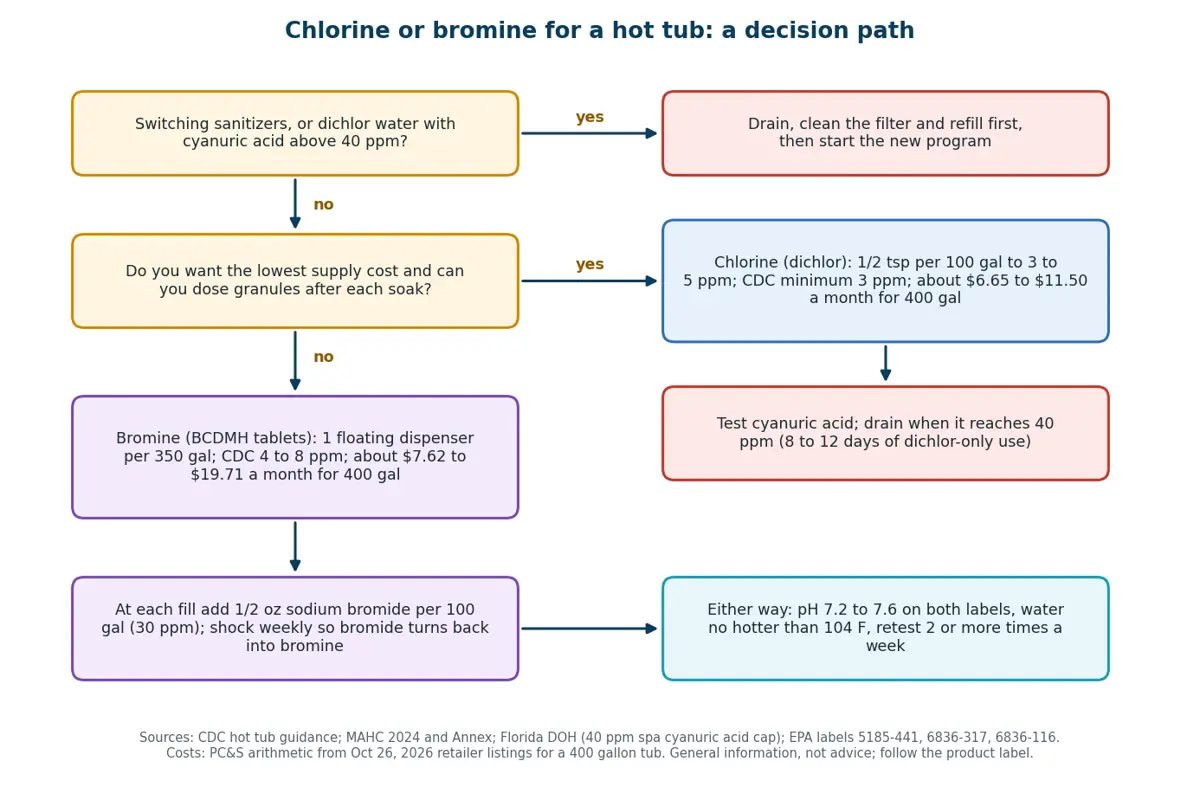
Yes, but drain first. The 2024 MAHC Annex explains that bromide in the water is readily oxidized back to active bromine, so chlorine added to old bromine water keeps making bromine. Starting a dichlor program on bromine water, or adding bromine tablets to water full of cyanuric acid, mixes two programs. Drain, clean, refill, then dose the new sanitizer.
- Drain the old waterTurn off power and drain fully; our guide on how to drain a hot tub covers the valve and pump steps.
- Clean the filter and shellThe dichlor label and the BCDMH label both say to clean or backwash the filter before starting the sanitizer.
- Refill and balance pHBring pH to 7.2 to 7.6, the range on both EPA labels, before adding sanitizer.
- Bromine: add the bromide bankAdd 1/2 oz of sodium bromide per 100 gallons, 2 oz for 400 gallons, to reach 30 ppm bromide (Dantobrom S label).
- Bromine: load the dispenserCheck that your owner’s manual allows bromine tablets (Hot Spring and Caldera ban them; see our hot tub chemicals guide), then use one floating dispenser per 350 gallons and adjust until bromine reads 2 to 4 ppm on the label scale, or 4 to 8 ppm per CDC.
- Chlorine: dose granulesAdd 1/2 teaspoon of dichlor per 100 gallons with the pump on and repeat every 15 to 20 minutes until chlorine reads 3 to 5 ppm (RWP label).
Never mix the products dry or in one feeder. The Dantobrom S label (EPA Reg. No. 6836-116) warns that adding other chemicals to a feeder holding the tablets can cause fire or explosion.
Planning a new hot tub or spa?
Should you use chlorine or bromine in your hot tub?
Choose by how you use the tub. Dichlor suits owners who dose after each soak and want the lowest supply cost, as long as they drain when cyanuric acid passes 40 ppm. Bromine tablets suit owners who want a floating feeder, run high pH or soak often. Public and rental spas follow the 2024 MAHC ranges whichever sanitizer they use.
| If your situation is | Do this | Why (source) |
|---|---|---|
| Lowest supply cost matters most and you can dose after each soak | Use dichlor granules at 1/2 teaspoon per 100 gallons, aiming for 3 to 5 ppm | Dichlor ran $6.65 to $11.50 a month in our 400 gallon arithmetic (labels; Oct 2026 listings) |
| You use dichlor and cyanuric acid tests above 40 ppm | Drain and refill before adding more dichlor | Florida DOH caps spa cyanuric acid at 40 ppm; CDC advises none in hot tubs |
| You want a feeder that doses between soaks | If your owner's manual allows bromine tablets (Hot Spring and Caldera ban them), use BCDMH tablets in one floating dispenser per 350 gallons, 2 to 4 ppm on the label, 4 to 8 ppm per CDC; add 1/2 oz sodium bromide per 100 gallons at each fill and shock weekly | EPA labels 6836-317 and 6836-116; CDC hot tub guidance; Master Spas guide: shock once a week |
| pH often drifts to 7.8 to 8.0 | Bromine keeps more of its active form, but still bring pH back to 7.2 to 7.6 | 83% active at pH 8.0 versus 23% for chlorine (MAHC Annex); labels say 7.2 to 7.6 |
| A soaker gets an itchy rash within 24 hours of a bromine soak | Test bromine, stop using the tub until levels are in range, and consider chlorine at the next refill; see a doctor for a rash | MAHC Annex: contact dermatitis from bromine usually appears within 24 hours |
| You are switching from one sanitizer to the other | Drain, clean and refill first, then start the new program | MAHC Annex: bromide is oxidized back to bromine, so chlorine added to old bromine water makes bromine |
| The tub serves a rental, gym or HOA | Follow the 2024 MAHC: chlorine 3.0 ppm minimum or bromine 4.00 to 8.0 ppm, no cyanuric acid in new spas | MAHC 2024 5.7.3.1.1.2.3, 5.7.3.1.2.2, 5.7.3.1.3.1 |
Sources: CDC; CDC home water page; MAHC 2024 Annex; MAHC 2024; Florida DOH; EPA label 6836-317; EPA label 5185-441. Download CSV
Salt systems are a third route: they make chlorine from dissolved salt, and the 2024 code lists salt electrolytic chlorine and bromine generators under 5.7.3.1.5. Our research on saltwater vs chlorine pools compares the running costs at pool scale. For spas, our salt water hot tub guide prices FreshWater cartridges and a Saltron Mini kit against bromine and dichlor at November 2026 prices. The steps and a dated cost build for adding a salt chlorine generator are in our guide on how to convert a pool to salt water.
Whichever you choose, the routine is the same: test 2 or more times a week, clean the filter every 2 to 6 weeks and drain every 1 to 6 months, the spread across 8 hot tub makers’ published schedules. Our hot tub maintenance schedule lists each task with each maker’s interval.
Hot tub sanitizer safety: what both labels require
Both products are EPA-registered pesticides, and using them against the label violates federal law, as each label states. Keep sanitizer in range before anyone soaks: the dichlor label bars entry above 5 ppm chlorine, and the BCDMH label says wait until bromine drops below 6 ppm after a shock. Water should never exceed 104 F.
| Number | Value | Source |
|---|---|---|
| Hot tub chlorine target | At least 3 ppm; ask the operator above 10 ppm | CDC hot tub guidance |
| Hot tub bromine target | 4 to 8 ppm | CDC hot tub guidance; MAHC 2024 5.7.3.1.2.2 and 5.7.3.1.2.3 |
| Hot tub pH | 7.0 to 7.8 | CDC hot tub guidance |
| Maximum water temperature | 104 F | CDC; MAHC 2024 4.12.1.7; CPSC |
| Active share at pH 8.0 | Bromine 83%, chlorine 23% | MAHC 2024 Annex 5.7.3.1.2.2 |
| Bromine test conversion | Chlorine value x 2.25 | MAHC 2024 Annex 5.7.3.1.2.2 |
| Cyanuric acid left by dichlor | About 0.91 ppm per 1 ppm chlorine | PC&S arithmetic from PubChem molecular weights |
| Sanitizer supply, 400 gal tub | Dichlor $6.65 to $11.50 a month; BCDMH $7.62 to $19.71 | PC&S arithmetic from Oct 26, 2026 listings |
Sources: CDC; MAHC 2024; MAHC 2024 Annex; CPSC; PubChem; PC&S arithmetic from Oct 26, 2026 listings. Download CSV
Hot tubs carry more outbreak risk than pools of the same use: our analysis of pool illness outbreaks found 176 of 560 treated-water outbreaks from 2009 to 2023 at hot tubs or spas, 147 of them Legionella, from CDC National Outbreak Reporting System data. Holding 3 ppm chlorine or 4 to 8 ppm bromine is the CDC line for that reason.
How we compiled this
We read 21 primary, maker and retailer documents in October 2026: five CDC sources including the 2024 Model Aquatic Health Code and its Annex, five EPA label files and the EPA product registration record, the Pennsylvania and Florida health department operator manuals, a CPSC release, PubChem molecular weights, the Master Spas water care guide and five retailer listings with dated prices. Monthly costs and cyanuric acid figures are PC&S arithmetic with every input shown. Competitor guides were read to compare claims, not as sources of fact; forum posts were excluded.
Frequently Asked Questions
Is bromine better for you than chlorine?
Not clearly. Bromine produces less odor, but the BCDMH label warns of eye and skin damage, EPA struck a “less irritating” claim from it in 2009, and the 2024 MAHC Annex says “bromine itch” is widely reported. Keep either sanitizer in the CDC range: 3 ppm chlorine or 4 to 8 ppm bromine.
What are the disadvantages of bromine in a hot tub?
It costs more per pound of halogen, $35.83 against $20.90 for dichlor at one retailer on Oct 26, 2026. It cannot be stabilized, lowers pH, needs 2 oz of sodium bromide per 400 gallons at each fill, and test kits measure only total bromine, so free and combined bromine cannot be told apart (MAHC Annex).
Can I just switch from chlorine to bromine?
Drain and refill first. The 2024 MAHC Annex notes that bromide turns back into bromine when an oxidizer is added, so leftover bromide or cyanuric acid mixes the two programs. After refilling, add 1/2 oz of sodium bromide per 100 gallons, then load bromine tablets in a floating dispenser.
Do hot tubs use bromine or chlorine?
Either. CDC gives hot tub targets for both: at least 3 ppm chlorine or 4 to 8 ppm bromine. The 2024 MAHC Annex says bromine is common in indoor commercial spas, and the Master Spas water care guide lists either chlorine at 2 to 4 ppm or bromine at 3 to 5 ppm.
Why don't swimming pools use bromine?
Sunlight. The 2024 MAHC Annex says bromine is not very common in outdoor pools because, like chlorine, it is destroyed rapidly in sunlight, and cyanuric acid, which protects chlorine outdoors, does not stabilize bromine. Pools that do use it must hold at least 3.0 ppm under the 2024 code.
Is it safe to swim in a pool with bromine?
Yes, when the level is in range. The 2024 code allows EPA-registered bromine at a minimum of 3.0 ppm in pools and 4.00 ppm in spas, with an 8.0 ppm maximum while bathers are present (MAHC 5.7.3.1.2). The BCDMH label says to wait until bromine drops below 6 ppm after a shock.
Sources
- CDC. What You Can Do to Stay Healthy in Hot Tubs. Accessed 2026-10-26.
- CDC. Home Pool and Hot Tub Water Treatment and Testing. Accessed 2026-10-26.
- CDC. Controlling Legionella in Hot Tubs (toolkit module). Accessed 2026-10-26.
- CDC. 2024 Model Aquatic Health Code, 5th Edition, Code Language. Accessed 2026-10-26.
- CDC. 2024 Model Aquatic Health Code, 5th Edition, Annex. Accessed 2026-10-26.
- U.S. EPA (Lonza label file). Dantoin BCDMH-RW Tablets label, EPA Reg. No. 6836-317 (May 22, 2026). Accessed 2026-10-26.
- U.S. EPA. Notification review, Dantoin BCDMH RW Tablets, EPA Reg. No. 6836-317 (Dec 17, 2009). Accessed 2026-10-26.
- U.S. EPA (Lonza label file). Dantobrom S label, EPA Reg. No. 6836-116 (May 28, 2026). Accessed 2026-10-26.
- U.S. EPA (Bio-Lab label file). BioGuard Master Dichloro Dihydrate label, EPA Reg. No. 5185-441 (May 22, 2024). Accessed 2026-10-26.
- U.S. EPA (label file). RWP Master Dihydrate Granular label, EPA Reg. No. 67262-1 (July 8, 2019). Accessed 2026-10-26.
- U.S. EPA. Pesticide Product and Label System record, 6836-317 (status Active). Accessed 2026-10-26.
- Pennsylvania Department of Health. Public Swimming and Bathing Places: Operational Recommendations. Accessed 2026-10-26.
- Florida Department of Health in Collier County. Swimming Pool Operators' Manual, 2016 Version. Accessed 2026-10-26.
- National Library of Medicine, PubChem. Molecular weights: cyanuric acid, chlorine, bromine. Accessed 2026-10-26.
- U.S. Consumer Product Safety Commission. CPSC Warns of Hot Tub Temperatures. Accessed 2026-10-26.
- Master Spas. Water Care and Basic Maintenance Guide. Accessed 2026-10-26.
- CDC. National Outbreak Reporting System (NORS) public dataset, via PC&S research: /research/swimming-pool-illness-outbreaks/. Accessed 2026-10-26.
- Leisure Time Inc. Leisure Time Spa 56 Chlorinating Granules, 2 lb (listing). Accessed 2026-10-26.
- Leisure Time Inc. SpaGuard Brominating Tabs, 1.5 lb (listing). Accessed 2026-10-26.
- Spa Depot. DiChlor Sanitizer-Shock for Spas, 2 lb (listing). Accessed 2026-10-26.
- Spa Depot. Bromine Tablets for Spas, 5 lb (listing). Accessed 2026-10-26.
- Hot Tub Things. Bromine Tablets and Leisure Time Sodium Bromide Granular, 1 lb (listing). Accessed 2026-10-26.
Related pages
Get Quotes From Licensed Local Pool Pros
Tell us what you need and your ZIP code. We match you with pool companies that cover your area.