How to Raise Alkalinity in Pool Water With Baking Soda
How to raise alkalinity in pool water: add 1.4 lb of baking soda per 10,000 gallons for each 10 ppm, broadcast it with the pump running, retest after 6 hours, and stop at 80 to 120 ppm.
- ✓1.4 lb per 10 ppm is the chemistryThe 2024 MAHC Annex prints 635.0 g of sodium bicarbonate per 37,854 liters (10,000 gallons); labels round up to 1.5 lb.
- ✓pH barely movesA 20 to 40 ppm alkalinity lift raises pH by at most about 0.10 to 0.22 right after dosing (PC&S carbonate arithmetic).
- ✓About $4 per 10 ppm1.4 lb at Leslie's September 2026 price of $29.99 per 10 lb is $4.20 per 10 ppm in 10,000 gallons.
Key takeaways
- Total alkalinity belongs at 80 to 120 ppm in home pools, per the Florida DOH operators manual and the Virginia DOH guide; the 2024 Model Aquatic Health Code lets public pools run 60 to 180 ppm (section 5.7.4.4.1).
- Each 10 ppm takes 1.40 lb of baking soda per 10,000 gallons: our stoichiometry gives 635.4 g, and the 2024 MAHC Annex prints 635.0 g per 37,854.1 L.
- Labels round up: Leslie's Alkalinity Up and Arm & Hammer say 1.5 lb, 7% above the chemistry, so a label dose adds about 10.7 ppm instead of 10.
- Baking soda barely moves pH: lifting alkalinity from 60 to 100 ppm raises pH by at most about 0.22 right after dosing (PC&S arithmetic with the USGS carbonic acid constant).
- Soda ash adds about 60% more alkalinity per pound than baking soda (Skinner and Hales, 1995), so it fits only when pH must rise too and the job needs under 2 lb per 10,000 gallons. Borax adds far less, about 3.1 ppm per pound per 10,000 gallons, which is why our borax in pool guide treats it as a pH tool rather than an alkalinity one.
- At Leslie’s September 2026 price of $29.99 per 10 lb, each 10 ppm in 10,000 gallons costs about $4.20 of product (PC&S price research).
What should total alkalinity be in a pool?
Aim for 80 to 120 ppm. The Florida, Virginia and Pennsylvania health departments all use that range, and the 2024 Model Aquatic Health Code sets a wider legal band of 60 to 180 ppm for public pools. Raise alkalinity when a test reads under 80 ppm after you correct for stabilizer.
| Source | Applies to | Total alkalinity | Extra rule |
|---|---|---|---|
| 2024 Model Aquatic Health Code 5.7.4.4.1 (CDC) | Public pools that adopt it | 60 to 180 ppm | Test weekly (5.7.5.5) |
| Florida DOH operators manual (2016) | Florida public pools | 80 to 120 ppm | Adjust alkalinity before pH |
| Virginia DOH, Portsmouth guide (2018) | Public and private pools | 80 to 120 ppm | 80 to 100 if pH tends to rise; up to 150 if it tends to fall |
| Pennsylvania DOH (2016) | Public pools | 80 to 120 ppm | Trichlor and dichlor lower alkalinity over time |
| HTH Alkalinity Up directions (manufacturer) | Home pools | 80 to 120 ppm ideal | Add product if below 60 ppm |
| Leslie's Alkalinity Up page (retailer) | Home pools | 80 to 120 ppm | 80 to 100 with liquid chlorine or cal-hypo; 100 to 120 with trichlor or dichlor |
| FROG Products (manufacturer) | Home pools | 80 to 120 ppm | Aim for the middle |
| Arm & Hammer Pool Owner's Guide (manufacturer) | Home pools | 110 to 150 ppm | Starts near the top of the health department ranges above |
Sources: MAHC 2024, 5.7.4.4.1 and 5.7.5.5; Florida DOH (2016); Virginia DOH (2018); Pennsylvania DOH (2016); HTH Alkalinity Up; Leslie's Alkalinity Up; FROG Products; Arm & Hammer Pool Owner's Guide. Download CSV
Your chlorine type moves the target inside that range. The Virginia guide says to keep alkalinity at 80 to 100 ppm when chlorine pushes pH up and up to 150 ppm when pH tends to fall. Leslie’s applies the same idea by product: 80 to 100 ppm for liquid chlorine and cal-hypo, 100 to 120 ppm for trichlor and dichlor. Arm & Hammer’s 110 to 150 ppm starts near the top of the health department ranges and only matches Virginia’s ceiling for pools whose pH keeps falling.
Correct the reading before you dose. Cyanuric acid (stabilizer) shows up in a total alkalinity titration, and the National Plasterers Council start-up card says to subtract one third of the cyanuric acid level from the result; the 2024 MAHC Annex deducts 30%, which lands within a few ppm. A test of 80 ppm in a pool with 60 ppm of stabilizer is really 60 ppm of carbonate alkalinity, which is low. Our cyanuric acid pool guide covers how to test stabilizer.
| Number | Value | Source |
|---|---|---|
| Total alkalinity target, home pools | 80 to 120 ppm | Florida, Virginia and Pennsylvania DOH |
| Public pool legal range | 60 to 180 ppm | 2024 MAHC 5.7.4.4.1 |
| Baking soda for +10 ppm in 10,000 gal (chemistry) | 1.40 lb (635 g) | PC&S stoichiometry; 2024 MAHC Annex |
| Baking soda for +10 ppm in 10,000 gal (labels) | 1.5 lb | Leslie's Alkalinity Up; Arm & Hammer; Florida DOH |
| Soda ash for +10 ppm alkalinity in 10,000 gal | 0.88 lb | Skinner and Hales 1995; PC&S stoichiometry |
| Alkalinity added per pound, 10,000 gal | 7.1 ppm baking soda; 11.3 ppm soda ash | PC&S stoichiometry |
| Correction for stabilizer | Subtract cyanuric acid / 3 from the alkalinity reading (MAHC Annex: 30%) | National Plasterers Council; 2024 MAHC Annex |
| Retest after | 4 to 24 hours (6 hours is the common floor) | Leslie's; FROG; HTH; Arm & Hammer |
Sources: Florida DOH; Virginia DOH; Pennsylvania DOH; MAHC 2024; MAHC 2024 Annex; Skinner and Hales (1995); Leslie's; Arm & Hammer; FROG; HTH; PC&S stoichiometry. Download CSV
What happens when pool alkalinity is low?
Low alkalinity leaves pH with no buffer, so it swings with every dose of chlorine, acid or rain. The 2024 MAHC Annex warns that pH can drop rapidly with net acidic products such as trichlor, dichlor and potassium monopersulfate, causing etching and corrosion. Florida DOH calls this aggressive water.
- pH bounce: pH changes rapidly when chemicals or impurities enter the water (MAHC Annex); Virginia DOH says it can change dramatically with small additions of chemicals.
- Etching and corrosion: Florida DOH says low alkalinity makes water aggressive, causing pitting, etching and pH bounce; Virginia DOH lists corrosion, eye irritation and green water.
- Falling pH from tablets: Pennsylvania DOH says trichlor, dichlor and bromine reduce pH and alkalinity over time, while sodium and calcium hypochlorite raise them.
- Rain: rainwater has a pH of nearly 5.75, per Pennsylvania DOH, so a wet week can pull a weakly buffered pool down fast.
The alkalinity fix and the pH fix are different jobs, which is why Florida’s manual says to adjust total alkalinity first. If your pH is low but alkalinity reads 80 ppm or more, skip the baking soda and use our guide on how to raise pH in pool water, which covers soda ash doses and aeration for pH alone.
How much baking soda raises alkalinity 10 ppm?
1.40 lb of sodium bicarbonate per 10,000 gallons raises total alkalinity 10 ppm. That figure comes straight from molar masses: 10 ppm as calcium carbonate in 37,854 liters is 7.56 equivalents, and 7.56 moles of baking soda weigh 635.4 g. The 2024 MAHC Annex prints 635.0 g, a match. Scaled to a spa, the same rate is 0.22 oz of baking soda per 100 gallons per 10 ppm, as the dose table in our hot tub alkalinity guide shows.
| Step | Arithmetic | Result |
|---|---|---|
| 1. Water in 10,000 gallons | 10,000 gal x 3.78541 L per gal | 37,854 L |
| 2. Alkalinity to add, counted as calcium carbonate | 10 mg/L x 37,854 L | 378.5 g CaCO3 |
| 3. Moles of calcium carbonate | 378.5 g / 100.09 g per mol | 3.782 mol |
| 4. Acid it can neutralize (2 per CaCO3) | 3.782 x 2 | 7.564 equivalents |
| 5. Sodium bicarbonate (1 equivalent per mol) | 7.564 x 84.007 g per mol | 635.4 g |
| 6. Convert to pounds | 635.4 g / 453.59 g per lb | 1.40 lb |
| 7. Check: 2024 MAHC Annex | 635.0 g per 37,854.1 L | 1.4 lb (matches) |
| 8. Check: label rate | 1.5 lb / 1.40 lb | 107% of the chemistry figure |
| 9. Same job with soda ash (2 equivalents per mol) | 7.564 / 2 x 105.988 g per mol | 400.8 g = 0.88 lb |
Molar masses from PubChem (sodium bicarbonate 84.007, sodium carbonate 105.988, calcium carbonate 100.09 g/mol); check value from the 2024 MAHC Annex, 5.7.4.4.1; arithmetic by PC&S, October 2026. Download CSV
Pool alkalinity is reported in ppm as calcium carbonate, and one calcium carbonate neutralizes two units of acid while one sodium bicarbonate neutralizes one. That 2 to 1 ratio is the whole calculation. Skinner and Hales published the same result in 1995 as a field formula, gallons divided by 71,425 times the ppm you want, which gives 1.40 lb for 10 ppm in 10,000 gallons.
A 1.5 lb dose adds about 10.7 ppm instead of 10, a harmless overshoot.
Source: Sources: PC&S stoichiometry from PubChem molar masses; 2024 MAHC Annex 5.7.4.4.1; Skinner and Hales, JSPSI (1995); Knorr Systems; Florida DOH (2016); Pennsylvania DOH (2016); Virginia DOH (2018); Leslie's Alkalinity Up (Sept 2026); Arm & Hammer.. Download chart data (CSV)
| Source | What it prints | Same job: +10 ppm in 10,000 gal | Share of chemistry figure |
|---|---|---|---|
| PC&S stoichiometry (PubChem molar masses) | 635.4 g sodium bicarbonate | 1.40 lb | 100% |
| 2024 MAHC Annex 5.7.4.4.1 | 1.4 lb (635.0 g per 37,854.1 L) | 1.40 lb | 100% |
| Skinner and Hales, JSPSI (1995) | Gallons / 71,425 x ppm = pounds | 1.40 lb | 100% |
| Knorr Systems dosing chart | 1.4 lb per 10 ppm | 1.40 lb | 100% |
| Florida DOH (2016); Pennsylvania DOH (2016) | 1.5 lb per 10 ppm | 1.50 lb | 107% |
| Virginia DOH (2018) table | 24 oz per 10 ppm in 10,000 gal | 1.50 lb | 107% |
| Leslie's Alkalinity Up label (2026) | 1 1/2 lb per 10 ppm | 1.50 lb | 107% |
| Arm & Hammer article | 1.5 lb per 10 ppm | 1.50 lb | 107% |
| Arm & Hammer Pool Owner's Guide chart | 3, 6, 9 and 12 lb at 80, 60, 40 and 20 ppm | 1.50 lb (implied, to reach 100 ppm) | 107% |
Sources: MAHC 2024 Annex; Skinner and Hales (1995); Knorr Systems; Florida DOH; Pennsylvania DOH; Virginia DOH, p. 33; Leslie's Alkalinity Up (Sept 2026); Arm & Hammer; Arm & Hammer Pool Owner's Guide, p. 6. Download CSV
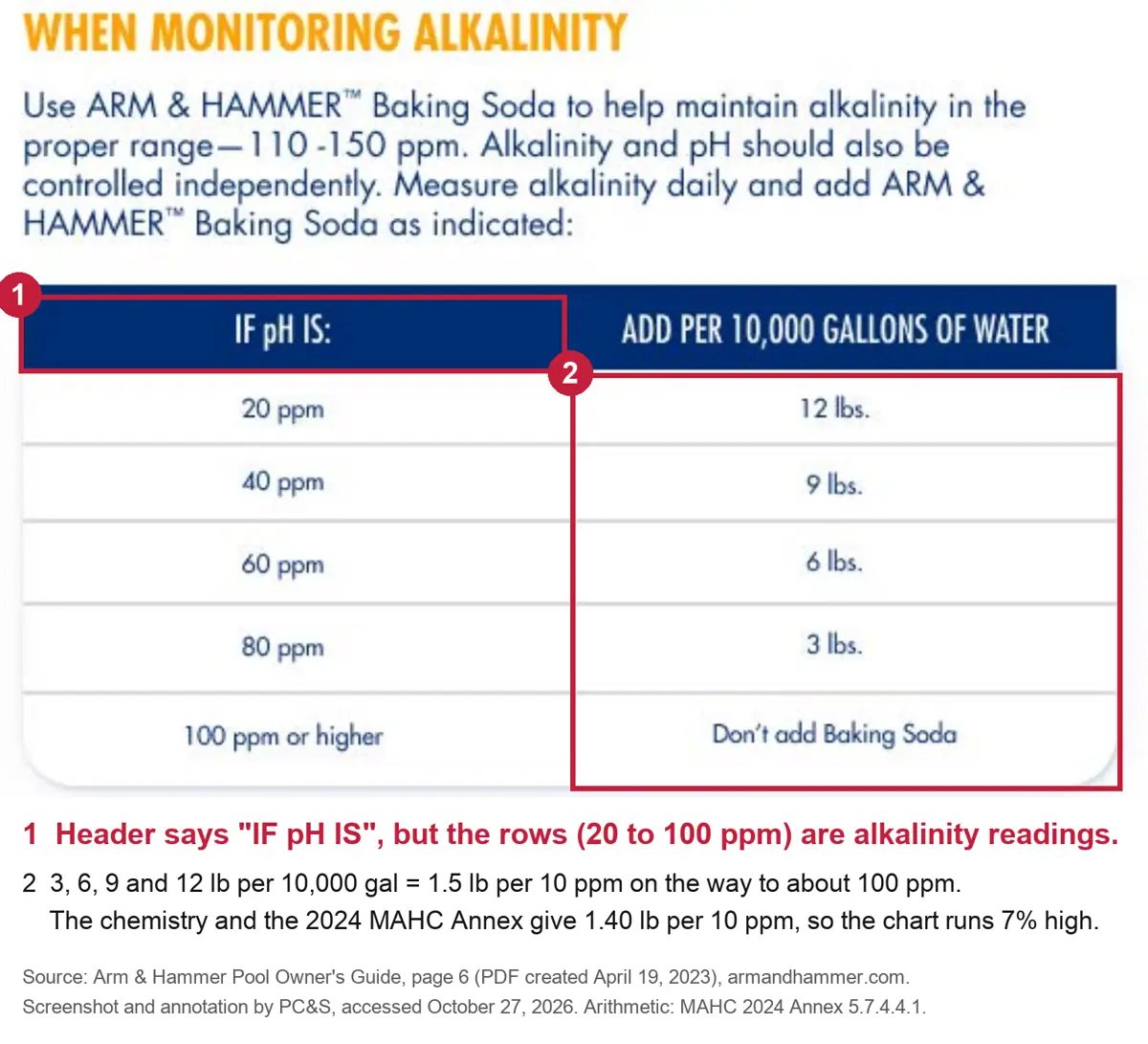
Should you use 1.4 or 1.5 lb? Either works. A 1.5 lb label dose adds about 10.7 ppm instead of 10, an overshoot of 0.7 ppm per step that Skinner and Hales traced to rounding in service manuals. The chemistry figure is the better number when you dose 40 ppm or more at once, where the gap grows to about 3 ppm.
How much baking soda do you need for your pool size?
Multiply 1.40 lb by your gallons divided by 10,000, then by the ppm you need divided by 10. A 20,000 gallon pool going from 60 to 100 ppm needs 11.2 lb. The table runs from 5,000 to 40,000 gallons and from a 10 ppm to a 60 ppm rise, all from the same formula.
| Raise alkalinity by | 5,000 gal | 10,000 gal | 15,000 gal | 20,000 gal | 25,000 gal | 30,000 gal | 40,000 gal |
|---|---|---|---|---|---|---|---|
| 10 ppm | 0.70 lb | 1.40 lb | 2.10 lb | 2.80 lb | 3.50 lb | 4.20 lb | 5.60 lb |
| 20 ppm | 1.40 lb | 2.80 lb | 4.20 lb | 5.60 lb | 7.00 lb | 8.41 lb | 11.21 lb |
| 30 ppm | 2.10 lb | 4.20 lb | 6.30 lb | 8.41 lb | 10.51 lb | 12.61 lb | 16.81 lb |
| 40 ppm | 2.80 lb | 5.60 lb | 8.41 lb | 11.21 lb | 14.01 lb | 16.81 lb | 22.41 lb |
| 50 ppm | 3.50 lb | 7.00 lb | 10.51 lb | 14.01 lb | 17.51 lb | 21.01 lb | 28.02 lb |
| 60 ppm | 4.20 lb | 8.41 lb | 12.61 lb | 16.81 lb | 21.01 lb | 25.22 lb | 33.62 lb |
PC&S calculation: 1.40 lb per 10 ppm per 10,000 gallons, from the stoichiometry above and the 2024 MAHC Annex. Label rates of 1.5 lb run 7% higher. Download CSV
The dose is only as good as your gallon count. Florida DOH estimates volume as length x width x average depth x 7.5, and our pool volume calculator does the same for round, oval and kidney shapes. A pool you think holds 15,000 gallons but really holds 20,000 will undershoot by a quarter. In a 500 gallon hot tub the same chemistry comes to about 1.12 oz of baking soda per 10 ppm, worked out in our guide on how to raise pH in a hot tub.
How to raise alkalinity in pool water, step by step
Test, correct the reading for stabilizer, weigh the baking soda, broadcast it over the deep end with the pump running, then retest after at least 6 hours. Leslie’s says its product takes about 4 hours to circulate fully, HTH says retest after 6 to 8 hours and Arm & Hammer allows up to 24 hours.
- Test alkalinity, pH and stabilizerUse a titration kit for alkalinity. Public pools must test it weekly under MAHC 5.7.5.5, a sensible rhythm at home.
- Correct for cyanuric acidSubtract one third of the cyanuric acid reading from the alkalinity result (National Plasterers Council; the 2024 MAHC Annex uses 30%). Reading 80 ppm with 60 ppm stabilizer means 60 ppm to work with.
- Work out the doseGallons / 10,000 x (ppm needed / 10) x 1.4 lb. Example: 18,000 gallons from 60 to 100 ppm is 1.8 x 4 x 1.4 = 10.1 lb (10.8 lb at the 1.5 lb label rate).
- Start with part of it the first timeArm & Hammer suggests one half to three fourths of the computed amount if you are new to dosing, then top up after the retest.
- Broadcast with the pump runningSpread it in wide arcs over the deep end, not in one pile, and not on a windy day (Arm & Hammer). Brush any powder that settles.
- Wait, then retestGive it at least 6 hours of circulation (FROG Products; HTH says 6 to 8 hours). Retest alkalinity and pH within 6 to 24 hours (Arm & Hammer).
- Check pH lastIf alkalinity is now 80 ppm or more and pH is still under 7.2, aerate or add soda ash; do not keep adding baking soda for pH.
- Log the resultWrite down gallons, pounds added and the ppm gained. After two or three doses you know your pool’s real response, which beats any chart.
Does baking soda raise pH in a pool?
A little. Baking soda has a pH of 8.3 to 8.6, so it nudges pool pH up, but Florida DOH says it raises alkalinity without greatly affecting pH. Our arithmetic puts the rise at no more than about 0.10 for a 20 ppm lift from 80 ppm and 0.22 for a 40 ppm lift from 60 ppm.
pH keeps drifting up afterward as carbon dioxide escapes (2024 MAHC Annex).
Source: PC&S estimate: rise = log10(new alkalinity / old alkalinity) with dissolved carbon dioxide unchanged; carbonic acid constant from the USGS National Field Manual, section 6.6 (2012). Cyanuric acid buffering makes the real rise smaller.. Download chart data (CSV)
| Starting alkalinity | Target | Rise | Baking soda, 10,000 gal | Largest pH rise right after dosing |
|---|---|---|---|---|
| 40 ppm | 80 ppm | 40 ppm | 5.60 lb | +0.30 |
| 50 ppm | 80 ppm | 30 ppm | 4.20 lb | +0.20 |
| 60 ppm | 80 ppm | 20 ppm | 2.80 lb | +0.12 |
| 60 ppm | 100 ppm | 40 ppm | 5.60 lb | +0.22 |
| 70 ppm | 90 ppm | 20 ppm | 2.80 lb | +0.11 |
| 80 ppm | 100 ppm | 20 ppm | 2.80 lb | +0.10 |
PC&S estimate: pH = pK1 + log10(bicarbonate / dissolved carbon dioxide), with K1 = 10-6.35 at 25 C from the USGS National Field Manual, section 6.6. Adding bicarbonate with carbon dioxide unchanged raises pH by log10(new alkalinity / old alkalinity). Cyanuric acid buffering makes the real rise smaller. Download CSV
The rise is small because bicarbonate is already the main form of alkalinity at pool pH, and adding more of it does not remove the carbon dioxide that holds pH down. pH climbs later, as that carbon dioxide escapes: the MAHC Annex calls alkalinity a source of rising pH through outgassing, and Robert Lowry explains in AQUA Magazine that aeration raises pH with no change in total alkalinity. So expect a slow drift up over the next days, not a jump.
That is the honest answer to raising alkalinity without raising pH: baking soda is already the lowest pH option. A bicarbonate solution sits at pH 8.3 to 8.6 (Orenda), close to the 8.3 equivalence point the USGS manual describes, so baking soda alone cannot drive pool water much past that. If pH ends up above 7.8, trim it with a small acid dose. Our guide on how to lower pH in pool water sizes that dose.
Should you use baking soda, soda ash or aeration?
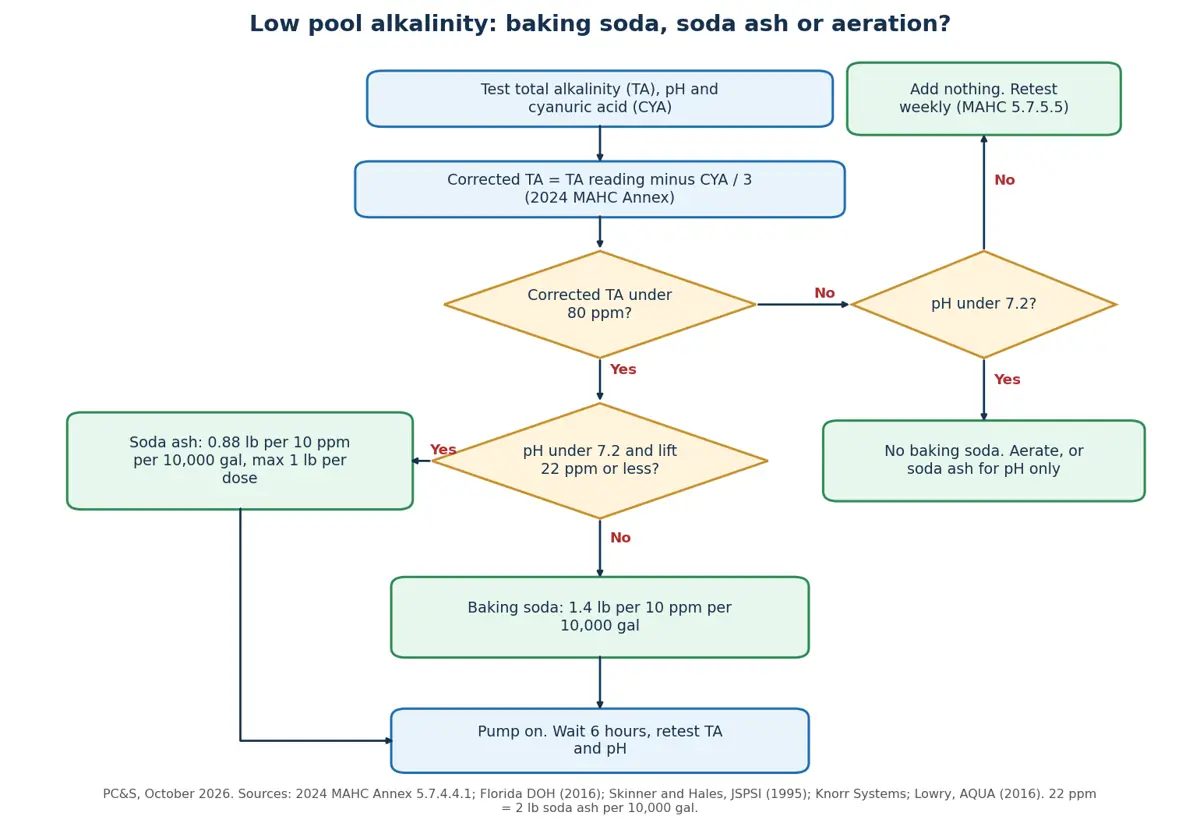
Use baking soda when only alkalinity is low, soda ash when pH and alkalinity are both low and the lift is small, and aeration when only pH is low. Skinner and Hales give the cut-off: if the alkalinity job needs less than 2 lb of soda ash per 10,000 gallons, about 22 ppm, soda ash is usually the better buy.
| Method | What it raises | Alkalinity per lb, 10,000 gal | pH of the product | Best use | Source |
|---|---|---|---|---|---|
| Baking soda (sodium bicarbonate) | Alkalinity; pH only a little | 7.1 ppm | 8.3 to 8.6 | Alkalinity under 80 ppm with pH 7.2 or higher | MAHC Annex; Florida DOH; Orenda; PC&S stoichiometry |
| Soda ash (sodium carbonate) | pH and alkalinity | 11.3 ppm | 11.3 to 11.8 | Both low, and the lift needs under 2 lb per 10,000 gal | Skinner and Hales 1995; Orenda; Leslie's Soda Ash |
| Aeration (fountains, jets, returns aimed up) | pH only; alkalinity unchanged | 0 ppm | No chemical | Alkalinity in range, pH low | Lowry, AQUA Magazine 2016; MAHC Annex |
Sources: MAHC 2024 Annex; Florida DOH; Skinner and Hales (1995); Orenda; Leslie's Soda Ash (Sept 2026); Lowry, AQUA Magazine (2016); PC&S stoichiometry. Download CSV
Soda ash is the stronger base, pH 11.3 to 11.8 against 8.3 to 8.6 for baking soda (Orenda). Per pound it adds 11.3 ppm of alkalinity in 10,000 gallons, against 7.1 ppm for baking soda, and it pushes pH far harder: Florida DOH’s chart lifts pH 0.2 with just 6 oz, which adds only about 4.2 ppm of alkalinity. Knorr Systems caps soda ash at 1 lb per 10,000 gallons per dose to avoid milky water, tighter than the 4 lb limit on Leslie’s soda ash page.
Hard water changes the call. Skinner and Hales warn that soda ash greatly increases the risk of a calcium carbonate cloud when hardness or dissolved solids are high, and Knorr flags clouding when alkalinity is over 120 ppm. If your calcium hardness is above 400 ppm, stick with baking soda; our calcium hardness pool guide explains the saturation math.
Rather have a pro balance the water?
Where do labels and guides get alkalinity wrong?
Mostly in small ways. Labels round 1.40 lb up to 1.5 lb, and the top-ranking Arm & Hammer guide sets a 110 to 150 ppm target that starts near the top of the health department ranges. Its claim that soda ash raises pH without adding alkalinity contradicts the 1995 dosage study, which found soda ash adds 60% more alkalinity per pound.
| What a guide says | Where | What the primary source says | Source |
|---|---|---|---|
| Ideal alkalinity is 110 to 150 ppm | Arm & Hammer article and Pool Owner's Guide | Health departments use 80 to 120 ppm (Virginia allows up to 150 ppm only when pH keeps falling); the public code allows 60 to 180 ppm | Florida, Virginia and Pennsylvania DOH; MAHC 5.7.4.4.1 |
| Soda ash raises pH without increasing alkalinity | Arm & Hammer Pool Owner's Guide, page 6 | Soda ash adds about 60% more alkalinity per pound than baking soda | Skinner and Hales 1995; Leslie's Soda Ash page |
| Add 3 to 4 lb of baking soda per 10,000 gal when pH is below 7.2 | Arm & Hammer article and guide | 3.5 lb adds about 25 ppm alkalinity but lifts pH by at most about +0.12 from 80 ppm | Florida DOH; PC&S arithmetic |
| 1.5 lb per 10 ppm per 10,000 gal | Labels, Arm & Hammer, Florida and Pennsylvania DOH | Chemistry gives 1.40 lb; charts overstate by about 7% | Skinner and Hales 1995; MAHC Annex |
| Chart column headed IF pH IS: | Arm & Hammer Pool Owner's Guide, page 6 | The rows (20 to 100 ppm) are alkalinity readings, not pH | Arm & Hammer Pool Owner's Guide |
| Up to 4 lb of soda ash per 10,000 gal at a time | Leslie's Soda Ash page | Knorr Systems says no more than 1 lb per 10,000 gal at a time, or the water may turn milky | Knorr Systems; Leslie's |
Sources: Arm & Hammer article; Arm & Hammer Pool Owner's Guide; Florida DOH; Virginia DOH; Pennsylvania DOH; MAHC 2024; Skinner and Hales (1995); Leslie's Soda Ash; Knorr Systems; PC&S arithmetic. Download CSV
None of these errors is dangerous on its own. The one that costs money is using baking soda to fix pH: Arm & Hammer’s 3.5 lb for a pH under 7.2 adds about 25 ppm of alkalinity in 10,000 gallons but lifts pH by at most about 0.12 from an 80 ppm start, so the pH problem stays while alkalinity climbs past 100 ppm.
What should you do at your alkalinity reading?
Match your corrected reading and your pH to a row. The thresholds come from the health department range of 80 to 120 ppm, the Skinner and Hales soda ash cut-off of 2 lb per 10,000 gallons, Knorr’s 1 lb per dose limit and Virginia’s chlorine-type targets. When both numbers are off, fix alkalinity first, as Florida DOH directs.
| If your situation is | Do this | Why (source) |
|---|---|---|
| Alkalinity 80 to 120 ppm after subtracting cyanuric acid / 3 | Add nothing; retest weekly | Florida, Virginia, Pennsylvania DOH; NPC; MAHC 5.7.5.5 |
| Alkalinity under 80 ppm, pH 7.2 or higher | Baking soda, 1.4 lb per 10,000 gal per 10 ppm; aim for 90 to 100 ppm | MAHC Annex; Florida DOH |
| Alkalinity under 80 ppm and pH under 7.2, lift of about 22 ppm or less | Soda ash, 0.88 lb per 10,000 gal per 10 ppm, at most 1 lb per dose | Skinner and Hales 1995 (under 2 lb rule); Knorr Systems |
| Alkalinity under 80 ppm and pH under 7.2, bigger lift | Baking soda first, retest after 6 hours, then soda ash or aeration for pH | Florida DOH (alkalinity first); Skinner and Hales |
| Alkalinity in range, pH under 7.2 | No baking soda; aerate or use soda ash | Lowry, AQUA 2016; MAHC Annex |
| Alkalinity under 80 ppm, pH above 7.8 | Baking soda only, then trim pH with a small acid dose | PC&S pH arithmetic; Florida DOH |
| Trichlor tablet pool where alkalinity keeps falling | Hold alkalinity at 100 to 120 ppm | Pennsylvania DOH; Virginia DOH (up to 150); Leslie's |
| Liquid chlorine or cal-hypo pool | Hold alkalinity at 80 to 100 ppm | Virginia DOH; Leslie's |
| First time dosing, or alkalinity under 40 ppm | Add one half to three fourths of the computed dose, retest in 6 to 24 hours | Arm & Hammer |
| Calcium hardness above 400 ppm or alkalinity over 120 ppm | Avoid soda ash; it can cloud the water | Skinner and Hales 1995; Knorr Systems |
Sources: Florida DOH; Virginia DOH; Pennsylvania DOH; MAHC 2024 Annex; Skinner and Hales (1995); Knorr Systems; Leslie's; Arm & Hammer; Lowry (2016); PC&S arithmetic. Download CSV
What does it cost to raise alkalinity 10 ppm?
Between about $2.70 and $5.04 of product per 10 ppm in 10,000 gallons at autumn 2026 retail prices. Bulk buckets cut the cost: Leslie’s 30 lb Alkalinity Up works out to $2.00 a pound against $3.00 for the 10 lb bag, so the same 10 ppm costs $2.80 instead of $4.20.
Soda ash is cheapest per ppm of alkalinity but also lifts pH sharply.
Source: Prices: Leslie's product pages (Wayback captures Sept 16, 2026) and Walmart.com (Oct 14, 2026) via PC&S pool equipment price research. Doses: PC&S stoichiometry (1.40 lb baking soda, 0.88 lb soda ash).. Download chart data (CSV)
| Product (active ingredient) | Retailer, price date | Listed price | Price per lb | Dose for +10 ppm, 10,000 gal | Cost per +10 ppm |
|---|---|---|---|---|---|
| Leslie's Alkalinity Up 10 lb (100% sodium bicarbonate) | Leslie's, Sept 16, 2026 | $29.99 | $3.00 | 1.40 lb (label 1.5 lb) | $4.20 (label $4.50) |
| Leslie's Alkalinity Up 30 lb | Leslie's, Sept 16, 2026 | $59.99 | $2.00 | 1.40 lb | $2.80 |
| HTH Alkalinity Up 5 lb (100% sodium bicarbonate) | Walmart.com, Oct 14, 2026 (marked down from $17.99) | $9.65 | $1.93 | 1.40 lb | $2.70 (regular $5.04) |
| Leslie's Soda Ash pH Up 10 lb (100% sodium carbonate) | Leslie's, Sept 16, 2026 | $32.99 | $3.30 | 0.88 lb | $2.92 (also raises pH) |
Prices: Leslie's Alkalinity Up 10 lb, 30 lb and Soda Ash 10 lb (Wayback captures, Sept 16, 2026); HTH Alkalinity Up 5 lb at Walmart.com (Oct 14, 2026); all logged in PC&S pool equipment price research. Doses: PC&S stoichiometry. Download CSV
Pool-store alkalinity increaser is plain sodium bicarbonate: both the HTH and Leslie’s pages list it as 100% sodium bicarbonate, the same compound as grocery baking soda, so buy on price per pound. A weekly pool cleaning service brings its own chemicals; producer prices for the chlorine side of the bill are tracked in our pool chemical price research. If your next job is sanitizer, our comparison of liquid chlorine vs shock shows which products push alkalinity up or down.
How we compiled this
We read 24 primary, manufacturer and retailer documents in October 2026: the 2024 Model Aquatic Health Code and its Annex, two CDC pages, three state health department manuals, the 1995 Skinner and Hales dosage study, the USGS alkalinity field manual, PubChem records, two Arm & Hammer documents, three Leslie’s product pages, a Walmart listing, HTH, FROG, Knorr and Orenda directions, AQUA Magazine, and EPA and NPIC safety sheets. Dose, pH and cost figures are our arithmetic, shown in full above. We did not test products or water, and forum threads were used only to find the questions people ask.
Frequently Asked Questions
How do I raise alkalinity without raising pH?
Use baking soda (sodium bicarbonate), not soda ash. It adds 10 ppm per 1.4 lb in 10,000 gallons and lifts pH by at most about 0.10 to 0.22 for a 20 to 40 ppm rise, per our carbonate arithmetic. pH drifts up later as carbon dioxide escapes, so trim it with a small acid dose if it passes 7.8.
How much baking soda do I put in my pool to raise alkalinity?
1.4 lb per 10,000 gallons for each 10 ppm, the figure in the 2024 MAHC Annex; labels such as Leslie’s Alkalinity Up say 1.5 lb. A 20,000 gallon pool going from 60 to 100 ppm needs about 11.2 lb. Retest after at least 6 hours before adding more.
Will pool alkalinity raise on its own?
Rarely. Pennsylvania DOH says liquid chlorine and cal-hypo nudge alkalinity up over time and lists makeup water among the inputs, but trichlor, dichlor, acid and rain (pH near 5.75) pull it down. In a tablet pool, test weekly as MAHC 5.7.5.5 asks of public pools and add baking soda when it drops under 80 ppm.
Does shocking a pool raise alkalinity?
Not enough to count on. Pennsylvania DOH says sodium and calcium hypochlorite tend to raise pH and alkalinity over time, while dichlor shock lowers them, and the 2024 MAHC Annex lists potassium monopersulfate non-chlorine shock as net acidic. Fix low alkalinity with 1.4 lb of baking soda per 10 ppm per 10,000 gallons.
How do I increase alkalinity in my pool quickly?
Add the full computed dose at once, broadcast over the deep end with the pump running, and keep it circulating. Leslie’s says its 100% sodium bicarbonate product needs about 4 hours to circulate, and FROG says retest after 6 hours. Soda ash works faster per pound, 11.3 ppm against 7.1, but also lifts pH sharply.
Is alkalinity increaser the same as baking soda?
Yes, in the products we checked. HTH Alkalinity Up and Leslie’s Alkalinity Up both list 100% sodium bicarbonate, the same compound as grocery baking soda. In September and October 2026 the pool-store versions cost $1.93 to $3.00 a pound for 5 to 10 lb packs, so compare price per pound.
Sources
- Centers for Disease Control and Prevention (CDC). 2024 Model Aquatic Health Code, 5th Edition, Code Language. Accessed 2026-10-19.
- Centers for Disease Control and Prevention (CDC). 2024 Model Aquatic Health Code, 5th Edition, Annex (section 5.7.4.4.1 Total Alkalinity). Accessed 2026-10-19.
- Centers for Disease Control and Prevention (CDC). Home Pool and Hot Tub Water Treatment and Testing (page dated May 10, 2024). Accessed 2026-10-19.
- Centers for Disease Control and Prevention (CDC). Pool Chemical Safety (page dated June 24, 2025). Accessed 2026-10-19.
- Florida Department of Health in Collier County. Swimming Pool Operators' Manual, 2016 Version. Accessed 2026-10-27.
- Virginia Department of Health. Pool Operation and Maintenance Guide (Portsmouth Health Department, June 2018). Accessed 2026-10-27.
- Pennsylvania Department of Health. Public Swimming and Bathing Places: Operational and Biological Contamination Protocol Recommendations (November 1, 2016). Accessed 2026-10-27.
- Kim Skinner and J. Que Hales (copy hosted by CPO Training). Dosages for Adjusting Alkalinity, Journal of the Swimming Pool and Spa Industry, vol. 1 no. 1, pp. 14 to 20 (1995). Accessed 2026-10-27.
- U.S. Geological Survey. National Field Manual, Chapter A6, Section 6.6: Alkalinity and Acid Neutralizing Capacity (version 4.0, September 2012). Accessed 2026-10-27.
- National Library of Medicine, PubChem. PubChem compound records: sodium bicarbonate (CID 516892), sodium carbonate (CID 10340), calcium carbonate (CID 10112). Accessed 2026-10-27.
- Arm & Hammer (manufacturer guidance). How to Use Baking Soda for Pool Maintenance. Accessed 2026-10-27.
- Arm & Hammer (manufacturer guidance). Arm & Hammer Pool Owner's Guide (PDF created April 19, 2023), page 6 dosing chart. Accessed 2026-10-27.
- Leslie's (retailer label and directions). Leslie's Alkalinity Up Total Alkalinity Increaser, 10 lbs (product page, Wayback capture September 16, 2026). Accessed 2026-10-27.
- Leslie's (retail listing). Leslie's Alkalinity Up Total Alkalinity Increaser, 30 lbs (product page, Wayback capture September 16, 2026). Accessed 2026-10-27.
- Leslie's (retailer label and directions). Leslie's Soda Ash pH Up, 10 lbs (product page, Wayback capture September 16, 2026). Accessed 2026-10-27.
- HTH Pools (manufacturer). HTH Pool Care Alkalinity Up (product page and directions). Accessed 2026-10-27.
- Walmart.com listing via Pool Construction & Service research. Pool Equipment Prices (PC&S research): HTH Pool Care Alkalinity Up 5 lb, Walmart.com live capture October 14, 2026. Accessed 2026-10-27.
- FROG Products (manufacturer guidance). Alkalinity information for balancing your pool. Accessed 2026-10-27.
- Knorr Systems (commercial pool supplier; manufacturer guidance). Chemical Dosing Charts. Accessed 2026-10-27.
- Orenda Technologies (manufacturer guidance). Why does Soda Ash cloud up pool water?. Accessed 2026-10-27.
- Robert W. Lowry, AQUA Magazine. Using Air and Acid to Quickly Get Perfect pH/Alkalinity (Sept 6, 2016; read via Wayback capture of Oct 17, 2025). Accessed 2026-10-27.
- National Pesticide Information Center (Oregon State University and U.S. EPA). Pool and Spa Chemicals Fact Sheet. Accessed 2026-10-27.
- U.S. Environmental Protection Agency. Chemical Safety Alert: Safe Storage and Handling of Swimming Pool Chemicals (EPA 550-F-01-003, March 2001). Accessed 2026-10-27.
- Pool Construction & Service. Pool Equipment Prices (PC&S research; Leslie's and Walmart listed prices). Accessed 2026-10-27.
Related pages
Get Quotes From Licensed Local Pool Pros
Tell us what you need and your ZIP code. We match you with pool companies that cover your area.