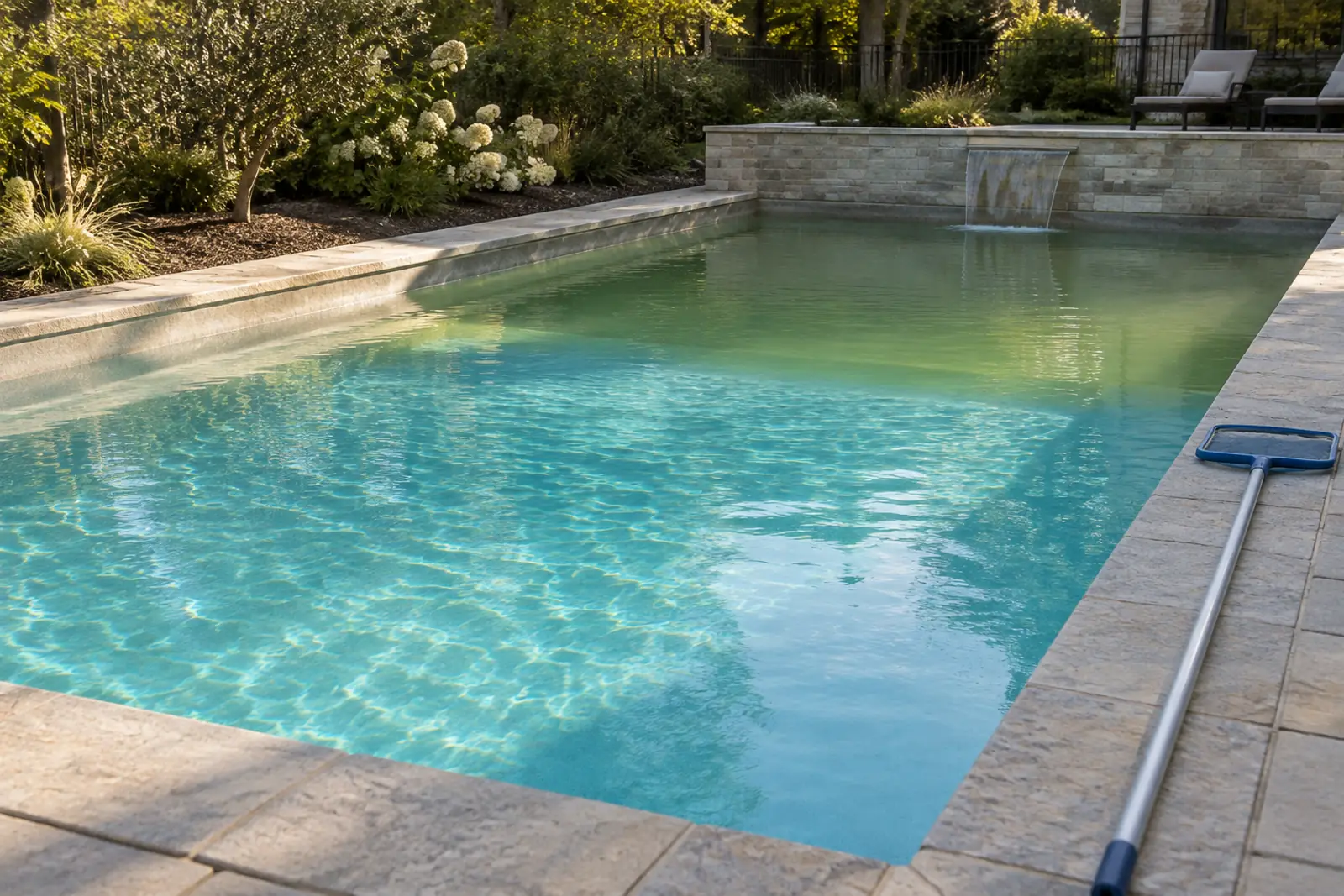
How to Get Rid of Algae in Pool Water: Identify the Type, Shock to Your CYA, Keep It Away
How to get rid of algae in pool water: name the type, brush, shock to at least one tenth of your cyanuric acid, filter nonstop and repeat daily until chlorine holds overnight.
- ✓Identify before you buyGreen, mustard, black and pink growth need different extra steps; a 2 minute vitamin C test rules out metal stains.
- ✓Shock to your stabilizerAt least CYA / 10 (2024 MAHC Annex example); the 10 ppm label maximum covers CYA up to 100 ppm.
- ✓1 to 7 days for most poolsLight green 24 to 48 hours, dark green 5 to 7 days (Beltway Pools); black algae needs a week of brushing.
Key takeaways
- Name the growth before you buy anything: green, mustard and black algae, pink slime and white water mold each need a different extra step, and pollen and metal stains are not algae at all (Natural Chemistry 2 minute vitamin C test).
- Shock to your stabilizer: hold free chlorine at or above one tenth of your cyanuric acid, the 2024 MAHC Annex 10:1 example, so the 10 ppm label maximum covers CYA up to 100 ppm.
- Chlorine kills algae but the filter removes it: the BioGuard 73 label (EPA Reg. No. 5185-515) runs the pump 24 hours after an algae dose, then cleans the filter.
- Light green clears in 24 to 48 hours and dark green in 5 to 7 days (Beltway Pools); black algae labels add daily brushing, and Leslie‘s says to keep brushing a week after the last spot.
- For a 20,000 gallon pool at 50 ppm CYA, one 10 ppm round takes about 1.41 gallons of 12.5% liquid chlorine, about $10.55 at Leslie‘s September 2026 price.
- Drain only for a reason a test can show: CYA above 100 ppm (National Plasterers Council surface warning), not for algae alone.
What type of pool algae do you have?
Four growths turn up in pools: green algae, mustard algae, black algae and pink slime or white water mold, and three lookalikes are not alive at all. The Maricopa County pool code names green, blue-green (often called black) and mustard as the three most common pool algae. Color, location, texture, a brush stroke and two tablet tests sort them in minutes.
| What it is | Color | Where it grows | Texture | Brush test | Test results | Fix page | Source |
|---|---|---|---|---|---|---|---|
| Green algae | Green tint in the water, green slime on walls | Whole pool; walls and floor; blooms fastest in warm water | Slippery, slimy | Smears and clouds green; water stays tinted | Free chlorine low, often under CDC's 1 ppm floor (2 ppm with CYA) | How to clear a green pool | BioGuard green algae; Algae Complete label 5185-513; CDC (May 2024) |
| Mustard algae | Yellow, yellow-green or brown dust | Shaded walls, corners and steps | Powdery, loose, looks like sand | Lifts into a cloud, settles back in the same shady spots within days | Chlorine can read normal: the label says it can form even with proper sanitation | Mustard algae | BioGuard mustard algae; Algae Complete label 5185-513 |
| Black algae (cyanobacteria) | Raised blue-black or dark green spots | Plaster cracks and rough patches; rare on vinyl and fiberglass | Crusty, anchored | A nylon brush barely moves it; stainless steel cracks the crust on plaster | Vitamin C tablet does not lighten it | Black algae in pool | BioGuard black algae; Maricopa County code; Natural Chemistry |
| Pink slime or white water mold (bacteria and other biofilm organisms, not algae) | Pink or orange slime; white or gray flakes like wet tissue paper | Skimmer, pump basket, behind ladders, light niches, filter, toys | Slimy, stringy; flakes float free | Wipes off, then returns to the same fittings | Chlorine reads normal or drops fast; water hazy | White water mold | No Mor Problems label 45337-11; QLF Algicide label 3432-63; WC&P (BioGuard, 2003) |
| Pollen (not algae) | Yellow or yellow-green film | Floats; rings the waterline; drifts to one corner | Fine powder | Swirls and settles; never regrows once removed | Free chlorine falls faster than usual | Pollen in pool | Swim University (April 2026); pollen guide |
| Metal stain (copper or iron, not algae) | Blue-green, teal (copper); brown or rust (iron) | Floor, steps, under fittings and returns | Flat, no texture | Does not brush off | A vitamin C tablet lightens it within 2 minutes; copper above 1.0 mg/L stains blue-green | Pool stains | Natural Chemistry; EPA secondary standards; Pinch A Penny (2022) |
| Organic stain (not algae) | Green or brown | Under leaves, acorns or worms | Flat | Does not brush off | Chlorine held on the spot lightens it; vitamin C does not | Pool stains | Pinch A Penny (2022); Natural Chemistry |
Sources: BioGuard green algae; BioGuard mustard algae; BioGuard black algae; EPA label 5185-513; Maricopa County code; EPA label 45337-11; EPA label 3432-63; Natural Chemistry; EPA secondary standards; Pinch A Penny (2022); Swim University (April 2026); CDC (May 2024). Accessed October and November 2026. Download CSV
Labels name the organisms more precisely than retail pages do. The QLF Algicide label (EPA Reg. No. 3432-63) lists Chlorella pyrenoidosa as green algae, Phormidium luridum as black algae, Lyngbya versicolor as blue-green algae and Pleurochloris meiringensis as mustard algae, plus slime producing microorganisms. Black algae is mostly bacteria: in pool samples from Mallorca, cyanobacteria made up almost 40% of the prokaryotic community (Christie-Oleza et al., 2025).
The two chlorine-tolerant types each have a full treatment page. Yellow dust that returns within days is covered, with eight labeled algaecide doses, in our mustard algae guide, and raised spots that need a stainless brush and 12 oz of Black Algaetrine per 10,000 gallons are covered in our black algae removal guide.
Pink slime and white water mold are the odd pair. The No Mor Problems label (45337-11) lists pink and white slime and pink and white water mold separately from algae, and they live in the skimmer, fittings and filter more than on the walls. Our white water mold and pink slime guide covers the plumbing treatment they need. The pink-specific steps, from a wipe test to the overnight skimmer soak, are in our pink algae in pool guide.
Two tests settle the lookalikes. A vitamin C tablet held on a flat spot for 2 minutes lightens a metal stain, according to Natural Chemistry, and chlorine held on the spot lightens an organic leaf stain, according to Pinch A Penny. Either result means no algaecide; the tests and doses are in our pool stains guide, and a yellow film that floats is covered in our guide to pollen in pool water. Small oval bugs swimming near the floor are a sign of algae too: water boatmen feed on it, as our water bugs in pool guide explains.
How do you get rid of algae in a pool, whatever the type?
Every pool algae treatment shares one spine: test, set pH, brush, shock to a target set by your cyanuric acid, run the filter 24 hours, clean it, and retest at dawn. Repeat until free chlorine holds overnight. Each type then adds one step of its own, from a mustard-labeled algaecide to a stainless brush on black spots or a plumbing soak for pink slime.
- Identify the growthUse the table above. A flat spot that lightens under vitamin C within 2 minutes is metal; stop here and treat it as a stain.
- Test free chlorine, pH and cyanuric acidCDC’s floor is 1 ppm free chlorine, or 2 ppm with cyanuric acid, at pH 7.0 to 7.8. If CYA reads above 100 ppm, partial drain first.
- Set pH to 7.2 to 7.6The BioGuard 73 and HTH Granular 73 labels use that range before an algae dose.
- Brush every surfaceStainless steel bristles on plaster and gunite only; Pentair marks them not for vinyl liner pools. Nylon on vinyl, fiberglass and pebble.
- Shock at dusk to your CYA targetAt least CYA / 10, using the 10 ppm label maximum; about 16 ppm only with the severe-bloom label 1258-1250 when the floor is hidden.
- Run the pump 24 hours, then clean the filterThe BioGuard 73 label sets 24 hours of continuous circulation. Hayward cleans sand, DE and cartridge filters at 8 to 10 psi over the clean reading.
- Retest at dawn and repeatIf free chlorine fell far below the target overnight, algae is still using it: brush, re-dose, filter another day.
- Add the type-specific stepMustard: a labeled algaecide 1 hour after the shock. Black: one labeled product and daily brushing. Pink slime: product in the skimmer with the pump off overnight.
- Swim at 4 ppm or lessMost labels bar re-entry above 4 ppm free chlorine; reopen only once the floor is visible and chlorine sits between CDC’s floor and that limit.
The full green water routine, with doses for 5,000 to 30,000 gallon pools, flocculant and vacuuming to waste, is in our guide on how to clear a green pool. Label doses for liquid chlorine, 73% and 65% cal-hypo and dichlor are in our pool shock guide.
How much chlorine kills algae at your CYA level?
Enough to stay at or above one tenth of your cyanuric acid, the example ratio in the 2024 MAHC Annex, which also notes algae may need more. With CYA at 50 ppm that floor is 5 ppm; the 10 ppm superchlorination maximum printed on chlorine labels covers every CYA level up to 100 ppm. Above 100 ppm, dilute before shocking.
| Cyanuric acid (ppm) | MAHC minimum free chlorine (ppm) | Lowry floor, 7.5% of CYA (ppm) | MAHC Annex 10:1 example (ppm) | Shock target used on our algae pages (ppm) |
|---|---|---|---|---|
| 0 | 1.0 | n/a | n/a | 10 |
| 20 | 2.0 | 1.50 | 2 | 10 |
| 30 | 2.0 | 2.25 | 3 | 10 |
| 40 | 2.0 | 3.00 | 4 | 10 |
| 50 | 2.0 | 3.75 | 5 | 10 |
| 60 | 2.0 | 4.50 | 6 | 10 |
| 70 | 2.0 | 5.25 | 7 | 10 |
| 80 | 2.0 | 6.00 | 8 | 10 |
| 90 | 2.0 | 6.75 | 9 | 10 |
| 100 | 2.0 | 7.50 | 10 | 10 |
| Above 100 | 2.0 | Above 7.50 | Above 10 | Partial drain to 100 or less first |
Sources: 2024 MAHC 5.7.3.1.1.2; 2024 MAHC Annex Table 5.7.3.1.1.2(c); Robert Lowry, Aqua Magazine (October 2015); EPA label 10897-26. Same figures as our green pool guide, accessed October 2026. Download CSV
Source: 2024 MAHC Annex Table 5.7.3.1.1.2(c); Robert Lowry, Aqua Magazine (October 2015); EPA label 10897-26.. Download chart data (CSV)
Some owner guides go higher. Trouble Free Pool sets a cleanup level near 40% of CYA, 16 ppm at 40 ppm CYA, but no EPA label we read and no MAHC section sets that level, so we use the label ceiling and the CDC test caution: a DPD test can bleach out above 10 ppm and read falsely low (CDC).
| Step | Input or formula | Result |
|---|---|---|
| Pool and test | 20,000 gallons; CYA 50 ppm; free chlorine 1 ppm | Light green, floor visible |
| Floor for the CYA level | CYA / 10 (MAHC Annex example ratio) = 50 / 10 | 5 ppm minimum |
| Target | Higher of the CYA floor and the 10 ppm label maximum for superchlorination | 10 ppm |
| Chlorine to add | 10 minus 1 | 9 ppm |
| Liquid chlorine 12.5% | 9 ppm x 10 fl oz per ppm per 10,000 gal x 2 | 180 fl oz (1.41 gal) |
| Cal-hypo 73% | 9 ppm x 1.78 oz per ppm per 10,000 gal x 2 | 32.1 oz (2.00 lb) |
| Cost, liquid | 1.41 gal x $7.50 (Leslie's 4 x 1 gal pack, $29.99, Sept 2026) | $10.55 |
| Cost, cal-hypo | 2.00 lb x $5.60 (Leslie's 25 lb bucket sale, Sept 2026) | $11.22 |
| Floor hidden instead | 16 ppm target: 15 ppm x 1.78 x 2 = 53.4 oz of 73% cal-hypo | 3.34 lb, $18.70 |
Sources: Hasachlor label 10897-26 (10 fl oz per ppm per 10,000 gal); Virginia DOH (1.3 oz per ppm); Leslie‘s and Leslie‘s listings, September 2026, tracked in our pool equipment price index. PC&S arithmetic. Download CSV
Will shock or chlorine alone get rid of algae?
Chlorine kills algae, and the 2024 MAHC Annex notes chlorine can itself be registered as an algaecide. It does not remove the dead cells: every label we read pairs the dose with brushing, 24 hours of filtration and a filter cleaning. Popular guides go wrong on the dose, from 2 to 4 ppm, which is only the everyday range, to about 36 ppm.
| What several guides say | What the label or code says | Source |
|---|---|---|
| Shock green algae with 2 lb of cal-hypo per 10,000 gal, yellow with 3 lb and black with 4 lb (about 18, 27 and 36 ppm if the product is 73%) | Superchlorination labels stop at 10 ppm (HTH Granular 73: 9 to 18 oz per 10,000 gal); only the severe-bloom label 1258-1250 goes to about 16 ppm. CDC says DPD tests can bleach out above 10 ppm | ASP (2022) vs EPA labels 1258-1239, 1258-1250; CDC |
| Shock to raise free chlorine to 2 to 4 ppm | 2 to 4 ppm is the everyday range; labels define superchlorination as 5 to 10 ppm | Frog vs EPA label 10897-26 (Hasachlor); MAHC Annex |
| Shock to 10 ppm to destroy all algae | 10 ppm holds the MAHC Annex 10:1 example only up to 100 ppm CYA; above that, drain first | Pool Operation Management vs MAHC Annex Table 5.7.3.1.1.2(c) |
| Run the pump 8 to 12 hours a day | During algae treatment the BioGuard 73 label runs the pump continuously for 24 hours after the dose | Pool Operation Management vs EPA label 5185-515 |
| Same treatment for every color of algae | Black algae labels add hard brushing and a set dose (Black Algaetrine 12 oz per 10,000 gal); pink slime labels add a plumbing soak | Labels 8959-14 and 3432-63 |
Sources: ASP (2022); Frog; Pool Operation Management; EPA label 1258-1239; EPA label 1258-1250; EPA label 10897-26; EPA label 5185-515; EPA label 8959-14; EPA label 3432-63; MAHC Annex; CDC. Accessed November 3, 2026. Download CSV
Algaecide is the add-on, not the replacement. HASA, which makes chlorine and algaecide, says a pool with enough free chlorine for its CYA level may not need a routine algaecide, and our pool algaecide guide lists 13 labels by type, dose and swim wait. Chlorine-tolerant mustard and black algae are where a labeled algaecide earns its place.
How long does it take for algae to go away in a pool?
One to seven days for most green pools, longer for black algae. Beltway Pools quotes 24 to 48 hours for light green and 5 to 7 days for dark green; Frog puts heavy mustard or black blooms at 4 to 7 days or more. Labels set the rhythm: repeat mustard doses after 2 to 4 days and brush black spots daily.
| Type | What sets the clock | Published time | Source |
|---|---|---|---|
| Green, light (floor visible) | Filter capacity and chlorine holding overnight | 24 to 48 hours | Beltway Pools; Frog (Frog also says 2 to 4 days for moderate) |
| Green, dark (floor hidden) | Repeated shock rounds plus filter cleaning | 5 to 7 days | Beltway Pools |
| Severe green with flocculant and vacuum to waste | Settling overnight, then vacuuming to waste | Within 24 hours | EPA label 1258-1250 |
| Heavy bloom, mustard or black | Repeat rounds | 4 to 7 days or longer | Frog |
| Mustard | Label repeat window | Repeat the dose after 2 to 4 days if algae persists | Algae Complete label 5185-513 |
| Black | Brushing schedule | Brush daily for 2 days after dosing; keep brushing 1 week after the last spot | Black Algaetrine label 8959-14; Leslie's |
| Pink slime or white water mold | Plumbing soak, then filtration | Pump off overnight with product in the skimmer, then 24 to 48 hours of filtering | QLF Algicide label 3432-63 |
| Any type, re-application | Label minimum wait | 72 hours before a second trichlor algae dose | Granular Trichlor 28 label 67262-39 |
Sources: Beltway Pools; Frog; EPA label 1258-1250; EPA label 5185-513; EPA label 8959-14; Leslie‘s; EPA label 3432-63; EPA label 67262-39. Accessed October and November 2026. Download CSV
Each bar is one round or one label window. Most pools need more than one round.
Source: Beltway Pools; Frog; EPA labels 1258-1250, 5185-513, 8959-14, 3432-63; Leslie's. Accessed October and November 2026.. Download chart data (CSV)
None of these times comes from a controlled test, and heat shortens the margin: BioGuard says green algae thrives above 85 F and can bloom overnight (BioGuard). Warm months are also when neglected pools turn; 81% of 3,082 green pool complaints in seven Sun Belt open-data sources arrived April to October, per our neglected green pool research.
When should you drain the pool instead of treating the algae?
Rarely for algae alone. Drain when a test shows something chlorine cannot fix: cyanuric acid above 100 ppm, which lowers active chlorine and can damage plaster, or black algae that returns to the same rough patch after two full rounds. A green tint from copper calls for a sequestrant first. A full refill of 20,000 gallons costs $39.00 to $649.98 in water charges.
| Situation | Treat in place or drain | Numbers | Source |
|---|---|---|---|
| Any algae with CYA at or under 100 ppm | Treat in place | One 10 ppm round for 20,000 gal: about $11 of chlorine | PC&S arithmetic; Leslie's Sept 2026 prices |
| CYA above 100 ppm | Partial drain, then treat | 120 to 50 ppm: replace 58.3% (11,667 of 20,000 gal), about $125 at the 25-city median water rate | PC&S cost to fill a pool study, October 2026 |
| Green or teal tint from copper | Neither: sequester the metal first | Copper above 1.0 mg/L causes blue-green staining | EPA secondary standards |
| Black algae returns to the same rough patch after two full rounds | Finish repair is the fix; draining for an acid wash or replaster is a pro job | Rough plaster gives colonies anchor points | BioGuard; black algae guide |
| Full drain and refill of 20,000 gal | Last resort | $39.00 to $649.98 in water and sewer charges, median $215.09 | PC&S cost to fill a pool study, 25 cities |
Sources: PC&S cost to fill a pool study (city rate schedules, October 2026); EPA secondary standards; National Plasterers Council; BioGuard; Leslie’s prices via our price index. Download CSV
Partial draining follows one formula: share to replace = 1 minus target / current, so 120 ppm to 50 ppm means replacing 58.3% of the water. Our cyanuric acid guide has the full drain-and-refill table, and draining a vinyl or fiberglass pool carries warranty and groundwater risks that call for a pro.
How do you keep algae from coming back?
Hold free chlorine at or above CDC’s 1 ppm floor, 2 ppm with cyanuric acid, test twice a day in hot weeks, and keep CYA at 30 to 50 ppm so that chlorine stays active. Brush the shaded walls weekly, shock weekly when water passes 80 F, clean the filter at an 8 to 10 psi rise, and clean gear that has been in a lake.
- Chlorine floor At least 1 ppm, or 2 ppm with cyanuric acid, tested at least twice a day (CDC, May 2024).
- Stabilizer band CYA 30 to 50 ppm (National Plasterers Council), never above the MAHC public pool cap of 90 ppm.
- Weekly shock in heat The BioGuard 73 label calls for weekly shocking when water is above 80 F.
- Brush the shade Mustard algae usually grows in shade and clings to walls (label 5185-513); brush corners, steps and behind ladders weekly.
- Filter on schedule Clean at 8 to 10 psi over the clean reading (Hayward); soak cartridges after any outbreak.
- Optional algaecide Polyquat 60% at 2 to 4 fl oz per 10,000 gallons every 5 to 7 days (BioGuard Algae All 60, label 5185-339, May 2026).
- Lake and ocean gear Leslie’s says black algae usually arrives on swimsuits, toys and floats from natural water; wash them before they touch the pool.
Phosphate removers are optional while chlorine holds at 1 ppm or more: CDC and the MAHC set no phosphate limit, even though lead-control tap water can carry 1,000 to 3,000 ppb, as our phosphates in pool guide explains.
Which algae fix fits your pool? Decision table and flowchart
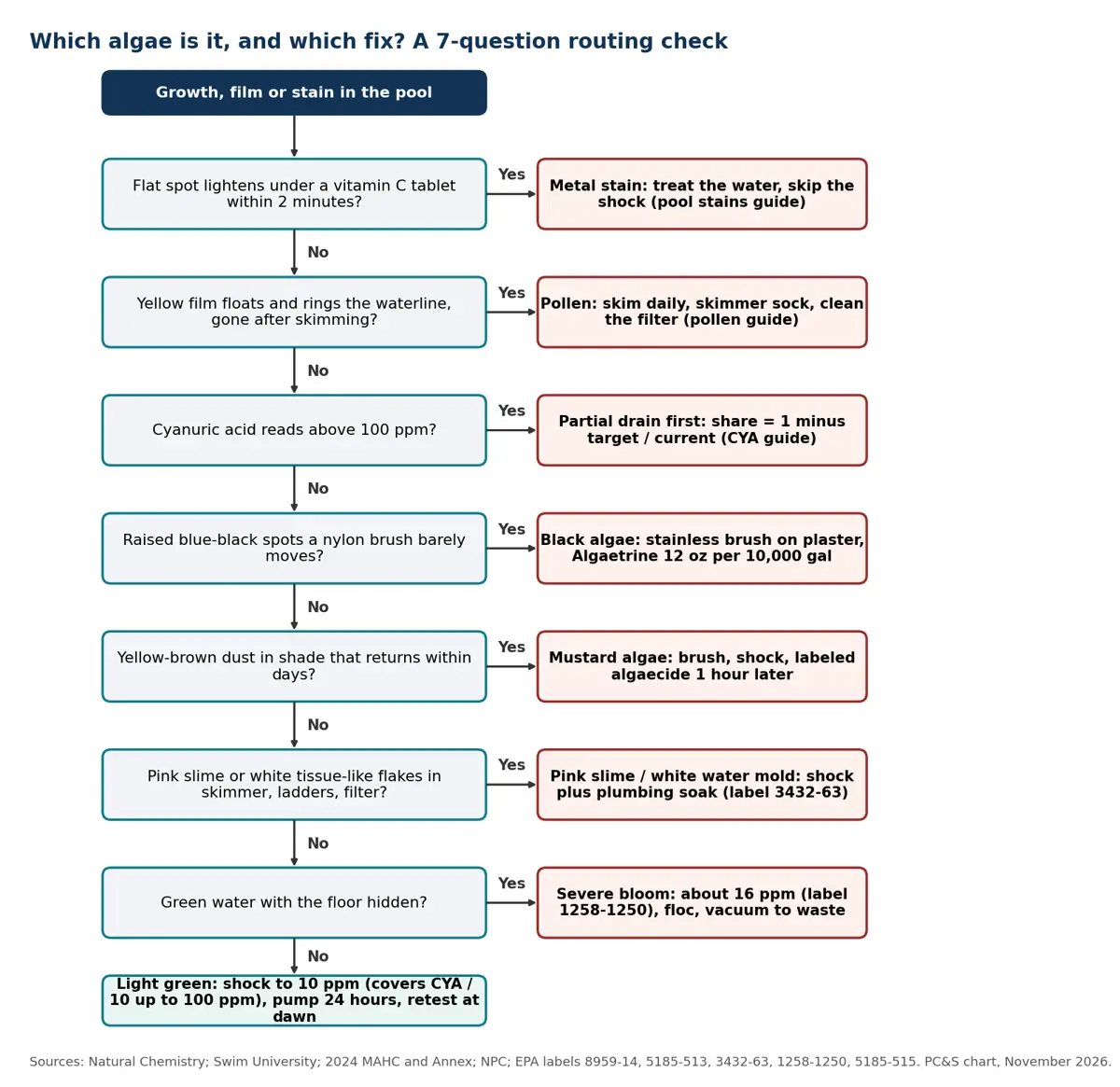
Start with the cheapest test that rules something out: vitamin C for metal, a look at the surface for pollen, a CYA reading for dilution. Then route by what you see: raised dark spots, yellow dust in shade, pink or white slime in fittings, or green water with the floor visible or hidden. Each row names the rule behind it and the page with the full steps.
| Number | What it means | Source |
|---|---|---|
| 1 ppm / 2 ppm | CDC's minimum free chlorine for home pools, without and with cyanuric acid | CDC (May 2024) |
| CYA / 10 | MAHC Annex example ratio that keeps active chlorine steady as CYA climbs | 2024 MAHC Annex Table 5.7.3.1.1.2(c) |
| 10 ppm | Top of the superchlorination range on chlorine labels | EPA labels 10897-26, 1258-1239 |
| About 16 ppm | Severe bloom dose: 2.6 lb of 52% cal-hypo per 10,000 gal | EPA label 1258-1250 |
| 24 hours | Continuous pump run after an algae dose, then clean the filter | EPA label 5185-515 |
| 8 to 10 psi | Filter pressure rise over clean that calls for backwash or cleaning | Hayward |
| 4 ppm | Most labels bar swimming above this free chlorine level | EPA labels 5185-515, 5185-441 |
| 90 / 100 ppm | MAHC cyanuric acid cap / level above which we drain before shocking | MAHC 5.7.3.1.3.2; National Plasterers Council |
Sources: CDC; MAHC Annex; MAHC Code; EPA labels 10897-26, 1258-1239, 1258-1250, 5185-515, 5185-441; Hayward; NPC. Download CSV
| If your situation is | Do this | Then read | Rule behind it |
|---|---|---|---|
| Flat stain lightens under a vitamin C tablet within 2 minutes | Treat the water for metals, not algae; skip the shock | Pool stains | Natural Chemistry; EPA copper 1.0 mg/L |
| Yellow film floats and rings the waterline | Skim daily, fit a skimmer sock, clean the filter | Pollen in pool | Swim University (April 2026) |
| Cyanuric acid reads above 100 ppm | Partial drain first: share = 1 minus target / current | Cyanuric acid pool | MAHC cap 90 ppm; NPC 100 ppm surface warning |
| Raised blue-black spots in plaster | Stainless brush, one labeled product such as Black Algaetrine at 12 oz per 10,000 gal, brush daily | Black algae in pool | EPA label 8959-14 |
| Yellow dust in shade that returns within days | Brush, shock, then an algaecide whose label lists mustard algae | Mustard algae | EPA label 5185-513 |
| Pink slime or white flakes in the skimmer and behind ladders | Shock plus a plumbing soak, clean or replace filter media, sanitize toys | White water mold | EPA label 3432-63; MAHC 5.7.2.4.3 |
| Green water, floor visible | Shock to 10 ppm, which covers CYA / 10 up to 100 ppm; pump 24 hours, retest at dawn | How to clear a green pool | MAHC Annex; EPA label 5185-515 |
| Green water, floor hidden | Severe-bloom dose (about 16 ppm), flocculant, vacuum to waste | How to clear a green pool | EPA label 1258-1250 |
| Clear water, chlorine holds overnight, algae keeps returning | Check phosphate and CYA, then add a weekly polyquat maintenance dose | Pool algaecide; Phosphates in pool | EPA label 5185-339; HASA |
Sources: Natural Chemistry; EPA; Swim University; MAHC 2024; EPA labels 8959-14, 5185-513, 3432-63, 5185-515, 1258-1250, 5185-339; HASA. Download CSV
How we compiled this
We read 11 EPA-accepted pool chemical labels from EPA’s Pesticide Product and Label System, the 2024 Model Aquatic Health Code and its Annex, CDC’s home pool guidance and three top-ranking algae guides, in October and November 2026, and reused the verified figures from nine PC&S sibling guides. Doses are quoted from labels or derived with the arithmetic shown. We ran no water tests; the clearing times are published figures, not our measurements.
Frequently Asked Questions
What is the quickest way to get rid of algae in a pool?
Shock, flocculate and vacuum to waste. The EPA label for registration 1258-1250 doses a severe bloom at 2.6 lb of 52% calcium hypochlorite per 10,000 gallons, about 16 ppm, adds flocculant, settles the pool overnight and vacuums debris to waste, and says the water can be clear blue within 24 hours. For light green, a 10 ppm shock with 24 hours of filtering usually takes 1 to 2 days.
How long does it take for algae to go away in a pool?
Usually 1 to 7 days. Beltway Pools quotes 24 to 48 hours for light green and 5 to 7 days for dark green, and Frog puts heavy mustard or black blooms at 4 to 7 days or longer. Labels add their own clocks: Algae Complete repeats after 2 to 4 days, and Leslie’s keeps brushing black algae for a week after the last spot.
Will shock get rid of algae?
Yes, if the dose matches your stabilizer and you repeat it until chlorine holds overnight. Keep free chlorine at or above one tenth of your cyanuric acid, the 2024 MAHC Annex example, using the 10 ppm label maximum. Above 100 ppm CYA, drain part of the water first. Shock alone does not remove dead algae: brush, filter 24 hours and clean the filter.
Will chlorine kill algae in a pool?
Yes. The 2024 MAHC Annex notes chlorine can be registered as an algaecide, and CDC’s floor of 1 ppm free chlorine, 2 ppm with cyanuric acid, is the everyday defense. Chlorine-tolerant types are the exception: mustard algae can form even with proper sanitation, according to the Algae Complete label (5185-513), and black algae shelters under a crust that needs brushing.
What are the types of pool algae?
Three algae plus one slime. The Maricopa County pool code names green, blue-green (often called black) and mustard algae as the most common in pools, and the QLF Algicide label (3432-63) names Chlorella, Phormidium, Lyngbya and Pleurochloris species. Pink slime and white water mold are bacteria and other biofilm organisms, listed separately on labels such as No Mor Problems (45337-11).
Should I drain my pool to get rid of algae?
Usually not. One 10 ppm round for a 20,000 gallon pool costs about $11 of liquid chlorine at Leslie’s September 2026 price, while refilling 20,000 gallons costs $39.00 to $649.98 in water charges across 25 cities. Drain part of the water when cyanuric acid reads above 100 ppm, and treat copper tint with a sequestrant before anything else.
Sources
- CDC. CDC: Home pool and hot tub water treatment and testing (page dated May 10, 2024). Accessed 2026-10-27.
- CDC. 2024 Model Aquatic Health Code, 5th edition. Accessed 2026-10-19.
- CDC. 2024 MAHC Annex, Table 5.7.3.1.1.2(c). Accessed 2026-10-27.
- Hasa label on file with U.S. EPA. Hasachlor, EPA Reg. No. 10897-26, label dated April 24, 2026. Accessed 2026-10-19.
- Innovative Water Care label on file with U.S. EPA. HTH Granular 73, EPA Reg. No. 1258-1239, label dated February 24, 2025. Accessed 2026-10-19.
- Innovative Water Care label on file with U.S. EPA. Arch 52% Calcium Hypochlorite, EPA Reg. No. 1258-1250, draft label dated July 12, 2021. Accessed 2026-10-27.
- Bio-Lab label on file with U.S. EPA. BioGuard Calcium Hypochlorite 73, EPA Reg. No. 5185-515, label dated May 21, 2024. Accessed 2026-10-27.
- Bio-Lab label on file with U.S. EPA. BioGuard Algae Complete, EPA Reg. No. 5185-513, label dated July 16, 2025. Accessed 2026-10-19.
- Bio-Lab label on file with U.S. EPA. BioGuard Algae All 60, EPA Reg. No. 5185-339, label dated May 20, 2026. Accessed 2026-11-03.
- Bio-Lab label on file with U.S. EPA. BioGuard Spot Kill, EPA Reg. No. 5185-441, label dated May 22, 2024. Accessed 2026-10-19.
- Label on file with U.S. EPA. Black Algaetrine, EPA Reg. No. 8959-14, notification accepted October 8, 2026. Accessed 2026-10-19.
- Recreational Water Products label on file with U.S. EPA. Granular Trichlor 28, EPA Reg. No. 67262-39, label dated February 12, 2025. Accessed 2026-10-27.
- N. Jonas & Co. label on file with U.S. EPA. QLF Algicide, EPA Reg. No. 3432-63, notification accepted February 2, 2012. Accessed 2026-11-03.
- United Chemical label on file with U.S. EPA. No Mor Problems, EPA Reg. No. 45337-11, master label dated March 30, 2025. Accessed 2026-11-03.
- Virginia Department of Health. Pool Operation and Maintenance Guide (2018). Accessed 2026-10-19.
- Maricopa County. Maricopa County Environmental Health Code, pool chapter. Accessed 2026-10-19.
- Elsevier. Christie-Oleza et al., Environmental Technology & Innovation (2025), abstract. Accessed 2026-10-19.
- U.S. EPA. Secondary drinking water standards. Accessed 2026-10-27.
- Natural Chemistry. Staining. Accessed 2026-10-27.
- Pinch A Penny. Pool stain identification and removal (June 6, 2022). Accessed 2026-11-02.
- BioGuard. Green algae; Yellow/mustard algae; Black algae. Accessed 2026-10-27.
- Hayward. Filter types. Accessed 2026-10-27.
- Pentair. Brush catalog. Accessed 2026-10-19.
- National Plasterers Council. Pool start-up card (rev. 03-2021). Accessed 2026-10-19.
- Horizon Commercial Pools. New thinking: chlorine and cyanuric acid in balance (Aqua Magazine, October 2015). Accessed 2026-10-27.
- Trouble Free Pool. Free chlorine and cyanuric acid relationship explained (2019). Accessed 2026-10-27.
- HASA. When and why to use algaecides. Accessed 2026-11-01.
- Beltway Pools. Green pool after opening. Accessed 2026-10-27.
- Frog. How to get rid of pool algae fast. Accessed 2026-11-03.
- ASP. Pool algae and how to kill any type (2022). Accessed 2026-11-03.
- Pool Operation Management. Tips to effectively deal with algae blooms. Accessed 2026-11-03.
- Leslie's. How to treat black algae. Accessed 2026-10-19.
- Swim University. Pollen in pool (updated April 13, 2026). Accessed 2026-11-02.
- Leslie's via PC&S price index. Leslie's chlorine listings (Wayback captures July to September 2026). Accessed 2026-10-27.
- PC&S research. Cost to fill a pool (25 cities, October 2026). Accessed 2026-10-27.
- PC&S research. Neglected green pools (open data). Accessed 2026-10-27.
Related pages
Get Quotes From Licensed Local Pool Pros
Tell us what you need and your ZIP code. We match you with pool companies that cover your area.