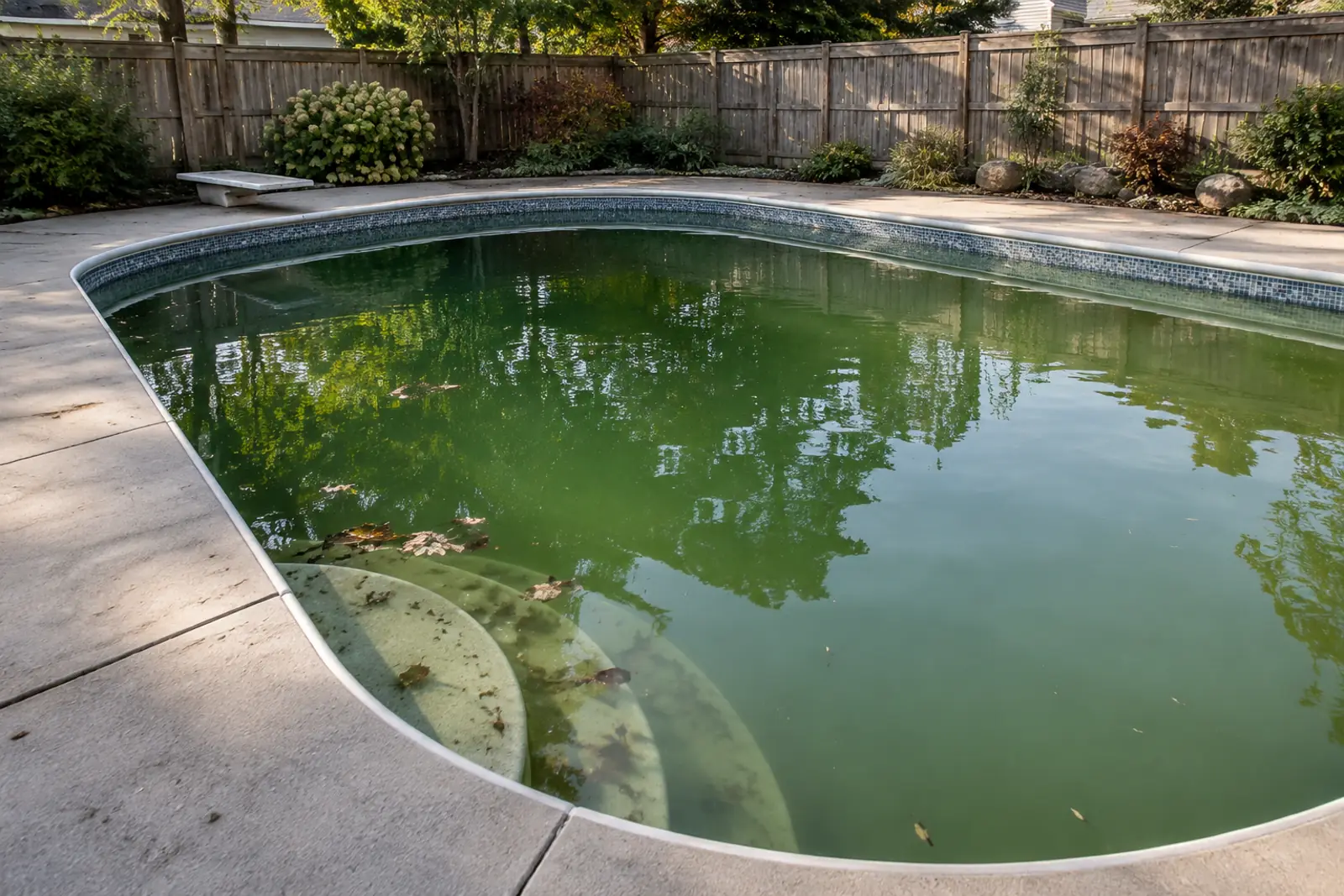
How to Clear a Green Pool: Diagnose It, Dose to Your CYA, Filter It Out
How to clear a green pool: brush it, raise free chlorine to 10 ppm (about 16 ppm if the floor is hidden), run the filter nonstop and retest daily until chlorine holds overnight.
- ✓Shock to your stabilizerThe 10 ppm label maximum holds the MAHC Annex 10:1 example ratio up to 100 ppm cyanuric acid; above that, partial drain first.
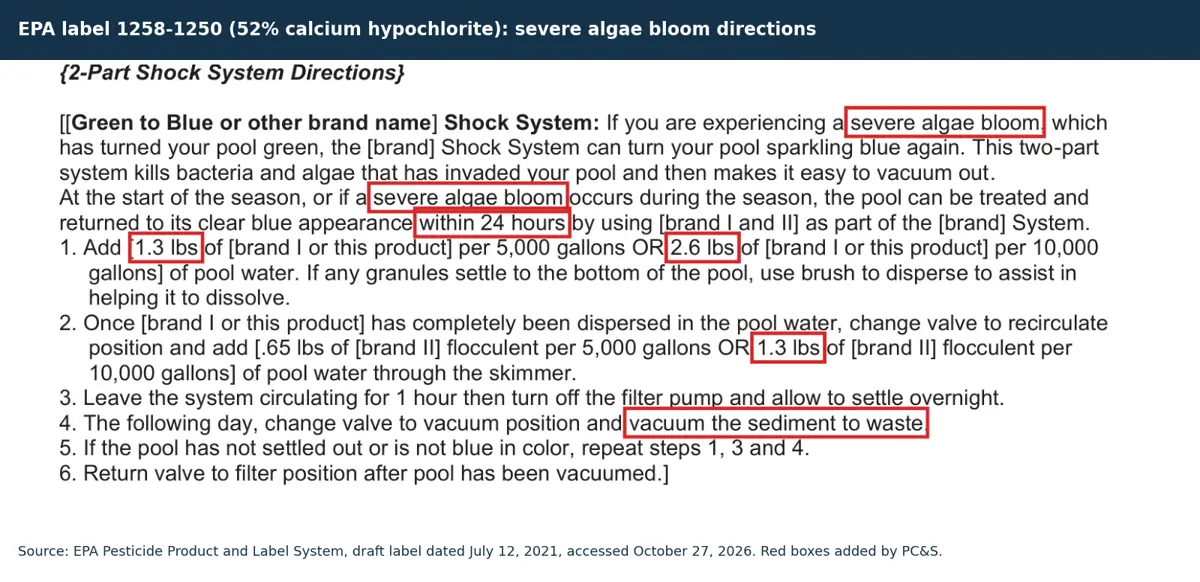
- ✓Hidden floor, bigger doseEPA label 1258-1250 doses a severe bloom at 2.6 lb of 52% cal-hypo per 10,000 gallons, about 16 ppm, then floc and vacuum to waste.
- ✓Expect 1 to 7 daysThe 1258-1250 label says 24 hours with floc; a pool company quotes 24 to 48 hours for light green and 5 to 7 days for dark green.
Key takeaways
- A green pool is usually algae, but clear water with a green or teal tint after a shock points to dissolved copper: EPA’s secondary drinking water standard ties copper above 1.0 mg/L to blue-green staining (EPA).
- Shock to your stabilizer level: labels set superchlorination at 5 to 10 ppm free chlorine, and the 2024 MAHC Annex example ratio of 10:1 means a 10 ppm dose covers cyanuric acid up to 100 ppm (MAHC Annex Table 5.7.3.1.1.2(c)).
- For a bloom you cannot see through, the EPA-accepted label for registration 1258-1250 calls for 2.6 lb of 52% calcium hypochlorite per 10,000 gallons, about 16 ppm by PC&S arithmetic, then flocculant and vacuuming to waste (EPA label 1258-1250).
- Run the pump continuously for 24 hours after an algae dose and then clean the filter, as the BioGuard Calcium Hypochlorite 73 label (5185-515) directs; Hayward cleans sand, DE and cartridge filters at 8 to 10 psi over the clean reading.
- One neglected pool can produce up to 3 million mosquitoes in a month, according to the Greater Los Angeles County Vector Control District.
- Chlorine for one round in a 20,000 gallon pool costs about $12 to $36 at Leslie’s 2026 listed prices; pool companies list green pool recovery at $150 to $400 (Ocala Pool Care, 2026).
Why is my pool green: algae or metals?
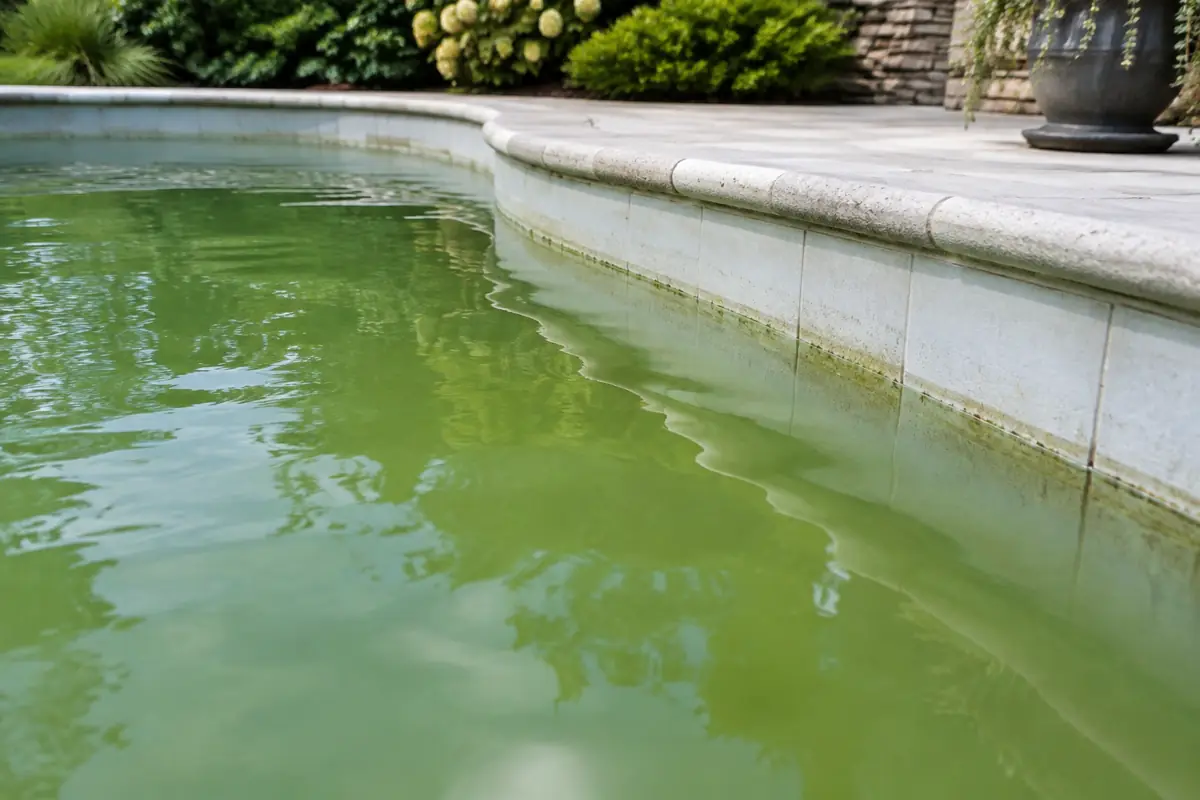
Most green pools are algae: low free chlorine, warm water and slow circulation let a bloom take over, and BioGuard says green algae thrives above 85 F and can bloom overnight. Metals are the other cause. Copper and iron tint water green, teal or brown, often right after a shock raises pH, and more chlorine does not fix them.
| What you see | Quick test | Likely cause | What to do | Source |
|---|---|---|---|---|
| Green and cloudy water, slick walls | Free chlorine near 0; brushing raises a green cloud | Green algae bloom | Shock and filter in rounds (steps below) | BioGuard; CDC 1 ppm minimum |
| Dark green water, floor and main drain not visible | Same, plus you cannot see the bottom | Severe algae bloom | Severe-bloom label dose, flocculant, vacuum to waste | EPA label 1258-1250 |
| Clear water with a green, teal or blue-green tint, often right after a shock | Copper test reads above 0; the tint does not brush off | Dissolved copper | Stop shocking; test copper; use a metal sequestrant | EPA secondary standard: copper above 1.0 mg/L causes blue-green staining; BioGuard |
| Brown, rust or red-brown tint | Iron test reads above 0 | Dissolved iron, often from well water | Same as copper: sequestrant, not more chlorine | EPA secondary standard: iron above 0.3 mg/L causes reddish or orange staining; Natural Chemistry |
| Flat green or brown stain on the floor | A vitamin C tablet held on it for 2 minutes lightens it | Metal stain | Metal stain treatment, not algaecide | Natural Chemistry |
| Yellow dust in shady spots that returns after brushing | Brushes into a cloud and settles back | Mustard algae | Mustard algae method | PC&S mustard algae guide |
| Raised blue-black spots in plaster | A nylon brush barely moves them | Black algae (cyanobacteria) | Black algae method | PC&S black algae guide |
| Test reads 0 right after a big shock | Dilute the sample 1:1 with tap water and retest | Test bleached out above 10 ppm | Add nothing until the diluted test reads | CDC (2024) |
Sources: EPA secondary drinking water standards (page updated May 2026); BioGuard metal staining; BioGuard green algae; Natural Chemistry staining guide; EPA label 1258-1250; CDC (May 2024). Accessed October 2026. Download CSV
The tint test matters because shocking a metal problem makes it worse. BioGuard says a change in water balance, usually a rise in pH or the application of a shock product, can make dissolved metals insoluble so they drop onto the pool surface as stains, with iron and copper the two most common (BioGuard). Natural Chemistry adds that metals often arrive in fill water, especially well water, and that a stain which lightens under a vitamin C tablet within 2 minutes is metal (Natural Chemistry).
Yellow dust in the shade and raised blue-black spots in plaster are different organisms with their own label products and brushing rules, covered in our mustard algae guide and our black algae removal guide. To tell all seven growths and lookalikes apart by color, brush test and test result, use our pool algae identification table.
Will chlorine alone clear a green pool?
Chlorine kills the algae but does not remove it. Every EPA label we read pairs the algae dose with work: brush before dosing, run the pump for 24 hours, then backwash or clean the filter and vacuum what settles. The six label doses below run from about 4 ppm to about 16 ppm of free chlorine.
| Product (EPA Reg. No.) | Active ingredient | Algae dose on the label | Free chlorine it adds (PC&S arithmetic) | What the label says to do with it | Label date |
|---|---|---|---|---|---|
| Arch 52% Calcium Hypochlorite, Green to Blue shock system (1258-1250) | Calcium hypochlorite 52% | 2.6 lb per 10,000 gal (1.3 lb per 5,000 gal) for a severe bloom | About 16.2 ppm | Add flocculant, circulate 1 hour, settle overnight, vacuum to waste; repeat if not blue | Draft label dated July 12, 2021 |
| BioGuard Calcium Hypochlorite 73 (5185-515) | Calcium hypochlorite 73% | 1 lb per 16,500 gal | About 5.3 ppm | Brush first; pump on continuously for 24 hours; then backwash or clean the filter; repeat if algae persists | May 21, 2024 |
| Scorch (3432-76) | Calcium hypochlorite 68% (65% available chlorine) | 1 oz per 500 gal | About 9.7 ppm | Scrub the algae, vacuum, cycle through the filter; repeat if necessary | September 22, 2025 |
| HTH Granular 73 (1258-1239) | Calcium hypochlorite 73% | 9 to 18 oz per 10,000 gal (superchlorination) | 5 to 10 ppm (label figure) | Label: visible algae may need additional shock treatments | February 24, 2025 |
| Hasachlor 12.5% liquid chlorine (10897-26) | Sodium hypochlorite 12.5% | 50 to 100 fl oz per 10,000 gal (superchlorination) | 5 to 10 ppm (label figure) | Product degrades with age, sunlight and heat; test and increase the dose as necessary | April 24, 2026 |
| Granular Trichlor 28, sold as Clorox Pool&Spa Goodbye Green Shock (67262-39) | Trichlor 43.47% (40% available chlorine) | 1 lb per 12,000 gal | About 4.0 ppm, plus about 2.4 ppm cyanuric acid | Brush; dose where algae is heaviest; pump 24 hours; brush again; re-apply after 72 hours if needed | February 12, 2025 |
Sources: EPA-accepted labels on the EPA Pesticide Product and Label System: 1258-1250, 5185-515, 3432-76, 1258-1239, 10897-26, 67262-39; PubChem molecular weights. Free chlorine and cyanuric acid figures are PC&S arithmetic. Accessed October 2026. Download CSV
Two patterns stand out. The doses span a fourfold range, from about 4 ppm to about 16 ppm, and the strongest is the only one written for water that has already turned green. The trichlor product, sold under a green-pool name, also adds about 2.4 ppm of stabilizer with every pound per 12,000 gallons; our cyanuric acid guide shows how that builds up and how to bring it down.
How much chlorine does a green pool need at your CYA level?
Enough to stay at or above one tenth of your cyanuric acid. The 2024 MAHC Annex shows active chlorine holding steady at a fixed CYA to free chlorine ratio and says algae may need more chlorine or a lower ratio. The 10 ppm label maximum covers a 10:1 ratio up to 100 ppm CYA; above that, dilute first.
| Cyanuric acid (ppm) | MAHC minimum free chlorine (ppm) | MAHC 45:1 hazard line (ppm) | Lowry maintenance floor, 7.5% of CYA (ppm) | MAHC Annex 10:1 example (ppm) | Light green target used here (ppm) | Floor not visible target used here (ppm) |
|---|---|---|---|---|---|---|
| 0 | 1.0 | n/a | n/a | n/a | 10 | 16 |
| 20 | 2.0 | 0.44 | 1.50 | 2 | 10 | 16 |
| 30 | 2.0 | 0.67 | 2.25 | 3 | 10 | 16 |
| 40 | 2.0 | 0.89 | 3.00 | 4 | 10 | 16 |
| 50 | 2.0 | 1.11 | 3.75 | 5 | 10 | 16 |
| 60 | 2.0 | 1.33 | 4.50 | 6 | 10 | 16 |
| 70 | 2.0 | 1.56 | 5.25 | 7 | 10 | 16 |
| 80 | 2.0 | 1.78 | 6.00 | 8 | 10 | 16 |
| 90 | 2.0 | 2.00 | 6.75 | 9 | 10 | 16 |
| 100 | 2.0 | 2.22 | 7.50 | 10 | 10 | 16 |
| Above 100 | 2.0 | Above 2.22 | Above 7.50 | Above 10 | Drain to 100 or less first | Drain to 100 or less first |
Sources: 2024 MAHC 5.7.3.1.1.2 and 6.6.3.1; 2024 MAHC Annex Table 5.7.3.1.1.2(c); Robert Lowry in Aqua Magazine, October 2015; HTH Granular 73 label; label 1258-1250. Ratio columns are PC&S arithmetic. Accessed October 2026. Download CSV
x axis is cyanuric acid in ppm. Above 100 ppm CYA the 10:1 example needs more than the 10 ppm label maximum, so dilute first.
Source: CDC 2024 Model Aquatic Health Code 6.6.3.1 and Annex Table 5.7.3.1.1.2(c); Robert Lowry in Aqua Magazine, October 2015; EPA labels Hasachlor 10897-26 and HTH Granular 73 1258-1239. Accessed October 2026. Download chart data (CSV)
The 7.5% column comes from chemical consultant Robert Lowry, who argued in Aqua Magazine (October 2015, reprinted by Horizon Commercial Pools) that free chlorine should be 7.5% of the CYA level to kill algae faster than it grows, with CYA ideally no higher than 50 ppm. It is a maintenance floor, not a shock dose. The 45:1 column is the only ratio written into the 2024 MAHC, where section 6.6.3.1 lists it as an imminent health hazard at public pools.
Some pool owner guides go much higher. Trouble Free Pool’s chart sets a cleanup level of about 40% of CYA, 16 ppm at 40 ppm CYA and 24 ppm at 60 ppm (Trouble Free Pool, January 2019). No EPA label we read and no section of the MAHC sets that level, and the MAHC Annex says peer-reviewed data on algae control is lacking. The highest label dose we found for green water is about 16 ppm, on registration 1258-1250.
How much shock to clear a green pool, by pool size
For light green water with the floor visible, dose to 10 ppm: 100 fl oz of 12.5% liquid chlorine or 18.29 oz of 73% calcium hypochlorite per 10,000 gallons. For water you cannot see into, the 1258-1250 severe-bloom rate is 2.6 lb of 52% cal-hypo per 10,000 gallons, about 16 ppm, or about 1.85 lb of 73% product.
| Pool size (gal) | Light green, 10 ppm: 12.5% liquid chlorine | Light green, 10 ppm: 73% cal-hypo | Floor not visible, about 16 ppm: 52% cal-hypo (label rate) | Floor not visible, about 16 ppm: 73% cal-hypo (PC&S equivalent) |
|---|---|---|---|---|
| 5,000 | 50 fl oz (0.39 gal) | 9.15 oz (0.57 lb) | 1.3 lb | 0.93 lb |
| 10,000 | 100 fl oz (0.78 gal) | 18.29 oz (1.14 lb) | 2.6 lb | 1.85 lb |
| 15,000 | 150 fl oz (1.17 gal) | 27.44 oz (1.71 lb) | 3.9 lb | 2.78 lb |
| 20,000 | 200 fl oz (1.56 gal) | 36.59 oz (2.29 lb) | 5.2 lb | 3.70 lb |
| 25,000 | 250 fl oz (1.95 gal) | 45.73 oz (2.86 lb) | 6.5 lb | 4.63 lb |
| 30,000 | 300 fl oz (2.34 gal) | 54.88 oz (3.43 lb) | 7.8 lb | 5.56 lb |
Sources: Hasachlor dosage chart (10897-26); HTH Granular 73 chart (1258-1239); label 1258-1250 severe bloom rate. Columns other than those printed on each label are scaled by PC&S; the 73% severe column is PC&S arithmetic (2.6 x 0.52 / 0.73). Accessed October 2026. Download CSV
Gallons come from length x width x average depth x 7.5 for rectangles, the formula printed on the Hasachlor label; our pool shock guide lists label doses for dichlor and other strengths. Liquid chlorine weakens in storage: the Hasachlor label says it degrades with age, sunlight and heat, and Leslie’s lists its jugs at 10 to 12.5% available chlorine, so a 10% jug needs 125 fl oz per 10,000 gallons for the same 10 ppm.
No liquid chlorine label we read prints a pool dose above 10 ppm. With liquid chlorine, treat a severe bloom as repeated 10 ppm doses, testing before each one, rather than one large pour.
| Step | Value | Basis |
|---|---|---|
| Pool and readings | 20,000 gal; floor not visible; cyanuric acid 50 ppm; free chlorine 0 | Example |
| Ratio check | 50 / 10 = 5 ppm minimum; the severe-bloom rate is well above it | MAHC Annex 10:1 example |
| Severe-bloom dose, 52% cal-hypo | 2.6 lb x 2 = 5.2 lb | EPA label 1258-1250 |
| Same chlorine from 73% cal-hypo | 5.2 x 0.52 / 0.73 = 3.70 lb | PC&S arithmetic |
| Free chlorine added | 3.70 x 0.73 x 1,000,000 / (20,000 x 8.34) = 16.2 ppm | Water weighs 8.34 lb per gallon |
| Cost from a 25 lb bucket | 3.70 lb x $5.60 = $20.72 | Leslie's, $139.99 sale price for 25 lb, September 2026 |
| Cost from 1 lb bags | 4 bags x $8.99 = $35.96 | Leslie's listing, July 2026 |
| Light green instead, liquid chlorine to 10 ppm | 200 fl oz = 1.56 gal x $7.50 = $11.71 | Leslie's 4 x 1 gal for $29.99, September 2026 |
| If it takes three severe rounds | 3 x $20.72 = $62.16 | Scenario; labels say repeat as needed |
| Pool company green recovery | $150 to $400 | Ocala Pool Care, Ocala, FL, 2026 |
Sources: EPA label 1258-1250; MAHC Annex; Leslie’s 25 lb listing (Sept 2026); Leslie’s 1 lb listing (July 2026); Leslie’s liquid chlorine 4-pack (Sept 2026); Ocala Pool Care. Arithmetic by PC&S. Download CSV
The prices are Leslie’s online listings captured by the Wayback Machine and tracked in our pool equipment and chemical price index. A 25 lb bucket cut the per-pound price from $8.99 to $5.60 at the September 2026 sale price.
How to clear a green pool, step by step
Work in rounds of about 24 hours: fix circulation, test, brush, dose at dusk, filter nonstop, then test again the next morning. Each step carries the label or maker figure behind it. Most pools need more than one round, and every algae label we read says to repeat the treatment if algae persists.
- Get the water moving firstEmpty the skimmer and pump baskets and run the pump. Maricopa County Environmental Services says a pool will not breed mosquitoes, even while green, if the pump runs several hours each day.
- Write down the clean filter pressureRead the gauge right after the filter is clean. Hayward backwashes or cleans sand, DE and cartridge filters at 8 to 10 psi over that starting value, and a green cleanup gets there fast.
- Test free chlorine, pH and cyanuric acidCDC’s floors are 1 ppm free chlorine, or 2 ppm with cyanuric acid, at pH 7.0 to 7.8. If CYA reads above 100 ppm, partial drain before you shock.
- Set pH to 7.2 to 7.6The BioGuard 73 algae directions and the HTH Granular 73 label both use 7.2 to 7.6, and the 98507-2 dichlor label says adjust pH first, not at the same time as chlorinating.
- Brush every surfaceThe BioGuard 73 and 67262-39 algae directions both start with brushing. Use a brush suited to your surface; vinyl, fiberglass and colored plaster bleach under undissolved granules.
- Dose at dusk with the pump runningUse the dose table. BioGuard 73 says apply when the pool is not in use, preferably at night, broadcast over the deep end, and brush any undissolved product off bleachable surfaces.
- Run the pump continuously for 24 hoursThen backwash or clean the filter, as the BioGuard 73 label directs. Dead algae loads the filter quickly, so read the gauge every morning.
- Test the next morning and repeatIf free chlorine fell far below your target overnight, algae is still using it: brush, re-dose and filter another day. The 67262-39 label allows a re-application after 72 hours.
- Vacuum what settlesWhen the water turns blue-gray and debris settles, vacuum it. The 1258-1250 label sends flocculated debris to waste so it bypasses the filter.
- Swim at 4 ppm or less, with the floor visibleMost labels bar re-entry above 4 ppm, and the 2024 MAHC treats a pool whose bottom is not visible as an imminent health hazard.
Timing that last step, anywhere from about an hour to several days depending on sun and stabilizer, is covered with exact label wording in our guide on how long after shocking a pool you can swim.
Rather hand the green pool to a pro?
How long does it take to clear a green pool?
Plan on 1 to 7 days. The 1258-1250 label says a severe bloom can be clear blue within 24 hours when shock, flocculant and vacuuming to waste are used together. A pool company quotes 24 to 48 hours for light green and 5 to 7 days for dark green, and the filter sets much of the pace.
| Source | Type | Time stated | Conditions |
|---|---|---|---|
| EPA label 1258-1250 (52% cal-hypo) | EPA-accepted label | Within 24 hours | Severe bloom; shock, flocculant, settle overnight, vacuum to waste |
| BioGuard Calcium Hypochlorite 73 (5185-515) | EPA-accepted label | 24 hours per round | Pump continuously 24 hours, then clean the filter; repeat if algae persists |
| Granular Trichlor 28 (67262-39) | EPA-accepted label | 72 hours before a re-application | Pump 24 hours after each dose |
| Beltway Pools | Pool company article | 24 to 48 hours | Light or hazy green |
| Beltway Pools | Pool company article | 5 to 7 days | Dark green or floor not visible |
| Swim University | Pool care publisher | 48 to 72 hours | Pool opened to green water |
| HTH Pools | Manufacturer guide | Within 24 hours | Claim for its own 2-step product system |
Sources: EPA label 1258-1250; EPA label 5185-515; EPA label 67262-39; Beltway Pools; Swim University (updated April 2026); HTH Pools. Accessed October 2026. Download CSV
Source: EPA label 1258-1250 (draft dated July 12, 2021); Beltway Pools; Swim University. Accessed October 2026. Download chart data (CSV)
None of these times comes from a controlled test. The 2024 MAHC Annex says there are few published data on chlorine demand, and a green pool’s demand depends on how much algae, debris and nutrient it holds, so the morning test, not the calendar, says when a round is done. Hot weeks need closer watching: BioGuard notes green algae thrives above 85 F and can bloom overnight.
How long should you run the filter, and how often should you clean it?
Run the filter 24 hours a day until the water is clear and chlorine holds overnight; the BioGuard 73 algae directions require 24 hours of continuous circulation after each dose. Clean or backwash whenever the gauge reads 8 to 10 psi over the clean starting pressure, Hayward’s trigger for sand, DE and cartridge filters, which during a cleanup can mean daily.
| Filter type | Smallest particles captured (Hayward) | Clean or backwash at | Green-pool note | Source |
|---|---|---|---|---|
| Sand | 20 to 40 microns | 8 to 10 psi over the clean reading | Backwash often; vacuum settled dead algae to waste instead of through the sand | Hayward (2023 article); EPA label 1258-1250 |
| DE | 3 to 5 microns | 8 to 10 psi over the clean reading | Finest filtration; backwash and recoat with fresh DE each time | Hayward (2023 article) |
| Cartridge | 10 to 20 microns | 8 to 10 psi over the starting value (7 to 10 psi on SwimClear) | No backwash; hose off the cartridges every time the trigger is hit | Hayward (2023 article); Hayward SwimClear manual |
Sources: Hayward, What are the Differences Between Filter Types? (May 2023); Hayward SwimClear manual; EPA label 1258-1250; EPA label 5185-515. Accessed October 2026. Download CSV
Hayward rates DE at 3 to 5 microns against 20 to 40 for sand, which is why a sand filter passes fine dead algae back into a pool that looks clear one hour and cloudy the next. Backwash steps, run times and where the waste water may go are in our guide on how to backwash a pool filter. Vacuuming to waste, which the 1258-1250 label uses for flocculated debris, skips the filter but lowers the water level, so top up as you go. Floc chemistry, pH windows and filter cautions for that step are in our pool flocculant guide.
When is draining cheaper than clearing a green pool?
Rarely, on chemicals alone. A severe round in a 20,000 gallon pool takes about $21 of 73% cal-hypo at Leslie’s September 2026 bucket price, while refilling 20,000 gallons costs $39.00 to $649.98 in water and sewer charges across 25 cities. Draining wins when cyanuric acid sits far above 100 ppm, when metals cause the color, or when debris fills the pool.
| Option (20,000 gal pool) | What it costs | What it fixes | Source |
|---|---|---|---|
| Treat it yourself, one severe round | $20.72 to $35.96 | Algae | Leslie's listings, July and September 2026; PC&S arithmetic |
| Treat it yourself, three severe rounds | $62.16 | Algae, slow cases | Same; scenario |
| Pool company green recovery | $150 to $400; from $395 flat; $150 to $300 per visit | Algae, with the labor | Ocala Pool Care (Ocala, FL); Pearlin Pools (Brevard County, FL); Noah's Pool Service (Fort Worth, TX), 2026 |
| Drain and refill yourself, water only | $39.00 to $649.98 (median $215.09) | Algae, high cyanuric acid, metals, debris | PC&S 25 city fill cost study, October 2026 rates |
| Professional drain plus refill | $400 to $450 ($180 to $230 drain, $220 refill at $55 per 5,000 gal) | Same | Angi (2026) |
| Partial drain, cyanuric acid 120 to 50 ppm | 58.3% of the water, 11,667 gal, about $125 at the median rate | High cyanuric acid | Dilution arithmetic; PC&S fill cost study |
Sources: Leslie’s (Sept 2026); Leslie’s (July 2026); Ocala Pool Care; Pearlin Pools; Noah’s Pool Service; PC&S cost to fill a pool study; Angi (2026). Arithmetic by PC&S. Download CSV
Source: Leslie's listings (Wayback captures July and September 2026); PC&S cost to fill a pool study, October 2026 rates; Ocala Pool Care 2026; Angi 2026. PC&S arithmetic. Download chart data (CSV)
Draining has risks the cost table leaves out. Our guide on how to drain a pool covers groundwater, fiberglass and vinyl rules and where the water may go, and our cost to fill a pool study gives the refill price for 25 cities at October 2026 rates. Before any drain, the BioGuard 73 label tells owners to contact the local sanitary sewer and storm drain authorities and follow their discharge instructions.
If you hire it out, ask which product and EPA Reg. No. the company will use, whether the price covers more than one visit, whether filter cleaning is included and what chlorine reading it reopens at. Pearlin Pools in Brevard County, Florida lists green pool recovery from $395 flat, and Ocala Pool Care puts one-time cleanups and green recovery at $150 to $400.
Is a green pool a mosquito problem, and who do you call?
Yes. A neglected pool is standing water, and the Greater Los Angeles County Vector Control District says one can produce up to 3 million mosquitoes in a month. CDC says a Culex egg becomes an adult in 7 to 10 days, so a pool left green for more than a week can already be breeding them. County vector control districts take reports and can help.
- Pump first: Maricopa County says a pool will not breed mosquitoes if the pump runs several hours each day, even when the water is green or low on chlorine (Maricopa County Environmental Services).
- Free fish: Maricopa County gives out mosquitofish (Gambusia) at no charge when a pump is broken and says 15 of them can clean a pool full of larvae.
- Scale: Maricopa County received about 9,500 mosquito or green pool complaints in 2021, the year it recorded 1,487 human West Nile virus cases (CDC MMWR, April 2023).
- Season: across 3,082 complaints in seven Sun Belt open-data sources, 81% arrived April to October, according to our neglected green pool complaint research.
Can you swim in a green pool?
No. Under the 2024 MAHC, a public pool whose bottom is not visible is an imminent health hazard that can be closed on the spot, and every chlorine label we read bars re-entry while chlorine is above 4 ppm (1.0 to 3.0 ppm on Scorch). A green pool fails the first test before treatment and the second during it.
What should you do at your test result?
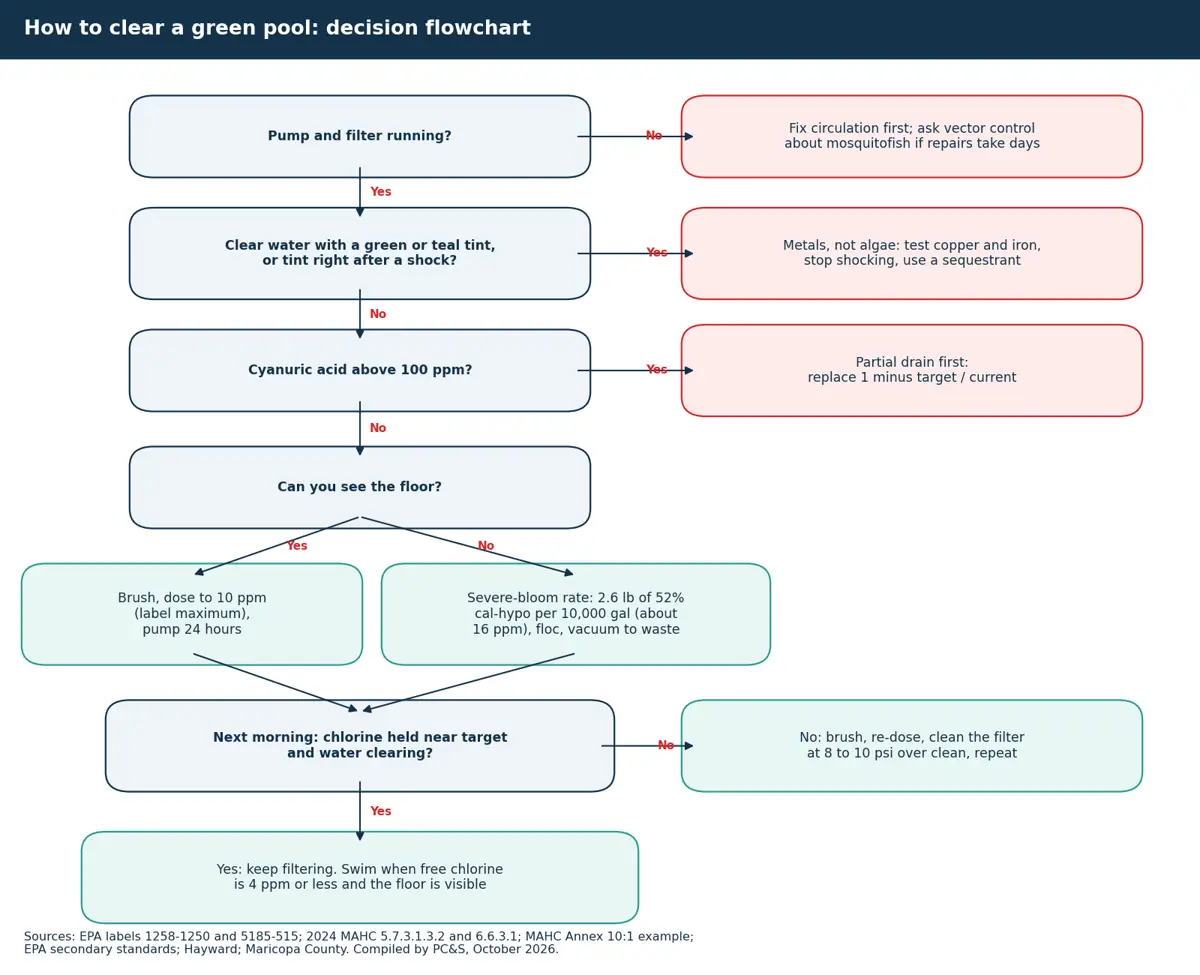
Match what you see and what the test says to a row. The table turns the label doses, the MAHC ratio and hazard lines, the copper and iron staining thresholds and the filter pressure trigger into if-then steps, and the flowchart under it holds the same logic for quick use at the pool.
| Key number | Value | Applies to | Source |
|---|---|---|---|
| Light green shock target | 10 ppm free chlorine | Floor visible | Hasachlor and HTH Granular 73 labels |
| Severe-bloom label rate | 2.6 lb of 52% cal-hypo per 10,000 gal (about 16 ppm) | Floor not visible | EPA label 1258-1250; PC&S arithmetic |
| Ratio example | Free chlorine at least CYA / 10 | Pools with cyanuric acid | 2024 MAHC Annex Table 5.7.3.1.1.2(c) |
| Cyanuric acid cap | 90 ppm | Public pools | 2024 MAHC 5.7.3.1.3.2 |
| Hazard ratio | CYA to free chlorine above 45:1 | Public pools | 2024 MAHC 6.6.3.1 |
| Pump after an algae dose | 24 hours, continuously | Cal-hypo algae directions | EPA label 5185-515 |
| Filter cleaning trigger | 8 to 10 psi over the clean reading | Sand, DE and cartridge filters | Hayward |
| Copper staining threshold | 1.0 mg/L (blue-green staining) | Drinking water secondary standard | EPA |
| Mosquito egg to adult | 7 to 10 days | Culex mosquitoes | CDC |
| Swim again | 4 ppm or less, floor visible | Home pools | EPA labels; 2024 MAHC 6.6.3.1 |
Sources: EPA labels 10897-26, 1258-1239, 1258-1250, 5185-515; 2024 MAHC; MAHC Annex; Hayward; EPA secondary standards; CDC. Accessed October 2026. Download CSV
| If your situation is | Do this | Source |
|---|---|---|
| Pump or filter not running | Fix circulation before dosing; ask county vector control about mosquitofish if repairs take days | Maricopa County Environmental Services |
| Clear water with a green or teal tint, or a tint that appeared right after a shock | Test copper and iron; stop shocking; use a metal sequestrant | EPA secondary standards; BioGuard |
| A flat stain lightens under a vitamin C tablet within 2 minutes | Treat it as a metal stain, not algae | Natural Chemistry |
| Cyanuric acid above 100 ppm | Partial drain first: replace 1 minus target / current of the water | MAHC 5.7.3.1.3.2 (90 ppm cap); MAHC Annex 10:1 example |
| Green, but you can see the floor | Brush, dose to 10 ppm, pump 24 hours, clean the filter | Hasachlor and HTH Granular 73 labels; BioGuard 73 label |
| You cannot see the floor | Severe-bloom rate: 2.6 lb of 52% cal-hypo per 10,000 gal, flocculant, vacuum to waste | EPA label 1258-1250 |
| Test reads 0 right after a big dose | Dilute 1:1 with tap water and retest; add nothing yet | CDC (2024) |
| Free chlorine fell far below the target overnight | Algae is still active: brush, re-dose, filter another 24 hours | BioGuard 73 and 67262-39 labels |
| Filter gauge 8 to 10 psi over the clean reading | Backwash or clean the filter now | Hayward |
| Yellow dust or blue-black spots remain after the water clears | Switch to the mustard or black algae method | PC&S algae guides |
| Water clear, free chlorine 1 to 4 ppm, floor visible | Swim; go back to testing twice a day | EPA labels; CDC; MAHC 6.6.3.1 |
Sources: 2024 MAHC; MAHC Annex; CDC (2024); EPA secondary standards; BioGuard; Natural Chemistry; Hayward; Maricopa County; EPA labels 1258-1250, 5185-515, 67262-39. Accessed October 2026. Download CSV
How we compiled this
We read 7 EPA-accepted pool chemical labels from the EPA Pesticide Product and Label System, the 2024 Model Aquatic Health Code and its Annex, CDC’s home pool and Culex mosquito pages, a 2023 CDC MMWR report, EPA’s secondary drinking water standards, two vector control agency pages, two Hayward filter documents and dated price pages from Leslie’s, Angi and three pool companies, all accessed in October 2026. Doses for unprinted pool sizes, ppm figures and costs are PC&S arithmetic. We did not test water or products; consumer guides appear only where we compare published times and dose levels, and forum threads were excluded as a source of facts.
Frequently Asked Questions
What is the fastest way to clear up a green pool?
Shock, floc and vacuum to waste. The EPA-accepted label for registration 1258-1250 doses a severe bloom at 2.6 lb of 52% calcium hypochlorite per 10,000 gallons, adds flocculant, settles the pool overnight and vacuums the debris to waste, and says the pool can be clear blue within 24 hours. Shocking alone usually takes longer, because the filter has to catch every dead cell.
Will chlorine alone clear a green pool?
It kills the algae but rarely clears the water by itself. Every algae direction we read pairs the chlorine with brushing, 24 hours of filtration and filter cleaning or vacuuming. The BioGuard Calcium Hypochlorite 73 label, for example, says brush first, run the pump continuously for 24 hours, then backwash or clean the filter and repeat if algae persists.
Will shocking a pool get rid of green algae?
Yes, if the dose matches your stabilizer and you repeat it until chlorine holds overnight. Label doses for green water run from about 4 ppm to about 16 ppm free chlorine. With cyanuric acid at 50 ppm, the MAHC Annex 10:1 example points to at least 5 ppm, and above 100 ppm CYA even the 10 ppm label maximum falls short.
Can green pool water be saved?
Almost always, without draining. Draining pays off mainly when cyanuric acid sits far above 100 ppm, when metals cause the color or when debris fills the pool. One severe round in a 20,000 gallon pool costs about $21 to $36 of cal-hypo at Leslie’s 2026 prices, while refill water alone runs $39 to $650 depending on the city.
How long does a green pool take to clear?
Usually 1 to 7 days. The 1258-1250 label says clear blue within 24 hours with shock, flocculant and vacuuming to waste. Beltway Pools quotes 24 to 48 hours for light green and 5 to 7 days for dark green, and Swim University says 48 to 72 hours for a pool opened green. A small or dirty filter slows every method.
Why is my pool still green after shocking?
Three common reasons: the dose was too small for the cyanuric acid level, dead algae is still in the water or the filter, or the color comes from metal, not algae. Clear water with a green or teal tint after a shock points to copper, which EPA links to blue-green staining above 1.0 mg/L in drinking water. Test copper before adding more chlorine.
Sources
- Innovative Water Care label on file with U.S. EPA (Pesticide Product and Label System). Arch 52% Calcium Hypochlorite, EPA Reg. No. 1258-1250, draft label dated July 12, 2021. Accessed 2026-10-27.
- Bio-Lab label on file with U.S. EPA. BioGuard Calcium Hypochlorite 73, EPA Reg. No. 5185-515, label dated May 21, 2024. Accessed 2026-10-27.
- N. Jonas & Co. label on file with U.S. EPA. Scorch, EPA Reg. No. 3432-76, label notification September 22, 2025. Accessed 2026-10-27.
- Innovative Water Care label on file with U.S. EPA. HTH Granular 73, EPA Reg. No. 1258-1239, label file dated February 24, 2025. Accessed 2026-10-27.
- Hasa label on file with U.S. EPA. Hasachlor, EPA Reg. No. 10897-26, label notification April 24, 2026. Accessed 2026-10-27.
- Recreational Water Products label on file with U.S. EPA. Granular Trichlor 28, EPA Reg. No. 67262-39, label dated February 12, 2025. Accessed 2026-10-27.
- Swimables label on file with U.S. EPA. Dichlor Chlorinating Granules, EPA Reg. No. 98507-2, registration issued December 8, 2025. Accessed 2026-10-27.
- U.S. Environmental Protection Agency (EPA). Pesticide Product and Label System, product name search 'GREEN' (October 27, 2026). Accessed 2026-10-27.
- Centers for Disease Control and Prevention (CDC). 2024 Model Aquatic Health Code, 5th Edition, Code Language. Accessed 2026-10-27.
- Centers for Disease Control and Prevention (CDC). 2024 Model Aquatic Health Code, 5th Edition, Annex. Accessed 2026-10-27.
- Centers for Disease Control and Prevention (CDC). Home Pool and Hot Tub Water Treatment and Testing (page dated May 10, 2024). Accessed 2026-10-27.
- U.S. Environmental Protection Agency (EPA). Secondary Drinking Water Standards: Guidance for Nuisance Chemicals (updated May 26, 2026). Accessed 2026-10-27.
- National Library of Medicine, PubChem. PubChem compound records: cyanuric acid (CID 7956), trichloroisocyanuric acid (CID 6909). Accessed 2026-10-27.
- Horizon Commercial Pools reprint of Aqua Magazine. New Thinking: Chlorine/Cyanuric Acid in Balance (Aqua Magazine, October 2015, reprinted April 17, 2018). Accessed 2026-10-27.
- Trouble Free Pool (pool owner community site; guide claim only). The Free Chlorine and Cyanuric Acid Relationship (January 18, 2019). Accessed 2026-10-27.
- BioGuard (manufacturer). Metal Staining. Accessed 2026-10-27.
- BioGuard (manufacturer). Green Algae. Accessed 2026-10-27.
- Natural Chemistry (manufacturer). Staining: Problems and Solutions. Accessed 2026-10-27.
- Hayward (manufacturer). What are the Differences Between Filter Types? (May 22, 2023). Accessed 2026-10-27.
- Hayward (manufacturer). SwimClear Cartridge Filter Owner's Manual ISC2031EF Rev B. Accessed 2026-10-27.
- Beltway Pools (pool company). Green Pool After Opening? Clear It Fast Without Draining. Accessed 2026-10-27.
- Swim University (pool care publisher). How to Clear a Green Pool After Opening (updated April 27, 2026). Accessed 2026-10-27.
- HTH Pools (manufacturer guide). How to Turn Green Pool Water Blue: Pool Opening Guide. Accessed 2026-10-27.
- Leslie's (retail listing) via PC&S research: /research/pool-equipment-prices/. Leslie's 1 lb Power Powder Plus 73% Calcium Hypochlorite Pool Shock (Wayback capture July 19, 2026). Accessed 2026-10-27.
- Leslie's (retail listing) via PC&S research: /research/pool-equipment-prices/. Leslie's 25 lb Power Powder Plus Calcium Hypochlorite Pool Shock (Wayback capture September 16, 2026). Accessed 2026-10-27.
- Leslie's (retail listing) via PC&S research: /research/pool-equipment-prices/. Pool Liquid Chlorine 4-Pack of 1 Gallon Bottles (Wayback capture September 22, 2026). Accessed 2026-10-27.
- Pearlin Pools (pool company). Pool Service Cost in Brevard County FL (2026 price list). Accessed 2026-10-27.
- Ocala Pool Care (pool company). Weekly Pool Service Cost in Ocala, FL (2026 Pricing Guide). Accessed 2026-10-27.
- Noah's Pool Service (pool company). Weekly Pool Service Cost in Fort Worth. Accessed 2026-10-27.
- Angi (via Wayback Machine). How Much Do Swimming Pool Repairs Cost? (2026 capture). Accessed 2026-10-27.
- PC&S research (city water and sewer rate schedules). Cost to Fill a Pool: 25 US Cities, 2026 Rates. Accessed 2026-10-27.
- Greater Los Angeles County Vector Control District. Mosquitoes in Pools. Accessed 2026-10-27.
- Centers for Disease Control and Prevention (CDC). Life Cycle of Culex Mosquitoes (page dated September 3, 2025). Accessed 2026-10-27.
- Maricopa County Environmental Services Department. Green pools and mosquito control bulletin. Accessed 2026-10-27.
- CDC, Morbidity and Mortality Weekly Report. West Nile Virus outbreak, Maricopa County, Arizona, 2021 (MMWR 72(17), April 28, 2023). Accessed 2026-10-27.
- PC&S research (city and county open data). Neglected Pool Complaints by City, 2017 to 2026. Accessed 2026-10-27.
Related pages
Get Quotes From Licensed Local Pool Pros
Tell us what you need and your ZIP code. We match you with pool companies that cover your area.