
Water Bugs in Pool Water: Identify Water Boatmen, Backswimmers and 6 Others, Then Get Rid of Them
Water bugs in pool water are usually water boatmen, which eat algae and never bite, and backswimmers, which hunt them and can bite: remove the algae, net the bugs and turn off lights at night.
- ✓Check the swimming positionBelly-up means backswimmer, the one that bites (Missouri Department of Conservation).
- ✓Starve them outBoatmen feed on algae in the pool, traps and filters; backswimmers feed on boatmen (LSU AgCenter).
- ✓Lights draw them inBoth fly to artificial lights at night and land in pools (MDC).
Key takeaways
- Water boatmen swim right side up, have dark crosslines on a flat back and do not bite people; backswimmers swim belly-up and can deliver a painful bite if handled, per the Missouri Department of Conservation field guide. Both are usually under 1/2 inch.
- The two are a food chain: water boatmen feed on algae in the pool, especially in the traps, filters and drains, and backswimmers feed on the boatmen, according to the LSU AgCenter. Remove the algae and both leave.
- Water boatmen, backswimmers and giant water bugs all fly to artificial lights at night and land in pools after those flights (MDC), so lights off and a cover at night cut new arrivals.
- Giant water bugs reach 2.5 inches and their bite is described as more painful than any other insect bite or sting, though short-lived (Mississippi State Extension, 2024). Lift them out with a net.
- Mosquito larvae mean the pool has stopped working: a Culex egg becomes a biting adult in 7 to 10 days (CDC), so restore chlorine and circulation the same day.
What are the water bugs in my pool?
Eight insects account for nearly every water bug in pool water: water boatmen, backswimmers, giant water bugs, whirligig beetles, water striders, springtails, mosquito larvae and, on the deck, the oriental cockroach that people call a water bug. Size, swimming position and where it sits in the water identify each one in a few seconds, before you buy any chemical.
| Insect | Size (adult) | How it moves | Bites people? | Why it is in the pool | Fix | Source |
|---|---|---|---|---|---|---|
| Water boatman (Corixidae) | Usually under 1/2 in | Swims right side up, flat back with dark crosslines, clings near the bottom | No | Flies in at night toward lights; eats algae and detritus in traps, filters and drains | Remove the algae; net the adults | MDC; LSU AgCenter |
| Backswimmer (Notonectidae) | Usually under 1/2 in | Swims belly-up; rests at the surface tilted head-down | Yes, painful if handled | Flies in at night toward lights; hunts water boatmen and other insects | Remove the boatmen it eats; net, never grab | MDC; LSU AgCenter |
| Giant water bug, toe-biter (Belostomatidae) | Up to 2 to 2.5 in | Flat brown oval body, grabbing front legs; sits still on the floor | Yes, very painful | Flies at night toward lights ('electric light bug') | Net it out; lights off | MDC; Mississippi State Extension |
| Whirligig beetle (Gyrinidae) | About 1/4 to 3/4 in | Shiny black beetle spinning in circles on the surface | Not reported in the sources | Flies in; eats insects that fall on the water | Skim; fewer drowning insects | MDC |
| Water strider (Gerridae) | 1/2 to 3/4 in (body) | Skates on the surface film on long legs | No ('harmless') | Hunts land insects trapped on the surface | Skim; keep the surface clear | MDC |
| Springtail (Collembola) | About 1/16 in | Specks that jump; coat the surface after drowning | No | Moves from drying soil and mulch toward moisture | Filter and skim; cut mulch at the pool edge | UC IPM Pest Notes 74136 |
| Mosquito larva (Culex) | Small wriggling larvae | Hangs under the surface, wriggles down when disturbed | Larvae no; adult females bite | Eggs laid on unmaintained pools; egg to adult in 7 to 10 days | Restore chlorine and circulation; empty cover water | CDC |
| Oriental cockroach ('water bug') | About 1 in | Dark, greasy-looking roach on the deck or in drains, not a swimmer | No | Lives in damp, dark drains and crawl spaces | Structural pest control, not pool chemistry | Penn State Extension |
Sources: MDC water boatmen, backswimmers, giant water bugs, whirligig beetles, water striders; LSU AgCenter; Mississippi State Extension; UC IPM Pest Notes 74136; CDC; Penn State Extension. Accessed November 9, 2026. Download CSV
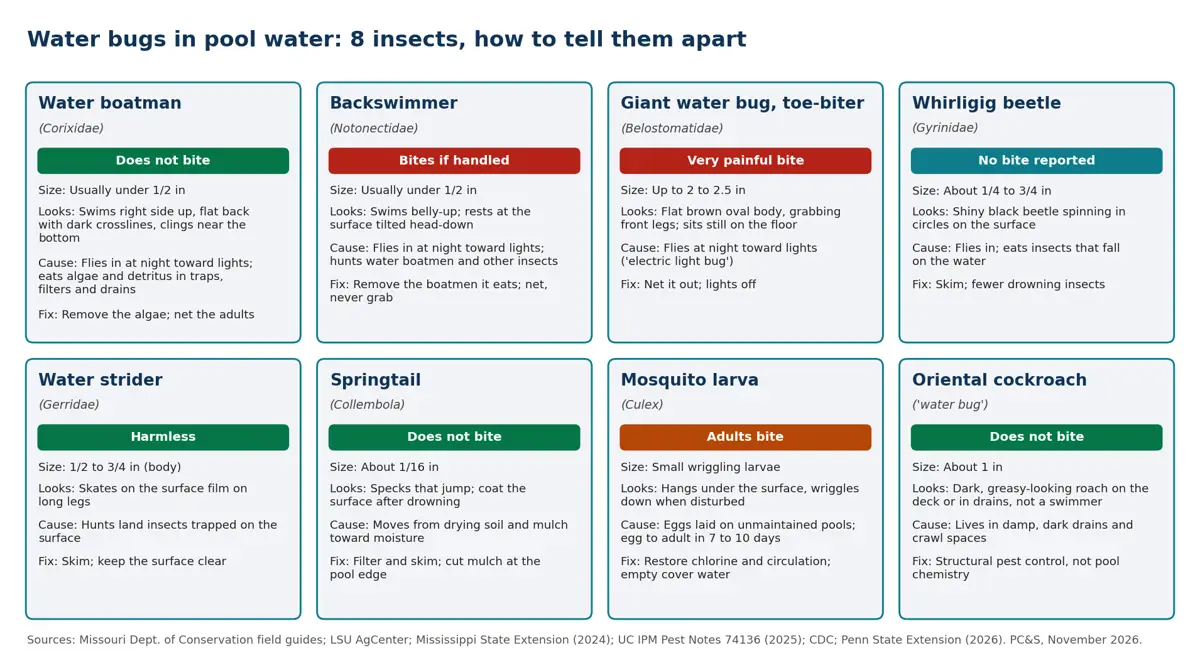
Swimming position is the fastest test. MDC notes that in the United Kingdom backswimmers are also called water boatmen, which is why bite reports get pinned on the harmless insect; the family names Corixidae (water boatmen) and Notonectidae (backswimmers) avoid that mix-up. A bug lying on its back at the surface with its tail tip out of the water is a backswimmer (MDC).
Source: Missouri Dept. of Conservation; Mississippi State Extension (2024); UC IPM Pest Notes 74136 (2025); Penn State Extension (2026). Accessed November 9, 2026.. Download chart data (CSV)
Size separates the rest. Anything 1 to 2.5 inches, flat and brown with grabbing front legs is a giant water bug, which MDC says people find in swimming pools after night flights. Specks about 1/16 inch that jump are springtails, which UC IPM says will not bite or harm people or pets (UC IPM Pest Notes 74136, August 2025).
Water boatmen or backswimmers: which one bites?
Backswimmers bite; water boatmen do not. MDC calls water boatmen one of the few aquatic true bugs that are not predaceous and do not bite people, while backswimmers are predators that deliver a painful bite if mishandled. LSU AgCenter describes the backswimmer bite as a nasty, stinging sensation. Six physical features tell them apart.
| Feature | Water boatman | Backswimmer | Source |
|---|---|---|---|
| Family | Corixidae, about 125 North American species | Notonectidae, about 32 North American species | MDC |
| Swimming position | Back up (right side up) | Belly up (on its back) | MDC |
| Back | Flattened, darker, narrow parallel crosslines | Keeled like a boat bottom, often lighter, no crosslines | MDC |
| Front feet | Scoop-shaped, one segment | Not scoop-shaped | MDC |
| At rest | Clings to an object underwater | At the surface, head down, abdomen tip out of the water | MDC |
| Food | Algae, other plants, detritus | Other insects, including water boatmen | MDC; LSU AgCenter |
| Bite | Does not bite people | Painful bite if mishandled, a 'nasty, stinging sensation' | MDC; LSU AgCenter |
| What removes it | Taking away the algae in walls, traps and filters | Taking away the water boatmen | LSU AgCenter |
Sources: MDC water boatmen; MDC backswimmers; LSU AgCenter pool pests. Accessed November 9, 2026. Download CSV
A backswimmer bite happens when a swimmer traps one against skin or picks it up. Use a leaf net, not a hand, and never let a child catch the bugs; giant water bugs are worse, and Mississippi State Extension says biologists and children are among the most common bite victims, with pain that is short-lived and no long-term adverse effects (MSU Extension).
Why do I have water bugs in my pool?
Because the pool offers food or light. Water boatmen eat algae and detritus, so a film in the skimmer, filter or shaded corners feeds them; backswimmers follow the boatmen. Most of these insects are strong fliers drawn to artificial lights at night, so a lit, uncovered pool collects them by morning. Mosquitoes breed only in water that has stopped circulating. Thin red wrigglers on the floor are not insects you net from the surface but midge larvae, which our guide to worms in pool water identifies.
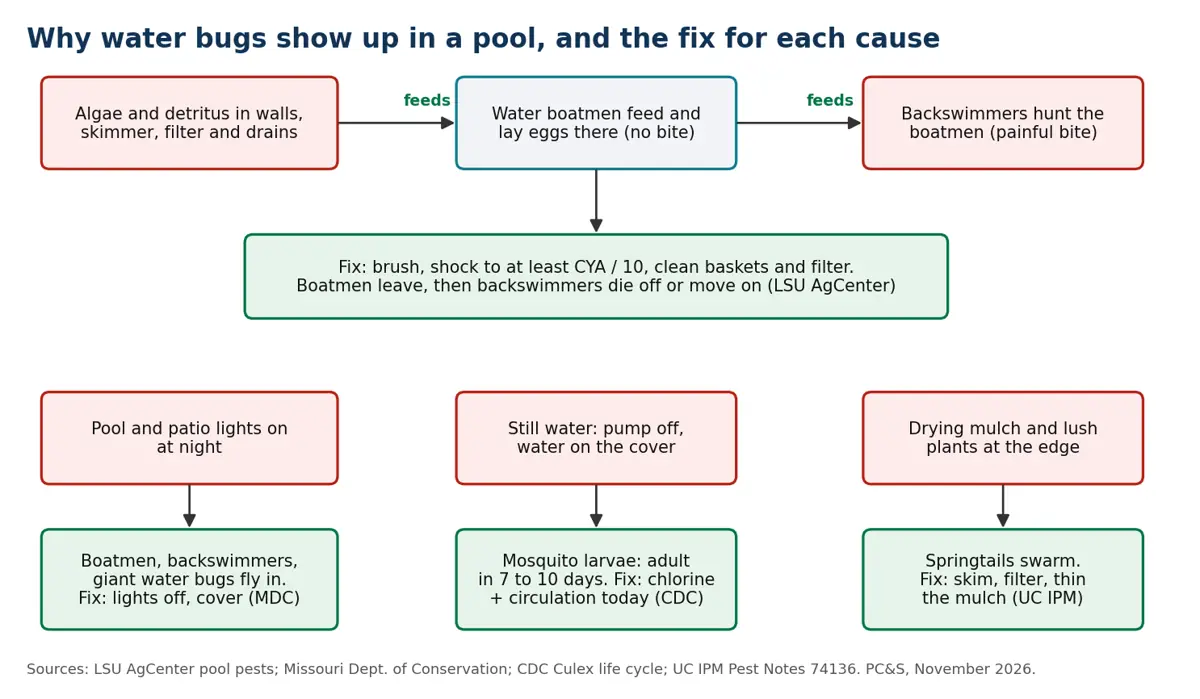
The algae link is the one most owners miss. LSU AgCenter says the water boatman feeds on algae and vegetation particularly in the traps, filters and drains, and lays its eggs there, so a pool can look clear while the skimmer throat and filter carry the food. Our guide to getting rid of algae in a pool sorts green, mustard and black growth and the dose each one needs.
Still water draws a different visitor. In 31 neglected pools in Bakersfield, researchers collected immature mosquitoes that produced 8,978 adults from February to August 2008 (Reisen et al., Emerging Infectious Diseases), and our neglected green pool research tracks the complaints cities log each summer. Water sitting on a solid cover counts as still water too.
How do you get rid of water bugs in a pool?
Take away their food, then their way in. Net out the adults, test the water, brush and shock if algae shows, clean the skimmer and filter, and hold free chlorine at CDC’s 2 ppm floor or one tenth of your stabilizer, whichever is higher. Then cut the night lights. Water boatmen leave first; backswimmers die off or move on once the boatmen are gone (LSU AgCenter).
- Net the adultsSkim with a fine leaf net and dump the catch in a bucket of water with a layer of oil, the method LSU AgCenter gives. Do not handle backswimmers or giant water bugs.
- Test free chlorine, pH and cyanuric acidCDC’s floor is 1 ppm free chlorine, 2 ppm with cyanuric acid, at pH 7.0 to 7.8; test at least twice a day while you treat.
- Brush walls, steps and cornersBrush before every dose so loosened algae meets the chlorine; LSU AgCenter pairs every shock with a scrub.
- Raise chlorine, or shock if algae showsEveryday target: at least CYA / 10. With visible algae, shock to the 10 ppm label maximum: 10 fl oz of 12.5% liquid chlorine per 10,000 gallons per 1 ppm (label 10897-26).
- Clean the skimmer basket, pump basket and filterThese are where boatmen feed and lay eggs (LSU AgCenter). Backwash sand or DE, or hose and soak a cartridge.
- Run the pump through the nightCirculation pushes chlorine through the traps and lines and keeps mosquito larvae from settling.
- Turn off lights and cover the pool at nightWater boatmen, backswimmers and giant water bugs fly to artificial lights after dark (MDC).
- Swim at 4 ppm or lessThe Hasachlor label bars entry above 4 ppm free chlorine; retest before anyone gets in.
| Step | Input or formula | Result |
|---|---|---|
| Pool and test | 20,000 gallons; cyanuric acid (CYA) 40 ppm; free chlorine 0.5 ppm; water boatmen on the floor | Chlorine below CDC's 2 ppm floor with CYA |
| Everyday target | Higher of CDC's 2 ppm floor and CYA / 10 (MAHC Annex example ratio) = 40 / 10 | 4 ppm, also the label swim limit |
| Raise to the everyday target | (4 minus 0.5) ppm x 10 fl oz per ppm per 10,000 gal x 2 | 70 fl oz (0.55 gal) of 12.5% liquid chlorine |
| Cost | 0.55 gal x $7.50 per gal (Leslie's 4 x 1 gal, $29.99, Sept 2026) | $4.10 |
| Visible algae instead: shock | (10 minus 0.5) ppm x 10 fl oz x 2, using the 10 ppm label maximum | 190 fl oz (1.48 gal) |
| Cost of the shock | 1.48 gal x $7.50 | $11.13 |
| Swim again | Hasachlor label 10897-26 bars entry above 4 ppm | Wait until free chlorine is 4 ppm or less |
Sources: EPA label 10897-26; CDC, May 2024; 2024 MAHC Annex; Leslie’s, Sept 2026. PC&S arithmetic, November 2026. Download CSV
Dose arithmetic for cal-hypo and dichlor, and how much stabilizer each adds, is in our pool shock guide. The basket and throat that hold the boatmen’s food are diagrammed in our pool skimmer guide, and filter cleaning by type is in how to clean a pool filter.
What kills water bugs in a pool fast?
A net kills the adults you can see today; chlorine and brushing kill what keeps them there. Adult boatmen and backswimmers carry a silvery air bubble that lets them stay underwater (MDC), and they fly, so chemistry alone will not empty the pool overnight. LSU AgCenter’s fix is shock several times, scrub after each shock, fish out the bugs and kill them in water with oil.
Skip the shortcuts. We found no extension or university source that recommends adding dish soap to pool water, and the claim circulates only on forums and retail blogs. Insecticides are a legal question as well as a safety one: EPA says every pesticide label carries the line “It is a violation of Federal law to use this product in a manner inconsistent with its labeling”, so a product whose label does not list pool water does not belong in it (EPA).
How do you keep water bugs out of a pool?
Keep the pool without food, light or still water. Hold free chlorine at or above CDC’s floor, brush and clean the filter so algae never settles in the traps, run the pump daily, switch off pool and patio lights after swimming, cover the pool at night, keep water off the cover and thin mulch and dense plants at the edge.
- Chlorine floor At least 1 ppm, or 2 ppm with cyanuric acid, tested at least twice a day (CDC, May 2024).
- Algae-free traps Empty the skimmer and pump baskets weekly and clean the filter on schedule; boatmen feed there (LSU AgCenter).
- Lights off after swimming Boatmen, backswimmers and giant water bugs fly to artificial lights at night (MDC).
- Cover at night Most visitors arrive after night flights (MDC); a cover keeps them off the water.
- No standing water on the cover Culex goes from egg to adult in 7 to 10 days (CDC).
- Edge of the deck Limit lush plants and mulch at the pool edge to cut springtail swarms (UC IPM).
- Auto-fill and fountains LSU AgCenter suggests a chlorine tablet in an automatic water refiller so algae cannot grow there.
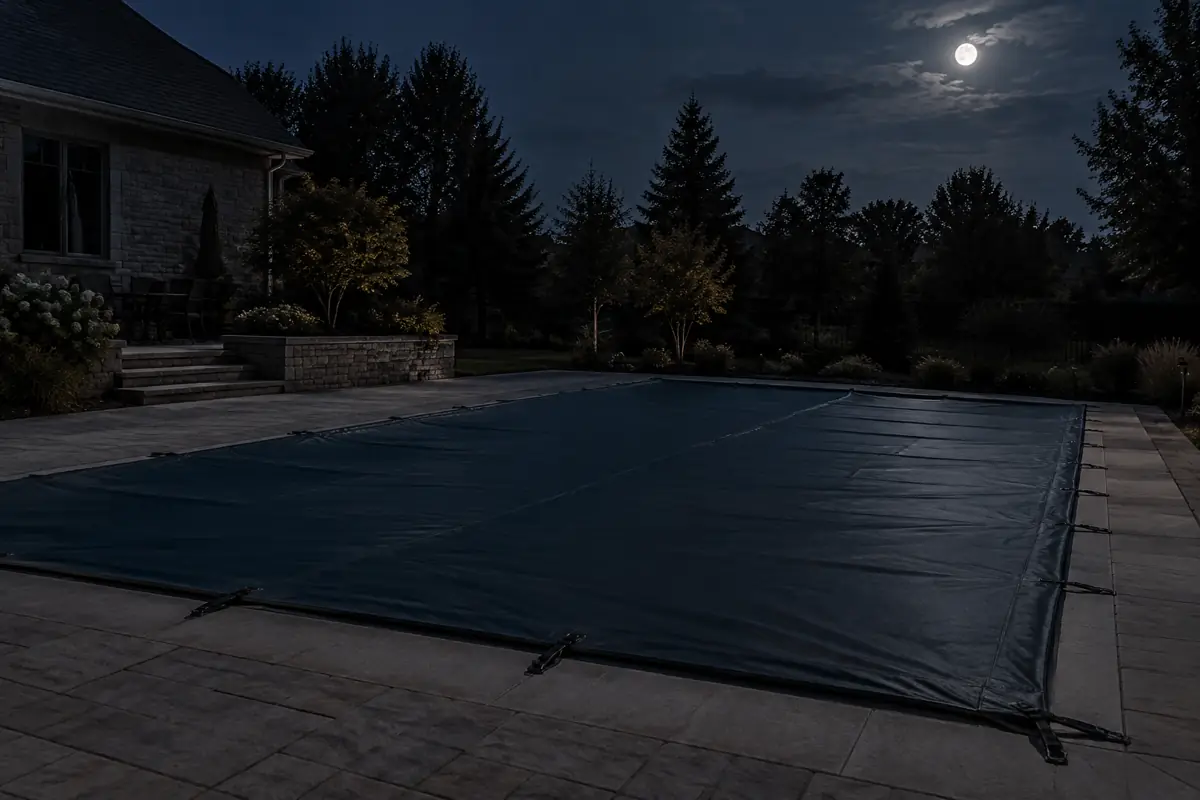
Cover type matters for the still-water rule. A mesh cover drains rain through, while a solid cover holds a puddle that needs a pump; our mesh vs solid pool cover comparison lays out the trade. Light schedules, LED fixtures and running costs are compared in our pool lighting guide.
Which fix fits the water bugs you see?
Match what you see to a row. Bugs on the floor point to algae, bugs on their backs point to boatmen for them to eat, jumping specks point to mulch, wriggling larvae point to a pool that stopped circulating, and fresh bugs in clear water every morning point to lights. The rows below give the rule and the source behind each move.
| Number | What it means | Source |
|---|---|---|
| Under 1/2 in | Usual adult length of water boatmen and backswimmers | MDC field guide |
| Up to 2.5 in | Adult giant water bug (toe-biter), the largest pool visitor | Mississippi State Extension, 2024 |
| About 1/16 in | Springtail length; they jump and coat the surface | UC IPM Pest Notes 74136, Aug 2025 |
| 7 to 10 days | Culex mosquito egg to adult in an unmaintained pool | CDC |
| 2 ppm | CDC minimum free chlorine in a pool that uses cyanuric acid | CDC, May 2024 |
| 4 ppm | Free chlorine above which the Hasachlor label bars swimming | EPA label 10897-26, April 2026 |
| 10 fl oz | 12.5% liquid chlorine per 10,000 gallons to raise free chlorine 1 ppm | EPA label 10897-26 |
Sources: MDC; MSU Extension; UC IPM; CDC mosquitoes; CDC pools; EPA label 10897-26. Download CSV
| If your situation is | Do this | Why (source) |
|---|---|---|
| Oval bugs swimming right side up near the floor | Test chlorine, brush walls and steps, shock if you see algae, clean the skimmer basket and filter, net the rest | Water boatmen feed on algae in the pool, traps and filters (LSU AgCenter) |
| Bugs swimming on their backs, resting head-down at the surface | Net them, never pick them up by hand; then remove the water boatmen | Backswimmers bite if mishandled and eat water boatmen (MDC; LSU AgCenter) |
| A flat brown bug 1 to 2.5 in long on the floor | Lift it out with a net; keep children and bare feet away | Giant water bugs give an extremely painful bite (Mississippi State Extension) |
| Swarms of jumping specks on the surface | Let the skimmer and filter collect them; thin mulch and lush plants at the pool edge | Springtails are harmless and leave with filtering (UC IPM) |
| Wriggling larvae in the pool or in water on the cover | Restore chlorine and circulation today; pump water off the cover | Culex goes from egg to adult in 7 to 10 days (CDC) |
| New bugs every morning in clear, chlorinated water | Turn off pool and patio lights at night and cover the pool | Boatmen, backswimmers and giant water bugs fly to lights at night (MDC) |
| A dark 1 in insect on the deck or in a drain | Treat it as a cockroach problem, not a pool problem | Oriental cockroaches are called water bugs (Penn State Extension) |
| Chlorine stays low after every shock and bugs keep coming | Book a service visit for the filter and water balance | A pool that cannot hold chlorine keeps the algae the bugs feed on (LSU AgCenter) |
Sources: MDC water boatmen, backswimmers, giant water bugs, whirligig beetles, water striders; LSU AgCenter; Mississippi State Extension; UC IPM Pest Notes 74136; CDC; Penn State Extension. Accessed November 9, 2026. Download CSV
Weekly service visits cover the testing, brushing and basket work that keeps boatmen away; what that costs by region is in our pool service cost guide.
How we compiled this
In November 2026 we read five Missouri Department of Conservation field guide pages, LSU AgCenter’s pool pest page, Mississippi State Extension’s giant water bug note, UC IPM Pest Notes 74136, Penn State Extension’s oriental cockroach page, CDC pool and mosquito pages, EPA label 10897-26 and the six top-ranking pages for this query: 15 primary documents in all, plus mosquito figures from our neglected pool research. We did not trap or test any insect; forum posts were read for question wording only.
Frequently Asked Questions
What kills water bugs in a pool fast?
A skimmer net removes the adults today; chlorine and brushing remove the algae that keeps them there. LSU AgCenter says to shock several times, scrub after each shock and drop netted bugs into a bucket of water with oil. Hold free chlorine at 2 ppm or more with stabilizer (CDC) and keep swimmers out until it falls to 4 ppm (EPA label 10897-26).
Why do I have waterbugs in my pool?
Food and light. Water boatmen feed on algae and detritus, particularly in skimmer traps, filters and drains (LSU AgCenter), and backswimmers come to eat the boatmen. Both fly to artificial lights at night and land in pools after those flights, according to the Missouri Department of Conservation. Clear chlorinated water with lights off and a cover on draws far fewer.
What instantly kills water bugs?
Nothing in the pool water does it instantly and safely: adult boatmen and backswimmers carry an air bubble and can fly off. Net them and drop them in a bucket of water with a layer of oil, the LSU AgCenter method. EPA says using a pesticide in a manner inconsistent with its labeling violates federal law, so use only a product whose label lists the site you treat.
How can I get rid of backswimmer bugs in my pool?
Remove what they eat. LSU AgCenter says backswimmers feed on water boatmen and will die off or move on once the boatmen are gone, so brush and shock away the algae the boatmen eat, clean the skimmer and filter, and net the backswimmers without touching them, since MDC says they bite when mishandled. Turn lights off at night.
Do water boatmen bite?
No. The Missouri Department of Conservation calls water boatmen one of the few aquatic true bugs that are not predaceous and do not bite people. Reported water boatman bites are usually backswimmers: MDC notes that in the United Kingdom backswimmers are also called water boatmen. A backswimmer swims belly-up; a water boatman swims right side up with dark crosslines on its back.
Are mosquito larvae in a pool dangerous?
They signal a pool that has stopped working. CDC says a Culex egg becomes an adult in 7 to 10 days and that females lay eggs on unmaintained swimming pools. In 31 neglected Bakersfield pools, immature collections produced 8,978 adult mosquitoes from February to August 2008 (Emerging Infectious Diseases). Restore chlorine and circulation the same day.
Sources
- Missouri Department of Conservation. Water Boatmen field guide. Accessed 2026-11-09.
- Missouri Department of Conservation. Backswimmers field guide. Accessed 2026-11-09.
- Missouri Department of Conservation. Giant Water Bugs field guide. Accessed 2026-11-09.
- Missouri Department of Conservation. Whirligig Beetles field guide. Accessed 2026-11-09.
- Missouri Department of Conservation. Water Striders field guide. Accessed 2026-11-09.
- LSU AgCenter. Pool pests (Dale K. Pollet, 2009). Accessed 2026-11-09.
- Mississippi State University Extension. Bug's Eye View: Giant Water Bug, Vol. 10, No. 08 (2024). Accessed 2026-11-09.
- UC Statewide IPM Program. Springtails, Pest Notes 74136 (revised August 2025). Accessed 2026-11-09.
- Penn State Extension. Oriental Cockroaches (updated June 24, 2026). Accessed 2026-11-09.
- CDC. Life Cycle of Culex Mosquitoes. Accessed 2026-10-08.
- CDC Emerging Infectious Diseases. Reisen et al., Delinquent mortgages, neglected swimming pools, and West Nile virus, EID 14(11), 2008. Accessed 2026-10-08.
- CDC. Home Pool and Hot Tub Water Treatment and Testing (May 10, 2024). Accessed 2026-10-19.
- CDC. 2024 Model Aquatic Health Code Annex. Accessed 2026-11-03.
- US EPA PPLS. Hasachlor, EPA Reg. No. 10897-26 (label April 24, 2026). Accessed 2026-10-19.
- US EPA. Introduction to Pesticide Labels. Accessed 2026-11-09.
- Leslie's. Pool liquid chlorine 4 pack (Wayback capture September 22, 2026). Accessed 2026-10-27.
Related pages
Get Quotes From Licensed Local Pool Pros
Tell us what you need and your ZIP code. We match you with pool companies that cover your area.