White Water Mold and Pink Slime in Pools: What They Are and How to Remove Them
White water mold is not algae: it is a slimy biofilm of bacteria and other microbes hiding in the skimmer, plumbing and filter, so kill it with a sustained shock circulated through every line plus a filter clean.
- ✓Treat the plumbingThe QLF label (3432-63) soaks the skimmer and lines overnight, then filters 24 to 48 hours.
- ✓Biofilm shields itThe 2024 MAHC Annex says pipes stay coated with biofilm even under a constant chlorine residual.
- ✓Read the labelThe one current label naming white water mold (45337-11) is not for outdoor pools.
Key takeaways
- White water mold is a pool trade name, not a species: in biology, water molds are oomycetes, filamentous protists once classed as fungi (UC Museum of Paleontology), while pool growth is a biofilm of bacteria that can include fungi, algae and protozoa (2024 MAHC Annex).
- Pink slime has a documented suspect: Methylobacterium was the major genus in all 42 bathroom pink biofilms sampled by Yano et al. (2013), and most isolates from chlorinated water supplies resisted chlorine (Hiraishi et al., 1995).
- Chlorine alone fails because biofilm shields its cells: the 2024 MAHC Annex says drinking water pipes stay coated with biofilm even under a constant chlorine residual.
- The QLF Algicide label (EPA Reg. No. 3432-63) treats slime producing microorganisms with a skimmer soak: 5 to 7 1/2 oz, pump off overnight, a second dose, then 24 to 48 hours of filtering.
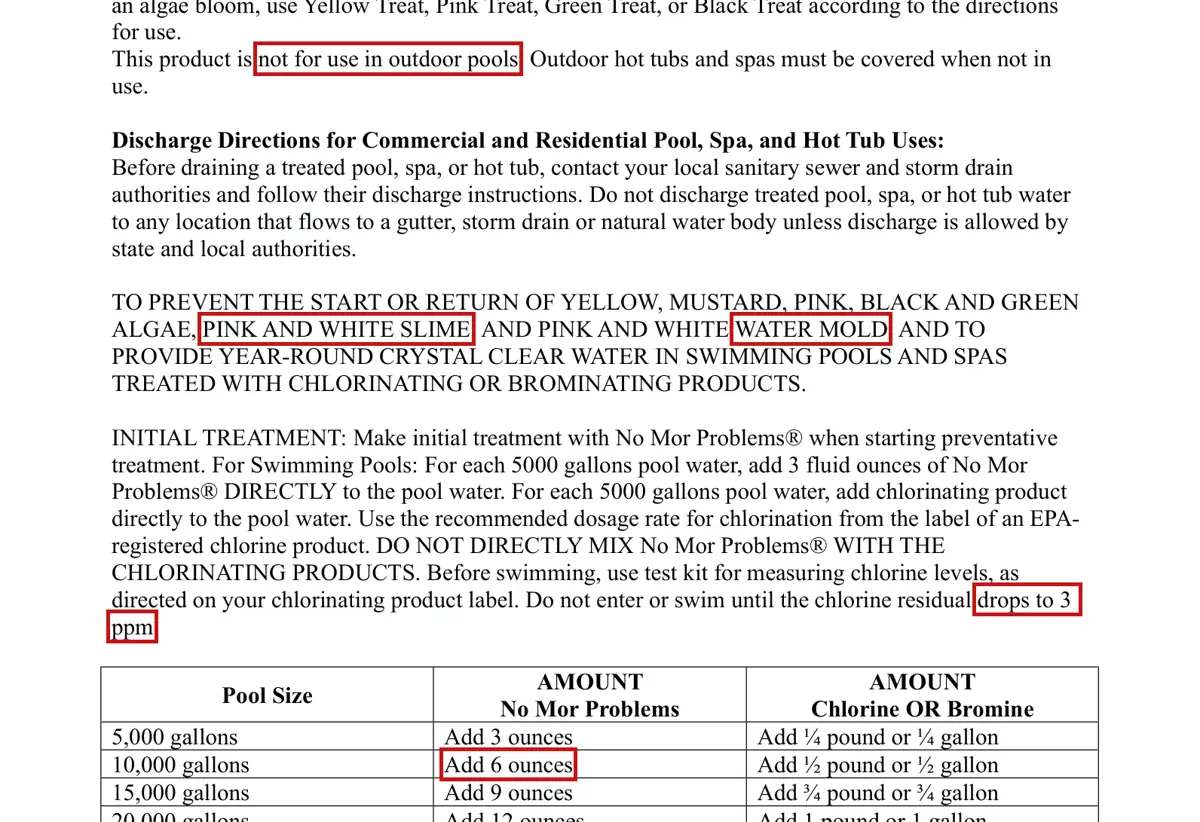
- The only current label we found that names white water mold, No Mor Problems (45337-11), is sodium bromide and now says it is not for use in outdoor pools.
What is white water mold in a pool?
White water mold is the pool trade’s name for white or gray, tissue-like flakes of biofilm that grow in the skimmer, plumbing and filter, often alongside a pink or orange slime. It is not algae. The 2024 MAHC Annex describes pool biofilms as many species of bacteria that can include fungi, algae and protozoa, sealed in a slime they make themselves.
| Source | What it says white water mold or pink slime is | Type of evidence |
|---|---|---|
| UC Museum of Paleontology, Berkeley | In biology, water molds are oomycetes: filamentous protists once classed as fungi, with cellulose walls and no chitin | University reference |
| WC&P, by BioGuard's technical services manager (2003) | Pink slime is a mixture of bacteria and other microorganisms; white water mold is fungal, white to pink, violet, yellow or gray | Trade article |
| 2024 MAHC Annex | Biofilms hold many species of bacteria and can include fungi, algae and protozoa; they form readily in recirculation lines and filters | CDC model code annex |
| Yano et al., Microbes and Environments (2013) | Methylobacterium was the major genus in all bathroom pink biofilms tested (42 sampled in Japan) | Peer-reviewed; bathrooms, not pools |
| Xu et al., Microbes and Environments (2014) | 16 of 21 pink-pigmented isolates from five homes' bathrooms were Methylobacterium | Peer-reviewed; bathrooms, not pools |
| Hiraishi et al., Applied and Environmental Microbiology (1995) | Most pink Methylobacterium isolates from chlorinated water supplies resisted chlorine | Peer-reviewed; water supplies |
| No Mor Problems label, EPA Reg. No. 45337-11 (2025) | Lists pink and white slime and pink and white water mold as claims separate from algae | EPA-accepted label |
| Swim University (hot tubs) | Not algae; a naturally occurring fungus | Pool care publisher |
| Allied Pools | Whitish, mucous-like, looks like shredded tissue paper; usually starts in the filter lines | Pool dealer |
Sources: UCMP Berkeley; WC&P (2003); 2024 MAHC Annex; Yano et al. (2013); Xu et al. (2014); Hiraishi et al. (1995); EPA label 45337-11; Swim University; Allied Pools. Accessed November 3, 2026. Download CSV
The name misleads twice. Biologists use water mold for oomycetes, more than 500 species of filamentous protists whose walls are cellulose rather than chitin, according to the UC Museum of Paleontology at Berkeley. Pool sources split: a 2003 WC&P article by BioGuard‘s technical services manager called white water mold fungal and pink slime a mix of bacteria, while Swim University calls white mold a fungus. No pool study we found has sequenced the flakes.
Pink slime is better studied, though not in pools. Xu et al. (2014) found 16 of 21 pink-pigmented isolates from five homes’ bathrooms were Methylobacterium, and a 1995 study found most Methylobacterium strains from chlorinated water supplies resisted chlorine. That fits pool symptoms: pink growth in fittings that a normal chlorine reading does not stop. Our pool algae hub compares it with green, mustard and black algae. How to tell pink slime from a pink liner stain, the nine spots it hides in and chlorine doses by pool size are in our guide to pink algae in pool water.
Where does white water mold hide in a pool?
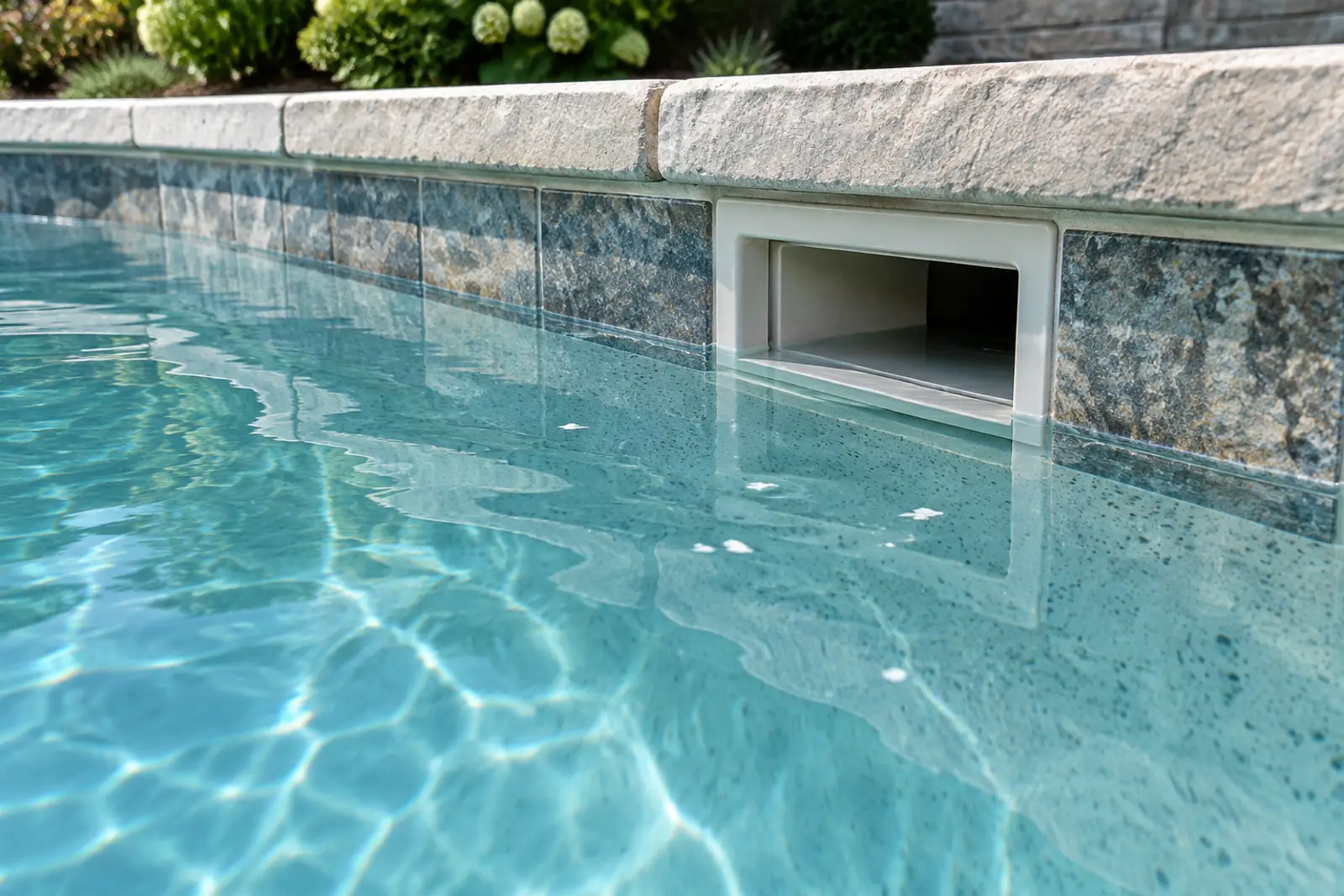
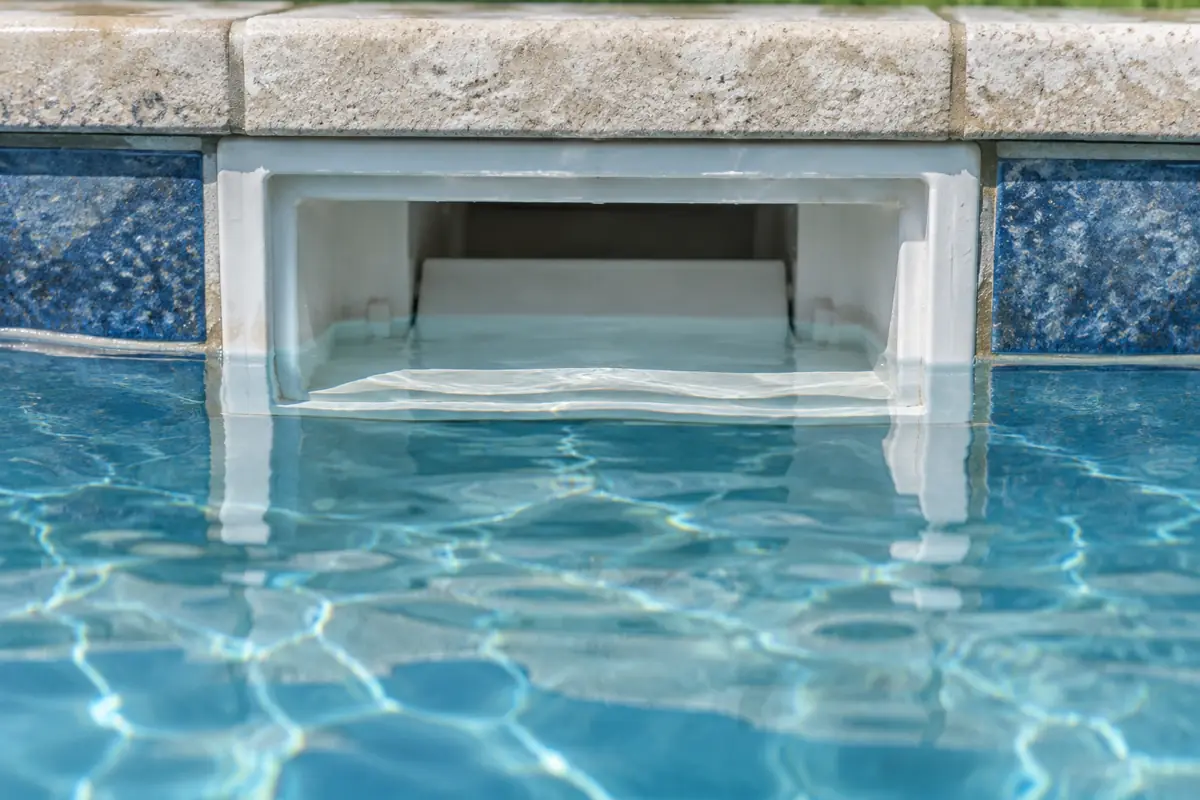
In places with low flow and low chlorine: the skimmer and its basket, the pump basket, every return and side line, the filter media and housing, behind ladders and in light niches, and on toys, cleaner hoses and covers. Allied Pools says it usually starts in the filter lines, so by the time flakes show in the water, the plumbing is already coated.
| Where it hides | Why it survives there | What to do | Source |
|---|---|---|---|
| Skimmer and skimmer basket | Slow water and debris; growth shows inside skimmer baskets first | Brush the throat and basket; put the label dose in the skimmer for the overnight soak | WC&P (2003); QLF label 3432-63 |
| Pump basket and suction lines | Biofilm forms readily in recirculation lines | Empty and scrub the basket; run the shock through with the pump on | MAHC Annex; EC-10 label 70060-20 |
| Return, cleaner, spa and waterfall lines, heater and chlorinator loops | Stagnant pipes lose their chlorine residual, and biofilm proliferates | Open every valve and run each line during the shock hold | MAHC Annex 4.7.1.3.2 and 5.7.1.1 |
| Filter media: cartridge pleats, sand bed, DE grids | Cartridges can shelter biofilm bacteria; the zone under sand laterals goes stagnant | Chemically clean, then sanitize a cartridge 1 hour in 1 quart of bleach per 5 gal; replace media if growth returns | MAHC 5.7.2.4.3.3; MAHC Annex; Allied Pools |
| Filter housing | Wet walls hold a slime layer | Drain, brush with mild detergent, rinse, mist with 1:10 bleach | MAHC 5.7.2.4.3.2 |
| Behind ladders and rails, steps, light niches | Shaded, low-flow pockets | Brush all visible growth before dosing | EC-10 label 70060-20; WC&P (2003) |
| Toys, floats, cleaner hoses | They leave the water wet and come back with growth on them | Scrub with a 1:10 bleach mix, rinse, dry fully | Swim University; MAHC 6.5.4.4 (1:10 strength) |
| Solar and winter covers | Stored folded and wet, they hold moisture against the slime | Scrub, rinse and dry completely before storing; drying controls biofilm | MAHC Annex 4.7.1.7.3 (drying a biofilm) |
Sources: WC&P (2003); EPA label 3432-63; EPA label 70060-20; 2024 MAHC 5.7.2.4.3 and 6.5.4.4; 2024 MAHC Annex; Allied Pools; Swim University. Accessed November 3, 2026. Download CSV
Dead-end lines are the hard part. The MAHC Annex (4.7.1.3.2) says idle pipes lose their chlorine residual and grow biofilm, and section 5.7.1.1 bars public pools from shutting down recirculation during closed hours for that reason. At home, that means a cleaner line, spa spillover or heater bypass you never open can reseed a pool you just treated. Skimmer layouts and the lines behind them are diagrammed in our pool skimmer guide.
Why doesn't chlorine alone kill white water mold?
Because the cells live inside biofilm that uses up chlorine before it reaches them. The 2024 MAHC Annex says organisms in a biofilm get extra protection as chlorine reacts with the slime, and that even high doses fail without enough concentration and contact time. Drinking water pipes stay coated with biofilm under a constant chlorine residual.
Three conditions decide whether a shock reaches the biofilm: concentration, contact time and flow through the coated surface. The 2024 MAHC spa protocol for Legionella shows how far a code goes: scrub surfaces at 5 ppm or more, replace filter media, then hold 20 ppm for 10 hours with water moving through every component. A pool that is shocked once with the pump on a timer misses all three.
Stabilizer lowers the active share further: the MAHC Annex 10:1 example keeps free chlorine at or above one tenth of cyanuric acid, so a pool at 50 ppm CYA needs at least 5 ppm just to match the shield a normal day gets. The full table is in our algae guide, and dose arithmetic by product is in our pool shock guide.
How do you get rid of white water mold in a pool?
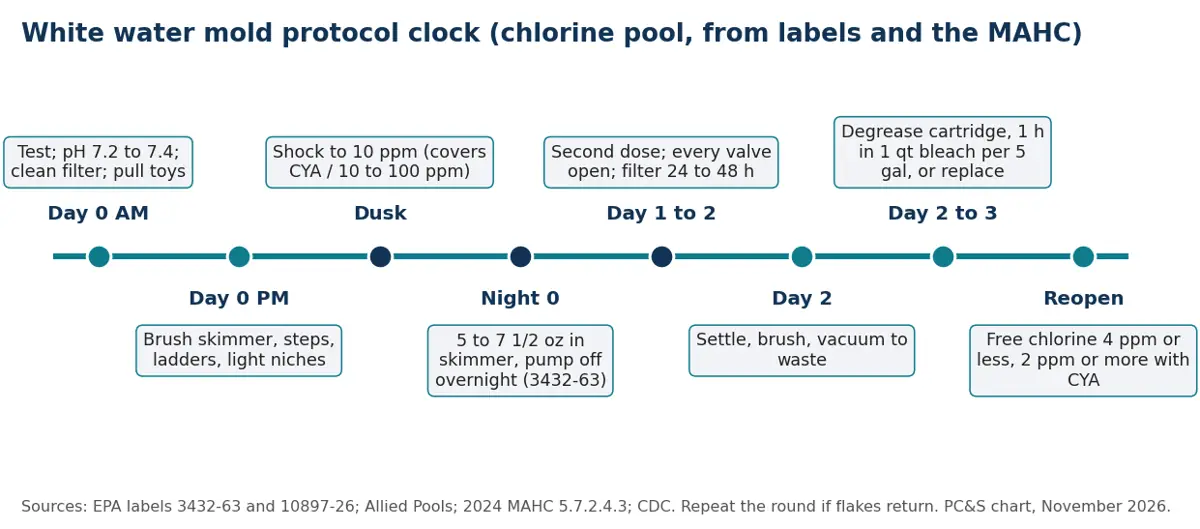
Treat the plumbing, not just the water: brush, shock to 10 ppm, soak the skimmer and lines overnight with a product labeled for slime, filter nonstop for 24 to 48 hours with every valve open, then chemically clean or replace the filter media. Repeat if flakes return. The steps below combine the QLF label, Allied Pools and the MAHC filter rules.
- Day 0, morning: test and prepareTest free chlorine, pH and cyanuric acid; set pH to 7.2 to 7.4 (Allied Pools). Clean the filter first: backwash sand, change DE or hose the cartridge. Pull toys and floats out to clean separately.
- Day 0, afternoon: brush everythingBrush all visible growth, giving extra time to steps, skimmers, ladders and light niches, as the EC-10 label (70060-20) directs.
- Day 0, dusk: shock to your CYA targetRaise free chlorine to 10 ppm, the label superchlorination maximum, which covers CYA / 10 up to 100 ppm: 100 fl oz of 12.5% liquid chlorine per 10,000 gallons from zero (Hasachlor 10897-26).
- Night 0: soak the skimmer and linesWith a slime-labeled algaecide such as QLF (3432-63), pour 5 to 7 1/2 oz into the skimmer, run the pump 1 minute, then leave it off overnight so the product sits in the plumbing.
- Day 1: second dose and nonstop filteringRestart the pump, add 5 to 7 1/2 oz to the pool, open every valve and side line, and filter continuously 24 to 48 hours, brushing often (label 3432-63). Retest chlorine morning and evening.
- Day 2: settle and vacuum to wasteTurn the filter off, brush, let debris settle and vacuum to waste so flakes do not reload the filter (Allied Pools).
- Day 2 to 3: clean or replace the filterDegrease a cartridge overnight, then sanitize 1 hour in 1 quart of household bleach per 5 gallons; brush the housing and mist it with 1:10 bleach (MAHC 5.7.2.4.3). Replace cartridges or sand that reseed the pool.
- Day 5 to 7: maintenance and recheckStart a weekly algaecide dose (QLF: 1 1/4 fl oz per 10,000 gallons). If flakes return, repeat the whole round (Allied Pools).
- Reopen at 4 ppm or lessChlorine labels bar swimming above 4 ppm; reopen once free chlorine sits between CDC’s 2 ppm floor (with CYA) and that limit.
| Source | Pool type | Chlorine or product | Hold and circulation | Filter | Extra steps |
|---|---|---|---|---|---|
| Allied Pools | Chlorine pool | pH 7.2 to 7.4; 3 times the normal shock (3 gal of its liquid shock per 10,000 gal) | Filter continuously overnight | Clean before; chemically clean after | Brush, settle, vacuum to waste; repeat if mold remains; algaecide 4 oz per 10,000 gal weekly from day 5 to 7 |
| QLF Algicide label, EPA Reg. No. 3432-63 | Chlorine pool | 5 to 7 1/2 oz in the skimmer, then 5 to 7 1/2 oz in the pool next day | Pump off overnight after 1 minute of run; then filter 24 to 48 hours | Run continuously | Brush sides and bottom often |
| EC-10 label, EPA Reg. No. 70060-20 | Biguanide (PHMB) pool | Tablets in pump basket and skimmer: 1 + 1 under 10,000 gal, 2 + 2 at 10,000 gal or more | Pump off 6 to 12 hours; swimmers out 8 hours | Filter aid; backwash as needed | Repeat every 3 to 4 weeks for maintenance |
| WC&P, BioGuard technical services (2003) | Biguanide pool | Chlorinating solution through a closed loop from each return to the skimmer | 10 minutes per return, then 5 minutes to waste | Check filtration first | Keep chlorine out of biguanide water: the two react and cloud green |
| 2024 MAHC 6.5.3.6 (public spas, Legionella) | Public spa | Scrub at 5 ppm or more; hyperchlorinate at 20 ppm | 20 ppm held 10 hours: 1 hour circulation, 9 hours with jets on | Replace cartridges, DE or sand | Drain, refill, flush, retest before reopening |
| Swim University | Hot tub | Triple or quadruple shock after refill | Drain, refill, shock, drain again | Chemically clean; replace if over a year old | Clean every surface before refilling |
Sources: Allied Pools; EPA label 3432-63; EPA label 70060-20; WC&P (2003); 2024 MAHC 6.5.3.6; Swim University. Accessed November 3, 2026. Download CSV
| Item, 20,000 gallon chlorine pool | Rule | Amount |
|---|---|---|
| Liquid chlorine 12.5%, 1 ppm to 10 ppm | 9 ppm x 10 fl oz per ppm per 10,000 gal x 2 (Hasachlor chart) | 180 fl oz (1.41 gal) |
| Allied Pools triple dose | 3 x its 1 gal per 10,000 gal normal shock dose x 2 | 6 gal of its liquid shock |
| QLF skimmer soak | 5 to 7 1/2 oz into the skimmer, pump off overnight (label sets no gallon scaling) | 5 to 7 1/2 oz, then the same next day |
| QLF weekly maintenance | 1 1/4 fl oz per 10,000 gal x 2 | 2 1/2 fl oz a week |
| Cartridge bleach soak in 20 gal of water | 1 qt household bleach per 5 gal x 4 | 4 qt (1 gal) of bleach, 1 hour |
| No Mor Problems (indoor pools only) | 3 fl oz per 5,000 gal x 4 | 12 fl oz with a chlorine dose |
Sources: EPA label 10897-26; Allied Pools; EPA label 3432-63; MAHC 5.7.2.4.3.3; EPA label 45337-11. PC&S arithmetic, November 2026. Download CSV
Source: EPA labels 70060-20, 5185-515 and 3432-63; 2024 MAHC 6.5.3.6. Accessed November 3, 2026.. Download chart data (CSV)
Filter cleaning steps for sand, DE and cartridge filters, including the overnight degreaser soak before the 1 hour bleach soak, are in our guide on how to clean a pool filter, and sand replacement is covered in how to change sand in a pool filter.
Which products are labeled for white water mold or pink slime?
Few, and read the fine print. No Mor Problems (EPA Reg. No. 45337-11) names pink and white water mold but is sodium bromide, now barred from outdoor pools. QLF Algicide (3432-63) claims slime producing microorganisms and is sold as Pink Algae Destroyer. EC-10 (70060-20) claims mold and slime in circulation systems for biguanide pools. Chlorine itself carries no water mold claim.
| Product, EPA Reg. No. | Active ingredient | What the label claims | Directions (pools) | Limits on the label | Label file |
|---|---|---|---|---|---|
| No Mor Problems, 45337-11 | Sodium bromide 41.4% | Prevents pink and white slime and pink and white water mold | 3 fl oz per 5,000 gal with a chlorine dose (6 oz per 10,000) | Not for use in outdoor pools; swim at 3 ppm chlorine or less | Master label March 30, 2025 |
| QLF Algicide, 3432-63 (also sold as Pink Algae Destroyer, 3432-63-41688) | Didecyl dimethyl ammonium chloride 50% | Green, black and mustard algae and slime producing microorganisms | Persistent slime: 5 to 7 1/2 oz in the skimmer, pump off overnight, repeat, filter 24 to 48 hours | Cationic: do not mix with soap or anionic products | Notification February 2, 2012 |
| EC-10, 70060-20 | Sodium chlorite 20% and sodium dichloroisocyanurate dihydrate 8% | Kills and removes mold and slime from pool and spa circulation systems | Biguanide pools: tablets in pump basket and skimmer, pump off 6 to 12 hours | Wait 8 hours before swimming; outdoor spas only | Registration notice September 28, 2012 |
| Liquid chlorine, e.g. Hasachlor 10897-26 | Sodium hypochlorite 10% to 12.5% | Sanitizer; superchlorination 5 to 10 ppm (no water mold claim) | 50 to 100 fl oz per 10,000 gal | Swim at 4 ppm or less | Label April 24, 2026 |
Sources: EPA Pesticide Product and Label System: 45337-11 label and record; 3432-63 label and record; name search PINK; 70060-20 label and record; 10897-26 label. Download CSV
Two cautions. First, a PPLS pest list is not a pool claim: the record for BioGuard Algae All 60 (5185-339) lists slime-forming bacteria and fungi, but its May 2026 label ties those to industrial water, and its pool directions cover algae. Second, sources disagree on chlorine dioxide: the MAHC Annex (5.7.3.3.1) says it is not registered for any recreational water use, while EPA’s record for EC-10, a sodium chlorite and dichlor tablet, lists swimming pool water as a site. Follow the label on the product in hand.
Algaecide types, doses and swim waits for chlorine pools are compared in our pool algaecide guide.
Is white water mold harmful?
No source we found ties white water mold itself to illness, and Allied Pools calls it not harmful to humans. The risk is what biofilm can shelter: the 2024 MAHC Annex lists Pseudomonas aeruginosa, the cause of hot tub rash, as chlorine resistant when living in biofilm. CDC’s outbreak data count 18 Pseudomonas outbreaks in treated recreational water from 2009 to 2023.
Hot tubs carry most of that risk: 176 of 560 treated recreational water outbreaks from 2009 to 2023 were at hot tubs or spas, in our tabulation of CDC’s NORS data in the pool illness outbreak report. CDC says hot tub rash appears a few days after use of a poorly maintained tub (CDC), and our guide to cloudy hot tub water covers line purges and drains.
How do you prevent white water mold and pink slime?
Keep chlorine moving through every line and keep surfaces dry when they are out of the water. Hold free chlorine at CDC’s 2 ppm floor with stabilizer, shock periodically, which the MAHC Annex says can minimize biofilm build-up, run every side line weekly, clean the filter on schedule, and dry toys and covers before storing them.
- Chlorine floor At least 1 ppm, or 2 ppm with cyanuric acid, tested at least twice a day (CDC, May 2024).
- Periodic shock The MAHC Annex says periodic shock dosing can minimize build-up of biofilms; labels shock weekly or as needed.
- Run every line Open cleaner, spa and water feature lines weekly so no pipe sits stagnant (MAHC Annex on idle pipes).
- Filter on schedule Degrease and sanitize cartridges per MAHC 5.7.2.4.3.3; replace media that has hosted growth.
- Brush the low-flow spots Skimmer throat, behind ladders, light niches and steps, weekly.
- Dry what leaves the water Toys, floats and covers: scrub, rinse and dry fully; the MAHC Annex says drying a biofilm controls it.
- Biguanide pools Keep PHMB at 30 to 50 ppm and use a labeled circulation-system product every 3 to 4 weeks (EC-10 label; WC&P).
Testing is where most owners slip: in a 2020 Water Quality and Health Council survey, 23% of do-it-yourself owners tested chlorine and pH once every two weeks or less, per our pool hygiene statistics.
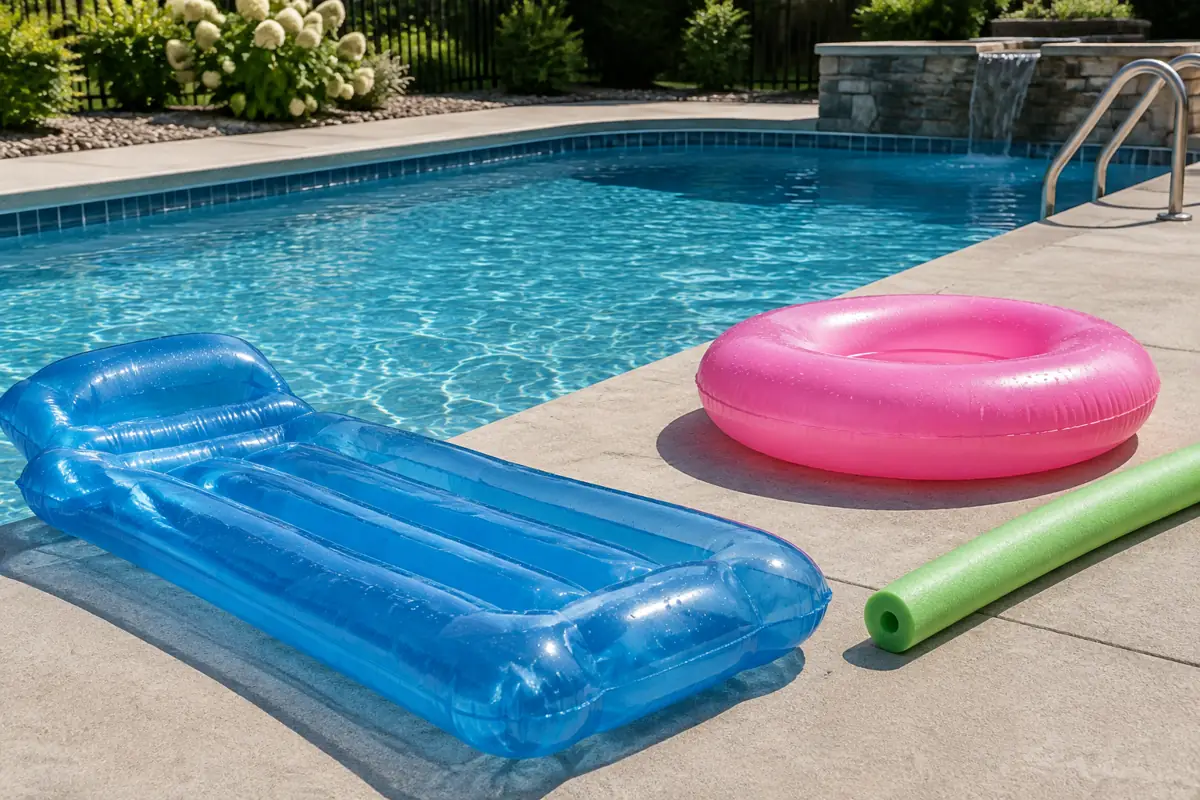
What should you do about white water mold in your pool or spa?
Match your sanitizer and setting to a row. Chlorine pools get the 3-day plumbing protocol, biguanide pools get a product labeled for their system and no chlorine, outdoor pools skip sodium bromide, hot tubs get a purge and drain, and flakes that return within two weeks point to filter media or a dead-end line.
| Number | What it means | Source |
|---|---|---|
| 10 ppm | Superchlorination maximum on chlorine labels; covers CYA / 10 up to 100 ppm CYA | EPA label 10897-26; MAHC Annex |
| 5 to 7 1/2 oz | QLF dose poured into the skimmer before the overnight pump-off soak, then again in the pool | EPA label 3432-63 |
| 24 to 48 hours | Continuous filtering after the skimmer soak | EPA label 3432-63 |
| 1 qt per 5 gal, 1 hour | Bleach soak that sanitizes a degreased cartridge | MAHC 5.7.2.4.3.3 |
| 1:10 | Bleach mist for filter housings and surfaces | MAHC 5.7.2.4.3.2 and 6.5.4.4 |
| 20 ppm for 10 hours | Public spa Legionella hold, circulated through every component | MAHC 6.5.3.6 |
| 4 ppm | Most chlorine labels bar swimming above this level | EPA label 5185-515 |
| 30 to 50 ppm | Biguanide (PHMB) level in biguanide programs | EC-10 label 70060-20; WC&P (2003) |
Sources: EPA labels 10897-26, 3432-63, 5185-515, 70060-20; 2024 MAHC; MAHC Annex; WC&P. Download CSV
| If your situation is | Do this | Rule behind it |
|---|---|---|
| Chlorine pool, white flakes or pink slime in skimmer and fittings | Run the 3-day protocol: brush, shock to 10 ppm, skimmer soak overnight, filter 24 to 48 hours, clean the filter | QLF label 3432-63; Allied Pools; MAHC Annex |
| Biguanide (PHMB) pool | Do not add chlorine; use a product labeled for biguanide circulation systems or a closed-loop flush to waste | EC-10 label 70060-20; WC&P (2003) |
| Indoor pool or covered spa | A sodium bromide preventive such as No Mor Problems is allowed by its label | EPA label 45337-11 |
| Outdoor pool | Skip sodium bromide products: their labels now say not for use in outdoor pools | EPA label 45337-11 (2025) |
| Hot tub | Purge the lines, drain, clean, replace an old filter, refill, shock | Swim University; CDC Legionella toolkit via our hot tub guide |
| Flakes return within 2 weeks of a full round | Replace cartridge or sand media; check every dead-end line and valve | MAHC 6.5.3.6 replaces filter media; MAHC Annex on stagnant pipes |
| Mold on house walls, not in water | Fix the moisture, scrub with detergent and water, dry; call a pro above about 10 sq ft | EPA mold guide (updated Feb 18, 2026) |
Sources: EPA labels 3432-63, 70060-20, 45337-11; Allied Pools; WC&P; MAHC 2024; MAHC Annex; Swim University; EPA mold guide. Download CSV
How we compiled this
We read 6 EPA-accepted labels and 4 records from EPA’s Pesticide Product and Label System, the 2024 Model Aquatic Health Code and Annex, CDC pages, three peer-reviewed studies on Methylobacterium, a Berkeley reference on water molds, EPA’s mold guide and six top-ranking pages, all in November 2026. We did not sample any pool; no study we found has sequenced white water mold from a residential pool, and we say so where it matters.
Frequently Asked Questions
Is white water mold harmful?
No study we found links white water mold itself to illness, and Allied Pools calls it not harmful to humans. The concern is what biofilm can hide: the 2024 MAHC Annex lists Pseudomonas aeruginosa, the cause of hot tub rash, as chlorine resistant inside biofilm. Keep swimmers out during treatment and until chlorine is 4 ppm or less.
How to treat white water mold?
Brush, shock to 10 ppm, then soak the plumbing: the QLF Algicide label (3432-63) puts 5 to 7 1/2 oz in the skimmer with the pump off overnight, adds a second dose and filters 24 to 48 hours. Then chemically clean or replace the filter media and repeat if flakes return. Biguanide pools need products labeled for biguanide instead.
Is white mold harmful to you?
In pool water, the documented risk comes from the biofilm, not the white flakes. The MAHC Annex says biofilms shelter disease-causing microorganisms from chlorine. House mold is a separate issue: EPA says to fix the moisture and clean small areas yourself, and to bring in a professional above about 10 square feet. Ask a doctor about symptoms.
What kills white mold in a house?
Moisture control first, then cleaning. EPA’s mold guide, updated February 18, 2026, says to scrub mold off hard surfaces with detergent and water and dry them completely, and calls routine bleach use not recommended. Areas larger than about 10 square feet call for a professional. Pool white water mold is a different problem and needs the plumbing protocol.
Is pink algae in a pool really algae?
No. Pink slime is bacterial biofilm. In bathroom pink biofilms, Methylobacterium was the major genus in every sample tested (Yano et al., 2013), and most Methylobacterium isolates from chlorinated water supplies resisted chlorine (Hiraishi et al., 1995). Labels list it apart from algae: No Mor Problems (45337-11) names pink and white slime separately.
Why does white water mold keep coming back?
Usually because the treatment missed the plumbing or the filter. The 2024 MAHC Annex says idle pipes lose their chlorine residual and grow biofilm, and cartridges can shelter biofilm bacteria. Open every line during the shock, soak the skimmer overnight, and replace cartridges or sand that have hosted growth, as the MAHC spa protocol does.
Sources
- United Chemical label on file with U.S. EPA. No Mor Problems, EPA Reg. No. 45337-11, master label dated March 30, 2025. Accessed 2026-11-03.
- U.S. EPA. EPA PPLS record 45337-11. Accessed 2026-11-03.
- N. Jonas & Co. label on file with U.S. EPA. QLF Algicide, EPA Reg. No. 3432-63, notification accepted February 2, 2012. Accessed 2026-11-03.
- U.S. EPA. EPA PPLS record 3432-63 and product name search PINK. Accessed 2026-11-03.
- Label on file with U.S. EPA. EC-10, EPA Reg. No. 70060-20, registration notice September 28, 2012. Accessed 2026-11-03.
- U.S. EPA. EPA PPLS record 70060-20. Accessed 2026-11-03.
- Bio-Lab label on file with U.S. EPA. BioGuard Algae All 60, EPA Reg. No. 5185-339, label dated May 20, 2026. Accessed 2026-11-03.
- Hasa label on file with U.S. EPA. Hasachlor, EPA Reg. No. 10897-26, label dated April 24, 2026. Accessed 2026-11-03.
- Bio-Lab label on file with U.S. EPA. BioGuard Calcium Hypochlorite 73, EPA Reg. No. 5185-515, label dated May 21, 2024. Accessed 2026-11-03.
- CDC. 2024 Model Aquatic Health Code, 5th edition (5.7.2.4.3, 6.5.3.6, 6.5.4.4). Accessed 2026-11-03.
- CDC. 2024 MAHC Annex (4.7.1.3.2, 4.7.3.6, 5.7.1.1, 5.7.3.3.1). Accessed 2026-11-03.
- CDC. Home pool and hot tub water treatment and testing (May 10, 2024). Accessed 2026-11-03.
- CDC. Preventing hot tub rash (May 30, 2025). Accessed 2026-11-03.
- CDC. NORS outbreak dataset (via PC&S outbreak report). Accessed 2026-11-03.
- ASM / PMC. Hiraishi et al. 1995, Applied and Environmental Microbiology 61(6):2099-2107. Accessed 2026-11-03.
- J-STAGE. Yano et al. 2013, Microbes and Environments 28(1):87-95. Accessed 2026-11-03.
- PMC. Xu et al. 2014, Microbes and Environments 29(4):388-392. Accessed 2026-11-03.
- UC Museum of Paleontology, Berkeley. Introduction to the Oomycota. Accessed 2026-11-03.
- U.S. EPA. A brief guide to mold, moisture and your home (updated February 18, 2026). Accessed 2026-11-03.
- WC&P Online. Eliminating mold and slime in swimming pools (July 11, 2003). Accessed 2026-11-03.
- Allied Pools. My pool is full of shredded tissue paper. Accessed 2026-11-03.
- Swim University. How to get rid of white mold in a hot tub. Accessed 2026-11-03.
- Swimmers Daily. 2020 pool owner survey (Water Quality and Health Council). Accessed 2026-11-03.
Related pages
Get Quotes From Licensed Local Pool Pros
Tell us what you need and your ZIP code. We match you with pool companies that cover your area.