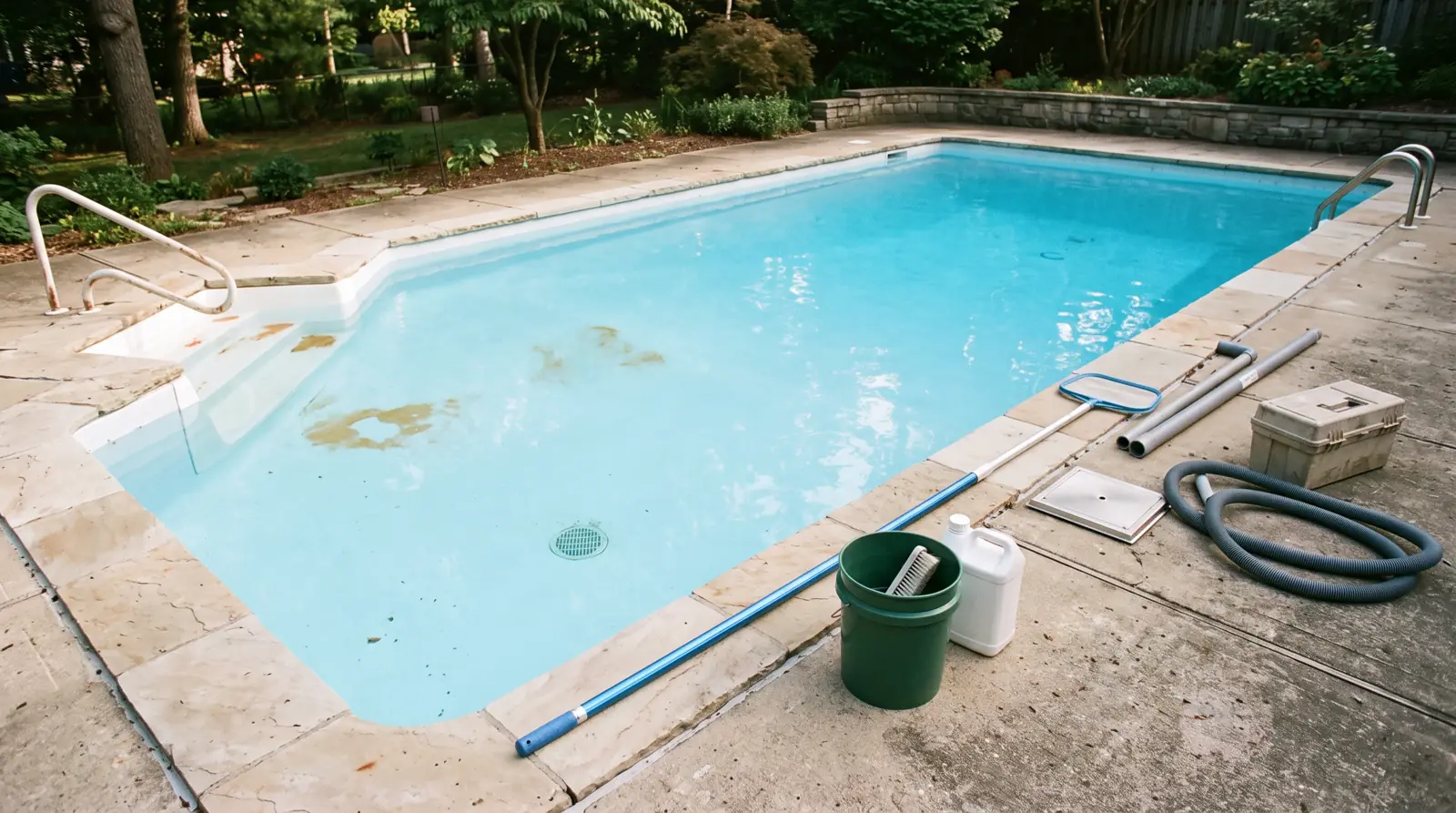
Pool Stains: How to Identify, Remove and Prevent Them by Color
Pool stains are organic or metal: hold chlorine on the spot, then vitamin C. If vitamin C lifts it, treat the water with ascorbic acid at 1 lb per 10,000 gallons and follow with a sequestrant.
- ✓Two tablets sort most stainsChlorine lightens organic stains; vitamin C lightens metal stains within 2 minutes (Natural Chemistry).
- ✓Label doses, not guesses1 lb ascorbic acid per 10,000 gallons, then 1 L of METALfree per 20,000 gallons and no shock for 1 week.
- ✓Iron stains at 0.3 mg/LEPA lists reddish staining above 0.3 mg/L iron, black above 0.05 mg/L manganese, blue-green above 1.0 mg/L copper.
Key takeaways
- A vitamin C tablet held on a stain for at least 2 minutes separates metal (it lightens) from non-living organic (no change), per Natural Chemistry, a pool chemical maker.
- Natural Chemistry’s metal stain procedure lowers chlorine to 1 ppm, keeps pH at 7.2 to 7.6, doses 1 lb of ascorbic acid per 10,000 gallons and bans shock for at least 1 week (Natural Chemistry procedure).
- EPA lists reddish or orange staining above 0.3 mg/L iron, black staining above 0.05 mg/L manganese and blue-green staining above 1.0 mg/L copper (EPA secondary standards, updated May 2026).
- The 2024 Model Aquatic Health Code Annex names the usual metal sources: copper from algaecides or corroded pipes, and iron and manganese from fill water (2024 MAHC Annex).
- Latham’s 2026 fiberglass warranty does not cover staining and is voided if water drops below the skimmer outlet, so fiberglass stains are treated in the water, not by draining (Latham warranty).
What do pool stain colors mean?
Color gives a suspect, and a 2 minute test confirms it. Green or brown under leaves is organic. Yellow, brown or reddish brown is generally iron, blue-green is copper, and gray or black is oxidized copper, per Pinch A Penny’s 2022 guide. River Pools adds manganese for brown, black or purple hues, and EPA ties black staining to manganese above 0.05 mg/L.
| Stain color and where it shows | Most likely cause | Field test result | First fix | Source |
|---|---|---|---|---|
| Green or brown flat patch under leaves, acorns or worms | Non-living organic (tannin) | Chlorine lightens it; vitamin C does not | Raise chlorine to breakpoint and scrub | Natural Chemistry; Pinch A Penny |
| Green film or fuzz that brushes off and returns | Green algae | Not a stain: it is alive and spreads | Shock and filter (green pool steps) | Natural Chemistry; BioGuard |
| Yellow-brown powder on shady walls that brushes off easily | Mustard algae | Returns within days after brushing | Mustard algae treatment | BioGuard; Algae Complete label 5185-513 |
| Raised, rough blue-black spots on plaster | Black algae (cyanobacteria) | Vitamin C does not change it; nylon brush barely moves it | Stainless steel brush on plaster, then a labeled product | Natural Chemistry; Pentair; EPA labels |
| Yellow, brown, orange or reddish-brown, often near steps, fittings or the floor | Iron | Vitamin C lightens it | Ascorbic acid, then a sequestrant | Pinch A Penny; River Pools; EPA (iron: reddish or orange staining) |
| Blue, blue-green or teal | Copper | Vitamin C or a citric acid product lightens it | Citric or ascorbic acid stain remover, then a sequestrant | Pinch A Penny; River Pools; EPA (copper: blue-green staining) |
| Gray or black flat stain | Oxidized copper or manganese | A non-chlorine shock spot test turns copper yellow or reddish | Stain ID kit first, then the matching treatment | Pinch A Penny (gray or black: oxidized copper); EPA (manganese: black staining) |
| Brown, black or purple hues | Manganese | Vitamin C lightens it if it is metal | Ascorbic acid, then a sequestrant | River Pools; EPA |
| White, crusty, rough to the touch | Calcium scale, not a stain | A drop of muriatic acid makes carbonate foam | Scale method by tile or finish type | Latham (via our tile cleaning guide); Pinch A Penny |
| Dark spots in fiberglass that ignore every treatment | Cobalt staining beneath the gelcoat | No reaction to brushing, vitamin C or ascorbic acid | Have a fiberglass pro evaluate it | River Pools (fiberglass maker) |
Sources: Natural Chemistry; Pinch A Penny stain guide (June 6, 2022); River Pools (updated April 9, 2026); BioGuard; EPA secondary standards. Download CSV
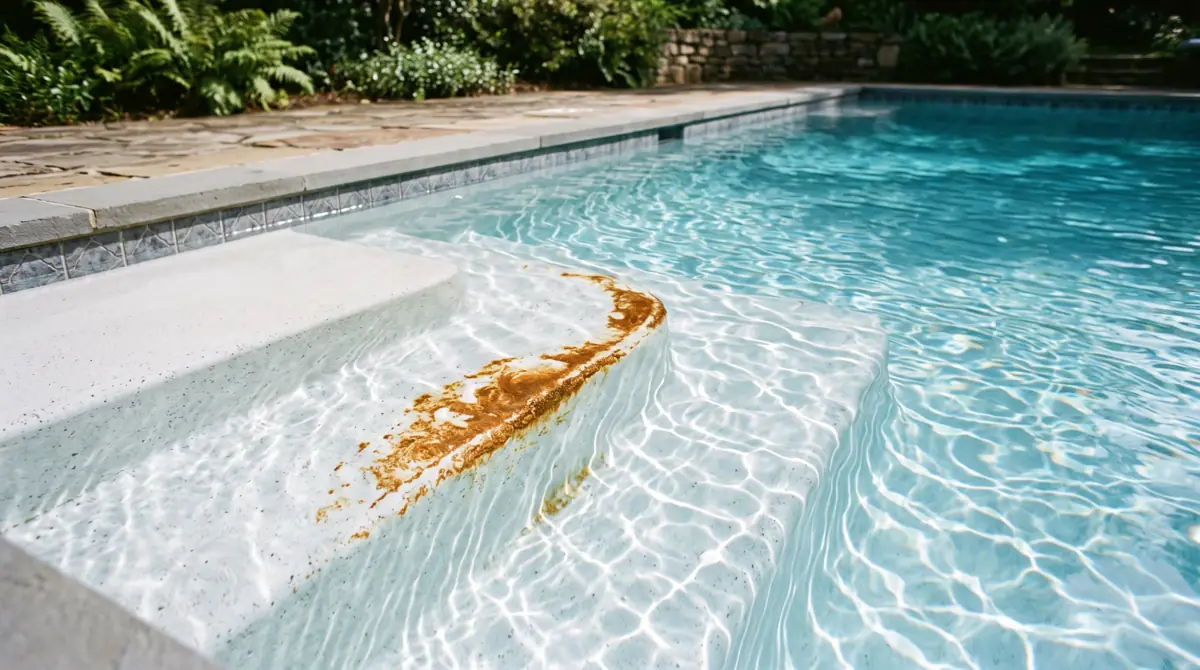
Two colors mislead often. A raised, rough blue-black spot on plaster is usually black algae, which our black algae in pool guide separates from metal with the same vitamin C test. A dark fiberglass spot that ignores every product can be cobalt staining beneath the gelcoat, which River Pools, a fiberglass pool maker, says brushing, vitamin C and ascorbic acid treatments will not remove. Both fail the 2 minute vitamin C test.
| Number | What it is | Source and date |
|---|---|---|
| 2 minutes | Minimum time a vitamin C tablet sits on a stain before you read the result | Natural Chemistry staining guide |
| 1 lb per 10,000 gal | Ascorbic acid (STAINfree Extra Strength) dose for surface metal stains | Natural Chemistry metal stain removal procedure |
| 1 ppm | Chlorine level to lower to before an ascorbic acid treatment | Natural Chemistry procedure |
| 1 L per 20,000 gal | METALfree sequestrant dose added after the stain lifts | Natural Chemistry procedure |
| 1 week | Minimum wait before shocking after a metal stain treatment | Natural Chemistry procedure; Jack's Magic FAQ |
| 65F | Water temperature the pool must exceed before a stain treatment program | Pinch A Penny stain guide, June 2022 |
| 0.3 mg/L | Iron level above which EPA lists reddish or orange staining | EPA secondary standards, page updated May 2026 |
| 1.0 mg/L | Copper level above which EPA lists blue-green staining | EPA secondary standards, page updated May 2026 |
| 0.05 mg/L | Manganese level above which EPA lists black staining | EPA secondary standards, page updated May 2026 |
| 28 days | Window in which new plaster is most susceptible to staining | National Plasterers Council start-up card, rev. 03-2021 |
Sources: Natural Chemistry; Natural Chemistry procedure; Jack’s Magic FAQ; Pinch A Penny; EPA; NPC start-up card. Download CSV
How do you test a pool stain before treating it?
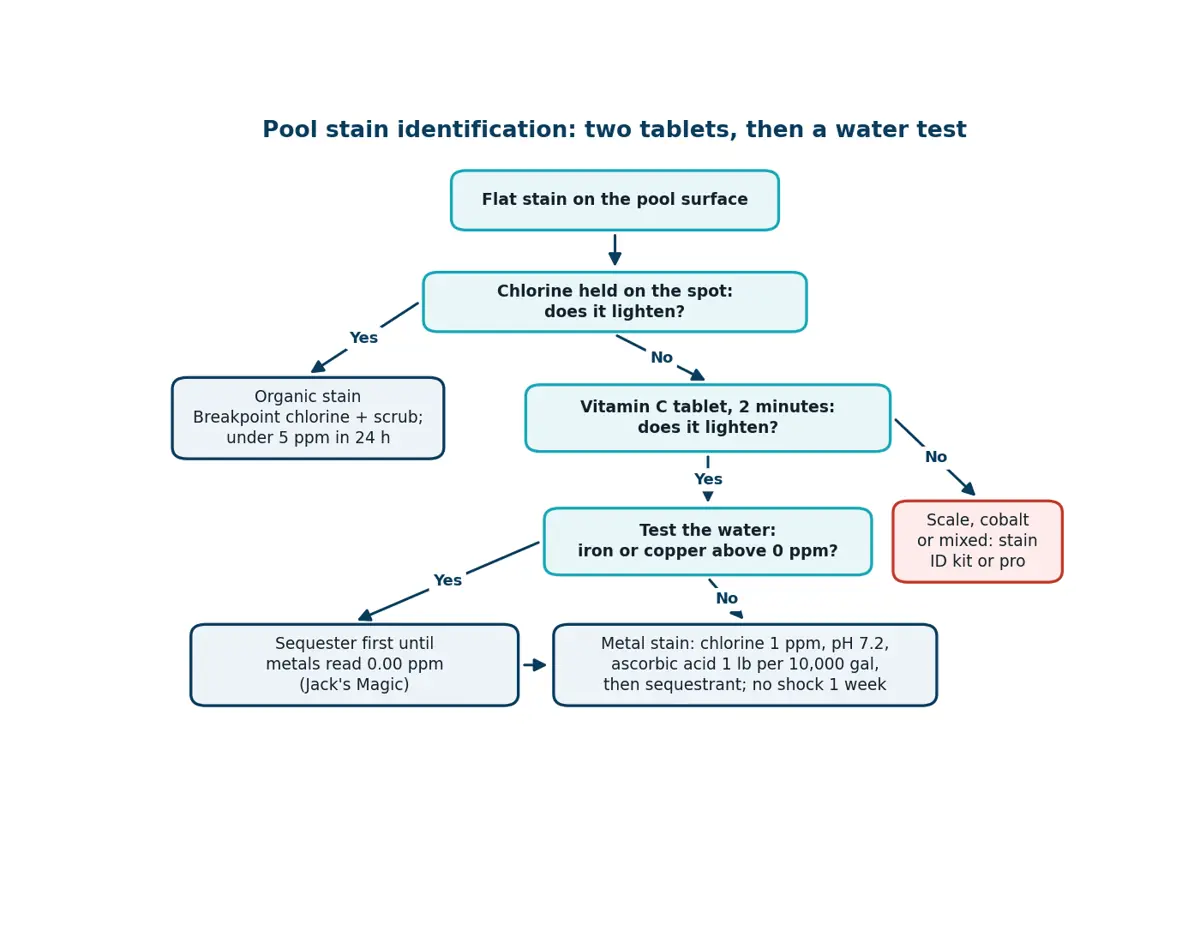
Run two spot tests in order. Pinch A Penny says chlorine placed over an organic stain usually removes it. If chlorine does nothing, hold a vitamin C tablet on the stain for at least 2 minutes: Natural Chemistry reads lightening as metal. If neither works, a stain ID kit tests several acid products, and a water test for iron and copper comes next.
- Balance firstPinch A Penny wants water above 65F, free chlorine 3.0 ppm or below and pH 7.4 or below before any stain test.
- Turn the pump offLet the water stand 30 minutes so the test product stays on the spot (Pinch A Penny).
- Chlorine on the spotHold chlorine over a small stain on plaster. On vinyl, skip the tablet: EPA label 5185-441 warns against undissolved granules resting on a liner.
- Vitamin C on the spotIf chlorine did nothing, hold a vitamin C tablet on the stain for at least 2 minutes (Natural Chemistry). Lighter means metal.
- Test the waterTest iron and copper. Jack’s Magic says a stain can exist at 0 ppm, and any reading above 0 should be sequestered first.
| Chlorine on the spot | Vitamin C on the spot | What it means | Next step | Source |
|---|---|---|---|---|
| Lightens | No change | Organic stain (leaves, debris, algae residue) | Breakpoint chlorine and scrubbing; skim debris daily | Pinch A Penny; Natural Chemistry |
| No change | Lightens in 2 minutes or less | Metal stain, usually iron or copper | Ascorbic acid treatment, then a sequestrant; no shock for 1 week | Natural Chemistry procedure |
| No change | No change | Scale, cobalt, a deep or mixed stain, or a reagent problem | Stain ID kit with several acid products; check scale with a muriatic acid drop | Pinch A Penny; Jack's Magic FAQ; River Pools |
| No change | Darkens or changes color | Possible copper or mixed metals; Pinch A Penny's non-chlorine shock spot test turns copper yellow or reddish | Stop; test the water for copper and iron, then use a stain ID kit | Pinch A Penny; Jack's Magic FAQ |
Sources: Pinch A Penny; Natural Chemistry; Jack’s Magic FAQ; River Pools. Download CSV
Where do metal stains in a pool come from?
Mostly from four places: fill water, corroded equipment, copper algaecides and copper ionizers. The 2024 MAHC Annex names copper from algaecides or corroded pipes and iron and manganese from fill water. BioGuard adds corroded heater parts and says a pH rise or a shock dose is what drops dissolved metals onto the surface.
| Where the metal comes from | How it gets into the water | What to check | Source |
|---|---|---|---|
| Fill water, especially well water | Iron and manganese arrive dissolved in source water | Test fill water for metals before filling (NPC); iron above 0.3 mg/L and manganese above 0.05 mg/L stain fixtures (EPA) | MAHC Annex; Natural Chemistry; NPC; EPA |
| Corroded heater parts, pipes and metal fittings | Low pH, low alkalinity or low calcium make aggressive water that dissolves metal parts | Keep pH 7.2 to 7.6 during treatment and 7.0 to 7.8 at home pools; bypass the heater during stain treatments where possible | BioGuard; MAHC Annex; Natural Chemistry; CDC; Jack's Magic |
| Copper algaecides | Each label dose adds copper; 4 oz of Swimtrine adds about 0.27 ppm per 10,000 gal | Leslie's says staining may occur above 0.6 ppm copper | MAHC Annex; EPA label 8959-2; Leslie's |
| Copper ionizers | Ion systems hold copper in the water on purpose | MAHC Annex cites a 1.3 ppm copper standard and warns against adding copper algaecides | MAHC Annex; Jack's Magic |
| A pH rise or a shock dose | Dissolved metals turn insoluble and drop onto the surface | Test metals before shocking; this is when stains appear | BioGuard |
| Floodwater | Hurricane or canal flooding leaves orange-brown stains from mixed organics and inorganics | Drain and replace the water, then use a stain ID kit | Jack's Magic FAQ |
Sources: 2024 MAHC Annex; BioGuard; Natural Chemistry; NPC; EPA; EPA label 8959-2; Leslie’s; Jack’s Magic; CDC. Download CSV
Copper algaecide is the source owners add themselves. A 4 oz opening dose of Swimtrine adds about 0.27 ppm of copper per 10,000 gallons, and Leslie’s warns that staining may start above 0.6 ppm, as our pool algaecide guide charts dose by dose. Ion systems hold copper on purpose: the MAHC Annex cites a 1.3 ppm copper standard for them, and our pool ionizer guide covers how they are dosed.
| Metal and limit | Level (ppm or mg/L) | What the source says happens above it | Source |
|---|---|---|---|
| Manganese, EPA secondary standard | 0.05 | Black to brown color; black staining | EPA secondary standards (updated May 26, 2026) |
| Iron, EPA secondary standard | 0.3 | Rusty color; reddish or orange staining | EPA secondary standards (updated May 26, 2026) |
| Copper, staining caution before a copper algaecide | 0.6 | Staining may occur | Leslie's black algae guide |
| Copper, EPA secondary standard | 1.0 | Metallic taste; blue-green staining | EPA secondary standards (updated May 26, 2026) |
| Copper, ion system standard cited in the MAHC Annex | 1.3 | Operating outside the maker's range can cause staining | 2024 MAHC Annex 5.7.3.2.3 |
Sources: EPA Secondary Drinking Water Standards (updated May 26, 2026); Leslie’s; 2024 MAHC Annex 5.7.3.2.3. Download CSV
Manganese and iron stain at far lower levels than copper, which is why a fill water test matters more than the copper reading alone.
Source: EPA Secondary Drinking Water Standards (updated May 26, 2026); Leslie's black algae guide; 2024 MAHC Annex 5.7.3.2.3. Download chart data (CSV)
Floodwater is the odd case. Jack’s Magic, a stain treatment maker, says hurricane or canal flooding leaves orange-brown stains and floodwater up to 10 times saltier than a salt pool, so the water has to be drained and replaced before any stain test. Our pool hurricane rules research shows official Florida guidance agrees on keeping water in the pool before a storm, which protects the shell.
How do you remove metal pool stains without draining?
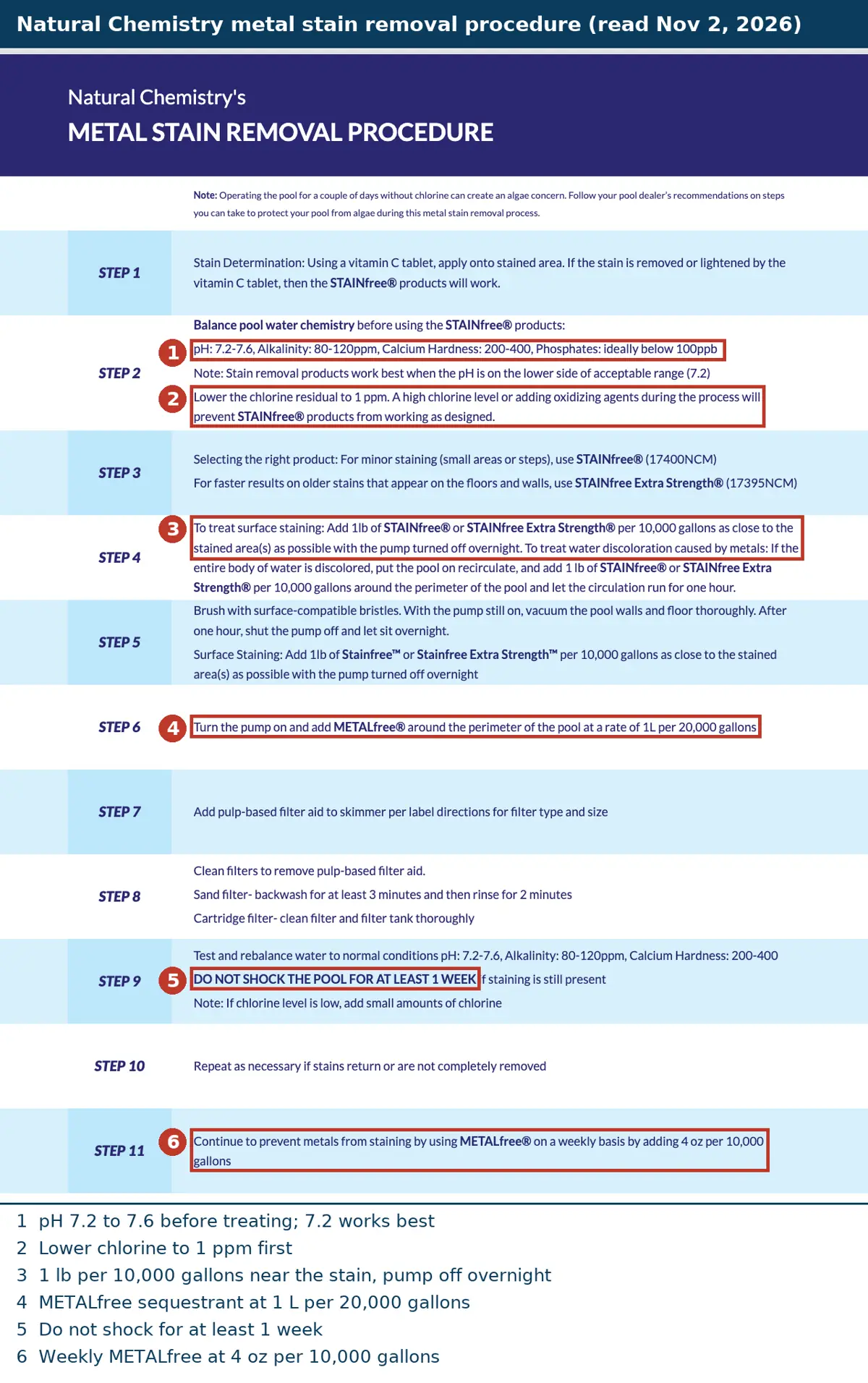
Treat the water, not the shell. Natural Chemistry’s procedure balances pH to 7.2 to 7.6, lowers chlorine to 1 ppm, adds 1 lb of ascorbic acid per 10,000 gallons near the stains with the pump off overnight, then adds METALfree at 1 L per 20,000 gallons and skips shock for at least 1 week. River Pools gives the same 1 lb rate.
- Balance and lower chlorinepH 7.2 to 7.6 (7.2 works best), alkalinity 80 to 120 ppm, calcium 200 to 400 ppm, phosphates under 100 ppb, chlorine 1 ppm.
- Pick the productSTAINfree (citric acid) for minor stains on small areas or steps; STAINfree Extra Strength (ascorbic acid) for older stains on floors and walls.
- Dose near the stain1 lb per 10,000 gallons as close to the stains as possible, pump off overnight. For discolored water, broadcast it and circulate 1 hour.
- Brush and vacuumUse bristles that suit the surface, vacuum walls and floor, then let it sit overnight.
- Lock up the metalPump on, add METALfree at 1 L per 20,000 gallons around the perimeter, then add pulp filter aid.
- Clean the filterSand: backwash at least 3 minutes and rinse 2 minutes. Cartridge: clean the cartridge and tank.
- Rebalance slowly, no shockBack to normal pH and alkalinity; no shock for at least 1 week; then 4 oz of METALfree per 10,000 gallons weekly.
How much vitamin C for pool stains? Dose by pool size
One pound of ascorbic acid per 10,000 gallons is the label rate from Natural Chemistry and the rate River Pools gives for fiberglass, so a 20,000 gallon pool takes 2 lb and a 30,000 gallon pool 3 lb. The sequestrant follows at 1 L per 20,000 gallons. Measure your volume first; a 25% error in gallons is a 25% error in dose.
| Pool volume (gallons) | Ascorbic acid, STAINfree Extra Strength (lb) | METALfree start dose (liters) | METALfree start dose (fl oz) | Weekly METALfree after treatment (fl oz) | Jack's Magic Blue or Purple Stuff start dose (quarts) |
|---|---|---|---|---|---|
| 10,000 | 1 | 0.5 | 16.9 | 4 | 1 |
| 15,000 | 1.5 | 0.75 | 25.4 | 6 | 1.5 |
| 20,000 | 2 | 1 | 33.8 | 8 | 2 |
| 25,000 | 2.5 | 1.25 | 42.3 | 10 | 2.5 |
| 30,000 | 3 | 1.5 | 50.7 | 12 | 3 |
| 40,000 | 4 | 2 | 67.6 | 16 | 4 |
Sources: Natural Chemistry procedure (1 lb per 10,000 gal; 1 L per 20,000 gal; 4 oz per 10,000 gal weekly); Jack’s Magic FAQ (1 qt per 10,000 gal); NIST (1 fl oz = 29.57 mL). PC&S arithmetic. Download CSV
River Pools gives the same 1 lb per 10,000 gallons for fiberglass pools.
Source: Natural Chemistry metal stain removal procedure (read November 2, 2026); PC&S arithmetic for each pool size. Download chart data (CSV)
Gallons drive every number in that table, so measure before dosing: a pool you think holds 20,000 gallons but really holds 25,000 gets 2 lb where the label calls for 2.5 lb. Ascorbic acid also uses up chlorine and pulls pH down, which is why Natural Chemistry’s step 9 rebalances to pH 7.2 to 7.6 and alkalinity 80 to 120 ppm before chlorine goes back up.
| Step | Natural Chemistry (STAINfree procedure) | River Pools (fiberglass maker blog, Apr 2026) | Pinch A Penny (Suncoast program, Jun 2022) | Jack's Magic (FAQ) |
|---|---|---|---|---|
| Chlorine before treating | Lower to 1 ppm | Lower to 0.0 ppm | 3.0 ppm or below | Low; raise gradually after a #1 treatment |
| pH before treating | 7.2 to 7.6, low end preferred | About 7.2 | 7.4 or below | Balanced |
| Other targets | Alkalinity 80 to 120 ppm, calcium 200 to 400 ppm, phosphates under 100 ppb | Not stated | Alkalinity 80 ppm or below, calcium 400 ppm or below, CYA 70 ppm or below, water above 65F | Water above 65F; test iron and copper first |
| Stain remover dose | 1 lb per 10,000 gal near the stain, pump off overnight | About 1 lb ascorbic acid per 10,000 gal, run 24 hours | Spot test with a stain ID kit, then a store procedure (A to D) | Stain ID kit decides the product |
| Sequestrant | METALfree 1 L per 20,000 gal, then 4 oz per 10,000 gal weekly | Add a metal sequestering agent | Use a metal control product periodically | Blue or Purple Stuff, 1 qt per 10,000 gal start dose |
| Shock after | Not for at least 1 week | Not stated | Not stated | Not for at least 1 week |
Sources: Natural Chemistry; River Pools (April 9, 2026); Pinch A Penny (June 6, 2022); Jack’s Magic FAQ. Download CSV
The four procedures agree on the order: low chlorine, low pH, stain remover, sequestrant, no shock. They disagree on the chlorine floor, from 0.0 ppm at River Pools to 1 ppm at Natural Chemistry and 3.0 ppm or below at Pinch A Penny. Follow the label of the product you bought, since its dose was set for its own chlorine target.
How do you remove algae and organic stains from pool walls?
With chlorine and a brush. Natural Chemistry raises chlorine to breakpoint, scrubs the stain, then expects chlorine back below 5 ppm within 24 hours before an enzyme dose. Live algae is a separate job: green water, mustard powder and black spots each have their own treatment. On fiberglass, River Pools says many organic stains fade within a few weeks to a couple of months. Our pool algae guide routes each type to its treatment with a flowchart.
Leaves, acorns and worms release tannins that leave green or brown marks, and Natural Chemistry notes they often look like algae, and vitamin C leaves them unchanged after 2 minutes. The difference is that an organic stain is flat and does not regrow. If the spot is fuzzy, slimy or spreading, start with how to clear a green pool; a yellow powder that brushes off and returns in the shade is covered in our mustard algae guide. Why earthworms end up in the pool after rain, and how to keep them out, is covered in worms in pool water.
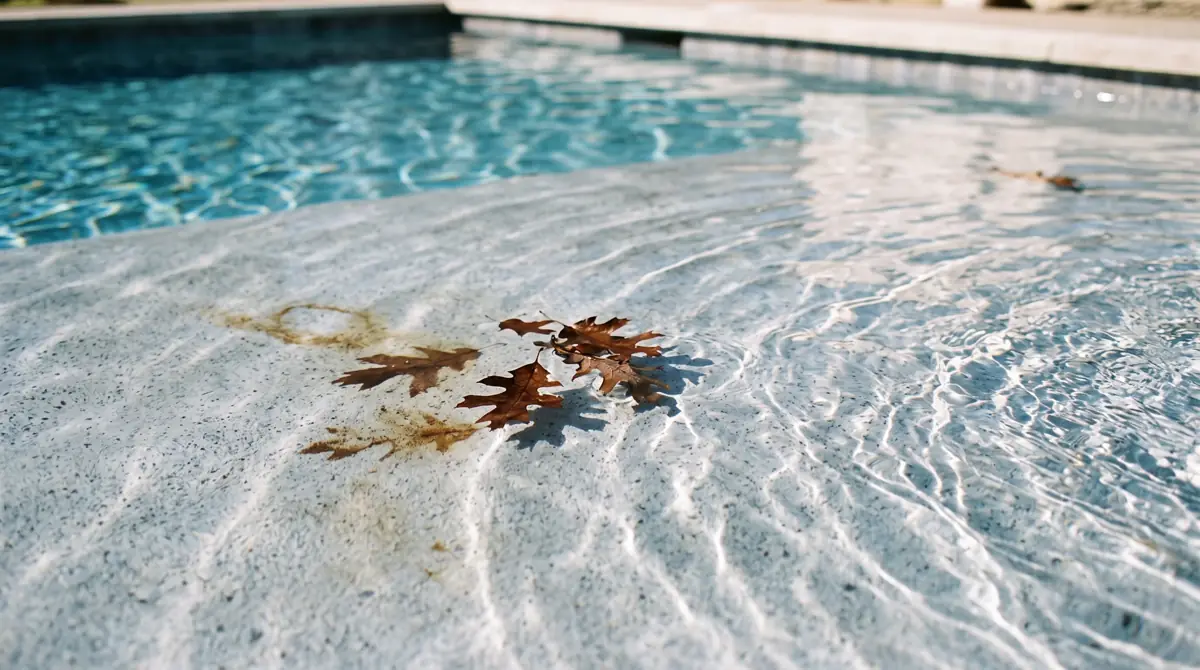
Brown stains on pool steps can be either kind, so test before treating. Steps hold leaves in still water, and they are also where Natural Chemistry points its milder citric acid STAINfree for small metal stains. If chlorine lightens the step stain, it was organic; if vitamin C does within 2 minutes, it was metal.
How do you remove stains from a fiberglass pool or vinyl liner?
In the water, gently, and without draining. River Pools treats fiberglass metal stains with chlorine at 0.0 ppm, pH near 7.2 and about 1 lb of ascorbic acid per 10,000 gallons for 24 hours. Latham’s 2026 warranty is voided if water drops below the skimmer outlet, and GLI’s liner warranty is void against shrinkage if the pool is emptied.
| Surface | Safe stain methods | Avoid | Warranty or maker rule | Source |
|---|---|---|---|---|
| Plaster or other cement finish | Two-tablet test; ascorbic acid and sequestrant; breakpoint chlorine with a brush; stainless brush for black algae | Acid washing new plaster; LSI above plus 0.3 | NPC: first 28 days most stain-prone; LSI 0.0 to plus 0.3; positive LSI causes metal staining | NPC start-up card (rev. 03-2021) |
| Pebble or quartz aggregate | In-water treatments as for plaster; nylon brush | Traditional acid wash (loosens aggregate); PoolDial suggests a 10:1 rinse at most | Follow the finish maker's start-up and care guide | PoolDial acid wash guide; Leslie's (nylon on pebble) |
| Fiberglass gelcoat | Soft sponge, fiberglass-safe eraser, ascorbic acid at about 1 lb per 10,000 gal, sequestrant | Abrasive or wire brushes, steel wool, harsh chemicals, draining below the skimmer | Latham's 2026 warranty excludes staining and is voided if water drops below the skimmer outlet | River Pools; Thursday Pools; Latham warranty |
| Vinyl liner | Ascorbic acid and sequestrant in the water; nylon brush | Resting chlorine tablets or undissolved granules on the liner; acid wash; emptying the pool | GLI liner warranty covers seam separation, excludes improper chemical use and fading, and is void against shrinkage if the pool is emptied | GLI warranty card; EPA label 5185-441; Pinch A Penny |
Sources: NPC start-up card (rev. 03-2021); PoolDial; Leslie’s; River Pools; Thursday Pools; Latham 2026 fiberglass warranty; GLI liner warranty card; EPA label 5185-441; Pinch A Penny. Download CSV
Read the warranty before treating, because neither maker promises the color. Latham’s fiberglass warranty excludes fading, staining and discoloration of the surface finish (section 8j), and GLI’s liner card covers seam separation, not stains, and excludes improper chemical use. What both protect is the structure, which is why draining for an acid wash is off the table on both surfaces; our how to drain a pool guide covers the rules. Pink or purple blotches inside a vinyl liner are a different case, a bacterial pigment that chlorine only bleaches for a while, as our guide to pink algae in pool water explains.
Which pool stain fix fits your pool? Decision table
Match the test result and the surface to one action. Organic stains get breakpoint chlorine. Metal stains get ascorbic acid at 1 lb per 10,000 gallons and a sequestrant, after metals in the water are sequestered to 0.00 ppm. Fiberglass spots that ignore everything may be cobalt. A stain that survives two full treatments on old plaster is an acid wash or resurfacing question.
| If your situation is | Do this | Rule behind it (source) |
|---|---|---|
| Green or brown flat stain under leaves, and chlorine lightens it | Raise chlorine to breakpoint, scrub, and let chlorine fall below 5 ppm within 24 hours | Natural Chemistry organic stain method |
| Brown, rust or blue-green stain that vitamin C lightens | Lower chlorine to 1 ppm and pH to 7.2, add ascorbic acid at 1 lb per 10,000 gal, then a sequestrant | Natural Chemistry metal stain procedure |
| Water test shows iron or copper above 0 ppm before treating | Pre-treat with a sequestrant until metals read 0.00 ppm, then treat the stain | Jack's Magic FAQ |
| Copper reads 0.6 ppm or more | Skip copper algaecides; use a polyquat if you need one | Leslie's; our pool algaecide guide |
| Pool has a copper ionizer | Use a sequestrant made for ion systems, not a standard one | Jack's Magic FAQ; MAHC Annex 5.7.3.2.3 |
| Fiberglass with dark spots that ignore vitamin C and ascorbic acid | Stop treating; ask a fiberglass pro about cobalt staining | River Pools |
| Raised blue-black spots on plaster that vitamin C does not touch | Treat as black algae, not a stain | Natural Chemistry; our black algae guide |
| Plaster under 28 days old shows a stain | Call the plasterer before treating; follow the NPC start-up routine | NPC start-up card |
| Stain survives two full metal treatments on old plaster | Price an acid wash or resurfacing; check the plaster first | Pinch A Penny; our acid wash guide |
Sources: Natural Chemistry; Natural Chemistry procedure; Jack’s Magic FAQ; Leslie’s; MAHC Annex; River Pools; NPC; Pinch A Penny. Download CSV
The last row is the expensive one. Pinch A Penny describes acid washing as the step for stains that chemical treatment cannot fix, and it removes a thin layer of plaster each time, about 1/16 inch by PoolDial’s estimate. Our pool acid wash guide shows how many washes a 3/8 inch plaster coat can take and when resurfacing is the better buy.
How do you keep pool stains from coming back?
Control metals at the source and hold the water balance. Test fill water for metals before filling, as the National Plasterers Council card directs, keep pH at 7.2 to 7.6 during treatment and inside CDC’s 7.0 to 7.8 at home, hold the saturation index at 0.0 to plus 0.3, and dose a sequestrant weekly: Natural Chemistry’s rate is 4 oz per 10,000 gallons.
- Test fill water for pH, alkalinity, calcium and metals and record it (NPC start-up card); well water is the usual iron source (Natural Chemistry).
- Keep the saturation index at 0.0 to plus 0.3; NPC says a positive index causes mineral scaling and metal staining, and our calcium hardness guide shows the math.
- Test copper before a copper algaecide and skip it at 0.6 ppm or more (Leslie’s); never add one to a pool with an ionizer (MAHC Annex).
- Test metals before shocking: BioGuard says a shock dose or a pH rise is what drops dissolved metal onto the surface.
- Skim leaves daily so tannins never sit, and brush the steps weekly.
- Partial drains dilute metals; a 20,000 gallon refill cost $39.00 to $649.98 across 25 cities in October 2026, median $215.09 (cost to fill a pool research).
How we compiled this
In November 2026 we read 21 primary and maker documents: stain procedures and FAQs from Natural Chemistry, BioGuard, Jack’s Magic and Pinch A Penny, a fiberglass maker’s stain guide and care sheet, two warranties, two EPA labels, EPA’s secondary standards, the 2024 MAHC Annex, the NPC start-up card, CDC guidance, a city plaster specification and NIST conversions, plus two PC&S research reports, and compared seven competing guides. Doses for other pool sizes are our arithmetic. We did not test any product, and forum posts were used for question wording only.
Frequently Asked Questions
How do I get rid of stains in my pool?
Identify the stain first. If chlorine lightens it, raise chlorine to breakpoint and scrub. If a vitamin C tablet lightens it within 2 minutes, it is metal: lower chlorine to 1 ppm, add ascorbic acid at 1 lb per 10,000 gallons, then a sequestrant, per Natural Chemistry. White crust is scale, not a stain.
Does vitamin C remove pool stains?
It removes many metal stains, mostly iron, because vitamin C is ascorbic acid. Natural Chemistry uses a tablet as the test and sells ascorbic acid at 1 lb per 10,000 gallons for floor and wall stains. It does nothing to organic stains, black algae or cobalt staining under fiberglass gelcoat (River Pools).
Will shock remove pool stains?
Only organic ones. Natural Chemistry treats leaf and debris stains by raising chlorine to breakpoint and scrubbing. Shock can make metal stains worse: BioGuard says a shock dose can turn dissolved metals insoluble so they drop onto the surface, and two makers say not to shock for at least 1 week after a metal treatment.
What causes brown stains on pool steps?
Usually leaves and debris, or iron. Steps hold leaves in still water, which leaves tannin stains that chlorine lightens. If vitamin C lightens the spot within 2 minutes instead, it is metal; Natural Chemistry suggests its citric acid STAINfree for minor stains on small areas or steps. EPA ties reddish staining to iron above 0.3 mg/L.
How do you remove iron stains from a pool floor?
Lower chlorine to 1 ppm and pH to 7.2 to 7.6, then add ascorbic acid at 1 lb per 10,000 gallons as close to the stain as possible with the pump off overnight, per Natural Chemistry. Brush, vacuum, add METALfree at 1 L per 20,000 gallons, clean the filter and do not shock for a week.
How do you remove pool stains without draining?
Treat the water. Organic stains respond to breakpoint chlorine and brushing; metal stains respond to ascorbic or citric acid in the water followed by a sequestrant, which holds the metal in solution so the filter can catch it. Draining is the step for stains that two in-water treatments do not move, and only on plaster.
What do copper stains in a pool look like?
Blue, blue-green or teal, per Pinch A Penny and River Pools, and EPA links blue-green staining to copper above 1.0 mg/L. Gray or black flat stains can be oxidized copper. Copper usually comes from algaecides, corroded heater parts or an ionizer; Leslie’s says staining may start above 0.6 ppm.
How do you remove stains from a fiberglass pool?
Wipe with a soft sponge first, then test. River Pools treats metal stains with chlorine at 0.0 ppm, pH near 7.2 and about 1 lb of ascorbic acid per 10,000 gallons for 24 hours, then a sequestrant. Avoid wire brushes and draining: Latham’s warranty is voided if water drops below the skimmer outlet.
Sources
- Natural Chemistry. Metal Stain Removal Procedure (STAINfree, METALfree). Accessed 2026-11-02.
- Natural Chemistry. Staining: stain identification and removal. Accessed 2026-11-02.
- BioGuard. Metal Staining. Accessed 2026-10-19.
- Pinch A Penny. How to Identify and Remove Pool Stains (June 6, 2022). Accessed 2026-11-02.
- Pinch A Penny. What is acid washing a pool? (June 13, 2018). Accessed 2026-11-02.
- Jack's Magic. Frequently Asked Questions. Accessed 2026-11-02.
- River Pools. How to Remove Stains from a Fiberglass Pool (updated April 9, 2026). Accessed 2026-11-02.
- River Pools. Fiberglass Pool Care Guide (2026 update). Accessed 2026-11-02.
- Latham Pool Products. Latham Fiberglass Pools Limited Lifetime Warranty (rev. 4/26). Accessed 2026-11-02.
- GLI Pool Products. 20 Year Liner Warranty Card. Accessed 2026-11-02.
- Thursday Pools. Fiberglass Pool Maintenance Tools and Cleaning Equipment (updated September 17, 2026). Accessed 2026-10-19.
- U.S. EPA Pesticide Product Label System. BioGuard Spot Kill, EPA Reg. No. 5185-441 (label May 22, 2024). Accessed 2026-10-19.
- U.S. EPA Pesticide Product Label System. Swimtrine, EPA Reg. No. 8959-2 (label April 14, 2025). Accessed 2026-11-01.
- U.S. EPA. Secondary Drinking Water Standards: Guidance for Nuisance Chemicals (updated May 26, 2026). Accessed 2026-11-01.
- CDC. 2024 Model Aquatic Health Code, 5th Edition, Annex. Accessed 2026-11-02.
- National Plasterers Council. Pool Start-Up Procedures card (rev. 03-2021). Accessed 2026-10-26.
- CDC. Home Pool and Hot Tub Water Treatment and Testing (May 10, 2024). Accessed 2026-11-01.
- Leslie's. How to Treat Black Algae in Your Pool. Accessed 2026-11-01.
- PoolDial. Acid Wash vs Replaster. Accessed 2026-11-02.
- City of Gulf Shores, Alabama. Swimming Pool Tile and Plaster Preparation, Gulf Shores Recreation Center pool resurfacing specification. Accessed 2026-11-02.
- NIST. Approximate Conversions from U.S. Customary Measures to Metric. Accessed 2026-11-01.
Related pages
Get Quotes From Licensed Local Pool Pros
Tell us what you need and your ZIP code. We match you with pool companies that cover your area.