Pool Ionizer: What It Does, Which Models Are EPA Registered, Copper Levels and Costs
A pool ionizer releases copper, and sometimes silver, ions that slow algae and bacteria, but it does not oxidize: all seven EPA pool labels we read keep chlorine or another sanitizer in use.
- ✓Every registration checkedFour active copper pool ionizer registrations and one inactive solar unit, with status, copper target and chlorine rule from each label.
- ✓Copper ppm risk tableLabel ranges of 0.2 to 0.9 ppm against the 0.6 ppm staining line, EPA's 1.0 and the MAHC's 1.3 ppm cap.
- ✓Dated pricesInline kits, a solar unit and mineral cartridges priced on November 2, 2026, with a two-year cost example.
Key takeaways
- A name search of EPA’s Pesticide Product and Label System on November 2, 2026 found four active pool ionizer registrations with elemental copper (90859-2, 101907-1, 105658-1, 105226-1) and one inactive solar unit (95407-1).
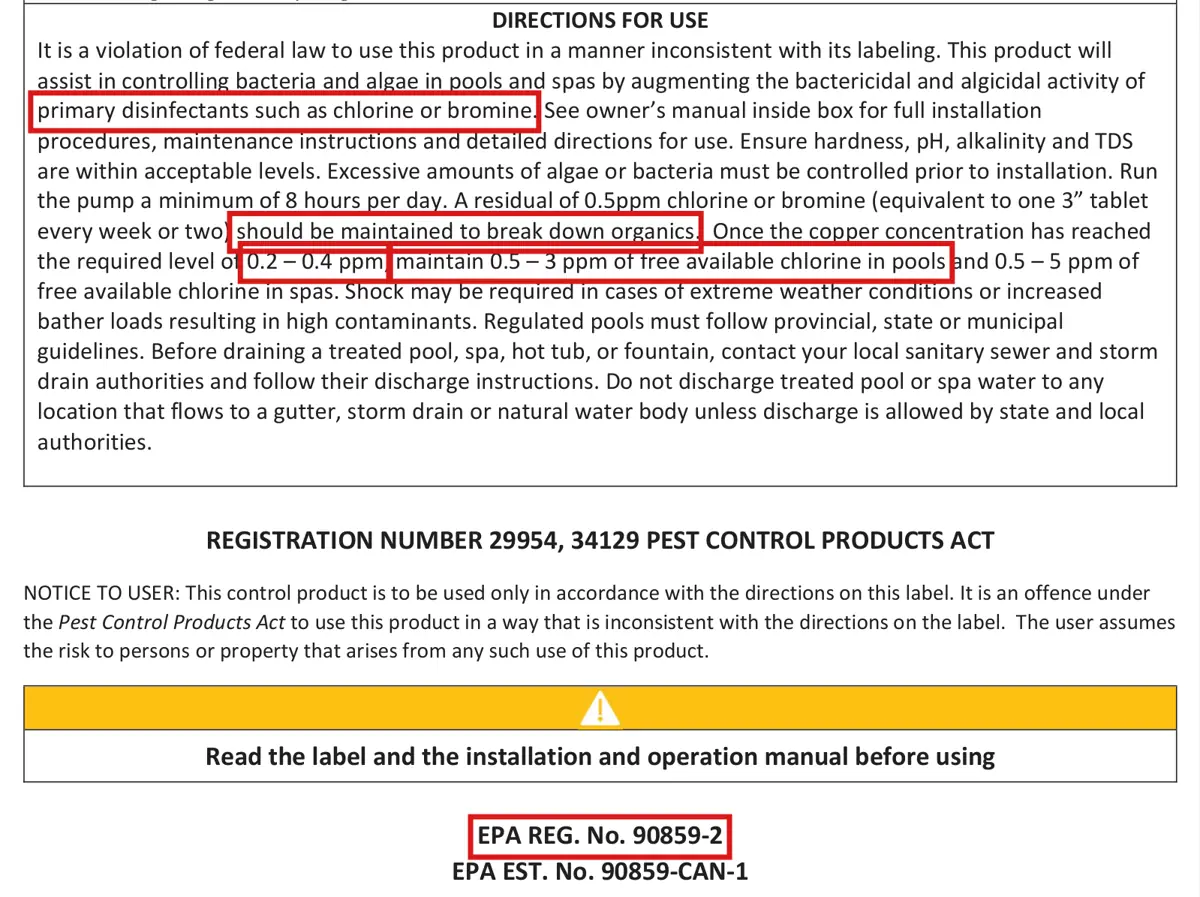
- Every pool ionizer or mineral label we read keeps a sanitizer in the water: the ClearBlue label (EPA Reg. No. 90859-2) says 0.5 to 3 ppm free chlorine once copper reaches 0.2 to 0.4 ppm.
- CDC’s home pool guidance still asks for at least 1 ppm free chlorine, 2 ppm with stabilizer, and the 2024 MAHC keeps those levels for public pools with ion systems (5.7.3.2.3.3).
- Copper staining may start above 0.6 ppm (Leslie‘s); Florida caps copper at 1 mg/L and the MAHC at 1.3 ppm for ion systems.
- In a 1990 test, copper and silver alone cut Staphylococcus by 0.03 log in 2 minutes, against 1.5 log for 1.0 mg/L chlorine (Yahya et al.).
- Prices on November 2, 2026: Mineral Lion by ClearBlue kits $349.99 to $599.99 (Think Minerals), the Floatron solar unit $299.00 (floatron.com).
What is a pool ionizer and what does a pool ionizer do?
A pool ionizer is a device that releases copper ions, and on some models silver ions, into the water. Copper slows algae at 0.2 to 0.4 ppm on three registered labels and silver adds bacteria control, but neither oxidizes sweat, urine or sunscreen, so chlorine or another sanitizer stays in the pool. EPA registers ionizers as pesticides when they claim to control algae or bacteria.
The labels describe the job narrowly. The Blue Torrent label (101907-1) says the copper ions bind with organic matter to kill algae, and the ClearBlue label says the system assists in controlling bacteria and algae by augmenting the activity of primary disinfectants such as chlorine or bromine. Neither claims to replace chlorine.
Registration follows from the ions. Under FIFRA sections 2(h) and 2(u), EPA’s pesticide devices guide says products that generate metal ions, such as silver, to control microorganisms are generally pesticides, not devices, so they need an EPA Registration Number. An EPA Establishment Number on the box only identifies the factory, and EPA says it does not mean the product was reviewed.
How does a pool ionizer work?
Current runs through copper, or copper and silver, electrodes; the metal dissolves into the water as ions. An inline unit puts the cell in a tee on the return line and a controller sets how long it runs. A solar unit floats, and its panel powers an anode in a basket underneath. Copper builds over days: 11 days to reach 0.20 ppm in one 1992 test.
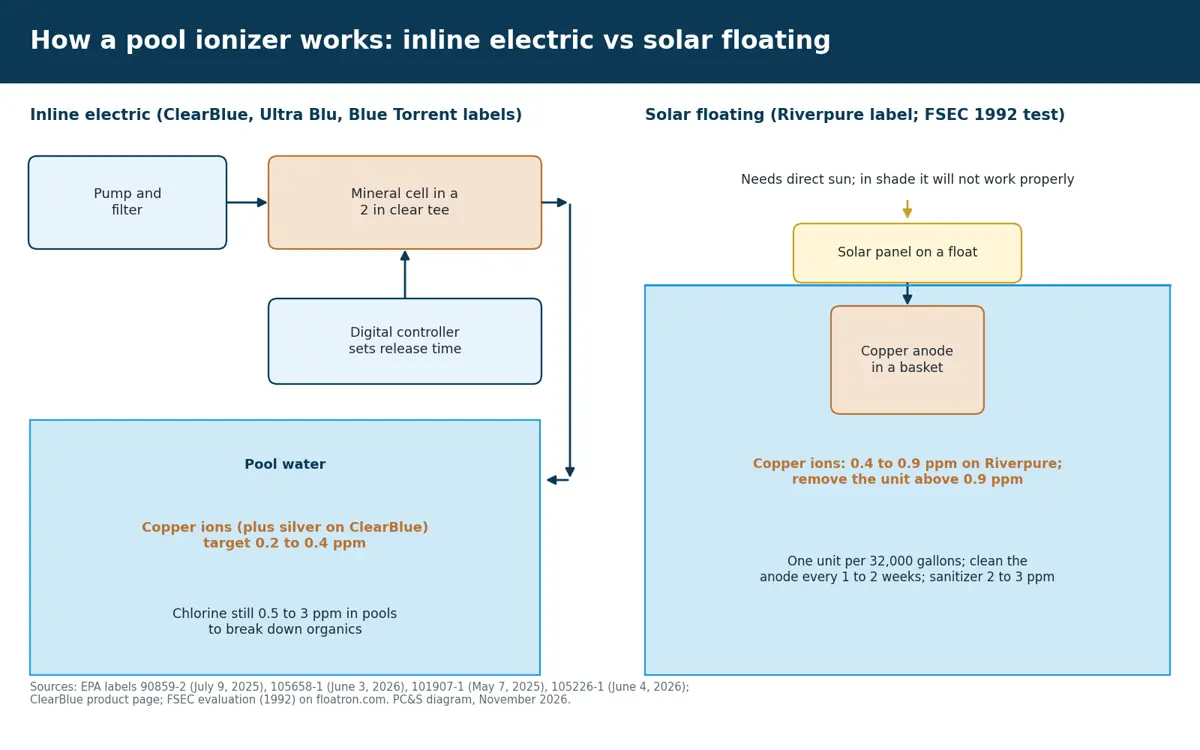
- Start with clear, balanced waterLabels require algae and bacteria under control first; Blue Torrent says to remove iron and let a new Marcite (plaster) finish cure 90 days.
- Keep normal chlorine while copper buildsClearBlue: do not reduce chlorine until copper reaches 0.2 ppm. In a 1992 Florida Solar Energy Center test, copper took 11 days to reach 0.20 ppm.
- Run the pump long enoughThe ClearBlue label sets a minimum of 8 hours a day; a solar unit works only in direct sun.
- Test copper weeklyHold 0.2 to 0.4 ppm on the inline labels; Riverpure holds 0.4 to 0.9 ppm and removes the unit above 0.9.
- Then drop chlorine to the label range, not to zero0.5 to 3 ppm free chlorine on the inline labels; CDC’s home minimum is 1 ppm, 2 ppm with stabilizer.
- Clean or replace the copperRiverpure: clean the anode every 1 to 2 weeks. ClearBlue: change the cell before each season or at least every 6 months.
Low dissolved solids slow the process. The Blue Torrent label says an ion residual is hard to build when TDS is under 1,000 ppm, and suggests raising it with pool salt; ClearBlue’s controller flags low TDS through its indicator light. Phosphates matter too: the ClearBlue, Ultra BLU and Blue Torrent labels list phosphates under 100 ppb for best results, and how to test and remove them is in our phosphates in pool guide.
Is a pool ionizer EPA registered?
Some are. On November 2, 2026, EPA’s label system listed four active pool ionizer registrations with elemental copper, three inline and one solar, plus one solar unit that went inactive in 2022. A name search for Floatron returned no product names, and the seller of Mineral Lion lists its EPA registration as in progress.
| EPA Reg. No. | Product (other brand names on the record) | Type | Active ingredient | Status (PPLS, Nov 2, 2026) | Label copper target | Label sanitizer rule | Label file |
|---|---|---|---|---|---|---|---|
| 90859-2 | ClearBlue Ionizer (ClearStream Ionizer, Bullion Mineral System, Platinum Pure, Zing) | Inline electric | Copper 85%, silver 5% | Active; registered Oct 18, 2024 | 0.2 to 0.4 ppm | 0.5 to 3 ppm free chlorine in pools (0.5 to 5 in spas) once copper reaches 0.2 | July 9, 2025 |
| 101907-1 | Blue Torrent Pool Products Ionizer (Chlor No More, Smart Salt, IClean, Simple Salt, Black & Decker Ionizer) | Pump with built-in ionizer | Copper 99.9% | Active; conditional registration May 7, 2025 | 0.2 to 0.4 ppm | 0.5 to 3 ppm free chlorine in pools | May 7, 2025 |
| 105658-1 | Ultra BLU Ionizer | Inline electric | Copper 99.9% | Active; unconditional registration June 3, 2026 | 0.2 to 0.4 ppm | 0.5 to 3 ppm free chlorine in pools | June 3, 2026 |
| 105226-1 | Riverpure Solar Pool Ionizer (model 5BM2) | Solar floating | Copper 99.9% | Active; unconditional registration June 4, 2026 | 0.4 to 0.9 ppm; remove unit above 0.9 | Sanitizer 2 to 3 ppm | June 4, 2026 |
| 95407-1 | AK600 Solar Pool Ionizer | Solar floating | Copper 99.75% | Inactive since Aug 11, 2022 (conditional 2020) | 0.2 to 0.5 ppm; never above 1.0 | 1.5 to 3.0 ppm at start, then 1.0 to 2.0 ppm | Dec 3, 2020 |
| 67712-1 | Nature2 G45-VC40 (Nature2 Fusion, TruGuard) | Mineral cartridge, no power | Copper sulfate pentahydrate 8.23%, silver 3.51% | Active | Not stated | With 0.5 ppm chlorine; change cartridge every 4 or 6 months | Mar 28, 2024 |
| 53735-11 | Pool Frog Mineral Reservoir (FROG @ease, Flippin' Frog and others) | Mineral cartridge, no power | Silver chloride 0.5% | Active | Not stated | At least 0.5 (to 1.0) ppm chlorine | Mar 13, 2025 |
| 68250-1 and 71898-1 | LiquiTech Liquidator; EPI Ionization Systems 70/30 | Building water systems, not pools | Copper 70%, silver 30% | Active | Not for pools | Potable water, Legionella pneumophila | 2013; Mar 26, 2026 |
Sources: EPA PPLS name search IONIZ; labels 90859-2, 101907-1, 105658-1, 105226-1, 95407-1, 67712-1, 53735-11, 68250-1, 71898-1. Download CSV
Method: we pulled every product name containing ‘ioniz’ from the label system (33 names on 22 registration numbers) and opened each record. Two of the names belong to chemicals, not devices: ‘Power Ionizer Protect 30’ is a brand name on Combat 30, a polyquat algaecide (57787-2), and ‘Old Man Winter ionizing orb’ sits on a copper sulfate registration (71146-2). Read the registration number, not the product name.
Registration status differs too. Blue Torrent holds a conditional registration under FIFRA section 3(c)(7)(A), issued May 7, 2025; Ultra BLU (June 3, 2026) and Riverpure (June 4, 2026) are unconditional under section 3(c)(5). The AK600 solar unit was conditionally registered in 2020 and has been inactive since August 11, 2022. A PPLS search for Floatron returned 0 product names.
Do you still need chlorine with a pool ionizer?
Yes. The three inline labels keep 0.5 to 3 ppm free chlorine in pools once copper reaches 0.2 to 0.4 ppm, the Riverpure solar label keeps a 2 to 3 ppm sanitizer, and mineral cartridges such as Nature2 and Pool Frog are registered for use with 0.5 ppm chlorine. CDC’s home minimum is 1 ppm, 2 ppm with stabilizer.
| Claim | Where it appears | What the labels, CDC and the MAHC say |
|---|---|---|
| With an ionizer, chlorine only needs to be 0.5 to 1 ppm | Swim University ionizer guide | Three inline labels allow 0.5 to 3 ppm; CDC sets at least 1 ppm for home pools, 2 ppm with stabilizer |
| Keep chlorine around 0.5 ppm | Beatbot ionizer guide | Nature2 and Frog labels allow 0.5 ppm; CDC's home minimum is 1 ppm |
| Mineral pools run 0.5 ppm chlorine | Pool Research chemistry page | MAHC 5.7.3.2.3.3 keeps public pools at full chlorine (1.0 ppm, 2.0 with stabilizer) with ion systems |
| After the ions build up, chlorine can drop to about half its normal level, or about 0.5 ppm | Floatron instructions | Riverpure, the registered solar unit, lists a sanitizer level of 2 to 3 ppm |
| Chlorine is needed only until copper reaches 0.3 to 0.5 ppm | One passage in the Blue Torrent label's manual section | The same label's directions for use say to maintain 0.5 to 3 ppm free chlorine once copper reaches 0.2 to 0.4 ppm |
Guides: Swim University; Beatbot; Pool Research; Floatron instructions. Primary: labels 90859-2, 105658-1, 101907-1, 105226-1, 67712-1, 53735-11; CDC; MAHC 5.7.3.2.3.3. Download CSV
The reason is oxidation and speed. Ions do not break down the sweat and urine that turn chlorine into chloramines, and they do not shorten the 10.6 days CDC says 1 ppm chlorine needs to kill Crypto, summarized in our pool hygiene statistics report. Chlorine doses by pool size are in our guide on how much chlorine to add to a pool.
What copper level should a pool ionizer keep, and when does it stain?
Hold copper where your label says: 0.2 to 0.4 ppm on the ClearBlue, Ultra BLU and Blue Torrent labels, 0.4 to 0.9 ppm on Riverpure. Staining may start above 0.6 ppm per Leslie’s, EPA links 1.0 mg/L copper to blue-green staining, and the MAHC caps ion systems at 1.3 ppm. Test copper at least weekly.
Source: EPA labels 90859-2, 105658-1, 101907-1, 95407-1, 105226-1; Floatron instructions (read Nov 2, 2026). Download chart data (CSV)
| Copper (ppm) | What it means | Source |
|---|---|---|
| 0 to 0.1 | Normal starting trace before an ionizer runs | Floatron instructions |
| 0.2 to 0.4 | Working range on three inline labels; do not cut chlorine below 0.2 | EPA labels 90859-2, 105658-1, 101907-1 |
| 0.3 (remove at 0.5) | Floatron target; take the unit out for a week at 0.5 or more | Floatron instructions |
| 0.4 to 0.9 | Riverpure solar working range; remove the unit above 0.9 | EPA label 105226-1 |
| Above 0.6 | Staining may occur | Leslie's |
| 1.0 | EPA staining benchmark (blue-green); Florida public pool maximum; AK600 label ceiling | EPA secondary standards; 64E-9.004(1)(d)6; EPA label 95407-1 |
| 1.3 | Maximum for copper ion systems at public pools that follow the MAHC | 2024 MAHC 5.7.3.2.3.2 |
Sources: Floatron instructions; EPA labels 90859-2, 105658-1, 101907-1, 105226-1, 95407-1; Leslie‘s; EPA secondary standards; Florida 64E-9.004; 2024 MAHC. Download CSV
Source: Leslie's; EPA label 105226-1; EPA secondary standards (May 2026); Florida 64E-9.004; EPA label 95407-1; 2024 MAHC 5.7.3.2.3.2. Download chart data (CSV)
Water balance changes the risk. The Blue Torrent label (101907-1) says stabilizer is not needed and may react with high copper to cause purple stains, so keep stabilizer at the 30 to 50 ppm most chlorine guidance uses (our cyanuric acid guide has the drain math), and the MAHC Annex warns against adding copper algaecides to an ionized pool and notes that copper speeds trihalomethane formation during chlorination. Removing stains that already formed is covered in our pool stains guide.
Do pool ionizers really work?
For algae and bacteria alongside chlorine, the evidence is decent; on their own, ions are slow. In a 1990 lab test, copper and silver with 0.3 mg/L chlorine matched 1.0 mg/L chlorine on bacteria counts, but ions alone cut Staphylococcus by only 0.03 log in 2 minutes. The MAHC Annex finds little data on viruses and parasites.
Source: Yahya MT et al. Can J Microbiol 1990;36(2):109-16 (PubMed 2337833). Download chart data (CSV)
The pool study behind most claims is Yahya et al. (1990): 400 micrograms/L copper and 40 micrograms/L silver, run for 4 weeks in 100 L systems seeded with body flora and urine. With 0.3 mg/L chlorine, counts stayed under drinking water standards, the same as 1.0 mg/L chlorine alone. The MAHC Annex (4.7.3.4.4) says such data cover mostly bacteria and usually include free chlorine.
Building water shows both sides. A 2016 systematic review of 4 studies found copper-silver ionization cut Legionella-positive samples by 95% (risk ratio 0.05), while rating the evidence low quality. A CDC-led investigation of a Pennsylvania hospital running copper-silver ionization counted 22 Legionnaires’ cases and 6 deaths in 2011 to 2012, with ion levels at or above the maker’s target and Legionella growing in every sample tested for ions.
EPA registers two copper-silver systems for Legionella in drinking water plumbing, LiquiTech’s Liquidator (68250-1) and EPI’s 70/30 (71898-1), both with 70% copper and 30% silver. Neither is registered for pools, and neither label replaces a disinfectant residual in a pool.
Does a solar pool ionizer really work?
A solar pool ionizer can hold copper in the label range in a sunny pool, but it needs direct sun, regular anode cleaning and a sanitizer. The one active registration, Riverpure (105226-1), covers 32,000 gallons per unit and keeps a 2 to 3 ppm sanitizer. The best-known field test is one Florida pool from 1992.
That test was run by the Florida Solar Energy Center over eight weeks from May 3 to June 28, 1992 and is republished on the Floatron site. Copper reached 0.05 ppm after 7 days and 0.20 ppm after 11 days, the pool stayed clear for over a week with no measurable chlorine, and the authors found best results with a trace of chlorine. It tracked clarity and algae in one pool, not pathogens.
The Riverpure label lists the conditions: float the unit in direct sunlight, clean the copper anode every 1 to 2 weeks, test copper weekly, remove it during shock treatments and above 0.9 ppm copper, and reinstall when copper falls below 0.4 ppm. In the shady end of a pool, the label says, it will not work properly.
Before buying a floating unit, check the box for an EPA Reg. No. and look it up in the label system. Solar ionizers sold online are listed at $59.99 to $129.99 in a seller comparison table dated November 2, 2026; the Florida-tested Floatron sells for $299.00 on its maker’s site.
How much does a pool ionizer cost?
On November 2, 2026, inline kits ran $349.99 to $599.99 for Mineral Lion by ClearBlue and $399.99 to $899.00 for the registered ClearBlue System; the Floatron solar unit cost $299.00. The recurring cost is copper: cells at $128.99 to $249.99, a $64.00 Floatron electrode, or Nature2 cartridges at $243.99 to $250.85.
| Product | Type | Price (USD) | Seller and date | Ongoing part |
|---|---|---|---|---|
| Mineral Lion by ClearBlue, above-ground kit | Inline electric | 349.99 | Think Minerals, Nov 2, 2026 | Standard cell 128.99 (up to 6 months); long-life cell 229.99 (up to 12 months) |
| Mineral Lion by ClearBlue, 25,000 gallon kit | Inline electric | 399.99 | Think Minerals, Nov 2, 2026 | Same cells |
| Mineral Lion by ClearBlue, 40,000 gallon kit | Inline electric | 599.99 | Think Minerals, Nov 2, 2026 | Same cells |
| ClearBlue System (registered 90859-2) | Inline electric | 399.99 to 899.00 | Think Minerals comparison table, Nov 2, 2026 | Cells 149.99, 179.99 or 249.99 |
| Floatron solar purifier | Solar floating | 299.00 | floatron.com store, Nov 2, 2026 | Mineral electrode 64.00; ion test kit 14.00 |
| Nature2 Fusion / DuoClear 25,000 gallon cartridge (W28000) | Mineral cartridge | 243.99 to 250.85 | Inyo Pools and Poolweb, Nov 2, 2026 | Replace every 4 or 6 months per label |
| Generic solar ionizers | Solar floating | 59.99 to 129.99 | Think Minerals comparison table, Nov 2, 2026 | Copper bars 99.99 (same table) |
Sources: Think Minerals product page and comparison table; Floatron store; Inyo Pools W28000; Poolweb W28000; EPA label 67712-1 (cartridge life). Download CSV
| System (25,000 gallon pool, one 6-month season a year) | Year 1 | Year 2 | Two-year total | Arithmetic |
|---|---|---|---|---|
| Mineral Lion 25,000 gallon kit | 399.99 | 128.99 | 528.98 | Kit includes a standard cell (up to 6 months); one standard cell in year 2 |
| Floatron solar purifier | 299.00 | 64.00 | 363.00 | One replacement electrode in year 2 (PC&S assumption: one per season) |
| Nature2 W28000 cartridge only | 243.99 | 243.99 | 487.98 | One cartridge per 6-month season at the Inyo price; housing not included |
Sources: Think Minerals; Floatron store; Inyo Pools; PC&S arithmetic. Excludes chlorine, copper test strips and installation. Download CSV
Chlorine savings are maker claims, not test results: the seller’s table claims up to 60% less chlorine for Mineral Lion, 80% for ClearBlue and 50% for solar units, and the Pool Frog label claims up to 50%. The 1992 Florida test reported 75 to 85% less chlorine in one pool. Whatever the saving, the chlorine you keep must stay at the label and CDC minimums.
Are pool ionizers allowed at public and HOA pools?
Yes, as a supplement only. The 2024 MAHC allows EPA-registered copper and silver systems up to 1.3 ppm copper and 0.10 ppm silver, keeps the normal chlorine minimums and requires daily copper and silver tests. Florida caps copper at 1 mg/L and silver at 0.1 mg/L, and Texas and California still require full chlorine.
| Rule | 2024 MAHC | Florida 64E-9.004 | Texas 25 TAC 265.193 | California 22 CCR 65529 |
|---|---|---|---|---|
| Registration | EPA-registered systems only (5.7.3.2.3.1) | Chemicals NSF/ANSI 60 or 50 approved ((1)(d)) | Sanitizers must be EPA-registered ((a)) | Other methods only if the enforcing agent accepts them ((d)) |
| Copper maximum | 1.3 ppm | 1 mg/L | Not set | Not set |
| Silver maximum | 0.10 ppm | 0.1 mg/L | Not set | Not set |
| Chlorine still required | Yes: 1.0 ppm, 2.0 with stabilizer (5.7.3.2.3.3) | Yes: 1 to 10 mg/L in conventional pools | Yes: 1.0 ppm minimum, 2.0 to 3.0 ideal | Yes: 1.0 ppm, 2.0 with stabilizer |
| Testing | Copper and silver daily (5.7.5.12) | Copper test kit on site; silver analysis every 6 months | Not set | Not set |
Sources: 2024 MAHC 5.7.3.2.3 and 5.7.5.12; Fla. Admin. Code 64E-9.004 (eff. June 11, 2023); 25 TAC 265.193; 22 CCR 65529. Download CSV
Want a pro to set up and test a mineral system?
Should you buy a pool ionizer?
Buy one if you want fewer algae problems and less chlorine use, will test copper weekly to hold 0.2 to 0.4 ppm and keep chlorine at the label and CDC minimum of 1 ppm. Skip it if you hope to drop chlorine entirely, have fresh plaster or metal-rich fill water, or plan to keep using copper algaecide. The table lists the thresholds.
| If your situation is | Do this | Rule behind it |
|---|---|---|
| You want to stop using chlorine | Do not count on an ionizer for that; keep at least 1 ppm free chlorine (2 ppm with stabilizer) | Every pool label read requires a sanitizer; CDC minimums |
| You run an HOA, hotel or apartment pool | Use an EPA-registered system only, test copper daily, keep full chlorine | MAHC 5.7.3.2.3 and 5.7.5.12; Florida 64E-9.004 |
| You are buying a floating solar unit online | Look for an EPA Reg. No. on the box; an establishment number alone is not a registration | EPA pesticide devices guide |
| New plaster (Marcite) pool | Wait 90 days of cure before running copper | Blue Torrent label 101907-1 |
| Fill water carries iron or other metals | Remove iron before starting the ionizer | Blue Torrent label 101907-1 |
| You also use a copper algaecide | Switch to a polyquat or stop the algaecide | MAHC Annex 5.7.3.2.3 |
| Copper reads above 0.6 ppm | Turn output down or pull the unit; watch for blue-green stains | Leslie's; EPA secondary standards |
| Copper reads above 0.9 ppm on a Riverpure unit | Remove it until copper falls below 0.4 ppm | EPA label 105226-1 |
| Pool sits in shade most of the day | Choose an inline unit; solar output drops in shade | Riverpure label |
Sources: CDC; MAHC; MAHC Annex; 64E-9.004; EPA devices guide; labels 101907-1, 105226-1; Leslie‘s; EPA. Download CSV
| Number | What it is | Source |
|---|---|---|
| 4 + 1 | Active pool ionizer registrations with elemental copper, plus one inactive solar unit, in a PPLS name search | EPA PPLS, Nov 2, 2026 |
| 0.2 to 0.4 ppm | Copper working range on the ClearBlue, Ultra BLU and Blue Torrent labels | EPA labels |
| 0.5 to 3 ppm | Free chlorine the same three labels keep in pools | EPA labels |
| 1 ppm / 2 ppm | CDC minimum free chlorine for home pools without / with stabilizer | CDC |
| 1.3 / 0.10 ppm | MAHC copper / silver maximum for ion systems | MAHC 5.7.3.2.3.2 |
| 0.03 vs 2.4 log | Staphylococcus reduction in 2 minutes: copper and silver alone vs with 0.3 mg/L chlorine | Yahya et al. 1990 |
| 10.6 days | Time 1 ppm chlorine needs to kill Crypto; ions do not shorten it | CDC |
Sources: EPA PPLS; EPA labels; CDC; MAHC; Yahya et al. 1990. Download CSV
Copper and chlorine are two lines on the same test. All 17 target ranges for a home pool, from pH to stabilizer, sit on one page in our pool chemical levels chart, and a salt chlorinator can run alongside an ionizer; cell care is covered in our salt water pool maintenance guide. Copper algaecide alternatives are compared in our pool algaecide guide.
How we compiled this
On November 2, 2026 we searched EPA’s Pesticide Product and Label System, opened 20 registration records and read 9 EPA label files, the 2024 MAHC Code and Annex, Florida 64E-9.004, California 22 CCR 65529 and Texas 25 TAC 265.193, three PubMed abstracts and EPA guidance. Prices come from maker and retailer pages on the same day. We did not test any ionizer; maker claims are labeled as claims, and forum reviews were excluded.
Frequently Asked Questions
What does a pool ionizer do?
It releases copper ions, and on some models silver ions, that slow algae and help chlorine control bacteria. It does not oxidize, so it cannot replace chlorine: the ClearBlue label (EPA Reg. No. 90859-2) keeps 0.5 to 3 ppm free chlorine once copper reaches 0.2 to 0.4 ppm.
How does a pool ionizer work?
Current passes through copper, or copper and silver, electrodes and the metal dissolves as ions. Inline units sit in a tee on the return line with a controller; solar units float and power an anode with a small panel. In a 1992 Florida test, copper took 11 days to reach 0.20 ppm.
Does a solar pool ionizer really work?
It can keep copper in range in a sunny pool, but it needs a sanitizer and upkeep. The registered Riverpure unit (105226-1) covers 32,000 gallons, needs direct sun, anode cleaning every 1 to 2 weeks and a 2 to 3 ppm sanitizer, and must come out when copper passes 0.9 ppm.
Can I stop using chlorine with an ionizer?
No. Every pool ionizer and mineral label we read keeps a sanitizer, from 0.5 ppm on Nature2 and Pool Frog to 2 to 3 ppm on Riverpure, and CDC asks home pools to hold at least 1 ppm free chlorine, 2 ppm with stabilizer. Public pools under the MAHC keep full chlorine levels.
Will a copper ionizer turn my pool green or stain it?
It can if copper runs high. Leslie’s says staining may occur above 0.6 ppm, EPA links 1.0 mg/L copper to blue-green staining, and the Blue Torrent label warns that stabilizer may react with high copper to leave purple stains. Holding 0.2 to 0.4 ppm and testing weekly keeps you under those lines.
Is it safe to swim in a pool with a copper ionizer?
At label levels, copper sits well under the MAHC cap of 1.3 ppm for public pools, the same figure the MAHC Annex cites as EPA’s drinking water standard. The labels list the device as toxic to aquatic organisms, so follow local drain rules. Keep chlorine at CDC minimums for germ control.
What is the difference between an ionizer and a mineral system?
An ionizer makes copper or silver ions with electricity, from a plug or a solar panel. A mineral cartridge, such as Nature2 (67712-1) with copper and silver or Pool Frog (53735-11) with silver chloride, dissolves slowly with no power and is replaced every 4 to 6 months on the Nature2 label.
Sources
- U.S. EPA. Pesticide Product and Label System, product name search IONIZ (Nov 2, 2026). Accessed 2026-11-02.
- U.S. EPA. Pesticide Product and Label System, product name search FLOATRON (Nov 2, 2026). Accessed 2026-11-02.
- U.S. EPA PPLS. ClearBlue Ionizer, EPA Reg. No. 90859-2, label file July 9, 2025. Accessed 2026-11-02.
- U.S. EPA PPLS. Blue Torrent Pool Products Ionizer, EPA Reg. No. 101907-1, notice and label May 7, 2025. Accessed 2026-11-02.
- U.S. EPA PPLS. Ultra BLU Ionizer, EPA Reg. No. 105658-1, notice and label June 3, 2026. Accessed 2026-11-02.
- U.S. EPA PPLS. Riverpure Solar Pool Ionizer, EPA Reg. No. 105226-1, notice and label June 4, 2026. Accessed 2026-11-02.
- U.S. EPA PPLS. AK600 Solar Pool Ionizer, EPA Reg. No. 95407-1, notice and label Dec 3, 2020. Accessed 2026-11-02.
- U.S. EPA PPLS. Nature2 G45-VC40, EPA Reg. No. 67712-1, label file Mar 28, 2024. Accessed 2026-11-02.
- U.S. EPA PPLS. Pool Frog Mineral Reservoir, EPA Reg. No. 53735-11, label file Mar 13, 2025. Accessed 2026-11-02.
- U.S. EPA PPLS. Liquidator Electronic Ionization System, EPA Reg. No. 68250-1, label April 18, 2013. Accessed 2026-11-02.
- U.S. EPA PPLS. EPI Ionization Systems 70/30, EPA Reg. No. 71898-1, label file Mar 26, 2026. Accessed 2026-11-02.
- U.S. EPA. Pesticide Devices: A Guide for Consumers. Accessed 2026-11-02.
- CDC. 2024 Model Aquatic Health Code, 5th Edition, Code Language. Accessed 2026-11-02.
- CDC. 2024 Model Aquatic Health Code, 5th Edition, Annex. Accessed 2026-11-02.
- CDC. Home Pool and Hot Tub Water Treatment and Testing (updated May 10, 2024). Accessed 2026-11-02.
- Florida Department of Health. Rule 64E-9.004, F.A.C., Operational Requirements (effective June 11, 2023). Accessed 2026-11-02.
- Texas Department of State Health Services. 25 TAC Chapter 265, Subchapter L, 265.193. Accessed 2026-11-02.
- California Code of Regulations via Cornell LII. Cal. Code Regs. tit. 22, 65529 Public Pool Disinfection. Accessed 2026-11-02.
- U.S. EPA. Secondary Drinking Water Standards: Guidance for Nuisance Chemicals. Accessed 2026-11-02.
- PubMed. Yahya MT et al. Disinfection of bacteria in water systems by using electrolytically generated copper:silver and reduced levels of free chlorine. Can J Microbiol 1990;36(2):109-16. Accessed 2026-11-02.
- PubMed. Demirjian A et al. Legionnaires' disease outbreak in a hospital with a Legionella disinfection system, Pennsylvania, 2011 to 2012. Clin Infect Dis 2015;60(11):1596-602. Accessed 2026-11-02.
- PubMed. Almeida D et al. Interventions to prevent hospital-acquired Legionnaires' disease: a systematic review. Am J Infect Control 2016;44(11):e183-e188. Accessed 2026-11-02.
- Floatron (maker-hosted copy). Performance Evaluation of Solar Powered Pool Purification Device (Florida Solar Energy Center, 1992). Accessed 2026-11-02.
- Floatron. Floatron instructions. Accessed 2026-11-02.
- Floatron. Floatron online store. Accessed 2026-11-02.
- Think Minerals. Mineral Lion Pool Ionizer by ClearBlue Ionizer. Accessed 2026-11-02.
- ClearBlue Ionizer. ClearBlue Ionizer home page. Accessed 2026-11-02.
- Inyo Pools. DuoClear 25 Inground Cartridge (W28000). Accessed 2026-11-02.
- Poolweb. Nature2 Fusion/Duoclear 25K Replacement Cartridge. Accessed 2026-11-02.
- Leslie's. How to Treat Black Algae in Your Pool. Accessed 2026-11-01.
Related pages
Get Quotes From Licensed Local Pool Pros
Tell us what you need and your ZIP code. We match you with pool companies that cover your area.