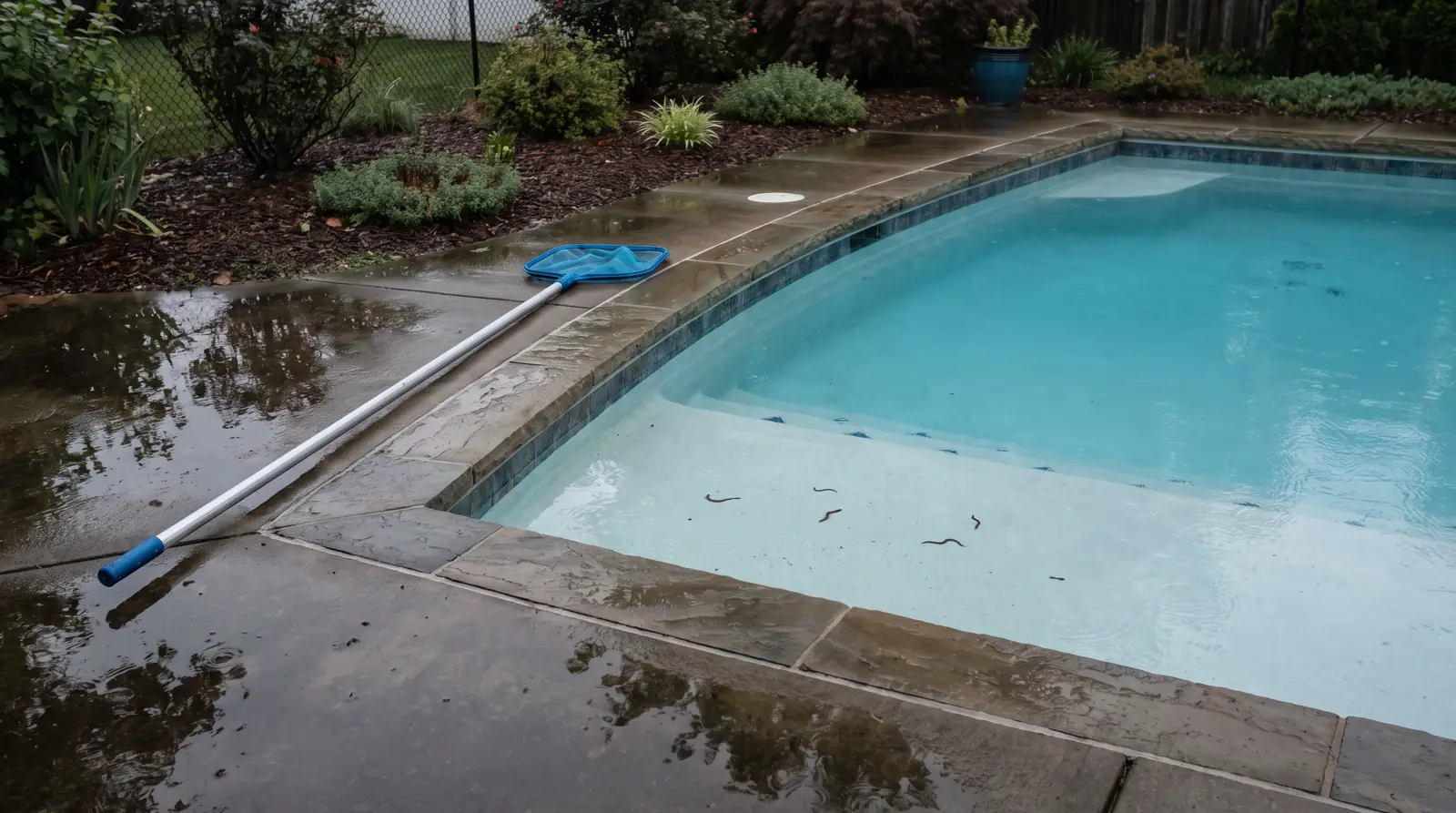
Worms in Pool Water: Earthworms, Red Bloodworms or Horsehair Worms, and How to Stop Them
Worms in pool water are usually earthworms driven out of saturated soil by rain, red midge larvae called bloodworms, or horsehair worms: net them out, divert runoff, and keep the water circulating and chlorinated.
- ✓Rain brings earthwormsSaturated soil drives them to the surface (Cornell; UC IPM).
- ✓Red means midgesBloodworms are harmless midge larvae in still water (MDC).
- ✓No pesticidesRemove, clean and circulate; never treat pool water with insecticide.
Key takeaways
- Earthworms end up in pools after rain because saturated soil drives them to the surface, sometimes over considerable distances (Cornell Waste Management Institute); UC IPM says they rise after rain or irrigation (UC IPM).
- Little red worms are bloodworms, the larvae of non-biting midges (Chironomidae); the Missouri Department of Conservation says both larvae and adults are harmless and adults do not bite (MDC).
- Horsehair worms, 4 to 14 inches long and hair-thin, turn up in swimming pools after leaving a cricket host; they parasitize only insects and need no control (Iowa State Extension; UC IPM).
- Wrigglers that hang under the surface are mosquito larvae, not worms: a Culex egg becomes a biting adult in 7 to 10 days (CDC).
- CDC says pinworm infections are rarely spread through recreational water, because a few eggs in thousands of gallons make infection unlikely (CDC, May 2025).
What kind of worms are in my pool?
Worms in a pool are almost always one of three animals: earthworms washed or crawling in after rain, red bloodworms (midge larvae) living in still, debris-rich spots, or horsehair worms that left a cricket host in the water. Mosquito larvae look like worms but are insects. Color, thickness and where they sit identify each one in seconds.
| What you see | What it is | Size | Why it is in the pool | Harmful? | Fix | Source |
|---|---|---|---|---|---|---|
| Pink or brownish-red segmented worms on the floor or steps, often after rain | Earthworm (family Lumbricidae, e.g. Lumbricus terrestris) | 3 to 4 in (leaf-litter species) to 8 to 10 in (nightcrawler) | Rain or irrigation saturates the soil and drives worms to the surface; they crawl across the deck and fall in | No | Net or vacuum them out; divert downspouts and let the soil dry | Cornell Waste Management Institute; UC IPM; MDC earthworms; UC Cooperative Extension Ventura County |
| Thin bright red worms that wriggle, often in corners, steps or on a cover | Bloodworm: larva of a non-biting midge (family Chironomidae) | Stream species usually 1/4 in or less | Midges lay eggs in water; larvae live on the bottom among debris where water is still | No: larvae and adults are harmless; adults do not bite | Brush, vacuum, clean the skimmer and filter, restore circulation and chlorine | Missouri Department of Conservation; Hong Kong LCSD and FEHD |
| Very long, hair-thin brown or black worm, often knotted | Horsehair (Gordian) worm, phylum Nematomorpha | 4 to 14 in long, 1/25 to 1/16 in wide | Leaves a cricket or grasshopper host that jumped into water to mate and lay eggs | No: parasitizes only insects | Remove by hand or with a net; no treatment needed | UC IPM; Iowa State; University of Kentucky; Mississippi State |
| Small wrigglers hanging under the surface | Mosquito larvae (not worms) | Small larvae | Eggs laid on unmaintained water; egg to biting adult in 7 to 10 days | Adults bite | Restore chlorine and circulation the same day | CDC |
Sources: Cornell Waste Management Institute, The Science of Composting, ch. 1; UC IPM earthworm; UC Cooperative Extension Ventura County; MDC midge fly larvae; Hong Kong government, Sept 1, 2004; UC IPM horsehair worms; Iowa State Extension; University of Kentucky ENTFACT-613; CDC. Accessed November 10, 2026. Download CSV
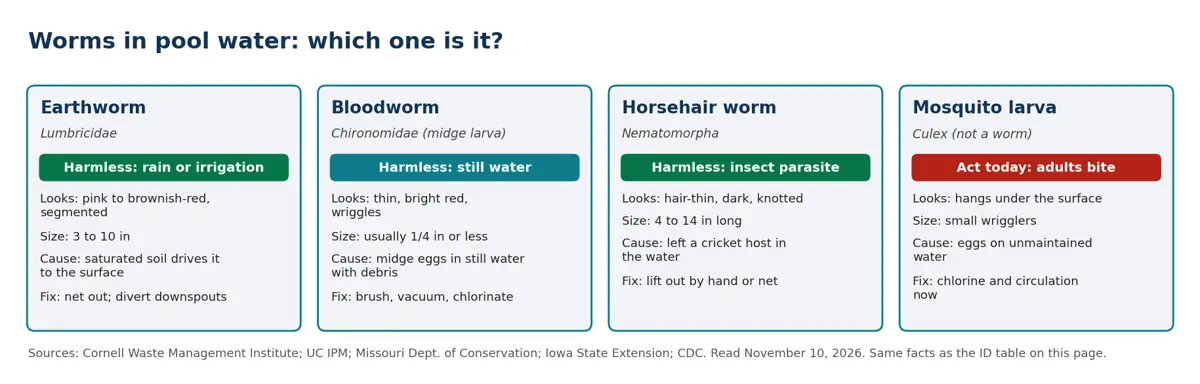
Source: Missouri Department of Conservation (midge larvae; earthworms); Iowa State Extension (horsehair worm, reviewed Oct 2022). Accessed November 10, 2026.. Download chart data (CSV)
Thickness is the fastest test. An earthworm is a soft, round, segmented tube; UC IPM describes the nightcrawler as brownish-red, up to a few inches long, with about 150 segments (UC IPM). The Missouri Department of Conservation puts leaf-litter species at 3 to 4 inches and the common nightcrawler at 8 to 10 inches (MDC earthworms). A bloodworm is a thin red thread a quarter inch long or less, and a horsehair worm is hair-thin but can reach a foot or more, often tied in a loose knot (UC IPM).
Why am I finding earthworms in my pool after it rains?
Because rain saturates the soil and earthworms leave it. Cornell’s Waste Management Institute says that under saturated soil conditions worms come to the surface, sometimes migrating considerable distances, and UC IPM says they rise to the surface or sidewalk after rain or irrigation. Worms crossing a wet deck beside the pool can drop over the coping into the water.
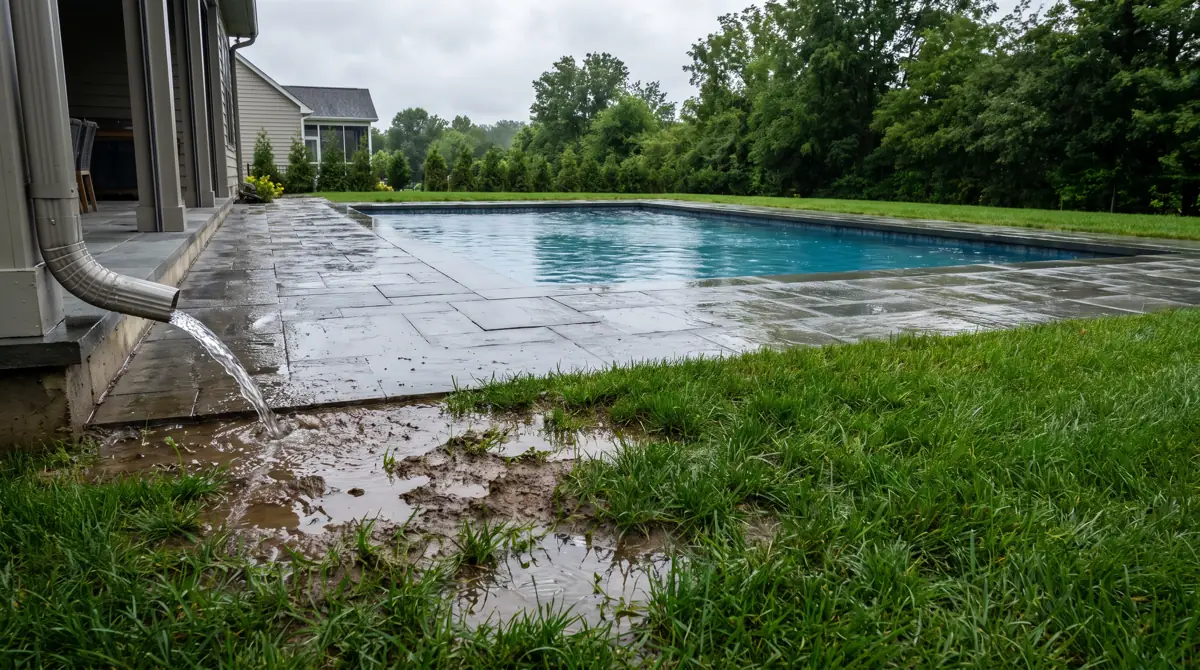
Earthworms breathe through their skin, which has to stay moist, and Cornell notes it is unknown whether low oxygen or chemicals in the soil water trigger the move (Cornell, The Science of Composting, chapter 1). The practical point is the same either way: the wetter the strip of soil next to the deck, the more worms cross it. UC Cooperative Extension in Ventura County advises keeping the area as dry as possible and diverting downspouts away from it (UC Ventura County).
Earthworms are not lawn pests, and UC IPM’s 2017 lawn guide says not to apply pesticides to control them (UC IPM). Never add an insecticide to pool water: the fix is runoff and irrigation, not poison.
What are the little red worms in my pool?
Little red worms in a pool are bloodworms, the larvae of non-biting midges in the family Chironomidae. The Missouri Department of Conservation says they can be clear, whitish, olive, tan or bright red, live on the bottom among leaves and debris, and are harmless, as are the adult midges, which do not bite. In a pool they point to still water and debris.
Midges are flies whose females lay eggs in water, and most of the life cycle is spent as larvae on the bottom eating decaying plant and animal matter and algae (MDC midges; MDC midge fly larvae). Stream species usually stay at 1/4 inch or less. MDC counts more than 7,300 described chironomid species worldwide.
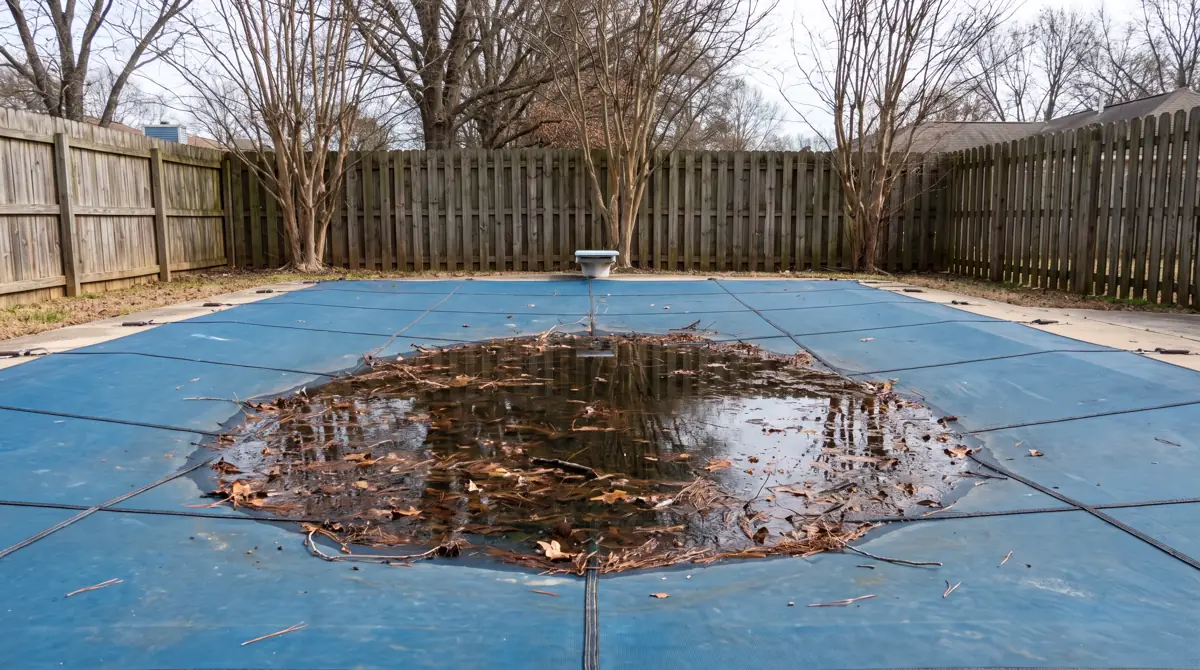
Pool cases follow the debris. When Hong Kong investigated bloodworms in public pools in 2004, the expert working group found no concrete evidence midges had bred in the pool water itself, but staff found more than 10 bloodworms under the artificial turf of a play feature, closed that pool, removed the turf and stepped up cleaning (Hong Kong government press release, September 1, 2004). At home the matching spots are the skimmer basket, the cover, step corners and any area the return jets do not reach.
Are long thread-like worms in a pool dangerous?
No. Long, hair-thin, often knotted worms in a pool are horsehair worms, 4 to 14 inches long and 1/25 to 1/16 inch wide (Iowa State Extension). They grow inside crickets and grasshoppers, leave the host in water to mate, and UC IPM says they parasitize only insects and are harmless to people, pets and plants. Lift them out with a net.
Mississippi State Extension explains why pools: adults turn up in water troughs, bird baths, swimming pools and puddles because they need water to mate and lay eggs (Mississippi State Extension, 2020). The University of Kentucky adds that a worm in a container means a cricket or other host insect got in and died, releasing it, and that there is no need for control (UK ENTFACT-613).
What kills worms in the pool, and how do you get rid of them?
Removal is the fix, not a worm poison. Net or vacuum earthworms and horsehair worms out the same day, brush and vacuum corners where red bloodworms gather, empty the skimmer, clean the filter and keep free chlorine at CDC’s 1 ppm floor, or 2 ppm with stabilizer. Then stop the source: runoff for earthworms, still water and debris for bloodworms.
- Net or vacuum them outUse a leaf net for earthworms and horsehair worms; vacuum red bloodworms from corners and steps.
- Empty the skimmer and pump basketsDead worms and leaves there are the debris bloodworm larvae feed on (MDC).
- Brush the walls, steps and cornersLarvae live on the bottom among debris; brushing puts it into circulation for the filter.
- Test and restore chlorineCDC sets at least 1 ppm free chlorine, or at least 2 ppm with cyanuric acid, and pH 7.0 to 7.8 for pools.
- Run the pumpCirculation removes the still water midges and mosquitoes need; mosquito eggs become adults in 7 to 10 days (CDC).
- Check for stainsGreen or brown marks where worms sat are organic stains; a vitamin C tablet held 2 minutes leaves them unchanged (Natural Chemistry).
Pump run times by season are in our guide to how long to run a pool pump, and the 2 minute vitamin C test and organic stain removal are covered in pool stains. If the water turned green along with the worms, follow how to get rid of algae in a pool first.
| Number | What it means | Source |
|---|---|---|
| About 150 | Segments on a nightcrawler earthworm, the common lawn species | UC IPM |
| 8 to 10 in | Common length of the common nightcrawler, Lumbricus terrestris | Missouri Department of Conservation |
| 1/4 in | Usual maximum length of stream bloodworm species; lake species can be larger | Missouri Department of Conservation |
| 1 to 3 years | Time most midge species spend as larvae in natural water | Missouri Department of Conservation |
| 7,300+ | Described chironomid midge species worldwide | Missouri Department of Conservation |
| 4 to 14 in | Length of a horsehair worm | Iowa State Extension |
| 1 ppm / 2 ppm | CDC minimum free chlorine in a pool, and with cyanuric acid | CDC |
| 7 to 10 days | Culex mosquito egg to adult, the clock on still water | CDC |
Sources: UC IPM; MDC; Iowa State Extension; CDC home pool water (May 2024); CDC Culex life cycle. Download CSV
How can I keep worms out of my pool?
Keep the soil beside the deck from staying saturated, keep pool water moving and clean, and close the pool at night after rain. UC IPM says letting the top layer of soil dry between irrigations drives earthworms deeper, and UC Cooperative Extension Ventura County says to divert downspouts away from the area. For bloodworms, remove still water and debris.
- Divert downspouts Send roof water away from the pool deck (UC Cooperative Extension Ventura County).
- Water the lawn less often Let the top layer dry between cycles; UC IPM says this drives worms deeper.
- Cover the pool after heavy rain A cover stops crossing worms from dropping in overnight; pump standing water off the cover afterward.
- Clear debris every week Leaves in corners and baskets feed midge larvae (MDC).
- Keep chlorine and circulation steady At least 1 ppm free chlorine, 2 ppm with stabilizer (CDC).
Deck slope and drainage that steer water away from the pool are covered in our pool landscaping ideas guide. Insects that arrive the same way, by flying to lights, are a different problem; water boatmen, backswimmers and 6 other insects are identified in our guide to water bugs in pool water.
Can you go to the pool if you have worms?
If the question is pinworms in people, CDC says pinworm infections are rarely spread through recreational water: pool chlorine does not kill pinworm eggs, but a small number of eggs in thousands of gallons makes infection unlikely. Handwashing with soap after the toilet is the main prevention. Earthworms, bloodworms and horsehair worms in the water do not infect swimmers.
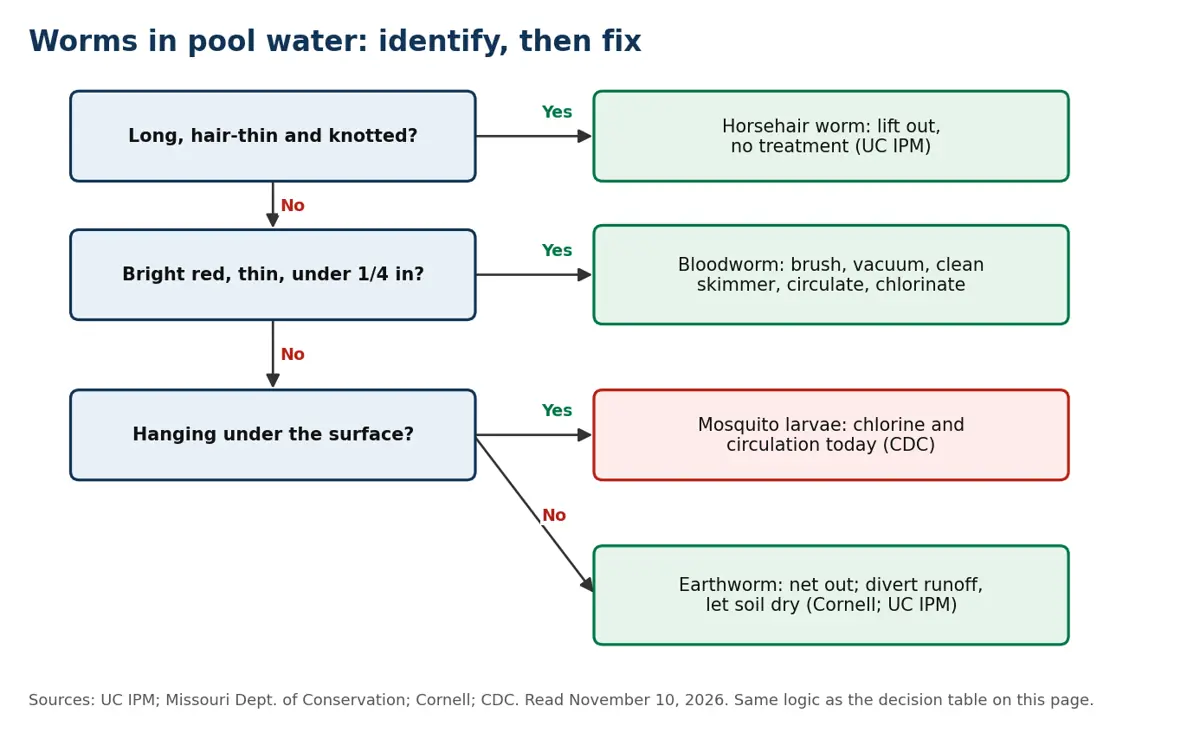
Which fix fits the worms you found?
Match the fix to the animal: runoff and irrigation for earthworms, cleaning and circulation for red bloodworms, a net for horsehair worms, and same-day chlorine for mosquito larvae. Check the deck for stains where worms sat, and run the vitamin C test before scrubbing.
| If your situation is | Do this | Why |
|---|---|---|
| Earthworms on the floor the morning after rain | Net or vacuum them out, then check where runoff reaches the deck | Worms surface when soil is saturated (Cornell; UC IPM) |
| Earthworms after every sprinkler cycle | Water less often so the top layer of soil dries between cycles | UC IPM: a dry top layer drives worms deeper |
| Downspouts or a lawn slope drain toward the pool | Divert the water away from the deck | UC Cooperative Extension Ventura County: keep the area dry, divert downspouts |
| Small red wriggling worms in corners or on the cover | Brush and vacuum, empty standing water on the cover, run the pump and test chlorine | Bloodworms live in still water with debris (MDC) |
| One long, knotted thread-like worm | Lift it out with a net | Horsehair worms are harmless and need no control (UC IPM; Iowa State) |
| Wrigglers hanging at the surface | Treat as mosquito larvae: chlorine and circulation today | Egg to adult takes 7 to 10 days (CDC) |
| Green or brown marks where worms lay | Vitamin C test for 2 minutes before scrubbing | Organic stains stay; metal stains lighten (Natural Chemistry) |
Sources: Cornell Waste Management Institute, The Science of Composting, ch. 1; UC IPM earthworm; UC Cooperative Extension Ventura County; MDC midge fly larvae; Hong Kong government, Sept 1, 2004; UC IPM horsehair worms; Iowa State Extension; University of Kentucky ENTFACT-613; CDC. Accessed November 10, 2026. Download CSV
How we compiled this
In November 2026 we read 12 primary documents: university extension pages and fact sheets from Cornell, UC IPM (2), UC Cooperative Extension Ventura County, Iowa State, the University of Kentucky and Mississippi State, three Missouri Department of Conservation field guides, a Hong Kong government release on pool bloodworms and a CDC page, plus CDC pool chlorine and mosquito figures already verified for our water bugs guide. Forum threads were used only for question wording. We did not collect or test any worms.
Frequently Asked Questions
Why am I finding worms in my pool?
Earthworms come up when rain or irrigation saturates the soil; Cornell’s Waste Management Institute says they surface and can travel considerable distances, so they cross the deck and fall in. Red worms are midge larvae (bloodworms) living in still water with debris, and long hair-thin worms are horsehair worms that left a cricket host, according to MDC and UC IPM.
What kills worms in the pool?
Removal is the fix: net or vacuum the worms out, brush corners, empty the baskets and clean the filter. Keep free chlorine at CDC’s 1 ppm minimum, or 2 ppm with cyanuric acid, and run the pump so water does not sit still. UC IPM says not to use pesticides on earthworms, and no insecticide belongs in pool water.
Can you go to the pool if you have worms?
CDC says pinworm infections are rarely spread through recreational water. Pool chlorine does not kill pinworm eggs, but a small number of eggs in thousands of gallons makes infection unlikely, and handwashing with soap after using the toilet is the best prevention (CDC, May 2025). Ask a doctor about treatment timing.
How can I keep worms out of my pool?
Divert downspouts away from the deck and keep that soil as dry as possible (UC Cooperative Extension Ventura County), and let the top layer dry between irrigation cycles, which UC IPM says drives earthworms deeper. Cover the pool after heavy rain, pump water off the cover and clear debris weekly so midge larvae have nothing to feed on.
Are red worms in a pool dangerous?
No. Red worms in pools are bloodworms, the larvae of chironomid midges, and the Missouri Department of Conservation says both larvae and adults are harmless; adult midges do not bite and live only a few weeks. Their presence points to still water and debris, so brush, vacuum, clean the skimmer and keep at least 1 ppm free chlorine (CDC).
Do horsehair worms in a pool hurt people or pets?
No. Horsehair worms parasitize only insects such as crickets and grasshoppers and are harmless to people, pets and plants (UC IPM; Iowa State Extension). They are 4 to 14 inches long and very thin, and they enter water to mate and lay eggs. UC IPM says to remove them by hand or with a net.
Sources
- Cornell Waste Management Institute. The Science of Composting, chapter 1 (earthworms). Accessed 2026-11-10.
- UC Statewide IPM Program. Healthy Lawns: Earthworm, Lumbricus terrestris. Accessed 2026-11-10.
- UC Cooperative Extension Ventura County. Controlling Earthworms. Accessed 2026-11-10.
- Missouri Department of Conservation. Midge Fly Larvae field guide. Accessed 2026-11-10.
- Missouri Department of Conservation. Earthworms field guide. Accessed 2026-11-10.
- Missouri Department of Conservation. Midges field guide. Accessed 2026-11-10.
- Government of the Hong Kong SAR. Working group reports on study to trace blood worms source (Sept 1, 2004). Accessed 2026-11-10.
- UC Statewide IPM Program. Pest Notes: Horsehair Worms (updated 03/2013). Accessed 2026-11-10.
- Iowa State University Extension. Horsehair Worm (last reviewed October 2022). Accessed 2026-11-10.
- University of Kentucky Entomology. ENTFACT-613: Horsehair Worms. Accessed 2026-11-10.
- Mississippi State University Extension. Bug's Eye View: Horsehair Worms, Vol. 6, No. 13 (2020). Accessed 2026-11-10.
- CDC. Preventing Lice, Pinworms, and MRSA at the Pool (May 29, 2025). Accessed 2026-11-10.
- CDC. Home Pool and Hot Tub Water Treatment and Testing (May 10, 2024). Accessed 2026-11-09.
- CDC. Life Cycle of Culex Mosquitoes. Accessed 2026-11-09.
- Natural Chemistry. Staining. Accessed 2026-11-02.
Related pages
Get Quotes From Licensed Local Pool Pros
Tell us what you need and your ZIP code. We match you with pool companies that cover your area.