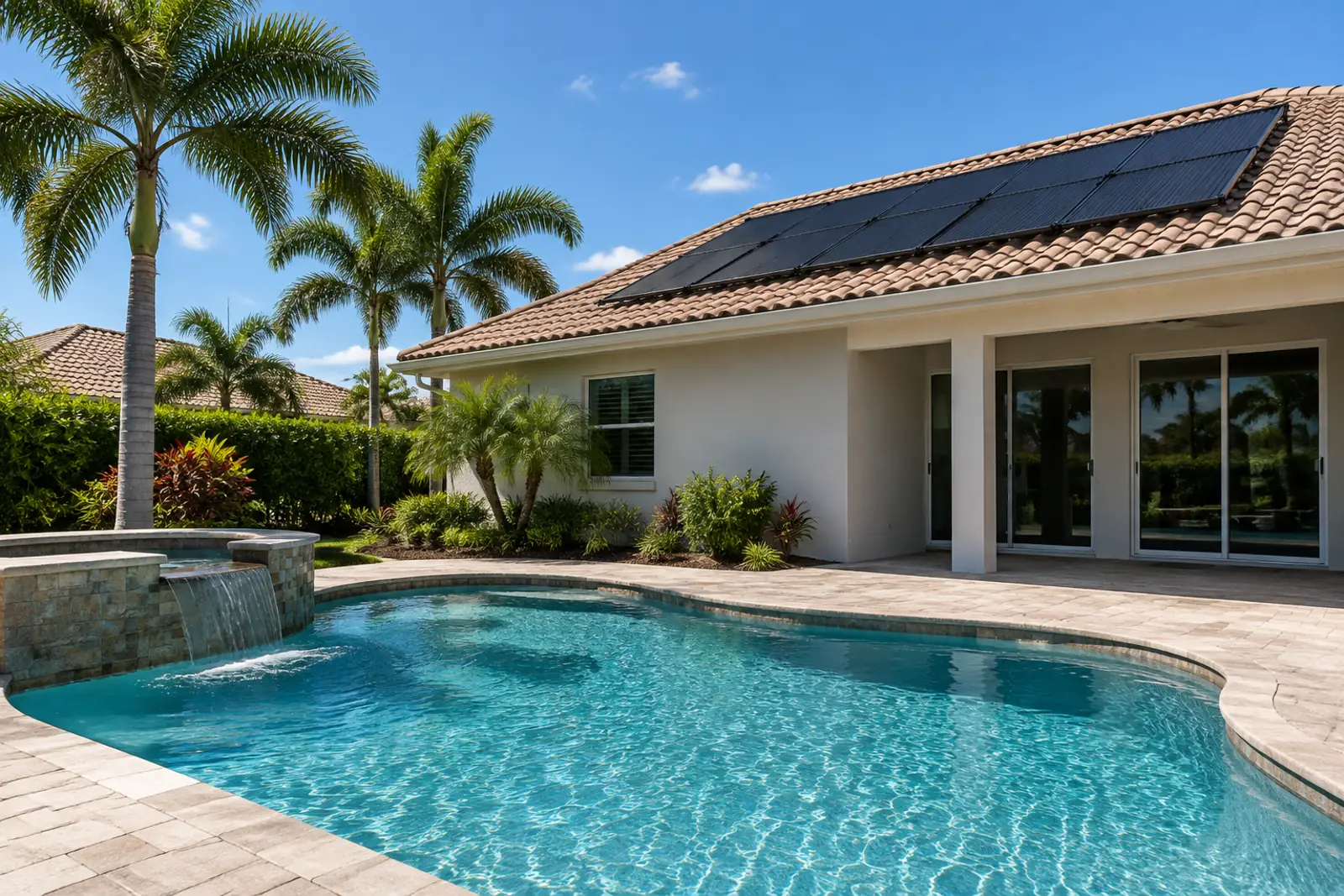
Solar Pool Heater: Cost, Sizing and How Much It Heats
A solar pool heater pumps pool water through collectors sized at 50% to 100% of the pool's surface area. DOE's archived Energy Saver guide puts the installed cost at $2,500 to $4,000 and payback at 1 to 7 years.
- ✓Solar pool heater cost: $2,500 to $6,500Installed range in recent cost guides (HomeGuide, EnergySage); DOE's archived figure is $2,500 to $4,000.
- ✓Payback worked outAgainst gas, propane, heat pump and electric heat, using 2025 EIA energy prices.
- ✓Climate by cityWarm-day counts from NOAA normals for 16 metros, plus DOE heating windows.
How a solar pool heater works
A solar pool heater uses the pool pump you already have to send water up through collectors and back to the pool warmer.
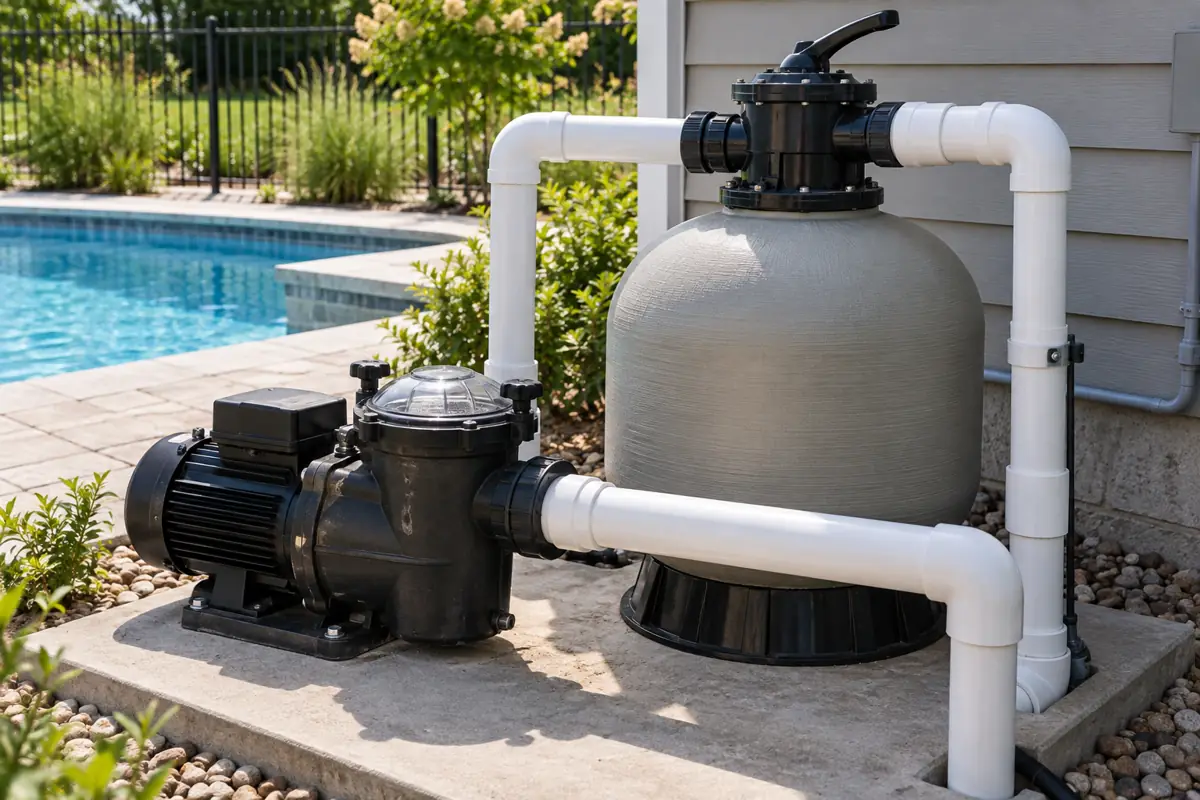
- FilterWater leaves the pool and passes the filter first, which removes debris before the water reaches the collectors.
- PumpThe pool pump pushes filtered water to the collectors. DOE notes a switch to solar can call for a larger pump or a separate, smaller one.
- CollectorWater runs through the collector panels, on a roof or a rack near the pool, and picks up heat from direct and diffuse sunlight.
- Flow control valveA manual or automatic valve sends water through the collectors only when they are warmer than the pool; otherwise water bypasses them.
- ReturnWarmed water goes back to the pool. In hot climates the same loop can run at night to cool the pool.
The U.S. Department of Energy’s Energy Saver guide (archived copy, captured January 1, 2026; the live page returned 404 on October 8, 2026) describes two collector types. Unglazed collectors are heavy-duty rubber or plastic with a UV inhibitor; they are cheaper and suit pools used above freezing. Glazed collectors are copper tubing on an aluminum plate under iron-tempered glass; they cost more but capture heat better in cold weather and, with heat exchangers, can run year-round. Both need freeze protection where temperatures drop below freezing (DOE, archived).
Solar pool heater sizing: collector area as a share of pool surface
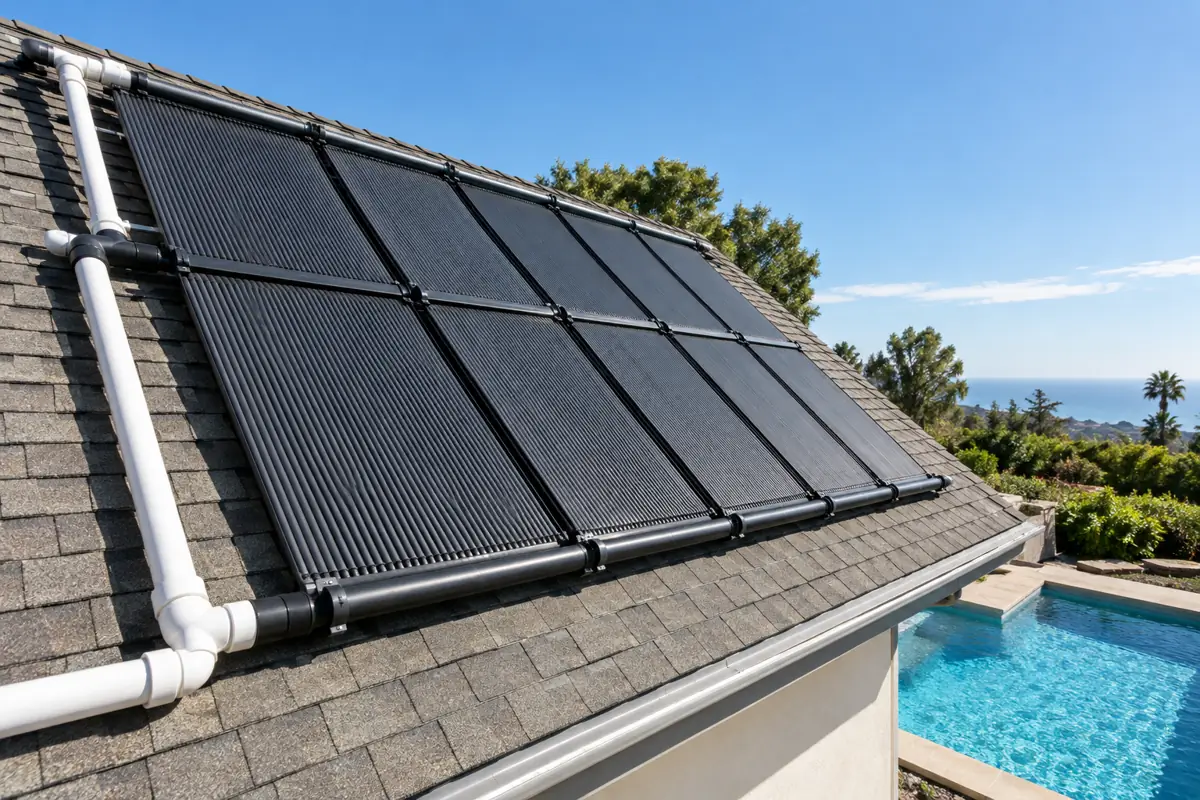
DOE’s rule of thumb is that the collector area should equal 50% to 100% of the pool’s surface area, with more in cooler, cloudier places and for a longer season. Its two examples: a 15 x 30 ft outdoor pool in Florida used year-round needs collectors equal to 100% of the pool, or 450 sq ft; in northern California, where most people swim 6 to 8 months a year, systems are typically 60% to 70% of the pool area. A pool cover lets you use less collector area in any climate.
| Pool (ft) | Pool surface (sq ft) | Collector at 50% (sq ft) | Collector at 70% (sq ft) | Collector at 100% (sq ft) | 4 x 10 ft panels at 50% | 4 x 10 ft panels at 100% |
|---|---|---|---|---|---|---|
| 12 x 24 | 288 | 144 | 201.6 | 288 | 4 | 8 |
| 14 x 28 | 392 | 196 | 274.4 | 392 | 5 | 10 |
| 15 x 30 | 450 | 225 | 315 | 450 | 6 | 12 |
| 16 x 32 | 512 | 256 | 358.4 | 512 | 7 | 13 |
| 18 x 36 | 648 | 324 | 453.6 | 648 | 9 | 17 |
| 20 x 40 | 800 | 400 | 560 | 800 | 10 | 20 |
Source: PC&S calculation from the DOE 50% to 100% sizing rule; 4 x 10 ft panel size as used in HomeGuide’s sizing table. Download CSV
To find your surface area, run the first step of our pool volume calculator: length x width for a rectangle, 0.785 x diameter squared for a round pool. Then pick a share: the low end for a southern pool used in summer, the top end for year-round use or a northern site.
Placement changes output as much as size. DOE says true south is best, but collectors can face up to 45 degrees east or west of south without a significant drop. For summer-only heating, tilt the collectors at your latitude minus 10 to 15 degrees; for year-round heating, tilt them at your latitude. A collector mounted flat on a roof at a less-than-ideal angle still works, but DOE says the roof angle should be taken into account when sizing.
Solar pool heater cost: what published sources say
| Source | Date | What it covers | Low ($) | High ($) | Tier |
|---|---|---|---|---|---|
| U.S. Department of Energy, Energy Saver (archived) | undated, captured 2026-01-01 | Buy and install | 2,500 | 4,000 | 1 |
| HomeGuide | 2023 | Installed, average range | 2,500 | 6,500 | 3 |
| EnergySage | 2025 | Per installation | 2,500 | 6,500 | 3 |
| Celestial Solar (Florida installer) | 2024 | System plus installation | 4,500 | 7,500 | 3 |
| HomeGuide, polypropylene mats | 2023 | Installed | 1,000 | 3,000 | 3 |
| HomeGuide, unglazed panels | 2023 | Installed | 1,500 | 4,500 | 3 |
| HomeGuide, glazed panels | 2023 | Installed | 3,000 | 10,000 | 3 |
Sources: DOE Energy Saver (archived); HomeGuide; EnergySage; Celestial Solar. Tier 1 = government; tier 3 = third-party cost guide or installer. Download CSV
Third-party cost guides are estimates, not quotes.
Source: U.S. Department of Energy Energy Saver (archived, undated); HomeGuide (2023); EnergySage (2025); Celestial Solar (2024). Download chart data (CSV)
DOE’s figure of $2,500 to $4,000 is the only government number, but the page is undated and no longer live, so treat it as a low-end reference. The newer cost guides cluster at $2,500 to $6,500 installed, and HomeGuide puts the national average at $4,500, with jobs reported from $1,500 to $11,000. HomeGuide splits that into $2,000 to $5,000 for the system and $500 to $1,500 for labor, plus $325 to $600 for a flow control and automatic diverter valve.
Collector type is the biggest swing. HomeGuide lists polypropylene mats at $1,000 to $3,000 installed, unglazed panels at $1,500 to $4,500 and glazed panels at $3,000 to $10,000. HomeGuide lists pool size, climate, sun exposure, collector type and plumbing among the cost drivers, and a Florida installer, Celestial Solar, quotes $4,500 to $7,500 including installation.
Is a solar pool heater worth it? Payback against gas and heat pumps
| Solar collectors | Heat pump | Natural gas heater | Electric resistance | |
|---|---|---|---|---|
| How it heats | Pool water runs through sun-warmed collectors | Moves heat from outside air into the water | Burns gas | Electric element |
| Efficiency | No purchased fuel | COP 3.0 to 7.0 (DOE) | 82% federal minimum; 89% to 95% models exist (DOE) | 100% |
| Installed cost | $2,500 to $4,000 (DOE); $2,500 to $6,500 (HomeGuide) | $2,000 to $6,000 (HomeGuide) | $1,500 to $4,500 (HomeGuide) | Not priced in sources used |
| Season energy cost, typical US gas-heated pool | Extra pump power, $10 to $25 a month (HomeGuide) | $327 | $582 | $1,638 |
| Life | 10 to 20 years (DOE) | 10 years or more (DOE) | 5 years or more (DOE) | Not stated in sources used |
| Weather limit | Needs sun; freeze protection in cold areas (DOE) | Works efficiently above 45 F to 50 F air (DOE) | Any weather | Any weather |
| Heat-up speed, 1,000 sq ft x 5 ft pool, no losses | 1 to 3 days to warm a pool (HomeGuide) | 2.49 to 4.15 hours per F at 125,000 to 75,000 Btu/h | 1.04 hours per F at 300,000 Btu/h | Not modelled in sources used |
Sources: DOE Energy Saver pages (archived); HomeGuide; season costs from PC&S research, cost to heat a pool (EIA 2025 prices). Download CSV
Payback depends on what the solar system replaces. Our cost to heat a pool study prices the season for the average US gas-heated pool, which uses 32.3 MMBtu of delivered heat a year (from EIA household survey data): $582 with a gas heater, $327 with a heat pump, $1,099 with propane and $1,638 with electric resistance, at 2025 prices.
| Heater the solar system replaces | Season cost avoided ($, US 2025 prices) | Payback at $2,500 (years) | Payback at $4,500 (years) | Payback at $6,500 (years) |
|---|---|---|---|---|
| Electric resistance heater | 1,638 | 1.5 | 2.7 | 4.0 |
| Propane heater | 1,099 | 2.3 | 4.1 | 5.9 |
| Natural gas heater | 582 | 4.3 | 7.7 | 11.2 |
| Heat pump | 327 | 7.6 | 13.8 | 19.9 |
Source: PC&S calculation; installed costs from DOE (archived) and HomeGuide; season costs from PC&S research using EIA 2025 prices. Download CSV
Assumes the collectors supply the full season's heat and ignores extra pump electricity.
Source: PC&S calculation; season costs from PC&S research (EIA 2025 prices, DOE efficiencies); $4,500 average from HomeGuide. Download chart data (CSV)
At HomeGuide’s $4,500 average, solar pays back in 2.7 years against electric resistance, 4.1 years against propane and 7.7 years against natural gas, which lines up with DOE’s 1 to 7 year range. Against a heat pump it takes 13.8 years, longer than DOE’s 10 to 20 year system life at the low end. These are best cases: they assume the collectors cover the whole season’s heat, and they ignore the extra pump electricity, which HomeGuide puts at $10 to $25 a month.
A cover changes the sum. DOE says covering a pool when it is not in use saves 50% to 70% of heating costs. If a cover has already cut a gas bill to $291, a $4,500 solar system takes 15.5 years to pay back on fuel savings alone. That is why the usual order is cover first, then collectors sized for the season you want.
Where a solar pool heater makes sense: climate by city
How long a pool stays comfortable without help sets how much heat you need. Our pool season length study counts the days each year with a normal high of 80 F or more at each metro’s main NOAA station. Miami has 265 such days, Phoenix 232, Orlando 227 and Tampa 223; Houston has 193 and Las Vegas 180.
Source: NOAA NCEI 1991 to 2020 climate normals; PC&S research, pool season length by city. Download chart data (CSV)
| City | Days with normal high of 80 F or more | 80 F season | DOE example heating window | Heat pump season cost, no cover ($) | Heat pump season cost, with cover ($) |
|---|---|---|---|---|---|
| Miami, FL | 265 | Mar 8 to Nov 27 | 1/1 to 12/31 | 2,544 | 522 |
| Phoenix, AZ | 232 | Mar 22 to Nov 8 | 3/1 to 10/31 | 1,595 | 151 |
| Dallas, TX | 161 | May 5 to Oct 12 | 4/1 to 10/31 | 1,741 | 254 |
| Atlanta, GA | 142 | May 11 to Sep 29 | 4/1 to 10/31 | 1,941 | 366 |
| Kansas City, MO | 106 | May 31 to Sep 13 | 5/1 to 10/31 | 1,481 | 329 |
| Denver, CO | 102 | Jun 6 to Sep 15 | 5/1 to 8/31 | 1,970 | 156 |
| New York, NY | 88 | Jun 12 to Sep 7 | 5/1 to 9/30 | 2,945 | 458 |
| Chicago, IL | 81 | Jun 14 to Sep 2 | 5/1 to 9/30 | 2,148 | 307 |
| Minneapolis, MN | 64 | Jun 19 to Aug 21 | 6/1 to 9/30 | 1,647 | 230 |
| Boston, MA | 54 | Jun 28 to Aug 20 | 5/1 to 8/31 | 3,745 | 586 |
| Los Angeles, CA | 0 | No day averages 80 F | 5/1 to 10/31 | 4,532 | 580 |
| San Francisco, CA | 0 | No day averages 80 F | 6/1 to 8/31 | 3,540 | 610 |
| Seattle, WA | 0 | No day averages 80 F | 6/1 to 8/31 | 1,371 | 326 |
Sources: NOAA 1991 to 2020 normals via PC&S season study; DOE heat pump and gas tables (archived) re-priced at 2025 state electricity prices in PC&S heating study. Download CSV
Two patterns stand out. In the Sun Belt, solar mainly stretches a season that is already long: DOE’s Florida example sizes for year-round use, and in Miami, Orlando, Tampa and Phoenix the collectors mostly add heat outside the 80 F season, which in Miami runs from Mar 8 to Nov 27. On the cool coast, Los Angeles, San Francisco and Seattle airport stations log no days with a normal high of 80 F, so pools there need added heat for any comfortable swimming, and DOE’s cost table, re-priced at 2025 prices in our heating study, shows the Los Angeles heat pump bill dropping from $4,532 to $580 a season once a cover is used.
In short-season northern cities such as Boston (54 warm days) or Minneapolis (64), DOE’s example heating window is only 4 months. DOE points to glazed collectors with freeze protection for colder climates and notes that a pool cover reduces the collector area needed.
Solar panel pool heater or solar electric panels?
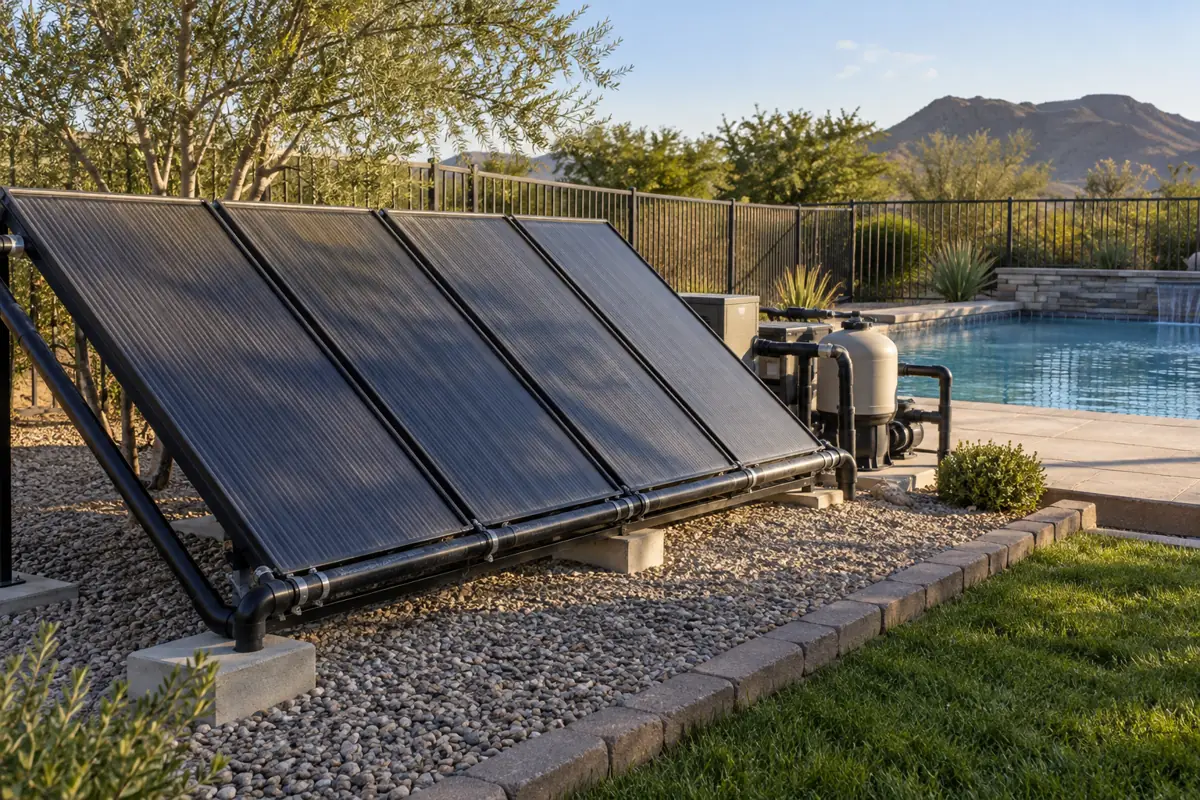
“Solar panel pool heater” can mean two different things. Most products sold under that name are solar thermal collectors: pool water flows through them and is heated directly. HomeGuide points out that these collectors are not the same as the photovoltaic panels that make electricity for a house.
The other route is to run a heat pump pool heater on electricity from rooftop photovoltaic panels, which Palmetto describes as a way to cut heating costs. The heat pump in our typical-pool scenario uses about 1,891 kWh a season (PC&S research), and HomeGuide puts a whole-house photovoltaic system at $10,600 to $26,500, a far larger outlay than a thermal pool system unless the array is being installed for the house anyway.
- Solar thermal collectors: lowest running cost; heat depends on daily sun; slow to raise temperature.
- Heat pump on photovoltaic power: heats on cloudy days while air is above about 45 F to 50 F (DOE); costs far more up front unless the array is already planned.
- Floating or above-ground solar heaters: small units sold for above-ground pools; DOE’s surface-area rule still applies.
Tax credits, HOA rules and permits for solar pool heating
No federal tax credit. The IRS instructions for Form 5695 say costs allocable to a swimming pool or hot tub do not qualify for the residential clean energy credit, and the IRS says the credit is not available for property placed in service after December 31, 2025 (IRS Form 5695 instructions; IRS). Check state and utility programs separately.
HOA limits in Florida. Florida Statute 163.04 bars deed restrictions and covenants from prohibiting solar collectors on buildings; an association may choose where on the roof they go, within an orientation to the south or within 45 degrees east or west of due south, as long as that does not impair their effective operation (Fla. Stat. 163.04). Rules differ by state.
Codes and ratings. DOE advises checking local building codes and covenants before installing, and notes that the Solar Rating and Certification Corporation (SRCC) rates solar pool heaters under its OG400 standard. Ask your building department whether the roof mount and plumbing need a permit; our pool permit guide explains how pool permits and inspections work.
Choosing a solar pool heater installer
- Licensing DOE notes a plumber’s or solar contractor’s license is required in some states; confirm it with your state’s contractor licensing board, which can also report complaints.
- Experience with your system type Ask how many solar pool systems of the type you want the company has installed and serviced, and ask for references.
- Collector rating Ask for the SRCC OG400 rating and the Btu per day of the panels quoted, then compare Btu per day per dollar.
- Sizing worksheet Ask what share of your surface area the bid covers and what season length it targets.
- Pump and valve Confirm whether your pump can move water to the roof, and whether the bid includes an automatic diverter valve.
- Freeze protection and warranty In freezing climates, ask how the system drains or protects itself, and get panel and labor warranties in writing.
The broader vetting steps in how to choose a pool builder apply here too. If your existing heater or pump needs work first, see pool repair, and for a spa that shares the system, hot tub cost.
Frequently Asked Questions
Are solar pool heaters worth it?
They pay back fastest where they replace expensive heat. At a $4,500 installed cost, simple payback is 2.7 years against electric resistance, 4.1 years against propane, 7.7 years against gas and 13.8 years against a heat pump (PC&S calculation, 2025 US prices). DOE’s archived guide gives 1 to 7 years.
How much does it cost to install a pool solar heater?
DOE’s archived guide says $2,500 to $4,000 to buy and install. Newer cost guides say $2,500 to $6,500 installed, and HomeGuide’s national average is $4,500 (HomeGuide; EnergySage).
Do solar pool heaters really work?
Yes, when sized and placed well. DOE calls solar pool heating cost competitive with gas and heat pump heaters, with very low running costs. HomeGuide reports gains of 8 to 12 degrees F and 1 to 3 days to warm a pool, slower than a gas heater.
What is the cheapest way to heat a swimming pool?
A cover is the cheapest step: DOE says it saves 50% to 70% of heating costs. Among heaters, solar has the lowest running cost, and a heat pump at a COP of 5.0 was cheaper per unit of heat than gas in all 44 jurisdictions (43 states plus DC) with July 2026 gas prices (PC&S research).
How many solar panels do I need to heat my pool?
Size collector area at 50% to 100% of the pool’s surface (DOE). A 16 x 32 ft pool (512 sq ft) needs 256 to 512 sq ft, which is 7 to 13 panels of 4 x 10 ft.
Can I heat my swimming pool with solar panels?
Yes, either with solar thermal collectors that heat the water directly or with photovoltaic panels powering a heat pump. Thermal collectors are the lower-cost route for pool heating; photovoltaic arrays cost $10,600 to $26,500 for a whole house (HomeGuide).
Do solar pool heaters use a lot of electricity?
The collectors use none, but the pool pump runs longer and may need to push water to the roof. HomeGuide estimates $10 to $25 a month in added running cost.
How long do solar pool heaters last?
DOE says a maintained system lasts 10 to 20 years. HomeGuide says 15 to 20 years. For comparison, DOE says gas heaters last five or more years and heat pumps 10 or more.
Can I run a pool heater on solar power?
Yes. Solar thermal collectors heat the water directly, and a heat pump pool heater can run on electricity from photovoltaic panels. For cold months, DOE says glazed collectors with heat exchangers can run year-round in many climates, with freeze protection where it freezes.
What are the downsides of a solar pool heater?
Slow heat-up (1 to 3 days per HomeGuide), dependence on sun, roof or yard space for collectors, extra pump run time, and no federal tax credit for pool heating (IRS Form 5695 instructions).
What is the cheapest way to heat an above-ground pool?
Start with a cover, which DOE says saves 50% to 70% of heating costs. Small solar heaters for above-ground pools follow the same rule: collector area of 50% to 100% of the pool’s surface area. A 24 ft round pool covers about 452 sq ft.
How much does a solar pool heater for an inground pool cost?
Most installed systems run $2,500 to $6,500 (HomeGuide; EnergySage), and HomeGuide says solar heating for inground pools typically costs more than for above-ground pools. Size drives the price: a 16 x 32 ft inground pool needs 256 to 512 sq ft of collector at DOE’s 50% to 100% rule.
Sources
- U.S. Department of Energy, Energy Saver. Solar Swimming Pool Heaters (archived 2026-01-01; live page returned 404 on 2026-10-08). Accessed 2026-10-08.
- U.S. Department of Energy, Energy Saver. Swimming Pool Covers (archived 2026-01-01). Accessed 2026-10-08.
- U.S. Department of Energy, Energy Saver. Heat Pump Swimming Pool Heaters (archived 2026-01-01). Accessed 2026-10-08.
- U.S. Department of Energy, Energy Saver. Gas Swimming Pool Heaters (archived 2026-01-01). Accessed 2026-10-08.
- Internal Revenue Service. Instructions for Form 5695. Accessed 2026-10-08.
- Internal Revenue Service. Residential Clean Energy Credit. Accessed 2026-10-08.
- Florida Legislature. Florida Statutes 163.04, Energy devices based on renewable resources. Accessed 2026-10-08.
- HomeGuide. Solar Pool Heater Cost. Accessed 2026-10-08.
- EnergySage. Why these solar heating systems could be the upgrade your pool needs. Accessed 2026-10-08.
- Celestial Solar. How Much Does a Solar Pool Heater Cost?. Accessed 2026-10-08.
- Palmetto. Solar Pool Heaters: How Do They Work. Accessed 2026-10-08.
- PC&S Research. Cost to heat a pool. Accessed 2026-10-08.
- PC&S Research. Pool season length by city. Accessed 2026-10-08.
- U.S. Energy Information Administration. Residential Energy Consumption Survey 2024. Accessed 2026-10-08.
Related pages
Get Quotes From Licensed Local Pool Pros
Tell us what you need and your ZIP code. We match you with pool companies that cover your area.