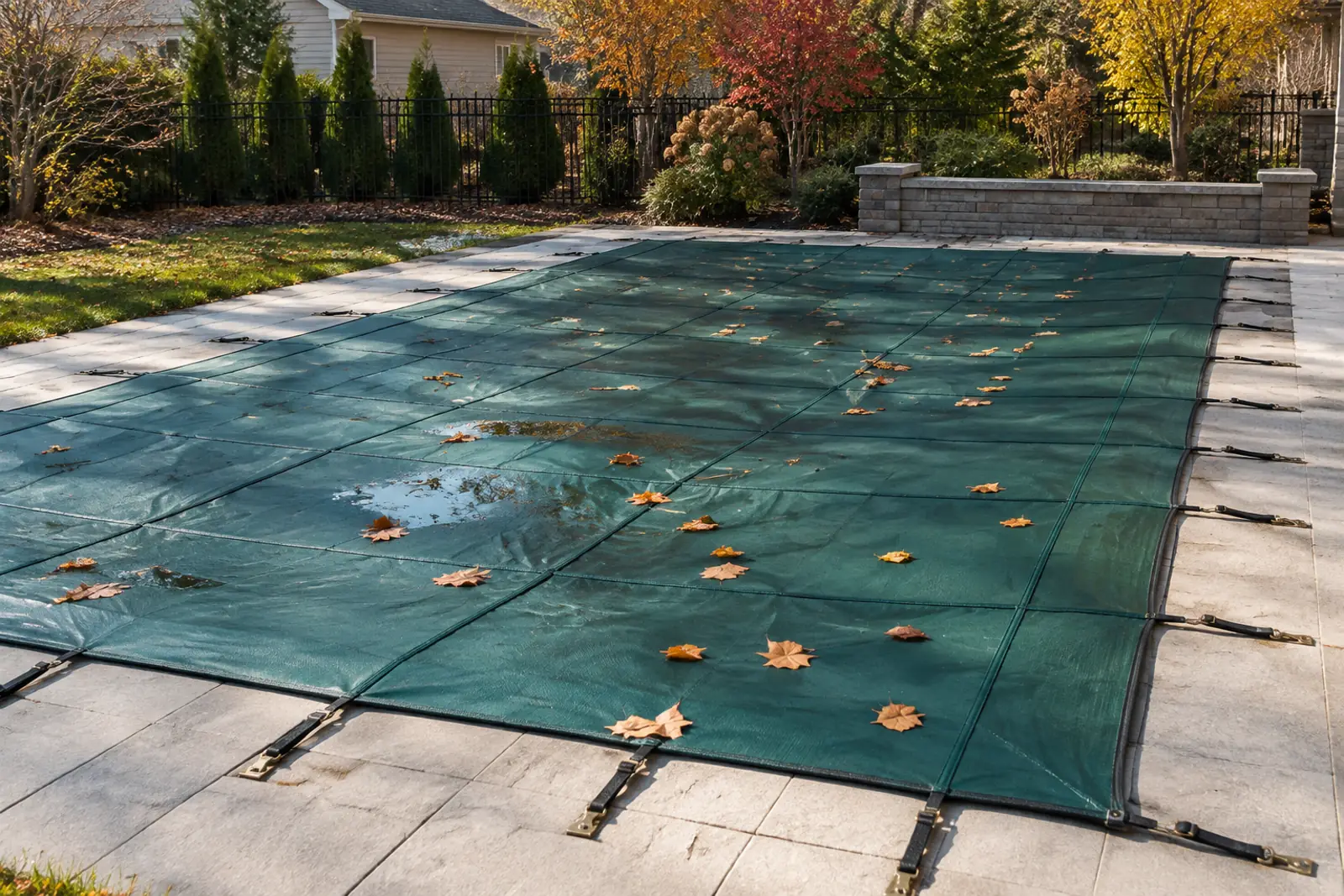
Pool Safety Cover: Mesh vs Solid, Cost and Standards
A pool safety cover is a mesh, solid or automatic cover built to ASTM F1346, a standard meant to keep children under 5 out of the water. Mesh covers cost about $1,200 to $3,000, solid $1,800 to $3,600 (Angi, 2025).
- ✓Pool safety cover cost: $1,200 to $3,600Mesh and solid ranges from Angi and HomeAdvisor; automatic covers run $7,000 to $25,000.
- ✓The standard, explainedWhat ASTM F1346 tests, from ASTM's and ANSI's public summaries.
- ✓State rules checked31 jurisdictions accept a safety cover in some form; New Jersey accepts none for pools.
What makes a pool safety cover: the ASTM F1346 standard
A safety cover is defined by a test standard, not by how heavy it looks. If the label does not cite ASTM F1346, treat it as a debris or winter cover.
The standard is ASTM F1346, Standard Performance Specification for Safety Covers and Labeling Requirements for All Covers for Swimming Pools, Spas and Hot Tubs. The current edition is F1346-23, listed as active and last updated July 13, 2023. ASTM’s public scope says it sets requirements for safety covers on swimming pools, spas, hot tubs and wading pools and, when a cover is correctly installed and used as the maker instructs, is intended to reduce the risk of drowning by inhibiting access to the water by children under five years of age. It also sets marking requirements for all covers, safety or not (ASTM International).
The full text is sold by ASTM ($72.00 on its store), so this page describes only what ASTM and ANSI publish. ANSI’s public summary names four performance tests:
- Static load test: shows the cover can support specified weights.
- Perimeter deflection test: shows a child who falls onto the cover, or another child, cannot slip through gaps between the cover and the pool edge.
- Surface drainage test: checks that no unsafe amount of water collects on top.
- Openings test: shows openings stay small enough to keep a small child’s head out of the water.
Older documents cite F1346-91, the edition referenced in the U.S. Consumer Product Safety Commission’s 2012 Safety Barrier Guidelines for Residential Pools. ASTM still lists F1346-91 (reapproved 2018) alongside the 2023 edition, so ask which edition a cover is certified to.
Mesh vs solid vs automatic pool safety covers
| Mesh safety cover | Solid safety cover | Automatic safety cover | |
|---|---|---|---|
| How it is held | Straps to anchors drilled into the deck | Straps to deck anchors | Motor and reel on a track |
| Rain and snowmelt | Drains through the mesh | Collects on top; needs a cover pump (Fixr) | Follow the maker's instructions |
| Sunlight blocked | 99% (Fixr) | 100% (Fixr) | Not stated in sources used |
| Handling | Often one person (Fixr) | At least two people (Fixr) | Key switch or button |
| Typical cost | $1,200 to $3,000 (Angi, HomeAdvisor) | $1,800 to $3,600 (Angi, HomeAdvisor) | $7,000 to $25,000 (Angi); $10,000 to $20,000 (Latham) |
| Life | 10 to 15 years (River Pools) | 7 to 11 years (River Pools) | Fabric 5 to 8 years (Latham) |
| Counts toward barrier rules | Where state law lists a safety cover option | Where state law lists a safety cover option | Model code exempts powered ASTM F1346 covers from barrier sections; NJ and MD do not |
| Watch out for | Fine debris and some light get through | Standing water is a drowning hazard if not pumped (Fixr) | Not made for heavy snow loads (Latham) |
Sources: Fixr; River Pools; Latham; Angi; HomeAdvisor; 2024 ISPSC 305.1. Download CSV
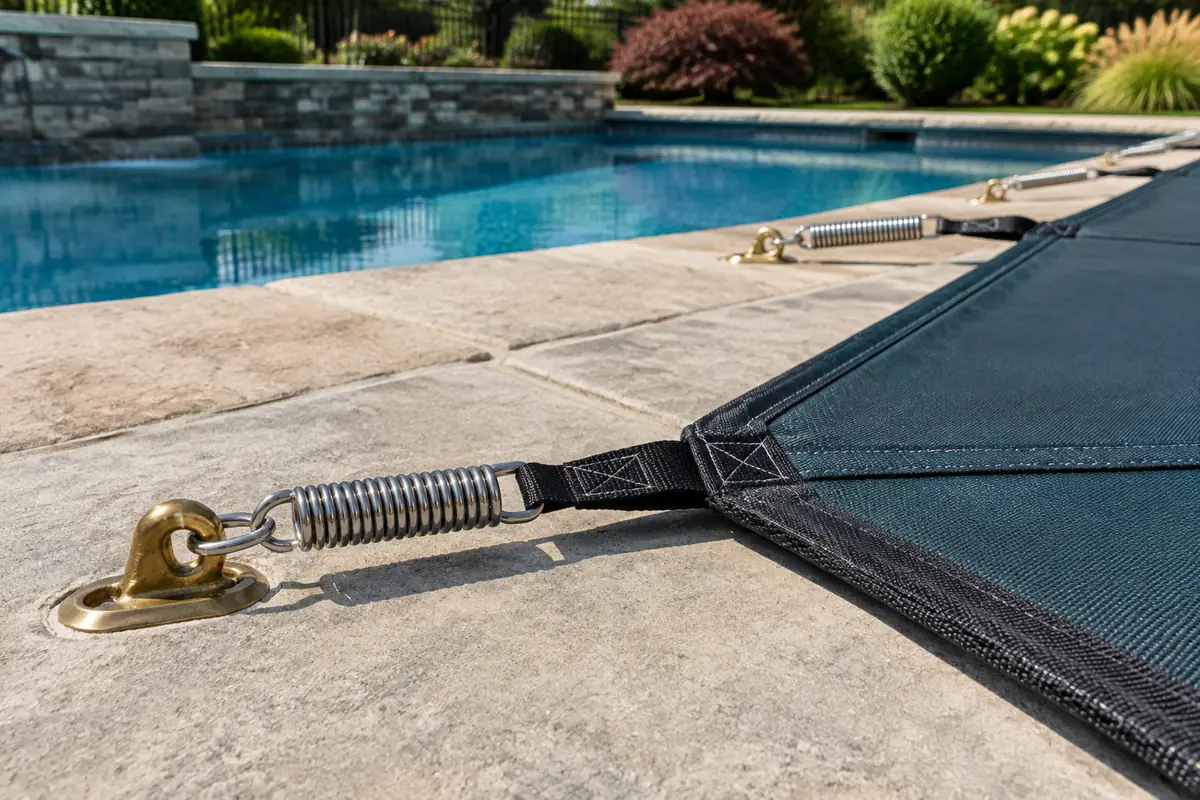
Mesh covers let rain and snowmelt drain through, so they need no pump and one person can often handle them. Fixr says mesh blocks 99% of sunlight against 100% for solid, so some light and fine debris get in and the water needs more work at opening. River Pools puts mesh life at 10 to 15 years and says mesh typically costs $200 to $600 less than solid vinyl.
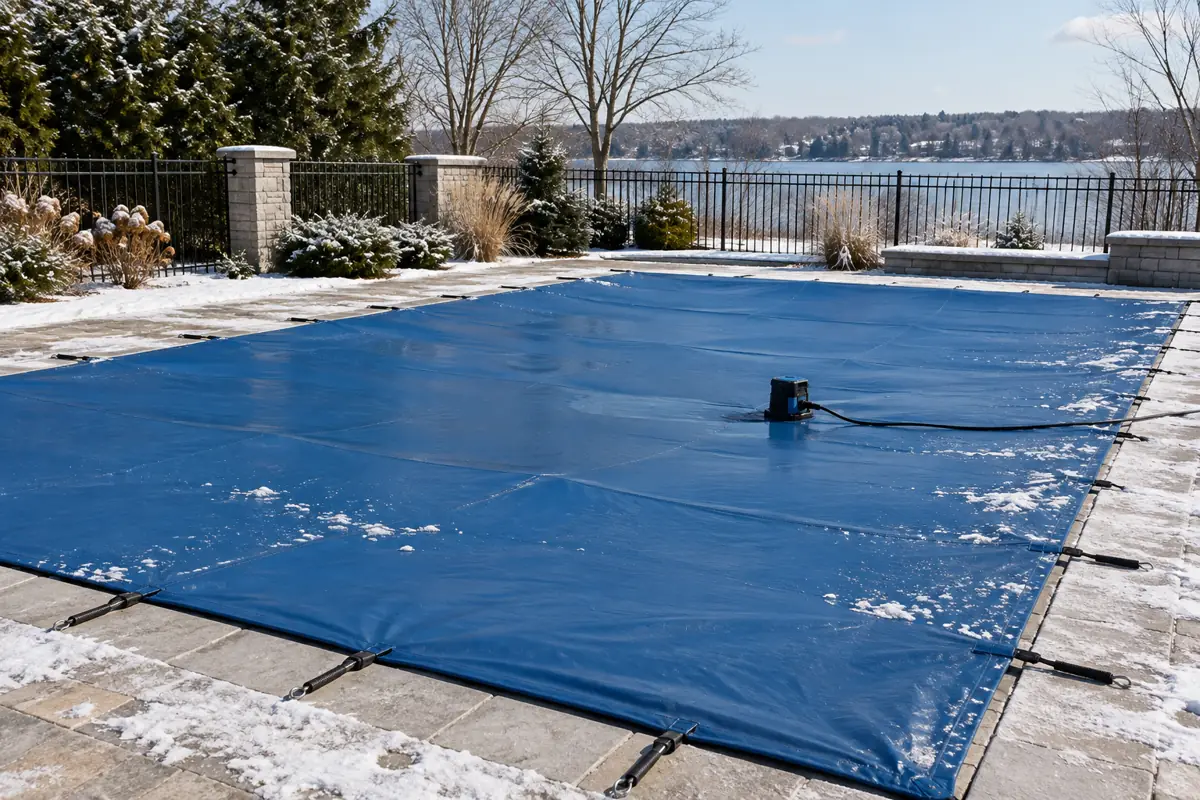
Solid covers keep sunlight and debris out, but water collects on top. Fixr warns that undrained water on a solid cover can be a drowning hazard for children and pets, which is why a cover pump is part of the system; River Pools says those submersible pumps last 2 to 4 years and the covers 7 to 11 years. Solid covers take at least two people to handle.
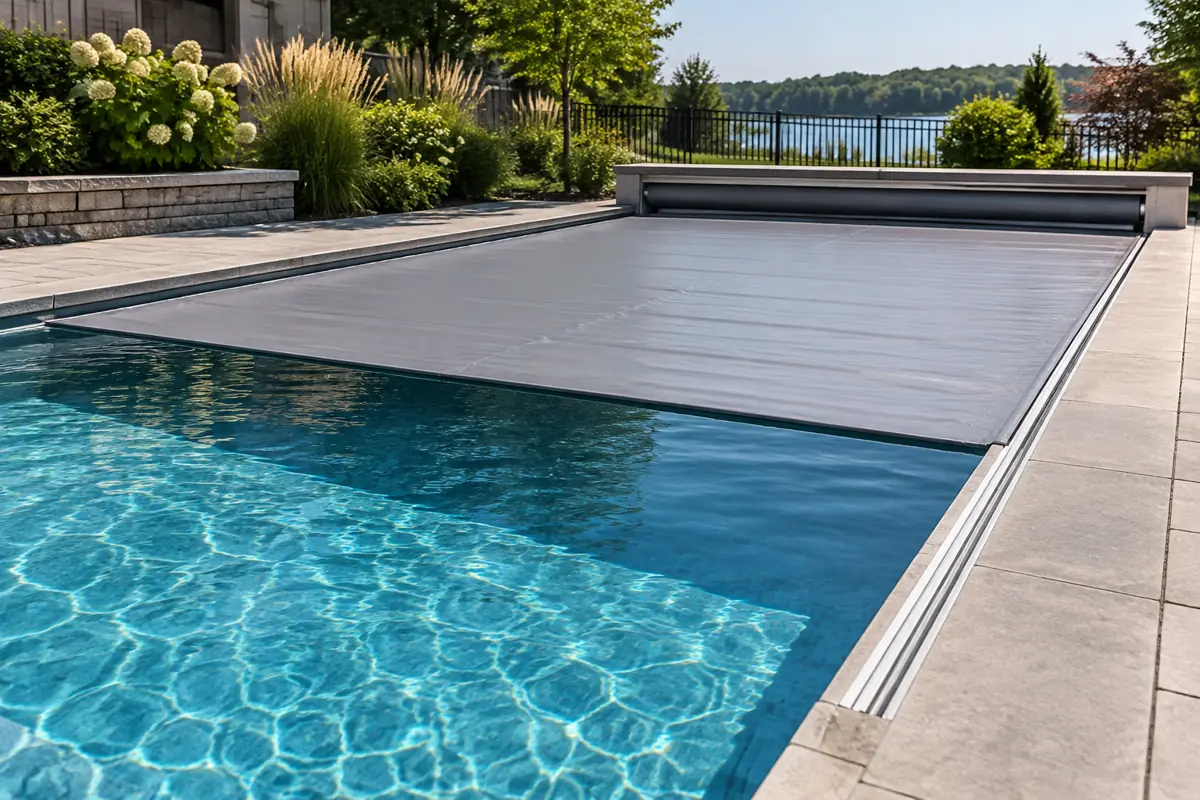
Automatic covers run on a track at the push of a key switch or button. They are the only type that the model International Swimming Pool and Spa Code accepts in place of a barrier around a pool, and only when powered and compliant with ASTM F1346 (2024 ISPSC 305.1). Where the house wall forms part of the barrier, the model code also lists an ASTM F1346 safety cover as one option next to door alarms (305.4). Latham, a cover maker, says the fabric may need replacing every five to eight years, and that automatic covers are not made to carry heavy snow, so owners also need a winter cover when closing the pool.
Inground pool covers: what each type costs
| Inground cover type | Angi cost range ($) | HomeAdvisor average ($) | Counts as a safety cover? |
|---|---|---|---|
| Automatic | 7,000 to 25,000 | 15,000 | Only if labeled to ASTM F1346 |
| Custom | 1,500 to 6,000 | Depends on the cover | |
| Manual | 500 to 5,000 | Only if labeled to ASTM F1346 | |
| Net | 1,200 to 3,000 | Check the label | |
| Safety (mesh) | 1,200 to 3,000 | 2,100 | Yes, when labeled to ASTM F1346 |
| Safety (solid) | 1,800 to 3,600 | 2,700 | Yes, when labeled to ASTM F1346 |
| Solar | 30 to 150 | No (Angi) | |
| Walkable | 600 to 2,280 | 1,440 | Check the label |
| Winter | 75 to 250 | No (Angi) |
Sources: Angi (updated Dec 29, 2025, Wayback copy); HomeAdvisor (updated Jun 19, 2026). Tier 3 cost guides. Download CSV
Cost-guide estimates, not quotes.
Source: Angi (updated Dec 29, 2025); HomeAdvisor (updated Jun 19, 2026); Latham Pool Products (May 26, 2025). Download chart data (CSV)
For a typical pool, budget $1,200 to $3,000 for a mesh safety cover and $1,800 to $3,600 for solid, according to both Angi and HomeAdvisor, which put average jobs at $2,100 and $2,700. Fixr prices a professionally installed 16 x 32 ft cover at about $2,700 in mesh and $3,700 in solid. Automatic safety covers sit in a different bracket: $7,000 to $25,000 with an average near $15,000 (Angi, HomeAdvisor), or $10,000 to $20,000 by Latham’s estimate.
| Pool size (ft) | Angi average cover cost ($) | Mesh safety, installed, Fixr ($) | Solid safety, installed, Fixr ($) |
|---|---|---|---|
| 12 x 20 | 960 | ||
| 16 x 32 | 2,050 | 2,700 | 3,700 |
| 18 x 36 | 2,590 | ||
| 20 x 40 | 3,200 |
Sources: Angi (all cover types, about $4 per sq ft); Fixr (16 x 32 ft installed). Download CSV
Labor is part of the spread. Angi puts installation at $400 to $1,500 for manual covers and $2,000 to $10,000 for automatic covers, where track type matters: top tracks cost least, recessed tracks more, and under-track systems most. Custom shapes cost more than stock rectangles, and Fixr puts ongoing seasonal installation at $100 to $500.
Does a pool safety cover count as a pool barrier? State rules
Federal guidance treats a cover as one layer. CPSC’s barrier guidelines say barriers include a fence or wall, door alarms for the house and a power safety cover over the pool, and that power safety covers can serve as security barriers, especially where the house forms the fourth side. CPSC also says fences should be at least 4 feet high, with 5 feet or more preferable, and that the guidelines are not a mandatory standard.
State law decides what passes inspection. Our pool fence laws by state study found that 31 jurisdictions, 30 states plus DC, accept an ASTM F1346 safety cover as an option or exemption in some form, 17 leave the matter to local codes, and New Jersey accepts none for pools. Here is how eight states treat a cover:
| State | Statewide mandate | Minimum barrier height | Safety cover option | How a cover is treated |
|---|---|---|---|---|
| Florida | Yes | 48 in | Yes | One of five allowed features under Fla. Stat. 515.27; the Florida Building Code exempts pools with an ASTM F1346 cover from its 48-inch barrier rule |
| Arizona | Partial | 60 in | Yes | Statewide statute accepts a motorized safety cover operated by a key switch; local ordinances that are equal or stricter apply |
| California | Partial | 60 in | Yes | Two of seven drowning prevention features at permit; a manual or power cover must carry a label verifying ASTM F1346-23 |
| Texas | Partial | 48 in | Yes | Municipal code is the 2018 ISPSC: powered ASTM F1346 cover on a pool, lockable cover on a spa, exempts the barrier |
| Georgia | Yes | 48 in | Yes | 2024 ISPSC with state amendments from Jan 1, 2026: pools without a 305.1 safety cover need a full permanent barrier |
| New York | Yes | 48 in | Yes | A power safety cover meeting ASTM F1346 replaces only the pool alarm; spas with a compliant cover are exempt from part of the barrier rule |
| Maryland | Yes | 48 in | Yes | Reverses the model code exemption for pools permitted on or after Dec 31, 2023; spas with a lockable cover still exempt |
| New Jersey | Yes | 48 in | No | Deletes the powered cover exemption for pools; the only state that accepts no cover in place of a pool barrier |
Source: PC&S research, pool fence laws by state, from state statutes and codes (Fla. Stat. 515; A.R.S. 36-1681; Cal. Health and Safety Code 115922; Tex. Loc. Gov’t Code 214; COMAR 09.12.56; N.J.A.C. 5:23-3.21; 2025 RCNYS R328; Georgia DCA). Download CSV
If you are building, the barrier plan is part of the permit; see our pool permit guide. Local builders in Miami, Phoenix and Houston work under three very different rules: Florida’s five-feature statute, Arizona’s statute that yields to local ordinances, and Texas’s municipal code.
Why safety covers matter: child drowning numbers
Source: U.S. Consumer Product Safety Commission, Pool or Spa Submersion report, 2026. Download chart data (CSV)
Home pools are where the youngest children drown. CPSC’s 2026 report puts 60% of reported pool or spa drowning deaths of children under 5 at the child’s own home and another 19% at a family member’s, friend’s or acquaintance’s home. That is the group ASTM F1346 is written for.
Source: CDC WONDER (ICD-10 W67-W68); PC&S research, pool drowning statistics by state. Download chart data (CSV)
Rates are highest in warm states. Florida had 6.65 pool drowning deaths per million residents a year in 2018 to 2024 and Arizona 6.15, against 2.42 nationally (pool drowning statistics by state, from CDC WONDER).
Measuring and installing an inground pool safety cover
- Measure the pool, not the coverStock covers are sold by pool size. One retailer, MFS Supply, builds a 1 ft overlap into each side, so its 16 x 32 cover measures 18 x 34 ft. Use our pool volume calculator for shape and area.
- Note steps, spas and raised wallsSteps, attached spas and raised features need cut-outs or a custom cover, which Angi says always costs more than a stock size.
- Check the deckMesh and solid covers strap to anchors drilled into the deck, patio, lawn or coping; Fixr says the deck material sets the drill bit and suggests a professional for non-rectangular pools.
- Tension the straps evenlyStraps hook to the anchors around the pool; Fixr notes the last few take the most tension.
- Plan for water on solid coversBudget for a cover pump and a routine for clearing standing water.
- Keep the paperworkKeep the ASTM F1346 label, warranty and installer details for the inspector and future buyers.
Measuring is the same job as finding your pool’s area in the pool volume calculator. If the deck needs repair before anchors go in, start with pool deck contractors; for a new build, ask your builder to price the cover with the pool, as covered in inground pool cost and how to choose a pool builder.
Pool safety cover care checklist
- Clear standing water Pump water off solid covers after rain or snowmelt (Fixr), and follow the maker’s instructions for automatic covers.
- Keep controls away from children CPSC says to keep cover control devices out of children’s reach.
- Keep the cover in good repair CPSC says to keep pool covers well-maintained; Angi puts pro repair labor at $50 to $100 an hour.
- Inspect straps, springs and anchors Replace worn parts before closing the pool for the season.
- Check the label Confirm the ASTM F1346 marking is still legible.
- Plan the replacement Angi says safety covers usually last seven to 10 years.
Frequently Asked Questions
Are pool safety covers worth it?
For homes with young children they add a layer CPSC recognizes: power safety covers can serve as barriers, especially where the house is one side of the enclosure. 60% of reported pool or spa drowning deaths of children under 5 in 2021 to 2023 happened at home (CPSC). A cover does not replace supervision.
What is the typical cost of a safety cover for an inground pool?
Mesh safety covers cost $1,200 to $3,000 and solid $1,800 to $3,600 (Angi; HomeAdvisor). HomeAdvisor’s averages are $2,100 for mesh and $2,700 for solid.
How much is an automatic safety pool cover?
$7,000 to $25,000, with most installs around $15,000 (Angi; HomeAdvisor). Latham, a cover maker, gives $10,000 to $20,000.
What is the best pool safety cover?
It depends on the job. Mesh is lighter, drains itself and lasts 10 to 15 years (River Pools). Solid keeps the water cleaner but needs a pump. Automatic is the only type the model code accepts in place of a barrier, and costs the most. Whatever you choose, check for an ASTM F1346 label.
Is there a safety pool cover that I can walk on?
ASTM F1346 includes a static load test showing a cover supports specified weights, but Fixr advises against walking on covers. Covers marketed as walkable cost $600 to $2,280 (Angi), or about $3 per sq ft (HomeAdvisor).
Which pool covers are ASTM rated?
Only covers labeled as meeting ASTM F1346, which sets marking requirements for all covers. California requires a compliance cover to carry a label verifying ASTM F1346-23. Ask for the edition on the label.
How much does a new inground pool cover cost?
Angi puts in-ground covers at $75 to $10,000 depending on type, about $4 per sq ft on average, and $2,050 for a 16 x 32 ft pool.
How long will a pool safety cover last?
Angi says safety covers usually last seven to 10 years. River Pools gives 10 to 15 years for mesh and 7 to 11 for solid, and Latham says automatic cover fabric may need replacing every five to eight years.
Are mesh pool covers better than solid?
Mesh drains rain, needs no pump and lasts longer; solid blocks 100% of sunlight against 99% for mesh (Fixr), so the pool opens cleaner. Solid covers need water pumped off, because standing water can be a drowning hazard.
Which pool covers are the best for safety?
Covers labeled to ASTM F1346. Whether one can replace a fence depends on the code. The model ISPSC exempts pools with a powered ASTM F1346 cover from the barrier sections, but New Jersey deletes that exemption, Maryland reverses it for pools, and in New York a power cover replaces only the pool alarm (PC&S research).
Are there safety covers for above ground pools?
ASTM F1346 covers swimming pools generally. For above-ground pools, the model code lets a wall at least 48 inches high act as the barrier if ladders can be secured or removed, and CPSC gives the same ladder advice.
What material is used for pool safety covers?
Mesh covers are made of vinyl fibers and solid covers of solid vinyl, according to Fixr. Automatic covers use a fabric on a motorized reel; Latham mentions reinforced vinyl.
What can I use instead of a pool cover?
CPSC lists other barrier layers: a fence at least 4 feet high (5 feet or more preferred) with self-closing, self-latching gates, and alarms on doors to the pool area. New Jersey, for one, requires a barrier around a pool whether or not it has a cover.
Sources
- ASTM International. ASTM F1346-23 Standard Performance Specification for Safety Covers and Labeling Requirements for All Covers for Swimming Pools, Spas and Hot Tubs. Accessed 2026-10-08.
- ASTM International. ASTM F1346-91(2018). Accessed 2026-10-08.
- ANSI Blog. ASTM F1346-23: Pool Safety Cover Requirements (Wayback capture 2025-12-08). Accessed 2026-10-08.
- U.S. Consumer Product Safety Commission. Safety Barrier Guidelines for Residential Pools, Publication 362. Accessed 2026-10-08.
- U.S. Consumer Product Safety Commission. Pool or Spa Submersion: Estimated Nonfatal Drowning Injuries and Reported Drownings, 2026 Report. Accessed 2026-10-08.
- International Code Council. 2024 International Swimming Pool and Spa Code, Chapter 3 (UpCodes). Accessed 2026-10-08.
- CDC, National Center for Health Statistics. CDC WONDER, Underlying Cause of Death. Accessed 2026-10-08.
- Angi. How Much Does a Pool Cover Cost? [2026 Data] (Wayback capture 2026-02-23). Accessed 2026-10-08.
- HomeAdvisor. How Much Does a Swimming Pool Cover Cost in 2026?. Accessed 2026-10-08.
- Fixr. Mesh vs Solid Pool Cover. Accessed 2026-10-08.
- River Pools. Solid Vinyl vs. Mesh Inground Winter Pool Covers. Accessed 2026-10-08.
- Latham Pool Products. Automatic Pool Covers: Price & Cost Factors. Accessed 2026-10-08.
- Latham Pool Products. Types of Pool Covers: Which is Right for You?. Accessed 2026-10-08.
- MFS Supply. Safety Cover For In-Ground Pools (Standard Sizes). Accessed 2026-10-08.
- PC&S Research. Pool fence laws by state. Accessed 2026-10-08.
- PC&S Research. Pool drowning statistics by state. Accessed 2026-10-08.
Related pages
Get Quotes From Licensed Local Pool Pros
Tell us what you need and your ZIP code. We match you with pool companies that cover your area.