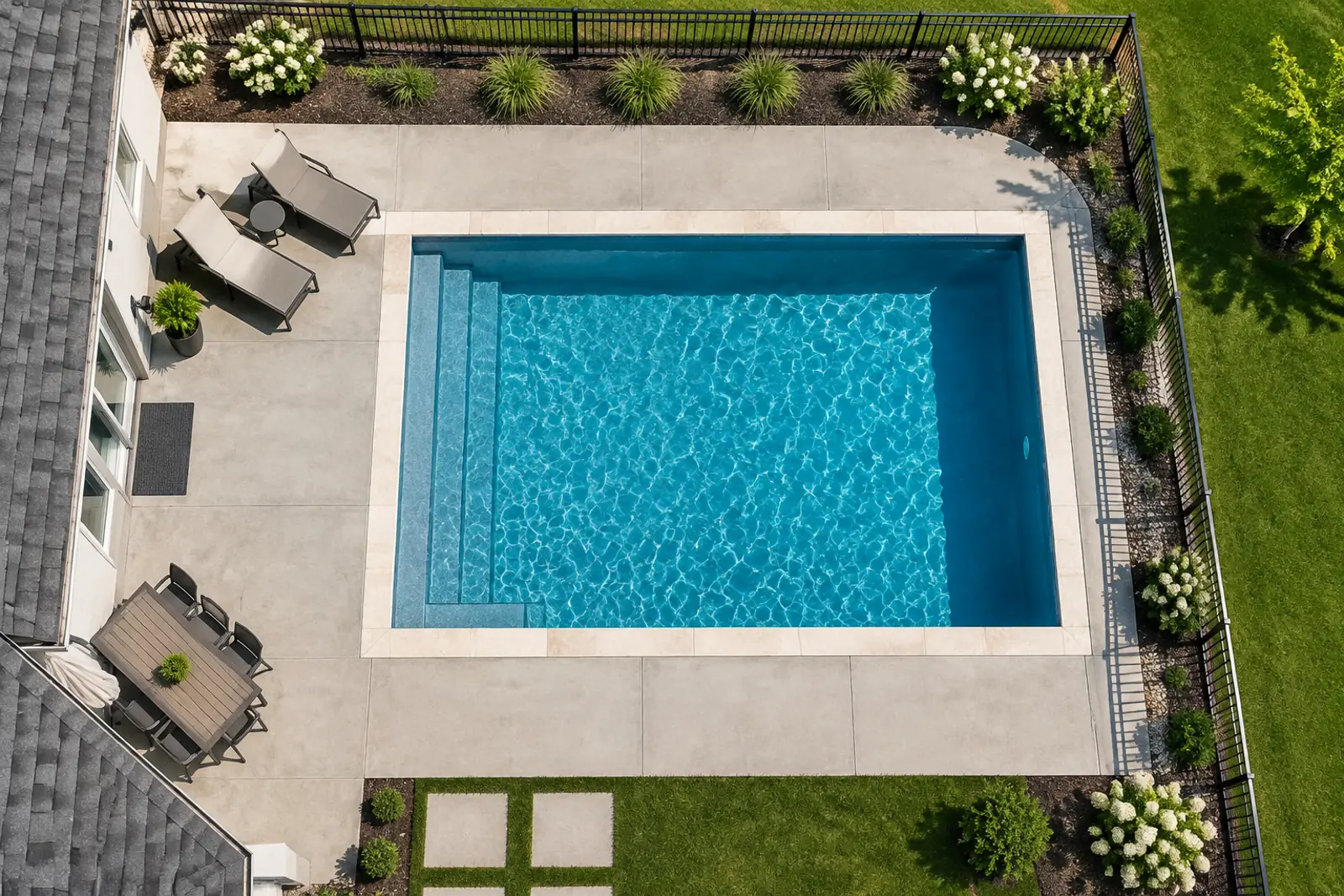
Pool Shapes: Rectangle, Freeform, Kidney and More
Pool shapes fall into two families: geometric (rectangle, Roman, Grecian, L-shape) and freeform (kidney, lagoon, free curves). A rectangle holds the most water for its footprint; curves usually cost more in concrete or vinyl.
- ✓Pool shapes by the gallonIn a 16 x 32 ft footprint at 4.5 ft average depth, a rectangle holds about 17,234 gallons and an oval about 13,594 (PC&S formula).
- ✓Real permit sizes2025 pool permits in Mesa, AZ stated a median pool area of 412 sq ft (City of Mesa open data, PC&S analysis).
- ✓Code-checked depth rulesDiving pools follow ISPSC Table 804.1, which calls for 7 ft 6 in to 9 ft of water depending on pool type.
Pool shapes compared: nine layouts in one table
Every residential pool is a variation on a few base shapes. The table lines them up by definition, published sizes, water volume and what drives the bill.
Builders and manufacturers use the same handful of names. Thursday Pools lists rectangle, freeform, Roman, Grecian, kidney, round, plunge and spool as the common inground shapes and calls rectangle, freeform and Roman the most popular, though it publishes no count behind that ranking. No public permit dataset we found records pool shape, so treat any popularity claim as a builder’s view, not a statistic.
| Shape | What defines it | Published example sizes | Water volume, PC&S formula | Main cost drivers | Automatic cover fit |
|---|---|---|---|---|---|
| Rectangle | Four straight sides and square corners | River Pools R Series: 10 x 20 to 16 x 40 ft | 16 x 32 ft at 4.5 ft average: 17,234 gal | Least forming labor; cheapest vinyl liner to replace (Thursday Pools) | Best fit: hidden tracks need straight parallel sides (Thursday Pools) |
| Roman | Rectangle with semicircular rounded ends (Thursday Pools) | Custom sizes | A little less than a rectangle of the same box | Curved end steps to form and tile | Ask the cover maker |
| Grecian | Rectangle with angled corners and straight sides (Thursday Pools) | Custom sizes | A little less than a rectangle of the same box | Extra corners to form and tile | Ask the cover maker |
| L-shape, Lazy L, T | Two joined rectangles; Lazy L softens the corner (SwimmingPool.com) | Custom sizes | Add the volumes of the two rectangles | Extra corners and a second zone | Ask the cover maker |
| Freeform or lagoon | Organic curves with no straight sides | River Pools I Series: 12 x 25.3 to 15.5 x 34 ft | 14 x 30 ft box at 4.5 ft average: 11,151 gal (5.9 rule) | Forming labor in gunite, custom liner in vinyl; Angi lagoon style $100,000+ | Deck-mounted tracks (Thursday Pools) |
| Kidney | Freeform with one inward curve and two lobes (A and B) | SwimUSA Charlotte 15 ft 6 in x 32 ft; Concord 10 ft 10 in x 16 ft 2 in | Charlotte: 11,680 gal (manufacturer) | Same as freeform | Deck-mounted tracks (Thursday Pools) |
| Oval | Ellipse | Mostly above-ground kits; Akron lists 12 x 24 to 18 x 40 ft ovals | 16 x 32 ft at 4.5 ft average: 13,594 gal | Curved walls | Ask the cover maker |
| Round | Circle | Plungie Arena: 11 ft 5 in diameter | 16 ft at 4.5 ft average: 6,797 gal | Small footprint; no lap length | Ask the cover maker |
| Plunge or cocktail rectangle | Short rectangle, often one depth | River Pools N Series 8 ft 4 in x 16 ft; Latham 10 x 16 ft | 10 x 16 ft at 3.5 ft: 4,189 gal | Equipment costs close to a full pool (The Pool Nerd) | Straight sides suit track covers |
Sources: Thursday Pools, River Pools, SwimUSA, SwimmingPool.com, City of Akron, Angi; volumes are a PC&S calculation. Download CSV
The volume column uses one method throughout: length x width x average depth x 7.48 gallons per cubic foot for straight-sided pools (the USGS conversion), 5.9 for ovals and circles (the City of Akron multiplier) and a 0.45 shape factor for kidneys (Leslie’s). Run your own numbers in the pool volume calculator.
Rectangle and geometric pool shapes: the most water per foot of yard
Geometry settles the first question. Any shape drawn inside a 16 x 32 ft box covers less water than the box itself. The rectangle uses all 512 sq ft; an oval in the same box covers about 402 sq ft, which is why Akron’s multiplier for ovals (5.9) is 78.7% of its rectangle multiplier (7.5). At 4.5 ft average depth that is 17,234 gallons for the rectangle and 13,594 for the oval.
Rectangles also match the hardware. Thursday Pools notes that hidden automatic cover tracks need straight, parallel edges, while freeform pools take deck-mounted tracks. That matters for fence rules: the 2024 International Swimming Pool and Spa Code (ISPSC) exempts a pool with a powered ASTM F1346 safety cover from its barrier sections, but states write their own rules. Our pool fence law study counts 20 of 51 jurisdictions with a statewide barrier mandate, 16 partial and 15 left to local codes, and Arizona and California set 60-inch heights against the ISPSC’s 48 inches. See our pool safety cover guide before you count on a cover to replace a fence.
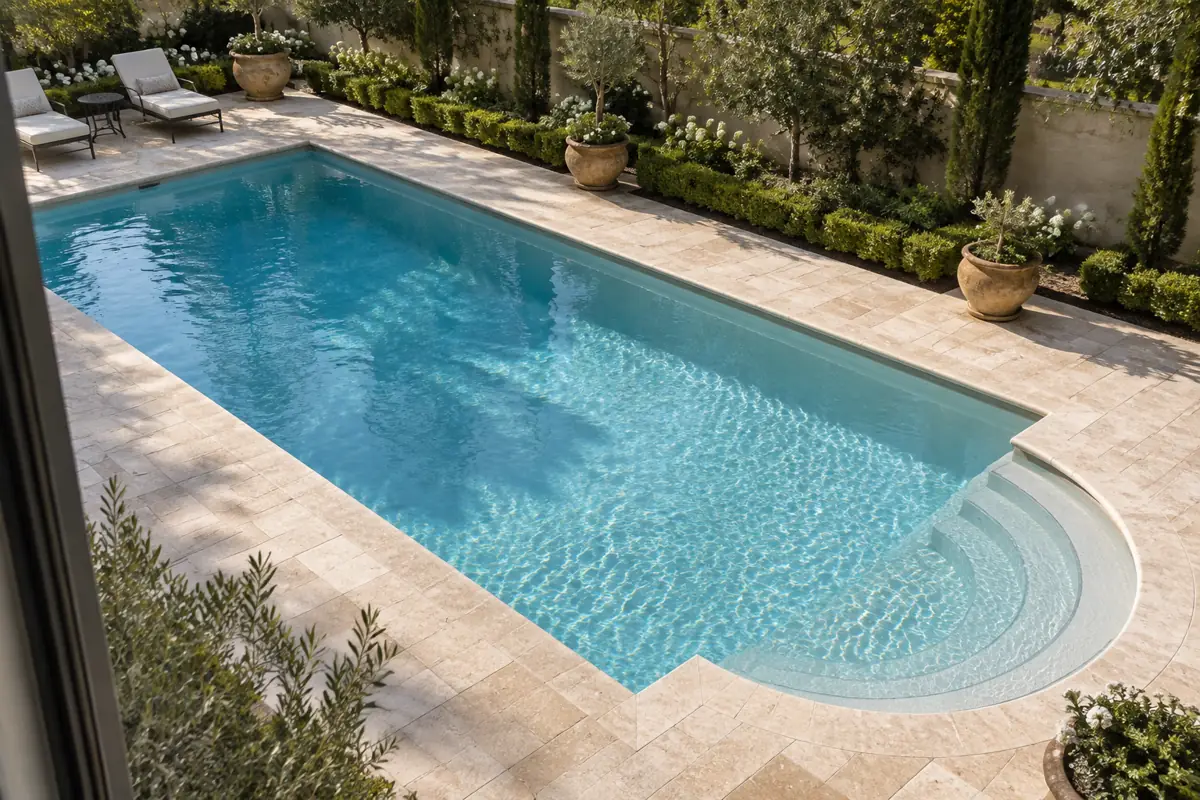
Roman and Grecian pools are dressed-up rectangles. Thursday Pools describes the Roman as a rectangular base with semicircular rounded ends, which often hold wide entry steps, and the Grecian as a rectangle with slightly angled corners and straight sides. L-shaped pools join two rectangles; SwimmingPool.com lists the Lazy L, with a softened corner, and the T as common variations. An L is the usual way to keep a shallow play area apart from a deeper leg.
Freeform pool shapes: curves, lagoons and what they add to cost
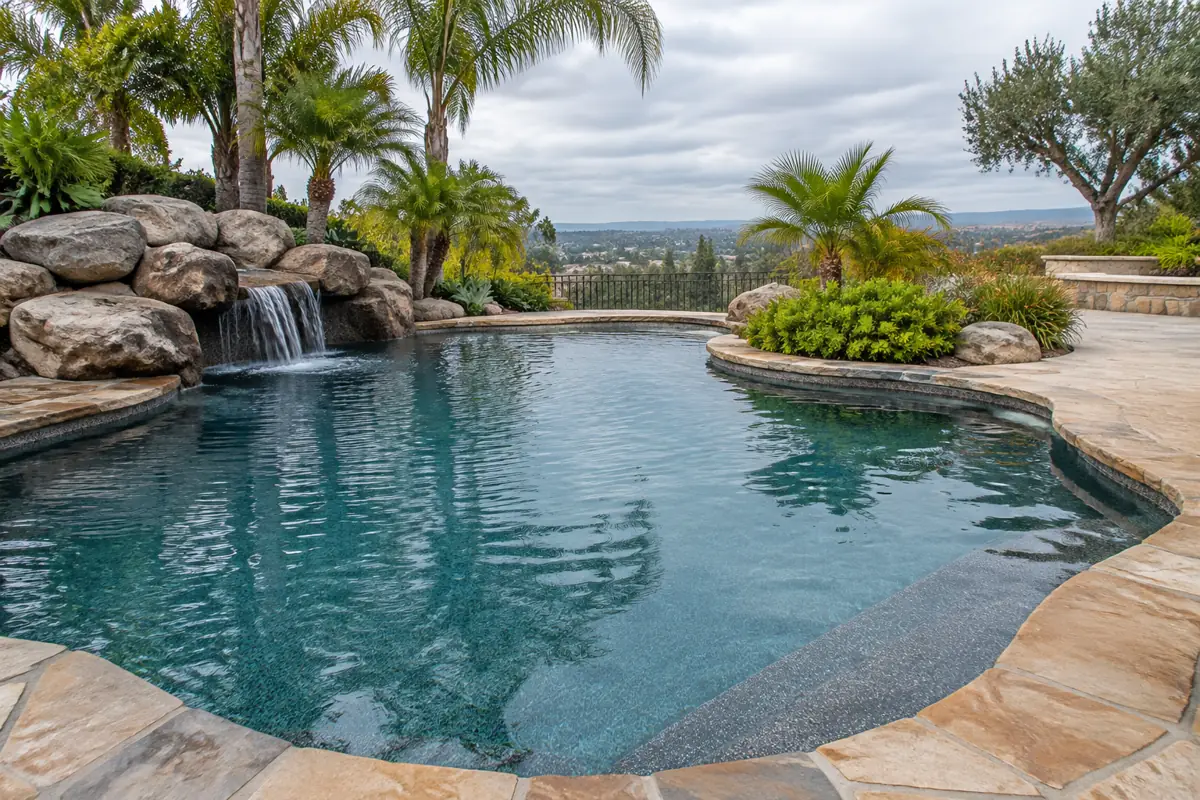
A freeform pool has no straight sides. The curves can follow a slope, wrap a patio or imitate a pond, and in concrete the shape is limited only by the drawing. Angi’s 2026 cost guide puts lagoon-style pools, freeform pools with organic edges and added features, at $100,000 or more on average, against $44,000 for a lap pool and $55,000 for a beach-entry design.
The premium depends on the build type. HomeGuide states that rectangular or oval pools typically cost the least, while freeform, lagoon, L-shaped, kidney-shaped and geometric pools cost more. Thursday Pools explains why: in gunite, complex curves add forming, grading and finishing labor; in vinyl, freeform liners need more material and more precise fabrication, at install and again at each liner replacement. In fiberglass, a freeform shell does not carry the same premium because the mold is fixed. Compare the three build types in our gunite vs fiberglass vs vinyl guide.
Measuring a freeform for chemicals is rough work. Leslie’s suggests longest length x widest width x average depth x 5.9 for irregular pools. Treat the result as an upper estimate: curves, steps and ledges remove water that a box formula counts.
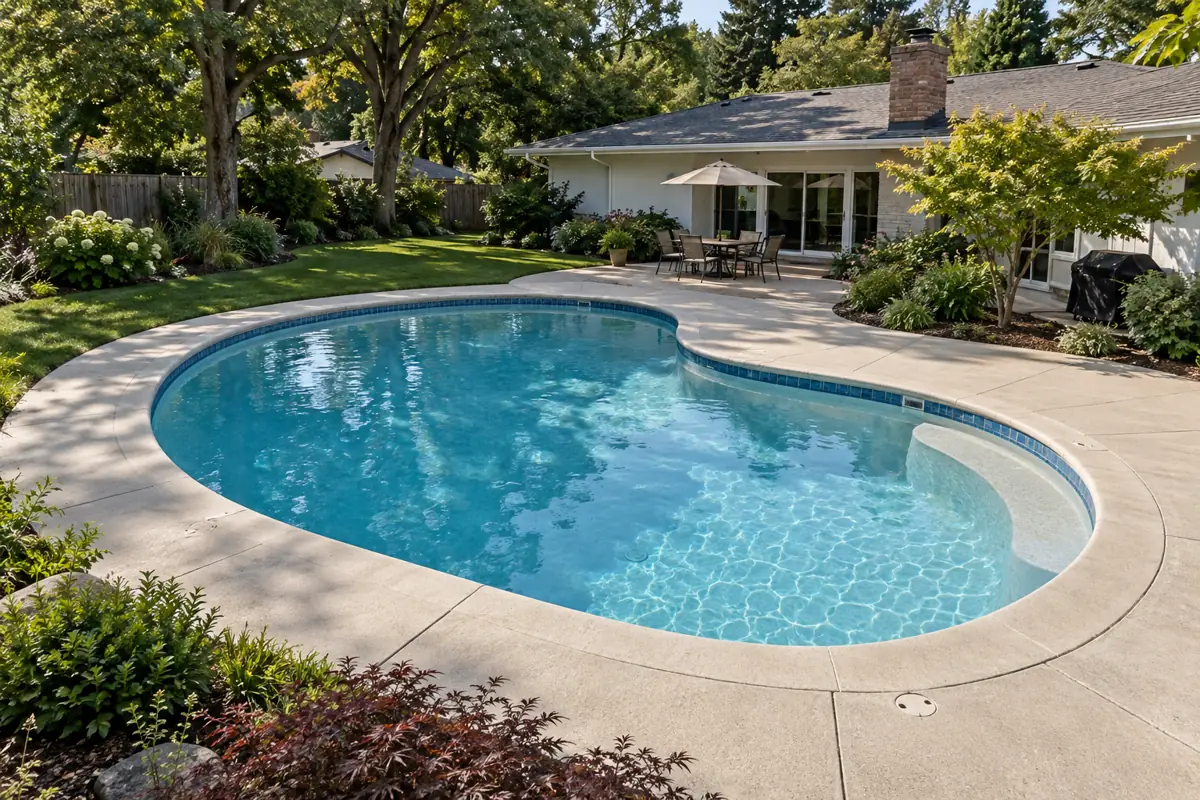
Kidney shaped pool: sizes, gallons and the inside curve
A kidney shaped pool is a freeform with one inward curve that splits it into two lobes. The curve creates a natural nook for a bench or steps on one side and an open swim area on the other. Thursday Pools notes the trade-off: debris tends to collect at the inside curve, and robotic cleaners cover curves less consistently than straight walls.
Leslie’s kidney formula is (A + B) x length x 0.45 x average depth x 7.5, where A and B are the widths of the two lobes. Makers rarely publish lobe widths, so we tested the two simpler shortcuts, the free-form rule and a plain bounding box, against two kidney shells whose maker publishes gallons. SwimUSA lists the Charlotte at 15 ft 6 in x 32 ft inside, 3 ft 4 in to 5 ft 5 in deep, holding 11,680 gallons, and the smaller Concord at 10 ft 10 in x 16 ft 2 in, 3 ft 10 in deep, holding 2,940 gallons.
Benches, steps and curved walls take up volume a footprint formula cannot see.
Source: SwimUSA model pages (manufacturer data); PC&S calculation. Download chart data (CSV)
The free-form rule overstated the Charlotte by 10% and the Concord by 35%; a plain bounding box overstated them by 39% and 71%. The small pool misses most because built-in benches and steps take a bigger share of a small shell. When a manufacturer publishes gallons, use that figure for chemical dosing and fill planning; when it does not, a formula gives a ceiling, not an answer.
How much water each pool shape holds
Source: PC&S calculation from USGS, City of Akron and Leslie's formulas. Download chart data (CSV)
Holding the footprint at 16 x 32 ft and the average depth at 4.5 ft, shape alone moves volume by about a fifth. The rectangle holds 17,234 gallons. A kidney with two full-width lobes comes to 15,511; trim one lobe to 12 ft and it drops to 13,572, close to the oval’s 13,594. A 16 ft round pool, half the length, holds 6,797.
Volume drives three bills: the first fill, chemicals and heating. Our cost to fill a pool study prices 10,000, 20,000 and 30,000-gallon fills at October 2026 utility rates in 25 cities.
Formula source: USGS (7.48 gallons per cubic foot); City of Akron (5.9 round and oval multiplier); Leslie's (0.45 kidney factor). Estimates only.
Fiberglass pool shells: the shapes you can order off the mold
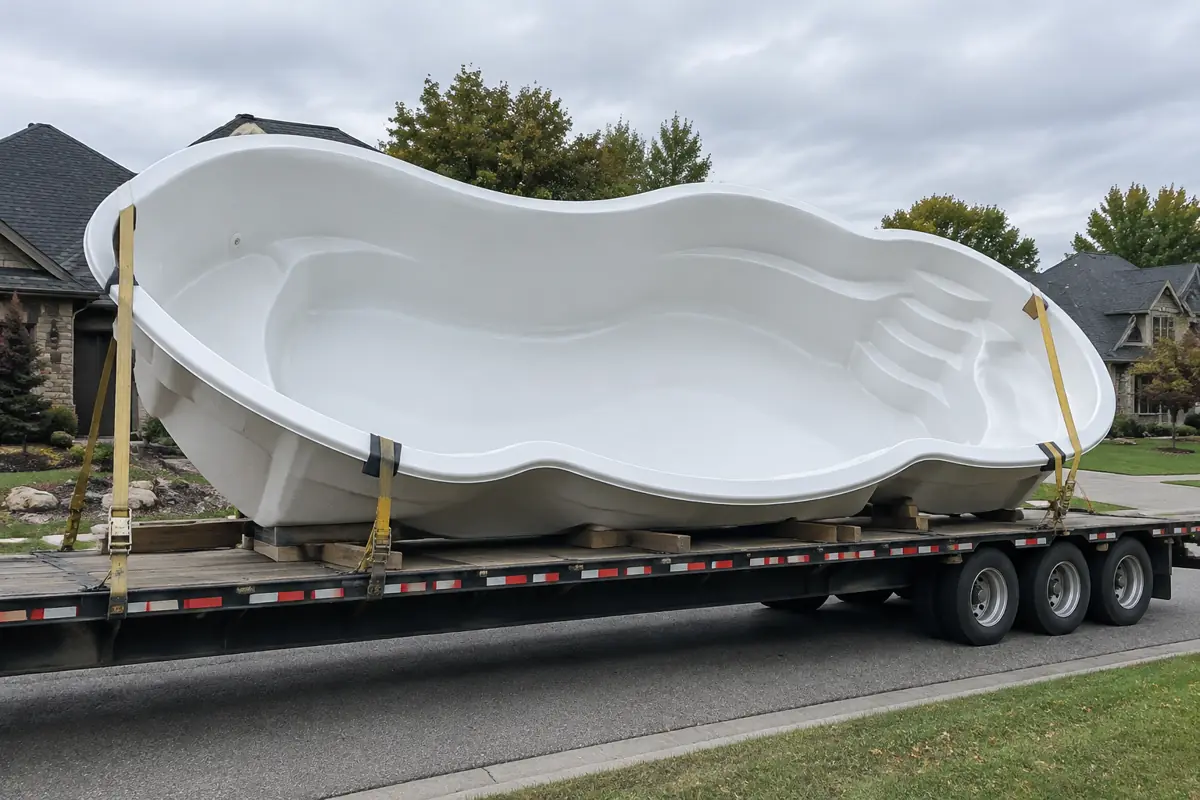
If you are shopping fiberglass pool shells, the menu is the catalog. Thursday Pools says most fiberglass pools max out at 16 feet wide and 41 feet long, because one-piece shells travel by road and most states set a 16-foot oversized load limit; the smallest start around 8 to 10 feet wide. Wider than 16 ft means concrete or vinyl.
| Manufacturer | Model or series | Shape | Sizes | Depth | Gallons (manufacturer) |
|---|---|---|---|---|---|
| River Pools | R Series | Rectangle | 16 x 40, 16 x 36, 15 x 32, 15 x 28, 12 x 24, 10 x 20 ft | Not listed on series page | Not listed |
| River Pools | D Series | Rectangle with tanning ledge | 16 x 40, 16 x 36, 15 x 32, 15 x 28, 12 x 24 ft | Not listed on series page | Not listed |
| River Pools | I Series | Freeform with tanning ledge | 15.5 x 34, 14 x 30, 12 x 25.3 ft | Not listed on series page | Not listed |
| River Pools | M Series | Rectangle with swim lane | 13.6 x 35, 12 x 30, 10 x 25 ft | Not listed on series page | Not listed |
| River Pools | N Series | Plunge | 8 ft 4 in x 16 ft | Single depth (flat bottom) | Not listed |
| River Pools | T40 | Rectangle with deep end | 16 x 40 ft | 3 ft 8 in to 8 ft 6 in | Not listed |
| SwimUSA | Charlotte | Kidney | 15 ft 6 in x 32 ft (inside) | 3 ft 4 in to 5 ft 5 in | 11,680 |
| SwimUSA | Concord | Kidney | 10 ft 10 in x 16 ft 2 in (inside) | 3 ft 10 in | 2,940 |
| Latham | Cocktail pool | Rectangle | 10 x 16 ft | Not listed | Not listed |
| Plungie | Arena | Round (precast concrete) | 11 ft 5 in diameter | 4 ft 11 in | Not listed |
Manufacturer data: River Pools, River Pools T40, SwimUSA, Latham, Plungie. Accessed 2026-10-08. Download CSV
Read catalog numbers with care. Latham states that its lengths, widths, depths and volumes may vary up to 3% and are measured to the widest point of the outside edge, while SwimUSA quotes inside dimensions. Two shells with the same headline size can differ in swimmable water. The fiberglass pool installation guide covers crane access and delivery.
What a pool shape does to cost
Shape changes price through three levers you can measure: water surface, edge length and labor. Some building departments value pools by surface area. The City of San Diego’s building valuation schedule (Information Bulletin 101) assigns $104 per sq ft of pool surface for vinyl, $114 for gunite and $124 for fiberglass. Applied to shapes in the same footprint, the numbers show how much of the valuation is simply area.
| Shape in a 16 x 32 ft footprint | Water surface (sq ft) | Edge length for coping and tile (ft) | San Diego valuation, vinyl at $104/sq ft | San Diego valuation, gunite at $114/sq ft | San Diego valuation, fiberglass at $124/sq ft |
|---|---|---|---|---|---|
| Rectangle 16 x 32 ft | 512 | 96 | $53,248 | $58,368 | $63,488 |
| Oval 16 x 32 ft | 402 | 77.5 | $41,808 | $45,828 | $49,848 |
| Kidney, lobes 16 and 12 ft (0.45 factor) | 403.2 | No standard formula | $41,933 | $45,965 | $49,997 |
| Round, 16 ft diameter | 201 | 50.3 | $20,904 | $22,914 | $24,924 |
Source: City of San Diego Information Bulletin 101 rates via PC&S build-cost study; areas and perimeters are PC&S calculations. Permit valuation, not a price quote. Download CSV
The second lever is edge length. Coping, waterline tile and the deck edge are bought by the linear foot, and a rectangle in this box has 96 ft of edge against about 77.5 ft for the oval. The third lever is labor, which the table cannot show: curves take longer to form in gunite and to fit in vinyl (Thursday Pools), while in fiberglass the factory has already paid for the curve. The Pool Nerd adds that pumps, filters and other equipment cost almost the same for a small pool as a full-size one, so shrinking the shape saves less than the area suggests. For full price ranges see the inground pool cost guide.
Surface area also sets how much water the sun takes. The EPA estimates an uncovered 500 sq ft pool loses 12,000 to 31,000 gallons a year to evaporation, and says a cover can prevent up to 95% of it. Using NOAA pan data from our pool evaporation study, here is what the three shapes above would lose.
| City | Pool evaporation (in/yr, NOAA pan x 0.70) | Rectangle 512 sq ft (gal/yr) | Oval 402 sq ft (gal/yr) | Round 201 sq ft (gal/yr) |
|---|---|---|---|---|
| Las Vegas, NV | 83.6 | 26,674 | 20,943 | 10,472 |
| Phoenix, AZ | 74.8 | 23,880 | 18,749 | 9,375 |
| Dallas, TX | 53.7 | 17,151 | 13,466 | 6,733 |
Source: NOAA TR 34 pan evaporation x 0.70 via PC&S evaporation study; PC&S calculation. Download CSV
Diving, depth and pool shape: what the code says
Diving locks in a shape more than any style choice does. The ISPSC sorts residential pools into Type O, a nondiving pool where diving equipment may not be installed, and Types I to V, which can take a board. Table 804.1 sets a minimum diving water envelope for each type: how deep, how wide and how long the deep end must be before the floor rises toward the shallow end.
| Residential pool type (ISPSC) | Minimum depths listed in Table 804.1 (ft-in) | Deepest listed minimum (ft-in) | Widest listed minimum width (ft-in) | Minimum length, deep-end wall to start of shallow end, WE (ft-in) | Maximum diving platform height (in) |
|---|---|---|---|---|---|
| Type I | 6-0, 7-6, 5-0, 2-9 | 7-6 | 12-0 | 28-9 | 42 |
| Type II | 6-0, 7-6, 5-0, 2-9 | 7-6 | 15-0 | 28-9 | 42 |
| Type III | 6-0, 8-0, 5-0, 2-9 | 8-0 | 15-0 | 31-3 | 50 |
| Type IV | 7-8, 8-0, 5-0, 2-9 | 8-0 | 18-0 | 31-3 | 60 |
| Type V | 8-6, 9-0, 5-0, 2-9 | 9-0 | 18-0 | 36-9 | 69 |
| Type O | Diving equipment not allowed | Not applicable | Not applicable | Not applicable | Not applicable |
Source: International Swimming Pool and Spa Code 2024, Chapter 8, Tables 804.1 and 808.12 (ICC, via UpCodes). Download CSV
The length column is the shape decision. A Type I envelope needs at least 28 ft 9 in from the deep-end wall to the start of the shallow end, and Type V needs 36 ft 9 in, before any shallow area is added. That is why diving pools are long rectangles, L-shapes with a deep leg, or long freeforms. River Pools’ 16 x 40 ft T40, 3 ft 8 in to 8 ft 6 in deep, is described by its maker as a Type III pool, yet the same company recommends against diving boards on any of its pools.
Other ISPSC numbers that shape the floor plan: the shallowest point must be 33 inches to 4 feet deep; anything deeper than 5 feet counts as deep area and needs its own way out; a pool more than 30 ft wide at the deep area needs exits on both sides; benches and swimouts sit no deeper than 20 inches; and handholds are required where a residential pool is deeper than 42 inches.
Choosing between pool shapes: a yard-first checklist
- Measure the buildable box first Setbacks, easements and the barrier line shrink the yard. Draw the largest rectangle that fits; every other shape sits inside it.
- Decide on diving now A board needs a Type I to V envelope of at least 28 ft 9 in of deep-end length under the ISPSC. Without one, plan a Type O pool.
- Pick the build type before the curve Fiberglass limits you to the catalog and about 16 ft of width; gunite and vinyl take any shape at a labor cost.
- Check cover and fence rules together If you want a powered safety cover, favor straight parallel sides, and confirm your state accepts a cover in place of a barrier.
- Count the edge Coping, tile and deck edging scale with perimeter, so a wavy outline costs more than its area suggests.
- Plan for cleaning Inside curves and tight corners collect debris; ask how the robotic cleaner handles them.
- Get gallons from the maker For shells, use the published volume; for custom pools, ask the designer for the computed volume.
Real yards run smaller than the catalog suggests: 2025 pool permits in Mesa, Arizona that stated a pool area had a median of 412 sq ft across 224 permits, smaller than a 16 x 32 ft rectangle. See the Phoenix pool builders page for the Valley’s permit and barrier rules, and our standard pool size guide for size data by city.
Frequently Asked Questions
What is the most affordable pool shape?
In concrete and vinyl, a rectangle or oval. HomeGuide states rectangular or oval pools typically cost the least, and Thursday Pools says rectangles are the cheapest vinyl pools to build and reline. In fiberglass, a freeform shell does not carry the same premium because the mold is fixed.
What is the most popular pool shape?
Thursday Pools names rectangle, freeform and Roman as the most popular inground shapes, but publishes no count behind it, and no permit dataset we found records shape. Mesa, Arizona permits do record size: the 2025 median was 412 sq ft of stated pool area.
What is a freeform pool?
A pool with curved, organic edges and no straight sides, often shaped to a slope or landscaping. Kidney and lagoon pools are freeform variations.
What is the typical cost of a freeform pool?
There is no national price by shape. Angi’s 2026 guide lists lagoon-style pools at $100,000 or more on average. In fiberglass, a freeform model is priced like a rectangle of similar size. See the inground pool cost guide for ranges by type and size.
Is a kidney-shaped pool more expensive?
Usually in gunite and vinyl, where HomeGuide groups kidney shapes with the shapes that cost more than rectangles. In fiberglass, a kidney shell is priced by its size and features rather than its curve.
What is a kidney-shaped pool?
A freeform pool with one inward curve that creates two lobes, often with a bench or steps tucked into the curve.
How do you calculate the gallons in a kidney-shaped pool?
Leslie’s uses (A + B) x length x 0.45 x average depth x 7.5, with A and B the two lobe widths. Expect an overestimate: on SwimUSA’s Charlotte the related free-form rule came out 10% above the published 11,680 gallons.
Are rectangular pools better than round pools?
For swimming and covers, yes: a rectangle gives a straight swim length and suits track covers. A round pool is compact; a 16 ft round at 4.5 ft average depth holds about 6,797 gallons, but there is no lap length.
What are some unusual pool shapes?
Figure-8, T-shaped and Lazy L pools (SwimmingPool.com), plus lagoon designs with rock edges. In fiberglass, unusual shapes are limited to what the molds offer.
What pool shape works with an automatic safety cover?
A rectangle. Thursday Pools says hidden cover tracks need straight, parallel edges, while freeform pools take deck-mounted tracks.
Can a freeform pool have a diving board?
Only if its deep end meets an ISPSC Type I to V envelope, which needs at least 28 ft 9 in from the deep-end wall to the shallow end and 7 ft 6 in to 9 ft of depth. Many manufacturers, River Pools among them, recommend no boards at all.
What are the key differences between freeform and rectangular pools?
Rectangles hold more water per square foot of yard (17,234 gallons vs about 13,594 for an oval in a 16 x 32 ft box at 4.5 ft), suit covers and robotic cleaners, and cost less in concrete and vinyl. Freeforms fit irregular yards and landscaping.
How wide can a fiberglass pool be?
About 16 feet. Thursday Pools says most fiberglass pools max out at 16 feet wide and 41 feet long because shells ship in one piece under state oversize load limits.
Sources
- International Code Council (via UpCodes). International Swimming Pool and Spa Code 2024, Chapters 2, 3 and 8. Accessed 2026-10-08.
- Council for the Model Aquatic Health Code. Model Aquatic Health Code section 4.5.19 and annex. Accessed 2026-10-08.
- North Carolina Administrative Code. 15A NCAC 18A .2523 Depth markings and safety ropes. Accessed 2026-10-08.
- U.S. Geological Survey. Water Science Glossary (7.48 gallons per cubic foot). Accessed 2026-10-04.
- City of Akron, Ohio. How to calculate the gallons in a swimming pool. Accessed 2026-10-04.
- Leslie's. How To Calculate Pool Volume. Accessed 2026-10-08.
- Thursday Pools. Inground Pool Shapes Guide. Accessed 2026-10-08.
- Thursday Pools. What Sizes Do Fiberglass Pools Come In?. Accessed 2026-10-08.
- River Pools & Spas. Fiberglass Pool Shapes; How Deep Are Fiberglass Pools?. Accessed 2026-10-08.
- SwimUSA Fiberglass Pools. Kidney Pool Models. Accessed 2026-10-08.
- Latham Pool Products. Fiberglass Pool Shapes & Sizes. Accessed 2026-10-08.
- SwimmingPool.com. Which Pool Shape Is Right for You?. Accessed 2026-10-08.
- HomeGuide. How Much Does An Inground Pool Cost? (2026). Accessed 2026-10-08.
- Angi (Wayback capture 2026-08-17). How Much Does an In-Ground Pool Cost? [2026 Data]. Accessed 2026-10-08.
- City of San Diego Development Services. Information Bulletin 101: Building Valuation Schedule. Accessed 2026-10-07.
- City of Mesa. Building Permits open data (dzpk-hxfb). Accessed 2026-10-03.
- U.S. Environmental Protection Agency. WaterSense outdoor pool guide (2022). Accessed 2026-10-04.
- NOAA National Weather Service. NOAA Technical Report NWS 34 (pan evaporation). Accessed 2026-10-04.
- The Pool Nerd. Cocktail Pools: Cost, Sizes, Options, and Best Brands. Accessed 2026-10-08.
- Plungie. What Is a Cocktail Pool? Sizes, Costs & Design Ideas. Accessed 2026-10-08.
Related pages
Get Quotes From Licensed Local Pool Pros
Tell us what you need and your ZIP code. We match you with pool companies that cover your area.