Pool Chemical Calculator: How Much of Each Chemical to Add, With the Math Shown
This pool chemical calculator turns gallons and test readings into doses: a 20,000 gallon pool needs 60 fl oz of 12.5% liquid chlorine for 1 to 4 ppm and 23 fl oz of muriatic acid for pH 7.8 to 7.5.
- ✓14 dose constants derivedEach rate is worked from molar masses and checked against an EPA label, a health department or a supplier chart.
- ✓pH math with its assumptionAcid and soda ash rates assume total alkalinity near 100 ppm, stated and tabled by pH band.
- ✓Right orderAlkalinity, then pH, calcium and stabilizer, with chlorine last.
Pool chemical calculator: enter gallons, current and target readings
Type your pool’s gallons, then the current reading from your test kit and the target for each line. The pool chemical calculator returns the amount of every matching product: chlorine sources for free chlorine, acid or soda ash for pH, baking soda or acid for alkalinity, calcium chloride, stabilizer and salt. Leave a line at its target to skip it.
| Reading | Current | Target | What to add |
|---|---|---|---|
| Free chlorine (ppm) | … | ||
| pH (pH units, assumes TA about 100 ppm) | … | ||
| Total alkalinity (ppm) | … | ||
| Calcium hardness (ppm) | … | ||
| Cyanuric acid (stabilizer) (ppm) | … | ||
| Salt (salt pools only) (ppm) | … |
Formula source: PC&S dose constants derived from PubChem molar masses (10,000 gal = 37,854 L) and checked against EPA-registered labels, Florida DOH, the 2024 MAHC Annex and Knorr Systems; pH rates assume total alkalinity about 100 ppm and cyanuric acid 30 ppm. Estimates only.
Default result: for a 20,000 gallon pool the calculator shows 60 fl oz of 12.5% liquid chlorine (1 to 4 ppm), 23.4 fl oz of muriatic acid (pH 7.8 to 7.5), 5.6 lb of baking soda (alkalinity 70 to 90 ppm), 16.8 lb of 77% calcium chloride (180 to 250 ppm), 3.3 lb of stabilizer (20 to 40 ppm) and 66.7 lb of salt (2,800 to 3,200 ppm). The full arithmetic is in the table below. If you do not know your gallons, run our pool volume calculator first.
| Reading | Current to target | Steps | Product | Rate x steps x 2 (20,000 gal) | Amount |
|---|---|---|---|---|---|
| Free chlorine | 1 to 4 ppm | 3 | Liquid chlorine 12.5% | 10 x 3 x 2 | 60 fl oz (0.47 gal) |
| Free chlorine | 1 to 4 ppm | 3 | Liquid chlorine 10% | 12.8 x 3 x 2 | 76.8 fl oz (0.60 gal) |
| Free chlorine | 1 to 4 ppm | 3 | Cal hypo 73% | 1.83 x 3 x 2 | 11.0 oz |
| Free chlorine | 1 to 4 ppm | 3 | Dichlor 56% | 2.38 x 3 x 2 | 14.3 oz |
| pH | 7.8 to 7.5 | 3 | Muriatic acid 31.45% | 3.9 x 3 x 2 | 23.4 fl oz |
| pH | 7.8 to 7.5 | 3 | Dry acid | 5.2 x 3 x 2 | 31.2 oz (1.95 lb) |
| Total alkalinity | 70 to 90 ppm | 2 | Baking soda | 22.4 x 2 x 2 | 89.6 oz (5.6 lb) |
| Calcium hardness | 180 to 250 ppm | 7 | Calcium chloride 77% | 19.2 x 7 x 2 | 268.8 oz (16.8 lb) |
| Calcium hardness | 180 to 250 ppm | 7 | Calcium chloride 94% | 15.7 x 7 x 2 | 219.8 oz (13.7 lb) |
| Cyanuric acid | 20 to 40 ppm | 2 | Stabilizer | 13.35 x 2 x 2 | 53.4 oz (3.3 lb) |
| Salt (salt pools only) | 2,800 to 3,200 ppm | 4 | Pool salt | 8.34 x 4 x 2 | 66.7 lb (2 bags of 40 lb, rounded up) |
PC&S arithmetic from the dose constants table on this page; amounts are pure-product weights or volumes. Download CSV
Key takeaways
- One ppm of chlorine in 10,000 gallons is 37.85 g (1.335 oz) of available chlorine, so 12.5% liquid chlorine takes 10 fl oz per ppm, matching the Hasachlor 12.5% label chart.
- Baking soda raises total alkalinity 10 ppm at 1.40 lb per 10,000 gallons by stoichiometry, the figure in the 2024 MAHC Annex 5.7.4.4.1; bag labels round it up to 1.5 lb.
- Acid per 0.1 pH is not constant: at alkalinity 100 ppm it runs from 2.4 fl oz between pH 7.9 and 7.8 to 5.1 fl oz between 7.5 and 7.4, a pattern the Trouble Free Pool PoolMath formula also shows.
- State quick references give 12 oz of acid per 0.2 pH (Florida DOH), about 1.5 times the 3.9 fl oz per 0.1 our model gives at alkalinity 100 ppm.
- Calcium chloride at 77% takes 1.20 lb per 10 ppm per 10,000 gallons and at 94% 0.98 lb; Knorr Systems lists 1.2 and 0.9 lb.
- About 4,500 emergency visits a year come from pool chemical injuries (CDC, 2025): never mix products, and add acid to water.
How do you figure out how much chemical to add to a pool?
Subtract the current reading from the target, divide by the product’s step (1 ppm, 0.1 pH, 10 ppm or 100 ppm), multiply by the product’s rate per 10,000 gallons, then by your gallons divided by 10,000. For 15,000 gallons going from 1 to 3 ppm with 12.5% liquid chlorine: 2 x 10 x 1.5 = 30 fl oz.
- Get your gallonsLength x width x average depth x 7.48 for a rectangle (7.48 gallons per cubic foot, USGS). A volume 20% too high adds 20% too much product.
- Test five readingsFree chlorine, pH, total alkalinity, calcium hardness and cyanuric acid, plus salt on a salt pool. CDC says to test chlorine and pH at least twice a day in use.
- Pick targetsUse the target table below: 2 to 4 ppm chlorine, pH 7.4 to 7.6, alkalinity 80 to 120 ppm, calcium 200 to 400 ppm, stabilizer 30 to 50 ppm.
- Compute stepsSteps = (target minus current) / step size. pH 7.8 to 7.5 is 3 steps of 0.1; alkalinity 70 to 90 is 2 steps of 10 ppm.
- MultiplyAmount = steps x rate per 10,000 gal x gallons / 10,000. Convert: 128 fl oz = 1 gallon, 16 oz = 1 lb.
- Add, circulate, retestOne chemical at a time with the pump running; wait 4 to 6 hours after acid and 6 hours after baking soda before the next test.
The calculator does this for every line at once. It shows fluid ounces above 128 as gallons and ounces above 16 as pounds. Each rate assumes 100% of the labeled strength: liquid chlorine loses strength in storage, so a jug several months old needs more than the figure shown (Hasachlor label states the product degrades with age).
What order should you add pool chemicals in?
Adjust total alkalinity first, then pH, then calcium hardness and stabilizer, and add chlorine last. Alkalinity sets how far a dose of acid or soda ash moves pH, and pH sets how much chlorine is active: at pH 8.0 only about 24% of free chlorine is hypochlorous acid, per a Pennsylvania DOH table.
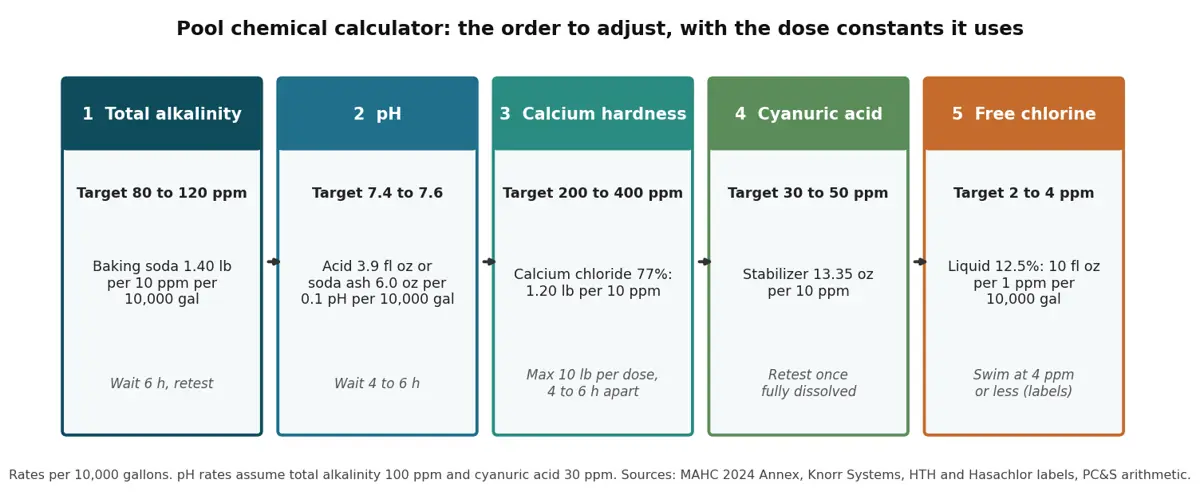
Florida DOH tells operators to adjust total alkalinity first (Swimming Pool Operators’ Manual). The National Plasterers Council start-up card says never add calcium chloride and sodium bicarbonate at the same time, because the mix clouds water. HTH limits calcium chloride to 10 lb per 10,000 gallons per dose, 4 to 6 hours apart (HTH Calcium Up directions).
Chlorine goes last for two reasons: liquid chlorine and cal hypo raise pH (Florida DOH lists a 1% solution of sodium hypochlorite at pH 9 to 14), and swimmers must stay out above 4 ppm on most labels. Step-by-step chlorine dosing by product is on our how much chlorine to add to a pool page.
Where do the calculator's dose rates come from?
Each rate starts from 10,000 gallons = 37,854 liters, so 1 ppm (1 mg/L) is 37.85 g of the active part. Molar masses from PubChem convert that to grams of product, then strength converts to the jug or bag. Every derived figure was checked against an EPA label, a health department chart or a supplier chart; 12 of the 14 land within 3% of the outside figure.
| Reading and product | Step | Rate per 10,000 gal per step | Derivation (10,000 gal = 37,854 L; 1 ppm = 1 mg/L) | Checked against | Sibling page |
|---|---|---|---|---|---|
| Free chlorine: liquid chlorine 10% (trade %, 100 g/L) | 1 ppm | 12.8 fl oz | 37.85 g available chlorine / 100 g/L = 0.379 L = 12.8 fl oz | Florida DOH: 13 oz per 1 ppm for 10 to 12% liquid | No 10% row on /how-much-chlorine-to-add-to-pool/ |
| Free chlorine: liquid chlorine 12.5% (125 g/L) | 1 ppm | 10 fl oz | 37.85 g / 125 g/L = 0.303 L = 10.2 fl oz; label chart rounds to 10 | Hasachlor 12.5% label (EPA Reg. No. 10897-26): 10 fl oz per 1 ppm | Agrees: 10 fl oz |
| Free chlorine: cal hypo 65% | 1 ppm | 2.05 oz | 37.85 g = 1.335 oz of 100% available chlorine; 1.335 / 0.65 | Scorch label: 10 to 20 oz gives 5 to 10 ppm (2.0 oz per ppm) | Agrees: 2.0 |
| Free chlorine: cal hypo 73% | 1 ppm | 1.83 oz | 1.335 / 0.73 | HTH Granular 73 label: 18.29 oz gives 10 ppm (1.83) | Agrees: 1.83 |
| Free chlorine: dichlor 56% | 1 ppm | 2.38 oz | 1.335 / 0.56 | Pace label: 12 to 24 oz gives 5 to 10 ppm (2.4) | Agrees: 2.4 |
| pH down: muriatic acid 31.45% | 0.1 pH | 3.9 fl oz | Carbonate and cyanurate buffer model at TA 100, CYA 30, 77 F: average acid per 0.1 from pH 7.8 to 7.4 | Trouble Free Pool PoolMath formula: 2.8 to 4.6 fl oz per 0.1 across the same band | Sibling quotes Florida DOH 12 oz per 0.2 (6 fl oz per 0.1): see note |
| pH down: dry acid (sodium bisulfate 94.5%) | 0.1 pH | 5.2 oz | 3.9 fl oz x (33.9 oz dry acid / 25.6 fl oz muriatic per equal acid) | Florida DOH: 1 pint muriatic = 1.25 lb dry acid (1.25 oz per fl oz) | Agrees with the 1.33 ratio on /how-to-lower-alkalinity-in-pool/ |
| pH up: soda ash (sodium carbonate) | 0.1 pH | 6.0 oz | Same model: average soda ash per 0.1 from pH 7.2 to 7.6 | Knorr Systems: 0.75 lb (12 oz) from 7.2 to 7.4 (6.0 oz per 0.1) | Sibling quotes Florida DOH 6 oz per 0.2 (3 oz per 0.1): see note |
| Total alkalinity up: baking soda | 10 ppm | 1.40 lb (22.4 oz) | 7.565 eq x 84.007 g = 635.5 g | MAHC Annex 5.7.4.4.1: 1.4 lb; labels say 1.5 lb | Agrees: 1.40 chemistry, 1.5 label |
| Total alkalinity down: muriatic acid 31.45% | 10 ppm | 25.6 fl oz | 7.565 mol HCl x 36.46 g / 0.3145 / 1.16 g per mL = 756 mL | Skinner and Hales (JSPSI vol. 1): 25.6 fl oz | Agrees: 25.6 |
| Calcium hardness up: calcium chloride 77 to 80% | 10 ppm | 1.20 lb (19.2 oz) | 3.782 mol Ca x 110.98 g / 0.77 = 545 g | Knorr Systems: 1.2 lb (77%) | Agrees: 1.20 |
| Calcium hardness up: calcium chloride 94 to 97% | 10 ppm | 0.98 lb (15.7 oz) | 3.782 mol x 110.98 g / 0.94 = 447 g | Knorr Systems: 0.9 lb (100%); chemistry 0.925 lb at 100% | Agrees: 0.984 |
| Cyanuric acid up: stabilizer (100% cyanuric acid) | 10 ppm | 13.35 oz | 10 mg/L x 37,854 L = 378.5 g | Knorr Systems: 13 oz; Leslie's label 2.5 lb per 30 ppm (13.3 oz per 10) | Agrees: 13 oz |
| Salt up: sodium chloride 99%+ | 100 ppm | 8.34 lb | 100 mg/L x 37,854 L = 3,785 g; or 10,000 gal x 8.34 lb x 100 / 1,000,000 | Pentair IntelliChlor table matches 8.34 within 1.1% | Agrees: /pool-salt-calculator/ |
Molar masses: PubChem and PubChem (sodium bicarbonate 84.007, sodium carbonate 105.99, calcium chloride 110.98, CaCO3 100.09). Acid strength 31.45%, density 1.16: Skinner and Hales. Trade percent = grams per liter / 10: OxyChem handbook. Labels: Hasachlor, HTH Granular 73, Scorch, Pace. Download CSV
Why 12.5% liquid chlorine is 10 fl oz and not 10.2? Pool bleach strength is sold as trade percent, grams of available chlorine per 100 mL (OxyChem), so 12.5% holds 125 g per liter and 37.85 g needs 0.303 L, or 10.2 fl oz. The Hasachlor label chart prints 10 fl oz, and our chlorine page uses 10, so the calculator keeps 10; the 2% difference is smaller than the strength a jug loses in a few weeks of storage.
Why does alkalinity use 50.04 and calcium 100.09? Both readings are reported as ppm of calcium carbonate. One mole of CaCO3 neutralizes two moles of acid, so 10 ppm of alkalinity is 378.5 g / 50.04 = 7.565 equivalents, met by 7.565 mol of baking soda (635.5 g). Calcium counts one mole per mole: 378.5 g / 100.09 = 3.782 mol, or 419.7 g of pure calcium chloride. Label rounding for baking soda (1.5 lb vs 1.40 lb) is compared brand by brand on our how to raise alkalinity in a pool page.
Two of our pages quote different pH figures: how to lower pH in a pool prints the Florida and Virginia tables (12 oz of acid per 0.2) and how to raise pH in a pool prints Florida’s 6 oz of soda ash per 0.2 and Knorr’s 0.75 lb per 0.2. Those are published figures, quoted correctly; the calculator uses the chemistry below, which matches Knorr for soda ash and sits between PoolMath and the state tables for acid.
Why does the pH dose depend on total alkalinity?
Total alkalinity is mostly bicarbonate, a buffer that soaks up acid before pH moves. With alkalinity at 100 ppm and stabilizer at 30 ppm, taking pH from 7.8 to 7.4 uses an average of 3.9 fl oz of 31.45% muriatic acid per 0.1 step per 10,000 gallons, and raising pH from 7.2 to 7.6 uses 6.0 oz of soda ash per 0.1.
The calculator uses 3.9 fl oz, the average from pH 7.8 to 7.4.
Source: PC&S carbonate and cyanurate buffer model (pK1 6.35, cyanuric acid pKa 6.88, 77 F); cross-checked with the Trouble Free Pool PoolMath formula, opened 2026-11-03.. Download chart data (CSV)
| pH band (0.1 step) | Muriatic acid 31.45%, fl oz (PC&S model) | Muriatic acid, fl oz (PoolMath formula) | Soda ash, oz (PC&S model) | Soda ash, oz (PoolMath formula) |
|---|---|---|---|---|
| 8.1 to 8.2 | 1.5 | 2.1 | 1.7 | 2.3 |
| 8.0 to 8.1 | 1.8 | 2.1 | 1.9 | 2.3 |
| 7.9 to 8.0 | 2.0 | 2.2 | 2.2 | 2.4 |
| 7.8 to 7.9 | 2.4 | 2.4 | 2.6 | 2.6 |
| 7.7 to 7.8 | 2.9 | 2.8 | 3.1 | 3.0 |
| 7.6 to 7.7 | 3.5 | 3.2 | 3.8 | 3.5 |
| 7.5 to 7.6 | 4.2 | 3.8 | 4.5 | 4.2 |
| 7.4 to 7.5 | 5.1 | 4.5 | 5.4 | 5.0 |
| 7.3 to 7.4 | 6.1 | 5.4 | 6.4 | 6.0 |
| 7.2 to 7.3 | 7.3 | 6.5 | 7.5 | 7.1 |
| 7.1 to 7.2 | 8.7 | 7.7 | 8.8 | 8.4 |
| 7.0 to 7.1 | 10.3 | 9.0 | 10.3 | 9.9 |
PC&S model: carbonic acid pK1 6.35 and pK2 10.33, cyanuric acid pKa 6.88, carbonate alkalinity = TA minus one third of CYA (NPC); script in raw/. Check column: Trouble Free Pool PoolMath formula (TA term only), opened 2026-11-03. Download CSV
Acid lowers pH by turning bicarbonate into dissolved carbon dioxide. Near pH 7.8 little carbon dioxide is present, so a small dose moves pH far: 2.9 fl oz per 0.1 between 7.8 and 7.7. Near 7.4 the same 0.1 takes 5.1 fl oz. Each 3.9 fl oz dose also uses about 1.5 ppm of alkalinity (3.9 / 25.6 x 10), which is why repeated acid slowly drags alkalinity down on a salt pool.
Soda ash works the other way and carries alkalinity with it: 6.0 oz adds about 4.2 ppm (6.0 / 14.1 x 10). Knorr’s chart of 0.75 lb to take 10,000 gallons from 7.2 to 7.4 at alkalinity 60 to 120 ppm lands on the same 6 oz per 0.1 (Knorr Systems). Knorr also caps soda ash at 1 lb per 10,000 gallons per dose to avoid clouding.
| Dose per 10,000 gal | Published figure | Who publishes it | Chemistry (this page) | Gap and why |
|---|---|---|---|---|
| Muriatic acid per 0.1 pH | 6 fl oz (12 oz per 0.2) | Florida DOH quick reference; Virginia DOH table | 3.9 fl oz (TA 100, CYA 30, pH 7.8 to 7.4) | State tables are about 1.5 times the model; they suit TA near 120 ppm or a pH near 7.4 |
| Muriatic acid per 0.1 pH | 5.3 fl oz (10.7 fl oz from 7.8 to 7.6) | Knorr Systems chart | 3.9 fl oz | Knorr starts at 7.8 and gives one dose to reach 7.6 |
| Muriatic acid per 0.1 pH | 6.4 fl oz; dry acid 9.6 oz | The Pool Nerd quick reference (no TA stated) | 3.9 fl oz; dry acid 5.2 oz | No buffer assumption stated; the dry acid figure is 1.5 times the acid figure, chemistry gives 1.33 |
| Soda ash per 0.1 pH | 3 oz (6 oz per 0.2) | Florida DOH quick reference | 6.0 oz (TA 100, pH 7.2 to 7.6) | Model and Knorr agree at 6 oz; Florida figure is half |
| Soda ash per 0.1 pH | 6 oz (0.75 lb from 7.2 to 7.4) | Knorr Systems chart | 6.0 oz | Agrees |
| Soda ash per 0.1 pH | 16 oz (1 lb per 0.1) | FROG pH overview | 6.0 oz | FROG figure is 2.7 times the model; start smaller and retest |
| Baking soda per 10 ppm TA | 1.5 lb | Florida DOH, Pennsylvania DOH, Arm & Hammer, Leslie's | 1.40 lb | Labels round up about 7% (Skinner and Hales) |
| Muriatic acid per 10 ppm TA | 21 oz | Virginia DOH table | 25.6 fl oz | Chart dose gives about 8.2 ppm, 18% under |
| Cal hypo 73% per 1 ppm FC | 1.83 oz (18.29 oz per 10 ppm) | HTH Granular 73 label | 1.83 oz | Agrees |
Published figures: Florida DOH, Virginia DOH, Knorr Systems, FROG, The Pool Nerd (saved copy in raw/), HTH label. Chemistry: this page. Download CSV
How much liquid chlorine should you use for a 20,000 gallon pool?
A 20,000 gallon pool takes 20 fl oz of 12.5% liquid chlorine for each 1 ppm of free chlorine, so going from 1 to 4 ppm takes 60 fl oz, just under half a gallon. With 10% liquid chlorine the same rise takes 76.8 fl oz; with 73% cal hypo it takes 11.0 oz by weight.
128 fl oz = 1 gallon. Re-entry labels prohibit swimming above 4 ppm.
Source: PC&S arithmetic: 10 fl oz (Hasachlor label) and 12.8 fl oz per ppm per 10,000 gal, times 2.. Download chart data (CSV)
| Raise free chlorine by | Liquid chlorine 12.5% (fl oz) | Liquid chlorine 10% (fl oz) | Cal hypo 73% (oz) | Cal hypo 65% (oz) | Dichlor 56% (oz) |
|---|---|---|---|---|---|
| 1 ppm | 20 | 25.6 | 3.7 | 4.1 | 4.8 |
| 2 ppm | 40 | 51.2 | 7.3 | 8.2 | 9.5 |
| 3 ppm | 60 | 76.8 | 11.0 | 12.3 | 14.3 |
| 5 ppm | 100 | 128.0 | 18.3 | 20.5 | 23.8 |
| 10 ppm | 200 | 256.0 | 36.6 | 41.0 | 47.6 |
PC&S arithmetic: rates per 10,000 gal from the dose constants table x 2. Labels: Hasachlor, HTH Granular 73, Scorch, Pace. Download CSV
Target free chlorine from your stabilizer level: the 2024 MAHC treats a cyanuric acid to free chlorine ratio above 45:1 as an imminent health hazard in public pools, so 30 ppm stabilizer needs at least 0.67 ppm and 90 ppm needs 2 ppm. Cal hypo adds about 0.71 ppm calcium and dichlor about 0.91 ppm cyanuric acid per ppm of chlorine, figures worked on our chlorine dosing page.
Which targets should you type into the calculator?
Type the middle of the home range: free chlorine 2 to 4 ppm, pH 7.4 to 7.6, total alkalinity 80 to 100 ppm (up to 120 with tablets), calcium hardness 200 to 400 ppm on plaster, cyanuric acid 30 to 50 ppm, and your salt cell’s ideal. Code limits are wider: MAHC allows alkalinity 60 to 180 ppm and stabilizer up to 90 ppm.
| Reading | Type this target | Allowed or minimum range | Source |
|---|---|---|---|
| Free chlorine | 2 to 4 ppm (and at least CYA / 45) | At least 1 ppm; 2 ppm with CYA (MAHC 5.7.3.1.1.2); labels bar swimming above 4 ppm | CDC; 2024 MAHC; Hasachlor and HTH labels |
| pH | 7.4 to 7.6 | 7.0 to 7.8 (CDC); 7.2 to 7.8 (Hayward, Pentair) | CDC; Hayward AquaRite 900; Pentair IntelliChlor |
| Total alkalinity | 80 to 100 ppm (salt or liquid chlorine), up to 120 ppm (tablets) | 60 to 180 ppm (MAHC 5.7.4.4.1); 80 to 120 ppm (Florida DOH) | 2024 MAHC; Florida DOH; Virginia DOH |
| Calcium hardness | 200 to 400 ppm for plaster | Up to 2,500 ppm (MAHC 5.7.4.4.3) | National Plasterers Council; 2024 MAHC |
| Cyanuric acid | 30 to 50 ppm | 90 ppm or less (MAHC 5.7.3.1.3.2) | NPC; Hayward AquaRite 900; 2024 MAHC |
| Salt (salt pools) | Your cell maker's ideal: 3,200 ppm (Hayward), 3,600 ppm (Pentair) | 2,700 to 3,400 (Hayward); 3,600 to 4,500 (Pentair) | Hayward AquaRite 900; Pentair IntelliChlor |
CDC; 2024 MAHC; Florida DOH; NPC start-up card; Hayward AquaRite 900; Pentair IntelliChlor. Download CSV
The full chart with state code columns is on our pool chemical levels chart. Calcium and stabilizer details, including how fill water hardness by city changes the calcium dose, are on the calcium hardness and cyanuric acid pages; salt bag counts by maker target are on the pool salt calculator.
What does a full rebalance look like, start to finish?
Take an 18,000 gallon plaster pool reading alkalinity 60 ppm, pH 7.1, calcium 150 ppm, stabilizer 0 ppm and chlorine 0.5 ppm after winter. The calculator sequence is 7.6 lb of baking soda, a pH retest, up to 2.0 lb of soda ash, 13.0 lb of 77% calcium chloride in two doses, 4.5 lb of stabilizer and 63 fl oz of 12.5% liquid chlorine.
- Alkalinity 60 to 90 ppm3 steps x 22.4 oz x 1.8 = 121 oz, 7.6 lb by the 1.40 lb rate (labels at 1.5 lb say 8.1 lb). Wait 6 hours and retest pH, which baking soda nudges up.
- pH 7.1 to 7.4 if still low3 steps x 6.0 oz x 1.8 = 32 oz (2.0 lb) of soda ash; split into two doses of 1 lb or less per 10,000 gal as Knorr advises.
- Calcium 150 to 210 ppm6 steps x 19.2 oz x 1.8 = 207 oz, 13.0 lb of 77% calcium chloride; HTH’s 10 lb per 10,000 gal cap allows 18 lb per dose here, but NPC’s 10 lb increments mean two doses hours apart.
- Stabilizer 0 to 30 ppm3 steps x 13.35 oz x 1.8 = 72 oz, 4.5 lb; the Leslie’s label rate (2.5 lb per 30 ppm per 10,000 gal) gives the same 4.5 lb.
- Chlorine 0.5 to 4 ppm3.5 steps x 10 fl oz x 1.8 = 63 fl oz of 12.5% liquid chlorine; swim once a test reads 4 ppm or less.
Each figure is pure product at labeled strength, so the gallons you enter carry the whole answer: the same readings in a 25,000 gallon pool scale every amount by 2.5 instead of 1.8. Retail prices for each product are in our pool chemical prices report.
How do you add pool chemicals safely?
Add one product at a time, never mix two products in a bucket, add acid to water and never water to acid, and keep people out of the pool until each product has circulated. CDC counts about 4,500 emergency department visits a year from pool chemical injuries, and at least 56.3% of 2015 to 2017 cases happened at a residence.
- Never mix products. EPA’s chemical safety alert says mixing incompatible pool chemicals can start a fire or release chlorine gas; NPIC gives the same rule. Use a separate clean scoop per product.
- Acid into water. Pre-dilute muriatic acid by pouring it into a bucket of pool water (Hayward Aqua Rite manual), outdoors, upwind, with goggles and gloves.
- Pump running, near a return. Pour along a return jet, away from the skimmer, and circulate 4 to 6 hours before retesting (FROG).
- Store apart and cool. Keep chlorine and acid on separate shelves, below 95 F (CDC).
- Poison Control: 1-800-222-1222. Call if anyone swallows, inhales or splashes a product (NPIC); call 911 for breathing trouble.
CPSC emergency department data put pool chemical injuries at 4,700 nonfatal visits in 2024, close to the CDC figure, as broken out in our pool injury statistics report.
What should you do for each reading?
Use the decision table when a reading is out of range. It turns the calculator output into an action: which product, how much per dose and how long to wait. Three readings cannot be lowered with a product: calcium hardness, cyanuric acid and salt all need a partial drain, and the share to drain is 1 minus target divided by current.
| If your situation is | Do this |
|---|---|
| Total alkalinity is under 80 ppm or over 120 ppm | Fix alkalinity first, then retest pH after 6 hours (FROG, Arm & Hammer wait times) |
| pH is above 7.8 and alkalinity is in range | Add the acid dose shown, pour it near a return jet with the pump on, retest after 4 to 6 hours |
| pH is under 7.2 and alkalinity is in range | Add soda ash, no more than 1 lb per 10,000 gal at a time (Knorr) to avoid clouding |
| Alkalinity is below 120 ppm and the pH move is more than 0.3 | Dose 3/4 of the calculator figure, retest, then add the rest: the per-step dose grows as pH falls |
| Calcium hardness is under 200 ppm on plaster | Add calcium chloride, at most 10 lb per 10,000 gal per dose, 4 to 6 hours apart (HTH) |
| Cyanuric acid is over 90 ppm or calcium over your target | No product lowers it: replace water; share to drain = 1 minus target / current |
| Free chlorine is below CYA / 45 | Add chlorine last, after pH is 7.2 to 7.8, and keep swimmers out until it reads 4 ppm or less |
| Readings came from test strips and the dose is large | Confirm with a drop-based (titration) test before adding more than 2 steps of any product |
Knorr Systems; HTH; FROG; 2024 MAHC; PC&S arithmetic. Download CSV
Test strips read in color blocks rather than exact ppm, so a strip that reads 40 ppm alkalinity when the water is at 70 would double the baking soda dose (5 steps instead of 2 for a 90 ppm target). Our how to test pool water page compares strips, drop kits and photometers before you trust a large number.
How we compiled this
We derived 14 dose constants from PubChem molar masses and the 37,854 liters in 10,000 gallons, then checked each against 4 EPA-registered labels, 2 state health department manuals, the 2024 MAHC Annex, the Skinner and Hales dosage paper and the Knorr Systems chart, all opened between October 19 and November 3, 2026. The pH rates come from a carbonate and cyanurate buffer model we wrote (script in the package) and were compared with the Trouble Free Pool PoolMath formula. We did not test any product in a pool.
Frequently Asked Questions
How to figure out how much chemicals to add to a pool?
Subtract your reading from the target, divide by the product’s step, multiply by its rate per 10,000 gallons and by your gallons divided by 10,000. Example: 15,000 gallons from 1 to 3 ppm with 12.5% liquid chlorine is 2 x 10 fl oz x 1.5 = 30 fl oz. Adjust alkalinity first and chlorine last, retesting between products.
How much liquid chlorine should I use for a 20,000 gallon pool?
Use 20 fl oz of 12.5% liquid chlorine per 1 ppm of free chlorine in 20,000 gallons, based on the Hasachlor label rate of 10 fl oz per ppm per 10,000 gallons. Raising 1 to 4 ppm takes 60 fl oz, just under half a gallon. With 10% liquid chlorine use 25.6 fl oz per ppm, or 76.8 fl oz for the same rise.
How much chlorine do I put in my pool calculator?
Enter your gallons, your current free chlorine and a target of 2 to 4 ppm, at least your stabilizer reading divided by 45. The calculator multiplies the difference by 10 fl oz of 12.5% liquid, 12.8 fl oz of 10% liquid, 1.83 oz of 73% cal hypo, 2.05 oz of 65% cal hypo or 2.38 oz of 56% dichlor per ppm per 10,000 gallons.
What app can I use to calculate pool chemical needs?
Free web calculators in the November 2026 Google results include Trouble Free Pool’s PoolMath, Hayward’s water chemistry calculator and AquaChek’s water balance calculator, plus phone apps such as Pool Chem Calculator. Whichever you use, check that it states its alkalinity assumption for acid doses: our model shows the acid per 0.1 pH roughly doubling between pH 7.9 and 7.4.
Why is the acid dose for pH different on every chart?
The acid needed depends on total alkalinity, stabilizer and the starting pH. At alkalinity 100 ppm our model gives 2.4 fl oz of 31.45% acid per 0.1 near pH 7.8 and 5.1 fl oz near 7.4 per 10,000 gallons. Florida DOH prints 12 oz per 0.2 for all cases, which suits higher alkalinity. Start at three quarters and retest.
Can I add all my pool chemicals at the same time?
No. Add one product, circulate, then add the next. The National Plasterers Council says never add calcium chloride and sodium bicarbonate together because the water clouds, and EPA warns that mixing incompatible pool chemicals can release chlorine gas. Wait about 6 hours after baking soda and 4 to 6 hours after acid before the next test.
Sources
- CDC. Home Pool and Hot Tub Water Treatment and Testing. Accessed 2026-10-19.
- CDC. 2024 Model Aquatic Health Code, 5th Edition, Code Language. Accessed 2026-11-03.
- CDC. 2024 Model Aquatic Health Code Annex (5.7.4.4.1 sodium bicarbonate dose). Accessed 2026-10-19.
- U.S. EPA Pesticide Product and Label System. Hasachlor sodium hypochlorite 12.5% label, EPA Reg. No. 10897-26. Accessed 2026-10-19.
- U.S. EPA Pesticide Product and Label System. HTH Granular 73 label, EPA Reg. No. 1258-1239. Accessed 2026-10-19.
- U.S. EPA Pesticide Product and Label System. Scorch calcium hypochlorite 65% label, EPA Reg. No. 3432-76. Accessed 2026-10-19.
- U.S. EPA Pesticide Product and Label System. Pace dichlor 56% label, EPA Reg. No. 1258-984. Accessed 2026-10-19.
- Florida Department of Health in Collier County. Swimming Pool Operators' Manual, 2016 Version. Accessed 2026-10-19.
- Virginia Department of Health, Portsmouth. Pool Operation and Maintenance Guide (June 2018). Accessed 2026-10-19.
- Knorr Systems. Chemical Dosing Charts. Accessed 2026-10-19.
- Skinner and Hales. Dosages for Adjusting Alkalinity (Journal of the Swimming Pool and Spa Industry, vol. 1). Accessed 2026-10-19.
- OxyChem. Sodium Hypochlorite Handbook. Accessed 2026-10-19.
- PubChem, NIH. Compound molar masses (sodium bicarbonate, sodium carbonate, CaCO3). Accessed 2026-10-19.
- PubChem, NIH. Compound molar masses (calcium chloride and others). Accessed 2026-10-19.
- Trouble Free Pool. Pool Math calculator (dosing formulas in page source). Accessed 2026-11-03.
- National Plasterers Council. Pool Start-Up Procedures card. Accessed 2026-10-19.
- HTH. HTH Pool Care Calcium Up directions. Accessed 2026-10-19.
- Leslie's. Leslie's Pool Stabilizer listing (Wayback capture Sept 16, 2026). Accessed 2026-10-19.
- Hayward. AquaRite 900 manual. Accessed 2026-11-01.
- Hayward. Aqua Rite product manual. Accessed 2026-10-19.
- Pentair. IntelliChlor Installation and User's Guide. Accessed 2026-11-01.
- National Pesticide Information Center. Pool and Spa Chemicals Fact Sheet. Accessed 2026-10-19.
- CDC. Pool Chemical Emergencies. Accessed 2026-10-19.
- CDC. Pool Chemical Safety. Accessed 2026-10-19.
- FROG. pH overview. Accessed 2026-10-19.
- FROG. How to lower pH in a pool. Accessed 2026-10-19.
- U.S. EPA. Chemical Safety Alert: Safe Storage and Handling of Swimming Pool Chemicals (EPA 550-F-01-003). Accessed 2026-10-19.
- CDC. Pool Chemical Injuries in Public and Residential Settings, MMWR 2019;68(19). Accessed 2026-10-19.
- Pennsylvania Department of Health. Public Swimming and Bathing Places: Operational and Biological Contamination Protocol Recommendations (Nov 1, 2016). Accessed 2026-10-19.
- USGS. Water Density. Accessed 2026-10-19.
Related pages
Get Quotes From Licensed Local Pool Pros
Tell us what you need and your ZIP code. We match you with pool companies that cover your area.