How to Lower pH in Hot Tub Water, Dosed by Tub Size
How to lower pH in hot tub water: check alkalinity first, then add sodium bisulfate, 0.64 oz (about 3 teaspoons) in a 400 gallon tub at pH 8.0 to 8.4 per the HTH label, with jets running.
- ✓Hot tubs miss pH more often27.5% of public hot tub inspections found a pH violation in 2013, versus 14.9% of all aquatic venues (CDC).
- ✓Published doses vary 25 foldFirst doses for a 400 gallon tub run from 0.16 oz to 4 oz, so start at the small end and retest.
- ✓Same range as pools, hotter waterCDC: pH 7.0 to 7.8, chlorine at least 3 ppm, water no hotter than 104 F.
Key takeaways
- CDC sets hot tub targets at pH 7.0 to 7.8, free chlorine of at least 3 ppm or bromine of 4 to 8 ppm, and water no hotter than 104 F.
- The HTH pH Down label rate of 1.6 oz per 1,000 gallons at pH 8.0 to 8.4 works out to 0.48 oz in a 300 gallon tub and 0.80 oz in a 500 gallon tub.
- One ounce of sodium bisulfate is about 4.5 teaspoons, from the Blue Tropic label (1 lb is about 1.5 cups) and the FDA definition of a 5 mL teaspoon.
- If total alkalinity is above 120 ppm, lower it first (Master Spas): 10 ppm in 400 gallons takes about 1.36 oz of dry acid by the Skinner and Hales formula.
- Published first doses for a 400 gallon tub range from 0.16 oz (Lincoln County, Wisconsin) to 4 oz, a 25 fold spread, so begin with the small dose.
- After dosing, leave the cover partly open for 20 minutes (Catalina Spas) and replace the water every 3 to 6 months (Coast Spas).
What pH should a hot tub be?
CDC recommends pH 7.0 to 7.8 for hot tubs, the same range as pools, with at least 3 ppm free chlorine or 4 to 8 ppm bromine. Spa makers aim tighter. Catalina Spas lists pH 7.2 to 7.6 and alkalinity 80 to 120 ppm, citing the Association of Pool and Spa Professionals, and Coast Spas lists pH 7.2 to 7.8.
| Source | pH | Sanitizer | Total alkalinity | Water temperature |
|---|---|---|---|---|
| CDC, What You Can Do to Stay Healthy in Hot Tubs | 7.0 to 7.8 | Chlorine at least 3 ppm; bromine 4 to 8 ppm | Not stated | Not above 104 F |
| 2024 Model Aquatic Health Code (public spas) | 7.0 to 7.8 (5.7.3.4.1) | Chlorine at least 3.0 ppm (5.7.3.1.1.2.3); bromine at least 4.0, max 8.0 ppm | 60 to 180 ppm (5.7.4.4.1) | Max 104 F (4.12.1.7) |
| CDC Legionella hot tub toolkit | 7.2 to 7.8 | Chlorine 3 to 10 ppm; bromine 4 to 8 ppm | Not stated | Not above 104 F |
| Catalina Spas owner's guide (citing APSP) | 7.2 to 7.6 | Chlorine 3.0 to 4.0 ppm; bromine 2.0 to 4.0 ppm | 80 to 120 ppm | Not stated in chemistry table |
| Coast Spas 2026 Purfikt owner's manual | 7.2 to 7.8 | Chlorine 1.0 to 3.0 ppm; bromine 2.0 to 5.0 ppm | 100 to 120 ppm | Never above 104 F |
| FROG Products (manufacturer) | 7.2 to 7.6 | Not stated | Not stated | Not stated |
| CPSC (1980 release) | Not stated | Not stated | Not stated | Never above 104 F; 100 F safe for a healthy adult |
Sources: CDC hot tub guidance; MAHC 2024; CDC Legionella hot tub toolkit; Catalina Spas owner guide; Coast Spas 2026 manual; FROG Products; CPSC. Download CSV
Where sources differ, use the stricter number. Coast Spas lists chlorine at 1.0 to 3.0 ppm, below the CDC minimum of 3 ppm for hot tubs, and the 2024 code requires 3.0 ppm in public spas.
High pH matters more in a hot tub because chlorine is already under strain: a 2021 CDC outbreak report says higher water temperatures and jet aerosols deplete disinfectant, which is why public spas need more of it. CDC also says chlorine’s ability to kill germs drops as pH rises, especially above 8.0. The Pennsylvania Department of Health table shows why: about 66% of free chlorine is in its active form at pH 7.2, 24% at 8.0 and 19% at 8.2. High pH is also the most cited cause of cloudy hot tub water, named in 8 of 9 makers’ manuals.
Convenience sample of reporting jurisdictions in Arizona, California, Florida, New York and Texas; public venues only.
Source: Source: CDC, MMWR Surveillance Summaries 65(SS-5), Network for Aquatic Facility Inspection Surveillance, five states, 2013 (published 2016).. Download chart data (CSV)
Public inspection data show hot tubs drift more than pools. In CDC inspection surveillance from 16 jurisdictions in five states in 2013, 27.5% of 13,783 routine hot tub and spa inspections found a pH violation, against 14.9% of all venues. Of 560 treated recreational water outbreaks reported to CDC from 2009 to 2023, 176 were linked to hot tubs or spas and 147 of those involved Legionella (PC&S outbreak research).
Why does hot tub pH keep rising?
Jets, alkalinity and sanitizer are the usual drivers. Master Spas, a hot tub maker, says jets add air that pushes pH up over time and that alkalinity above 120 ppm locks pH in place. Pennsylvania DOH says sodium and calcium hypochlorite raise pH and alkalinity over time, while bromine and dichlor push them down. Our guide to chlorine vs bromine compares the two hot tub sanitizers on pH effect, stabilizer and monthly cost.
| What you see | Likely cause | What to do | Source |
|---|---|---|---|
| pH climbs after every soak or long jet run | Jets add air, which drives off carbon dioxide | Shorter jet cycles while balancing; air valves off when dosing | Master Spas (manufacturer) |
| pH will not move after a full dose | Total alkalinity above 120 ppm | Lower alkalinity first, 10 ppm at a time | Master Spas; Spa Care |
| High pH right after a fresh fill | Mineral-rich or high-pH source water | Test the fill water; a hose filter can reduce minerals | Master Spas |
| pH and alkalinity creep up with chlorine use | Hypochlorite sanitizers (liquid or cal hypo) | Expect regular small acid doses; bromine and dichlor push the other way | Pennsylvania DOH |
| Chemical smell, cloudy water, scale on jets | pH high for days; sanitizer weakened | Correct pH, then sanitizer; drain if it will not hold | Spa Care; CDC |
Sources: Master Spas; Spa Care; Pennsylvania DOH; CDC. Download CSV
How much pH decreaser should you add to a hot tub?
Scale the label rate to your gallons. The HTH pH Down label lists 1.6 oz of sodium bisulfate per 1,000 gallons at pH 8.0 to 8.4 and 2.4 oz above 8.4. For a 400 gallon tub that is 0.64 oz or 0.96 oz, about 2.9 or 4.3 teaspoons. Hot tubs from Coast Spas and Hot Spring hold 232 to 527 gallons.
| Tub size | pH 8.0 to 8.4: ounces | pH 8.0 to 8.4: teaspoons | pH above 8.4: ounces | pH above 8.4: teaspoons |
|---|---|---|---|---|
| 300 gal | 0.48 oz | about 2.2 tsp | 0.72 oz | about 3.2 tsp |
| 350 gal | 0.56 oz | about 2.5 tsp | 0.84 oz | about 3.8 tsp |
| 400 gal | 0.64 oz | about 2.9 tsp | 0.96 oz | about 4.3 tsp |
| 450 gal | 0.72 oz | about 3.2 tsp | 1.08 oz | about 4.9 tsp |
| 500 gal | 0.80 oz | about 3.6 tsp | 1.20 oz | about 5.4 tsp |
PC&S scaling of the HTH Pool Care pH Down label rates (1.6 and 2.4 oz per 1,000 gallons). Teaspoons use 4.5 tsp per oz from the Blue Tropic label and 21 CFR 101.9; your product’s density may differ, so weigh the first dose if you can. Download CSV
Find your gallons in the owner’s manual before you measure. The Coast Spas 2026 manual lists 232 gallons for a 3 to 4 seat 2Purfikt Traditional, 305 for the 2Purfikt Infinity and 527 for the 7 to 8 seat Purfikt Infinity, and Hot Spring gives 450 gallons for its 7 seat Grandee. A 300 gallon guess on a 450 gallon tub underdoses by a third.
| Step | Arithmetic | Result |
|---|---|---|
| 1. Label rate (HTH pH Down, pH 8.0 to 8.4) | 1.6 oz per 1,000 gal | 0.0016 oz per gallon |
| 2. Scale to a 400 gallon tub | 1.6 x 400 / 1,000 | 0.64 oz |
| 3. Volume of 1 lb of sodium bisulfate (Blue Tropic label) | 1 lb = about 1.5 cups; 1 cup = 240 mL (FDA) | about 360 mL per lb |
| 4. Teaspoons per pound (FDA: 1 tsp = 5 mL) | 360 / 5 | 72 tsp per lb |
| 5. Teaspoons per ounce | 72 / 16 | 4.5 tsp per oz |
| 6. Dose for a 400 gallon tub in teaspoons | 0.64 x 4.5 | about 2.9 tsp (just under 1 tablespoon) |
Sources: HTH pH Down label; Blue Tropic pH Decreaser label; FDA, 21 CFR 101.9(b)(5)(viii). Arithmetic by PC&S, October 2026. Download CSV
Starting pH and goals differ by source; the 25 fold spread is why the first dose should be the small one.
Source: Sources: Lincoln County, WI operator handout (Acid Addition table); HTH Pool Care pH Down label; Swim University pH decreaser chart; Royal Spa, Lowering pH Level in Your Hot Tub. PC&S scaling to 400 gallons.. Download chart data (CSV)
| Source | Starting point | Published rate | 400 gallon tub | Teaspoons at label density |
|---|---|---|---|---|
| Lincoln County, WI health handout | pH 8.0 to 7.5, alkalinity about 100 | 0.4 oz per 1,000 gal | 0.16 oz | 0.7 |
| Lincoln County, WI health handout (its own spa example) | pH 8.0 to 7.0 | 1.4 oz per 1,000 gal | 0.56 oz (handout rounds to 0.6) | 2.5 |
| HTH pH Down label | pH 8.0 to 8.4 | 1.6 oz per 1,000 gal | 0.64 oz | 2.9 |
| Swim University chart | pH 8.0 | Listed per tub size | 0.75 oz, also listed as 1 1/2 tsp | 3.4 (1 1/2 tsp would weigh 0.33 oz) |
| HTH pH Down label | pH above 8.4 | 2.4 oz per 1,000 gal | 0.96 oz | 4.3 |
| Royal Spa (manufacturer), pH/Alkalinity Down | First dose, pH and alkalinity both high | 1 oz per 100 gal | 4 oz | 18 |
Sources: Lincoln County, WI handout; HTH pH Down label; Swim University; Royal Spa. PC&S scaling to 400 gallons; teaspoons at 4.5 per oz. Download CSV
Two things explain the spread. The sources start from different readings and aim for different targets, and some products are sold to lower pH and alkalinity together, which takes more acid. One chart’s units do not agree with each other either: 1 1/2 teaspoons of sodium bisulfate weighs about 0.33 oz at label density, not the 0.75 oz printed beside it. Weigh or measure the smaller figure, then let the retest decide.
How to lower pH in hot tub water, step by step
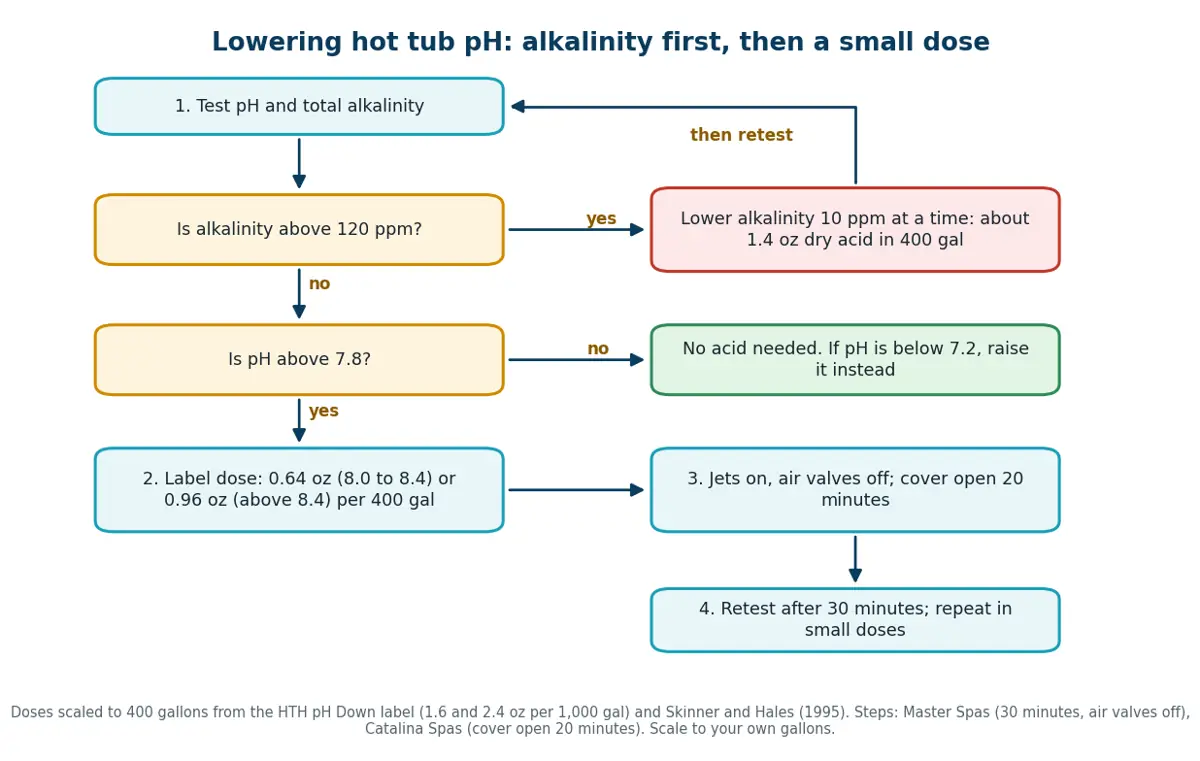
Test, fix alkalinity if it is above 120 ppm, add a measured dose of pH decreaser with the jets running and the air valves closed, leave the cover partly open, and retest after 30 minutes. Repeat in small doses until pH reads 7.2 to 7.8, ideally 7.4 to 7.6.
- Test pH and total alkalinityTest strips or a liquid kit. Catalina Spas says test at least twice a week; for public tubs, CDC suggests asking whether pH is checked at least twice a day.
- Lower alkalinity first if it is above 120 ppmUse the alkalinity table below, 10 ppm at a time, then retest pH before dosing for pH.
- Measure the dose for your gallons0.64 oz (about 2.9 tsp) per 400 gallons at pH 8.0 to 8.4, or 0.96 oz (about 4.3 tsp) above 8.4, per the HTH label rate.
- Jets on, air valves offMaster Spas says close the air valves and run the jets while the decreaser works; Catalina says run the primary pump at least 10 minutes after adding chemicals.
- Add it to the waterSprinkle it over the water surface (Master Spas). Add chemicals to water, never water to chemicals, and never mix products (NPIC).
- Leave the cover openCatalina says leave the cover partly open for 20 minutes after adding chemicals so vapor escapes; Coast Spas says about 30 minutes after a shock.
- Retest after 30 minutes and repeat smallMaster Spas says wait at least 30 minutes, then repeat until pH is 7.2 to 7.8. FROG Products aims for 7.2 to 7.6.
| Number | Value | Source |
|---|---|---|
| Target pH | 7.0 to 7.8 (makers: 7.2 to 7.6 or 7.8) | CDC; Catalina Spas; Coast Spas |
| Sodium bisulfate, 400 gal at pH 8.0 to 8.4 | 0.64 oz, about 2.9 tsp | HTH label rate, PC&S scaling |
| Sodium bisulfate, 400 gal above pH 8.4 | 0.96 oz, about 4.3 tsp | HTH label rate, PC&S scaling |
| Teaspoons per ounce of sodium bisulfate | about 4.5 | Blue Tropic label; FDA 21 CFR 101.9 |
| Lower alkalinity 10 ppm, 400 gal | 1.36 oz dry acid | Skinner and Hales (1995), PC&S scaling |
| Retest after a dose | 30 minutes or more | Master Spas |
| Cover open after adding chemicals | 20 minutes | Catalina Spas |
| Maximum water temperature | 104 F | CPSC; MAHC 4.12.1.7 |
| Replace the water | every 3 to 6 months | Coast Spas (Catalina: 4 to 6) |
Sources: CDC; HTH label; Blue Tropic label; FDA; Skinner and Hales (1995); Master Spas; Catalina Spas; Coast Spas; CPSC. Download CSV
Should you lower alkalinity before pH in a hot tub?
Yes, when alkalinity reads above 120 ppm. Master Spas and Spa Care both say high alkalinity holds pH in place, so pH decreaser seems not to work. Dry acid lowers both numbers. By the Skinner and Hales formula, a 10 ppm alkalinity drop takes about 1.36 oz of 94.5% sodium bisulfate in a 400 gallon tub.
| Tub size | Lower alkalinity 10 ppm: dry acid (94.5%) | Teaspoons | Lower alkalinity 10 ppm: muriatic acid (31.45%) |
|---|---|---|---|
| 300 gal | 1.02 oz | about 4.6 tsp | 0.77 fl oz |
| 350 gal | 1.19 oz | about 5.4 tsp | 0.90 fl oz |
| 400 gal | 1.36 oz | about 6.1 tsp | 1.02 fl oz |
| 450 gal | 1.53 oz | about 6.9 tsp | 1.15 fl oz |
| 500 gal | 1.70 oz | about 7.7 tsp | 1.28 fl oz |
PC&S scaling of the Skinner and Hales (1995) formulas: gallons / 47,058 x ppm = lb of dry acid; gallons / 125,000 x ppm = quarts of muriatic acid. The Blue Tropic label rate of 2 lb per 10 ppm per 10,000 gallons gives 1.28 oz for 400 gallons. Download CSV
Pool owners with high alkalinity in the main pool can find dose tables by gallons in our guide on how to lower alkalinity in pool water. In a hot tub the same chemistry runs at a 25th of the volume: 400 gallons against a 10,000 gallon pool. Raising alkalinity, the target bands from 10 spa manuals and doses for 100 to 600 gallon tubs are in our guide to hot tub alkalinity.
Can you use muriatic acid or vinegar to lower hot tub pH?
Muriatic acid works but the doses are tiny, and some makers forbid it: Catalina Spas says never to use muriatic acid in its spas. The Virginia DOH chart, scaled to 400 gallons, gives 0.48 to 1.28 fl oz depending on starting pH. Vinegar is not on the 2024 Model Aquatic Health Code list of pH chemicals, and we found no label or health department dose for it.
| Tub size | pH 7.6 to 7.8 | pH 7.8 to 8.0 | pH 8.0 to 8.4 | pH above 8.4 |
|---|---|---|---|---|
| 300 gal | 0.36 fl oz (0.7 tbsp) | 0.48 fl oz (1.0 tbsp) | 0.72 fl oz (1.4 tbsp) | 0.96 fl oz (1.9 tbsp) |
| 350 gal | 0.42 fl oz (0.8 tbsp) | 0.56 fl oz (1.1 tbsp) | 0.84 fl oz (1.7 tbsp) | 1.12 fl oz (2.2 tbsp) |
| 400 gal | 0.48 fl oz (1.0 tbsp) | 0.64 fl oz (1.3 tbsp) | 0.96 fl oz (1.9 tbsp) | 1.28 fl oz (2.6 tbsp) |
| 450 gal | 0.54 fl oz (1.1 tbsp) | 0.72 fl oz (1.4 tbsp) | 1.08 fl oz (2.2 tbsp) | 1.44 fl oz (2.9 tbsp) |
| 500 gal | 0.60 fl oz (1.2 tbsp) | 0.80 fl oz (1.6 tbsp) | 1.20 fl oz (2.4 tbsp) | 1.60 fl oz (3.2 tbsp) |
PC&S scaling of the Virginia DOH chart (12, 16, 24 and 32 oz per 10,000 gallons). Tablespoons use 1 tbsp = 15 mL and 1 fl oz = 30 mL (21 CFR 101.9). Download CSV
The 2024 Model Aquatic Health Code lists muriatic acid, sodium bisulfate, carbon dioxide, sulfuric acid, sodium bicarbonate and soda ash as pH chemicals (5.7.3.4.2). Swim University suggests half a cup of white vinegar per 100 gallons but names no source for the figure. Baking soda will not help: Florida DOH uses it to raise alkalinity, at 1.5 lb per 10,000 gallons per 10 ppm. Full size pool charts are in our guide on how to lower pH in pool water. If a dose overshoots below 7.2, our guide on how to raise pH in a hot tub scales soda ash and baking soda to 200 to 600 gallon tubs.
Planning a new spa or a pool and spa combo?
What should you do at your hot tub reading?
Read alkalinity first, then pH, then decide. The thresholds below come from CDC and spa maker ranges, the HTH label bands and the Coast and Catalina drain intervals. When chemistry will not hold after a few small doses, a drain and refill resets it for about $4.30 of water in a 400 gallon tub.
| If your situation is | Do this | Why (source) |
|---|---|---|
| pH 7.2 to 7.8 and alkalinity 80 to 120 ppm | Nothing; retest at your next check | Inside CDC, Catalina and Coast ranges |
| pH above 7.8 and alkalinity above 120 ppm | Lower alkalinity first with dry acid, then recheck pH | Master Spas and Spa Care: high alkalinity locks pH in place |
| pH 8.0 to 8.4, alkalinity in range | Add the label dose for your gallons (0.64 oz in 400 gal), jets on, retest after 30 minutes | HTH label rate; Master Spas wait time |
| pH above 8.4 | Use the above 8.4 dose (0.96 oz in 400 gal) and retest before adding more | HTH label rate |
| pH drops but climbs back within a day or two | Check alkalinity and run jets less while balancing | Master Spas: jet aeration pushes pH up |
| Water is 3 to 6 months old, or chemistry will not hold | Drain, clean and refill (about $4.30 of water for 400 gal at the median rate) | Coast Spas 3 to 6 months; Catalina 4 to 6 months; PC&S fill cost study |
| pH below 7.2 after a dose | Stop adding acid; raise with a spa pH increaser or baking soda per label | CDC floor is 7.0; Florida DOH: baking soda raises alkalinity |
| Water above 104 F | Lower the set point before anyone soaks | CPSC; MAHC 4.12.1.7 |
Sources: CDC; Master Spas; Spa Care; HTH label; Coast Spas; Catalina Spas; CPSC; MAHC 2024; PC&S water cost study. Download CSV
When is draining the hot tub the better fix?
When the water is several months old or pH will not hold. Coast Spas says replace the water every 3 to 6 months and Catalina Spas every 4 to 6 months. Refilling a 400 gallon tub costs about $4.30 in water at the 25 city median rate in our fill cost study. Drain times by tub size, valve locations from five owner’s manuals and the refill steps that avoid an air lock are in our guide on how to drain a hot tub. Our hot tub maintenance schedule compares the drain interval across 8 makers, from 8 to 12 weeks to 6 months.
Public spas use a formula that also works as a home cross check. The 2024 Model Aquatic Health Code (5.12.1.2.1) sets the replacement interval in days as tub gallons divided by 3, divided by average users per day. Two soakers a day in a 400 gallon tub gives about 67 days.
| Tub | Users per day | Arithmetic (MAHC 5.12.1.2.1) | Replace water every |
|---|---|---|---|
| 400 gal | 2 | 400 / 3 / 2 | about 67 days |
| 400 gal | 4 | 400 / 3 / 4 | about 33 days |
| 500 gal | 2 | 500 / 3 / 2 | about 83 days |
| 300 gal | 1 | 300 / 3 / 1 | 100 days |
Formula: MAHC 2024, 5.12.1.2.1 (written for public spas). Arithmetic by PC&S. Download CSV
Water is the cheap part: our fill cost study found a median of $215.09 per 20,000 gallons across 25 cities, about $10.75 per 1,000 gallons. Running and upkeep costs are in our hot tub cost guide, and built-in options are on our spa construction page.
Hot tub chemical and heat safety
A hot tub concentrates chemicals and heat in a small space. CPSC says water should never exceed 104 F and calls 100 F safe for a healthy adult, and the EPA warns that mixing pool and spa chemicals can release highly toxic chlorine gas.
CDC also advises against cyanuric acid or stabilized chlorine in hot tubs (CDC Legionella toolkit), and the 2024 code bars it for new or substantially altered public spas (5.7.3.1.3.1). If you are still choosing a tub, our hot tub ownership research covers running costs by state.
How we compiled this
We read 24 primary and manufacturer documents in October 2026: six CDC sources including the 2024 Model Aquatic Health Code and the 2013 inspection surveillance report, a CPSC release, three state and one county health department manual, the 1995 Skinner and Hales dosage study, the FDA household measure rule, two hot tub owner’s manuals, a Hot Spring spec page, HTH and Blue Tropic labels, guidance from Master Spas, Royal Spa, Spa Care and FROG, and NPIC and EPA safety sheets. Doses are our arithmetic from published rates, shown above. We did not test products, and forum posts were used only to find questions.
Frequently Asked Questions
How do I bring the pH down in my hot tub?
Test alkalinity first and lower it if it is above 120 ppm. Then add sodium bisulfate (pH decreaser) at the label rate, 0.64 oz per 400 gallons at pH 8.0 to 8.4 on the HTH label, with jets running and air valves closed. Retest after 30 minutes and repeat in small doses.
What do you do if your pH is too high in your hot tub?
Bring it back to CDC’s 7.0 to 7.8 range before the next soak, because chlorine weakens as pH rises: Pennsylvania DOH puts active chlorine at 24% at pH 8.0 against 66% at 7.2. Check alkalinity, dose a small amount of pH decreaser, and test sanitizer again afterward.
How much pH decreaser to add to hot tub?
Scale the label to your gallons. HTH lists 1.6 oz per 1,000 gallons at pH 8.0 to 8.4 and 2.4 oz above 8.4, so a 300 gallon tub takes 0.48 or 0.72 oz and a 500 gallon tub 0.80 or 1.20 oz. One ounce is about 4.5 teaspoons.
How to lower pH in a hot tub quickly?
Use dry acid with the jets on and air valves closed, then retest after 30 minutes (Master Spas). Speed comes from circulation, not a bigger dose: published first doses for 400 gallons range from 0.16 oz to 4 oz, and overshooting below 7.2 means adding pH increaser next.
Will vinegar lower the pH in a hot tub?
It is an acid, but we found no label or health department dose for it, and it is not on the 2024 Model Aquatic Health Code list of pH chemicals, which names muriatic acid, sodium bisulfate, carbon dioxide and sulfuric acid among others. Sodium bisulfate made for spas is the measured option.
How long does it take for a pH reducer to work in a hot tub?
Plan on 30 minutes or more. Master Spas says run the jets and wait at least 30 minutes before retesting, Catalina Spas says leave the cover partly open for 20 minutes after adding chemicals, and Virginia DOH says keep people out until chemicals are fully dissolved or dispersed.
Sources
- Centers for Disease Control and Prevention (CDC). What You Can Do to Stay Healthy in Hot Tubs. Accessed 2026-10-19.
- CDC. Home Pool and Hot Tub Water Treatment and Testing (updated May 10, 2024). Accessed 2026-10-19.
- CDC. Controlling Legionella in Hot Tubs (toolkit module). Accessed 2026-10-19.
- CDC. Immediate Closures and Violations Identified During Routine Inspections of Public Aquatic Facilities, Five States, 2013 (MMWR Surveill Summ 2016;65(SS-5)). Accessed 2026-10-19.
- CDC. Outbreaks Associated with Treated Recreational Water, United States, 2015 to 2019 (MMWR 70(20), 2021). Accessed 2026-10-19.
- CDC. 2024 Model Aquatic Health Code, 5th Edition, Code Language. Accessed 2026-10-19.
- U.S. Consumer Product Safety Commission. CPSC Warns of Hot Tub Temperatures (1980 release). Accessed 2026-10-19.
- Pennsylvania Department of Health. Public Swimming and Bathing Places: Operational and Biological Contamination Protocol Recommendations (2016). Accessed 2026-10-19.
- Virginia Department of Health. Pool Operation and Maintenance Guide (Portsmouth Health Department, 2018). Accessed 2026-10-19.
- Florida Department of Health in Collier County. Swimming Pool Operators' Manual, 2016 Version. Accessed 2026-10-19.
- Lincoln County, Wisconsin. What Does a Swimming Pool Operator Need to Know? (undated handout). Accessed 2026-10-19.
- Kim Skinner and J. Que Hales (copy hosted by CPO Training). Dosages for Adjusting Alkalinity, Journal of the Swimming Pool and Spa Industry, vol. 1 no. 1 (1995). Accessed 2026-10-19.
- U.S. Food and Drug Administration (eCFR). 21 CFR 101.9(b)(5)(viii), household measures for nutrition labeling. Accessed 2026-10-19.
- HTH (manufacturer label). HTH Pool Care pH Down (product directions). Accessed 2026-10-19.
- Blue Tropic (manufacturer label). pH Decreaser (product label directions). Accessed 2026-10-19.
- Catalina Spas (manufacturer manual). Owner's Guide. Accessed 2026-10-19.
- Coast Spas (manufacturer manual). 2026 Owner's Manual, Purfikt Series. Accessed 2026-10-19.
- Hot Spring Spas (manufacturer). Hot Tub Facts and Stats: All You Need to Know Before Buying. Accessed 2026-10-19.
- Master Spas (manufacturer guidance). What to do when the pH in your hot tub is too high. Accessed 2026-10-19.
- Royal Spa (manufacturer guidance). Lowering pH Level in Your Hot Tub. Accessed 2026-10-19.
- Spa Care (spa chemical retailer guidance). Understanding Spa and Hot Tub Water Chemistry. Accessed 2026-10-19.
- FROG Products (manufacturer guidance). Hot Tub pH Overview. Accessed 2026-10-19.
- Swim University (publisher chart, cited as a comparison only). How to Lower pH in a Hot Tub. Accessed 2026-10-19.
- National Pesticide Information Center (Oregon State University and U.S. EPA). Pool and Spa Chemicals Fact Sheet. Accessed 2026-10-19.
- U.S. Environmental Protection Agency. Chemical Safety Alert: Safe Storage and Handling of Swimming Pool Chemicals (EPA 550-F-01-003). Accessed 2026-10-19.
- Pool Construction & Service. Swimming Pool Illness Outbreaks (PC&S research; CDC NORS data). Accessed 2026-10-19.
- Pool Construction & Service. Cost to Fill a Pool (PC&S research; 25 city water and sewer rates). Accessed 2026-10-19.
Related pages
Get Quotes From Licensed Local Pool Pros
Tell us what you need and your ZIP code. We match you with pool companies that cover your area.