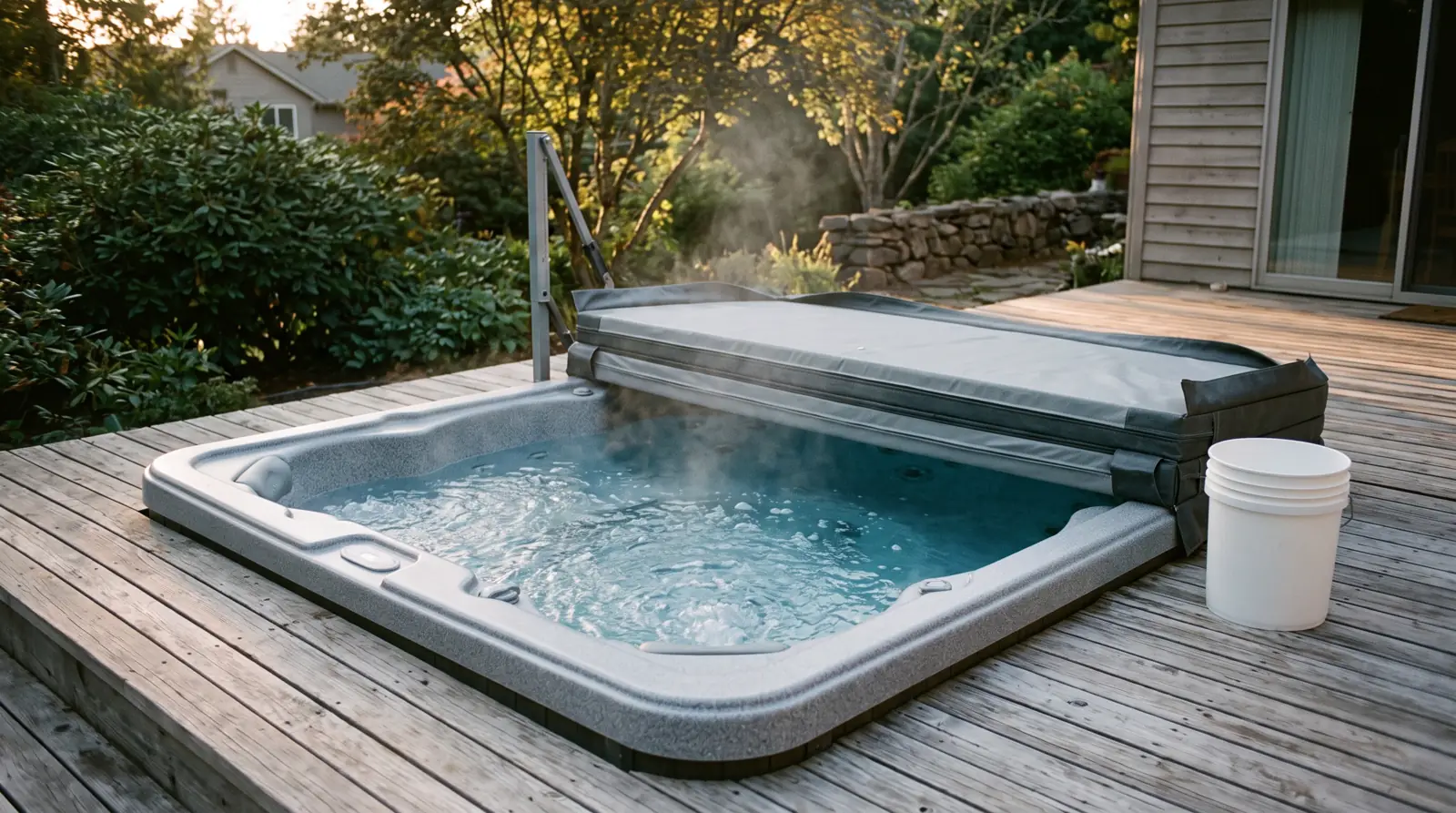
Hot Tub Alkalinity: Target Range and How to Raise or Lower It
Hot tub alkalinity should read 80 to 120 ppm in most spa manuals: raise it with baking soda and lower it with dry acid, about 1.5 teaspoons per 100 gallons for each 10 ppm.
- ✓10 manuals, 4 different bandsMakers publish 40 to 120 ppm (Caldera, Hot Spring), 80 to 120, 100 to 150 (Sundance) and 125 to 150 ppm (Bullfrog 2018).
- ✓A tablespoon moves about 5 ppmIn a 400 gallon tub, one tablespoon of baking soda adds about 5.4 ppm and one of dry acid removes about 4.9 ppm.
- ✓Hot water sheds CO2Water at 104 F holds about 29% less carbon dioxide than at 80 F (NIST), so spa pH drifts up.
Key takeaways
- Most spa manuals set hot tub alkalinity at 80 to 120 ppm (Catalina, Hydropool, Nordic), but the range across 10 makers runs from 40 ppm (Hot Spring, Caldera) to 150 ppm (Sundance, Bullfrog), and the 2024 Model Aquatic Health Code allows 60 to 180 ppm in public spas.
- To raise alkalinity 10 ppm, add 0.22 oz of baking soda per 100 gallons, or 0.90 oz (about 5.5 teaspoons at USDA‘s 4.6 g per teaspoon) in a 400 gallon tub, by the Skinner and Hales dosage formula.
- To lower it 10 ppm, add 0.34 oz of dry acid per 100 gallons, 1.36 oz in 400 gallons; muriatic acid works too, 1.02 fl oz in 400 gallons, but the Catalina Spas owner’s guide says never use it in its spas.
- Alkalinity drives pH upward as carbon dioxide leaves the water (MAHC Annex), and by NIST Henry’s law data, 104 F water holds about 29% less carbon dioxide than 80 F water, which is why spa pH drifts up between doses.
- Published hot tub doses run from 75% to 196% of the chemistry figure: Jacuzzi‘s tablespoon rule lowers about 20 ppm per 100 gallons, not the 10 ppm it states.
What should hot tub alkalinity be?
Most hot tub manuals put total alkalinity at 80 to 120 ppm, the band Catalina, Hydropool, Nordic and Jacuzzi publish. The outliers sit on both sides: Caldera and Hot Spring accept 40 to 120 ppm, Sundance 100 to 150 and Bullfrog’s 2018 manual 125 to 150. The 2024 Model Aquatic Health Code allows 60 to 180 ppm in public spas. Follow your own manual first.
| Source (document, year) | Total alkalinity (ppm) | Start-up or ideal point | Product the source names | Applies to |
|---|---|---|---|---|
| Catalina Spas owner's guide (2022 file) | 80 to 120 | Not stated | Not stated in the chemistry table; never muriatic acid | Catalina home spas |
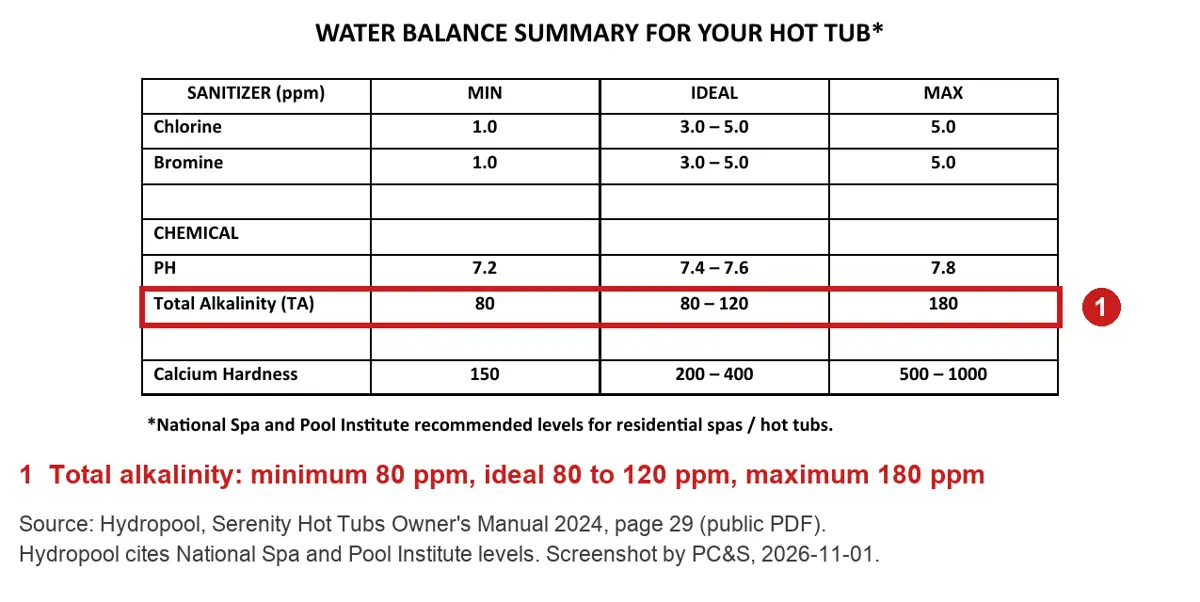
| Hydropool Serenity owner's manual (2024) | 80 to 120 ideal; 80 minimum; 180 maximum | Cites National Spa and Pool Institute levels | Alkalinity booster (raise) | Hydropool home tubs |
| Nordic Hot Tubs owner's manual | 80 to 120 ideal (test range 20 to 180) | Start with alkalinity, step 1 | Sodium carbonate up; sodium bisulfate or fresh water down | Nordic home tubs |
| Jacuzzi, How to Lower Alkalinity in Hot Tub (maker article) | 80 to 120 | Not stated | Sodium bisulfate (dry acid) down | Jacuzzi home tubs |
| Coast Spas Purfikt owner's manual (2026) | 100 to 120 | Not stated | Not stated | Coast home spas |
| Master Spas water care guide; Getaway manual (2025) | 80 to 150 in the tables (80 to 120 in the guide text) | Not stated | Follow the product label | Master Spas home tubs |
| Sundance 780 Series owner's manual (2025) | 100 to 150 | Same with or without ClearRay | Not stated | Sundance home spas |
| Hot Spring Highlife owner's manual (2026) | 40 to 120 | Adjust to 80 at fill | pH/Alkalinity Up and Down | Hot Spring home spas |
| Caldera Paradise Series owner's manual (2025) | 40 to 120 | Adjust to 80 at fill | pH/Alkalinity Up and Down | Caldera home spas |
| Bullfrog Spas owner's manual (2018, rev 3.1.8) | 125 to 150 | Not stated | Total Alkalinity Increaser (raise) | Bullfrog home spas |
| 2024 Model Aquatic Health Code 5.7.4.4.1 (CDC) | 60 to 180 | Test weekly (5.7.5.5) | Annex lists baking soda, dry acid and muriatic acid | Public pools and spas that adopt it |
Sources: Catalina Spas owner’s guide; Hydropool 2024 manual; Nordic owner’s manual; Jacuzzi; Coast Spas 2026 manual; Master Spas water care guide; Master Spas Getaway 2025 manual; Sundance 780 Series 2025 manual; Hot Spring Highlife 2026 manual; Caldera Paradise 2025 manual; Bullfrog 2018 manual; CDC 2024 MAHC. Compiled by PC&S, November 2026. Download CSV
Bullfrog's website guide says 80 to 120 ppm; its 2018 manual says 125 to 150 ppm.
Source: Owner's manuals from Bullfrog (2018), Sundance (2025), Coast (2026), Catalina (2022 file), Hydropool (2024), Nordic, Hot Spring (2026) and Caldera (2025); Master Spas water care guide; Jacuzzi; CDC 2024 MAHC 5.7.4.4.1. Download chart data (CSV)
Two makers publish a start-up number inside the band: the Hot Spring Highlife 2026 and Caldera Paradise 2025 manuals both say to adjust alkalinity to 80 ppm at fill, then calcium hardness, then pH. Hydropool prints a minimum of 80 ppm, an ideal of 80 to 120 ppm and a maximum of 180 ppm, citing National Spa and Pool Institute levels for home spas.
Bullfrog is the clearest conflict. Its 2018 owner’s manual says alkalinity should measure 125 to 150 ppm, while the alkalinity guide on bullfrogspas.com says 80 to 120 ppm. Swim University, a publisher rather than a maker, suggests 100 to 150 ppm for more room. When a manual and a website disagree, follow the manual tied to your warranty: Nordic says failing to keep pH, alkalinity and hardness balanced could negate its warranty.
How do alkalinity and pH interact in a hot tub?
Alkalinity is the buffer and pH is the reading it protects. The 2024 MAHC Annex calls total alkalinity a measure of resistance to pH change and also a source of rising pH as carbon dioxide gasses off. Hot tubs speed that up: jets add air, and by NIST’s Henry’s law data, water at 104 F holds about 29% less dissolved carbon dioxide than water at 80 F.
| Water temperature | Kelvin | CO2 solubility, mol/(kg x bar) | Share of the 80 F amount |
|---|---|---|---|
| 80 F | 299.82 | 0.0325 | 100% |
| 90 F | 305.37 | 0.0281 | 86% |
| 100 F | 310.93 | 0.0244 | 75% |
| 104 F | 313.15 | 0.0231 | 71% |
Source: NIST Chemistry WebBook, carbon dioxide, Henry’s law data (0.034 mol/(kg x bar) at 298.15 K; temperature constant 2,400 K). PC&S arithmetic; NIST notes the fit is weaker above 86 F, so treat the hot tub rows as estimates. Download CSV
More bicarbonate means more carbon dioxide waiting to leave, so the higher the alkalinity, the harder pH pushes upward between doses. Master Spas, a hot tub maker, says jet aeration naturally causes pH to rise over time and that alkalinity above 120 ppm locks pH in place, so decreaser seems not to work. Low alkalinity fails the other way: the MAHC Annex says pH then changes rapidly, and net acidic sanitizers such as dichlor can pull it down.
Sanitizer choice moves alkalinity too. The Pennsylvania Department of Health notes that sodium and calcium hypochlorite raise pH and alkalinity over time, while bromine, trichlor and dichlor reduce them; our chlorine vs bromine comparison covers that choice. In a dichlor tub, correct the test first: the MAHC Annex says divide cyanuric acid by 3 and subtract it, so a 120 ppm reading with 30 ppm of cyanuric acid is really 110 ppm.
Small volume is the other difference. A level tablespoon of baking soda raises alkalinity about 5.4 ppm in a 400 gallon tub and a tablespoon of dry acid lowers it about 4.9 ppm; in a 10,000 gallon pool the same spoonful of baking soda moves it about 0.2 ppm. Measure with spoons or a kitchen scale, not by the capful.
How much baking soda or acid does a hot tub need?
About 1.5 teaspoons per 100 gallons for each 10 ppm, in either direction. By the Skinner and Hales formulas, 10 ppm takes 0.22 oz of baking soda, 0.34 oz of dry acid or 0.26 fl oz of 31.45% muriatic acid per 100 gallons. A 400 gallon tub needs 0.90 oz, 1.36 oz or 1.02 fl oz. Coast Spas’ 2026 lineup holds 232 to 527 gallons.
| Number | Value | Source |
|---|---|---|
| Hot tub alkalinity, most manuals | 80 to 120 ppm | Catalina; Hydropool; Nordic; Jacuzzi |
| Range across 10 makers | 40 to 150 ppm | Caldera and Hot Spring (40); Sundance and Bullfrog (150) |
| Public spa legal range | 60 to 180 ppm | MAHC 2024, 5.7.4.4.1 |
| Baking soda, +10 ppm per 100 gal | 0.22 oz, about 1.4 tsp | Skinner and Hales 1995; USDA |
| Dry acid, -10 ppm per 100 gal | 0.34 oz, about 1.5 tsp | Skinner and Hales 1995; Blue Tropic label |
| Muriatic acid, -10 ppm per 100 gal | 0.26 fl oz, about 1.5 tsp | Skinner and Hales 1995; 21 CFR 101.9 |
| One tablespoon in 400 gal | baking soda +5.4 ppm; dry acid 4.9 ppm down; muriatic 4.9 ppm down | PC&S arithmetic from the rows above |
| CO2 solubility at 104 F vs 80 F | 71% (about 29% less) | NIST Chemistry WebBook |
| Cyanuric acid correction | Subtract cyanuric acid / 3 | MAHC Annex |
| Largest cut per acid round | 20 ppm | Orenda |
Sources: Catalina; Hydropool; Nordic; Jacuzzi; MAHC 2024; Skinner and Hales (1995); USDA; Blue Tropic label; 21 CFR 101.9; NIST; MAHC Annex; Orenda. Download CSV
| Tub size | Raise 10 ppm: baking soda | Lower 10 ppm: dry acid (sodium bisulfate) | Lower 10 ppm: muriatic acid (31.45%) |
|---|---|---|---|
| 100 gal | 0.22 oz (6.4 g), about 1.4 tsp | 0.34 oz, about 1.5 tsp | 0.26 fl oz, about 1.5 tsp |
| 200 gal | 0.45 oz (12.7 g), about 2.8 tsp | 0.68 oz, about 3.1 tsp | 0.51 fl oz, about 3.1 tsp |
| 300 gal | 0.67 oz (19.1 g), about 4.1 tsp | 1.02 oz, about 4.6 tsp | 0.77 fl oz, about 4.6 tsp |
| 400 gal | 0.90 oz (25.4 g), about 5.5 tsp | 1.36 oz, about 6.1 tsp | 1.02 fl oz, about 6.1 tsp |
| 500 gal | 1.12 oz (31.8 g), about 6.9 tsp | 1.70 oz, about 7.7 tsp | 1.28 fl oz, about 7.7 tsp |
| 600 gal | 1.34 oz (38.1 g), about 8.3 tsp | 2.04 oz, about 9.2 tsp | 1.54 fl oz, about 9.2 tsp |
PC&S scaling of the Skinner and Hales (1995) formulas: gallons / 71,425 x ppm = lb of baking soda; gallons / 47,058 x ppm = lb of 94.5% dry acid; gallons / 125,000 x ppm = quarts of 31.45% muriatic acid. Teaspoons: USDA FoodData Central (baking soda 4.6 g per tsp), Blue Tropic label (dry acid 4.5 tsp per oz), 21 CFR 101.9 (5 mL tsp, 30 mL fl oz). Multiply by 2 for 20 ppm. Download CSV
| Step | Baking soda (raise) | Dry acid (lower) |
|---|---|---|
| 1. Skinner and Hales formula, 10 ppm | gallons / 71,425 x 10 = lb | gallons / 47,058 x 10 = lb |
| 2. Pounds for 400 gallons | 400 / 71,425 x 10 = 0.0560 lb | 400 / 47,058 x 10 = 0.0850 lb |
| 3. Ounces (x 16) | 0.90 oz | 1.36 oz |
| 4. Grams (x 28.35) | 25.4 g | 38.6 g |
| 5. Spoon conversion | USDA: 1 tsp baking soda = 4.6 g | Blue Tropic label: 1 lb = about 1.5 cups, so 4.5 tsp per oz |
| 6. Teaspoons for 400 gallons | 25.4 / 4.6 = about 5.5 tsp | 1.36 x 4.5 = about 6.1 tsp |
| 7. Per 100 gallons | about 1.4 tsp | about 1.5 tsp |
| 8. Check against the MAHC Annex | 1.4 lb per 10,000 gal = 0.90 oz per 400 gal (match) | Annex prints 1.6 lb per 10,000 gal = 1.02 oz (75% of step 3) |
Sources: Skinner and Hales (1995); USDA FoodData Central 175040; Blue Tropic label; 2024 MAHC Annex 5.7.4.4.1. Arithmetic by PC&S, November 2026. Download CSV
Find the gallons before you measure. The Coast Spas 2026 manual lists 232 gallons for a 3 to 4 seat 2Purfikt Traditional and 527 gallons for the 7 to 8 seat Purfikt Infinity, and Hot Spring gives 450 gallons for its 7 seat Grandee. Dosing a 450 gallon tub as if it held 300 gallons leaves the correction a third short.
The chemicals cost cents. At Leslie’s September 2026 list prices of $29.99 for 10 lb of Alkalinity Up and $30.99 for 10 lb of Dry Acid pH Down, from the PC&S pool equipment price index, a 10 ppm correction in a 400 gallon tub costs about $0.17 in baking soda or $0.26 in dry acid.
How do you raise alkalinity in a hot tub?
Add baking soda (sodium bicarbonate) or a spa alkalinity increaser, which Hydropool’s water balance chart names as the fix for low alkalinity. Dose 0.22 oz per 100 gallons per 10 ppm, pour it into the filter compartment with the jet pump on high for at least 10 minutes, as Hot Spring’s manual directs, and retest before adding more. Baking soda lifts pH a little as well.
- Test alkalinity and pHUse strips or a drop kit; in a dichlor tub subtract cyanuric acid / 3 from the alkalinity reading (MAHC Annex).
- Pick a target inside your maker's bandAim for the low middle: 80 to 90 ppm for an 80 to 120 ppm manual, which leaves room for the pH rise that follows.
- Weigh the dose0.22 oz (about 1.4 tsp) per 100 gallons per 10 ppm; 0.90 oz in 400 gallons. Add half to three quarters of it first if you are new to your tub.
- Jets on high, cover offPour it into the filter compartment with the jet pump on high for at least 10 minutes (Hot Spring 2026); Catalina says add chemicals when the water is 80 F or warmer.
- Retest after an hour, read it again after 4 to 6 hoursMaster Spas says let the water circulate an hour before retesting; Jacuzzi waits 4 to 6 hours before reading alkalinity again.
- Then adjust pHWith alkalinity in range, bring pH to 7.2 to 7.8; Hot Spring and Caldera both list alkalinity first and pH last.
Soda ash (sodium carbonate) is the other alkali. Nordic lists it as pH/Alkalinity Up, and it adds about 59% more alkalinity per pound than baking soda by the Skinner and Hales divisors (113,231 against 71,425), with a much bigger pH jump. Use it when pH and alkalinity are both low; our guide on how to raise pH in a hot tub covers that case. Pool-size tables to 40,000 gallons are in our guide on how to raise alkalinity in a pool.
| Method | Alkalinity | pH | Dose per 100 gal for 10 ppm | Use it when | Source |
|---|---|---|---|---|---|
| Baking soda (sodium bicarbonate) | Raises | Raises a little | 0.22 oz | Alkalinity low, pH fine | Skinner and Hales 1995; MAHC Annex; Hydropool manual |
| Soda ash (sodium carbonate) | Raises | Raises | 0.14 oz | Both low | Skinner and Hales 1995; Nordic manual |
| Aeration (jets, air controls open, cover off) | No change | Raises | None | Alkalinity in range, pH low; or after an acid round | MAHC Annex; Lowry, AQUA 2016; Master Spas |
| Dry acid (sodium bisulfate) | Lowers | Lowers | 0.34 oz | Alkalinity high | Skinner and Hales 1995; Jacuzzi; Nordic manual |
| Muriatic acid (31.45%) | Lowers | Lowers | 0.26 fl oz | Alkalinity high, and your manual allows it | Skinner and Hales 1995; Catalina bars it |
| Partial drain and refill | Moves toward the tap water | Moves toward the tap water | Not a dose | Alkalinity over 180 ppm, or old water | Nordic manual; MAHC 5.7.4.4.1; Coast |
Sources: Skinner and Hales (1995); 2024 MAHC Annex; Lowry, AQUA Magazine (2016); Master Spas; Hydropool, Nordic and Catalina manuals; Jacuzzi; Coast Spas. Download CSV
How do you lower alkalinity in a hot tub?
Add dry acid (sodium bisulfate), 0.34 oz per 100 gallons for each 10 ppm, in rounds of no more than 20 ppm, then let the jets aerate the water to bring pH back up. Acid lowers pH and alkalinity together; aeration raises pH alone by driving off carbon dioxide. Hydropool says two or three smaller doses over a day or two beat one large dose.
- Test and correct the readingSubtract cyanuric acid / 3 in a dichlor tub; check pH too, because the acid will lower it.
- Compute one round0.34 oz of dry acid per 100 gallons per 10 ppm, capped at 20 ppm a round (Orenda): 2.72 oz in 400 gallons.
- Pre-dissolve and add with jets runningJacuzzi says dissolve dry acid in a cup of tub water and pour it around the edge with all jets on high; Hot Spring adds chemicals into the filter compartment.
- Circulate, cover openRun the jets 20 to 30 minutes (Jacuzzi) and leave the cover open at least 15 minutes to off-gas (Hydropool).
- Aerate to lift pHRun the jets with the air controls open and the cover off; pH rises while alkalinity stays down.
- Retest after 4 to 6 hours, repeatJacuzzi waits 4 to 6 hours and says most cases need 2 to 3 treatments; stop at the top of your maker’s band.
| Job | Arithmetic | Amount | How to dose it |
|---|---|---|---|
| Lower 400 gal from 160 to 100 ppm with dry acid | 400 / 47,058 x 60 = 0.510 lb | 8.16 oz (about 37 tsp) | 3 rounds of 2.72 oz (about 12.2 tsp), aerate and retest between rounds |
| Same job with muriatic acid (if your manual allows it) | 400 / 125,000 x 60 = 0.192 qt | 6.14 fl oz | 3 rounds of 2.05 fl oz (about 12 tsp) |
| Raise 350 gal from 50 to 90 ppm with baking soda | 350 / 71,425 x 40 = 0.196 lb | 3.14 oz (89 g, about 19 tsp) | 2 rounds of 1.57 oz, retest after each |
| Product cost, 10 ppm in 400 gal | 0.0560 lb x $3.00; 0.0850 lb x $3.10 | $0.17 baking soda; $0.26 dry acid | Leslie's 10 lb list prices, September 2026 |
| Drain and refill instead, 400 gal | 400 / 1,000 x $10.75 | $4.30 of water | Median of 25 cities in the PC&S fill cost study |
Sources: Skinner and Hales (1995); Blue Tropic label; USDA; Orenda (20 ppm per round); Leslie’s list prices via the PC&S price index; PC&S fill cost study. Download CSV
Aeration is slow at the top end. Robert Lowry’s pool estimates in AQUA Magazine put pH recovery from 6.5 to 7.0 at about 4 to 8 hours and from 7.0 to 7.5 at more than a day, and he notes aeration rarely pushes pH much past 7.5. Orenda adds that carbon dioxide cannot escape under a cover, so keep the hot tub cover off while the jets run.
Muriatic acid works by the same chemistry, 0.26 fl oz per 100 gallons per 10 ppm, but check your manual first: the Catalina Spas owner’s guide says never use swimming pool chemicals, muriatic acid or household bleach in its spas. Vinegar is not on the 2024 MAHC list of pH chemicals, and we found no label or health department dose for it. The acid and aerate cycle for pools, with charts to 30,000 gallons, is in our guide on how to lower alkalinity in a pool, and pH-only fixes are in how to lower pH in a hot tub.
Would you rather have a pro balance the water?
A service visit makes sense when alkalinity will not hold for a week, the fill water itself tests above 180 ppm, or scale already crusts the jets. Ask the technician to write down alkalinity, pH, calcium hardness and cyanuric acid before and after, plus the product and dose used, so you can repeat it between visits.
Why do hot tub alkalinity doses disagree online?
Guides round, mislabel or skip the units. Scaled to a 400 gallon tub and a 10 ppm drop, published dry acid figures run from 1.02 oz in the MAHC Annex to 2.67 oz from Jacuzzi’s tablespoon rule, against 1.36 oz from the Skinner and Hales chemistry. Start at or below the chemistry figure, then let the retest decide the next round.
Jacuzzi's tablespoon rule converts at 4.5 teaspoons per ounce (Blue Tropic label density).
Source: CDC 2024 MAHC Annex; Swim University; Blue Tropic label; Hunker; Skinner and Hales (1995); Poolonomics; Jacuzzi; PC&S scaling to 400 gallons, November 2026. Download chart data (CSV)
| Source | What it says | Same job: 10 ppm in 400 gal | Chemistry figure | Share of chemistry |
|---|---|---|---|---|
| Jacuzzi (maker article) | 1 tablespoon of dry acid per 100 gal lowers about 10 ppm | 4 tbsp = 2.67 oz dry acid | 1.36 oz | 196% |
| Poolonomics | 3.5 oz of acid per 1,000 gal per 10 ppm | 1.40 oz dry acid | 1.36 oz | 103% |
| Hunker | 0.21 lb per 1,000 gal per 10 ppm | 1.34 oz dry acid | 1.36 oz | 99% |
| Blue Tropic pH Decreaser label | 2 lb per 10,000 gal per 10 ppm | 1.28 oz dry acid | 1.36 oz | 94% |
| Swim University | 3 oz per 1,000 gal per 10 ppm | 1.20 oz dry acid | 1.36 oz | 88% |
| 2024 MAHC Annex | 1.6 lb dry acid per 10,000 gal per 10 ppm | 1.02 oz dry acid | 1.36 oz | 75% |
| 2024 MAHC Annex | 1.3 qt muriatic acid per 10,000 gal per 10 ppm | 1.66 fl oz muriatic | 1.02 fl oz | 162% |
| Poolonomics | 1 tablespoon of baking soda per 100 gal (no ppm given) | 4 tbsp = 55.2 g, about 22 ppm | 25.4 g per 10 ppm | About double a 10 ppm step |
| Co-Z Palace | 1.5 lb baking soda per 10,000 gal raises pH about 0.1 | 1.5 lb is an alkalinity dose: about 10.7 ppm | 1.40 lb per 10 ppm | Labels an alkalinity dose as pH |
Sources: Jacuzzi; Poolonomics (lower); Hunker; Blue Tropic label; Swim University; 2024 MAHC Annex; Poolonomics (raise); Co-Z Palace; Skinner and Hales (1995). Tablespoons convert at 4.5 tsp per oz of dry acid and 4.6 g per tsp of baking soda. Download CSV
Jacuzzi’s rule is the biggest miss: one tablespoon of dry acid weighs about 0.67 oz at label density, while 100 gallons needs 0.34 oz for 10 ppm, so each tablespoon cuts closer to 20 ppm. The MAHC Annex disagrees with itself: its 1.3 quarts of muriatic acid equals about 3.25 lb of dry acid at Florida DOH‘s 1 pint = 1.25 lb conversion, double the 1.6 lb of dry acid it lists for the same 10 ppm.
What should you do at your alkalinity reading?
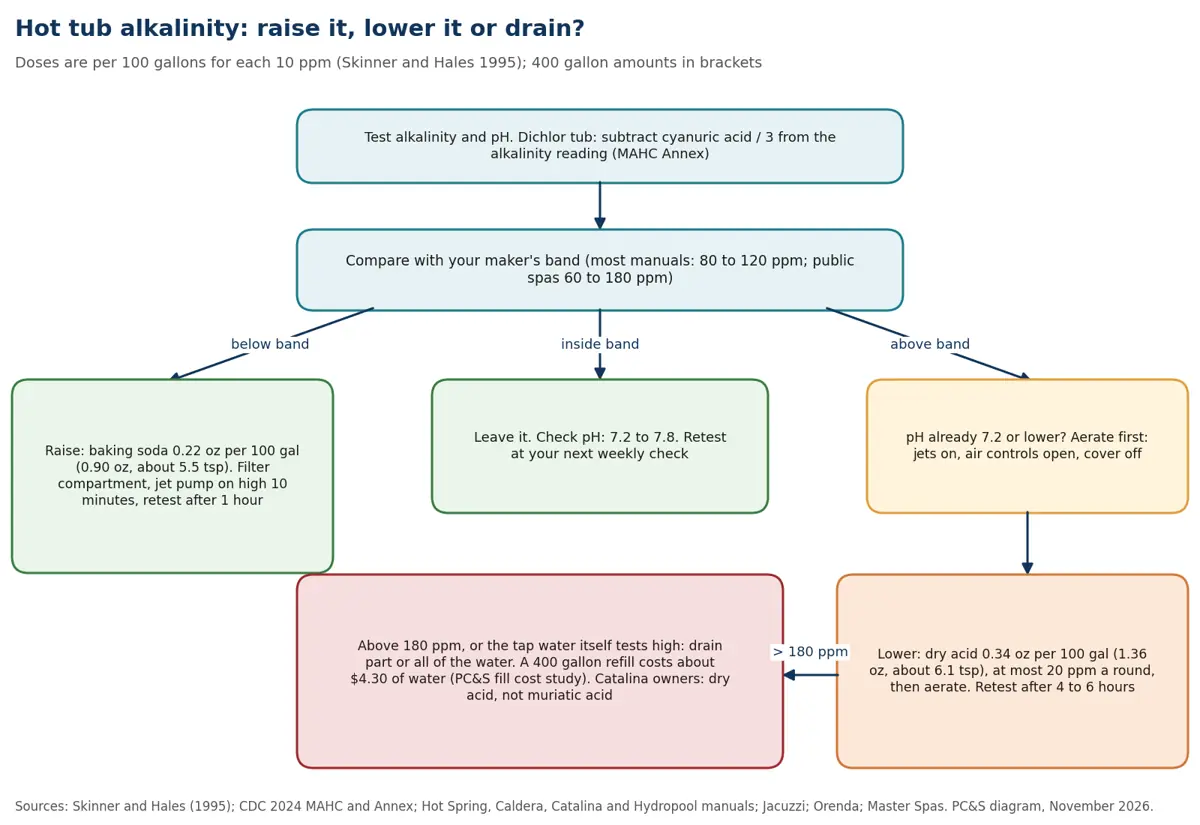
Correct the reading for cyanuric acid, compare it with your maker’s band, then read pH. The table pairs each situation with an action and the source behind it, from leaving 80 to 120 ppm alone to draining when the water tests above the MAHC ceiling of 180 ppm. A 400 gallon refill costs about $4.30 in water at the median rate in our fill cost study.
| If your situation is | Do this | Why (source) |
|---|---|---|
| Alkalinity inside your maker's band (most say 80 to 120 ppm) and pH 7.2 to 7.8 | Leave it; retest at your next check | Maker manuals; MAHC 5.7.5.5 tests public spas weekly |
| Dichlor tub with cyanuric acid | Subtract cyanuric acid / 3 from the alkalinity reading before deciding | MAHC Annex 5.7.4.4.1 |
| Alkalinity below 80 ppm, pH 7.2 or higher | Baking soda, 0.22 oz per 100 gal per 10 ppm, then retest | Skinner and Hales 1995; Hydropool chart |
| Alkalinity below 80 ppm and pH below 7.2 | Baking soda first; if pH is still low, soda ash or a spa pH increaser | Hot Spring and Caldera manuals: alkalinity first |
| Alkalinity 120 to 180 ppm and pH above 7.8 | Dry acid, 0.34 oz per 100 gal per 10 ppm, at most 20 ppm per round, then aerate | Skinner and Hales 1995; Orenda; Hydropool |
| Alkalinity high but pH already 7.2 or lower | Aerate first (jets on, air controls open, cover off), then acid | Lowry, AQUA 2016; Orenda |
| Alkalinity above 180 ppm, or the fill water itself tests high | Drain part or all of the water; about $4.30 of water refills 400 gal | MAHC 5.7.4.4.1 ceiling; Nordic manual; PC&S fill cost study |
| You own a Catalina spa | Use dry acid, not muriatic acid | Catalina owner's guide |
| Your Bullfrog manual says 125 to 150 ppm | Follow the manual tied to your warranty | Bullfrog 2018 owner's manual |
Sources: MAHC 2024; MAHC Annex; Skinner and Hales (1995); Hydropool; Hot Spring; Caldera; Orenda; Lowry, AQUA 2016; Nordic; Catalina; Bullfrog; PC&S fill cost study. Download CSV
If the tub is due for fresh water anyway, a drain resets alkalinity to your tap water’s level; Coast Spas says replace the water every 3 to 6 months. Our guide on how to drain a hot tub covers drain times and where the water may go, the hot tub maintenance schedule compares 8 makers’ intervals, and filter care sits on the same calendar in how to clean a hot tub filter.
Is it safe to add acid to a hot tub?
Yes, with a measured dose and nobody in the water. Add chemicals to water, never water to chemicals, one product at a time, and wear gloves and goggles (NPIC). The EPA warns that mixing pool and spa chemicals can release toxic chlorine gas. Keep water at or below 104 F (CPSC) and leave the cover open after dosing so vapor can escape.
Balanced water is a health issue as well as an equipment one: alkalinity that locks pH above 8.0 weakens chlorine, and hot tubs or spas accounted for 176 of 560 treated recreational water outbreaks from 2009 to 2023 in CDC reporting data, per our outbreak research.
How we compiled this
We read 27 primary and maker documents in October and November 2026: 10 hot tub makers’ manuals or maker guides (Bullfrog, Caldera, Catalina, Coast, Hot Spring, Hydropool, Jacuzzi, Master Spas, Nordic, Sundance), the 2024 Model Aquatic Health Code and its Annex, the 1995 Skinner and Hales dosage study, NIST Henry’s law data, USDA and FDA measure data, two state health department manuals, two product labels, Orenda and AQUA Magazine guidance, and CDC, CPSC, EPA and NPIC safety pages. Doses are our arithmetic, shown above. We tested no products; six competitor guides served only as the comparison rows.
Frequently Asked Questions
What should the alkalinity be in a hot tub?
80 to 120 ppm in most spa manuals, including Catalina, Hydropool, Nordic and Jacuzzi. Makers differ: Caldera and Hot Spring accept 40 to 120 ppm, Sundance 100 to 150 and Bullfrog’s 2018 manual 125 to 150. The 2024 Model Aquatic Health Code allows 60 to 180 ppm in public spas. Use the range printed in your own manual.
How do I lower the alkalinity in my hot tub?
Add dry acid (sodium bisulfate) at 0.34 oz per 100 gallons for each 10 ppm, 1.36 oz in a 400 gallon tub, with the jets running. Cut no more than 20 ppm per round, aerate with the cover off so pH recovers, and retest after 4 to 6 hours before the next round.
Can I use baking soda to raise alkalinity in my hot tub?
Yes. Baking soda is sodium bicarbonate, the same chemical Hydropool’s chart names for low alkalinity. Use 0.22 oz per 100 gallons per 10 ppm, about 5.5 teaspoons in a 400 gallon tub, added with the jet pump on high. It raises pH slightly, so retest both readings after an hour.
What happens if alkalinity is too high in a hot tub?
pH becomes hard to adjust and tends to sit high. The 2024 MAHC Annex lists cloudy water, weaker disinfectant, scale and filter problems as results, and Master Spas says alkalinity above 120 ppm locks pH in place so decreaser seems not to work. Lower alkalinity first, then pH.
Should I adjust alkalinity or pH first in a hot tub?
Alkalinity first. The Hot Spring 2026 and Caldera 2025 manuals both say to adjust total alkalinity before calcium and pH, because out-of-balance alkalinity affects your ability to set pH. Bring alkalinity into your maker’s band, wait an hour, retest pH, then use a small pH dose if it is still outside 7.2 to 7.8.
Does vinegar lower alkalinity in a hot tub?
We found no label or health department dose for it. Vinegar is not on the 2024 Model Aquatic Health Code list of pH chemicals, which names muriatic acid, sodium bisulfate, carbon dioxide and sulfuric acid among others. Dry acid made for spas is the measured option: 0.34 oz per 100 gallons per 10 ppm.
Sources
- CDC. 2024 Model Aquatic Health Code, 5th Edition, Code Language. Accessed 2026-10-19.
- CDC. 2024 Model Aquatic Health Code, 5th Edition, Annex (5.7.4.4.1 Total Alkalinity). Accessed 2026-10-19.
- CDC. What You Can Do to Stay Healthy in Hot Tubs. Accessed 2026-10-19.
- Bullfrog Spas (manufacturer manual). Owner's Manual 2018 (rev 3.1.8). Accessed 2026-10-26.
- Bullfrog Spas (manufacturer guide). The Complete Guide on Hot Tub Alkalinity. Accessed 2026-11-01.
- Caldera Spas (manufacturer manual). Paradise Series Owner's Manual 2025. Accessed 2026-10-26.
- Hot Spring Spas (manufacturer manual). Highlife Collection Owner's Manual 2026. Accessed 2026-10-26.
- Catalina Spas (manufacturer manual). Owner's Guide. Accessed 2026-10-26.
- Coast Spas (manufacturer manual). 2026 Owner's Manual, Purfikt Series. Accessed 2026-10-26.
- Master Spas (manufacturer guide). Water Care and Basic Maintenance Guide. Accessed 2026-10-26.
- Master Spas (manufacturer manual). 2025 Getaway Spas Owner's Manual. Accessed 2026-10-26.
- Sundance Spas (manufacturer manual). 780 Series Owner's Manual 2025. Accessed 2026-10-26.
- Hydropool (manufacturer manual). Serenity Hot Tubs Owner's Manual 2024. Accessed 2026-10-26.
- Hydropool (manufacturer guide). How to Lower pH in Your Hot Tub: A Complete Guide (Sept 8, 2026). Accessed 2026-10-19.
- Nordic Hot Tubs (manufacturer manual). Owner's Manual. Accessed 2026-10-26.
- Jacuzzi (manufacturer guide). How to Lower Alkalinity in Hot Tub: Complete Step-by-Step Guide. Accessed 2026-11-01.
- Master Spas (manufacturer guide). What to do when the pH in your hot tub is too high. Accessed 2026-10-19.
- Kim Skinner and J. Que Hales. Dosages for Adjusting Alkalinity, Journal of the Swimming Pool and Spa Industry 1(1):14-20 (1995). Accessed 2026-10-19.
- U.S. Department of Agriculture. FoodData Central 175040, Leavening agents, baking soda (portion weights). Accessed 2026-11-01.
- NIST Chemistry WebBook. Carbon dioxide, Henry's Law data (SRD 69). Accessed 2026-11-01.
- Blue Tropic (manufacturer label). pH Decreaser (label directions). Accessed 2026-10-19.
- U.S. Food and Drug Administration (eCFR). 21 CFR 101.9(b)(5)(viii), household measures. Accessed 2026-10-19.
- Pennsylvania Department of Health. Public Swimming and Bathing Places: Operational and Biological Contamination Protocol Recommendations. Accessed 2026-10-19.
- Florida Department of Health in Collier County. Swimming Pool Operators' Manual, 2016 Version. Accessed 2026-10-19.
- AQUA Magazine (Robert W. Lowry). Using Air and Acid to Quickly Get Perfect pH/Alkalinity (Sept 6, 2016). Accessed 2026-10-19.
- Orenda Technologies. How to Lower Alkalinity in a Pool; How to lower Total Alkalinity without lowering pH too much. Accessed 2026-10-19.
- National Pesticide Information Center. Pool and Spa Chemicals Fact Sheet. Accessed 2026-10-19.
- U.S. EPA. Chemical Safety Alert: Safe Storage and Handling of Swimming Pool Chemicals. Accessed 2026-10-19.
- U.S. Consumer Product Safety Commission. CPSC Warns of Hot Tub Temperatures. Accessed 2026-10-19.
- Hot Spring Spas. Hot Tub Facts and Stats. Accessed 2026-10-19.
- Pool Construction & Service research. Pool Equipment Prices (Leslie's list prices, Sept 2026). Accessed 2026-10-27.
- Pool Construction & Service research. Cost to Fill a Pool (25 city water and sewer rates). Accessed 2026-10-19.
- Pool Construction & Service research. Swimming Pool Illness Outbreaks (CDC NORS data). Accessed 2026-10-19.
Related pages
Get Quotes From Licensed Local Pool Pros
Tell us what you need and your ZIP code. We match you with pool companies that cover your area.