Do Solar Pool Covers Work? Evaporation Tests, Degrees Gained and Payback
Do solar pool covers work? Yes: a bubble cover cut evaporation 94.9% in Cal Poly's test pools, keeps about 1.3 to 2.7 F a day in cool weather, and DOE says covers save 50% to 70% of heating cost.
- ✓Tested, not claimedCal Poly evaporation results for bubble covers, rings, foam and liquids, plus EPA and DOE figures.
- ✓Degrees with the math shownHow much heat a cover keeps per cool day, from Pentair and peer-reviewed loss data.
- ✓Payback by pool typeGas, heat pump and unheated pools, with dated cover prices and city water rates.
Key takeaways
- In Cal Poly’s 65-day test, a bubble solar cover cut evaporation 94.9%, solar disks 50.1% and liquid covers 14.4% to 15.8% (Cal Poly test via Pool & Spa News, 2016).
- Covering a heated pool when it is not in use saves 50% to 70% of heating cost, the U.S. Department of Energy says (DOE Energy Saver).
- A bubble cover keeps about 1.3 to 2.7 F a day that an uncovered pool would lose in cool weather, by our arithmetic from Pentair and Cal Poly data.
- A transparent bubble cover blocks 5% to 15% of the sun’s heat, so on hot, humid days DOE says the cover may be better off (DOE Energy Saver).
- A 16 x 32 ft 8 mil blanket listed at $174.59 with a 4-year warranty on November 9, 2026 (PoolWeb); on a gas-heated pool it pays back in under one season.
| Number | What it means | Source |
|---|---|---|
| 94.9% | Evaporation cut by a bubble cover left on a test pool for 65 days | Cal Poly NPIRC test (Muleta, 2016) via Pool & Spa News |
| 50.1% | Evaporation cut by floating solar disks (rings) in the same test | Same |
| 14.4% to 15.8% | Evaporation cut by two liquid suppressants in the same test | Same |
| 50% to 70% | Heating cost saved by covering a heated pool when not in use | U.S. DOE Energy Saver |
| 5% to 15% | Solar gain a transparent bubble cover blocks | U.S. DOE Energy Saver |
| 1.3 to 2.7 F a day | Heat a bubble cover keeps in cool weather (PC&S arithmetic) | Pentair; Cal Poly; Instal 2022 |
| $174.59 | 16 x 32 ft 8 mil solar blanket with a 4-year warranty, listed Nov 9, 2026 | PoolWeb |
Sources: Cal Poly test via Pool & Spa News; DOE Energy Saver; Pentair engineering data; Instal (2022); PoolWeb (Nov 9, 2026). Download CSV
Do solar pool covers work? What the test data says
Yes, solar pool covers work, mainly by stopping evaporation. In Cal Poly’s test pools a bubble cover cut evaporation 94.9%, nearly matching foam (95.9%) and solid track covers (93.9%). Solar disks managed 50.1% and liquid covers 14.4% to 15.8%. Because evaporation drives most heat loss, the same cover keeps the heat in.
Source: Cal Poly National Pool Industry Research Center test (Muleta, 2016), as reported by Pool & Spa News (Feb 10, 2016) and summarized by EPA WaterSense (2022).. Download chart data (CSV)
| Cover type | Evaporation cut when in use | Safety cover? | Test or source | Source |
|---|---|---|---|---|
| Foam (thermal) cover | 95.9% | No | Cal Poly NPIRC test pools, 65 days | Pool & Spa News, Feb 10, 2016 |
| Bubble (solar) cover | 94.9% | No | Cal Poly NPIRC test pools, 65 days | Pool & Spa News, Feb 10, 2016 |
| Solid track (automatic) cover | 93.9% | Only if ASTM F1346 rated | Cal Poly NPIRC test pools, 65 days | Pool & Spa News, Feb 10, 2016 |
| Solar disks (rings) | 50.1% | No | Cal Poly NPIRC test pools, 65 days | Pool & Spa News, Feb 10, 2016 |
| Liquid evaporation suppressant | 14.4% to 15.8% | No | Cal Poly NPIRC test pools | Pool & Spa News, Feb 10, 2016 |
| Solar covers as a group (bubble, rings, thermal) | 50% to 95% by shape and coverage | No | EPA summary of Muleta (2016) | EPA WaterSense, 2022 |
| Liquid evaporation suppressant | 15% | No | EPA summary of Muleta (2016) | EPA WaterSense, 2022 |
Sources: Cal Poly test via Pool & Spa News (Feb 10, 2016), reporting Muleta (2016); EPA WaterSense (2022), Table 1. Download CSV
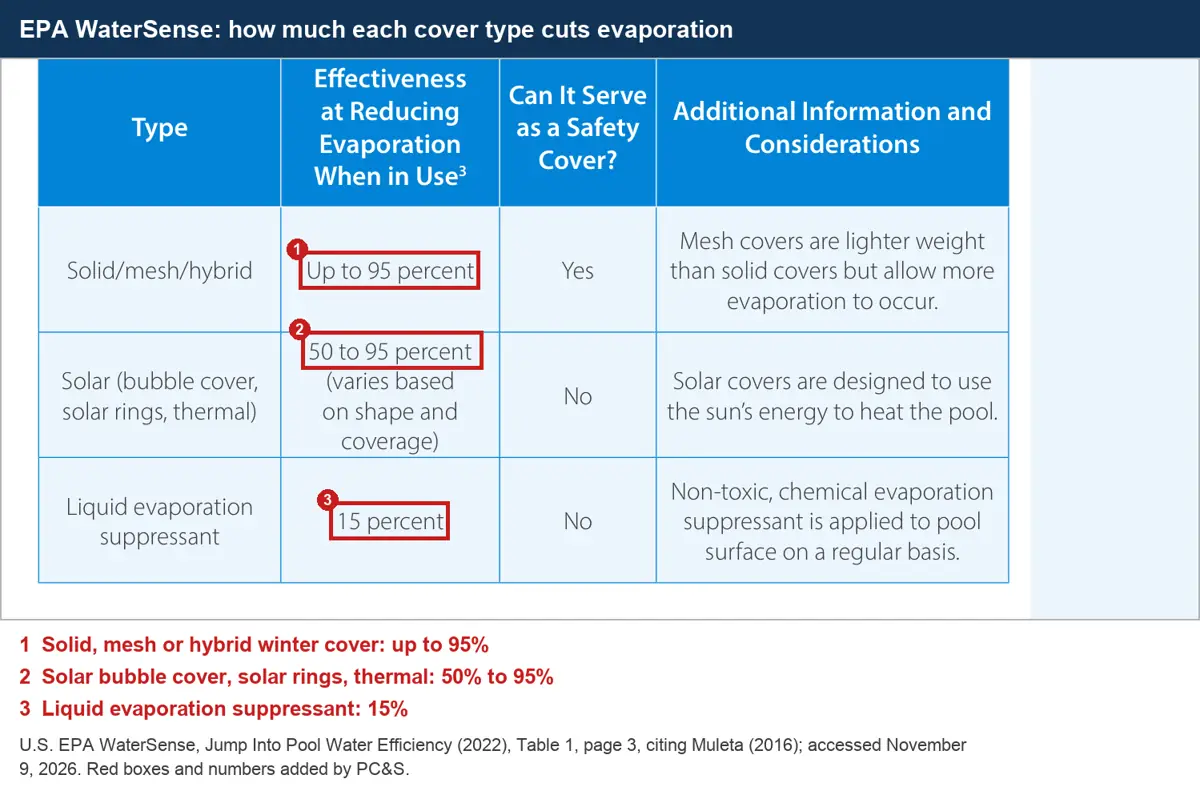
The test had limits. Covers stayed on except during cleaning and readings, so the study itself says the solid cover results should be treated as maximum possible efficiencies; on a pool people swim in, the real figure is lower (Cal Poly test via Pool & Spa News). EPA puts it plainly: covers are only effective at reducing evaporation when they are applied (EPA WaterSense).
How much warmer will a solar cover make a pool?
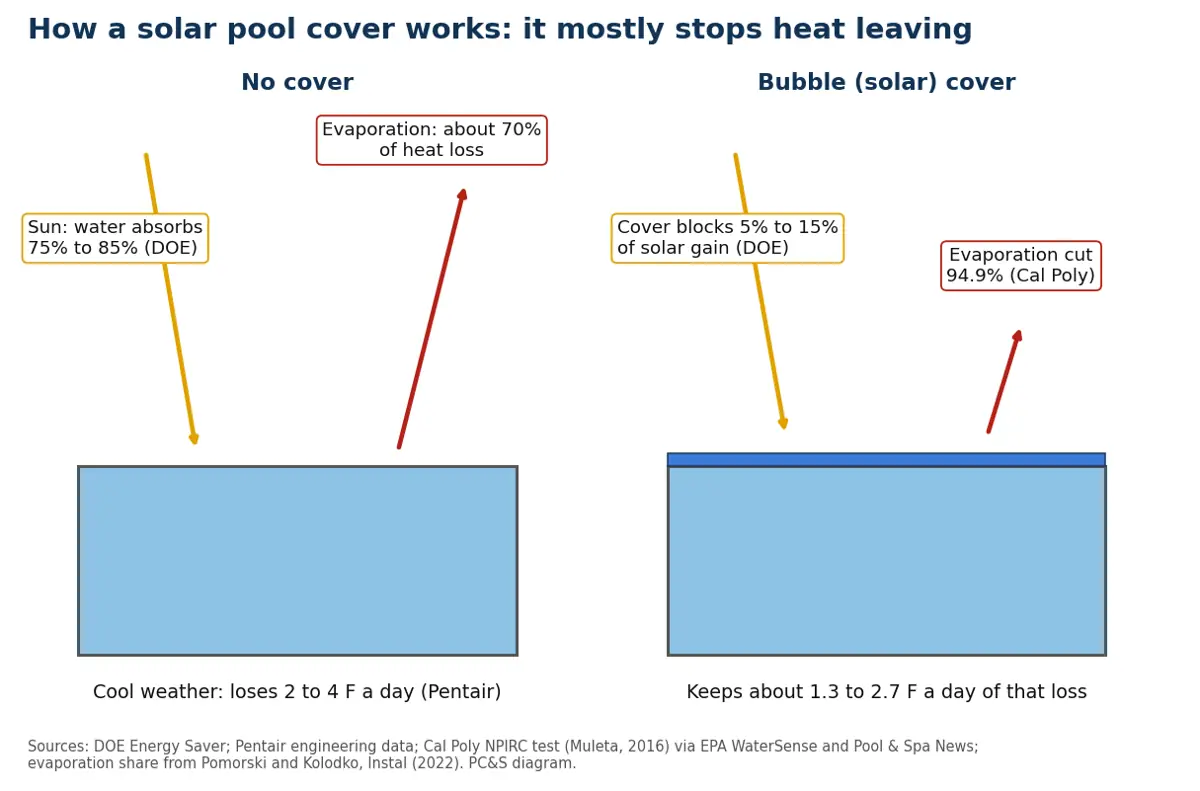
A solar cover keeps a pool about 1.3 to 2.7 F a day warmer in cool weather than it would be uncovered, by our arithmetic: Pentair says an uncovered pool loses 2 to 4 F a day, about 70% of that loss is evaporation, and a bubble cover stops 94.9% of evaporation. Over a week that is 9.3 to 18.6 F.
| Step | Low | High | Source |
|---|---|---|---|
| Uncovered pool heat loss in cool weather | 2 F a day | 4 F a day | Pentair engineering data |
| Share of outdoor pool heat loss from evaporation | about 70% | about 70% | Pomorski and Kolodko, Instal (2022) |
| Evaporation a bubble cover stops | 94.9% | 94.9% | Cal Poly NPIRC test (Muleta, 2016) |
| Loss left with the cover: 1 minus 0.70 x 0.949 | 33.6% of 2 F = 0.67 F | 33.6% of 4 F = 1.34 F | PC&S arithmetic |
| Heat the cover keeps per cool day | 1.3 F | 2.7 F | PC&S arithmetic |
| Over 7 cool days | 9.3 F | 18.6 F | PC&S arithmetic; ignores sun gain |
| Cost on sunny days | 5% of solar gain blocked | 15% blocked | U.S. DOE Energy Saver |
Sources: Pentair engineering data; Pomorski and Kolodko, Instal (2022); Cal Poly test via Pool & Spa News; DOE Energy Saver. PC&S arithmetic. Download CSV
Sellers print bigger numbers. PoolWeb’s blanket listings say a 15 degree rise is typical (PoolWeb), and GeoBubble reports up to 8 C (14.4 F) from its own test (GeoBubble). We found no independent U.S. study that measured a temperature rise; the 15 F figure only fits several cool days in a row on a pool that would otherwise be losing heat.
| What sellers say | Who says it | What the primary source says | Primary source |
|---|---|---|---|
| Typically a 15 degree temperature rise | PoolWeb solar blanket listings | No independent U.S. measurement found; the arithmetic gives 1.3 to 2.7 F kept per cool day, about 9.3 to 18.6 F over 7 days | Pentair; Cal Poly; Instal 2022 |
| Up to 8 C (14.4 F) above ambient pool temperature | GeoBubble (maker's own test of Sol+Guard) | Maker test, not independent; method not published on the page | GeoBubble blog |
| Cuts evaporation up to 95% | PoolWeb listings | 94.9% when left on full time; the study calls this a maximum because covers come off for swimming | Cal Poly NPIRC via Pool & Spa News |
| Prevents 98% of evaporation | GeoBubble | Highest result in the Cal Poly test was 95.9%, for foam | Cal Poly NPIRC via Pool & Spa News |
| Cuts chemical costs up to 40% | PoolWeb listings | Covers cut chemical consumption 35% to 60% | U.S. DOE Energy Saver |
| Liquid covers work like an invisible blanket | Liquid cover labels | 14.4% to 15.8% evaporation cut, against 94.9% for a bubble cover | Cal Poly NPIRC via Pool & Spa News; EPA |
Sources: PoolWeb and GeoBubble (claims); Cal Poly test via Pool & Spa News; EPA WaterSense; DOE Energy Saver. Download CSV
Color and clarity matter at the margin. DOE says a transparent bubble cover reduces solar absorption 5% to 15% while an opaque cover cuts it 20% to 40%, so a clear or light blue blanket gives up the least daytime heat (DOE Energy Saver). With a heater running, our how long does it take to heat a pool guide shows how a cover shortens heat-up hours by heater size.
Are solar covers for pools worth it? Payback by pool type
Solar covers are worth it on any heated pool: at DOE’s 50% to 70% saving, a $174.59 blanket pays back in 0.43 to 0.60 season with gas heat and 0.76 to 1.06 with a heat pump. On an unheated pool only the water saved counts, and payback runs 1.05 to 4.51 years at the median of 25 cities’ water rates.
| Pool | Yearly saving with a cover | Cover cost | Payback | Source of saving |
|---|---|---|---|---|
| Gas-heated, average U.S. pool ($582 a season) | $291 to $407 (50% to 70%) | $174.59 | 0.43 to 0.60 season | DOE 50% to 70%; PC&S cost to heat a pool study |
| Heat pump, average U.S. pool ($327 a season) | $164 to $229 (50% to 70%) | $174.59 | 0.76 to 1.06 seasons | Same |
| Unheated, 512 sq ft pool, water only, median of 25 cities ($10.75 per 1,000 gal) | 3,600 to 15,500 gal = $38.70 to $166.63 | $174.59 | 1.05 to 4.51 years | EPA 12,000 to 31,000 gal a year; DOE 30% to 50% less make-up water; PC&S cost to fill a pool study |
| Unheated, water only, Houston rate ($32.50 per 1,000 gal) | $117.00 to $503.75 | $174.59 | 0.35 to 1.49 years | Same, highest of 25 cities |
| Unheated, water only, Sacramento rate ($1.95 per 1,000 gal) | $7.02 to $30.23 | $174.59 | 5.8 to 24.9 years: longer than the 4-year warranty | Same, lowest of 25 cities |
Sources: PoolWeb (Nov 9, 2026); DOE Energy Saver; EPA WaterSense; PC&S cost to heat a pool study; PC&S cost to fill a pool study. Download CSV
Source: PoolWeb (Nov 9, 2026); U.S. DOE Energy Saver; EPA WaterSense (2022); PC&S cost to heat a pool and cost to fill a pool studies.. Download chart data (CSV)
The heated-pool figures use the average U.S. season from our cost to heat a pool study: $582 with gas and $327 with a heat pump at 2025 prices. Water rates come from our cost to fill a pool study, which runs from $1.95 per 1,000 gallons in Sacramento to $32.50 in Houston. Chemical savings would shorten every payback.
Solar cover vs solar rings vs liquid cover: which works best?
The bubble solar cover works best: 94.9% less evaporation against 50.1% for solar rings and 14.4% to 15.8% for liquid covers in the Cal Poly test. Rings are easier to handle and liquids need no handling, but for a 16 x 32 ft pool 11 rings cost $296.45 to $439.45 and a season of liquid $87.59 to $137.70.
| Option | Evaporation cut | Example and listed price (Nov 9, 2026) | Cost for a 16 x 32 ft pool | Handling | Source |
|---|---|---|---|---|---|
| Bubble solar cover | 94.9% | 8 mil oval blanket, 4-year warranty, $174.59; PoolStyle 10 mil rectangle $176.95 | $174.59 to $176.95 once | Two people or a reel; off before every swim | PoolWeb; ePoolSupply; Cal Poly |
| Solar rings (5 ft disks) | 50.1% | Solar Sun Rings $26.95 sale, $39.95 retail each (listing marked discontinued); 1 ring per 50 sq ft | 11 rings: $296.45 to $439.45; cover about 42% of the surface | One person; lift out by hand | Backyard City Pools; Cal Poly |
| Liquid solar cover | 14.4% to 15.8% | Cover Free 1 qt $26.95, 4 oz per 20,000 gal weekly; AquaPill SolarPill $22.95, up to 30 days | $87.59 to $137.70 a 26-week season | Nothing to remove | ePoolSupply; Cal Poly |
| No cover | 0% | n/a | $0, but 12,000 to 31,000 gal a year can evaporate from 500 sq ft | n/a | EPA WaterSense |
Sources: PoolWeb; ePoolSupply; Backyard City Pools; Cal Poly test via Pool & Spa News; EPA WaterSense. Download CSV
Rings leave gaps. Each Solar Sun Ring is 5 ft across, and the maker’s sizing of one ring per 50 sq ft puts 11 rings on a 512 sq ft pool, covering about 42% of the surface (Backyard City Pools). That gap explains why disks cut evaporation about half as much as a full blanket.
Liquid covers form a thin surface film; Cover Free calls it a mono-layer barrier. Its label’s label calls for 4 oz per 20,000 gallons every week (ePoolSupply), and the Cal Poly team noted unusually high winds during the liquid tests, which may have lowered the 14.4% to 15.8% result (Cal Poly test via Pool & Spa News).
How much water and chemicals does a solar cover save?
A pool cover cuts make-up water 30% to 50% and chemical use 35% to 60%, according to DOE. EPA estimates an uncovered 500 sq ft pool loses 12,000 to 31,000 gallons a year to evaporation, so a similar 16 x 32 ft pool would save roughly 3,600 to 15,500 gallons a year with regular cover use.
Only 15% of pool owners have and regularly use a cover, EPA reports from the 2016 Residential End Uses of Water study (EPA WaterSense). Some water utilities rebate up to $200 for qualified covers, so ask yours before buying. Evaporation by city is mapped in our pool evaporation rate report.
How long does a solar cover last, and does thickness matter?
Solar covers are sold by thickness and warranty: 8 mil blankets carry about 4 years, 12 and 14 mil about 6. Read the fine print: Blue Wave’s 6-year card is pro-rated so the owner pays 35% of list in year 2 and 95% in year 6, and it covers only delamination and seam failure.
| Blanket | Thickness | Warranty | Fine print | Source |
|---|---|---|---|---|
| Standard oval solar blanket | 8 mil | 4 years | Listed $174.59 for 16 x 32 ft | PoolWeb |
| PoolStyle rectangle | 10 mil | Not stated on listing | Listed $176.95 for 16 x 32 ft | ePoolSupply |
| Deluxe rectangle | 12 mil | 6 years | Listed $241.78 for 16 x 36 ft | PoolWeb |
| Blue Wave 14 mil blanket | 14 mil | 6 years, pro-rated | Owner pays 0% of list in year 1, 35% in year 2, 45%, 65%, 85%, then 95% in year 6; covers delamination and seams only | Blue Wave warranty card |
Sources: PoolWeb; ePoolSupply; Blue Wave 14 mil warranty card; listings accessed November 9, 2026. Download CSV
Heat and chlorine shorten life more than thickness does. Blue Wave’s card voids coverage on pools above 90 F, excludes damage from excessive chlorine, and says a blanket left in direct sun off the pool can delaminate (Blue Wave). A 12 mil Deluxe blanket for a 16 x 36 ft pool listed at $241.78, against $174.59 for an 8 mil 16 x 32 ft oval.
How many days can you leave a solar cover on a pool?
There is no day limit: a solar cover can stay on for days as long as the water stays under 90 F and chlorine under 3 ppm, the limits on Blue Wave’s warranty card. Run the pump with the cover on; Pool Supplies Canada suggests about 10am to 4pm to spread the warm surface water and chlorine.
- Take it off above 90 F Blue Wave and Pool Supplies Canada both say water above 90 F shortens blanket life; Blue Wave voids the warranty.
- Take it off to shock Remove the blanket whenever chlorine must go above 3 ppm, and put it back once it drops (Blue Wave).
- Keep the pump running Run circulation in the warmest part of the day, about 10am to 4pm, so hot water and chlorine do not build up under the cover (Pool Supplies Canada).
- Shade it when it is off Roll it up and cover it, or store it below 120 F; a blanket baking on the deck can delaminate.
- Bubbles down Blue Wave: bubbles face down, smooth side up; leave a new blanket floating 2 to 4 days to relax creases before trimming.
- Remove it fully before anyone swims Blue Wave warns a person can get caught under a solar blanket and drown; it is not a safety cover.
Should you buy a solar cover, solar rings or a heater?
Buy a bubble solar cover first if the pool is heated or water costs $10 or more per 1,000 gallons: it pays back in 0.43 to 4.51 years. Pick rings only if nobody will handle a blanket. Skip liquid covers for warmth. If you want degrees added rather than kept, a solar or heat pump heater does that, and a cover still cuts its running cost 50% to 70% (DOE).
| If your situation is | Do this | Why (source) |
|---|---|---|
| Pool has a gas heater or heat pump | Buy a bubble cover and use it every night | Pays back in 0.43 to 1.06 season (DOE 50% to 70% savings) |
| Unheated pool, water costs $10 or more per 1,000 gal | Buy a bubble cover | Water alone pays it back in about 1 to 4.5 years |
| Unheated pool, cheap water, mild climate | A cover is optional; buy it for warmth, not savings | At $1.95 per 1,000 gal payback runs past the 4-year warranty |
| Nobody will pull a cover on and off | Solar rings, or a reel for the blanket | Rings cut evaporation 50.1%; a cover left in the shed cuts 0% (EPA: covers work only when applied) |
| You want warmer water without handling anything | Skip liquid covers for heat; price a solar heater | Liquid cut evaporation only 14.4% to 15.8% |
| Pool reaches 90 F or chlorine is above 3 ppm | Take the blanket off | Blue Wave warranty card voids coverage above 90 F; remove above 3 ppm chlorine |
| You need a barrier for children | Do not rely on a solar cover | EPA: solar covers cannot serve as safety covers; see ASTM F1346 covers |
Sources: DOE Energy Saver; EPA WaterSense; Cal Poly test via Pool & Spa News; Blue Wave warranty card; PC&S payback table above. Download CSV
To add heat rather than keep it, compare collectors in our solar pool heater guide and models rated at 50 F and 80 F air in our heat pump pool heater guide.
How we compiled this
PC&S opened 11 documents on November 9, 2026: the EPA WaterSense pool guide, DOE’s Energy Saver cover page, the Pool & Spa News report of the 2016 Cal Poly test, a solar blanket warranty card, a care guide and retailer listings. The original Cal Poly report did not load (404, archive rate-limited), so its figures come from the trade report and EPA. We did not test covers.
Frequently Asked Questions
How much warmer will a solar cover make a pool?
In cool weather a bubble cover keeps about 1.3 to 2.7 F a day that an uncovered pool would lose, by our arithmetic from Pentair’s 2 to 4 F daily loss and Cal Poly’s 94.9% evaporation cut. Over a week that adds up to 9.3 to 18.6 F. We found no independent U.S. study backing sellers’ 15 degree claims.
Are solar covers for pools worth it?
Yes for heated pools: DOE puts the saving at 50% to 70% of heating cost, so a $174.59 blanket pays back in under one season on an average gas-heated pool (DOE Energy Saver). On an unheated pool only water counts, and payback runs 1.05 to 4.51 years at a median $10.75 per 1,000 gallons.
How many days can you leave a solar cover on a pool?
As long as you like while the water stays under 90 F and free chlorine under 3 ppm, the limits on Blue Wave’s warranty card (Blue Wave). Take it off to shock, keep the pump running, and store it shaded below 120 F when it is off the water.
Is it okay to run a pool pump with a solar cover on?
Yes, and you should. Pool Supplies Canada recommends running the pump in the warmest part of the day, about 10am to 4pm, so warm surface water and chlorine mix through the pool instead of building up under the cover (Pool Supplies Canada).
Do solar rings work as well as a solar cover?
No. In the Cal Poly test, solar disks cut evaporation 50.1% against 94.9% for a bubble cover (Cal Poly test via Pool & Spa News). At one ring per 50 sq ft, 11 five-foot rings cover only about 42% of a 16 x 32 ft pool, and they cost $296.45 to $439.45 at listed prices.
Do liquid solar covers work?
Only a little. Two liquid evaporation suppressants cut evaporation 14.4% to 15.8% in the Cal Poly test, and EPA rounds it to 15% (EPA WaterSense). A season of liquid for a 20,000-gallon pool costs about $87.59 to $137.70 at November 2026 prices, close to the price of a blanket that cut evaporation 94.9%.
Sources
- U.S. EPA WaterSense. Jump Into Pool Water Efficiency (2022). Accessed 2026-11-09.
- U.S. Department of Energy. Energy Saver: Swimming Pool Covers (archived Jan 1, 2026). Accessed 2026-11-09.
- Pool & Spa News. Evaporation Study Compares Water Savings of Covers (Feb 10, 2016). Accessed 2026-11-09.
- Cal Poly NPIRC / Irvine Ranch Water District. Evaporation Study Final Report (Muleta, 2016), IRWD copy (not opened: 404 live, archive rate-limited). Accessed 2026-11-09.
- Pentair. Engineering data, 2025 to 2026 catalog. Accessed 2026-11-03.
- Instal (Pomorski, Kolodko). An analysis of heat losses from an all-year outdoor swimming pool (2022). Accessed 2026-11-03.
- PoolWeb. Solar blanket listings. Accessed 2026-11-09.
- ePoolSupply. Solar cover and liquid solar cover listings. Accessed 2026-11-09.
- Backyard City Pools. Solar Sun Rings. Accessed 2026-11-09.
- Blue Wave Products. 14 mil solar blanket 6 year limited warranty. Accessed 2026-11-09.
- Pool Supplies Canada. Solar Cover Care Guide. Accessed 2026-11-09.
- GeoBubble. How does a solar pool cover work?. Accessed 2026-11-09.
- Pool Construction & Service. Cost to Heat a Pool: Gas Heater vs Heat Pump by State, 2026. Accessed 2026-11-09.
- Pool Construction & Service. Cost to Fill a Pool in 25 US Cities. Accessed 2026-11-09.
Related pages
Get Quotes From Licensed Local Pool Pros
Tell us what you need and your ZIP code. We match you with pool companies that cover your area.