How Long Does It Take to Heat a Pool? Heat-Up Hours by Pool Size, Heater and City
How long does it take to heat a pool? For a covered 20,000-gallon pool rising 15 F: about 8 hours with a 400,000 Btu/h gas heater, 19 with a 140,000 Btu/h heat pump, and 58 with a 50,000 Btu/h unit.
- ✓45-cell heat-up matrix15,000 to 30,000 gallons, 10 F to 20 F rises, five heaters, with and without a cover.
- ✓Losses shown, not hiddenPentair's 2 F to 4 F daily loss and a 70% evaporation share, with every assumption in a table.
- ✓City by cityApril and May heat-up for a heat pump in 10 cities from NOAA 1991-2020 normals.
Key takeaways
- Every gallon needs 8.34 Btu per degree, so 20,000 gallons needs 2,502,000 Btu for a 15 F rise; hours = gallons x 8.34 x rise / heater output (Pentair Engineering Data, p. 530).
- With a cover on, that 15 F rise takes about 7.6 hours with a 400,000 Btu/h gas heater, 18.8 hours with a 140,000 Btu/h heat pump and 58 hours with a 50,000 Btu/h heat pump (PC&S calculation).
- An uncovered pool loses 2 F to 4 F a day in cool weather (Pentair’s engineering data), and about 70% of an outdoor pool’s heat loss is evaporation (Pomorski and Kolodko, 2022).
- A cover stops up to 95% of evaporation (EPA WaterSense), which cuts the heat-up time for a 50,000 Btu/h heat pump on 20,000 gallons from 86 to 58 hours.
- Heat pumps slow down in cool air: at 50 F a 140,000 Btu/h unit delivers 85,000 Btu/h, so the covered 15 F rise takes 32.1 hours instead of 18.8 (Hayward AHRI 1160 ratings).
How long does it take to heat a pool, by heater and pool size?
Plan on hours with gas and a day or more with a heat pump. With a cover, a 400,000 Btu/h gas heater raises 15,000 to 30,000 gallons by 10 F to 20 F in 3.8 to 15.4 hours; a 140,000 Btu/h heat pump needs 9.3 to 38.6, and a 50,000 Btu/h unit 28 to 127 hours.
| Pool volume (gallons) | Temperature rise (F) | Heat needed (Btu) | Heat pump 50,000 Btu/h (hours) | Heat pump 100,000 Btu/h (hours) | Heat pump 140,000 Btu/h (hours) | Gas 250,000 Btu/h input (210,000 output) (hours) | Gas 400,000 Btu/h input (336,000 output) (hours) |
|---|---|---|---|---|---|---|---|
| 15,000 | 10 | 1,251,000 | 27.9 | 13.2 | 9.3 | 6.1 | 3.8 |
| 15,000 | 15 | 1,876,500 | 41.9 | 19.8 | 13.9 | 9.2 | 5.7 |
| 15,000 | 20 | 2,502,000 | 55.9 | 26.4 | 18.6 | 12.2 | 7.6 |
| 20,000 | 10 | 1,668,000 | 38.8 | 17.9 | 12.5 | 8.2 | 5.1 |
| 20,000 | 15 | 2,502,000 | 58.2 | 26.9 | 18.8 | 12.3 | 7.6 |
| 20,000 | 20 | 3,336,000 | 77.6 | 35.9 | 25.1 | 16.4 | 10.1 |
| 30,000 | 10 | 2,502,000 | 63.3 | 27.9 | 19.3 | 12.5 | 7.7 |
| 30,000 | 15 | 3,753,000 | 95.0 | 41.9 | 29.0 | 18.8 | 11.5 |
| 30,000 | 20 | 5,004,000 | 126.6 | 55.9 | 38.6 | 25.1 | 15.4 |
Source: Pentair 2025-2026 Engineering Data, p. 530 formula; loss of 1.005 F per day from Pentair, Pomorski and Kolodko 2022 and EPA WaterSense; PC&S calculation, November 2026. Download CSV
Heat pump outputs are 80 F air ratings; at 50 F air expect about 61% to 66% of that output (AHRI 1160 maker sheets).
Source: Pentair 2025-2026 Engineering Data p. 530; Pomorski and Kolodko 2022; EPA WaterSense; PC&S calculation. Download chart data (CSV)
The five heaters span what most backyards install. The 50,000 Btu/h class matches small units such as the Fibropool FH255 (55,000 Btu), 100,000 Btu/h matches the Pentair UltraTemp 110 or Raypak Crosswind V 5550, and 140,000 Btu/h the largest residential heat pumps. Gas outputs are input x 84%, Pentair’s MasterTemp efficiency. Every model’s spec is compared in our heat pump pool heater guide.
| Pool volume (gallons) | Temperature rise (F) | Heat needed (Btu) | Heat pump 50,000 Btu/h (hours) | Heat pump 100,000 Btu/h (hours) | Heat pump 140,000 Btu/h (hours) | Gas 250,000 Btu/h input (210,000 output) (hours) | Gas 400,000 Btu/h input (336,000 output) (hours) |
|---|---|---|---|---|---|---|---|
| 15,000 | 10 | 1,251,000 | 36.4 | 14.8 | 10.1 | 6.4 | 3.9 |
| 15,000 | 15 | 1,876,500 | 54.6 | 22.2 | 15.1 | 9.7 | 5.9 |
| 15,000 | 20 | 2,502,000 | 72.8 | 29.7 | 20.1 | 12.9 | 7.8 |
| 20,000 | 10 | 1,668,000 | 57.2 | 21.1 | 14.0 | 8.8 | 5.3 |
| 20,000 | 15 | 2,502,000 | 85.8 | 31.6 | 21.0 | 13.2 | 7.9 |
| 20,000 | 20 | 3,336,000 | 114.4 | 42.1 | 28.0 | 17.6 | 10.6 |
| 30,000 | 10 | 2,502,000 | 133.6 | 36.4 | 23.0 | 14.0 | 8.2 |
| 30,000 | 15 | 3,753,000 | 200.4 | 54.6 | 34.5 | 21.0 | 12.3 |
| 30,000 | 20 | 5,004,000 | 267.2 | 72.8 | 46.0 | 28.0 | 16.4 |
Source: Pentair’s engineering data, p. 530; PC&S calculation. Download CSV
Small heat pumps feel losses most. A 50,000 Btu/h unit on 30,000 gallons uncovered fights a 31,275 Btu/h loss, so its net heat is about 18,700 Btu/h and a 20 F rise takes 267 hours, or 11 days. The same unit covered needs 127 hours. Gas barely notices: the 400,000 Btu/h heater goes from 15.4 to 16.4 hours. How a bubble cover compares with solar rings and liquid covers in measured evaporation is set out in our guide to whether solar pool covers work.
How do you calculate how long it takes to heat your pool?
Multiply gallons by 8.34 and by the degrees you want to add to get the Btu needed, then divide by the heater’s output in Btu per hour, minus the heat the pool loses while it warms. One Btu raises one pound of water 1 F, and a gallon weighs 8.34 lb, so 20,000 gallons needs 166,800 Btu per degree.
- Find the gallonsLength x width x average depth x 7.48 gallons per cubic foot (USGS); a 16 x 32 ft pool at 4.5 ft averages about 17,234 gallons.
- Pick the riseTarget minus current water temperature; DOE calls 78 F to 82 F typical, so 65 F water needs about 15 F.
- Work out the BtuGallons x 8.34 x rise: 20,000 x 8.34 x 15 = 2,502,000 Btu.
- Find the heater's outputGas: input x thermal efficiency (400,000 x 84% = 336,000 Btu/h). Heat pump: the AHRI 1160 rating nearest your air temperature (80 F or 50 F).
- Subtract the lossGallons x 8.34 x loss per day / 24: 1.005 F per day covered (20,000 gal: 6,985 Btu/h) or 3 F per day uncovered (20,850 Btu/h).
- Divide2,502,000 / (140,000 minus 6,985) = 18.8 hours for a 140,000 Btu/h heat pump with a cover.
| Step | Value | Arithmetic and source |
|---|---|---|
| Pool volume | 20,000 gallons | Example pool |
| Weight of the water | 166,800 lb | 20,000 x 8.34 lb per gallon (Pentair p. 530) |
| Heat for a 15 F rise (65 F to 80 F) | 2,502,000 Btu | 166,800 lb x 15 F x 1 Btu per lb per F (EIA) |
| Heater output | 140,000 Btu/h | Heat pump rated at 80 F air, 80% RH (Hayward HP21404T, AHRI 1160) |
| Hours before losses | 17.9 | 2,502,000 / 140,000 |
| Heat lost while warming, covered | 6,985 Btu/h | 166,800 x 1.005 F per day / 24 |
| Net heat into the water | 133,015 Btu/h | 140,000 minus the loss |
| Hours with a cover | 18.8 | 2,502,000 / 133,015 |
| Hours without a cover (3 F per day loss) | 21.0 | 2,502,000 / 119,150 |
| Same heat pump at 50 F air (85,000 Btu/h), covered | 32.1 | 2,502,000 / 78,015 |
Source: Pentair’s engineering data, p. 530; EIA Btu definition; Hayward HP21404T AHRI ratings; PC&S calculation. Download CSV
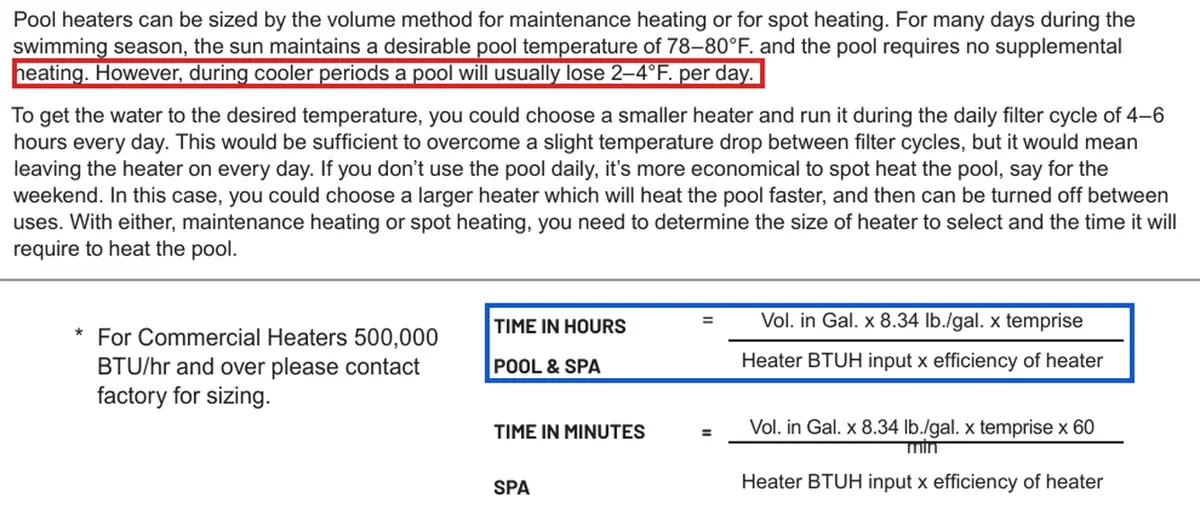
Pentair’s own table states that its figures discount losses, which is why its spa chart puts a 30 F rise in 500 gallons at 22 minutes with a 400,000 Btu/h heater. Pools are different: the heater runs for hours while the surface keeps losing heat. Which heater size your pool needs in the first place is covered in our guide to what size pool heater you need.
How much heat does a pool lose while it warms up?
In cool weather an uncovered pool usually loses 2 F to 4 F a day, per Pentair, and evaporation causes about 70% of that loss in a published energy balance of an outdoor pool. This page uses the 3 F midpoint uncovered and 1.0 F per day covered, because a cover can stop up to 95% of evaporation (EPA).
Source: Pomorski and Kolodko, An analysis of heat losses from an all-year outdoor swimming pool, Instal 9/2022 (abstract); remainder by subtraction. Download chart data (CSV)
| Assumption | Value used | Source | Effect on the hours |
|---|---|---|---|
| Uncovered pool loses heat in cool periods | 3 F per day (midpoint of 2 to 4 F) | Pentair Engineering Data p. 530 | Adds 21,000 Btu/h of loss for 20,000 gallons |
| Share of outdoor pool heat loss from evaporation | About 70% (radiation about 8%) | Pomorski and Kolodko, Instal 9/2022 | Sets how much a cover can save |
| Evaporation a cover can stop | Up to 95% | EPA WaterSense | Cuts evaporation loss when on |
| Covered loss | 3 x (1 minus 0.70 x 0.95) = 1.005 F per day | PC&S arithmetic | Loss falls by 66.5%, inside DOE's 50% to 70% cover saving |
| Loss stays constant while the water warms | Simplification | PC&S model | Understates hours near the target, since evaporation grows with water temperature (Pomorski and Kolodko) |
| Heater output stays at its rating | 80 F air for heat pumps; input x 84% for gas | AHRI 1160 maker sheets; Pentair MasterTemp 84% | Cool air lowers heat pump output to 61% to 66% at 50 F |
Source: Pentair’s engineering data; Pomorski and Kolodko, Instal 9/2022; EPA WaterSense; DOE Energy Saver, pool covers (archived). Download CSV
Evaporation dominates because it is so energy-dense: DOE says each pound of 80 F water that evaporates takes 1,048 Btu out of the pool, against 1 Btu to warm that pound by 1 F (DOE Energy Saver). Pomorski and Kolodko also found evaporation loss grows exponentially with water temperature, so a constant loss slightly understates the last few degrees. Our pool evaporation rate study maps how many inches a year evaporate in 25 US cities.
Does a pool heat faster with a cover on?
Yes. A cover blocks evaporation, the largest loss, so more of the heater’s output stays in the water. For a 20,000-gallon pool raised 15 F, a cover cuts heat-up from 31.6 to 26.9 hours with a 100,000 Btu/h heat pump and from 86 to 58 hours with a 50,000 Btu/h unit. DOE puts a cover’s saving at 50% to 70% of heating cost.
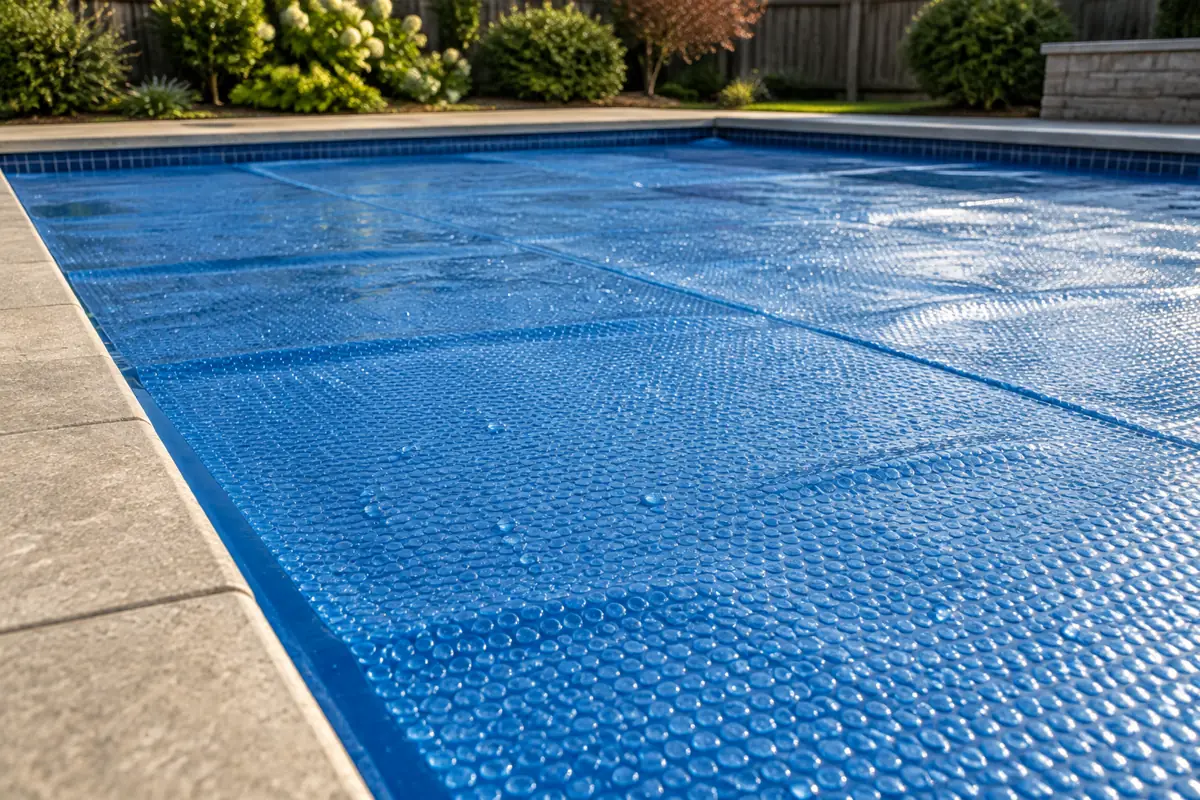
The cover matters most when the heater is small relative to the pool. A 400,000 Btu/h gas heater on 20,000 gallons saves only 0.3 hours from a cover on a 15 F rise, because the loss is 6% of its output. A 50,000 Btu/h heat pump saves 28 hours, because the uncovered loss eats 42% of its output. In California, heated outdoor pools must have a cover under Title 24 Section 110.4(b)3.
Wind is the other lever. DOE recommends a windbreak of trees, shrubs or a fence, high and close enough not to create turbulence over the water, because wind raises the evaporation rate (DOE). DOE’s city tables show a cover cutting full-season heating cost by 76.2% (Seattle) to 92.1% (Denver), as our cost to heat a pool study documents.
How long does it take to heat a pool with a heat pump vs a gas heater?
A gas heater adds about 1.2 F to 2.0 F an hour to a covered 20,000-gallon pool; a heat pump adds 0.26 F to 0.80 F, depending on size. So a 15 F rise takes 7.6 to 12.3 hours with gas and 18.8 to 58 hours with a heat pump. In 50 F air a heat pump slows further, to about 61% to 66% of its rated output.
| Heater | Gross rise per hour, 20,000 gal (F) | Net rise per hour with a cover (F) | Net rise per hour without a cover (F) | Net rise per 24 hours with a cover (F) |
|---|---|---|---|---|
| Heat pump 50,000 Btu/h | 0.30 | 0.26 | 0.17 | 6.2 |
| Heat pump 100,000 Btu/h | 0.60 | 0.56 | 0.47 | 13.4 |
| Heat pump 140,000 Btu/h | 0.84 | 0.80 | 0.71 | 19.1 |
| Gas 250,000 Btu/h input (210,000 output) | 1.26 | 1.22 | 1.13 | 29.2 |
| Gas 400,000 Btu/h input (336,000 output) | 2.01 | 1.97 | 1.89 | 47.3 |
Source: Pentair’s engineering data; PC&S loss model. Download CSV
Source: Pentair formula; PC&S loss model (1.0 F per day with a cover). Download chart data (CSV)
For a 60 F to 80 F opening on 20,000 gallons with a cover, gas takes 10.1 hours at 400,000 Btu/h input and 16.4 at 250,000. A 140,000 Btu/h heat pump takes 25.1 hours in 80 F air and 42.8 in 50 F air. That gap, and what each costs per month, is the core trade-off in our heat pump vs gas comparison.
| What some guides say | Who says it | What the arithmetic shows (20,000 gallons, cover on) |
|---|---|---|
| 60 F to 80 F: gas 14 to 28 hours, heat pump 28 to 40 hours | Shasta Pool Supply | Gas: 10.1 hours at 400,000 Btu/h input, 16.4 at 250,000. Heat pump: 25.1 at 140,000 Btu/h and 35.9 at 100,000 (80 F air); 42.8 at 50 F air. The gas range fits a 250,000 heater or smaller. |
| Gas heaters add 1 F to 2 F per hour; heat pumps 0.5 F to 1 F | ePoolSupply | Net of a covered pool's loss, 1.97 F per hour at 400,000 input, 1.22 at 250,000, 0.80 for a 140,000 heat pump and 0.26 for a 50,000 unit. The 0.5 floor overstates small heat pumps on 20,000 gallons. |
| Heat-up takes about 8 to 12 hours | New England Propane | True for a 400,000 Btu/h gas heater on 20,000 gallons and a 15 F to 20 F rise (7.6 to 10.1 hours); a 250,000 unit needs 12.3 to 16.4. |
| Covers cut evaporation by over 98% | Shasta Pool Supply | EPA WaterSense says up to 95%; DOE puts cover savings at 50% to 70% of heating cost. |
Source: Shasta Pool Supply; ePoolSupply; New England Propane; EPA WaterSense; PC&S arithmetic. Pages accessed Nov 8, 2026. Download CSV
How long does it take to heat a pool in your city?
With gas, about the same everywhere: a 400,000 Btu/h heater needs about 7.6 hours for 20,000 gallons and 15 F, covered. With a heat pump, the month’s air temperature decides. Our estimate for a 140,000 Btu/h heat pump in May runs from about 20 hours in Miami and Phoenix to 28 hours in Seattle and Denver; in April, Chicago and Denver air averages below the 50 F heating floor.
| City (NOAA airport station) | Days with normal high 80 F or more | 80 F season dates | April mean air (F) | May mean air (F) | 140,000 Btu/h heat pump output at May mean air (Btu/h) | Hours, 20,000 gal +15 F, covered, May | Hours, same, April | Gas 400,000 input, any month (hours) |
|---|---|---|---|---|---|---|---|---|
| Miami | 265 | Mar 8 to Nov 27 | 76.7 | 80.1 | 130,000 | 20.3 | 21.2 | 7.6 |
| Phoenix | 232 | Mar 22 to Nov 8 | 73.2 | 82.0 | 130,000 | 20.3 | 22.2 | 7.6 |
| Houston | 193 | Apr 15 to Oct 24 | 70.0 | 77.4 | 126,100 | 21.0 | 23.2 | 7.6 |
| Dallas | 161 | May 5 to Oct 12 | 65.6 | 74.0 | 121,000 | 21.9 | 24.7 | 7.6 |
| Atlanta | 142 | May 11 to Sep 29 | 63.2 | 71.2 | 116,800 | 22.8 | 25.6 | 7.6 |
| Los Angeles | 0 | none at 80 F | 61.1 | 63.6 | 105,400 | 25.4 | 26.4 | 7.6 |
| New York | 88 | Jun 12 to Sep 7 | 53.6 | 63.7 | 105,550 | 25.4 | 30.0 | 7.6 |
| Chicago | 81 | Jun 14 to Sep 2 | 49.7 | 60.6 | 100,900 | 26.6 | below 50 F floor | 7.6 |
| Seattle | 0 | none at 80 F | 51.3 | 57.5 | 96,250 | 28.0 | 31.3 | 7.6 |
| Denver | 102 | Jun 6 to Sep 15 | 47.8 | 57.4 | 96,100 | 28.1 | below 50 F floor | 7.6 |
Source: NOAA NCEI 1991-2020 monthly normals (example: Miami USW00012839); PC&S pool season length by city; Hayward HP21404T AHRI 1160 ratings; PC&S calculation. Download CSV
Blank April bars: mean air below the 50 F floor of standard heat pumps (Hayward). A 400,000 Btu/h gas heater needs about 7.6 hours in any month.
Source: NOAA NCEI 1991-2020 monthly normals; Hayward HP21404T AHRI 1160 ratings; PC&S calculation. Download chart data (CSV)
The season column explains when you need a heater at all. Our pool season length study counts 265 days with a normal high of 80 F or more in Miami and 232 in Phoenix, but 81 in Chicago and none at Los Angeles and Seattle airports. Where the season is short, the heater mostly closes the gap at each end, which is when air is coolest and heat pumps are slowest.
The interpolation is a planning estimate: we drew a straight line between the HP21404T’s 85,000 Btu/h at 50 F and 130,000 Btu/h at 80 F (both at 63% humidity) and read it at the monthly mean. Days run warmer than the mean and nights cooler, so a heat pump that runs through the night will sit nearer the lower rating.
How to heat a pool faster: what actually changes the time?
Four things move the hours: heater output, the loss you allow, air temperature for a heat pump, and how many degrees you need. A cover and continuous running change the loss and run time; a bigger or gas heater changes output; starting from warmer water changes the rise. Doubling heater output roughly halves the time once losses are small.
- Cover the pool before you startCuts the modeled loss from 3 F to 1.005 F per day; up to 95% of evaporation stops (EPA).
- Run the heater and pump around the clockHeat pumps need flow, 30 to 75 gpm on Hayward HeatPro; set the pump timer to cover the full heat-up.
- Heat in the warmest daysA heat pump at 80 F air delivers 140,000 Btu/h; at 50 F, 85,000 (Hayward HP21404T).
- Block the windDOE recommends a windbreak high and close enough to avoid turbulence over the water.
- Hold, then lowerFor weekend use, DOE says turning the heater down between uses saves energy and reheating does not use more.
| Method | How it heats | Heat-up role | Cost per million Btu into the water, US | Source |
|---|---|---|---|---|
| Gas heater (natural gas) | Burns gas; 82% to 96% efficient | Fastest: 336,000 Btu/h out from a 400,000 input | $31.14 (July 2026, 82%) | EIA; 10 CFR 430.32(k); Pentair |
| Propane heater | Burns propane; same federal 82% floor | Same speed as natural gas | $34.04 (Oct 2025 to Mar 2026 price average) | EIA propane survey via PC&S research |
| Heat pump | Moves heat from air; COP 4.0 to 7.1 | Medium: 85,000 to 145,000 Btu/h at 80 F air | $10.73 (July 2026, COP 5.0) | EIA; maker AHRI sheets |
| Electric resistance heater | Element heats water; 100% | Slow at household amperage | $53.66 (July 2026) | EIA via PC&S research |
| Solar collectors | Pool pump sends water through roof or rack collectors | Slow, sun-dependent; collectors sized 50% to 100% of pool area | No fuel; pump power only | DOE via PC&S solar pool heater guide |
| Solar or bubble cover | Stops evaporation, the largest loss | Cuts the loss term; adds no heat source | No energy cost | EPA WaterSense; DOE |
Source: EIA prices; 10 CFR 430.32(k); PC&S cost to heat a pool study; PC&S solar pool heater guide. Download CSV
Solar collectors heat slowly and only in sun, so they suit holding temperature over a season rather than a fast opening; our solar pool heater guide covers sizing at 50% to 100% of pool area. For a heated indoor pool the room air takes the evaporated heat, which our indoor pool cost guide sizes separately.
Which heater and start date should you plan for?
Plan backward from the day you want to swim: hours from the table for your gallons, rise and heater, then add a margin for cool nights. Gas or a hybrid suits same-day or weekend heating; a heat pump suits a season opened one to two days ahead with a cover. The decision table sets out the thresholds.
| If your situation is | Do this | Threshold and source |
|---|---|---|
| You want to swim tomorrow and the water is 15 F or more below target | Use gas (or a hybrid) and cover the pool tonight | 20,000 gal +15 F: 7.6 hours at 400,000 Btu/h input vs 18.8 for a 140,000 Btu/h heat pump, covered |
| You open the pool for the season with a heat pump | Start it 1 to 2 days before you swim, cover on, pump running 24 hours | A 140,000 Btu/h unit needs 25 hours for 20 F; a 100,000 unit 36; at 50 F air 43 |
| Your heat pump is under 60,000 Btu/h on a pool over 20,000 gallons | Expect days, not hours; add a cover or move the start date | 50,000 Btu/h on 30,000 gal +15 F: 95 hours covered, 200 uncovered |
| Your air averages under 50 F (Chicago and Denver in April) | Wait for May, use a low-ambient heat pump rated to 40 F, or use gas | Hayward: standard models heat to 50 F air, low-ambient to 40 F |
| You leave the pool uncovered | Cover it; it is the cheapest time cut | Covered loss 1.005 F per day vs 3 F (Pentair; Pomorski and Kolodko; EPA) |
| You heat only on weekends | Turn the heater off between uses and reheat; DOE says reheating does not use more energy | DOE Energy Saver (archived) |
Source: PC&S calculations from Pentair’s engineering data; Hayward; DOE Energy Saver (archived). Download CSV
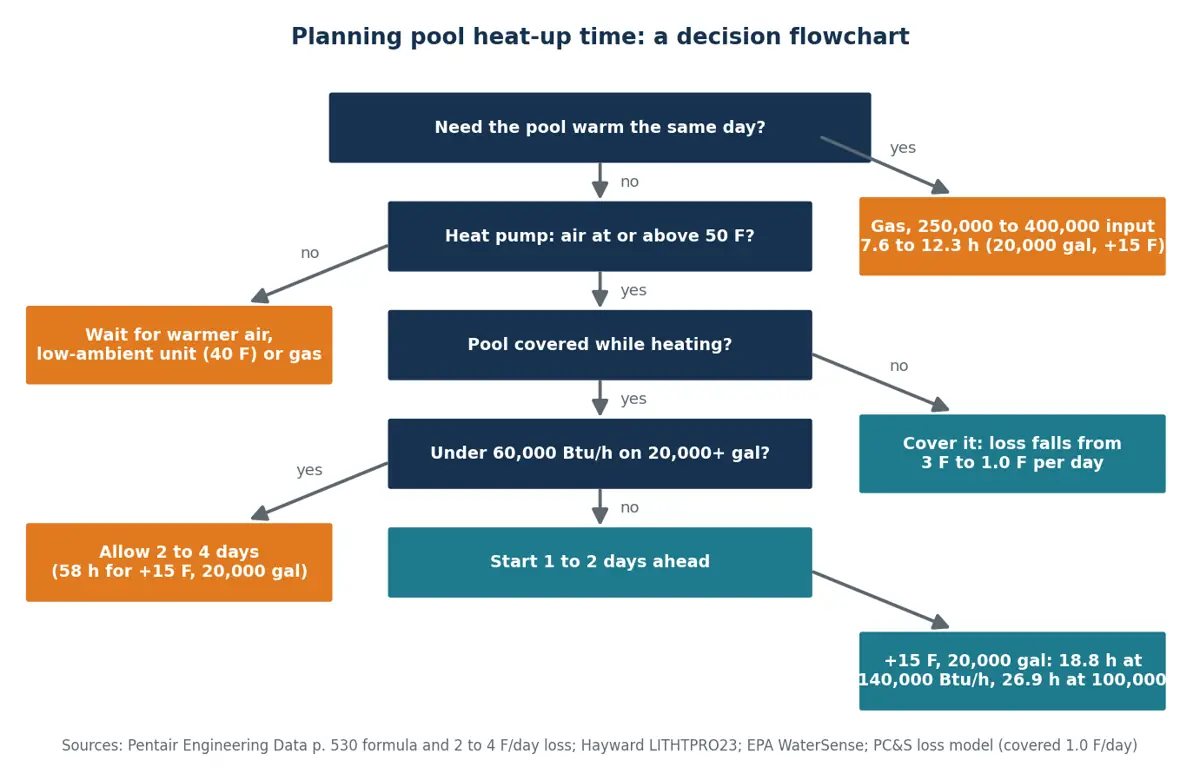
The target temperature sets the rise, so choose it first: DOE calls 78 F to 82 F typical, and children’s lessons need warmer water, as our ideal pool temperature guide explains by use and age. Pool automation can start a heater on a schedule so the water is ready on time; our pool automation system guide lists what controllers do.
How we compiled this
We opened 11 primary documents in November 2026: Pentair’s 2025-2026 engineering data and heater catalog, the Hayward HeatPro, Raypak Crosswind V and Fibropool sheets, four archived DOE Energy Saver pages, EPA WaterSense and a 2022 peer-reviewed pool heat-loss study. EIA, NOAA 1991-2020 normals, USGS, NWS and Title 24 figures are reused from our research reports and sibling guides, which cite them. Every time on the page is our arithmetic from Pentair’s formula with the loss assumptions stated; we did not measure any pool. Competitor pages served only as claims to check.
Frequently Asked Questions
How long does it take to heat a pool from 60 to 80?
For 20,000 gallons with a cover: about 10 hours with a 400,000 Btu/h gas heater, 16 hours with a 250,000 Btu/h unit and 25 hours with a 140,000 Btu/h heat pump in 80 F air. That is 3,336,000 Btu (20,000 x 8.34 x 20) divided by output minus a 1 F per day loss. In 50 F air the heat pump needs about 43 hours.
How can I heat up my pool quickly?
Use the biggest heater you have, cover the pool and run heater and pump continuously. A 400,000 Btu/h gas heater adds about 2.0 F an hour to a covered 20,000-gallon pool, against 0.80 F for a 140,000 Btu/h heat pump. Leaving the cover off adds 21,000 Btu/h of loss at 3 F per day (Pentair’s 2 F to 4 F range).
Is 72 degree pool water too cold?
For most swimmers, yes. The National Weather Service says gasping can be triggered by water as warm as 77 F, and DOE calls 78 F to 82 F typical for pools. Raising 20,000 gallons from 72 F to 80 F takes about 4.1 hours with a 400,000 Btu/h gas heater or 10 with a 140,000 Btu/h heat pump, covered. See our ideal pool temperature guide.
How long does it take to heat a 30000 gallon pool?
A 15 F rise in 30,000 gallons needs 3,753,000 Btu. With a cover that takes about 11.5 hours with a 400,000 Btu/h gas heater, 18.8 with a 250,000 unit, 29 with a 140,000 Btu/h heat pump and 95 with a 50,000 unit; uncovered the small heat pump needs 200 hours.
How long does it take to heat a pool with a heat pump?
Usually 12 to 45 hours. With a cover, a 140,000 Btu/h heat pump raises 20,000 gallons 10 F in 12.5 hours and 20 F in 25.1; a 100,000 Btu/h unit needs 17.9 and 35.9. At 50 F air the 140,000 unit delivers 85,000 Btu/h and needs 43 hours for 20 F.
How long does it take to heat a pool with a gas heater?
Hours. A 400,000 Btu/h gas heater at 84% puts 336,000 Btu/h into the water, raising a covered 20,000-gallon pool 10 F in 5.1 hours and 20 F in 10.1. A 250,000 Btu/h heater needs 8.2 and 16.4 hours. Gas output does not fall in cool air.
Sources
- Pentair. 2025-2026 catalog, Engineering Data, heater sizing information (p. 530). Accessed 2026-11-03.
- Pentair. 2025-2026 Pool Product Catalog, heaters and heat pumps section. Accessed 2026-11-03.
- Hayward Industries. HeatPro Series sell sheet LITHTPRO23 (AHRI 1160 ratings). Accessed 2026-11-03.
- Raypak. Crosswind V product submittal 100-10009566 Rev 01. Accessed 2026-11-03.
- Fibropool. FH255 heat pump product page. Accessed 2026-11-03.
- Pomorski M., Kolodko Z.. An analysis of heat losses from an all-year outdoor swimming pool (Instal 9/2022). Accessed 2026-11-03.
- U.S. Environmental Protection Agency, WaterSense. Pool water efficiency. Accessed 2026-11-03.
- U.S. Department of Energy. Energy Saver: Swimming Pool Covers (archived Jan 1, 2026). Accessed 2026-11-03.
- U.S. Department of Energy. Energy Saver: Gas Pool Heaters (archived Jan 1, 2026). Accessed 2026-11-03.
- U.S. Department of Energy. Energy Saver: Managing Swimming Pool Temperature (archived Jan 1, 2026). Accessed 2026-11-03.
- U.S. Energy Information Administration. British thermal units (Btu). Accessed 2026-10-27.
- U.S. Energy Information Administration. Natural gas prices, residential. Accessed 2026-10-27.
- U.S. Geological Survey. Water science glossary (gallons per cubic foot). Accessed 2026-10-27.
- NOAA NCEI. U.S. Climate Normals 1991-2020, monthly (example: Miami USW00012839). Accessed 2026-10-27.
- National Weather Service. Cold water hazards and safety. Accessed 2026-10-27.
- California Energy Commission. 2025 Building Energy Efficiency Standards, Title 24 Part 6. Accessed 2026-10-27.
Related pages
Get Quotes From Licensed Local Pool Pros
Tell us what you need and your ZIP code. We match you with pool companies that cover your area.