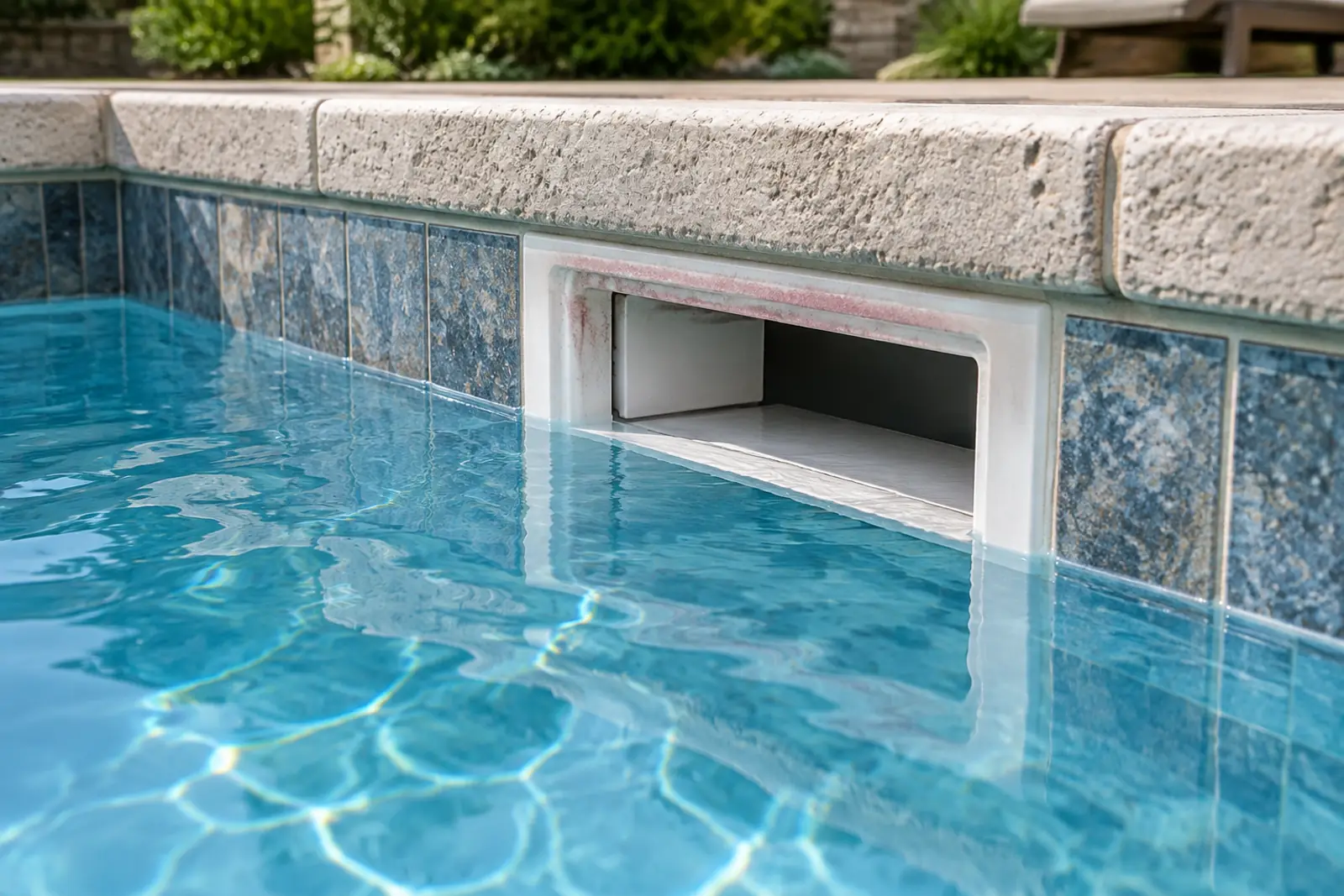
Pink Algae in Pool Water: What It Really Is, Where It Hides and How to Kill It for Good
Pink algae in pool fittings is not algae but a pink bacterial slime, usually Methylobacterium: brush every hiding spot, shock to 10 ppm, soak the skimmer overnight with a slime-labeled product and clean the filter.
- ✓It is bacteriaMethylobacterium was the major genus in all 42 pink biofilms in one study (Yano et al., 2013).
- ✓Nine hiding spotsSkimmer, light niche, eyeballs, ladder sockets, filter, toys and more: miss one and it returns.
- ✓Check the label'Pink 30' lists algae only; QLF (3432-63) claims slime producing microorganisms.
Key takeaways
- Pink algae is bacterial slime, not algae: Methylobacterium was the major genus in all 42 pink biofilms studied by Yano et al. (2013), and most Methylobacterium strains from chlorinated water supplies resisted chlorine (Hiraishi et al., 1995).
- Pink color inside a vinyl liner is a different problem: pigment from Streptoverticillium bacteria that migrates through the vinyl, so chlorine bleaches it only until new dye surfaces (Pool & Spa News).
- The slime hides in nine places, from the skimmer lid and light niche to ladder sockets and toys; the QLF Algicide label (EPA Reg. No. 3432-63) treats it with 5 to 7 1/2 oz in the skimmer, pump off overnight, then 24 to 48 hours of filtering.
- A 20,000 gallon pool needs 160 fl oz (1.25 gal) of 12.5% liquid chlorine to go from 2 to 10 ppm, the label superchlorination maximum, about $9.37 at Leslie’s September 2026 price.
- A pink product name is not a pink claim: the EPA record for Pink 30 (3525-133-51688) lists algae only.
What is pink algae in a pool?
Pink algae is a slimy pink or orange biofilm made by bacteria, not algae. The best-studied pink biofilms, from bathrooms, are dominated by Methylobacterium, a pink-pigmented bacterium that resists chlorine and common cleaners. In pools it shows up where water moves slowly: the skimmer, fittings, light niche and filter. No study we found has sequenced pink slime from a residential pool.
Three studies carry the evidence. Xu et al. (2014) identified 16 of 21 pink-pigmented isolates from bathrooms in five houses as Methylobacterium; Yano et al. found the genus dominant in every biofilm they tested and saw isolates survive 24 hours in 1.0% cleaning agents; and Hiraishi et al. found most chlorinated-water isolates chlorine resistant. That matches the pool pattern: pink film that returns while the test kit reads normal.
Pink slime often travels with white water mold, the tissue-like flakes that grow in the same lines. Our white water mold guide covers the biofilm science and the plumbing purge in full; this page covers what is specific to pink: telling it from a stain, the pink hiding spots, the dose math and the products sold under pink names.
Is it pink slime, a liner stain or something else?
Wipe it with a white cloth. Pink slime comes off and returns to the same fittings within days. Pink, red or purple color that stays in a vinyl liner is a pigment stain from Streptoverticillium bacteria and will not wipe off. A brown-red flat stain that lightens under a vitamin C tablet is iron. Each needs a different fix, and only the first is pink algae.
| What you see | Wipe or brush test | Chlorine response | Most likely | What to do | Source |
|---|---|---|---|---|---|
| Slimy pink or orange film in the skimmer, on fittings, behind the light or ladder | Wipes off on a cloth, then returns to the same spots in days | Normal chlorine does not stop it; free chlorine may drop fast | Pink slime biofilm, often Methylobacterium | Brush, shock and soak the plumbing (steps below) | Yano et al. 2013; Hiraishi et al. 1995; United Chemical |
| Pink, red or purple blotches on a vinyl liner that do not wipe off | Cloth stays clean; the color is in the vinyl | Chlorine fades the surface, then the color returns from inside the liner | Pink stain from Streptoverticillium bacteria feeding on plasticizer | Treat as liner damage; ask about the backing and a barrier at replacement | Pool & Spa News (2013); PCI Magazine (2019); Gerber (1975) |
| Brown or reddish brown flat stain on plaster, under fittings | Does not brush off | A vitamin C tablet held on it lightens it within 2 minutes | Iron stain | Treat as a metal stain, not algae | Natural Chemistry; Pinch A Penny (2022) |
| Pink or red spot under leaves, berries or fruit | Does not brush off | Chlorine held on the spot lightens it; vitamin C does not | Organic stain | Spot-treat with chlorine; skim debris daily | Pinch A Penny (2022) |
Sources: Yano et al. 2013; Hiraishi et al. 1995; United Chemical; Pool & Spa News (2013); PCI Magazine (2019); Gerber (1975); Natural Chemistry. Accessed November 9, 2026. Download CSV
The liner stain explains many ‘pink algae that will not die’ posts. Pool & Spa News says the dye is highly soluble in vinyl and migrates through the full thickness of the liner, and the growth can sit behind it on soil, foam, felt or tape. PCI Magazine adds that Streptoverticillium feeds on the plasticizer that keeps vinyl flexible, and that once the stain happens it cannot be cleaned. Liner prices are in our pool liner replacement cost guide.
Where does pink algae hide in a pool?
In nine places with shade, slow water and plastic surfaces: the skimmer throat and lid, the light niche, return eyeballs, ladder and rail sockets, steps and corners, the pump basket and lines, the filter, toys and hoses, and the cover or liner backing. United Chemical names skimmers, return jets and pool lights first. Treat all nine in the same round.
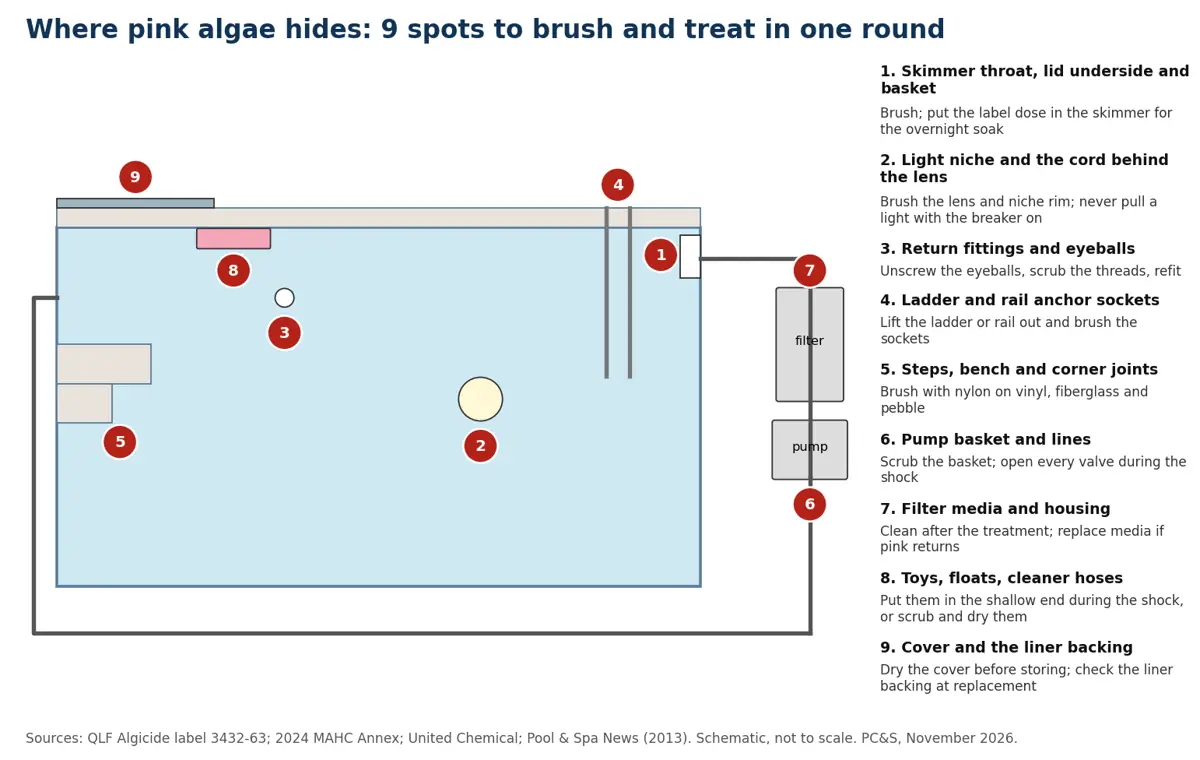
- 1. Skimmer throat, lid underside and basket Slow water, debris and shade. Brush; put the label dose in the skimmer for the overnight soak.
- 2. Light niche and the cord behind the lens Dark, low-flow pocket. Brush the lens and niche rim; never pull a light with the breaker on.
- 3. Return fittings and eyeballs Plastic threads hold a film. Unscrew the eyeballs, scrub the threads, refit.
- 4. Ladder and rail anchor sockets Stagnant water inside the sleeve. Lift the ladder or rail out and brush the sockets.
- 5. Steps, bench and corner joints Shade and low flow. Brush with nylon on vinyl, fiberglass and pebble.
- 6. Pump basket and lines Biofilm forms readily in recirculation lines (MAHC Annex). Scrub the basket; open every valve during the shock.
- 7. Filter media and housing Cartridges can shelter biofilm bacteria (MAHC Annex). Clean after the treatment; replace media if pink returns.
- 8. Toys, floats, cleaner hoses They leave the water wet and come back seeded. Put them in the shallow end during the shock, or scrub and dry them.
- 9. Cover and the liner backing Folded wet covers; soil or felt behind vinyl feeds pink stain. Dry the cover before storing; check the liner backing at replacement.
How do you get rid of pink algae in a pool?
Brush every hiding spot, shock to 10 ppm with the pump running and every valve open, soak the skimmer overnight with a slime-labeled product, filter 24 to 48 hours, then clean or replace the filter media. Retest at dawn and repeat until free chlorine holds overnight. The QLF label (3432-63) and the 10 ppm label maximum set the doses below.
- Wipe-test and identifySlime that wipes off is pink algae; color in vinyl that stays is a liner stain (table above).
- Test free chlorine, pH and cyanuric acidSet pH to 7.2 to 7.6. If CYA reads above 100 ppm, replace part of the water first: share = 1 minus 100 / CYA.
- Brush all nine spotsUnscrew return eyeballs, lift ladder and rail out of their sockets, brush the skimmer lid and throat and the light niche rim with the breaker off.
- Clean the filter firstBackwash sand or DE, or hose a cartridge, so the shock is not spent on a dirty filter.
- Shock to 10 ppm at dusk12.5% liquid chlorine at 10 fl oz per 10,000 gallons per 1 ppm (label 10897-26): 160 fl oz for 20,000 gallons from 2 ppm. Toys go in the shallow end.
- Soak the skimmer overnightWith a slime-labeled product such as QLF (3432-63): 5 to 7 1/2 oz into the skimmer, pump on 1 minute, then pump off overnight. Add each chemical separately.
- Second dose and 24 to 48 hours of filteringRestart the pump, add 5 to 7 1/2 oz to the pool, open every valve and side line, brush the sides and bottom often (label 3432-63).
- Retest at dawn, repeat if chlorine crashedIf free chlorine fell well below CYA / 10 overnight, brush and re-dose; repeat daily.
- Clean or replace the filter mediaCartridges can shelter biofilm bacteria (MAHC Annex); replace media that has hosted pink growth.
- Swim at 4 ppm or lessLiquid chlorine labels bar swimming above 4 ppm.
| Pool size (gallons) | Raise free chlorine 2 to 10 ppm: 12.5% liquid chlorine (fl oz) | Gallons of 12.5% liquid | Cost at $7.50 per gallon (Sept 2026) | QLF skimmer soak, then pool dose (label 3432-63) |
|---|---|---|---|---|
| 10,000 | 80 | 0.62 | $4.69 | 5 to 7 1/2 oz, then 5 to 7 1/2 oz |
| 15,000 | 120 | 0.94 | $7.03 | 5 to 7 1/2 oz, then 5 to 7 1/2 oz |
| 20,000 | 160 | 1.25 | $9.37 | 5 to 7 1/2 oz, then 5 to 7 1/2 oz |
| 25,000 | 200 | 1.56 | $11.71 | 5 to 7 1/2 oz, then 5 to 7 1/2 oz |
| 30,000 | 240 | 1.88 | $14.06 | 5 to 7 1/2 oz, then 5 to 7 1/2 oz |
Sources: EPA label 10897-26; EPA label 3432-63; Leslie’s, Sept 2026. PC&S arithmetic, November 2026. Download CSV
Source: EPA label 10897-26 (Hasachlor, April 2026); PC&S arithmetic, November 2026.. Download chart data (CSV)
| Step | Input or formula | Result |
|---|---|---|
| Pool and test | 20,000 gallons; cyanuric acid (CYA) 50 ppm; free chlorine 2 ppm; pink film in skimmer and light niche | Treat as pink slime |
| Floor for the CYA level | CYA / 10 (2024 MAHC Annex example ratio) = 50 / 10 | 5 ppm minimum |
| Shock target | Higher of the floor and the 10 ppm label superchlorination maximum (label 10897-26) | 10 ppm |
| Chlorine to add | 10 minus 2 = 8 ppm; 8 x 10 fl oz per ppm per 10,000 gal x 2 | 160 fl oz (1.25 gal) of 12.5% liquid |
| Cost of one round | 1.25 gal x $7.50 (Leslie's 4 x 1 gal, $29.99, Sept 2026) | $9.37 |
| Three daily rounds if chlorine keeps crashing | 3 x 1.25 gal | 3.75 gal, $28.12 |
| If CYA reads 120 ppm | Share of water to replace = 1 minus 100 / 120 | 16.7%, about 3,340 gallons, before shocking |
| Swim again | Hasachlor label bars entry above 4 ppm | Reopen at 4 ppm or less |
Sources: 2024 MAHC Annex; EPA label 10897-26; Leslie’s. PC&S arithmetic, November 2026. Download CSV
Cal-hypo and dichlor doses, and the stabilizer dichlor adds with every round, are worked out in our pool shock guide; the pool chemical calculator runs the same arithmetic for your gallons and readings. Filter cleaning by type, including the degreaser soak, is in how to clean a pool filter.
Which products are labeled for pink algae?
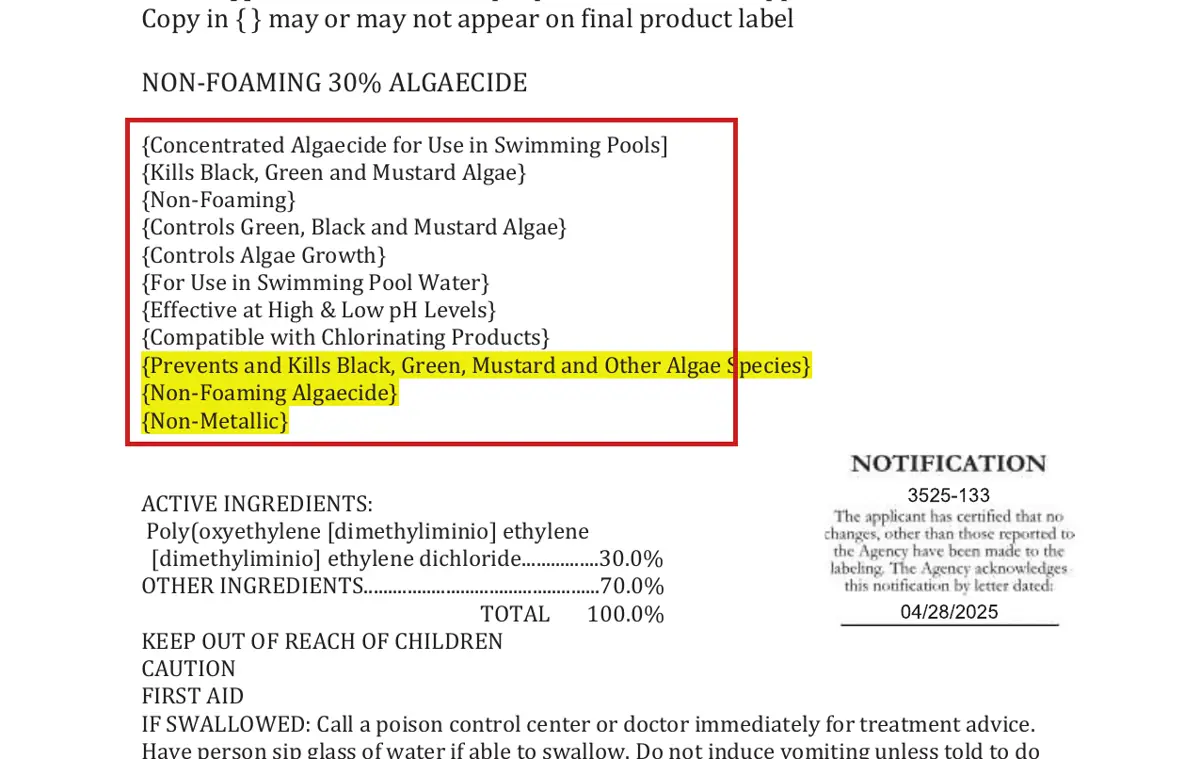
Read the EPA registration number, not the bottle name. Pink Algae Destroyer and Pink QLF Algaecide are distributor names of QLF Algicide (3432-63), whose label claims slime producing microorganisms. Pink 30 (3525-133-51688) is a polyquat whose EPA record lists algae only. No Mor Problems (45337-11) names pink slime but is sodium bromide, barred from outdoor pools by its label.
| Product name | EPA Reg. No. | Active ingredient | What the label claims | Pink-specific note | Source |
|---|---|---|---|---|---|
| Pink Algae Destroyer; Pink QLF Algaecide (distributor names) | 3432-63-41688; 3432-63-64041 | Didecyl dimethyl ammonium chloride 50% (QLF Algicide) | Green, black, blue-green and mustard algae, plus slime producing microorganisms; skimmer soak overnight, then filter 24 to 48 hours | The only 'pink' pool name we found whose label claims slime | EPA PPLS; label 3432-63 |
| Gallagher Pools & Spas Pink 30 (distributor name) | 3525-133-51688 | Polyquat 30% (30% Non-Foaming Algaecide) | Black, green and mustard algae; PPLS pest list is algae only | The pink name is not a pink slime claim | EPA PPLS; label 3525-133 (April 2025) |
| No Mor Problems | 45337-11 | Sodium bromide 41.4% | Pink and white slime, pink and white water mold | Label says not for use in outdoor pools | EPA label 45337-11 (March 2025) |
| Liquid chlorine, e.g. Hasachlor 12.5% | 10897-26 | Sodium hypochlorite 12.5% | Sanitizer and superchlorination to 5 to 10 ppm | Kills what it reaches; biofilm shields the rest | EPA label 10897-26 (April 2026) |
Sources: EPA PPLS record 3432-63 and label; name search PINK; record 3525-133 and April 2025 label; label 45337-11; label 10897-26. Download CSV
| Claim seen in guides | What the primary source says | Source |
|---|---|---|
| Pink algae is a type of algae | Pink biofilms are bacterial: Methylobacterium was the major genus in all 42 bathroom pink biofilms studied | Yano et al. 2013 |
| Pink algae is not a pathogen and cannot harm your health | Methylobacterium species are a cause of health care-associated infection, including in immunocompromised hosts; no pool case was found | Kovaleva et al. 2014 |
| A product named 'pink' treats pink algae | Pink 30 (3525-133-51688) lists algae only; QLF (3432-63) claims slime producing microorganisms | EPA PPLS records |
| Superchlorinating removes pink spots on a liner | Chlorine bleaches the surface dye, then new dye migrates up from inside the vinyl | Pool & Spa News (2013) |
| Shock to triple the normal dose | Chlorine labels set superchlorination at 5 to 10 ppm and bar swimming above 4 ppm | EPA label 10897-26 |
Sources: Yano et al. 2013; Kovaleva et al. 2014; EPA PPLS; Pool & Spa News; EPA label 10897-26; claims from GPS Pool Store and other top-ranking pages. Download CSV
Copper algaecides are a weak choice here: United Chemical’s help article says standard copper-based algaecides are largely ineffective on pink slime because it is not an alga. Our pool algaecide guide compares 13 labels by active ingredient, dose and swim wait.
Is pink algae harmful?
Usually not to healthy swimmers, but it is not harmless. Methylobacterium species cause health care-associated infections, including in immunocompromised people, according to a 2014 review in the Journal of Clinical Microbiology; we found no reported case tied to a pool. The slime also shelters other bacteria and makes steps slippery. Keep swimmers out during treatment.
The review by Kovaleva et al. (2014) ties Methylobacterium’s persistence to biofilm formation and resistance to drying and disinfecting agents, the same traits that let it outlast a normal chlorine reading. None of the 1,085 treated recreational water outbreaks from 1978 to 2023 in CDC’s outbreak reporting file, tabulated in our pool illness outbreak research, names Methylobacterium as the cause.
How do you stop pink algae from coming back?
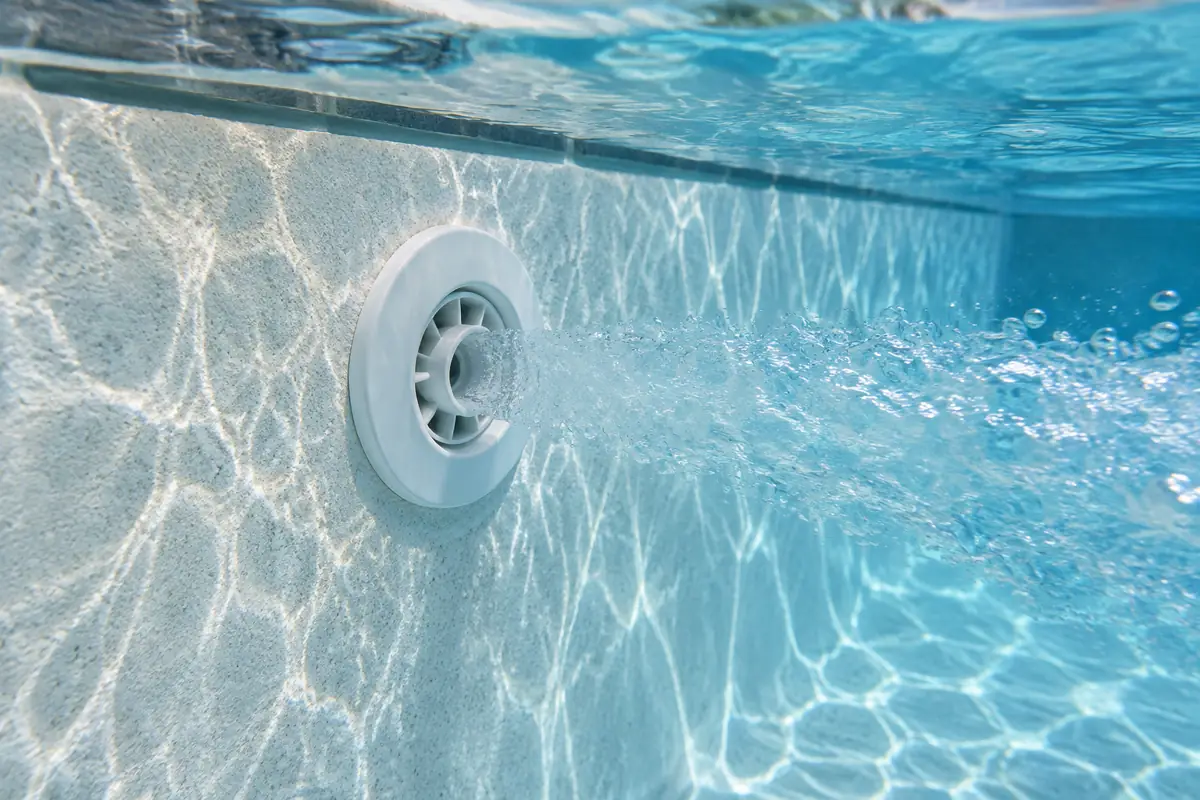
Keep chlorine moving through the nine hiding spots. Hold free chlorine at CDC’s 2 ppm floor with stabilizer and at least one tenth of CYA, brush the skimmer, eyeballs and light niche weekly, run every side line weekly, clean the filter on schedule, and dry toys and covers before storing them. The QLF label adds a weekly maintenance dose of 1 1/4 fl oz per 10,000 gallons.
Testing frequency is where most repeat cases start: CDC says to test at least twice a day, and a DPD kit can bleach out above 10 ppm and read falsely low (CDC). Our pool chemical levels chart lists every target in one place, including the stabilizer range that keeps chlorine active.
What should you do about the pink in your pool?
Match what you see to a row. Slime that wipes off gets the brush, shock and skimmer soak; color in vinyl gets a liner plan, not more chlorine; high stabilizer gets a partial drain first; biguanide pools and outdoor pools with bromide products get different products; and a household member with a weak immune system stays out until the round is done.
| Number | What it means | Source |
|---|---|---|
| 42 of 42 | Bathroom pink biofilms in which Methylobacterium was the major genus | Yano et al. 2013 |
| 16 of 21 | Pink-pigmented bathroom isolates identified as Methylobacterium | Xu et al. 2014 |
| CYA / 10 | Free chlorine floor during treatment | 2024 MAHC Annex |
| 10 ppm | Superchlorination maximum on liquid chlorine labels | EPA label 10897-26 |
| 10 fl oz | 12.5% liquid chlorine per 10,000 gallons per 1 ppm | EPA label 10897-26 |
| 5 to 7 1/2 oz | QLF into the skimmer, pump off overnight, then the same into the pool | EPA label 3432-63 |
| 24 to 48 hours | Filter run after the QLF skimmer soak | EPA label 3432-63 |
| 4 ppm | Free chlorine above which swimming is barred | EPA label 10897-26 |
Sources: Yano et al.; Xu et al.; MAHC Annex; EPA label 10897-26; EPA label 3432-63. Download CSV
| If your situation is | Do this | Why (source) |
|---|---|---|
| Slimy pink film that wipes off, chlorine pool | Brush, shock to 10 ppm, QLF skimmer soak overnight, filter 24 to 48 hours, clean the filter | QLF label 3432-63 directions for slime producing microorganisms |
| Pink color in a vinyl liner that does not wipe off | Stop shocking for it; plan liner replacement with the backing removed and the shell disinfected | Dye migrates through the vinyl; new dye replaces bleached dye (Pool & Spa News) |
| Pink returns within two weeks | Repeat the round with every valve open and replace cartridge or sand that hosted growth | Idle pipes lose chlorine and grow biofilm (MAHC Annex 4.7.1.3.2) |
| CYA above 100 ppm | Replace part of the water before shocking | 10 ppm label maximum covers CYA up to 100 at the MAHC 10:1 ratio |
| Biguanide (PHMB) pool | Use a product labeled for biguanide systems; no chlorine | Chlorine reacts with biguanide (WC&P 2003, via our white water mold guide) |
| Outdoor pool with a sodium bromide product on the shelf | Do not use it | No Mor Problems label: not for use in outdoor pools |
| Someone in the household is immunocompromised | Keep them out until the treatment is done and ask their doctor about pool use | Methylobacterium causes health care-associated infections in immunocompromised hosts (Kovaleva 2014) |
| Brown-red flat stain that lightens under vitamin C | Treat as iron, not pink algae | Natural Chemistry vitamin C test |
Sources: EPA label 3432-63; Pool & Spa News; MAHC Annex; EPA label 45337-11; Kovaleva 2014; Natural Chemistry. Download CSV
Green, mustard and black growth need different extra steps, compared in our guide to getting rid of algae in a pool.
How we compiled this
In November 2026 we read four EPA labels and two EPA product records, the EPA name search for ‘pink’, five peer-reviewed microbiology papers, the 2024 MAHC Annex, CDC’s home pool page, two trade articles on pink vinyl stains and the top-ranking pink algae pages: 16 primary documents, plus figures reused from our white water mold, algae and shock guides. We did not sample any pool, and no study we found has sequenced pink slime from a residential pool.
Frequently Asked Questions
Is pink algae harmful?
Rarely to healthy swimmers, but it is not harmless. Pink slime is usually Methylobacterium, which a 2014 Journal of Clinical Microbiology review lists as a cause of health care-associated infections in immunocompromised people; we found no case tied to a pool. Keep swimmers out during treatment and until free chlorine falls to 4 ppm or less, the limit on liquid chlorine labels.
Will shock get rid of algae?
Shock kills what it reaches, but pink slime shelters in biofilm. Raise free chlorine to 10 ppm, the label maximum, which is 160 fl oz of 12.5% liquid chlorine for a 20,000 gallon pool starting at 2 ppm. Pair it with brushing, an overnight skimmer soak with a slime-labeled product such as QLF (3432-63) and 24 to 48 hours of filtering.
My pool has pink algae. What can I do to get rid of it?
Wipe-test it first: slime that wipes off is pink algae, color that stays in vinyl is a liner stain. For slime, brush the skimmer, light niche, eyeballs and ladder sockets, shock to 10 ppm, put 5 to 7 1/2 oz of QLF in the skimmer with the pump off overnight, then filter 24 to 48 hours and clean the filter.
What kills algae in pools quickly?
Chlorine at a dose matched to your stabilizer: at least one tenth of your cyanuric acid (2024 MAHC Annex example), up to the 10 ppm label maximum, with 24 hours of filtering. Pink slime needs one more step because it is bacterial biofilm: the overnight skimmer soak on the QLF label (3432-63). Green, mustard and black algae each add their own step.
Why does pink algae keep coming back?
Usually a hiding spot was missed or the color is not slime. Idle pipes lose their chlorine and grow biofilm (2024 MAHC Annex 4.7.1.3.2), and cartridges can shelter it, so open every valve and replace media that hosted growth. Pink in a vinyl liner returns after chlorine because dye migrates up from inside the vinyl (Pool & Spa News).
Is pink algae the same as white water mold?
No, but they often grow together. Pink slime is a pink bacterial biofilm, usually Methylobacterium (Yano et al., 2013); white water mold is white or gray tissue-like flakes of biofilm in the same skimmer, lines and filter. Labels list them separately: No Mor Problems (45337-11) names pink and white slime and pink and white water mold. One plumbing round treats both.
Sources
- Japanese Society of Microbial Ecology. Yano et al., Microbes and Environments 28(1):87-95 (2013). Accessed 2026-11-03.
- Japanese Society of Microbial Ecology. Xu et al., Microbes and Environments 29(4):388-392 (2014). Accessed 2026-11-03.
- American Society for Microbiology. Hiraishi et al., Appl Environ Microbiol 61(6):2099-2107 (1995). Accessed 2026-11-03.
- American Society for Microbiology via PubMed. Kovaleva et al., Methylobacterium and its role in health care-associated infection, J Clin Microbiol 52(5) (2014). Accessed 2026-11-09.
- American Society for Microbiology via PMC. Gerber, Prodiginine pigments from Streptoverticillium rubrireticuli, Appl Microbiol 30(5) (1975). Accessed 2026-11-09.
- Pool & Spa News. Preventing Stains in Vinyl Liners (December 11, 2013). Accessed 2026-11-09.
- PCI Magazine. Pink Stain Damage on Vinyl Surfaces (April 3, 2019). Accessed 2026-11-09.
- US EPA PPLS. QLF Algicide, EPA Reg. No. 3432-63 (notification February 2, 2012). Accessed 2026-11-09.
- US EPA. PPLS record 3432-63. Accessed 2026-11-09.
- US EPA. PPLS product name search PINK. Accessed 2026-11-03.
- US EPA PPLS. 30% Non-Foaming Algaecide, EPA Reg. No. 3525-133 (notification April 28, 2025). Accessed 2026-11-09.
- US EPA. PPLS record 3525-133. Accessed 2026-11-09.
- US EPA PPLS. No Mor Problems, EPA Reg. No. 45337-11 (master label March 30, 2025). Accessed 2026-11-03.
- US EPA PPLS. Hasachlor, EPA Reg. No. 10897-26 (April 24, 2026). Accessed 2026-10-19.
- CDC. Home Pool and Hot Tub Water Treatment and Testing (May 10, 2024). Accessed 2026-10-19.
- CDC. 2024 Model Aquatic Health Code Annex. Accessed 2026-11-03.
- United Chemical. Pink Slime (Pink Algae) in Your Pool. Accessed 2026-11-09.
- Natural Chemistry. Staining. Accessed 2026-10-27.
- Leslie's. Pool liquid chlorine 4 pack (Wayback capture September 22, 2026). Accessed 2026-10-27.
Related pages
Get Quotes From Licensed Local Pool Pros
Tell us what you need and your ZIP code. We match you with pool companies that cover your area.