Pool Chemical Levels Chart: Ideal Ranges From the CDC, the MAHC and Three State Codes
This pool chemical levels chart puts six authorities side by side; home targets are free chlorine 2 to 4 ppm, pH 7.4 to 7.6, alkalinity 80 to 120 ppm and stabilizer 30 to 50 ppm.
- ✓17 readings, six authoritiesCDC, the 2024 MAHC, the PHTA guideline and the Florida, California and Texas rules, with section numbers.
- ✓Printable chartsOne chart for chlorine pools and one for salt water pools, each with what to add when a reading is low or high.
- ✓Salt by chlorinatorFive manuals put salt anywhere from 2,700 to 4,500 ppm, so the salt chart shows the range and the strictest maker.
Key takeaways
- Every authority agrees on a pH floor of 7.0 to 7.2 and a ceiling of 7.8: CDC home pool guidance (May 2024), the 2024 Model Aquatic Health Code (5.7.3.4.1), the PHTA guideline table, Florida rule 64E-9.004, California 22 CCR 65530 and Texas 25 TAC 265.193.
- Minimum free chlorine is 1 ppm, or 2 ppm when the pool holds cyanuric acid, in both CDC guidance and MAHC 5.7.3.1.1.2; common labels such as Hasachlor (EPA Reg. No. 10897-26) bar swimming above 4 ppm.
- The stabilizer cap differs: 90 ppm in the MAHC, 100 ppm in Florida, California and Texas, and Florida recommends staying under 40 ppm (Florida rule 64E-9.004, subparagraph (1)(d)4).
- No CDC page, MAHC section or state rule sets a phosphate or borate limit; the 125 ppb phosphate line comes from HTH remover directions and 30 to 50 ppm borates from the ProTeam Supreme label.
- Salt has no code range at all: five chlorinator manuals span 2,700 to 4,500 ppm, from Hayward AquaRite 900 at 2,700 to 3,400 to Pentair IntelliChlor at 3,600 to 4,500.
- Copper above 0.6 ppm may stain (Leslie‘s), Florida caps it at 1 ppm and the MAHC at 1.3 ppm for ion systems (5.7.3.2.3.2).
Pool chemical levels chart: 17 readings, six authorities
The master chart below lists 17 readings and the number each authority sets: CDC guidance for home pools, the 2024 MAHC for public pools that adopt it, the PHTA industry guideline, and the Florida, California and Texas public pool rules with section numbers. The first column is the PC&S home target, chosen to sit inside every column.
| Reading | Home target (PC&S pick) | CDC home pools | 2024 MAHC (public pools) | PHTA guideline: min / ideal / max | Florida 64E-9.004 | California 22 CCR | Texas 25 TAC 265.193(c) |
|---|---|---|---|---|---|---|---|
| Free chlorine (ppm) | 2 to 4 | 1 minimum; 2 with cyanuric acid | 1.0 minimum, 2.0 with CYA; max per label; over 10 with swimmers closes | 1.0 / 2.0 to 4.0 / 5.0 | 1 to 10 (indoor pools: 5 max) | 1.0 to 10.0; 2.0 to 10.0 with CYA (65529) | 1.0 / 2.0 to 3.0 / 8.0 |
| Combined chlorine (ppm) | 0 to 0.2 | Not set | Act above 0.4 (5.7.4.4.2) | 0 / 0 / 0.2 | Not set | Not set | 0.4 maximum |
| Bromine (ppm) | 4 to 6 | Not set for pools | 3.0 minimum, 8.0 maximum (5.7.3.1.2) | 2.0 / 4.0 to 6.0 / 10.0 | 1.5 to 6 | 2.0 minimum (65529) | 3.0 / 4.0 to 6.0 / 10.0 |
| pH | 7.4 to 7.6 | 7.0 to 7.8 | 7.0 to 7.8 (5.7.3.4.1); below 6.5 or above 8.0 closes | 7.2 / 7.4 to 7.6 / 7.8 | 7.0 to 7.8 | 7.2 to 7.8 (65530) | 7.0 / 7.2 to 7.6 / 7.8 |
| Total alkalinity (ppm) | 80 to 120 | Not set | 60 to 180 (5.7.4.4.1) | 60 / 80 to 100 with hypochlorite, 100 to 120 with trichlor or dichlor / 180 | Test kit required; no range | Not set | 60 / 60 to 180 / over 180 |
| Calcium hardness (ppm) | 200 to 400 on plaster; vinyl and fiberglass per maker | Not set | 2,500 maximum (5.7.4.4.3); Annex: 200 to 400 plaster, 80 to 200 vinyl or fiberglass | 150 / 200 to 400 / 1,000 | Test kit required; no range | Not set | 150 / over 150 to 400 / 1,000 |
| Cyanuric acid (ppm) | 30 to 50 | No number; keep chlorine at 2 when used | 90 maximum (5.7.3.1.3.2); 300 closes | 0 / 30 to 50 / per code, typically 100 | 100 maximum, 40 recommended maximum; spas 40 | 100 maximum (65530) | None / 30 to 50 / 100 |
| Salt (ppm) | Your cell's range (2,700 to 4,500 across five manuals) | Not set | Maker's range (5.7.3.1.5.2); test weekly (5.7.5.11) | Not listed | Test kit required if fed | Not set | Not set |
| Total dissolved solids (ppm) | Under 1,500 above start-up | Not set | Test quarterly (5.7.5.9); Annex: 1,500 above fill water | 1,500 over start-up | Not set | Not set | Not set |
| Phosphates (ppb) | Under 125 if algae keeps returning | Not set | Not set | Not listed | Not set | Not set | Not set |
| Borates (ppm) | 30 to 50 if you use them | Not set | Not set | Not listed | Not set | Not set | Not set |
| Copper (ppm) | 0; 0.2 to 0.4 with an ionizer | Not set | 1.3 maximum with ion systems (5.7.3.2.3.2) | None | 1 maximum | Not set | Not set |
| Silver (ppm) | 0.10 or less | Not set | 0.10 maximum (5.7.3.2.3.2) | None | 0.1 maximum | Not set | Not set |
| Iron (ppm) | 0 (EPA staining guide: 0.3) | Not set | Not set | None | Not set | Not set | Not set |
| Water temperature (F) | 104 maximum | Not set for pools | 104 maximum (5.7.4.7.2) | 78 to 82 for competition; 104 maximum | Not set | 104 maximum (65530) | Not set |
| Saturation index (LSI) | 0.0 to +0.3 | Not set | Balanced (5.7.4.6); Annex: minus 0.3 to plus 0.3; check monthly | Not listed | Not set | Not set | Balance test every 10 days (265.193(k)) |
| ORP (mV) | Not needed at home | Not set | Recorded with each test if installed (5.7.5.4) | Calibrate to sanitizer | 700 to 850 where controllers are required | Not set | 600 / 650 to 750 / 900 |
Sources: CDC (May 10, 2024); 2024 MAHC Code and Annex; PHTA table via Taylor (reviewed Aug 12, 2026); Fla. Admin. Code 64E-9.004 (eff. June 11, 2023); 22 CCR 65529 and 65530; 25 TAC 265.193; EPA secondary standards; HTH; EPA label 57787-27. Download CSV
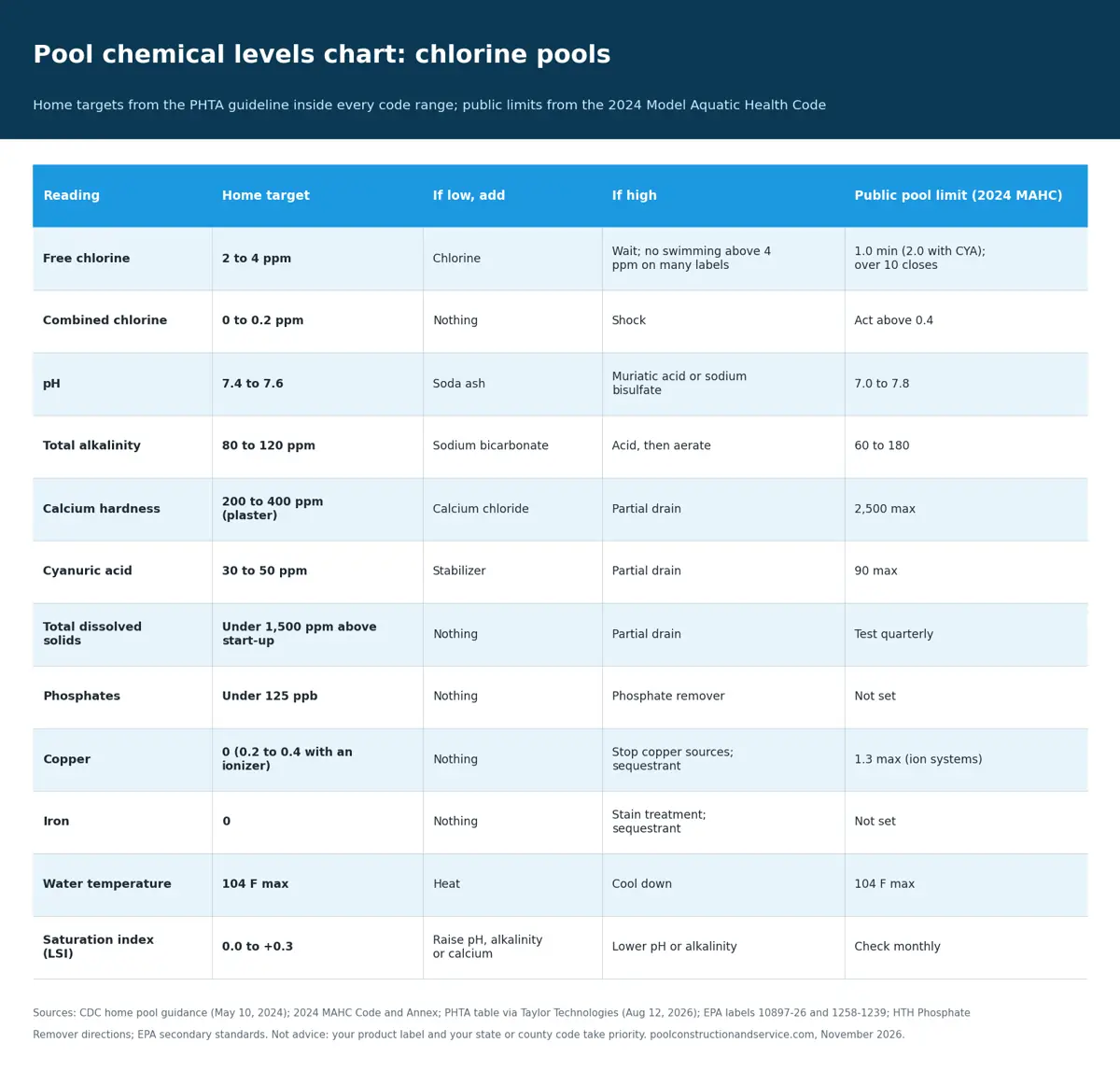
How the home target was picked: we took the PHTA ideal band, checked that it sits inside the Florida, California and Texas ranges, and used CDC minimums as floors. Free chlorine stops at 4 ppm because the HTH Granular 73 label (EPA Reg. No. 1258-1239) and Hasachlor both bar re-entry above it, even though the MAHC, Florida and California allow up to 10 ppm.
What do you do when a reading is low or high?
Each reading has one standard fix in each direction. Low chlorine takes chlorine (10 fl oz of 12.5% liquid per ppm in 10,000 gallons), high pH takes acid, high cyanuric acid, salt, TDS and hardness take a partial drain, and high combined chlorine takes a shock. The table gives the fix and the rule behind it; the linked guides give doses by pool size.
| Reading | If it is low | If it is high | Rule behind the fix |
|---|---|---|---|
| Free chlorine | Add chlorine: 10 fl oz of 12.5% liquid chlorine raises 10,000 gallons about 1 ppm | Stop dosing and let sun and swimmers use it up; no swimming above 4 ppm on many labels | Hasachlor label 10897-26 dose chart and re-entry line |
| Combined chlorine | Nothing to do | Shock (superchlorinate), exchange water, shower before swimming | MAHC 5.7.4.4.2 lists those three actions above 0.4 ppm |
| pH | Add soda ash or sodium bicarbonate | Add muriatic acid, sodium bisulfate or carbon dioxide | MAHC 5.7.3.4.2 list of approved pH chemicals |
| Total alkalinity | Add sodium bicarbonate: 1.5 lb raises 10,000 gallons about 10 ppm | Add acid in doses, then aerate to lift pH | Product labels and Florida DOH, via PC&S alkalinity guides |
| Calcium hardness | Add calcium chloride in 10 lb steps (NPC start-up card) | Partial drain and refill with softer water | MAHC Annex: lowering hardness is not always possible with hard fill water |
| Cyanuric acid | Add stabilizer through the skimmer | Partial drain: replace 1 minus target / current of the water | MAHC 5.7.3.1.3.2 cap of 90 ppm; dilution arithmetic |
| Salt | Add pool salt: pounds = ppm needed x gallons x 8.34 / 1,000,000 | Dilute with fresh water | Water weighs 8.34 lb per gallon; chlorinator manuals |
| Total dissolved solids | Nothing to do | Partial drain and refill | MAHC Annex 5.7.4.6: 1,500 ppm above fill water |
| Phosphates | Nothing to do | Phosphate remover per label: HTH lists 16 fl oz per 10,000 gallons at 1,000 ppb | HTH Phosphate Remover dosage guide |
| Copper or iron | Nothing to do | Stop copper sources, test fill water, treat stains, add a sequestrant | MAHC Annex 5.7.3.2.3; EPA secondary standards |
Sources: EPA label 10897-26; MAHC 5.7.3.4.2, 5.7.4.4.2, 5.7.3.1.3.2; MAHC Annex 5.7.4.6; NPC start-up card; HTH; EPA. Download CSV
- Chlorine: doses by pool size and product are in our guide on how much chlorine to add to a pool, including how long a high reading takes to fall.
- Combined chlorine: the total minus free arithmetic and the shock trigger are in free chlorine vs total chlorine.
- pH: soda ash charts are in how to raise pH in a pool and acid charts in how to lower pH in a pool.
- Alkalinity: baking soda by pool size is in how to raise alkalinity in a pool, along with the 1.5 lb per 10,000 gallon rule of thumb.
- Hardness and stabilizer: calcium chloride and drain tables are in our calcium hardness guide, and the drain-and-refill table for stabilizer is in our cyanuric acid guide.
- Salt, phosphates, borates and metals: see salt water pool maintenance, phosphates in a pool and pool stains.
What should free chlorine, combined chlorine and bromine be?
Keep free chlorine at 2 to 4 ppm in a home pool, combined chlorine at 0.2 ppm or less, and bromine at 4 to 6 ppm. Codes set wider legal ranges: free chlorine may run from 1.0 to 10.0 ppm in Florida and California public pools and 1.0 to 8.0 ppm in Texas, but most chlorine labels bar swimming above 4 ppm.
Source: CDC (May 10, 2024); 2024 MAHC 5.7.3.1.1.2 and 6.6.3.1; PHTA via Taylor (Aug 12, 2026); 64E-9.004; 22 CCR 65529; 25 TAC 265.193; EPA labels 10897-26, 1258-1239. Download chart data (CSV)
The floor moves with stabilizer. CDC and MAHC 5.7.3.1.1.2 both lift the minimum from 1 ppm to 2 ppm once cyanuric acid is in the water, and MAHC 6.6.3.1 treats a cyanuric acid to free chlorine ratio above 45 to 1 as an imminent hazard. At 50 ppm stabilizer that line sits at 1.1 ppm free chlorine; at 90 ppm it sits at 2.0 ppm. The chlorine and stabilizer math is worked through in our cyanuric acid guide.
Combined chlorine is total chlorine minus free chlorine, and it is the reading behind the chlorine smell. The MAHC acts above 0.4 ppm, Texas caps it at 0.4 ppm and the PHTA guideline at 0.2 ppm. In a 2025 survey summarized in our pool hygiene statistics report, 77% of respondents blamed red, stinging eyes on too much chlorine; CDC attributes them to chloramines.
Bromine reads higher than chlorine for the same job. The MAHC sets 3.0 ppm minimum and 8.0 ppm maximum for pools, Texas sets an ideal of 4.0 to 6.0 ppm, and Florida allows 1.5 to 6 mg/L in conventional pools. Hot tubs differ again: the MAHC sets 4.00 ppm bromine and 3.0 ppm chlorine minimums for spas.
What pH and total alkalinity should a pool have?
Aim for pH 7.4 to 7.6 and total alkalinity of 80 to 120 ppm. Every authority on the chart caps pH at 7.8; the floor is 7.0 in CDC guidance, the MAHC, Florida and Texas, and 7.2 in California 65530. Public pools close below pH 6.5 or above 8.0 under MAHC 6.6.3.1.
Alkalinity has the widest legal band: 60 to 180 ppm in MAHC 5.7.4.4.1 and Texas. The PHTA guideline narrows the ideal by sanitizer: 80 to 100 ppm with calcium, lithium or sodium hypochlorite, because they push pH up, and 100 to 120 ppm with trichlor or dichlor, which push it down. Florida’s rule names no range but requires an alkalinity test kit under 64E-9.004(10).
Stabilizer distorts the alkalinity reading. The MAHC Annex deducts 30% of the cyanuric acid reading from total alkalinity before computing the saturation index; the National Plasterers Council card deducts one third. At 40 ppm cyanuric acid the two rules subtract 12 ppm and 13.3 ppm.
How much cyanuric acid and calcium hardness is too much?
Cyanuric acid tops out at 90 ppm in the MAHC and 100 ppm in Florida, California and Texas, with 30 to 50 ppm as the shared ideal. Calcium hardness may legally reach 2,500 ppm under the MAHC and 1,000 ppm in Texas, but 200 to 400 ppm is the plaster target in both the PHTA guideline and the MAHC Annex.
Source: 2024 MAHC 5.7.3.1.3.2; Florida 64E-9.004(1)(d)4; 22 CCR 65530; 25 TAC 265.193(c); PHTA via Taylor. Download chart data (CSV)
Surface decides the hardness target. The MAHC Annex gives 200 to 400 ppm for plaster and 80 to 200 ppm for vinyl or fiberglass, and fiberglass makers publish their own numbers, compared maker by maker in our calcium hardness guide. The National Plasterers Council warns that 100 ppm or more of cyanuric acid may permanently damage plaster.
Balance ties hardness, pH, alkalinity and temperature together in the Langelier saturation index. The MAHC Annex calls minus 0.3 to plus 0.3 balanced and prefers a small positive value; the NPC asks for 0.0 to plus 0.3 on plaster; Texas 265.193(k) requires a balance test at least every 10 days at public pools.
Salt water pool chemical levels chart
A salt water pool uses the same chart with three changes: salt goes to the range printed on your chlorinator, from 2,700 to 3,400 ppm on Hayward AquaRite 900 to 3,600 to 4,500 ppm on Pentair IntelliChlor; alkalinity sits at the low end, 80 to 100 ppm; and TDS is measured after salting as the new baseline.
| Reading | Salt pool target (PC&S pick) | Range across five chlorinator manuals | Strictest manual | Differs from the chlorine pool chart? |
|---|---|---|---|---|
| Salt (ppm) | The range printed on your cell | 2,700 to 4,500 | Jandy AquaPure: 3,000 to 3,500 | Yes: no code sets it; Pentair IntelliChlor wants 3,600 to 4,500, Hayward AquaRite 900 2,700 to 3,400 |
| Free chlorine (ppm) | 2 to 3 | 1.0 to 4.0 | Hayward, Jandy, CircuPool: 1.0 to 3.0 | Slightly lower ceiling than the chlorine chart |
| pH | 7.4 to 7.6 | 7.2 to 7.8 | Jandy and AutoPilot: 7.4 to 7.6 | No, but salt cells push pH up, so test it more often |
| Total alkalinity (ppm) | 80 to 100 | 80 to 120 | AutoPilot Digital Nano: 80 to 100 | Lower end, which slows the pH climb |
| Calcium hardness (ppm) | 200 to 400 | 175 to 400 | Pentair, CircuPool, AutoPilot: 200 to 400 | No; Hayward uses the saturation index instead |
| Cyanuric acid (ppm) | 30 to 50 (older Hayward manuals: 60 to 80) | 30 to 75 | Four of five manuals: 30 to 50 | Same as the chlorine chart on current manuals |
| Total dissolved solids | Measure after salting; that is the new baseline | Not given | Not given | Yes: MAHC Annex says salt raises TDS, so the 1,500 ppm rule starts after salting |
Sources: Hayward AquaRite 900 manual; Hayward Aqua Rite manual (2010); Pentair IntelliChlor guide; Jandy AquaPure manual; CircuPool CORE manual; AutoPilot Digital Nano manual; MAHC Annex 5.7.4.6. Download CSV
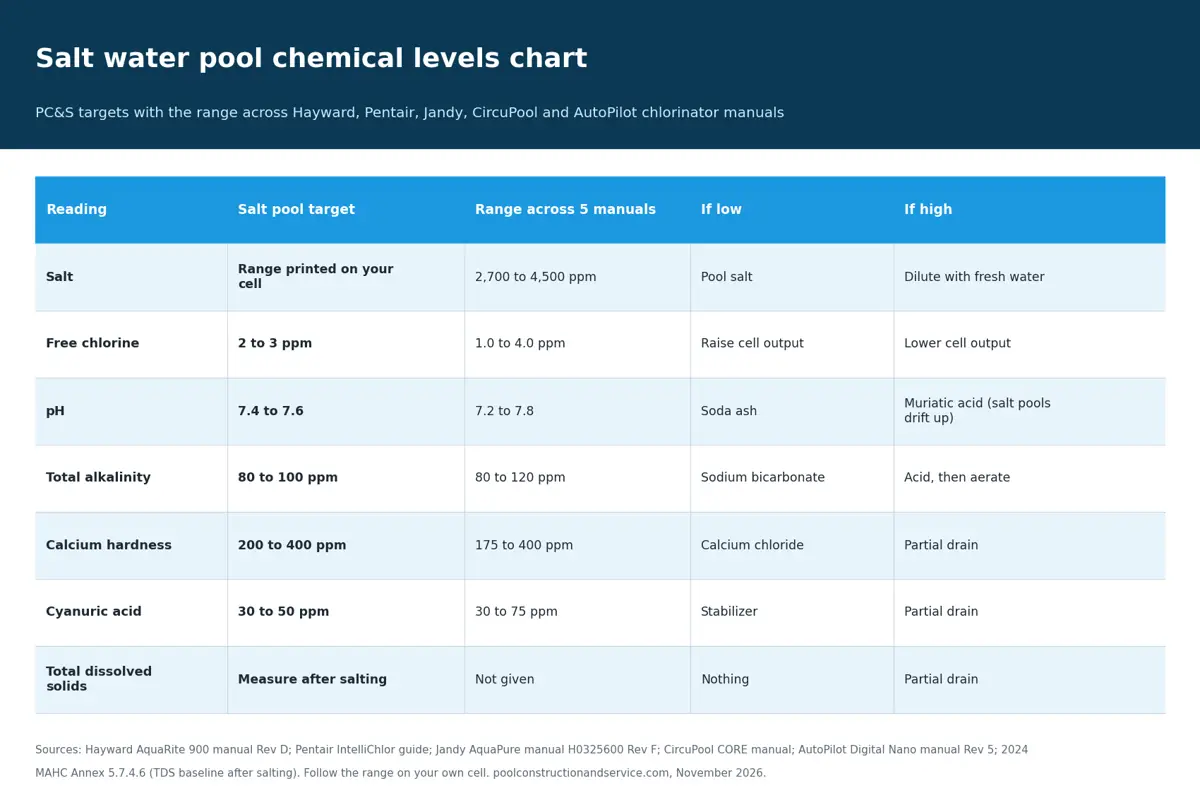
Follow the manual for your cell, not a generic 3,200 ppm. At 3,000 ppm a Hayward AquaRite 900 is inside its range while a Pentair IntelliChlor is 600 ppm short of its 3,600 ppm ideal. The MAHC leaves salt to the manufacturer (5.7.3.1.5.2) and asks public pools to test it at least weekly (5.7.5.11). Salt doses by pool size are in our salt water pool maintenance guide.
What about TDS, phosphates, borates, copper and iron?
Only copper, silver and TDS appear in any code. The MAHC caps copper at 1.3 ppm and silver at 0.10 ppm for ion systems, Florida caps copper at 1 mg/L, and the MAHC Annex flags TDS 1,500 ppm above fill water. Phosphates, borates and iron have no code limit, so the targets come from labels and EPA staining guidance.
Iron has no pool limit, but EPA secondary drinking water standards link 0.3 mg/L iron to reddish staining and 1.0 mg/L copper to blue-green staining. Leslie’s says copper above 0.6 ppm may stain. Copper from ionizers, with label targets of 0.2 to 0.4 ppm, is covered in our pool ionizer guide.
TDS climbs with every dose of chemicals and every top-off. The MAHC Annex says a generally accepted TDS is 1,500 ppm above fill water, that high TDS can cut disinfectant effectiveness by up to 50%, and that readings above 5,000 ppm may need a drain and refill. Phosphates feed algae but are not regulated; HTH repeats its remover treatment above 125 ppb.
| Number | What it is | Source |
|---|---|---|
| 7.0 to 7.8 | pH range in CDC home guidance, the MAHC and Florida's rule | CDC (May 10, 2024); MAHC 5.7.3.4.1; 64E-9.004(1)(d)1 |
| 1 ppm / 2 ppm | Minimum free chlorine without / with cyanuric acid | CDC; MAHC 5.7.3.1.1.2 |
| 10 ppm | Free chlorine with swimmers that closes a public pool, and the Florida and California maximum | MAHC 6.6.3.1; 64E-9.004; 22 CCR 65529 |
| 4 ppm | Re-entry ceiling printed on common chlorine labels | EPA labels 10897-26 and 1258-1239 |
| 0.4 ppm | Combined chlorine that triggers action (MAHC) and the Texas maximum | MAHC 5.7.4.4.2; 25 TAC 265.193(c) |
| 90 / 100 ppm | Cyanuric acid cap: MAHC / Florida, California, Texas | MAHC 5.7.3.1.3.2; 64E-9.004; 65530; 265.193 |
| 2,500 ppm | Calcium hardness cap in the MAHC | MAHC 5.7.4.4.3 |
| 1,500 ppm | TDS above fill or start-up water | MAHC Annex 5.7.4.6; PHTA via Taylor |
| 1.3 / 1.0 ppm | Copper cap: MAHC ion systems / Florida | MAHC 5.7.3.2.3.2; 64E-9.004(1)(d)6 |
| 104 F | Maximum water temperature | MAHC 5.7.4.7.2; 22 CCR 65530 |
Sources: CDC; MAHC 2024; MAHC Annex; 64E-9.004; 65529; 65530; 265.193; EPA label 10897-26; EPA label 1258-1239. Download CSV
How do you read a test result against the chart?
Read each number against the chart, then run four quick checks: total minus free chlorine for combined chlorine, cyanuric acid divided by 45 for the chlorine floor, alkalinity minus 30% of cyanuric acid, and the saturation index. The worked example below takes one home test and one salt top-up through those steps.
| Step | Reading or input | Arithmetic | Result | Verdict against the chart |
|---|---|---|---|---|
| 1. Combined chlorine | Free 2.0 ppm, total 2.6 ppm | 2.6 minus 2.0 | 0.6 ppm | Above MAHC 0.4 and PHTA 0.2: shock |
| 2. Chlorine for the stabilizer | Cyanuric acid 40 ppm | 40 / 45 | 0.89 ppm | 2.0 ppm clears the MAHC 45:1 line and meets CDC's 2 ppm |
| 3. Corrected alkalinity | Total alkalinity 110 ppm, CYA 40 ppm | 110 minus 0.30 x 40 | 98 ppm | Use 98, not 110, in the LSI (MAHC Annex 30% rule) |
| 4. Saturation index | pH 7.5, 84 F, hardness 300, alkalinity 98, TDS under 1,000 | 7.5 + 0.7 + 2.1 + 2.0 minus 12.1 | +0.2 | Inside MAHC minus 0.3 to plus 0.3 and NPC 0.0 to plus 0.3 |
| 5. Salt top-up (20,000 gal, Pentair cell) | Salt 3,000 ppm, target 3,600 ppm | 600 x 20,000 x 8.34 / 1,000,000 | 100.08 lb | Three 40 lb bags, then retest |
Sources: MAHC Annex Table 5.7.4.6 factors and 30% CYA rule; MAHC 5.7.4.4.2 and 6.6.3.1; NPC; Pentair IntelliChlor guide; PC&S arithmetic. Download CSV
The example passes on pH 7.5, free chlorine 2.0 ppm and an LSI of +0.2 but fails on combined chlorine at 0.6 ppm, so the only action is a shock. How to read the kit itself, and which kits are accurate enough for these checks, is covered in how to test pool water. CDC asks home owners to test chlorine and pH at least twice a day. To turn a reading into an amount of product, our pool chemical calculator gives ounces of chlorine, acid, soda ash, baking soda, calcium chloride, stabilizer and salt for your gallons.
Where do popular pool chemical charts disagree with the codes?
Several widely shared charts print ideal ranges that sit outside the PHTA guideline, a chlorine label or a CDC minimum. The most common gaps are an ideal pH of 7.6 to 7.8, free chlorine above the 4 ppm label ceiling, 1 ppm chlorine in a stabilized pool and one salt range for every chlorinator.
| Claim | Where it appears | What the primary source says |
|---|---|---|
| Ideal pH 7.6 to 7.8 | Inyo Pools levels page (plaster and fiberglass) | PHTA ideal is 7.4 to 7.6; 7.8 is the maximum in PHTA, California 65530 and Texas 265.193 |
| Ideal free chlorine 4 to 6 ppm at 30 ppm CYA | Inyo Pools levels page | PHTA ideal is 2.0 to 4.0 with a 5.0 maximum; Hasachlor and HTH Granular 73 labels bar swimming above 4 ppm |
| Total alkalinity 60 to 80 ppm ideal for vinyl | Inyo Pools levels page | PHTA ideal is 80 to 120 ppm; 60 is the PHTA and Texas minimum |
| Free chlorine 1 to 3 ppm | Dreame cheat sheet | CDC asks for at least 2 ppm when cyanuric acid is used, so 1 ppm is too low in a stabilized pool |
| Salt 2,700 to 3,400 ppm | Dreame cheat sheet | True for Hayward; Pentair IntelliChlor wants 3,600 to 4,500 ppm |
| Chlorine 0.5 ppm in a mineral pool | Pool Research chemistry page | CDC sets 1 ppm for home pools; MAHC 5.7.3.2.3.3 keeps full chlorine levels with copper and silver ion systems |
| Calcium hardness 175 to 275 ppm | Pool Research chemistry page | PHTA and the MAHC Annex give 200 to 400 ppm for plaster |
Charts: Inyo Pools; Dreame; Pool Research. Primary sources: PHTA via Taylor; CDC; MAHC; 65530; 265.193; EPA label 10897-26; Pentair. Download CSV
Some gaps have a reason. Inyo’s higher chlorine targets scale chlorine to stabilizer, a method the MAHC also uses for its 45 to 1 hazard line. The label ceiling still applies to the product in your pool, so check the bottle before swimming at those levels.
Rather have a pro keep the water in range?
Which numbers apply to your pool?
A private backyard pool answers to CDC guidance and the product labels, not to state pool codes. An HOA, apartment, hotel or club pool answers to its state rule: 64E-9.004 in Florida, 22 CCR 65529 and 65530 in California, 25 TAC 265.193 in Texas. The decision table turns the chart into actions.
| If your situation is | Do this | Rule behind it |
|---|---|---|
| A backyard pool at a single-family home | Use the home target column; never go below CDC minimums; the product label wins over both | CDC home guidance; no Florida, California or Texas chemistry rule covers private residential pools |
| An HOA, apartment, hotel or club pool | Follow your state code; the MAHC applies only where adopted | 64E-9.004 (FL), 22 CCR 65529 and 65530 (CA), 25 TAC 265.193 (TX) |
| Free chlorine above 10 ppm | Keep swimmers out until it drops | MAHC 6.6.3.1 hazard; Florida and California maximum |
| Free chlorine 4 to 10 ppm | Read your chlorine label before swimming | Hasachlor and HTH Granular 73 labels: no entry above 4 ppm |
| pH below 6.5 or above 8.0 | Correct it before anyone swims | MAHC 6.6.3.1 closes public pools at those readings |
| Combined chlorine above 0.4 ppm | Shock the pool | MAHC 5.7.4.4.2 |
| Cyanuric acid above 90 to 100 ppm | Partial drain; in Texas public pools hold free chlorine at 2.0 ppm until CYA is under 100 | MAHC 5.7.3.1.3.2; 65530; 265.193(p) |
| Salt pool with salt outside the cell's range | Add salt or dilute to the range printed on your chlorinator | MAHC 5.7.3.1.5.2 |
| Copper above 0.6 ppm | Stop copper products, check for stains, test fill water | Leslie's staining line; Florida cap 1 ppm |
| TDS 1,500 ppm above start-up | Partial drain and refill | MAHC Annex 5.7.4.6 |
Sources: CDC; MAHC 2024; 64E-9.004; 65529; 65530; 265.193; EPA label 10897-26; EPA label 1258-1239; Leslie‘s; MAHC Annex. Download CSV
How we compiled this
We read the CDC home pool page, the 2024 MAHC Code and Annex, the PHTA parameter table as reproduced by Taylor Technologies, Florida rule 64E-9.004 (effective June 11, 2023), California 22 CCR 65529 and 65530 and Texas 25 TAC 265.193 in October and November 2026, plus two EPA chlorine labels, five chlorinator manuals, EPA secondary standards and the NPC start-up card. The ANSI/APSP/ICC-11 standard is paywalled, so no number is taken from it directly. Retailer and forum charts appear only in the comparison table, never as sources for a target.
Frequently Asked Questions
What should my pool chemical levels be?
For a home chlorine pool: free chlorine 2 to 4 ppm, combined chlorine 0.2 ppm or less, pH 7.4 to 7.6, total alkalinity 80 to 120 ppm, calcium hardness 200 to 400 ppm on plaster and cyanuric acid 30 to 50 ppm. Those are the PHTA ideal ranges, and each sits inside the CDC, MAHC, Florida, California and Texas limits.
What is the ideal pH level for a pool?
7.4 to 7.6 is the PHTA ideal. CDC and the 2024 MAHC accept 7.0 to 7.8, California 65530 accepts 7.2 to 7.8, and Texas sets 7.2 to 7.6 as ideal with 7.8 as the maximum. Below 6.5 or above 8.0, the MAHC treats a public pool as an imminent health hazard.
What should the chlorine level be in a pool?
At least 1 ppm free chlorine, or 2 ppm if the water contains cyanuric acid, per CDC. The PHTA ideal is 2 to 4 ppm. Florida and California public pools may run up to 10 ppm and Texas to 8 ppm, but Hasachlor and HTH Granular 73 labels bar swimming above 4 ppm.
What are the ideal chemical levels for a salt water pool?
Salt at the range printed on your chlorinator, 2,700 to 3,400 ppm for Hayward AquaRite 900 and 3,600 to 4,500 ppm for Pentair IntelliChlor; free chlorine 2 to 3 ppm; pH 7.4 to 7.6; alkalinity 80 to 100 ppm; calcium 200 to 400 ppm; and stabilizer 30 to 50 ppm on current manuals.
Which pool chemical should I balance first?
Total alkalinity first, then pH. The Florida DOH operators’ manual (2016) tells operators to adjust alkalinity before pH because alkalinity buffers pH. Next come calcium hardness and stabilizer, which change slowly, and chlorine last, since its strength depends on pH and cyanuric acid. Retest after each change.
How often should I test my pool water?
CDC asks home owners to test free chlorine and pH at least twice a day. For public pools the MAHC sets total alkalinity weekly, calcium hardness and cyanuric acid monthly, the saturation index monthly, TDS quarterly and salt at least weekly, and Florida requires pH and disinfectant tests every 24 hours.
Sources
- CDC. Home Pool and Hot Tub Water Treatment and Testing (updated May 10, 2024). Accessed 2026-11-02.
- CDC. 2024 Model Aquatic Health Code, 5th Edition, Code Language. Accessed 2026-11-01.
- CDC. 2024 Model Aquatic Health Code, 5th Edition, Annex. Accessed 2026-11-01.
- Taylor Technologies / Pool & Hot Tub Alliance. Water Testing Technical FAQs: PHTA recommended water chemistry parameters (reviewed Aug 12, 2026). Accessed 2026-11-02.
- Florida Department of Health / Florida Administrative Code. Rule 64E-9.004, F.A.C., Operational Requirements (effective June 11, 2023). Accessed 2026-11-02.
- California Code of Regulations via Cornell LII. Cal. Code Regs. tit. 22, 65529 Public Pool Disinfection. Accessed 2026-11-02.
- California Code of Regulations via Cornell LII. Cal. Code Regs. tit. 22, 65530 Public Pool Water Characteristics. Accessed 2026-11-02.
- Texas Department of State Health Services. 25 TAC Chapter 265, Subchapter L, 265.193 Water Quality at Pools and Spas. Accessed 2026-11-02.
- U.S. EPA Pesticide Product and Label System. Hasachlor, EPA Reg. No. 10897-26 (label accepted April 24, 2026). Accessed 2026-10-19.
- U.S. EPA Pesticide Product and Label System. HTH Granular 73, EPA Reg. No. 1258-1239 (label file February 24, 2025). Accessed 2026-10-19.
- U.S. EPA Pesticide Product and Label System. ProTeam Supreme, EPA Reg. No. 57787-27 (master label). Accessed 2026-11-02.
- U.S. EPA. Secondary Drinking Water Standards: Guidance for Nuisance Chemicals. Accessed 2026-11-02.
- National Plasterers Council. Pool Start-Up Procedures card (rev. 03-2021). Accessed 2026-11-02.
- Hayward. AquaRite 900 Series Owner's Manual, Rev D. Accessed 2026-11-02.
- Hayward. Aqua Rite Electronic Chlorine Generator manual. Accessed 2026-10-26.
- Pentair. IntelliChlor IC15 to IC60 Installation and User's Guide. Accessed 2026-11-02.
- Jandy. AquaPure and PureLink manual H0325600 Rev F. Accessed 2026-11-02.
- CircuPool. CORE Series manual. Accessed 2026-10-26.
- AutoPilot. Pool Pilot Digital Nano manual, Rev 5. Accessed 2026-11-02.
- HTH. HTH Pool Care Phosphate Remover. Accessed 2026-11-02.
- Leslie's. How to Treat Black Algae in Your Pool. Accessed 2026-11-01.
- Florida Department of Health in Collier County. Swimming Pool Operators' Manual, 2016 Version. Accessed 2026-10-08.
- CDC. Pool Chemical Safety. Accessed 2026-10-19.
Related pages
Get Quotes From Licensed Local Pool Pros
Tell us what you need and your ZIP code. We match you with pool companies that cover your area.