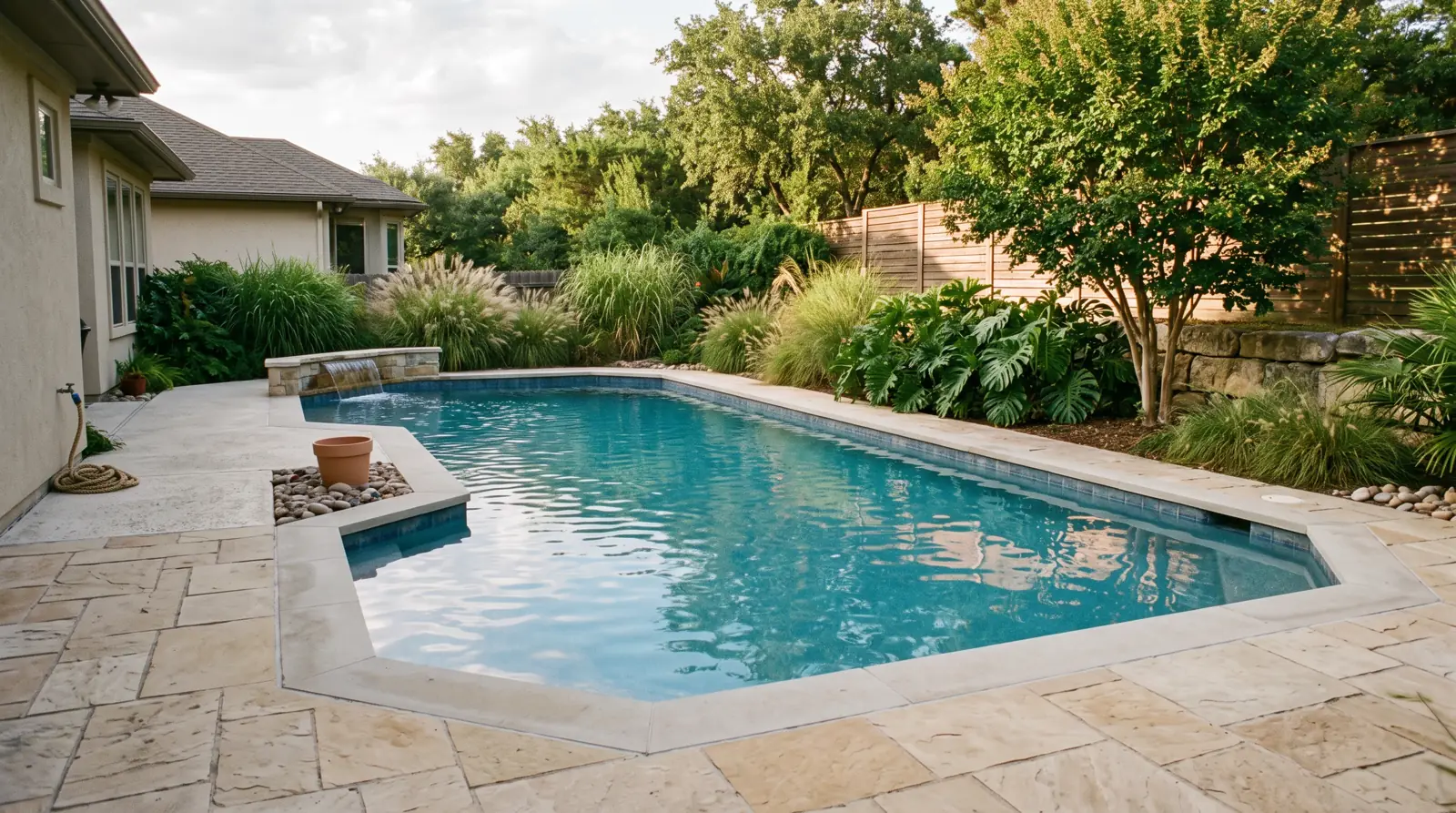
Pool Landscaping Ideas: Poolside Plants by Climate, Tree Setbacks, Fence Rules and Above Ground Pool Layouts
Pool landscaping ideas that hold up start with three rules: low-litter, spine-free plants near the water, trees 4 to 10 ft back from paving, and nothing climbable within 3 ft outside the pool fence.
- ✓Plants by climate, from extension listsUniversity of Arizona, UF/IFAS and Iowa State picks with litter, spine, root and salt notes.
- ✓Code rules for the yardThe ISPSC 3 ft barrier zone, 36 in equipment clearance, deck slopes and light setbacks.
- ✓Water use in gallonsPool vs lawn per 1,000 sq ft in 7 cities from our 25-city model.
Key takeaways
- The University of Arizona’s poolside guide says to pick plants with minimal litter or that drop all their leaves at once, to plant seasonal-litter plants downwind, and to keep cacti far enough from paths to prevent injury (AZ1058, 1998).
- 2024 ISPSC 305.2.1 measures the 48 in pool barrier on the outside and requires that height for 3 ft out, so a planter or boulder in that strip lowers the fence (ISPSC Chapter 3 via UpCodes).
- Iowa State University Extension puts small trees (under 30 ft) 4 to 6 ft from paving and large shade trees 10 ft or more, with root barriers at least 18 in deep (Iowa State, reviewed July 2024).
- ISPSC 306.5 requires decks to slope away from the pool at 1/8 to 1/2 in per foot by surface, and site and roof drainage to run away from the pool area (ISPSC Table 306.5).
- In a PC&S model of 25 US cities, an uncovered pool used less water per square foot than a sprinkler-watered cool-season lawn in 22 (PC&S pool vs lawn study).
What makes a plant good for a pool area?
Five traits: little litter, no spines near paths, roots that stay out of paving, tolerance of reflected heat, and tolerance of occasional chlorine or salt splash. The University of Arizona adds low water use, since heavy irrigation can damage decks and equipment, and UF/IFAS warns that no poolside plant survives a deluge of chlorine or salt water.
| Measure | Figure | Date and scope | Source |
|---|---|---|---|
| Pool barrier height, measured on the outside | 48 in, held for 3 ft out from the barrier | 2024 ISPSC 305.2.1 (model code) | International Code Council via UpCodes |
| States that require 60 in instead of 48 in | Arizona and California | October 2026 | ARS 36-1681; Cal. Health and Safety Code 115923 |
| Pool equipment outside the barrier | At least 36 in from the barrier | 2024 ISPSC 305.2.10 | International Code Council via UpCodes |
| Rooting space for small trees (under 30 ft tall) | 4 to 6 ft from paving | Last reviewed July 2024 | Iowa State University Extension |
| Rooting space for large shade trees | 10 ft or more from paving | Last reviewed July 2024 | Iowa State University Extension |
| Root barrier depth | At least 18 in, top above soil and mulch | Last reviewed July 2024 | Iowa State University Extension |
| Deck drainage slope | 1/8 to 1/2 in per ft by surface; 1/2 in per ft maximum | 2024 ISPSC Table 306.5 | International Code Council via UpCodes |
| Uncovered pool vs sprinkler-watered cool-season lawn | Pool used less in 22 of 25 cities | 1991 to 2020 climate | PC&S pool vs lawn model |
| Saltwater pool salt vs ocean water | 2,700 to 3,400 ppm vs about 35,000 ppm | Current maker manual; USGS | Hayward; USGS |
Sources: 2024 ISPSC Chapter 3; ARS 36-1681; Cal. Health and Safety Code 115923; Iowa State University Extension; PC&S pool vs lawn study; Hayward AquaRite 900 manual; USGS. Download CSV
| Rule | Threshold or detail | Source |
|---|---|---|
| Litter | Choose plants with minimal litter, or that drop all leaves at once so cleanup happens once a year | UA AZ1058 (1998) |
| Seasonal litter | Plant anything with seasonal litter downwind from the pool | UA AZ1058 |
| Palms | Keep fronds pruned and remove flowers before seeds set | UA AZ1058 |
| Flowers | Showy flowers are animal-pollinated, cleaner and less likely to cause allergies than wind-pollinated ones | UA AZ1058 |
| Reflected heat | Pool and deck reflect intense sun; choose plants that take it | UA AZ1058 |
| Water | Choose low-water plants; too much irrigation can damage decking or equipment | UA AZ1058 |
| Spines | Plant cacti far enough from paths to prevent injury to people | UA AZ1058 |
| Splash | No poolside plant survives a deluge of chlorine or salt water; plan for occasional splash only | UF/IFAS Gardening Solutions |
| Pool water on beds | Chlorine is rapidly inactivated by sunlight; keep spray off leaves and move the hose to avoid salt build-up | City of Chandler (from UA Extension lists) |
| Wind and shade | Landscaping, walls or fencing that block wind and add shade reduce evaporation; pick plants that do not add debris | EPA WaterSense tech sheet (July 2023) |
Sources: University of Arizona AZ1058 (1998); UF/IFAS Gardening Solutions; City of Chandler; EPA WaterSense tech sheet (July 2023). Download CSV
Does pool water hurt plants? Occasional splash rarely does; repeated soaking can. The City of Chandler, drawing on University of Arizona Extension lists, says chlorine is rapidly inactivated by sunlight, but repeated pool water builds salt in soil and spray on leaves causes yellowing and leaf drop. Hayward runs its AquaRite 900 at 2,700 to 3,400 ppm salt (Hayward manual), about a tenth of the 35,000 ppm in ocean water (USGS), so plants rated for light salt spray are the safer picks beside a saltwater pool.
Which plants work around a pool in your climate?
In the Desert Southwest, the University of Arizona lists succulents, Texas ranger, yellow bells, rosemary and deer grass for poolsides and puts mesquite, jacaranda, ash and bottlebrush on its keep-away list. In Florida, UF/IFAS suggests bird of paradise, compact hibiscus, cordyline, variegated shell ginger, dwarf schefflera and dwarf crotons. Cold-climate tree picks come from Iowa State.
| Climate | Plant | Role | Litter | Thorns or spines | Size and roots | Salt or splash | Source |
|---|---|---|---|---|---|---|---|
| Desert Southwest | Texas ranger (Leucophyllum frutescens) | Shrub | On AZ suggested poolside list | Not stated | Not stated | Salt tolerant: can take backwash water | UA AZ1058; City of Chandler (from UA Extension lists) |
| Desert Southwest | Rosemary (Rosmarinus officinalis), prostrate form for groundcover | Shrub or groundcover | On AZ suggested poolside list | Not stated | Not stated | Salt tolerant | UA AZ1058; City of Chandler |
| Desert Southwest | Arizona yellow bells (Tecoma stans var. angustata) | Shrub | On AZ suggested poolside list | Not stated | Not stated | Salt tolerant | UA AZ1058; City of Chandler |
| Desert Southwest | Deer grass (Muhlenbergia rigens) | Accent grass | On AZ suggested poolside list | Not stated | Not stated | Salt tolerant | UA AZ1058; City of Chandler |
| Desert Southwest | Aloe (Aloe vera, tiger aloe A. saponaria) | Accent succulent | Succulents produce almost no litter | Not stated | Not stated | Salt tolerant | UA AZ1058; City of Chandler |
| Desert Southwest | Red yucca (Hesperaloe parviflora) | Accent succulent | Succulents produce almost no litter | Not stated | Not stated | Not rated | UA AZ1058 |
| Desert Southwest | Prickly pear (Opuntia spp.) | Accent cactus | Cacti produce almost no litter | Cactus: plant far enough from paths to prevent injury | Not stated | Not rated | UA AZ1058 |
| Desert Southwest | Jojoba (Simmondsia chinensis) | Shrub | On AZ suggested poolside list | Not stated | Not stated | Salt sensitive: no backwash water | UA AZ1058; City of Chandler |
| Desert Southwest | Lantana (bush and trailing) | Shrub or groundcover | On AZ suggested poolside list | Not stated | Not stated | Moderately salt sensitive | UA AZ1058; City of Chandler |
| Desert Southwest | Keep far from the pool: mesquite, ash, jacaranda, bottlebrush, bougainvillea, Chinese elm, carob, orchid tree, chaste tree, sweet acacia, bottle tree | Trees and vines | Listed to keep far away from the pool | Not stated | Not stated | Mesquite and bougainvillea salt tolerant, still kept away | UA AZ1058; City of Chandler |
| Florida and Gulf subtropical | Bird of paradise (Strelitzia) | Clumping perennial | Does not tend to cause leaf litter | Not stated | Stays small in partial shade | Tolerates a light salt spray | UF/IFAS Gardening Solutions |
| Florida and Gulf subtropical | Tropical hibiscus | Shrub | Individual flowers are short-lived | Not stated | Pick compact, dense varieties | Chinese hibiscus salt sensitive on the Arizona list | UF/IFAS; City of Chandler |
| Florida and Gulf subtropical | Cordyline, ti plant | Foliage shrub | Not stated | Not stated | Plant in zones 10 to 11 | Not rated | UF/IFAS Gardening Solutions |
| Florida and Gulf subtropical | Variegated shell ginger (Alpinia zerumbet 'Variegata') | Foliage perennial | Not stated | Not stated | Less vigorous than the green form, easier to keep in bounds | Not rated | UF/IFAS Gardening Solutions |
| Florida and Gulf subtropical | Dwarf schefflera (Heptapleurum arboricola) | Shrub or small tree | Orange-yellow fruit in winter | Not stated | Can be pruned into a small patio tree | Not rated | UF/IFAS Gardening Solutions |
| Florida and Gulf subtropical | Croton (Codiaeum variegatum) | Shrub | Not stated | Not stated | Up to 10 ft; dwarf varieties suit poolside | Not rated | UF/IFAS Gardening Solutions |
| Cold and temperate (Midwest) | Crabapple, redbud, Japanese tree lilac | Small trees under 30 ft | Not stated | Not stated | Need a rooting area 4 to 10 ft wide; 4 to 6 ft from paving | Not rated | Iowa State University Extension |
| Cold and temperate (Midwest) | Avoid near paving: Norway, red and sugar maple; ash; sweetgum; tuliptree; pin oak; poplars and cottonwoods; willows; American elm | Shade trees | Not stated | Not stated | Abundant surface roots that lift and crack paving | Not rated | Iowa State University Extension |
Sources: University of Arizona Cooperative Extension AZ1058 (August 1998); City of Chandler salt lists (derived from UA Extension); UF/IFAS Gardening Solutions, Poolside Plants; Iowa State University Extension (reviewed July 2024). Not stated means the source does not say. Download CSV
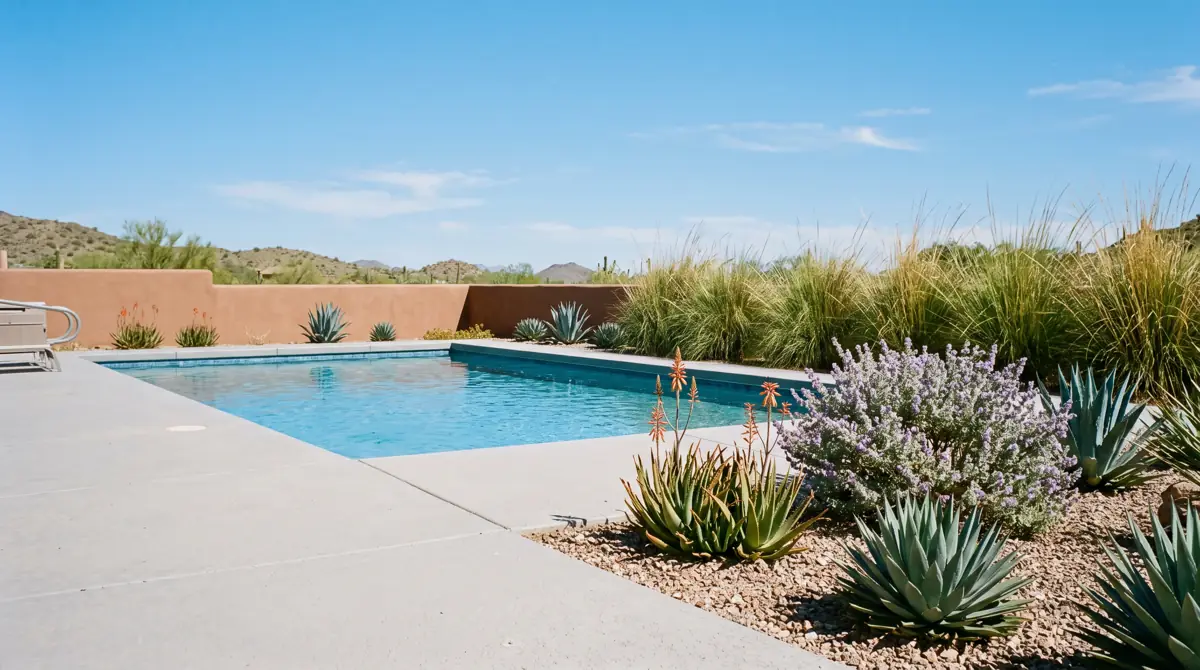
The table records only what each publication says. AZ1058 dates from August 1998 and names suggested plants without per-plant litter notes, so treat its list as a starting point. Salt ratings come from the City of Chandler list, which credits University of Arizona Cooperative Extension publications. Jojoba sits on the Arizona poolside list yet is rated salt sensitive, so keep it away from a saltwater pool’s splash zone.
We found no Texas A&M AgriLife or UC Cooperative Extension publication on poolside plants. For Texas and California yards, match rainfall first: Phoenix averages 7.22 in a year and Fresno 10.99 in, so desert rows fit, while Houston gets 51.84 in and Miami 67.41 in, closer to the Florida rows (NOAA 1991 to 2020 normals). Then ask the county extension office for a local list.
How far should trees and plants be from a pool?
Set small trees, under 30 ft at maturity, 4 to 6 ft from paving and large shade trees 10 ft or more, and plant no tree in a strip under 4 ft wide, per Iowa State University Extension. Where space is short, a root barrier at least 18 in deep with its top above the mulch steers roots down, and pavers flex over roots better than rigid slabs.
| Item | Distance or rule | Source |
|---|---|---|
| Climbable objects outside the pool barrier | Barrier keeps 48 in of height for 3 ft out from its outside face, so no planters, boulders, raised beds or benches in that 3 ft | 2024 ISPSC 305.2.1 |
| Pool equipment outside the barrier | At least 36 in from the outside of the barrier | 2024 ISPSC 305.2.10 |
| Gap under a barrier over grass, gravel or mulch | 2 in maximum; 4 in over a solid surface | 2024 ISPSC 305.2.1 |
| Small trees (mature height under 30 ft) | 4 to 6 ft from paving | Iowa State University Extension |
| Large shade trees | 10 ft or more from paving | Iowa State University Extension |
| Any tree | Not in a rooting area narrower than 4 ft | Iowa State University Extension |
| Root barrier | At least 18 in deep, top above the soil and mulch | Iowa State University Extension |
| Clear space around an above ground pool | 4 ft (Intex Metal Frame manual) | Intex owner's manual (2022) |
| Organic mulch near flammable structures, wildfire areas | Avoid thick layers within 10 to 15 ft of decks, wooden fences or propane tanks | UA Backyard Gardener #30 (2022) |
| Light fixtures over or near an outdoor pool | None within 5 ft horizontally of the pool unless 12 ft or more above the water | IRC E4203.4.1 (2012 text via UpCodes) |
| Lights and outlets 5 to 10 ft from the pool | GFCI protected unless 5 ft or more above the water and rigidly attached | IRC E4203.4.5 (2012 text via UpCodes) |
Sources: 2024 ISPSC 305.2.1 and 305.2.10; Iowa State University Extension; Intex Metal Frame owner manual (May 2022); University of Arizona Backyard Gardener #30 (June 2022); IRC E4203.4, 2012 text via UpCodes. Download CSV
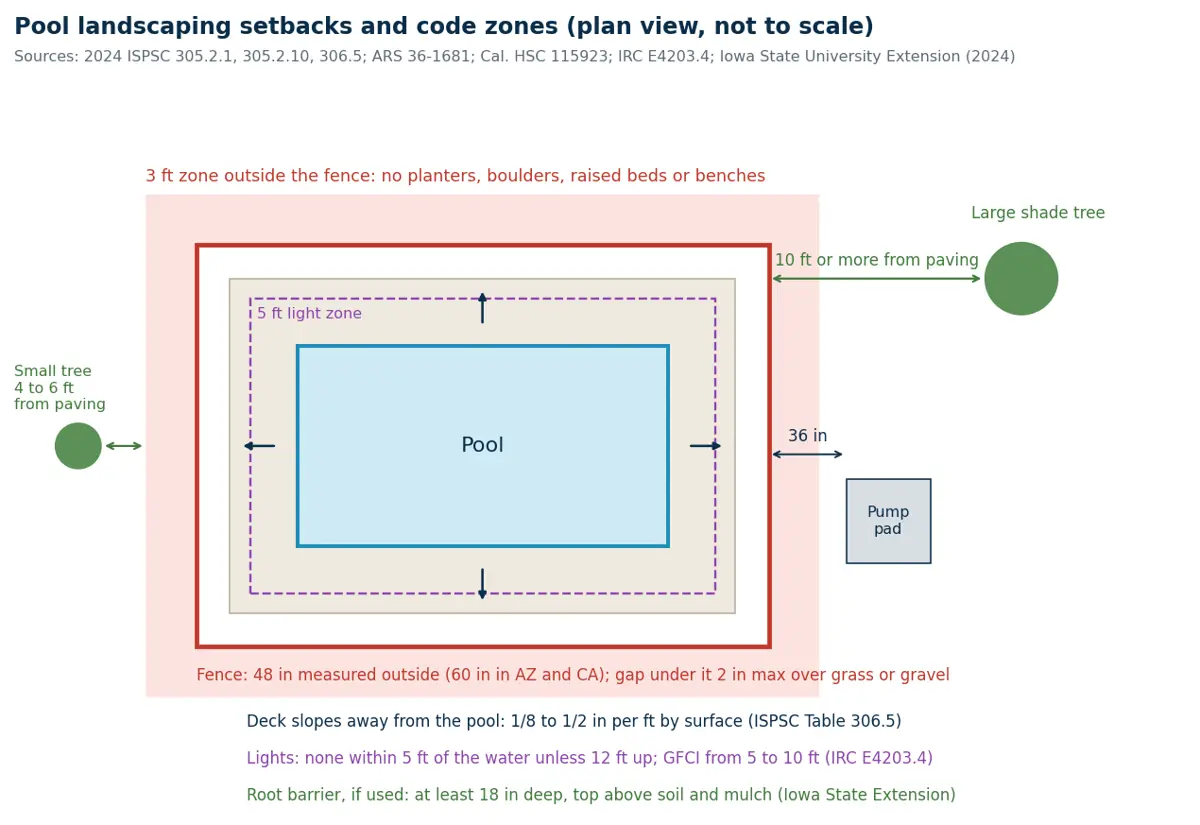
Iowa State names the shallow-rooted trees to keep off paving: Norway, red and sugar maple, ash, sweetgum, tuliptree, pin oak, poplars and cottonwoods, willows and American elm (Iowa State). In the desert, AZ1058 keeps ash, mesquite, jacaranda and Chinese elm far from the pool as well. Trees and walls earn their place by blocking wind and adding shade, which EPA WaterSense says cuts evaporation, provided they do not drop debris into the water.
Lights belong in the plan too. Under IRC E4203.4.1 no fixture goes within 5 ft horizontally of an outdoor pool unless it sits 12 ft or more above the water, and fixtures 5 to 10 ft away need GFCI protection unless mounted 5 ft up and rigidly attached (2012 IRC text via UpCodes). Underwater and deck fixtures are compared in our pool lighting guide.
What do pool fence rules say about plants near the barrier?
Most say keep climbable things away. The 2024 ISPSC measures the 48 in barrier on the side away from the pool and requires that height for 3 ft out from the barrier, so a raised bed, boulder or bench in that strip lowers the fence. Florida law says a barrier may not be placed where a permanent structure, equipment or similar object can be used to climb it. Ways to pair a hedge with a fence that passes are in our guide to pool fence ideas.
| Rule | Code or law | What it means for planting and hardscape |
|---|---|---|
| 48 in barrier height, measured on the side away from the pool, held for 3 ft horizontally outside | 2024 ISPSC 305.2.1 | A raised bed, boulder or planter within 3 ft of the outside face lowers the effective height |
| 2 in maximum gap under the barrier over grass or gravel; 4 in over concrete | 2024 ISPSC 305.2.1 | Settling mulch or gravel can open the gap; check it after each season |
| Solid barriers: no handholds or footholds | 2024 ISPSC 305.2.3 | Trellis, vine wire or decorative stone on a solid wall can create footholds |
| Equipment at least 36 in from the outside of the barrier | 2024 ISPSC 305.2.10 | Keep the pump pad and any screen wall around it 36 in clear of the fence |
| Barrier may not be located so a permanent structure, equipment or similar object can be used to climb it | Fla. Stat. 515.29(5) | Statute language in Florida; CPSC Publication 362 gives the same advice nationally |
| 60 in minimum height | ARS 36-1681 (Arizona); Cal. Health and Safety Code 115923 | Plants are not the barrier; the fence or wall itself must reach 60 in |
Sources: 2024 ISPSC 305.2.1, 305.2.3, 305.2.10; Florida Statutes 515.29(5); CPSC Safety Barrier Guidelines, Publication 362; ARS 36-1681; Cal. Health and Safety Code 115923. Download CSV
State rules decide the height. Our review of 50 states and DC found 20 jurisdictions require a barrier around new residential pools statewide, 16 have partial rules and 15 leave it to local codes, and Arizona and California set 60 in instead of 48 in (pool fence laws by state). CPSC’s guidelines, which are advisory, say barriers should be located so permanent structures, equipment or similar objects cannot be used to climb them (CPSC Publication 362). Fence styles and per-foot prices are in our pool fence cost guide. A pool house set near the barrier counts as a permanent structure too; its setback and height limits in five jurisdictions are compared in our pool house ideas guide.
How should the yard drain around a pool?
Away from the water. ISPSC 306.5.1 requires decks to slope away from the pool or toward deck drains, from 1/8 in per foot for textured concrete, pavers and wood up to 1/2 in for carpet, and 306.5.2 sends deck, site and roof drainage away from the pool area. The University of Arizona adds that heavy irrigation near the pool can damage decking and equipment. Saturated soil beside the deck also brings earthworms to the surface, the main cause of worms in pool water after rain.
| Deck surface | Minimum slope, inch per foot | Source |
|---|---|---|
| Textured, hand-finished concrete | 1/8 | 2024 ISPSC Table 306.5 |
| Exposed aggregate | 1/4 | 2024 ISPSC Table 306.5 |
| Travertine or brick-set pavers, residential | 1/8 | 2024 ISPSC Table 306.5 |
| Wood or wood-plastic composite | 1/8 | 2024 ISPSC Table 306.5 |
| Carpet | 1/2 | 2024 ISPSC Table 306.5 |
| Any surface, maximum | 1/2 | 2024 ISPSC 306.5 |
Source: 2024 ISPSC Section 306.5 and Table 306.5 (UpCodes copy). Download CSV
- Check the deck fallAt 1/8 in per foot, a 4 ft walkway falls 1/2 in from the coping to its outer edge; exposed aggregate needs twice that, and no deck may exceed 1/2 in per foot.
- Send water away or to drainsISPSC 306.5.1 allows a slope away from the pool or toward deck drains; drains may sit at the back of the pool structure where the site requires.
- Route roof and yard waterISPSC 306.5.2 directs perimeter deck, general site and roof drainage away from the pool area, so downspouts should discharge beyond the deck.
- Keep beds lower and drierChoose low-water plants beside the deck, as AZ1058 advises, so sprinkler overspray and runoff do not soak the deck base.
- Use the drainage exception only if it is testedA deck may skip the minimum slope if water clears to less than 1/8 in within 20 minutes after wetting stops (ISPSC 306.5).
Gravel, mulch or pavers: what goes around a pool?
Pavers or textured concrete next to the water, organic mulch in planting beds, and gravel only where heat does not matter. The University of Arizona says rock and gravel mulch collect heat and raise nearby temperatures, while organic mulch should be at least 2 to 3 in thick. California’s 2026 cost tables price broom concrete at $9.19 and flagstone at $31.29 per sq ft.
| Surface | Heat | Upkeep and risks | Installed cost, California 2026 | Source |
|---|---|---|---|---|
| Broom-finish concrete (2 in on 4 in rock) | Conventional pavements reach 120 to 150 F at peak | Slope to drain away from the pool | $9.19 per sq ft (0 to 1,000 sq ft) | BOE AH 531; EPA |
| Colored salt-finish concrete | As above | As above | $14.33 per sq ft | BOE AH 531 |
| Brick in sand | Not stated | Pavers flex better over roots than rigid slabs | $26.54 per sq ft | BOE AH 531; Iowa State Extension |
| Flagstone | Not stated | Hayward's AquaRite warranty excludes natural stone damage next to a salt pool | $31.29 per sq ft | BOE AH 531; Hayward |
| Rock or gravel mulch | Collects heat and raises nearby temperatures | Weed seeds blow in even over landscape fabric | Not in BOE tables | UA Backyard Gardener #30 |
| Organic mulch (bark, wood chips) | Cooler than rock | At least 2 to 3 in thick; flammable, keep thick layers 10 to 15 ft from decks in wildfire areas | Not in BOE tables | UA Backyard Gardener #30 |
Sources: California BOE Assessors Handbook 531, costs effective January 1, 2026; EPA Reducing Urban Heat Islands, Cool Pavements; University of Arizona Backyard Gardener #30; Iowa State Extension; Hayward Aqua Rite manual warranty. Download CSV
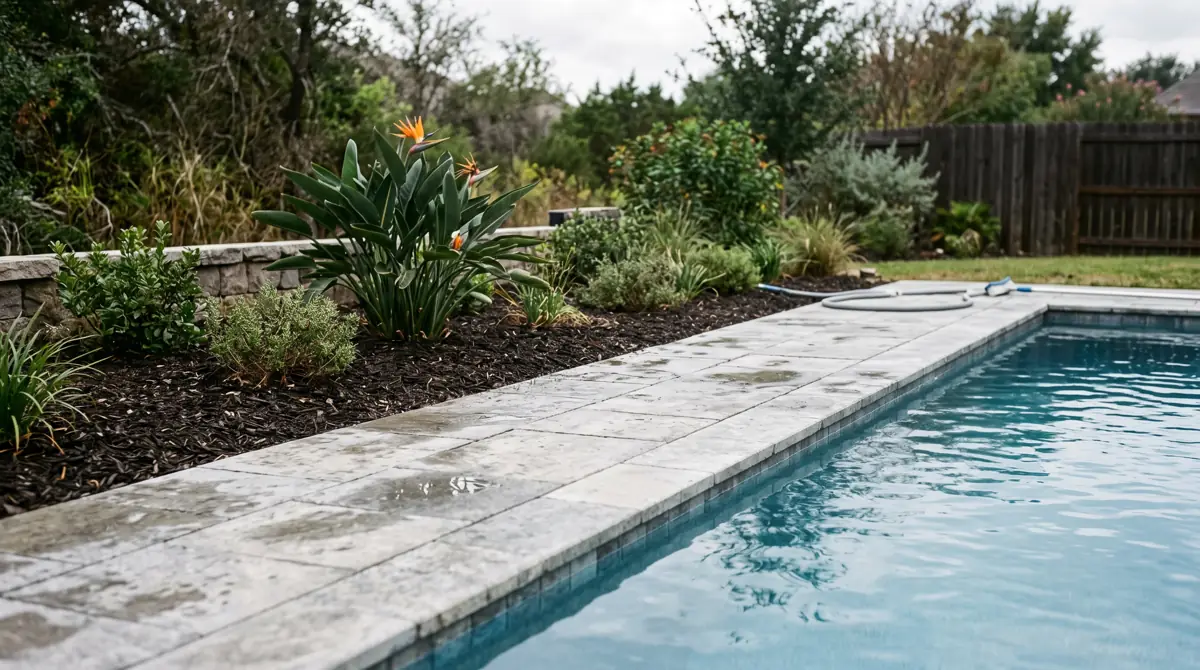
Whatever meets the water must be slip resistant: ISPSC 306.2 asks for a wet dynamic coefficient of friction of at least 0.42 where a surface is tested to ANSI A326 (ISPSC 306.2). Backyard pool landscaping ideas often mix paving with beds, and the paving choice by slip, heat and freeze data is laid out in our pool deck materials guide.
Salt pools change the stone math. Hayward’s Aqua Rite warranty excludes degradation of natural stone used in or right next to a pool (Hayward Aqua Rite manual), so flagstone or travertine beside a saltwater pool deserves a sealer plan and a clear answer from the installer on who covers damage.
Does a pool landscape use less water than a lawn?
Usually, per square foot. In a PC&S model of 25 US cities, an uncovered pool used less water than a sprinkler-watered cool-season lawn in 22, and about the same in Las Vegas and Phoenix. Against warm-season grass the gap is small. Low-water plants on drip use far less than either: a pool uses 2.5 to 12.1 times as much in 11 arid cities.
| City | Uncovered pool, net of rain (gal per 1,000 sq ft a year) | Cool-season lawn, sprinkler water | Warm-season lawn, sprinkler water | Pool vs cool-season lawn | Pool vs warm-season lawn |
|---|---|---|---|---|---|
| Las Vegas, NV | 49,493 | 53,170 | 42,137 | About even | Pool uses more |
| Phoenix, AZ | 42,137 | 43,945 | 34,159 | About even | Pool uses more |
| Tucson, AZ | 42,013 | 48,059 | 37,213 | Lawn uses more | Depends on rainfall |
| Denver, CO | 19,635 | 25,058 | 17,890 | Lawn uses more | About even |
| Dallas, TX | 11,781 | 18,451 | 11,158 | Lawn uses more | About even |
| Miami, FL | 4,488 | 5,735 | 3,304 | Lawn uses more | Depends on rainfall |
| Atlanta, GA | 1,621 | 6,794 | 1,434 | Lawn uses more | Depends on rainfall |
Source: PC&S pool vs lawn water use model (NOAA TR 34 pan data x 0.70; gridMET reference ET; UC ANR turf crop coefficients; NOAA 1991 to 2020 rainfall normals). Download CSV
Source: PC&S pool vs lawn water use model (NOAA pan data, gridMET reference ET, UC ANR crop coefficients; 1991 to 2020 climate). Download chart data (CSV)
Southern Nevada’s own figures agree. The Southern Nevada Water Authority puts average pool evaporation at 48.6 gallons per square foot a year (SNWA pools and spas), while its Water Smart Landscapes program projects 825,000 gallons a year saved by an average 15,000 sq ft grass-to-desert conversion, about 55.0 gallons per square foot (SNWA rebate page). The drip comparison uses the low-water plant factor range in California MWELO.
Evaporation runs from 37.4 in a year in Nashville to 83.6 in in Las Vegas for an uncovered pool, by city in our pool evaporation rate study. A cover, which EPA says can stop up to 95% of it, is the largest lever; plantings help at the edges by cutting wind across the water.
Above ground pool landscaping ideas that pass code
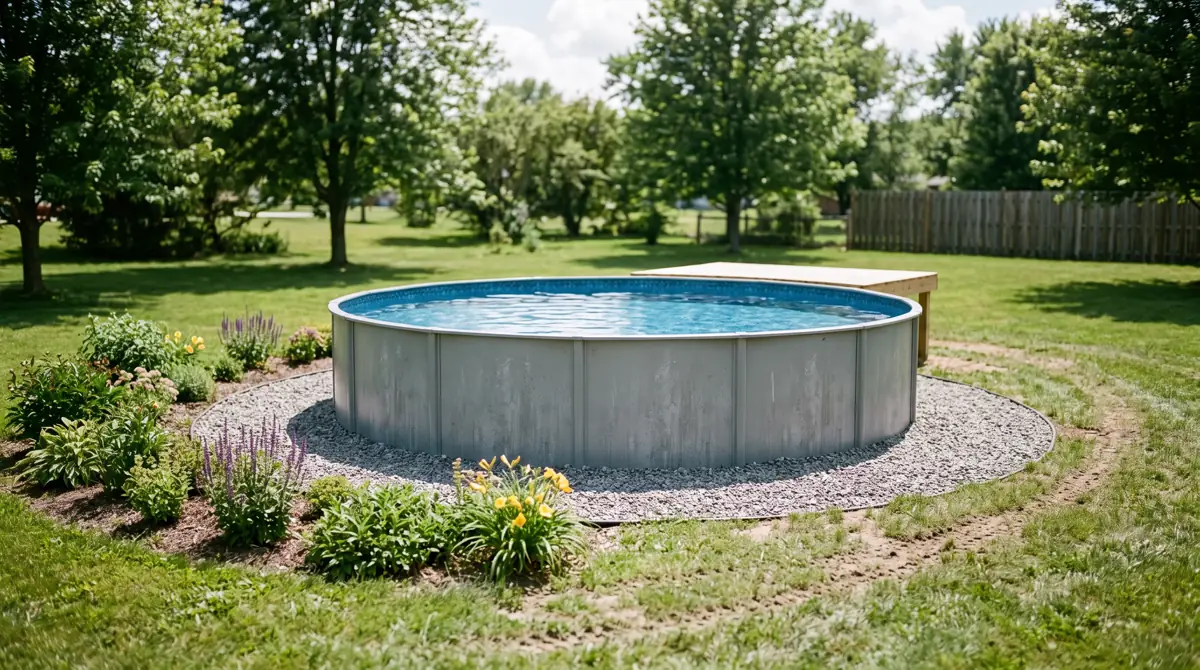
Treat the pool wall as a fence. Under 2024 ISPSC 305.5 an above ground pool wall can be the barrier only if it stands at least 48 in above grade all the way around and the ladder can be locked or removed, and a planter, step or deck within 3 ft outside that wall cuts the effective height. Intex asks for 4 ft of clear space around its frame pools.
- Level base before any planting Makers ask for the frame within 1 in of level; dig down high spots and never fill low ones, as set out in our guide on how to level ground for an above ground pool.
- No soil banked against the wall The Islamorada round pool manual says the pool is not designed to be buried (manual), so berms and raised beds stay off the wall.
- Clear the grass from the footprint Intex warns that St. Augustine and Bermuda grass may grow through the liner and that this is not covered by its warranty (Intex manual, 2022).
- Keep a 4 ft ring clear Intex asks for 4 ft of clear space around the pool, which also keeps planters, steps and benches out of the 3 ft barrier zone of ISPSC 305.2.1.
- Lock or remove the ladder ISPSC 305.5 accepts the wall as the barrier only if ladders or steps can be secured, locked or removed, and the opening left must not pass a 4 in sphere.
- Check the permit line IRC R105.2 (2021) exempts prefabricated pools less than 24 in deep from a building permit (IRC via UpCodes); deeper pools usually need one.
Which pool landscaping idea fits your yard?
Start from the constraint, not the look. If a bed sits within 3 ft outside the fence, move it. If you want shade, choose trees under 30 ft set 4 to 6 ft from paving. In the desert, lean on the University of Arizona list; in Florida, on UF/IFAS. Regrade any deck that drains toward the pool, and keep light fixtures 5 ft from the water.
| If your situation is | Do this | Why (source) |
|---|---|---|
| Bed or planter planned within 3 ft outside the pool fence | Move it, or raise the fence so 48 in holds above it | ISPSC 305.2.1 measures height for 3 ft out |
| You want shade trees | Pick trees under 30 ft and set them 4 to 6 ft from paving; large trees 10 ft or more | Iowa State Extension |
| Desert climate with reflected heat | Use succulents, Texas ranger, yellow bells or deer grass; skip mesquite and jacaranda near the water | UA AZ1058 |
| Florida or Gulf Coast yard | Use bird of paradise, compact hibiscus or variegated ginger; expect splash damage from heavy chlorine or salt water | UF/IFAS Gardening Solutions |
| Saltwater pool | Favor salt-tolerant plants and keep salt splash off natural stone | City of Chandler list; Hayward warranty exclusion |
| Deck drains toward the pool or beds | Regrade so deck, roof and site water run away from the pool area | ISPSC 306.5.1 and 306.5.2 |
| Hot, dry climate and a choice between gravel and mulch | Use organic mulch at 2 to 3 in near plants; gravel collects heat | UA Backyard Gardener #30 |
| Above ground pool used as its own barrier | Keep steps, decks and planters off the outside wall and lock or remove the ladder | ISPSC 305.5 and 305.2.1 |
| Replacing lawn to save water | Low-water plants on drip use far less than lawn or pool | PC&S pool vs lawn model |
| Lights near the water | Keep fixtures 5 ft or more from the pool unless 12 ft up; GFCI from 5 to 10 ft | IRC E4203.4 |
Sources: 2024 ISPSC; Iowa State Extension; UA AZ1058; UF/IFAS; City of Chandler; Hayward; UA Backyard Gardener #30; IRC E4203.4; PC&S pool vs lawn model. Download CSV
A planted regeneration zone is landscaping that also cleans the water: 40% to 70% of the water surface under the German FLL pond types, sized in our natural swimming pool guide. If the plan adds a waterfall, laminars or bubblers, from 3 gpm deck jets to 90 gpm scuppers, the costs and evaporation are in our pool water features guide.
How we compiled this
We read 4 extension publications (University of Arizona AZ1058 and Backyard Gardener #30, UF/IFAS Gardening Solutions, Iowa State Yard and Garden), the City of Chandler salt lists, the 2024 ISPSC Chapter 3, Florida Statutes 515.29, the IRC E4203.4 text, CPSC Publication 362, two above ground pool manuals, California BOE cost tables, EPA, USGS, SNWA and Hayward documents, and PC&S research on fence laws and pool vs lawn water use. Nothing was planted, measured or tested. We found no Texas A&M or UC publication on poolside plants and say so where it matters.
Frequently Asked Questions
What is the best landscaping around a pool?
Low-litter, spine-free plants that take reflected heat and occasional splash, set back from paving. The University of Arizona lists succulents, Texas ranger and yellow bells for desert pools, and UF/IFAS suggests bird of paradise and compact hibiscus in Florida. Put pavers or textured concrete next to the water and keep beds out of the 3 ft zone outside the pool fence.
How far should plants be from a pool?
Iowa State University Extension puts small trees under 30 ft at 4 to 6 ft from paving and large shade trees at 10 ft or more, with no tree in a strip under 4 ft wide. Shrubs can sit closer if they drop little litter. Outside the pool fence, keep a 3 ft strip clear, because 2024 ISPSC 305.2.1 measures the 48 in height that far out.
Can I put plants next to my pool fence?
Low plants that cannot be climbed are usually fine; raised beds, boulders, planters and benches within 3 ft outside the barrier are not, because 2024 ISPSC 305.2.1 requires 48 in of height for 3 ft out. Florida Statutes 515.29(5) bars placing a barrier where a permanent structure or object can be used to climb it. Check your local edition.
What can I put around an above ground pool?
A clear ring of about 4 ft, which Intex asks for, then low beds or a deck set back from the wall. Keep soil off the wall, since some makers say their pools are not designed to be buried, and keep steps and planters out of the 3 ft zone if the wall is your barrier. Clear St. Augustine and Bermuda grass from the footprint first.
Is gravel or mulch better around a pool?
Mulch is cooler in planting beds; gravel lasts longer but holds heat. The University of Arizona says rock and gravel mulch collect heat and raise nearby temperatures and that weed seeds blow into gravel even over fabric, while organic mulch should be at least 2 to 3 in deep. In wildfire areas, keep thick organic mulch 10 to 15 ft from decks and wooden fences.
Does pool water kill plants?
Not usually in small doses. The City of Chandler, citing University of Arizona lists, says chlorine is rapidly inactivated by sunlight, but repeated soaking builds salt in the soil and spray on leaves causes yellowing and leaf drop. Saltwater pools run about 2,700 to 3,400 ppm salt, so salt-sensitive plants such as jojoba and star jasmine belong away from splash.
Sources
- University of Arizona Cooperative Extension. Plants for Poolside Landscapes, AZ1058 (Lucy Bradley, August 1998). Accessed 2026-11-02.
- University of Arizona Cooperative Extension. Backyard Gardener #30: Mulches (June 25, 2022). Accessed 2026-11-02.
- UF/IFAS Gardening Solutions. Poolside Plants. Accessed 2026-11-02.
- Iowa State University Extension and Outreach. How to Manage Trees Near Sidewalks (Steil and Iles, reviewed July 2024). Accessed 2026-11-02.
- City of Chandler, Arizona. Using Chlorine and Salt Pool Water on Plants. Accessed 2026-11-02.
- International Code Council via UpCodes. 2024 International Swimming Pool and Spa Code, Chapter 3 (Austin adoption copy). Accessed 2026-11-02.
- Florida Legislature. Florida Statutes Chapter 515, Residential Swimming Pool Safety Act (515.29). Accessed 2026-11-02.
- U.S. Consumer Product Safety Commission. Safety Barrier Guidelines for Residential Pools, Publication 362. Accessed 2026-11-02.
- Arizona Legislature. ARS 36-1681, Pool enclosures. Accessed 2026-11-02.
- California Legislative Information. Health and Safety Code, Swimming Pool Safety Act (115920 to 115929). Accessed 2026-11-02.
- International Code Council via UpCodes. IRC Section E4203.4, Luminaires and Ceiling Fans (2012 text, South Holland adoption). Accessed 2026-11-02.
- International Code Council via UpCodes. 2021 IRC Chapter 1, R105.2 work exempt from permit (Montana adoption). Accessed 2026-11-02.
- U.S. Environmental Protection Agency. Pools and Outdoor Water Features, WaterSense tech sheet (July 2023). Accessed 2026-11-02.
- Intex. Metal Frame Pool owner's manual (May 13, 2022). Accessed 2026-11-02.
- Pro Pools (host). Islamorada round pool installation instructions. Accessed 2026-11-02.
- California State Board of Equalization. Assessors' Handbook Section 531, costs effective January 1, 2026. Accessed 2026-11-02.
- U.S. Environmental Protection Agency. Reducing Urban Heat Islands: Cool Pavements. Accessed 2026-11-02.
- Hayward. Aqua Rite manual (warranty exclusions). Accessed 2026-11-02.
- Hayward. AquaRite 900 manual, Rev D. Accessed 2026-11-02.
- U.S. Geological Survey. Saline Water and Salinity. Accessed 2026-11-02.
- Southern Nevada Water Authority. Pools and spas. Accessed 2026-11-02.
- Southern Nevada Water Authority. Water Smart Landscapes Rebate. Accessed 2026-11-02.
- California Department of Water Resources via Cornell LII. Model Water Efficient Landscape Ordinance definitions, 23 CCR 490.2. Accessed 2026-11-02.
- Pool Construction & Service research. Pool Fence Laws by State. Accessed 2026-11-02.
- Pool Construction & Service research. Does a Pool Use More Water Than a Lawn?. Accessed 2026-11-02.
Related pages
Get Quotes From Licensed Local Pool Pros
Tell us what you need and your ZIP code. We match you with pool companies that cover your area.