Pool Fence Laws by State: Residential Pool Barrier Rules in All 50 States and DC, 2026
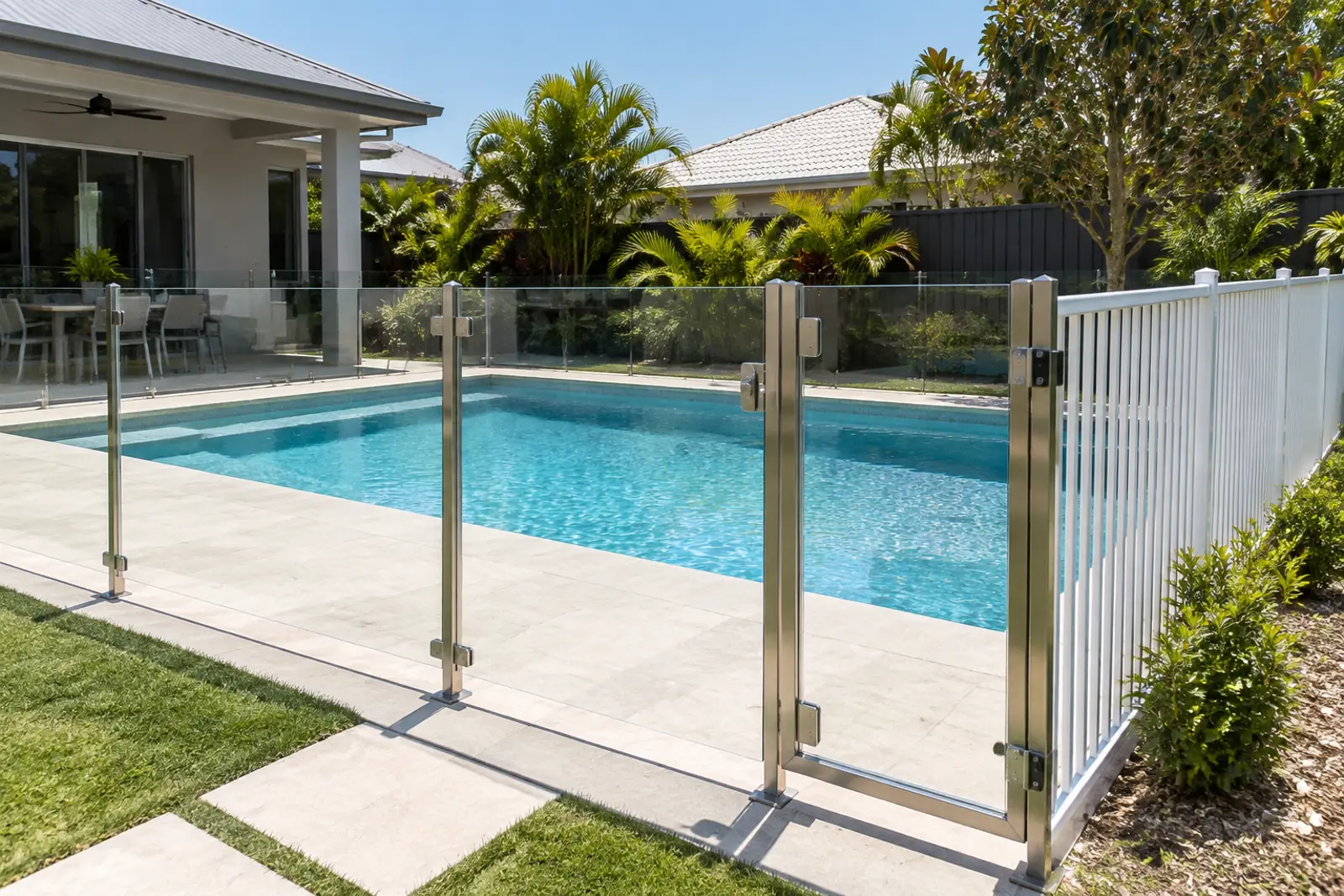
Pool fence laws by state, checked against statutes and adopted codes on October 4, 2026, show that 20 of 51 US jurisdictions (50 states plus DC) require a barrier around new residential pools statewide, 16 have partial rules and 15 leave it to local codes. Most set a 48-inch minimum; Arizona and California require 60 inches.
The rules at a glance
- 20 of 51 US jurisdictions require a barrier around new residential pools statewide as of October 4, 2026, through a statute or a mandatory statewide code (PC&S review; ICC adoption chart).
- 16 states have a partial statewide rule, limited to certain pools, to places that adopt the state code, or to a menu of features, and 15 states leave pool barriers to local codes (PC&S review, October 2026).
- 44.9% of US residents lived in a jurisdiction with a statewide barrier mandate on July 1, 2025, 36.5% in a partial-rule state and 18.5% in a local-only state (U.S. Census Bureau).
- 30 of the 32 states with a statewide height rule set the minimum barrier at 48 inches; Arizona (ARS 36-1681) and California (Health and Safety Code 115923) require 60 inches (October 2026).
- Only Connecticut (CGS 29-265a) and New York (RCNYS R328) require a pool alarm in addition to the barrier for new residential pools, as of October 2026.
- New Jersey is the only state whose statewide rule accepts no safety cover in place of a pool barrier, after deleting the model code exemption (N.J.A.C. 5:23-3.21, 2026).
- The District of Columbia is the only jurisdiction in the matrix whose barrier rule clearly reaches existing private pools, through its Property Maintenance Code (DC Department of Buildings, 2026).
- 6 states had the 2024 ISPSC in force statewide by October 2026 (Maryland, Georgia, New Hampshire, Utah, New Jersey, Montana), while ICC’s December 2025 chart listed none (ICC).
Pool fence laws by state: the 51-jurisdiction matrix
20 jurisdictions require a residential pool barrier statewide, 16 have partial rules and 15 leave it to local codes, as of October 4, 2026. Most statewide rules copy the model code: 48 inches, self-closing and self-latching gates, and alarms or covers as options where the house is part of the barrier.
| State | Abbr | Regime | Statewide barrier mandate | Minimum barrier height | Self-closing, self-latching gate | Door or window alarm | Safety cover option | Applies to existing pools | Spas and hot tubs covered | Layered protection required | Strictness score (0 to 5) |
|---|---|---|---|---|---|---|---|---|---|---|---|
| Alabama | AL | Statewide code | Partial | Not verified | Not verified | Not verified | Not verified | No | Not verified | Not verified | 0.5 |
| Alaska | AK | Local | Local | Local | Local | Local | Local | Local | Local | Local | 0 |
| Arizona | AZ | Statute | Partial | 60 in | Yes | No | Yes | No | No | No | 2.5 |
| Arkansas | AR | Statewide code | Yes | 48 in | Yes | Yes | Yes | No | Yes | No | 3 |
| California | CA | Statute | Partial | 60 in | Yes | Yes | Yes | Partial | Yes | Yes | 4 |
| Colorado | CO | Local | Local | Local | Local | Local | Local | Local | Local | Local | 0 |
| Connecticut | CT | Statewide code | Yes | 48 in | Yes | Required | Yes | No | Yes | Yes | 4 |
| Delaware | DE | Local | Local | Local | Local | Local | Local | Local | Local | Local | 0 |
| District of Columbia | DC | Statewide code | Yes | 48 in | Yes | Yes | Yes | Yes | Yes | No | 4 |
| Florida | FL | Statute | Yes | 48 in | Yes | Yes | Yes | No | Yes | No | 3 |
| Georgia | GA | Statewide code | Yes | 48 in | Yes | Yes | Yes | No | Yes | No | 3 |
| Hawaii | HI | Local | Local | Local | Local | Local | Local | Local | Local | Local | 0 |
| Idaho | ID | Statewide code | Partial | Not verified | Not verified | Not verified | Not verified | No | Not verified | Not verified | 0.5 |
| Illinois | IL | Local | Local | Local | Local | Local | Local | Local | Local | Local | 0 |
| Indiana | IN | Statewide code | Partial | 48 in | Yes | No | Yes | No | No | No | 2.5 |
| Iowa | IA | Statewide code | Partial | 48 in | Yes | Yes | Yes | No | Yes | No | 2.5 |
| Kansas | KS | Local | Local | Local | Local | Local | Local | Local | Local | Local | 0 |
| Kentucky | KY | Statewide code | Partial | 48 in | Yes | Yes | Yes | No | Partial | No | 2.5 |
| Louisiana | LA | Statewide code | Yes | 48 in | Yes | Yes | Yes | No | Yes | No | 3 |
| Maine | ME | Statewide code | Partial | 48 in | Yes | Yes | Yes | No | Yes | No | 2.5 |
| Maryland | MD | Statewide code | Yes | 48 in | Yes | Yes | Yes | No | Yes | No | 3 |
| Massachusetts | MA | Statewide code | Yes | 48 in | Yes | Yes | Yes | No | Yes | No | 3 |
| Michigan | MI | Statewide code | Yes | 48 in | Yes | Yes | Yes | No | Yes | No | 3 |
| Minnesota | MN | Local | Local | Local | Local | Local | Local | Local | Local | Local | 0 |
| Mississippi | MS | Local | Local | Local | Local | Local | Local | Local | Local | Local | 0 |
| Missouri | MO | Local | Local | Local | Local | Local | Local | Local | Local | Local | 0 |
| Montana | MT | Statewide code | Partial | 48 in | Yes | Yes | Yes | Not verified | Yes | No | 2.5 |
| Nebraska | NE | Statewide code | Partial | 48 in | Yes | Yes | Yes | Not verified | Yes | No | 2.5 |
| Nevada | NV | Local | Local | Local | Local | Local | Local | Local | Local | Local | 0 |
| New Hampshire | NH | Statewide code | Yes | 48 in | Yes | Yes | Yes | Not verified | Yes | No | 3 |
| New Jersey | NJ | Statewide code | Yes | 48 in | Yes | No | No | Not verified | Yes | No | 3 |
| New Mexico | NM | Statewide code | Yes | 48 in | Yes | Yes | Yes | No | Yes | No | 3 |
| New York | NY | Statute | Yes | 48 in | Yes | Required | Yes | Partial | Yes | Yes | 4.5 |
| North Carolina | NC | Statewide code | Yes | 48 in | Yes | Yes | Yes | No | Yes | No | 3 |
| North Dakota | ND | Statewide code | Partial | 48 in | Yes | Yes | Yes | No | Yes | No | 2.5 |
| Ohio | OH | Local | Local | Local | Local | Local | Local | Local | Local | Local | 0 |
| Oklahoma | OK | Statewide code | Partial | 48 in | Yes | No | Yes | No | Yes | No | 2.5 |
| Oregon | OR | Statewide code | Yes | 48 in | Yes | Yes | Yes | No | Yes | No | 3 |
| Pennsylvania | PA | Statewide code | Yes | 48 in | Yes | Yes | Yes | No | Yes | No | 3 |
| Rhode Island | RI | Statewide code | Yes | 48 in | Yes | Yes | Yes | No | Yes | No | 3 |
| South Carolina | SC | Statewide code | Partial | Local | Local | Local | Local | Local | Local | No | 0.5 |
| South Dakota | SD | Local | Local | Local | Local | Local | Local | Local | Local | Local | 0 |
| Tennessee | TN | Statewide code | Partial | Local | Local | Local | Local | No | Local | No | 0.5 |
| Texas | TX | Statewide code | Partial | 48 in | Yes | Yes | Yes | No | Yes | No | 2.5 |
| Utah | UT | Statewide code | Yes | 48 in | Yes | Yes | Yes | No | Yes | No | 3 |
| Vermont | VT | Local | Local | Local | Local | Local | Local | Local | Local | Local | 0 |
| Virginia | VA | Statewide code | Yes | 48 in | Yes | Yes | Yes | No | Yes | No | 3 |
| Washington | WA | Statewide code | Yes | 48 in | Yes | Yes | Yes | No | Yes | No | 3 |
| West Virginia | WV | Statewide code | Partial | 48 in | Yes | Yes | Yes | No | Yes | No | 2.5 |
| Wisconsin | WI | Local | Local | Local | Local | Local | Local | Local | Local | Local | 0 |
| Wyoming | WY | Local | Local | Local | Local | Local | Local | Local | Local | Local | 0 |
Source: PC&S review of state statutes and adopted codes (citations in the code basis table); ICC adoption chart, December 2025. Download CSV
Source: PC&S review of state statutes and adopted codes, opened 2026-10-04. Download chart data (CSV)
Three legal routes to a pool barrier rule: statute, statewide code or local ordinance
Only 4 states write residential pool barrier rules into a dedicated statute. 32 jurisdictions reach home pools through a statewide building code, and 15 have no statewide rule at all.
Arizona, California, Florida and New York have statutes aimed at residential pool safety (ARS 36-1681; HSC 115920 to 115929; Fla. Stat. ch. 515; Executive Law 378 and RCNYS R328). In the other code states, the rule comes from a single line in the International Residential Code: pools and spas shall comply with the ISPSC.
20 jurisdictions apply that rule statewide (Yes). 16 states have partial rules: the state code applies only where local governments adopt or enforce it (Iowa, Nebraska, North Dakota, West Virginia, Montana for small buildings), only in towns above a size threshold (Maine), only to certain pools (Kentucky in-ground pools, Indiana pools deeper than 42 inches, Oklahoma lots of 2 acres or less), or only as a menu of features (California).
Some states with a statewide residential code delete the pool section. Ohio deletes IRC R326 (OAC 4101:8-3-01) and Minnesota deletes both R326 and IBC 3109 (Minn. R. ch. 1309), so both are classed Local.
| Statewide barrier mandate | States (incl. DC) | Members | Population July 1, 2025 | Share of US population (%) |
|---|---|---|---|---|
| Yes | 20 | AR CT DC FL GA LA MA MD MI NC NH NJ NM NY OR PA RI UT VA WA | 153584722 | 44.9 |
| Partial | 16 | AL AZ CA IA ID IN KY ME MT ND NE OK SC TN TX WV | 124882070 | 36.5 |
| Local | 15 | AK CO DE HI IL KS MN MO MS NV OH SD VT WI WY | 63318065 | 18.5 |
Source: PC&S classification; population from U.S. Census Bureau Vintage 2025. Download CSV
Source: U.S. Census Bureau Vintage 2025; PC&S review of state statutes and adopted codes, opened 2026-10-04. Download chart data (CSV)
Pool fence height, gate, alarm and cover rules across the states
The 48-inch barrier is close to universal among states with a statewide height rule: 30 of 32. Differences sit in the details: alarms, covers, spas and existing pools.
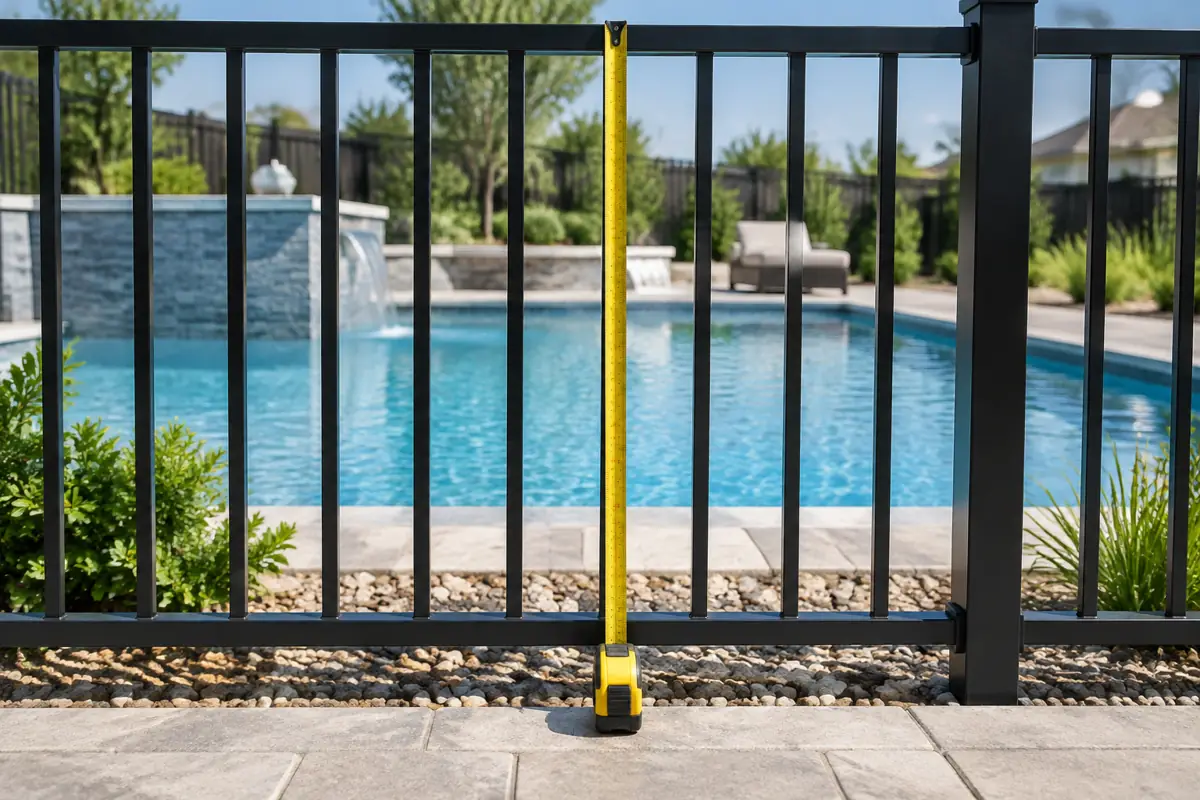
- Height: the 2024 ISPSC requires a barrier top at least 48 inches above grade, measured on the side away from the pool (ISPSC 305.2.1). Arizona requires a 5-foot enclosure and California’s enclosure standard is 60 inches.
- Gates: 32 jurisdictions require self-closing, self-latching pedestrian gates statewide; the model code also requires a latch release at least 54 inches high at residential pools when reached from outside (ISPSC 305.3).
- Openings: the model code bars openings that pass a 4-inch sphere (ISPSC 305.2.2).
- Alarms: 26 states accept door or window alarms as one option where a house wall is part of the barrier; Connecticut and New York require a pool alarm on top of the barrier; Arizona, Indiana, New Jersey and Oklahoma offer no alarm route in their statewide rule.
- Covers: 31 states accept an ASTM F1346 safety cover as an option or exemption in some form; New Jersey accepts none for pools.
- Spas and hot tubs: 29 jurisdictions’ statewide rules cover spas, usually exempting spas with a lockable safety cover.
- Existing pools: only DC clearly applies its barrier rule to existing private pools; New York and California do so in part. In 28 jurisdictions the opened text applies to new or permitted work only.
What the strictest state pool barrier regimes require
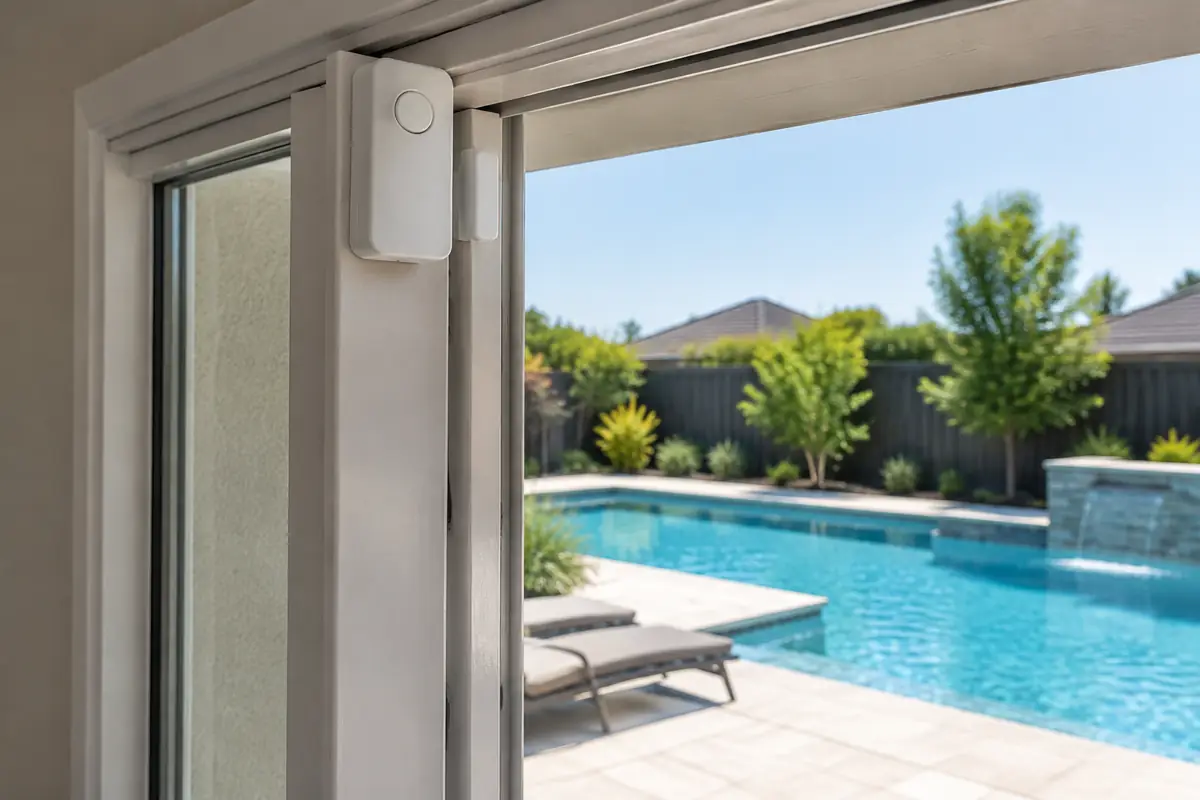
New York, California, Connecticut and DC go beyond the model code by stacking a second layer or reaching existing pools. New Jersey and Maryland tighten the model code by removing the safety-cover shortcut for pools.
- New York (score 4.5): a 48-inch permanent barrier, gates that are self-closing and self-latching, and an ASTM F2208 pool alarm for pools installed or substantially modified after December 14, 2006; the Property Maintenance Code requires an enclosure on all pools, accepting barriers that met the code in force when built (NY Department of State). New York City is outside the Uniform Code and was not reviewed.
- California (score 4): at least two of seven drowning prevention features for new or remodeled pools and spas at single-family homes, including a 60-inch enclosure option (California Legislature).
- Connecticut (score 4): the 2021 ISPSC barrier plus a pool alarm required by CGS 29-265a before a permit is issued for a new or substantially altered residential pool (Connecticut State Building Code).
- District of Columbia (score 4): the DC Swimming Pool and Spa Code for new pools, and a Property Maintenance Code rule requiring a 48-inch barrier around existing private pools deeper than 24 inches (DC Department of Buildings).
- New Jersey: deletes the model code’s powered-cover exemption for pools and the house-wall alarm option (N.J.A.C. 5:23-3.21).
- Maryland: reverses the cover exemption for pools permitted on or after December 31, 2023 (COMAR 09.12.56).
| State | Abbr | Statewide mandate (1, Partial 0.5) | Height 48 in or more (1) | Self-closing, self-latching gate (1) | Existing pools covered (1, Partial 0.5) | Layered protection required (1) | Strictness score (0 to 5) | Population 2025 (Census Vintage 2025) | Pool drowning rate per 1 million per year, 2018 to 2024 (CDC WONDER via PC&S) | Rate reliability |
|---|---|---|---|---|---|---|---|---|---|---|
| Alabama | AL | 0.5 | 0 | 0 | 0 | 0 | 0.5 | 5193088 | 3.59 | reliable |
| Alaska | AK | 0 | 0 | 0 | 0 | 0 | 0 | 737270 | suppressed | suppressed |
| Arizona | AZ | 0.5 | 1 | 1 | 0 | 0 | 2.5 | 7623818 | 6.15 | reliable |
| Arkansas | AR | 1 | 1 | 1 | 0 | 0 | 3 | 3114791 | 2.77 | reliable |
| California | CA | 0.5 | 1 | 1 | 0.5 | 1 | 4 | 39355309 | 2.93 | reliable |
| Colorado | CO | 0 | 0 | 0 | 0 | 0 | 0 | 6012561 | 1.23 | reliable |
| Connecticut | CT | 1 | 1 | 1 | 0 | 1 | 4 | 3688496 | 1.07 | reliable |
| Delaware | DE | 0 | 0 | 0 | 0 | 0 | 0 | 1059952 | 1.99 | unreliable |
| District of Columbia | DC | 1 | 1 | 1 | 1 | 0 | 4 | 693645 | suppressed | suppressed |
| Florida | FL | 1 | 1 | 1 | 0 | 0 | 3 | 23462518 | 6.65 | reliable |
| Georgia | GA | 1 | 1 | 1 | 0 | 0 | 3 | 11302748 | 2.89 | reliable |
| Hawaii | HI | 0 | 0 | 0 | 0 | 0 | 0 | 1432820 | 3.9 | reliable |
| Idaho | ID | 0.5 | 0 | 0 | 0 | 0 | 0.5 | 2029733 | suppressed | suppressed |
| Illinois | IL | 0 | 0 | 0 | 0 | 0 | 0 | 12719141 | 1.27 | reliable |
| Indiana | IN | 0.5 | 1 | 1 | 0 | 0 | 2.5 | 6973333 | 1.66 | reliable |
| Iowa | IA | 0.5 | 1 | 1 | 0 | 0 | 2.5 | 3238387 | 0.94 | reliable |
| Kansas | KS | 0 | 0 | 0 | 0 | 0 | 0 | 2977220 | 1.66 | reliable |
| Kentucky | KY | 0.5 | 1 | 1 | 0 | 0 | 2.5 | 4606864 | 1.93 | reliable |
| Louisiana | LA | 1 | 1 | 1 | 0 | 0 | 3 | 4618189 | 3.4 | reliable |
| Maine | ME | 0.5 | 1 | 1 | 0 | 0 | 2.5 | 1414874 | suppressed | suppressed |
| Maryland | MD | 1 | 1 | 1 | 0 | 0 | 3 | 6265347 | 1.37 | reliable |
| Massachusetts | MA | 1 | 1 | 1 | 0 | 0 | 3 | 7154084 | 0.86 | reliable |
| Michigan | MI | 1 | 1 | 1 | 0 | 0 | 3 | 10127884 | 1.28 | reliable |
| Minnesota | MN | 0 | 0 | 0 | 0 | 0 | 0 | 5830405 | 1.23 | reliable |
| Mississippi | MS | 0 | 0 | 0 | 0 | 0 | 0 | 2954160 | 2.75 | reliable |
| Missouri | MO | 0 | 0 | 0 | 0 | 0 | 0 | 6270541 | 2.18 | reliable |
| Montana | MT | 0.5 | 1 | 1 | 0 | 0 | 2.5 | 1144694 | suppressed | suppressed |
| Nebraska | NE | 0.5 | 1 | 1 | 0 | 0 | 2.5 | 2018006 | suppressed | suppressed |
| Nevada | NV | 0 | 0 | 0 | 0 | 0 | 0 | 3282188 | 4.58 | reliable |
| New Hampshire | NH | 1 | 1 | 1 | 0 | 0 | 3 | 1415342 | 1.24 | unreliable |
| New Jersey | NJ | 1 | 1 | 1 | 0 | 0 | 3 | 9548215 | 1.94 | reliable |
| New Mexico | NM | 1 | 1 | 1 | 0 | 0 | 3 | 2125498 | 1.62 | reliable |
| New York | NY | 1 | 1 | 1 | 0.5 | 1 | 4.5 | 20002427 | 1.32 | reliable |
| North Carolina | NC | 1 | 1 | 1 | 0 | 0 | 3 | 11197968 | 1.85 | reliable |
| North Dakota | ND | 0.5 | 1 | 1 | 0 | 0 | 2.5 | 799358 | suppressed | suppressed |
| Ohio | OH | 0 | 0 | 0 | 0 | 0 | 0 | 11900510 | 1.67 | reliable |
| Oklahoma | OK | 0.5 | 1 | 1 | 0 | 0 | 2.5 | 4123288 | 3.28 | reliable |
| Oregon | OR | 1 | 1 | 1 | 0 | 0 | 3 | 4273586 | 0.64 | unreliable |
| Pennsylvania | PA | 1 | 1 | 1 | 0 | 0 | 3 | 13059432 | 1.48 | reliable |
| Rhode Island | RI | 1 | 1 | 1 | 0 | 0 | 3 | 1114521 | 1.32 | unreliable |
| South Carolina | SC | 0.5 | 0 | 0 | 0 | 0 | 0.5 | 5570274 | 2.42 | reliable |
| South Dakota | SD | 0 | 0 | 0 | 0 | 0 | 0 | 935094 | suppressed | suppressed |
| Tennessee | TN | 0.5 | 0 | 0 | 0 | 0 | 0.5 | 7315076 | 2.58 | reliable |
| Texas | TX | 0.5 | 1 | 1 | 0 | 0 | 2.5 | 31709821 | 3.07 | reliable |
| Utah | UT | 1 | 1 | 1 | 0 | 0 | 3 | 3538904 | 1.63 | reliable |
| Vermont | VT | 0 | 0 | 0 | 0 | 0 | 0 | 644663 | suppressed | suppressed |
| Virginia | VA | 1 | 1 | 1 | 0 | 0 | 3 | 8880107 | 1.44 | reliable |
| Washington | WA | 1 | 1 | 1 | 0 | 0 | 3 | 8001020 | 1.07 | reliable |
| West Virginia | WV | 0.5 | 1 | 1 | 0 | 0 | 2.5 | 1766147 | 1.44 | unreliable |
| Wisconsin | WI | 0 | 0 | 0 | 0 | 0 | 0 | 5972787 | 1.05 | reliable |
| Wyoming | WY | 0 | 0 | 0 | 0 | 0 | 0 | 588753 | suppressed | suppressed |
Source: PC&S calculation from state law review; Census Vintage 2025; PC&S from CDC WONDER. Download CSV
Source: PC&S review of state statutes and adopted codes, opened 2026-10-04. Download chart data (CSV)
Where pool fence rules are left to cities and counties
15 states set no statewide residential pool barrier rule, and in several partial-rule states the state code bites only where a local government adopts it. Texas, the second most populous state, is in this group for single-family homes.
The local-only states are AK, CO, DE, HI, IL, KS, MN, MO, MS, NV, OH, SD, VT, WI, WY. Most have no statewide residential building code (for example Colorado, Missouri, Kansas and Alaska); Hawaii’s counties adopt and enforce the state code, which treats the ISPSC as non-mandatory (Hawaii State Building Code Council); Nevada leaves building codes to cities and counties (NRS 278.580).
Texas applies the 2018 ISPSC only in municipalities that elect to regulate pools, and its Health and Safety Code enclosure chapter excludes single-family homes (Tex. Loc. Gov. Code 214.103). South Carolina’s residential code points to the ISPSC, but the state treats the ISPSC as a permissive code that a city or county must adopt (SC Building Codes Council). Tennessee’s state program allows local opt-outs (Tennessee rules 0780-02-23).
Arizona’s statute requires a 5-foot enclosure but yields to local ordinances adopted before it took effect and to later ordinances at least as strict (ARS 36-1681). Alabama’s residential code is enforced only by local jurisdictions with permitting programs (Alabama Home Builders Licensure Board).
Pool fence law strictness and state pool drowning rates
Stricter statewide barrier rules do not line up with lower state pool drowning rates in 2018 to 2024. The comparison is confounded by climate and the number of pools, so it shows association only.
States with no statewide rule had a pooled pool drowning rate of 1.76 deaths per 1 million residents per year in 2018 to 2024; states scoring 0.5 to 2.5 had 3.0; states scoring 3 had 2.57; and states scoring 4 to 5 had 2.32 (PC&S from CDC WONDER). The US rate was 2.42.
Across 36 states with reliable rates, the Spearman rank correlation between the score and the rate is -0.11. Florida, which has the highest state rate in the PC&S drowning report, scores 3; Arizona and Texas, which also have rates above the US rate of 2.42, score 2.5.
| band | states | members | states_with_rate | suppressed | deaths_2018_2024 | pooled_rate_per_million_per_year | median_reliable_state_rate |
|---|---|---|---|---|---|---|---|
| 0 (no statewide rule) | 15 | AK CO DE HI IL KS MN MO MS NV OH SD VT WI WY | 11 | AK SD VT WY | 730 | 1.76 | 1.67 |
| 0.5 to 2.5 | 15 | AL AZ IA ID IN KY ME MT ND NE OK SC TN TX WV | 10 | ID ME MT NE ND | 1568 | 3.0 | 2.58 |
| 3 | 17 | AR FL GA LA MA MD MI NC NH NJ NM OR PA RI UT VA WA | 17 | 2250 | 2.57 | 1.62 | |
| 4 to 5 | 4 | CA CT DC NY | 3 | DC | 1013 | 2.32 | 1.32 |
Source: PC&S calculation; rates from Pool Drowning Statistics by State (CDC WONDER). Download CSV
Association only. Warm-climate states with many pools sit in the middle and upper bands, so climate and pool density confound the comparison.
Source: CDC WONDER via PC&S Pool Drowning Statistics by State; PC&S review of state statutes and adopted codes, opened 2026-10-04. Download chart data (CSV)
Pool barrier code updates by state, 2023 to 2026
States logged 49 dated pool-code and barrier changes between 2023 and 2027 in the sources opened. The main trend is the move to the 2024 IRC and 2024 ISPSC, which 6 states had in force by October 2026.
- UTUtahFurther version of 15A-2-103 (Chapter 386, 2026 General Session) effective 1/1/2027 keeps the 2024 ISPSC residential provisions and adopts the 2024 IWUIC.
- OROregonBuilding Codes Division adopts the 2026 ORSC (2024 IRC base), effective October 1, 2026; Chapter 1 effective immediately, the rest with a six-month phase-in ending March 31, 2027. The 2026 pool barrier wording was not opened.
- MTMontanaMontana DLI moved the state building code to the 2024 editions, including the 2024 IRC and 2024 ISPSC (MAR Notice No. 2026-95.2 draft amends ARM 24.301.154 and 24.301.175 from 2021 to 2024). Barrier requirements in ISPSC 305 are substantively the same 48 in / self-closing, self-latching gate rules.
- OKOklahomaOUBCC permanent rule adopting the 2024 IRC took effect, superseding the 2018 IRC rule. The pool barrier rules carry over as R328.1-R328.5 (48 in fence/barrier or screen enclosure, self-closing and self-latching pedestrian gates, 2-acre and safety-cover exceptions); the ISPSC reference is moved to non-mandatory Appendix BQ.
- NJNew JerseyDCA lists the 2024 IRC (NJ edition) and referenced ISPSC/2024 as the current one- and two-family dwelling subcode, adoption date Aug 17, 2026.
- NHNew HampshireHB 1159-2026, signed May 8, 2026, ratified Building Code Review Board amendments and moved six model codes, including the IRC and ISPSC, to the 2024 editions effective July 1, 2026. NH's ISPSC 2024 amendment only replaces chapter 1, so the Section 305 barrier rules apply as published.
- UTUtahUtah Code 15A-2-103, amended by Chapter 47 (2026 General Session), effective 7/1/2026, lists the residential provisions of the 2024 ISPSC and the 2021 IRC (plus 2024 IBC, IPC, IMC, IFGC, IECC, IEBC) as the state construction code.
- UTUtahUtah Code 15A-3-1001 (ISPSC statewide amendments) amended by Chapter 47, 2026 General Session: adds a 'private residential swimming pool' definition (pools, spa pools, wading pools not serving housing complexes of four or more units); no change to barrier Section 305.
- MDMarylandBuilding Codes Administration proposed updating the MBPS to the 2024 IBC, IRC and IECC (Maryland Register June 26, 2026; comments to July 27, 2026). Not final as of the opened page.
- NCNorth CarolinaNC Licensing Board update: 2024 code effective date postponed again; at least one year after the Residential Code Commission nominees are approved; earliest possible date May 1, 2027.
- DCDistrict of ColumbiaDC Department of Buildings began a code update to incorporate newer ICC model code editions across all 12 construction code categories, with a June 25, 2026 listening session on Property Maintenance and Swimming Pool and Spa codes and proposed rules planned for mid-to-late fall 2026. No new pool barrier rule is in force yet.
- INIndianaIndiana DHS posted a final-rule LSA document adopting the 2024 IBC as the 2026 Indiana Building Code (675 IAC 13-2.7), which swaps the ISPSC reference for Indiana's own pool code. This is the commercial building code; the residential code (675 IAC 14-4.4, 2018 IRC base) was still listed as currently in effect.
- LALouisianaLSUCCC Blue Book (May 20, 2026) shows LAC 17:I.107 amended LR 52:684 (May 2026); the residential code remains the 2021 IRC and R327 (pools points to ISPSC) is not amended. No 2023-2026 change specific to residential pool barriers found in opened sources.
- MNMinnesotaDLI published a Request for Comments on amending Minn. R. ch. 1309 to incorporate the 2024 IRC; no draft rule yet. A November 2025 TAG report recommended adopting the 2024 IRC.
- CACalifornia2025 California Building Standards Code (Title 24), including the 2025 California Residential Code, took effect.
- GAGeorgiaDCA moved the mandatory Swimming Pool and Spa Code from the 2018 ISPSC to the 2024 ISPSC with Georgia amendments. New GA 305.1.1 requires pools and spas without a safety cover to have a complete permanent barrier before being filled and placed in operation; GA 305.3.3 sets outside latch releases at not less than 54 in for residential pools and spas. The IRC moved to the 2024 edition on the same date.
- NDNorth Dakota2024 IRC/IBC/IMC/IFGC/IECC/IEBC with ND amendments adopted 2025-09-11, effective 2026-01-01. UpCodes copy of the 2024 ND Residential Code shows R328.1 (pools and spas comply with the ISPSC) retained.
- PAPennsylvania34 Pa. Code 403.21 amended (55 Pa.B. 7701) to adopt the 2021 I-codes, including the 2021 IRC and the 2021 ISPSC (replacing the 2018 ISPSC), effective January 1, 2026.
- SDSouth DakotaSL 2026, ch 59, section 4 amended SDCL 11-10-12 so municipalities that adopt a residential code adopt the 2024 edition of the IRC and may not impose requirements more stringent than the 2024 IRC.
- WAWashingtonState Building Code Council 2024 cycle: 2024 IRC (WAC 51-51) had a preliminary cost benefit analysis dated 5/5/2026 and a public hearing on 06/10/2026; CR-102 and CR-103 (adoption) dates listed as tbd. No 2024 IRC/ISPSC effective date set in the opened page.
- NYNew York2025 Uniform Code of New York State (based on 2024 ICC codes, incl. 2025 RCNYS Section R328) fully effective on and after December 31, 2025.
- RIRhode IslandRhode Island Swimming Pool and Spa Code amended to adopt the 2021 ISPSC (replacing the 2018 ISPSC); Chapter 3 (barriers) adopted with no changes. SBC-2 updated to the 2021 IRC on the same date.
- CTConnecticutProposed 2026 Connecticut State Building Code adopts the 2024 ISPSC and keeps the pool alarm amendment (renumbered 324.4, per CGS 29-265a). DAS says the intended July 1, 2026 effective date has been delayed pending Legislative Regulation Review Committee approval; the 2022 code remains in force.
- NJNew JerseyDCA proposed PRN 2025-136 (57 N.J.R. 10(2)) to move the one- and two-family subcode to the 2024 IRC; the NJ ISPSC amendments carry over (powered pool cover exemption deleted, construction fencing section deleted, structure wall as a barrier section deleted) with renumbering to R328.2.
- MEMaineAdministration of MUBEC rules transferred from the Office of State Fire Marshal to the Maine Office of Community Affairs (PL 2025, c. 388); no change to pool provisions.
- HIHawaiiGovernor's 15th Emergency Proclamation Relating to Affordable Housing suspends the State Building Code Council's ability to amend or update the state building codes (HRS 107-24(c)) and the two-year default deadline for counties to adopt state codes (HRS 107-28); counties may still update county building codes. State Residential Code remains the 2018 IRC.
- IAIowaState building code rules moved from 661 IAC 301 to 481 IAC 301 and updated to the 2024 IBC and 2024 IRC (ARC 9474C, IAB 8/6/25). The IRC pool section (R328, pools points to ISPSC) is not amended by Iowa.
- NHNew HampshireHB 134-2025 (2025 ch. 135) amended RSA 155-A:1, IV to adopt the 2021 IBC, IRC, ISPSC and other codes with amendments approved through April 11, 2025.
- MIMichiganRule set 2022-16-LR would have adopted the 2021 IRC as the Michigan Residential Code (2021 MRC moves the pool pointer to R327.1, still points to ISPSC) effective Aug. 29, 2025, but a July 7, 2025 stipulated order in Home Builders Assoc et al. v LARA blocks implementation; the 2015 IRC-based code stays in effect.
- TNTennesseeRule 0780-02-02 (non-residential minimum standards) amended to the 2021 IBC, effective April 17, 2025; it does not adopt the ISPSC and does not change the one and two family residential code.
- MEMaineMUBEC updated from the 2015 to the 2021 I-Codes (residential rule amended March 4, 2025, filing 2025-046); rules in effect before April 7, 2025 are listed as prior rules. The 2021 IRC pool section R327.1 (pools points to ISPSC) is not amended by Maine.
- NCNorth CarolinaOSFM: implementation of the 2024 NC State Building Code postponed (S.L. 2025-2); the 2018 code remains in effect, and the 2024 code may be used as an alternative method on owner request. The 2024 NCRC moves pool rules to R327.1 and Appendix NC-A.
- VAVirginiaBoard of Housing and Community Development approved NOIRAs to start the 2024 Code Development Cycle; DHCD tentative schedule shows 2024 USBC final regulations published July 2027 and effective October 2027. The 2024 USBC is not yet in effect.
- NMNew Mexico14.7.3.9 NMAC (Chapter 1 scope and administration) amended; pool barrier section 14.7.3.25 unchanged since 2023-07-14.
- CACaliforniaSB 552 (Stats. 2024, ch. 769) amended 115921, 115922 and 115925: two of seven drowning prevention features still required; safety cover must carry a label verifying ASTM F1346-23; removable mesh fencing per ASTM F2286; spa exemption tied to locking ASTM F1346 covers.
- CACaliforniaAB 2866 (Stats. 2024, ch. 745) repealed and re-added 115926: Department of Social Services to adopt drowning prevention standards for pools at facilities it regulates by January 1, 2027.
- KYKentucky815 KAR 7:125 amended to incorporate the 2018 Kentucky Residential Code, Third Edition (August 2024), replacing the Second Edition (May 2020). Base model remains the 2015 IRC; Kentucky's own R326 barrier text (not the ISPSC) is retained in the Third Edition.
- MAMassachusetts780 CMR 10th edition (2021 I-Codes, including the 2021 ISPSC) first effective, replacing the 9th edition (which used the 2015 ISPSC). Concurrency period extended and ended June 30, 2025, after which only the 10th edition applies.
- ALAlabamaAct 2024-443 gives the Home Builders Licensure Board sole authority to adopt the Alabama Residential Building Code, enforced by local jurisdictions that have residential permitting and inspection programs; an advisory council had to propose a code (based on the Alabama Energy and Residential Code / IRC) by October 1, 2025. From January 1, 2027, residential home builders must build to the applicable residential code.
- NYNew YorkL.2024 ch.292 (A9888C/S7731A) signed: amends Executive Law 378(14)(a) to drop the 40-inch inside latch-handle rule; gates must be self-closing, self-latching and locked, with release mechanism standards set by the Code Council based on international standards. Effective December 31, 2025.
- WAWashington2021 IRC with Washington amendments took effect, including R327.1 requiring residential pools and spas at single-family dwellings and owner-occupied duplexes to comply with the 2021 ISPSC.
- TNTennesseeAmendments to rule chapter 0780-02-23 (one and two family dwellings) took effect; the residential code edition remains the 2018 IRC and R326 is not amended in the rule.
- MDMarylandMaryland Swimming Pool and Spa Standards (COMAR 09.12.56) updated to adopt the 2024 ISPSC with state amendments; Maryland deleted the ISPSC 305.1 safety-cover exemption for pools, so pools with a powered safety cover still need a full barrier (only non-public spas/hot tubs with a lockable ASTM F1346 cover remain exempt).
- VAVirginia2021 edition of the USBC (incl. 2021 IRC and 2021 ISPSC by reference) took effect; permit applicants had a one-year window to choose the prior edition.
- SCSouth CarolinaBuilding Codes Council 2024 cycle document lists proposed modification continuations from 2021 for the 2024 IRC; no adoption or effective date for 2024 codes found in opened sources, and no pool-related modification listed.
- FLFloridaFlorida Building Code 8th Edition (2023), including FBC Residential R4501.17 barrier rules, took effect.
- NMNew Mexico14.7.3 NMAC replaced: 2021 New Mexico Residential Building Code (2021 IRC base) with the state Chapter 45 swimming pool barrier rules re-adopted (14.7.3.25 NMAC); permits after 2023-12-14 must use it.
- NDNorth Dakota2023 ND State Building Code (2021 IRC) took effect with an amendment deleting IRC Section 327 Swimming Pools, Spas, and Hot Tubs in its entirety, so the state code carried no residential pool barrier rule.
- SCSouth Carolina2021 IRC with SC modifications took effect statewide; the SC 2021 modification index does not modify or delete R327 (Swimming Pools, Spas and Hot Tubs).
Statutes and code sections behind each state's pool barrier rule
Each row lists the statute or code section that sets the state’s rule, the residential code and ISPSC edition in force, and the primary source opened for this report.
| State | Abbr | Code basis | Statewide residential code (per state source) | ISPSC status (per state source) | Effective date of current rule | Primary citation URL |
|---|---|---|---|---|---|---|
| Alabama | AL | Ala. Admin. Code 305-2-4-.09 (2015 IRC, R326 unamended points to ISPSC); Ala. Code 34-14A-12, 34-14A-12.1, 34-14A-82 (Act 2024-443) | 2015 IRC with Alabama amendments (Alabama Energy and Residential Code, Ala. Admin. Code 305-2-4-.09); adoption authority moved to the Home Builders Licensure Board by Act 2024-443 | Not adopted statewide (IRC R326.1 references the ISPSC; ICC chart shows X) | 2016-10-01 | https://admincode.legislature.state.al.us/api/chapter/305-2-4 |
| Alaska | AK | 13 AAC 50.020 (2021 IBC adopted by the State Fire Marshal; Section 101.2 exception excludes detached one-, two-, and three-family dwellings; IRC references deleted); ICC Dec 2025 chart: IRC X, ISPSC blank | None statewide | Not adopted statewide | https://www.law.cornell.edu/regulations/alaska/13-AAC-50.020 | |
| Arizona | AZ | A.R.S. 36-1681 (pool enclosures; requirements; exceptions; enforcement) | None statewide (ICC chart: IRC marked X, adopted locally) | Not adopted statewide | https://www.azleg.gov/ars/36/01681.htm | |
| Arkansas | AR | Arkansas Fire Prevention Code Vol. III (2021 Arkansas Residential Code) R327.1 points to ISPSC Section 305 | 2021 IRC with Arkansas amendments (Arkansas Fire Prevention Code Volume III, Arkansas Residential Code 2021) | Not adopted statewide as a separate code; Arkansas Residential Code R327.1 references the ISPSC | https://up.codes/viewer/arkansas/irc-2021/chapter/3/building-planning | |
| California | CA | Cal. Health and Safety Code 115920 to 115929 (Swimming Pool Safety Act), esp. 115921, 115922, 115923, 115925 | 2025 California Residential Code (Title 24 Part 2.5, based on 2024 IRC), effective 2026-01-01; CRC R326 is Sanitation (no ISPSC pointer); pool safety act reproduced as Appendix CI | Not adopted statewide | 2025-01-01 (115921, 115922, 115925 as amended by SB 552, Stats. 2024 ch. 769) | https://leginfo.legislature.ca.gov/faces/codes_displayText.xhtml?lawCode=HSC&division=104.&title=&part=10.&chapter=5.&article=2.5. |
| Colorado | CO | No statewide building code (DOLA planning guidance); state Division of Housing codes (8 CCR 1302-14) cover only factory-built structures, manufactured homes and hotels/motels/multi-family dwellings in no-code areas; ICC Dec 2025 chart: IRC X, ISPSC X | None statewide | Not adopted statewide | https://planningforhazards.colorado.gov/building-code | |
| Connecticut | CT | 2022 CT State Building Code: IRC R327.1 (Amd) points to 2021 ISPSC portion; ISPSC 305 barriers; ISPSC 323.4 (Add) pool alarm per CGS 29-265a; IBC 3109.3 (Add) | 2021 IRC with Connecticut amendments (2022 Connecticut State Building Code) | 2021 ISPSC with Connecticut amendments (2024 ISPSC proposed in the 2026 CSBC, pending) | 2022-10-01 | https://up.codes/viewer/connecticut/ispsc-2021/chapter/3/general-compliance |
| Delaware | DE | Building and residential codes adopted and enforced by counties (New Castle, Kent, Sussex) and municipalities, e.g. 9 Del. C. ch. 44 (Kent County building permits and construction codes); ICC Dec 2025 chart: IRC X | None statewide | Not adopted statewide | https://delcode.delaware.gov/title9/c044/index.html | |
| District of Columbia | DC | 2017 DC Construction Codes: 12 DCMR L (DC Swimming Pool and Spa Code, ISPSC 2015 Section 305); 12 DCMR G (DC Property Maintenance Code, IPMC 2015 Section 303.2) for existing private pools | 2015 IRC with DC amendments (2017 DC Residential Code, 12 DCMR B) | 2015 ISPSC with DC amendments (2017 DC Swimming Pool and Spa Code, 12 DCMR L) | 2020-05-29 | https://dob.dc.gov/node/1615636 |
| Florida | FL | Fla. Stat. 515.25, 515.27, 515.29, 515.37 (Residential Swimming Pool Safety Act); FBC Residential (8th ed. 2023) R4501.17 | 2023 Florida Building Code - Residential, 8th edition (state code based on the 2021 IRC); 9th edition (2026) reported effective 2026-12-31 | Not adopted statewide (FBC Residential Chapter 45 Private Swimming Pools governs) | 2023-12-31 (FBC 8th edition); Fla. Stat. ch. 515 enacted by ch. 2000-143 | http://www.leg.state.fl.us/statutes/index.cfm?App_mode=Display_Statute&URL=0500-0599/0515/0515.html |
| Georgia | GA | O.C.G.A. 8-2-20(9)(B), 8-2-25 (Uniform Codes Act); Georgia State Minimum Standard Swimming Pool and Spa Code = 2024 ISPSC Section 305 with GA amendments 305.1.1 and 305.3.3 | 2024 IRC with Georgia amendments (Georgia State Minimum Standard One- and Two-Family Dwelling Code, effective 2026-01-01) | 2024 ISPSC with Georgia amendments (Georgia State Minimum Standard Swimming Pool and Spa Code, mandatory, effective 2026-01-01) | 2026-01-01 | https://dca.georgia.gov/community-assistance/construction-codes/current-state-minimum-codes-construction |
| Hawaii | HI | Hawaii State Residential Code (2018 IRC as amended by SBCC), amendment (3) R102.4.1.7; HRS 107-24, 107-28 (county adoption) | Hawaii State Residential Code = 2018 IRC with state amendments (SBCC, effective 2020-11-17); counties must amend and adopt it (HRS 107-28) and enforce their own county codes; ICC chart shows 21** for Hawaii | Not adopted statewide (state residential code makes non-listed referenced codes such as the ISPSC non-mandatory guidelines) | 2020-11-17 (State Residential Code adopted by SBCC) | https://ags.hawaii.gov/bcc/files/2021/09/2018StateResidentialCode_20201117rev1.pdf |
| Idaho | ID | Idaho Code 39-4109, 39-4116; IDAPA 24.39.30.600.03 (2018 IRC) incl. unamended R326.1 points to ISPSC; R105.2 item 7 amended (pool permit exemption 4 ft) | 2018 IRC Parts I, II, III and IX with Idaho amendments (Idaho residential code, IDAPA 24.39.30.600.03) | Not adopted statewide (no ISPSC edition in IDAPA 24.39.30; Idaho IRC R326.1 references the ISPSC) | https://proddfmmainsa.blob.core.windows.net/dfm-admin-website/rules/current/24/243930.pdf | |
| Illinois | IL | No statewide residential pool barrier rule; Swimming Facility Act (210 ILCS 125) and 77 Ill. Adm. Code 820 exclude pools and spas at private single-family residences; Swimming Pool Safety Act (210 ILCS 130) likewise excludes private residences | None statewide | Not adopted statewide | https://www.ilga.gov/commission/jcar/admincode/077/077008200A00100R.html | |
| Indiana | IN | 675 IAC 14-4.4-38 (2020 Indiana Residential Code Section R326, R326.27.3 access restriction) | 2020 Indiana Residential Code (2018 IRC with Indiana amendments), 675 IAC 14-4.4 | Not adopted statewide (Indiana replaced IRC R326 with its own residential pool section) | 2019-12-26 | https://www.law.cornell.edu/regulations/indiana/675-IAC-14-4.4-38 |
| Iowa | IA | Iowa Code 103A.10; 481 IAC 301.8 (2024 IRC); IRC R328.1 points to ISPSC Section 305 | 2024 IRC with Iowa amendments (481 IAC 301.8, state building code; applies only where Iowa Code 103A.10 makes it applicable) | Not adopted separately; 2024 IRC R328.1 (unamended by Iowa) requires pools to comply with the ISPSC | 2025-09-10 (2024 IRC adoption, ARC 9474C) | https://www.legis.iowa.gov/docs/iac/chapter/481.301.pdf |
| Kansas | KS | No statewide residential building code (home rule; local adoption and enforcement); no state statute on residential pool barriers found | None statewide | Not adopted statewide | https://www.kcc.ks.gov/kansas-energy-office/ks-building-energy-codes | |
| Kentucky | KY | 815 KAR 7:125; 2018 Kentucky Residential Code Section R326 (R326.8 barrier requirements, R326.8.4 spa exception) | 2018 Kentucky Residential Code (2015 IRC with Kentucky amendments), Third Edition August 2024 | Not adopted statewide | 2019-08-01 (2018 KRC mandatory); Third Edition referenced by 815 KAR 7:125 eff. 2024-12-03 | https://apps.legislature.ky.gov/law/kar/titles/815/007/125/ |
| Louisiana | LA | La. R.S. 40:1730.28(A)(3)(a); LAC 17:I.107 (2021 IRC); IRC R327.1 points to ISPSC 2021 Section 305; La. R.S. 33:4875.1 (local pool enclosure ordinances) | 2021 IRC with Louisiana amendments (Louisiana State Uniform Construction Code, LAC 17:I.107) | 2021 ISPSC (included as a standard referenced by 2021 IRC R327.1; not separately listed in LAC 17:I) | LSUCC enforceable statewide since 2007-01-01; effective date of the 2021 IRC edition not stated in the opened text | https://lsuccc.la/wp-content/uploads/LSUCCC-blue-book_05-20-2026.pdf |
| Maine | ME | MUBEC: 10 M.R.S. 9721 et seq.; MUBEC administrative rule Section 4 (application/enforcement); MUBEC residential rule adopting 2021 IRC Chapters 1-11 (incl. R327.1 points to ISPSC Section 305) | 2021 IRC with Maine amendments (MUBEC residential rule, formerly 16-642 C.M.R. ch. 5), effective 2025-04-07 | Not separately adopted; 2021 IRC R327.1 (unamended by Maine) requires pools and spas to comply with the ISPSC | 2025-04-07 (2021 IRC-based MUBEC rules) | https://www.maine.gov/dps/fmo/building-codes/mubec-rules |
| Maryland | MD | COMAR 09.12.56.01-.05 (2024 ISPSC Section 305 as amended); COMAR 09.12.51.04-.06 (MBPS, 2021 IRC) | 2021 IRC with Maryland modifications (Maryland Building Performance Standards, COMAR 09.12.51); 2024 IRC proposed June 2026 | 2024 ISPSC with Maryland amendments (Maryland Swimming Pool and Spa Standards, COMAR 09.12.56) | Applies to pools and spas with building permit applications received on or after 2023-12-31; Department reports the 2024 ISPSC update effective 2024-01-22 | https://dsd.maryland.gov/regulations/Pages/09.12.56.05.aspx |
| Massachusetts | MA | 780 CMR 51.00 R101.4.15 (residential pools points to ISPSC 2021 as amended); 780 CMR 3109.1; ISPSC 2021 Section 305 | 780 CMR 10th edition, Chapter 51 Massachusetts Residential Code (2021 IRC with Massachusetts amendments) | 2021 ISPSC with Massachusetts amendments (Section 305 barrier text unamended) | 2024-10-11 (10th edition first effective; concurrency with 9th edition ended 2025-06-30) | https://www.mass.gov/handbook/tenth-edition-of-the-ma-state-building-code-780 |
| Michigan | MI | Stille-DeRossett-Hale Single State Construction Code Act, MCL 125.1508a; Mich. Admin. Code R 408.30500 (adopts 2015 IRC); MRC 2015 R326.1 points to 2015 ISPSC Section 305 | 2015 IRC with Michigan amendments (Michigan Residential Code 2015, Mich. Admin. Code R 408.30500 et seq.); the 2021-based MRC update is on hold under a July 7, 2025 Court of Claims order | 2015 ISPSC, referenced through MRC R326.1 (Chapter 44 lists ISPSC-15) | 2015 MRC rules; R 408.30500 last amended effective Feb. 8, 2022 | https://ars.apps.lara.state.mi.us/AdminCode/DownloadAdminCodeFile?FileName=R+408.30500++to+408.30547g.pdf&ReturnHTML=True |
| Minnesota | MN | Minn. R. 1309.0326 (IRC R326 pools/spas deleted); Minn. R. 1305.3109 (IBC 3109 pool enclosures deleted); Minn. Stat. 326B.121 | 2018 IRC with Minnesota amendments (Minn. R. ch. 1309, Minnesota Residential Code); 2024 IRC update in early rulemaking | Not adopted statewide | https://www.revisor.mn.gov/rules/1309/full | |
| Mississippi | MS | Miss. Code Ann. 17-2-3 (Building Codes Council, discretionary statewide minimum codes); Miss. Code Ann. 17-2-1 (Jackson, Harrison, Hancock, Stone, Pearl River counties); no state pool barrier statute found | None statewide (Mississippi Building Codes Council adopts IRC editions only as discretionary statewide minimum codes; local governments choose whether to adopt; five Gulf Coast counties were directed to adopt the latest IRC) | Not adopted statewide | https://codes.findlaw.com/ms/title-17-local-government-provisions-common-to-counties-and-municipalities/ms-code-sect-17-2-3/ | |
| Missouri | MO | No statewide residential code; county building codes under RSMo 64.170 (voter approval required for counties without a code before Aug. 28, 2001); cities adopt their own codes; no state pool barrier statute found | None statewide | Not adopted statewide | https://revisor.mo.gov/main/OneSection.aspx?section=64.170 | |
| Montana | MT | MCA 50-60-102 (state code does not apply to residential buildings under 5 units unless locally made applicable); ARM 24.301.154 (IRC, R326 not deleted); ARM 24.301.175 (ISPSC; chapters 7 to 10 deleted); ISPSC Section 305 | 2024 IRC with Montana amendments (ARM 24.301.154), effective Sept. 26, 2026 (2021 IRC before that); applies to 1- to 4-unit homes only where a city, county or town makes it applicable | 2024 ISPSC (ARM 24.301.175), effective Sept. 26, 2026; 2021 ISPSC before that | 2026-09-26 (2024 ISPSC/IRC per Montana DLI current codes page) | https://bsd.dli.mt.gov/Building-Codes-Permits/current-codes |
| Nebraska | NE | Neb. Rev. Stat. 71-6403 (state building code: 2018 IBC, 2018 IRC); 71-6406 (local adoption; state code applies by default if no local code within two years, except farms; locals may amend or delete portions); IRC 2018 R326.1 points to ISPSC 2018 Section 305 | 2018 IRC (except R313 and chapters 25 to 33) adopted by statute as part of the state building code, Neb. Rev. Stat. 71-6403 | Not adopted as a separate state code; 2018 IRC R326.1 (adopted by statute) requires pools and spas to comply with the ISPSC (2018 edition) | https://nebraskalegislature.gov/laws/statutes.php?statute=71-6403 | |
| Nevada | NV | NRS 278.580 (local adoption of building codes); NAC 444.058 and 444.075 exclude private residential pools from the state public bathing place rules | None statewide (cities and counties may adopt building codes under NRS 278.580; ICC chart: IRC marked X) | Not adopted statewide (ICC chart: ISPSC marked X, local adoption) | https://www.leg.state.nv.us/nrs/NRS-278.html#NRS278Sec580 | |
| New Hampshire | NH | RSA 155-A:1, IV (state building code includes the ISPSC and IRC); RSA 155-A:2, I (all buildings and structures must comply); ISPSC Section 305; NH administrative amendment 101.2.7 | 2024 IRC with NH amendments, effective July 1, 2026 (2021 IRC before that); statewide under RSA 155-A | 2024 ISPSC (NH replaces chapter 1 only), effective July 1, 2026; 2021 ISPSC before that | 2026-07-01 (2024 ISPSC/IRC, ratified by HB 1159-2026); 6-month concurrency period lets permit applicants use the prior code | https://mm.nh.gov/files/uploads/fmo/remote-docs/state-bldg-code-amendments-summary-2026july01.pdf |
| New Jersey | NJ | N.J.A.C. 5:23-3.21 (one- and two-family dwelling subcode; IRC R327.1/R327.2, renumbered R328.1/R328.2 for 2024) amending ISPSC Section 305 | 2024 IRC, NJ edition, as the one- and two-family dwelling subcode (N.J.A.C. 5:23-3.21), adopted Aug. 17, 2026 (2021 IRC before that) | 2024 ISPSC as referenced and amended by N.J.A.C. 5:23-3.21 (IRC R328.2), adopted Aug. 17, 2026; 2021 ISPSC via R327.2 before that | 2026-08-17 (2024 IRC/ISPSC, per DCA Current Construction Codes) | https://www.law.cornell.edu/regulations/new-jersey/N-J-A-C-5-23-3-21 |
| New Mexico | NM | 14.7.3.11(I) NMAC (deletes IRC R326); 14.7.3.25 NMAC (adds IRC Chapter 45 Swimming Pools, R4505 barrier requirements) | 2021 New Mexico Residential Building Code (14.7.3 NMAC, 2021 IRC with state amendments), effective 2023-07-14, mandatory for permits after 2023-12-14 | Not adopted statewide (IRC R326 deleted; pools governed by state-added IRC Chapter 45 in 14.7.3.25 NMAC) | 2023-07-14 (permits after 2023-12-14 only under this rule) | https://www.srca.nm.gov/parts/title14/14.007.0003.html |
| New York | NY | NY Executive Law 378(14) (as amended by L.2024 ch.292, eff. 2025-12-31); 2025 RCNYS R328.4 (barriers), R328.6 (pool alarms); 2025 PMCNYS 303.2-303.3 | 2025 Residential Code of New York State (2024 IRC with NY amendments), part of the 2025 Uniform Code; NYC has its own building code | Not adopted statewide (pools regulated by RCNYS Section R328 instead of IRC R326/ISPSC) | 2025-12-31 | https://up.codes/viewer/new_york/irc-2024/chapter/3/building-planning |
| North Carolina | NC | 2018 NC Residential Code R326.1 and Appendix V (AV105 barrier requirements); 2024 NCRC R327.1 and Appendix NC-A (pending) | 2018 North Carolina Residential Code (based on 2015 IRC) in effect; 2024 NC Residential Code (based on 2021 IRC) adopted but effective date delayed (optional alternative until then) | Not adopted statewide (NC uses its own appendix: Appendix V in 2018 NCRC, Appendix NC-A in 2024 NCRC) | https://up.codes/viewer/north_carolina/irc-2015/chapter/new_V/swimming-pools-spas-and-hot-tubs | |
| North Dakota | ND | NDCC 54-21.3-03(6); NDAC 108-01-01-06; 2024 ND Residential Code R328.1 points to ISPSC 305 (2023 ND code had deleted IRC Section 327 in its entirety) | 2024 IRC with North Dakota amendments (State Building Code effective 2026-01-01); applies only in cities, townships and counties that elect to enforce a building code | Not adopted as a separate state code; 2024 ND Residential Code R328.1 references the ISPSC (2024 edition) | 2026-01-01 | https://up.codes/viewer/north_dakota/irc-2024/chapter/3/building-planning |
| Ohio | OH | OAC 4101:8-3-01 (Residential Code of Ohio Chapter 3), Section 326 Swimming Pools, Spas and Hot Tubs: Deleted | 2019 Residential Code of Ohio (based on 2018 IRC), OAC 4101:8 | Not adopted statewide | 2019-07-01 | https://codes.ohio.gov/ohio-administrative-code/rule-4101:8-3-01 |
| Oklahoma | OK | 59 O.S. 1000.23; OAC 748:20-6-3(c) and 748:20-6 amendments to IRC 2024 R328.1-R328.5 (formerly 2018 IRC R326.1-R326.5 as amended by OUBCC) | 2024 IRC with OUBCC amendments (OAC 748:20 Subchapter 6), statewide minimum code effective 2026-09-14 (replaced 2018 IRC with amendments, effective 2022-09-14) | Not adopted statewide (OUBCC moved the IRC pointer to the ISPSC into non-mandatory Appendix BQ and wrote its own R328.2-R328.3 barrier rules) | 2026-09-14 | https://oklahoma.gov/content/dam/ok/en/oubcc/documents/rules/2026%2009%2014%20IRC%202024%20Permanent%20Rule.pdf |
| Oregon | OR | 2023 ORSC R328.1 (barriers per ISPSC 305); ORSC R101.2.2 (pool barrier fences require a building permit statewide); OAR 918-480 (ORSC adoption) | 2023 Oregon Residential Specialty Code (based on 2021 IRC); 2026 ORSC (based on 2024 IRC) effective 2026-10-01 with optional use of either edition until 2027-03-31 | Not adopted as a whole; ORSC R328.1 (2023 ed., shown as R327.1 in UpCodes) applies ISPSC Section 305 (2021 ISPSC per ORSC Chapter 44) to residential pool barriers statewide; full ISPSC applies only where a municipality requires in-ground pool permits | https://up.codes/viewer/oregon/irc-2021/chapter/3/building-planning | |
| Pennsylvania | PA | Pennsylvania Construction Code Act (35 P.S. 7210.101 et seq.); 34 Pa. Code 403.21(a)(7) and (a)(14) (2021 ISPSC incl. Section 305 barriers) | 2021 IRC with PA modifications, part of the Uniform Construction Code (34 Pa. Code 403.21), effective 2026-01-01 (previously 2018 IRC) | 2021 ISPSC (adopted as part of the UCC, effective 2026-01-01; previously 2018 ISPSC) | 2026-01-01 | https://www.pacodeandbulletin.gov/Display/pacode?file=/secure/pacode/data/034/chapter403/s403.21.html |
| Rhode Island | RI | R.I. Gen. Laws ch. 23-27.3; 510-RICR-00-00-14 (ISPSC 2021, Chapter 3 incl. Section 305 adopted without changes); 510-RICR-00-00-2 (SBC-2) cross-reference to SBC-14 | Rhode Island One and Two-Family Dwelling Code (SBC-2, 510-RICR-00-00-2) = 2021 IRC with RI amendments, effective 2025-12-01 | 2021 ISPSC as the Rhode Island Swimming Pool and Spa Code (SBC-14, 510-RICR-00-00-14), effective 2025-12-01 (previously 2018 ISPSC, effective 2022-02-01) | 2025-12-01 | https://rules.sos.ri.gov/regulations/part/510-00-00-14 |
| South Carolina | SC | S.C. Code 6-9-50 (mandatory codes), 6-9-60 (permissive codes incl. swimming pool code); 2021 SC Residential Code R327.1 (unmodified IRC text referencing the ISPSC) | 2021 IRC with SC modifications (2021 South Carolina Residential Code), implemented January 1, 2023 | Not adopted statewide (permissive code under S.C. Code 6-9-60; local adoption by ordinance required before enforcement) | 2023-01-01 (2021 SC Residential Code implementation date) | https://www.llr.sc.gov/BCC/PDFfiles/Building%20Codes%20in%20Effect%20for%20South%20Carolina.pdf |
| South Dakota | SD | SDCL 11-10-12 (local option residential code, 2024 IRC ceiling); SDCL 11-10-5 (non-residential standard excludes residential structures) | None statewide (municipalities may adopt the 2024 IRC under SDCL 11-10-12; may not exceed it) | Not adopted statewide | https://sdlegislature.gov/Statutes/11-10-12 | |
| Tennessee | TN | T.C.A. 68-120-101; Tenn. Comp. R. & Regs. 0780-02-23-.01, -.02, -.05, -.14 (state residential program); 2018 IRC R326.1 (unamended) | 2018 IRC with Tennessee amendments (Tenn. Comp. R. & Regs. 0780-02-23-.02), as minimum standard; local opt-out and exempt jurisdictions | Not adopted statewide (not listed in rules 0780-02-23-.02 or 0780-02-02-.01; IRC R326.1 cross-references it) | https://publications.tnsosfiles.com/rules/0780/0780-02/0780-02-23.20240225.pdf | |
| Texas | TX | Tex. Loc. Gov't Code 214.101, 214.103, 214.212; model ISPSC 2018 Section 305; Tex. Health and Safety Code ch. 757 (multiunit rental complexes and property owners association pools only) | 2012 IRC adopted by statute as the municipal residential code (Tex. Loc. Gov't Code 214.212); applies in municipalities only, local amendments allowed; no code for unincorporated areas | 2018 ISPSC (as it existed May 1, 2019) adopted by statute as the municipal swimming pool and spa code (Tex. Loc. Gov't Code 214.103); applies only in municipalities that elect to regulate pools or spas; ICC chart lists Texas ISPSC as 18 | 2020-09-01 (Loc. Gov't Code 214.103 ISPSC adoption, HB 2858), amended eff. 2021-09-01 (HB 2205) | https://statutes.capitol.texas.gov/Docs/LG/htm/LG.214.htm |
| Utah | UT | Utah Code 15A-2-103(1)(b), (1)(n); 15A-3-1001 (ISPSC amendments, none to Section 305); ISPSC 2024 Section 305; IRC 2021 R327.1 (Utah numbering) | 2021 IRC with Utah statewide amendments (Utah Code 15A-2-103(1)(b), 15A-3 Part 2); IRC R327.1 points pools and spas to the ISPSC | 2024 ISPSC residential provisions with Utah amendments (Utah Code 15A-2-103(1)(n), 15A-3-1001), version effective 2026-07-01; ICC Dec 2025 chart lists Utah ISPSC as 21 | 2026-07-01 (15A-2-103 as amended by Chapter 47, 2026 General Session) | https://le.utah.gov/xcode/Title15A/Chapter2/C15A-2-S103_2026050620260701.html |
| Vermont | VT | 20 V.S.A. 2730(b)(1) (owner-occupied single-family residence is not a public building); ICC Dec 2025 chart (no statewide IRC) | None statewide (owner-occupied single-family residences are excluded from the state 'public building' fire and building safety program) | Not adopted statewide | https://legislature.vermont.gov/statutes/section/20/173/02730 | |
| Virginia | VA | 13VAC5-63 (USBC Part I, VCC): Section 310.6.1 Virginia Residential Code; IRC R327.1 points to ISPSC 2021 Section 305; 13VAC5-63-336 (IBC 3109.1 points to ISPSC); VMC 303.2 (maintenance of existing barriers) | 2021 IRC as amended (Virginia Residential Code) within the 2021 USBC, 13VAC5-63, effective January 18, 2024 | 2021 ISPSC (Virginia Swimming Pool and Spa Code), incorporated by reference in the USBC | 2024-01-18 (2021 USBC, Virginia Register Volume 40, Issue 9) | https://law.lis.virginia.gov/admincodefull/title13/agency5/chapter63/ |
| Washington | WA | RCW 19.27.031 (state building code in effect in all counties and cities); WAC 51-51-0327 (IRC R327.1 points to 2021 ISPSC Section 305); WAC 51-50-3109 | 2021 IRC with Washington amendments (chapter 51-51 WAC), effective March 15, 2024 | 2021 ISPSC, adopted by reference through WAC 51-51-0327 (IRC R327.1) for single-family and owner-occupied duplex pools | 2024-03-15 (WAC 51-51-0327 as amended by WSR 23-02-058, 23-12-104, 23-20-024) | https://app.leg.wa.gov/wac/default.aspx?cite=51-51-0327 |
| West Virginia | WV | W. Va. Code 15A-11-5; 87CSR4 sections 1.1, 1.4, 4.1.h, 4.1.n, 7.1-7.3; 2018 ISPSC Section 305 | 2018 IRC (Chapter 11 exempt) in the State Building Code, 87CSR4, effective August 1, 2022; applies only where a local jurisdiction adopts the State Building Code | 2018 ISPSC listed in the State Building Code (87CSR4 4.1.n), applicable where locally adopted | 2022-08-01 | https://firemarshal.wv.gov/media/39311/download?inline= |
| Wisconsin | WI | Wis. Admin. Code SPS 320.01, 320.02 (UDC purpose and scope; no pool provisions; municipalities may permit construction outside the UDC scope) | Wisconsin Uniform Dwelling Code (chs. SPS 320 to 325), a state-written code; not the IRC | Not adopted statewide | https://docs.legis.wisconsin.gov/code/admin_code/sps/safety_and_buildings_and_environment/320_325/320 | |
| Wyoming | WY | W.S. 35-9-106(a)(i) (state council adopts minimum fire standards from IFC/IBC/IMC/IEBC/IFGC only; no IRC or ISPSC); W.S. 35-9-108(a) (state plan review limited to government, public, child care and assembly buildings) | None statewide | Not adopted statewide | https://wyoleg.gov/statutes/compress/title35.pdf |
Source: state legislatures, state code agencies and official registers; UpCodes copies of state-adopted codes where noted. Download CSV
Federal pool barrier guidance: CPSC guidelines are not law
No federal law requires a fence around a residential pool. The CPSC publishes barrier guidelines that many state codes mirror, but they are recommendations.
CPSC Publication 362 says its swimming pool barrier guidelines are not a CPSC standard and are not mandatory. It recommends a barrier at least 48 inches high and notes that some states, counties or municipalities require 60 inches (CPSC). It also says above-ground pools should have barriers and that power safety covers should meet ASTM F1346.
The ISPSC, developed by the International Code Council with the Pool and Hot Tub Alliance, covers barriers for residential and public pools and spas (PHTA ISPSC FAQ). It becomes law only where a state or local government adopts it. For pool counts behind these rules, see number of swimming pools in the US and pool construction statistics; for injuries, see pool injury statistics. More reports are on the PC&S research hub.
How the states compare
Regime count
How do states put a residential pool barrier rule into law?
count of 51 jurisdictions by regime (Statute, Statewide code, Local) and by mandate cell (Yes, Partial, Local)Inputs: fact rows #18 to #168 (state rows); derived D1 to D6
Limitations: Partial bundles different limits (local opt-out, limited pool types, local adoption required). Regime labels describe the legal route, not enforcement quality.
Barrier Requirement Strictness Score
Which states have the most demanding residential pool barrier rules?
S = mandate (Yes 1, Partial 0.5) + statewide height of 48 in or more (1) + self-closing, self-latching gate (1) + existing pools covered (Yes 1, Partial 0.5) + layered protection required (1); range 0 to 5Inputs: state rows #18 to #168; derived D23 to D29
Limitations: Equal weights are an editorial choice. Not verified cells score 0, which may understate Alabama and Idaho. The score measures text, not enforcement or local rules.
Strictness and pool drowning rates
Do states with stricter statewide barrier rules have lower pool drowning rates?
pooled rate per band = sum of 2018 to 2024 pool drowning deaths / sum of person-years x 1,000,000; Spearman rho between score and reliable state ratesInputs: rate rows (one per state, from the PC&S CDC WONDER table); derived D30 to D47
Limitations: Association only, not causal. Climate, pool density and age structure differ across bands; states with many pool deaths may have adopted laws because of them; current law is compared with 2018 to 2024 deaths; local ordinances are ignored.
Population under a statewide barrier mandate
What share of Americans live where state law requires a residential pool barrier?
sum of July 1, 2025 state populations by mandate cell / 341,784,857 x 100Inputs: fact row #15 (US population) and state population rows; derived D7 to D12
Limitations: Residents of Partial states may or may not be covered depending on local adoption; local-only states often have city ordinances that this measure does not count.
2024 ISPSC adoption gap
How current are state pool codes compared with ICC’s adoption chart?
count of states whose own sources show the 2024 ISPSC in force on or before 2026-10-04, compared with ISPSC entries reading 24 in the ICC December 2025 chartInputs: fact row #1; derived D48
Limitations: ICC notes that not every jurisdiction reports adoptions. Iowa and North Dakota reference the ISPSC through the 2024 IRC without naming an edition and are not counted.
What the statutes show
- 4 states (Arizona, California, Florida and New York) regulate residential pool barriers through a dedicated state statute, as of October 2026 (PC&S review).
- 32 jurisdictions reach residential pools through a statewide residential or pool code, usually the IRC pointer to the ISPSC, as of October 2026 (ICC; state codes).
- Florida law (Fla. Stat. 515.27) lets a new residential pool pass with any one of five safety features, but the statewide Florida Building Code requires a 48-inch barrier unless the pool has an ASTM F1346 safety cover, 2026 (Florida Legislature).
- California requires at least two of seven drowning prevention features when a permit is issued for a new or remodeled pool or spa at a private single-family home, as amended effective January 1, 2025 (California Legislature).
- Arizona’s ARS 36-1681 requires a 5-foot enclosure but does not apply in cities and counties that adopted their own pool barrier ordinance before the statute took effect (Arizona Legislature).
- New York requires a 48-inch barrier and an ASTM F2208 pool alarm for pools installed or substantially modified after December 14, 2006, under the 2025 Residential Code of New York State (NY Department of State).
- Texas has no statewide barrier rule for single-family pools: Health and Safety Code chapter 757 covers multiunit rental and property owners association pools, and the 2018 ISPSC applies only in cities that choose to regulate pools (Tex. Loc. Gov. Code 214.103).
- Ohio and Minnesota have statewide residential codes but delete the IRC pool section, leaving barriers to local ordinances, as of October 2026 (OAC 4101:8-3-01; Minn. R. ch. 1309).
- Maryland reverses the model code’s safety cover exemption for pools, so a powered cover does not replace a barrier for pools permitted on or after December 31, 2023 (COMAR 09.12.56.05).
- Oklahoma’s 2024 IRC rule, effective September 14, 2026, requires a 4-foot barrier for new permitted pools but exempts lots over 2 acres (OUBCC).
- New York scores 4.5 of 5 on the PC&S Barrier Requirement Strictness Score, the highest in the US; California, Connecticut and DC score 4, as of October 2026.
- 15 states score 0 on the strictness score because no statewide rule reaches residential pools, October 2026.
- Across 36 states with reliable 2018 to 2024 rates, the strictness score and the pool drowning rate show a Spearman correlation of -0.11, close to no association (PC&S from CDC WONDER).
- States with no statewide barrier rule had a pooled pool drowning rate of 1.76 per 1 million per year in 2018 to 2024, below the 2.57 in states scoring 3 (PC&S from CDC WONDER).
State-specific questions
Do I need a fence around my pool?
In 20 of 51 jurisdictions, state law or a statewide code requires a barrier around a new residential pool, as of October 2026. In 16 states the rule is partial and in 15 states the answer depends on your city or county code. A 48-inch barrier with self-closing, self-latching gates is the most common requirement (2024 ISPSC 305). Check with your local building department before you build.
How tall does a pool fence have to be?
30 states with a statewide height rule require at least 48 inches, measured on the side away from the pool, matching the model code (ISPSC 305.2.1). Arizona requires 5 feet (ARS 36-1681) and California’s enclosure standard is 60 inches (HSC 115923), as of October 2026.
Is a pool fence required by law in Texas?
Not statewide for single-family homes. Texas Health and Safety Code chapter 757 requires enclosures only for pools at multiunit rental complexes and property owners associations. For houses, the 2018 ISPSC applies only in municipalities that choose to regulate pools, under Local Government Code 214.103 (Texas Legislature). Unincorporated county areas have no state barrier rule.
Does a pool cover count as a barrier?
Under the model code, a pool with a powered ASTM F1346 safety cover is exempt from the barrier sections (ISPSC 305.1), and 31 states accept a cover as an option or exemption in some form. New Jersey deletes that exemption, Maryland reverses it for pools, and in New York a power safety cover only replaces the pool alarm (2026 state codes).
Do above-ground pools need a fence?
Under the ISPSC, an above-ground (onground) pool wall can serve as the barrier if its top is at least 48 inches above grade and ladders or steps can be secured, locked or removed (ISPSC 305.5). CPSC guidance also says above-ground pools should have barriers (CPSC Publication 362). Where no statewide code applies, local rules decide.
Questions and answers
Which states have the strictest pool fence laws?
On the PC&S 0 to 5 strictness score, New York ranks first at 4.5 because it requires a 48-inch barrier, a pool alarm, and an enclosure for existing pools under its maintenance code (NY Department of State). California, Connecticut and DC score 4, as of October 2026.
Which states have no statewide pool fence law?
15 states leave residential pool barriers to local codes as of October 2026: AK, CO, DE, HI, IL, KS, MN, MO, MS, NV, OH, SD, VT, WI, WY. These states had 18.5% of the US population in 2025 (U.S. Census Bureau).
What does Florida's pool fence law require?
Florida’s Residential Swimming Pool Safety Act requires at least one safety feature on new residential pools, and the statewide Florida Building Code requires a barrier at least 48 inches high, with an exception for pools with an ASTM F1346 safety cover (Florida Legislature; 8th edition in effect since December 31, 2023).
What is California's pool safety law?
California Health and Safety Code 115922 requires at least two of seven drowning prevention features, such as a 60-inch enclosure, an ASTM F1346-23 safety cover or exit alarms, when a permit is issued for a new or remodeled pool or spa at a private single-family home (California Legislature, as amended effective January 1, 2025).
Do pool barrier laws apply to existing pools?
Mostly not. In 28 jurisdictions the opened text applies to new or permitted work only. DC applies a 48-inch barrier rule to existing private pools through its Property Maintenance Code, and New York and California reach existing pools only in part (DC Department of Buildings; 2026).
Do hot tubs and spas need a fence?
29 jurisdictions’ statewide rules cover spas and hot tubs, as of October 2026, but the model ISPSC exempts spas with a lockable ASTM F1346 safety cover (ISPSC 305.1). Arizona’s statute does not mention spas, and Indiana’s residential pool definition is limited to pools deeper than 42 inches and indoor pools.
Is a pool alarm required by law?
Connecticut and New York require a pool alarm for new residential pools in addition to the barrier, as of October 2026 (Connecticut State Building Code; RCNYS). In 26 other states, door or window alarms are one option where a house wall forms part of the barrier.
Are the CPSC pool barrier guidelines the law?
No. CPSC Publication 362 states that its barrier guidelines are not a CPSC standard and are not mandatory; it recommends a barrier at least 48 inches high and notes some places require 60 inches (CPSC).
Which edition of the pool code do states use?
6 states had the 2024 International Swimming Pool and Spa Code in force statewide by October 2026: Maryland, Georgia, New Hampshire, Utah, New Jersey and Montana. Others use the 2015, 2018 or 2021 edition or their own pool rules (ICC chart; state code agencies).
Do states with stricter pool fence laws have fewer drownings?
The state data do not show a clear link. Across 36 states with reliable 2018 to 2024 rates, the strictness score and the pool drowning rate have a Spearman correlation of -0.11. Florida scores 3 and has the highest rate, which points to climate and pool numbers, not law alone (PC&S from CDC WONDER).
Recent law changes
- Oklahoma’s 2024 IRC rule took effect September 14, 2026, and Montana moved to the 2024 IRC and ISPSC on September 26, 2026 (OUBCC; Montana DLI).
- New Jersey lists the 2024 IRC (NJ edition) with the referenced 2024 ISPSC as its current one- and two-family code from August 17, 2026 (NJ DCA).
- New Hampshire (2024 IRC and ISPSC) and Utah (2024 ISPSC residential provisions) changed codes on July 1, 2026 (NH State Fire Marshal; Utah Legislature).
- Georgia’s mandatory pool code moved to the 2024 ISPSC on January 1, 2026; Pennsylvania adopted the 2021 ISPSC and North Dakota’s 2024 IRC restored the pool pointer the same day (Georgia DCA; 34 Pa. Code 403.21; ND Commerce).
- The 2025 Uniform Code of New York State took effect December 31, 2025; Rhode Island adopted the 2021 ISPSC on December 1, 2025 (NY DOS; RI Code of Regulations).
- California SB 552 amended the Swimming Pool Safety Act effective January 1, 2025, keeping the two-of-seven feature rule and updating cover standards to ASTM F1346-23 (California Legislature).
How we read the statutes
- Listed all 50 states and DC and started from ICC’s International Codes-Adoption by State chart (December 2025) to see which states adopt the IRC and ISPSC statewide.
- For each jurisdiction, opened the state statute, administrative code or state-adopted code text (legislature sites, state code agencies, official registers, and UpCodes copies of state-adopted codes) and saved the raw text in raw/states/.
- Recorded each matrix cell only where a verbatim quote in a saved file supports it (433 quotes, checked by script against the raw files); otherwise the cell reads Not verified or Local.
- Classified each jurisdiction by regime (Statute, Statewide code, Local) and statewide mandate (Yes, Partial, Local) using the definitions in the Definitions callout.
- Logged dated amendments and code-edition changes from 2023 to 2027 found in the opened sources.
- Computed the strictness score, regime counts, population shares (Census Vintage 2025) and the cross-tab with 2018 to 2024 state pool drowning rates published in the PC&S report on pool drowning statistics by state.
Included: Rules that apply to private residential pools, spas and hot tubs at one- and two-family dwellings: state statutes, state administrative rules and statewide residential or pool codes, including codes that apply only where local governments adopt or enforce them (classed Partial).
Excluded: Public and commercial pool rules, multifamily-only rules (for example Texas Health and Safety Code chapter 757), city and county ordinances, HOA rules, and secondary summaries such as contractor blogs. Bills not enacted and proposed rules are logged as pending, not as law.
Conflicting numbers: Where ICC’s chart and a state’s own source disagree (for example on ISPSC editions in Georgia, Maryland or Iowa), the state source wins. Where a statute and a statewide code differ (Florida), both are described and the stricter statewide code sets the matrix cell.
Derived metrics: All counts, shares, scores and rates are computed by scripts/build_matrix.py and scripts/build_facts.py from raw/states/*.json, the Census Vintage 2025 file and the PC&S state drowning table; formulas are in derived.csv.
Caveats
- This is a reading of statutory and code text, not legal advice. Local governments often add stricter rules, and enforcement varies.
- Several states adopt the ISPSC only by reference through the IRC; detailed cells for those states rest on the model ISPSC Section 305 text the state adopts without change.
- Some state sites blocked automated access; Wayback Machine copies and Cornell LII or UpCodes copies of official text were used and are marked tier 2 where not the official publisher.
- Alabama and Idaho detail cells are Not verified because no adopted ISPSC text was opened; existing-pool coverage is Not verified for Montana, Nebraska, New Hampshire and New Jersey.
- The drowning cross-tab compares current law with 2018 to 2024 deaths and is an association only.
Method last reviewed October 4, 2026.
For reporters and policy researchers
Quotable comparisons
- 20 of 51 US jurisdictions require a barrier around new residential swimming pools statewide as of October 2026. (International Code Council)
- 18.5% of US residents in 2025 lived in the 15 states that leave residential pool barriers entirely to local codes. (U.S. Census Bureau)
- Arizona and California are the only states whose statewide rules set a 60-inch minimum pool barrier height; every other state with a height rule uses 48 inches (October 2026). (California Legislature)
- Only Connecticut and New York require a pool alarm on top of the barrier for new residential pools (October 2026). (NY Department of State, 2025 RCNYS (UpCodes copy))
- New Jersey is the only state whose statewide rule accepts no safety cover in place of a residential pool barrier (2026). (N.J.A.C. via Cornell LII)
- 6 states had the 2024 International Swimming Pool and Spa Code in force statewide by October 2026, while ICC’s December 2025 adoption chart listed none. (International Code Council)
Statutes to cite
- International Codes-Adoption by State (December 2025), copy hosted by the American Concrete Institute, International Code Council
- Florida: Fla. Stat. 515.25, 515.27, 515.29, 515.37 (Residential Swimming Pool Safety Act); FBC Residential (8th ed. 2023) R4501.17, Florida Legislature
- California: Cal. Health and Safety Code 115920 to 115929 (Swimming Pool Safety Act), esp. 115921, 115922, 115923, 115925, California Legislature
- New York: NY Executive Law 378(14) (as amended by L.2024 ch.292, eff. 2025-12-31); 2025 RCNYS R328.4 (barriers), R328.6 (pool alarms); 2025 PMCNYS 303.2-303.3, NY Department of State, 2025 RCNYS (UpCodes copy)
- 2024 International Swimming Pool and Spa Code, Chapter 3 (UpCodes copy), International Code Council via UpCodes
- Vintage 2025 state population estimates (NST-EST2025-ALLDATA), U.S. Census Bureau
Summary for editors
A PC&S Research Desk review of state statutes and adopted building codes, checked on October 4, 2026, finds that 20 of 51 US jurisdictions (50 states plus DC) require a barrier around new residential swimming pools statewide. 16 states have partial rules that depend on local adoption, pool type or a menu of safety features, and 15 states, home to 18.5% of US residents in 2025, leave pool barriers to cities and counties. Most state rules follow the model International Swimming Pool and Spa Code: a 48-inch barrier with self-closing, self-latching gates. Arizona and California require 60 inches. Only Connecticut and New York also require a pool alarm, and only DC clearly applies its rule to existing pools. Six states had the 2024 pool code in force by October 2026. A 0 to 5 strictness score shows no clear association with state pool drowning rates for 2018 to 2024 (Spearman rho -0.11). The full 51-row matrix and citations are downloadable.
Headline options
- 15 states leave backyard pool fences to local rules, PC&S review of state codes finds
- 20 of 51 US jurisdictions now mandate barriers around new home pools
- Only New York and Connecticut require a pool alarm on top of the fence
- Six states moved to the 2024 pool code before ICC's chart caught up
- Stricter pool fence laws show no clear link to lower state drowning rates, 2018 to 2024 data show
Suggested citation
Pool Construction & Service. "Pool Fence Laws by State: Residential Pool Barrier Rules in All 50 States and DC, 2026." PC&S Research Desk, October 4, 2026. https://poolconstructionandservice.com/research/pool-fence-laws-by-state/
License
The data tables and charts in this report are licensed under CC BY 4.0. Reuse them with this attribution: “Source: Pool Construction & Service (poolconstructionandservice.com), Pool Fence Laws by State: Residential Pool Barrier Rules in All 50 States and DC, 2026.” Figures from third-party sources remain subject to their publishers’ terms.
Matrix data
- Pool fence laws by state: barrier rule matrix, 50 states + DC, October 2026 CSV
- Code basis, adopted code editions and citation URLs by state, October 2026 CSV
- Statewide barrier mandate status and population coverage, 2025 CSV
- Barrier Requirement Strictness Score by state with 2025 population and 2018 to 2024 pool drowning rate CSV
- Pool drowning rates by strictness band, 2018 to 2024 CSV
- State pool barrier and code changes, 2023 to 2027 CSV
- Full fact sheet with sources and limitations CSV
Source hierarchy
Tier 1: primary and government sources (46)
- International Code Council: International Codes-Adoption by State (December 2025), copy hosted by the American Concrete Institute
- U.S. Consumer Product Safety Commission: Safety Barrier Guidelines for Residential Pools (Publication 362)
- U.S. Consumer Product Safety Commission: Pool or Spa Submersion: Estimated Nonfatal Drowning Injuries and Reported Drownings, 2026 Report
- U.S. Census Bureau: Vintage 2025 state population estimates (NST-EST2025-ALLDATA)
- PC&S Research Desk: Pool Drowning Statistics by State, 2018 to 2024 (CDC WONDER data)
- Alabama Energy and Residential Codes Board (Ala. Admin. Code): Alabama: Ala. Admin. Code 305-2-4-.09 (2015 IRC, R326 unamended points to ISPSC); Ala. Code 34-14A-12, 34-14A-12.1, 34-14A-82 (Act 2024-443)
- Arizona Legislature: Arizona: A.R.S. 36-1681 (pool enclosures; requirements; exceptions; enforcement)
- California Legislature: California: Cal. Health and Safety Code 115920 to 115929 (Swimming Pool Safety Act), esp. 115921, 115922, 115923, 115925
- Colorado Department of Local Affairs (Planning for Hazards): Colorado: No statewide building code (DOLA planning guidance); state Division of Housing codes (8 CCR 1302-14) cover only factory-built structures, manufactured homes and
- Delaware General Assembly (9 Del. C. 4414): Delaware: Building and residential codes adopted and enforced by counties (New Castle, Kent, Sussex) and municipalities, e.g. 9 Del. C. ch. 44 (Kent County building permi
- DC Department of Buildings: District of Columbia: 2017 DC Construction Codes: 12 DCMR L (DC Swimming Pool and Spa Code, ISPSC 2015 Section 305); 12 DCMR G (DC Property Maintenance Code, IPMC 2015 Section 303.2)
- Florida Legislature: Florida: Fla. Stat. 515.25, 515.27, 515.29, 515.37 (Residential Swimming Pool Safety Act); FBC Residential (8th ed. 2023) R4501.17
- Georgia Department of Community Affairs: Georgia: O.C.G.A. 8-2-20(9)(B), 8-2-25 (Uniform Codes Act); Georgia State Minimum Standard Swimming Pool and Spa Code = 2024 ISPSC Section 305 with GA amendments 305.1.1
- Hawaii State Building Code Council (DAGS): Hawaii: Hawaii State Residential Code (2018 IRC as amended by SBCC), amendment (3) R102.4.1.7; HRS 107-24, 107-28 (county adoption)
- Idaho Building Code Board (IDAPA 24.39.30): Idaho: Idaho Code 39-4109, 39-4116; IDAPA 24.39.30.600.03 (2018 IRC) incl. unamended R326.1 points to ISPSC; R105.2 item 7 amended (pool permit exemption 4 ft)
- Illinois General Assembly, JCAR (77 Ill. Adm. Code 820.10, Wayback capture 2026-05-11): Illinois: No statewide residential pool barrier rule; Swimming Facility Act (210 ILCS 125) and 77 Ill. Adm. Code 820 exclude pools and spas at private single-family resid
- Iowa Administrative Code (481 IAC 301.8): Iowa: Iowa Code 103A.10; 481 IAC 301.8 (2024 IRC); IRC R328.1 points to ISPSC Section 305
- Kansas Corporation Commission, Kansas Energy Office: Kansas: No statewide residential building code (home rule; local adoption and enforcement); no state statute on residential pool barriers found
- Kentucky Legislative Research Commission: Kentucky: 815 KAR 7:125; 2018 Kentucky Residential Code Section R326 (R326.8 barrier requirements, R326.8.4 spa exception)
- Louisiana State Uniform Construction Code Council: Louisiana: La. R.S. 40:1730.28(A)(3)(a); LAC 17:I.107 (2021 IRC); IRC R327.1 points to ISPSC 2021 Section 305; La. R.S. 33:4875.1 (local pool enclosure ordinances)
- Maine MUBEC Administrative Procedures rule (formerly 16-642 C.M.R. ch. 1), via Wayback copy of maine.gov: Maine: MUBEC: 10 M.R.S. 9721 et seq.; MUBEC administrative rule Section 4 (application/enforcement); MUBEC residential rule adopting 2021 IRC Chapters 1-11 (incl. R327
- Maryland Division of State Documents (COMAR): Maryland: COMAR 09.12.56.01-.05 (2024 ISPSC Section 305 as amended); COMAR 09.12.51.04-.06 (MBPS, 2021 IRC)
- Massachusetts Board of Building Regulations and Standards (mass.gov): Massachusetts: 780 CMR 51.00 R101.4.15 (residential pools points to ISPSC 2021 as amended); 780 CMR 3109.1; ISPSC 2021 Section 305
- Michigan LARA, Administrative Rules: Michigan: Stille-DeRossett-Hale Single State Construction Code Act, MCL 125.1508a; Mich. Admin. Code R 408.30500 (adopts 2015 IRC); MRC 2015 R326.1 points to 2015 ISPSC Section
- Minnesota Office of the Revisor of Statutes: Minnesota: Minn. R. 1309.0326 (IRC R326 pools/spas deleted); Minn. R. 1305.3109 (IBC 3109 pool enclosures deleted); Minn. Stat. 326B.121
- Missouri Revisor of Statutes: Missouri: No statewide residential code; county building codes under RSMo 64.170 (voter approval required for counties without a code before Aug. 28, 2001); cities adopt
- Montana Department of Labor & Industry, Building Codes: Montana: MCA 50-60-102 (state code does not apply to residential buildings under 5 units unless locally made applicable); ARM 24.301.154 (IRC, R326 not deleted); ARM 24.
- Nebraska Legislature (Wayback capture 2026-07-10): Nebraska: Neb. Rev. Stat. 71-6403 (state building code: 2018 IBC, 2018 IRC); 71-6406 (local adoption; state code applies by default if no local code within two years, exc
- Nevada Legislature (Wayback copy): Nevada: NRS 278.580 (local adoption of building codes); NAC 444.058 and 444.075 exclude private residential pools from the state public bathing place rules
- NH Building Code Review Board / State Fire Marshal: New Hampshire: RSA 155-A:1, IV (state building code includes the ISPSC and IRC); RSA 155-A:2, I (all buildings and structures must comply); ISPSC Section 305; NH administrativ
- New Mexico State Records Center and Archives (NMAC): New Mexico: 14.7.3.11(I) NMAC (deletes IRC R326); 14.7.3.25 NMAC (adds IRC Chapter 45 Swimming Pools, R4505 barrier requirements)
- Ohio Legislative Service Commission, Ohio Administrative Code (Wayback copy, May 2026): Ohio: OAC 4101:8-3-01 (Residential Code of Ohio Chapter 3), Section 326 Swimming Pools, Spas and Hot Tubs: Deleted
- Oklahoma Uniform Building Code Commission (unofficial copy of OAC 748:20 rule): Oklahoma: 59 O.S. 1000.23; OAC 748:20-6-3(c) and 748:20-6 amendments to IRC 2024 R328.1-R328.5 (formerly 2018 IRC R326.1-R326.5 as amended by OUBCC)
- Pennsylvania Code (Fry Communications / Legislative Reference Bureau), 34 Pa. Code 403.21: Pennsylvania: Pennsylvania Construction Code Act (35 P.S. 7210.101 et seq.); 34 Pa. Code 403.21(a)(7) and (a)(14) (2021 ISPSC incl. Section 305 barriers)
- Rhode Island Department of State, RI Code of Regulations: Rhode Island: R.I. Gen. Laws ch. 23-27.3; 510-RICR-00-00-14 (ISPSC 2021, Chapter 3 incl. Section 305 adopted without changes); 510-RICR-00-00-2 (SBC-2) cross-reference to SBC
- South Carolina Building Codes Council (LLR): South Carolina: S.C. Code 6-9-50 (mandatory codes), 6-9-60 (permissive codes incl. swimming pool code); 2021 SC Residential Code R327.1 (unmodified IRC text referencing the ISP
- South Dakota Legislature (Legislative Research Council): South Dakota: SDCL 11-10-12 (local option residential code, 2024 IRC ceiling); SDCL 11-10-5 (non-residential standard excludes residential structures)
- Tennessee Secretary of State (Rules of the Department of Commerce and Insurance): Tennessee: T.C.A. 68-120-101; Tenn. Comp. R. & Regs. 0780-02-23-.01, -.02, -.05, -.14 (state residential program); 2018 IRC R326.1 (unamended)
- Texas Legislature (Wayback copy of statutes.capitol.texas.gov): Texas: Tex. Loc. Gov't Code 214.101, 214.103, 214.212; model ISPSC 2018 Section 305; Tex. Health and Safety Code ch. 757 (multiunit rental complexes and property owner
- Utah Legislature: Utah: Utah Code 15A-2-103(1)(b), (1)(n); 15A-3-1001 (ISPSC amendments, none to Section 305); ISPSC 2024 Section 305; IRC 2021 R327.1 (Utah numbering)
- Vermont General Assembly: Vermont: 20 V.S.A. 2730(b)(1) (owner-occupied single-family residence is not a public building); ICC Dec 2025 chart (no statewide IRC)
- Virginia Administrative Code (Virginia Legislative Information System): Virginia: 13VAC5-63 (USBC Part I, VCC): Section 310.6.1 Virginia Residential Code; IRC R327.1 points to ISPSC 2021 Section 305; 13VAC5-63-336 (IBC 3109.1 points to ISPSC); VMC 303.2 (m
- Washington State Legislature (WAC): Washington: RCW 19.27.031 (state building code in effect in all counties and cities); WAC 51-51-0327 (IRC R327.1 points to 2021 ISPSC Section 305); WAC 51-50-3109
- West Virginia State Fire Commission (87CSR4): West Virginia: W. Va. Code 15A-11-5; 87CSR4 sections 1.1, 1.4, 4.1.h, 4.1.n, 7.1-7.3; 2018 ISPSC Section 305
- Wisconsin Legislature (Wisconsin Administrative Code): Wisconsin: Wis. Admin. Code SPS 320.01, 320.02 (UDC purpose and scope; no pool provisions; municipalities may permit construction outside the UDC scope)
- Wyoming Legislature: Wyoming: W.S. 35-9-106(a)(i) (state council adopts minimum fire standards from IFC/IBC/IMC/IEBC/IFGC only; no IRC or ISPSC); W.S. 35-9-108(a) (state plan review limited
Tier 2: trade bodies, public companies, market research (13)
- International Code Council via UpCodes: 2024 International Swimming Pool and Spa Code, Chapter 3 (UpCodes copy)
- International Code Council via UpCodes: 2021 International Swimming Pool and Spa Code, Chapter 3, Montana edition (UpCodes copy)
- Pool & Hot Tub Alliance: International Swimming Pool & Spa Code (ISPSC) FAQ 2/2021
- Alaska Department of Public Safety, State Fire Marshal (13 AAC 50.020, via Cornell LII): Alaska: 13 AAC 50.020 (2021 IBC adopted by the State Fire Marshal; Section 101.2 exception excludes detached one-, two-, and three-family dwellings; IRC references dele
- UpCodes (Arkansas Residential Code 2021): Arkansas: Arkansas Fire Prevention Code Vol. III (2021 Arkansas Residential Code) R327.1 points to ISPSC Section 305
- UpCodes (2021 ISPSC portion of the 2022 CT State Building Code): Connecticut: 2022 CT State Building Code: IRC R327.1 (Amd) points to 2021 ISPSC portion; ISPSC 305 barriers; ISPSC 323.4 (Add) pool alarm per CGS 29-265a; IBC 3109.3 (Add)
- LII copy of 675 IAC 14-4.4-38 (Indiana Fire Prevention and Building Safety Commission): Indiana: 675 IAC 14-4.4-38 (2020 Indiana Residential Code Section R326, R326.27.3 access restriction)
- Mississippi Code via FindLaw: Mississippi: Miss. Code Ann. 17-2-3 (Building Codes Council, discretionary statewide minimum codes); Miss. Code Ann. 17-2-1 (Jackson, Harrison, Hancock, Stone, Pearl River c
- N.J.A.C. via Cornell LII: New Jersey: N.J.A.C. 5:23-3.21 (one- and two-family dwelling subcode; IRC R327.1/R327.2, renumbered R328.1/R328.2 for 2024) amending ISPSC Section 305
- NY Department of State, 2025 RCNYS (UpCodes copy): New York: NY Executive Law 378(14) (as amended by L.2024 ch.292, eff. 2025-12-31); 2025 RCNYS R328.4 (barriers), R328.6 (pool alarms); 2025 PMCNYS 303.2-303.3
- NC Building Code Council, 2018 NC Residential Code Appendix V (UpCodes copy): North Carolina: 2018 NC Residential Code R326.1 and Appendix V (AV105 barrier requirements); 2024 NCRC R327.1 and Appendix NC-A (pending)
- ND Department of Commerce, 2024 ND Residential Code (UpCodes copy): North Dakota: NDCC 54-21.3-03(6); NDAC 108-01-01-06; 2024 ND Residential Code R328.1 points to ISPSC 305 (2023 ND code had deleted IRC Section 327 in its entirety)
- Oregon Building Codes Division, 2023 ORSC (UpCodes copy): Oregon: 2023 ORSC R328.1 (barriers per ISPSC 305); ORSC R101.2.2 (pool barrier fences require a building permit statewide); OAR 918-480 (ORSC adoption)
Statutes and official sources
- International Code Council. International Codes-Adoption by State (December 2025), copy hosted by the American Concrete Institute. Accessed 2026-10-04.
- International Code Council via UpCodes. 2024 International Swimming Pool and Spa Code, Chapter 3 (UpCodes copy). Accessed 2026-10-04.
- International Code Council via UpCodes. 2021 International Swimming Pool and Spa Code, Chapter 3, Montana edition (UpCodes copy). Accessed 2026-10-04.
- U.S. Consumer Product Safety Commission. Safety Barrier Guidelines for Residential Pools (Publication 362). Accessed 2026-10-04.
- U.S. Consumer Product Safety Commission. Pool or Spa Submersion: Estimated Nonfatal Drowning Injuries and Reported Drownings, 2026 Report. Accessed 2026-10-04.
- U.S. Census Bureau. Vintage 2025 state population estimates (NST-EST2025-ALLDATA). Accessed 2026-10-04.
- PC&S Research Desk. Pool Drowning Statistics by State, 2018 to 2024 (CDC WONDER data). Accessed 2026-10-04.
- Pool & Hot Tub Alliance. International Swimming Pool & Spa Code (ISPSC) FAQ 2/2021. Accessed 2026-10-04.
- Alabama Energy and Residential Codes Board (Ala. Admin. Code). Alabama: Ala. Admin. Code 305-2-4-.09 (2015 IRC, R326 unamended points to ISPSC); Ala. Code 34-14A-12, 34-14A-12.1, 34-14A-82 (Act 2024-443). Accessed 2026-10-04.
- Alaska Department of Public Safety, State Fire Marshal (13 AAC 50.020, via Cornell LII). Alaska: 13 AAC 50.020 (2021 IBC adopted by the State Fire Marshal; Section 101.2 exception excludes detached one-, two-, and three-family dwellings; IRC references dele. Accessed 2026-10-04.
- Arizona Legislature. Arizona: A.R.S. 36-1681 (pool enclosures; requirements; exceptions; enforcement). Accessed 2026-10-04.
- UpCodes (Arkansas Residential Code 2021). Arkansas: Arkansas Fire Prevention Code Vol. III (2021 Arkansas Residential Code) R327.1 points to ISPSC Section 305. Accessed 2026-10-04.
- California Legislature. California: Cal. Health and Safety Code 115920 to 115929 (Swimming Pool Safety Act), esp. 115921, 115922, 115923, 115925. Accessed 2026-10-04.
- Colorado Department of Local Affairs (Planning for Hazards). Colorado: No statewide building code (DOLA planning guidance); state Division of Housing codes (8 CCR 1302-14) cover only factory-built structures, manufactured homes and. Accessed 2026-10-04.
- UpCodes (2021 ISPSC portion of the 2022 CT State Building Code). Connecticut: 2022 CT State Building Code: IRC R327.1 (Amd) points to 2021 ISPSC portion; ISPSC 305 barriers; ISPSC 323.4 (Add) pool alarm per CGS 29-265a; IBC 3109.3 (Add). Accessed 2026-10-04.
- Delaware General Assembly (9 Del. C. 4414). Delaware: Building and residential codes adopted and enforced by counties (New Castle, Kent, Sussex) and municipalities, e.g. 9 Del. C. ch. 44 (Kent County building permi. Accessed 2026-10-04.
- DC Department of Buildings. District of Columbia: 2017 DC Construction Codes: 12 DCMR L (DC Swimming Pool and Spa Code, ISPSC 2015 Section 305); 12 DCMR G (DC Property Maintenance Code, IPMC 2015 Section 303.2). Accessed 2026-10-04.
- Florida Legislature. Florida: Fla. Stat. 515.25, 515.27, 515.29, 515.37 (Residential Swimming Pool Safety Act); FBC Residential (8th ed. 2023) R4501.17. Accessed 2026-10-04.
- Georgia Department of Community Affairs. Georgia: O.C.G.A. 8-2-20(9)(B), 8-2-25 (Uniform Codes Act); Georgia State Minimum Standard Swimming Pool and Spa Code = 2024 ISPSC Section 305 with GA amendments 305.1.1. Accessed 2026-10-04.
- Hawaii State Building Code Council (DAGS). Hawaii: Hawaii State Residential Code (2018 IRC as amended by SBCC), amendment (3) R102.4.1.7; HRS 107-24, 107-28 (county adoption). Accessed 2026-10-04.
- Idaho Building Code Board (IDAPA 24.39.30). Idaho: Idaho Code 39-4109, 39-4116; IDAPA 24.39.30.600.03 (2018 IRC) incl. unamended R326.1 points to ISPSC; R105.2 item 7 amended (pool permit exemption 4 ft). Accessed 2026-10-04.
- Illinois General Assembly, JCAR (77 Ill. Adm. Code 820.10, Wayback capture 2026-05-11). Illinois: No statewide residential pool barrier rule; Swimming Facility Act (210 ILCS 125) and 77 Ill. Adm. Code 820 exclude pools and spas at private single-family resid. Accessed 2026-10-04.
- LII copy of 675 IAC 14-4.4-38 (Indiana Fire Prevention and Building Safety Commission). Indiana: 675 IAC 14-4.4-38 (2020 Indiana Residential Code Section R326, R326.27.3 access restriction). Accessed 2026-10-04.
- Iowa Administrative Code (481 IAC 301.8). Iowa: Iowa Code 103A.10; 481 IAC 301.8 (2024 IRC); IRC R328.1 points to ISPSC Section 305. Accessed 2026-10-04.
- Kansas Corporation Commission, Kansas Energy Office. Kansas: No statewide residential building code (home rule; local adoption and enforcement); no state statute on residential pool barriers found. Accessed 2026-10-04.
- Kentucky Legislative Research Commission. Kentucky: 815 KAR 7:125; 2018 Kentucky Residential Code Section R326 (R326.8 barrier requirements, R326.8.4 spa exception). Accessed 2026-10-04.
- Louisiana State Uniform Construction Code Council. Louisiana: La. R.S. 40:1730.28(A)(3)(a); LAC 17:I.107 (2021 IRC); IRC R327.1 points to ISPSC 2021 Section 305; La. R.S. 33:4875.1 (local pool enclosure ordinances). Accessed 2026-10-04.
- Maine MUBEC Administrative Procedures rule (formerly 16-642 C.M.R. ch. 1), via Wayback copy of maine.gov. Maine: MUBEC: 10 M.R.S. 9721 et seq.; MUBEC administrative rule Section 4 (application/enforcement); MUBEC residential rule adopting 2021 IRC Chapters 1-11 (incl. R327. Accessed 2026-10-04.
- Maryland Division of State Documents (COMAR). Maryland: COMAR 09.12.56.01-.05 (2024 ISPSC Section 305 as amended); COMAR 09.12.51.04-.06 (MBPS, 2021 IRC). Accessed 2026-10-04.
- Massachusetts Board of Building Regulations and Standards (mass.gov). Massachusetts: 780 CMR 51.00 R101.4.15 (residential pools points to ISPSC 2021 as amended); 780 CMR 3109.1; ISPSC 2021 Section 305. Accessed 2026-10-04.
- Michigan LARA, Administrative Rules. Michigan: Stille-DeRossett-Hale Single State Construction Code Act, MCL 125.1508a; Mich. Admin. Code R 408.30500 (adopts 2015 IRC); MRC 2015 R326.1 points to 2015 ISPSC Section . Accessed 2026-10-04.
- Minnesota Office of the Revisor of Statutes. Minnesota: Minn. R. 1309.0326 (IRC R326 pools/spas deleted); Minn. R. 1305.3109 (IBC 3109 pool enclosures deleted); Minn. Stat. 326B.121. Accessed 2026-10-04.
- Mississippi Code via FindLaw. Mississippi: Miss. Code Ann. 17-2-3 (Building Codes Council, discretionary statewide minimum codes); Miss. Code Ann. 17-2-1 (Jackson, Harrison, Hancock, Stone, Pearl River c. Accessed 2026-10-04.
- Missouri Revisor of Statutes. Missouri: No statewide residential code; county building codes under RSMo 64.170 (voter approval required for counties without a code before Aug. 28, 2001); cities adopt . Accessed 2026-10-04.
- Montana Department of Labor & Industry, Building Codes. Montana: MCA 50-60-102 (state code does not apply to residential buildings under 5 units unless locally made applicable); ARM 24.301.154 (IRC, R326 not deleted); ARM 24.. Accessed 2026-10-04.
- Nebraska Legislature (Wayback capture 2026-07-10). Nebraska: Neb. Rev. Stat. 71-6403 (state building code: 2018 IBC, 2018 IRC); 71-6406 (local adoption; state code applies by default if no local code within two years, exc. Accessed 2026-10-04.
- Nevada Legislature (Wayback copy). Nevada: NRS 278.580 (local adoption of building codes); NAC 444.058 and 444.075 exclude private residential pools from the state public bathing place rules. Accessed 2026-10-04.
- NH Building Code Review Board / State Fire Marshal. New Hampshire: RSA 155-A:1, IV (state building code includes the ISPSC and IRC); RSA 155-A:2, I (all buildings and structures must comply); ISPSC Section 305; NH administrativ. Accessed 2026-10-04.
- N.J.A.C. via Cornell LII. New Jersey: N.J.A.C. 5:23-3.21 (one- and two-family dwelling subcode; IRC R327.1/R327.2, renumbered R328.1/R328.2 for 2024) amending ISPSC Section 305. Accessed 2026-10-04.
- New Mexico State Records Center and Archives (NMAC). New Mexico: 14.7.3.11(I) NMAC (deletes IRC R326); 14.7.3.25 NMAC (adds IRC Chapter 45 Swimming Pools, R4505 barrier requirements). Accessed 2026-10-04.
- NY Department of State, 2025 RCNYS (UpCodes copy). New York: NY Executive Law 378(14) (as amended by L.2024 ch.292, eff. 2025-12-31); 2025 RCNYS R328.4 (barriers), R328.6 (pool alarms); 2025 PMCNYS 303.2-303.3. Accessed 2026-10-04.
- NC Building Code Council, 2018 NC Residential Code Appendix V (UpCodes copy). North Carolina: 2018 NC Residential Code R326.1 and Appendix V (AV105 barrier requirements); 2024 NCRC R327.1 and Appendix NC-A (pending). Accessed 2026-10-04.
- ND Department of Commerce, 2024 ND Residential Code (UpCodes copy). North Dakota: NDCC 54-21.3-03(6); NDAC 108-01-01-06; 2024 ND Residential Code R328.1 points to ISPSC 305 (2023 ND code had deleted IRC Section 327 in its entirety). Accessed 2026-10-04.
- Ohio Legislative Service Commission, Ohio Administrative Code (Wayback copy, May 2026). Ohio: OAC 4101:8-3-01 (Residential Code of Ohio Chapter 3), Section 326 Swimming Pools, Spas and Hot Tubs: Deleted. Accessed 2026-10-04.
- Oklahoma Uniform Building Code Commission (unofficial copy of OAC 748:20 rule). Oklahoma: 59 O.S. 1000.23; OAC 748:20-6-3(c) and 748:20-6 amendments to IRC 2024 R328.1-R328.5 (formerly 2018 IRC R326.1-R326.5 as amended by OUBCC). Accessed 2026-10-04.
- Oregon Building Codes Division, 2023 ORSC (UpCodes copy). Oregon: 2023 ORSC R328.1 (barriers per ISPSC 305); ORSC R101.2.2 (pool barrier fences require a building permit statewide); OAR 918-480 (ORSC adoption). Accessed 2026-10-04.
- Pennsylvania Code (Fry Communications / Legislative Reference Bureau), 34 Pa. Code 403.21. Pennsylvania: Pennsylvania Construction Code Act (35 P.S. 7210.101 et seq.); 34 Pa. Code 403.21(a)(7) and (a)(14) (2021 ISPSC incl. Section 305 barriers). Accessed 2026-10-04.
- Rhode Island Department of State, RI Code of Regulations. Rhode Island: R.I. Gen. Laws ch. 23-27.3; 510-RICR-00-00-14 (ISPSC 2021, Chapter 3 incl. Section 305 adopted without changes); 510-RICR-00-00-2 (SBC-2) cross-reference to SBC. Accessed 2026-10-04.
- South Carolina Building Codes Council (LLR). South Carolina: S.C. Code 6-9-50 (mandatory codes), 6-9-60 (permissive codes incl. swimming pool code); 2021 SC Residential Code R327.1 (unmodified IRC text referencing the ISP. Accessed 2026-10-04.
- South Dakota Legislature (Legislative Research Council). South Dakota: SDCL 11-10-12 (local option residential code, 2024 IRC ceiling); SDCL 11-10-5 (non-residential standard excludes residential structures). Accessed 2026-10-04.
- Tennessee Secretary of State (Rules of the Department of Commerce and Insurance). Tennessee: T.C.A. 68-120-101; Tenn. Comp. R. & Regs. 0780-02-23-.01, -.02, -.05, -.14 (state residential program); 2018 IRC R326.1 (unamended). Accessed 2026-10-04.
- Texas Legislature (Wayback copy of statutes.capitol.texas.gov). Texas: Tex. Loc. Gov't Code 214.101, 214.103, 214.212; model ISPSC 2018 Section 305; Tex. Health and Safety Code ch. 757 (multiunit rental complexes and property owner. Accessed 2026-10-04.
- Utah Legislature. Utah: Utah Code 15A-2-103(1)(b), (1)(n); 15A-3-1001 (ISPSC amendments, none to Section 305); ISPSC 2024 Section 305; IRC 2021 R327.1 (Utah numbering). Accessed 2026-10-04.
- Vermont General Assembly. Vermont: 20 V.S.A. 2730(b)(1) (owner-occupied single-family residence is not a public building); ICC Dec 2025 chart (no statewide IRC). Accessed 2026-10-04.
- Virginia Administrative Code (Virginia Legislative Information System). Virginia: 13VAC5-63 (USBC Part I, VCC): Section 310.6.1 Virginia Residential Code; IRC R327.1 points to ISPSC 2021 Section 305; 13VAC5-63-336 (IBC 3109.1 points to ISPSC); VMC 303.2 (m. Accessed 2026-10-04.
- Washington State Legislature (WAC). Washington: RCW 19.27.031 (state building code in effect in all counties and cities); WAC 51-51-0327 (IRC R327.1 points to 2021 ISPSC Section 305); WAC 51-50-3109. Accessed 2026-10-04.
- West Virginia State Fire Commission (87CSR4). West Virginia: W. Va. Code 15A-11-5; 87CSR4 sections 1.1, 1.4, 4.1.h, 4.1.n, 7.1-7.3; 2018 ISPSC Section 305. Accessed 2026-10-04.
- Wisconsin Legislature (Wisconsin Administrative Code). Wisconsin: Wis. Admin. Code SPS 320.01, 320.02 (UDC purpose and scope; no pool provisions; municipalities may permit construction outside the UDC scope). Accessed 2026-10-04.
- Wyoming Legislature. Wyoming: W.S. 35-9-106(a)(i) (state council adopts minimum fire standards from IFC/IBC/IMC/IEBC/IFGC only; no IRC or ISPSC); W.S. 35-9-108(a) (state plan review limited . Accessed 2026-10-04.
Related pool research
Pool Drowning Statistics by State: Deaths and Rates, 2018 to 2024
Pool Injury Statistics: U.S. Emergency Room Visits by Product, Age and Month, 2015 to 2024
Pool Product Recalls: A Registry of U.S. CPSC Recalls of Pool and Spa Products, 2001 to 2026
Swimming Pool Illness Outbreaks: U.S. Registry of CDC-Reported Outbreaks, 2009 to 2023
Pool Electrocution Statistics: U.S. Deaths, Shock Injuries and the Equipment Involved
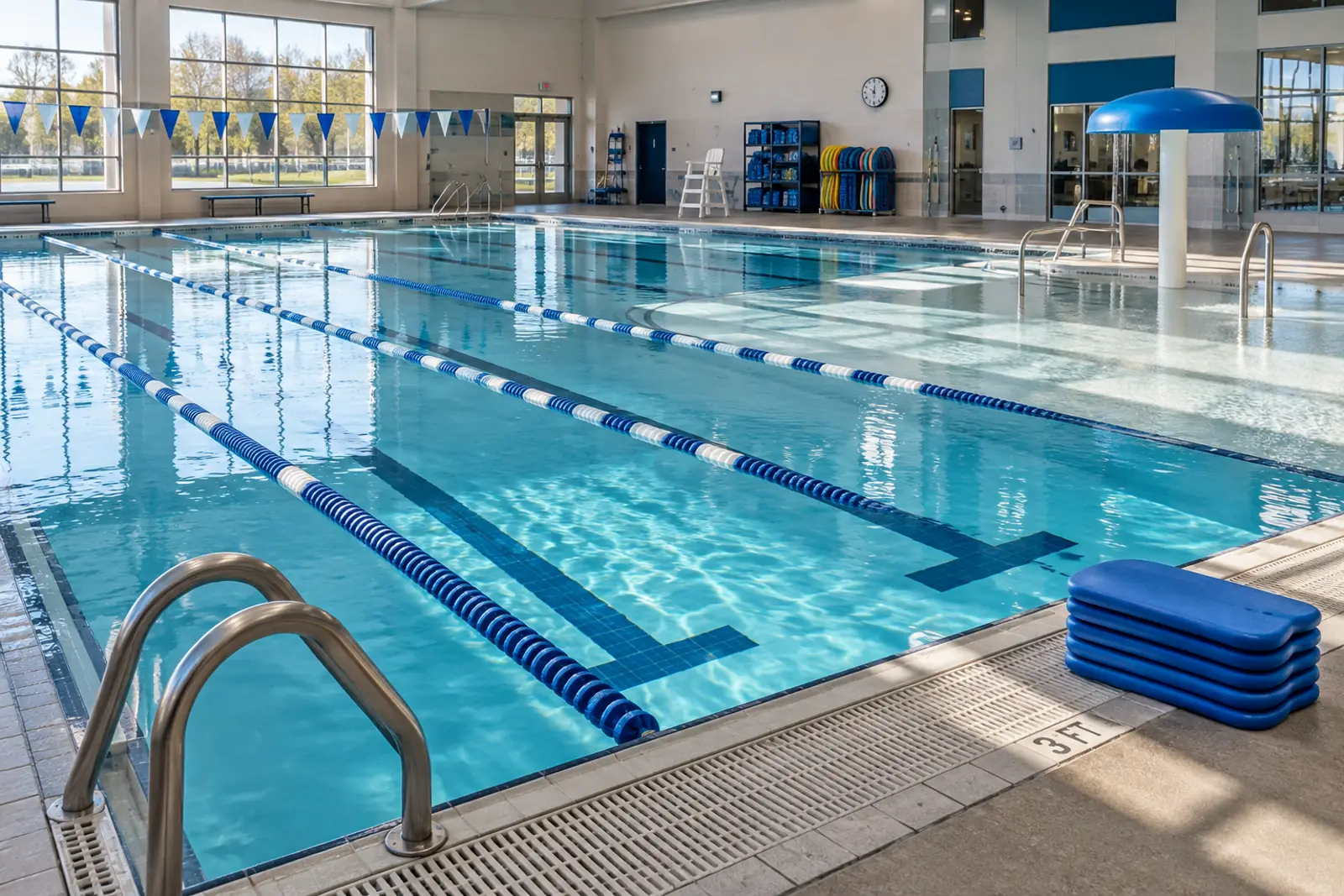
How Many Americans Can't Swim: National Estimates Reconciled, 2014 to 2023
All pool industry research (43 reports)