Pool Fence Ideas: 12 Styles From Glass to Living Walls, Checked Against the Barrier Code
Pool fence ideas that pass code share four 2024 ISPSC rules: 48 inches tall, no gap a 4 inch sphere fits through, no climbable rails outside, and an outward, self-closing, self-latching gate.
- ✓12 styles checkedEach idea is matched to the Section 305 rule that decides it.
- ✓Cost per footInstalled $10 to $500 per linear foot by style (HomeGuide, Feb 2026).
- ✓State rulesArizona and California require 60 inches (PC&S research).
Key takeaways
- Every pool fence idea has to clear the same model-code tests: at least 48 inches tall, no opening that passes a 4 inch sphere, and a bottom gap of 2 inches over grass or 4 inches over concrete (2024 ISPSC 305.2.1 and 305.2.2).
- Picket styles pass when pickets are 4 inches apart or less with rails 45 inches or more apart, or 1.75 inches apart with the rails on the pool side when rails are closer (2024 ISPSC 305.2.6 and 305.2.7).
- Glass panels within 60 inches of the water with a bottom edge under 60 inches sit in a hazardous location, so the glass has to be tested safety glazing (2024 IRC R324.4.5).
- Removable mesh fences must be certified to ASTM F2286 and set at least 20 inches from the water, and they may not go on top of an above-ground pool (2024 ISPSC 305.2.5).
- Installed prices run $10 to $30 per linear foot for mesh, $30 to $45 for aluminum or vinyl and $120 to $500 for tempered glass (HomeGuide, February 2026).
- Arizona and California set a 60 inch minimum; 20 of 51 US jurisdictions require a pool barrier statewide as of October 2026 (PC&S pool fence law research).
Which pool fence ideas pass the barrier code?
Ten of the 12 pool fence ideas in this table can pass the 2024 International Swimming Pool and Spa Code (ISPSC) when the details are right; horizontal cable rail usually fails, and a hedge never counts on its own. The table checks each style against the Section 305 rule that decides it and gives HomeGuide’s February 2026 installed price per linear foot.
| Pool fence idea | Code verdict | Rule that decides it | What to write into the quote | Installed $/LF (HomeGuide, Feb 2026) | Source |
|---|---|---|---|---|---|
| Frameless or semi-frameless glass panels | Passes when gaps are tight and the glass is safety glazing | No gap between or under panels passes a 4 in sphere; bottom 4 in max over concrete; glass within 60 in of the water is a hazardous location | Panel gap and spigot clearance in inches; glass labeled CPSC 16 CFR 1201 or ANSI Z97.1 | $120 to $500 | 2024 ISPSC 305.2.1, 305.2.2; 2024 IRC R324.4.5 |
| Black aluminum flat-top picket | Passes with the right rail spacing | Rails 45 in or more apart: pickets 4 in max; rails closer than 45 in: rails on the pool side and pickets 1.75 in max | Rail spacing, picket gap (Weatherables lists 3.8 in for one aluminum panel), height at least 48 in | $30 to $45 | 2024 ISPSC 305.2.6, 305.2.7 |
| Wrought iron with scrolls or finials | Passes if the scrollwork is tight | Decorative cutouts 1.75 in max; same picket rules as aluminum | Largest cutout width in the scroll panel | $50 to $85 | 2024 ISPSC 305.2.6, 305.2.7 |
| Removable mesh (child safety fence) | Passes as a listed system set back from the water | Certified to ASTM F2286; inside face at least 20 in from the water; never on top of an onground pool | ASTM F2286 listing, setback in inches, self-closing gate | $10 to $30 | 2024 ISPSC 305.2.5, 305.2.5.1 |
| Vinyl picket or vinyl privacy panel | Passes with the same picket or solid-face rules | Picket fences follow 305.2.6 or 305.2.7; solid panels must have no handholds or footholds | Picket gap (Weatherables lists 3.7 in for one vinyl pool panel), which side the rails face | $30 to $45 | 2024 ISPSC 305.2.3, 305.2.6, 305.2.7 |
| Vertical wood board or board-on-board privacy | Passes with a smooth outside face | Solid barrier with no handholds or footholds; rails less than 45 in apart go on the pool side | Rails face the pool; bottom gap 2 in over soil | $20 to $40 | 2024 ISPSC 305.2.1, 305.2.3, 305.2.6 |
| Modern horizontal slat wood | Fails if the slats face outward with gaps | Horizontal members less than 45 in apart must sit on the pool side, so open slats on the street side act as a ladder | Solid backer or vertical infill on the outside face; slats on the pool side only | $20 to $40 (wood) | 2024 ISPSC 305.2.3, 305.2.6 |
| Horizontal cable or rod rail | Fails in most designs | Cables are horizontal members spaced well under 45 in, exposed to the outside | Use it only as a deck guard inside a compliant fence | Not priced by HomeGuide | 2024 ISPSC 305.2.6 |
| Chain link with privacy slats | Passes with small mesh | Openings 1.75 in max, with or without slats; CPSC suggests 1.25 in mesh | Mesh opening size in inches, top and bottom rail or tension wire | $10 to $29 | 2024 ISPSC 305.2.8; CPSC Pub. 362 |
| Lattice or diagonal pattern | Passes only with small openings | Diagonal openings 1.75 in max; members within 45 degrees of vertical | Lattice opening size and angle | $20 to $40 (wood) | 2024 ISPSC 305.2.9 |
| Living wall: hedge, bamboo or vines | Not a barrier on its own | A barrier must pass 305.2.1 to 305.2.2; plants do not, and natural features count only when the building official approves them | Plant the hedge beside a compliant fence, outside the 3 ft climb zone | Fence price plus planting (not priced) | 2024 ISPSC 305.2, 305.7 |
| Screen enclosure (pool cage) | Passes as a designed enclosure | Designed by a registered design professional; barrier mesh 100 lb/sq ft tensile (ASTM D5034) and 150 lb/sq ft burst (ASTM D3787) | Engineer's drawings and the mesh test data | $8 to $15 per sq ft (Angi, Sept 2026) | 2024 ISPSC 305.2.4, 305.2.4.1 |
Sources: 2024 ISPSC Chapter 3 (ICC via UpCodes, read November 10, 2026); 2024 IRC R324.4.5; CPSC Publication 362; installed prices from HomeGuide (updated February 2026) and Angi (September 2026); picket gaps from Weatherables listings captured October 19, 2026. Download CSV
The ISPSC is the model code the International Code Council (ICC) publishes for pools and spas, and the 2024 International Residential Code (IRC) sends home pools to it in one line: Section R328.1 says pools and spas shall comply with the ISPSC (2024 IRC R328.1). Your city may adopt an older edition or add amendments, so treat the table as the model rule and ask the permit office which edition it enforces.
What are the pool fence requirements every style has to meet?
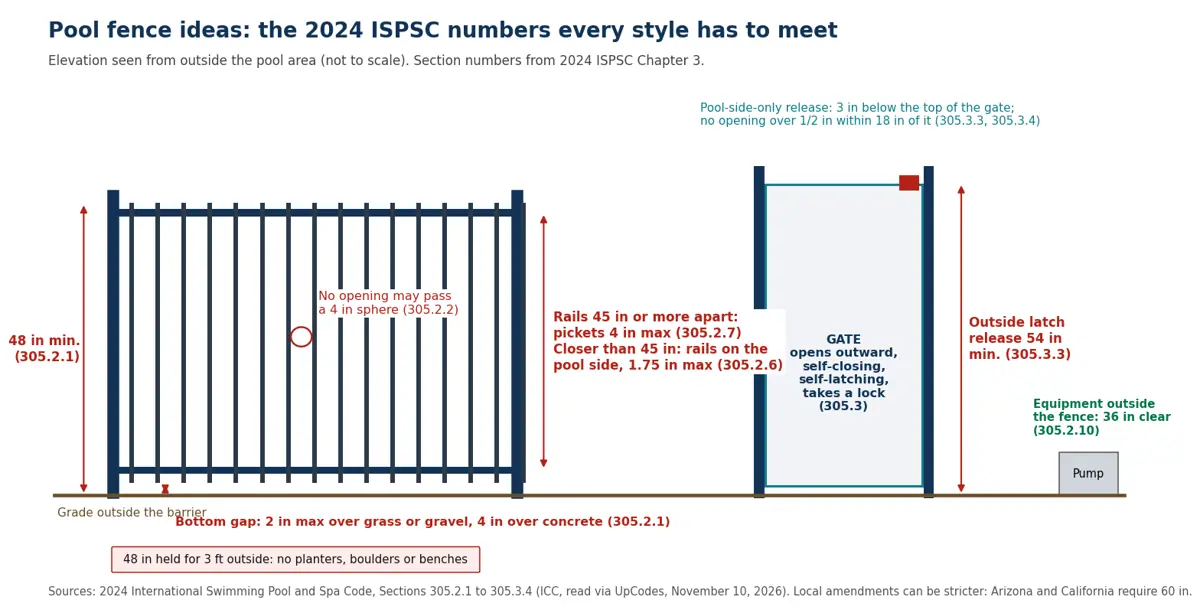
Pool fence requirements under 2024 ISPSC Section 305 come down to ten numbers: 48 inches of height held for 3 feet outside, a 4 inch sphere test, 2 or 4 inch bottom gaps, a 45 inch rail rule, 1.75 inch cutouts, a 20 inch mesh setback, a 54 inch latch and a 36 inch equipment zone. State law can raise the height to 60 inches.
| Number | What it controls | Section |
|---|---|---|
| 48 in | Minimum barrier height, measured outside, held for 3 ft out from the fence | 2024 ISPSC 305.2.1 |
| 60 in | Minimum height in Arizona and California state law | A.R.S. 36-1681; Cal. HSC 115923 |
| 4 in | Largest sphere that may not pass through any opening | 2024 ISPSC 305.2.2 |
| 2 in / 4 in | Bottom gap over grass or gravel / over concrete | 2024 ISPSC 305.2.1 |
| 45 in | Rail spacing that switches the picket rule (1.75 in below it, 4 in at or above it) | 2024 ISPSC 305.2.6, 305.2.7 |
| 1.75 in | Cutouts, chain link openings and diagonal openings | 2024 ISPSC 305.2.6 to 305.2.9 |
| 20 in | Minimum setback of a mesh fence from the water | 2024 ISPSC 305.2.5.1 |
| 54 in | Outside latch release height on a residential gate | 2024 ISPSC 305.3.3 |
| 36 in | Clear space between the fence and pool equipment outside it | 2024 ISPSC 305.2.10 |
| 60 in | Glass within 60 in of the water with a bottom edge under 60 in is a hazardous location | 2024 IRC R324.4.5 |
Sources: 2024 ISPSC Section 305; 2024 IRC R324.4.5; state rules from PC&S pool fence laws by state (A.R.S. 36-1681; Cal. HSC 115923), as of October 4, 2026. Download CSV
The 3 foot rule is the easiest one to break by accident: the 48 inch height has to exist for 3 feet measured horizontally from the outside of the fence, so a raised planter or a boulder placed there shortens the fence. The U.S. Consumer Product Safety Commission’s barrier guide calls 48 inches the minimum and 5 feet or higher preferable (CPSC Publication 362). Florida’s statute also sets 4 feet for residential pools deeper than 24 inches (Fla. Stat. 515.29).
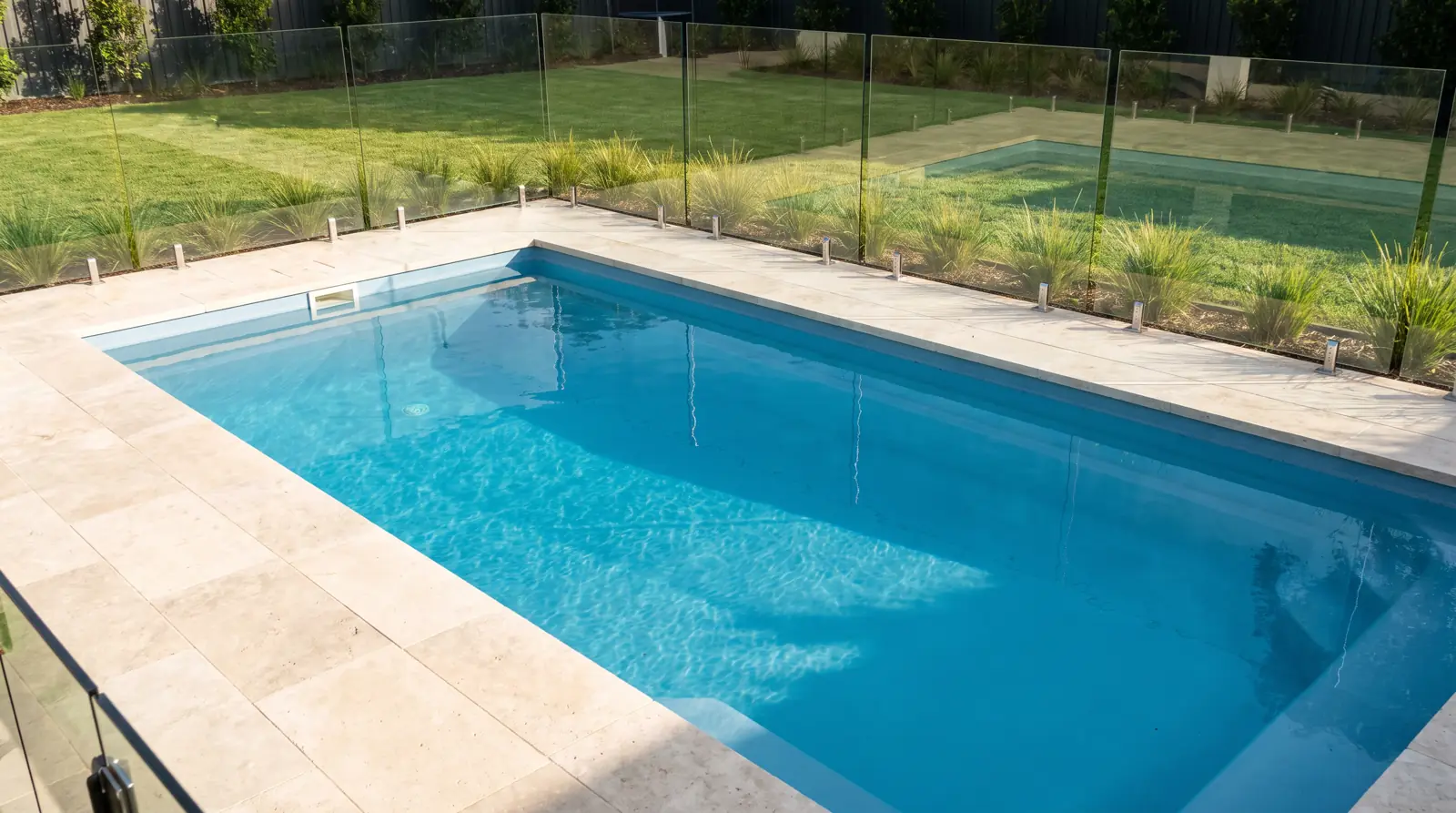
Glass pool fence ideas: frameless or semi-frameless?
A glass pool fence passes when no gap between or under the panels lets a 4 inch sphere through, the bottom gap stays at 4 inches or less over concrete, and the glass is safety glazing. Frameless panels on spigots and semi-frameless panels between posts meet the same tests; HomeGuide lists tempered glass at $120 to $500 per linear foot installed as of February 2026.
The glazing rule comes from the IRC, not the pool code. Section R324.4.5 treats glass in walls, enclosures or fences beside indoor or outdoor swimming pools as a hazardous location when its bottom edge is less than 60 inches above the walking surface, unless the glass is more than 60 inches from the water’s edge, measured horizontally (2024 IRC R324.4.5). Glass in a hazardous location must pass the impact test in R324.3, which names CPSC 16 CFR 1201, with ANSI Z97.1 allowed for glazing outside doors and tub or shower enclosures.
Does a glass pool fence need a top rail? Not under the ISPSC, which sets height, openings and climbability rather than a frame. A smooth glass face has no handholds or footholds, which is why glass passes 305.2.3 easily; the failures happen at the gaps, at the hinge side of the glass gate and at the bottom clearance over a lawn, where the limit is 2 inches.
Aluminum and wrought iron pool fence ideas: how far apart can pickets be?
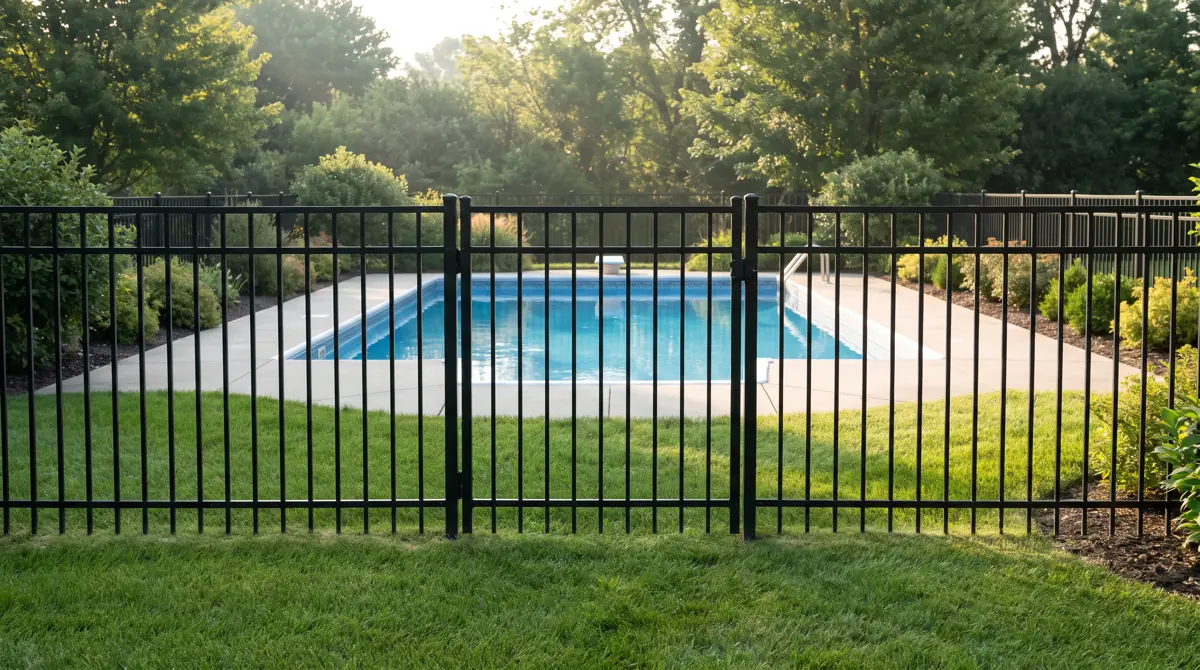
Pickets can be up to 4 inches apart when the tops of the horizontal rails are 45 inches or more apart, under 2024 ISPSC 305.2.7. When rails are closer than 45 inches, they have to sit on the pool side and pickets drop to 1.75 inches. Scrolls and finials in wrought iron count as cutouts, capped at 1.75 inches.
Retail pool panels are built to the 4 inch rule. Weatherables lists 3.8 inch picket spacing for its Pacific aluminum panel and 3.7 inches for its Neptune vinyl pool panel, as captured on October 19, 2026 (Pacific listing, Neptune listing). Before ordering, measure the rail spacing on the drawing: a three-rail panel with the middle rail on the outside can turn a 45 inch rail gap into two short ones that form a step.
Installed cost per linear foot: aluminum $30 to $45 and wrought iron $50 to $85 (HomeGuide, February 2026). A flat-top or pressed-spear top avoids the scrollwork question entirely; a scrolled panel passes only if the largest scroll opening measures 1.75 inches or less.
Is a removable pool fence code compliant?
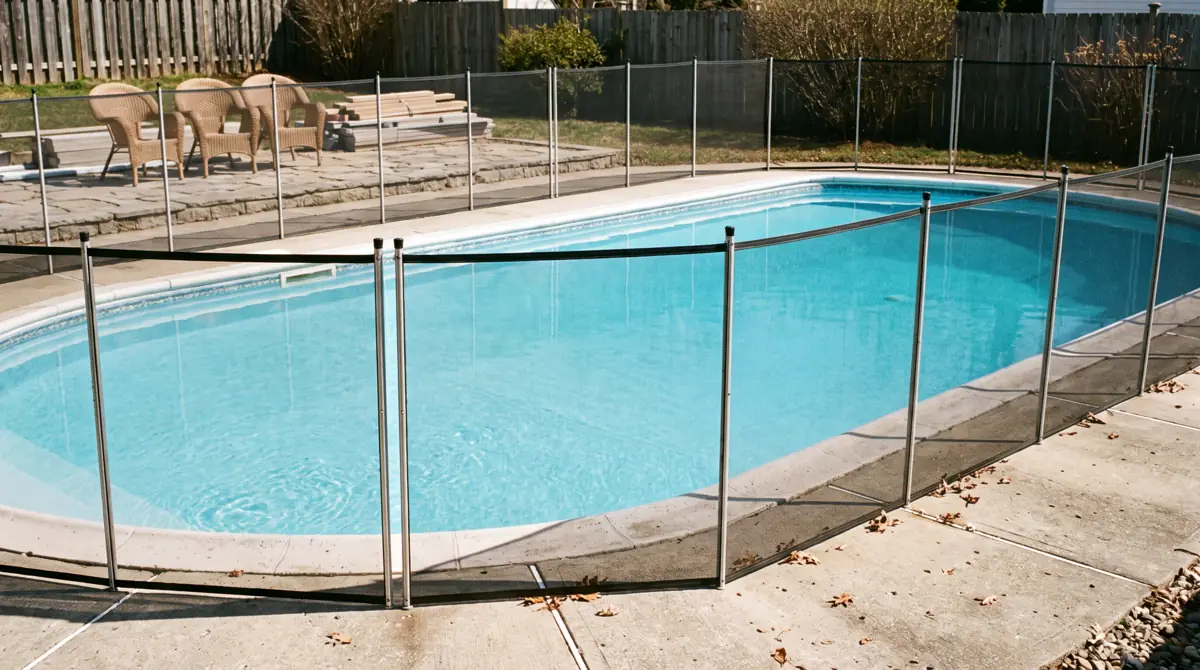
Yes, a removable mesh pool fence is compliant under the 2024 ISPSC when the system meets ASTM F2286, its inside face stands at least 20 inches from the water and any hinged gate follows Section 305.3. It may not be mounted on top of an above-ground pool. HomeGuide lists $10 to $30 per linear foot installed as of February 2026.
- Confirm the listingAsk for the ASTM F2286 certification of the exact fence system (2024 ISPSC 305.2.5).
- Mark the 20 inch setbackMeasure from the water’s edge to the inside face of the mesh: 20 inches minimum (305.2.5.1).
- Set the postsCPSC Publication 362 suggests posts at least 3 inches below grade and no more than 40 inches apart, with the mesh bottom 1 inch or less above the deck.
- Add a self-closing gateA hinged gate in a mesh fence has to open outward, self-close and self-latch (305.3).
- Price the DIY routeA 4 ft x 12 ft DIY mesh section listed at $115.86, or $9.66 per foot, on October 19, 2026 (Pool Fence DIY), before the gate and drilling.
Wood and vinyl privacy pool fence ideas: which side do the rails go on?
On a wood or vinyl privacy pool fence, the rails go on the pool side whenever they are less than 45 inches apart, and the outside face has to be free of handholds and footholds under 2024 ISPSC 305.2.3 and 305.2.6. HomeGuide lists wood at $20 to $40 and vinyl at $30 to $45 per linear foot installed as of February 2026.
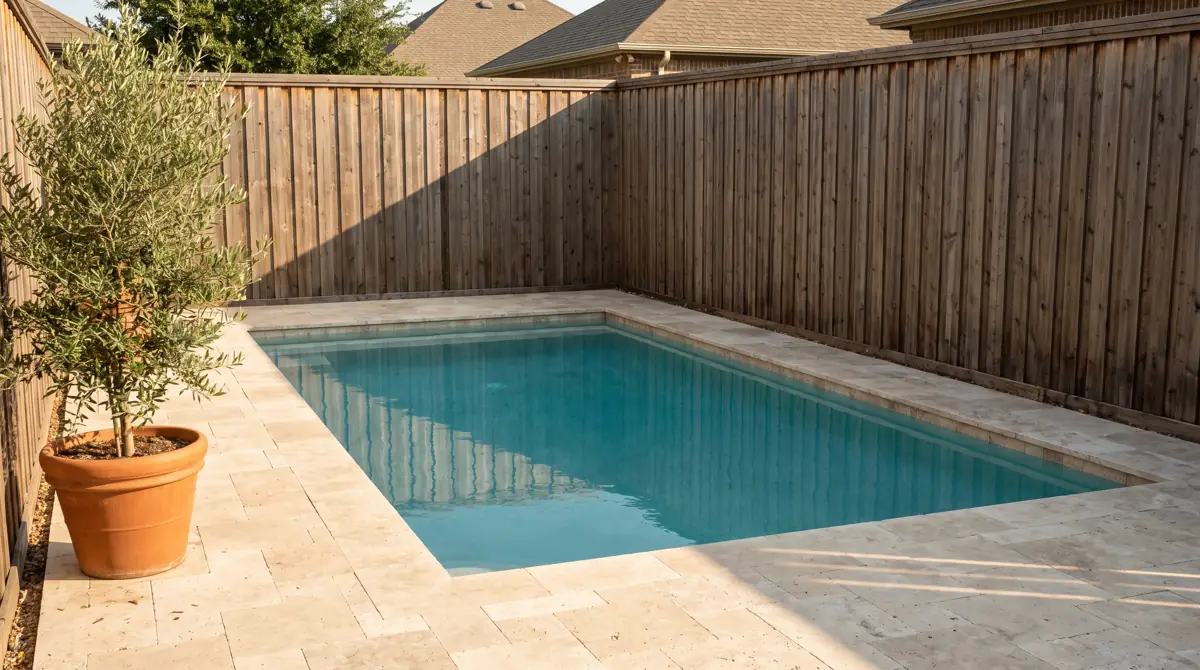
Can a horizontal slat fence be a pool fence? Only with the slats on the pool side. Open horizontal slats on the street side are horizontal members far less than 45 inches apart, and 305.2.6 puts those on the pool side. The usual fix is a solid or tight vertical face toward the street and the slat pattern facing the water.
Does lattice work? A lattice top or panel passes only if each diagonal opening is 1.75 inches or smaller and the members lean no more than 45 degrees from vertical (2024 ISPSC 305.2.9). Standard garden lattice with larger squares fails that test and gives a child a ladder.
| Design detail | Why it fails or passes | Fix | Section |
|---|---|---|---|
| Planter, boulder or bench against the outside face | Lowers the effective height below 48 in inside the 3 ft zone | Move it 3 ft out or inside the pool area | 2024 ISPSC 305.2.1 |
| Fence dropped onto lawn with a 3 in gap | Grass and gravel allow only 2 in | Lower the panel or pour a concrete mow strip (4 in allowed) | 2024 ISPSC 305.2.1 |
| Pump pad 2 ft outside the fence | Equipment must sit 36 in from the outside of the barrier | Move the pad or bring it inside the fence | 2024 ISPSC 305.2.10 |
| Gate that swings into the pool area | Pedestrian gates must open outward, self-close and self-latch | Rehang with the swing away from the pool | 2024 ISPSC 305.3 |
| Latch knob at 42 in on the street side | A non-locking outside release must sit at 54 in or higher | Raise the release or move it to the pool side, 3 in below the top | 2024 ISPSC 305.3.3 |
| Mesh fence clipped to an above-ground pool wall | Mesh may not be installed on top of an onground pool | Use the pool wall plus a barrier listed by the pool maker | 2024 ISPSC 305.2.5, 305.5 |
| Ordinary annealed glass panels | Glass beside the water within 60 in is a hazardous location | Specify tested safety glazing | 2024 IRC R324.4.5, R324.3 |
| House wall with a patio door as the fourth side | Needs a UL 2017 door alarm, an ASTM F1346 cover or another approved means | Add the alarm or a listed cover | 2024 ISPSC 305.4 |
Sources: 2024 ISPSC Chapter 3 (ICC via UpCodes, read November 10, 2026); 2024 IRC R324.4.5; CPSC Publication 362; installed prices from HomeGuide (updated February 2026) and Angi (September 2026); picket gaps from Weatherables listings captured October 19, 2026. Download CSV
Can a hedge or living wall be a pool fence?
No, a hedge, bamboo screen or vine wall is not a pool barrier by itself: the 2024 ISPSC requires a barrier that meets the height and 4 inch opening tests of Section 305.2, and it accepts natural features only when the building official approves them under 305.7. Plant the hedge beside a compliant fence instead, and keep it out of the 3 foot climb zone outside.
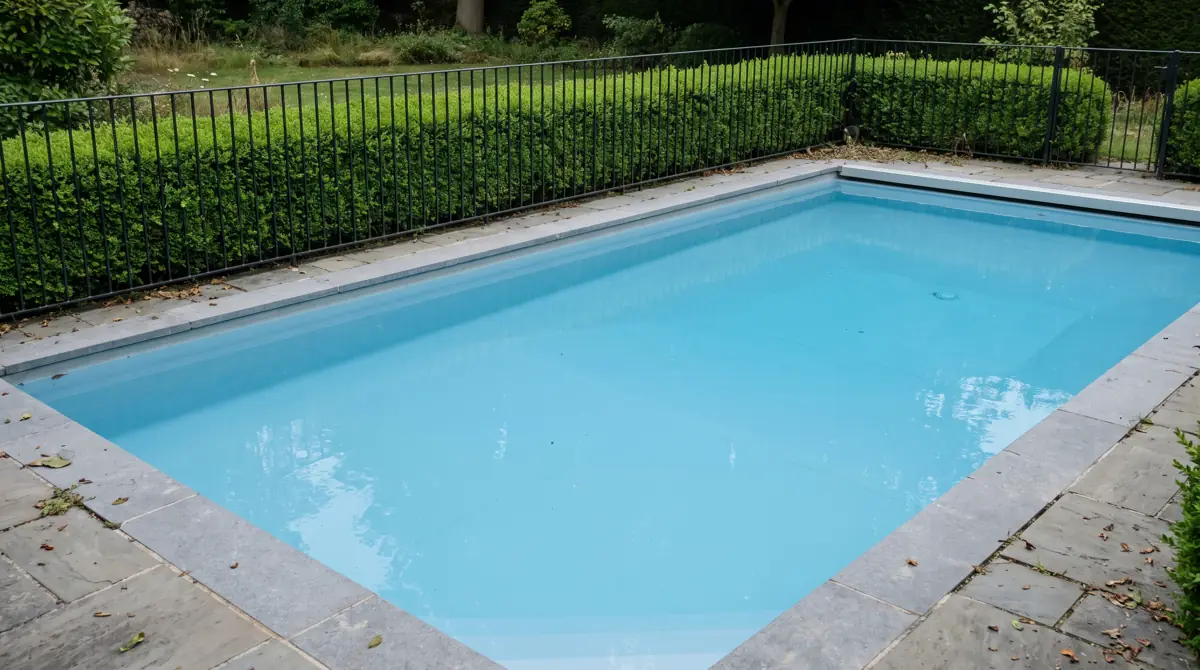
The living-wall idea works in two layouts: hedge inside the fence on the pool side, where branches cannot help anyone climb from outside, or hedge on the outside at least 3 feet from the fence, where 305.2.1 measures the 48 inch height. Vines trained up the outside face add footholds to a solid wall, which 305.2.3 forbids. Plant choices, root distances and drainage around the deck are in our guide to pool landscaping ideas.
Which pool gate ideas pass inspection?
A pool gate passes when it opens outward away from the pool, closes and latches on its own, can take a lock and does not swing over stairs (2024 ISPSC 305.3). A non-locking outside release sits at 54 inches or higher; a pool-side-only release sits 3 inches below the top of the gate. HomeGuide lists self-closing, self-locking gates at $200 to $800.
- Swing Outward, away from the pool or spa, never over a step (305.3).
- Hinges Self-closing from any open position; test by opening the gate a few inches and letting go.
- Latch height Outside release 54 inches or higher on residential pools, or a key or code lock at 54 inches or lower (305.3.3).
- Pool-side release At least 3 inches below the top of the gate, with no opening larger than 1/2 inch within 18 inches of it (305.3.3, 305.3.4).
- Double gates One leaf secured in place, the other self-latching (305.3.2). Service gates stay locked when not in use (305.3.1).
A decorative gate can fail 305.3.4 when its frame has openings wider than 1/2 inch within 18 inches of an inside latch. A latch shield or a mesh panel over the 18 inch zone fixes it. Gate pricing and full fence quotes for a typical yard are in our pool fence cost guide.
What are some alternatives to a pool fence?
The 2024 ISPSC accepts four alternatives: a powered safety cover listed to ASTM F1346, which exempts the pool area from Sections 305.2 to 305.7; an above-ground pool wall at least 48 inches high; an engineered screen enclosure; and natural topography the building official approves. A hedge is not one of them.
| Alternative to a pool fence | When the code accepts it | Section | Cost reference |
|---|---|---|---|
| Powered safety cover listed to ASTM F1346 | Exempts the pool area from Sections 305.2 to 305.7 where the code is adopted without change | 2024 ISPSC 305.1 | $7,000 to $25,000 installed (Angi, Mar 2025) |
| Above-ground pool wall | Wall top 48 in above grade all the way around, ladder secured, locked or removed | 2024 ISPSC 305.5 | Included in the pool |
| Screen enclosure | Engineered enclosure with tested mesh | 2024 ISPSC 305.2.4 | $8 to $15 per sq ft (Angi, Sept 2026) |
| Natural topography or a lake edge | Only with approval, or a shoreline with no public access and the barrier carried 18 in past the water's edge | 2024 ISPSC 305.6, 305.7 | Not priced |
| Hedge or living wall | Not accepted as the barrier by itself | 2024 ISPSC 305.2 | Not priced |
Sources: 2024 ISPSC 305.1, 305.2.4, 305.5 to 305.7; costs from Angi automatic cover cost (March 2025) and Angi pool enclosure cost (September 2026). Download CSV
The cover route has a narrow condition. Section 305.1 exempts the area only for a powered cover that complies with ASTM F1346, and a manual cover does not qualify for pools; several states also write their own rules. Cover types and the F1346 test are compared in our pool safety cover guide, and enclosure pricing is in pool enclosure cost.
What is the cheapest pool fence idea that still passes code?
Removable mesh and black chain link are the cheapest pool fence ideas that can pass code, at $10 to $30 and $10 to $29 per linear foot installed (HomeGuide, February 2026). Chain link passes only with openings of 1.75 inches or less. Tempered glass sits at the other end, at $120 to $500 per foot.
Source: HomeGuide, Pool Fence Cost (updated February 3, 2026), as recorded on /pool-fence-cost/ on October 19, 2026.. Download chart data (CSV)
Per-foot rates hide length. A 16 x 32 ft pool with a 3 ft walkway needs about 120 linear feet, so each $10 per foot difference is about $1,200, a figure worked out in the pool fence cost breakdown. Permit fees for the fence vary by city; Austin’s small-projects plan review was $146.15 in its FY 2026-27 schedule (PC&S pool permit cost research).
Which pool fence idea fits your yard?
Pick the rule you must meet first, then the look: glass for the view, mesh for the lowest price and toddler years, solid board or vinyl for privacy, slats only on the pool side, and a hedge only beside a real fence. Arizona and California owners should start every idea at 60 inches.
| If your situation is | Do this | Why |
|---|---|---|
| You want the view of the water from the house | Price frameless glass and ask for the panel gap in writing | Glass passes when no gap passes a 4 in sphere; it costs $120 to $500 per foot (HomeGuide) |
| You want the lowest installed price per foot | Removable mesh, chain link or aluminum, in that order | HomeGuide lists $10 to $30, $10 to $29 and $30 to $45 per foot |
| You have toddlers and want the fence off for parties | Removable mesh certified to ASTM F2286, set 20 in or more from the water | 305.2.5.1 sets the 20 in setback |
| You want privacy from neighbors | Vertical board, board-on-board or solid vinyl with the rails on the pool side | Solid faces may not offer handholds (305.2.3) |
| You love the horizontal slat look | Put the slats on the pool side over a solid or vertical outside face | Open horizontal members under 45 in apart must face the pool (305.2.6) |
| You want a green hedge as the fence | Plant it beside a compliant fence, outside the 3 ft climb zone | Plants do not pass the barrier tests on their own |
| You live in Arizona or California | Order 60 in panels and gates from the start | State law sets 60 in, above the 48 in model code |
| You want no fence at all | Price a powered ASTM F1346 cover and confirm your city adopted 305.1 unchanged | 305.1 exempts the pool area where it applies |
Sources: 2024 ISPSC Chapter 3 (ICC via UpCodes, read November 10, 2026); 2024 IRC R324.4.5; CPSC Publication 362; installed prices from HomeGuide (updated February 2026) and Angi (September 2026); picket gaps from Weatherables listings captured October 19, 2026. Download CSV
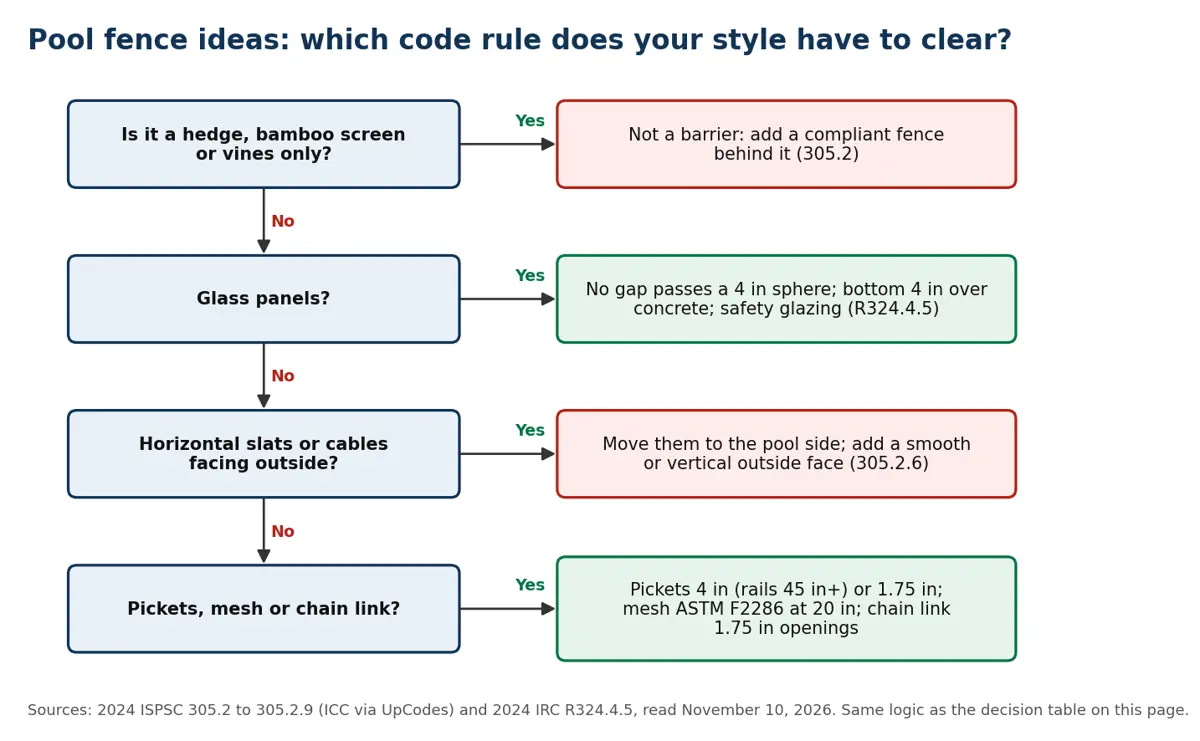
How we compiled this
We read the 2024 ISPSC Chapter 3 and the 2024 IRC Chapter 3 on UpCodes (Austin adoption copies) on November 10, 2026, and checked each fence style against the section that governs it. Prices and the CPSC, Florida and state-law figures come from 9 documents already verified for our pool fence cost guide and pool fence law research in October 2026. We did not install, test or inspect any fence.
Frequently Asked Questions
What is the cheapest way to fence a pool?
Removable mesh at $10 to $30 per linear foot installed and black chain link at $10 to $29 are the lowest installed prices (HomeGuide, February 2026). Mesh must meet ASTM F2286 and stand 20 inches from the water; chain link openings may not exceed 1.75 inches (2024 ISPSC 305.2.5 and 305.2.8). Both still need a self-closing, self-latching gate.
What are some good options for pool fencing?
Aluminum picket, removable mesh, glass, vinyl and solid wood all pass the 2024 ISPSC when built to its numbers: 48 inches tall, no opening that passes a 4 inch sphere, a 2 inch bottom gap over grass and an outward-opening, self-closing gate. Choose by goal: glass for the view, mesh for price, wood or vinyl for privacy.
What are some alternatives to a pool fence?
The 2024 ISPSC accepts a powered safety cover listed to ASTM F1346 (Section 305.1), an above-ground pool wall at least 48 inches high with the ladder secured (305.5), an engineered screen enclosure (305.2.4) and approved natural topography (305.7). Angi priced automatic covers at $7,000 to $25,000 installed in March 2025. A hedge does not count.
What is the best DIY pool fence for my pool?
Removable mesh is the usual DIY choice because sections drop into drilled deck sleeves; one 4 ft x 12 ft section listed at $115.86, or $9.66 per foot, on October 19, 2026 (Pool Fence DIY). Buy a system certified to ASTM F2286, keep it 20 inches from the water and confirm whether your city requires a permit before drilling.
How tall does a pool fence have to be?
At least 48 inches above grade, measured on the side away from the pool and held for 3 feet out from the fence, under 2024 ISPSC 305.2.1. Arizona (A.R.S. 36-1681) and California (Health and Safety Code 115923) require 60 inches, and the CPSC calls 5 feet or higher preferable.
Does a glass pool fence need safety glass?
Yes in most layouts. The 2024 IRC treats glass in fences beside a pool as a hazardous location when its bottom edge is under 60 inches above the walking surface and it is within 60 inches of the water (R324.4.5). Glass there must pass the CPSC 16 CFR 1201 impact test or, where allowed, ANSI Z97.1.
Sources
- International Code Council via UpCodes. 2024 International Swimming Pool and Spa Code, Chapter 3 (Austin adoption copy). Accessed 2026-11-10.
- International Code Council via UpCodes. 2024 International Residential Code, Chapter 3 (R324.3, R324.4.5, R328.1; Austin adoption copy). Accessed 2026-11-10.
- U.S. Consumer Product Safety Commission. Safety Barrier Guidelines for Residential Pools, Publication 362. Accessed 2026-10-19.
- Florida Legislature. Florida Statutes Chapter 515, Residential Swimming Pool Safety Act. Accessed 2026-10-19.
- PC&S Research (A.R.S. 36-1681; Cal. HSC 115923; state codes). Pool Fence Laws by State. Accessed 2026-10-19.
- HomeGuide. Pool Fence Cost (updated February 3, 2026). Accessed 2026-10-19.
- Pool Fence DIY. Pool fence sections product page. Accessed 2026-10-19.
- Weatherables. Pacific Aluminum Fence listing. Accessed 2026-10-19.
- Weatherables. Neptune Pool Fence listing. Accessed 2026-10-19.
- Angi. How Much Does a Pool Enclosure Cost?. Accessed 2026-10-19.
- Angi. How Much Does an Automatic Pool Cover Cost? (Wayback capture May 17, 2025). Accessed 2026-10-19.
- PC&S Research. Pool Permit Cost (City of Austin fee schedule FY 2026-27). Accessed 2026-10-19.
Related pages
Get Quotes From Licensed Local Pool Pros
Tell us what you need and your ZIP code. We match you with pool companies that cover your area.