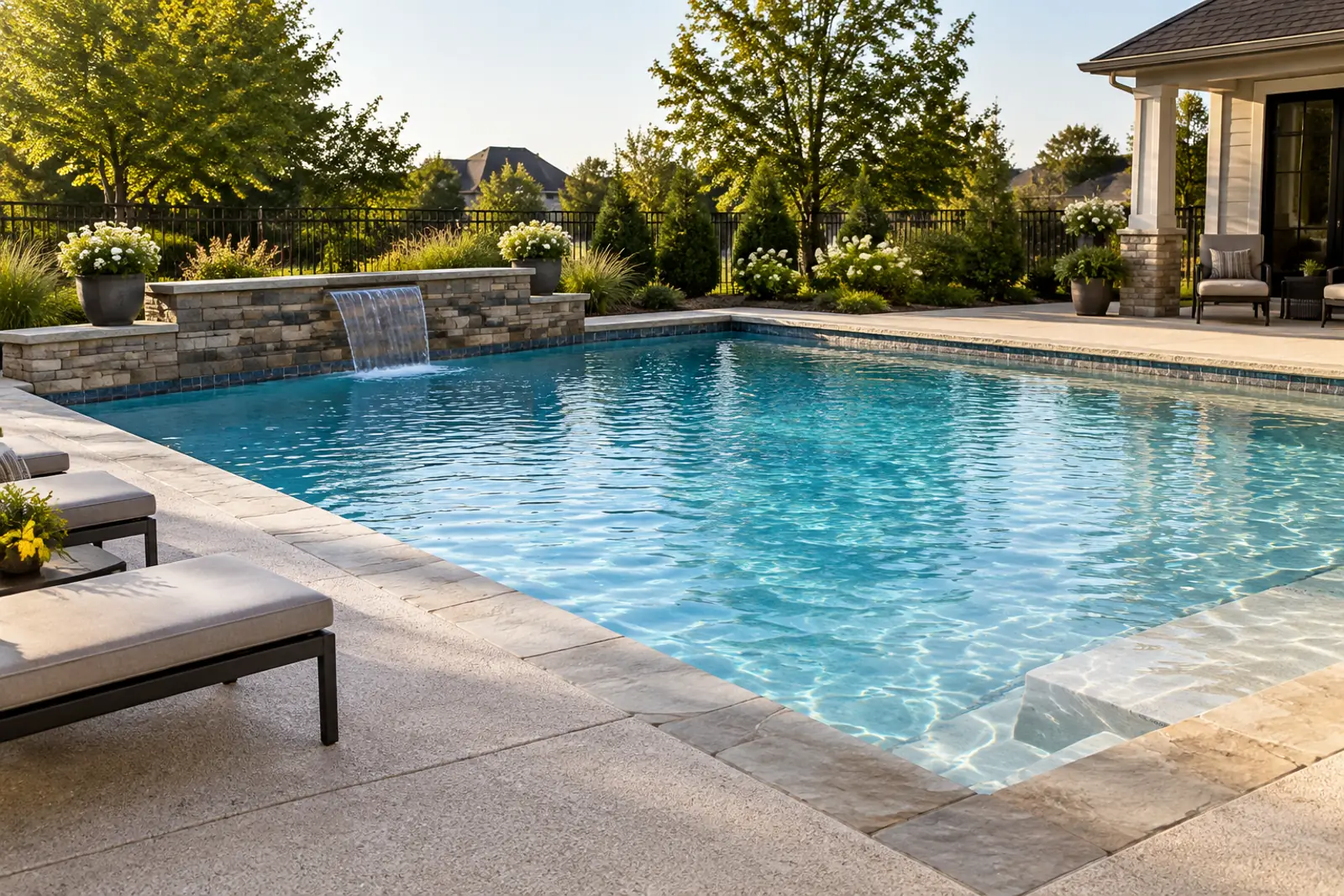
Pool Deck Materials Compared: Concrete, Pavers, Travertine, Wood and Coatings
Pool deck materials run from broom-finish concrete at $11.32 per square foot to flagstone at $31.29 in California's 2026 assessor tables; color sets surface heat, texture sets wet grip and freeze ratings set winter life.
- ✓Slip rules read at the sourceANSI A326.3 sets no DCOF value for pool decks; ISPSC 306.2 uses 0.42 where a deck is tested wet.
- ✓Heat by color, measuredOne paver finish runs from SRI 6 to SRI 67 across 12 colors in the maker's lab data.
- ✓Freeze data by cityChicago has 120 days a year with a normal low at or below 32F; Phoenix has none (NOAA 1991 to 2020).
Key takeaways
- Section 306.2 of the 2024 International Swimming Pool and Spa Code requires slip-resistant decks and, where a surface is tested wet, a minimum DCOF of 0.42 under ANSI A326 or pendulum class P4.
- ANSI A326.3-2021 itself sets no DCOF limit for pool decks: its 0.42 figure is for level interior floors, and an informative note puts outdoor wet floors at a generally accepted 0.55.
- Color moves deck heat more than the material name: one Techo-Bloc paver finish tests from SRI 6 in Onyx Black to SRI 67 in Pure White, and the EPA says conventional pavements reach 120 to 150F in summer.
- Concrete pavers made to ASTM C936 must average 8,000 psi and lose no more than 225 g/m2 after 28 freeze-thaw cycles in the ASTM C1645 test (CMHA PAV-TEC-002).
- Chicago averages 120 days a year with a normal low at or below 32F and Phoenix none, by our count of NOAA 1991 to 2020 daily normals; the IRC asks for 3,500 psi, 5 to 7% air-entrained concrete where weathering is severe.
- HUD plans on 15 years for a pool deck, 50 for concrete flatwork, 30 for brick or concrete pavers, 20 for treated lumber decks and 50 for composite decks.
What are the main pool deck materials?
Most pool decks are poured concrete (broom, stamped or exposed aggregate), concrete or brick pavers, natural stone such as travertine or flagstone, or wood and composite boards on raised decks. Cool-deck coatings resurface old concrete. Installed prices run from $6 per square foot for simple concrete to $80 for composite, per ConcreteNetwork (2026) and HomeGuide (2025).
| Material | Installed price per sq ft (source, date) | HUD planning life | Wet slip | Heat | Freeze-thaw standard | Source |
|---|---|---|---|---|---|---|
| Broom-finish concrete | $6 to $11 simple design (ConcreteNetwork, Feb 2026); $11.32 (BOE CA, 2026) | 50 years (concrete flatwork) | Textured hand finish; ISPSC minimum slope 1/8 in per ft | New concrete SR averaged 0.47 in PCA tests; darkens with traffic (EPA) | IRC Table R402.2: 3,500 psi, 5 to 7% air where severe | ConcreteNetwork; BOE AH 531; HUD; PCA; EPA; IRC |
| Stamped or colored concrete | $8 to $19 stamped patio (HomeGuide, Dec 2025); $14.33 colored salt finish (BOE CA, 2026) | 50 years (concrete flatwork) | Depends on stamp texture and sealer | Davis Colors SRI from 1 (Graphite) to 52 (Willow Green) | Same as concrete | HomeGuide; BOE AH 531; Davis Colors |
| Exposed aggregate concrete | Within $6 to $18+ concrete range (ConcreteNetwork) | 50 years (concrete flatwork) | ISPSC minimum slope 1/4 in per ft | Depends on stone color | Same as concrete | ConcreteNetwork; ISPSC Table 306.5 |
| Concrete pavers | $12 to $45 (ConcreteNetwork); $10 to $17 (HomeGuide) | 30 years (brick or concrete pavers) | Ask for the maker DCOF or pendulum data | Techo-Bloc HD2 Smooth SRI 6 to 67 by color | ASTM C936 with ASTM C1645: 225 g/m2 max loss after 28 cycles | ConcreteNetwork; HomeGuide; HUD; Techo-Bloc; CMHA |
| Brick pavers | $10 to $30 (ConcreteNetwork); $26.54 brick in sand (BOE CA) | 30 years | ISPSC minimum slope 1/8 in per ft residential | ConcreteNetwork notes brick can be hot | Not checked for this page; ask for the paving brick standard and grade | ConcreteNetwork; BOE AH 531; HUD |
| Travertine pavers | $20 to $34 (AE Outdoor Living, Phoenix, 2026) | No HUD row | Tumbled, not honed or polished, near water (AE) | Light colors stay cooler; no SR figure published by AE | ASTM C1527 lists no freeze-thaw test; ask the supplier | AE Outdoor Living; ASTM C1527 |
| Flagstone or natural stone | $15 to $32 flagstone; $16 to $35 natural stone (HomeGuide); $31.29 (BOE CA) | No HUD row | Irregular surface; check wet rating | Varies by stone color | Ask for absorption and freeze data | HomeGuide; BOE AH 531 |
| Wood deck | $15 to $40+ (ConcreteNetwork); $26.59 to $32.00 raised 1 to 3 ft (BOE CA) | 20 years (treated lumber) | ISPSC gaps 1/8 to 1/2 in between boards | Darker woods absorb more sun | Footings follow the local frost line depth in IRC Table R301.2 | ConcreteNetwork; BOE AH 531; HUD; ISPSC 306.6; IRC |
| Composite or PVC decking | $40 to $80 composite (HomeGuide); $31.08 to $48.98 plastic or fiberglass (BOE CA) | 50 years (composite) | Gaps per maker instructions (ISPSC 306.6) | TimberTech claims 30 degrees cooler for Cool Guard PVC, no test stated | No freeze test cited on the maker page read | HomeGuide; BOE AH 531; HUD; TimberTech |
| Cool-deck coating over concrete | $4 to $8 basic resurfacing; $6 to $12+ decorative overlay (ConcreteNetwork) | Not listed | Mortex calls Kool Deck Elite a non-skid, textured surface | Mortex says Kool Deck stays cooler than plain concrete; no figure | Mortex cites 100 degree days to freezing nights | ConcreteNetwork; Mortex |
Sources: ConcreteNetwork (Feb 13, 2026), HomeGuide (Dec 22, 2025), AE Outdoor Living (Phoenix), California BOE AH 531 (2026), HUD CNA e-Tool, ISPSC 2024, Techo-Bloc, Davis Colors, CMHA, TimberTech, Mortex; accessed 2026-10-26. Download CSV
Overlay range combines basic resurfacing ($4 to $8) and decorative overlay ($6 to $12+).
Source: ConcreteNetwork (updated February 13, 2026): overlay, concrete, brick, concrete pavers, rubber, wood; HomeGuide (December 22, 2025): stamped, flagstone, composite; AE Outdoor Living (Phoenix, 2026): travertine. Download chart data (CSV)
Concrete is the price floor: ConcreteNetwork puts a simple design at $6 to $11 per square foot, custom work at $11 to $18 and elaborate designs above $18 (updated February 13, 2026). Pavers cost more, $12 to $45 for concrete pavers and $10 to $30 for brick, but a damaged unit can be lifted and replaced without breaking the rest of the deck (ConcreteNetwork). Travertine sits at $20 to $34 installed in one Phoenix contractor’s published ranges (AE Outdoor Living).
California’s State Board of Equalization prices the same surfaces for property tax in its Assessors’ Handbook Section 531, effective January 1, 2026: $11.32 per square foot for broom-finish concrete, $26.54 for brick in sand, $31.29 for flagstone, $26.59 to $32.00 for a wood deck 1 to 3 feet off the ground and $31.08 to $48.98 for plastic or fiberglass decking (BOE AH 531). Our pool deck contractors page covers what installers charge for labor and how to vet them.
| Number | What it is | Source and date |
|---|---|---|
| 0.42 wet DCOF | Minimum where a deck surface is tested per ANSI A326 (ISPSC 306.2) | ISPSC 2024 |
| 0.55 wet DCOF | Generally accepted minimum for Exterior, Wet hard surfaces (informative note) | ANSI A326.3-2021 |
| SRI 6 to 67 | Same Techo-Bloc paver finish, darkest to lightest color | Techo-Bloc SR and SRI sheet, 2025 |
| 120 to 150 F | Peak summer surface temperature of conventional pavements | EPA Cool Pavements compendium |
| 225 g/m2 after 28 cycles | Maximum freeze-thaw mass loss for ASTM C936 concrete pavers (ASTM C1645) | CMHA PAV-TEC-002-22 |
| 3,500 psi, 5 to 7% air | IRC concrete for exterior slabs and steps where weathering is severe | IRC 2024 Table R402.2 |
| 15 years | Pool deck useful life in federal multifamily planning tables | HUD CNA e-Tool; Fannie Mae Form 4099.F |
Sources: ISPSC 2024, ANSI A326.3-2021, Techo-Bloc, EPA, CMHA, IRC 2024, HUD, Fannie Mae; accessed 2026-10-26. Download CSV
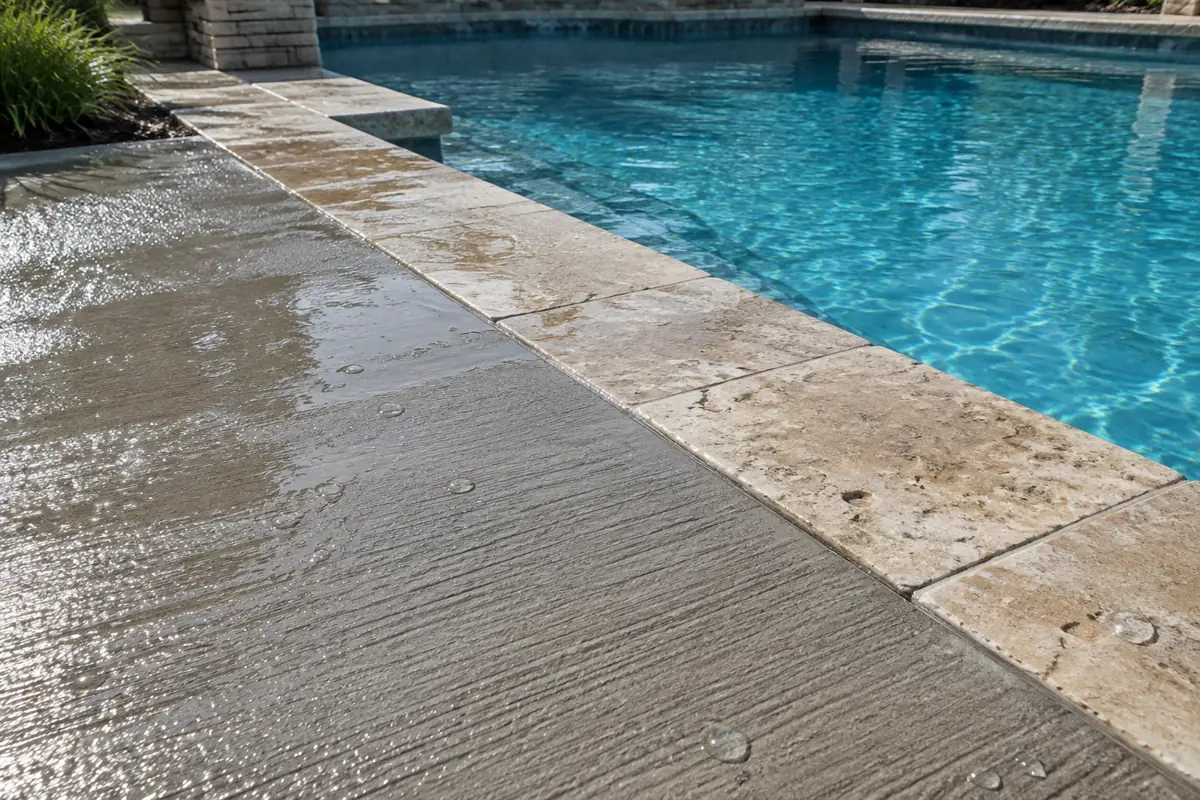
Which pool deck material is least slippery?
Texture and drainage decide wet grip more than the material name: broom-finished or exposed aggregate concrete, tumbled travertine and textured coatings grip better than polished stone or glossy tile. The 2024 ISPSC requires slip-resistant decks and a wet DCOF of at least 0.42 where tested, but ANSI A326.3 sets no single value for pool decks.
| Rule | What it says | Where it applies | Source |
|---|---|---|---|
| ISPSC 306.2 | Deck, ramp, coping and step surfaces must be slip resistant and cleanable; if tested wet, minimum DCOF 0.42 (ANSI A326) or pendulum class P4 (SA AS4586) | Pool and spa decks where the ISPSC is adopted | ISPSC 2024 |
| ISPSC 306.2 | The design professional decides the classification and level of slip resistance by surface type, environment and traffic | Same | ISPSC 2024 |
| ANSI A326.3 Interior, Wet | Minimum wet DCOF 0.42 on the BOT 3000E for level interior floors walked on when wet | Indoor level floors, not outdoor decks | ANSI A326.3-2021 |
| ANSI A326.3 Exterior, Wet | Manufacturer-declared; informative note says 0.55 wet DCOF is generally accepted | Level outdoor spaces including pool decks | ANSI A326.3-2021 |
| ANSI A326.3 pool decks | No single normative DCOF limit, because drainage, surface structure and contaminants decide suitability | Pool decks | ANSI A326.3-2021 |
| ISPSC Table 306.5 | Minimum slope 1/8 in per ft for textured concrete, wood, composite and residential pavers; 1/4 in for exposed aggregate; maximum 1/2 in | All decks unless water clears within 20 minutes | ISPSC 2024 |
Sources: ISPSC 2024 Sections 306.2 and 306.5 via UpCodes; ANSI A326.3-2021 (TCNA, released February 2022); accessed 2026-10-26. Download CSV
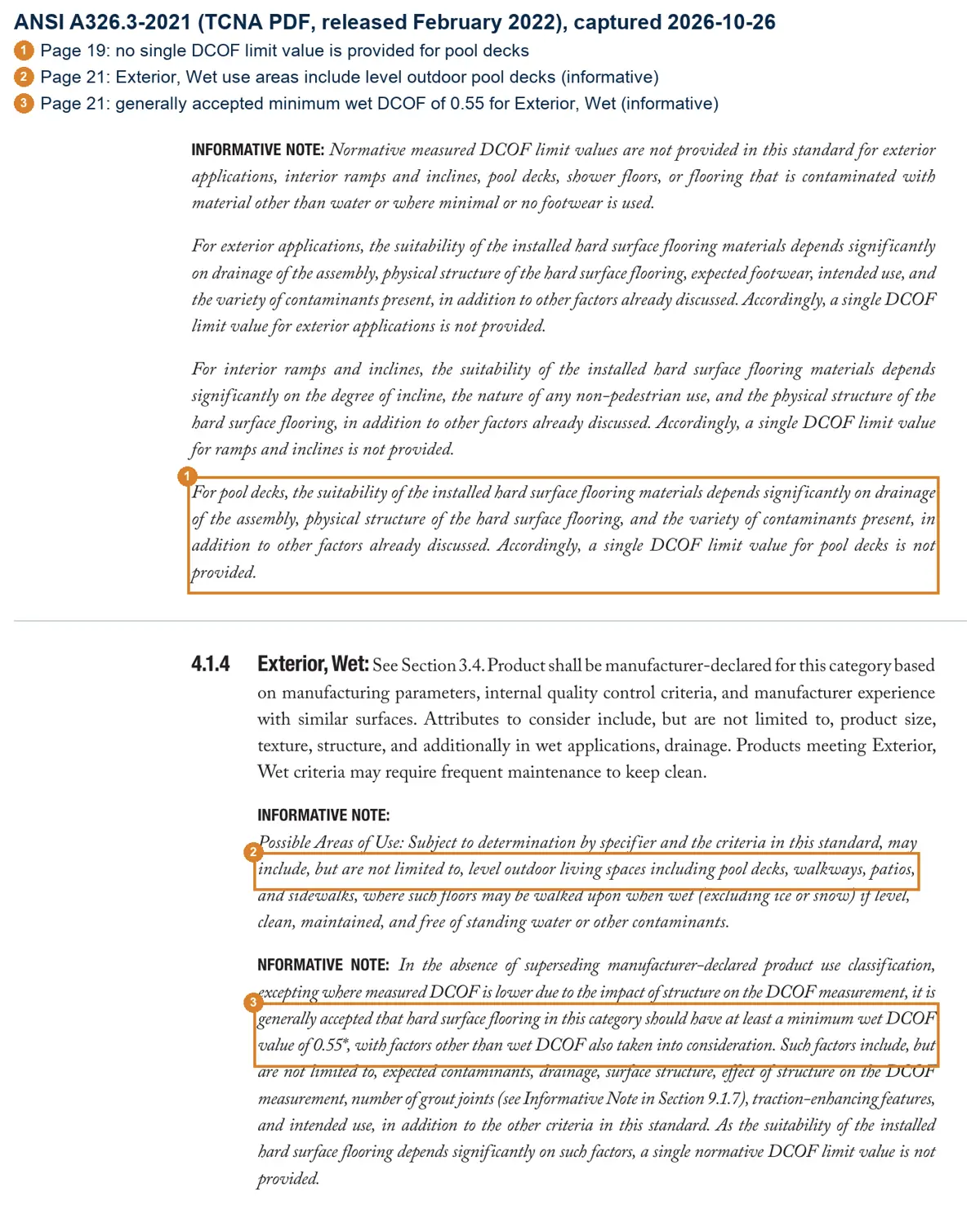
Several popular deck guides tell owners to “aim for DCOF 0.42” around a pool. The standard reads differently: 0.42 on the BOT 3000E tester is the floor for level interior floors walked on when wet, outdoor wet surfaces are manufacturer-declared with 0.55 described as generally accepted, and pool decks get no normative number because drainage and surface structure decide suitability (ANSI A326.3). The Tile Council of North America adds that the 2024 ISPSC references the 2017 edition of A326.3 (TCNA).
Drainage is the other half. ISPSC Table 306.5 sets minimum slopes of 1/8 inch per foot for textured concrete, wood, composite and residential pavers, 1/4 inch for exposed aggregate and 1/2 inch for carpet, with a maximum of 1/2 inch; a deck is exempt if water clears to under 1/8 inch within 20 minutes (ISPSC). Falls on decks are easy to miss in injury data: CPSC coders file a pool deck under product code 1817, not a pool code, as our pool injury statistics report notes.
Which pool deck material stays coolest?
The coolest pool deck is the lightest-colored one, whatever it is made of. Solar reflectance is the main driver of a pavement’s peak surface temperature, according to the EPA, and one Techo-Bloc paver finish tests from SRI 6 in Onyx Black to SRI 67 in Pure White. Conventional pavements reach 120 to 150F in summer. Planting beds, mulch and shade trees that sit well beside a hot deck are compared in our pool landscaping ideas guide.
Source: Techo-Bloc, Solar reflectance and LEED credits (TB2025): SR per ASTM C1549, SRI per ASTM E1980, independent laboratory averages. Download chart data (CSV)
| Product and color | Solar reflectance (SR) | Solar reflectance index (SRI) | Test basis | Source |
|---|---|---|---|---|
| Techo-Bloc HD2 Smooth paver, Pure White | 0.57 | 67 | ASTM C1549 SR; ASTM E1980 SRI; independent lab | Techo-Bloc, 2025 |
| Techo-Bloc HD2 Smooth paver, Salt & Pepper | 0.53 | 62 | ASTM C1549 SR; ASTM E1980 SRI; independent lab | Techo-Bloc, 2025 |
| Techo-Bloc HD2 Smooth paver, Silver Granite | 0.40 | 45 | ASTM C1549 SR; ASTM E1980 SRI; independent lab | Techo-Bloc, 2025 |
| Techo-Bloc HD2 Smooth paver, Beige Cream | 0.38 | 42 | ASTM C1549 SR; ASTM E1980 SRI; independent lab | Techo-Bloc, 2025 |
| Techo-Bloc HD2 Smooth paver, Greyed Nickel | 0.37 | 41 | ASTM C1549 SR; ASTM E1980 SRI; independent lab | Techo-Bloc, 2025 |
| Techo-Bloc HD2 Smooth paver, Caffe Crema | 0.36 | 38 | ASTM C1549 SR; ASTM E1980 SRI; independent lab | Techo-Bloc, 2025 |
| Techo-Bloc HD2 Smooth paver, Grey | 0.30 | 31 | ASTM C1549 SR; ASTM E1980 SRI; independent lab | Techo-Bloc, 2025 |
| Techo-Bloc HD2 Smooth paver, Chestnut Brown | 0.21 | 20 | ASTM C1549 SR; ASTM E1980 SRI; independent lab | Techo-Bloc, 2025 |
| Techo-Bloc HD2 Smooth paver, Shale Grey | 0.21 | 19 | ASTM C1549 SR; ASTM E1980 SRI; independent lab | Techo-Bloc, 2025 |
| Techo-Bloc HD2 Smooth paver, Merlot | 0.15 | 13 | ASTM C1549 SR; ASTM E1980 SRI; independent lab | Techo-Bloc, 2025 |
| Techo-Bloc HD2 Smooth paver, Charcoal | 0.14 | 11 | ASTM C1549 SR; ASTM E1980 SRI; independent lab | Techo-Bloc, 2025 |
| Techo-Bloc HD2 Smooth paver, Onyx Black | 0.09 | 6 | ASTM C1549 SR; ASTM E1980 SRI; independent lab | Techo-Bloc, 2025 |
| Davis Colors concrete, Willow Green | 0.46 | 52 | ASTM C1549-02 SR; ASTM C1371-04 emittance; independent lab | Davis Colors, July 2023 |
| Davis Colors concrete, Uncolored | 0.39 | 41 | ASTM C1549-02 SR; ASTM C1371-04 emittance; independent lab | Davis Colors, July 2023 |
| Davis Colors concrete, Adobe | 0.24 | 21 | ASTM C1549-02 SR; ASTM C1371-04 emittance; independent lab | Davis Colors, July 2023 |
| Davis Colors concrete, Cobblestone | 0.21 | 18 | ASTM C1549-02 SR; ASTM C1371-04 emittance; independent lab | Davis Colors, July 2023 |
| Davis Colors concrete, Light Gray | 0.15 | 9 | ASTM C1549-02 SR; ASTM C1371-04 emittance; independent lab | Davis Colors, July 2023 |
| Davis Colors concrete, Graphite | 0.08 | 1 | ASTM C1549-02 SR; ASTM C1371-04 emittance; independent lab | Davis Colors, July 2023 |
Sources: Techo-Bloc, Solar reflectance and LEED credits (2025); Davis Colors, SRI values for colored concrete (July 20, 2023). Maker data from independent labs, not PC&S tests. Download CSV
Concrete starts light and darkens. The Portland Cement Association tested 135 specimens from 45 concrete mixes and found every one above 0.30 solar reflectance, with an average of 0.47; white cement alone measured 0.87 (PCA SN2982). The EPA notes that foot traffic and dirt darken concrete over time, and that conventional asphalt and concrete reflect only 5 to 40% of sunlight (EPA). Integral color pulls the number down further: Davis Colors measured uncolored concrete at SRI 41 and Graphite at SRI 1.
Branded “cooler” claims rarely come with a test. Mortex says its Kool Deck Elite topping stays cooler than plain concrete but publishes no temperature in its instructions (Mortex), and TimberTech says its Cool Guard PVC boards stay 30 degrees cooler without naming the comparison or conditions (TimberTech). The one measured field figure we found is the EPA’s Arizona pilot, where asphalt reached 152F at mid-day and cool pavements stayed 10 to 16F cooler (EPA). Maker-by-maker cool deck specs, including Miracote’s published SRI values by color, are compared in our cool deck guide.
Which pool deck materials survive freeze-thaw?
In a freezing climate, choose concrete pavers tested to ASTM C1645 or air-entrained concrete, and check stone and tile separately. ASTM C936 pavers must lose no more than 225 g/m2 after 28 freeze-thaw cycles, and the IRC asks for 3,500 psi concrete with 5 to 7% air in severe weathering regions. Denver, Minneapolis and Chicago each log 120 or more freezing normal lows a year.
Source: NOAA NCEI U.S. Climate Normals 1991 to 2020, daily, primary airport stations; PC&S count of daily normal lows at or below 32F. Download chart data (CSV)
| City (NOAA station) | Days with normal low at or below 32F | Days with normal high 80F or more | Peak normal high (F) | Lowest normal low (F) |
|---|---|---|---|---|
| Phoenix (Phoenix Sky Harbor Intl Ap) | 0 | 232 | 106.9 | 44.4 |
| Miami (Miami Intl Ap) | 0 | 265 | 91.0 | 60.6 |
| Houston (Houston Intercont Ap) | 0 | 193 | 95.7 | 43.3 |
| Dallas (Dallas Ft Worth Ap) | 0 | 161 | 97.2 | 35.7 |
| Denver (Denver Intl Ap) | 161 | 102 | 90.5 | 17.6 |
| Chicago (Chicago Ohare Intl Ap) | 120 | 81 | 84.8 | 17.9 |
| Minneapolis (Minneapolis/St Paul Ap) | 148 | 64 | 83.8 | 8.1 |
| Boston (Boston Logan Intl Ap) | 106 | 54 | 82.5 | 22.3 |
Source: NOAA NCEI U.S. Climate Normals, daily, 1991 to 2020; PC&S count of 366 daily normals per station. Heat columns match our pool season length study. Download CSV
| Material | Standard | Requirement | Source |
|---|---|---|---|
| Concrete pavers | ASTM C936 with ASTM C1645 freeze-thaw test | Average 8,000 psi and absorption no more than 5%; mass loss no more than 225 g/m2 after 28 cycles or 500 g/m2 after 49; 3% saline where deicers are used | CMHA PAV-TEC-002-22 |
| Paver base | CMHA construction guideline | At least 4 in compacted base for patios and pedestrian areas on well-drained soils; thicker in colder climates and wet or weak soils | CMHA PAV-TEC-002-22 |
| Cast-in-place concrete | IRC 2024 Table R402.2 (closest residential benchmark; pool decks are not named) | Porches, carport slabs and steps: 2,500 / 3,000 / 3,500 psi for negligible / moderate / severe weathering; 5 to 7% air where moderate or severe | IRC 2024 |
| Ceramic or porcelain tile | ANSI A137.1 | Frost resistance is a separate criterion; an A326.3 Exterior, Wet label does not mean frost resistant | ANSI A326.3-2021 note |
| Travertine | ASTM C1527 | Sets absorption, density, compressive strength, modulus of rupture, abrasion and flexural strength; the scope lists no freeze-thaw test | ASTM C1527/C1527M-23 scope |
Sources: CMHA PAV-TEC-002-22, IRC 2024 Table R402.2 via UpCodes, ANSI A326.3-2021, ASTM C1527 scope; accessed 2026-10-26. Download CSV
For pavers, the Concrete Masonry and Hardscapes Association (CMHA) spells out the ASTM C936 numbers: 8,000 psi average strength, no more than 5% absorption, and freeze-thaw loss under 225 g/m2 after 28 cycles or 500 g/m2 after 49, tested in 3% saline where deicers are used (CMHA). It also calls for at least 4 inches of compacted base under patios on well-drained soil, with thicker bases in colder climates. Travertine is different: the ASTM C1527 scope lists absorption, density and strength requirements but no freeze-thaw test, so ask the supplier for freeze data. Grades, paver thickness, sand-set base depths and salt water sealing for stone decks are priced out in our travertine pool deck guide.
Get quotes for your pool deck
What is the cheapest pool deck material?
Broom-finish concrete is the cheapest common pool deck material, at $11.32 per square foot in California’s 2026 assessor tables and $6 to $11 for a simple design in ConcreteNetwork’s national range. A 448 square foot deck around a 16 x 32 ft pool comes to about $5,071 at the California rate, against $14,018 for flagstone.
| Surface | BOE 2026 rate per sq ft | Cost for 448 sq ft | HUD planning life | Cost per year of life |
|---|---|---|---|---|
| Broom-finish concrete | $11.32 | $5,071 | 50 years (concrete flatwork) | $101 |
| Colored concrete, salt finish | $14.33 | $6,420 | 50 years (concrete flatwork) | $128 |
| Quarry tile patio | $22.76 | $10,196 | No HUD row | n/a |
| Brick in sand | $26.54 | $11,890 | 30 years (brick or concrete pavers) | $396 |
| Wood deck, 1 to 3 ft above ground | $26.59 to $32.00 | $11,912 to $14,336 | 20 years (treated lumber) | $596 to $717 |
| Flagstone patio | $31.29 | $14,018 | No HUD row | n/a |
| Plastic or fiberglass decking | $31.08 to $48.98 | $13,924 to $21,943 | 50 years (composite) | $278 to $439 |
PC&S calculation. Area = (16 + 8) x (32 + 8) minus 16 x 32 = 448 sq ft. Rates: BOE AH 531 (0 to 1,000 sq ft column, effective January 1, 2026). Life: HUD CNA e-Tool material rows; HUD’s own pool deck row is 15 years for any material. Download CSV
Per year of planning life, concrete stays cheapest at about $101 for 448 square feet, then plastic or fiberglass decking at $278 to $439, brick at $396 and wood at $596 to $717. Stamped concrete has no small-job rate in the California table; its $23.03 rate applies to 1,001 square feet and up (BOE). Pool deck quotes are often left out of the pool price, so check the deck line in our inground pool cost guide, and for raised decks around above-ground pools see our above ground pool cost page.
What is the best low-maintenance pool deck material?
Concrete and composite carry the longest planning lives in HUD’s table, 50 years each, against 30 for pavers and 20 for treated wood. Natural stone needs sealing and salt checks, wood needs board gaps and refinishing, and pavers need joint sand topped up. A saltwater pool changes the stone answer, since Hayward excludes natural stone damage from its generator warranty.
- Concrete HUD gives concrete flatwork 50 years. Control joints and a watertight joint at the coping are required by ISPSC 306.7.
- Pavers HUD gives brick or concrete pavers 30 years; ConcreteNetwork notes moisture in the joints can erode the base unevenly and let weeds grow.
- Travertine and natural stone AE Outdoor Living says sealers improve stain resistance but do not make travertine etch-proof; confirm sealer compatibility with chlorine or salt.
- Wood HUD gives treated lumber decks 20 years; ISPSC 306.6 requires 1/8 to 1/2 inch gaps between wood boards unless the deck is sloped.
- Composite and PVC HUD gives composite decks 50 years; TimberTech warrants fade and stain for 50 years on Advanced PVC and 30 years on composite.
Salt chlorine generators raise the stakes for stone. Hayward’s AquaRite warranty excludes degradation of natural stone used in or right next to a pool, and its newer manual tells owners to consult a stone specialist about stone type and sealer first, as our saltwater pool vs chlorine study documents. The pool interior has its own salt rules, covered in our guide to pool finishes.
What is the best material for resurfacing a pool deck?
If the existing slab is sound, an overlay or cool-deck coating is the usual resurfacing material: ConcreteNetwork prices basic resurfacing at $4 to $8 per square foot and decorative overlays at $6 to $12 or more, against $2 to $6 to remove the old deck plus $6 to $18 or more for new concrete. HomeGuide puts concrete deck resurfacing at $3 to $12. Bag counts and seller prices for spray texture, stamped overlays and sealers are worked out in our pool deck resurfacing cost guide.
- Check the slabOverlays bond to sound concrete only; ConcreteNetwork says resurfacing depends on the existing deck being a good candidate.
- Order the material by coverageMortex rates Kool Deck Elite at 65 to 70 sq ft per 50 lb bag, so a 448 sq ft deck needs about 7 bags.
- Stay off for 48 hoursMortex says to avoid contact with a new Kool Deck surface for 48 hours.
- Light walking after 3 daysNormal walking traffic after 14 days.
- Heavy furniture after 28 daysMortex lists 28 days before heavy patio furniture goes back on the deck.
Tear-out makes sense when the slab is cracked through, heaving or draining toward the pool, since ISPSC 306.5.1 requires decks to slope away from the pool or to deck drains (ISPSC). HomeGuide adds $5 per square foot to replace an existing deck rather than build new (HomeGuide). A deck rebuild may need its own permit and inspection, which our pool permit guide explains, and it is easiest to schedule alongside other work on our pool remodeling page.
Which pool deck material fits your climate?
Match the material to your worst season. In hot, dry markets such as Phoenix, choose light colors with solar reflectance of 0.33 or more. In humid, rainy markets, prioritize texture and drainage slope. Where normal lows fall to 32F on 100 or more days a year, choose ASTM C1645-tested pavers or air-entrained concrete.
| If your situation is | Do this | Why (source) |
|---|---|---|
| Hot, sunny climate with no freezing nights (Phoenix: 232 days at 80F or more, 0 freeze days) | Pick light colors with a published solar reflectance of 0.33 or more, in textured concrete, tumbled travertine or light pavers | Same paver line runs SRI 6 to 67 by color (Techo-Bloc); 0.33 is the LEED v4.1 nonroof threshold |
| Hot and humid, heavy rain (Miami: 265 days at 80F or more) | Textured concrete or pavers with slope of at least 1/8 in per ft (1/4 in for exposed aggregate); tile only if declared Exterior, Wet | ISPSC Table 306.5; ANSI A326.3 |
| Freeze-thaw climate (Chicago: 120 days with a normal low at or below 32F) | Pavers tested to ASTM C1645 (saline test if you use deicers) on at least 4 in of base, or air-entrained 3,500 psi concrete | CMHA PAV-TEC-002-22; IRC Table R402.2 |
| Saltwater pool with natural stone coping or deck | Ask the stone supplier and sealer maker in writing about salt exposure before you buy | Hayward excludes natural stone degradation from its AquaRite warranty |
| Raised deck around an above-ground pool | Composite or PVC for longer life, or treated wood with 1/8 to 1/2 in board gaps | HUD: 50 years composite vs 20 treated lumber; ISPSC 306.6 |
| Sound existing concrete slab that looks worn | Overlay or cool-deck coating instead of tear-out | $4 to $8 basic or $6 to $12+ decorative overlay vs $2 to $6 removal plus $6 to $18+ new (ConcreteNetwork) |
| Lowest upfront cost | Broom-finish concrete | $11.32 per sq ft in BOE 2026 tables; $6 to $11 simple design (ConcreteNetwork) |
| You plan to tile the deck | Ask for the product use classification and wet DCOF in writing | ANSI A326.3 sets no pool deck value; ISPSC 306.2 uses 0.42 where tested |
Sources: NOAA normals, Techo-Bloc, ISPSC 2024, ANSI A326.3, CMHA, IRC 2024, HUD, ConcreteNetwork, BOE AH 531, Hayward via PC&S research. Download CSV
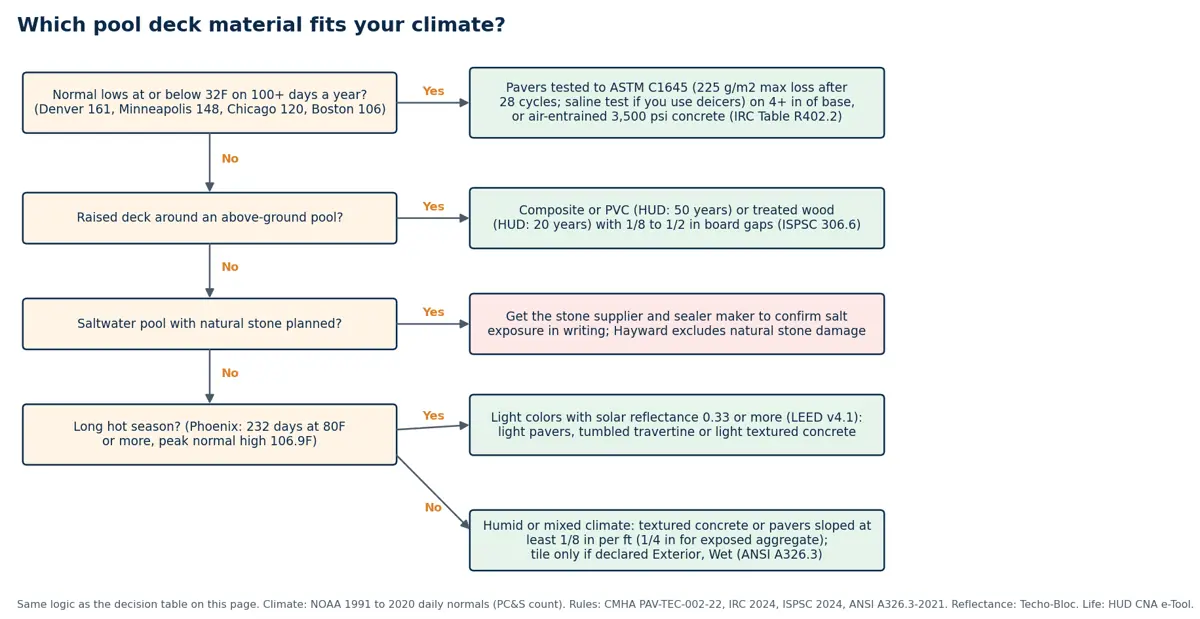
The city figures in the decision table come from NOAA daily normals: Phoenix has 232 days a year with a normal high of 80F or more and a peak normal high of 106.9F, Miami 265 warm days, and Minneapolis 148 days with a normal low at or below 32F. Swim-season length for 60 metros is in our pool season length study, and installers for the deck you pick are on our pool deck contractors page.
How we compiled this
We read 22 documents in October 2026: the ISPSC and IRC 2024 code text, ANSI A326.3-2021 and its TCNA FAQ, two EPA cool pavement documents, a PCA research report, a CMHA tech note, two ASTM scope pages, the HUD and Fannie Mae useful-life tables, six test sheets, instructions and product pages from Techo-Bloc, Davis Colors, Mortex, TimberTech and Hayward, three cost guides and California’s 2026 assessor cost tables. We also downloaded NOAA daily normals for eight stations and counted freezing days ourselves; we did not test any deck surface.
Frequently Asked Questions
What is the best material to use for a pool deck?
For most budgets, textured concrete: $6 to $11 per square foot for a simple design (ConcreteNetwork, 2026) and a 50-year planning life for concrete flatwork in HUD’s table. Pavers cost $12 to $45 but can be repaired one unit at a time. In freezing climates, choose pavers tested to ASTM C1645 or air-entrained concrete.
What is the cheapest pool decking material?
Broom-finish concrete. California’s 2026 assessor tables price it at $11.32 per square foot, against $26.54 for brick in sand and $31.29 for flagstone, and ConcreteNetwork puts a simple concrete deck at $6 to $11. A 448 sq ft deck around a 16 x 32 ft pool costs about $5,071 at the California rate (BOE).
What is the best low-maintenance pool deck material?
Concrete or composite. HUD assigns concrete flatwork and composite decks 50 years each, against 30 for pavers and 20 for treated lumber. Concrete needs crack-control joints and occasional resealing if stamped; composite needs no staining, and TimberTech warrants its composite against fade and stain for 30 years (HUD).
What is the best material to use for resurfacing a pool deck?
An overlay or cool-deck coating over sound concrete. ConcreteNetwork prices basic resurfacing at $4 to $8 per square foot and decorative overlays at $6 to $12 or more, far below removal at $2 to $6 plus new concrete at $6 to $18 or more. Mortex rates Kool Deck Elite at 65 to 70 square feet per 50 lb bag (ConcreteNetwork).
What is the coolest material for a pool deck?
The lightest color you can find, in any material. One Techo-Bloc paver finish tests from SRI 6 in Onyx Black to SRI 67 in Pure White, and the EPA says solar reflectance is the main driver of peak pavement temperature. Ask for solar reflectance of at least 0.33, the LEED v4.1 cool paving threshold (Techo-Bloc).
What is the best type of decking for a pool?
On a raised deck, composite or PVC boards outlast wood: HUD plans on 50 years for composite decks and 20 for treated lumber. ISPSC 306.6 requires 1/8 to 1/2 inch gaps between wood boards for drainage. Plastic or fiberglass decking costs $31.08 to $48.98 per square foot in California’s 2026 tables (ISPSC). For raised decks beside an above-ground pool, guard heights, gate rules and joist spans are in our above ground pool deck guide.
Sources
- International Code Council via UpCodes. International Swimming Pool and Spa Code 2024, Chapter 3, Section 306 Decks (Austin adoption). Accessed 2026-10-26.
- Tile Council of North America. ANSI A326.3-2021 Test Method for Measuring Dynamic Coefficient of Friction of Hard Surface Flooring Materials (released February 2022). Accessed 2026-10-26.
- Tile Council of North America. Dynamic Coefficient of Friction: Frequently Asked Questions. Accessed 2026-10-26.
- U.S. Environmental Protection Agency. Using Cool Pavements to Reduce Heat Islands. Accessed 2026-10-26.
- U.S. Environmental Protection Agency. Reducing Urban Heat Islands: Compendium of Strategies, Cool Pavements. Accessed 2026-10-26.
- Techo-Bloc. Solar reflectance and LEED credits (TB2025). Accessed 2026-10-26.
- Davis Colors. Solar Reflectance Index values for colored concrete (July 20, 2023). Accessed 2026-10-26.
- Portland Cement Association. Solar Reflectance of Concretes for LEED Sustainable Sites Credit, SN2982 (2007). Accessed 2026-10-26.
- Concrete Masonry and Hardscapes Association. Tech Note PAV-TEC-002-22, Construction of Interlocking Concrete Pavements. Accessed 2026-10-26.
- ASTM International. ASTM C936/C936M Standard Specification for Solid Concrete Interlocking Paving Units (scope). Accessed 2026-10-26.
- ASTM International. ASTM C1527/C1527M-23 Standard Specification for Travertine Dimension Stone (scope). Accessed 2026-10-26.
- International Code Council via UpCodes. International Residential Code 2024, Chapter 4, Table R402.2 (Austin adoption). Accessed 2026-10-26.
- NOAA National Centers for Environmental Information. U.S. Climate Normals 1991 to 2020, daily, eight airport stations. Accessed 2026-10-26.
- U.S. Department of Housing and Urban Development. CNA e-Tool Estimated Useful Life Table. Accessed 2026-10-26.
- Fannie Mae. Instructions for Performing a Multifamily Property Condition Assessment, Appendix F. Accessed 2026-10-26.
- ConcreteNetwork.com. Concrete Pool Deck Cost (updated February 13, 2026). Accessed 2026-10-26.
- HomeGuide. How Much Does a Pool Deck Cost? (updated December 22, 2025). Accessed 2026-10-26.
- AE Outdoor Living. Pool Deck Cost: Concrete, Pavers, Travertine. Accessed 2026-10-26.
- California State Board of Equalization. Assessors' Handbook Section 531, Residential Building Costs (effective January 1, 2026). Accessed 2026-10-26.
- TimberTech (AZEK). How Much Does It Cost To Build a Pool Deck?. Accessed 2026-10-26.
- Mortex Manufacturing. Kool Deck Elite instructions. Accessed 2026-10-26.
- Hayward. Aqua Rite product manual (warranty exclusions). Accessed 2026-10-26.
- PC&S research. Pool Season Length by City. Accessed 2026-10-26.
- PC&S research. Pool Injury Statistics. Accessed 2026-10-26.
- PC&S research. Saltwater Pool vs Chlorine. Accessed 2026-10-26.
Related pages
Get Quotes From Licensed Local Pool Pros
Tell us what you need and your ZIP code. We match you with pool companies that cover your area.