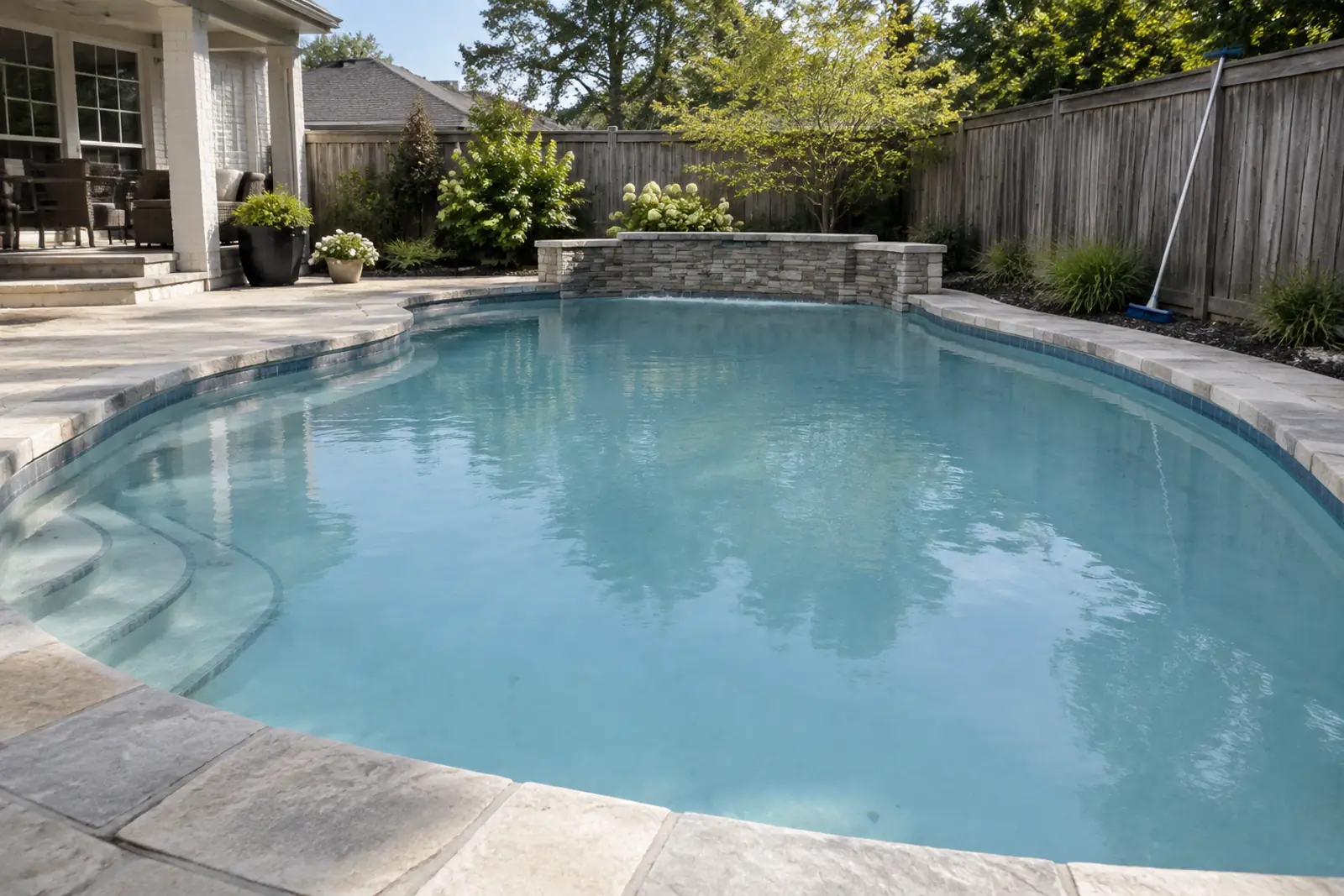
Chlorine Lock: What It Really Is and How to Fix a Pool That Won't Sanitize
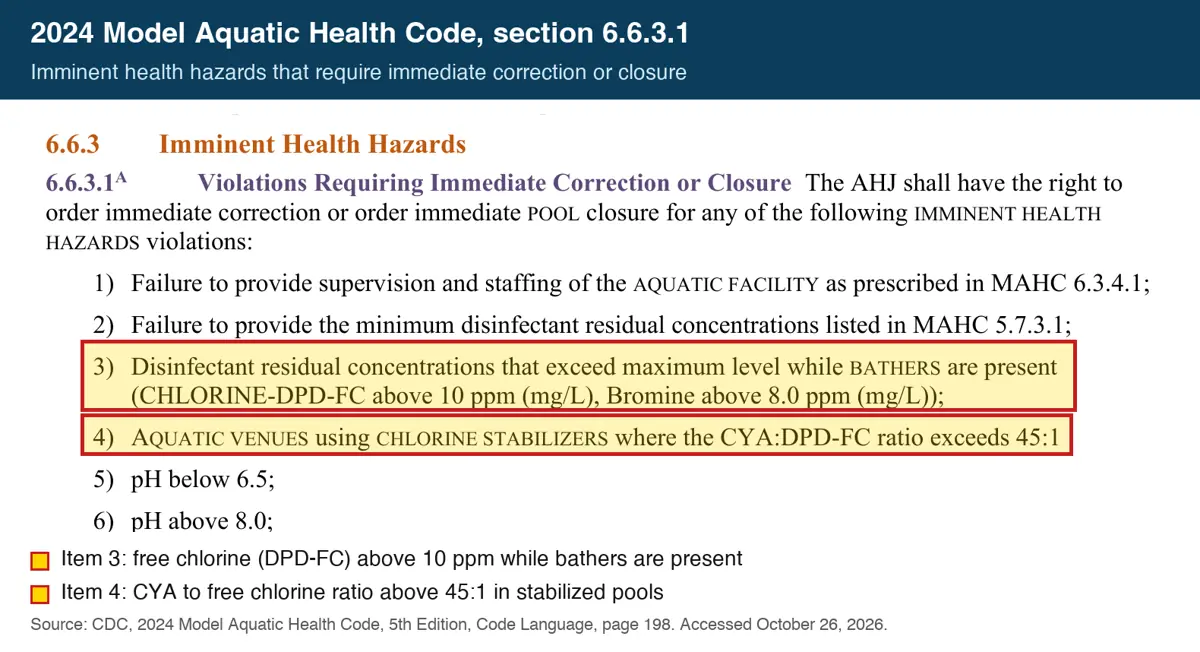
Chlorine lock is a pool-trade name, not a code term: high cyanuric acid reversibly binds chlorine and cuts its active form, so the 2024 MAHC treats a CYA to free chlorine ratio above 45:1 as a hazard.
- ✓Reversible, not lockedThe 2024 MAHC Annex says CYA reversibly binds chlorine and lowers HOCl.
- ✓45:1 hazard lineThe MAHC treats a CYA to free chlorine ratio above 45:1 as an imminent health hazard.
- ✓Dilution is the fixReplace 1 minus target / current: 150 to 50 ppm CYA means 66.7% of the water.
Key takeaways
- The 2024 MAHC never uses the term chlorine lock; its Annex says cyanuric acid (CYA) reversibly binds chlorine and lowers hypochlorous acid (HOCl), the fast-killing form.
- Active chlorine follows the CYA to free chlorine ratio: HOCl holds near 0.020 ppm at 20:1 and falls to 0.0038 ppm at 100:1, against 0.49 ppm at 1 ppm free chlorine with no CYA (MAHC Annex Tables 5.7.3.1.1.2(c) and (d)).
- The 2024 MAHC caps CYA at 90 ppm and treats a CYA to free chlorine ratio above 45:1 as an imminent health hazard (sections 5.7.3.1.3.2 and 6.6.3.1).
- Adding chlorine fails at high CYA for a practical reason: at 200 ppm CYA the Annex 20:1 example needs 10 ppm free chlorine, while the HTH Granular 73 label prohibits swimming above 4 ppm.
- The fix is dilution: share of water to replace = 1 minus target / current, so 150 to 50 ppm CYA means replacing 66.7%, by PC&S arithmetic.
What is chlorine lock?
Chlorine lock is a trade name for over-stabilized water: cyanuric acid has built up until free chlorine tests normal but disinfects slowly. Taylor Technologies calls it overstabilized or locked, and Virginia DOH says chlorine may become trapped. The 2024 MAHC Annex is more precise: CYA binds chlorine reversibly, so bound chlorine can be released again rather than destroyed.
Three primary sources describe the same chemistry in different words. The Virginia DOH operator guide (2018) says routine use of stabilized chlorine causes an over stabilized pool, where chlorine added to superchlorinate may become trapped, levels rise and bathers get irritated. The Montana DPHHS fact sheet calls it a weak, temporary bond, and Taylor Technologies writes that chlorine can become overstabilized or locked.
| Number | What it means | Source |
|---|---|---|
| 90 ppm | Maximum cyanuric acid at public pools | 2024 MAHC 5.7.3.1.3.2 |
| 45:1 | CYA to free chlorine ratio above which a public pool faces closure | 2024 MAHC 6.6.3.1 item 4 |
| 300 ppm | CYA level that is an imminent health hazard with bathers present | 2024 MAHC 6.6.3.1 item 23 |
| 2 ppm | Minimum free chlorine when CYA is present | CDC; 2024 MAHC 5.7.3.1.1.2 |
| 4 ppm | Free chlorine above which EPA labels prohibit swimming | HTH Granular 73 and Comal EPA labels |
| 10 ppm | Free chlorine with bathers present that the MAHC lists as a hazard | 2024 MAHC 6.6.3.1 item 3 |
| 0.4 ppm | Combined chlorine that triggers action | 2024 MAHC 5.7.4.4.2 |
| 100 ppm | Top of the CYA test scale without dilution | Taylor Technologies; MAHC Annex |
Sources: CDC, 2024 MAHC code; CDC; EPA label 1258-1239; EPA label 103607-1; Taylor Technologies. Accessed October 26, 2026. Download CSV
| What guides say | Who says it | What the primary source says | Primary source |
|---|---|---|---|
| CYA binds chlorine so tightly it can no longer work | HTH blog; Beatbot blog | CYA reversibly binds chlorine and lowers HOCl; raising free chlorine in proportion to CYA restores the same HOCl | 2024 MAHC Annex 5.7.3.1.3.1 and Table 5.7.3.1.1.2(c) |
| No amount of chlorine breaks a lock | Beatbot blog | HOCl tracks the CYA to free chlorine ratio; the limit is practical (label 4 ppm swim ceiling, MAHC 10 ppm bather maximum), not chemical | MAHC Annex Table (c); EPA labels; MAHC 6.6.3.1 |
| Chlorine lock means free chlorine far below total chlorine | Mr Pool Man | A gap between total and free chlorine is combined chlorine (chloramines); act above 0.4 ppm with breakpoint chlorination | 2024 MAHC 5.7.4.4.2 and glossary |
| Chlorine lock is a myth | Swim University | The MAHC does not use the term, but slower disinfection at high CYA is measured: poliovirus 99.9% kill took 0.8 min without CYA and 5.6 min with 30 ppm | MAHC Annex Table 5.7.3.1.3.1 |
| Keep CYA at 20 to 25 ppm | HTH blog | Health departments publish 30 to 50 ppm (Montana) and a 90 ppm public pool cap (MAHC); 20 to 25 ppm is HTH's own target | Montana DPHHS; 2024 MAHC 5.7.3.1.3.2 |
| A CYA reducer product breaks the lock | Mr Pool Man; INYO Pools | Partial draining is the method health departments name; the MAHC Annex accepts other methods for public pools only with test data showing 15 ppm or less | Montana DPHHS; Virginia DOH; MAHC Annex 6.5.3.2 |
Guides: HTH blog; Beatbot blog; Mr Pool Man; Swim University; INYO Pools. Primary sources: CDC, 2024 MAHC Annex; 2024 MAHC code; Montana DPHHS; Virginia DOH; EPA label 1258-1239. Accessed October 26, 2026. Download CSV
The word that matters is reversible. A permanent lock would mean added chlorine is wasted; a reversible bond means each ppm of free chlorine you add raises active chlorine in proportion. That difference decides whether the answer is more chlorine or less cyanuric acid, and at high CYA the second wins for the reasons set out below.
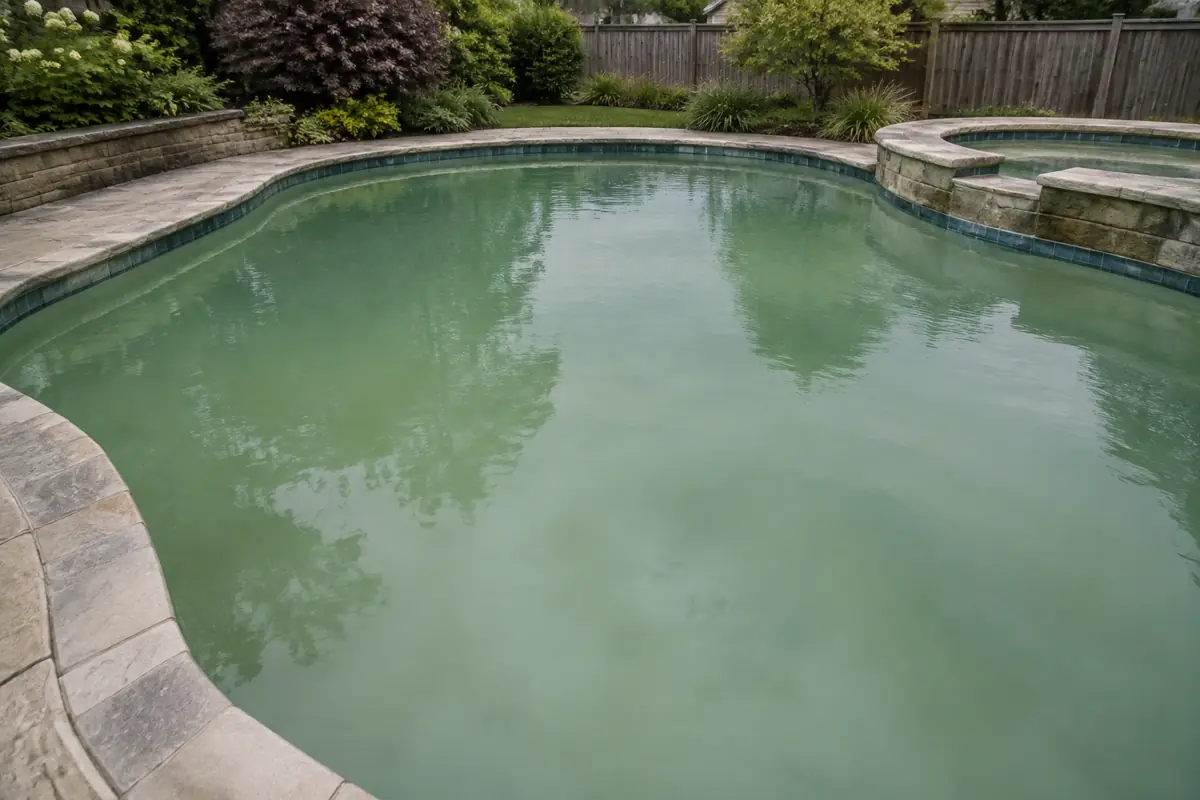
What does over-stabilized water do to disinfection?
It cuts the share of chlorine that kills germs fast. In the 2024 MAHC Annex, active HOCl at 90 ppm CYA falls from 20 ppb at a 20:1 ratio to 3.8 ppb at 100:1, while 1 ppm free chlorine with no CYA gives 490 ppb. Kill times stretch to match: poliovirus took 0.8 minutes without CYA and 5.6 minutes with 30 ppm.
The MAHC code treats any ratio above 45:1 as an imminent health hazard at public pools (6.6.3.1).
Source: Source: CDC, 2024 Model Aquatic Health Code Annex, Table 5.7.3.1.1.2(c). Converted from ppm to ppb by PC&S.. Download chart data (CSV)
| CYA to free chlorine ratio | Free chlorine at 20 ppm CYA (ppm) | HOCl at 20 ppm CYA (ppm) | Free chlorine at 90 ppm CYA (ppm) | HOCl at 90 ppm CYA (ppm) | HOCl at 90 ppm CYA (ppb) |
|---|---|---|---|---|---|
| 5:1 | 4 | 0.099 | 18 | 0.1 | 100 |
| 10:1 | 2 | 0.042 | 9 | 0.044 | 44 |
| 20:1 | 1 | 0.02 | 4.5 | 0.02 | 20 |
| 40:1 | 0.5 | 0.0095 | 2.25 | 0.0098 | 9.8 |
| 70:1 | 0.29 | 0.0053 | 1.29 | 0.0055 | 5.5 |
| 100:1 | 0.2 | 0.0037 | 0.9 | 0.0038 | 3.8 |
| No CYA, 1.0 ppm free chlorine (reference) | n/a | n/a | 1.0 | 0.49 | 490 |
Source: CDC, 2024 MAHC Annex, Tables 5.7.3.1.1.2(c) and (d). Accessed October 26, 2026. ppb column converted by PC&S. Download CSV
Read the table across: at every ratio, HOCl at 20 ppm CYA and at 90 ppm CYA is nearly the same. The Annex states the rule directly: free chlorine should increase proportionally as CYA rises to keep HOCl consistent. That is the evidence against a fixed lock; the ratio, not the CYA number alone, sets disinfection speed.
| Germ | No CYA (minutes) | 30 ppm CYA (minutes) | Times longer |
|---|---|---|---|
| Poliovirus 1 | 0.8 | 5.6 | 7.0 |
| Coxsackievirus A24 | 0.5 | 14.4 | 28.8 |
| Enterovirus 70 | 0.12 | 2.5 | 20.8 |
| Adenovirus type 3 | 0.14 | 2.1 | 15.0 |
Source: CDC, 2024 MAHC Annex, Table 5.7.3.1.3.1. Multiples are PC&S arithmetic. Download CSV
Cryptosporidium is the extreme case: the Annex reports 3-log kill is possible at 15 to 16 ppm CYA or less but was not reached at 50 or 100 ppm. Algae is less clear-cut; the Annex cites one study where CYA had a relatively minor effect on chlorine’s algae kill and says peer-reviewed data is lacking. CDC sums it up for home pools: disinfection times are longer when cyanuric acid is present, so keep at least 2 ppm free chlorine.
Why does the chlorine test read normal in a locked pool?
Because the DPD free chlorine test counts chlorine bound to cyanuric acid. The 2024 MAHC Annex defines DPD free chlorine as free available chlorine plus cyanurate-bound chlorine, so a pool at 150 ppm CYA and 3 ppm free chlorine reads 3 ppm while running at a 50:1 ratio. Two other test traps look like lock: chloramines and bleached samples.
Chloramines show up as a gap between total and free chlorine. The 2024 MAHC calculates combined chlorine as total minus free and requires action above 0.4 ppm (section 5.7.4.4.2); Pennsylvania DOH sets 0.2 ppm. That is chlorine demand, not stabilizer, and breakpoint chlorination fixes it. The difference between the two readings, and why the PHTA pool guideline sets 0.2 ppm, is covered in our free chlorine vs total chlorine guide.
A bleached sample reads falsely low. Taylor Technologies says sanitizer above 10 ppm can bleach a DPD test, and the Florida DOH test kit guide adds that a sample with no color often means chlorine above 20 ppm. Owners who see zero after a heavy shock and add more chlorine are dosing a pool that already has too much; dilute 1:1 and multiply by 2 before deciding.
| What you see | Test signature | Likely cause | Primary source |
|---|---|---|---|
| Free chlorine reads 2 to 4 ppm, yet algae or haze keeps coming back | CYA above 90 ppm, CYA divided by free chlorine above 45 | Over-stabilization (what most guides call chlorine lock) | MAHC 5.7.3.1.3.2 and 6.6.3.1; VDH |
| Free chlorine drops to near zero within hours of dosing | Total chlorine minus free chlorine above 0.4 ppm, or a heavy organic or algae load | Chlorine demand and chloramines | MAHC 5.7.4.4.2; PA DOH |
| DPD sample flashes pink then turns clear, or reads zero right after a big dose | Diluted 1:1 retest reads high | Bleached test: chlorine above 10 ppm | Taylor FAQ; Florida DOH Sarasota |
| Free chlorine and CYA both in range, water still slow to clear | pH above 7.8 | Less HOCl at high pH: 49% at pH 7.5, 23% at pH 8.0 (no CYA) | MAHC Annex; MAHC 5.7.3.4.1 |
Sources: 2024 MAHC; MAHC Annex; Virginia DOH; Pennsylvania DOH; Taylor FAQ; Florida DOH Sarasota. Download CSV
How do you know if you have a chlorine lock?
Test four numbers: free chlorine, total chlorine, cyanuric acid and pH. You are looking at over-stabilization when CYA is above 90 ppm and CYA divided by free chlorine is above 45, with combined chlorine at 0.4 ppm or less. Retest any CYA reading at 100 ppm with a 1:1 dilution, because the kit cannot read higher.
- Test free and total chlorine with a DPD kitIf the sample goes clear, dilute 1:1 and multiply by 2 (Taylor).
- Work out combined chlorineTotal minus free; above 0.4 ppm means chloramines (MAHC 5.7.4.4.2).
- Test cyanuric acidAt 100 ppm or a dot that never disappears, mix 1 part pool water with 1 part tap water and multiply by 2.
- Test pHAbove 7.8 is outside the MAHC range of 7.0 to 7.8 and cuts HOCl on its own.
- Divide CYA by free chlorineAbove 45 crosses the MAHC imminent health hazard line; 120 ppm CYA at 2 ppm free chlorine is 60:1.
If CYA is in range, the pool is not locked. Low chlorine with high combined chlorine points to demand, covered in our guide on how to shock a pool, and a pH problem is covered in our guide on how to lower pH in a pool.
Why doesn't adding more chlorine break a chlorine lock?
Chemically it would, but the dose runs into limits. Holding the MAHC Annex’s 20:1 example takes 7.5 ppm free chlorine at 150 ppm CYA and 10 ppm at 200 ppm, while EPA labels such as HTH Granular 73 and Comal bar swimming above 4 ppm and the MAHC lists 10 ppm as a bather hazard. Stabilized chlorine also adds more CYA with every dose.
| CYA (ppm) | Ratio at 2 ppm free chlorine | Free chlorine for the 45:1 line (ppm) | Free chlorine for the Annex 20:1 example (ppm) | 20:1 dose vs limits |
|---|---|---|---|---|
| 90 | 45:1 | 2.0 | 4.5 | Above the 4 ppm label swim ceiling |
| 100 | 50:1 | 2.2 | 5 | Above the 4 ppm label swim ceiling |
| 120 | 60:1 | 2.7 | 6 | Above the 4 ppm label swim ceiling |
| 150 | 75:1 | 3.3 | 7.5 | Above the 4 ppm label swim ceiling |
| 200 | 100:1 | 4.4 | 10 | At the 10 ppm MAHC bather maximum |
| 300 | 150:1 | 6.7 | 15 | At or above the 10 ppm MAHC bather maximum |
PC&S arithmetic: CYA / 45 and CYA / 20. Limits from 2024 MAHC 6.6.3.1, HTH Granular 73 label and Comal sodium hypochlorite label. Download CSV
X axis: cyanuric acid in ppm (90, 100, 120, 150, 200, 300).
Source: PC&S arithmetic from CDC 2024 MAHC 6.6.3.1 and Annex Table 5.7.3.1.1.2(c); HTH Granular 73 and Comal EPA labels (4 ppm re-entry).. Download chart data (CSV)
The source of the chlorine makes it worse. By PubChem weights, dichlor adds about 0.91 ppm CYA and trichlor about 0.61 ppm for each 1 ppm of chlorine, so a 7.5 ppm dichlor dose adds about 6.8 ppm CYA. Taylor puts it per pound: 1 lb of trichlor in 10,000 gallons adds 7 ppm CYA. Virginia DOH recommends non-chlorine products for superchlorinating stabilized pools for this reason.
Above 180 ppm CYA even the 45:1 minimum passes the label limit, because 180 / 45 = 4 ppm. From there no free chlorine level satisfies both the MAHC ratio and a 4 ppm swim ceiling, and only dilution can. Liquid chlorine and calcium hypochlorite add no CYA, so they can hold a pool on the right side of 45:1 while dilution catches up. Our guide on how much chlorine to add to a pool converts a ppm target into ounces of each product.
Why does cyanuric acid build up in the first place?
Stabilized chlorine used day after day. Taylor Technologies says trichlor and dichlor are more than 50% CYA by weight and daily use can easily reach 80 ppm. CYA leaves only with water: Virginia DOH lists backwashing and other water loss, and evaporation removes water while leaving all the CYA behind. Shocking with liquid chlorine or cal-hypo instead of dichlor stops adding to it, and our comparison of liquid chlorine vs shock shows what each product leaves behind per 10 ppm.
Our cyanuric acid pool guide works through the season math: 100 ppm of chlorine delivered by trichlor leaves about 61 ppm of CYA. Our saltwater vs chlorine research compares tablet pools with salt systems, which make chlorine without adding stabilizer. In public pools the problem is common enough to be a routine inspection citation, as our public pool inspection violations report shows.
Some causes are not stabilizer at all. A pool that loses chlorine overnight has demand from algae, leaves or swimmers; a pool at pH 8.0 has only 23% of its free chlorine as HOCl even with no CYA, per the MAHC Annex. Both get called chlorine lock in forums, and both are fixed differently.
How to fix chlorine lock in a pool
Lower the cyanuric acid by replacing water, then keep chlorine in proportion. The share to replace is 1 minus target divided by current: 150 to 50 ppm means 66.7%, or 13,333 gallons of a 20,000 gallon pool. Meanwhile hold free chlorine at or above CYA divided by 45 with liquid chlorine or cal hypo, and stop using tablets until CYA is back under 90 ppm.
- Confirm with diluted testsCYA 1:1 dilution if it reads 100 ppm; DPD dilution if chlorine bleaches.
- Hold the hazard line todayRaise free chlorine to at least CYA / 45 with liquid chlorine or cal hypo; keep swimmers out above 4 ppm (EPA labels).
- Compute the drain share1 minus target / current; pick a target of 50 ppm or less (Montana DPHHS: 30 to 50 ppm).
- Check where the water may go, then drainLocal rules decide whether pool water goes to the sewer or the street; split a large drain into two rounds.
- Refill and rebalanceRetest CYA, pH and alkalinity; fresh water dilutes chlorine too.
- Break chloramines if presentIf total minus free chlorine is above 0.4 ppm, raise free chlorine to about 10 times that gap (MAHC glossary).
- Switch the routineUse unstabilized chlorine until CYA falls, and test CYA monthly (MAHC 5.7.5.7).
| Step | Value | Basis |
|---|---|---|
| Pool and readings | 20,000 gal, CYA 150 ppm, target 50 ppm | Example |
| Share to replace | 66.7% | 1 minus 50 / 150 (dilution; refill water has no CYA) |
| Gallons to replace | 13,333 | 20,000 x 0.667 |
| Same result in two equal rounds | 42.3% per round | 1 minus the square root of 50 / 150 |
| Water and sewer cost | $83.33 (Las Vegas) to $433.33 (Houston) | $6.25 to $32.50 per 1,000 gal, PC&S research |
| Free chlorine after refill | At least 2 ppm; 2.5 ppm holds the Annex 20:1 example at 50 ppm CYA | MAHC 5.7.3.1.1.2; Annex Table (c) |
PC&S arithmetic. Water and sewer cost per 1,000 gallons from PC&S research: Cost to Fill a Pool (rates in effect October 2026). Download CSV
Two equal rounds of 42.3% reach the same 50 ppm as one 66.7% drain and keep the water higher during the job. Before any deep drain, read our guide on how to drain a pool, which covers pumps, hoses and groundwater risk. Round counts and refill costs for any starting reading are tabled in our guide on how to lower cyanuric acid in a pool.
What should you do at your test results?
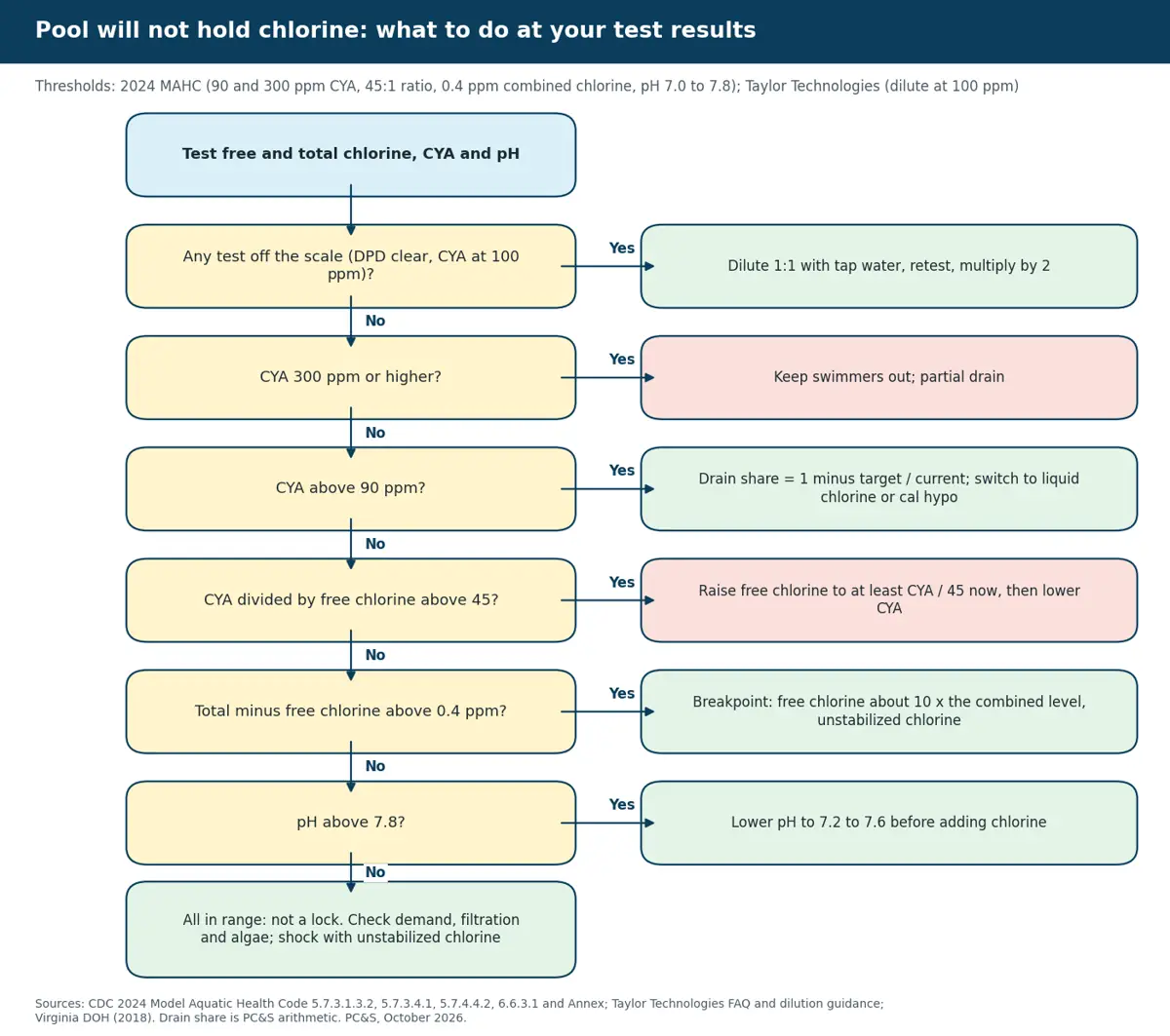
Rule out test errors first, then act on the highest threshold you cross. Dilute any DPD or CYA test that reads off the scale. At 300 ppm CYA or more keep swimmers out; above 90 ppm replace water; above a 45:1 ratio raise free chlorine now. If CYA and pH are in range, treat chloramines or demand instead.
| If your situation is | Do this | Rule behind it |
|---|---|---|
| DPD sample clear or zero right after a big dose | Dilute 1:1 with tap water, retest and multiply by 2 | Taylor FAQ (bleaching above 10 ppm) |
| CYA test reads 100 ppm or the dot never disappears | Dilute 1:1, retest and multiply by 2 before deciding anything | Taylor dilution guidance |
| CYA 300 ppm or more | Keep swimmers out; partial drain | 2024 MAHC 6.6.3.1 item 23 |
| CYA above 90 ppm | Drain and refill: share = 1 minus target / current; switch to liquid chlorine or cal hypo | 2024 MAHC 5.7.3.1.3.2; Taylor; VDH |
| CYA divided by free chlorine above 45 | Raise free chlorine to at least CYA / 45 now, then lower CYA | 2024 MAHC 6.6.3.1 item 4 |
| Combined chlorine (total minus free) above 0.4 ppm | Breakpoint: raise free chlorine to about 10 times the combined level with unstabilized chlorine | 2024 MAHC 5.7.4.4.2 and glossary |
| Free chlorine and CYA in range, pH above 7.8 | Lower pH to 7.2 to 7.6 before adding more chlorine | 2024 MAHC 5.7.3.4.1; Annex HOCl by pH |
| Everything in range but algae persists | Brush, shock with unstabilized chlorine, check the filter; the Annex notes algae data is limited | MAHC Annex 5.7.3.1.1.2 |
Sources: 2024 MAHC; MAHC Annex; Taylor FAQ; Taylor dilutions; Virginia DOH; Taylor CYA; PC&S arithmetic. Download CSV
If the water is cloudy rather than green, check filtration and balance too; our cloudy pool water guide runs that diagnosis in order.
How we compiled this
We compiled this page in October 2026 from 14 primary documents: the 2024 MAHC code and Annex, CDC’s home pool guidance, health department documents from Virginia, Montana, Pennsylvania and Sarasota County, Florida, two EPA-registered chlorine labels, three Taylor Technologies pages and the NPIC fact sheet, plus five top-ranking guides quoted only to compare their claims. Ratio guidance comes from the MAHC alone; we did not use forum ratio charts. Water costs come from our own research report built from utility rate cards. We did not test water or products, and forum threads were used for question wording only.
Frequently Asked Questions
How do you know if you have a chlorine lock?
Test free chlorine, total chlorine, cyanuric acid and pH. It is over-stabilization when CYA is above 90 ppm and CYA divided by free chlorine is above 45, the 2024 MAHC hazard line, while combined chlorine stays at 0.4 ppm or less. Retest any CYA reading at 100 ppm with a 1:1 dilution.
What does a chlorine lock do?
It slows disinfection. The 2024 MAHC Annex shows active HOCl at 90 ppm CYA falling from 20 ppb at a 20:1 ratio to 3.8 ppb at 100:1, and poliovirus kill time rising from 0.8 to 5.6 minutes with 30 ppm CYA at 0.5 ppm free chlorine. The free chlorine test still reads normal.
How do I get my pool out of chlorine lock?
Replace water to lower cyanuric acid: share = 1 minus target / current, so 150 to 50 ppm means 66.7%. Until then keep free chlorine at or above CYA divided by 45 using liquid chlorine or cal hypo, which add no CYA, and stop trichlor and dichlor. Taylor Technologies gives the same two-part fix.
What causes a chlorine lock in a pool?
Cyanuric acid build-up from stabilized chlorine. Taylor Technologies says trichlor and dichlor are more than 50% CYA and 1 lb of trichlor in 10,000 gallons adds 7 ppm. CYA leaves only with water loss (Virginia DOH), so tablets used all season keep pushing the ratio past 45:1.
Will chlorine lock fix itself?
Rarely. Cyanuric acid stays in the water: Virginia DOH says it remains until lost through backwashing or other water loss, and evaporation leaves it behind. Rain overflow dilutes a little. Without a partial drain, CYA keeps rising for as long as stabilized chlorine is used.
Is it safe to swim in a pool with chlorine lock?
Not when CYA divided by free chlorine is above 45: the 2024 MAHC lists that as an imminent health hazard, along with CYA above 300 ppm. Raising chlorine to fix the ratio has its own limit, because EPA-registered labels such as HTH Granular 73 prohibit swimming above 4 ppm free chlorine.
Sources
- Centers for Disease Control and Prevention (CDC). 2024 Model Aquatic Health Code, 5th Edition, Annex. Accessed 2026-10-26.
- CDC. 2024 Model Aquatic Health Code, 5th Edition, Code Language. Accessed 2026-10-26.
- CDC. Home Pool and Hot Tub Water Treatment and Testing (page updated May 10, 2024). Accessed 2026-10-26.
- Virginia Department of Health. Pool Operation and Maintenance Guide (Portsmouth Health Department, 2018). Accessed 2026-10-26.
- Montana Department of Public Health and Human Services. Fact Sheet on Cyanuric Acid and Stabilized Chlorine Products. Accessed 2026-10-26.
- Pennsylvania Department of Health. Public Swimming and Bathing Places: Operational and Biological Contamination Protocol Recommendations (November 1, 2016). Accessed 2026-10-26.
- Florida Department of Health in Sarasota County. How to Use Your Test Kit. Accessed 2026-10-26.
- U.S. EPA Pesticide Product Label System. HTH Granular 73, EPA Reg. No. 1258-1239 (label file February 24, 2025). Accessed 2026-10-26.
- U.S. EPA Pesticide Product Label System. Sodium Hypochlorite 12.5% (Comal Chemical), EPA Reg. No. 103607-1 (September 28, 2025). Accessed 2026-10-26.
- Taylor Technologies. Why Monitoring Cyanuric Acid (CYA) in a Pool is Important (February 26, 2025). Accessed 2026-10-26.
- Taylor Technologies. Taylor Water Testing Technical FAQs. Accessed 2026-10-26.
- Taylor Technologies. How and When to Use Dilutions in Pool and Spa Water Testing. Accessed 2026-10-26.
- National Pesticide Information Center (Oregon State University). Pool and Spa Chemicals Fact Sheet. Accessed 2026-10-26.
- HTH. What Is Chlorine Lock and How Cal Hypo Prevents It (claims compared). Accessed 2026-10-26.
- Beatbot. How Do I Fix a Chlorine Lock in My Pool? (claims compared). Accessed 2026-10-26.
- Mr Pool Man. What is a Chlorine Lock and How do you Break It (claims compared). Accessed 2026-10-26.
- Swim University. How to Cure Chlorine Lock and Chlorine Demand (claims compared). Accessed 2026-10-26.
- INYO Pools. How To Break Chlorine Lock (claims compared). Accessed 2026-10-26.
- Pool Construction & Service. Cost to Fill a Pool (PC&S research, rates in effect October 2026). Accessed 2026-10-26.
Related pages
Get Quotes From Licensed Local Pool Pros
Tell us what you need and your ZIP code. We match you with pool companies that cover your area.