What Size Pool Heater Do I Need? BTU Sizing by Pool Size, Climate and Heat-Up Time
What size pool heater do I need? Multiply surface area by the temperature rise and 12 (DOE's rule): a 16 x 32 ft pool needing a 20 F rise needs about 123,000 Btu per hour of output.
- ✓Five sizing methods, one poolDOE, Hayward, Pentair, California JA16.3 and the retailer rule of thumb run on the same 16 x 32 ft pool.
- ✓Heat pumps rated at 50 F airAHRI 1160 ratings for 7 Hayward and Pentair models: 61% to 68% of headline output in cool air.
- ✓Climate table for 12 citiesNOAA 1991-2020 normals turn April and May air temperatures into heater output for your start date.
Key takeaways
- The U.S. Department of Energy sizes pool heaters by surface area: Btu per hour of output = area x temperature rise x 12, a rule built on a 1 F to 1.25 F rise per hour and a 3.5 mph wind, multiplied by 1.5 or 2 for faster heating (DOE Energy Saver, archived Jan 1, 2026).
- A 16 x 32 ft pool (512 sq ft) needs 122,880 Btu/h for a 20 F rise and 184,320 Btu/h for a 30 F rise; a gas heater at 84% efficiency needs a 146,286 Btu/h input for the 20 F case (PC&S sizing table).
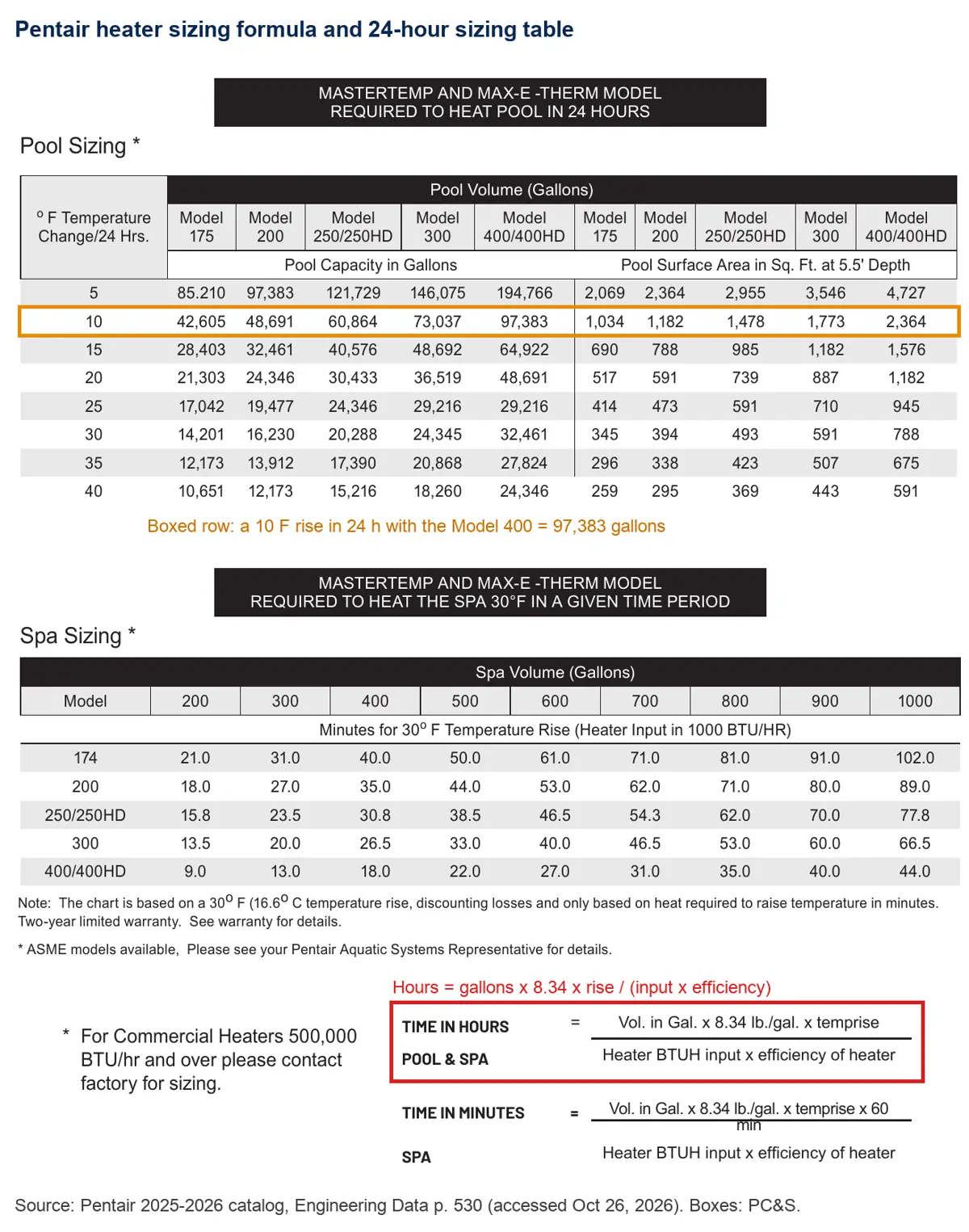
- Heating time = gallons x 8.34 x rise / (input x efficiency): 20,000 gallons raised 20 F takes 9.9 hours with a 400,000 Btu/h, 84% gas heater and 23.8 hours with a 140,000 Btu/h heat pump, before losses (Pentair Engineering Data, p. 530).
- At 50 F air, the 7 Hayward HeatPro and Pentair UltraTemp heat pumps compared here deliver 61% to 68% of their 80 F output, and their COP falls to 4.0 (Hayward AHRI 1160 ratings).
- Gas pool heaters must reach 82% thermal efficiency until May 30, 2028 (10 CFR 430.32(k)); California pools permitted since Jan 1, 2026 need a heat pump or solar as the primary heater (Title 24 Section 110.4(c)).
- A cover saves 50% to 70% of pool heating cost, and DOE’s own city tables at 80 F show 76.2% to 92.1% (DOE Energy Saver, archived).
How do you calculate what size pool heater you need?
Use DOE’s surface-area rule: Btu per hour of output equals pool area in square feet times the temperature rise times 12. The rise is your target water temperature minus the average air temperature of the coldest month you plan to swim. The rule assumes a 1 F to 1.25 F hourly rise and a 3.5 mph wind at the water.
- Pick the target water temperatureDOE gives 78 F to 82 F as the typical range for pools; lessons and therapy pools run warmer.
- Find the coldest month you will swimUse the NOAA 1991-2020 monthly normal mean air temperature for the nearest airport, for example 63.2 F for April in Atlanta.
- Subtract to get the rise82 F target minus 63.2 F air = an 18.8 F temperature rise.
- Measure the surface areaLength x width for a rectangle: 16 x 32 ft = 512 sq ft.
- Multiply area x rise x 12512 x 18.8 x 12 = 115,507 Btu/h of output. Multiply by 1.5 for a 1.5 F hourly rise or by 2 for 2 F; add 25% for a 5 mph wind and double the figure for 10 mph (Hayward IMG; Coates).
- Convert to the rating you shop byGas heaters are sold by input, so divide by thermal efficiency: 115,507 / 0.84 = 137,508 Btu/h. Heat pumps are sold by output, so compare with the 50 F air rating.
Five published methods land close together for the same pool. For a 16 x 32 ft pool and a 20 F rise, DOE’s rule gives 122,880 Btu/h, the Hayward IMG heater size calculator gives 126,268 Btu/h (its metric formula works out to 12.33 Btu/h per sq ft per F), and Pentair‘s volume method gives 119,776 Btu/h to heat 17,234 gallons in 24 hours, a spread of under 6%. The pool’s area comes from our standard pool size guide, and warmer targets for lessons or therapy are in our ideal pool temperature guide.
| Method | Formula | Result for a 16 x 32 ft pool (512 sq ft) and a 20 F rise | What it assumes | Source |
|---|---|---|---|---|
| DOE Energy Saver rule | Surface area x temperature rise x 12 | 122,880 Btu/h output | 1 F to 1.25 F rise per hour; 3.5 mph wind at the water; x1.5 for 1.5 F per hour, x2 for 2 F per hour | U.S. Department of Energy, gas and heat pump pool heater pages (archived Jan 1, 2026) |
| Hayward IMG heater size calculator | 0.7 x area (sq m) x rise (C) / 10 = kW; kW x 3,413 = Btu/h | 126,268 Btu/h output (12.33 Btu/h per sq ft per F) | Lowest expected air temperature; add 25% for a 5 mph wind, double for 10 mph | Hayward IMG calculator page (accessed Oct 26, 2026) |
| Pentair volume method | Gallons x 8.34 x rise / hours = output | 119,776 Btu/h output to heat 17,234 gallons in 24 hours (142,590 Btu/h input at 84%) | Heat to raise the water only; losses ignored | Pentair 2025-2026 catalog, Engineering Data p. 530 |
| California JA16.3 (heat pumps) | Gallons x 8.33 x 10 / hours, with hours no more than 17.5 | 82,033 Btu/h minimum heat pump output | 10 F rise in 17.5 hours or less; used only when the maker gives no sizing method | California Energy Commission, 2025 Reference Appendices JA16.3 |
| Retailer rule of thumb | Surface area / 3 x 1,000 | 170,667 Btu/h (Leslie's rounds to 170,700) | Leslie's says it covers a 25 F to 30 F rise; the rise is not an input | Leslie's (archived Oct 15, 2025); Inyo Pools |
Sources: DOE Energy Saver (archived); Hayward IMG; Pentair Engineering Data; CEC JA16.3; Leslie's (archived); Inyo Pools; PC&S calculation. Download CSV
The retailer shortcut of area divided by 3, times 1,000, equals 333 Btu/h per sq ft. That matches DOE’s formula only at a 27.8 F rise, so for a pool that needs 10 F of lift (120 Btu/h per sq ft under DOE) it oversizes by a factor of 2.8. California’s JA16.3 goes the other way for heat pumps: a 10 F rise in no more than 17.5 hours, or 82,033 Btu/h for 17,234 gallons.
Pool heater BTU sizing table by pool size and temperature rise
Most residential pools from 12 x 24 ft to 22 x 44 ft need 34,560 to 348,480 Btu/h of output, depending on the temperature rise. The table applies DOE’s area x rise x 12 rule to seven common sizes. A 16 x 32 ft pool needs 122,880 Btu/h at a 20 F rise, which a gas heater at 84% delivers from a 146,286 Btu/h input.
| Pool size (ft) | Surface area (sq ft) | 10 F rise (Btu/h output) | 15 F rise | 20 F rise | 25 F rise | 30 F rise | Gas input needed at 84%, 20 F rise (Btu/h) |
|---|---|---|---|---|---|---|---|
| 12 x 24 | 288 | 34,560 | 51,840 | 69,120 | 86,400 | 103,680 | 82,286 |
| 14 x 28 | 392 | 47,040 | 70,560 | 94,080 | 117,600 | 141,120 | 112,000 |
| 15 x 30 | 450 | 54,000 | 81,000 | 108,000 | 135,000 | 162,000 | 128,571 |
| 16 x 32 | 512 | 61,440 | 92,160 | 122,880 | 153,600 | 184,320 | 146,286 |
| 18 x 36 | 648 | 77,760 | 116,640 | 155,520 | 194,400 | 233,280 | 185,143 |
| 20 x 40 | 800 | 96,000 | 144,000 | 192,000 | 240,000 | 288,000 | 228,571 |
| 22 x 44 | 968 | 116,160 | 174,240 | 232,320 | 290,400 | 348,480 | 276,571 |
Sources: DOE Energy Saver sizing rule (archived Jan 1, 2026); PC&S calculation. Download CSV
Output, not gas input: divide by thermal efficiency (82% to 96%) to get the gas heater input rating.
Source: U.S. Department of Energy Energy Saver sizing rule (archived Jan 1, 2026); PC&S calculation. Download chart data (CSV)
Gas heaters come in input steps. Pentair sells the MasterTemp at 125,000, 200,000, 250,000, 300,000 and 400,000 Btu/h input, so pick the first size whose output (input x efficiency) covers the table. A 20 x 40 ft pool needing 25 F of lift needs 240,000 Btu/h, which a 300,000 input MasterTemp at 84% covers with 252,000. What each size costs to install, including the gas pipe it needs at 50 or 100 ft from the meter, is in our pool heater installation cost guide.
Heat pumps are rated by output. DOE lists standard sizes of 75,000, 100,000 and 125,000 Btu, and the largest model in our comparison delivers 145,000 Btu/h at 80 F air. A 22 x 44 ft pool at a 20 F rise (232,320 Btu/h) is beyond any single unit we compared, so it takes two units, a smaller rise or a later start date.
How many BTU do you need for a 10,000 to 30,000 gallon pool?
Each gallon of water takes 8.34 Btu per degree, so a 20,000-gallon pool needs 166,800 Btu for every 1 F and 3,336,000 Btu for 20 F. Spread over 24 hours that is 139,000 Btu/h of output, or a 165,476 Btu/h gas input at 84%. The area method gives a close 142,602 Btu/h at 4.5 ft average depth.
| Pool volume (gallons) | Btu to raise the water 1 F | Btu to raise it 20 F | Output to add 20 F in 24 hours (Btu/h) | Gas input for that at 84% (Btu/h) | Surface area if 4.5 ft average depth (sq ft) | DOE output for that area, 20 F rise (Btu/h) | California JA16.3 minimum heat pump output (Btu/h) |
|---|---|---|---|---|---|---|---|
| 10,000 | 83,400 | 1,668,000 | 69,500 | 82,738 | 297 | 71,301 | 47,600 |
| 15,000 | 125,100 | 2,502,000 | 104,250 | 124,107 | 446 | 106,952 | 71,400 |
| 20,000 | 166,800 | 3,336,000 | 139,000 | 165,476 | 594 | 142,602 | 95,200 |
| 25,000 | 208,500 | 4,170,000 | 173,750 | 206,845 | 743 | 178,253 | 119,000 |
| 30,000 | 250,200 | 5,004,000 | 208,500 | 248,214 | 891 | 213,904 | 142,800 |
Sources: Pentair Engineering Data p. 530 (8.34 lb per gallon); USGS (7.48 gallons per cubic foot); DOE; CEC JA16.3; PC&S calculation. Download CSV
Volume and area give similar answers because most backyard pools average 4 to 5 ft deep. At 4.5 ft, 10,000 gallons covers about 297 sq ft and 30,000 gallons about 891 sq ft (7.48 gallons per cubic foot, USGS). To size by volume for a different deadline, divide the Btu column by your hours: 3,336,000 Btu over 12 hours is 278,000 Btu/h of output. Our pool volume calculator gives gallons for round, oval and kidney shapes.
How long does it take to heat a pool?
Hours equal gallons x 8.34 x temperature rise divided by heater output. A 20,000-gallon pool raised 20 F takes 9.9 hours with a 400,000 Btu/h gas heater at 84%, 15.9 hours with a 250,000 Btu/h unit and 23.8 hours with a 140,000 Btu/h heat pump at 80 F air. Those are floors: heat lost during warm-up adds time.
| Pool volume (gallons) | Btu for a 20 F rise | Gas, 400,000 Btu/h input at 84% (336,000 output) | Gas, 250,000 input at 84% (210,000 output) | Gas, 125,000 input at 82% (102,500 output) | Heat pump, 140,000 output at 80 F air | Same heat pump, 85,000 output at 50 F air |
|---|---|---|---|---|---|---|
| 10,000 | 1,668,000 | 5.0 h | 7.9 h | 16.3 h | 11.9 h | 19.6 h |
| 15,000 | 2,502,000 | 7.4 h | 11.9 h | 24.4 h | 17.9 h | 29.4 h |
| 20,000 | 3,336,000 | 9.9 h | 15.9 h | 32.5 h | 23.8 h | 39.2 h |
| 30,000 | 5,004,000 | 14.9 h | 23.8 h | 48.8 h | 35.7 h | 58.9 h |
Sources: Pentair Engineering Data p. 530 (formula); Pentair catalog and Hayward HeatPro sell sheet (ratings); PC&S calculation. Download CSV
Real heat-up takes longer: Pentair notes an uncovered pool usually loses 2 F to 4 F a day in cool periods.
Source: Pentair 2025-2026 catalog Engineering Data p. 530 (formula); Pentair and Hayward ratings; PC&S calculation. Download chart data (CSV)
Pentair’s own table checks the arithmetic: its ETi 400 at 96% raises 20,000 gallons by 20 F in 8.69 hours, the same result as 20,000 x 8.34 x 20 / 384,000. Real heat-up takes longer because the pool keeps losing heat; Pentair notes that during cooler periods a pool usually loses 2 F to 4 F a day (Pentair Engineering Data). DOE also calls it a myth that reheating uses more energy than holding temperature, so turning the heater off between uses saves energy (DOE, archived). Heat-up hours with those losses included, for 15,000 to 30,000 gallons and five heaters, are in our guide to how long it takes to heat a pool.
A spa heats in minutes, not hours, because it holds far less water. Pentair’s table puts a 30 F rise in a 500-gallon spa at 22 minutes with a 400,000 Btu/h input heater and 44 minutes with a 200,000 Btu/h unit, which is why pool and spa combinations often get sized for the spa.
How much does a heat pump's output drop in cool air?
About a third. Heat pump makers rate output under AHRI 1160 at three air conditions, and at 50 F air with 63% humidity the seven Hayward HeatPro and Pentair UltraTemp models compared here deliver 61% to 68% of their 80 F output, with COP falling from 5.4 to 6.1 down to 4.0. Size a heat pump on the rating closest to your coldest swim month.
| Model | 80 F air, 80% humidity, 80 F water (Btu/h / COP) | 80 F air, 63% humidity (Btu/h / COP) | 50 F air, 63% humidity (Btu/h / COP) | Output kept at 50 F air | Lowest air temperature for heating | Source |
|---|---|---|---|---|---|---|
| Hayward HeatPro HP21004T | 90,000 / 5.7 | 85,000 / 5.5 | 59,000 / 4.0 | 66% | 50 F | Hayward LITHTPRO23 sell sheet (AHRI 1160 ratings) |
| Hayward HeatPro HP21124T | 110,000 / 5.7 | 107,000 / 5.4 | 75,000 / 4.0 | 68% | 50 F | Hayward LITHTPRO23 sell sheet (AHRI 1160 ratings) |
| Hayward HeatPro HP21254T | 125,000 / 5.7 | 120,000 / 5.5 | 80,000 / 4.0 | 64% | 50 F | Hayward LITHTPRO23 sell sheet (AHRI 1160 ratings) |
| Hayward HeatPro HP21404T | 140,000 / 5.7 | 130,000 / 5.5 | 85,000 / 4.0 | 61% | 50 F | Hayward LITHTPRO23 sell sheet (AHRI 1160 ratings) |
| Pentair UltraTemp 110 | 110,000 / 6.1 | 101,000 / 5.8 | 70,000 / 4.0 | 64% | Not stated | Pentair 2025-2026 catalog, heaters section (AHRI 1160 ratings) |
| Pentair UltraTemp 120Q | 127,000 / 5.7 | 120,000 / 5.5 | 80,000 / 4.0 | 63% | Not stated | Pentair 2025-2026 catalog, heaters section (AHRI 1160 ratings) |
| Pentair UltraTemp 140 | 145,000 / 5.8 | 135,000 / 5.6 | 90,000 / 4.0 | 62% | Not stated | Pentair 2025-2026 catalog, heaters section (AHRI 1160 ratings) |
Sources: Hayward HeatPro sell sheet LITHTPRO23; Pentair 2025-2026 catalog, UltraTemp heat pumps; PC&S calculation of output kept at 50 F. Download CSV
At 50 F air every model keeps 61% to 68% of its 80 F output and its COP falls to 4.0.
Source: Hayward HeatPro sell sheet LITHTPRO23; Pentair 2025-2026 catalog heaters section. Download chart data (CSV)
DOE’s federal test runs at 80 F air, 63% humidity and 80 F water, and DOE says heat pumps work efficiently while air stays above the 45 F to 50 F range (DOE, archived). Hayward lists 50 F as the lowest heating air temperature for its standard HeatPro models and 40 F for its low-ambient versions. In Chicago and Denver, April air averages 49.7 F and 47.8 F under NOAA normals, below that 50 F floor. Twelve heat pumps with all three AHRI 1160 ratings, amps, breaker sizes and dated 2026 prices are compared in our heat pump pool heater guide.
Should you compare a gas heater's input or output rating?
Compare output, because DOE’s formula gives the heat the water must receive. Gas heaters are sold by input, so multiply the input by thermal efficiency: a 400,000 Btu/h Pentair MasterTemp at 84% delivers 336,000 Btu/h, and an ETi 400 at 96% delivers 384,000. Federal rules set an 82% minimum for gas pool heaters made before May 30, 2028.
| Model | Rated input (Btu/h) | Thermal efficiency | Heat delivered to water (Btu/h output) | Source |
|---|---|---|---|---|
| Pentair MasterTemp 125 | 125,000 | 82% | 102,500 | Pentair 2025-2026 catalog, heaters section |
| Pentair MasterTemp 200 | 200,000 | 84% | 168,000 | Pentair 2025-2026 catalog, heaters section |
| Pentair MasterTemp 250 | 250,000 | 84% | 210,000 | Pentair 2025-2026 catalog, heaters section |
| Pentair MasterTemp 300 | 300,000 | 84% | 252,000 | Pentair 2025-2026 catalog, heaters section |
| Pentair Max-E-Therm 333 | 333,000 | 84% | 279,720 | Pentair 2025-2026 catalog, heaters section |
| Pentair MasterTemp 400 | 400,000 | 84% | 336,000 | Pentair 2025-2026 catalog, heaters section |
| Pentair ETi 250 (natural gas) | 250,000 | 94% | 235,000 | Pentair 2025-2026 catalog, heaters section |
| Pentair ETi 400 | 400,000 | 96% | 384,000 | Pentair 2025-2026 catalog, heaters section |
| Federal minimum, gas pool heaters made before May 30, 2028 | Any | 82% | Input x 0.82 | 10 CFR 430.32(k) |
Sources: Pentair 2025-2026 catalog, heaters section; 10 CFR 430.32(k); PC&S calculation. Download CSV
A 16 x 32 ft pool at a 30 F rise needs 184,320 Btu/h of output, or 219,429 Btu/h of input at 84%, so a 200,000 Btu/h MasterTemp (168,000 output) falls short and the 250,000 Btu/h model (210,000 output) covers it. Running cost per delivered Btu depends on fuel price and efficiency, not size; our cost to heat a pool study prices that by state.
Does a pool cover change what size heater you need?
A cover changes running cost more than size. DOE’s sizing formula has no cover term, but DOE says a cover saves 50% to 70% of heating cost, and its own city tables at 80 F show savings of 76.2% to 92.1%. A heater sized by the formula holds temperature with less run time when the pool is covered every night. Indoors, the heat that evaporation takes from the water lands in the room air, and our indoor pool cost guide sizes that load for a 16 x 32 ft pool.
Evaporation is the largest heat loss: DOE says each pound of 80 F water that evaporates takes 1,048 Btu with it (DOE, archived), and EPA WaterSense says a cover can prevent up to 95% of evaporation (EPA). In DOE’s Phoenix example, repriced at 2025 Arizona rates, a heat pump holding a 1,000 sq ft pool at 80 F costs $1,595 a season uncovered and $151 covered. A safety cover or solar blanket used nightly is what lets a heat pump at its 50 F rating keep up in spring.
| What some guides say | Who says it | What the primary source or arithmetic shows |
|---|---|---|
| Divide surface area by 3 and multiply by 1,000 for the minimum Btu | Leslie's; Inyo Pools | That equals DOE's area x rise x 12 only at a 27.8 F rise. For a 10 F rise DOE gives 120 Btu/h per sq ft, not 333 (DOE Energy Saver). |
| Sizing by gallons is a common misconception | Leslie's | Pentair's catalog sizes heaters by gallons for spot heating, and California's JA16.3 sizes heat pumps by gallons (Pentair p. 530; CEC JA16.3). |
| A cover cuts the Btu you need by about 30% | MBTEK calculator page | DOE puts cover savings at 50% to 70% of heating cost, and DOE's sizing formula has no cover term (DOE Energy Saver). |
| A 15 x 30 ft pool (about 17,000 gallons) heated 15 F over 24 hours needs roughly 72,000 Btu/h | MBTEK calculator page | MBTEK's own formula (gallons x 8.34 x rise / hours, plus 25%) gives 110,766 Btu/h for those inputs (PC&S arithmetic). |
| Gas heaters add 1 F to 2 F per hour; heat pumps 0.5 F to 1 F | ePoolSupply | Consistent with Pentair's formula for 20,000 gallons before losses: 2.01 F per hour at 400,000 input, 1.26 at 250,000, 0.84 for a 140,000 Btu/h heat pump at 80 F air, 0.51 at 50 F air. |
| Heat pump size is the headline Btu rating | Spec sheets list the 80 F air rating first | The same AHRI 1160 tables show 61% to 68% of that output at 50 F air for the 7 models compared here (Hayward; Pentair). |
Sources: Leslie's (archived Oct 15, 2025); Inyo Pools; MBTEK; ePoolSupply; DOE; Pentair; CEC JA16.3; Hayward. Download CSV
What size pool heater do I need for my climate?
Your start month sets the answer, because the rise is measured from the coldest month’s air. For a 16 x 32 ft pool held at 82 F from April, DOE’s rule gives 32,563 Btu/h in Miami, 115,507 in Atlanta and 198,451 in Chicago. Starting in May cuts Atlanta’s need to 66,355 Btu/h.
| City (NOAA airport station) | April normal mean air (F) | Rise to 82 F, April start | DOE output, 16 x 32 ft pool, April start (Btu/h) | May normal mean air (F) | Rise to 82 F, May start | DOE output, May start (Btu/h) |
|---|---|---|---|---|---|---|
| Miami (USW00012839) | 76.7 | 5.3 | 32,563 | 80.1 | 1.9 | 11,674 |
| Phoenix (USW00023183) | 73.2 | 8.8 | 54,067 | 82.0 | 0 (no heat needed) | 0 |
| Houston (USW00012960) | 70.0 | 12.0 | 73,728 | 77.4 | 4.6 | 28,262 |
| Las Vegas (USW00023169) | 67.7 | 14.3 | 87,859 | 77.3 | 4.7 | 28,877 |
| Dallas-Fort Worth (USW00003927) | 65.6 | 16.4 | 100,762 | 74.0 | 8.0 | 49,152 |
| Atlanta (USW00013874) | 63.2 | 18.8 | 115,507 | 71.2 | 10.8 | 66,355 |
| Los Angeles (USW00023174) | 61.1 | 20.9 | 128,410 | 63.6 | 18.4 | 113,050 |
| Sacramento (USW00093225) | 58.8 | 23.2 | 142,541 | 66.2 | 15.8 | 97,075 |
| New York (LaGuardia) (USW00014732) | 53.6 | 28.4 | 174,490 | 63.7 | 18.3 | 112,435 |
| Chicago (USW00094846) | 49.7 | 32.3 | 198,451 | 60.6 | 21.4 | 131,482 |
| Seattle (USW00024233) | 51.3 | 30.7 | 188,621 | 57.5 | 24.5 | 150,528 |
| Denver (USW00003017) | 47.8 | 34.2 | 210,125 | 57.4 | 24.6 | 151,142 |
Sources: NOAA NCEI U.S. Climate Normals 1991-2020 (monthly files by station ID); DOE sizing rule; PC&S calculation. Download CSV
Season length matters as much as size. Our pool season length study counts the days with a normal high of 80 F or more in 60 metros. In Phoenix the May normal mean is already 82.0 F, so the DOE formula needs no heat that month. In Los Angeles it is 63.6 F, so a heater runs well into the season.
| Step | Input or formula | Result | Source |
|---|---|---|---|
| 1. Surface area | 16 x 32 ft | 512 sq ft | Length x width |
| 2. Volume | 512 sq ft x 4.5 ft average depth x 7.48 gallons per cubic foot | 17,234 gallons | USGS (7.48 gallons per cubic foot) |
| 3. Target water temperature | Top of DOE's typical 78 F to 82 F range | 82 F | DOE Energy Saver |
| 4. Coldest month of use | April normal mean, Atlanta Hartsfield airport | 63.2 F | NOAA 1991-2020 normals |
| 5. Temperature rise | 82 minus 63.2 | 18.8 F | DOE method |
| 6. Heater output needed | 512 x 18.8 x 12 | 115,507 Btu/h | DOE Energy Saver |
| 7. Gas heater input | 115,507 / 0.84 | 137,508 Btu/h; first Pentair MasterTemp size above it is the 200 (168,000 output) | Pentair catalog |
| 8. Heat pump check | Best 50 F air rating among 7 models: 90,000 Btu/h | Short of the April need by 25,507 Btu/h; meets the May need of 66,355 Btu/h | Hayward; Pentair (AHRI 1160) |
| 9. California heat pump minimum (if built there) | 17,234 x 8.33 x 10 / 17.5 | 82,033 Btu/h | CEC JA16.3 |
| 10. Opening heat-up from an assumed 62 F to 82 F | 17,234 x 8.34 x 20 | 2,874,618 Btu (2.87 MMBtu) | Pentair formula |
| 11. Hours with the MasterTemp 200 | 2,874,618 / 168,000 | 17.1 hours before losses | Pentair formula |
| 12. Energy cost of that heat-up, July 2026 US average prices | 2.87 MMBtu x $31.14 (gas at 82%) or x $10.73 (heat pump at COP 5.0) | $89 gas; $31 heat pump | PC&S cost-to-heat study from EIA prices |
Sources: NOAA normals, Atlanta Hartsfield; DOE; Pentair; Hayward; CEC JA16.3; PC&S cost-to-heat study from EIA prices. Download CSV
The example shows the usual split. A 200,000 Btu/h gas heater covers April in Atlanta, while no single heat pump we compared does: the best 50 F rating is 90,000 Btu/h against a 115,507 Btu/h need. From May, when the need drops to 66,355 Btu/h, a heat pump rated 75,000 Btu/h or more at 50 F air covers it at about a third of the energy cost of gas.
Which pool heater size should you buy?
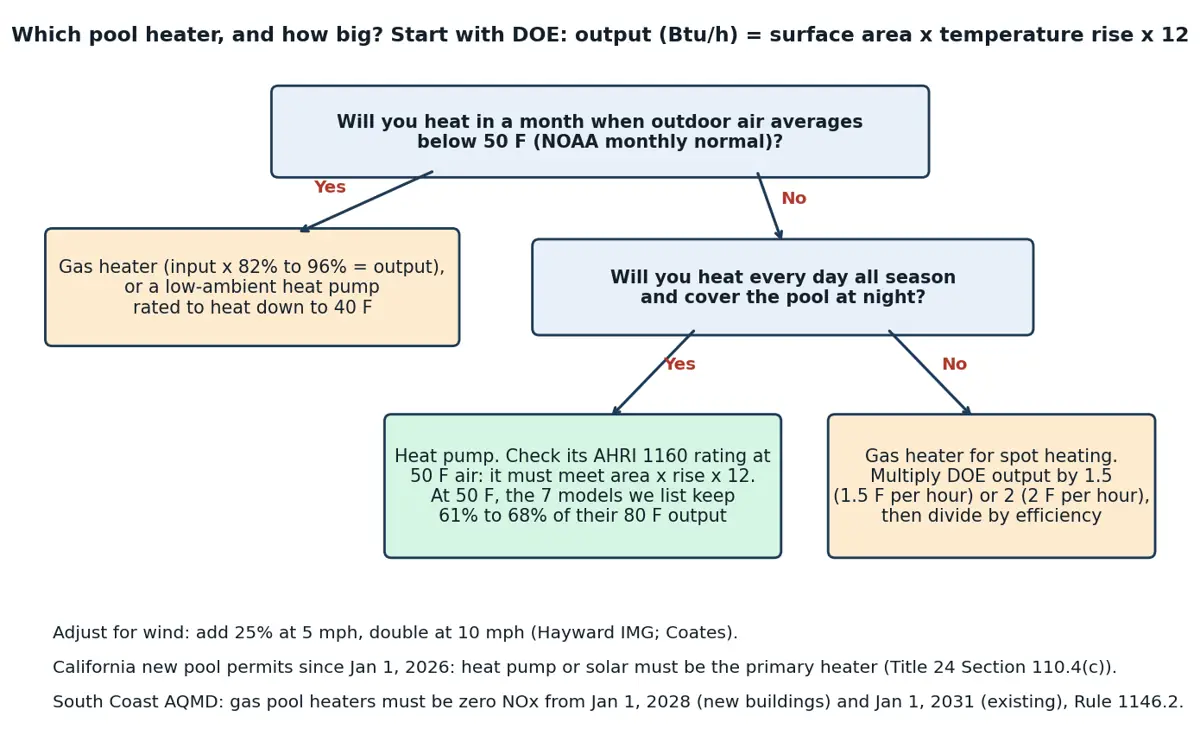
Buy the first size whose output meets area x rise x 12 for your coldest swim month, using the 50 F air rating for a heat pump and input x efficiency for gas. Then adjust for wind, spot heating, a spa and local rules. The table and flowchart below turn those checks into a choice.
| If your situation is | Do this | Why (source) |
|---|---|---|
| You plan to heat in a month when air averages below 50 F | Choose a gas heater or a low-ambient heat pump rated to heat at 40 F | Hayward lists 50 F as the lowest heating air temperature for its standard HeatPro models and 40 F for low-ambient models |
| You heat daily all season, cover the pool at night, and air stays at 50 F or warmer | Choose a heat pump whose 50 F air rating meets area x rise x 12 | At 50 F air the 7 models compared run at COP 4.0, against 82% to 96% efficiency for gas (Hayward; Pentair) |
| You spot heat for weekends and leave the pool uncovered | Size gas at DOE output x 1.5 (1.5 F per hour) or x 2 (2 F per hour), then divide by efficiency | DOE Energy Saver multipliers |
| Your yard is windy | Add 25% for a 5 mph wind at the water; double the result for 10 mph | Hayward IMG calculator; Coates sizing guide |
| You are permitting a new pool in California on or after Jan 1, 2026 | Make a heat pump (at least gallons x 8.33 x 10 / 17.5 Btu/h) or solar the primary heater; gas only as backup; fit a cover | Title 24 Part 6 Sections 110.4(b)3 and 110.4(c); JA16.3 |
| You are in the South Coast AQMD (Los Angeles, Orange, Riverside, San Bernardino counties) | Plan on a heat pump: gas pool heaters must be zero NOx from Jan 1, 2028 in new buildings and Jan 1, 2031 in existing ones | SCAQMD Rule 1146.2 (amended June 7, 2024) |
| Your pool has an attached spa heated on demand | Size gas for the spa: a 400,000 Btu/h input heats 500 gallons by 30 F in 22 minutes; a 200,000 input takes 44 | Pentair Engineering Data p. 530 |
Sources: DOE; Hayward; Pentair; Hayward IMG; Coates; Title 24; JA16.3; SCAQMD Rule 1146.2; Pentair Engineering Data. Download CSV
Ask any installer for the calculation, not just a model number: the surface area, the target temperature, the air temperature they assumed and whether they used the 80 F or 50 F heat pump rating. For a pool and spa on one system, also ask how many minutes the spa takes to heat from cold.
How we compiled this
We opened 16 primary documents in October 2026: four archived DOE Energy Saver pages, Pentair’s 2025-2026 catalog sections, Hayward’s HeatPro sell sheet with AHRI 1160 ratings, the Hayward IMG and Coates calculators, 10 CFR 430.32, California Title 24 and JA16.3, SCAQMD Rule 1146.2, EIA and USGS unit references, and NOAA 1991-2020 normals for 12 airports. Every size, time and cost figure is our arithmetic from those documents; we did not test heaters. Retailer guides from Leslie’s, Inyo Pools, MBTEK and ePoolSupply served only as the claims compared in one table.
Frequently Asked Questions
How many BTU do I need to heat a 10,000 gallon pool?
About 69,500 Btu per hour of output adds 20 F to 10,000 gallons in 24 hours (10,000 x 8.34 x 20 / 24, Pentair’s formula, before losses). By area, a 10,000-gallon pool 4.5 ft deep covers about 297 sq ft, and DOE’s rule gives 71,301 Btu/h for a 20 F rise. Pentair’s smallest MasterTemp, 125,000 Btu/h input (102,500 output), covers either figure.
How big of a pool heater do I need for a 30000 gallon pool?
Adding 20 F in 24 hours takes 208,500 Btu/h of output, a 248,214 Btu/h input at 84% efficiency. DOE’s area rule, at 4.5 ft average depth (about 891 sq ft), gives 213,904 Btu/h for a 20 F rise. A 250,000 Btu/h input gas heater (210,000 output) just covers the volume figure; a 300,000 input unit (252,000 output) covers both with margin.
What size heater for a 16×32 inground pool?
A 16 x 32 ft pool has 512 sq ft of surface, so DOE’s rule gives 122,880 Btu/h of output for a 20 F rise and 184,320 for 30 F. With gas at 84% efficiency that is a 146,286 or 219,429 Btu/h input: a 200,000 Btu/h heater for the first case, a 250,000 for the second. A heat pump needs a 50 F air rating near 122,880 Btu/h.
How many BTU do I need to heat a 20,000 gallon pool?
Raising 20,000 gallons by 1 F takes 166,800 Btu, so 20 F takes 3,336,000 Btu. Done in 24 hours that is 139,000 Btu/h of output, or 165,476 Btu/h of gas input at 84%. DOE’s area rule at 4.5 ft average depth (about 594 sq ft) gives 142,602 Btu/h. A 200,000 Btu/h input heater (168,000 output) covers both.
How long does it take to heat a pool from 60 to 80?
For a 20,000-gallon pool, that 20 F rise takes about 9.9 hours with a 400,000 Btu/h gas heater at 84%, 15.9 hours with a 250,000 Btu/h unit, 23.8 hours with a 140,000 Btu/h heat pump at 80 F air and 39.2 hours at 50 F air. Those exclude losses; Pentair says a pool loses 2 F to 4 F a day in cool weather.
Is it better to oversize a pool heat pump?
A larger heat pump reaches temperature sooner at the same efficiency: Hayward’s four standard HeatPro models all rate COP 5.7 at 80 F air and 4.0 at 50 F air, so cost per delivered Btu does not change with size. Oversizing mainly costs more upfront and draws more power, 7.2 kW and a 42 amp minimum circuit for the 140,000 Btu/h model against 4.9 kW and 38 amps for the 90,000.
Sources
- U.S. Department of Energy. Energy Saver: Gas Pool Heaters (archived copy, Jan 1, 2026). Accessed 2026-10-26.
- U.S. Department of Energy. Energy Saver: Heat Pump Swimming Pool Heaters (archived copy, Jan 1, 2026). Accessed 2026-10-26.
- U.S. Department of Energy. Energy Saver: Swimming Pool Covers (archived copy, Jan 1, 2026). Accessed 2026-10-26.
- U.S. Department of Energy. Energy Saver: Managing Swimming Pool Temperature for Energy Efficiency (archived copy, Jan 1, 2026). Accessed 2026-10-26.
- Pentair. Pool Product Catalog 2025-2026, Engineering Data (heater sizing, p. 530). Accessed 2026-10-26.
- Pentair. Pool Product Catalog 2025-2026, Heaters and Heat Pumps. Accessed 2026-10-26.
- Hayward Industries. HeatPro Series sell sheet LITHTPRO23 (AHRI 1160 ratings). Accessed 2026-10-26.
- Hayward IMG. Heater Size Calculator. Accessed 2026-10-26.
- Coates Heater. Heater Sizing Guide. Accessed 2026-10-26.
- California Energy Commission, via Energy Code Ace. JA16.3 Heat Pump Pool Heater Sizing (2025 Reference Appendices). Accessed 2026-10-26.
- California Energy Commission. 2025 Building Energy Efficiency Standards, Title 24 Part 6 (CEC-400-2025-010-F). Accessed 2026-10-26.
- eCFR. 10 CFR 430.32(k), pool heater energy conservation standards. Accessed 2026-10-26.
- South Coast Air Quality Management District. Rule 1146.2 (amended June 7, 2024). Accessed 2026-10-26.
- U.S. Energy Information Administration. Energy Explained: British thermal units. Accessed 2026-10-26.
- U.S. Geological Survey. Water Science Glossary (7.48 gallons per cubic foot). Accessed 2026-10-26.
- NOAA National Centers for Environmental Information. U.S. Climate Normals 1991-2020, monthly station files. Accessed 2026-10-26.
- U.S. Environmental Protection Agency WaterSense. Pool Water Efficiency. Accessed 2026-10-26.
- U.S. Energy Information Administration. Natural Gas Prices, residential, monthly. Accessed 2026-10-26.
- U.S. Energy Information Administration. Electric Power Monthly Table 5.6.A. Accessed 2026-10-26.
Related pages
Get Quotes From Licensed Local Pool Pros
Tell us what you need and your ZIP code. We match you with pool companies that cover your area.