Pool Flocculant: How Floc Works, Label Doses and Vacuum to Waste Steps
Pool flocculant is a coagulant, usually an aluminum salt, that clumps fine haze so it sinks overnight: dose by the label, settle 8 to 12 hours with the pump off, then vacuum the floor to waste.
- ✓Six labels, one tableDoses per 10,000 gallons run 8 to 25.6 fl oz for liquids and 1.5 to 3.34 lb for granular alum, converted from each maker's directions.
- ✓Needs a WASTE valveHTH tells owners without a vacuum-to-waste option to use clarifier; Hy-Clor rates its alum tablets not suitable for cartridge or DE filters.
- ✓Plan for lost waterA 20 to 45 minute vacuum at 45 GPM sends 900 to 2,025 gallons to waste, 3.2 to 7.2 inches of a 15 by 30 foot pool.
Key takeaways
- All eight pool flocculants we read are aluminum salts: HTH Drop Out lists aluminum chloride, Poolife and Baquacil use aluminum sulfate, and Zodiac’s liquid is polyaluminium chloride, per the maker pages and safety data sheets read in November 2026.
- Label doses per 10,000 US gallons run from 8 fl oz (HTH Drop Out) to about 25.6 fl oz (Zodiac liquid) for liquids, and from 1.5 lb (Poolife) to about 3.34 lb (Zodiac) for granular alum.
- Coagulation takes several seconds and flocculation is the slower, gentle-mixing step that grows floc to 0.1 to 3 mm, according to the EPA Ireland water treatment manual; a clarifier leaves that floc for the filter, a flocculant sinks it.
- pH guidance conflicts: about 5 to 8 for alum in the EPA manual, 6.5 to 7.0 on Zodiac’s granular page, 7.2 to 7.6 on HTH Drop Out, and 7.0 to 7.8 for every pool per CDC.
- Vacuuming floc to waste for 20 to 45 minutes at 45 GPM sends 900 to 2,025 gallons down the drain, 3.2 to 7.2 inches of a 15 by 30 foot pool, worth $1.76 to $60.82 at 25-city refill rates.
- Maker cautions: HTH says floc needs a vacuum-to-waste option, Hy-Clor rates its alum tablets not suitable for cartridge or DE filters, and the Maytronics Dolphin manual says not to run the robot after adding liquid flocculant.
What is pool flocculant made of?
Pool flocculant is a coagulant, and in all eight products we read it is an aluminum salt: aluminum sulfate (alum), aluminum chloride or polyaluminum chloride (PAC). In water these salts form aluminum hydroxide floc that grabs suspended particles and sinks. Polymers do the same job in treatment plants, and chitosan, a natural polymer, is sold to pool owners as a clarifier dosed at 1 oz per 10,000 gallons.
| Product | Seller | Active ingredient (as published) | Chemistry family | Form | Document read |
|---|---|---|---|---|---|
| HTH Pool Care Drop Out Flocculant | HTH (US) | Contains aluminum chloride | Aluminum salt | Liquid, 28 oz and 1 qt | Maker product page |
| Poolife Flocculant | Poolife (US) | Aluminum sulfate | Aluminum salt (alum) | Granular, 2.25 lb | Maker page; retailer listing for the active |
| BAQUACIL Filter Aid and Flocculant | Baquacil (US) | Iron-free aluminum sulfate compound | Aluminum salt (alum) | Granular, 1.5 lb | Maker product listing |
| Zodiac Pure Perfection Granular Flocculant | Zodiac (Australia) | 1000 g/kg aluminium sulphate | Aluminum salt (alum) | Granular, 2 kg | Maker product page |
| Zodiac Liquid Flocculant | Zodiac (New Zealand) | Poly aluminium chloride | Polyaluminum chloride (PAC) | Liquid, 1 L | Maker product page |
| Focus Pool Floc | Focus Products (Australia) | Dialuminium chloride pentahydroxide, under 10% | Polyaluminum chloride (PAC) | Liquid | Safety data sheet, Sept 2020 |
| Hy-Clor Cloud Out Clear Tablets | Hy-Clor (Australia) | Aluminium sulfate, about 100% | Aluminum salt (alum) | Tablet | Safety data sheet, Feb 2026 |
| AQUA Floc | Lawrason's (Canada) | Aluminum sulfate hydrate, 80 to 100% | Aluminum salt (alum) | Granular | Safety data sheet, Feb 2017 |
| SeaKlear Chitosan Clarifier | SeaKlear (US) | Chitosan | Natural polymer, sold as a clarifier | Liquid, 32 oz | Maker product page |
Sources: HTH Drop Out; Poolife and Simplified Pools listing; Baquacil; Zodiac granular; Zodiac liquid; Focus Pool Floc SDS (2020); Hy-Clor SDS (2026); AQUA Floc SDS (2017); SeaKlear. Accessed November 1, 2026. Download CSV
The chemistry is the same one city water plants use. The EPA Ireland water treatment manual (2002) calls aluminum sulfate probably the most widely used coagulant in water treatment, names PAC as an alternative for difficult waters, and says the hydroxide floc carries the positive charge that neutralizes the negative charge on fine particles. That is why one dose can drop dust, pollen and dead algae that slip through a sand filter.
Polymers are the second family. The same manual describes polyelectrolytes as long-chain molecules that can be cationic, anionic, non-ionic or amphoteric, used to bring small particles into larger agglomerates. In the pool aisle the polymer most often named is chitosan: SeaKlear Chitosan Clarifier doses 1 oz per 10,000 gallons weekly with the filter running at least six hours, so it behaves as a clarifier, not a floc that you vacuum up.
Pool clarifier vs flocculant: what is the difference?
Both products clump fine particles; the difference is where the clumps go. Clarifier makes flocs the filter can catch, so it is slower but needs no vacuuming: HTH doses 2 fl oz per 10,000 gallons and allows 48 hours. Flocculant makes heavy masses that sink in 8 to 12 hours and must be vacuumed to waste, which costs water and an hour of work.
| Question | Pool clarifier | Pool flocculant | Source |
|---|---|---|---|
| What it does | Clumps fine particles into flocs small enough for the filter to catch | Clumps particles into heavy masses that sink to the floor | HTH Clarifier Advanced and Drop Out pages |
| Water-treatment step | Coagulation plus filtration | Coagulation plus flocculation and settling | EPA Ireland Water Treatment Manual (2002) |
| Example label dose per 10,000 gal | 2 fl oz (4 fl oz for extremely cloudy water) | 8 fl oz | HTH product directions |
| Pump | Run the filter at least 8 hours, or 24 to 48 hours continuously | 2 hours on, then off 8 to 12 hours | HTH product directions |
| Filter rule | Do not backwash or clean for at least 24 hours | Vacuum to WASTE, then backwash | HTH product directions |
| Time to clear | Within 48 hours, or check the filter | Overnight; 12 to 24 hours if very heavy | HTH product directions |
| Water lost | Only routine backwash water | 900 to 2,025 gal in 20 to 45 minutes at 45 GPM (PC&S arithmetic) | Hayward ProSeries; Pools by Cory |
| Needs a WASTE valve | No | Yes, for the vacuum step | HTH cloudy water guide; Hayward ProSeries |
| Best for | Dull or hazy water with the floor visible | Water too cloudy to see the floor | HTH cloudy water guide |
Sources: HTH Clarifier Advanced; HTH Drop Out Flocculant; HTH cloudy water guide; EPA Ireland Water Treatment Manual (2002); Hayward ProSeries manual; Pools by Cory (2025). Water figures are PC&S arithmetic. Accessed November 2026. Download CSV
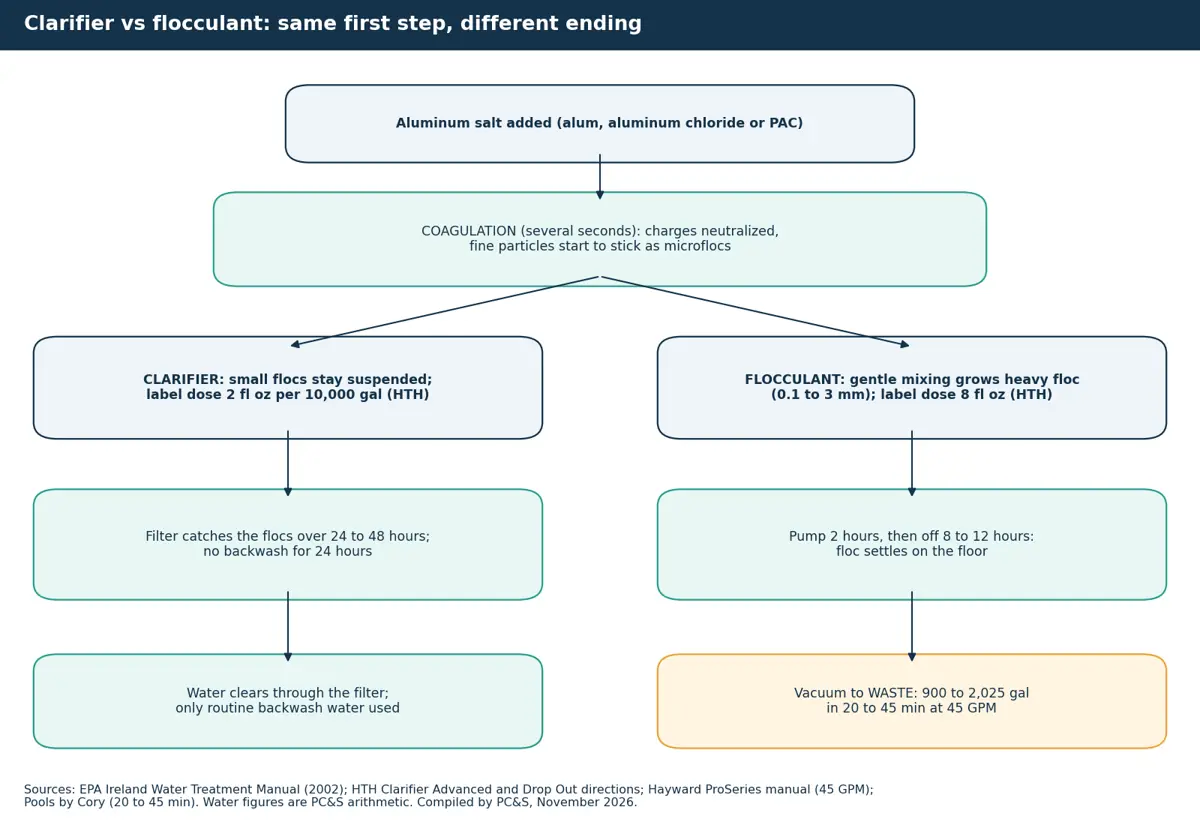
Pick by the floor and the valve. If you can still see the main drain and your chemistry is balanced, 2 fl oz of clarifier per 10,000 gallons and 24 to 48 hours of filtration is the lower-effort route, and our cloudy pool water guide walks through finding the cause first. If the floor is gone and your filter valve has a WASTE position, flocculant clears it overnight. Clarifier doses, filter times and cost per treatment for 12 products are in our pool clarifier guide.
How much pool flocculant per 10,000 gallons?
Use the label: doses differ fourfold because concentrations differ. HTH Drop Out calls for 8 fl oz per 10,000 gallons, Focus Pool Floc works out to 12.8 fl oz and Zodiac’s liquid PAC to 25.6 fl oz. Granular alum runs 1.5 lb (Poolife) to about 3.34 lb (Zodiac). Double each for a 20,000 gallon pool and never add a second dose early.
| Product (active) | Dose as printed | Per 10,000 US gal (PC&S conversion) | For a 20,000 gal pool | pH it asks for | Settle or filter time | Source |
|---|---|---|---|---|---|---|
| HTH Drop Out (aluminum chloride) | 8 fl oz per 10,000 gal | 8 fl oz | 16 fl oz | 7.2 to 7.6 | Pump 2 h, off 8 to 12 h | HTH |
| Poolife Flocculant (aluminum sulfate) | 1.5 lb per 10,000 gal | 1.5 lb | 3 lb | Not stated | 12 to 24 h still water | Simplified Pools listing; Poolife |
| Zodiac Granular Flocculant (alum) | 400 g per 10,000 L | 3.34 lb (400 x 3.785 / 453.6) | 6.68 lb | 6.5 to 7.0 (page also cites 8.2 on the label) | Second dose in extreme cases | Zodiac Australia |
| Zodiac Liquid Flocculant (PAC) | 200 mL per 10,000 L | 25.6 fl oz (200 x 3.785 / 29.57) | 51.2 fl oz | Not pH dependent; 8.2 more efficient | Second dose in extreme cases | Zodiac New Zealand |
| Focus Pool Floc (PAC) | 500 mL per 50,000 L | 12.8 fl oz | 25.6 fl oz | Not stated | Not stated | Focus SDS (2020) |
| Hy-Clor Cloud Out Clear Tablets (alum) | 1 tablet per 50,000 L, in the skimmer | 0.76 tablet (1 per 13,209 gal) | 2 tablets | 7.2 to 7.6 | Filter 24 to 48 h, then backwash | Hy-Clor |
| For comparison: SeaKlear Chitosan Clarifier | 1 oz per 10,000 gal weekly | 1 oz | 2 oz | Not stated | Filter at least 6 h | SeaKlear |
Sources: HTH; Simplified Pools listing and Poolife; Zodiac Australia; Zodiac New Zealand; Focus SDS; Hy-Clor; SeaKlear; NIST conversions. Metric conversions are PC&S arithmetic. Accessed November 1, 2026. Download CSV
Source: HTH product directions; Focus Pool Floc SDS (2020); Zodiac New Zealand; NIST conversions. Accessed November 2026. Download chart data (CSV)
The metric conversions use 3.785 liters per US gallon, 29.57 mL per fluid ounce and 453.6 grams per pound from NIST: 400 g per 10,000 liters becomes 1,514 g, or 3.34 lb, per 10,000 gallons. Work out your gallons first with our pool volume calculator, because a 20% error in volume is a 20% error in dose.
Guides quote bigger numbers than the labels. Swim University suggests about 4 lb of alum per 10,000 gallons and Beatbot 10 to 20 oz of liquid, against 1.5 lb and 8 fl oz on the Poolife and HTH directions. Extra alum also uses up more total alkalinity, so start at the label figure.
| What a guide says | What the label or maker says | Sources |
|---|---|---|
| Swim University: about 4 lb of alum per 10,000 gal | Poolife lists 1.5 lb of aluminum sulfate per 10,000 gal; Zodiac's alum works out to 3.34 lb | Swim University; Poolife listing; Zodiac |
| Beatbot: 1 to 2 oz of liquid floc per 1,000 gal (10 to 20 oz per 10,000) | HTH Drop Out: 8 fl oz per 10,000 gal; Focus: 12.8 fl oz; Zodiac liquid: 25.6 fl oz | Beatbot; HTH; Focus SDS; Zodiac |
| River Pools: balance pH to about 7.0 | HTH and Hy-Clor: 7.2 to 7.6; CDC keeps pools at 7.0 to 7.8 | River Pools; HTH; Hy-Clor; CDC |
| Beatbot: flocculant works with sand filters only | HTH's rule is a vacuum-to-waste option; Poolife allows cartridge filters if you vacuum to waste | Beatbot; HTH; Poolife |
| Swim University: let floc sit 8 to 16 hours | HTH: 8 to 12 hours, 12 to 24 for heavy cloudiness; Poolife: 12 to 24 hours | Swim University; HTH; Poolife |
Sources: Swim University; Beatbot; River Pools (2018); HTH; Poolife; Simplified Pools; Zodiac; Focus SDS; Hy-Clor; CDC. Accessed November 2026. Download CSV
What pH does pool flocculant need?
Follow the product: HTH Drop Out and Hy-Clor both ask for pH 7.2 to 7.6 before dosing, inside CDC’s 7.0 to 7.8 pool range. Water plants run alum lower, roughly pH 5 to 8 and 6.5 to 7.5 for alkaline lowland water, per the EPA Ireland manual. Alum also eats alkalinity, so a 1.5 lb dose can pull total alkalinity down by about 9 to 16 ppm.
| Source | pH it gives | Applies to | Type of source |
|---|---|---|---|
| EPA Ireland Water Treatment Manual (2002) | About 5 to 8 (most effective 5.5 to 8) | Alum coagulation in drinking water plants | Government technical manual |
| EPA Ireland Water Treatment Manual (2002) | 6.5 to 7.5 | Lowland surface waters, which carry more alkalinity | Government technical manual |
| Zodiac Granular Flocculant page | 6.5 to 7.0 (and cites 8.2 on the label) | Alum pool floc | Maker page |
| Zodiac Liquid Flocculant page | Not pH dependent; 8.2 more efficient | PAC pool floc | Maker page |
| HTH Drop Out Flocculant | 7.2 to 7.6 | Aluminum chloride pool floc | Maker directions |
| Hy-Clor Cloud Out Clear Tablets | 7.2 to 7.6 | Alum tablets | Maker directions |
| CDC | 7.0 to 7.8 | Every pool, for germ kill and comfort | Federal health guidance (2024) |
| Swim University (guide) | 7.4 to 7.6 | Pool floc in general | Consumer guide |
| River Pools (guide) | About 7.0 | Pool floc in general | Consumer guide (2018) |
Sources: EPA Ireland Water Treatment Manual (2002); Zodiac granular; Zodiac liquid; HTH; Hy-Clor; CDC (page dated May 10, 2024); Swim University; River Pools. Accessed November 2026. Download CSV
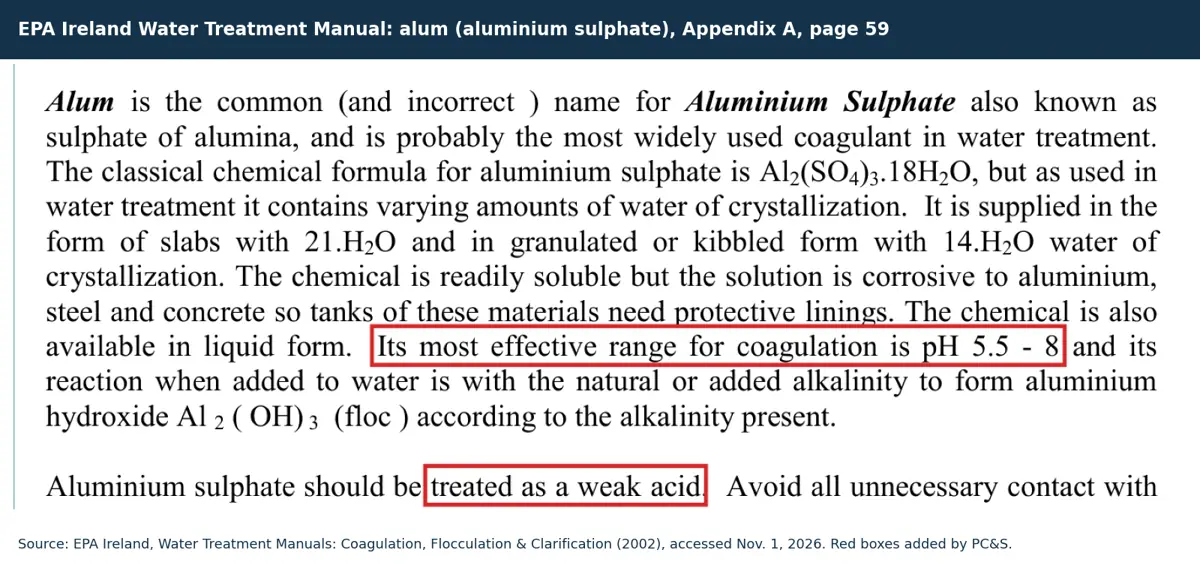
Zodiac’s own granular page shows why to read the fine print: it tells owners to set pH to 6.5 to 7.0 for optimum coagulation and, in the next line, says the label recommends 8.2 (Zodiac Australia). Its liquid PAC page says the product is not pH dependent but works better at 8.2. When the page and the bag disagree, the bag in your hand is the instruction.
| Step | Input | Calculation | Result |
|---|---|---|---|
| Reaction | EPA Ireland manual: 1 aluminum sulfate reacts with 3 calcium alkalinity units | Al2(SO4)3 + 3 Ca(OH)2 = 2 Al(OH)3 + 3 CaSO4 | 3 x 100.09 = 300.27 mg CaCO3 per 342.2 mg alum |
| Ratio, dry (anhydrous) alum | PubChem: aluminum sulfate 342.2, calcium carbonate 100.09 | 300.27 / 342.2 | 0.88 ppm alkalinity per ppm alum |
| Ratio, 14-hydrate alum | 342.2 + 14 x 18.015 (water) = 594.4 | 300.27 / 594.4 | 0.51 ppm alkalinity per ppm alum |
| Poolife dose | 1.5 lb per 10,000 gal | 680.4 g / 37,854 L | 18.0 ppm alum |
| Alkalinity used, Poolife | 18.0 ppm | x 0.51 to x 0.88 | About 9 to 16 ppm |
| Zodiac granular dose | 400 g per 10,000 L | 400,000 mg / 10,000 L | 40 ppm alum |
| Alkalinity used, Zodiac | 40 ppm | x 0.51 to x 0.88 | About 20 to 35 ppm |
Sources: EPA Ireland manual reaction equations; PubChem molecular weights; Poolife dose; Zodiac dose. Arithmetic by PC&S; real use depends on how much water of crystallization the product holds. Download CSV
The 14-hydrate row is the closer estimate for granular products, because the EPA Ireland manual says granulated alum is supplied with 14 waters of crystallization (slabs carry 21). Retest after the vacuum step. A drop of 9 to 35 ppm matters most in pools already near the low end of the 80 to 120 ppm alkalinity range, and the fix is in our guide on how to raise alkalinity in a pool.
How to use pool flocculant, step by step
Balance the water, top it up, dose with the valve on RECIRCULATE, mix for 2 hours, then leave the pump off overnight. Vacuum slowly on WASTE, refill, backwash and retest. The steps below follow the HTH Drop Out directions and the Hayward ProSeries valve definitions, with the times and settings each one sets.
- Test and balance firstBring pH to 7.2 to 7.6 and confirm free chlorine is in range, as the HTH Drop Out directions require. Floc does not kill anything: HTH says it does not replace a sanitizer or algaecide.
- Raise the water levelFill an inch or two above normal. A 30 minute vacuum on WASTE at 45 GPM removes about 1,350 gallons, 4.8 inches of a 15 by 30 foot pool.
- Take out the robotMaytronics tells Dolphin owners not to run the robot after liquid flocculant or clarifier is added, because both clog its filters.
- Set the valve to RECIRCULATEOn a Hayward multiport, RECIRCULATE returns water to the pool bypassing the filter, so the floc does not load the sand. Shut the pump off before turning the handle.
- Add the label dose8 fl oz per 10,000 gallons of HTH Drop Out, or your product’s rate, spread evenly around the edges. Zodiac says dilute first.
- Circulate 2 hours, then pump offHTH: run the pump 2 hours, then off for 8 to 12 hours, ideally overnight; very cloudy pools may need 12 to 24 hours. Poolife asks for 12 to 24 hours of still water.
- Vacuum slowly on WASTEHayward’s WASTE position sends water straight out of the pool. Move the head slowly so the floc does not lift; vacuuming through the filter puts the particles back, HTH warns.
- Watch the level and refillStop before the skimmer draws air. A manual vacuum takes 20 to 45 minutes (Pools by Cory), so refill as you go or right after.
- Backwash, then retestBackwash the filter, return to FILTER and test again. HTH: swim only when the water is clear, free chlorine is 1 to 4 ppm and pH is 7.2 to 7.6.
The vacuum itself, from priming the hose to the FILTER and WASTE positions Hayward prints for sand and DE valves, is covered in our guide on how to vacuum a pool. When the floc is out, follow the backwash and rinse times in our guide on how to backwash a pool filter.
How much water does flocking a pool waste?
More than most owners expect: every minute on WASTE sends one minute of pump flow to the drain. At the 45 GPM Hayward lists for 1-1/2 inch pipe, a 20 to 45 minute vacuum removes 900 to 2,025 gallons, 3.2 to 7.2 inches of a 15 by 30 foot pool. Refilling that costs $1.76 to $60.82 depending on the city.
| Setup | Flow (GPM) | Example pool | Minutes on WASTE | Gallons sent to waste | Inches of water lost | Refill cost at $1.95 per 1,000 gal (Sacramento) | At $9.12 (25-city median) | At $30.04 (Houston) |
|---|---|---|---|---|---|---|---|---|
| Hayward maximum for 1-1/2 in pipe | 45.0 | 15 x 30 ft inground | 20 | 900 | 3.2 | $1.75 | $8.21 | $27.03 |
| Hayward maximum for 1-1/2 in pipe | 45.0 | 15 x 30 ft inground | 30 | 1,350 | 4.8 | $2.63 | $12.32 | $40.55 |
| Hayward maximum for 1-1/2 in pipe | 45.0 | 15 x 30 ft inground | 45 | 2,025 | 7.2 | $3.95 | $18.47 | $60.82 |
| Intex SF80110-2 pump, 1,600 GPH | 26.7 | 18 ft round above-ground | 20 | 533 | 3.4 | $1.04 | $4.87 | $16.02 |
| Intex SF80110-2 pump, 1,600 GPH | 26.7 | 18 ft round above-ground | 30 | 800 | 5.0 | $1.56 | $7.30 | $24.03 |
| Intex SF80110-2 pump, 1,600 GPH | 26.7 | 18 ft round above-ground | 45 | 1,200 | 7.6 | $2.34 | $10.95 | $36.04 |
Sources: Hayward ProSeries manual (45 GPM); Intex SF80110-2 manual (1,600 GPH); Pools by Cory (20 to 45 minutes); Town of Flower Mound (7.48 gal per cu ft); PC&S cost to fill a pool study (October 2026 rates). Arithmetic by PC&S; rated maximum flows, so real loss may be lower. Download CSV
Source: Hayward ProSeries manual (45 GPM for 1-1/2 in pipe); Intex SF80110-2 manual (1,600 GPH); Pools by Cory (20 to 45 minutes). Accessed November 2026. Download chart data (CSV)
The refill prices come from our cost to fill a pool study, which priced 10,000 gallons at $19.50 in Sacramento, $91.23 at the 25-city median and $300.36 in Houston at October 2026 water and sewer rates. Chemical cost is small by comparison: a 1.5 lb Poolife dose costs about $18.66 at the $27.99 retail price for a 2.25 lb bag.
Water rules can matter more than price. Florida’s Southwest Florida Water Management District rule 40D-21.631 requires pools to be kept in a way that minimizes make-up water, including the scheduling of backwashing (Fla. Admin. Code 40D-21.631); our pool filling restrictions research tracks which utilities limit fills and top-offs. Under rules like these, clarifier plus filtration is the lower-water route.
Can you use flocculant with a cartridge or DE filter?
Only if you can vacuum to waste. Most cartridge filters have no WASTE position, and HTH tells owners without a vacuum-to-waste option to use clarifier instead. Poolife allows cartridge filters when you vacuum to waste, while Hy-Clor rates its alum tablets not suitable for cartridge or DE filters. Sand filters with a multiport WASTE position, such as Hayward’s ProSeries rated to 45 GPM on 1-1/2 inch pipe, are the standard floc setup.
| Filter or equipment | What the maker says | Source |
|---|---|---|
| Sand filter with multiport valve | Recirculate 2 hours, pump off overnight, vacuum directly to waste, then backwash | HTH Drop Out directions |
| Any pool without a vacuum-to-waste option | Flocculant requires one; above-ground pools without it should use a clarifier | HTH cloudy water guide |
| Cartridge filter | Usable if you vacuum to waste; as a filter aid, clean the cartridge thoroughly after | Poolife Flocculant page |
| Cartridge filter (Hayward SwimClear) | No WASTE position; the manual sends vacuuming into the filter, then a cartridge clean | Hayward SwimClear manual |
| Cartridge and DE filters | Cloud Out Clear tablets are not suitable for cartridge or DE filters; sand, glass and zeolite media only | Hy-Clor product page |
| Sand filter (Hayward ProSeries) | WASTE bypasses the filter for vacuuming heavy debris directly to waste | Hayward ProSeries manual |
| Robotic cleaner (Maytronics Dolphin) | Do not use the robot if liquid flocculant or any other clarifier was added; they obstruct and damage its filters | Dolphin M600 and Wave 90i manuals |
Sources: HTH Drop Out; HTH cloudy water guide; Poolife; Hayward SwimClear manual; Hy-Clor; Hayward ProSeries manual; Dolphin M600 manual; Dolphin Wave 90i manual (2024). Accessed November 2026. Download CSV
The reason is plumbing, not chemistry. Hayward’s SwimClear cartridge manual sends all vacuuming through the filter, and a cartridge loaded with aluminum floc blinds fast. Above-ground sand pumps are different: the Intex SF80110-2 manual lists a WASTE position for vacuuming directly to waste. Our pool filter types guide compares the three filters on backwash water and cost.
Rather have a pro clear the water?
Can you swim after using flocculant, and is it safe?
Not while floc is settling. HTH says swim only after the floc is vacuumed out and the water is clear with free chlorine at 1 to 4 ppm and pH 7.2 to 7.6. The products are irritants: safety data sheets class AQUA Floc as a skin and eye irritant and Hy-Clor’s alum tablets as a serious eye irritant, and EPA treats aluminum above 0.05 to 0.2 mg/L as a color problem in drinking water.
Settled floc stirs up the moment someone walks on it, which is why HTH bars swimming while material is settling (HTH Drop Out FAQ). The aluminum itself leaves with the vacuumed sediment. EPA’s secondary drinking water standard for aluminum, 0.05 to 0.2 mg/L, is a cosmetic limit tied to colored water, not a swimming limit, but it shows why a pool should not be left full of unsettled floc.
Flocculant, clarifier or shock: what should you use?
Match your filter, your water and your water rules to a row. Clarifier (2 fl oz per 10,000 gallons) for haze with the floor visible, flocculant (8 fl oz) for a hidden floor when you have a WASTE valve, shock when algae is alive, and clarifier again when water use is restricted. The flowchart holds the same logic for use at the pool.
| Number | What it means | Source |
|---|---|---|
| 8 fl oz per 10,000 gal | HTH Drop Out Flocculant label dose (aluminum chloride) | HTH product directions |
| 2 hours, then 8 to 12 hours | Pump on to mix, then pump off to settle (12 to 24 hours for very heavy cloudiness) | HTH product directions |
| pH 7.2 to 7.6 | Range HTH and Hy-Clor set before dosing their flocculants | HTH; Hy-Clor |
| pH 5 to 8 | Approximate optimum for alum coagulation in water treatment | EPA Ireland Water Treatment Manual (2002) |
| 0.1 to 3 mm | Best floc size range for removal in treatment plants | EPA Ireland Water Treatment Manual (2002) |
| 20 to 45 minutes | Time a pool company gives for manually vacuuming an average pool | Pools by Cory (2025) |
| 900 to 2,025 gal | Water sent to WASTE in 20 to 45 minutes at 45 GPM (PC&S arithmetic) | Hayward ProSeries manual; Pools by Cory |
| $1.95 to $30.04 per 1,000 gal | Cost to replace that water across 25 cities (PC&S fill-cost study, 10,000 gal column / 10) | PC&S cost to fill a pool study |
| 0.05 to 0.2 mg/L | EPA secondary standard for aluminum in drinking water (colored water above it) | EPA secondary drinking water standards |
Sources: HTH; Hy-Clor; EPA Ireland manual; Pools by Cory; Hayward; PC&S fill-cost study; EPA secondary standards. Accessed November 2026. Download CSV
| If your situation is | Do this | Why (source) |
|---|---|---|
| Hazy or dull water, floor visible, chemistry balanced | Use clarifier: 2 fl oz per 10,000 gal (HTH), filter 24 to 48 hours, no backwash for 24 hours | HTH Clarifier Advanced directions |
| Floor not visible, sand or DE filter with a WASTE setting | Use flocculant at the label dose, pump 2 hours, off 8 to 12 hours, vacuum to waste | HTH Drop Out directions; Hayward ProSeries |
| Cartridge filter or an above-ground pump with no WASTE port | Use clarifier, or a floc that names cartridges and only if you can vacuum to waste | HTH cloudy water guide; Poolife; Hy-Clor |
| Water is green or cloudy from live algae | Shock first; label 1258-1250 adds floc only after the shock and vacuums the sediment to waste | EPA label 1258-1250 |
| pH outside 7.2 to 7.6 | Adjust pH before dosing, not after | HTH Drop Out directions |
| A robotic cleaner is in the pool | Take it out; do not run it until the floc is vacuumed and the water is clear | Maytronics Dolphin manuals |
| Drought rules limit make-up water | Prefer clarifier: one floc job sends 900 to 2,025 gal to waste at 45 GPM | Fla. Admin. Code 40D-21.631; PC&S arithmetic |
| Floc has not settled after 12 hours | Leave the pump off up to 24 hours; a second dose only if the label allows it | HTH Drop Out; Zodiac |
| Haze is back within days | Check the filter, calcium and pH before another floc job | HTH Clarifier Advanced; CDC |
Sources: HTH Clarifier Advanced; HTH Drop Out; HTH cloudy water guide; Hayward; Poolife; Hy-Clor; EPA label 1258-1250; Maytronics; Fla. Admin. Code 40D-21.631; Zodiac; CDC. Accessed November 2026. Download CSV
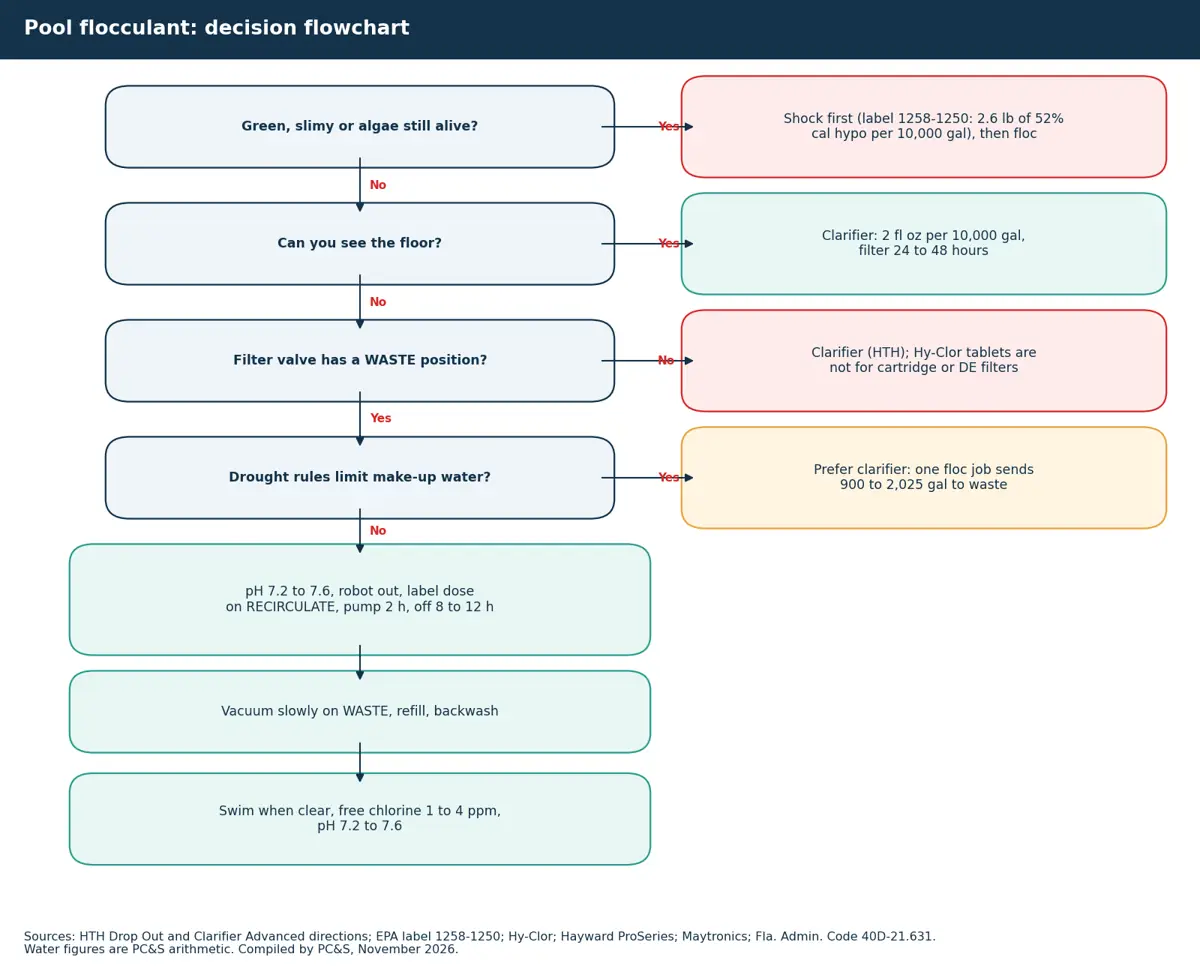
Algae changes the order. The EPA-accepted label for registration 1258-1250 doses a severe bloom at 2.6 lb of 52% calcium hypochlorite per 10,000 gallons and only then adds flocculant and vacuums the sediment to waste (EPA label 1258-1250); our guide to clearing a green pool covers that sequence. Where algae keeps returning after a cleanup, our pool algaecide guide compares the registered products and their swim waits.
How we compiled this
We read 31 documents in November 2026: 10 maker and retailer product pages, 3 safety data sheets, 5 equipment manuals (Hayward, Intex, Maytronics), one EPA pesticide label, the EPA Ireland water treatment manual, one EPA and two CDC pages, PubChem records, NIST conversions, one Florida water rule, a pool company vacuuming guide, a town unit page and two PC&S research reports. Metric conversions, alkalinity and water-loss figures are PC&S arithmetic. We did not test any product; consumer guides appear only where we compare their claims with the labels, and forum posts were excluded as a source of facts.
Frequently Asked Questions
Can you swim after using flocculant?
Not until the floc is vacuumed out. HTH bars swimming while material is settling and says to swim only when the water is visibly clear, free chlorine reads 1 to 4 ppm and pH is 7.2 to 7.6. With an overnight settle of 8 to 12 hours and a 20 to 45 minute vacuum, that usually means waiting until the day after dosing.
How long does it take flocculant to work?
Overnight for most pools. HTH’s Drop Out directions call for 2 hours of circulation, then the pump off for 8 to 12 hours, with debris visible on the floor within 4 to 8 hours; very cloudy pools may need 12 to 24 hours. Poolife asks for 12 to 24 hours of still water before vacuuming to waste.
Can you use flocculant with a cartridge filter?
Only if you can vacuum to waste, which most cartridge systems cannot. Hayward’s SwimClear manual sends vacuuming through the filter, and HTH tells owners without a vacuum-to-waste option to use clarifier. Poolife allows cartridge filters when you vacuum to waste, while Hy-Clor rates its Cloud Out tablets not suitable for cartridge or DE filters.
Is it better to use clarifier or flocculant?
Clarifier for haze with the floor visible, flocculant when you cannot see the floor and have a WASTE valve. HTH doses clarifier at 2 fl oz per 10,000 gallons and allows 48 hours; flocculant at 8 fl oz clears overnight but costs 900 to 2,025 gallons of water in a 20 to 45 minute vacuum at 45 GPM.
Can you use too much pool flocculant?
Yes. Aluminum floc is acidic: by PC&S arithmetic a 1.5 lb alum dose per 10,000 gallons uses about 9 to 16 ppm of total alkalinity, and doubling it doubles that. Label doses run 8 to 25.6 fl oz for liquids and 1.5 to 3.34 lb for granular alum per 10,000 gallons; Zodiac allows a second treatment only in extreme cases.
Can you use flocculant and algaecide together?
Not in the same step. Floc removes particles but kills nothing: HTH says Drop Out does not replace a sanitizer or algaecide. Kill algae first with chlorine, as EPA label 1258-1250 does with 2.6 lb of 52% calcium hypochlorite per 10,000 gallons, then floc, vacuum to waste and start any algaecide program once the water is clear.
Sources
- HTH (manufacturer). HTH Pool Care Drop Out Flocculant (directions and FAQ). Accessed 2026-11-01.
- HTH (manufacturer). HTH Pool Care Clarifier Advanced (directions and FAQ). Accessed 2026-11-01.
- HTH (manufacturer guide). Why Is My Pool Cloudy? Causes and Fixes. Accessed 2026-11-01.
- Poolife (manufacturer). Poolife Pool Flocculant. Accessed 2026-11-01.
- Simplified Pools (retailer). Poolife Flocculant listing (active ingredient, dose, price). Accessed 2026-11-01.
- Baquacil (manufacturer). BAQUACIL Cleaners and Solutions (Filter Aid and Flocculant). Accessed 2026-11-01.
- Zodiac Australia (manufacturer). Granular Flocculant WC000424. Accessed 2026-11-01.
- Zodiac New Zealand (manufacturer). Liquid Flocculant WPQDO1. Accessed 2026-11-01.
- Focus Products via Clark Rubber. Focus Pool Floc Safety Data Sheet (revision September 8, 2020). Accessed 2026-11-01.
- Hy-Clor (manufacturer). Cloud Out Clear Tablets. Accessed 2026-11-01.
- Hy-Clor Group. Hy-Clor Clarifier Tablet and Cloudout Clear Tablets Safety Data Sheet (February 2026). Accessed 2026-11-01.
- Lawrason's, Inc.. AQUA Floc Safety Data Sheet (February 1, 2017). Accessed 2026-11-01.
- SeaKlear (NC Brands). Chitosan Clarifier. Accessed 2026-11-01.
- Environmental Protection Agency, Ireland. Water Treatment Manuals: Coagulation, Flocculation and Clarification (2002). Accessed 2026-11-01.
- U.S. Environmental Protection Agency. Secondary Drinking Water Standards: Guidance for Nuisance Chemicals (updated May 26, 2026). Accessed 2026-11-01.
- Centers for Disease Control and Prevention. Home Pool and Hot Tub Water Treatment and Testing (May 10, 2024). Accessed 2026-11-01.
- Centers for Disease Control and Prevention. Pool Chemical Emergencies (May 28, 2025). Accessed 2026-11-01.
- U.S. EPA Pesticide Product and Label System. Arch 52% Calcium Hypochlorite, EPA Reg. No. 1258-1250, draft label dated July 12, 2021. Accessed 2026-11-01.
- National Library of Medicine. PubChem compound records: aluminum sulfate, calcium carbonate, water. Accessed 2026-11-01.
- National Institute of Standards and Technology. Approximate Conversions from U.S. Customary Measures to Metric. Accessed 2026-11-01.
- Hayward (manufacturer). ProSeries Sand Filter Owner's Manual IS210TS Rev A. Accessed 2026-11-01.
- Hayward (manufacturer). SwimClear Cartridge Filter Owner's Manual ISC2031EF Rev B. Accessed 2026-11-01.
- Maytronics (manufacturer). Dolphin M600 User Manual. Accessed 2026-11-01.
- Maytronics (manufacturer). Dolphin Wave 90i Instructions Manual (January 2024). Accessed 2026-11-01.
- Intex (manufacturer). Sand Filter Pump SF60110-2 / SF80110-2 Owner's Manual. Accessed 2026-11-01.
- Pools by Cory (pool company). How to Vacuum Your Pool Like a Pro (October 5, 2025). Accessed 2026-11-01.
- Town of Flower Mound, Texas. Pool Evaporation (7.48 gallons per cubic foot). Accessed 2026-11-01.
- Cornell Legal Information Institute. Fla. Admin. Code 40D-21.631, Water Shortage Restrictions. Accessed 2026-11-01.
- PC&S research. Cost to Fill a Pool: 25 US Cities (October 2026 rates). Accessed 2026-11-01.
- PC&S research. Pool Filling Restrictions in 2026. Accessed 2026-11-01.
- Swim University (consumer guide). Pool Flocculant: How Does It Work (guide claims compared). Accessed 2026-11-01.
- River Pools (builder blog). The Beginner's Guide to Pool Flocculants (April 19, 2018; guide claims compared). Accessed 2026-11-01.
- Beatbot (manufacturer blog). Pool Flocculant: How It Works and How to Use It (guide claims compared). Accessed 2026-11-01.
Related pages
Get Quotes From Licensed Local Pool Pros
Tell us what you need and your ZIP code. We match you with pool companies that cover your area.