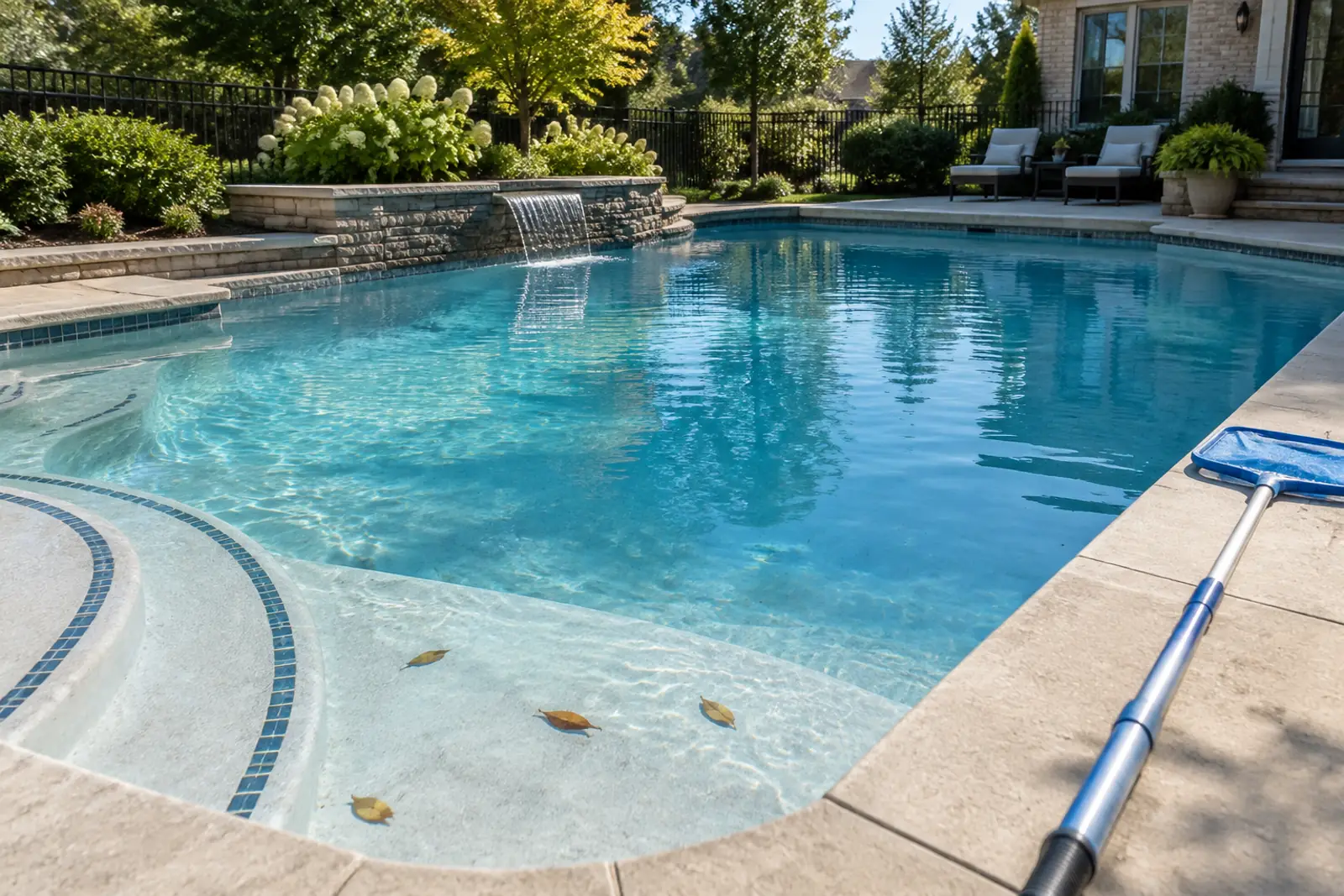
How to Vacuum a Pool: Steps, Valve Settings and Cleaner Types
How to vacuum a pool: prime the hose until no air is left, turn the pump off, set the valve to FILTER for routine dirt or WASTE for heavy debris, then vacuum in slow passes.
- ✓Settings from the manualHayward lists FILTER for regular vacuuming and WASTE for heavy debris loads.
- ✓Waste costs waterAt 45 GPM, 10 minutes on WASTE pumps out 450 gallons.
- ✓Watch the gaugeBackwash a sand filter at 8 to 10 psi over its clean reading (Hayward).
Key takeaways
- The Hayward VariFlo multiport manual lists FILTER for vacuuming through the filter and WASTE for vacuuming directly to waste, and says to turn the pump off before changing position (Hayward SP0710X62 manual).
- BACKWASH is a filter-cleaning setting, not a vacuum setting; Pentair’s System 3 manual says not to vacuum while backwashing (Pentair).
- Vacuuming on WASTE at 45 GPM, Hayward’s maximum for 1-1/2 inch pipe, sends 450 gallons out in 10 minutes, about 1.6 inches off a 15 x 30 ft pool (Hayward ProSeries manual).
- Backwash sand or DE filters at 8 to 10 psi over the clean reading and clean a SwimClear cartridge at 7 to 10 psi over (Hayward SwimClear manual).
- Wheeled vacuums and cleaners stay off new plaster until day 28 under the National Plasterers Council start-up procedure.
- Weekly full-service plans bundle vacuuming with skimming and brushing in our October 2026 survey of 58 pool company price pages (PC&S pool service cost survey).
Which kind of pool vacuum are you using?
Four kinds clean a pool floor: a manual head, pole and hose on the skimmer; a suction-side cleaner such as the Pentair Rebel on the same port; a pressure-side cleaner such as the Polaris 280 on a return line with a booster pump; and a robot such as the Maytronics Dolphin with its own filter and power supply. The step list below covers the manual vacuum.
| Number or setting | What it means | Source |
|---|---|---|
| FILTER | Valve position for normal filtration and routine vacuuming | Hayward VariFlo and ProSeries manuals |
| WASTE | Valve position that bypasses the filter to vacuum heavy debris out of the pool | Hayward VariFlo and ProSeries manuals |
| 8 to 10 psi | Rise over the clean gauge reading that calls for a sand or DE backwash | Hayward ProSeries and Pro-Grid manuals |
| 7 to 10 psi | Rise over the starting reading that calls for a cartridge clean | Hayward SwimClear manual |
| 450 gallons | Water sent out in 10 minutes on WASTE at 45 GPM | PC&S arithmetic; 45 GPM from Hayward ProSeries manual |
| 28 days | Wait before wheeled vacuums or cleaners touch new plaster | National Plasterers Council |
| 12 ft (3.5 m) | Minimum distance from robot power supply to pool edge | Maytronics Dolphin M600 manual |
Sources: Hayward VariFlo; Hayward ProSeries; Hayward SwimClear; National Plasterers Council; Maytronics Dolphin M600. Download CSV
| Type (example named in a manual) | Connects to | Where the debris goes | Rule from the manual | Source |
|---|---|---|---|---|
| Manual vacuum: head, telescoping pole and hose | Skimmer suction port, vac plate or dedicated vac port | Pool filter on FILTER; waste line on WASTE | Prime the hose until no air is left; pump off before moving the valve | Hayward VariFlo; Pentair Rebel; Home Depot |
| Suction-side cleaner (Pentair Rebel, Hayward TracVac) | Skimmer or dedicated vac port | Pump basket, then the pool filter | Close other suction lines; Rebel cleans in about 4 to 6 hours; remove TracVac before backwashing | Pentair Rebel; Hayward TracVac manuals |
| Pressure-side cleaner (Polaris 280) | Dedicated 1-1/2 in return line about 6 in below the water, fed by a booster pump | Cleaner's own debris bag | Booster pump installed by a licensed electrician; disconnect when backwashing; cleans an average pool in 3 hours or less | Polaris 280 manual |
| Robotic cleaner (Maytronics Dolphin M600) | Low-voltage cable from a deck power supply | Onboard filter basket | Power supply at least 12 ft (3.5 m) from the edge; take it out before people swim; clean the basket after each cycle | Maytronics Dolphin manuals |
Sources: Hayward VariFlo; Pentair Rebel manual; Hayward TracVac manual; Polaris 280 manual; Maytronics Dolphin M600 manual; Home Depot’s 2023 guide. Download CSV
Only the manual and suction-side types load your pool filter, so only they care about the multiport setting. A robot works apart from the circulation system: the 2024 Model Aquatic Health Code defines a robotic cleaner as a motor-driven in-pool suction device, self-powered or fed through a low voltage cable from a deck-side power supply. Maytronics adds that the supply must sit on a GFCI-protected circuit in the US and Canada (Dolphin Wave 90i manual, 2024).
How do you vacuum a pool step by step?
Clear the baskets, switch the pump off, pick FILTER or WASTE, assemble the head, pole and hose, prime the hose under water until no air is left, connect it at the skimmer, then vacuum in slow passes and read the filter gauge when you finish. The steps follow the Hayward, Pentair, Home Depot and Virginia Department of Health instructions cited in each line.
- Clear the surface and basketsSkim leaves and empty the skimmer and pump baskets, which Hayward says to clean regularly. Write down the filter gauge reading so you can compare it afterward.
- Pump off, then set the valveHayward prints it above the valve table: turn off the pump before changing valve position. Choose FILTER for routine dirt or WASTE for heavy debris, dead algae or flocculant.
- Assemble the vacuumClip the vacuum head to the telescoping pole, push the hose onto the head and lower the head until it rests on the floor.
- Prime the hoseFeed the hose straight down into the water until it is full and purged of air; Pentair warns that air pulled into the plumbing can make the pump lose prime. Home Depot’s 2023 guide holds the free end against a return jet until bubbles stop rising from the head.
- Connect at the skimmerKeep the hose end under water and push it onto the skimmer suction port or a vac plate. Throttle the main drain so the pump pulls through the vacuum line (Virginia Department of Health). A dedicated vac port needs a spring-loaded Safety Vac-Lock cover whenever it is not in use (Hayward).
- Pump on and vacuumMove the head in slow, overlapping passes so dirt does not lift into the water. On WASTE, run a garden hose into the pool: at 45 GPM the pool loses 450 gallons every 10 minutes.
- Finish and check the filterPump off, valve back to FILTER, pump on. If the gauge reads 8 to 10 psi over the clean figure, backwash about 2 minutes and rinse 1/2 to 1 minute (Hayward ProSeries); clean a cartridge at 7 to 10 psi over.
What setting do you put your pool filter on when vacuuming?
FILTER for routine vacuuming and WASTE for heavy debris. In the Hayward VariFlo SP0710X62 manual, FILTER sends water through the sand and back to the pool, and WASTE sends it straight from the pump to the waste port, bypassing the filter. BACKWASH, RINSE, RECIRCULATE and CLOSED are not vacuum settings.
| Valve position | Flow path (Hayward VariFlo SP0710X62) | What the manual says it is for | Use for vacuuming? |
|---|---|---|---|
| FILTER | Pump, top, through filter, bottom, return | Normal filtration and vacuuming the pool through the filter | Yes: routine dirt |
| WASTE | Pump, through valve, waste | Vacuuming directly to waste, lowering the pool level or draining | Yes: heavy debris, dead algae, flocculant |
| BACKWASH | Pump, bottom, through filter, top, waste | Cleaning the filter | No |
| RINSE | Pump, top, through valve, waste | Start-up and clearing the valve after backwashing | No |
| RECIRCULATE | Pump, through valve, return | Bypassing the filter while still circulating | No: dirt goes straight back to the pool |
| CLOSED | No circulation past the pump port | Shutting off all flow to filter and pool | No: Pentair says never use it with the pump running |
Source: Hayward VariFlo multiport owner’s manual (IS0710X62 Rev B); CLOSED warning from the Pentair sand filter manual. Download CSV
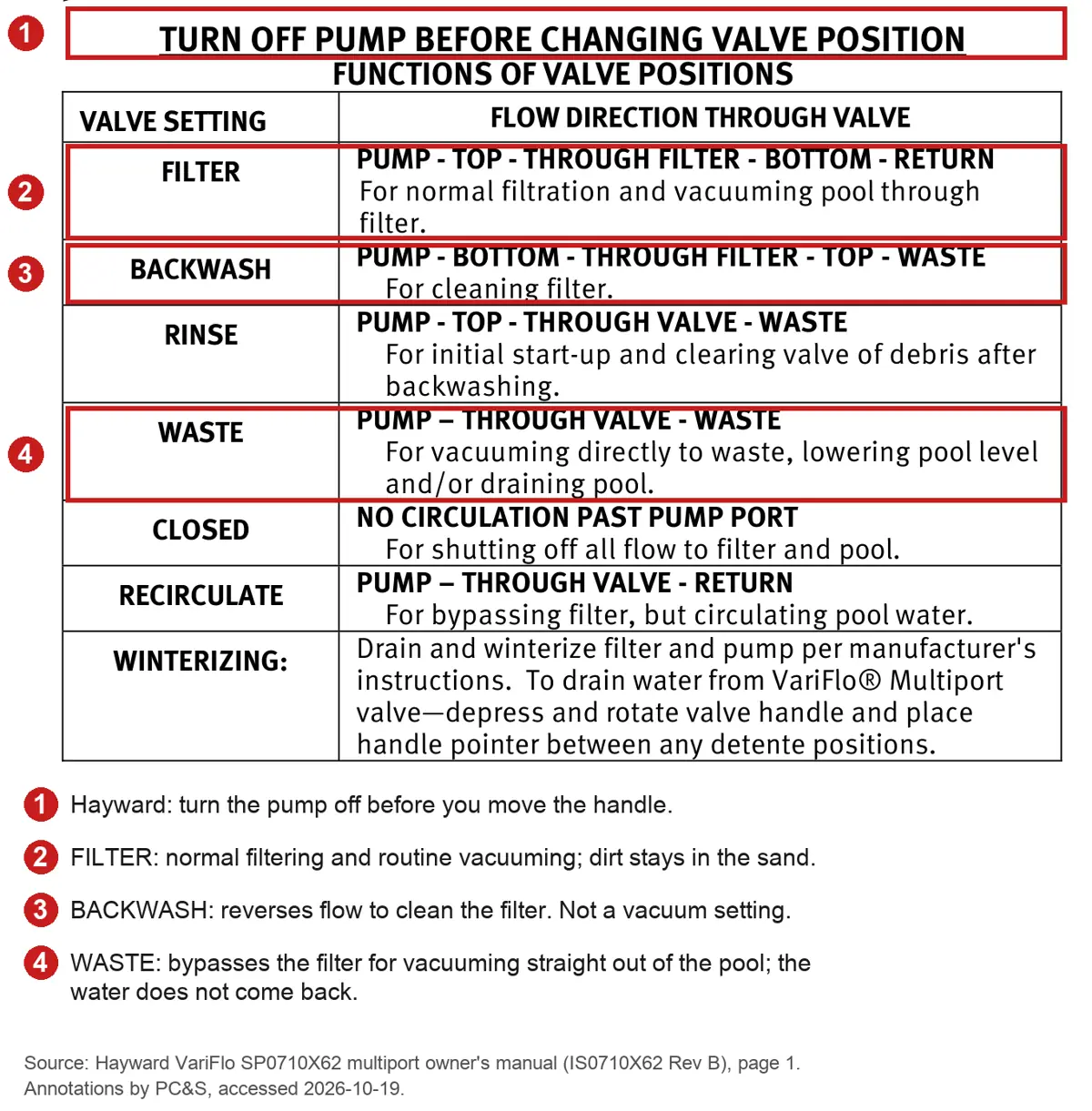
RECIRCULATE looks tempting because it moves water without loading the filter, but its flow path runs pump, valve, return: whatever you vacuum goes straight back into the pool. Pentair’s manual for its Sand Dollar and Cristal-Flo II filters uses the same names and warns that CLOSED must never be used while the pump is operating (Pentair).
Do you vacuum a pool on backwash or waste?
Waste, never backwash. BACKWASH reverses flow through the filter to flush trapped dirt out the waste line; it is a cleaning setting, and Pentair’s System 3 manual says plainly not to vacuum while backwashing. WASTE skips the filter entirely, and Hayward reserves it for heavy debris loads such as silt, dead algae or settled flocculant.
| Filter type (model in the manual) | Routine vacuuming | Heavy debris | Clean or backwash when | Source |
|---|---|---|---|---|
| Sand, multiport valve (Hayward ProSeries) | FILTER | WASTE | Gauge 8 to 10 psi over clean; backwash about 2 minutes, then RINSE 1/2 to 1 minute | Hayward ProSeries manual |
| Sand, top-mount valve (Pentair Sand Dollar, Cristal-Flo II) | FILTER | WASTE | Gauge 10 psi over the clean reading | Pentair sand filter manual |
| DE (Hayward Pro-Grid) | FILTER | WASTE | Gauge 8 to 10 psi over pre-coat pressure; add fresh DE after backwashing | Hayward Pro-Grid manual |
| DE, modular (Pentair System 3) | FILTER | Not covered for vacuuming; never vacuum while backwashing | Clean the module at more than 10 psi over start-up | Pentair System 3 manual |
| Cartridge (Hayward SwimClear) | Through the filter whenever needed | No WASTE position on the filter; clean cartridges after if needed | Gauge 7 to 10 psi over starting; replace when a cleaned set starts more than 6 psi above new | Hayward SwimClear manual |
| Above-ground sand pump (Intex SF60110-2, SF80110-2) | FILTER | WASTE on the 6-way valve, outlet run to a proper drain | Gauge in the yellow zone; 30 psi maximum working pressure | Intex owner's manual |
Sources: Hayward ProSeries; Pentair sand filter manual; Hayward Pro-Grid; Pentair System 3; Hayward SwimClear; Intex SF60110-2/SF80110-2 manual. Download CSV
What if your filter has no waste setting? Most cartridge filters do not. Hayward’s SwimClear manual says vacuuming can go directly into the filter whenever needed, followed by a cartridge clean if required. For a cloudy pool on a cartridge system, HTH steers owners to clarifier instead of flocculant, because floc has to be vacuumed to waste (HTH); our cloudy pool water guide covers that choice. How cartridge, sand and DE filters differ on backwash water and cost is laid out in our pool filter types guide.
Above-ground sand filter pumps often do have one. The Intex SF60110-2 and SF80110-2 manual lists WASTE on the 6-way valve for vacuuming directly to waste, with the third hose port run to a proper drain, and caps the system at 30 psi (Intex).
Where does the dirt go when vacuuming a pool?
On FILTER, the dirt stays in the sand, DE or cartridge (Hayward flow path: pump, filter, return) and leaves later when you backwash or hose off the cartridge. On WASTE (pump, valve, waste), it leaves the pool at once with every gallon the pump moves: 450 gallons in 10 minutes at 45 GPM, so the level drops and the dirty water needs a legal outlet.
| Flow source | Flow (GPM) | Example pool | Gallons in 1 inch of that pool | 5 min on WASTE (gal) | 10 min on WASTE (gal) | 20 min on WASTE (gal) | 10 min: inches lost | 10 min: water cost at $8.54 per 1,000 gal (25-city median) |
|---|---|---|---|---|---|---|---|---|
| Intex SF80110-2 sand filter pump, rated maximum 1,600 GPH | 26.7 | 18 ft round above-ground | 158.6 | 133 | 267 | 533 | 1.68 | 2.28 |
| Intex SF60110-2 sand filter pump, rated maximum 2,450 GPH | 40.8 | 18 ft round above-ground | 158.6 | 204 | 408 | 817 | 2.57 | 3.49 |
| Hayward maximum for 1-1/2 in pipe | 45.0 | 15 x 30 ft inground | 280.5 | 225 | 450 | 900 | 1.60 | 3.84 |
| Hayward maximum for 2 in pipe | 80.0 | 15 x 30 ft inground | 280.5 | 400 | 800 | 1,600 | 2.85 | 6.83 |
Sources: flows from the Intex SF60110-2/SF80110-2 manual and Hayward ProSeries manual (maximum system flow by pipe size); 7.48 gallons per cubic foot; median rate from the PC&S cost to fill a pool ledger. Download CSV
At 45 GPM, 10 minutes takes about 1.6 inches off a 15 x 30 ft pool.
Source: Source: PC&S arithmetic (gallons = GPM x minutes) from Intex SF60110-2/SF80110-2 manual flow ratings and the Hayward ProSeries manual maximum flow by pipe size.. Download chart data (CSV)
The cost of that water is small at the 25-city median of $8.54 per 1,000 gallons used in our pool evaporation research: $3.84 for 10 minutes at 45 GPM. The level is the bigger issue, since 1.6 inches can drop the water below the skimmer opening on a pool that started low. If the level keeps falling days after you vacuum, run the bucket test in our pool leak detection guide.
The City of Mesa, AZ tells owners to send backwash and drain water to their own yard or the home’s sanitary sewer cleanout, never to a street storm drain, because storm water gets no treatment (City of Mesa). Mesa also warns against letting sand, sediment or debris pass into the cleanout, which matters when WASTE water carries vacuumed silt.
Which vacuum setting fits this job?
Match the setting to the debris and the filter. Routine dirt goes through the filter, heavy silt and settled flocculant go to waste, new plaster gets only a brush vacuum until day 28, and automatic cleaners come out of the pool before a backwash. The table and flowchart hold the same rules, each tied to its manual.
| If your situation is | Do this | Why (source) |
|---|---|---|
| Light dirt and leaves, weekly routine | FILTER; read the gauge before and after | Hayward lists FILTER for regular vacuuming |
| Heavy silt after a storm | WASTE with a garden hose refilling, or FILTER and backwash at 8 to 10 psi over clean | Hayward ProSeries manual |
| Flocculant has settled for 8 to 12 hours | WASTE, slow strokes so the floc does not lift | HTH flocculant directions |
| Cloudy water and no WASTE position (cartridge filter) | Use clarifier instead of flocculant; vacuum on the filter and clean the cartridge | HTH; Hayward SwimClear |
| Gauge climbs 8 to 10 psi mid-job | Pump off, backwash, rinse, back to FILTER, resume | Hayward ProSeries manual |
| Pump loses prime or the hose sucks air | Re-prime the hose fully under water; empty skimmer and pump baskets | Pentair Rebel; Hayward ProSeries |
| New plaster under 28 days old | Brush vacuum only, no wheeled vacuum or cleaner | National Plasterers Council |
| Automatic cleaner attached and the filter needs a backwash | Remove it first; for a Polaris 280, run the filter 5 minutes before reconnecting | Hayward TracVac; Polaris 280 manual |
| Robot running and swimmers arrive | Take the robot out of the pool | Maytronics Dolphin manual |
| Deciding where WASTE water goes | Your yard or the sewer cleanout, never the street | City of Mesa, AZ |
Sources: Hayward ProSeries; HTH; Hayward SwimClear; Pentair Rebel; National Plasterers Council; Hayward TracVac; Polaris 280; Maytronics; City of Mesa. Download CSV
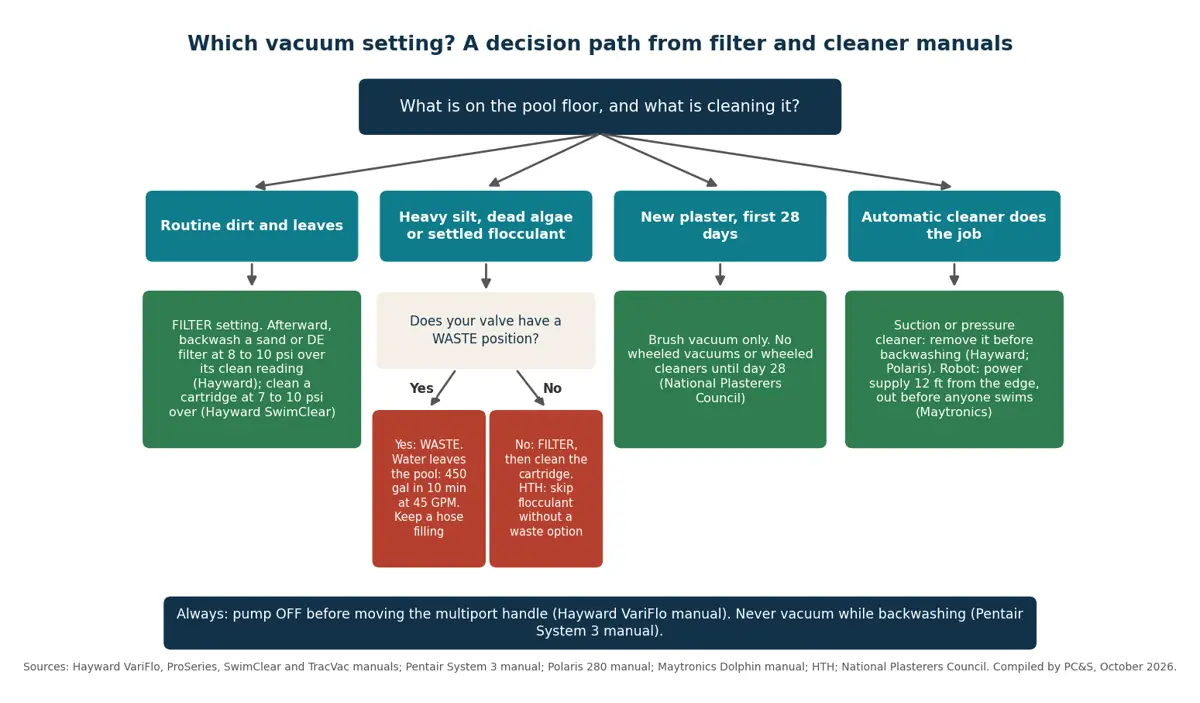
Dead algae after a shock is the kind of heavy debris load the Hayward ProSeries manual sends to WASTE, which also keeps it out of a filter you may have just cleaned. Treat the algae first; our black algae guide covers the brushing and chlorine steps before the vacuum comes out.
How often should you vacuum a pool?
Weekly for routine care, plus after specific events. Weekly full-service plans in our October 2026 survey of 58 pool company price pages bundle vacuuming with skimming and brushing. Flocculant needs vacuuming to waste after 8 to 12 hours of settling, and new plaster gets a brush vacuum only until day 28.
| Trigger | When to vacuum | Source |
|---|---|---|
| Routine care | Weekly: weekly full-service plans in our October 2026 survey of 58 pool company price pages bundle skimming, brushing and vacuuming | PC&S pool service cost survey (71 full-service price points) |
| After flocculant | After 8 to 12 hours of settling, to WASTE | HTH |
| After shocking, with a suction cleaner | Wait 1 to 2 days before running the TracVac | Hayward TracVac manual |
| Pool opening or after a storm | Remove large debris by hand and vacuum manually first; Pentair says the Rebel is not built for opening cleanup | Pentair Rebel; Hayward TracVac |
| New plaster | Brush vacuum from day 1; wheeled vacuums or cleaners only after day 28 | National Plasterers Council |
| Robot in use | Clean the filter basket after each cleaning cycle | Maytronics Dolphin M600 manual |
Sources: PC&S pool service cost survey (October 2026); HTH; Hayward TracVac; Pentair Rebel; National Plasterers Council; Maytronics. Download CSV
If weekly vacuuming is the chore you want to drop, a weekly full-service plan covers it at a median of $160 a month in our October 2026 survey of 71 price points; our pool cleaning service guide lists what those plans include. A pump that keeps losing prime even with a fully primed hose points to air entering the suction side, which a technician should trace; our pool repair guide prices pump repairs. Before calling, run the manual checks in our how to prime a pool pump guide. Vacuuming is one of the weekly tasks in our how to maintain a pool checklist, alongside baskets, brushing and the filter gauge.
How we compiled this
We read 12 manufacturer manuals in October 2026 (Hayward, Pentair, Polaris, Maytronics, Intex) plus the HTH flocculant directions, the National Plasterers Council start-up procedure, the Virginia Department of Health pool guide, the 2024 Model Aquatic Health Code and the City of Mesa discharge rules. Water costs come from our own fill-cost research. We did not test vacuums or rank products; models appear only because their manuals state the rules.
Frequently Asked Questions
How long does it take to vacuum a pool?
Manual vacuuming takes 20 to 45 minutes for an average Indiana pool, according to Pools by Cory (October 2025). Automatic cleaners run longer but unattended: the Polaris 280 manual says it cleans an average pool in 3 hours or less, and Pentair says its Rebel suction cleaner clears debris in about 4 to 6 hours.
Can you vacuum a pool with a cartridge filter?
Yes. Hayward’s SwimClear manual says vacuuming can be performed directly into the filter whenever needed, then clean the cartridges if required (Hayward). Clean them when the gauge rises 7 to 10 psi over the starting reading. Without a waste line, use clarifier rather than flocculant for cloudy water, as HTH advises. Our guide on how to clean a pool filter covers the hosing, degreasing and acid steps. How much water a floc job sends to waste, 900 to 2,025 gallons in 20 to 45 minutes at 45 GPM, is worked out in our pool flocculant guide.
Why does my pool vacuum keep losing suction?
Usually air or a clog. Pentair warns that air pulled into the plumbing from an unprimed hose can make the pump lose prime, so refill the hose under water. Then empty the skimmer and pump baskets and check the gauge: at 8 to 10 psi over the clean reading, Hayward says to backwash (Hayward ProSeries).
How much water do you lose vacuuming to waste?
Flow times minutes. At 45 GPM, the maximum Hayward recommends for 1-1/2 inch pipe, 10 minutes on WASTE sends 450 gallons out, about 1.6 inches off a 15 x 30 ft pool and $3.84 at the 25-city median rate of $8.54 per 1,000 gallons (PC&S ledger). Keep a hose filling while you work.
Can you swim while a robotic pool cleaner is running?
No. The Maytronics Dolphin manual says to take the robot out of the pool before allowing people to enter, to keep the power supply at least 12 ft (3.5 m) from the edge, and, in the US and Canada, to plug it into a GFCI-protected circuit (Dolphin M600 manual; Dolphin Wave 90i manual).
Do you need to backwash after vacuuming?
Only if you vacuumed on FILTER and the gauge now reads 8 to 10 psi over its clean figure, Hayward’s backwash trigger; then backwash about 2 minutes and rinse 1/2 to 1 minute (Hayward ProSeries). After vacuuming on WASTE, the dirt never entered the filter, so no backwash is needed for that load. The full sand and DE sequence is in our guide on how to backwash a pool filter.
Sources
- Hayward. VariFlo Multiport 1-1/2 in Filter Control Valve Owner's Manual, SP0710X62 (IS0710X62 Rev B). Accessed 2026-10-19.
- Hayward. ProSeries High Rate Sand Filters Owner's Manual (IS210TS Rev A). Accessed 2026-10-19.
- Hayward. Pro-Grid Vertical DE Filter Owner's Manual (ISDE2423EF Rev E). Accessed 2026-10-19.
- Hayward. SwimClear Cartridge Filter Owner's Manual (ISC2031EF Rev B). Accessed 2026-10-19.
- Hayward. TracVac Suction Cleaner Owner's Manual. Accessed 2026-10-19.
- Pentair. Sand Dollar and Cristal-Flo II Top Mount Sand Filter Installation and User's Guide. Accessed 2026-10-19.
- Pentair. System 3 Modular D.E. Filters Install Guide. Accessed 2026-10-19.
- Pentair. Rebel Suction-Side Pool Cleaner Installation and User's Guide. Accessed 2026-10-19.
- Polaris (Zodiac). Polaris 280 Owner's Manual (hosted by INYO Pools). Accessed 2026-10-19.
- Maytronics. Dolphin M600 Robotic Pool Cleaner Manual (hosted by Royal Swimming Pools). Accessed 2026-10-19.
- Maytronics (Fluidra). Dolphin Wave 90i User Instructions (2024). Accessed 2026-10-19.
- Intex. Krystal Clear Sand Filter Pump SF80110-2, SF70110-2, SF60110-2 Owner's Manual (hosted by Home Depot). Accessed 2026-10-19.
- HTH Pools. Why Is My Pool Cloudy? Causes and Fixes (flocculant directions). Accessed 2026-10-19.
- National Plasterers Council via Pool Pro Magazine. NPC Start-up Procedure for Standard Pool Plaster. Accessed 2026-10-19.
- Virginia Department of Health. Pool Operation and Maintenance Guide (Portsmouth Health Department). Accessed 2026-10-19.
- CDC. Model Aquatic Health Code, 5th Edition (2024). Accessed 2026-10-19.
- City of Mesa, Arizona. Drain or Backwash Your Pool or Spa. Accessed 2026-10-19.
- The Home Depot. How to Vacuum a Pool (read via Wayback Machine snapshot; live page blocks automated access). Accessed 2026-10-19.
- Pools by Cory. How to Vacuum Your Pool Like a Pro. Accessed 2026-10-19.
- Pool Construction & Service. Cost to Fill a Pool in 25 US Cities (PC&S research). Accessed 2026-10-19.
- Pool Construction & Service. Pool Service Cost per Month: 2026 survey (PC&S). Accessed 2026-10-19.
Related pages
Get Quotes From Licensed Local Pool Pros
Tell us what you need and your ZIP code. We match you with pool companies that cover your area.