Black Algae in Pool: How to Identify and Remove It
Black algae in pool plaster is a cyanobacteria colony, not a true alga: crack its crust with a stainless steel brush, then apply one labeled product, such as Black Algaetrine at 12 oz per 10,000 gallons.
- ✓Doses from EPA-stamped labelsEvery dose here is quoted from a label in EPA's Pesticide Product Label System, with its registration number.
- ✓What the bottle really holdsWe sorted 101 registrations named 'black algae' by active ingredient, so you can buy by chemistry, not branding.
- ✓IndependentPC&S sells no pool chemicals. We connect owners with licensed pool service companies.
Key takeaways
- Pool black algae is mostly cyanobacteria: in black algae biofilms from Mallorca pools, filamentous cyanobacteria, mainly Leptolyngbya, made up almost 40% of the prokaryotic community (Christie-Oleza et al., 2025).
- The Black Algaetrine label (EPA Reg. No. 8959-14) says brush the spots first, then pour 12 oz per 10,000 gallons around the edge, and ‘Do not concentrate the application in only one area.’
- Of 101 active EPA registration numbers with ‘black algae’ in a product name, 38 are Black Algaetrine (8959-14) or its distributor versions, 31 are polyquats and 20 are trichlor chlorine (EPA label system, October 19, 2026).
- The BioGuard Spot Kill dichlor label (5185-441) uses 1 lb per 10,000 gallons for light black algae and 2 lb for medium to heavy growth, and bars swimming above 4 ppm chlorine.
- Stainless steel algae brushes are for plaster, concrete and gunite: Pentair marks them ‘not for vinyl liner pools’ (Pentair catalog), and fiberglass maker Thursday Pools says wire brushes damage gelcoat.
What is black algae in a pool?
Black algae is the pool trade’s name for dark, crusty colonies dominated by cyanobacteria, the photosynthetic bacteria once called blue-green algae. Maricopa County’s pool code even writes it as ‘blue-green (frequently called black)’ algae. The colonies build biofilms that grip rough plaster and resist routine chlorine, which is why every label we read starts treatment with a brush.
The best pool-specific evidence is recent. A 2025 peer-reviewed study in Environmental Technology & Innovation sequenced black algae biofilms from pools in Mallorca, Spain, and found filamentous cyanobacteria, primarily Leptolyngbya, made up almost 40% of the prokaryotic community (Christie-Oleza et al., 2025). Genomes of isolated strains carried genes for extracellular polysaccharide and type IV pili, traits biofilms rely on to build a matrix and grip surfaces.
In the same study’s bioassays, commercial algicides and silver nanoparticles worked, but high concentrations were required to clear the cyanobacteria. That matches the label pattern: BioGuard describes black algae as somewhat resistant to normal chlorine levels and calls brushing extremely important to break the protective layer (BioGuard).
| Number | What it is | Source |
|---|---|---|
| Almost 40% | Share of the prokaryotic community that filamentous cyanobacteria, mainly Leptolyngbya, made up in black algae biofilms from Mallorca pools | Christie-Oleza et al., 2025 (peer-reviewed) |
| 12 oz per 10,000 gal | Black Algaetrine (EPA Reg. No. 8959-14) dose for visible algae, spread around the pool edge | EPA label, notification accepted October 8, 2026 |
| 1 lb / 2 lb per 10,000 gal | BioGuard Spot Kill dichlor (EPA Reg. No. 5185-441) for light / medium to heavy black algae | EPA label, 2024 |
| 4 ppm | Chlorine level above which the Spot Kill and cal hypo labels prohibit re-entry | EPA Reg. No. 5185-441 and 5185-515 |
| 38 of 101 | Active EPA registrations with 'black algae' in a product name that are Black Algaetrine or its distributor versions | EPA PPLS name search, October 19, 2026 |
| 2 minutes | Time a vitamin C tablet sits on a spot to separate a metal stain from algae | Natural Chemistry |
| 8 micrograms per liter | EPA's recommended swimming advisory level for microcystins in natural waters (2019) | EPA 822-F-19-001 |
Sources: Christie-Oleza et al., 2025; EPA label 8959-14; EPA label 5185-441; EPA label 5185-515; EPA PPLS; Natural Chemistry; EPA 822-F-19-001. Download CSV
Is it black algae or a stain? The 2 minute test
Black algae spots are raised, rough and anchored, while stains are flat. Hold a vitamin C tablet on the spot for 2 minutes: if it lightens, it is metal, usually iron or copper, and no algaecide will move it. A spot that stays dark, feels crusty and shrugs off a nylon brush is black algae, and on plaster a stainless steel brush will crack its crust.
| If your situation is | It is most likely | Do this next | Source |
|---|---|---|---|
| Flat stain with no texture that lightens after a vitamin C tablet sits on it for 2 minutes | Metal stain, often iron or copper | Use a metal stain treatment; algaecide will not lift it | Natural Chemistry; BioGuard (iron and copper are the two most common stains) |
| Raised, rough blue-black spots on plaster, concrete or gunite that a nylon brush barely moves and vitamin C does not change | Black algae (cyanobacteria biofilm) | Stainless steel brush, then one labeled black algae product | Algae Complete label 5185-513 ('black or green/blue spots', 'forms protective crust'); BioGuard |
| The same raised spots on vinyl or fiberglass | Black algae, less common on smooth surfaces | Nylon brush only; a dichlor label such as Spot Kill lists vinyl and fiberglass pools | Leslie's; EPA label 5185-441; Thursday Pools |
| Yellow-brown powder that brushes off easily and comes back in shade | Mustard algae | Follow the mustard algae steps | BioGuard; Algae Complete label 5185-513 |
| Flat green or brown stain that vitamin C does not change, often under leaves | Non-living organic stain | Raise chlorine to breakpoint and scrub with a surface-appropriate brush | Natural Chemistry |
Sources: Natural Chemistry; BioGuard metal staining; EPA label 5185-513; EPA label 5185-441; Thursday Pools; Leslie‘s. Download CSV
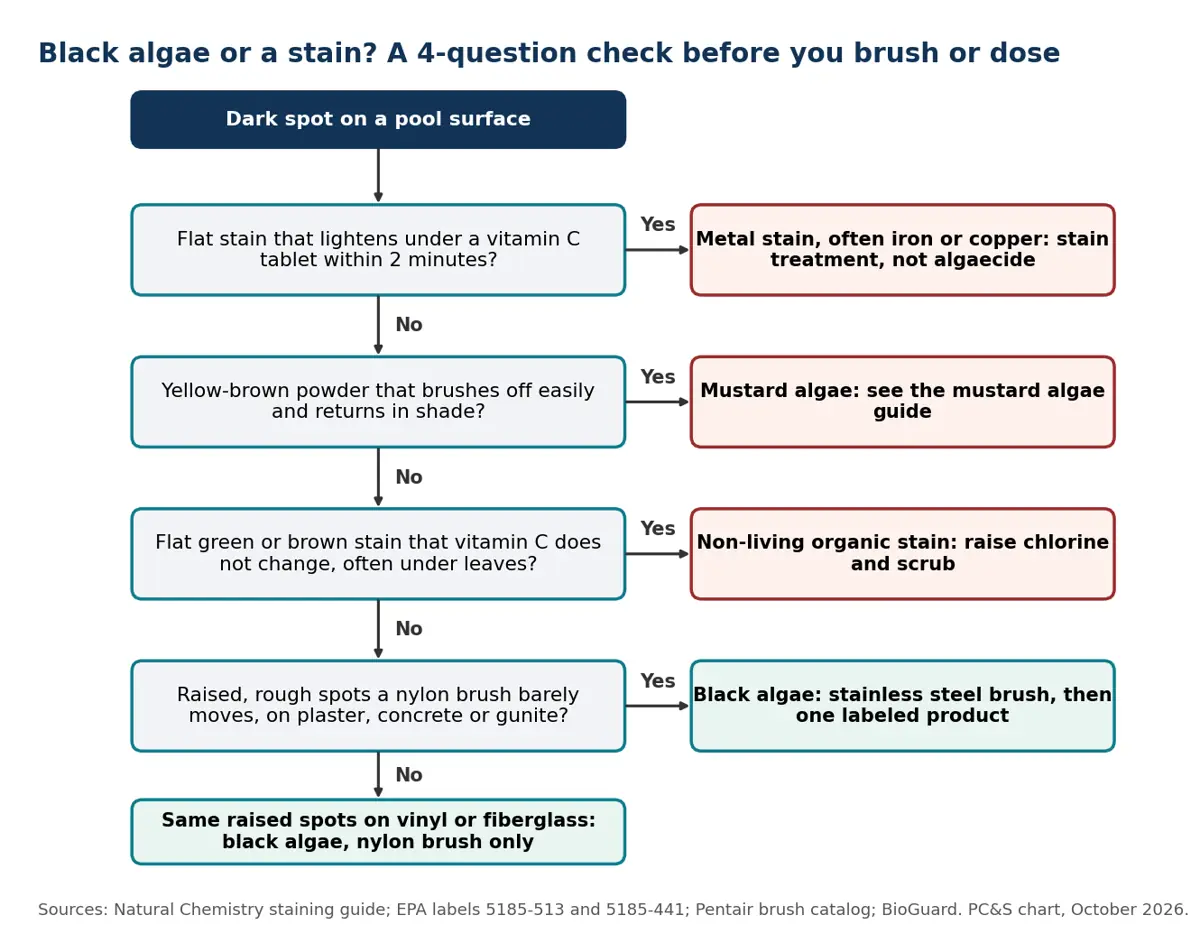
Natural Chemistry, a pool chemical maker, publishes the tablet test: a stain unaffected after at least 2 minutes is most likely non-living organic, and one that lightens is metal (Natural Chemistry). BioGuard adds that iron and copper are the two most common stains and that some dark marks, such as black algae, are organic and need algicide and shock instead (BioGuard). Leslie’s, a pool retailer, notes that splotchy metal stains are often mistaken for black algae. Once the test points to metal, our pool stains guide gives the ascorbic acid and sequestrant doses by pool size.
How do you get rid of black algae in a pool? Step by step
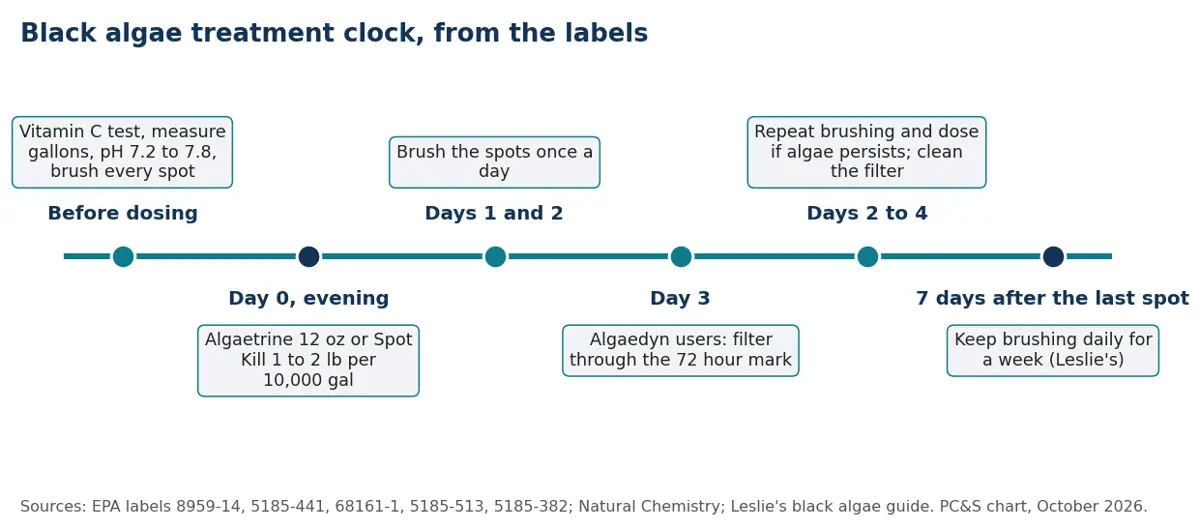
Treat black algae as a surface job first and a water job second. Every label we read starts with brushing the spots, adds one registered product at its labeled dose, and then repeats brushing for at least 2 days. The order below follows the Black Algaetrine (8959-14) and BioGuard Spot Kill (5185-441) labels, worked for a 20,000 gallon pool.
- Confirm and measureRun the vitamin C test, work out gallons with a volume calculator, and test free chlorine, pH and copper.
- Set pHThe Black Algaetrine label wants pH 7.2 to 7.8 before application; Silver Algaedyn wants 7.2 to 7.4.
- Brush every spot hardStainless steel bristles on plaster, concrete and gunite; nylon on vinyl, fiberglass, pebble and quartz. The labels say brush before dosing.
- Dose one labeled productEither Black Algaetrine at 12 oz per 10,000 gallons (24 oz here) poured around the edge, or Spot Kill dichlor broadcast in the deep end at night: 1 lb per 10,000 gallons for light growth, 2 lb for medium to heavy.
- Brush dailyThe Algaetrine label asks for brushing once a day for two days after application. Leslie’s goes further: brush daily until the spots are gone and for at least one week after.
- Filter and vacuumKeep the filter running, vacuum settled debris, then clean the filter as the Spot Kill label directs.
- Repeat while spots remainThe Spot Kill label says that if algae is still visible, repeat the treatment.
- Reopen at 4 ppm or lessThe Spot Kill and cal hypo labels bar re-entry above 4 ppm chlorine; CDC’s floor is 1 ppm, or 2 ppm with cyanuric acid.
| When | What to do | Label or source |
|---|---|---|
| Before dosing | Vitamin C test, measure gallons, set pH (7.2 to 7.8 for Algaetrine), brush every spot | Natural Chemistry; EPA label 8959-14 |
| Day 0, evening | Dose one product: Algaetrine 12 oz or Spot Kill 1 to 2 lb per 10,000 gal | EPA labels 8959-14 and 5185-441 |
| Days 1 and 2 | Brush the spots once a day | EPA label 8959-14 |
| Day 3 | Silver Algaedyn users keep the filter running through the 72 hour mark | EPA label 68161-1 |
| Days 2 to 4 | Repeat brushing and the dose if algae persists; clean the filter | EPA labels 5185-513 and 5185-382 |
| 7 days after the last spot | Keep brushing daily for a week after spots disappear | Leslie's black algae guide |
Sources: EPA label 8959-14; EPA label 5185-441; EPA label 68161-1; EPA label 5185-513; EPA label 5185-382; Natural Chemistry; Leslie‘s. Download CSV
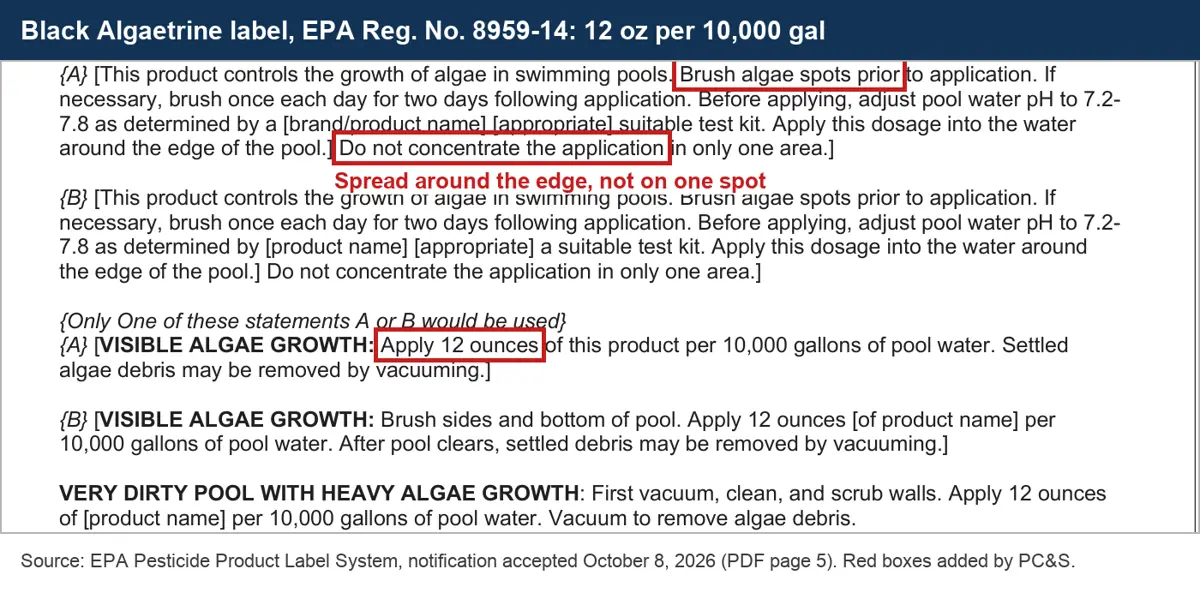
That last label line contradicts some popular advice. Aiper’s black algae guide tells owners to apply concentrated algaecide directly to each colony (Aiper), while the Algaetrine label says to spread the dose around the edge and not concentrate it in one area. Leslie’s, which sells the same formula as Leslie’s Black Algae Killer (EPA Reg. No. 8959-14-11411), follows the label. Our pool volume calculator gives the gallons for scaling the dose.
Which products are labeled for black algae, and what is the dose?
Labeled options fall into four chemistries: copper plus quat (Black Algaetrine, 12 oz), chlorine granules (Spot Kill dichlor, 1 to 2 lb), silver (Algaedyn, 1/2 quart) and polyquat (Algon 60, 12 to 18 fl oz), each per 10,000 gallons. The bottle name says little: products called ‘black algae’ killers span all of these except silver.
| Product | EPA Reg. No. | Active ingredient | Black algae dose per 10,000 gal | Label rules that matter | EPA label file | Source |
|---|---|---|---|---|---|---|
| Black Algaetrine (also sold as Leslie's Black Algae Killer, 8959-14-11411) | 8959-14 | Copper ethanolamine complexes 9.5% + quat 26.3% | 12 oz | Brush spots first; pH 7.2 to 7.8; spread around the edge, not on one area; brush daily for 2 days; maintenance 6 oz every 5 to 7 days | October 8, 2026 | EPA PPLS |
| BioGuard Spot Kill (Master Dichloro Dihydrate) | 5185-441 | Sodium dichloro-s-triazinetrione dihydrate 99% | 1 lb (light) or 2 lb (medium to heavy) | Broadcast in the deep end at night; brush settled granules; repeat if algae is visible; no entry above 4 ppm | May 22, 2024 | EPA PPLS |
| Silver Algaedyn | 68161-1 | Colloidal silver 0.80% | 1/2 quart (16 fl oz) | pH 7.2 to 7.4; chlorine to 3 ppm; feed 8 oz every 10 minutes via skimmer; filter at least 72 hours | June 3, 2010 | EPA PPLS |
| BioGuard Algae Complete | 5185-513 | Copper sulfate pentahydrate 13.07% + polyquat 6.5% | 16 fl oz | Shock first and circulate 1 hour; brush next day; repeat after 2 to 4 days; re-enter at 1 to 4 ppm | July 15, 2025 | EPA PPLS |
| BioGuard MSA Algicide II | 5185-382 | Copper triethanolamine 23.6% + quat 2.5% | 8 fl oz, diluted | Labeled for blue-green 'frequently called black or spot algae'; stain control 2 days after | August 4, 2026 | EPA PPLS |
| Algon 60 Algaecide | 3525-117 | Polyquat 60% | 12 to 18 fl oz | Clean heavy growth first; vacuum after 24 hours | March 11, 2015 | EPA PPLS |
| Pro Algaecide | 3432-31 | Polyquat 30% | 24 to 36 oz | Labeled for 'so called black algae'; pour all around the pool | July 17, 2025 | EPA PPLS |
Sources: EPA Pesticide Product Label System: 8959-14, 5185-441, 68161-1, 5185-513, 5185-382, 3525-117, 3432-31. Download CSV
To see what is actually sold as a black algae killer, we searched EPA’s Pesticide Product Label System for product names containing ‘black algae’ on October 19, 2026. The search returned 438 names, 137 of them active, covering 101 distinct registration numbers (EPA PPLS). We then looked up the active ingredients of each base registration.
38 of the 41 copper plus quat numbers are Black Algaetrine (8959-14) and its distributor versions. No silver product name contained 'black algae'.
Source: Source: EPA Pesticide Product Label System name search 'black algae' and registration records, accessed October 19, 2026; PC&S classification by active ingredient.. Download chart data (CSV)
| Chemistry inside products named 'black algae' | Active EPA registration numbers | Example registrations |
|---|---|---|
| Copper complexes + quat (ADBAC) | 41 | 8959-14 Black Algaetrine (38 numbers); 46043-25 Super Black Algaecide (3) |
| Polyquat | 31 | 45309-2 (10); 57787-23 Combat 60 (3); 3525-117 Algon 60 |
| Trichlor (chlorine) | 20 | 42177-67 (5); 69681-10 (3); 5185-100 |
| Copper only | 6 | 69681-21; 8959-2; 58412-1 |
| Quat (ADBAC) only | 2 | 3525-118 |
| Copper + polyquat | 1 | 57787-25 Combat Extra |
| Total | 101 | 438 name results, 137 active rows |
Source: EPA Pesticide Product Label System name search and registration records; classification by PC&S. Download CSV
The takeaway for a shopper: read the active ingredient and the EPA Reg. No., not the front label. Thirty-eight registration numbers are one copper and quat formula, Black Algaetrine, under its own name and store brands, and twenty are plain trichlor chlorine with ‘black algae’ in the name. If your water already carries copper, a polyquat, silver or dichlor product avoids adding more. How fast label copper doses build toward the 0.6 ppm staining line is charted in our pool algaecide guide.
How much chlorine and copper does a black algae treatment add?
Enough to plan around. By the Virginia health department’s rule of 1.3 oz of 100% available chlorine per ppm per 10,000 gallons, a 2 lb dose of dichlor lifts free chlorine about 13.8 ppm, and 12 oz of Black Algaetrine adds about 0.30 ppm of copper. Both numbers decide when you can swim and whether the plaster stains.
| Step | Input | Calculation | Result |
|---|---|---|---|
| Pool volume | 20,000 gallons (measure with a volume calculator) | Given | 20,000 gal |
| Ounces of dichlor per 1 ppm | VDH: 1.3 oz of 100% available chlorine per 10,000 gal; USITC: dichlor dihydrate is 56% available chlorine | 1.3 / 0.56 | 2.32 oz per ppm per 10,000 gal |
| Spot Kill, light growth | 1 lb (16 oz) per 10,000 gal | 16 / 2.32 | About 6.9 ppm; 2 lb for 20,000 gal |
| Spot Kill, medium to heavy | 2 lb (32 oz) per 10,000 gal | 32 / 2.32 | About 13.8 ppm; 4 lb for 20,000 gal |
| Black Algaetrine dose | 12 oz per 10,000 gal | 12 x 2 | 24 oz for 20,000 gal |
| Copper in one dose | Label: 0.27 lb elemental copper per gallon; NIST: 29.57 mL per fl oz, 3.79 L per gallon, 28.35 g per oz | 12 fl oz = 0.094 gal; 0.094 x 0.27 = 0.0253 lb = 11.5 g in 37,900 L | About 0.30 ppm copper |
| Copper in a maintenance dose | 6 oz per 10,000 gal every 5 to 7 days | Half of 0.30 | About 0.15 ppm per dose |
| Reopen the pool | Spot Kill label: no entry above 4 ppm | Test with DPD; dilute the sample above 10 ppm | Free chlorine 4 ppm or less |
Sources: Virginia Department of Health; USITC Pub. 5391; EPA label 5185-441; EPA label 8959-14; NIST conversions; CDC. Arithmetic by PC&S. Download CSV
CDC warns DPD tests can bleach out above 10 ppm, so the heavy dose can read falsely low right after treatment.
Source: Source: EPA labels 5185-515 and 5185-441; Virginia Department of Health 1.3 oz per ppm rule; USITC Pub. 5391 (dichlor dihydrate 56% available chlorine). Arithmetic by PC&S.. Download chart data (CSV)
Copper is why Leslie’s tells owners to test before adding its copper-based Black Algae Killer: above 0.6 ppm, staining may occur (Leslie‘s). Two visible-algae doses of Algaetrine add about 0.61 ppm if no copper leaves the water, which is already past that line. Dichlor brings its own baggage: CDC notes dichlor and trichlor contain cyanuric acid and raises its chlorine floor to 2 ppm in stabilized pools (CDC). Our cyanuric acid guide covers how far stabilizer can climb, and the pool shock guide compares shock types. Phosphate is a separate question with no CDC limit, covered in our phosphates in pool guide. A copper ionizer adds copper too, and its label ranges of 0.2 to 0.9 ppm are set against the same staining line in our pool ionizer guide.
Which brush is safe on plaster, vinyl and fiberglass?
Stainless steel bristles belong on plaster, concrete and gunite only. Pentair’s catalog marks its stainless algae brushes ‘not for vinyl liner pools’ and sells a nylon brush with end caps for liners. Thursday Pools, a fiberglass pool maker, says wire brushes, steel wool and metal scrapers can damage gelcoat, and Leslie’s puts pebble and quartz finishes on nylon too.
| Surface | Brush | Chemical caution | Source |
|---|---|---|---|
| Plaster, concrete, gunite | Stainless steel algae brush (Pentair R500012, 6 in.; R111646, 18 in.) | Brush settled granules so they dissolve; the Spot Kill label lists colored plaster as bleachable | Pentair catalog; EPA label 5185-441 |
| Vinyl liner | Nylon brush; Pentair 912VL (R111386) has end caps for liners | Never let undissolved granules rest on the liner | Pentair catalog ('not for vinyl liner pools'); EPA labels 5185-441, 5185-515 |
| Fiberglass | Soft nylon brush | Wire brushes, steel wool and metal scrapers can damage gelcoat | Thursday Pools; EPA label 5185-441 |
| Pebble or quartz finish | Softer nylon brush | Same as plaster for chemistry | Leslie's black algae guide |
Sources: Pentair brush catalog; Thursday Pools; EPA label 5185-441; EPA label 5185-515; Leslie‘s. Download CSV
Some guides tell owners to rub a trichlor tablet on each spot. The trichlor label we read, T-0035 (EPA Reg. No. 67262-42), gives directions for feeders, floaters and skimmers and none for rubbing tablets on surfaces, and it warns that in vinyl pools, leaving the pump off for more than 8 hours may bleach and damage the liner (EPA label 67262-42). The Spot Kill label adds the general rule: never let undissolved product rest on vinyl, fiberglass, paint or colored plaster.
Surface type also shapes the odds of black algae in the first place. Leslie’s says owners of fiberglass and vinyl-lined pools likely won’t have to deal with it, while pebble, plaster and gunite give colonies texture to grip, and BioGuard says it forms in cracks and crevices, especially in plaster (BioGuard). Our gunite vs fiberglass vs vinyl comparison covers the maintenance trade-offs of each finish.
Is it safe to swim in a pool with black algae?
Not during treatment, and the labels decide when: the Spot Kill and cal hypo labels prohibit re-entry above 4 ppm chlorine. Outside treatment the evidence is thin. EPA says some cyanobacteria make potent toxins, but we found no peer-reviewed measurement of cyanotoxins in pool black algae, so retail sources range from ‘stay out’ to ‘yes, but’.
| Source | What it says about swimming with black algae | Type of source |
|---|---|---|
| Leslie's | 'Extremely important that no one gets in the water' because cyanobacteria produce cyanotoxins | Retailer blog |
| Aiper | 'Short answer: yes, but you shouldn't treat it as fine'; never swim during the shock phase | Pool equipment maker blog |
| EPA | Some cyanobacteria make potent toxins; recommended swimming advisory levels are 8 micrograms per liter for microcystins and 15 for cylindrospermopsin (2019) | Federal agency, natural waters |
| Christie-Oleza et al. (2025) | Pool black algae from Mallorca dominated by Leptolyngbya; the abstract reports no toxin test | Peer-reviewed journal |
| Florida case series (2018 samples, published 2026) | Microcystins and nodularins not detected (below 0.15 ng/mL) in one pool's biomass; authors say this does not prove the absence of other toxins | Training firm; not peer-reviewed |
| Spot Kill and cal hypo labels | Re-entry prohibited above 4 ppm chlorine | EPA-stamped labels |
Sources: Leslie‘s; Aiper; EPA; EPA 822-F-19-001; Christie-Oleza et al., 2025; Florida case series; EPA label 5185-441. Download CSV
The one toxin test we found comes with caveats. A Florida case series posted by a pool operator training firm, Aquatic Facility Training and Consultants, reports that biomass from one Gainesville pool tested below the 0.15 ng/mL reporting limit for microcystins and nodularins in 2018 (case series, not peer-reviewed). Its authors say the result neither shows toxin production nor rules out toxins the assay did not measure. EPA’s 2019 swimming advisory level for microcystins in lakes and rivers is 8 micrograms per liter (EPA).
Why is black algae so hard to get rid of, and what causes it?
Because the visible spot is a biofilm anchored in the surface, and biofilm protects what is inside. The Mallorca bioassays needed high algicide concentrations, and rough plaster gives colonies anchor points, so a spot that returns to the same place after two full rounds can point to the finish. Low chlorine, rare testing and gear from lakes do the rest.
- Carried in from natural water Leslie’s says black algae usually arrives on swimsuits, toys and floats used in lakes or the ocean.
- Porous or rough finish BioGuard: it forms in cracks and crevices, especially plaster finishes.
- Low chlorine CDC’s minimum is 1 ppm free chlorine, or 2 ppm with cyanuric acid, tested at least twice a day.
- Rare testing In a 2020 Water Quality and Health Council survey, 23% of do-it-yourself owners tested chlorine and pH once every two weeks or less.
| If your situation is | Do this | Why |
|---|---|---|
| A few spots on white plaster | Stainless steel brush, then Black Algaetrine at 12 oz per 10,000 gal; brush daily for 2 days | Algaetrine label 8959-14; Pentair catalog |
| Spots on vinyl, fiberglass or colored plaster | Run the vitamin C test, brush with nylon, then Spot Kill dichlor at 1 lb per 10,000 gal (light growth) with granules brushed off the surface | Spot Kill label 5185-441: 'ideal for use in vinyl lined, fiberglass or colored plaster surface pools' |
| Copper already reads 0.6 ppm or more | Pick a non-copper product such as Algaedyn silver, a polyquat or dichlor | Leslie's: staining may occur above 0.6 ppm |
| Many spots across the shallow end | Spot Kill at 2 lb per 10,000 gal at night, then brush and repeat while spots remain | Spot Kill label 5185-441 |
| Spots return to the same place after two full rounds | Have the plaster inspected; rough or pitted finish may need resurfacing | Christie-Oleza et al.: biofilm traits; several guides tie repeat spots to degraded plaster |
| Public, HOA or community pool | Use only algaecides labeled for aquatic venues, exactly as labeled | MAHC 2024, 5.7.4.4.4A |
Sources: EPA label 8959-14; EPA label 5185-441; Pentair; Leslie‘s; Christie-Oleza et al., 2025; MAHC 2024. Download CSV
The testing figure comes from our pool hygiene statistics report. When spots keep coming back to the same rough patch, treatment buys time but the finish is the fix; our pool resurfacing cost guide lays out the price of replastering by finish type.
How do you stop black algae spreading on equipment and swimwear?
Treat every tool and the filter as a carrier. Leslie’s says to wash swimsuits and towels and scrub floats with bleach after lake trips, and the Model Aquatic Health Code sets the filter standard: brush housings to remove biofilms and algae, mist them with 1:10 bleach, and soak cartridges 1 hour in 1 quart of household bleach per 5 gallons. The degreasing soak that comes before the bleach is laid out in our how to clean a pool filter guide.
- After lake or ocean trips Machine wash swimsuits and towels and scrub floats and toys with a bleach and water solution before they touch the pool (Leslie’s).
- Cartridge filter Rinse, degrease overnight, then sanitize 1 hour in 1 quart of household bleach per 5 gallons of water and rinse (MAHC 2024, 5.7.2.4.3.3).
- Filter housing Brush with mild detergent to remove biofilms and algae, rinse, and mist with chlorine bleach at a 1:10 dilution (MAHC 5.7.2.4.3.2).
- Sand and DE filters Backwash and chemically clean after treatment, as the Spot Kill and Algae Complete labels direct.
- Brushes and nets Rinse them in the same 1:10 bleach mix after each session. That strength is the MAHC operator rule for filter housings, not a home-use label.
Public and HOA pools have a firmer line: the 2024 Model Aquatic Health Code allows algaecides only if they are labeled for aquatic venue use, used in strict compliance with the label, and registered with EPA and the state (section 5.7.4.4.4A, MAHC 2024). For a hazy rather than spotted pool, start with the cloudy pool water guide.
How we compiled this
We read 10 EPA-stamped labels and 101 registration records from EPA’s Pesticide Product Label System, the abstract of a 2025 peer-reviewed study of pool black algae, EPA and CDC guidance, the 2024 Model Aquatic Health Code, and manufacturer and retailer pages, all accessed in October 2026. Doses are quoted from labels; chlorine and copper figures are PC&S arithmetic. We did not test products, used one non-peer-reviewed case series only with that label, and excluded forum posts as a source of facts.
Frequently Asked Questions
How do you get rid of black algae in a pool?
Brush every spot hard first, stainless steel on plaster and nylon on vinyl or fiberglass, then add one labeled product: Black Algaetrine at 12 oz per 10,000 gallons spread around the edge, or BioGuard Spot Kill dichlor at 1 lb (light) to 2 lb (heavy) per 10,000 gallons. Brush daily for at least 2 days, clean the filter, and repeat while spots remain.
Is it safe to swim in a pool with black algae?
Not during treatment: the Spot Kill and cal hypo labels prohibit re-entry above 4 ppm chlorine. Beyond that, sources split. EPA says some cyanobacteria make toxins, Leslie’s says stay out, and Aiper says yes with care. We found no peer-reviewed toxin test of pool black algae, so the cautious choice is to wait until the spots are gone.
Is black algae hard to get rid of?
Yes. It is a biofilm dominated by cyanobacteria that anchors in rough plaster, and a 2025 peer-reviewed study of Mallorca pools found its bioassays needed high algicide concentrations for efficient eradication. Labels build in repetition: Algaetrine asks for brushing on 2 days after dosing, and Algae Complete says repeat after 2 to 4 days if algae persists.
How long does it take to remove black algae from a pool?
Count on several days and often more than one round. The Algaetrine label sets 2 days of follow-up brushing, Silver Algaedyn needs the filter running at least 72 hours, and Algae Complete repeats after 2 to 4 days. Leslie’s adds a week of daily brushing after the last spot disappears, so a plan of one to two weeks fits those directions.
What causes black algae in pools?
Cyanobacteria carried in from lakes or the ocean on swimsuits, toys and floats, according to Leslie’s, settling into rough plaster and the cracks and crevices where BioGuard says the colonies form. Low chlorine lets them anchor: CDC’s minimum is 1 ppm free chlorine, or 2 ppm with cyanuric acid, and 23% of do-it-yourself owners test only every two weeks or less.
What kills black algae in pools the best?
No label or study ranks the products head to head, so pick by surface and water. On white plaster, Black Algaetrine (12 oz per 10,000 gallons) after hard brushing follows its label exactly. On vinyl, fiberglass or colored plaster, Spot Kill dichlor is labeled for those surfaces. If copper already reads 0.6 ppm or more, choose silver, a polyquat or dichlor.
Sources
- U.S. Environmental Protection Agency (EPA), Pesticide Product Label System. Black Algaetrine, EPA Reg. No. 8959-14 (PRN 98-10 notification accepted October 8, 2026). Accessed 2026-10-19.
- U.S. Environmental Protection Agency (EPA), Pesticide Product Label System. BioGuard Master Dichloro Dihydrate / Spot Kill, EPA Reg. No. 5185-441 (label May 22, 2024). Accessed 2026-10-19.
- U.S. Environmental Protection Agency (EPA), Pesticide Product Label System. BioGuard Calcium Hypochlorite 73, EPA Reg. No. 5185-515 (2024). Accessed 2026-10-19.
- U.S. Environmental Protection Agency (EPA), Pesticide Product Label System. Silver Algaedyn, EPA Reg. No. 68161-1 (label June 3, 2010). Accessed 2026-10-19.
- U.S. Environmental Protection Agency (EPA), Pesticide Product Label System. BioGuard Algae Complete (BioLab T-0041), EPA Reg. No. 5185-513 (label July 15, 2025). Accessed 2026-10-19.
- U.S. Environmental Protection Agency (EPA), Pesticide Product Label System. BioGuard MSA Algicide II, EPA Reg. No. 5185-382 (label August 4, 2026). Accessed 2026-10-19.
- U.S. Environmental Protection Agency (EPA), Pesticide Product Label System. Algon 60 Algaecide, EPA Reg. No. 3525-117 (label March 11, 2015). Accessed 2026-10-19.
- U.S. Environmental Protection Agency (EPA), Pesticide Product Label System. Pro Algaecide, EPA Reg. No. 3432-31. Accessed 2026-10-19.
- U.S. Environmental Protection Agency (EPA), Pesticide Product Label System. T-0035 trichlor tablets, EPA Reg. No. 67262-42 (2021). Accessed 2026-10-19.
- U.S. Environmental Protection Agency (EPA), Pesticide Product Label System. Pesticide Product Label System, product name search 'black algae' and registration records (October 19, 2026). Accessed 2026-10-19.
- Elsevier (peer-reviewed; abstract read). Christie-Oleza et al., Black Algae biofilms in recreational swimming pools: Causes and solutions, Environmental Technology & Innovation 40:104664 (2025). Accessed 2026-10-19.
- U.S. Environmental Protection Agency. Learn about Harmful Algae, Cyanobacteria and Cyanotoxins. Accessed 2026-10-19.
- U.S. Environmental Protection Agency. Recommended Human Health Recreational Ambient Water Quality Criteria or Swimming Advisories for Microcystins and Cylindrospermopsin, fact sheet EPA 822-F-19-001 (May 2019). Accessed 2026-10-19.
- Aquatic Facility Training and Consultants. Cyanobacteria-dominated black algae biofilms in three Florida swimming pools (posted September 21, 2026; not peer-reviewed). Accessed 2026-10-19.
- Maricopa County, Arizona. Environmental Health Code, Chapter VI, Section I, Regulation 1 (Definitions). Accessed 2026-10-19.
- Centers for Disease Control and Prevention (CDC). 2024 Model Aquatic Health Code, 5th Edition, Code Language. Accessed 2026-10-19.
- CDC. Home Pool and Hot Tub Water Treatment and Testing (page updated May 10, 2024). Accessed 2026-10-19.
- CDC. Pool Chemical Emergencies (page updated May 28, 2025). Accessed 2026-10-19.
- Virginia Department of Health. Pool Operation and Maintenance Guide (Portsmouth Health Department, 2018). Accessed 2026-10-19.
- U.S. International Trade Commission. Chlorinated Isocyanurates from China and Spain, Publication 5391 (December 2022). Accessed 2026-10-19.
- National Institute of Standards and Technology. Approximate Conversions from U.S. Customary Measures to Metric. Accessed 2026-10-19.
- Natural Chemistry (manufacturer guidance). Staining: stain identification and removal. Accessed 2026-10-19.
- BioGuard (manufacturer guidance). Metal Staining. Accessed 2026-10-19.
- BioGuard (manufacturer guidance). Black Algae. Accessed 2026-10-19.
- Pentair (manufacturer). Brushes and scrubbers catalog. Accessed 2026-10-19.
- Thursday Pools (manufacturer). Fiberglass Pool Maintenance Tools and Cleaning Equipment (updated September 17, 2026). Accessed 2026-10-19.
- Leslie's (retailer guidance). How to Treat Black Algae in Your Pool (opened via the Wayback Machine). Accessed 2026-10-19.
- Aiper (equipment maker blog). Black Algae: Why It Survives Chlorine and How to Actually Kill It. Accessed 2026-10-19.
- Water Quality & Health Council. 2020 Healthy Pools survey release, reprinted by Swimmer's Daily (via PC&S pool hygiene research). Accessed 2026-10-19.
Related pages
Get Quotes From Licensed Local Pool Pros
Tell us what you need and your ZIP code. We match you with pool companies that cover your area.