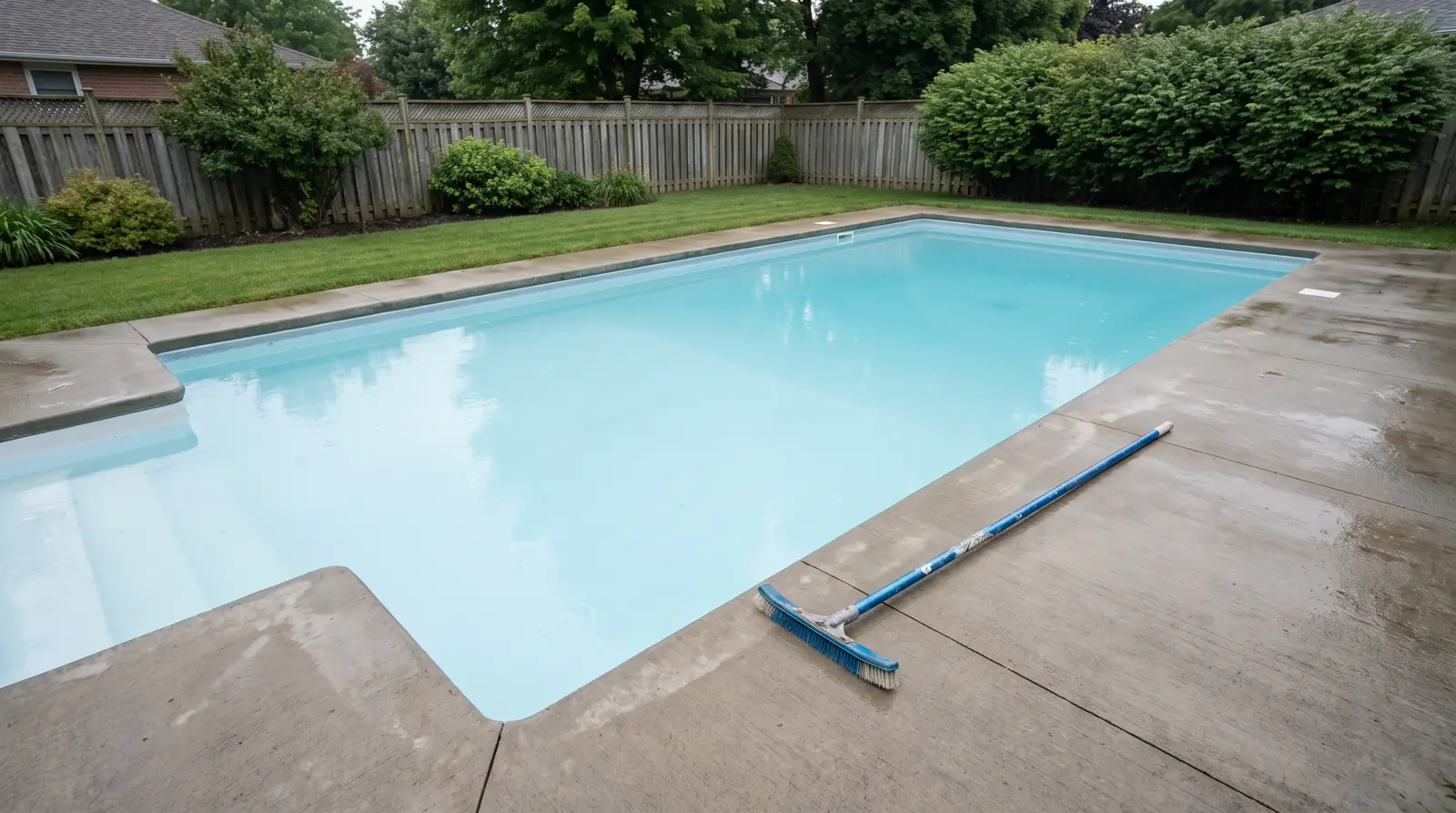
Cloudy Pool After Shock: Why It Happens and How Long It Takes to Clear
A cloudy pool after shock usually holds dead algae the filter has not caught yet, a pH jump or calcium from cal-hypo. Three filter turnovers clear 95% of it: about 25 hours for 20,000 gallons at 40 gpm.
- ✓Pump 24 hours after an algae doseThen clean the filter, per the BioGuard Calcium Hypochlorite 73 label (EPA Reg. No. 5185-515).
- ✓3 turnovers = 95% filteredThe dilution math in the 2024 MAHC Annex; 5 turnovers reach 99.3%.
- ✓Milky white? Check pHPennsylvania DOH links pH above 7.6 to cloudiness and calcium precipitates.
Key takeaways
- Haze right after a shock is usually dead algae and organics the filter has not caught yet; the BioGuard Calcium Hypochlorite 73 label calls for 24 hours of continuous pump time after an algae dose, then a filter clean.
- Clear time is set by turnovers: three passes filter 95% of the water, per the 2024 MAHC Annex, which is about 25 hours for a 20,000 gallon pool at 40 gpm.
- Milky white water points to a pH jump or calcium: the Florida DOH manual lists a pH of 8.5 to 11 for cal-hypo solution, and each 10 ppm of cal-hypo adds about 7.1 ppm calcium hardness (PubChem arithmetic).
- If free chlorine falls hard overnight the algae is still alive; re-dose and filter again, as the BioGuard 73 label says to repeat while algae persists.
- Add clarifier 4 to 12 hours after the shock and expect results within 48 hours, per HTH Clarifier Advanced directions; if you cannot see the main drain, floc and vacuum to waste instead.
Why is my pool cloudy after I shocked it?
Eight causes cover almost every cloudy pool after shock: dead algae still suspended, live algae, a pH jump above 7.6, calcium from cal-hypo, undissolved granules, a filter past its 8 to 10 psi trigger, cyanuric acid above 90 ppm and metals. Each has a test that separates it and its own clear time, set out in the table below.
| Cause | What you see | Test that confirms it | Fix | Expected clear time | Source |
|---|---|---|---|---|---|
| Dead algae and organics still in the water | Even, dull haze; no green; free chlorine holds overnight | Free chlorine drops 1 ppm or less overnight; brushing raises no green cloud | Brush, run the pump 24 hours, clean the filter at its pressure trigger | About 3 turnovers: 25 hours for 20,000 gal at 40 gpm | BioGuard 73 label 5185-515; 2024 MAHC Annex dilution math |
| Algae still alive | Haze with a green or teal cast; chlorine falls hard overnight | Free chlorine falls far below target by morning | Re-dose to the target, brush, filter another 24 hours, repeat | 24 hour rounds until chlorine holds overnight | BioGuard 73 label; Arch 52% label 1258-1250 |
| pH jump from cal-hypo or liquid chlorine | Milky white haze within hours of shocking | pH above 7.6 (Pennsylvania DOH lists cloudiness) | Lower pH to 7.2 to 7.6 with measured acid, keep the filter running | Counts in turnovers once pH is 7.2 to 7.6 | Pennsylvania DOH; Florida DOH pH chart; HTH |
| Calcium from cal-hypo in hard or warm water | White haze or scale feel; worse after repeated cal-hypo shocks | Calcium hardness near or above 400 ppm with pH above 7.6 | Lower pH; switch to liquid chlorine; partial drain if hardness is far over | Filter-bound; clarifier helps within 48 hours | PubChem arithmetic; Florida DOH; HTH |
| Undissolved granules | Cloudy streaks or white specks over the deep end right after dosing | Granules visible on the floor | Brush them up; pre-dissolve next time (Scorch: 1 oz in 2 qt of water) | About 30 minutes to disperse | HTH Granular 73 label; Scorch label 3432-76 |
| Filter not keeping up | Haze stops improving; filter pressure flat or very high | Gauge 8 to 10 psi over the clean reading, or no rise at all | Clean or backwash; run longer; replace sand older than 5 years | Resumes once the filter is clean | Hayward; HTH |
| Cyanuric acid too high | Haze plus algae that keeps coming back despite shocks | CYA above 90 to 100 ppm | Partial drain to lower CYA, then shock again | Only after the drain | City of Longview health division; 2024 MAHC |
| Metals released by the shock | Clear water with a green, teal or brown tint, not haze | Copper or iron test reads above 0 | Stop shocking; add a metal sequestrant | Not a filtration problem | BioGuard; EPA secondary standards |
Source: BioGuard 73 label 5185-515, HTH Granular 73 label, Scorch label, Arch 52% label 1258-1250; 2024 MAHC Annex; Pennsylvania DOH; Florida DOH; Hayward; City of Longview; BioGuard. Download CSV
The first row is the normal case. Chlorine kills algae and burns organics, but dead cells stay in the water until the filter catches them, which is why every algae direction we read pairs the dose with filtration. The BioGuard 73 label is explicit: brush, run the pump continuously for 24 hours, then backwash or clean the filter, and repeat if algae persists.
General cloudiness with no recent shock, such as total alkalinity above 120 ppm (Virginia DOH), dissolved solids or plaster dust, is a different diagnosis covered in our guide to cloudy pool water. If the water was green before the shock, the dose and the rounds it takes are in our guide on how to clear a green pool.
Is it normal for a pool to be cloudy after shocking?
Yes, for 1 to 2 days, if the haze is even, the water is not green and free chlorine holds overnight. It is not normal when the water turns milky white within hours (pH or calcium), takes on a green, teal or brown tint (metals), or chlorine falls far below target by morning (live algae). The flowchart sorts them.
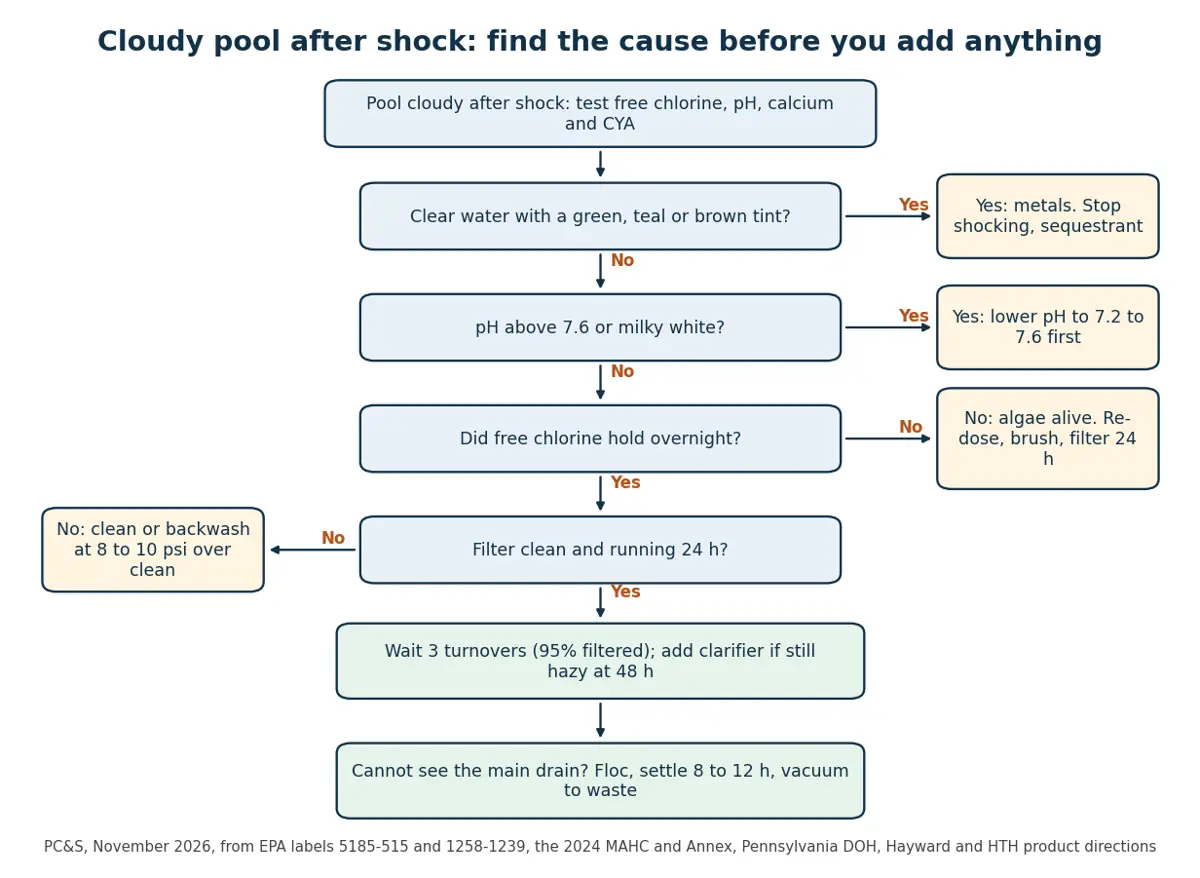
- Look for a tintClear water with a green, teal or brown cast is metal, not haze; BioGuard says a pH rise or a shock can make dissolved metals drop out, and EPA ties copper above 1.0 mg/L to blue-green staining.
- Test pHAbove 7.6, Pennsylvania DOH lists cloudiness and calcium precipitates; bring it to 7.2 to 7.6 before anything else.
- Test free chlorine at dusk and again at dawnA large overnight drop means algae is still alive and needs another dose.
- Read the filter gaugeClean at 8 to 10 psi over the clean reading (Hayward); a gauge that never rises can mean particles are passing straight through.
- Count turnovers, not hoursDivide gallons by pump gpm x 60; three turnovers filter 95% of the water.
How long does it take for a pool to clear after shock?
Usually one to two days once chlorine holds: the filter must pass the water about three times to catch 95% of the dead material, per the dilution math in the 2024 MAHC Annex. That is 25 hours for 20,000 gallons at 40 gpm and 50 hours at 20 gpm. Floc is faster, settling in 8 to 12 hours, but needs vacuuming to waste.
| Pool size | Pump flow | Hours per turnover | Hours to 3 turnovers (95% filtered) | Hours to 5 turnovers (99.3%) |
|---|---|---|---|---|
| 10,000 gal | 20 gpm | 8.3 | 25 | 42 |
| 10,000 gal | 40 gpm | 4.2 | 12 | 21 |
| 10,000 gal | 60 gpm | 2.8 | 8 | 14 |
| 15,000 gal | 20 gpm | 12.5 | 38 | 62 |
| 15,000 gal | 40 gpm | 6.2 | 19 | 31 |
| 15,000 gal | 60 gpm | 4.2 | 12 | 21 |
| 20,000 gal | 20 gpm | 16.7 | 50 | 83 |
| 20,000 gal | 40 gpm | 8.3 | 25 | 42 |
| 20,000 gal | 60 gpm | 5.6 | 17 | 28 |
| 30,000 gal | 20 gpm | 25.0 | 75 | 125 |
| 30,000 gal | 40 gpm | 12.5 | 38 | 62 |
| 30,000 gal | 60 gpm | 8.3 | 25 | 42 |
Source: 2024 MAHC Annex (3 turnovers = 95%, 5 = 99.3%); pump flows are example inputs; PC&S arithmetic. Public pools must turn over in 6 hours or less (2024 MAHC Table 4.7.1.10). Download CSV
Source: 2024 MAHC Annex (3 turnovers = 95%, 5 = 99.3%); 1, 2 and 4 turnovers are PC&S arithmetic with the same law (1 minus e to the minus N). Download chart data (CSV)
| Turnovers | Share of water passed through the filter at least once | Basis |
|---|---|---|
| 1 | 63.2% | 1 minus e to the minus N, same dilution law |
| 2 | 86.5% | 1 minus e to the minus N, same dilution law |
| 3 | 95.0% | 2024 MAHC Annex (3 = 95%, 5 = 99.3%) |
| 4 | 98.2% | 1 minus e to the minus N, same dilution law |
| 5 | 99.3% | 2024 MAHC Annex (3 = 95%, 5 = 99.3%) |
Source: 2024 MAHC Annex; 1, 2 and 4 turnovers are PC&S arithmetic with the same law. Download CSV
Your pump flow is the unknown in that math. A variable-speed pump on a low setting can halve the flow and double the clear time, so run it at a higher speed until the water clears. The dilution law assumes every particle that reaches the filter stays there; Hayward rates sand filters at 20 to 40 microns against 3 to 5 for DE, which is why a sand pool can need more than three turnovers.
| Fix | Label or source dose | Time the source gives | Filter step | Source |
|---|---|---|---|---|
| Keep filtering after an algae dose | Pump continuously | 24 hours, then clean the filter | Backwash or clean after 24 hours | BioGuard Calcium Hypochlorite 73 label 5185-515 |
| Clarifier (HTH Clarifier Advanced) | 2 fl oz per 10,000 gal; 4 fl oz if extremely cloudy | Wait 4 to 12 hours after shock to add; clear within 48 hours or check the filter | No backwash for 24 hours | HTH product directions |
| Flocculant (HTH Drop Out) | 8 fl oz per 10,000 gal | Pump 2 hours, settle 8 to 12 hours | Vacuum to waste, not through the filter | HTH product directions |
| Shock plus floc (severe bloom) | 2.6 lb of 52% cal-hypo and 1.3 lb floc per 10,000 gal | Clear blue within 24 hours | Vacuum sediment to waste | Arch 52% label 1258-1250 |
| New plaster dust (if the pool was just resurfaced) | Brush daily | At least 72 hours of continuous filtration | Run filter continuously | National Plasterers Council start-up card |
Source: BioGuard 73 label; HTH Clarifier Advanced; HTH Drop Out; Arch 52% label 1258-1250; National Plasterers Council. Download CSV
Source: HTH Drop Out and Clarifier Advanced directions; BioGuard 73 label 5185-515; Arch 52% label 1258-1250; National Plasterers Council; 2024 MAHC Annex dilution math. Download chart data (CSV)
Can the shock itself make pool water cloudy?
Yes. Calcium hypochlorite and liquid chlorine both raise pH, and cal-hypo adds about 7.1 ppm of calcium hardness for every 10 ppm of chlorine. In hard or warm water at pH above 7.6, that calcium can drop out as fine white particles. Undissolved granules also cloud the deep end for about 30 minutes.
| Shock type | What it adds per 10 ppm of chlorine | pH of a 1% solution | Cloud risk after a shock | Source |
|---|---|---|---|---|
| Calcium hypochlorite (cal-hypo) | About 7.1 ppm calcium hardness | 8.5 to 11 | Highest in hard water at pH above 7.6 | PubChem 100.09 / 141.80; Florida DOH |
| Liquid chlorine (sodium hypochlorite) | No calcium, no cyanuric acid | 9 to 14 | pH rise only | Florida DOH |
| Dichlor | About 9.1 ppm cyanuric acid | 6.5 to 6.8 | Low; CYA builds up over many shocks | PubChem 129.07 / 141.80; Florida DOH |
| Non-chlorine shock (MPS) | No chlorine, calcium or CYA | Acidic (net acidic per MAHC Annex) | Does not kill algae, so it cannot clear algae haze | 2024 MAHC Annex |
Source: PubChem molar masses (PC&S arithmetic); Florida DOH disinfectant chart; 2024 MAHC Annex. Download CSV
Calcium builds with every cal-hypo shock. Ten 10 ppm shocks add about 71 ppm of calcium hardness, and the Florida DOH manual puts the normal range at 200 to 400 ppm and warns calcium is less soluble in warm water. HTH describes the result: high pH and alkalinity make calcium precipitate as fine white particles. If your hardness is already near 400 ppm, shock with liquid chlorine; our calcium hardness guide covers the targets by surface.
For a pH jump, lower pH to 7.2 to 7.6 first and retest before any more chlorine. The dose of acid by pool size is in our guide on how to lower pH in a pool, and choosing a dose that does not overshoot is easier with our table of how much shock to add to a pool.
Why is my pool still cloudy after shocking and running the filter?
Four reasons: the filter is past its 8 to 10 psi cleaning trigger or worn, algae is still alive, pH is above 7.6 or calcium is high, or cyanuric acid is above the 90 ppm MAHC cap so chlorine cannot finish the job. A filter gauge that never rises and a chlorine reading that falls overnight are the two quickest tells.
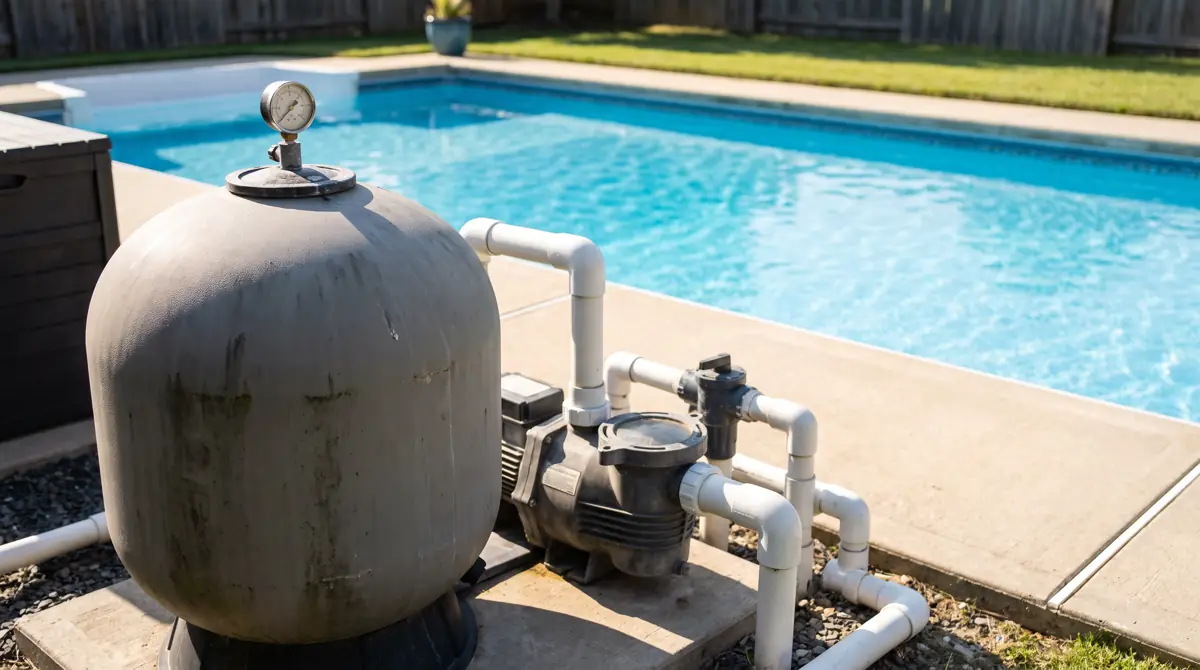
Filters load up fast after a shock. Hayward cleans sand, DE and cartridge filters at 8 to 10 psi over the clean reading, and HTH says sand older than 5 years stops trapping particles well. Backwash or rinse, then keep the pump on; the step-by-step is in our guide on how to backwash a pool filter.
High stabilizer is the slow cause. The City of Longview health division links rising cyanuric acid to cloudier water, high bacteria results and algae, and the 2024 MAHC caps public pools at 90 ppm. Above that, each shock needs more chlorine than the labels allow, so lower CYA first with the drain table in our guide on how to lower cyanuric acid in a pool.
| Guide claim | Who says it | What primary sources show | Source for the check |
|---|---|---|---|
| A cloudy pool after shock is a sign the algae is dead | Swim University | Often true, but only if free chlorine holds overnight; a big overnight drop means live algae | BioGuard 73 label (repeat if algae persists) |
| Shock takes 12 to 24 hours to kill algae | Carlton Pools | The BioGuard 73 label sets 24 hours of continuous pump time after an algae dose, then a filter clean | BioGuard 73 label 5185-515 |
| Run the pump at least 8 hours a day | HTH | Fine for routine care; after a shock the BioGuard 73 label asks for 24 hours continuous | BioGuard 73 label |
| High calcium hardness turns water white or milky | Beatbot | Florida DOH: calcium is less soluble in warm water; cal-hypo adds about 7.1 ppm per 10 ppm chlorine | Florida DOH; PubChem |
| Floc is not for cartridge filters | Beatbot | HTH Drop Out needs a vacuum-to-waste option; vacuuming floc through any filter puts it back in the water | HTH Drop Out directions |
Source: claims from Swim University, Carlton Pools, HTH and Beatbot (opened November 10, 2026); checks against BioGuard 73, Florida DOH, PubChem and HTH Drop Out. Download CSV
Should you add clarifier, floc or more shock?
More shock only if free chlorine fell below target overnight. Clarifier if the water is hazy with the drain visible and chemistry in range: HTH says add it 4 to 12 hours after the shock at 2 fl oz per 10,000 gallons. Floc if you cannot see the drain and can vacuum to waste: 8 fl oz, then 8 to 12 hours of settling.
Clarifier and floc work differently. Clarifier clumps fine particles so the filter can catch them, and HTH says not to backwash for 24 hours afterward. Floc drops particles to the floor, and HTH Drop Out directions say to vacuum to waste, because vacuuming through the filter returns the material to the pool. Label doses for 12 clarifiers are compared in our pool clarifier guide, and floc chemistry in our pool flocculant guide.
Can you swim in a cloudy pool after shock?
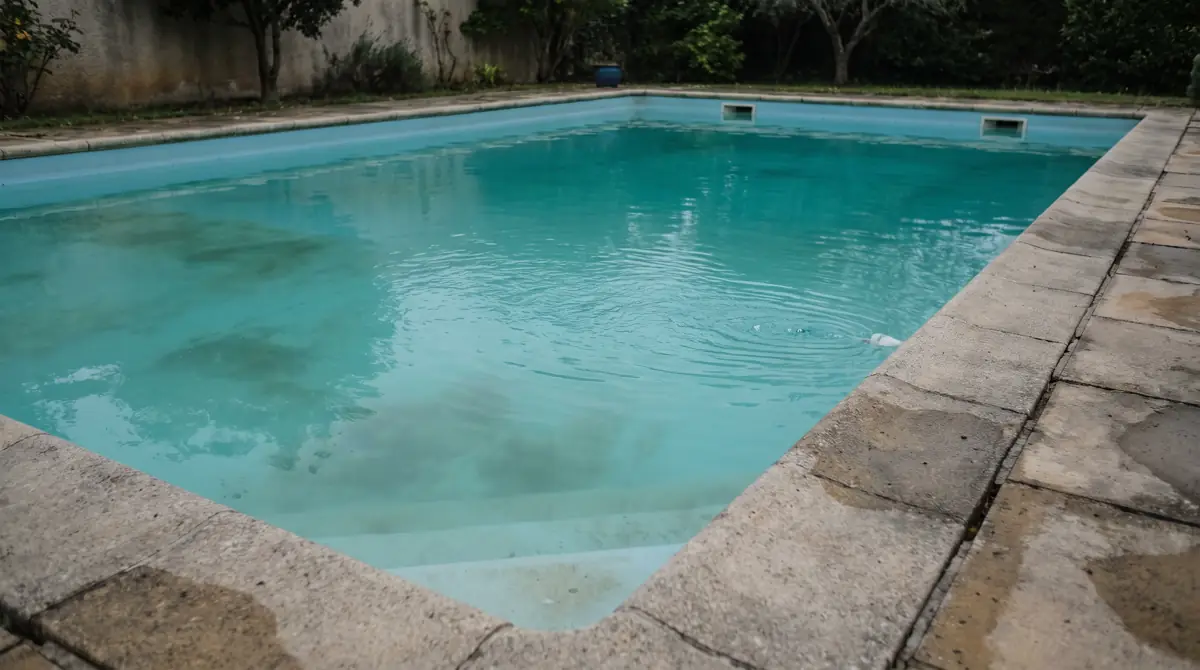
Not until you can see the main drain and free chlorine is back to 4 ppm or less. The 2024 MAHC requires the main drain or a reference tile to be visible from the deck up to 30 feet away, and the EPA chlorine labels we read bar swimming above 4 ppm. Haze hides a swimmer in trouble, which is why public codes close cloudy pools.
Public pools fail on this point regularly. A main drain that was not visible failed 1.2% of routine inspections in Louisville Metro from October 2021 to April 2024, and accounted for 6.3% of unsatisfactory critical-item marks in Montgomery County, Maryland, from April 2025 to September 2026, according to our public pool inspection research. For home pools the HTH Granular 73 label sets re-entry at 1 to 4 ppm free chlorine.
What should you do at your test result?
Match what you see and your test result to a row. The table turns the BioGuard 24 hour pump rule, the Pennsylvania DOH pH 7.6 line, the HTH clarifier and floc directions, the MAHC drain-visibility and CYA limits and Hayward’s filter trigger into if-then steps, with the key numbers listed under it.
| If your situation is | Do this | Source |
|---|---|---|
| Haze, free chlorine held overnight, pH 7.2 to 7.6 | Brush, keep filtering, clean the filter at its trigger; wait 3 turnovers | BioGuard 73 label; 2024 MAHC Annex |
| Free chlorine dropped far below target overnight | Algae is still alive: re-dose to target, brush, filter 24 hours | BioGuard 73 label |
| Milky white and pH above 7.6 | Lower pH to 7.2 to 7.6 first; do not add more shock | Pennsylvania DOH; HTH |
| Calcium hardness near 400 ppm and you shock with cal-hypo | Switch to liquid chlorine; consider a partial drain | PubChem arithmetic; Florida DOH |
| Granules sitting on the floor | Brush them into the water; pre-dissolve next time | HTH Granular 73 and Scorch labels |
| Still hazy after 48 hours with good chemistry | Clean the filter, then clarifier (2 to 4 fl oz per 10,000 gal) | HTH Clarifier Advanced |
| Cannot see the main drain | Floc (8 fl oz per 10,000 gal), settle 8 to 12 hours, vacuum to waste | HTH Drop Out; 2024 MAHC 5.7.6 |
| Cyanuric acid above 90 ppm | Lower CYA by partial drain before the next shock | 2024 MAHC 5.7.3.1.3.2 |
| Clear but tinted green, teal or brown | Test copper and iron; stop shocking; sequestrant | BioGuard; EPA secondary standards |
| Filter pressure 8 to 10 psi over clean | Backwash or clean the filter now | Hayward |
Source: BioGuard 73; Pennsylvania DOH; HTH Clarifier Advanced; HTH Drop Out; 2024 MAHC; Hayward; BioGuard; EPA. Download CSV
| Key number | Value | Source |
|---|---|---|
| Pump time after an algae dose | 24 hours continuous, then clean the filter | BioGuard 73 label 5185-515 |
| Water filtered after 3 turnovers | 95% | 2024 MAHC Annex (Gage-Bidwell dilution) |
| Maximum turnover, most public pools | 6 hours | 2024 MAHC Table 4.7.1.10 |
| Calcium hardness added by 10 ppm of cal-hypo | About 7.1 ppm | PubChem molar masses |
| Clarifier wait after shock | 4 to 12 hours | HTH Clarifier Advanced |
| Clarifier deadline | Clear within 48 hours or check the filter | HTH Clarifier Advanced |
| Floc settling time | 8 to 12 hours | HTH Drop Out |
| Filter cleaning trigger | 8 to 10 psi over the clean reading | Hayward |
| Clarity standard | Main drain visible from the deck up to 30 ft away | 2024 MAHC 5.7.6 |
Source: as listed in each row; 2024 MAHC Annex; 2024 MAHC. Download CSV
How we compiled this
We read 5 EPA-registered pool chlorine labels, the 2024 Model Aquatic Health Code and its Annex, operator manuals from the Florida, Pennsylvania and Virginia health departments, a City of Longview health division fact sheet, Hayward filter guidance and HTH clarifier and flocculant directions, accessed October and November 2026. Turnover times and calcium figures are PC&S arithmetic shown in the tables. Four consumer guides appear only where we check their claims; a forum thread was read for question wording only, and we did not test water.
Frequently Asked Questions
How long does it take for a pool to clear after shock?
Usually 1 to 2 days once free chlorine holds overnight. The filter has to pass the water about 3 times to catch 95% of the dead material (2024 MAHC Annex), which is about 25 hours for 20,000 gallons at 40 gpm. Floc settles in 8 to 12 hours but must be vacuumed to waste.
Is it normal for a pool to be cloudy after shocking?
Yes, for about a day, if the haze is even, the water is not green and free chlorine holds overnight. Milky white water points to a pH jump or calcium from cal-hypo, a green or brown tint to metals, and a big overnight chlorine drop to algae that is still alive.
Why is my pool cloudy after adding chlorine?
Most often the chlorine raised pH. Florida DOH lists a pH of 9 to 14 for sodium hypochlorite solution and 8.5 to 11 for cal-hypo, and Pennsylvania DOH links pH above 7.6 to cloudiness and calcium precipitates. Test pH, bring it to 7.2 to 7.6, and keep the filter running.
Should I shock my pool again if it is still cloudy?
Only if free chlorine fell far below your target overnight, which means algae is still consuming it. If chlorine held, more shock adds nothing: clean the filter, check pH, and give it 3 turnovers. The BioGuard 73 label repeats the algae dose only while algae persists.
When should I add clarifier after shocking?
HTH says wait 4 to 12 hours after a shock, then add 2 fl oz of Clarifier Advanced per 10,000 gallons (4 fl oz if extremely cloudy), run the filter continuously and skip backwashing for 24 hours. If the water is not clear within 48 hours, check the filter before adding more.
Can you swim in a cloudy pool after shock?
No. Wait until you can see the main drain and free chlorine is 4 ppm or less. The 2024 MAHC requires the drain or a reference tile to be visible from the deck up to 30 feet away, and the EPA chlorine labels we read bar swimming above 4 ppm.
Sources
- BioLab label on file with U.S. EPA (PPLS). BioGuard Calcium Hypochlorite 73, EPA Reg. No. 5185-515, label dated May 21, 2024. Accessed 2026-10-27.
- Innovative Water Care label on file with U.S. EPA (PPLS). HTH Granular 73, EPA Reg. No. 1258-1239, label file dated February 24, 2025. Accessed 2026-11-10.
- N. Jonas & Co. label on file with U.S. EPA (PPLS). Scorch, EPA Reg. No. 3432-76, label notification September 22, 2025. Accessed 2026-11-10.
- Arch label on file with U.S. EPA (PPLS). Arch 52% Calcium Hypochlorite, EPA Reg. No. 1258-1250, draft label dated July 12, 2021. Accessed 2026-11-10.
- Hasa, Inc. label on file with U.S. EPA (PPLS). Hasachlor (sodium hypochlorite 12.5%), EPA Reg. No. 10897-26. Accessed 2026-11-10.
- CDC. 2024 Model Aquatic Health Code, 5th Edition, Code Language. Accessed 2026-11-10.
- CDC. 2024 Model Aquatic Health Code, 5th Edition, Annex. Accessed 2026-11-10.
- Pennsylvania Department of Health. Public Swimming and Bathing Places: Operational and Biological Contamination Protocol Recommendations (November 1, 2016). Accessed 2026-10-27.
- Florida Department of Health in Collier County. Swimming Pool Operators' Manual, 2016 Version. Accessed 2026-10-27.
- Virginia Department of Health. Pool Operation and Maintenance Guide (2018). Accessed 2026-10-27.
- City of Longview Environmental Health Division (Texas). Frequently Asked Questions about Cyanuric Acid and Stabilized Chlorine Products. Accessed 2026-11-10.
- NIH National Library of Medicine. PubChem compound records (molar masses). Accessed 2026-10-27.
- Hayward. What are the Differences Between Filter Types? (May 22, 2023). Accessed 2026-10-27.
- HTH (Innovative Water Care). HTH Pool Care Clarifier Advanced (directions). Accessed 2026-11-03.
- HTH (Innovative Water Care). HTH Pool Care Drop Out Flocculant (directions). Accessed 2026-11-01.
- HTH (Innovative Water Care). Why Is My Pool Cloudy? Causes and Fixes. Accessed 2026-11-10.
- National Plasterers Council. NPC Pool Start-up Card. Accessed 2026-10-27.
- BioGuard. Metal Staining. Accessed 2026-10-27.
- U.S. EPA. Secondary Drinking Water Standards: Guidance for Nuisance Chemicals. Accessed 2026-10-27.
- PC&S research. Public Pool Inspection Violations (PC&S research). Accessed 2026-10-27.
- Swim University. How Much Pool Shock to Add (claims compared). Accessed 2026-11-10.
- Carlton Pools. How Much Shock to Open a Pool (claims compared). Accessed 2026-11-10.
- Beatbot. Pool Cloudy After Shock (claims compared). Accessed 2026-11-10.
Related pages
Get Quotes From Licensed Local Pool Pros
Tell us what you need and your ZIP code. We match you with pool companies that cover your area.