How to Open a Pool After Winter: Steps, Startup Doses and Timing
How to open a pool: store the cover, pull the winter plugs, refill to mid-skimmer, prime the pump, balance alkalinity before pH, then shock to 5 to 10 ppm free chlorine and filter for 24 hours.
- ✓Startup dose tablePounds and ounces for 15,000, 20,000 and 30,000 gallons, math shown.
- ✓Opening dates for 20 metrosFirst 70F normal highs from NOAA 1991-2020 normals.
- ✓Maker rules for salt cells and heatersCold cutoffs from Hayward, Pentair, Jandy and CircuPool manuals.
Key takeaways
- Open when daytime highs hold above 70F, the trigger Swim University uses; NOAA 1991-2020 normals put that date at Feb 26 in Houston, May 15 in Chicago and May 29 in Boston, by PC&S arithmetic from the NOAA NCEI Climate Normals.
- Refill to the middle of the skimmer opening, the level the 2024 Model Aquatic Health Code sets in section 5.7.1.4.3 and Pentair’s pump guide repeats before priming.
- For spring start-up, the Hasachlor label (EPA Reg. No. 10897-26) calls for 50 to 100 fl oz of 12.5% liquid chlorine per 10,000 gallons to reach 5 to 10 ppm, and bars swimming above 4 ppm.
- Four salt chlorinators stop making chlorine in water colder than 50F to 53F: Hayward AquaRite 900 at 50F, Jandy AquaPure at 51F, Pentair IntelliChlor at 52F and CircuPool CORE at 53F (Jandy manual, maker manuals).
- A professional opening costs $200 to $400 a visit in Angi 2026 data and $200 to $500 at Swim University (March 2026); do-it-yourself chemicals run $50 to $150.
When should you open your pool after winter?
Open when daytime highs stay above 70F, or a little earlier: algae wakes up as water warms, so an early opening is cheaper than a late one. NOAA normals put the first 70F normal high at Feb 26 in Houston, Apr 1 in Atlanta, May 10 in New York and May 29 in Boston.
The 70F rule comes from Swim University, which says to open once the outside daytime temperature stays consistently above 70F (21C) and reports that most of the 1,900 owners it surveyed open between May 1 and May 15. The water side of the same logic is in In The Swim‘s closing guidance: algae growth is very low once water drops into the low 60s and stops below 40F. Spring runs that curve in reverse, so the warmer the water gets under the cover, the more algae you open to.
Cover makers start the clock earlier. Loop-Loc adds algaecide and sanitizer one month before opening, or once temperatures of 60F or higher hold. Its FAQ is specific: pour two gallons of liquid shock through the cover in the beginning of April, or at least four weeks before opening, then one gallon of algaecide one week before the cover comes off.
| Metro (NOAA airport station) | Median last 32F night | Normal daily high first reaches 70F | Normal daily mean first reaches 65F | NOAA station ID |
|---|---|---|---|---|
| Miami, FL | No freeze in most years | Year-round | Year-round | USW00012839 |
| Phoenix, AZ | No freeze in most years | Feb 11 | Mar 11 | USW00023183 |
| Los Angeles, CA | No freeze in most years | May 29 | Jun 4 | USW00023174 |
| Houston, TX | Feb 13 | Feb 26 | Mar 22 | USW00012960 |
| Las Vegas, NV | Jan 20 | Mar 12 | Apr 4 | USW00023169 |
| Dallas-Fort Worth, TX | Mar 8 | Mar 21 | Apr 13 | USW00003927 |
| Atlanta, GA | Mar 15 | Apr 1 | Apr 23 | USW00013874 |
| Charlotte, NC | Mar 30 | Apr 5 | Apr 30 | USW00013881 |
| Seattle, WA | Mar 2 | Jun 10 | Jul 3 | USW00024233 |
| Washington, DC | Mar 24 | Apr 21 | May 8 | USW00013743 |
| St. Louis, MO | Apr 2 | Apr 22 | May 8 | USW00013994 |
| Philadelphia, PA | Apr 2 | Apr 30 | May 19 | USW00013739 |
| New York, NY | Mar 26 | May 10 | May 21 | USW00014732 |
| Salt Lake City, UT | Apr 8 | May 10 | May 27 | USW00024127 |
| Boston, MA | Apr 4 | May 29 | Jun 7 | USW00014739 |
| Chicago, IL | Apr 16 | May 15 | May 29 | USW00094846 |
| Denver, CO | May 5 | May 14 | Jun 6 | USW00003017 |
| Detroit, MI | Apr 20 | May 15 | May 30 | USW00094847 |
| Buffalo, NY | Apr 24 | May 24 | Jun 9 | USW00014733 |
| Minneapolis-St. Paul, MN | Apr 23 | May 18 | Jun 1 | USW00014922 |
Source: NOAA NCEI U.S. Climate Normals 1991-2020 (daily and annual/seasonal station files), computed by PC&S, November 2026. Download CSV
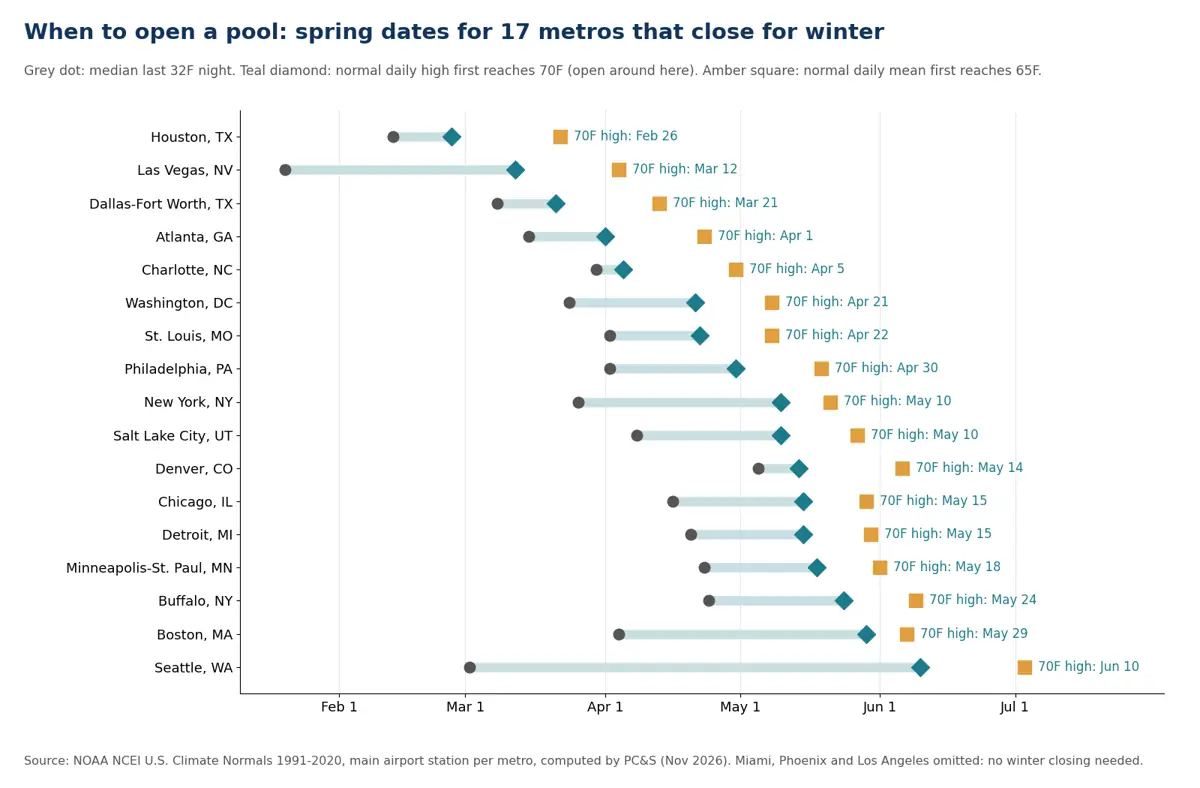
What month should you open your pool? In the colder half of the table, mid to late May: the normal daily high first reaches 70F on May 15 in Chicago and Detroit, May 18 in Minneapolis-St. Paul and May 24 in Buffalo. Mid-Atlantic metros get there in late April (Apr 21 in Washington, DC, Apr 30 in Philadelphia), Dallas-Fort Worth on Mar 21. Seattle’s marine climate holds highs under 70F until Jun 10 even though its median last 32F night is Mar 2. The same NOAA files drive our pool season length by city study.
This table mirrors the fall one in our guide on how to winterize a pool, which uses a 65F water trigger for closing. Miami, Phoenix and Los Angeles appear for completeness: NOAA counts under 1 freezing night a year there, so most pools run all winter and have nothing to open.
How to open a pool, step by step
Pre-treat under the cover, pump the cover dry, remove and store it, pull every winter plug, reinstall plugs and fittings, refill to the middle of the skimmer opening, prime the pump, circulate before testing, balance alkalinity before pH, shock at dusk and filter at least 24 hours. The order reverses the closing steps.
- Pre-treat under the coverFour weeks out, add 2 gallons of liquid shock through a mesh cover or under a couple of springs; one week out, add 1 gallon of algaecide (Loop-Loc FAQ).
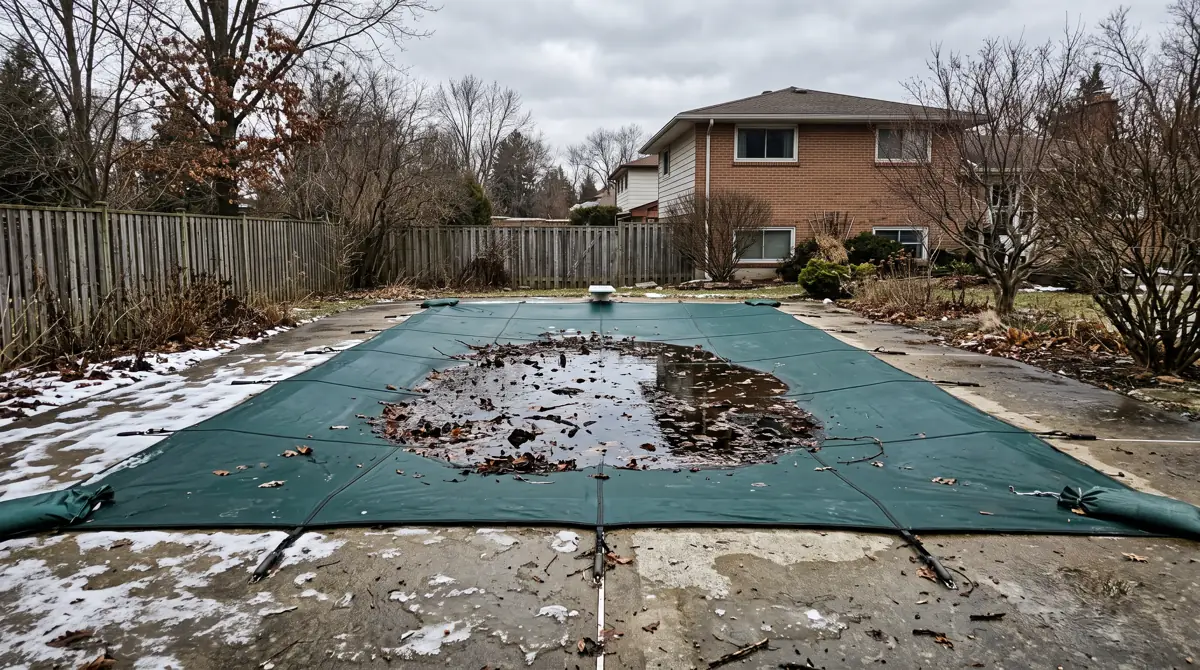
- Pump the cover dry and clear itSet a cover pump in the middle of a solid cover; move dry leaves with a brush or leaf blower and wet leaves with a cover rake (Pentair). Loop-Loc solid covers without drain panels need the automatic cover pump.
- Remove, clean and store the coverUnhook springs at one end and accordion fold it into its bag (Loop-Loc). Clean solid and mesh covers with mild detergent, dry them and store them away from rodents (Meyco); Loop-Loc says off the ground, since mouse damage is not covered under its 15-year pro-rated warranty.
- Pull every winter plugRemove return and skimmer plugs and the Gizzmo skimmer guard. Hayward’s heat pump manual warns that winterization plugs left in suction outlets raise the risk of suction entrapment.
- Reinstall the hardwarePut back skimmer baskets, return fittings, ladders and rails, and reinstall the pump, filter and heater drain plugs that Leslie’s tells owners to store in the pump basket at closing.
- Reset the valves and equipmentMove the multiport handle from its winter position to FILTER with the pump off. Refit the heater’s water pressure switch and take the plastic bag off its air inlet (Pentair Max-E-Therm manual). Reinstall the salt cell, but leave it off.
- Fill to the middle of the skimmer openingThat is the 2024 MAHC level (5.7.1.4.3). On a 16 x 32 ft pool, each inch is about 319 gallons (512 sq ft x 1/12 ft x 7.48 gal per cu ft).
- Prime and start the pumpFill the strainer pot to the suction port, seat the lid O-ring, open the filter’s air relief valve and start; Hayward’s Super Pump may take up to 10 minutes to prime. Note the clean filter pressure: Pentair says most gauges read 8 to 25 psi.
- Brush, skim and vacuumHTH’s opening steps scoop surface and floor debris, brush the walls and floor and vacuum what remains, before the chemistry starts.
- Circulate, then testRun the filter 12 hours (HTH) to 24 hours (Fixr) so fill water, old water and any antifreeze mix before the full test: free chlorine, pH, total alkalinity, calcium hardness, cyanuric acid and salt.
- Balance in orderTotal alkalinity first, wait at least 6 hours (Arm & Hammer), then pH to 7.2 to 7.6, then calcium hardness, then stabilizer. Use the dose table below.
- Shock at duskRaise free chlorine to 5 to 10 ppm with the pump running, in the evening (HTH Granular 73 label). Do not adjust pH and chlorinate at the same time.
- Filter and retestKeep the filter running at least 24 hours after the shock (Swim University). Swim when free chlorine reads 4 ppm or less and pH is back in range (EPA labels).
Priming is where most openings stall. The fill level, lid O-ring and air relief steps, and the time limits from 9 pump manuals, are in our guide on how to prime a pool pump. Pentair’s opening tips add one check before any of it: have the equipment pad plumbing looked at for leaks or cracks, which it calls critical after a harsh winter.
What did you do at closing, and how do you undo it?
Every closing step has an opening twin. The water you lowered to the cover maker’s level goes back to the middle of the skimmer opening, plugs come out, drain plugs go back in, the multiport returns to FILTER, and the heater and salt cell stay off until water circulates and tests in range. The table pairs them with the source for each.
| What you did at closing | What to do at opening | Source |
|---|---|---|
| Lowered water to the cover maker's level (Loop-Loc mesh: 15 to 18 in below the top of the pool) | Refill to the middle of the skimmer opening | Loop-Loc FAQs; 2024 MAHC 5.7.1.4.3; Pentair IntelliFlo3 guide |
| Plugged return and skimmer lines; set a Gizzmo skimmer guard | Remove every winter plug and the Gizzmo before the pump starts | Leslie's winterizing guide; Hayward heat pump manual (suction entrapment warning) |
| Stored drain plugs in the pump basket | Reinstall drain plugs in the pump, filter and heater | Leslie's winterizing guide |
| Set the multiport valve between two settings (Winterize) | Return the handle to FILTER with the pump off | Leslie's winterizing guide |
| Drained the heater, removed its pressure switch and bagged the air inlet | Refit the pressure switch, remove the bag, start only with water circulating | Pentair Max-E-Therm manual |
| Drained the salt cell and flow switch | Reinstall and inspect the cell; leave it off until the water is balanced | Hayward AquaRite 900 manual |
| Added propylene glycol antifreeze to wet lines | Lines still holding it empty into the pool on start-up; circulate 12 to 24 hours, then test | In The Swim antifreeze FAQ (non-toxic, no harm to water chemistry); HTH; Fixr |
| Fitted a safety or winter cover | Pump it dry, fold it and store it off the ground | Loop-Loc FAQs; Meyco Seasonal Cover Care |
Sources: Loop-Loc FAQs; 2024 MAHC; Leslie’s winterizing guide; Pentair Max-E-Therm manual; Hayward AquaRite 900 manual; In The Swim antifreeze FAQ; Meyco Seasonal Cover Care; Hayward heat pump manual. Download CSV
Water level is the biggest gap. A Loop-Loc mesh cover wants winter water 15 to 18 inches below the top of the pool, and the Pentair IntelliFlo3 guide wants it halfway up the skimmer opening before the pump runs. Refilling 12 inches on a 16 x 32 ft pool is about 3,830 gallons; a full 20,000 gallon fill cost $39.00 in Sacramento to $649.98 in Houston at October 2026 rates, according to our cost to fill a pool study.
What order do you add chemicals when opening a pool?
Alkalinity first, then pH, then calcium hardness, then stabilizer, then shock, with time between them. Alkalinity buffers pH, so fixing pH first wastes acid. Calcium chloride clouds water if it goes in within hours of baking soda or soda ash, and labels say not to adjust pH and chlorinate at the same time.
| Reading | Startup target | Adjust in this order | Source |
|---|---|---|---|
| Total alkalinity | 80 to 120 ppm | 1st: it buffers pH; wait at least 6 hours, then retest | Florida, Virginia and Pennsylvania DOH via our alkalinity guide; Arm & Hammer |
| pH | 7.2 to 7.6 before shocking (CDC range 7.0 to 7.8) | 2nd, at a different time from chlorine | HTH Granular 73 label; CDC; Dichlor 98507-2 label |
| Calcium hardness | 200 to 400 ppm plaster; 80 to 200 ppm vinyl or fiberglass | 3rd, hours apart from baking soda or soda ash | 2024 MAHC Annex via our calcium guide; Taylor Technologies |
| Cyanuric acid | 30 to 50 ppm for most outdoor pools and salt cells | 4th | Hayward AquaRite 900 manual; our cyanuric acid guide |
| Free chlorine | Shock to 5 to 10 ppm, swim at 4 ppm or less | 5th, at dusk with the pump running | Hasachlor and HTH Granular 73 labels |
| Salt (salt pools) | Your cell's ideal: 3,000 to 3,600 ppm across 9 manuals | Before the cell goes back on | Hayward, Pentair, Jandy, CircuPool manuals via our salt guide |
Sources: CDC home pool guidance; HTH Granular 73 label; 2024 MAHC Annex; Taylor Technologies; Arm & Hammer; Hayward AquaRite 900 manual. Download CSV
How much of each chemical do you need to open a pool? The table below works one example change per chemical for 15,000, 20,000 and 30,000 gallons. Each row starts from a published per 10,000 gallon constant: 1.4 lb of baking soda per 10 ppm of alkalinity (2024 MAHC Annex), 1.2 lb of 77% calcium chloride and 13 oz of cyanuric acid per 10 ppm (Knorr Systems chart), muriatic acid from the Virginia Department of Health table and the shock rates printed on two EPA labels.
| Order | Step and example change | Product | Dose per 10,000 gal | Math | 15,000 gal | 20,000 gal | 30,000 gal | Source |
|---|---|---|---|---|---|---|---|---|
| 1 | Raise total alkalinity 20 ppm (60 to 80 ppm) | Baking soda (sodium bicarbonate) | 1.4 lb per 10 ppm | 1.4 x (20 / 10) x gallons / 10,000 | 4.2 lb | 5.6 lb | 8.4 lb | 2024 MAHC Annex 5.7.4.4.1; Knorr Systems chart |
| 2 | Lower pH from 7.6 to 7.8 into 7.4 to 7.6 | Muriatic acid | 12 oz | Printed for each size in the VDH table | 18 oz | 24 oz | 36 oz | Virginia Department of Health operator guide (2018) |
| 3 | Raise calcium hardness 50 ppm (150 to 200 ppm, plaster) | Calcium chloride 77% | 1.2 lb per 10 ppm | 1.2 x (50 / 10) x gallons / 10,000 | 9 lb | 12 lb | 18 lb | Knorr Systems chart |
| 4 | Raise cyanuric acid 30 ppm (0 to 30 ppm) | Stabilizer (cyanuric acid) | 13 oz per 10 ppm | 13 x (30 / 10) x gallons / 10,000 | 58.5 oz (3.7 lb) | 78 oz (4.9 lb) | 117 oz (7.3 lb) | Knorr Systems chart |
| 5a | Shock to 5 to 10 ppm free chlorine (spring start-up) | Liquid chlorine 12.5% | 50 to 100 fl oz | (50 to 100) x gallons / 10,000 | 75 to 150 fl oz | 100 to 200 fl oz | 150 to 300 fl oz | Hasachlor label, EPA Reg. No. 10897-26 |
| 5b | Same shock, granular | Calcium hypochlorite 73% | 9.15 to 18.29 oz | (9.15 to 18.29) x gallons / 10,000; 15,000 gal printed on label | 13.72 to 27.44 oz | 18.3 to 36.6 oz | 27.4 to 54.9 oz | HTH Granular 73 label, EPA Reg. No. 1258-1239 |
| 6 | Salt pools only: raise salt 300 ppm (2,900 to 3,200 ppm) | Pool salt (sodium chloride) | 8.34 lb per 100 ppm | 8.34 x (300 / 100) x gallons / 10,000 | 37.5 lb | 50.0 lb | 75.1 lb | Water weighs 8.34 lb per gallon; Hayward AquaRite 900 manual (3,200 ppm) |
Sources: 2024 MAHC Annex 5.7.4.4.1; Knorr Systems dosing chart; VDH Pool Operation and Maintenance Guide (2018), Annex 2.6; Hasachlor label 10897-26; HTH Granular 73 label 1258-1239; Hayward AquaRite 900 manual; PC&S arithmetic. Download CSV
Read the shock rows against the label, not a rule of thumb. Swim University recommends a double shock of 2 lb per 10,000 gallons at opening, about 16 to 17.5 ppm with 65% to 73% calcium hypochlorite by the label rates, and Aiper suggests 1 gallon of liquid chlorine per 10,000 gallons, about 12.8 ppm. The Hasachlor and Comal labels set spring start-up at 5 to 10 ppm, and the Hasachlor label states that using the product inconsistently with its labeling violates federal law.
The label is the legal dose. Every label we read bars swimming above 4 ppm.
Source: Hasachlor EPA label 10897-26; Comal label 103607-1; Jandy AquaPure manual H0325600; Aiper; Swim University; PC&S arithmetic (accessed 2026-11-02). Download chart data (CSV)
Dosing by volume starts with knowing your gallons. Shock strengths, pour methods and the breakpoint math are in our guide on how to shock a pool, and test kit accuracy is compared in our guide on how to test pool water.
How do you open a salt water pool, and when can the heater go on?
Balance and shock the water by hand, then turn the salt cell on. Hayward says not to switch the AquaRite on until chemistry is right, and Jandy says shock to 5 to 15 ppm from an outside source and wait for 1 to 3 ppm first. Cells also stop working in cold water: below 50F to 53F across four makers.
| Equipment (manual) | Opening rule | Number | Source |
|---|---|---|---|
| Hayward AquaRite 900 salt chlorinator | Do not turn it on until pool chemistry is at proper levels; stops generating in cold water | Below 50F | AquaRite 900 owner's manual, Spring Start-up |
| Pentair IntelliChlor salt cell | Cell will not produce chlorine; SYS OFF until water warms | Below 52F (plus or minus 3F) | IntelliChlor LT/Plus manual |
| Jandy AquaPure salt chlorinator | Shock from an outside source to 5 to 15 ppm, wait for 1 to 3 ppm, then power on at 50% and retest after 24 hours | No production below 51F | AquaPure manual, 5.4 Startup and 6.5 |
| CircuPool CORE salt chlorinator | Cold Water mode cuts output to 45%, then 15%, then stops | Below 68F, 59F, 53F | CORE manual |
| Pentair Max-E-Therm gas heater | Do not turn on until water circulates; from under 50F water, run continuously until 68F | 68F minimum setting; under 50F start | Max-E-Therm manual, Winter Operation |
| Pentair Max-E-Therm gas heater | Before first start or after a long shutdown: clear debris from heater and vent, check water connections, run the filter pump several minutes to clear air | n/a | Max-E-Therm manual, Before Start-Up |
| Hayward heat pump | Verify and balance pool chemicals before connecting water piping to the heater | Water 40 to 104F; air 40 to 115F | Hayward heat pump owner's manual 51300122601 Rev C |
Sources: Hayward AquaRite 900 manual (Rev D); Pentair IntelliChlor LT/Plus manual; Jandy AquaPure manual H0325600; CircuPool CORE manual; Pentair Max-E-Therm manual; Hayward heat pump manual. Accessed 2026-11-02. Download CSV
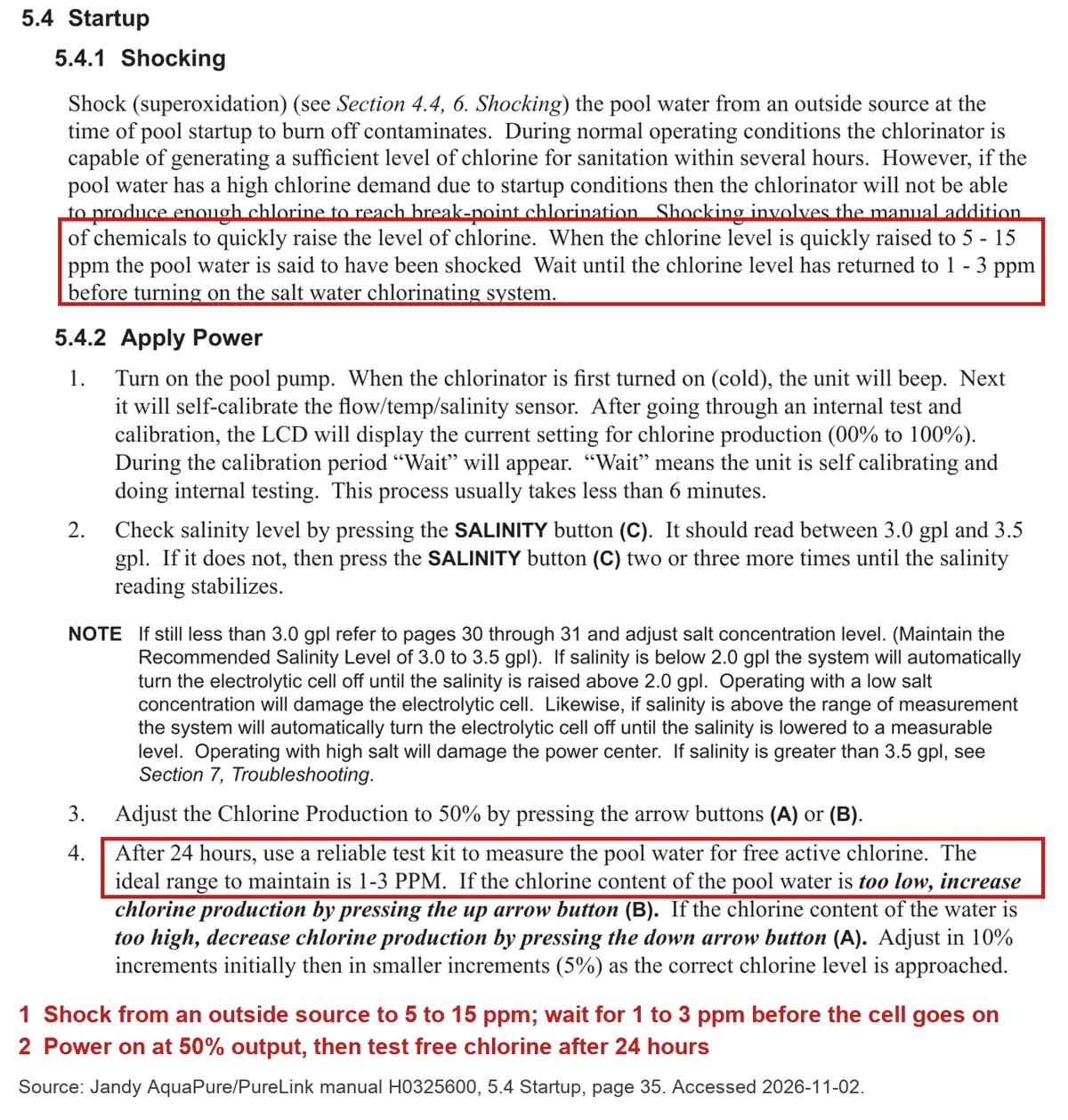
CircuPool CORE also cuts output to 45% below 68F and 15% below 59F.
Source: Hayward AquaRite 900 manual Rev D; Jandy AquaPure manual H0325600; Pentair IntelliChlor LT/Plus manual 523854; CircuPool CORE manual; Aiper (accessed 2026-11-02). Download chart data (CSV)
Several guides get the cold cutoff wrong. Aiper says most cells need 60F or warmer, but the manuals we read stop production at 50F (Hayward), 51F (Jandy), 52F plus or minus 3F (Pentair) and 53F (CircuPool). The practical effect is the same in April: a cell in 55F water may run, but at low output, so chlorinate by hand until the water warms.
Test salt before adding any. Hayward’s manuals say salt does not evaporate and is lost mainly to splash-out, backwashing and rain dilution, so a winter of snowmelt can pull it down. Each 100 ppm takes 8.34 lb per 10,000 gallons; target ranges by model are in our salt water pool maintenance guide.
When can the heater go on? Only with water flowing. The Pentair Max-E-Therm manual says a heater drained for winter must not be turned on until the system circulates, and that when starting the season with water below 50F it should run continuously until the water reaches its 68F minimum setting, because running below 68F causes harmful condensation. The Hayward heat pump manual lists water operating limits of 40F to 104F and air limits of 40F to 115F.
What if the pool is green, a swamp or leaking when you open it?
Match what you see to a row. Green water with the floor visible takes a 10 ppm shock and steady filtering; a floor you cannot see takes the severe-bloom label dose and floc. A water level far below where you left it calls for a 24 hour bucket test, and equipment drips need a check before the pump runs.
| If your situation is | Do this | Source |
|---|---|---|
| Water clear or slightly hazy, floor visible | Circulate 12 to 24 hours, balance, shock to 5 to 10 ppm, filter 24 hours | HTH; Fixr; Hasachlor label; Swim University |
| Water green, floor visible | Brush, shock to 10 ppm (100 fl oz of 12.5% per 10,000 gal), filter nonstop, retest daily | Hasachlor label; our green pool guide |
| Floor not visible (swamp) | Severe-bloom label dose: 2.6 lb of 52% cal-hypo per 10,000 gal (about 16 ppm), then floc and vacuum to waste | EPA label 1258-1250; our green pool guide |
| Clear water turns teal or green right after shocking | Test copper before adding more chlorine | EPA secondary standard: copper above 1.0 mg/L stains blue-green |
| Yellow dust in shade that brushes off and returns | Treat as mustard algae with a labeled algaecide | Our mustard algae guide |
| Water far below the level you left at closing | Run a 24 hour bucket test with the pump and autofill off | EPA WaterSense (2022); our leak detection guide |
| Cracked fitting or drip at the equipment pad | Shut the pump off and have the plumbing checked before running it | Pentair Five Tips for Opening Your Pool |
| Pump runs but will not prime | Fill the pot, reseat the lid O-ring, raise water to mid-skimmer; Hayward allows up to 10 minutes | Hayward Super Pump manual; our priming guide |
| Filter gauge reads far outside 8 to 25 psi | Check the skimmer door and lid O-ring, then have the gauge or filter checked | Pentair Five Tips for Opening Your Pool |
| Salt cell shows a cold-water or no-output light | Water is under the 50F to 53F cutoffs; chlorinate by hand until it warms | Hayward, Jandy, Pentair, CircuPool manuals |
| Pool sits in a no-freeze climate (Miami, Phoenix, Los Angeles) | Keep it running all year; there is nothing to open | NOAA 1991-2020 normals; our winterizing guide |
Sources: Hasachlor label; EPA label 1258-1250; EPA secondary drinking water standards; EPA WaterSense pool guide (2022); Pentair; Hayward Super Pump manual; Fixr; NOAA. Download CSV
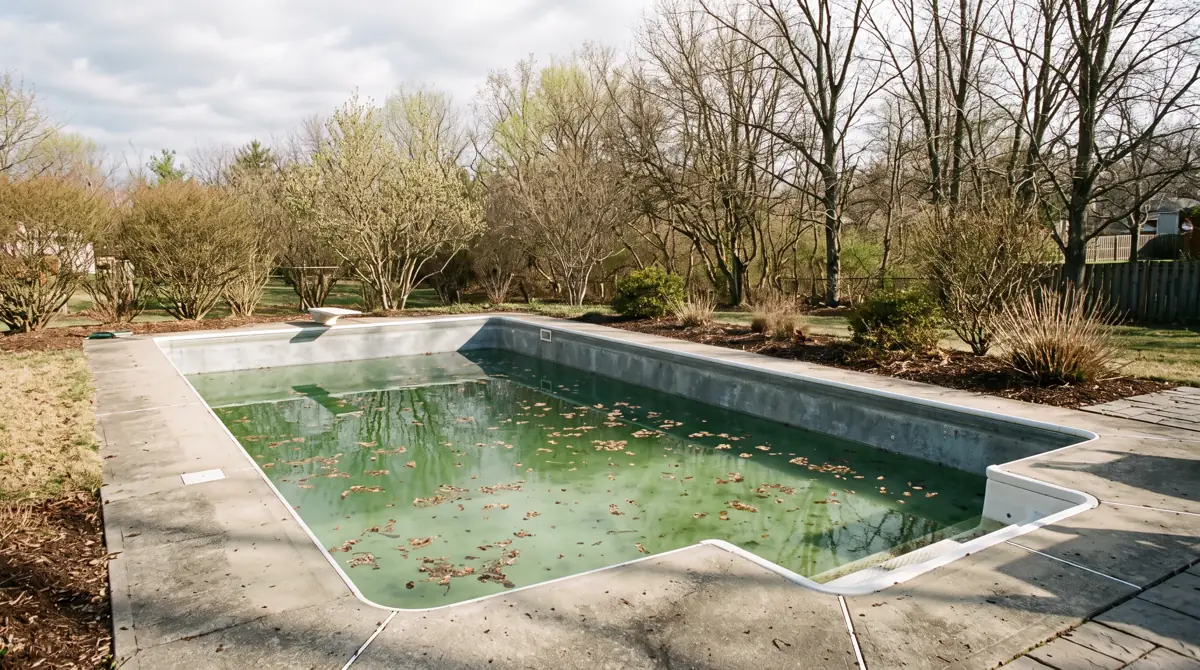
A green opening is common under mesh covers, which let sunlight and fine debris through. Fixr prices mesh-cover openings at $300 to $450 against $250 to $400 for solid covers for that reason. Doses for every bloom level, the cyanuric acid ratio and when draining is cheaper are in our guide on how to clear a green pool. Whether that $50 a year outweighs a solid cover’s pump and shorter life is worked out in our mesh vs solid pool cover guide.
Some water loss over winter is evaporation and splash from the cover pump, but a drop far below your closing level is worth testing. The EPA WaterSense pool guide describes the 24 hour bucket test; the pump-on and pump-off version that separates plumbing from shell leaks is in our pool leak detection guide.
How much does it cost to open a pool?
A professional opening runs $200 to $400 a visit in Angi’s 2026 data and $200 to $500 at Swim University (March 2026), with above-ground pools at $175 to $250 and concrete pools at $300 to $500. Fixr’s January 2025 average is $300. Doing it yourself costs $50 to $150 in chemicals and supplies.
| Source (date) | What is priced | Price | Notes |
|---|---|---|---|
| Angi (2026 data, archived Sep 27, 2026) | Seasonal opening or closing service | $200 to $400 per visit | National |
| Swim University (updated Mar 31, 2026) | Professional opening | $200 to $500 | Above ground $175 to $250; inground $250 to $500; concrete and gunite $300 to $500 |
| Swim University (updated Mar 31, 2026) | Do-it-yourself chemicals and supplies | $50 to $150 | $30 to $60 if restocking only |
| Fixr (updated Jan 31, 2025) | Full opening, national | $250 to $350; average $300 | Low $175 (partial above ground), high $500 |
| Fixr (updated Jan 31, 2025) | By cover type | Solid $250 to $400; mesh $300 to $450 | Mesh pools need more vacuuming and chemicals |
| Fixr (updated Jan 31, 2025) | Opening plus closing | $450 to $650 a year | Closing $200 to $300 |
| Swimply (2026 guide) | Professional spring opening | $200 to $500 | DIY supplies $50 to $150 |
| Aiper (accessed Nov 2026) | Standard opening by a pool company | $300 to $600 | Chemicals $50 to $100 |
Sources: Angi (archived Sep 27, 2026); Swim University (Mar 31, 2026); Fixr (Jan 31, 2025); Swimply (2026); Aiper. Accessed 2026-11-02. Download CSV
What moves the price: pool type (Swim University puts concrete and gunite at the top because they take more labor to clean), cover type (mesh adds $50 at both ends of Fixr’s range) and water condition. Fixr counts cover pumping, removal, rinsing and storage in a full-service opening; a partial above-ground opening with equipment installation and chemical testing is its $175 low end. The closing side for above ground pools, from the winter water level to the air pillow, is in our guide on how to close an above ground pool.
| Item (20,000 gal, after a partial refill) | Quantity | Arithmetic | Cost | Price source |
|---|---|---|---|---|
| 73% cal-hypo shock to 10 ppm | 36.6 oz (2.29 lb), so 3 x 1 lb bags | 18.29 oz x 2 | $26.97 | Leslie's 1 lb bag at $8.99 (July 2026 listing) |
| Stabilizer, 0 to 30 ppm | 5 lb | 2.5 lb x 2 (label rate per 10,000 gal) | $34.37 (share of an 8 lb tub) | Leslie's 8 lb tub at $54.99 (Sept 2026 listing) |
| Total for these two items | 26.97 + 34.37 | $61.34 | Baking soda, acid and calcium not priced here |
Sources: Leslie’s 1 lb 73% cal-hypo listing (Wayback, July 19, 2026); Leslie’s 8 lb stabilizer listing (Wayback, Sept 16, 2026); HTH Granular 73 label; PC&S arithmetic. Download CSV
In warm-climate metros the opening is folded into weekly service instead. Our pool service cost survey found a median of $160 a month for weekly full service across 71 published company prices in 20 metros in October 2026.
How long does it take to open a pool?
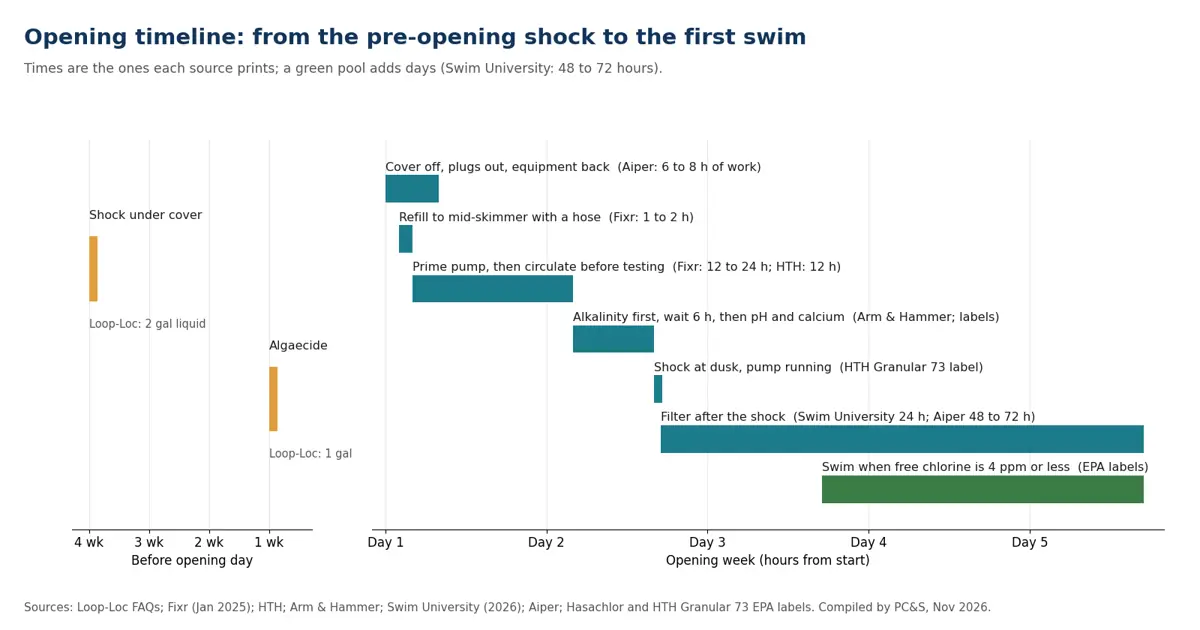
A pool that was closed clean can be swim-ready in as little as 8 hours, Swim University says, but most openings take 2 to 4 days because the water has to circulate 12 to 24 hours before testing and filter 24 to 72 hours after the shock. A pool opened green takes 48 to 72 hours or more.
| Stage | Time | Source |
|---|---|---|
| Shock under the cover before opening | At least 4 weeks ahead (beginning of April) | Loop-Loc FAQs |
| Algaecide under the cover | 1 week ahead | Loop-Loc FAQs |
| Hands-on work: cover, plugs, equipment, cleaning | About 6 to 8 hours | Aiper example routine |
| Raise water with a garden hose | 1 to 2 hours for 6 to 18 inches | Fixr |
| Prime the pump | Up to 10 minutes (Hayward Super Pump) | Hayward Super Pump manual |
| Circulate before testing | 12 to 24 hours | Fixr; HTH (12 hours) |
| Wait after baking soda before retesting | At least 6 hours | Arm & Hammer; FROG |
| Filter after the shock | 24 hours (Swim University) to 48 to 72 hours (Aiper) | Swim University; Aiper |
| Salt cell first check | 24 hours after power-on at 50% | Jandy AquaPure manual |
| Clean, well-closed pool to swim-ready | As little as 8 hours | Swim University |
| Pool opened green | 48 to 72 hours | Swim University |
Sources: Loop-Loc FAQs; Aiper; Fixr; HTH; Hayward Super Pump manual; Arm & Hammer; Swim University; Swim University cost guide; Jandy AquaPure manual. Download CSV
The hands-on part is short. Aiper‘s example routine puts active work at about 6 to 8 hours over a weekend, and Fixr says a garden hose raises the level 6 to 18 inches in 1 to 2 hours. The waiting is chemistry: alkalinity needs at least 6 hours before a retest (Arm & Hammer), and a salt cell needs 24 hours at 50% before its first chlorine check (Jandy).
| Number | What it means | Source |
|---|---|---|
| 70F daytime highs | Open when the outside daytime temperature stays above this | Swim University (updated Apr 8, 2026) |
| 60F | Loop-Loc adds algaecide and sanitizer once temperatures of 60F or higher hold | Loop-Loc winter care article |
| Middle of the skimmer opening | Water level for normal operation | 2024 MAHC 5.7.1.4.3; Pentair |
| 5 to 10 ppm | Spring start-up superchlorination on the Hasachlor label (50 to 100 fl oz per 10,000 gal) | EPA Reg. No. 10897-26 |
| 4 ppm | Highest free chlorine at which the labels allow swimming | Hasachlor; HTH Granular 73 |
| 50F to 53F | Water temperature below which four salt chlorinators stop making chlorine | Hayward, Jandy, Pentair, CircuPool manuals |
| 68F | Minimum Pentair Max-E-Therm setting; heat continuously from a cold start until reached | Pentair Max-E-Therm manual |
| $200 to $400 | Professional opening or closing visit | Angi (2026 data) |
Sources: Swim University; Loop-Loc; 2024 MAHC; Hasachlor label; HTH Granular 73 label; maker manuals; Angi. Download CSV
How we compiled this
We read 23 primary documents in October and November 2026: 4 EPA-registered chlorine labels, 8 equipment manuals from Hayward, Pentair, Jandy and CircuPool, the 2024 MAHC and its Annex, the Virginia Department of Health operator guide, the EPA WaterSense pool guide and EPA’s secondary standards, 3 Loop-Loc and Meyco cover care pages, Pentair’s opening tips, the Knorr Systems dosing chart and NOAA NCEI 1991-2020 normals for 20 airport stations, which we processed ourselves. A few were read through saved copies in our sibling guides. Prices come from Angi, Swim University, Fixr, Swimply, Aiper and dated Leslie’s listings. We did not open any pools or test products, and we left out forum posts.
Frequently Asked Questions
When should I open my pool?
When daytime highs stay above 70F, or a few weeks earlier with a pre-opening shock. NOAA 1991-2020 normals put the first 70F normal high at Feb 26 in Houston, Apr 1 in Atlanta, Apr 30 in Philadelphia, May 15 in Chicago and May 29 in Boston. Loop-Loc adds chlorine and algaecide once 60F temperatures hold, about a month before opening.
What chemicals do I need to open my pool?
Test first, then buy only what the test calls for: baking soda for alkalinity (1.4 lb per 10 ppm per 10,000 gallons), muriatic acid for pH, calcium chloride for hardness, stabilizer for cyanuric acid and chlorine shock. The Hasachlor label sets spring start-up at 50 to 100 fl oz of 12.5% liquid chlorine per 10,000 gallons.
What order do you add chemicals when opening a pool?
Total alkalinity first, then pH, then calcium hardness, then stabilizer, then shock. Wait at least 6 hours after baking soda before retesting (Arm & Hammer), keep calcium chloride hours away from baking soda or soda ash so the water does not cloud (Taylor Technologies), and shock at dusk with the pump running.
How much does it cost to open a pool?
A professional opening costs $200 to $400 a visit in Angi’s 2026 data and $200 to $500 at Swim University (March 2026), from $175 for an above-ground pool to $500 for concrete. Fixr’s average is $300 (January 2025). Doing it yourself costs $50 to $150 in chemicals and supplies, more if the pool opens green.
How long does it take to open a pool?
As little as 8 hours for a pool closed clean (Swim University), but usually 2 to 4 days. Water should circulate 12 to 24 hours before a full test (HTH; Fixr), alkalinity needs 6 hours before a retest, and the filter should run at least 24 hours after the shock. A pool that opens green takes 48 to 72 hours or longer.
How do you open a salt water pool?
Open it like a chlorine pool, but keep the cell off until the water is balanced. Jandy says to shock from an outside source to 5 to 15 ppm and wait for 1 to 3 ppm before powering the cell at 50%. Test salt before adding any: 8.34 lb raises 10,000 gallons by 100 ppm. Most cells stop working below 50F to 53F.
Should you shock a pool when you first open it?
Yes, after the water has circulated and the alkalinity and pH are set. The Hasachlor and Comal labels list spring start-up at 5 to 10 ppm free chlorine, and Jandy’s manual uses 5 to 15 ppm before a salt cell goes on. Swim only when free chlorine falls to 4 ppm or less, the limit on the labels.
Sources
- NOAA National Centers for Environmental Information. U.S. Climate Normals 1991-2020 (daily and annual/seasonal station files). Accessed 2026-11-02.
- Loop-Loc. FAQs (cover storage, pre-opening chemicals, water levels). Accessed 2026-11-02.
- Loop-Loc. How to care for and maintain your safety pool cover over the winter months. Accessed 2026-11-02.
- Meyco. Seasonal Cover Care. Accessed 2026-11-02.
- Pentair. Five Tips for Opening Your Pool. Accessed 2026-11-02.
- Pentair. IntelliFlo3 VSF Installation and Maintenance Guide (priming, water level). Accessed 2026-10-27.
- CDC. 2024 Model Aquatic Health Code, 5th Edition, Code Language. Accessed 2026-10-27.
- CDC. 2024 Model Aquatic Health Code, 5th Edition, Annex. Accessed 2026-10-27.
- Knorr Systems. Chemical Dosing Charts. Accessed 2026-11-02.
- Virginia Department of Health. Pool Operation and Maintenance Guide (Portsmouth Health Department, 2018). Accessed 2026-10-08.
- Hasa, Inc. via EPA PPLS. Hasachlor 12.5% sodium hypochlorite label, EPA Reg. No. 10897-26. Accessed 2026-11-02.
- Comal Chemical via EPA PPLS. Sodium Hypochlorite 12.5% label, EPA Reg. No. 103607-1. Accessed 2026-10-19.
- Innovative Water Care via EPA PPLS. HTH Granular 73 label, EPA Reg. No. 1258-1239. Accessed 2026-11-02.
- EPA PPLS. Calcium hypochlorite label, EPA Reg. No. 1258-1250. Accessed 2026-10-27.
- Hayward. AquaRite 900 owner's manual, Rev D. Accessed 2026-11-02.
- Pentair. IntelliChlor LT/Plus salt chlorine generator manual (P/N 523854). Accessed 2026-11-02.
- Jandy (Zodiac). AquaPure/PureLink Power Center and Cell Kit manual H0325600. Accessed 2026-11-02.
- CircuPool. CORE Series salt chlorinator manual. Accessed 2026-11-02.
- Pentair. Max-E-Therm Pool and Spa Heater Installation and User's Guide. Accessed 2026-11-02.
- Hayward. Heat pump owner's manual 51300122601 Rev C. Accessed 2026-11-02.
- Hayward. Super Pump owner's manual 1017836 Rev A. Accessed 2026-10-27.
- CDC. Home Pool and Hot Tub Water Treatment and Testing. Accessed 2026-10-27.
- U.S. EPA. Jump Into Pool Water Efficiency (WaterSense outdoor pool guide, 2022). Accessed 2026-11-02.
- U.S. EPA. Secondary Drinking Water Standards: Guidance for Nuisance Chemicals. Accessed 2026-10-27.
- Taylor Technologies. Understanding and Managing Calcium Hardness in Pool & Spa Water. Accessed 2026-10-26.
- Arm & Hammer. How to Use Baking Soda for Pool Maintenance. Accessed 2026-10-27.
- Leslie's. Winterizing an Inground Pool: a How-To Guide. Accessed 2026-10-19.
- In The Swim. Swimming Pool Antifreeze FAQ. Accessed 2026-10-19.
- In The Swim. Don't Close Your Pool Green!. Accessed 2026-10-19.
- Swim University. When To Open Your Pool in 2026 (updated Apr 8, 2026). Accessed 2026-11-02.
- Swim University. How Much Does It Cost to Open a Swimming Pool in 2026? (updated Mar 31, 2026). Accessed 2026-11-02.
- Swim University. How to Open an Inground Pool in 13 Steps (updated Apr 8, 2026). Accessed 2026-11-02.
- Fixr. How much does it cost to open a pool? (updated Jan 31, 2025). Accessed 2026-11-02.
- Angi. How Much Does Pool Maintenance Cost? [2026 Data] (Wayback capture Sep 27, 2026). Accessed 2026-10-19.
- Swimply. Swimming Pool Service Cost in 2026: Full Price Guide. Accessed 2026-10-08.
- Aiper. How to Open a Pool. Accessed 2026-11-02.
- HTH Pools. How to: Open Your Pool and Turn it Blue. Accessed 2026-11-02.
- Leslie's. Leslie's Power Powder Plus 73% cal-hypo, 1 lb (Wayback capture July 19, 2026). Accessed 2026-10-19.
- Leslie's. Leslie's Pool Stabilizer, 8 lb (Wayback capture Sept 16, 2026). Accessed 2026-10-19.
Related pages
Get Quotes From Licensed Local Pool Pros
Tell us what you need and your ZIP code. We match you with pool companies that cover your area.