Hot Tub Chemicals: Starter List, Maker Rules, Doses and Yearly Cost
Hot tub chemicals start with one sanitizer, test strips, pH up and down, alkalinity up and non-chlorine shock. All 7 maker manuals we read reject trichlor, and a 400 gallon tub runs about $376 to $474 a year.
- ✓7 makers' rulesJacuzzi, Sundance, Hot Spring, Caldera, Bullfrog, Master Spas and Hydropool manuals compared chemical by chemical.
- ✓EPA label dosesDichlor 1/2 tsp per 100 gal (EPA Reg. No. 5185-441); one bromine floater per 350 gal (6836-317).
- ✓Dated cost table$376.34 to $474.37 a year on dichlor, $399.98 to $584.89 on bromine, from Sept to Nov 2026 prices.
Key takeaways
- CDC sets hot tub targets of at least 3 ppm free chlorine or 4 to 8 ppm bromine and a pH of 7.0 to 7.8.
- All 7 owner’s manuals we read ban or advise against trichlor tablets; Jacuzzi and Sundance say trichlor or acid voids the warranty.
- Hot Spring and Caldera also ban BCDMH bromine tablets and any compressed bromine or chlorine, the same chemical sold as EPA Reg. No. 6836-317.
- The BioGuard dichlor label (EPA Reg. No. 5185-441) doses 1/2 teaspoon per 100 gallons, repeated every 15 to 20 minutes until chlorine reads 3 to 5 ppm.
- In our 400 gallon budget, weekly non-chlorine shock ($125.12 to $150.75 a year) costs more than the dichlor itself ($79.80 to $138.00).
- A dichlor SDS lists calcium hypochlorite and acids as incompatible, and a bromine tablet SDS says never mix spa chemicals in concentrated form.
What chemicals do you need for a hot tub?
Ten items cover a new owner: a sanitizer, a way to test, pH up, pH down, alkalinity up, calcium increaser, non-chlorine shock, a metal sequestrant, filter cleaner and, optionally, defoamer or enzyme. The sanitizer is the only one that kills germs; the rest keep it working and protect the shell, heater and filter. The list below shows what each does and what the manuals say. The metal sequestrant earns its place when copper or iron tints the water, the clear-green case in our green hot tub water guide.
| Item | What it does | What the manuals say | Example price (date) |
|---|---|---|---|
| Sanitizer: dichlor granules or bromine | Kills germs; CDC sets at least 3 ppm chlorine or 4 to 8 ppm bromine | Dichlor is the one chlorine Master Spas approves; Hot Spring and Caldera ban BCDMH bromine tablets | Dichlor 2 lb $19.95 to $36.95; bromine tabs 1.5 lb $30.99 to $37.95 (Oct 26 to Nov 8, 2026) |
| Test strips or a liquid DPD kit | Reads sanitizer, pH, alkalinity and hardness | Test 3 times a week (Master Spas); 2 to 3 times a week for 0 to 3 uses (Bullfrog) | AquaChek 6-in-1, 50 strips, $13.99 (Nov 8, 2026) |
| pH increaser (sodium carbonate) | Raises pH toward 7.2 to 7.8 | Hot Spring, Caldera, Bullfrog and Hydropool name a pH increaser | SpaGuard pH Increaser 18 oz $8.99 (Nov 8, 2026) |
| pH decreaser (sodium bisulfate) | Lowers pH and alkalinity | Bullfrog: never muriatic acid; Jacuzzi and Sundance: never add acid | SpaGuard pH Decreaser 22 oz $9.99 (Nov 8, 2026) |
| Alkalinity increaser (sodium bicarbonate) | Raises total alkalinity, the pH buffer | Hot Spring and Caldera: set alkalinity first, to 80 ppm | Alkalinity Up 10 lb $29.99 (Sept 2026) |
| Calcium hardness increaser | Raises hardness when fill water is soft | Targets run 75 to 150 ppm (Hot Spring) to 180 to 250 ppm (Master Spas) | Liquid Calcium 1 qt $11.95 (Nov 8, 2026) |
| Non-chlorine shock (potassium monopersulfate, MPS) | Oxidizes sweat, oils and combined chlorine; not a sanitizer | Weekly shock: Master Spas, Bullfrog; Hot Spring: 4 tbsp per 250 gal | SpaBoss Shock 2 lb $22.00; SpaGuard 35 oz $28.99 (Nov 8, 2026) |
| Metal sequestrant (stain and scale control) | Holds iron, copper and calcium in solution | Add at every fill: Master Spas, Hydropool, Bullfrog | SpaBoss Prevent II 32 oz $19.00 (Nov 8, 2026) |
| Defoamer and enzyme (optional) | Defoamer knocks foam down; enzymes digest oils and scum | Master Spas: overuse of defoamer makes cloudy, milky water | SpaBoss Defoamer $10.95; Descummer $10.95 (Nov 8, 2026) |
| Filter cleaner | Degreases the cartridge | Monthly overnight soak (Master Spas) | Cartridge cleaner 32 oz $14.79 (Nov 8, 2026); FreshWater 2.7 lb $28.99 (Nov 1, 2026) |
Sources: CDC; owner’s manuals listed below; prices from Master Spa Parts, the Bullfrog Spas shop, Spa Depot, Leisure Time and Leslie’s via PC&S research. Prices accessed Sept 16 to Nov 8, 2026. Download CSV
Order matters more than brand. Hot Spring tells owners to set total alkalinity to 80 ppm first, then calcium, then pH 7.4 to 7.8, because out-of-balance alkalinity keeps the pH from holding and the sanitizer from working. Master Spas adds a sequestering agent while the tub fills and waits at least 30 minutes before anything else goes in.
| Number | Value | Source |
|---|---|---|
| Chlorine target, hot tubs | At least 3 ppm | CDC |
| Bromine target, hot tubs | 4 to 8 ppm | CDC |
| pH target | 7.0 to 7.8 (CDC); 7.4 to 7.6 (Jacuzzi, Sundance, Bullfrog) | CDC; owner's manuals |
| Manuals that ban or advise against trichlor | 7 of 7 | PC&S review of 7 manuals |
| Manuals that ban BCDMH bromine tablets | 2 of 7 (Hot Spring, Caldera) | Hot Spring 2026; Caldera 2025 |
| Wait after a shock before closing the cover | 15 minutes (Master Spas) to 20 minutes (Hot Spring) | Owner's manuals |
| Yearly supplies, 400 gal, dichlor program | $376.34 to $474.37 | PC&S arithmetic, Oct and Nov 2026 prices |
Sources: CDC; owner’s manuals of Jacuzzi, Sundance, Hot Spring, Caldera, Bullfrog, Master Spas and Hydropool; PC&S arithmetic from Sept to Nov 2026 listings. Download CSV
Which hot tub chemicals do makers require or ban?
Every manual we read rejects trichlor, and most reject acid in the tub. The split is bromine: Hot Spring and Caldera ban BCDMH tablets outright, Bullfrog allows them only in a feeder, Master Spas bars them with EcoPur filters and Comfort Floor mats, and Hydropool uses them in a dispenser. Jacuzzi and Sundance rule out sodium bromide with their UV and ozone systems.
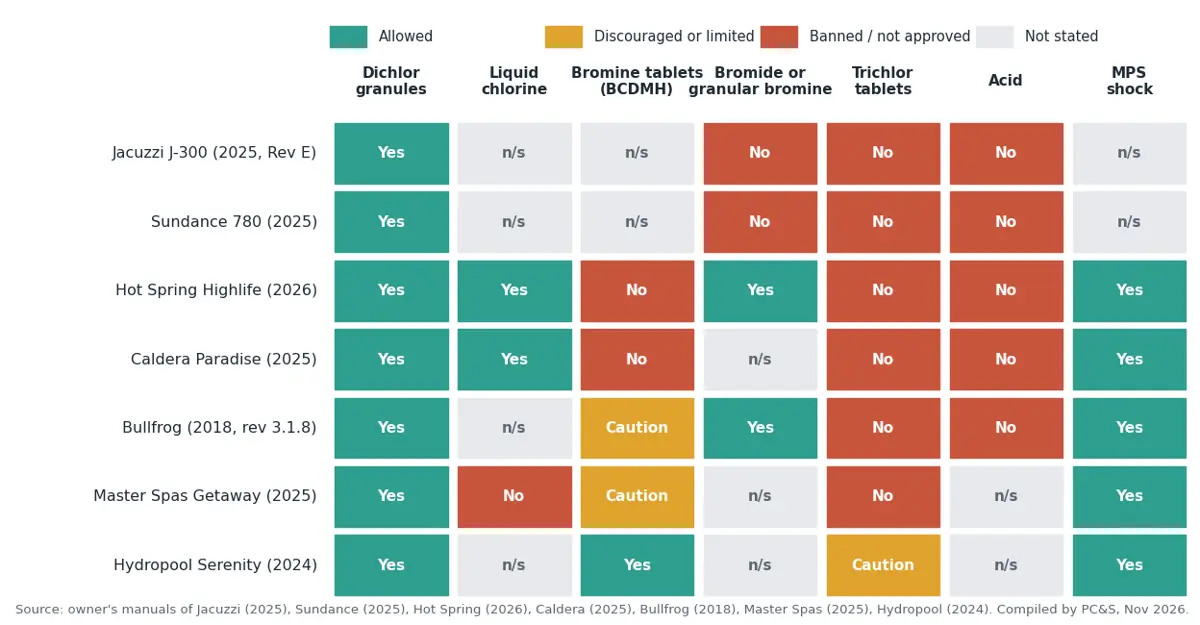
| Manual | Dichlor granules | Liquid chlorine | Bromine tablets (BCDMH) | Bromide or granular bromine | Trichlor tablets | Acid (muriatic or other) | MPS shock | Required or recommended add-ons | Chlorine target |
|---|---|---|---|---|---|---|---|---|---|
| Jacuzzi J-300 (2025, Rev E) | Allowed: 2.5 oz per 100 gal start-up dose | Not stated | Not stated | Not with UV, ozone or a chlorine generator | Banned: voids warranty | Banned: voids warranty | Not stated | Never fill from a water softener; half hard, half softened if very hard | 0.5 to 1.0 ppm with FROG @ease |
| Sundance 780 (2025) | Allowed: 2.5 oz per 100 gal start-up dose | Not stated | Not stated | Not with UV, ozone or a chlorine generator | Banned: voids warranty | Banned: voids warranty | Not stated | Calcium 150 to 250 ppm | 3.0 to 4.0 ppm (1.0 with ClearRay) |
| Hot Spring Highlife (2026) | Recommended | Allowed | Banned: compressed bromine not covered by warranty | Granular brominating concentrate allowed | Banned | Banned | Allowed | Alkalinity to 80 ppm, calcium 75 to 150 ppm; stain and scale control for hard water | 3 to 5 ppm |
| Caldera Paradise (2025) | Recommended | Allowed (not splashless) | Banned | Not stated | Banned | Banned | Allowed | Alkalinity to 80 ppm, calcium 75 to 150 ppm | 3 to 5 ppm |
| Bullfrog (2018, rev 3.1.8) | Recommended | Not stated | Discouraged unless a feeder is used | Granular bromine allowed | Banned: voids warranty | Muriatic acid banned | Allowed | Stain and scale inhibitor at fill; alkalinity 125 to 150 ppm | 3.0 to 5.0 ppm |
| Master Spas Getaway (2025) | The only chlorine approved | Not approved | Allowed, except with EcoPur filters or Comfort Floor mats | Not stated | Not approved | Not stated | Allowed | Sequestering agent at every fill; never over 50% softened water; spa chemicals only | 2 to 4 ppm |
| Hydropool Serenity (2024) | Allowed | Not stated | Allowed in a dispenser | Not stated | Not recommended; may void warranty | Not stated | Shock or oxidizer at fill | Sequesterant at fill; hydrogen peroxide products may void warranty | 3.0 to 5.0 ppm |
Sources: Jacuzzi J-300 2025; Sundance 780 2025; Hot Spring Highlife 2026; Caldera Paradise 2025; Bullfrog 2018; Master Spas Getaway 2025; Hydropool Serenity 2024. Accessed Nov 8, 2026. Download CSV
The warranty language is blunt. Hot Spring says a compressed bromine or chlorine product or an unapproved sanitizer will damage the spa and is not covered, and calls cover damage from trapped shock gas chemical abuse. Bullfrog says trichlor tablets void its warranty, citing their dissolve rate, potency and low pH. Hydropool reserves the right to void its warranty if products containing hydrogen peroxide are used.
Jacuzzi's low range applies only with the FROG @ease mineral system; CDC's general hot tub page sets at least 3 ppm.
Source: Owner's manuals of Jacuzzi (2025), Master Spas (2025), Sundance (2025), Hot Spring (2026), Caldera (2025), Bullfrog (2018), Hydropool (2024); CDC Legionella hot tub toolkit. Accessed Nov 8, 2026. Download chart data (CSV)
Targets differ because the systems differ. Jacuzzi prints 0.5 to 1.0 ppm free chlorine for tubs on the FROG @ease mineral system, and Sundance drops to no less than 1.0 ppm with its ClearRay UV running, against 3.0 to 4.0 ppm without it. With plain dichlor, the CDC Legionella toolkit range of 3 to 10 ppm is the safer floor. Salt cells are a separate program, compared in our salt water hot tub guide.
Which hot tub sanitizers are EPA registered, and what do the labels say?
Dichlor and bromine sanitizers are registered pesticides, so the label is the legal dose. Four spa labels on the EPA’s PPLS database were active in October 2026: BioGuard dichlor 5185-441, RWP dichlor 67262-1, Dantoin BCDMH 6836-317 and Dantobrom S 6836-116. Non-chlorine shock carries no sanitizer registration; its own label says use an EPA-registered product to disinfect.
| Product (label date) | EPA Reg. No. | Active ingredient | Spa dose on the label | Entry and drain rules on the label |
|---|---|---|---|---|
| BioGuard Master Dichloro Dihydrate (May 22, 2024) | 5185-441 | 99.0% sodium dichloro-s-triazinetrione dihydrate | 1/2 tsp per 100 gal, repeat every 15 to 20 min to 3 to 5 ppm; shock 1 tsp per 100 gal | No entry above 5 ppm; do not add stabilizer to brominated water |
| RWP Master Dihydrate Granular (July 8, 2019) | 67262-1 | 99.0% dichlor dihydrate, 55% available chlorine | 1/2 tsp per 100 gal, repeat at 15 to 20 min to 3 to 5 ppm | Same spa directions as 5185-441 |
| Dantoin BCDMH-RW Tablets (May 22, 2026) | 6836-317 | 97.70% BCDMH | One floating dispenser per 350 gal; residential spas 2 to 4 ppm; superoxidize to 10 to 20 ppm | No entry until bromine is below 6 ppm; drain every 60 days; do not heat above 102 F |
| Dantobrom S (May 28, 2026) | 6836-116 | Bromine feeder product, 141% halogen as bromine | 1/2 oz sodium bromide per 100 gal at first use and each refill (30 ppm bromide); 2 to 4 ppm | Change water at least every 30 days; no other chemicals in the feeder (fire or explosion) |
| Non-chlorine shock (SpaBoss Shock, MPS) | None printed | Potassium monopersulfate | 3 1/2 oz per 400 gal after each use | Label: not a sanitizer; use an EPA-registered product for disinfection |
Sources: EPA label files 5185-441, 67262-1, 6836-317, 6836-116; EPA PPLS status (accessed Oct 26, 2026); SpaBoss Shock listing (Nov 8, 2026). Download CSV
Federal law backs the label. The U.S. International Trade Commission notes that trichlor and dichlor sold for pool and spa use must be registered with the EPA, and each label states it is a violation of federal law to use the product in a manner inconsistent with its labeling. Our guide to chlorine vs bromine compares these same labels on pH effect, stabilizer buildup and monthly cost.
How much of each chemical does a 300, 400 or 500 gallon tub need?
Scale every label rate by your tub’s gallons. Dichlor runs 1.5, 2 and 2.5 teaspoons per routine dose in 300, 400 and 500 gallons on EPA label 5185-441. Sodium bromide takes 1.5, 2 and 2.5 ounces at each fill. Non-chlorine shock runs 2.6, 3.5 and 4.4 ounces. Find your gallons on the spec sheet before dosing.
| Chemical and label rate | 300 gal | 400 gal | 500 gal | Source |
|---|---|---|---|---|
| Dichlor, routine dose (1/2 tsp per 100 gal) | 1.5 tsp | 2 tsp | 2.5 tsp | EPA labels 5185-441, 67262-1 |
| Dichlor, weekly shock (1 tsp per 100 gal) | 3 tsp | 4 tsp | 5 tsp | EPA label 5185-441 |
| Dichlor, start-up decontamination (2.5 oz per 100 gal) | 7.5 oz | 10 oz | 12.5 oz | Jacuzzi 2025; Sundance 2025 |
| Dichlor super-chlorination (1.5 tsp per 250 gal) | 1.8 tsp | 2.4 tsp | 3 tsp | Hot Spring 2026; Caldera 2025 |
| Sodium bromide at each fill (1/2 oz per 100 gal) | 1.5 oz | 2 oz | 2.5 oz | EPA label 6836-116 |
| Bromine floating dispensers (1 per 350 gal) | 1 | 2 | 2 | EPA label 6836-317 |
| MPS shock (3 1/2 oz per 400 gal) | 2.62 oz | 3.5 oz | 4.38 oz | SpaBoss Shock label |
| MPS shock (4 tbsp per 250 gal) | 4.8 tbsp | 6.4 tbsp | 8 tbsp | Hot Spring 2026; Caldera 2025 |
| pH decreaser at pH 7.8 to 8.0 (1 oz per 250 gal) | 1.2 oz | 1.6 oz | 2 oz | SpaBoss pH Minus label |
| pH increaser (1 oz per 250 gal) | 1.2 oz | 1.6 oz | 2 oz | SpaBoss pH Plus label |
| Baking soda, +10 ppm alkalinity (0.22 oz per 100 gal) | 0.67 oz | 0.9 oz | 1.12 oz | PC&S alkalinity arithmetic |
| Stain and scale, at fill (4 oz per 500 gal) | 2.4 oz | 3.2 oz | 4 oz | SpaBoss Prevent II label |
| Stain and scale, weekly (2 oz per 500 gal) | 1.2 oz | 1.6 oz | 2 oz | SpaBoss Prevent II label |
| Enzyme, weekly (2 oz per 250 gal) | 2.4 oz | 3.2 oz | 4 oz | SpaBoss Descummer label |
Sources: EPA labels 5185-441, 67262-1, 6836-317, 6836-116; Jacuzzi 2025; Sundance 2025; Hot Spring 2026; SpaBoss labels at Master Spa Parts (Nov 8, 2026); baking soda rate from our hot tub alkalinity guide. PC&S scaling. Download CSV
The start-up dose is not a soak dose. The worked example below converts the 2.5 ounce per 100 gallon decontamination dose in the Jacuzzi and Sundance manuals into parts per million for a 400 gallon tub.
| Step | Arithmetic | Result |
|---|---|---|
| 1. Water weight, 400 gal | 400 x 8.34 lb | 3,336 lb (53,376 oz) |
| 2. Dichlor start-up dose, Jacuzzi and Sundance | 2.5 oz x 4 (hundreds of gallons) | 10 oz, matching Jacuzzi's J-355 and Sundance's Chelsee row |
| 3. Chlorine in that dose (55% available) | 10 oz x 0.55 | 5.5 oz of available chlorine |
| 4. Concentration | 5.5 / 53,376 x 1,000,000 | 103 ppm, a decontamination level, not a soak level |
| 5. Why the tub is drained afterward | 103 ppm vs the 5 ppm entry limit on label 5185-441 | Jacuzzi runs it 1 hour with the cover open, then drains and refills |
| 6. Weekly MPS shock for a year, 400 gal | 3.5 oz x 52 | 182 oz, about 11.4 lb |
| 7. MPS cost per year | 182 / 32 x $22.00 to 182 x $28.99 / 35 | $125.12 to $150.75 |
Inputs: Jacuzzi J-300 2025 and Sundance 780 2025 dose tables; 55% available chlorine from EPA label 67262-1; 5 ppm entry limit from EPA label 5185-441; SpaBoss and SpaGuard prices Nov 8, 2026. PC&S arithmetic. Download CSV
Gallons decide every row, and hot tub spec sheets list them by model: Jacuzzi’s J-300 line runs from 230 gallons (J-315) to 500 gallons (J-385). Our hot tub dimensions guide lists capacities for common models. For pH and alkalinity corrections at other readings, see our guides on how to raise pH in a hot tub and hot tub alkalinity.
What chemicals do you put in a hot tub first?
Sequestrant goes in first, while the tub fills; then alkalinity, calcium and pH; sanitizer goes in last. Master Spas says add the sequestering agent during the fill and circulate 30 minutes; Hydropool says circulate an hour. Hot Spring adjusts alkalinity to 80 ppm before pH. Master Spas says never add chlorine before pH, alkalinity and calcium are in range.
- Fill through the filter and add sequestrantAdd stain and scale control during the fill (4 oz per 500 gal on SpaBoss Prevent II); circulate 30 minutes (Master Spas) to 1 hour (Hydropool).
- Heat and circulateHydropool says the water should be above 68 F and circulating before chemicals go in.
- Set total alkalinityTo 80 ppm per Hot Spring and Caldera, or 125 to 150 ppm per Bullfrog; about 0.9 oz baking soda per 10 ppm in 400 gal.
- Set calcium hardnessTo your maker’s range: 75 to 150 ppm (Hot Spring), 150 to 250 ppm (Sundance), 180 to 250 ppm (Master Spas).
- Set pHTo 7.4 to 7.6 (Jacuzzi, Sundance, Bullfrog) or 7.2 to 7.8 (Hot Spring); wait 15 minutes and retest (Master Spas).
- Add sanitizerDichlor at 1/2 tsp per 100 gal until 3 to 5 ppm (EPA label 5185-441), or sodium bromide then bromine tablets for a bromine tub.
- Shock and ventRun the jets at least 10 minutes (Hot Spring) and leave the cover open 15 to 20 minutes after any shock.
Pour granules and liquids into the filter compartment or across the surface with the jets running, never as a pile on the shell: Hot Spring requires the jet pump on high for at least 10 minutes, and Bullfrog asks for 15 minutes on high after any chemical. The full weekly routine is in our hot tub maintenance schedule.
Rather have a pro handle the water?
How much do hot tub chemicals cost per year?
About $376.34 to $474.37 a year for a 400 gallon tub on dichlor, and $399.98 to $584.89 on bromine, in our arithmetic from September to November 2026 listings. The assumptions: water changed 4 times a year, 3 tests and one non-chlorine shock a week, and one pH correction a week. Shock and sequestrant together cost more than the sanitizer.
| Line item, 400 gal tub | Quantity per year (assumption) | Price used (date, seller) | Cost per year |
|---|---|---|---|
| Sanitizer: dichlor granules | 0.67 to 1.00 lb a month | $19.95 to $22.99 per 2 lb (Oct 26, 2026; Spa Depot, Leisure Time) | $79.80 to $138.00 |
| Or sanitizer: bromine tablets plus sodium bromide | 0.64 to 0.95 lb a month; 2 oz bromide at 4 fills | $59.95 per 5 lb to $30.99 per 1.5 lb; $23.99 per lb bromide (Oct 26, 2026) | $103.44 to $248.52 |
| Test strips | 3 tests a week = 156 strips = 4 bottles of 50 | $13.99 per 50 (Nov 8, 2026; Master Spa Parts) | $55.96 |
| Non-chlorine shock (MPS) | 3.5 oz weekly = 182 oz | $22.00 per 2 lb to $28.99 per 35 oz (Nov 8, 2026) | $125.12 to $150.75 |
| pH decreaser | 1.6 oz weekly = 83.2 oz | $9.99 per 22 oz (Nov 8, 2026; Bullfrog shop) | $37.78 |
| pH increaser | 1.6 oz at each of 4 fills = 6.4 oz | $8.99 per 18 oz (Nov 8, 2026; Bullfrog shop) | $3.20 |
| Alkalinity increaser | 3.59 oz (+40 ppm) at each of 4 fills = 14.36 oz | $29.99 per 10 lb (Sept 2026; Leslie's) | $2.69 |
| Metal sequestrant | 3.2 oz at 4 fills + 1.6 oz weekly = 96 oz = 3 bottles | $19.00 per 32 oz (Nov 8, 2026; Master Spa Parts) | $57.00 |
| Filter cleaner | 1 container | $14.79 to $28.99 (Nov 1 to 8, 2026) | $14.79 to $28.99 |
| Total, dichlor program | $376.34 to $474.37 | ||
| Total, bromine program | $399.98 to $584.89 |
Prices: Master Spa Parts (strips, shock, sequestrant, filter cleaner; Nov 8, 2026); Bullfrog Spas shop (SpaGuard pH and shock; Nov 8, 2026); Spa Depot, Leisure Time and Hot Tub Things (sanitizers, Oct 26, 2026); Leisure Time filter cleaner (Nov 1, 2026); Leslie’s via PC&S research (Sept 2026). Sanitizer use from our chlorine vs bromine arithmetic. Download CSV
Assumes water changed 4 times a year, 3 tests and 1 MPS shock a week. Single-price items show as a dot.
Source: PC&S arithmetic from label doses and listings at Master Spa Parts, the Bullfrog Spas shop, Spa Depot, Leisure Time and Leslie's, Sept to Nov 2026. Download chart data (CSV)
Angi’s 2026 cost guide puts chlorine and test strips at $20 a month, or $240 a year, which matches our sanitizer and strip lines ($135.76 to $193.96) but leaves out shock, pH chemicals and sequestrant. Wholesale costs have eased: the PC&S Pool Chemical Price Index stood at 124.1 in August 2026, 12.7% below its January 2023 peak, from BLS producer price data. Electricity is the bigger bill, about $363 a year for an average electric tub per our hot tub ownership study.
What do popular hot tub chemical guides get wrong?
Most retail guides list the same products but skip the maker rules. Bromine tablets are not universal: two of seven manuals ban them. Non-chlorine shock does not disinfect. Softened fill water can void the advice in Jacuzzi’s manual. And bromine and chlorine products never belong in the same feeder or bucket, per the labels and SDS sheets.
| What several guides say | What the manuals and labels say | Primary source |
|---|---|---|
| Bromine tablets suit any hot tub | Hot Spring and Caldera ban BCDMH and any compressed bromine; Master Spas bars bromine with EcoPur filters and Comfort Floor mats | Hot Spring 2026; Caldera 2025; Master Spas Getaway 2025 |
| Pool chlorine tablets work in a spa if you use fewer | Trichlor is banned or not recommended in all 7 manuals; Hot Spring cites its pH of 2.6 | All 7 manuals; Hot Spring 2026 |
| Non-chlorine shock replaces sanitizer | The SpaBoss label says MPS is not a sanitizer; Master Spas says it does not disinfect | SpaBoss Shock label; Master Spas Getaway 2025 |
| Softened water saves chemicals | Jacuzzi says never fill from a water softener; Master Spas caps softened water at 50% | Jacuzzi J-300 2025; Master Spas Getaway 2025 |
| Bromine and chlorine can be mixed to boost each other | MAHC Annex: chlorine added to bromide water turns into bromine; bromine SDS: do not mix with other pool or spa chemicals in concentrated form | MAHC 2024 Annex; Spa Essentials SDS 2016 |
Sources: Hot Spring 2026; Caldera 2025; Master Spas Getaway 2025; Jacuzzi J-300 2025; SpaBoss Shock label; MAHC 2024 Annex; Spa Essentials Brominating Tablets SDS. Download CSV
Dish soap is the other common mistake. Hot Spring says soap from bodies and swimsuits makes spa water foam and may need a water change, Sundance warns that soap residue left on the shell causes severe sudsing on refill, and Master Spas lists surface cleaners among the causes of foam. Causes and fixes by test reading are in our hot tub foam guide.
Which hot tub chemical program should you choose?
Start from your manual, then your budget. Hot Spring and Caldera owners should run dichlor or liquid chlorine. Jacuzzi and Sundance owners with ClearRay UV should run chlorine, since both manuals rule out sodium bromide with UV. Owners who want a feeder can use bromine tablets where the manual allows them. Dichlor was the cheaper program in our arithmetic.
| If your situation is | Do this | Why (source) |
|---|---|---|
| New tub, first fill | Add sequestrant during the fill, set alkalinity, then calcium and pH, then sanitizer | Master Spas, Hydropool and Hot Spring start-up order |
| Hot Spring or Caldera tub | Use dichlor, liquid chlorine or granular bromine; never BCDMH tablets | Hot Spring 2026; Caldera 2025 warranty language |
| Jacuzzi or Sundance tub with ClearRay UV | Use chlorine; skip sodium bromide products | Jacuzzi and Sundance manuals: no sodium bromide with UV or ozone |
| You want a feeder that doses between soaks | Use bromine tablets in one floating dispenser per 350 gal, if your manual allows them | EPA label 6836-317; Bullfrog, Master Spas, Hydropool |
| Free chlorine reads below total chlorine | Shock with MPS or extra dichlor | Master Spas Getaway 2025 |
| Fill water is soft (hardness below your maker's range) | Add calcium increaser to the maker's target | Hot Spring 75 to 150 ppm; Master Spas 180 to 250 ppm |
| Well water or metal stains | Add metal sequestrant at fill and weekly | Master Spas; Hot Spring stain and scale advice |
| Budget matters most | Run dichlor: $376.34 to $474.37 a year in supplies for 400 gal | PC&S arithmetic, Oct to Nov 2026 prices |
Sources: owner’s manuals of Hot Spring (2026), Caldera (2025), Jacuzzi (2025), Sundance (2025), Bullfrog (2018), Master Spas (2025), Hydropool (2024); EPA label 6836-317; PC&S cost arithmetic. Download CSV
If the water turns hazy after the routine is in place, our guide to cloudy hot tub water matches the cause to a test reading.
How should you store and mix hot tub chemicals safely?
Never mix chlorine and bromine products, never mix any two chemicals dry, and add one chemical at a time to the water, never water to the chemical. A dichlor SDS says contact with acids liberates toxic gas and lists calcium hypochlorite as incompatible. A bromine tablet SDS classes the tablets as an oxidizer that may intensify fire.
| Document | What it says | Date |
|---|---|---|
| Capo Chlorinating Granules SDS (sodium dichlor dihydrate) | Incompatible with calcium hypochlorite, acids, alkalis, ammonia and urea; contact with acids liberates toxic gas; store below 140 F | Revised May 22, 2016 |
| Spa Essentials Brominating Tablets SDS (UN1479 oxidizer) | Do not mix with other swimming pool or spa chemicals in their concentrated forms; may intensify fire | Revised May 10, 2016 |
| Dantobrom S label, EPA Reg. No. 6836-116 | Do not add other chemicals to the feeder: fire or explosion | May 28, 2026 |
| Hot Spring Highlife manual | Store chemicals cool, dry and closed; never in the spa equipment compartment; do not vacuum up spills | 2026 |
| Hydropool Serenity manual | Add one chemical at a time; add chemicals to water, not water to chemicals; wear glasses and gloves | 2024 |
Sources: Capo Chlorinating Granules SDS (2016); Spa Essentials Brominating Tablets SDS (2016); Dantobrom S label 6836-116; Hot Spring 2026; Hydropool 2024. Download CSV
How we compiled this
We used 22 documents. In November 2026 we read 7 owner’s manuals (Jacuzzi, Sundance, Hot Spring, Caldera, Bullfrog, Master Spas, Hydropool), the Master Spas water guide, two safety data sheets, CDC’s hot tub page and retailer listings at Master Spa Parts and the Bullfrog Spas shop. Four EPA label files, the MAHC Annex, the CDC Legionella toolkit and the Spa Depot, Leisure Time and Hot Tub Things sanitizer prices were checked in October 2026 for our sibling guides and reused here. Budget lines are our arithmetic from label doses and dated prices; we did not test any product. Forum posts were used only for question wording.
Frequently Asked Questions
What chemicals should be used in a hot tub?
An EPA-registered sanitizer (dichlor granules or bromine), pH increaser and decreaser, alkalinity increaser, non-chlorine shock and a metal sequestrant, with calcium increaser for soft water. CDC sets at least 3 ppm chlorine or 4 to 8 ppm bromine. Check your manual first: Hot Spring and Caldera ban BCDMH bromine tablets, and all 7 manuals we read reject trichlor.
Is bromine better than chlorine?
Neither is better in every tub. Bromine holds 83% of its active form at pH 8.0 against 23% for chlorine (MAHC Annex) and suits a floating feeder, but Hot Spring and Caldera ban bromine tablets and Jacuzzi and Sundance rule out sodium bromide with UV. Dichlor was cheaper in our 400 gallon arithmetic. Our chlorine vs bromine guide compares both.
What chemicals do you put in a hot tub first?
Sequestrant first, during the fill, then alkalinity, calcium and pH, and sanitizer last. Master Spas circulates 30 minutes after the sequestering agent, Hot Spring sets alkalinity to 80 ppm before pH, and Master Spas says never add chlorine granules until pH, alkalinity and calcium are in range. Run the jets 10 to 15 minutes after each addition.
Can I put Dawn dish soap in my hot tub?
No. Hot Spring’s 2026 manual says soap carried in on bodies and swimsuits makes spa water foam and may require a water change, and Sundance warns that soap residue left on the shell causes severe sudsing after a refill. Clean the shell only with products your manual approves, then rinse well.
What chemicals do I need for a hot tub as a beginner?
Start with seven items: dichlor granules, test strips, pH increaser, pH decreaser, alkalinity increaser, non-chlorine shock and a stain and scale sequestrant. Add filter cleaner for the monthly soak. At November 2026 prices, that kit costs about $376.34 to $474.37 a year for a 400 gallon tub, with weekly shock the largest single line.
Can you mix chlorine and bromine in a hot tub?
No. The Spa Essentials bromine tablet SDS says do not mix with other pool or spa chemicals in their concentrated forms, and the Dantobrom S label warns other chemicals in the feeder can cause fire or explosion. Chlorine added to bromide water also turns into bromine (MAHC Annex), so drain and refill before switching.
Sources
- Jacuzzi Hot Tubs. J-300 Collection Owner's Manual, Rev E (2025). Accessed 2026-11-08.
- Sundance Spas. 780 Series Owner's Manual, 2025 Rev A. Accessed 2026-11-08.
- Hot Spring Spas (Watkins Wellness). Highlife Collection Owner's Manual, 2026. Accessed 2026-11-08.
- Caldera Spas (Watkins Wellness). Paradise Series Owner's Manual, 2025. Accessed 2026-11-08.
- Bullfrog Spas. Owner's Manual, 2018 (rev 3.1.8). Accessed 2026-11-08.
- Master Spas. 2025 Getaway Spas Owner's Manual. Accessed 2026-11-08.
- Master Spas. Water Care and Basic Maintenance Guide. Accessed 2026-11-08.
- Hydropool. Serenity Hot Tubs Owner's Manual, 2024. Accessed 2026-11-08.
- CDC. What You Can Do to Stay Healthy in Hot Tubs. Accessed 2026-11-08.
- CDC. Controlling Legionella in Hot Tubs (toolkit module). Accessed 2026-11-08.
- CDC. 2024 Model Aquatic Health Code Annex, 5th Edition. Accessed 2026-10-26.
- U.S. EPA (label file). BioGuard Master Dichloro Dihydrate label, EPA Reg. No. 5185-441. Accessed 2026-10-26.
- U.S. EPA (label file). RWP Master Dihydrate Granular label, EPA Reg. No. 67262-1. Accessed 2026-10-26.
- U.S. EPA (label file). Dantoin BCDMH-RW Tablets label, EPA Reg. No. 6836-317. Accessed 2026-10-26.
- U.S. EPA (label file). Dantobrom S label, EPA Reg. No. 6836-116. Accessed 2026-10-26.
- U.S. EPA. Pesticide Product and Label System record 6836-317. Accessed 2026-10-26.
- U.S. International Trade Commission. Chlorinated Isocyanurates from China, USITC Pub. 5677. Accessed 2026-10-05.
- Capo Industries. Chlorinating Granules Safety Data Sheet (revised May 22, 2016). Accessed 2026-11-08.
- Spa Essentials (H4997). Spa Essentials Brominating Tablets Safety Data Sheet (revised May 10, 2016). Accessed 2026-11-08.
- Master Spa Parts (retailer). Spa chemical listings (test strips, SpaBoss shock, pH, Prevent II, Descummer, defoamer, cartridge cleaner, dichlor, liquid calcium). Accessed 2026-11-08.
- Bullfrog Spas shop. Hot tub chemicals category (SpaGuard pH Increaser, pH Decreaser, Spa Shock; FROG @ease). Accessed 2026-11-08.
- Spa Depot; Leisure Time Inc; Hot Tub Things (retailers). Spa sanitizer listings (dichlor and bromine). Accessed 2026-10-26.
- Angi. How Much Does a Hot Tub Cost? (2026). Accessed 2026-10-08.
Related pages
Get Quotes From Licensed Local Pool Pros
Tell us what you need and your ZIP code. We match you with pool companies that cover your area.