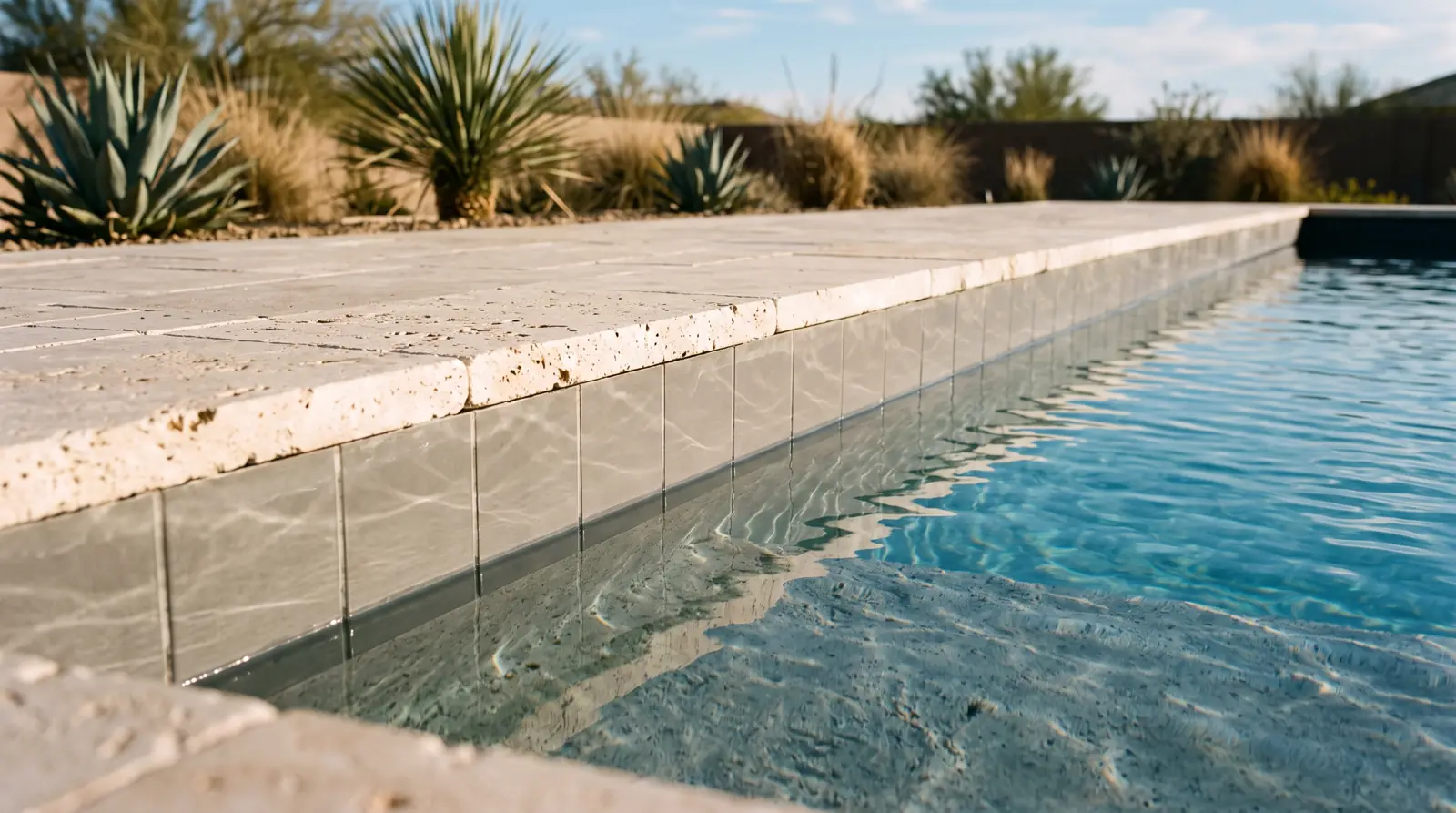
Pool Waterline Tile: Types, Specs, Ideas and Replacement Cost
Pool waterline tile is the 6 inch band at the water surface: choose porcelain or glass at 0.5% water absorption or less, freeze-rated where winters bite, and budget about $25 per linear foot to replace it.
- ✓Spec table, not a mood boardSix tile types compared on ANSI absorption class, ASTM C1026 freeze evidence and how each takes scale cleaning.
- ✓Code numbers quotedFlorida public pools: a tile line of 4 in or more, tiles 1 in or larger, dark bands 12 in at most.
- ✓Retile cost built line by lineA 16 x 32 ft pool: 96 ft of waterline, $2,400 at HomeAdvisor's $25 per foot, with demolition and refill shown.
Key takeaways
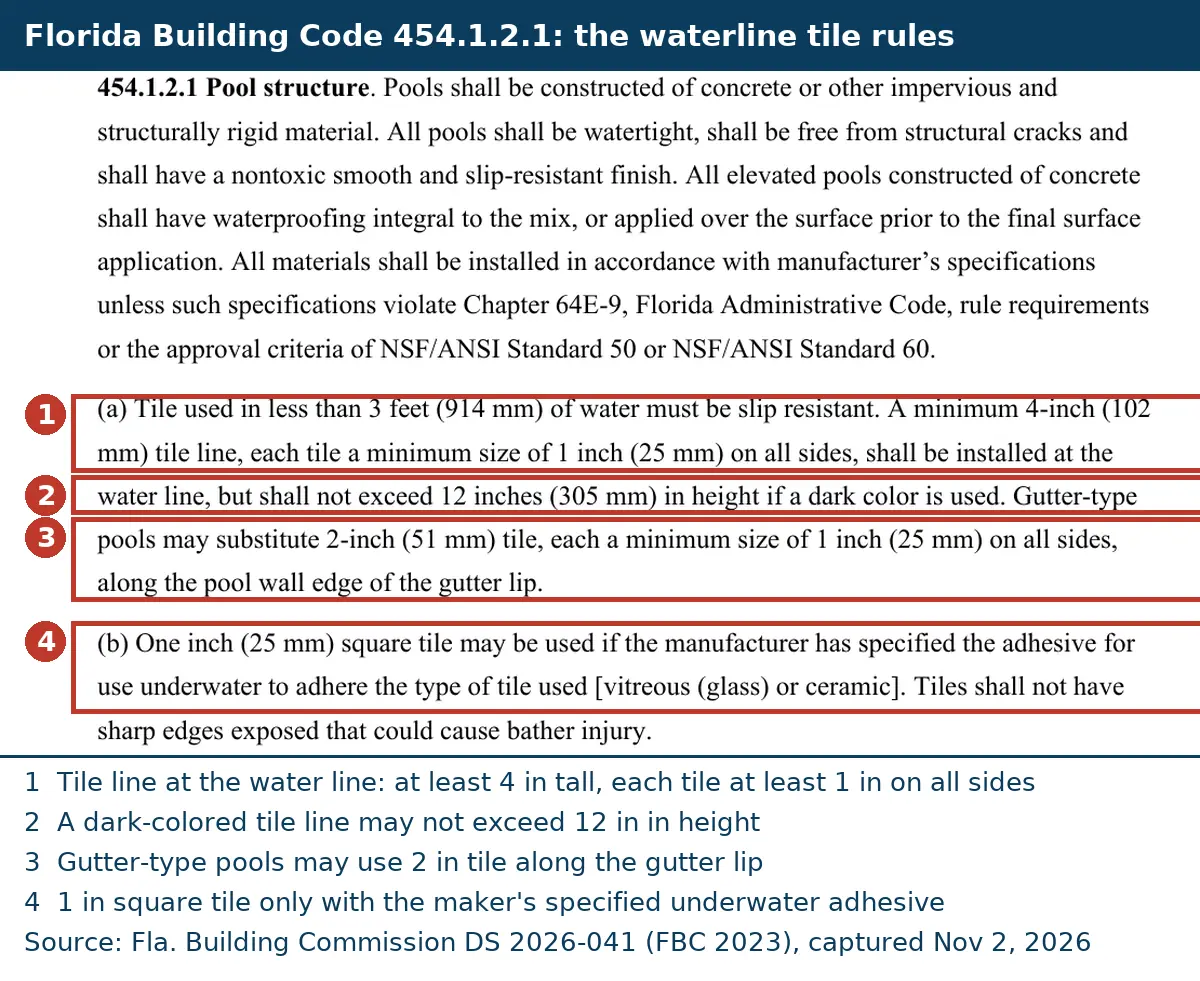
- Florida’s 2023 Building Code, Section 454.1.2.1(a), requires public pools to carry a tile line at least 4 in tall, each tile at least 1 in on all sides, and no taller than 12 in if the tile is dark (Florida Building Commission).
- ANSI A137.1 calls tile impervious at 0.5% water absorption or less under ASTM C373; porcelain and all glass tile must meet it, while glazed wall tile is non-vitreous, above 7.0% (TCNA lab report).
- ASTM C1026 is the freeze-thaw test to ask for: a lab summary describes 300 cycles between 27 F and 40 F on soaked tile (Intertek).
- A 2025 TEC pool tile spec calls for A118.15 or A118.4 thin-set, A118.7 or A118.3 grout, 21 days of cure before filling and refilling at 1 in per hour (TEC Specialty Products).
- HomeAdvisor put waterline retiling at $25 per linear foot (April 2025), or $2,400 for the 96 ft waterline of a 16 x 32 ft pool (HomeAdvisor, archived).
What is pool waterline tile, and why does the band exist?
Pool waterline tile is the band of tile set along the top of a concrete pool wall, where the water surface meets the shell. Oils, sunscreen and calcium collect there as water evaporates, and tile cleans more easily than plaster. Florida requires the band on public pools, at least 4 inches tall, and most residential builders install a 6 inch course.
| Item | Value | Source |
|---|---|---|
| Florida public pool tile line, minimum height | 4 in (102 mm) | FBC 8th Ed. (2023) 454.1.2.1(a) |
| Florida public pool tile line, maximum height if a dark color is used | 12 in (305 mm) | FBC 454.1.2.1(a) |
| Florida gutter-type pools, tile along the gutter lip | 2 in (51 mm) | FBC 454.1.2.1(a) |
| Florida public pools, minimum tile size | 1 in (25 mm) on all sides | FBC 454.1.2.1(a) and (b) |
| Common residential band | 6 in: one course of 6 x 6 in tile | California Pools & Landscape (2024); Fireclay Tile |
| Porcelain field tile in a pool spec | 6 x 6 in nominal, 3/8 in thick, 0 to 0.5% absorption | TEC pool tile spec (2025) |
| A118.7 cement grout joint width | 1/16 to 1/2 in | TEC pool tile spec (2025) |
| Cure before filling the pool | 21 days for a completed tile installation; refill at 1 in per hour | TEC pool tile spec (2025) |
| National average to retile a waterline | $25 per linear foot | HomeAdvisor (updated Apr 14, 2025) |
Source: FBC 454.1.2.1, TEC pool spec (2025), California Pools & Landscape, Fireclay Tile, HomeAdvisor. Download CSV
California Pools & Landscape, an Arizona builder, says the band protects the interior finish from sun and chemical damage and makes cleaning easier, and that its standard waterline tile is 6 x 6 in porcelain (California Pools). Evaporation is what drives scale to the band: our pool evaporation study finds an uncovered 15 x 30 ft pool loses 37.4 to 83.6 inches of water a year across 25 cities, leaving its calcium behind at the waterline.
How tall is pool waterline tile, and how much tile does a pool need?
A single 6 inch course is the residential norm, and Florida public pools need at least 4 inches. Tile area is the waterline length times the band height: a 16 x 32 ft pool has 96 linear feet of waterline, so a 6 inch band takes 48 square feet, the figure Fireclay Tile also gives. Free-form pools need a measured perimeter.
| Rectangular pool | Waterline length (linear ft) | 6 in band area (sq ft) | Retile at $25 per linear ft (HomeAdvisor, Apr 2025) | Retile at $25 to $30 per linear ft (Shasta Pools, Jan 2026) |
|---|---|---|---|---|
| 12 x 24 ft | 2 x (12 + 24) = 72 | 72 x 0.5 ft = 36 | $1,800 | $1,800 to $2,160 |
| 15 x 30 ft | 2 x (15 + 30) = 90 | 90 x 0.5 ft = 45 | $2,250 | $2,250 to $2,700 |
| 16 x 32 ft | 2 x (16 + 32) = 96 | 96 x 0.5 ft = 48 | $2,400 | $2,400 to $2,880 |
| 18 x 36 ft | 2 x (18 + 36) = 108 | 108 x 0.5 ft = 54 | $2,700 | $2,700 to $3,240 |
| 20 x 40 ft | 2 x (20 + 40) = 120 | 120 x 0.5 ft = 60 | $3,000 | $3,000 to $3,600 |
Source: PC&S arithmetic; rates from HomeAdvisor (April 14, 2025) and Shasta Pools (January 12, 2026). Download CSV
Small tile is allowed but has a floor in Florida public pools: each tile must be at least 1 inch on all sides, and 1 inch square tile is allowed only if the tile maker specifies the adhesive for underwater use (FBC 454.1.2.1(b)). The same section caps a dark-colored band at 12 inches. Coping sits on top of the band and is usually replaced in the same visit, as our pool coping guide explains.
Which tile types work at a pool waterline?
Porcelain and glass are the two tile types built for permanent water exposure, because both must be impervious under ANSI standards: 0.5% water absorption or less by ASTM C373. Glazed ceramic wall tile is non-vitreous, above 7.0%, and natural stone falls outside the ceramic standard. The table compares six types on absorption, freeze evidence and cleaning tolerance.
| Tile type | Standard and absorption class | Water absorption (ASTM C373) | Freeze-thaw evidence to ask for | Waterline guidance | Scale cleaning tolerance | Source |
|---|---|---|---|---|---|---|
| Porcelain (glazed or unglazed) | ANSI A137.1 (2022): porcelain shall be impervious | 0.5% or less | ASTM C1026 result on the data sheet | TEC pool spec: 6 x 6 in nominal, 3/8 in thick; California Pools: standard waterline tile is 6 x 6 in porcelain | Glazed ceramic and porcelain take a wet pumice stone; test one hidden tile first | TCNA lab report quoting A137.1; TEC (2025); California Pools (2024); US Pumice listing |
| Glass tile | ANSI A137.2 (2022): all glass tile shall be impervious | 0.5% or less | ASTM C1026 (title covers glass tile since the 2013 edition) | Set in an A118.15 glass tile thin-set (CBP pool detail) | One glass tile maker bans pumice, wire brushes and acidic cleaners; allows baking soda or kieserite blasting | TCNA lab report; ASTM; CBP (2020); Jeffrey Court (2021) |
| Glazed ceramic wall tile | ANSI A137.1: glazed wall tile shall be non-vitreous | More than 7.0% (class runs to 20.0%) | Usually none; ask the maker in writing | Fireclay no longer recommends its Original Ceramic line for exterior pools outside Southern California, Florida and Hawaii | Acids can damage tile glaze (Jeffrey Court) | TCNA lab report; Fireclay Tile (2026) |
| Mosaic tile (sheet-mounted) | ANSI A137.1: impervious, vitreous, semi-vitreous or non-vitreous by class | Depends on class: ask for the C373 number | ASTM C1026 if the pool freezes | Florida public pools: each tile at least 1 in on all sides; 1 in square only with the maker's underwater adhesive | Follows the body: glass or porcelain rules above | TCNA lab report; FBC 454.1.2.1 |
| Quarry tile | ANSI A137.1: impervious, vitreous or semi-vitreous | TEC pool spec lists over 3.0% up to 5.0% | ASTM C1026 if the pool freezes | TEC pool spec: 4 x 8 in nominal, 1/2 in thick | Unglazed body; test any abrasive on a spare tile | TEC (2025); TCNA lab report |
| Natural stone (travertine, slate, limestone) | Not covered by ANSI A137.1 | Not classed by A137.1 | Ask the stone supplier | California Pools: travertine, clay and stone tiles are not recommended for waterline tile | Ask the supplier before any acid contact | California Pools (2024) |
Source: TCNA IPA Laboratories report quoting ANSI A137.1 and A137.2, TEC (2025), CBP (2020), California Pools, Fireclay, Jeffrey Court (2021), FBC. Download CSV
Porcelain and all glass tile must be impervious; glazed wall tile is non-vitreous.
Source: TCNA IPA Laboratories test report quoting ANSI A137.1 classes (2019); TEC pool tile specification (2025). Download chart data (CSV)
Absorption matters underwater and in winter. A tile that drinks water can carry it into the bond coat, and in a freeze climate that water expands. The Tile Council of North America (TCNA), secretariat of the ANSI committee that develops A137.1, says water absorption tested to ASTM C373 is the determining factor for whether a tile counts as porcelain, and only tiles at 0.5% or less can be certified as porcelain (ASTM Standardization News, 2024). Ask for that number on the data sheet, not a “pool tile” label.
What is the best tile for a pool waterline?
The best tile for a pool waterline is porcelain or glass that tests at 0.5% water absorption or less, carries its maker’s written rating for submerged pool use and, in freeze climates, has an ASTM C1026 freeze-thaw result. Between the two, 6 x 6 in porcelain costs less and tolerates pumice, while glass offers more shimmer and needs gentler cleaning.
Several top-ranking guides name “ceramic” as a safe waterline choice. The makers are narrower. Fireclay Tile says its Original Ceramic line is no longer recommended for exterior pools outside Southern California, Florida and Hawaii, and that only its Natural Press line passes freeze-thaw tests for pools in all climates (Fireclay). ANSI A137.1 classes glazed wall tile as non-vitreous, so “ceramic” alone tells you nothing about absorption.
Specifiers write the rule into contracts. TEC’s 2025 pool spec requires tile “recommended in writing by manufacturer for use in pools and water features”, with porcelain at 0 to 0.5% absorption (TEC), and California Pools says all waterline tile must be rated for outdoor submersible use and be frost protected, or it may lose adhesion or crack. Put both conditions in your bid request.
- Absorption figure ASTM C373 water absorption on the data sheet: 0.5% or less for porcelain and glass.
- Written pool rating The tile maker’s statement that the tile is suitable for submerged pool use.
- Freeze-thaw result An ASTM C1026 result if your pool sees freezing winters.
- Setting materials by standard Thin-set (A118.4 or A118.15) and grout (A118.7 or A118.3) named by product, as TEC’s 2025 spec requires.
- Cure time before refill 21 days in TEC’s 2025 spec; get the installer’s figure for the products used.
Does pool waterline tile need to be frost resistant?
Yes, wherever the pool sees hard freezes. ASTM C1026 measures resistance to freeze-thaw cycling for glazed or unglazed ceramic and glass tile, and Intertek’s summary of the method describes 300 cycles between 27 F and 40 F on soaked specimens. A winterized pool also leaves the band in open air: mesh covers call for water 15 to 18 inches below the top.
ASTM says C1026 serves as a guide to selecting tiles for outdoor service in areas subject to freezing, and the 2013 edition widened its title from ceramic tile to ceramic and glass tile (ASTM C1026-13). Loop-Loc, a safety cover maker, sets winter water 15 to 18 inches below the top of the pool for its mesh covers, so the tile band spends winter above the water line, wet and exposed (Loop-Loc FAQ). Our how to winterize a pool guide lists each cover maker’s level.
What thinset and grout hold waterline tile underwater?
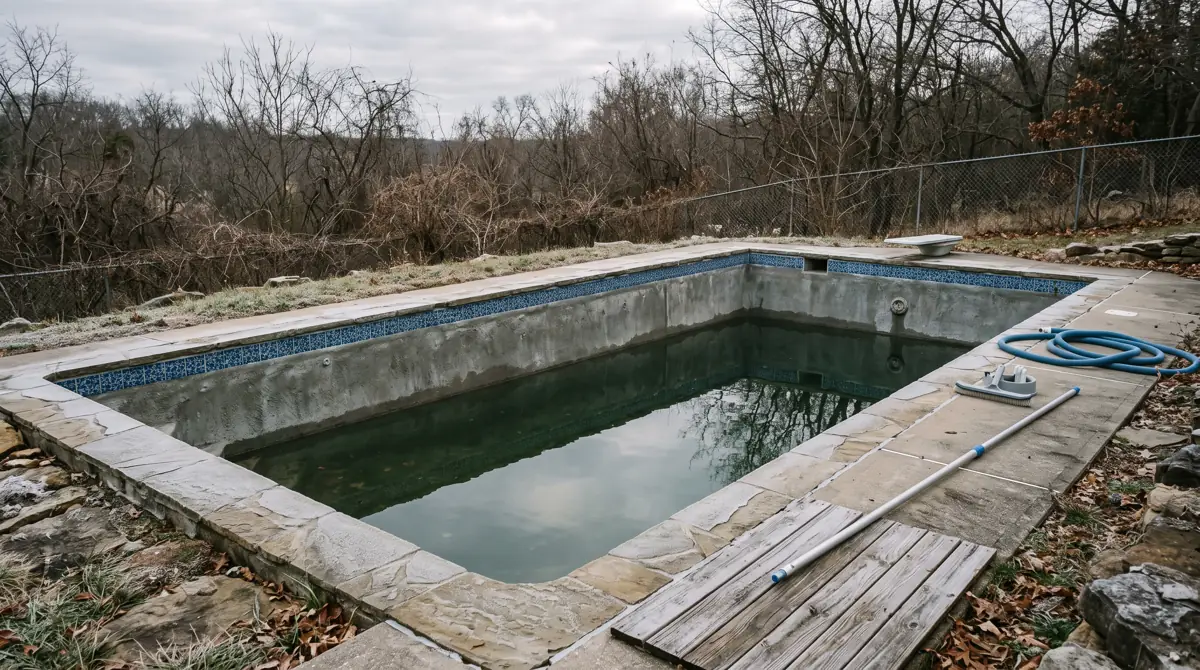
Pool tile goes in under TCNA Handbook method P601, using modified or improved modified thin-set (ANSI A118.4 or A118.15), a high-performance cement grout (A118.7) or a 100% solids epoxy (A118.3), and a waterproofing membrane where the method calls for one (A118.10). A 2025 TEC spec adds 21 days of cure before the pool is filled.
| Layer | Standard (current edition per TCNA) | Pool note | Source |
|---|---|---|---|
| Installation method | TCNA Handbook method P601 (pool tank, direct bond or bonded mortar bed) | CBP detail CP601TB lists exposure classes RES and COM 3, 4, 6 and 7: high temperature, continuous water exposure | Custom Building Products (April 2020) |
| Waterproofing and crack isolation membrane | ANSI A118.10 (2023); A118.12 (2014, reaffirmed 2024) | TEC: let the membrane cure at least 72 hours before a water test | TEC (2025); TCNA |
| Thin-set mortar | ANSI A118.4 modified dry-set (2023); A118.15 improved modified dry-set (2023) | CBP lists an A118.15 glass tile thin-set and rapid-setting A118.15F mortars for pool tanks | CBP; TCNA |
| Epoxy mortar and grout | ANSI A118.3 (2021, reaffirmed 2025) | CBP: epoxy grouts are not completely UV stable and colors may fade; TEC names 100% solids epoxy as the alternative where pool chemistry swings | CBP; TEC |
| Cement grout | ANSI A118.7 high performance (2019); A118.6 standard (2019) | TEC: joints 1/16 to 1/2 in; 28-day water absorption 1.1% maximum for its grout; do not let pool pH drop below 7.0 | TEC (2025) |
| Sealant and movement joints | ASTM C920 sealant; joints per TCNA EJ171 and ANSI A108.01 | TEC: silicone in submerged joints needs 14 days to cure before filling | TEC; CBP |
| Refill after tiling | Maker instructions | TEC: a completed tile installation cures 21 days before filling; add water at 1 in per hour | TEC (2025) |
Source: TCNA ANSI standards list (read November 2, 2026), Custom Building Products CP601TB, TEC pool tile spec (2025). Download CSV
Grout is the weak point where water chemistry swings. TEC tells specifiers not to let pool pH drop below 7.0 over cement grout, since calcium-deficient water and acid shocks can damage it, and offers epoxy as the alternative (TEC). Custom Building Products notes that epoxy grouts are not completely UV stable and their colors may fade (CBP). Our calcium hardness guide covers the water side of that trade.
Get quotes for new waterline tile
How much does pool waterline tile replacement cost?
Pool waterline tile replacement runs about $25 per linear foot by HomeAdvisor’s April 2025 average, or $25 to $30 per foot per an Arizona remodeler in January 2026. For a 16 x 32 ft pool with 96 feet of waterline that is $2,400 to $2,880. A line-item build from the same sources spans $795 to $6,848 for porcelain.
| Line item | Rate | Unit | Source | Date |
|---|---|---|---|---|
| Waterline tiling, national average | $25 | per linear ft | HomeAdvisor | Updated Apr 14, 2025 |
| Waterline tile replacement (Arizona remodeler) | $25 to $30 | per linear ft | Shasta Pools | Jan 12, 2026 |
| Tile, builder rule of thumb | $25 to $30 | per sq ft | Anthony & Sylvan Pools | Updated Nov 21, 2025 |
| Retile an average pool | $2,500 to $5,000 | per job | Anthony & Sylvan Pools | Updated Nov 21, 2025 |
| Old tile demolition and prep | $500 to $2,500 | per job | HomeAdvisor | Updated Apr 14, 2025 |
| Tile labor | $4 to $32 | per sq ft | HomeAdvisor | Updated Apr 14, 2025 |
| Porcelain pool tile | $2 to $56 | per sq ft | HomeAdvisor | Updated Apr 14, 2025 |
| Glass pool tile | $7 to $50 | per sq ft | HomeAdvisor | Updated Apr 14, 2025 |
| Tap water to refill, 25-city median | $215.09 | per 20,000 gallons | PC&S cost to fill a pool study (utility rate schedules) | Rates in effect Oct 4, 2026 |
Source: HomeAdvisor (archived May 19, 2025), Shasta Pools, Anthony & Sylvan, PC&S cost to fill a pool study. Download CSV
The Anthony & Sylvan average-pool figure covers a whole retile job of unstated size.
Source: HomeAdvisor (Apr 14, 2025); Shasta Pools (Jan 12, 2026); Anthony & Sylvan (Nov 21, 2025); PC&S cost to fill a pool study (Oct 2026); PC&S arithmetic. Download chart data (CSV)
| Line | Arithmetic | Porcelain band | Glass band | Source |
|---|---|---|---|---|
| Waterline length and band area | 2 x (16 + 32) = 96 linear ft; 96 x 0.5 ft = 48 sq ft | 48 sq ft | 48 sq ft | PC&S arithmetic |
| Demolition and prep | HomeAdvisor range per job | $500 to $2,500 | $500 to $2,500 | HomeAdvisor, Apr 2025 |
| Labor | 48 x $4 to 48 x $32 | $192 to $1,536 | $192 to $1,536 | HomeAdvisor, Apr 2025 |
| Tile | Porcelain 48 x $2 to $56; glass 48 x $7 to $50 | $96 to $2,688 | $336 to $2,400 | HomeAdvisor, Apr 2025 |
| Refill water after lowering 12 in (PC&S assumption) | 16 x 32 x 1 ft x 7.48 = 3,830 gal; x $39.00 to $649.98 per 20,000 gal | $7 to $124 | $7 to $124 | PC&S cost to fill a pool study, Oct 2026 |
| Component total | Sum of the lines above | $795 to $6,848 | $1,035 to $6,560 | PC&S arithmetic |
| Benchmark: flat per-foot price | 96 x $25; 96 x $25 to $30 | $2,400; $2,400 to $2,880 | $2,400; $2,400 to $2,880 | HomeAdvisor; Shasta Pools |
Source: PC&S arithmetic from HomeAdvisor rates (April 2025) and the PC&S cost to fill a pool study (October 2026); 12 in drawdown is a PC&S assumption. Download CSV
The flat per-foot prices sit inside the line-item range, which is wide because demolition alone runs $500 to $2,500 depending on how hard the old tile comes off. One published example does not add up: Shasta Pools prices a 10 x 20 ft pool’s 60 feet of tile at $1,500 to $2,500, but 60 feet at $25 to $30 is $1,500 to $1,800 (Shasta Pools). Ask each bidder for the linear feet, tile price per square foot and demolition as separate lines. Bundling tile with a new interior is priced in our pool resurfacing cost guide.
How is pool waterline tile replaced without draining the pool?
Most waterline retiles only lower the water below the band rather than draining the pool. On a 16 x 32 ft pool, dropping the level 12 inches removes about 3,830 gallons, which costs a median $41 to replace at October 2026 city water rates. The tile then has to cure before refilling, 21 days in TEC’s 2025 pool spec.
- Measure the jobWaterline length times band height: 96 linear ft and 48 sq ft for a 16 x 32 ft pool with a 6 in band. Order extra tile for cuts and future repairs.
- Lower the water below the workAbout 12 in on most pools (PC&S assumption), roughly 3,830 gallons on a 16 x 32; protect the skimmer and returns.
- Remove the old tile and bond coatHomeAdvisor puts demolition and prep at $500 to $2,500. Check the bond beam and coping joint for cracks while it is open.
- Treat cracks and jointsHandle substrate cracks and movement joints per ANSI A108.01 and TCNA EJ171, and apply an A118.10 membrane where the method calls for one; TEC allows a water test after 72 hours of membrane cure.
- Set the tileUse the thin-set the tile maker names: an A118.15 glass tile mortar for glass, A118.4 or A118.15 for porcelain. In Florida public pools, keep tiles at least 1 in on every side.
- Grout and sealA118.7 cement grout in joints of 1/16 to 1/2 in, or A118.3 epoxy; silicone (ASTM C920) at the coping joint, which TEC gives 14 days to cure.
- Cure, then refill slowlyTEC’s 2025 spec says 21 days of cure before filling and water added at 1 in per hour, so a 12 in refill takes about 12 hours. Rapid-setting A118.15F mortars change the timing; get the cure time in writing.
Plan the drawdown for the shoulder season, since the water stays down while the tile cures. Refill water for the 12 inch drawdown ranges from $7 in the cheapest of 25 cities to $124 in the dearest, per our cost to fill a pool study, small next to the tile itself.
How do you choose pool waterline tile?
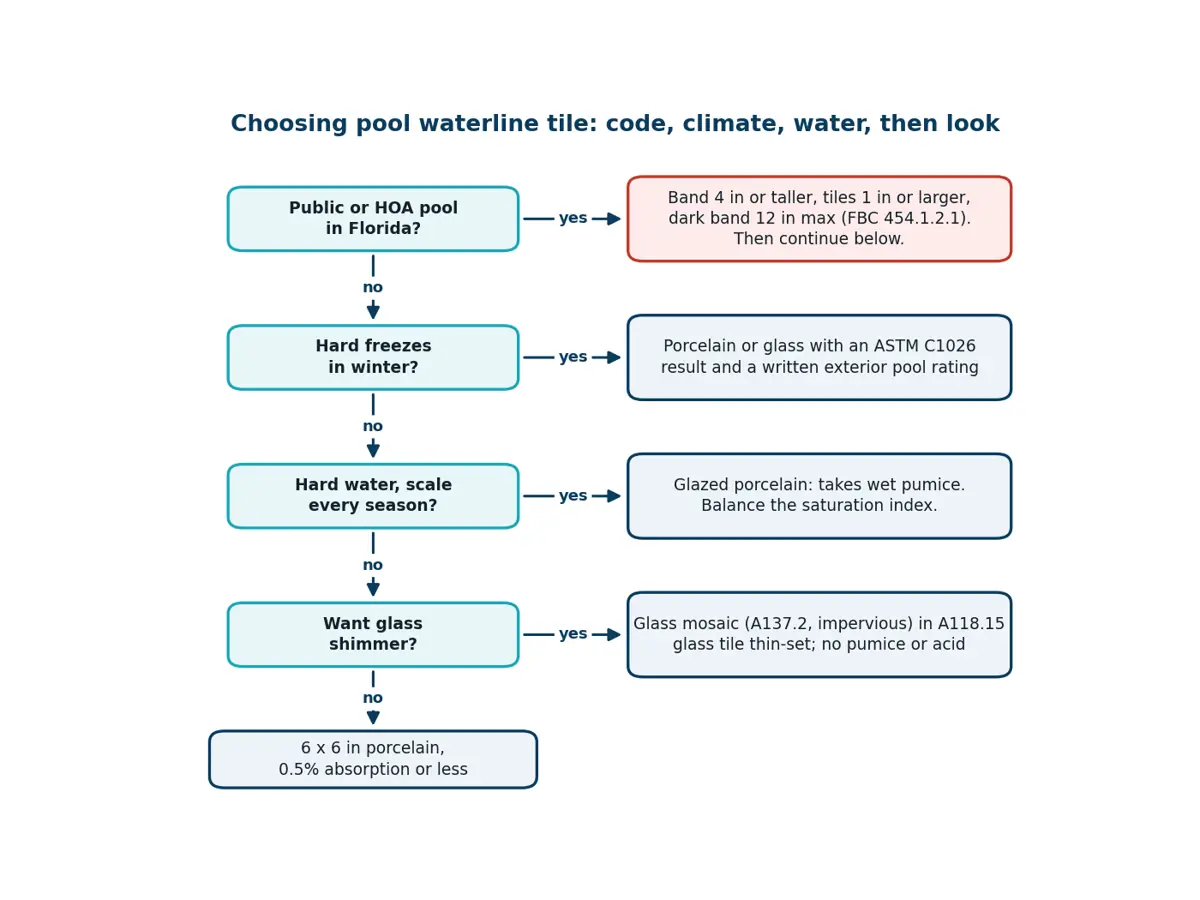
Start with the code and climate, then the water, then the look. A Florida public pool needs a band of 4 to 12 inches in tiles of 1 inch or more. A freeze climate needs an ASTM C1026 result. Hard water favors glazed porcelain, which tolerates pumice. Only then pick color and pattern, ideally against your finish maker’s pairing list.
| If your situation is | Do this | Why (source) |
|---|---|---|
| Public or HOA pool in Florida | Keep the band 4 in or taller, tiles 1 in or larger on every side, and a dark band no taller than 12 in | FBC 8th Ed. (2023) 454.1.2.1(a) |
| Your pool sees hard freezes | Porcelain or glass with an ASTM C1026 result and the maker's written exterior pool rating | ASTM C1026; California Pools; Fireclay |
| Hard water and scale every season | Glazed porcelain, which tolerates wet pumice, plus a balanced saturation index | Jeffrey Court glass care rules; US Pumice listing |
| You want glass shimmer | Glass mosaic (A137.2, impervious) set in an A118.15 glass tile thin-set; plan soft-media cleaning | CBP P601 detail; Jeffrey Court |
| Tight budget, simplest care | 6 x 6 in porcelain at 0.5% absorption or less | TEC pool spec; California Pools |
| You like the travertine or stone look | Choose stone-look porcelain for the band; keep real stone on the coping | California Pools: stone not recommended at the waterline |
| Tile is sound but crusted with scale | Clean it first: about $620 to $635 to blast a 96 ft line vs $2,400 to retile | PC&S how to clean pool tile guide |
| Tile is cracked or loose along long runs | Retile, and fix the cause (movement joints, coping) in the same visit | TCNA EJ171 via CBP detail; HomeAdvisor |
| Dark pool finish | Pick from the finish maker's pairing list, often black, bronze or steel tones | Pebble Tec Black Pearl page |
Source: FBC 454.1.2.1, ASTM C1026, California Pools, Fireclay, Jeffrey Court, CBP, TEC, Pebble Tec. Download CSV
What modern pool waterline tile ideas still meet the specs?
Modern pool waterline tile ideas lean on contrast and small formats: checkerboards, stripes, two-tone bands and glass mosaics, per Fireclay Tile, plus stone-look porcelain for natural designs. Each works if the body is impervious and freeze-rated where needed. Because a 16 x 32 ft pool needs only 48 square feet at 6 inches, premium tile is affordable here.
- Glass mosaic band. All glass tile must be impervious under ANSI A137.2; set it in an A118.15 glass tile thin-set and plan soft-media cleaning.
- Checkerboard or stripes in 2 x 2 in tile. Fireclay calls contrast its top trend; in Florida public pools each tile must still be at least 1 in on every side.
- Two-tone band. Fireclay shows a light tile above the water and a dark one below; on a Florida public pool a dark band may not exceed 12 in.
- 3 x 12 in stacked porcelain. A long format reads modern; check the 0.5% absorption line and the C1026 result.
- Blue pool waterline tile ideas. California Pools says blue or teal tile enhances the water color, while stone-colored tile blends with the deck.
- Stone look without stone. California Pools does not recommend travertine, clay or stone at the waterline, so use stone-look porcelain and keep real stone on the coping.
- Match the finish. Pebble Tec suggests turquoise, aqua and white glass for Tahoe Blue and black, bronze and silver tones for Black Pearl; our pool plaster colors chart shows the water each finish makes.
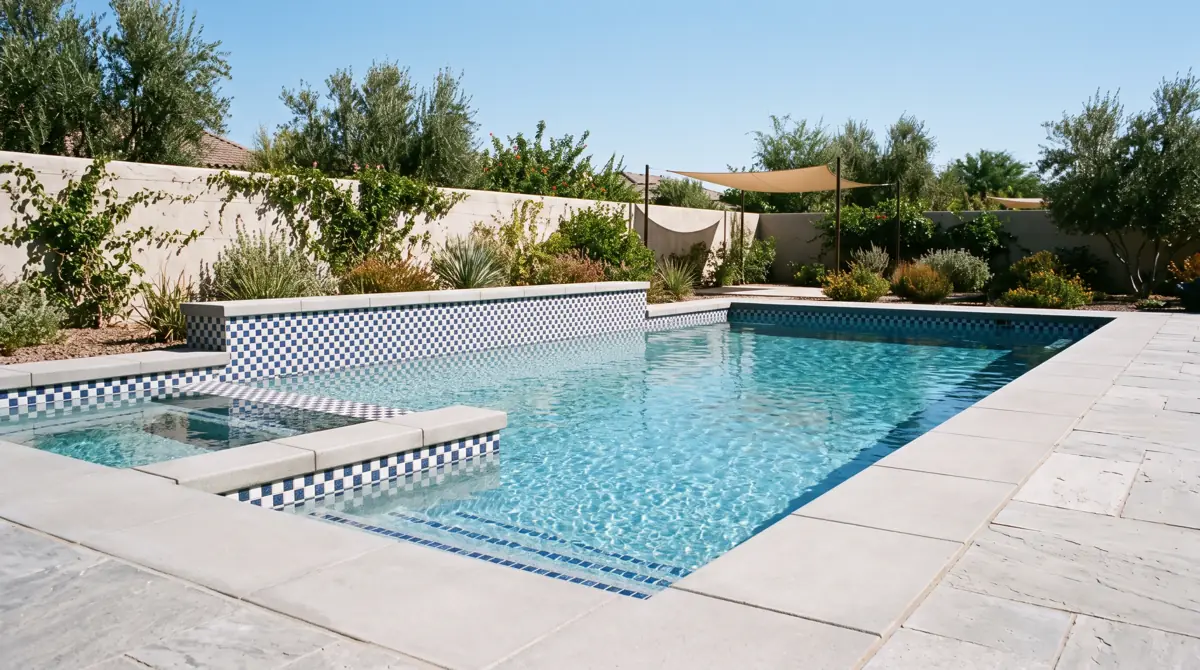
SGM, a pool finish maker, notes that waterline tile color changes how the water color is perceived, while Fireclay says the tile’s influence stops close to the pool edge and the submerged surface sets the color of the whole pool (SGM, Fireclay). Pick the finish color first and the band second, and view both samples together in daylight; at 6 inches the band is 48 square feet against 944 square feet of interior on a 16 x 32 ft pool with a 4.5 ft average depth.
Which waterline tile is easiest to keep free of calcium?
Glazed porcelain is the easiest to scrub, because it takes a wet pumice stone; glass shows scale as clearly but rules out pumice and acid, at least for one glass maker. The Jeffrey Court guide (October 2021) bans pumice, wire brushes and acidic cleaners on its glass tile and allows baking soda or kieserite blasting. Water balance decides how fast scale returns.
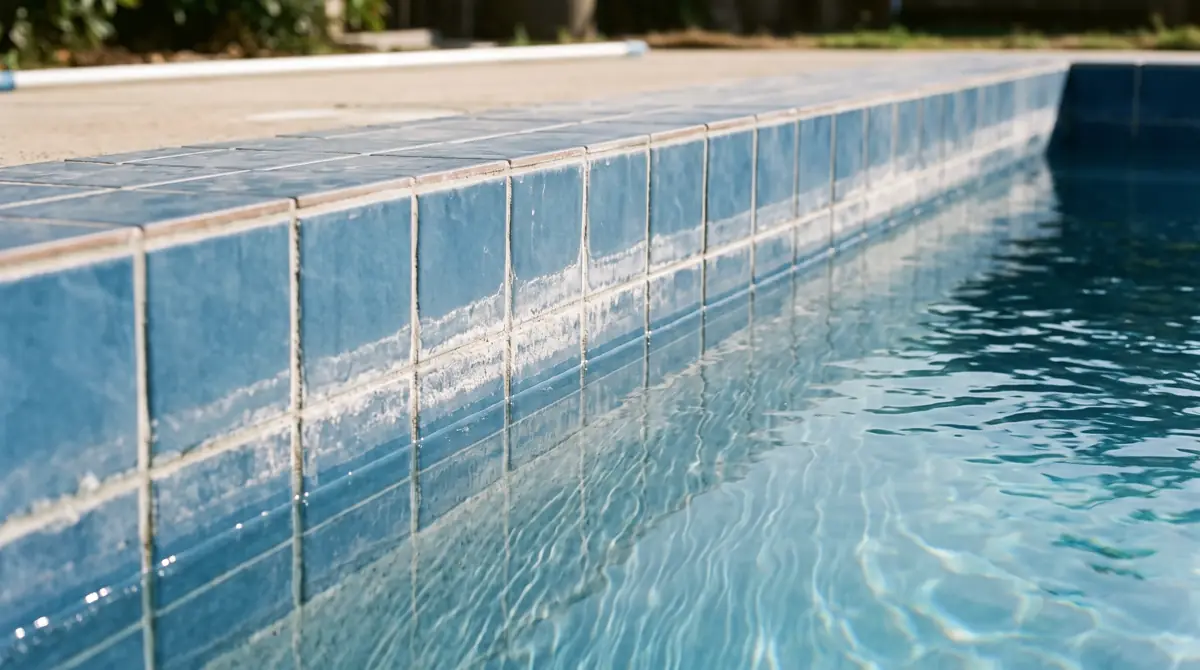
If scale is the only problem, clean before you retile: our how to clean pool tile guide works a 96 ft waterline at $620 to $635 for glass bead blasting with sealer against $2,400 to retile. US Pumice sells its Pool Blok, a 6 oz block listed at $7.99, for ceramic tile and concrete (Ace Hardware listing, archived), and Jeffrey Court asks owners to reapply its glass protectant every 6 months (Jeffrey Court).
How we compiled this
We used 23 documents, read in October and November 2026: the Florida Building Commission analysis quoting the 2023 code, TCNA’s standards list, a TCNA laboratory report and a TCNA article, ASTM’s C1026 page and an Intertek summary, two setting-material specifications (TEC 2025 and Custom Building Products 2020), 7 maker and builder pages, 4 dated price sources and 4 of our own guides and studies. We did not install or test tile; the cost build uses published ranges and one stated assumption, a 12 inch drawdown.
Frequently Asked Questions
What is the best tile for a pool waterline?
Porcelain or glass rated by its maker for submerged pool use, testing at 0.5% water absorption or less (ASTM C373) and, in freeze climates, with an ASTM C1026 result. California Pools & Landscape installs 6 x 6 in porcelain as standard and does not recommend travertine, clay or stone at the waterline (California Pools).
How much does it cost to replace pool waterline tile?
HomeAdvisor put waterline retiling at $25 per linear foot in April 2025, and Shasta Pools quotes $25 to $30 in January 2026. A 16 x 32 ft pool has 96 feet of waterline, so $2,400 to $2,880. Demolition and prep alone run $500 to $2,500 per HomeAdvisor (HomeAdvisor).
How high should pool waterline tile be?
Six inches is the usual residential band, one course of 6 x 6 in tile. Florida’s 2023 Building Code, Section 454.1.2.1(a), requires public pools to have a tile line at least 4 inches tall and caps a dark-colored band at 12 inches; gutter-type pools may use 2 inch tile along the gutter lip (FBC).
Can you replace waterline tile without draining the pool?
Usually yes: the installer lowers the water below the band, about 12 inches or 3,830 gallons on a 16 x 32 ft pool, which costs a median $41 to replace at October 2026 city rates. TEC’s 2025 spec says tile should cure 21 days before refilling, at 1 inch per hour.
Is glass or porcelain better for a pool waterline?
Both are impervious under ANSI rules (0.5% absorption or less). Porcelain costs less, $2 to $56 per square foot against $7 to $50 for glass in HomeAdvisor’s April 2025 ranges, and takes wet pumice for scale. Glass shimmers more but, per Jeffrey Court’s 2021 guide, rules out pumice and acidic cleaners (Jeffrey Court).
Can you use regular ceramic tile at a pool waterline?
Only if its maker rates it for pools. ANSI A137.1 classes glazed wall tile as non-vitreous, with water absorption above 7.0%, and Fireclay Tile no longer recommends its own Original Ceramic line for exterior pools outside Southern California, Florida and Hawaii (Fireclay). Ask for the C373 absorption figure.
Sources
- Florida Building Commission. DS 2026-041 Staff Analysis quoting Florida Building Code 8th Ed. (2023) Section 454. Accessed 2026-11-02.
- Tile Council of North America. ANSI Standards (A108, A118, A137 editions and status). Accessed 2026-11-02.
- TCNA IPA Laboratories / MSI Surfaces. Test report quoting ANSI A137.1 and A137.2 absorption classes (Aria, Aug 29, 2019). Accessed 2026-11-02.
- ASTM Standardization News (TCNA). Standards and the Ceramic Tile Industry (Jan/Feb 2024). Accessed 2026-11-02.
- ASTM International. C1026-13 Standard Test Method for Measuring the Resistance of Ceramic and Glass Tile to Freeze-Thaw Cycling. Accessed 2026-11-02.
- Intertek. ASTM C1026 test summary. Accessed 2026-11-02.
- TEC Specialty Products (H.B. Fuller). Suggested Specification for Ceramic Tiling of Pools and Water Features (2025). Accessed 2026-11-02.
- Custom Building Products. CP601TB Pools and Water Features detail (April 2020). Accessed 2026-11-02.
- California Pools & Landscape. How To Choose The Best Pool Waterline Tile (modified Nov 24, 2024). Accessed 2026-11-02.
- Fireclay Tile. Modern Pool Waterline Tile Ideas. Accessed 2026-11-02.
- HomeAdvisor. How Much Does Installing Pool Tile Cost? (updated Apr 14, 2025; archived May 19, 2025). Accessed 2026-11-02.
- Shasta Pools. What's the Cost to Replace Your Pool Tile, Deck, or Interior Finish? (Jan 12, 2026). Accessed 2026-11-02.
- Anthony & Sylvan Pools. Pool Remodeling Costs: Complete Guide (updated Nov 21, 2025). Accessed 2026-10-08.
- Jeffrey Court. Pool Tile Maintenance Guide (Oct 8, 2021). Accessed 2026-11-01.
- Ace Hardware. US Pumice Pool Blok PB-80 listing (archived June 12, 2026). Accessed 2026-11-01.
- Loop-Loc. FAQs (winter water level for safety covers). Accessed 2026-10-19.
- Pebble Technology International. PebbleTec Tahoe Blue pool finish (suggested waterline tiles). Accessed 2026-11-02.
- Pebble Technology International. PebbleTec Black Pearl pool finish (suggested waterline tiles). Accessed 2026-11-02.
- SGM. How Pool Finishes Affect Water Color (June 20, 2025). Accessed 2026-11-02.
Related pages
Get Quotes From Licensed Local Pool Pros
Tell us what you need and your ZIP code. We match you with pool companies that cover your area.