Pool Coping: Types, Sizes, Code Rules and Replacement Cost
Pool coping is the cap on top of the pool wall: it covers the bond beam, gives swimmers a handhold and sheds splash water, and costs $6 to $60 per linear foot new (River Pools, 2025).
- ✓Code text, quotedMAHC 4.5.14.4 sets a 1 to 2 in overhang; ISPSC 324.1.1 keeps the handhold within 12 in of the water.
- ✓Maker sizes and testsStepstone, Unilock, Mortex and Deck-O-Seal data sheets, with the freeze-thaw test to ask for.
- ✓Priced for a 16 x 32 pool96 ft of coping from $576 to $1,440 new to $4,800 to $15,360 replaced.
Key takeaways
- Section 324.1 of the 2024 International Swimming Pool and Spa Code (ISPSC) requires handholds where a residential pool is deeper than 42 in, located at the top of deck or coping, not more than 12 in above the design waterline and no more than 4 ft apart.
- For public pools, the 2024 Model Aquatic Health Code (MAHC, CDC) caps coping overhang at 1 to 2 in past the pool wall and its thickness at 2.5 in at the overhang (Sections 4.5.14.4 and 4.5.14.5).
- The joint between coping and deck must be watertight (ISPSC 306.7); the Deck-O-Seal 125 data sheet (January 2026) sets sealant depth at 1/4 to 1/2 in with joint width twice the depth.
- New coping costs $6 to $15 per linear foot for poured cantilever concrete, $25 to $30 for brick, $40 to $50 for pavers and $40 to $60 for travertine or stone, per River Pools and Spas (updated August 18, 2025). If the deck will match the coping, our travertine pool deck guide compares grades, finishes and salt water sealers.
- Replacing coping costs $50 to $160 per linear foot installed in the Washington DC area (Beltway Pools, October 2026), so a 16 x 32 ft pool’s 96 ft perimeter runs about $4,800 to $15,360 before the joint reseal.
What is pool coping and what does it do?
Pool coping is the cap set on top of the pool wall where the water meets the deck. It covers the wall’s top edge, gives swimmers something to grip, and pitches splash water toward the deck instead of behind the shell. The ISPSC names the top of deck or coping as a required handhold on residential pools deeper than 42 in.
Coping does three jobs. It protects the top of the pool wall and brings the pool edge level with the deck, as Anthony & Sylvan Pools describes it. It is the handhold: ISPSC 324.1.2 lists the top of pool deck or coping first among accepted handhold types, and 324.1.1 keeps it within 12 in of the design waterline (ISPSC 2024). It also has to grip wet feet, since ISPSC 306.2 names coping alongside decks as a surface that shall be slip resistant.
| Number | Value | Source |
|---|---|---|
| Coping overhang past the pool wall (public pools) | 1 to 2 in | MAHC 2024, 4.5.14.4 |
| Coping thickness at the overhang (public pools) | 2.5 in maximum | MAHC 2024, 4.5.14.5 |
| Handhold height above the design waterline | 12 in maximum | ISPSC 2024, 324.1.1 |
| Handhold spacing along the perimeter | 4 ft maximum | ISPSC 2024, 324.1.3 |
| Wet slip resistance where coping is tested | DCOF 0.42 or pendulum P4 | ISPSC 2024, 306.2 |
| Sealant depth in the coping-to-deck joint | 1/4 to 1/2 in, width twice the depth | Deck-O-Seal 125 data sheet (Jan 2026) |
| New coping, installed | $6 to $60 per linear ft by material | River Pools (updated Aug 18, 2025) |
| Coping replacement, installed | $50 to $160 per linear ft | Beltway Pools, DC area (Oct 15, 2026) |
| Mastic life between coping and deck | 5 to 10 years | Anthony & Sylvan Pools |
Sources: MAHC 2024 (CDC); ISPSC 2024 via UpCodes; Deck-O-Seal 125 (Jan 2026); River Pools (Aug 2025); Beltway Pools (Oct 2026); Anthony & Sylvan. Download CSV
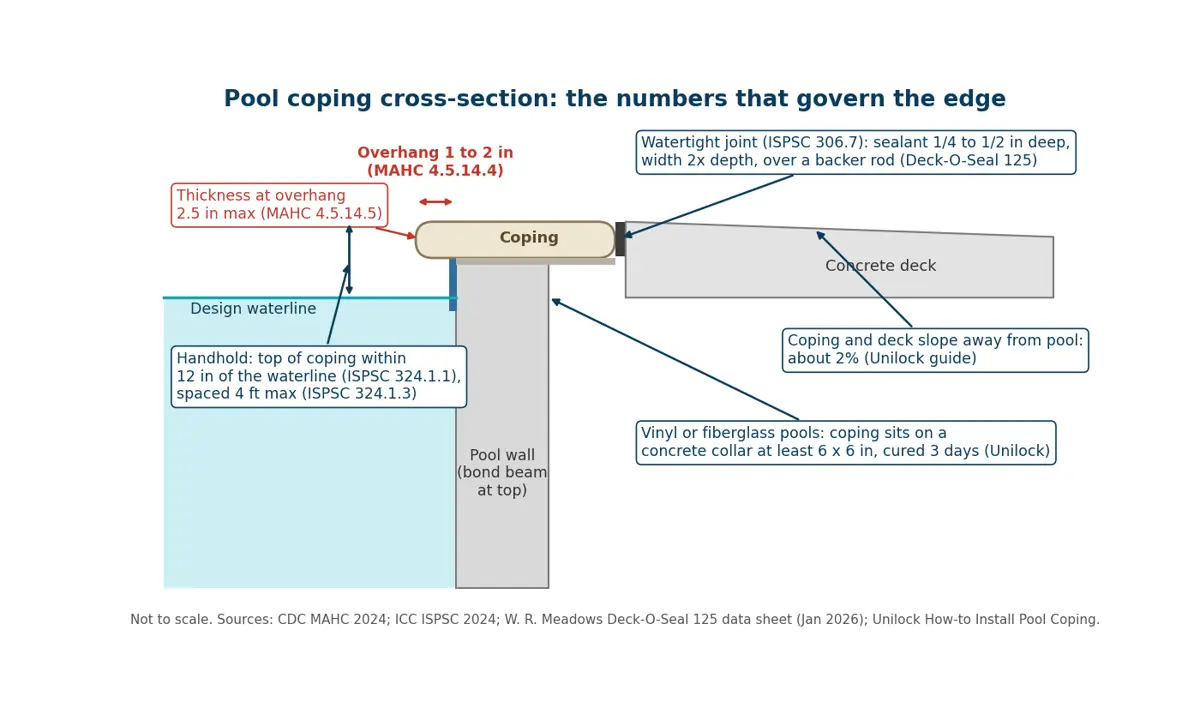
On a concrete pool, coping sits in a mortar bed on the wall itself. On vinyl and fiberglass pools the wall cannot carry it, so Unilock has installers pour a reinforced concrete collar at least 6 x 6 in around the pool, recessed 1/2 in below the top of the wall, and let it cure for at least 3 days before setting coping. Vinyl pools often use an aluminum coping track instead, which Royal Swimming Pools describes as the part that secures the liner bead.
What are the types of pool coping?
Seven coping types cover most pools: poured cantilever concrete, precast concrete, travertine, other natural stone, brick, concrete paver coping and aluminum or rolled-edge coping for vinyl pools. Bullnose is an edge profile, not a material: a rounded front edge offered in precast, brick, paver and stone coping. New installed cost runs from $6 to $60 per linear foot.
| Coping type | Maker size or profile | Pool types | Standard or test to ask for | New cost per linear ft | Source |
|---|---|---|---|---|---|
| Cantilever poured concrete | Formed on site; Mortex form shapes Keystone, Poly (bullnose), French Curve, Commercial (2 in deep from tile) | Concrete, fiberglass, vinyl | Air content and strength of the deck mix | $6 to $15 | Mortex Standard Forms; River Pools (Aug 2025) |
| Precast concrete bullnose | Stepstone Classic 14 x 24 x 2.5 in, 2 in bullnose; Modern 18 x 24 x 2 in | All | Absorption 6.0% average max; ASTM C666 and E303 listed | Not published as new; $50 to $90 replaced | Stepstone (Feb 2025); Beltway Pools (Oct 2026) |
| Travertine | 12 x 24 in, 2 in or 1.25 in thick | All | ASTM C1527 has no freeze-thaw test: ask for data | $40 to $60 | TravertineMart; ASTM C1527; River Pools |
| Natural stone (limestone, bluestone, granite, flagstone) | Cut to order | All | Ask for absorption and freeze data by quarry | $40 to $60 | Anthony & Sylvan; River Pools |
| Brick | Bullnose brick paving units | All | ASTM C902 class for your exposure | $25 to $30 | ASTM C902; Anthony & Sylvan; River Pools |
| Concrete paver coping | Units up to 72 in straight; 18 in max on curves | All | ASTM C936 (8,000 psi) and C1645 freeze-thaw | $40 to $50 | Unilock guide; CMHA PAV-TEC-002; River Pools |
| Aluminum or rolled-edge coping (vinyl pools) | Extruded track that holds the liner bead | Vinyl liner | Profile must match the liner bead | $8 to $12 | Royal Swimming Pools; HomeGuide (Jul 2025) |
Sources: Mortex Standard Forms; Stepstone Classic and Modern data sheets (Feb 2025); TravertineMart (Nov 2026); ASTM C1527; ASTM C902; Unilock; CMHA PAV-TEC-002; Royal Swimming Pools; HomeGuide (Jul 2025); River Pools (Aug 2025); Beltway Pools (Oct 2026). Download CSV
What is bullnose pool coping? Bullnose coping has a fully rounded front edge that hangs over the water. Stepstone’s Classic precast unit is 14 x 24 x 2.5 in with a 2 in bullnose and 1/4 in reveals top and bottom, and its Modern unit is 18 x 24 x 2 in with a rolling 2 in bullnose (Stepstone data sheets, February 2025). Both are wet-cast from 4,000 psi concrete with water absorption held to 6.0% on average.
What is concrete pool coping? Two different things go by that name. Cantilever coping is poured with the deck over disposable forms; Mortex sells Keystone, Poly (bullnose), French Curve and Commercial shapes, and its Commercial form adds 3/4 in for a 2 in depth from the tile. Precast coping is cast in a plant and set in mortar. River Pools prices cantilever concrete at $6 to $15 per linear foot when it is not already in the pool package.
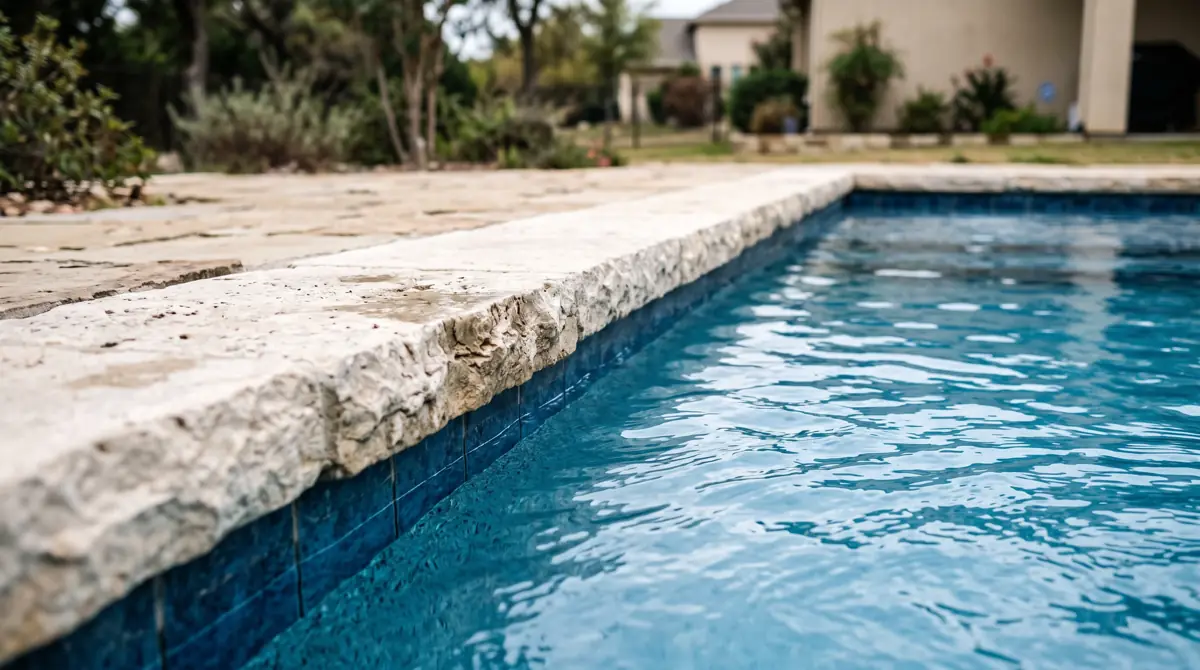
Is travertine good for pool coping? It is common and mid-priced: River Pools puts travertine or natural stone at $40 to $60 per linear foot installed, and TravertineMart lists 12 x 24 in Ivory coping 2 in thick at $14.99 per linear foot for material in stock (November 2, 2026). The gap is freeze data: the ASTM C1527 travertine standard covers absorption, density, strength and abrasion but no freeze-thaw test. Brick, at $25 to $30 per foot, is sold to ASTM C902, which sorts paving brick into 3 classes by exposure.
Concrete paver coping is the modular option. Unilock allows straight units up to 72 in long, recommends units no longer than 18 in on curved pools so the edge does not look choppy, and calls for 1/2 in mortar joints on long units or 1/4 in spacing with flexible grout at butt joints. Paver coping runs $40 to $50 per linear foot new in the River Pools guide.
What do the codes say about coping overhang, handholds and slip?
Two model codes set the numbers. The ISPSC, adopted for many residential pools, makes the top of coping a handhold within 12 in of the waterline and requires a slip-resistant, cleanable surface. The CDC’s MAHC, written for public pools, adds dimensions: 1 to 2 in of overhang, 2.5 in maximum thickness at the overhang and rounded, slip-resistant edges.
| Rule | What the text says | Applies to | Source |
|---|---|---|---|
| Slip resistance | Decks, ramps, coping and similar step surfaces shall be slip resistant and cleanable; where tested wet, DCOF 0.42 (ANSI A326) or P4 pendulum | Pools under the ISPSC | ISPSC 2024, 306.2 |
| Handholds required | Where depth below the design waterline exceeds 42 in (residential) or 24 in (public); handholds shall be located at the top of deck or coping | Pools under the ISPSC | ISPSC 2024, 324.1 |
| Handhold height and spacing | Not more than 12 in above the design waterline; spaced not greater than 4 ft apart | Pools under the ISPSC | ISPSC 2024, 324.1.1 and 324.1.3 |
| Coping to recessed tread | The vertical distance between the pool coping edge, deck, or step surface and the uppermost recessed tread shall be not greater than 12 in | Pools under the ISPSC | ISPSC 2024, 323.4 |
| Joint at the coping | Isolation joints where the pool coping meets the concrete deck shall be watertight and protect the coping and its mortar bed | Pools under the ISPSC | ISPSC 2024, 306.7 and 306.7.1 |
| Overhang | Not greater than 2 in from the vertical plane of the pool wall, nor less than 1 in | Public pools under the MAHC | MAHC 2024, 4.5.14.4 |
| Thickness | Shall not exceed 2.5 in for the horizontal overhang | Public pools under the MAHC | MAHC 2024, 4.5.14.5 |
| Edge | Coping or cantilevered decking of reinforced concrete or equivalent, with rounded, slip-resistant edges | Public pools without perimeter gutters | MAHC 2024, 4.5.14.3 |
| Expansion joint | Continuous watertight expansion joint material between perimeter decks and pool coping | Public pools under the MAHC | MAHC 2024, 4.8.1.2.2 |
Sources: ISPSC 2024 Chapter 3 via UpCodes (Austin adoption); MAHC 2024, 5th edition (CDC), pages 52 and 88. Your local code edition and amendments decide what applies. Download CSV
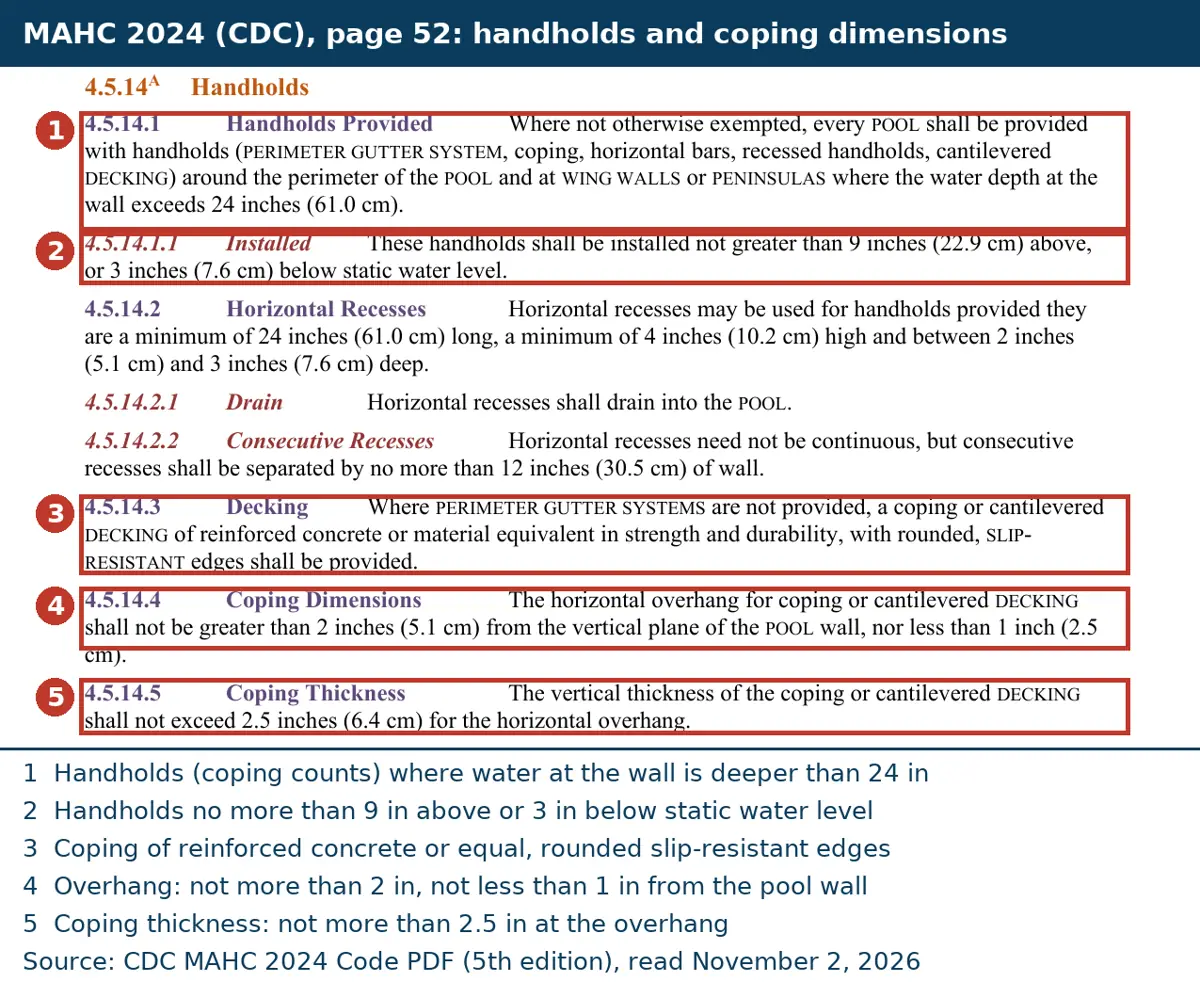
Several popular coping guides say a 1 to 1.5 in overhang is standard. The primary texts read differently. MAHC 4.5.14.4 allows 1 to 2 in for public pools, and Unilock’s install guide tells installers to overhang coping approximately 2 in and slope it at a 2% grade away from the pool. The ISPSC text we read sets no overhang number for residential pools; it regulates the handhold instead (12 in maximum above the waterline, 4 ft maximum spacing).
Slip numbers are often misquoted the same way. ISPSC 306.2 applies a wet DCOF of 0.42 (ANSI A326) or a P4 pendulum rating only where a surface is evaluated, and the design professional picks the level. ANSI A326.3-2021 itself sets no DCOF value for pool decks, as our guide to pool deck materials explains with the standard’s own text. Stepstone lists ASTM E303, a pendulum test, among the standards for its coping; ask for the wet result on the finish you are buying.
Which pool coping materials hold up to freeze-thaw?
In a freezing climate, buy coping with a named freeze-thaw result. Concrete pavers to ASTM C936 must lose no more than 225 g/m2 after 28 cycles in the ASTM C1645 test. Cast stone to ASTM C1364 carries a freeze-thaw requirement. Travertine’s ASTM C1527 has no freeze test, and a maker listing ASTM C666 has not told you a service life.
| Coping material | Standard named by maker or spec | What it measures | Pass mark or published data | Caveat | Source |
|---|---|---|---|---|---|
| Concrete paver coping | ASTM C936 with C1645 | Strength, absorption, mass loss after freeze-thaw | 8,000 psi average; 5% absorption max; 225 g/m2 max after 28 cycles or 500 g/m2 after 49 | Test in 3% saline where deicers are used | CMHA PAV-TEC-002-22 |
| Precast concrete coping | ASTM C666 (listed by Stepstone) | Rapid freeze-thaw in lab | No cycle count published; reports on request | ASTM says C666 does not measure length of service | Stepstone (Feb 2025); ASTM C666 scope |
| Architectural cast stone | ASTM C1364 | Strength, absorption, freeze-thaw, shrinkage | Requirements set in the standard | Ask for the test report on the lot you buy | ASTM C1364 scope |
| Brick | ASTM C902 | Paving brick by exposure class and traffic type | 3 classes by exposure environment | Ask which class the bullnose unit meets | ASTM C902 scope |
| Travertine | ASTM C1527 | Absorption, density, strength, abrasion | No freeze-thaw test in the scope | Ask the supplier for freeze data before using it in a cold climate | ASTM C1527 scope |
| Any coping surface | ANSI A326 or SA AS4586 (ISPSC 306.2) | Wet slip resistance | DCOF 0.42 or pendulum P4 where tested | ANSI A326.3 itself sets no pool deck value | ISPSC 2024; ANSI A326.3-2021 |
Sources: CMHA PAV-TEC-002-22; Stepstone (Feb 2025); scope pages for ASTM C666, C1364, C902 and C1527; ISPSC 2024, 306.2; ANSI A326.3-2021. Download CSV
Read the test name, then the number. ASTM’s own scope for C666, the rapid freeze-thaw test for concrete, says neither of its procedures gives a quantitative measure of the length of service to expect. Stepstone lists C666 among its applicable standards and offers test reports on request, so ask for the report and the cycle count. Concrete pavers are the easiest to compare, because CMHA publishes the pass marks: 8,000 psi average strength, 5% maximum absorption and the C1645 mass-loss limit.
What goes between pool coping and the deck?
A flexible sealant over a compressible backer, not grout or sand. ISPSC 306.7 requires the joint where coping meets a concrete deck to be watertight and to protect the coping’s mortar bed from deck movement. The Deck-O-Seal 125 data sheet sets sealant depth at 1/4 to 1/2 in, width twice the depth, and joints no narrower than 1/4 in.
Pool builders call this joint mastic. Anthony & Sylvan Pools says properly installed mastic lasts 5 to 10 years, less in extreme sun or weather. The MAHC asks public pools for continuous watertight expansion joint material between perimeter decks and pool coping (Section 4.8.1.2.2), and the ISPSC asks the same joint on residential pools to protect the coping and its mortar bed (306.7.1).
- Cut out the old sealantRemove foreign substances, incompressibles and free water; the joint must be clean and dry (Deck-O-Seal 125, January 2026).
- Check the concrete ageW. R. Meadows cites 28 days as the accepted cure for new concrete before sealing.
- Set the backerUse a foam backer rod so sealant depth stays at 1/4 to 1/2 in with a 2:1 width-to-depth ratio; joints under 1/4 in wide are too narrow for this product.
- Mask and primeTape 2 in wide along both edges. Primer is optional on concrete but required for joints wider than 1 in or under water.
- Mix and pourMix the 96 oz two-part kit for at least 10 minutes; application life is about 1 hour at 77F and 30% humidity; apply at 40F or warmer.
- Let it setPull the tape before the sealant sets; it sets firm and rubbery within 24 hours at 77F, longer when cold. Do not paint over it.
| Joint size (width x depth) | Linear ft per 96 oz kit | Kits for a 96 ft perimeter | Source |
|---|---|---|---|
| 1/2 in wide x 1/4 in deep | 106 | 1 | Deck-O-Seal 125 data sheet No. 786 (Jan 2026); PC&S math |
| 3/4 in wide x 3/8 in deep | 51 | 2 | Deck-O-Seal 125 data sheet No. 786 (Jan 2026); PC&S math |
| 1 in wide x 1/2 in deep | 29 | 4 | Deck-O-Seal 125 data sheet No. 786 (Jan 2026); PC&S math |
Source: W. R. Meadows, DECK-O-SEAL 125 Product Data No. 786 (January 2026). Kits = 96 / coverage, rounded up. The sheet recommends a trained contractor for joints below the waterline. Download CSV
Most homeowners hire this out: Beltway Pools prices an expansion-joint reseal at $8 to $20 per linear foot, or $800 to $1,900 for a 96 ft perimeter (Beltway Pools, October 2026). Deck-side joints and slopes for every deck surface are covered on our pool deck contractors page.
Get quotes for pool coping work
How much does pool coping cost per linear foot?
New pool coping costs $6 to $15 per linear foot for poured cantilever concrete, $25 to $30 for brick, $40 to $50 for pavers and $40 to $60 for travertine or natural stone, per River Pools (August 2025). Replacement on an existing pool runs $50 to $160 per foot in the Washington DC area (Beltway Pools, October 2026), and repairs $30 to $50.
Source: River Pools and Spas (updated Aug 18, 2025); HomeGuide (Jul 16, 2025); Anthony & Sylvan Pools (Nov 2025); Beltway Pools (Oct 15, 2026). Download chart data (CSV)
| Job | Cost per linear ft | Who published it | Date | Geography |
|---|---|---|---|---|
| New cantilever (poured) concrete | $6 to $15 | River Pools and Spas (builder) | Updated Aug 18, 2025 | US |
| New brick coping | $25 to $30 | River Pools and Spas | Updated Aug 18, 2025 | US |
| New paver coping | $40 to $50 | River Pools and Spas | Updated Aug 18, 2025 | US |
| New travertine or natural stone | $40 to $60 | River Pools and Spas | Updated Aug 18, 2025 | US |
| Vinyl liner pool coping | $8 to $12 | HomeGuide | Jul 16, 2025 | US |
| Travertine coping, material only (12 x 24 x 2 in) | $14.99 | TravertineMart (seller) | Nov 2, 2026 | US, online |
| Coping repair | $30 to $50 | Anthony & Sylvan Pools (builder) | Page modified Nov 21, 2025 | US |
| Coping replacement, any material | $50 to $160 | Beltway Pools (remodeler) | Oct 15, 2026 | VA, MD, DC |
| Coping replacement, precast concrete | $50 to $90 | Beltway Pools | Oct 15, 2026 | VA, MD, DC |
| Expansion joint reseal | $8 to $20 | Beltway Pools | Oct 15, 2026 | VA, MD, DC |
| Sealing stone or paver coping | $1 to $3, every 2 to 3 years | Pool Research | Jan 16, 2024 | US |
Sources: River Pools and Spas; HomeGuide; TravertineMart; Anthony & Sylvan Pools; Beltway Pools; Pool Research. None of these publishers states a sample size; treat them as published ranges, not quotes. Download CSV
Material is the small part. TravertineMart’s in-stock travertine coping is $14.99 per linear foot, against $40 to $60 installed for travertine in the River Pools guide, so setting, cutting corners, mortar and labor are most of the bill. Older guides run lower: Pool Research gave $6 to $55 per foot in January 2024. Coping on a new build is usually priced inside the pool contract, as our concrete pool cost breakdown shows line by line.
What does pool coping replacement cost on a 16 x 32 ft pool?
A 16 x 32 ft pool has a 96 ft perimeter. At Beltway Pools’ October 2026 rates, replacing it with precast concrete costs $4,800 to $8,640, plus $768 to $1,920 to reseal the deck joint. Any-material replacement spans $4,800 to $15,360. Repairing 20 damaged feet and resealing the whole joint costs $1,368 to $2,920.
| Line | Rate per linear ft | Feet | Total | Source of rate |
|---|---|---|---|---|
| Perimeter of a 16 x 32 ft pool: 2 x (16 + 32) | 96 | PC&S | ||
| New cantilever concrete | $6 to $15 | 96 | $576 to $1,440 | River Pools (Aug 2025) |
| New brick | $25 to $30 | 96 | $2,400 to $2,880 | River Pools (Aug 2025) |
| New pavers | $40 to $50 | 96 | $3,840 to $4,800 | River Pools (Aug 2025) |
| New travertine or natural stone | $40 to $60 | 96 | $3,840 to $5,760 | River Pools (Aug 2025) |
| Travertine coping, material only | $14.99 | 96 | $1,439.04 | TravertineMart (Nov 2026) |
| Vinyl pool coping | $8 to $12 | 96 | $768 to $1,152 | HomeGuide (Jul 2025) |
| Replace with precast concrete | $50 to $90 | 96 | $4,800 to $8,640 | Beltway Pools (Oct 2026) |
| Replace, any material | $50 to $160 | 96 | $4,800 to $15,360 | Beltway Pools (Oct 2026) |
| Repair 20 damaged feet only | $30 to $50 | 20 | $600 to $1,000 | Anthony & Sylvan (Nov 2025) |
| Reseal the coping-to-deck joint | $8 to $20 | 96 | $768 to $1,920 | Beltway Pools (Oct 2026) |
| Remove deck-mounted cover tracks (if present) | flat | $1,100 to $1,600 | Beltway Pools (Oct 2026) | |
| Scenario A: precast replacement + joint reseal | 96 | $5,568 to $10,560 | PC&S sum | |
| Scenario B: scenario A + cover track removal | 96 | $6,668 to $12,160 | PC&S sum | |
| Scenario C: 20 ft repair + full joint reseal | 96 | $1,368 to $2,920 | PC&S sum |
PC&S calculation: perimeter = 2 x (16 + 32) = 96 ft; total = rate x feet. Rates: River Pools (Aug 18, 2025); TravertineMart (Nov 2, 2026); HomeGuide (Jul 16, 2025); Beltway Pools (Oct 15, 2026); Anthony & Sylvan (Nov 2025). Beltway prints its precast line as $4,800 to $8,600. Download CSV
Source: PC&S calculation from River Pools (Aug 2025), Anthony & Sylvan (Nov 2025) and Beltway Pools (Oct 2026) rates. Download chart data (CSV)
Three things move a replacement quote most. Material is the first: Beltway’s $50 to $160 per foot spans precast to premium stone. An automatic cover is the second, since new coping usually means removing deck-mounted tracks at $1,100 to $1,600 before reinstalling them; our automatic pool cover cost guide prices the tracks. The third is the tile: coping and waterline tile share the same edge and drain-down, so price them in the same visit; tile choices for that band are in our pool waterline tile guide.
Vinyl pools add the liner. Royal Swimming Pools notes that if the coping holds the liner track, removing it may disturb the bead or require detaching the liner, so price both at once. HomeGuide puts vinyl pool coping at $8 to $12 per linear foot, and our pool liner replacement cost guide covers the liner side.
When does pool coping need repair or replacement?
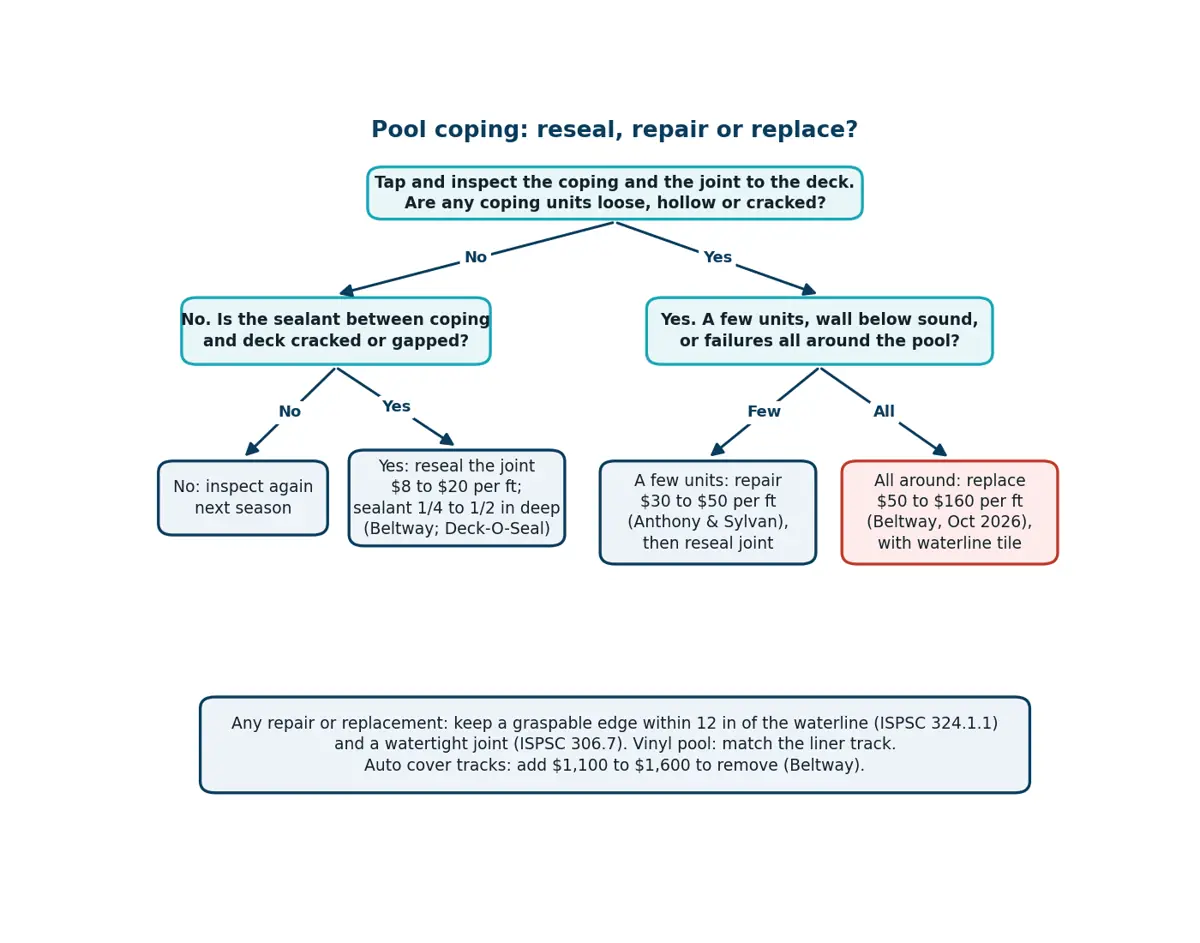
Reseal when the joint between coping and deck cracks or gaps but the stones are tight. Repair when a few units are loose, hollow or cracked and the wall beneath is sound, at $30 to $50 per linear foot (Anthony & Sylvan). Replace when failures run around the pool or the mortar bed has let go, at $50 to $160 per foot (Beltway Pools, 2026). Step-by-step resetting, mortar cure times and a one-stone to 96 ft cost table are in our pool coping repair guide.
- Sealant cracked, gapped or missing The ISPSC 306.7 joint is no longer watertight; mastic lasts 5 to 10 years (Anthony & Sylvan).
- Coping rocks or sounds hollow when tapped The mortar bed has let go under that unit; reset it before water and freeze cycles widen the gap.
- Cracked or spalled units A broken bullnose edge is no longer a safe handhold under ISPSC 324.1.2.
- Cracked waterline tile under the coping Tile and coping share the bond beam; Beltway Pools lists expansion-joint damage under old caulk among the most common finds in remodels.
- Deck heaving against the coping Deck movement is what the coping joint exists to absorb (ISPSC 306.7.1); fix the deck slope as well.
| If your situation is | Do this | Why (source) |
|---|---|---|
| Sealant between coping and deck is cracked, gapped or missing, coping is tight | Reseal the joint: backer rod plus sealant 1/4 to 1/2 in deep | ISPSC 306.7 wants a watertight joint; Deck-O-Seal 125 sizing rules |
| One or a few stones are loose or hollow-sounding, bond beam sound | Reset or repair those units, then reseal the full joint | Repair budget $30 to $50 per linear ft (Anthony & Sylvan) |
| Many units loose, cracked or spalled, or mortar bed failing all around | Replace the coping, usually with the waterline tile | Replacement $50 to $160 per linear ft (Beltway Pools, Oct 2026) |
| Pool deeper than 42 in and the new edge would not serve as a handhold | Keep a graspable edge within 12 in of the waterline, or add another handhold type | ISPSC 324.1 and 324.1.1 |
| Cold climate with freeze-thaw | Choose pavers tested to ASTM C1645, cast stone to C1364, or ask for travertine freeze data | CMHA; ASTM C1364 and C1527 scopes |
| Vinyl liner pool | Match the coping track to the liner bead, and plan the liner if the track comes out | Royal Swimming Pools; HomeGuide $8 to $12 per ft |
| Automatic cover with deck-mounted tracks | Price track removal and reinstall in the same quote | $1,100 to $1,600 to remove (Beltway Pools) |
Sources: ISPSC 2024; Deck-O-Seal 125; Anthony & Sylvan Pools; Beltway Pools; CMHA; Royal Swimming Pools; HomeGuide. Download CSV
Coping work is licensed trade work in several states. Nevada’s A-10c pool repair license, for example, names plaster, coping and coating of pool decks in its scope (NAC 624), and our pool contractor license requirements study lists the rules by state. Bundling coping with resurfacing and tile is covered on our pool remodeling page.
Pool coping ideas that also meet the numbers
Good coping ideas start with the deck, the pool shape and the climate. Match or contrast the deck color, use short units on curves, turn corners with a coined accent stone, and keep the color light where the sun is strong. Each idea below carries the maker rule or measured number behind it.
- Contrast band: a 14 or 18 in wide precast coping (Stepstone’s two widths) in a lighter or darker shade than the deck frames the water; Stepstone offers 12 standard colors on the same unit.
- Coined corners: Unilock calls a square accent stone at each 90 degree corner the easiest corner to build, with no miter cuts.
- Curved pools: units of 18 in or less flow around a kidney shape; Unilock shows 12 x 12 in units with a 1/2 to 2 in overhang.
- Long straight runs: units up to 72 in long install faster on rectangles, balanced so no short end pieces remain (Unilock).
- Cool feet: lighter coping stays cooler in sun; one paver finish tests from SRI 6 in black to SRI 67 in white (Techo-Bloc data on our pool deck materials page).
- Poured edge on a budget: a cantilever bullnose formed with the deck pour costs $6 to $15 per linear foot (River Pools, 2025).
For decks that run hot, a light cool-deck topping can run right up to the coping; our cool deck guide compares those products and their data sheets. Slip falls at the pool edge are hard to count, because NEISS injury coders file a pool deck under product code 1817 (porches, balconies, open-side floors), as our pool injury statistics report explains.
How we compiled this
We read 24 documents in October and November 2026: the 2024 ISPSC and 2024 MAHC coping, handhold and joint sections; data sheets from Stepstone, W. R. Meadows (Deck-O-Seal 125) and Mortex; Unilock’s coping install guide; ASTM scope pages for C666, C902, C1364 and C1527 and the CMHA paver tech note; a dated seller price from TravertineMart; and cost pages from River Pools, Anthony & Sylvan, Beltway Pools, HomeGuide and Pool Research. The 16 x 32 ft example multiplies published rates by 96 ft; we did not install or test any coping or collect contractor quotes.
Frequently Asked Questions
What is pool coping?
Pool coping is the cap on top of the pool wall where the water meets the deck. It protects the wall’s top edge, sheds splash water and serves as the handhold: ISPSC 324.1 requires handholds at the top of deck or coping on residential pools deeper than 42 in, within 12 in of the waterline (ISPSC 2024).
What is the best material for pool coping?
For cost, poured cantilever concrete at $6 to $15 per linear foot (River Pools, 2025). For cold climates, pick coping with a named freeze-thaw result, such as pavers meeting ASTM C1645 (225 g/m2 maximum loss after 28 cycles). Travertine and natural stone, at $40 to $60, look best but ASTM C1527 has no freeze test (CMHA).
How much does it cost to replace pool coping?
About $50 to $160 per linear foot installed in the Washington DC area, or $50 to $90 for precast concrete (Beltway Pools, October 2026). For a 16 x 32 ft pool’s 96 ft perimeter that is $4,800 to $15,360, plus $768 to $1,920 to reseal the deck joint and $1,100 to $1,600 if automatic cover tracks must come out.
Does pool coping have to overhang?
For public pools, yes: MAHC 4.5.14.4 requires 1 to 2 in of overhang from the pool wall and 4.5.14.5 caps thickness at 2.5 in (MAHC 2024). The residential ISPSC sets no overhang number but requires a graspable handhold within 12 in of the waterline. Unilock’s install guide uses about 2 in.
What goes between pool coping and the concrete deck?
A flexible joint sealant, called mastic, over a backer rod or foam. ISPSC 306.7 requires the joint to be watertight. The Deck-O-Seal 125 data sheet sets sealant depth at 1/4 to 1/2 in with width twice the depth, and Anthony & Sylvan says mastic lasts 5 to 10 years.
What is bullnose pool coping?
Bullnose coping has a rounded front edge that overhangs the water and is easy to grip. It comes in precast concrete, brick, pavers and stone; Stepstone’s Classic precast unit is 14 x 24 x 2.5 in with a 2 in bullnose (Stepstone, February 2025). Mortex’s Poly form pours the same profile in place.
Can you repair pool coping without replacing all of it?
Yes, when only some units are loose or cracked and the wall below is sound. Anthony & Sylvan budgets $30 to $50 per linear foot for coping repair, so 20 damaged feet cost about $600 to $1,000, plus a full joint reseal at $8 to $20 per foot (Anthony & Sylvan).
Sources
- International Code Council via UpCodes. International Swimming Pool and Spa Code 2024, Chapter 3 (Sections 306, 323, 324). Accessed 2026-10-26.
- Centers for Disease Control and Prevention. Model Aquatic Health Code 2024, 5th edition, Code (Sections 4.5.14, 4.8.1.2). Accessed 2026-11-02.
- W. R. Meadows. DECK-O-SEAL 125 Product Data No. 786 (January 2026). Accessed 2026-11-02.
- Stepstone, LLC. Material Product Data Sheet: Classic Pool Coping (February 2025). Accessed 2026-11-02.
- Stepstone, LLC. Material Product Data Sheet: Modern Pool Coping (February 2025). Accessed 2026-11-02.
- Unilock. How-to Install Pool Coping. Accessed 2026-11-02.
- Mortex Manufacturing. Standard Forms (cantilever coping forms). Accessed 2026-11-02.
- Concrete Masonry and Hardscapes Association. Tech Note PAV-TEC-002-22. Accessed 2026-10-26.
- ASTM International. ASTM C666/C666M-15 scope. Accessed 2026-11-02.
- ASTM International. ASTM C902-22 scope. Accessed 2026-11-02.
- ASTM International. ASTM C1364-19 scope. Accessed 2026-11-02.
- ASTM International. ASTM C1527/C1527M-23 scope. Accessed 2026-10-26.
- Tile Council of North America. ANSI A326.3-2021. Accessed 2026-10-26.
- TravertineMart. 12×24 Ivory 2 Inch Travertine Pool Coping. Accessed 2026-11-02.
- River Pools and Spas. Inground Pool Coping Idea and Cost Guide (updated August 18, 2025). Accessed 2026-11-02.
- Pool Research. Pool Coping Cost: New & Replacement (January 16, 2024). Accessed 2026-11-02.
- Beltway Pools. Pool Renovation Cost: What to Budget in VA, MD & DC (modified October 15, 2026). Accessed 2026-11-02.
- Anthony & Sylvan Pools. Pool Remodeling Costs. Accessed 2026-11-02.
- Anthony & Sylvan Pools. Pool Mastic Repair & Replacement. Accessed 2026-11-02.
- Anthony & Sylvan Pools. Inground Pool Coping Options. Accessed 2026-11-02.
- HomeGuide. Vinyl Liner Pool Cost (July 16, 2025). Accessed 2026-10-19.
- Royal Swimming Pools. Cinderella Pool Copings. Accessed 2026-11-02.
- Techo-Bloc. Solar reflectance and LEED credits (TB2025), via PC&S pool deck materials guide. Accessed 2026-10-26.
- Nevada Legislature. Nevada Administrative Code chapter 624. Accessed 2026-10-08.
Related pages
Get Quotes From Licensed Local Pool Pros
Tell us what you need and your ZIP code. We match you with pool companies that cover your area.