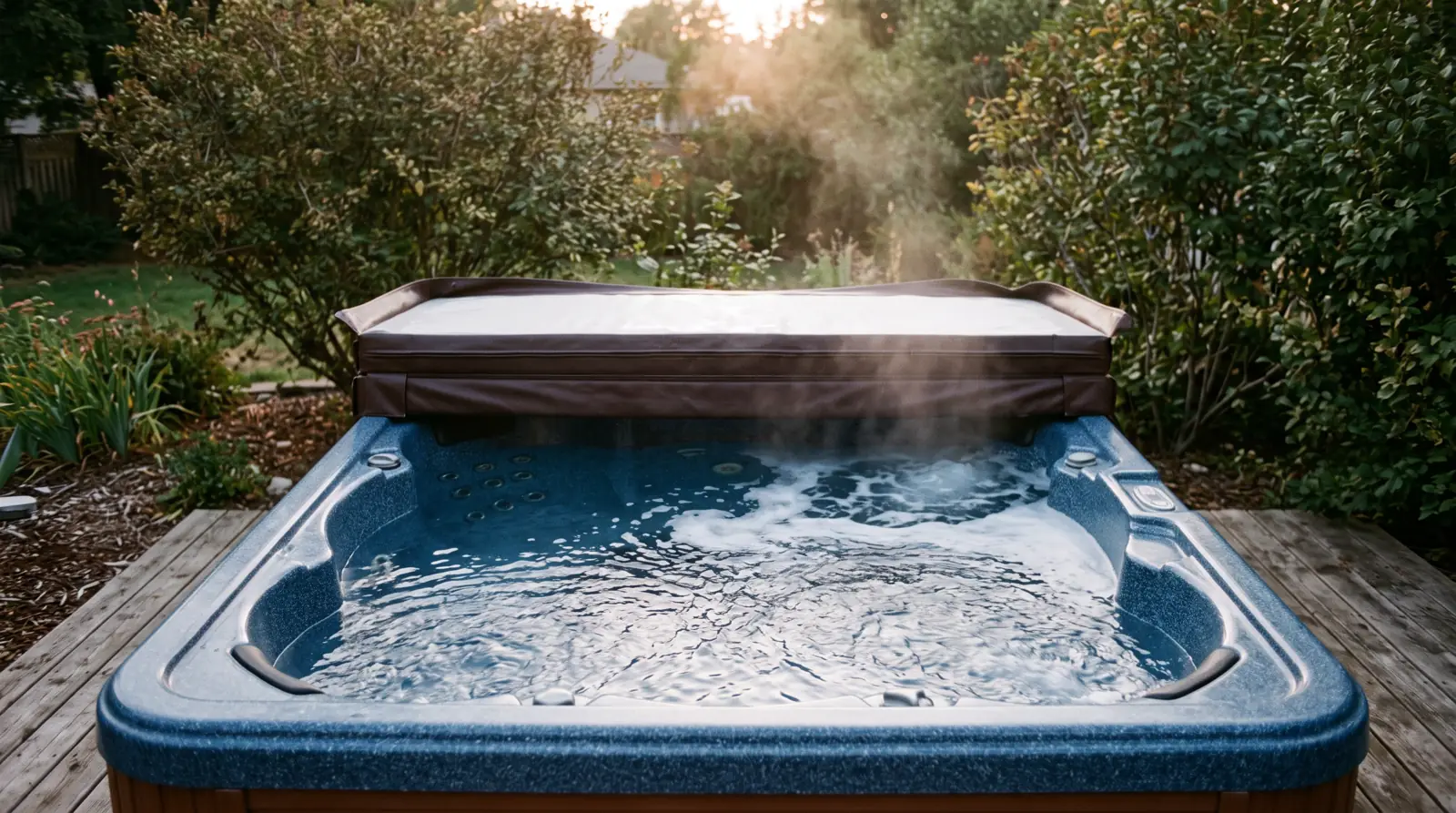
Hot Tub Foam: What Causes It and How to Get Rid of It
Hot tub foam is soap, lotion and body oil whipped up by the jets, and soft water below your maker's calcium range makes it worse: defoamer only hides it, so test, shock, clean the filter, then drain.
- ✓Ranked from 9 manualsBather soap and oils appear in 7 of 9 makers' foam advice; low calcium in 5.
- ✓Defoamer, decodedA silicone emulsion that EPA has not reviewed for efficacy or safety (2024 MAHC Annex).
- ✓Drain math2024 MAHC: gallons / 3 / daily users, so 67 days for 400 gallons and 2 users.
Key takeaways
- Bather soap, body oil and lotion is the foam cause named most often, in 7 of 9 makers’ manuals; the Caldera 2025 manual adds that soap is not oxidized by any chemical added to the spa, only by ozone.
- Low calcium hardness increases foaming in 5 of 9 manuals, but “low” depends on the maker: 75 to 150 ppm for Caldera and Hot Spring, 200 to 400 ppm ideal for Hydropool (2024).
- Spa defoamers are silicone emulsions: the Spa Pure Defoamer safety data sheet lists 5 to 10% dimethyl silicone polymer with silica, and the 2024 MAHC Annex says no federal agency, EPA included, has reviewed their efficacy or safety.
- The Master Spas Getaway 2025 manual warns that overuse of a defoamer will result in cloudy, milky water.
- The 2024 Model Aquatic Health Code (5.12.1.2.1) sets days between drains at gallons / 3 / average daily users: 67 days for a 400 gallon tub with 2 users.
- The MAHC Annex treats total dissolved solids 1,500 ppm above the fill water as the accepted level, because higher levels can cut disinfectant effectiveness by up to 50%.
What causes hot tub foam?
Foam forms when surfactants, molecules that lower water’s surface tension, are churned by the jets. In 9 makers’ manuals the most cited source is bather soap, body oil and lotion (7 manuals), then low calcium hardness (5) and laundry detergent left in swimwear (4). Hot water and a small volume concentrate all of it: a 400 gallon tub holds about 1/50 of a 20,000 gallon pool.
Coast's 2026 manual has no foam entry; Sundance names sudsing as the signal to change water. Counts only causes the manual names in its foam text.
Source: Maker owner's manuals dated 2018 to 2026, read October and November 2026. PC&S count. Download chart data (CSV)
| Cause | Manuals that list it (of 9) | Makers | What the manuals say |
|---|---|---|---|
| Bather soap, body oils, lotions and cosmetics | 7 | Bullfrog, Caldera, Catalina, Hot Spring, Hydropool, Master Spas, Nordic | Caldera and Hot Spring: soap is not oxidized by any chemical added to the spa; only ozone oxidizes it |
| Low calcium hardness (soft water) | 5 | Caldera, Hot Spring, Hydropool, Master Spas, Nordic | Caldera: low calcium hardness can increase foaming; Master Spas: use a calcium hardness increaser |
| Laundry detergent left in swimwear | 4 | Caldera, Catalina, Hot Spring, Hydropool | Catalina and Hydropool: run an extra rinse cycle when washing swimwear |
| pH or total alkalinity out of range | 3 | Hydropool, Master Spas, Nordic | Hydropool: foam is a symptom of high organic residue and/or high pH |
| Low sanitizer or too little oxidation | 2 | Master Spas, Nordic | Nordic lists inadequate oxidation; Master Spas lists low sanitizer |
| Cleaner residue on the shell or cleaner product | 2 | Master Spas, Sundance | Sundance: soap residue left on the shell can cause severe sudsing when the spa is refilled |
| Leaves, algae and other organic debris | 2 | Hydropool, Master Spas | Hydropool: maple leaves are prone to causing foam as they break down in the filter |
| Antifreeze left from winterizing | 2 | Caldera, Nordic | Caldera: a defoamer may be needed for foam caused by the antifreeze |
| Incompatible chemicals added | 1 | Nordic | Nordic lists addition of incompatible chemicals |
Sources: Bullfrog 2018; Caldera 2025; Catalina 2022; Coast 2026; Hot Spring 2026; Hydropool 2024; Master Spas Getaway 2025 and Master Spas water care guide; Nordic 2023; Sundance 2025. Read October 2026 (saved copies) and re-checked November 1, 2026. PC&S count. Download CSV
Bathers bring most of the surfactant load. In a 2019 Healthy Pools poll of 3,100 U.S. adults, 48% said they do not shower at all before swimming, per our pool hygiene statistics built on the Sachs Media topline. A shower and a swimsuit rinsed without detergent remove the two inputs Catalina and Hydropool tell owners to cut first.
Is it foam or just jet bubbles? Fine bubbles rising from the returns while the pump or ozone injector runs are aeration, not foam, according to Hydropool. Foam is a layer that stays on the surface after the jets shut off. Simple quat algaecides are another source the 2024 MAHC Annex names: overdosed, they tend to foam, while polyquats do not.
What does your test reading say is causing the foam?
Test before you add anything. Calcium hardness below your manual’s range points to soft water; pH above 7.8 or alkalinity above 120 ppm points to balance; chlorine under 3 ppm or bromine under 4 ppm points to too little oxidation. When every reading is in range and sudsing keeps returning, Sundance’s 2025 manual says the water itself is spent and due for a change.
| Test reading or sign | Likely cause | What to do first | Source |
|---|---|---|---|
| Calcium hardness below your maker's range (under 75 ppm on Caldera or Hot Spring, under 150 ppm on Catalina, Coast or Sundance) | Soft water that foams more easily | Add calcium hardness increaser up to the manual's range | Caldera 2025; Hot Spring 2026; Master Spas; Nordic; Hydropool 2024 |
| pH above 7.8 | High pH, a foam cause in two manuals | Lower pH to 7.2 to 7.8 | CDC hot tub range; Master Spas; Hydropool 2024 |
| Total alkalinity above 120 ppm | pH and alkalinity out of balance | Lower alkalinity first, then recheck pH | Nordic; Catalina 2022 (80 to 120 ppm) |
| Free chlorine below 3 ppm or bromine below 4 ppm | Too little sanitizer to oxidize bather waste | Shock, then hold the CDC minimum | CDC; Master Spas; Nordic; Bullfrog 2018 |
| Free chlorine more than 0.4 ppm below total chlorine | Combined chlorine from bather waste | Shock with chlorine or a non-chlorine oxidizer | MAHC 2024 5.7.4.4.2; Master Spas Getaway 2025 |
| Every reading in range but sudsing keeps coming back | Soap and dissolved solids built up in old water | Drain and refill | Sundance 2025; Caldera 2025 |
| TDS more than 1,500 ppm above your fill water | Dissolved solids that cut sanitizer power by up to 50% | Partial or full drain | MAHC 2024 Annex |
| Gray or dull water with foam | Excess dissolved solids | Drain | Hydropool 2024 |
| Foam right after a refill | Cleaner residue on the shell, or antifreeze left in the lines | Rinse the shell; run the filter for 1 to 2 weeks | Sundance 2025; Nordic |
| Foam after adding an enzyme product, water under 95 F | Enzyme dosed into cool water | Heat to 95 F; the label says foaming subsides | SpaGuard Natural Spa Enzyme label |
Sources: CDC hot tub guidance; MAHC 2024; MAHC 2024 Annex; Bullfrog 2018; Caldera 2025; Catalina 2022; Coast 2026; Hot Spring 2026; Hydropool 2024; Master Spas Getaway 2025 and Master Spas water care guide; Nordic 2023; Sundance 2025; SpaGuard Natural Spa Enzyme label. Download CSV
Use a DPD liquid kit for chlorine when you can: CDC says DPD kits read more accurately than strips. Free chlorine more than 0.4 ppm below total chlorine is the combined chlorine level at which the 2024 MAHC (5.7.4.4.2) requires public spas to act, by superchlorination or water exchange. Alkalinity and pH fixes for small tubs, with doses by tub size, are in our guide on how to lower pH in a hot tub.
| Number | Value | Source |
|---|---|---|
| CDC hot tub sanitizer and pH targets | Chlorine at least 3 ppm, bromine 4 to 8 ppm, pH 7.0 to 7.8 | CDC, May 2025 |
| MAHC 2024 public spa minimums | Free chlorine 3.0 ppm; bromine 4.00 ppm | MAHC 5.7.3.1.1.2.3, 5.7.3.1.2.2 |
| Days between drains | gallons / 3 / average daily users: 67 days at 400 gal and 2 users | MAHC 5.12.1.2.1 |
| Accepted total dissolved solids | 1,500 ppm above the fill water | MAHC 2024 Annex |
| Sanitizer power lost to high TDS | Up to 50% | MAHC 2024 Annex |
| Calcium hardness for water above 90 F | 100 to 200 ppm | MAHC 2024 Annex 5.7.4.4.3 |
| Calcium hardness in 8 makers' manuals | 75 to 150 ppm up to 200 to 400 ppm | Maker manuals, 2018 to 2026 |
| Silicone in one spa defoamer | 5 to 10% dimethyl silicone polymer with silica | Haviland SDS, 2015 |
| U.S. adults who do not shower before swimming | 48% (2019 poll) | Sachs Media for WQHC, via PC&S research |
Sources: CDC; MAHC 2024; MAHC 2024 Annex; maker manuals linked above; Haviland SDS; PC&S pool hygiene statistics (Sachs Media 2019). Download CSV
Why does defoamer only hide hot tub foam?
Defoamer collapses bubbles by breaking their surface tension; it does not remove the soap or oil that made them. The SpaPure label says so in plain words: it removes the foam, not the contaminants. Most spa defoamers are silicone emulsions, and the 2024 MAHC Annex notes that EPA has not reviewed the efficacy or safety of defoamers, clarifiers or flocculants.
| Product or document | What it is | Label dose | Dose for 400 gal | What the label or document says | Source |
|---|---|---|---|---|---|
| Spa Pure Defoamer SDS (Haviland, 2015) | Dimethyl silicone polymer with silica 5 to 10%; triethanolamine 1 to 5% | n/a | n/a | Rated a skin sensitizer, category 1 | Haviland SDS |
| Foam Free / Defoamer SDS (Capo Industries) | Silicone emulsion; 83% volatile by weight | n/a | n/a | No regulated components listed | Capo SDS 2007 and 2017 |
| SpaPure Defoamer label | Liquid defoamer | 1/2 oz capful where foam is heaviest | 1/2 oz, repeat as needed | Removes the foam, not the contaminants causing it | Leisure Time product page |
| SeaKlear Defoamer with Clarifier label | Defoamer with chitosan clarifier | 2 oz per 500 gal | 1.6 oz | Directions also say shock every other week | Leisure Time product page |
| FreshWater Defoamer label | Oil-free silicone compound | 1 or 2 squirts at the foam | 1 or 2 squirts | Use only when needed | Backyard Plus product page |
Sources: Haviland Spa Pure Defoamer SDS (2015); Capo Foam Free MSDS (2007); Capo Defoamer SDS (2017); SpaPure Defoamer; SeaKlear Defoamer with Clarifier; FreshWater Defoamer. Accessed November 1, 2026. Download CSV
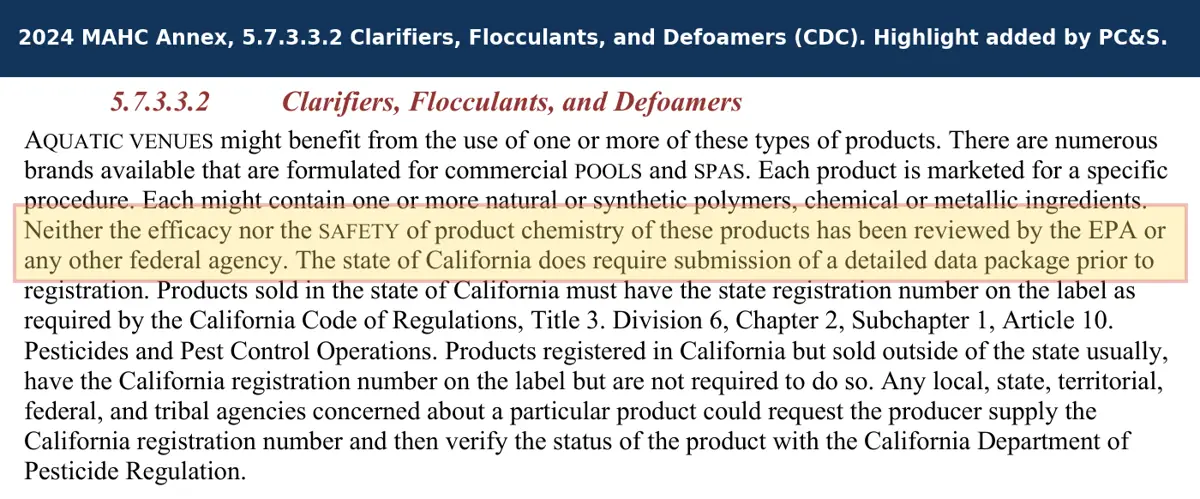
None of the three defoamer labels or three safety data sheets we read carries an EPA registration number, which fits the MAHC Annex note that EPA does not review these products. California is the exception: it requires a data package and a state registration number on labels sold there. Public spas that follow the 2024 MAHC (5.7.3.3.2) may only use defoamers certified to NSF/ANSI 50 or NSF/ANSI 60.
Defoamer also has a cost in clarity. The Master Spas Getaway 2025 manual says overuse will leave the water cloudy and milky, and the Hydropool 2024 manual calls defoamer at best a temporary remedy because foam is a symptom of improper balance. Our guide to cloudy hot tub water covers that haze by test reading. Which defoamers, enzymes and shocks belong in a starter kit, and which chemicals hot tub makers ban, is laid out in our hot tub chemicals guide.
Do enzyme products stop hot tub foam?
Enzyme labels claim to digest oils, lotions and scum, but those are label claims, not independent results. We found no peer-reviewed field trial of enzymes against hot tub foam. Label doses for the same job differ fivefold, from 0.8 to 4.0 fl oz a week in a 400 gallon tub, and two labels warn that enzymes can raise foaming for a while.
| Product (label claim, not tested by PC&S) | Label dose | Weekly dose for 400 gal (fl oz) | Claim as printed | Label caution |
|---|---|---|---|---|
| SpaGuard Natural Spa Enzyme | 1 fl oz per 100 gal weekly | 4.0 | Controls odors and scum line build-up | Water at least 95 F or foaming may increase |
| HTH Spa Enzyme Cleaner | 1 fl oz per 250 gal weekly | 1.6 | Helps remove oils that can cause foam and scum lines | Repeat daily until scum lines clear |
| Leisure Time Enzyme | 1 oz per 250 gal | 1.6 | Naturally removes lotions, oils and other contaminants | Repeat daily until scum line is gone |
| Orenda CE-SPA (chitosan plus enzymes) | 1 oz per 500 gal weekly; 2 oz initial | 0.8 | Enzymes remove non-living organic waste and oils | Enzymes can increase foaming for a while |
| SpaPure Natural Clear | About 1 oz per 500 gal weekly | 0.8 | Enzymes digest oils, soaps, lotions and organics | None printed on the page |
Sources: SpaGuard Natural Spa Enzyme; HTH Spa Enzyme Cleaner; Leisure Time Enzyme; Orenda CE-SPA; SpaPure Natural Clear. Accessed November 1, 2026. PC&S arithmetic. Download CSV
A 5 fold spread for products that make the same claim. Doses are label instructions, not test results.
Source: Product labels and product pages for SpaGuard, HTH, Leisure Time, Orenda and SpaPure, read November 1, 2026. PC&S arithmetic. Download chart data (CSV)
The closest research we found is a 2007 survey in the International Journal of Aquatic Research and Education, sponsored by the National Swimming Pool Foundation, that measured lipase activity in commercial pool and spa products with a lab assay (Rippe and Condon, 2007). It measured enzyme activity, not foam or clarity in a working tub. Master Spas says to use an enzyme only after chlorine and oxidizer have done their job.
How do you get rid of hot tub foam for good?
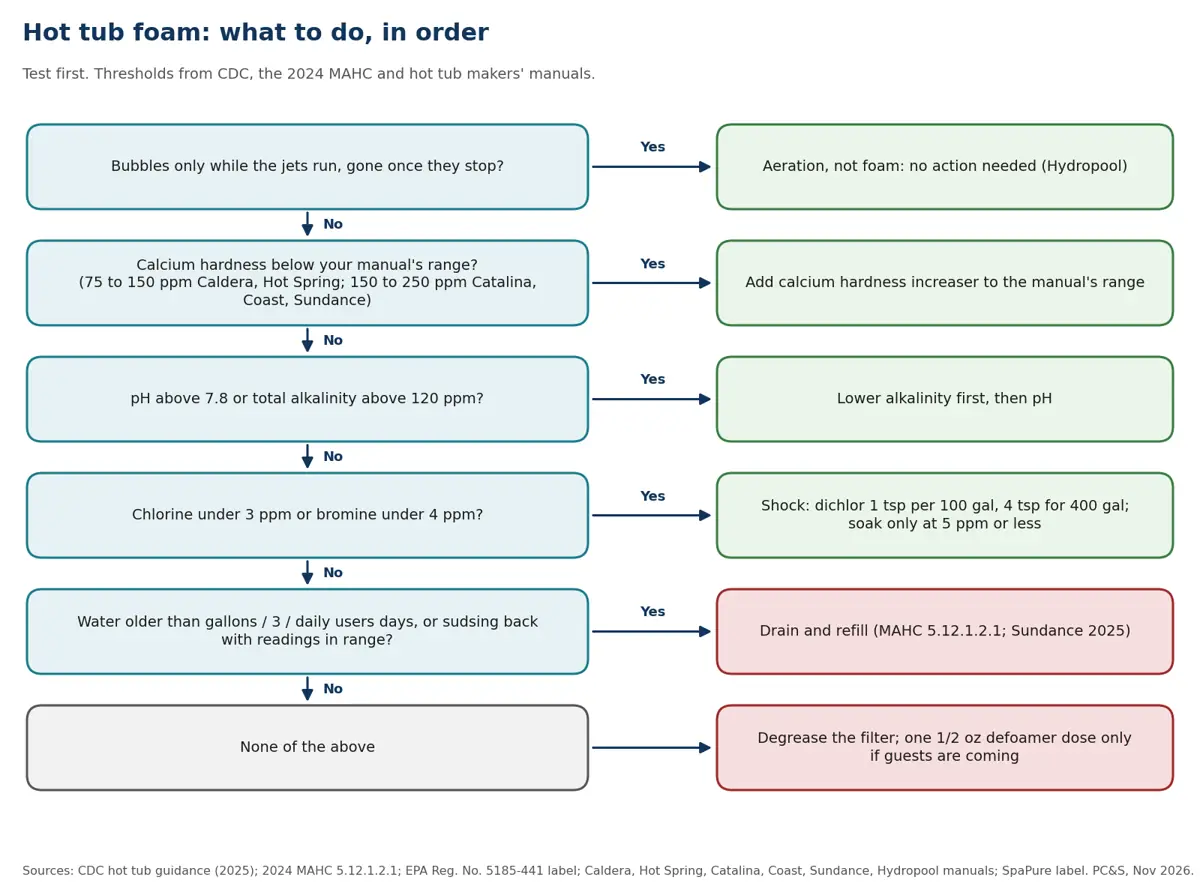
Work from cheapest to most certain: confirm it is foam, test, rebalance, shock, degrease the filter, and drain when sudsing keeps returning. Each step below carries the label or manual figure behind it. Budget about $4.30 of water for a 400 gallon refill at the median rate in our 25 city fill cost study.
- Confirm it is foamTurn the jets off; foam that stays on the surface is the problem, fine rising bubbles are aeration (Hydropool).
- Test five readingsFree and total chlorine (or bromine), pH, total alkalinity and calcium hardness; CDC targets at least 3 ppm chlorine or 4 to 8 ppm bromine and pH 7.0 to 7.8.
- Rebalance in orderAlkalinity first, then pH, then calcium hardness up to your manual’s range, for example 150 to 250 ppm for Catalina; wait 2 hours before retesting pH (Catalina 2022).
- Shock with the cover offDichlor at 1 teaspoon per 100 gallons, 4 teaspoons for 400 gallons (EPA Reg. No. 5185-441 label); stay out until chlorine is 5 ppm or lower, and leave the cover open 15 minutes (Master Spas).
- Degrease the filterHose each pleat, then soak in filter cleaner; Hydropool suggests an overnight soak when foam is the problem, and Bullfrog says degrease before any acid soak. Cartridge steps are in our guide on how to clean a hot tub filter.
- Defoam only for tonightIf guests are coming, one 1/2 oz capful where foam is heaviest (SpaPure label); repeat sparingly.
- Drain when sudsing returnsSundance says change the water when you cannot control sudsing even with balanced readings; Master Spas suggests a line flush each time you drain.
- Refill and rebalanceNever fill from a water softener (Hydropool); bring calcium into range, then sanitizer. Steps for the drain itself are in our guide on how to drain a hot tub.
| Item | Rate from the label or code | Arithmetic for a 400 gal tub | Result |
|---|---|---|---|
| Days between drains, 2 daily users (MAHC 2024) | gallons / 3 / average daily users | 400 / 3 / 2 | 67 days |
| Days between drains, 4 daily users (MAHC 2024) | gallons / 3 / average daily users | 400 / 3 / 4 | 33 days |
| Days between drains, 2 daily users (Hydropool) | liters / 13.5 / daily bathers | 400 x 3.785 = 1,514 L; 1,514 / 13.5 / 2 | 56 days |
| Dichlor shock (EPA Reg. No. 5185-441 label) | 1 teaspoon per 100 gal | 400 / 100 x 1 | 4 teaspoons |
| Dichlor shock (Leisure Time Spa 56, 55% available chlorine) | 1 oz per 500 gal | 400 / 500 x 1 = 0.8 oz; 0.8 x 28.35 g x 0.55 / 1,514 L | 0.8 oz, about 8.2 ppm |
| Defoamer (SeaKlear label) | 2 oz per 500 gal | 400 / 500 x 2 | 1.6 oz |
| Enzyme, lowest and highest label rate | 1 oz per 500 gal to 1 fl oz per 100 gal | 400 / 500 x 1; 400 / 100 x 1 | 0.8 to 4.0 fl oz a week |
| Refill water cost | $10.75 per 1,000 gal (PC&S 25 city median) | 400 x 10.75 / 1,000 | $4.30 |
Sources: MAHC 2024, 5.12.1.2.1; Hydropool 2024; EPA label 5185-441; Leisure Time Spa 56; SeaKlear; enzyme labels above; PC&S fill cost study. 1 oz = 28.35 g; 1 gal = 3.785 L. Download CSV
How often do hot tub makers say to drain, clean the filter and check calcium?
Nine makers’ manuals agree on the tasks, not the numbers. Drain intervals run from 8 to 12 weeks (Hydropool) to 180 days (Master Spas); filter cleaning from weekly sprays to every 6 weeks; calcium hardness from 75 to 150 ppm (Caldera, Hot Spring) to 200 to 400 ppm (Hydropool). Raise calcium only to your own maker’s range, since a generic 175 ppm target overshoots Caldera’s.
| Maker and document | Drain interval | Filter cleaning | Recommended calcium hardness (ppm) | What the manual says about foam |
|---|---|---|---|---|
| Bullfrog Spas, owner's manual 2018 | Every 1 to 4 months | Every 3 to 6 weeks | No number; dealer test | Foam remover is a temporary fix; super chlorinate to destroy soap agents |
| Caldera Spas, Paradise Series 2025 | About 4 months, by soap input | Monthly | 75 to 150 (salt system 25 to 75) | Foam inhibitors suppress foam but cannot remove soap |
| Catalina Spas, owner's guide 2022 | Every 4 to 6 months | Every 2 to 4 weeks | 150 to 250 | Defoamer, clean or replace the filter, extra rinse for swimwear |
| Coast Spas, Purfikt Series 2026 | Every 3 to 6 months | Rinse weekly, cleaner monthly | 150 to 250 | No foam entry in troubleshooting |
| Hot Spring, Highlife Collection 2026 | Every 3 to 4 months (up to 12 with salt system) | Monthly | 75 to 150 (salt system 50) | Foam inhibitors cannot remove soap; excessive soap may need a water change |
| Hydropool, Serenity 2024 | Every 8 to 12 weeks | Every 2 to 4 weeks; spray weekly, soak monthly | 200 to 400 ideal (150 minimum) | Defoamer is at best temporary; foam is a symptom of improper balance |
| Master Spas, Getaway 2025 | At least every 180 days | At least monthly | 180 to 250 | Overuse of a defoamer will result in cloudy, milky water |
| Nordic Hot Tubs, owner's manual 2023 | About every 3 months | Spray weekly, soak monthly | 100 to 150 ideal | Low calcium, inadequate oxidation and pH or alkalinity cause foam |
| Sundance Spas, 780 Series 2025 | About every 3 months | Stage 1 cartridge monthly | 150 to 250 | Time to change the water when you cannot control sudsing |
Manuals: Bullfrog 2018; Caldera 2025; Catalina 2022; Coast 2026; Hot Spring 2026; Hydropool 2024; Master Spas Getaway 2025 and Master Spas water care guide; Nordic 2023; Sundance 2025. Read in saved copies October 26, 2026 and re-checked November 1, 2026. Download CSV
Bullfrog's 2018 manual gives no number and asks owners to have a dealer test calcium. Salt systems run lower: 25 to 75 ppm for Caldera, 50 ppm for Hot Spring.
Source: Maker owner's manuals 2022 to 2026; 2024 MAHC Annex 5.7.4.4.3; RWP Master Dihydrate label, EPA Reg. No. 67262-1. Download chart data (CSV)
The code check uses use, not months. The 2024 MAHC drain formula gives 133 days for a 400 gallon tub with 1 daily user and 33 days with 4, and the Hydropool formula (liters / 13.5 / bathers) lands about 16% sooner. Chemical labels set their own calcium targets too: the RWP dichlor label (EPA Reg. No. 67262-1) says 175 to 225 ppm for non-plaster spas. Our hot tub maintenance schedule lays out the weekly and monthly tasks around those intervals.
Dissolved solids are the reason old water foams. Hydropool says water must be changed when dissolved solids become excessive, usually shown by gray or dull water. The Florida DOH operator manual says TDS under 2,000 ppm does not affect water balance and should be checked whenever clarity drops, and draining is the only way to lower it.
What do popular foam guides get wrong?
Several top-ranking guides repeat numbers that the primary sources do not support. The biggest gaps: a 1,500 ppm total TDS limit that is really 1,500 ppm above the fill water, chlorine targets of 1 to 3 ppm against CDC’s 3 ppm minimum, one-size calcium targets, and unlimited defoamer use. Makers also disagree on whether shock removes soap.
| What a top-ranking guide says | What the primary source says | Primary source |
|---|---|---|
| "For hot tubs, a TDS level under 1500 ppm is acceptable" (Poolonomics) | The accepted level is 1,500 ppm above the TDS of the fill water, not 1,500 ppm in total | MAHC 2024 Annex |
| Ideal chlorine 1 to 3 ppm (Swim University; Poolonomics) | At least 3 ppm chlorine in hot tubs; 3.0 ppm minimum for public spas | CDC; MAHC 5.7.3.1.1.2.3 |
| Calcium hardness 175 to 250 ppm for a hot tub (Poolonomics) | Caldera and Hot Spring manuals set 75 to 150 ppm; Hydropool 200 to 400 ppm | Maker manuals |
| Use a defoamer as needed (Swim University FAQ) | Overuse of a defoamer will result in cloudy, milky water | Master Spas Getaway manual 2025 |
| Super chlorinating destroys soap agents (Bullfrog manual 2018) | Soap is not oxidized by any chemical added to the spa; only ozone oxidizes it | Caldera 2025 and Hot Spring 2026 manuals |
Guides: Poolonomics; Swim University, accessed November 1, 2026. Primary: MAHC 2024 Annex; CDC; MAHC 2024; Bullfrog 2018; Caldera 2025; Catalina 2022; Coast 2026; Hot Spring 2026; Hydropool 2024; Master Spas Getaway 2025 and Master Spas water care guide; Nordic 2023; Sundance 2025. Download CSV
The shock question splits the makers. Bullfrog says super chlorinating destroys soap agents that normal sanitizer levels will not, while Caldera and Hot Spring say soap is not oxidized by any added chemical and only ozone breaks it down. Both camps agree on the end point: when soap builds up, change the water. Our chlorine vs bromine guide compares the two sanitizers on EPA label data.
Should you defoam, shock or drain?
Match the situation to one row. Calcium, pH and sanitizer problems get a chemical fix; foam with every reading in range, water older than the MAHC formula allows, or a ring at the waterline all point to a drain. A defoamer belongs only in the guests-are-coming row, followed by a planned water change.
| If your situation is | Do this | Why (source) |
|---|---|---|
| Fine bubbles rise from the jets or ozone line while running and vanish when off | Nothing: that is aeration, not foam | Hydropool |
| Foam with calcium hardness below your manual's range | Add calcium hardness increaser to the manual's range | Caldera, Hot Spring, Master Spas, Nordic, Hydropool |
| Foam with pH above 7.8 or alkalinity above 120 ppm | Lower alkalinity first, then pH | CDC range; Nordic; Catalina |
| Foam with free chlorine under 3 ppm or bromine under 4 ppm | Shock, then hold the CDC minimum | CDC; Bullfrog; Nordic |
| All readings in range and guests arriving | One defoamer dose, then plan a drain | SpaPure label; Caldera |
| Sudsing keeps coming back with every reading in range | Drain and refill | Sundance; Caldera |
| Water older than gallons / 3 / daily users days | Drain and refill | MAHC 5.12.1.2.1 |
| Foam right after a refill | Rinse cleaner off the shell; let the filter run | Sundance; Nordic |
| A ring or film at the waterline | Drain, wipe the shell, soak the filter overnight | Hydropool |
Sources: Hydropool; Bullfrog 2018; Caldera 2025; Catalina 2022; Coast 2026; Hot Spring 2026; Hydropool 2024; Master Spas Getaway 2025 and Master Spas water care guide; Nordic 2023; Sundance 2025; CDC; MAHC 2024; SpaPure label. Download CSV
Rather have a spa pro sort it out?
Is hot tub foam safe to soak in?
Foam itself is a symptom, but what causes it can make soaking unsafe. Bullfrog’s 2018 manual says water with significant surface foam needs treatment or draining before use, and that using it could cause irritation. Hot tubs and spas were the setting for 176 of 560 U.S. treated recreational water outbreaks from 2009 to 2023 in CDC reporting data.
Of those 176 outbreaks, 147 involved Legionella and 18 involved Pseudomonas, the germ behind hot tub rash, by our tally of CDC NORS data in the swimming pool illness outbreak registry. Keep chlorine at 3 ppm or more or bromine at 4 to 8 ppm while you work on the foam, per CDC, and stay out above 5 ppm chlorine after a shock, per the dichlor label.
How we compiled this
We read 33 documents between October 26 and November 1, 2026: nine hot tub makers’ owner’s manuals plus a Master Spas water care guide and a Hydropool foam article, the 2024 Model Aquatic Health Code and its Annex, two CDC pages, a Florida DOH operator manual, two EPA dichlor labels, one dichlor product page, three defoamer safety data sheets, three defoamer and five enzyme product pages, one enzyme study abstract and two competitor guides used only for the comparison table. Outbreak, hygiene and fill cost figures come from PC&S research built on CDC and survey data. We did not test any product; forum posts were not used.
Frequently Asked Questions
Is foam OK in a hot tub?
Fine bubbles from the returns while the jets run are normal aeration, says Hydropool; a foam layer that stays after the jets stop means soap, oil or soft water. Bullfrog’s 2018 manual says water with significant surface foam should be treated or drained before use. Test first: CDC wants at least 3 ppm chlorine or 4 to 8 ppm bromine and pH 7.0 to 7.8.
Will shock get rid of foam in a hot tub?
Sometimes. Bullfrog says super chlorinating destroys soap agents that normal sanitizer levels miss, and an EPA dichlor label sets the spa shock at 1 teaspoon per 100 gallons. Caldera and Hot Spring disagree, saying only ozone oxidizes soap. If sudsing returns after a shock and a filter soak, Sundance says change the water.
Does low calcium cause foam in a hot tub?
It can. Five of nine makers’ manuals, including Caldera 2025 and Master Spas, list low calcium hardness as a foam cause. Low is relative to your maker: 75 to 150 ppm for Caldera and Hot Spring, 150 to 250 ppm for Catalina, Coast and Sundance, 200 to 400 ppm ideal for Hydropool.
How often can you use a defoamer in a hot tub?
Only when needed. The SpaPure label doses 1/2 oz where foam is heaviest and says repeated foaming means the water may need draining. The Master Spas Getaway 2025 manual warns that overusing defoamer leaves cloudy, milky water, and Caldera notes it cannot remove soap, so frequent use means a drain is due.
Does high pH cause foam in a hot tub?
It is listed as one cause. Master Spas and Hydropool name high pH, and Nordic names pH and alkalinity out of balance, as foam contributors. CDC’s hot tub range is pH 7.0 to 7.8, and most makers aim for 7.2 to 7.6 or 7.8; lower alkalinity first if it reads above 120 ppm.
Why does my hot tub foam after I refill it?
Usually residue. Sundance says soap left on the shell can cause severe sudsing after a refill, and Nordic says antifreeze from winterizing can foam for the first week or two while the filter removes it. Rinse cleaner off the shell, never fill from a water softener (Hydropool), and rinse the filter after any cleaner soak.
Sources
- CDC. What You Can Do to Stay Healthy in Hot Tubs (May 20, 2025). Accessed 2026-10-26.
- CDC. Home Pool and Hot Tub Water Treatment and Testing. Accessed 2026-10-26.
- CDC. 2024 Model Aquatic Health Code, 5th Edition, Code Language. Accessed 2026-10-26.
- CDC. 2024 Model Aquatic Health Code, 5th Edition, Annex. Accessed 2026-11-01.
- Florida Department of Health in Collier County. Swimming Pool Operators' Manual, 2016 Version. Accessed 2026-10-26.
- CDC. NORS public dataset (via PC&S outbreak registry). Accessed 2026-10-26.
- Bullfrog Spas. Owner's Manual 2018 (rev 3.1.8). Accessed 2026-10-26.
- Caldera Spas (Watkins Wellness). Paradise Series Owner's Manual 2025. Accessed 2026-10-26.
- Catalina Spas. Owner's Guide (file dated 2022-12). Accessed 2026-10-26.
- Coast Spas. 2026 Owner's Manual, Purfikt Series. Accessed 2026-10-26.
- Hot Spring Spas (Watkins Wellness). Highlife Collection Owner's Manual 2026. Accessed 2026-10-26.
- Hydropool. Serenity Spas Owner's Manual 2024. Accessed 2026-10-26.
- Master Spas. Hot Tub Maintenance Guide (water care). Accessed 2026-10-26.
- Master Spas. Getaway Spas Owner's Manual 2025. Accessed 2026-10-26.
- Nordic Hot Tubs. Owner's Manual (file dated 2023-06). Accessed 2026-10-26.
- Sundance Spas. 780 Series Owner's Manual 2025. Accessed 2026-10-26.
- Hydropool. How to Get Rid of Foam and Bubbles in Your Hot Tub. Accessed 2026-11-01.
- U.S. EPA (PPLS). BioGuard Master Dichloro Dihydrate label, EPA Reg. No. 5185-441. Accessed 2026-10-26.
- U.S. EPA (PPLS). RWP Master Dihydrate Granular label, EPA Reg. No. 67262-1. Accessed 2026-10-26.
- Leisure Time. Spa 56 Chlorinating Granules product page. Accessed 2026-11-01.
- Haviland Consumer Products. Spa Pure Defoamer Safety Data Sheet (2015). Accessed 2026-11-01.
- Capo Industries. Foam Free Material Safety Data Sheet (2007). Accessed 2026-11-01.
- Capo Industries. Defoamer Safety Data Sheet (2017). Accessed 2026-11-01.
- Leisure Time. SpaPure Defoamer product page. Accessed 2026-11-01.
- Leisure Time. SeaKlear Defoamer with Clarifier product page. Accessed 2026-11-01.
- Backyard Plus. FreshWater Defoamer product page. Accessed 2026-11-01.
- Backyard Plus. SpaGuard Natural Spa Enzyme product page. Accessed 2026-11-01.
- HTH Pools. HTH Spa Enzyme Cleaner product page. Accessed 2026-11-01.
- Sunplay. Leisure Time Enzyme product page. Accessed 2026-11-01.
- Orenda Technologies. How to use CE-SPA. Accessed 2026-11-01.
- Leisure Time. SpaPure Natural Clear product page. Accessed 2026-11-01.
- Kennesaw State University repository. A Survey of Enzymatic Activity in Commercially Available Pool and Spa Products (2007), abstract. Accessed 2026-11-01.
- Sachs Media for the Water Quality & Health Council. Healthy Pools 2019 survey results (via PC&S hygiene research). Accessed 2026-10-08.
Related pages
Get Quotes From Licensed Local Pool Pros
Tell us what you need and your ZIP code. We match you with pool companies that cover your area.