Salt Water Pool Maintenance: Salt Levels, Cell Cleaning and Dose Math
Salt water pool maintenance: keep salt in your chlorinator's band (3,000 to 3,600 ppm ideal in most manuals), add 8.34 lb of salt per 100 ppm per 10,000 gallons, and inspect the cell every 2 to 3 months.
- ✓9 manuals comparedSalt range, stabilizer, acid mix and cell life from Hayward, Pentair, Jandy, CircuPool, AutoPilot and Intex.
- ✓Dose math shownlb = ppm x gallons x 8.34 / 1,000,000, checked against 5 maker charts.
- ✓Dated cell pricesHayward W3T-CELL-9 at $899 in June 2026, up 28.6% from $699 in July 2024 (Leslie's).
Key takeaways
- Ideal salt runs from 3,000 ppm (AutoPilot, Intex) through 3,200 ppm (Hayward AquaRite 900) to 3,600 ppm (Pentair IntelliChlor), so the right number is the one in your chlorinator’s manual.
- Raising salt 100 ppm in 10,000 gallons takes 8.34 lb; Hayward lists 267 lb to take 10,000 gallons from 0 to 3,200 ppm, which matches the formula to the pound.
- Pentair and Jandy say inspect the cell every 2 months, Hayward every 3 months or about 500 hours; most mix acid washes at 4 parts water to 1 part muriatic acid, CircuPool at 10 to 1.
- Pentair designs its IntelliChlor cell for about 10,000 hours, roughly 5 years, and a Hayward W3T-CELL-9 listed at $899 at Leslie‘s in June 2026, up from $699 in July 2024.
- The 2024 Model Aquatic Health Code (5.7.5.11) has public pools test salt at least weekly when an in-line electrolytic chlorinator is used.
- Phoenix prohibits discharging saltwater pools to the right-of-way, and Fairfax County, Virginia sends salt pool water to the sanitary sewer instead of storm drains.
What does salt water pool maintenance involve?
The same routine as any chlorine pool plus two jobs: testing salt and keeping the cell free of scale. Mahoning County Public Health puts it plainly: salt pools are still sanitized with chlorine, which the generator makes from salt. The schedule below lists each task with the interval and target from CDC, the 2024 MAHC or the maker manual.
| Task | How often | Target or trigger | Source |
|---|---|---|---|
| Test free chlorine and pH | At least twice a day in use (CDC); daily at minimum | Free chlorine 2 ppm or more with stabilizer; pH 7.0 to 7.8 | CDC home pool page (2024); MAHC 2024 5.7.3.4.1 |
| Empty skimmer and pump baskets | At least weekly | Inspect the pump basket at least once a week | Pentair SuperFlo manual |
| Test salt | At least weekly, or per the chlorinator manual | Your model's band; ideal 3,000 to 3,600 ppm across 9 manuals | MAHC 2024 5.7.5.11; maker manuals |
| Test total alkalinity | Weekly | 80 to 120 ppm (Pentair, Jandy, CircuPool) | MAHC 2024 5.7.5.5; maker manuals |
| Test stabilizer (CYA) and calcium hardness | Monthly | CYA 30 to 50 ppm for most models; calcium 200 to 400 ppm (Pentair) | MAHC 2024 5.7.5.6, 5.7.5.7 |
| Inspect the salt cell | Every 2 months (Pentair, Jandy) to 3 months or 500 hours (Hayward); monthly (Intex) | Scale or debris between the plates | Maker manuals |
| Acid wash the cell | Only when scale stays after hosing | Foaming stops; 15 to 30 minute maximum soak | Maker manuals |
| Clean the filter | At the maker's pressure rise | About 8 to 10 psi over the clean reading | Hayward and Pentair filter manuals |
| Winterize the cell | Before freezing weather | Drain the cell and lines; Hayward says freezing water damages the cell | Hayward Aqua Rite manual |
Sources: CDC; 2024 MAHC; Pentair SuperFlo manual; Pentair IntelliChlor; Jandy AquaPure; Hayward AquaRite 900; Hayward Aqua Rite; Intex 329PO. Accessed Oct 27, 2026. Download CSV
Salt itself barely moves. Hayward‘s AquaRite S3 manual says salt is constantly recycled, is not lost to evaporation, and drops mainly through splash-out, backwashing and rain dilution. What does move is pH and the cell: Mahoning County Public Health notes that pH rises as chlorine is generated and calls for frequent acid additions. The general routine for any pool, chlorine or salt, is in our guide on how to maintain a pool.
What salt level should a salt water pool have?
Use your model’s number: across 9 manuals the ideal ranges from 3,000 ppm (AutoPilot Digital Nano, Intex) to 3,600 ppm (Pentair IntelliChlor), with Hayward at 3,200 ppm. Low salt is the costly error: Jandy says below 2,000 ppm causes premature cell failure, AutoPilot below 2,500 ppm, and Pentair’s IntelliChlor turns off below 2,600 ppm.
| Chlorinator (manual) | Ideal salt, ppm | Maker's salt range, ppm | Low-salt cutoff or alarm | Stabilizer (CYA), ppm | Cell inspection interval | Acid wash mix (water to acid) | Max acid soak | Rated cell life or warranty | Manual URL |
|---|---|---|---|---|---|---|---|---|---|
| Hayward Aqua Rite (092009N Rev P, 2010) | 3,200 | 2,700 to 3,400 | Check Salt light below 2,400 | 60 to 80 | Inspect Cell light after about 500 hours | 4:1 (1 gal water to 1 qt acid) | A few minutes | 3 years residential (Hayward warranty) | https://hayward.com/media/wysiwyg/pdf/aqua_rite_product_manual.pdf |
| Hayward AquaRite 900 (092623 Rev D) | 3,200 | 2,700 to 3,400 | Check Salt flashes below 2,700 | 30 to 50 | Every 3 months or about 500 hours | 4:1 (1 gal water to 1 qt acid) | A few minutes | 3 years residential | https://hayward.com/media/akeneo_connector/asset_files/0/9/092623_RevD_53e4.pdf |
| Hayward AquaRite S3 (092769 Rev D) | 3,200 | 1,200 to 8,000 operating | Alarm default 2,700; runs to 800 | Raise to 40 | Not stated; inspect when scaled | 4:1 (1 gal water to 1 qt acid) | A few minutes | 3 years residential | https://hayward.com/media/akeneo_connector/asset_files/0/9/092769_RevD_f825.pdf |
| Pentair IntelliChlor IC15 to IC60 (520589 Rev R, 2023) | 3,600 | 3,600 to 4,500 | Off below 2,600 | 30 to 50 | Every 2 months; twice a year once 4 months stay clean | 4:1 (1 gal water to 1 qt acid) | 30 minutes | About 10,000 hours, roughly 5 years | https://www.pentair.com/content/dam/extranet/nam/pentair-pool/residential/sanitizers/intellichlor/intellichlor-installation-users-guide-ic15-ic20-ic40-ic60.pdf |
| Pentair IntelliChlor Plus and LT (523854 Rev B, 2025) | 3,600 | 2,600 to 4,500 | Warning below 3,000 | 0 to 50 | At least every 2 months | 4:1 (for example 1.4 L water to 350 mL acid) | Not stated | Plus: 3 years or 10,000 hours; LT: 2 years or 6,000 hours | https://www.pentair.com/content/dam/extranet/nam/pentair-pool/residential/sanitizers/intellichlor-plus-lt/user-documents/intellichlor-ltplus-manual-en-fr-523854.pdf |
| Jandy AquaPure (H0325600 Rev F, 2021) | 3,000 to 3,500 | 3,000 to 3,500 | Below 2,000 causes premature cell failure | 50 to 75 (75 to 85 above 86 F) | Every 2 months if it scales; at least twice a year | 4:1 (2 qt water to 1 pint acid) | 30 minutes | Not stated in manual | https://www.jandy.com/-/media/zodiac/global/downloads/jandy/water-sanitizers/h0325600.pdf |
| CircuPool CORE (R202411) | 3,500 | 3,000 to 4,000 (operates 2,000 to 7,000) | Keep above 3,000 | 30 to 50 | When the Clean Cell light comes on; a handful of times a season | 10:1 | 15 minutes | Parts free years 1 and 2, then prorated to year 8 | https://www.circupool.com/assets/doc/CircuPool-CORE-Manual.pdf |
| AutoPilot Digital Nano (LTP0086 Rev 5, 2020) | 3,000 | 3,000 to 4,500 | Below 2,500 causes premature cell failure; stops below 2,000 | 30 to 50 | When the Check/clean cell message shows | About 4:1 | 15 minutes | Not stated in manual | https://archive.autopilot.com/wp-content/uploads/LTP0086-Digital-Nano-Rev-5-10-1-2020.pdf |
| Intex Krystal Clear ECO5110/6110 (329PO R2, 2021) | 3,000 | 2,500 to 3,500 | Code 91 when salt is low | About 30 (1% of the salt weight) | Monthly | No acid: kitchen vinegar | 1 hour (vinegar) | System 2 years; electrode 1 year | https://www.intexdevelopment.com/support/downloadmnl?filename=329PO_R2_2101_EN.pdf |
Manuals: Hayward Aqua Rite (2010); Hayward AquaRite 900; Hayward AquaRite S3; Pentair IntelliChlor IC (2023); Pentair IntelliChlor Plus/LT (2025) and warranty page; Jandy AquaPure (2021); CircuPool CORE; AutoPilot Digital Nano (2020); Intex 329PO (2021). Accessed Oct 27, 2026. Download CSV
The Hayward AquaRite S3 runs from 1,200 to 8,000 ppm with 3,200 optimal; it is left off the scale. Follow the manual for the model on your pad.
Source: Sources: Hayward Aqua Rite (2010) and AquaRite 900 manuals; Pentair IntelliChlor IC (2023) and Plus/LT (2025) guides; Jandy AquaPure H0325600 Rev F (2021); CircuPool CORE (R202411); AutoPilot Digital Nano Rev 5 (2020); Intex 329PO (2021). Accessed Oct 27, 2026.. Download chart data (CSV)
Several top-ranking guides print one maker’s numbers as if they were universal: 2,700 to 3,400 ppm salt and 60 to 80 ppm stabilizer, both from Hayward’s 2010 Aqua Rite manual. Pentair asks for 3,600 to 4,500 ppm on the IntelliChlor, and Hayward’s own current AquaRite 900 manual lowers stabilizer to 30 to 50 ppm. A Pentair cell run at 3,200 ppm sits below its 3,600 ppm ideal and close to its 2,800 ppm low-salt light. A printable salt water pool chemical levels chart puts the five manuals’ ranges for salt, chlorine, pH, alkalinity, hardness and stabilizer on one page.
Too much salt is the smaller risk. Hayward says most people start to taste salt at 3,500 to 4,000 ppm and puts pool salinity at about 1/12 of the ocean; seawater runs about 35,000 ppm per the USGS, so 3,200 ppm is about 9.1% as salty. The AquaRite S3 keeps working from 1,200 to 8,000 ppm, but most other makers set corrosion limits far lower, covered further down.
How much salt to add to a pool
Pounds of salt = ppm to add x gallons x 8.34 / 1,000,000, because a gallon of water weighs 8.34 lb. That is 8.34 lb per 100 ppm per 10,000 gallons, and one 40 lb bag raises 10,000 gallons by about 480 ppm. Test first, since fill water and old chlorine already leave salt behind, then add only the difference.
| Check | Formula: ppm x gallons x 8.34 / 1,000,000 | Maker's chart says | Difference |
|---|---|---|---|
| 0 to 3,200 ppm, 10,000 gal (Hayward) | 266.9 lb | 267 lb (Hayward Aqua Rite) | +0.0% |
| 0 to 3,000 ppm, 10,000 gal (Jandy) | 250.2 lb | 250 lb (Jandy AquaPure) | -0.1% |
| 0 to 3,600 ppm, 1,000 gal (CircuPool) | 30.0 lb | About 30 lb (CircuPool CORE) | -0.1% |
| 0 to 3,000 ppm, 12,481 gal (Intex 24 ft x 52 in) | 312.3 lb | 310 lb (Intex table) | -0.7% |
| 0 ppm start, 10,000 gal (Pentair, titled 3,400 ppm) | 283.6 lb | 300.43 lb (Pentair IntelliChlor Table 1) | +5.9% |
| Raise 100 ppm in 10,000 gal | 8.34 lb | Pentair table steps: 20.86 lb per 250 ppm = 8.34 lb per 100 ppm | 0.0% |
| One 40 lb bag in 10,000 gal | 480 ppm | n/a | n/a |
| One 40 lb bag in 20,000 gal | 240 ppm | n/a | n/a |
Sources: Hayward Aqua Rite salt chart; Jandy AquaPure Table 2; CircuPool CORE; Intex salt table; Pentair IntelliChlor Table 1. PC&S arithmetic. Download CSV
Four of the five charts land within 1% of the formula. Pentair’s IntelliChlor Table 1 is titled “to obtain 3,400 ppm” but its pounds reach about 3,600 ppm, its stated ideal: 300.43 lb from zero in 10,000 gallons is 5.9% more than 3,400 ppm needs, while each 250 ppm step in the same table adds 20.86 lb, exactly 8.34 lb per 100 ppm. Our pool salt calculator runs the same formula for any pool size, bag weight and target, and works out how much water to drain after an overshoot.
| Pool size, gallons | Raise 200 ppm, lb | Raise 500 ppm, lb | Raise 1,000 ppm, lb | New fill 0 to 3,200 ppm, lb | New fill, 40 lb bags |
|---|---|---|---|---|---|
| 5,000 | 8 | 21 | 42 | 133 | 4 |
| 10,000 | 17 | 42 | 83 | 267 | 7 |
| 15,000 | 25 | 63 | 125 | 400 | 11 |
| 20,000 | 33 | 83 | 167 | 534 | 14 |
| 25,000 | 42 | 104 | 208 | 667 | 17 |
| 30,000 | 50 | 125 | 250 | 801 | 21 |
| 40,000 | 67 | 167 | 334 | 1068 | 27 |
PC&S arithmetic: lb = ppm x gallons x 8.34 / 1,000,000. New-fill bags rounded up. Target from the Hayward Aqua Rite and AquaRite 900 manuals. Download CSV
Test first: most fill water and older chlorinated pools already hold some salt, and every 40 lb bag adds about 480 ppm in 10,000 gallons.
Source: PC&S arithmetic; target from the Hayward Aqua Rite and AquaRite 900 manuals (3,200 ppm optimal). Matches Hayward's 267 lb for 10,000 gallons.. Download chart data (CSV)
- Test salt firstUse a salt meter, strips or the chlorinator readout; Pentair says its sensor reads within plus or minus 500 ppm.
- Turn the cell output downJandy says set chlorine production to 00% while salt is added; running above 00% without salt damages the cell.
- Buy the right saltSodium chloride at least 99.8% pure for Jandy, 99.0% for Hayward; no rock salt, iodized salt, anti-caking agents or calcium chloride.
- Broadcast it in the pool, pump runningSpread it around the perimeter or shallow end, never through the skimmer, main drain or surge tank (Jandy), and brush it so it does not pile up.
- Circulate 24 hours, then retestHayward, Pentair and Jandy all allow 24 hours for salt to dissolve and the reading to settle before you restart the cell.
- Wait on new plasterHayward says wait 10 to 14 days; Pentair 1 month; Jandy, CircuPool and AutoPilot 30 days. Use the longest that applies to your finish.
How do you clean a salt cell?
Hose first, acid only if scale stays. Turn the power off, remove the cell, and spray out loose scale with a garden hose. If white crust remains between the plates, soak them in diluted muriatic acid: 4 parts water to 1 part acid for Hayward, Pentair, Jandy and AutoPilot, 10 to 1 for CircuPool. Stop when the foaming stops, within 15 to 30 minutes.
- Power off and relieve pressureSwitch off the pump and chlorinator at the breaker and open the filter air relief valve (Pentair Plus/LT).
- Remove and lookUnscrew the unions and look through the cell for light, crusty or flaky deposits and for debris caught on the plates (Hayward AquaRite 900).
- Hose it outSpray both ends with a garden hose on jet; no pressure washer, screwdriver or brush, which strip the plate coating (Pentair; Hayward says plastic or wood tools only).
- Mix the acid, acid into waterHayward: 1 gallon of water to 1 quart of muriatic acid. Pentair Plus40 and Plus60: 1.4 L water to 350 mL acid. Jandy: 2 quarts water to 1 pint acid. CircuPool: 10 to 1.
- Soak until foaming stopsHayward says 15 minutes for a TurboCell; Pentair and Jandy cap it at 30 minutes; CircuPool and AutoPilot at 15. No foaming means no scale: stop.
- Rinse, reinstall, resetRinse with tap water, reinstall, then clear the Inspect Cell light (Hayward: hold the diagnostic button 3 seconds) so the 500 hour timer restarts.
Acid is the main thing that wears a cell out between scale events. Jandy warns that excessive acid washing will damage the cell, and Hayward calls it a step for severe cases only. Intex skips acid entirely on its above-ground Krystal Clear units and has owners soak the electrodes in kitchen vinegar for 1 hour.
How often should you clean a salt cell, and how long does it last?
Inspect every 2 months on Pentair and Jandy cells, every 3 months or 500 hours on Hayward, monthly on Intex, and clean only when scale shows. Pentair designs its IntelliChlor cells for about 10,000 hours, roughly 5 years, and Mahoning County Public Health puts average replacement at 5 years. Hours, not calendar years, set the clock.
| Item | Figure | Source and date |
|---|---|---|
| Pentair IntelliChlor design life | About 10,000 cell hours, roughly 5 years of average use | Pentair IntelliChlor guide, Rev R 2023 |
| Pentair IntelliChlor Plus warranty | 3 years or 10,000 hours | Pentair product page, accessed Oct 2026 |
| Pentair IntelliChlor LT warranty | 2 years or 6,000 hours | Pentair product page, accessed Oct 2026 |
| Hayward AquaRite warranty | 3 years on private residential pools | Hayward AquaRite S3 and 900 manuals |
| Average cell replacement interval | Every 5 years on average | Mahoning County Public Health fact sheet |
| Retailer estimate of cell life | 3 to 7 years depending on care | EZ Test Pools (retailer blog) |
| Hayward W3T-CELL-9 (25,000 gal) | $899; was $699 in July 2024 (+28.6%) | Leslie's list price, Wayback captures Jun 30, 2026 and Jul 19, 2024 |
| Hayward W3T-CELL-15 (40,000 gal) | $1,099; was $899 in June 2024 (+22.2%) | Leslie's list price, Wayback captures Sep 16, 2026 and Jun 23, 2024 |
| Pentair IntelliChlor Plus40 cell (523735-EC) | $1,819 | Leslie's list price, Wayback capture Sep 16, 2026 |
| Cell cost per year at a 5 year life | $899 / 5 = $180 | PC&S arithmetic |
| Pool salt, 40 lb bag | $11.99 ($0.30 per lb), unchanged from July 2024 | Leslie's list price, Wayback captures |
Sources: Pentair IntelliChlor guide; Pentair product page; Hayward AquaRite S3; Mahoning County Public Health; EZ Test Pools; Leslie’s captures: W3T-CELL-9 2026, 2024, W3T-CELL-15 2026, 2024, IntelliChlor Plus40, 40 lb salt 2026, 2024. Download CSV
Count hours the cell produces chlorine, not pump hours: Pentair's meter records only active cell time. Calendar age and scaling also end cells early.
Source: PC&S arithmetic: 10,000 / (hours per day x days per year). Rating from the Pentair IntelliChlor guide (Rev R, 2023); season lengths from the U.S. DOE pool pump analysis (2016).. Download chart data (CSV)
Season length changes the answer more than care does. Running 8 cell hours a day all year uses up 10,000 hours in 3.4 years; the same 8 hours over a 4-month May to August season, the season the U.S. Department of Energy assumes for most cold states, takes 10.2 years. Our saltwater vs chlorine cost study estimates 5.5 cell hours a day for a 25,000 gallon cell at mid chlorine demand, about 5.0 years year-round.
Replacement prices have climbed faster than salt. Leslie’s list price for a Hayward W3T-CELL-15 rose from $899 in June 2024 to $1,099 in September 2026, up 22.2%, while a 40 lb bag of pool salt stayed at $11.99. At $899 and a 5 year life, a cell costs about $180 a year. Retail equipment price trends are tracked in our pool equipment price index. Six replacement cells priced at 3, 5 and 7 year lives are compared in our salt water pool cost guide.
Why does pH rise in a salt water pool, and how much stabilizer does it need?
Electrolysis leaves excess hydroxide in the water, so pH climbs (Mahoning County Public Health): Jandy says salt pools tend to settle near pH 7.6 and CircuPool near 7.8. Lower it with muriatic acid, since Hayward and Pentair warn that dry acid by-products can damage the cell. For stabilizer, 4 of 9 manuals print 30 to 50 ppm and 3 more aim inside it; Jandy wants 50 to 75 ppm. Some owners also hold borates at 30 to 50 ppm, the range on EPA-registered borate labels, to slow that climb; our borax in pool guide covers the dose, the acid it takes and the limits.
| Reading | CDC / MAHC 2024 | Hayward AquaRite 900 | Pentair IntelliChlor IC | Jandy AquaPure | CircuPool CORE | AutoPilot Digital Nano |
|---|---|---|---|---|---|---|
| Free chlorine, ppm | At least 1; at least 2 with CYA | 1.0 to 3.0 | 2.0 to 4.0 | 1.0 to 3.0 | 1.0 to 3.0 | 2.0 to 4.0 |
| pH | 7.0 to 7.8 | 7.2 to 7.8 | 7.2 to 7.8 | 7.4 to 7.6 | 7.2 to 7.8 (7.5 best) | 7.4 to 7.6 (7.2 to 7.8 limits) |
| Total alkalinity, ppm | Test weekly (MAHC) | 80 to 120 | 80 to 120 | 80 to 120 | 80 to 120 | 80 to 100 |
| Calcium hardness, ppm | Test monthly (MAHC) | Not listed (uses saturation index) | 200 to 400 | 175 to 400 | 200 to 400 | 200 to 400 |
| Stabilizer (CYA), ppm | 90 maximum (MAHC 5.7.3.1.3.2) | 30 to 50 | 30 to 50 | 50 to 75 | 30 to 50 | 30 to 50 |
| Salt, ppm | Test at least weekly (MAHC 5.7.5.11) | 2,700 to 3,400 | 3,600 to 4,500 | 3,000 to 3,500 | 3,000 to 4,000 | 3,000 to 4,500 |
Sources: CDC; 2024 MAHC; Hayward AquaRite 900; Pentair IntelliChlor IC; Jandy AquaPure; CircuPool CORE; AutoPilot Digital Nano. Download CSV
Two maker numbers fall below health guidance. Jandy, CircuPool and Hayward list free chlorine at 1.0 to 3.0 ppm, but CDC asks for at least 2 ppm whenever stabilizer is in the water, and all three tell owners to use stabilizer. Hold 2 ppm or more. Our cyanuric acid pool guide has the 2024 MAHC’s 90 ppm cap and the drain math, and our guide on how to lower pH in pool water has acid doses by pool size.
Calcium matters more on a salt pool because scale forms first on the cell plates. Pentair asks for 200 to 400 ppm calcium hardness and says an acid wash should trigger a water test for excess hardness. Intex shortens its polarity-reversing cycle from 14 hours to 6 hours as hardness climbs from under 150 ppm to 250 to 350 ppm. Ranges by surface are in our calcium hardness guide.
Does salt water damage pool equipment, finishes or natural stone?
It can, and the makers say so. Pentair warns that any salt raises the chance of corrosion and that IntelliChlor salt above 4,500 ppm may deteriorate equipment and nearby surfaces. Jandy puts its fixture corrosion line at 6,000 ppm. Hayward’s warranty excludes natural stone damage, and Jandy tells owners to seal all masonry around a salt pool.
| Equipment or surface | Salt limit or rule | Source |
|---|---|---|
| Pentair IntelliChlor IC cell | Above 4,500 ppm may cause excessive corrosion or deterioration of equipment and surrounding surfaces | Pentair IntelliChlor guide (2023) |
| Pentair IntelliChlor Plus/LT | Above 6,000 ppm can accelerate corrosion of equipment in or around the pool | Pentair Plus/LT guide (2025) |
| Jandy AquaPure power center | Above 4,000 ppm may damage the power center; above 6,000 ppm may corrode pool fixtures | Jandy H0325600 Rev F (2021) |
| AutoPilot Digital Nano | Above 6,000 ppm not normally recommended because of corrosion | AutoPilot Rev 5 (2020) |
| Hayward heat pump | 2,700 to 5,000 ppm; above that is corrosive to the heat exchanger | Hayward heat pump manual Rev C |
| Pentair Max-E-Therm gas heater | 2,000 minimum, 3,200 ideal, 5,000 maximum | Pentair Max-E-Therm manual |
| SGM plaster finish warranty | Salt 2,500 to 3,500 ppm; no salt for the first 28 days | SGM warranty terms (2025) |
| New plaster, before adding salt | Wait 10 to 14 days (Hayward 900, S3); 30 days (Jandy, CircuPool, AutoPilot); 1 month (Pentair) | Maker manuals |
| Natural stone coping and decking | Hayward warranty excludes degradation of natural stone in or next to the pool; Jandy advises sealing all masonry | Hayward Aqua Rite manual; Jandy manual |
| Seawater for scale | About 35,000 ppm, so a 3,200 ppm pool is about 9.1% as salty | USGS; PC&S arithmetic |
Sources: Pentair IntelliChlor; Pentair Plus/LT; Jandy AquaPure; AutoPilot; Hayward heat pump manual; Pentair Max-E-Therm; SGM warranty terms; Hayward Aqua Rite; USGS. Download CSV
The plaster evidence is thinner than forum posts suggest. In the Cal Poly NPIRC test pools reported by AQUA Magazine in 2006, the salt-sanitized pools showed the most etching over about 10 months, but the generators were oversized for the 7,900 gallon test pools and could not hold chlorine steady. Finish makers handle it through warranties: SGM requires salt between 2,500 and 3,500 ppm and none for the first 28 days. Our pool finishes guide compares warranty water rules by finish.
Can you drain or backwash a salt water pool into the street?
Often not. Phoenix prohibits discharging saltwater pools and pool backwash to the right-of-way, Fairfax County, Virginia says salt pools should not go to a storm drain or stream, and Orange County, Florida asks owners to stop adding salt and chlorine several days before draining onto grass. Check your city’s stormwater page before you open a hose.
| Place | Rule for salt water pools | Source |
|---|---|---|
| Phoenix, AZ | Discharging saltwater pools and pool backwash to the right-of-way is prohibited; clean water needs a permit, under 50 gpm and under 1 ppm chlorine | City of Phoenix Water Services |
| Fairfax County, VA | Salt pools should not drain to a storm drain or stream; send debris-free salt water, including backwash, to the sanitary sewer through a household drain; never to a septic system | Fairfax County Public Works |
| Orange County, FL | Stop adding salt and chlorine several days before draining to a grassy area; total chlorine 0.01 ppm or less and pH 6.5 to 8.0 first | Orange County Environmental Protection |
| St. Pete Beach, FL | Do not drain pools into the street: chemicals in chlorinated and saltwater pools can kill fish | City of St. Pete Beach Public Works FAQ |
Sources: City of Phoenix; Fairfax County Public Works; Orange County, FL; City of St. Pete Beach. Accessed Oct 27, 2026. Download CSV
Fairfax County’s route is the household drain: debris-free salt water, backwash included, can go to the public sanitary sewer through a bathtub, sink or floor drain, but never into a septic system. Phoenix sends draining pools to the sewer clean-out at about 700 gallons an hour and caps permitted right-of-way discharges of clean water at 50 gallons a minute and 1 ppm chlorine. Pump sizes, drain times and more city rules are in our guides on how to drain a pool and how to backwash a pool filter.
Is a salt water pool harder to maintain?
Not harder, but different. You buy salt a few times a season instead of chlorine every week, then add more acid, watch one more reading and clean and eventually replace a cell. Our cost study puts a year-round 20,000 gallon salt pool at about $285 a year to run (electricity $42, salt and stabilizer $63, cell $180) before acid. If you are still on tablets, our guide on how to convert a pool to salt water sizes 13 chlorinator models and prices the switch for a 20,000 gallon pool.
| If your situation is | Do this | Why (source) |
|---|---|---|
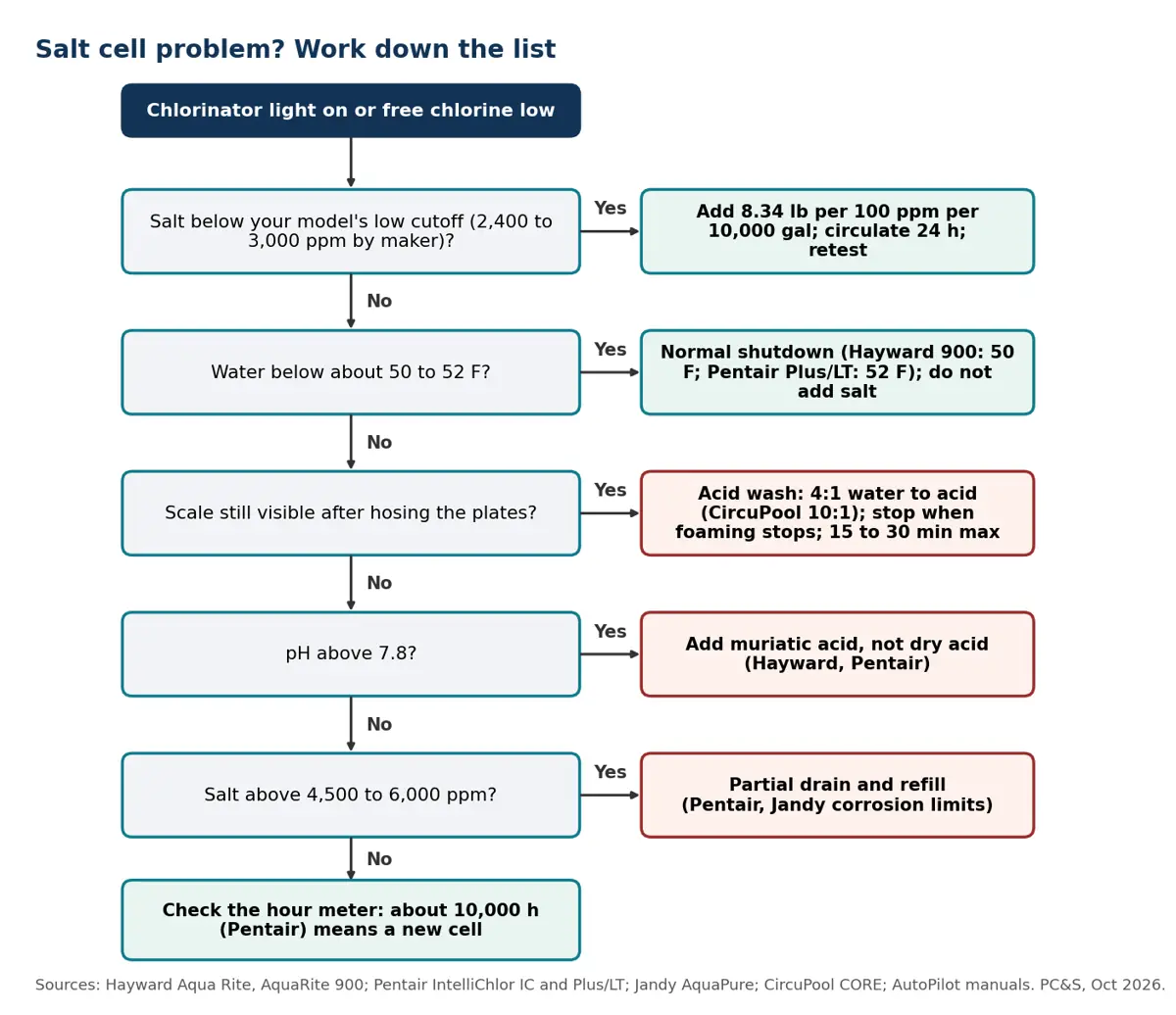
| Salt reads below your model's low cutoff (2,400 to 3,000 ppm by maker) | Add salt at 8.34 lb per 100 ppm per 10,000 gal, brush, circulate 24 hours, retest | Low salt shortens cell life: Jandy below 2,000 ppm, AutoPilot below 2,500 ppm |
| Salt is in range but free chlorine stays low | Hose the cell, look for scale; check CYA and pump hours | Hayward lists low stabilizer and short filter time (8 hours for average pools) as causes |
| Scale stays after hosing | Acid wash at the maker's mix: 4:1 water to acid for most, 10:1 for CircuPool | Pentair and Jandy cap the soak at 30 minutes, CircuPool and AutoPilot at 15 |
| No foaming when acid touches the plates | Stop: the cell does not need acid | Pentair and Jandy manuals |
| pH keeps drifting above 7.8 | Add muriatic acid, not dry acid | Hayward and Pentair say dry acid by-products can damage the cell |
| Salt reads above 4,500 to 6,000 ppm | Drain part of the water and refill with fresh water | Pentair and Jandy corrosion limits |
| Cell light stays on after a clean and salt is correct | Check the hour meter; plan a replacement cell | Pentair rates about 10,000 hours; Hayward says the cell may be worn |
| Water below about 50 to 52 F | Expect no output; lower the output setting and test chlorine instead of adding salt | Hayward AquaRite 900 stops generating below 50 F; Pentair Plus/LT below 52 F |
Sources: Hayward Aqua Rite; Hayward AquaRite 900; Pentair IntelliChlor; Pentair Plus/LT; Jandy AquaPure; CircuPool; AutoPilot. Download CSV
How we compiled this
We read 9 salt chlorinator manuals from 6 makers (Hayward, Pentair, Jandy, CircuPool, AutoPilot, Intex) plus Pentair’s warranty page and two Hayward care articles, the 2024 MAHC, CDC’s home pool page, a county health fact sheet, two heater manuals, a finish warranty, four local discharge rules and dated Leslie’s price captures, all in October 2026. The salt formula is checked against five maker charts, and cost figures come from the PC&S saltwater cost study. Forum posts were used only for question wording.
Frequently Asked Questions
What is the downside of a saltwater pool?
Higher upfront cost and a cell to replace. A Hayward W3T-CELL-9 listed at $899 at Leslie’s in June 2026, and Pentair rates its cells at about 10,000 hours. Salt pools also push pH up, so you buy more muriatic acid, and Hayward‘s warranty excludes damage to natural stone near the pool.
What chemicals do I need for my saltwater pool?
Pool salt (sodium chloride at least 99% pure), muriatic acid to lower pH, cyanuric acid stabilizer to 30 to 50 ppm for most models, baking soda for alkalinity and calcium chloride if hardness falls below 200 ppm. Keep liquid chlorine or shock on hand for a boost, and never use dry acid if your maker warns against it, as Hayward and Pentair do.
Is a salt water pool harder to maintain?
No, but the jobs change. Salt is added a few times a season instead of chlorine every week, and you add two tasks: testing salt at least weekly (2024 MAHC 5.7.5.11) and inspecting the cell every 2 to 3 months. Our cost study puts year-round running costs at about $285 a year for a 20,000 gallon pool, before acid.
How to keep a salt water pool crystal clear?
Hold free chlorine at 2 ppm or more with stabilizer (CDC), pH 7.2 to 7.8, salt at your model’s ideal, and clean the filter at its pressure rise, about 8 to 10 psi over clean on Hayward filters. Brush and vacuum weekly, and raise the cell output or run hours in hot weather.
How many 40 lb bags of salt do I need for my pool?
Divide the pounds needed by 40. A new 10,000 gallon fill to 3,200 ppm takes 267 lb, so 7 bags; 20,000 gallons takes 534 lb, or 14 bags. Each 40 lb bag raises 10,000 gallons by about 480 ppm and 20,000 gallons by about 240 ppm, so top-ups usually take one or two bags.
How often does a salt cell need to be cleaned?
Only when you see scale. Inspect every 2 months for Pentair and Jandy, every 3 months or about 500 hours for Hayward, monthly for Intex. Pentair drops to twice a year once 4 months of inspections stay clean. Hard water or a high saturation index means more frequent cleaning.
Can you add too much salt to a salt water pool?
Yes. Most people taste salt at 3,500 to 4,000 ppm (Hayward), Pentair warns IntelliChlor salt above 4,500 ppm may corrode equipment, and Jandy says above 4,000 ppm may damage its power center. Salt does not evaporate, so the fix is draining part of the water and refilling with fresh water. Our pool salt calculator gives the share to drain: 1 minus target divided by current, or 20% from 4,000 to 3,200 ppm.
Sources
- CDC. Home Pool and Hot Tub Water Treatment and Testing. Accessed 2026-10-27.
- CDC. 2024 Model Aquatic Health Code, 5th Edition, Code Language. Accessed 2026-10-27.
- Hayward. Aqua Rite Electronic Chlorine Generator manual (092009N Rev P, 2010). Accessed 2026-10-27.
- Hayward. AquaRite 900 Series Owner's Manual (092623 Rev D). Accessed 2026-10-27.
- Hayward. AquaRite S3 Owner's Manual (092769 Rev D). Accessed 2026-10-27.
- Hayward. How to Clean Your Hayward Salt Chlorinator Turbo Cell. Accessed 2026-10-27.
- Hayward. How To Take Care of a Saltwater Pool (2023). Accessed 2026-10-27.
- Hayward. Heat pump owner's manual (51300122601 Rev C). Accessed 2026-10-27.
- Pentair. IntelliChlor Installation and User's Guide, IC15 to IC60 (P/N 520589 Rev R, 2023). Accessed 2026-10-27.
- Pentair. IntelliChlor Plus and LT Installation and User's Guide (P/N 523854 Rev B, 2025). Accessed 2026-10-27.
- Pentair. IntelliChlor Plus and LT product page and warranty FAQ. Accessed 2026-10-27.
- Pentair. Max-E-Therm heater installation and user's guide. Accessed 2026-10-27.
- Pentair. SuperFlo pump installation and user's guide. Accessed 2026-10-27.
- Jandy (Zodiac Pool Systems). AquaPure and PureLink Installation and Operation Manual (H0325600 Rev F, 2021). Accessed 2026-10-27.
- CircuPool. CORE Series Salt Systems manual (R202411). Accessed 2026-10-27.
- AutoPilot. Pool Pilot Digital Nano and Nano+ manual (LTP0086 Rev 5, 2020). Accessed 2026-10-27.
- Intex. Krystal Clear Saltwater System ECO5110/6110 manual (329PO R2, 2021). Accessed 2026-10-27.
- Mahoning County Public Health. Pools Equipped With a Chlorine Generator From Salt (fact sheet). Accessed 2026-10-27.
- EZ Test Pools (retailer). Extending the Life of Your Hayward Salt System Cell. Accessed 2026-10-27.
- Leslie's. Hayward W3T-CELL-9 listing, Wayback capture Jun 30, 2026. Accessed 2026-10-27.
- Leslie's. Hayward W3T-CELL-9 listing, Wayback capture Jul 19, 2024. Accessed 2026-10-27.
- Leslie's. Hayward W3T-CELL-15 listing, Wayback capture Sep 16, 2026. Accessed 2026-10-27.
- Leslie's. Hayward W3T-CELL-15 listing, Wayback capture Jun 23, 2024. Accessed 2026-10-27.
- Leslie's. Pentair IntelliChlor Plus40 replacement cell listing, Wayback capture Sep 16, 2026. Accessed 2026-10-27.
- Leslie's. Leslie's Pool Salt 40 lb listing, Wayback capture Jun 30, 2026. Accessed 2026-10-27.
- U.S. Geological Survey. Saline Water and Salinity. Accessed 2026-10-27.
- SGM. Pool and Spa Finish Warranty Terms. Accessed 2026-10-27.
- City of Phoenix Water Services. Draining and Backwashing Your Pool. Accessed 2026-10-27.
- Fairfax County Public Works. Proper Discharge of Swimming Pool Water. Accessed 2026-10-27.
- Orange County, Florida. Pool Pollution Prevention. Accessed 2026-10-27.
- City of St. Pete Beach. Why can't I drain my pool into the street? (FAQ). Accessed 2026-10-27.
- U.S. Department of Energy. Dedicated-Purpose Pool Pumps Technical Support Document (2016). Accessed 2026-10-27.
- AQUA Magazine. Scratching the Surface (Cal Poly NPIRC plaster study report, 2006). Accessed 2026-10-27.
- National Pesticide Information Center. Pool Chemicals fact sheet. Accessed 2026-10-27.
- Knorr Systems. Chemical dosing charts and safety notes. Accessed 2026-10-27.
- Leslie's. Leslie's Pool Salt 40 lb listing, Wayback capture Jul 19, 2024. Accessed 2026-10-27.
- Pool Construction & Service. Saltwater Pool vs Chlorine: 10-Year Costs (PC&S research, cost model inputs). Accessed 2026-10-27.
Related pages
Get Quotes From Licensed Local Pool Pros
Tell us what you need and your ZIP code. We match you with pool companies that cover your area.