Ideal Pool Temperature: Ranges by Use and Age, and What Each Degree Costs
The ideal pool temperature for most backyard swimming is 78 to 82 F, DOE's typical range; racing pools run 77 to 82.4 F, and Red Cross guidance calls for 84.2 F or warmer for children's lessons.
- ✓18 uses, each with its sourceWorld Aquatics, the American Red Cross, the Arthritis Foundation, AEA, CPSC and the CDC's MAHC, with rule numbers.
- ✓Cost of each degree in 13 citiesDOE's heat pump tables repriced at 2025 energy prices: $101 to $501 a season per degree, uncovered.
- ✓Limits from 60.8 F to 104 FWhere cold shock starts, where codes cap hot water, and what pregnant swimmers should avoid.
Key takeaways
- Pool water typically runs 78 F to 82 F, and each degree warmer adds 10% to 30% to heating energy cost depending on location (DOE Energy Saver, archived Jan 1, 2026).
- Competition pools must hold 25 C to 28 C (77 F to 82.4 F) under World Aquatics rule 16.2.13.1, in force since Jan 1, 2024 (World Aquatics).
- The American Red Cross Scientific Advisory Council (June 2018) sets 89.6 F (32 C) or warmer for infant and preschool classes, 84.2 F (29 C) or warmer for lessons at ages 6 to 15, and 78.8 F to 82 F for intense activity (Red Cross advisory).
- The Arthritis Foundation recommends 83 F to 90 F for warm water exercise, and the Aquatic Exercise Association lists 91 F to 95 F for therapy and rehab (Arthritis Foundation; AEA via USA Swimming).
- Hot tub water should never exceed 104 F, and 100 F is the limit CPSC gives for pregnant women (CPSC); the 2023 Model Aquatic Health Code caps every public aquatic venue at 104 F (MAHC 5.7.4.7.2).
- In DOE’s city tables repriced at 2025 energy prices, holding an uncovered 1,000 sq ft pool 1 F warmer with a heat pump adds $101 a season in Seattle to $501 in Los Angeles (PC&S cost-to-heat study).
What is the ideal pool temperature?
For most backyard swimming the ideal pool temperature is 78 F to 82 F, the range the U.S. Department of Energy calls typical. The right number then shifts with activity and age: racers and lap swimmers sit at the low end, children’s lessons start at 84.2 F, and therapy pools run 91 F to 95 F.
| Use | Water temperature (F) | Water temperature (C) | Source |
|---|---|---|---|
| Backyard pool, typical range | 78 to 82 | 25.6 to 27.8 | DOE Energy Saver (archived Jan 1, 2026) |
| Competition swimming pool | 77 to 82.4 | 25 to 28 | World Aquatics Competition Regulations Part 2, 16.2.13.1 (in force Jan 1, 2024) |
| Masters swimming competition pool | 77 to 82 | 25.0 to 27.8 | U.S. Masters Swimming rule book, as reported by USMS (2019) |
| Swim team and lap swimming | 78 to 82 | 25.5 to 27.5 | Aquatic Exercise Association guidelines, via USA Swimming |
| Intense training (lifeguard and instructor courses) | 78.8 to 82 | 26 to 28 | American Red Cross Scientific Advisory Council (June 2018) |
| Artistic swimming competition | 80.6 or warmer | 27 or warmer | FINA Facilities Rules 2021 to 2025, FR 5.1.5.2 |
| Children's swim lessons (AEA) | 82 or warmer | 27.5 or warmer | Aquatic Exercise Association, via USA Swimming |
| Learn to swim, ages 6 to 15 (30 to 45 minutes) | 84.2 or warmer | 29 or warmer | American Red Cross Scientific Advisory Council (June 2018) |
| Infant and preschool classes (20 to 30 minutes) | 89.6 or warmer | 32 or warmer | American Red Cross Scientific Advisory Council (June 2018) |
| Water fitness classes | 83 to 86 | 28 to 30 | Aquatic Exercise Association, via USA Swimming |
| Pregnancy exercise | 78 to 84 | 25.5 to 29 | Aquatic Exercise Association, via USA Swimming |
| Multiple sclerosis exercise | 80 to 84 | 26.5 to 29 | Aquatic Exercise Association, via USA Swimming |
| Older adults, low intensity | 86 to 88 | 30 to 31 | Aquatic Exercise Association, via USA Swimming |
| Warm water exercise for arthritis | 83 to 90 | 28.3 to 32.2 | Arthritis Foundation |
| Therapy and rehabilitation | 91 to 95 | 33 to 35 | Aquatic Exercise Association, via USA Swimming |
| UK hydrotherapy pools, normal operating range | 93.2 to 95 | 34 to 35 | ATACP guidance as summarized for the Chartered Society of Physiotherapy |
| Open water races | 60.8 to 87.8 | 16 to 31 | FINA Facilities Rules FR 7.1.6.4; USMS caps races of 5 km or longer at 85 F |
| Hot tub | 100 safe for a healthy adult; 104 maximum | 37.8; 40.0 | CPSC (release dated Dec 31, 1979); MAHC 2023, 5.7.4.7.2 |
Sources: DOE (archived); World Aquatics 16.2.13.1; USMS; AEA via USA Swimming; American Red Cross SAC 2018; FINA Facilities Rules 2021 to 2025; Arthritis Foundation; ATACP via CSP; CPSC; MAHC 2023. Celsius converted by PC&S where a source gives only F. Download CSV
Scale starts at 0 F; the limits diagram below zooms in on 60 F to 105 F.
Source: DOE; World Aquatics 16.2.13.1; American Red Cross SAC 2018; AEA via USA Swimming; Arthritis Foundation; CPSC. Download chart data (CSV)
DOE adds that 78 F may be too cool for young children and the elderly, who may need 80 F or higher (DOE Energy Saver, archived). That makes 80 F to 82 F the practical setting for a family pool with mixed ages, and 78 F the setting for adults swimming laps who are also paying the heating bill.
| What some guides say | Who says it | What the primary source shows |
|---|---|---|
| The American Red Cross recommends 78 F for competitive swimming | DOE Energy Saver page (archived Jan 1, 2026) | The Red Cross Scientific Advisory Council's June 2018 advisory gives 78.8 F to 82 F (26 C to 28 C) for intense activity; competition limits come from World Aquatics, 77 F to 82.4 F. |
| The Red Cross recommends 78 F to 85 F | Poolwerx | The 2018 advisory sets ranges by activity and age: 78.8 F to 82 F for intense work, 84.2 F to 89.6 F for low intensity, 89.6 F or warmer for infants. |
| The Red Cross suggests at least 84 F for children's lessons | Imagine Pools | Close: 84.2 F (29 C) or warmer for ages 6 to 15, and 89.6 F (32 C) or warmer for infant and preschool classes. |
| 78 F is the minimum swimming pool temperature | Latham Pool | World Aquatics allows 77 F (25 C) for competition, and USMS allows open water races down to 60.8 F. |
| The CDC Model Aquatic Health Code recommends 88 F or below for vigorous activity | Aquatic Therapy University | The 2023 MAHC text sets a 104 F maximum (5.7.4.7.2) and says temperature should be planned by risk, use and age (5.7.4.7.1); we found no 88 F figure in it. |
Sources: DOE (archived); Poolwerx; Imagine Pools; Latham Pool; Aquatic Therapy University; American Red Cross SAC 2018; World Aquatics; USMS; MAHC 2023. Download CSV
What temperature do competition and lap pools use?
Competition pools hold 25 C to 28 C, or 77 F to 82.4 F, under World Aquatics rule 16.2.13.1, and U.S. Masters Swimming uses 77 F to 82 F. Training groups land in the same band: the Aquatic Exercise Association lists 78 F to 82 F for swim team and lap swimming, and the Red Cross 78.8 F to 82 F for intense activity.
Cooler water suits hard swimming because the body makes heat as effort rises. The Red Cross advisory says thermal balance can be reached at the lower end of a range as intensity increases, while longer immersion lowers core temperature. Artistic swimming runs warmer, at 27 C (80.6 F) or more under FINA rule FR 5.1.5.2, because swimmers hold positions instead of swimming laps.
Open water races follow wider limits. FINA rule FR 7.1.6.4 sets 16 C to 31 C (60.8 F to 87.8 F), and U.S. Masters Swimming caps races of 5 km or longer at 85 F (USMS). A backyard pool kept near 78 F to 80 F sits inside every racing range listed here.
What pool temperature is best for babies, kids and older swimmers?
Warmer than for adults. The American Red Cross Scientific Advisory Council sets 89.6 F (32 C) or warmer for infant and preschool classes of 20 to 30 minutes and 84.2 F (29 C) or warmer for lessons at ages 6 to 15. The Aquatic Exercise Association lists 83 F to 86 F for older adults at moderate effort and 86 F to 88 F at low effort.
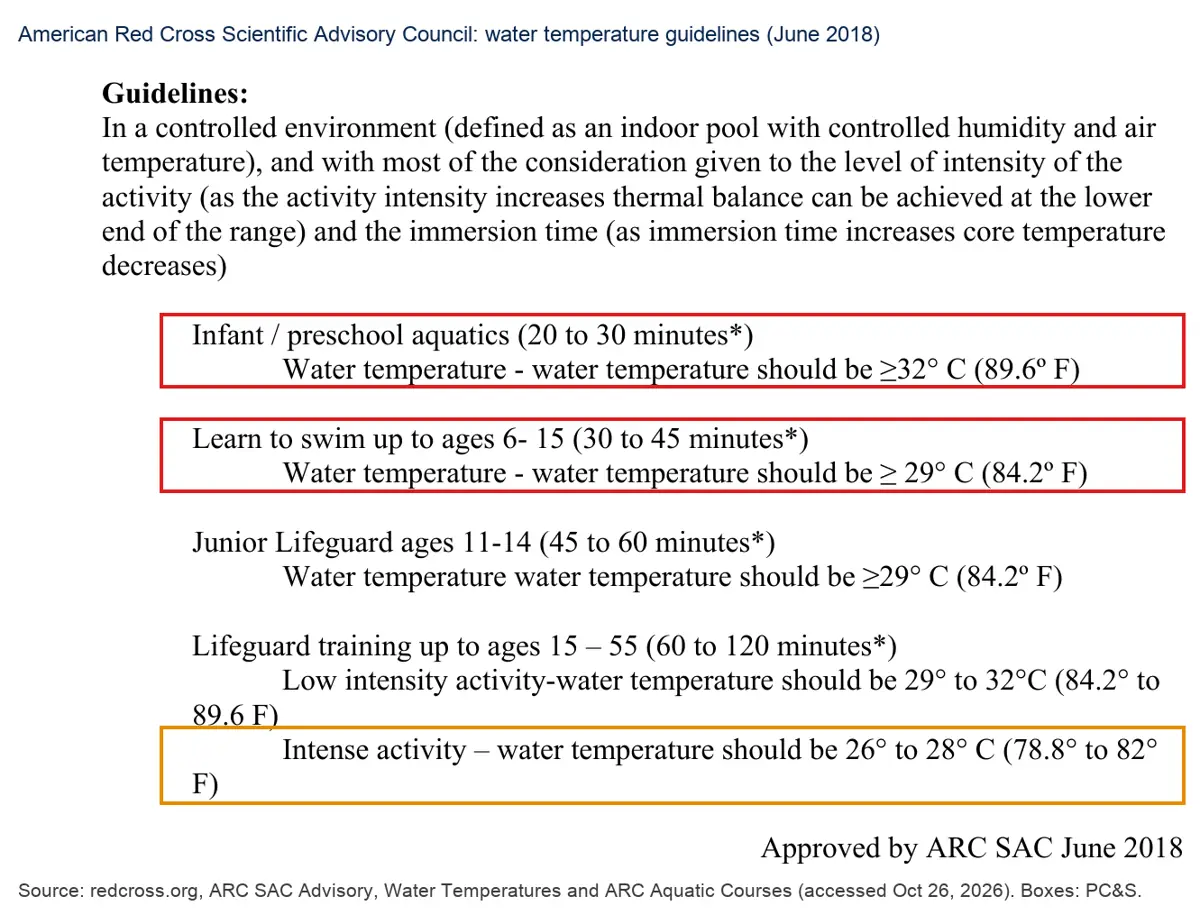
Session length matters as much as the number. The Red Cross pairs each temperature with an immersion time and tells instructors to shorten sessions, add activity or add safe head and body covering when water is below the guideline (Red Cross). Signs to end a session include shivering, numbness, a glassy stare or weakness. For children’s lessons the AEA lists 82 F or warmer (AEA), and our swimming ability report shows why lesson pools matter.
For a home pool, that means a pool held at 80 F works for adults and older children who keep moving, while a toddler class or a grandparent floating for an hour needs 84 F or more. Heating from 80 F to 84 F is a four-degree step, which DOE’s 10% to 30% per degree rule turns into a 46% to 186% higher heating bill.
What temperature do therapy and arthritis pools use?
Warm water exercise for arthritis runs 83 F to 90 F, per the Arthritis Foundation, and the Aquatic Exercise Association lists 91 F to 95 F for therapy and rehab, with many therapies workable at 87 F. UK hydrotherapy pools operate at 34 C to 35 C (93.2 F to 95 F) under guidance summarized for the Chartered Society of Physiotherapy.
Some conditions call for cooler water. The AEA lists 80 F to 84 F for multiple sclerosis and 78 F to 84 F for pregnancy, noting that warmer water can cause adverse effects (AEA via USA Swimming). The Red Cross notes that some state codes require medical permission for pregnant women, the elderly and people with heart disease, diabetes or blood pressure problems before entering a spa or hot tub above 90 F (Red Cross).
Warm therapy water also needs more water treatment. The 2023 Model Aquatic Health Code requires spa, therapy and exercise pools at 93 F to 104 F to turn over their full volume every 30 minutes or less, against 1 to 4 hours for the same pools at 72 F to 93 F (MAHC 2023, Table 4.7.1.10).
How cold is too cold, and how hot is too hot, for a pool?
Below 77 F, sudden immersion can trigger gasping, per the National Weather Service, and below 70 F swimming raises heart rate and blood pressure, per U.S. Masters Swimming. At the hot end, CPSC sets 104 F as the hot tub maximum and 100 F as safe for a healthy adult, and the 2023 MAHC caps every public aquatic venue at 104 F.
| Water temperature | What happens or what the rule says | Source |
|---|---|---|
| 104 F (40 C) | Maximum for hot tubs and for any public aquatic venue | CPSC; MAHC 2023, 4.12.1.7 and 5.7.4.7.2 |
| 102 F | CPSC warns pregnant women that soaking above this in the first three months can harm the fetus; it advises a 100 F maximum | CPSC release 79-071 |
| 100 F | Considered safe for a healthy adult in a hot tub | CPSC release 79-071 |
| 93 F to 104 F | Spa, therapy and exercise pools in this range need full turnover every 30 minutes or less | MAHC 2023, Table 4.7.1.10 |
| 90 F (32 C) | Some state pool codes require heated pools above this to close | American Red Cross Scientific Advisory Council (2018) |
| 77 F (25 C) | Gasping or rapid breathing on sudden immersion can start in water this warm; also the World Aquatics competition minimum | National Weather Service; World Aquatics 16.2.13.1 |
| Below 70 F | Swimming raises heart rate and blood pressure | U.S. Masters Swimming (2019) |
| Below 64 F | Risk of cardiac arrest keeps rising | U.S. Masters Swimming (2019) |
| 60.8 F (16 C) | Minimum water temperature for open water races | FINA FR 7.1.6.4; U.S. Masters Swimming |
| 50 F to 60 F | Cold shock can be as severe as in 35 F water | National Weather Service |
Sources: CPSC release 79-071; MAHC 2023; American Red Cross SAC 2018; National Weather Service; World Aquatics; USMS; FINA FR 7.1.6.4. Download CSV
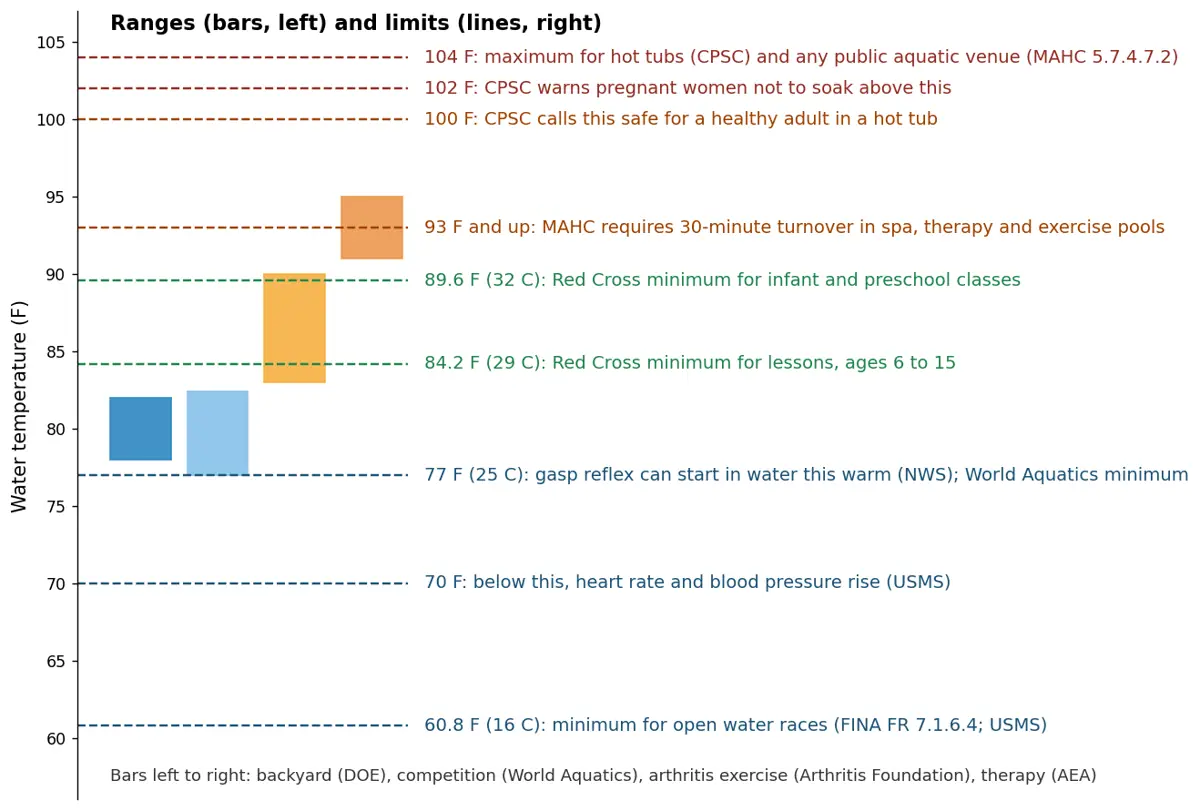
Is 72 too cold to swim in a pool? For most people, yes for anything but a short or hard swim. 72 F is 5 F below the World Aquatics racing minimum of 77 F, and the National Weather Service says the gasp reflex can start in water as warm as 77 F. Adults swimming hard laps tolerate it better than children, who need 84.2 F for lessons.
Is 90 degrees warm for a pool? Yes. 90 F sits at the top of the Arthritis Foundation’s 83 F to 90 F exercise range and above every racing range, and the Red Cross notes that some state codes close heated pools above 90 F (32 C). It suits infant classes, which need 89.6 F, but it is too warm for lap swimming.
How much does each degree of pool temperature cost?
DOE says each degree warmer adds 10% to 30% to heating energy cost, depending on location. Working through DOE’s own city tables, a heat pump holding an uncovered 1,000 sq ft pool 1 F warmer adds 7.7% (Seattle) to 14.1% (Atlanta) to the season’s bill, or $101 to $501 at 2025 prices. With a cover the dollar cost falls but the percentage rises.
| City | DOE season | Heat pump season cost at 78 F, no cover ($, 2025 prices) | At 82 F, no cover ($) | Added cost per 1 F, no cover ($ per season) | Added cost per 1 F, no cover (%) | Added cost per 1 F, with cover (%) | Gas heater: added cost per 1 F, no cover (%) |
|---|---|---|---|---|---|---|---|
| Miami | 1/1 to 12/31 | 1,917 | 3,215 | 325 | 13.8 | 17.5 | 13.9 |
| Phoenix | 3/1 to 10/31 | 1,240 | 1,987 | 187 | 12.5 | 34.0 | 12.5 |
| Dallas (DOE heat pump table anomaly, see note) | 4/1 to 10/31 | 647 | 2,227 | 395 | 36.2 | 22.7 | 12.9 |
| Atlanta | 4/1 to 10/31 | 1,470 | 2,493 | 256 | 14.1 | 17.0 | 14.0 |
| Los Angeles | 5/1 to 10/31 | 3,556 | 5,560 | 501 | 11.8 | 29.6 | 11.7 |
| Kansas City | 5/1 to 10/31 | 1,132 | 1,877 | 186 | 13.5 | 16.8 | 13.5 |
| New York | 5/1 to 9/30 | 2,235 | 3,686 | 363 | 13.3 | 17.5 | 13.3 |
| Chicago | 5/1 to 9/30 | 1,682 | 2,635 | 238 | 11.9 | 16.8 | 11.8 |
| Denver | 5/1 to 8/31 | 1,634 | 2,325 | 173 | 9.2 | 21.1 | 9.2 |
| Boston | 5/1 to 8/31 | 3,047 | 4,458 | 353 | 10.0 | 18.2 | 10.0 |
| Minneapolis | 6/1 to 9/30 | 1,279 | 2,015 | 184 | 12.0 | 17.5 | 13.1 |
| San Francisco | 6/1 to 8/31 | 2,982 | 4,136 | 289 | 8.5 | 26.2 | 8.6 |
| Seattle | 6/1 to 8/31 | 1,173 | 1,577 | 101 | 7.7 | 17.0 | 7.7 |
Sources: DOE heat pump cost table and DOE gas cost table (archived Jan 1, 2026; undated prices); 2025 repricing from the PC&S cost-to-heat study using EIA electricity prices; PC&S calculation. Download CSV
Dallas is left out of the chart: DOE's heat pump table jumps from $491 at 78 F to $1,321 at 80 F, while its gas table rises 27%.
Source: DOE Energy Saver heat pump cost table (archived Jan 1, 2026), repriced in the PC&S cost-to-heat study from EIA 2025 prices. Download chart data (CSV)
Covered pools lose less heat, so each degree is a larger share of a much smaller bill: 16.8% to 34.0% per degree in DOE’s covered heat pump figures. DOE also says a cover saves 50% to 70% of heating cost (DOE, archived). Raising the setting once costs little: a 16 x 32 ft pool holds about 17,234 gallons, so each 1 F takes 143,731 Btu, about $1.54 with a heat pump or $4.48 with gas at July 2026 US average prices (EIA). Holding the extra degree all season is what costs hundreds.
Dallas is left out of the chart. DOE’s heat pump table for Dallas jumps from $491 at 78 F to $1,321 at 80 F, a 169% step, while its gas table for the same city rises 27%, which points to an error in the heat pump figure. Heater size also sets which temperature you can hold in spring; our pool heater sizing guide works that out by city.
How do you keep a pool at the ideal temperature?
Measure the water, set the heater to the target for the people using the pool, and cover it whenever nobody is swimming. DOE says a cover saves 50% to 70% of heating cost and that turning the heater down for several days away saves energy, because reheating does not use more than holding the temperature. How many hours each heater needs to reach your target is worked out in our guide to how long it takes to heat a pool.
- Measure with a thermometerCPSC warns that hot tub thermostats may be off by as much as 4 degrees, so check the water with an accurate thermometer before trusting the setting.
- Set the target by use80 F to 82 F for a mixed family pool, 78 F for lap swimming, 84.2 F or more for children’s lessons (Red Cross), 83 F to 90 F for arthritis exercise (Arthritis Foundation).
- Cover the pool when not in useDOE: 50% to 70% lower heating cost. California’s Title 24 Section 110.4(b)3 requires a cover on heated outdoor pools.
- Turn it down when you are awayLower the setting or switch the heater off for absences of several days; DOE calls the idea that reheating costs more a myth.
- Check the heater can hold the targetIf the pool falls short in spring, compare heater output with DOE’s surface area x temperature rise x 12 rule.
- Keep a spa at 104 F or below100 F for healthy adults and as the maximum for pregnant women (CPSC).
A solar blanket adds heat as well as holding it: DOE says outdoor pools absorb 75% to 85% of the solar energy striking them, and a transparent bubble cover cuts that by only 5% to 15% (DOE, archived). For more heat from the sun, our solar pool heater guide sizes collectors by pool area, and a safety cover adds child protection when it meets ASTM F1346.
Which pool temperature should you set?
Match the setting to the most temperature-sensitive regular user, then trim it if heating cost matters more. Most family pools land at 80 F to 82 F, lap pools at 78 F, lesson pools at 84.2 F or more and hot tubs at 100 F to 104 F. The decision table lists each case with its source.
| If your situation is | Do this | Why (source) |
|---|---|---|
| Mixed family use with young children or older adults | Set 80 F to 82 F | DOE: 78 F to 82 F is typical, and young children and the elderly may need 80 F or higher |
| Lap swimming or swim team training | Set 77 F to 82 F; 78 F saves the most heat | World Aquatics 25 C to 28 C; AEA 78 F to 82 F |
| Teaching children 6 to 15 to swim | Heat to 84.2 F or warmer; keep sessions to 30 to 45 minutes | American Red Cross SAC (2018) |
| Parent and infant or preschool classes | Heat to 89.6 F or warmer; 20 to 30 minute sessions | American Red Cross SAC (2018) |
| Water aerobics or older adults exercising | 83 F to 86 F; 86 F to 88 F for low intensity | Aquatic Exercise Association |
| Exercise for arthritis | 83 F to 90 F | Arthritis Foundation |
| Pregnant swimmers | 78 F to 84 F pool; hot tub no hotter than 100 F | AEA; CPSC |
| Heating cost is the priority | Hold 78 F and cover the pool whenever it is not in use | DOE: each degree adds 10% to 30%; a cover saves 50% to 70% |
| Hot tub or spa | 100 F for a healthy adult; never above 104 F; check with a thermometer | CPSC; MAHC 2023 |
Sources: DOE; World Aquatics; AEA; American Red Cross; Arthritis Foundation; CPSC; MAHC 2023. Download CSV
For a hot tub, the CPSC limits of 104 F maximum and 100 F for a healthy adult apply at home as in public venues; our hot tub cost guide covers running cost at those temperatures. Set ranges, overheat cutoffs and soak times from 10 hot tub owner’s manuals are compared in our guide to hot tub temperature.
How we compiled this
We opened 13 primary documents in October 2026: the archived DOE Energy Saver temperature, heat pump, gas heater and cover pages, World Aquatics and FINA facilities rules, the American Red Cross Scientific Advisory Council advisory, the AEA guidelines published by USA Swimming, the Arthritis Foundation, CPSC, the 2023 Model Aquatic Health Code and the National Weather Service. The cost-per-degree figures are our arithmetic on DOE’s city tables. Forum threads were excluded; five retailer and clinic pages appear only in the claims table.
Frequently Asked Questions
Is 72 too cold to swim in a pool?
For most swimmers, yes. 72 F is 5 F below the 77 F (25 C) minimum World Aquatics sets for competition pools, and the National Weather Service says the gasp reflex can start in water as warm as 77 F. Hard lap swimming is manageable for fit adults, but children’s lessons call for 84.2 F or warmer (American Red Cross, 2018).
Is 80 degree pool water cold?
No for active adults, often yes for children and older people at rest. 80 F sits inside DOE’s typical 78 F to 82 F range and the 77 F to 82.4 F racing range, but it is 4.2 F below the Red Cross minimum for lessons at ages 6 to 15 and 9.6 F below its minimum for infant classes.
Is 90 degrees warm for a pool?
Yes. 90 F is the top of the Arthritis Foundation’s 83 F to 90 F warm water exercise range and above every racing range. It suits infant classes, which the Red Cross sets at 89.6 F or warmer, but the Red Cross notes some state codes close heated pools above 90 F (32 C).
What is the most comfortable pool temperature?
Activity matters more than taste: the Red Cross says comfort rises with water temperature as effort falls. For swimming laps, 78.8 F to 82 F is its intense-activity range; for floating, teaching or low-intensity exercise it gives 84.2 F to 89.6 F. DOE’s 78 F to 82 F suits most backyard pools.
What temperature should a pool be for babies?
The American Red Cross Scientific Advisory Council sets 32 C (89.6 F) or warmer for infant and preschool aquatics, with sessions of 20 to 30 minutes. Instructors should end a session at signs of chilling such as shivering, numbness or a glassy stare. Keep babies out of hot tubs; CPSC urges special caution for young children.
How hot should a hot tub be?
CPSC says hot tub water should never exceed 104 F and considers 100 F safe for a healthy adult. Pregnant women should stay at or below 100 F, because soaking above 102 F early in pregnancy can harm the fetus. The 2023 Model Aquatic Health Code also caps public spas and pools at 104 F.
Sources
- U.S. Department of Energy. Energy Saver: Managing Swimming Pool Temperature for Energy Efficiency (archived copy, Jan 1, 2026). Accessed 2026-10-26.
- U.S. Department of Energy. Energy Saver: Heat Pump Swimming Pool Heaters, cost table (archived copy, Jan 1, 2026). Accessed 2026-10-26.
- U.S. Department of Energy. Energy Saver: Gas Pool Heaters, cost table (archived copy, Jan 1, 2026). Accessed 2026-10-26.
- U.S. Department of Energy. Energy Saver: Swimming Pool Covers (archived copy, Jan 1, 2026). Accessed 2026-10-26.
- World Aquatics. Swimming Pool Certification checklist, Part 2, 16.2.13.1 (in force Jan 1, 2024). Accessed 2026-10-26.
- FINA (now World Aquatics). FINA Facilities Rules 2021 to 2025 (FR 2.1.13.1, FR 5.1.5.2, FR 7.1.6.4). Accessed 2026-10-26.
- American Red Cross Scientific Advisory Council. ARC SAC Advisory: Water Temperatures and ARC Aquatic Courses (June 2018). Accessed 2026-10-26.
- Aquatic Exercise Association, published by USA Swimming. Water Temperature: AEA Guidelines. Accessed 2026-10-26.
- Arthritis Foundation. Hit the Pool to Relieve Joint Pain. Accessed 2026-10-26.
- U.S. Masters Swimming. What's a Safe Pool Temperature? (Dec 26, 2019). Accessed 2026-10-26.
- U.S. Consumer Product Safety Commission. CPSC Warns of Hot Tub Temperatures, release 79-071 (Dec 31, 1979). Accessed 2026-10-26.
- Centers for Disease Control and Prevention. 2023 Model Aquatic Health Code, 4th edition. Accessed 2026-10-26.
- National Weather Service. Cold Water Hazards and Safety. Accessed 2026-10-26.
- ATACP, Chartered Society of Physiotherapy. Hydrotherapy Pools: New Guidance and the Impact on the Aquatic Physiotherapist. Accessed 2026-10-26.
- California Energy Commission. 2025 Building Energy Efficiency Standards, Title 24 Part 6. Accessed 2026-10-26.
- U.S. Energy Information Administration. Electric Power Monthly Table 5.6.A. Accessed 2026-10-26.
- U.S. Energy Information Administration. Natural Gas Prices, residential, monthly. Accessed 2026-10-26.
Related pages
Get Quotes From Licensed Local Pool Pros
Tell us what you need and your ZIP code. We match you with pool companies that cover your area.